warwick.ac.uk/lib-publications
Manuscript version: Author’s Accepted Manuscript
The version presented in WRAP is the author’s accepted manuscript and may differ from the
published version or Version of Record.
Persistent WRAP URL:
http://wrap.warwick.ac.uk/139941
How to cite:
Please refer to published version for the most recent bibliographic citation information.
If a published version is known of, the repository item page linked to above, will contain
details on accessing it.
Copyright and reuse:
The Warwick Research Archive Portal (WRAP) makes this work by researchers of the
University of Warwick available open access under the following conditions.
Copyright © and all moral rights to the version of the paper presented here belong to the
individual author(s) and/or other copyright owners. To the extent reasonable and
practicable the material made available in WRAP has been checked for eligibility before
being made available.
Copies of full items can be used for personal research or study, educational, or not-for-profit
purposes without prior permission or charge. Provided that the authors, title and full
bibliographic details are credited, a hyperlink and/or URL is given for the original metadata
page and the content is not changed in any way.
Publisher’s statement:
Please refer to the repository item page, publisher’s statement section, for further
information.
Journey Towards Tiny Perceptual
Super-Resolution
Royson Lee1, Łukasz Dudziak1, Mohamed Abdelfattah1, Stylianos I. Venieris1,
Hyeji Kim1, Hongkai Wen1,2, and Nicholas D. Lane1,3
1
Samsung AI Center, Cambridge, UK 2
University of Warwick 3
University of Cambridge
{royson.lee, l.dudziak, mohamed1.a, s.venieris, hyeji.kim1, hongkai.wen, nic.lane}@samsung.com
Abstract. Recent works in single-image perceptual super-resolution (SR) have demonstrated unprecedented performance in generating realistic textures by means of deep convolutional networks. However, these con-volutional models are excessively large and expensive, hindering their effective deployment to end devices. In this work, we propose a neural architecture search (NAS) approach that integrates NAS and genera-tive adversarial networks (GANs) with recent advances in perceptual SR and pushes the efficiency of small perceptual SR models to facilitate on-device execution. Specifically, we search over the architectures of both the generator and the discriminator sequentially, highlighting the unique challenges and key observations of searching for an SR-optimized discrim-inator and comparing them with existing discrimdiscrim-inator architectures in the literature. Our tiny perceptual SR (TPSR) models outperform SR-GAN and EnhanceNet on both full-reference perceptual metric (LPIPS) and distortion metric (PSNR) while being up to 26.4× more memory efficient and 33.6×more compute efficient respectively.
1
Introduction
Single-image super-resolution (SR) is a low-level vision problem that entails the upsampling of a single low-resolution (LR) image to a high-resolution (HR) im-age. Currently, the highest-performing solutions to this problem are dominated by the use of convolutional neural networks, which have left limited space for traditional approaches [6,26]. Nevertheless, with the super-resolution task being inherently ill-posed, i.e.a given LR image can correspond to many HR images, SR methods follow different approaches. In this respect, existing supervised so-lutions can be mainly grouped into two tracks based on the optimization target: distortion and perceptual quality.
To improve perceptual quality, Lediget al.[27] first empirically showed that the use of generative adversarial networks (GANs) [15] results in upsampled images that lie closer to the natural-image manifold. This observation was later backed theoretically [5] through a proof that using GANs is a principled approach
to minimize the distance between the distribution of the upsampled image and that of natural images. Until today, there have been several works focusing on using GANs for perceptual SR, leading to prominent networks such as ESR-GAN [48] and EnhanceNet [39].
Although these proposed perceptual SR solutions achieve promising results, they remain extremely resource-intensive in terms of computational and mem-ory demands. Existingefficient SR solutions [22,21,47,11,10,1,8,9,44,28], on the other hand, are mostly optimized for distortion metrics, leading to blurry results. Hence, in this work, we pose the following question:Can we build an efficient and constrained SR model while providing high perceptual quality?
In order to build such SR models, we apply neural architecture search (NAS). In particular, we run NAS on both the discriminator as well as the generator architecture. To the best of our knowledge, our study is the first to search for a discriminator in SR, shedding light on the role of the discriminator in GAN-based perceptual SR. Our contributions can be summarized as follows:
– We adopt neural architecture search (NAS) to find efficient GAN-based SR models, using PSNR and LPIPS [52] as the rewards for the generator and discriminator searches respectively.
– We extensively investigate the role of the discriminator in training our GAN and we show that both existing and new discriminators of various size and compute can lead to perceptually similar results on standard benchmarks.
– We present a tiny perceptual SR (TPSR) model that yields high-performance results in both full-reference perceptual and distortion metrics against much larger full-blown perceptual-driven models.
2
Background & Related Work
In SR, there is a fundamental trade-off between distortion- and perceptual-based methods [5]; higher reconstruction accuracy results in a less visually appealing image and vice versa. Distortion-based solutions [46,29,53] aim to improve the fidelity of the upsampled image,i.e.reduce the dissimilarity between the upsam-pled image and the ground truth, but typically yield overly smooth images.
Perceptual-based methods [27,32,48,39], on the other hand, aim to improve the visual quality by reducing the distance between the distribution of natural images and that of the upsampled images, resulting in reconstructions that are usually considered more appealing. These perceptual SR models are usually com-monly evaluated using full-reference methods such as LPIPS [52] or no-reference methods such as NIQE [34], BRISQUE [33], and DIIVINE [36], which are de-signed to quantify the deviation from natural-looking images in various domains.
Hand-crafted Super-resolution Models. Since the first CNN was pro-posed for SR [10] there has been a surge of novel methods, adapting successful ideas from other high- and low-level vision tasks. For instance, state-of-the-art distortion-driven models such as EDSR [29], RDN [54], and RCAN [53] use resid-ual blocks [17], and attention mechanisms [2], respectively, to achieve competitive fidelity results. Independently, state-of-the-art perceptual-driven SR models have
been primarily dominated by GAN-based models such as SRGAN [27] (which uses a combination of perceptual loss [24] and GANs), and ESRGAN [48] (which improves on SRGAN by employing the relativistic discriminator [25]).
Towards efficiency, Donget al.[11] and Shiet al.[42] proposed reconstructing the upsampled image at the end of a network, rather than at its beginning, to reduce the computational complexity during feature extraction. Since then, numerous architectural changes have been introduced to obtain further efficiency gains. For instance, group convolutions [17] were adopted by Ahn et al. [1], channel splitting [30] by Huiet al.[22,21], and inverse sub-pixel convolutions by
Vuet al. [47], all of which significantly reduced the computational cost.
Similar to one of our goals, Chen et al. [7] explored how the discriminator would affect performance in SR by introducing two types of attention blocks to the discriminator to boost image fidelity in both lightweight and large models. Unlike their approach, we optimize for a perceptual metric and explore a wide range of discriminators using standard popular NN operations instead.
Neural Architecture Search for Super-resolution. Recent SR works aim to build more efficient models using NAS, which has been vastly successful in a wide range of tasks such as image classification [57,55,38], language mod-eling [56], and automatic speech recognition [12]. We mainly focus on previous works that adopt NAS for SR and refer the reader to Elsken et al. [13] for a detailed survey on NAS. Chuet al. [9,8] leveraged both reinforcement learning and evolutionary methods for exploitation and exploration respectively, consid-ering PSNR, FLOPs and memory in a multi-objective optimization problem.
Songet al. [44] argued that searching for arbitrary combinations of basic
oper-ations could be more time-consuming for mobile devices, a guideline that was highlighted by Ma et al. [30]. To alleviate that, they proposed searching us-ing evolutionary methods for hand-crafted efficient residual blocks. Although we agree with their approach to utilize platform-specific optimizations, we decided to keep our approach platform-agnostic and only consider models that fit in the practical computational regime based on the models used in the current SoTA SR mobile framework [28]. Most importantly, our work differs from previous NAS with SR approaches as we focus on optimizing the perceptual quality rather than the fidelity of the upsampled images.
Neural Architecture Search for GANs.Recently, Gong et al.[14] pre-sented a way of incorporating NAS with GANs for image generative tasks, ad-dressing unique challenges faced by this amalgamation. Combining NAS with GANs for SR, on the other hand, presents its own set of challenges. For ex-ample, as perceptual SR only requires one visually appealing solution, mode collapse might be favorable so their proposed dynamic-resetting strategy is not desirable in our context. Another major difference is that GAN-based methods for SR usually start with a pre-trained distortion model, avoiding undesired lo-cal optima and allowing GAN training to be more stable with high-fidelity input images. Therefore, naively applying their approach is not suitable for the task. With fewer restrictions, we are able to search for a discriminator as opposed to manually tuning it to fit the generator.
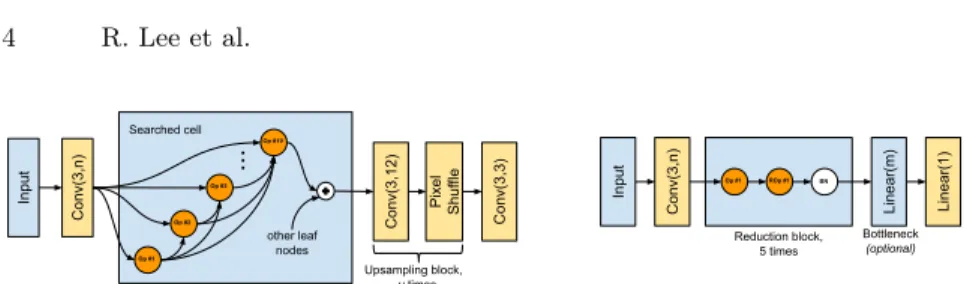
Searched cell Conv(3,n) ... Op #1 Op #2 Op #3 Op #10 Input Conv(3,12) Pixel Shuf fle Conv(3,3) Upsampling block, u times other leaf nodes
Conv(3,n) Linear(m) Linear(1)
Reduction block, 5 times Bottleneck (optional) Input Op #1 ROp #1 BN
Fig. 1. Structure and search space of the generator (left) and discriminator (right). Orange nodes represent operations which are selected by the controller from the set of available candidates. In the case of the generator, the controller additionally selects only one of the incoming edges as input for each node and, after connections are selected, all leaf nodes are added together to create the cell’s output. Linear(n) represents a linear layer withnoutput units. Operations in yellow blocks are fixed.
3
Searching for Tiny Perceptual SR
In the proposed scheme, we extend the original REINFORCE-based NAS frame-work [56] in order to search for a GAN-based super-resolution model. As a first step, we split the process into two stages. First, we search only for the best generator, using a selected distortion metric to assess different architectures. Next, we utilize the best found model and search for a matching discrimina-tor which would maximize the generadiscrimina-tor’s performance on a selected perceptual metric. Although the same backbone algorithm is used in both cases to conduct the search, the differences between distortion- and GAN-based training require us to approach the two stages with a dedicated methodology, addressing the respective challenges in critical design decisions, including defining the search space and generating reward signals.
We begin with a short introduction to REINFORCE and NAS in Section 3.1 and continue to discuss the details related to the specific use-case of percep-tual SR. The skeleton models for both the generator and the discriminator are shown in Figure 1 and the search methodology for both of them is presented in Sections 3.2 and 3.3 respectively, with a summary shown in Algorithm 1.
3.1 Searching Algorithm
We can formulate our NAS problem in a generic way as:
S=O1×O2× · · · ×On E:S→R s?= argmax s∈S E(s) (1)
whereS is asearch space constructed fromnindependentdecisions,Oi is a set
of availableoptionsfor thei-th decision, andEis a selectedevaluation function
which we aim to optimize.
Usually,Eis implemented as a sequence of steps: construct a model according to the selected options s, train and evaluate it, and return its performance. In
Algorithm 1:A summary of the proposed two-stage approach to searching for a perceptually-good compact SR model
Input:search space for the generatorSGand discriminatorSD, maximum number of steps
when searching for generatorTGand discriminatorTD, Mult-Adds limit for the
generatorf
Output:trained perceptual modelG•best
1 Functionsearch(S, T , E): 2 s∗←None 3 θ∼ N 4 fort←0toT do 5 st∼πθ,S 6 mt←E(st) 7 ifmt=Nonethen 8 go back to line 5 9 end 10 updates∗usingmt
11 θ←updateθusing∇θlogπθ,S(st)R(mt)
12 end
13 returns∗
14 End Function
15 FunctionEG(s):
16 G←construct model according tosand initialize its weights with the cached ones 17 fs←calc Mult-Adds required to runG
18 iffs> fthen
19 returnNone
20 end
21 m←train and evaluateGon the proxy distortion task 22 update cached weights according to Eq. 5
23 returnm
24 End Function
25 s∗G←search(SG, TG, EG)
26 Gbest←construct model usings∗G, initialize from cache, and train on the full dist. task
27 FunctionED(s):
28 D←construct discriminator according tos
29 returnperformance ofGon the proxy perc. task after fine-tuning usingD
30 End Function
31 s∗D ←search(SD, TD, ED)
32 Dbest←construct discriminator according tos∗D
33 G•best←fine-tuneGbestwithDbeston the full perceptual task
our case specifically,Erepresents a trained model’s performance on a validation set – see the following sections for the details about training and evaluation of different models. Because training takes an excessive amount of time and it is hard to predict the performance of a model without it, brute-forcing the optimization problem in Eq. (1) quickly becomes infeasible as the number of elements in S increases. Therefore, a standard approach is to limit the search process to at most T models (steps), where T is usually decided based on the available time and computational resources. Given a sequence ofT architectures explored during the search τ(T) = (s1, s2,· · ·, sT), we can approximate the
optimization problem in Eq. (1) with its equivalent over the values in τ(T):
s?≈s∗= argmax s∈τ(T)
We then use REINFORCE [50] to guide the search and ensure that, as T in-creases, sT optimizes E thus providing us with a better approximation. More
specifically, we include a probabilistic, trainable policyπθ (a controller) which,
at each search stept = 1,2,· · ·, T, is first sampled in order to obtain a candi-date structure stand then updated usingE(st). We use the following standard formulation to optimize this policy:
J(θ) =Es∼πθR(E(s)) θt+1=θt+β∇θtJ(θt) ∇θtJ(θt)≈ ∇θtlogπθt(st)R(E(st)) argmax θ J(θ)≈θT (3)
where R:R→Ris areward function used to make values ofE more suitable for the learning process (e.g.via normalization), andβ is a learning rate. Please refer to the supplementary material for further details.
3.2 Generator Search
When searching for the generator architecture, we adopt the micro-cell approach. Under this formulation, we focus the search on finding the best architecture of a single cell which is later placed within a fixed template to form a full model. In conventional works, the full model is constructed by stacking the found cell multiple times, forming in this way a deep architecture. In our case, since we aim to find highly compact models, we defined the full-model architecture to contain a single, relatively powerful cell. Furthermore, the single cell is instantiated by selecting 10 operations from the set of available candidates,Op, to assign to 10 nodes within the cell. The connectivity of each node is determined by configuring the input to its operation, selecting either the cell’s input or the output of any previous node. Thus, our generator search space (Figure 1 (left)) is defined as:
SG =Scell=Op×Z1× · · · ×Op×Z10
| {z }
20elements
(4) where Zm ={1,2,· · ·, m} is a set of indices representing possible inputs to a
node. We consider the following operations when searching for the generator:
Op={Conv(k, n)withk= 1,3,5,7;Conv(k, n,4), DSep(k, n), andInvBlock(k, n,2)withk= 3,5,7;
SEBlock(),CABlock(),Identity}
whereConv(k, n, g=1, s=1)is a convolution with kernelk×k,noutput channels,
ggroups and strides;DSep(k, n)is depthwise-separable convolution [18];SEBlock
is Squeeze-and-Excitation block [19];CABlockis channel attention block [53]; and
InvBlock(k, n, e)is inverted bottleneck block [41] with kernel sizek×k,noutput channels and expansion ofe. In the case where a cell constructed from a point in
the search space has more than one node which is not used as input to any other node (i.e.a leaf node), we add their outputs together and use the sum as the cell’s output. Otherwise, the output of the last node is set as the cell’s output.
We use weight sharing similar to [37]. That is, for each search stept, after evaluating an architecture st ∈ SG we save trained weights and use them to
initialize the weights when training a model at step t+ 1. Because different operations will most likely require weights of different shape, for each node i
we keep track of the best weights so far for each operation from the set Op
independently. Let s(i) be the operation assigned to the i-th node according to the cell structure s. Further, let Po,i,t be the set of architectures explored
until stept(inclusive) in whichowas assigned to thei-th node, that is:Po,i,t= {s|s∈τ(t)∧s(i) =o}. Finally, letθi,o,trepresent weights in the cache, at the
beginning of stept, for an operationowhen assigned to thei-th node, andθi,o,tˆ
represent the same weights after evaluation ofst(which includes training). Note
that θo,i,tˆ =θo,i,tifst(i)6=oas the weights are not subject to training. We can
then formally define our weight sharing strategy as:
θo,i,0∼ N θo,i,t+1= ˆ
θo,i,t ifst(i) =oand
E(st)>maxsp∈Po,i,t−1E(sp)
θo,i,t otherwise
(5)
As SR models require at least one order of magnitude more compute than classi-fication tasks, we employ a variety of techniques to speed up the training process when evaluating different architectures and effectively explore a larger number of candidate architectures. First, similar to previous works [57], we use lower fidelity estimates, such as fewer epochs with higher batch sizes, instead of performing full training until convergence which can be prohibitively time consuming. Moreover, we use smaller training patch sizes as previous studies [48] have shown that the performance of the model scales according to its training patch size, preserving in this manner the relative ranking of different architectures. Lastly, we leverage the small compute and memory usage of the models in our search space and dy-namically assign multiple models to be trained on each GPU. We also constrain the number of Mult-Adds and discard all proposed architectures which exceed the limit before the training stage, guaranteeing the generation of small models while, indirectly, speeding up their evaluation.
After the search has finished, we take the best found design point s∗ and train it on the full task to obtain the final distortion-based generatorG, before proceeding to the next stage. When performing the final training, we initialize the weights with values from the cacheθo,i,T, as we empirically observed that it
helps the generator converge to better minima. Both the proxy and full task aim to optimize the fidelity of the upsampled image and are, thus, validated using PSNR and trained on the training setTˆusing the L1 loss, defined as:
L1= 1 |Tˆ| X (ILR,IHR)∈Tˆ |G(ILR)−IHR| (6)
withILR the low-resolution image andIHR the high-resolution ground-truth.
3.3 Discriminator Search
After we find the distortion-based generator model G, we proceed to search for a matching discriminator D that will be used to optimize the generator towards perceptually-good solutions. The internal structure of our discriminator consists of 5 reduction blocks. Each reduction block comprises a sequence of two operations followed by a batch normalization [23] – the first operation is selected from the set of candidate operations Opwhich is the same as for the generator search; the second one is a reduction operation and its goal is to reduce the spatial dimensions along the x- and y-axes by a factor of 2 while increasing the number of channels by the same factor. To only choose reduction operations from the set of operations derived fromOp, we only consider standard convolutions with the same hyperparameters as inOp, but with stride changed to 2 and increased number of output channels:
ROp={Conv(k,2n,1,2)withk= 1,3,5,7and
Conv(k,2n,4,2)withk= 3,5,7}
As a result, the search space for the discriminator can be defined as:
SD=Op×ROp× · · · ×Op×ROp
| {z }
10elements
(7)
After the 5 reduction blocks, the extracted features are flattened to a 1-D vector and passed to a final linear layer (preceded by an optional bottleneck with m
outputs), producing a single output which is then used to discriminate between the generated upsampled image, G(ILR) and the ground truth, IHR. Figure 1 (right) shows the overall structure of the discriminator architecture.
To optimize for perceptual quality (Eq. (8)), we use the perceptual loss [24],
Lvgg, and adversarial loss [15], Ladv, on both the proxy and full task. The discriminator is trained on the standard loss, LD. As observed by previous
works [48,39,7], optimizing solely for perceptual quality may lead to undesir-able artifacts. Hence, similar to Wang et al. [48], we incorporate L1 into the
generator loss,LG. Additionally, we validate the training using a full-reference
perceptual metric, Learned Perceptual Image Patch Similarity [52] (LPIPS), as we find no-reference metrics such as NIQE to be more unstable since they do not take into account the ground truth. Our generator loss and discriminator loss are as follows:
Lvgg = 1 |Tˆ| X (ILR,IHR)∈Tˆ (φ(G(ILR))−φ(IHR))2 Ladv=−log(D(G(ILR)) LG=αL1+λLvgg+γLadv
LD=−log(D(IHR))−log(1−D(G(ILR)))
(8)
Unlike the generator search we do not use weight sharing when searching for the discriminator. The reason behind this is that we do not want the discriminator to be too good at the beginning of training to avoid a potential situation where the generator is unable to learn anything because of the disproportion between its own and a discriminator’s performance. Similar to the generator search stage, we used a lower patch size, fewer epochs, and a bigger batch size to speed up the training. Additionally, from empirical observations in previous works [24,27], the perceptual quality of the upsampled image scales accordingly with the depth of the network layer used. Therefore, we use an earlier layer of the pre-trained VGG network (φ) as a fidelity estimate to save additional computations. In contrast to the generator search, we do not impose a Mult-Adds limit to the discriminator as its computational cost is a secondary objective for us, since it does not affect the inference latency upon deployment.
After the search finishes, we collect a set of promising discriminator archi-tectures and use them to train the generator on the full task. At the beginning of training, we initialize the generator with the pre-trained model found in the first stage (Section 3.2) to reduce artifacts and produce better visual results.
4
Evaluation
In this section, we present the effectiveness of the proposed methodology. For all experiments, the target models were trained and validated on the DIV2K [45] dataset and tested on the commonly-used SR benchmarks, namely Set5 [3], Set14 [51], B100 [31], and Urban100 [20]. For distortion (PSNR/Structural Sim-ilarity index (SSIM) [49]) and perceptual metrics (Natural Image Quality Eval-uator [34] (NIQE)/Perceptual Index [4] (PI)), we shaved the upsampled image by its scaling factor before evaluation. For LPIPS, we passed the whole upsam-pled image and evaluated it on version 0.1 with linear calibration on top of intermediate features in the VGG [43] network4. For the exhaustive list of all hyperparameters and system details, please refer to the supplementary material.
4.1 TPSR Generator
Following Algorithm 1, we began by running the first search stage for the gener-ator architecture to obtain a distortion-driven tiny SR model. During the search,
4
C o n v 7 x7 Sep ara bl e C o n v 5 x5
+
C el l In pu t C on v 7 x7 C on v 3 x3 C o n v 3 x3 C on v 5 x5 C o n v 5 x5 Se p ar a b le C on v 3 x3 C o n v 3 x3 C o n v 7 x7Fig. 2.Discovered cell architecture for the TPSR generator. Each operation is followed by a PReLU [16] activation.
we trained candidate models to perform×2upscaling (i.e.with one upsampling block) and we set the number of feature maps (n) to 16. Each model was eval-uated using PSNR as the target metric and the final reward for the controller was calculated by normalizing the average PSNR of a model.
To obtain the final generator model, we run the generator search for 2,500 steps and stored the highest-performing cell architecture as evaluated on the proxy task. Figure 2 illustrates the obtained cell structure. We refer to this model as TPSR (Tiny Perceptual Super Resolution). For the rest of this section, we use the notation TPSR-X to refer to TPSR when trained with discriminator
X and TPSR-NOGAN when TPSR is distortion-driven.
After the end of the first search stage, we trained the discovered TPSR model on the full task for×2 upscaling and×4 upscaling, starting from the pre-trained
×2 model, to obtain TPSR-NOGAN. Our NAS-based methodology was able to yield the most efficient architecture of only 3.6G Mult-Adds on×4 upscaling with performance that is comparable with the existing state-of-the-art distortion-driven models that lie within the same computational regime. Given that our goal was to build a perceptual-based model, we did not optimize our base model further, considering it to be a good basis for the subsequent search for a discrim-inator. The distortion-based results can be found in the supplementary material.
4.2 Discriminator Analysis
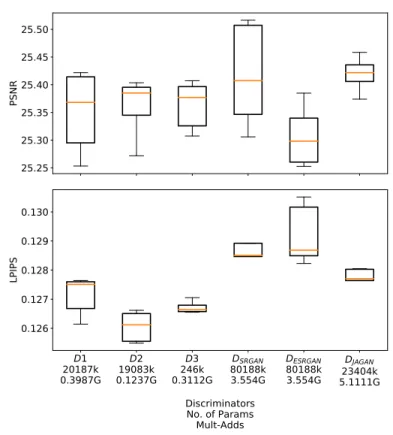
To obtain a discriminator architecture, we utilized the TPSR-NOGAN variant trained on the ×4 upscaling task and searched for a suitable discriminator to minimize the perceptual LPIPS metric. To minimize the instability of the per-ceptual metric, we evaluated each model by considering the last three epochs and returning the best as the reward for the controller. We also incorporated spectral normalization [35] for the discriminator on both the proxy and the full task. We have found that discriminators of varying size and compute can lead to percep-tually similar results (LPIPS). Upon further examinations, we have also found that these upsampled images look perceptually sharper than TPSR-NOGAN’s.
25.25 25.30 25.35 25.40 25.45 25.50 PSNR D1 20187k 0.3987G D2 19083k 0.1237G D3 246k 0.3112G DSRGAN 80188k 3.554G DESRGAN 80188k 3.554G DJAGAN 23404k 5.1111G Discriminators No. of Params Mult-Adds 0.126 0.127 0.128 0.129 0.130 LPIPS
Fig. 3. Performance of TPSR after adversarial training using different discrimina-tors found via NAS (D1, D2, D3) vs. existing discriminadiscrimina-tors designed for (SRGAN, ESRGAN, JAGAN). TPSR trained on searched discriminators, which are optimized for LPIPS, outperform fixed discriminators in the literature for the targeted metric (LPIPS). Each GAN training was performed 5 times
In order to evaluate the fidelity of the proxy task, we took the three best per-forming discriminator candidates based on their performance on the proxy task. We then evaluated our TPSR model when trained with these discriminators on the full task. To compare to models from the literature, we also considered the discriminators that were used in SRGAN [27], ESRGAN [48], and the recently proposed Joint-Attention GAN [7] (JAGAN). Note that the discriminator’s ar-chitecture in SRGAN and ESRGAN is the same but the latter is trained using the relativistic GAN (RGAN) loss [25]. For more details on how RGAN is adopted for SR, please refer to Wanget al.[48].
Each GAN training was performed 5 times and the best performing model, based on the achieved LPIPS on the validation set, was evaluated on the test benchmarks. Specifically, we took the weighted average (based on the number of images) over the test benchmarks of three metrics: PSNR, NIQE, and LPIPS, and present our findings in Figure 3. Our chosen discriminators (TPSR-D1,
Table 1.We compare our×4 upscaling TPSR models, which are optimized for LPIPS, with perceptual-driven models in the literature. Higher is better for PSNR and lower is better for LPIPS and PI.red/bluerepresentsbest/second bestrespectively. On the optimization target metric, LPIPS, our model (TPSR-D2) achieves the second best result while it is the smallest among all. Our model outperforms EnhanceNet and SRGAN in visual quality metrics (PSNR & LPIPS) while being 26.4×more memory efficient and 33.6×more compute efficient than SRGAN and EnhanceNet, respectively
Model Params (K) Mult-Adds (G) Set5 PSNR/LPIPS/PI Set14 PSNR/LPIPS/PI B100 PSNR/LPIPS/PI Urban100 PSNR/LPIPS/PI ESRGAN 16,697 1034.1 30.40/0.0745/3.755 26.17/0.1074/2.926 25.34/0.1083/2.478 24.36/0.1082/3.770 SRGAN 1,513 113.2 29.40/0.0878/3.355 26.05/0.1168/2.881 25.19/0.1224/2.351 23.67/0.1653/3.323 EnhanceNet 852 121.0 28.51/0.1039/2.926 25.68/0.1305/3.017 24.95/0.1291/2.907 23.55/0.1513/3.471 FEQE 96 5.6431.29/0.0912/5.935 27.98/0.1429/5.400 27.25/0.1455/5.636 25.26/0.1503/5.499 TPSR-D2 61 3.6 29.60/0.076/4.454 26.88/0.110/4.055 26.23/0.116/3.680 24.12/0.141/4.516
TPSR-D2, TPSR-D3) have led to better results as compared to the existing dis-criminators (TPSR-DSRGAN, TPSR-DESRGAN, TPSR-DJ AGAN) in the
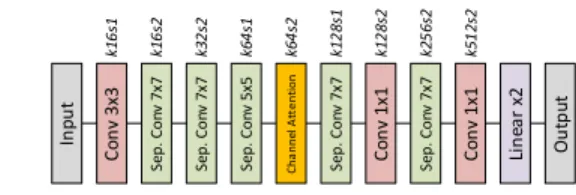
partic-ular perceptual metric (LPIPS) that they were optimized for. The discriminator of TPSR-D2 can be found in Figure 5.
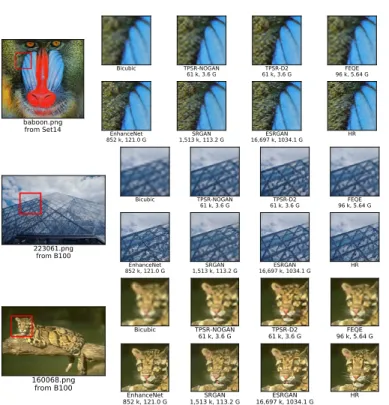
Finally, we compared the best performing GAN-based generator (TPSR-D2) on common full-reference and no-reference perceptual metrics with various well-known perceptual models (Table 1). Considering our optimized metric, our model outperforms SRGAN and EnhanceNet while being up to 26.4× more memory efficient when compared to EnhanceNet and 33.6×more compute efficient com-pared to SRGAN. Additionally, our model also achieves higher performance in distortion metrics, indicating higher image fidelity and, therefore, constitutes a dominant solution for full-reference metrics (PSNR & LPIPS) especially with our tiny computational budget. Visual comparisons can be found in Figure 4.
5
Limitations and Discussion
In this paper, we have presented a NAS-driven framework for generating GAN-based SR models that combine high perceptual quality with limited resource re-quirements. Despite introducing the unique challenges of our target problem and showcasing the effectiveness of the proposed approach by finding high-performing tiny perceptual SR models, we are still faced with a few open challenges.
The usefulness of NAS approaches which utilize a proxy task to obtain feed-back on candidate architectures naturally depends on the faithfulness of the proxy task with regards to the full task. As GANs are known to be unstable and hard to train [40], providing the search with a representative proxy task is even more challenging for them than for other workloads. We were able to par-tially mitigate this instability by smoothing out accuracy of a trained network, as mentioned in Section 4.2. Nevertheless, we still observed that the informative-ness of results obtained on the proxy task for GAN-training is visibly worse than
baboon.png from Set14 Bicubic TPSR-NOGAN 61 k, 3.6 G 61 k, 3.6 GTPSR-D2 96 k, 5.64 GFEQE EnhanceNet 852 k, 121.0 G 1,513 k, 113.2 GSRGAN 16,697 k, 1034.1 GESRGAN HR 223061.png from B100 Bicubic TPSR-NOGAN 61 k, 3.6 G 61 k, 3.6 GTPSR-D2 96 k, 5.64 GFEQE EnhanceNet 852 k, 121.0 G 1,513 k, 113.2 GSRGAN 16,697 k, 1034.1 GESRGAN HR 160068.png from B100 Bicubic TPSR-NOGAN 61 k, 3.6 G 61 k, 3.6 GTPSR-D2 96 k, 5.64 GFEQE EnhanceNet 852 k, 121.0 G 1,513 k, 113.2 GSRGAN 16,697 k, 1034.1 GESRGAN HR
Fig. 4.Visual comparisons among SoTA perceptual-driven networks and TPSR mod-els, with their no. of parameters (left) and mult-add operations (right). Despite the quantitative results that show that TPSR-D2 is better than eg. SRGAN (Table. 1), the qualitative results are arguably worse-off in some images, highlighting a limitation and the need for a better perceptual metric. However, TPSR-D2 still produces better reconstructions than FEQE - the current SoTA for constrained perceptual models.
of our method. This instability is reinforced even more when using no-reference perceptual metrics such as NIQE [34] and PI [4] - in which case we observed that training a single model multiple times on our proxy task can result in a set of final accuracies with variance close to the variance of all accuracies of all models explored during the search - rendering it close to useless in the context of search-ing. In this respect, we adopted LPIPS which, being a full-reference metric, was able to provide the search with a more robust evaluation of proposed architec-tures. While the strategies we used to improve the stability of the search were adequate for us to obtain decent-performing models, the challenge still remains open and we strongly suspect that overcoming it would be a main step towards improving the quality of NAS with GAN-based perceptual training.
Another important challenge comprises the selection of a metric that ade-quately captures perceptual quality. Identifying a metric that closely aligns with human-opinion scores across a wide range of images still constitutes an open research problem with significant invested research effort [36,34,52,4]. In this respect, although we show that optimizing for LPIPS on the average leads to
Se p . Co nv 7 x7 In p u t C o n v 3 x3 Se p . Co nv 5 x5 Se p . Co nv 7 x7 Se p . Co nv 7 x7 C o n v 1 x1 Se p . Co nv 7 x7 C o n v 1 x1 Li n ea r x2 C h a n n el A tt e n ti o n k16 s1 k16 s2 k32 s2 k64 s1 k64 s2 k1 2 8s 1 k1 2 8s 2 k2 5 6s 2 k5 1 2s 2 O u tp u t
Fig. 5. Discovered architecture of the TPSR discriminator (D2). Convolutions are followed by batch normalization and PReLU. k = output tensor depth, s = stride
better quantitative results, the inherent limitations of the metric itself might not result to qualitatively better results on certain images.
With our work targeting highly compact models optimized for perceptual quality, it is currently challenging to find appropriate baselines that lie within the same computational and memory footprint regime, as FEQE [47] is, to the best of our knowledge, the only perceptual SR model that meets these specifications. As a result, in this paper, we also present comparisons with significantly larger models, including SRGAN and EnhanceNet, which our method outperforms in our optimized metric. We also compare with ESRGAN which is more than an order of magnitude more expensive than all examined models. Although our design did not outperform ESRGAN, we could extend our method to explore relaxed constraints to allow a slightly larger generator and employ a relativistic discriminator [25]. As our focus is on pushing the limits of building a constrained and perceptual SR model that can be deployed in a mobile SR framework [28], we leave the trade-off between model size and perceptual quality as future work. Lastly, our method resulted in discriminators that are slightly better than existing discriminators in terms of perceptual performance. Nevertheless, even though the performance gains on LPIPS are marginal, our resulted discrimina-tors are orders of magnitude smaller in terms of model size and computational cost and the obtained gains are consistently better across multiple runs.
6
Conclusion
In this paper, we investigated the role of the discriminator in GAN-based SR and the limits to which we can push perceptual quality when targeting extremely constrained deployment scenarios. In this context, we adopted the use of NAS to extensively explore a wide range of discriminators, making the following key observations on NAS for GAN-based SR: 1) Discriminators of drastically vary-ing sizes and compute can lead to similar perceptually good images; possible solutions for the ill-posed super-resolution problem. 2) Due to this phenomenon and the high variance in the results of popular perceptual metrics, designing a faithful proxy task for NAS is extremely challenging. Nevertheless, we are able to find discriminators that are consistently better than existing discriminators on our chosen metric, generating a tiny perceptual model that outperforms the state-of-the-art SRGAN and EnhanceNet in both full-reference perceptual and distortion metrics with substantially lower memory and compute requirements.
References
1. Ahn, N., Kang, B., Sohn, K.A.: Fast, Accurate, and Lightweight Super-Resolution with Cascading Residual Network. In: ECCV (2018)
2. Bahdanau, D., Cho, K., Bengio, Y.: Neural machine translation by jointly learning to align and translate (2015)
3. Bevilacqua, M., Roumy, A., Guillemot, C., line Alberi Morel, M.: Low-Complexity Single-Image Super-Resolution based on Nonnegative Neighbor Embedding. In: British Machine Vision Conference (BMVC) (2012)
4. Blau, Y., Mechrez, R., Timofte, R., Michaeli, T., Zelnik-Manor, L.: The 2018 PIRM Challenge on Perceptual Image Super-Resolution. In: ECCV Workshops (2018) 5. Blau, Y., Michaeli, T.: The Perception-Distortion Tradeoff. In: IEEE Conference
on Computer Vision and Pattern Recognition (CVPR) (2018)
6. Chang, H., Yeung, D.Y., Xiong, Y.: Super-resolution through neighbor embedding. In: Proceedings of the 2004 IEEE Computer Society Conference on Computer Vision and Pattern Recognition (CVPR) (2004)
7. Chen, R., Xie, Y., Luo, X., Qu, Y., Li, C.: Joint-attention discriminator for ac-curate super-resolution via adversarial training. In: Proceedings of the 27th ACM International Conference on Multimedia (ACM MM). pp. 711–719 (2019) 8. Chu, X., Zhang, B., Ma, H., Xu, R., Li, J., Li, Q.: Fast, accurate and lightweight
super-resolution with neural architecture search. ArXiv abs/1901.07261(2019) 9. Chu, X., Zhang, B., Xu, R., Ma, H.: Multi-objective reinforced evolution in mobile
neural architecture search. ArXivabs/1901.01074(2019)
10. Dong, C., Loy, C.C., He, K., Tang, X.: Image super-resolution using deep convolu-tional networks. IEEE Transactions on Pattern Analysis and Machine Intelligence
38, 295–307 (2016)
11. Dong, C., Loy, C.C., Tang, X.: Accelerating the Super-Resolution Convolutional Neural Network. In: ECCV (2016)
12. ÅĄukasz Dudziak, Abdelfattah, M.S., Vipperla, R., Laskaridis, S., Lane, N.D.: ShrinkML: End-to-End ASR Model Compression Using Rein-forcement Learning. In: Proc. Interspeech 2019. pp. 2235–2239 (2019). https://doi.org/10.21437/Interspeech.2019-2811, http://dx.doi.org/10.21437/ Interspeech.2019-2811
13. Elsken, T., Metzen, J.H., Hutter, F.: Neural architecture search: A survey. J. Mach. Learn. Res.20, 55:1–55:21 (2018)
14. Gong, X., Chang, S., Jiang, Y., Wang, Z.: Autogan: Neural architecture search for generative adversarial networks. In: The IEEE International Conference on Computer Vision (ICCV) (Oct 2019)
15. Goodfellow, I., et al.: Generative Adversarial Nets. In: Advances in Neural Pro-cessing Systems (2014)
16. He, K., Zhang, X., Ren, S., Sun, J.: Delving deep into rectifiers: Surpassing human-level performance on imagenet classification. 2015 IEEE International Conference on Computer Vision (ICCV) pp. 1026–1034 (2015)
17. He, K., Zhang, X., Ren, S., Sun, J.: Deep Residual Learning for Image Recognition. pp. 770–778 (2016)
18. Howard, A.G., Zhu, M., Chen, B., Kalenichenko, D., Wang, W., Weyand, T., An-dreetto, M., Adam, H.: MobileNets: Efficient Convolutional Neural Networks for Mobile Vision Applications. ArXivabs/1704.04861(2017)
19. Hu, J., Shen, L., Sun, G.: Squeeze-and-excitation networks. 2018 IEEE/CVF Con-ference on Computer Vision and Pattern Recognition pp. 7132–7141 (2017)
20. Huang, J., Singh, A., Ahuja, N.: Single image super-resolution from transformed self-exemplars. In: IEEE Conference on Computer Vision and Pattern Recognition (CVPR) (2015)
21. Hui, Z., Gao, X., Yang, Y., Wang, X.: Lightweight image super-resolution with information multi-distillation network. In: Proceedings of the 27th ACM Interna-tional Conference on Multimedia (ACM MM). pp. 2024–2032 (2019)
22. Hui, Z., Wang, X., Gao, X.: Fast and accurate single image super-resolution via information distillation network. In: CVPR. pp. 723–731 (2018)
23. Ioffe, S., Szegedy, C.: Batch normalization: Accelerating deep network training by reducing internal covariate shift. ArXivabs/1502.03167(2015)
24. Johnson, J., Alahi, A., Fei-Fei, L.: Perceptual losses for real-time style transfer and super-resolution. In: ECCV (2016)
25. Jolicoeur-Martineau, A.: The relativistic discriminator: a key element missing from standard gan (2018)
26. Kim, K.I., Kwon, Y.: Single-Image Super-Resolution Using Sparse Regression and Natural Image Prior. IEEE Transactions on Pattern Analysis and Machine Intel-ligence (TPAMI)32, 1127–1133 (2010)
27. Ledig, C., et al.: Photo-Realistic Single Image Super-Resolution Using a Gener-ative Adversarial Network. IEEE Conference on Computer Vision and Pattern Recognition (CVPR) (2017)
28. Lee, R., Venieris, S.I., Dudziak, L., Bhattacharya, S., Lane, N.D.: MobiSR: Effi-cient On-Device Super-Resolution Through Heterogeneous Mobile Processors. In: The 25th Annual International Conference on Mobile Computing and Networking. MobiCom ’19 (2019),http://doi.acm.org/10.1145/3300061.3345455
29. Lim, B., Son, S., Kim, H., Nah, S., Lee, K.M.: Enhanced Deep Residual Networks for Single Image Super-Resolution. In: IEEE Conference on Computer Vision and Pattern Recognition (CVPR) Workshops (2017)
30. Ma, N., Zhang, X., Zheng, H.T., Sun, J.: ShuffleNet V2: Practical Guidelines for Efficient CNN Architecture Design. In: The European Conference on Computer Vision (ECCV) (2018)
31. Martin, D., Fowlkes, C., Tal, D., Malik, J.: A database of human segmented natu-ral images and its application to evaluating segmentation algorithms and measur-ing ecological statistics. In: IEEE International Conference on Computer Vision (ICCV) (2001)
32. Mechrez, R., Talmi, I., Shama, F., Zelnik-Manor, L.: Learning to maintain nat-ural image statistics, [arxiv](https://arxiv.org/abs/1803.04626). arXiv preprint arXiv:1803.04626 (2018)
33. Mittal, A., Moorthy, A.K., Bovik, A.C.: No-Reference Image Quality Assessment in the Spatial Domain. IEEE Transactions on Image Processing 21, 4695–4708 (2012)
34. Mittal, A., Soundararajan, R., Bovik, A.C.: Making a “Completely Blind" Image Quality Analyzer. IEEE Signal Processing Letters20, 209–212 (2013)
35. Miyato, T., Kataoka, T., Koyama, M., Yoshida, Y.: Spectral Normalization for Generative Adversarial Networks. ArXivabs/1802.05957(2018)
36. Moorthy, A.K., Bovik, A.C.: Blind image quality assessment: From natural scene statistics to perceptual quality. IEEE Transactions on Image Processing20, 3350– 3364 (2011)
37. Pham, H.Q., Guan, M.Y., Zoph, B., Le, Q.V., Dean, J.: Efficient neural architecture search via parameter sharing. In: International Conference on Machine Learning (2018)
38. Real, E., Aggarwal, A., Huang, Y., Le, Q.V.: Regularized evolution for image clas-sifier architecture search. CoRRabs/1802.01548(2018)
39. Sajjadi, M.S.M., Schölkopf, B., Hirsch, M.: Enhancenet: Single image super-resolution through automated texture synthesis. 2017 IEEE International Con-ference on Computer Vision (ICCV) pp. 4501–4510 (2016)
40. Salimans, T., Goodfellow, I., Zaremba, W., Cheung, V., Radford, A., Chen, X., Chen, X.: Improved Techniques for Training GANs. In: Advances in Neural Infor-mation Processing Systems (NeurIPS). pp. 2234–2242 (2016)
41. Sandler, M., Howard, A., Zhu, M., Zhmoginov, A., Chen, L.C.: MobileNetV2: In-verted Residuals and Linear Bottlenecks. In: IEEE Conference on Computer Vision and Pattern Recognition (CVPR) (2018)
42. Shi, W., Caballero, J., Huszár, F., Totz, J., Aitken, A.P., Bishop, R., Rueckert, D., Wang, Z.: Real-time single image and video super-resolution using an efficient sub-pixel convolutional neural network. 2016 IEEE Conference on Computer Vision and Pattern Recognition (CVPR) pp. 1874–1883 (2016)
43. Simonyan, K., Zisserman, A.: Very deep convolutional networks for large-scale im-age recognition. In: International Conference on Learning Representations (2015) 44. Song, D., Xu, C., Jia, X., Chen, Y., Xu, C., Wang, Y.: Efficient residual dense
block search for image super-resolution. In: Thirty-Fourth AAAI Conference on Artifical Intelligence (2020)
45. Timofte, R., et al.: NTIRE 2017 Challenge on Single Image Super-Resolution: Methods and Results. In: IEEE Conference on Computer Vision and Pattern Recognition Workshops (CVPRW) (2017)
46. Tong, T., Li, G., Liu, X., Gao, Q.: Image Super-Resolution Using Dense Skip Con-nections. In: IEEE International Conference on Computer Vision (ICCV) (2017) 47. Vu, T., Van Nguyen, C., Pham, T.X., Luu, T.M., Yoo, C.D.: Fast and Efficient
Image Quality Enhancement via Desubpixel Convolutional Neural Networks. In: The European Conference on Computer Vision (ECCV) Workshops (September 2018)
48. Wang, X., Yu, K., Wu, S., Gu, J., Liu, Y., Dong, C., Loy, C.C., Qiao, Y., Tang, X.: ESRGAN: Enhanced Super-Resolution Generative Adversarial Networks. In: ECCV Workshops (2018)
49. Wang, Z., Bovik, A.C., Sheikh, H.R., Simoncelli, E.P.: Image quality assessment: from error visibility to structural similarity. IEEE Transactions on Image Process-ing 13, 600–612 (2004)
50. Williams, R.J.: Simple statistical gradient-following algorithms for connectionist reinforcement learning. Machine Learning8, 229–256 (1992)
51. Yang, J., Wright, J., Huang, T.S., Ma, Y.: Image Super-resolution via Sparse Rep-resentation. Trans. Img. Proc.19(11), 2861–2873 (2010)
52. Zhang, R., Isola, P., Efros, A.A., Shechtman, E., Wang, O.: The unreasonable effec-tiveness of deep features as a perceptual metric. In: IEEE Conference on Computer Vision and Pattern Recognition (CVPR) (2018)
53. Zhang, Y., Li, K., Li, K., Wang, L., Zhong, B., Fu, Y.: Image Super-Resolution Using Very Deep Residual Channel Attention Networks. In: European Conference on Computer Vision (ECCV) (2018)
54. Zhang, Y., Tian, Y., Kong, Y., Zhong, B., Fu, Y.: Residual Dense Network for Im-age Super-Resolution. In: The IEEE Conference on Computer Vision and Pattern Recognition (CVPR) (2018)
55. Zhong, Z., Yan, J., Wu, W., Shao, J., Liu, C.L.: Practical block-wise neural net-work architecture generation. 2018 IEEE/CVF Conference on Computer Vision and Pattern Recognition pp. 2423–2432 (2018)
56. Zoph, B., Le, Q.V.: Neural architecture search with reinforcement learning. In: In-ternational Conference on Learning Representations (2017),https://openreview. net/forum?id=r1Ue8Hcxg
57. Zoph, B., Vasudevan, V., Shlens, J., Le, Q.V.: Learning transferable architectures for scalable image recognition. 2018 IEEE/CVF Conference on Computer Vision and Pattern Recognition pp. 8697–8710 (2018)
Experiment Details
Neural Architecture Search:Similar to previous approaches, we use a sin-gle LSTM layer with 100 hidden units as the trainable policy, πθ. It takes an empty embedding as input and generates a sequence ofloutputs, wherelis the number of decisions to make in order to decide about a generator’s structure. Each element of the sequence at position i is then passed through the follow-ing composition of functions, includfollow-ing a tanh constant of 2.5 and a sampling logit temperature of 5.0, in order to reduce its dimensionality and produce a probability distribution:
softmax◦2.5·tanh◦0.2·linear◦li (9)
Each search is ran on five servers, totalling to 40 NVIDIA GeForce GTX 1080 Ti, and each GPU can fit up to three models which are trained in parallel depending on the sampled model’s memory usage at each step. Our generator search took 2 days and our discriminator search took 10 days due to the mem-ory requirement needed for the pre-trained generator, sampled discriminator, and two VGG networks to computeLvgg and LPIPS respectively in each train-ing pipeline. Due to the huge resource needed to run discriminator search, we limit the number of mult-add operations and run a constrained search for a generator, as mentioned in the paper. The performance of our generator for the discriminator search is listed in Table 2.
Table 2.Our TPSR-NOGAN modelserves as a good basisfor the ×4 upscaling
discriminator search as it is the most computationally efficient and has performance that is comparable with other distortion-driven models in the literature within the same computational regime. Given that our goal is to build aperceptual-basedmodel, we do not optimize our base model further. Higher is better for distortion metrics.red/blue
representsbest/second bestrespectively
Scale Model Params(K) Mult-Adds(G) PSNR/SSIMSet5 PSNR/SSIMSet14 PSNR/SSIMB100 PSNR/SSIMUrban100 FSRCNN [11] 12 6.0 37.00/0.9558 32.63/0.9088 31.53/0.8920 29.88/0.9020 ×2 MOREMNAS-C [9] 25 5.5 37.06/0.9561 32.75/0.9094 31.50/0.8904 29.92/0.9023 TPSR-NOGAN 60 14.0 37.38/0.9583 33.00/0.9123 31.75/0.8942 30.61/0.9119 FSRCNN [11] 12 4.6 30.71/0.8657 27.59/0.7535 26.98/0.7150 24.62/0.7280 ×4 FEQE-P [47] 96 5.6 31.53/0.8824 28.21/0.7714 27.32/0.7273 25.32/0.7583 TPSR-NOGAN 61 3.6 31.10/0.8779 27.95/0.7663 27.15/0.7214 24.97/0.7456
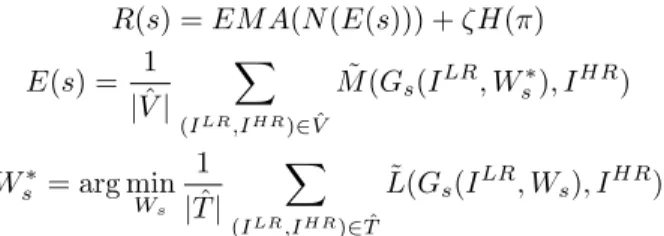
Each training pipeline is run by a separate process/worker and each worker asynchronously samples the probability distribution (Eq (9)), trains the result-ing model, and returns the result (PSNR for generator search and LPIPS for discriminator search) from the validation set, Vˆ, of the proxy task. The result would then be normalized using a minmax normalization, N, to scale it from
0 to 1 with a exponential moving average baseline, EM A, (decay of 0.95) to obtain the reward. We then add the sampled entropy, H, (ζ = 0.0001) to the
reward and use it to update πθ via REINFORCE using an Adam optimizer
(β1= 0.9, β2= 0.999, = 10−8) with learning rate of3.5e−4. The training
pro-cess is detailed in Eq. 10 where M˜ is the metric of choice (PSNR, LPIPS, etc), and L˜ is the training loss (LG and LD for generator and discriminator search respectively). R(s) =EM A(N(E(s))) +ζH(π) E(s) = 1 |Vˆ| X (ILR,IHR)∈Vˆ ˜ M(Gs(ILR, Ws∗), IHR) Ws∗= arg min Ws 1 |Tˆ| X (ILR,IHR)∈Tˆ ˜ L(Gs(ILR, Ws), IHR) (10)
Super-resolution:The set of hyper-parameters chosen for both the proxy task and the full task is summarized in Table 3.
Table 3. Hyper-parameters for the searching (proxy-task) and training (full-task) of the generator and discriminator. The generator search is done on×2 upscaling and the discriminator is done on×4 upscaling. We use the features before activations in the pre-trained VGG19 network provided by PyTorch to computeLvgg. Each input patch
is an RGB image. We used the same model in both proxy and full task to closely align the performance between both tasks. For speed ups during the search, we use lower fidelity estimates, lower patch size etc, that have been shown in previous works such as ESRGAN to preserve the ranking of the model.
Search Hyper-parameter Proxy-task Full-task
Generator Epochs 50 450
Batch size 64 16
Input patch size 12×12 96×96
LG(α) 1 1
Discriminator Epochs 50 450
Batch size 32 16
Input patch size 24×24 48×48
VGG19 Features 22 54
LG(α,λ,γ) (0.01,1,0.005) (0.01,1,0.005)
For all experiments, we use 800 images for training and 100 images for val-idation from the DIV2K dataset. We train for the stated number of epochs in Table 3 using an Adam optimizer (β1= 0.9, β2= 0.999, = 10−8) with learning
rate of 1e−4 at the beginning and 5e−5 after 200 epochs for the full task. All training patches are randomly flipped, both horizontally and vertically, ro-tated 90◦, and subtracted by the mean RGB values of the DIV2K dataset. All operations in the generator is followed by a PReLU and all operations in the discriminator is followed by batch normalization and PReLU.
Finally, all experiments are built on top of EDSR’s [29] code base5 using PyTorch 1.2. PSNR and SSIM [49] were evaluated on each image’s Y-channel and NIQE [34] and PI [4] were evaluated using the official code for the PIRM 2018 SR Challenge6 on Matlab R2018b. As mentioned in the main paper, all images are shaved by their scaling factor before evaluation apart from that of LPIPS (version 0.1), which we evaluate using the linear calibration of the features in the provided VGG network7. In order to compare to previous works, the number of Mult-Add operations are calculated by upscaling to an 1280 * 720 image. Images from state-of-the-art models are taken from Wanget al.[48]8and Thang
et al.[47]9or generated using provided model by Donget al.[27]10.
5 https://github.com/thstkdgus35/EDSR-PyTorch 6 https://github.com/roimehrez/PIRM2018 7 https://github.com/richzhang/PerceptualSimilarity 8 https://github.com/xinntao/ESRGAN 9 https://github.com/thangvubk/FEQE 10 https://github.com/tensorlayer/srgan
![Fig. 2. Discovered cell architecture for the TPSR generator. Each operation is followed by a PReLU [16] activation.](https://thumb-us.123doks.com/thumbv2/123dok_us/39568.2505530/11.918.270.626.158.355/discovered-architecture-tpsr-generator-operation-followed-prelu-activation.webp)