University of Nebraska - Lincoln
DigitalCommons@University of Nebraska - Lincoln
Papers in Plant Pathology
Plant Pathology Department
2017
Effect of Temperature on Wheat Streak Mosaic
Disease Development in Winter Wheat
Everlyne N. Wosula
University of Nebraska-Lincoln
, [email protected]
Satyanarayana Tatineni
USDA-ARS
, [email protected]
Stephen N. Wegulo
University of Nebraska-Lincoln
, [email protected]
Gary L. Hein
University of Nebraska-Lincoln
, [email protected]
Follow this and additional works at:
http://digitalcommons.unl.edu/plantpathpapers
Part of the
Other Plant Sciences Commons
,
Plant Biology Commons
, and the
Plant Pathology
Commons
This Article is brought to you for free and open access by the Plant Pathology Department at DigitalCommons@University of Nebraska - Lincoln. It has been accepted for inclusion in Papers in Plant Pathology by an authorized administrator of DigitalCommons@University of Nebraska - Lincoln. Wosula, Everlyne N.; Tatineni, Satyanarayana; Wegulo, Stephen N.; and Hein, Gary L., "Effect of Temperature on Wheat Streak Mosaic Disease Development in Winter Wheat" (2017).Papers in Plant Pathology. 464.
Effect of Temperature on Wheat Streak Mosaic Disease Development
in Winter Wheat
E. N. Wosula,International Institute of Tropical Agriculture, Dar es Salaam, Tanzania;S. Tatineni,United States Department of Agriculture– Agricultural Research Service, and Department of Plant Pathology, University of Nebraska-Lincoln, Lincoln 68583;S. N. Wegulo,Department of Plant Pathology, University of Nebraska-Lincoln; andG. L. Hein,Department of Entomology, University of Nebraska-Lincoln
Abstract
Temperature is one of the key factors that influence viral disease develop-ment in plants. In this study, temperature effect onWheat streak mosaic vi-rus(WSMV) replication and in planta movement was determined using a green fluorescent protein (GFP)-tagged virus in two winter wheat cultivars. Virus-inoculated plants were first incubated at 10, 15, 20, and 25°C for 21 days, followed by 27°C for 14 days; and, in a second experiment, virus-inoculated plants were initially incubated at 27°C for 3 days, fol-lowed by 10, 15, 20, and 25°C for 21 days. In the first experiment, WSMV-GFP in susceptible‘Tomahawk’wheat at 10°C was restricted at the point of inoculation whereas, at 15°C, the virus moved systemically, accompanied with mild symptoms, and, at 20 and 25°C, WSMV elicited se-vere WSMV symptoms. In resistant‘Mace’wheat (PI 651043), WSMV-GFP
was restricted at the point of inoculation at 10 and 15°C but, at 20 and 25°C, the virus infected systemically with no visual symptoms. Some plants that were not systemically infected at low temperatures expressed WSMV-GFP in regrowth shoots when later held at 27°C. In the second experiment, Tomahawk plants (100%) expressed systemic WSMV-GFP after 21 days at all four temperature levels; however, systemic WSMV expression in Mace was delayed at the lower temperatures. These results indicate that temperature played an important role in WSMV replication, movement, and symptom development in resistant and susceptible wheat cultivars. This study also demonstrates that suboptimal temperatures impair WSMV movement but the virus rapidly begins to replicate and spread in planta under optimal temperatures.
Wheat streak mosaic virus(WSMV; genusTritimovirus, family
Potyviridae) infects wheat worldwide (Brunt et al. 1996; Dwyer et al. 2007; Ellis et al. 2003; S´anchez-S´anchez et al. 2001; Stenger et al. 1998). It causes 2 to 3% annual yield loss in wheat in North America (Great Plains) (Appel et al. 2013). In severe epidemics, WSMV usually causes total crop loss in affected fields (Wegulo et al. 2008).
WSMV is transmitted byAceria tosichellaKeifer (wheat curl mite) (Slykhuis 1955; Staples and Allington 1956). The mite also is a vector of two other wheat viruses, Wheat mosaic virus (WMoV), tentatively in the genusEmaravirus (Seifers et al. 1997; Tatineni et al. 2014a) andTriticum mosaic virus(TriMV; genusPoacevirus, family
Potyviridae) (Seifers et al. 2009; Tatineni et al. 2009). These viruses are widespread in the Great Plains but WSMV is the most common (Burrows et al. 2008; Byamukama et al. 2013).
Environmental factors are known to influence plant–pathogen in-teractions, affecting both pathogenicity and host defense responses (Browder 1985; Colhoun 1973). Disease resistance in plants to bacte-ria, fungi, viruses, and insects is known to vary depending on prevail-ing temperatures (Garrett et al. 2006). Disease severity can be intense at either low or high temperatures but, in culture, the pathogens may establish under a broad temperature range. This is because the effects of temperature on disease, like those of some other environmental factors, may be due to effects on the host, the pathogen, or an in-teraction between pathogen and host (Colhoun 1973; Wang et al. 2009).
Temperatusensitive resistance to plant viruses has been re-ported in various host–pathogen systems such as cassava and cas-sava mosaic geminiviruses (Chellappan et al. 2005), tobacco and
Tobacco mosaic virus(TMV) (Kir´aly et al. 2008),Nicotianaspp. andTobacco ringspot virus(Siddiqui et al. 2008), andNicotiana benthamianaandCymbidium ringspot virus(Szittya et al. 2003). In
wheat, temperature-sensitive resistance that impedes WSMV infec-tion and symptom expression has been identified in various germ-plasm that is either associated with alien chromatin (Wsm1gene) (Seifers et al. 1995) or obtained entirely from wheat germplasm (Wsm2) (Fahim et al. 2012; Seifers et al. 2006, 2007).Wsm1has been deployed into resistant‘Mace’wheat (PI 651043) (Graybosch et al. 2009), whileWsm2has been incorporated into‘RonL’and
‘Snowmass’ (Lu et al. 2011, 2012). Recently, another resistance gene, designated Wsm3, was identified in wheat germplasm, and it prevents WSMV symptom expression at higher temperatures (up to 24°C) (Seifers et al. 2013). Temperature-sensitive resis-tance in wheat cultivars containing theWsm1orWsm2gene is ef-fective at 18°C but allows infection and symptom expression when subjected to temperatures ranging between 20 and 28°C for sustained periods (Fahim et al. 2012; Seifers et al. 1995, 2006, 2007; Tatineni et al. 2010, 2014b). Recently,Wsm1andWsm2genes were found to confer resistance in wheat cultivars by temperature-dependent impairment of viral long-distance movement, with no signif-icant effects on virus replication and cell-to-cell movement (Tatineni et al. 2016).
The appearance of visible WSMV symptoms (mosaic or chloro-sis) in systemically infected leaves normally indicates virus pres-ence. However, symptomatology does not show the primary site of phloem unloading (Roberts et al. 1997). The introduction of the green fluorescent protein (GFP) gene (Oparka et al. 1996) into viral genomes has permitted the noninvasive monitoring of the progress of viral infections (Baulcombe et al. 1995; Folimonova et al. 2008; Tatineni et al. 2011). In infections byPotato virus X,Citrus tristeza virus, and WSMV, GFP expression was used to track virus movement and study the effect of specific gene de-letions on cell-to-cell movement (Baulcombe et al. 1995; Cruz et al. 1996; Folimonova et al. 2008; Oparka et al. 1996; Tatineni et al. 2011).
Factors contributing to the impact of WSMV infection on the plant include plant stage at the time of infection and temperature and other environmental stresses during infection (Hunger et al. 1992). In the Great Plains, WSMV damage is usually more severe in cases where winter wheat is planted early in the fall, when temperatures are warmer, or during seasons with warmer growing conditions; however, damage is less severe when wheat is planted late in the fall or during
Corresponding author: E. N. Wosula; E-mail: [email protected] Accepted for publication 26 September 2016.
©2017 The American Phytopathological Society
324 Plant Disease / Vol. 101 No. 2
Plant Disease•2017•101:324-330•http://dx.doi.org/10.1094/PDIS-07-16-1053-RE
seasons with cool fall and spring conditions (McMechan and Hein 2016). It is common for plants that are asymptomatic and negative for WSMV via enzyme-linked immunosorbent assay (ELISA) dur-ing fall and early sprdur-ing to develop severe symptoms soon after tem-peratures increase in spring. Knowledge of the interaction between viral disease development and temperature is important in predicting plant response to infection and developing recommendations for effec-tive management. The main objeceffec-tive was to study the effect of differ-ent temperature regimes on the replication, movemdiffer-ent, and symptom expression of WSMV using a GFP-tagged virus in virus-resistant (Mace) and virus-susceptible (‘Tomahawk’) winter wheat cultivars.
Materials and Methods
Virus inoculum.A GFP-tagged WSMV (Sidney 81 strain) ex-pression vector, designated as pSP6-WSMV-GFP-NIb/CP(11aa), was used in this study (Tatineni et al. 2011). This construct (hereafter designated as WSMV-GFP) stably expressed GFP in wheat and eli-cited symptoms in wheat (chlorotic streaks or spots, mosaic, and mot-tling) similar to those of wild-type WSMV Sidney 81, except for a delay of 1 to 2 days (Tatineni et al. 2011). Wheat leaves infected with in vitro transcript of pSP6-WSMV-GFP-NIb/CP(11aa) were used for inoculum preparation.
Wheat plants.Two winter wheat cultivars (Mace and Tomahawk) were used in this study. Mace (PI 651043), developed by the United States Department of Agriculture–Agricultural Research Service and the Nebraska Agricultural Experiment Station, is a hard red winter wheat cultivar adapted to rainfed and irrigation production (Graybosch et al. 2009). Resistance to WSMV in Mace is conditioned by theWsm1
gene, which was sourced from intermediate wheatgrassThinopyrum intermedium(Host) Barkworth & D. R. Dewey (Friebe et al. 1991; Seifers et al. 1995). Tomahawk (Agripro BioSciences) is highly sus-ceptible to WSMV and currently under limited field production in the Great Plains region but it is often used as a WSMV-susceptible check (Divis et al. 2006; Seifers et al. 2007).
Experiment I.Four temperature regimes were selected to evaluate their effect on virus movement and replication in wheat plants (10, 15, 20, and 25°C). The experimental design was a Latin square with four temperature levels and four replications, with 10 plants within each replicate for each temperature–cultivar combination. Each rep-licate comprised the four temperature treatments randomly allocated to four growth chambers (Percival Scientific, Inc.), such that each growth chamber was used once for each temperature treatment. This was done to account for the variability in photosynthetic photon flux density in the chambers (range 130 to 320mmol/m2s). Within the main
plot temperature treatments, split-plot treatments of the two cultivars were included. The growth chambers were held at 30 to 40% relative humidity and a photoperiod of 14 h of light and 10 h of darkness. Wheat seedlings were established individually in 4-cm-diameter Cone-tainers (Stuewe & Sons, Inc.) and maintained under standard greenhouse con-ditions, as described by Wosula et al. (2016). After 10 days, wheat plants were moved to the laboratory and mechanically inoculated with WSMV-GFP. A 5-cm section of the second leaf of each plant was in-oculated by rubbing the inoculum (infected leaf tissue ground in sterile water, 1:10 [wt/vol]) onto leaves using individual cotton buds. The leaf tips were rinsed using distilled water shortly after inoculation.
After virus inoculation, plants were placed at the appropriate treatment temperature and observed at 3, 7, 14, and 21 days postinoculation (dpi) for GFP expression. GFP presence in different leaves was observed and the number of infection foci at the inoculated 5-cm leaf section was counted with the aid of a Zeiss Stereo Discovery V12 Fluorescence Microscope by using a GFP narrow-band filter set at 38 (excitation 400 to 450 nm and emission 450 to 490 nm; Carl Zeiss Micro Imaging, Inc.). After 21 dpi, the top two fully expanded leaves of five plants per treatment were harvested and WSMV titer was quantified by using quan-titative reverse-transcription polymerase chain reaction (QRT-PCR) (replicate 1 and 2) or tested for presence of WSMV by using double-antibody sandwich (DAS)-ELISA (replicate 3 and 4). After harvesting leaves, these plants (five per treatment) were cut back to approximately 2 cm above soil level and then held at 27°C to allow regrowth. The regrowth was observed for expression of WSMV-GFP after 21 days.
The five unharvested plants from each temperature–cultivar–replicate combination were moved to a growth chamber, held at 27°C, and ob-served at 3, 7, and 14 days for GFP expression. After 14 days, the top two fully expanded leaves were harvested and WSMV virus titer was quantified by using QRT-PCR (replicate 1 and 2) or tested for pres-ence of WSMV by using DAS-ELISA (replicate 3 and 4). Data were recorded on number of days required to express GFP by WSMV-GFP at the point of inoculation, number of infection foci (localized virus centers at the point of initial infection) at the point of inoculation, and percentage of plants expressing WSMV-GFP at the point of inoculation, systemically and in regrowth. This experi-ment was conducted four times.
Experiment II.A second experiment was conducted with 10-day old wheat plants that were inoculated with WSMV-GFP as described above and immediately held at 27°C for three days to allow virus replication and cell-to-cell movement at the point of inoculation, but limiting systemic infection. Plants were then placed at either 10, 15, 20, or 25°C for 21 days. At 21 days, the top two fully-expanded leaves were harvested, and plants were cut back to approximately 2 cm and held at 27°C for 14 days to allow for regrowth. The harvested leaves were tested for WSMV-GFP by DAS-ELISA. Data were recorded as in experiment I, and the experiment was conducted twice.
DAS-ELISA assays on test plants. Samples were tested for WSMV in duplicate using DAS-ELISA, following procedures previ-ously described by Wosula et al. (2016). Sample extracts were pre-pared by grinding leaf tissue in general extraction buffer at a 1:10 (wt/vol) ratio (Agdia, Inc.). Samples were loaded (100ml/well) in 96-well ELISA plates (Thermo Scientific, Inc.) coated with WSMV capture antibody (Agdia, Inc.) and incubated at 37°C for 1 h. The plates were rinsed and WSMV conjugate antibody (Agdia, Inc.) was added and incubated at 37°C for 1 h. After rinsing the plates, p-nitrophenyl phosphate (100ml) was added and plates were held in the dark for 1 h. Absorbance (405 nm) was determined using a Multiscan FC Spectrophotometer (Thermo Fisher Scientific, Inc.). Samples with absorbance values at least three times the negative con-trol (healthy tissue) were considered positive.
QRT-PCR assays. WSMV was quantified using QRT-PCR according to the procedures described by Tatineni et al. (2010). Leaf tissue (approximately 200 mg) harvested from the upper leaves was ground in liquid nitrogen and mixed with TriPure reagent (Roche). The mixture was transferred to an Eppendorf tube, chloroform was added, and the contents were mixed thoroughly, followed by incuba-tion for 10 min at room temperature and vortexing at 12,000 ×gfor 15 min. The supernatant (200ml) was transferred to new tubes and total RNA was precipitated using isopropanol. The pellet was rinsed with 70% ethanol, air dried, and dissolved in 125ml of sterile water. The integrity of RNA was determined using a spectrophotometer (NanoDrop Lite; Thermo Scientific, Inc.) and cDNA was synthesized using 1mg of RNA.
QRT-PCR was carried out using the Applied Biosystems 7300 Real-Time PCR System. The thermal cycling conditions were 50°C for 2 min, 95°C for 15 min, and 40 cycles at 95°C for 15 s and 58°C for 60 s. Reactions were conducted in duplicate using primers and probes specific to WSMV and 18S ribosomal RNA (internal control) (Tatineni et al. 2010). The absolute number of genomic RNA copies of WSMV was calculated from the threshold cycle values of real-time RT-PCR by using Q-Gene software (Muller et al. 2002; Pfaffl et al. 2002).
Data analysis.Data analysis was carried out using SAS software (version 9.4; SAS Institute, Inc.). The number of days to expression of WSMV-GFP foci and the number of foci were tested for differ-ences using PROC GLIMMIX with a Poisson distribution. The per-centage of plants expressing WSMV-GFP at the point of inoculation showing systemic infection and the number of RNA molecules were log transformed and tested for differences by using PROC GLIMMIX; however, nontransformed data are reported. The LSMEANS statement was used to obtain least squares means and the Tukey-Kramer test atP= 0.05 was used for pairwise comparison of treat-ment means. Fixed factors were temperature and wheat cultivar, and replicate was included as a random factor. Means and standard errors for the number of days to WSMV-GFP expression at the point
of inoculation, numbers of foci at the point of inoculation, and the number of RNA molecules were obtained by using the PROC MEANS statement. ELISA results were reported as percent infection without analysis, because they were used to confirm infection by WSMV in the presence of WSMV-GFP expression and to determine the sensitivity of ELISA to detect WSMV in plants expressing WSMV-GFP.
Results
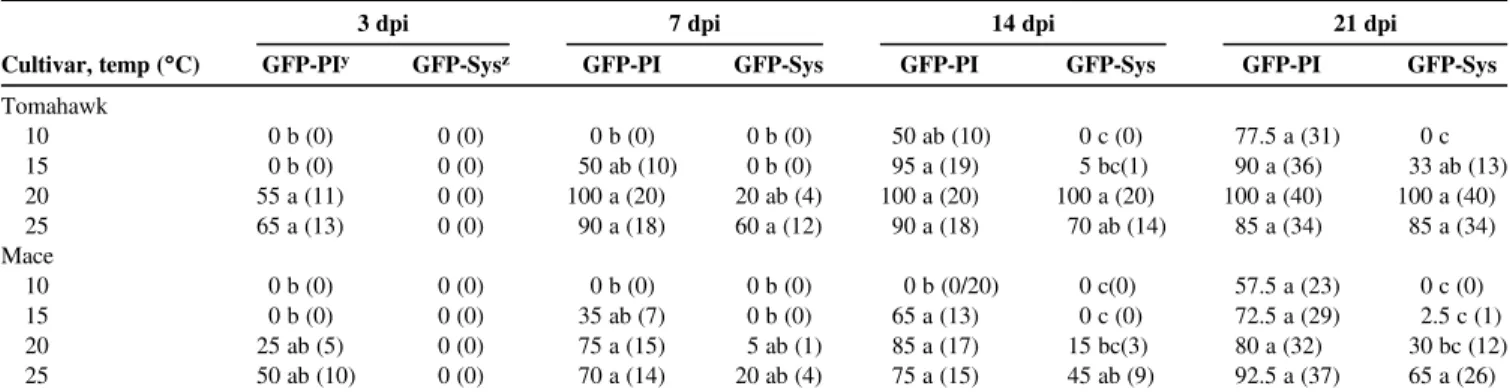
Experiment I.The expression of visual virus symptoms in wheat plants inoculated with WSMV-GFP was influenced by temperatures and cultivar. Tomahawk plants held at 10°C did not develop symp-toms after 21 dpi but, at 15°C, they developed occasional mild mottling. Tomahawk plants held at 20 and 25°C developed typical WSMV symptoms (chlorotic streaks or spots, mosaic, and mottling). Mace plants held at all four temperatures did not show WSMV symp-toms after 21 dpi, although 30 and 65% of those at 20 and 25°C, re-spectively, expressed GFP systemically after 21 dpi (Table 1).
Temperature and cultivar had significant effects on the percentage of plants that elicited infection at the point of inoculation at 3 dpi (temperature:F= 8.5; df = 3, 9;P= 0.005, cultivar:F= 5.3; df = 1, 12;P= 0.039), 7 dpi (temperature:F= 12.0; df = 3, 9;P= 0.029, cul-tivar:F= 6.8; df = 1, 12;P= 0.023), and 14 dpi (temperature:F= 24.0; df = 3, 9;P= 0.0001, cultivar:F= 6.2; df = 1, 12;P= 0.007) (Table 1). However, at 21 dpi, temperature differences were not significant (F= 2.7; df = 3, 9;P= 0.109) and cultivar differences only approached sig-nificance (F= 4.4; df = 1, 12;P= 0.060). No significant interactions occurred between temperature and cultivar at 3, 7, 14, and 21 days (Table 1). Mace plants held at 10 and 15°C did not express GFP at 3 dpi at the point of inoculation but GFP was observed in 38% of plants held at 20 and 25°C. At 21 dpi, no differences were observed in expression at the point of inoculation at the four temperatures in Mace (57 to 92%). In Tomahawk, at 21 dpi, no differences were observed in the expression of GFP at the point of inoculation at the four temperatures (77 to 100%).
No systemic movement of virus was detected in either cultivar af-ter 3 days at any temperature examined. Only temperature had sig-nificant effects on the percentage of plants infected systemically at 7 days (temperature:F= 5.9; df = 3, 9;P= 0.017). At 7 dpi, no Tomahawk plants had systemic infection (GFP expression in nonino-culated leaves) at 10 and 15°C, while 20 and 60% of the plants were infected at 20 and 25°C, respectively. In Mace at 7 dpi, no systemic infection was observed in plants held at 10 and 15°C, while those at 20 and 25°C had 5 and 20% of the plant with systemic infection, re-spectively. Both temperature and cultivar had significant effects at 14 dpi (temperature:F= 32.8; df = 3, 9;P< 0.0001, cultivar:F= 9.7; df = 1, 12;P= 0.009) and 21 dpi (temperature:F= 30.2; df = 3, 9;
P< 0.0001, cultivar:F= 24.7; df = 1, 12;P= 0.0003). Significant in-teractions were observed between temperature and cultivar at 21 dpi (F= 6.8; df = 3, 12;P= 0.006) but no interactions occurred at 3, 7,
and 14 dpi (Table 1). The interaction at 21 dpi resulted from a more rapid increase in systemic infection at 15 and 20°C, with 33 and 100% infection in Tomahawk compared with only 2.5 and 30% in Mace plants, respectively; however, expression rates were both zero at 10°C and com-parable at 25°C (Table 1). The percentage of plants expressing WSMV-GFP at either the point of inoculation or systemically was generally lower in Mace compared with Tomahawk across all temperatures.
Over 50% of plants expressed GFP at the point of inoculation by 21dpi in both Mace and Tomahawk held at 10°C but none of these plants was infected systemically (Table 1). GFP was expressed as in-dividual foci in upper noninoculated Mace leaves but not in all leaves and, sometimes, only a few foci were seen in the entire plant. In Tomahawk, GFP was localized at low temperatures but was intense and uniformly distributed in leaves at higher temperatures (20 and 25°C). Days to development of foci at the point of inoculation decreased significantly with increasing temperature up to 21 dpi: 17.0, 9.8, 5.4, and 4.2 days at 10, 15, 20, and 25°C, respectively (F= 82.5; df = 3, 115;P< 0.0001). Smaller but significant differences were also seen between Tomahawk (8.5 days) and Mace (9.8 days) (F= 10.1; df = 1, 115;P= 0.005). No significant interaction between temperature and cultivar was seen (F= 0.03; df = 3, 115;P= 0.983). This indicates that foci initiation occurred sooner for Tomahawk but the increase in the days to development of foci with decreasing temperature was similar between cultivars. The number of foci at the point of in-oculation in plants held at the four temperature regimes (3.9 foci; range 3.6 to 4.5) did not differ significantly after 21 dpi (F= 0.9; df = 3, 115;P= 0.494). However, there were significantly fewer foci in Mace (2.8 foci) compared with Tomahawk (5.0 foci) (F= 60.2; df = 1, 115;P< 0.0001). There was no significant interaction between temperature and cultivar (F= 0.6; df = 3, 115;P= 0.599).
WSMV was not detected using QRT-PCR at 21 dpi in Tomahawk plants held at 10°C whereas, at 15°C, it was detected and titer was lower compared with plants held at 20 and 25°C (Table 2). In Mace, WSMV was not detected in plants that were held at 10, 15, and 20°C but was detected only in those that were held at 25°C. Accumulation of WSMV genomic RNA in wheat plants incubated at 10, 15, 20, and 25°C as measured with QRT-PCR at 21 dpi was significantly af-fected by temperature (F= 27.6; df = 3, 3;P= 0.011) and cultivar (F= 31.6; df = 1, 4;P= 0.005). There was a significant interaction between cultivar and temperature (F= 9.6; df = 3, 4;P= 0.027), which resulted from the more rapid increase in titer across the lower temperatures for Tomahawk and the lack of difference in WSMV titer in Tomahawk and Mace at 25°C (Table 2). In replicates 3 and 4, in which ELISA was used to test for presence of WSMV, no virus was detected in Tomahawk and Mace plants that were held at 10°C which also did not express systemic GFP. WSMV was detected in 20% (15°C) and 100% (20 and 25°C) of the Tomahawk plants that expressed systemic GFP. In Mace, WSMV was detected in 6 of the 10 plants that expressed systemic GFP at 15, 20, and 25°C (Table 3).
Table 1.Percentage of wheat plants expressing local or systemic green fluorescent protein (GFP)-taggedWheat streak mosaic virusinfection at four temperature (temp) levels at 3, 7, 14, and 21 days postinoculation (dpi)x
3 dpi 7 dpi 14 dpi 21 dpi
Cultivar, temp (°C) GFP-PIy GFP-Sysz GFP-PI GFP-Sys GFP-PI GFP-Sys GFP-PI GFP-Sys
Tomahawk 10 0 b (0) 0 (0) 0 b (0) 0 b (0) 50 ab (10) 0 c (0) 77.5 a (31) 0 c 15 0 b (0) 0 (0) 50 ab (10) 0 b (0) 95 a (19) 5 bc(1) 90 a (36) 33 ab (13) 20 55 a (11) 0 (0) 100 a (20) 20 ab (4) 100 a (20) 100 a (20) 100 a (40) 100 a (40) 25 65 a (13) 0 (0) 90 a (18) 60 a (12) 90 a (18) 70 ab (14) 85 a (34) 85 a (34) Mace 10 0 b (0) 0 (0) 0 b (0) 0 b (0) 0 b (0/20) 0 c(0) 57.5 a (23) 0 c (0) 15 0 b (0) 0 (0) 35 ab (7) 0 b (0) 65 a (13) 0 c (0) 72.5 a (29) 2.5 c (1) 20 25 ab (5) 0 (0) 75 a (15) 5 ab (1) 85 a (17) 15 bc(3) 80 a (32) 30 bc (12) 25 50 ab (10) 0 (0) 70 a (14) 20 ab (4) 75 a (15) 45 ab (9) 92.5 a (37) 65 a (26)
xNumbers in parenthesis represent the number of infected plants out of 20 (3, 7, and 14 dpi) or 40 (21 dpi). Means with the same letter within columns are not significantly different (Tukey-Kramer,P< 0.05).
yGFP-PI = GFP present at point of inoculation (5-cm upper portion of the second leaf). zGFP-Sys = GFP present in leaves above the second inoculated leaf (third, fourth, or fifth).
After 21 dpi, half of the test plants were moved to a constant temper-ature of 27°C for 14 days. Tomahawk plants previously held at 10 and 15°C expressed noticeable symptoms within 7 days after moving them to 27°C, while those previously held at 20 and 25°C rapidly developed severe WSMV symptoms at 27°C. When Mace plants held at 25°C were moved to 27°C for 14 days, 34% of them displayed localized mild chlorotic mottling, while the rest remained symptomless. No significant differences were seen in systemic infection between temperatures or cul-tivars (temperature:F= 0.8; df = 3, 9;P= 0.524, cultivar:F= 4.3; df = 1, 12;P= 0.062). However, the cultivar effect was marginal, resulting from more Tomahawk plants (range 90 to 100%) than Mace plants (range 50 to 85%) expressing systemic GFP. No significant interaction occurred between temperature and cultivar (F= 0.68; df = 3, 12;P= 0.579) because the differences seen at 21 dpi were no longer observed. After holding plants for 21 days at the four temperature regimes and then at 27°C for 14 days, virus titer was no longer affected by temperature (F= 0.17; df = 3, 3;P= 0.913) or cultivar (F= 7.8; df = 1, 4;P= 0.068) (Table 2). Using QRT-PCR, WSMV was de-tected in all Tomahawk plants (38 of 38) that had systemic infection and in 19 of the 21 Mace plants that had systemic infection. In rep-licates 3 and 4 in which ELISA was used to confirm WSMV in plants expressing GFP, the virus was detected in all Tomahawk plants and in 32 of 36 Mace plants that expressed GFP systemically (Table 3). In plants allowed to regrow at 27°C for 14 days, all Tomahawk plants expressing systemic WSMV-GFP in plants previously incubated at 20 and 25°C (21 dpi) had the virus in regrowth shoots. In Tomahawk, 29 of 33 (88%) of plants that failed to express systemic WSMV-GFP infec-tion at 10 and 15°C expressed virus in regrowth shoots (Table 4). In Mace, only 16 of 39 (41%) of plants that failed to express systemic WSMV-GFP infection at 10 and 15°C expressed virus in regrowth shoots (Table 4).
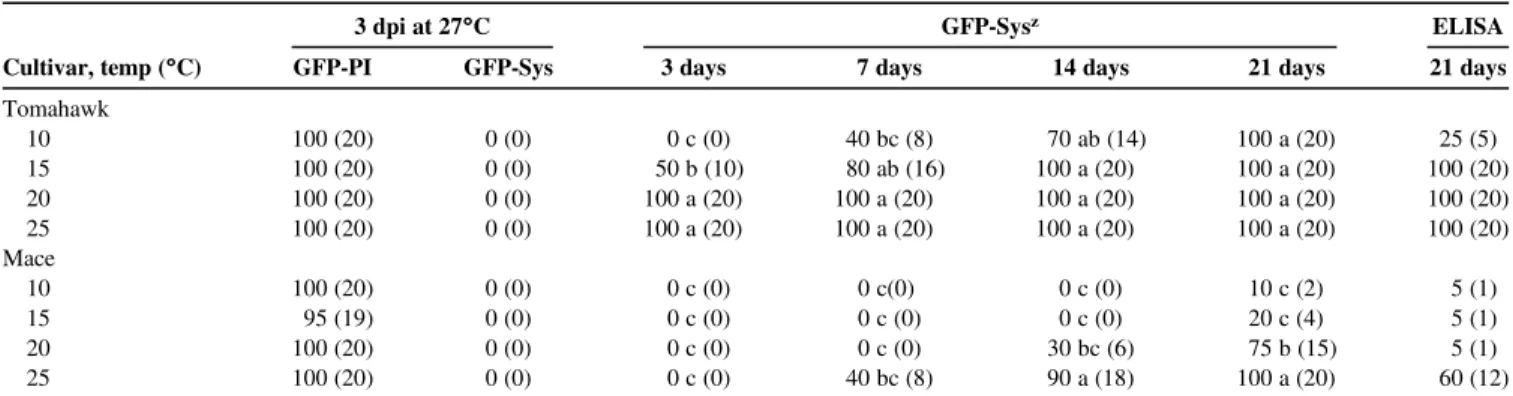
Experiment II.Symptom expression in plants was similar to what was observed in experiment I. Tomahawk plants held at 10°C did not develop symptoms after 21 dpi but, at 15°C, they developed occasional mild mottling. Tomahawk plants held at 20 and 25°C de-veloped typical WSMV symptoms. Mace plants held at all four tem-peratures did not show WSMV symptoms after 21 dpi. By 3 dpi at 27°C, nearly all plants expressed GFP at the point of inoculation in Tomahawk (40 of 40) and Mace (39 of 40); however, none of the plants had systemic expression of GFP. At 3 days after transferring plants to the four temperatures, Tomahawk plants expressed systemic GFP in 100, 50, and 0% of the plants held at 20 and 25, 15, and 10°C, respectively. In Mace, no plants expressed systemic GFP at 3 days after transference to the four temperatures. There were significant temperature and cultivar effects on the percentage of plants express-ing systemic GFP after transference to 10, 15, 20, and 25°C for 3 days (temperature:F= 91.7; df = 3, 3;P= 0.002; cultivar:F= 625.0.0; df = 1, 4;P< 0.0001; interaction between temperature and cultivar
F= 91.7; df = 3, 4;P= 0.0004). This significant interaction between cultivar and temperature resulted from the rapid infection in Tomahawk (0 to 100%) compared with Mace (0%) across the four temperature
levels. At 7 days, only cultivar was significant (F= 44.3; df = 1, 4;
P= 0.002) and, at 14 days, both temperature and cultivar were signif-icant (temperature:F= 9.6; df = 3, 3;P= 0.048; cultivar:F= 56.8; df = 1, 4;P= 0.002). No significant interactions occurred between temperature and cultivar at 7 days (F= 1.5; df = 3, 4;P= 0.342) and 14 days (F= 5.2; df = 3, 4;P= 0.073) (Table 5). At 21 days, temperature, (F= 44.6; df = 3, 3;P= 0.006), cultivar (F= 226.5; df = 1, 4; P= 0.0001), and their interaction (F= 44.6; df = 3, 4;
P= 0.002) were all significant. This interaction resulted from 100% of Tomahawk plants systemically expressing virus across all tempera-tures, whereas systemic virus expression in the Mace plants increased from 10% at 10°C to 100% at 25°C.
The number of foci in plants held at 27°C for 3 days was signifi-cantly smaller in Mace compared with Tomahawk (F= 44.7; df = 1, 76;P< 0.0001). The mean number of foci across all temperatures was 5.2 (± 0.46) in Mace and 14.5 (± 1.51) in Tomahawk. WSMV was detected by ELISA in 100% (60 of 60) of the Tomahawk plants held at 15, 20, and 25°C but only 25% (5 of 20) of those held at 10°C. In Mace, WSMV was detected in 60% (12 of 20) of the plants held at 25°C but only 5% (3 of 60) of plants held at 10, 15, and 20°C that expressed systemic WSMV-GFP infection after 21 days at the four temperature levels (Table 5).
All Tomahawk plants and 85% of Mace plants incubated at all four temperature regimens expressed WSMV-GFP systemic infection in regrowth shoots after 21 days at 27°C. Mace plants held at 10, 15, and 20°C for 21 days had variable expression of WSMV-GFP sys-temic infection, ranging from 10 to 65%, but plants showed a higher level of virus in regrowth shoots, ranging from 75 to 90% (Table 4).
Discussion
This study revealed that temperature dramatically affects WSMV rep-lication, movement, titer, and symptom expression in a susceptible
Table 2.Absolute quantification of green fluorescent protein-taggedWheat streak mosaic virus(WSMV-GFP) in Mace and Tomahawk plants held at 10, 15, 20, and 25°C for 21 days and at 27°C for 14 days
Number (means6standard error) of WSMV-GFP RNA copiesz
Cultivar, temperature (°C) 21 dpi 27°C for 14 days
Tomahawk 10 0 ± 0c (0/0) 3.19 × 10⁵± 2.75 × 10⁴a (10/10) 15 3.18 × 10³± 5.99 × 10²bc (2/2) 5.85 × 10⁵± 1.52 × 10⁵a (10/10) 20 3.71 × 10⁶± 9.36 × 10⁵a (10/10) 3.25 × 10⁵± 2.73 × 10⁴a (10/10) 25 3.54 × 10⁶± 2.10 × 10⁶a (6/6) 3.66 × 10⁵± 8.77 × 10⁴a (8/8) Mace 10 0 ± 0c (0/0) 4.04 × 10⁴± 2.02 × 10⁴a (7/7) 15 0 ± 0c (0/0) 4.69 × 10⁵± 4.18 × 10⁵a (3/2) 20 0 ± 0c (0/0) 8.51 × 10⁴± 2.64 × 10⁴a (6/8) 25 6.04 × 10⁴± 3.16 × 10⁴ab (8/8) 3.24 × 10⁴± 1.91 × 10⁴a (3/4)
zNumbers in parentheses represent number of plants out of 10 in which WSMV-GFP was detected by quantitative reverse-transcription polymerase chain reaction versus those in which it was observed by systemic expression of GFP. Means with the same letter within columns are not significantly different (Tukey-Kramer P< 0.05); dpi = days postinoculation.
Table 3.Percentage of plants that tested positive to green fluorescent protein-taggedWheat streak mosaic virus(WSMV-GFP) using enzyme-linked immu-nosorbent assay (ELISA) in Mace and Tomahawk plants held at 10, 15, 20, and 25°C at 21 days postinoculation (dpi) followed by at 27°C for 14 daysz
Cultivar Temperature (°C) 21 dpi 14 days at 27°C
Tomahawk 10 0 (0/0) 100 (10/10) 15 20 (2/2) 100 (10/10) 20 100 (10/10) 100 (10/10) 25 100 (10/10) 100 (10/10) Mace 10 0 (0/0) 90 (9/10) 15 10 (1/1) 80 (8/9) 20 10 (1/1) 60 (6/8) 25 40 (4/8) 90 (9/9)
zNumbers in parentheses represent number of plants out of 10 in which WSMV was detected by ELISA versus those in which it was observed by systemic expression of GFP.
cultivar (Tomahawk) and these effects were dramatically altered for a virus-resistant wheat cultivar (Mace). The failure of WSMV-GFP to sys-temically infect Tomahawk at 10°C and the production of only mild mot-tling at 15°C indicate that temperatures at 15°C and below suppresses WSMV symptoms in susceptible wheat cultivars. Foci at the point of in-oculation developed sooner and were more numerous in Tomahawk than in Mace at the four temperature levels. The number of days to foci devel-opment decreased with increasing temperatures in both cultivars. These results indicate that low temperatures delay initiation of WSMV infec-tion; however, this relationship differed between the two cultivars.
In resistant Mace, plants held at all four temperatures failed to ex-press WSMV symptoms, and only mild chlorotic mottling developed in 34% of plants after they were moved to 27°C for 14 days. These data confirm that Mace is resistant (lack of symptom expression) to WSMV at 25°C and below; however, a majority of plants expressed GFP systemically when they were moved from 10 and 15°C for 21 dpi to 27°C for 14 days. These data suggest that virus from local foci developed in inoculated leaves at 10 and 15°C might have moved systemically when plants were transferred to permissible temperature at 27°C. These data also suggest that WSMV replication and cell-to-cell movement was occurring in inoculated leaves of resistant Mace wheat bearing theWsm1gene. Recently, Tatineni et al. (2016) found that theWsm1gene in Mace provides resistance to WSMV and TriMV by debilitating long-distance movement at 18°C, with no appreciable effects on virus replication and cell-to-cell movement. These findings are similar to what we observed; however, results from our study indi-cate that this impairment in WSMV movement also occurs at lower temperatures (10 and 15°C) but at different rates in the resistant and susceptible cultivars.
Failure to detect systemic WSMV infection using QRT-PCR in the youngest leaves of Mace plants held at or below 20°C at 21 dpi
indicates that these temperatures hinder long-distance movement within wheat plants bearing theWsm1gene but virus replication and foci development proceed at the point of inoculation, as observed by Tatineni et al. (2016). However, when these plants were moved to 27°C for 14 days, virus titer was similar to that in plants that were pre-viously held at 25°C. This indicates that temperatures at 20°C or below suppress WSMV movement systemically to upper, noninoculated leaves. Tatineni et al. (2016) reported that lower temperatures (18°C) affected virus long-distance movement in resistant wheat cul-tivars. Seifers et al. (2013) also observed lack of symptoms at 20°C in theWsm1resistant check KS86W10-3. In field trials in Nebraska, Mace consistently demonstrated lack of symptoms following me-chanical and vector-borne WSMV infections (Graybosch et al. 2009). In terms of systemic virus movement and symptom expres-sion, Mace plants failed to show symptoms at any of the four temper-atures, and virus was detected only in plants held at 25°C. However, Tomahawk remained symptomatic and WSMV was detected at all temperatures, except 10°C. These results suggest that temperatures at or below 20°C are capable of suppressing WSMV symptoms and systemic virus infection in resistant Mace whereas, in susceptible Tomahawk, WSMV symptoms and systemic infection occur at tem-peratures as low as 15°C, though symptom expression is slow. These results suggest that, in resistant Mace, symptoms are limited at all temperatures and long-distance movement of WSMV begins to in-crease when temperatures rise above 15°C; however, symptoms are expressed as localized foci even at 25°C.
Prevailing cool temperatures in the fall and spring in the Great Plains region of North America can reduce losses attributed to WSMV even in susceptible cultivars. However, as temperatures in-crease above 15°C, severe WSMV symptoms begin to develop in susceptible cultivars, and this likely will result in increased yield
Table 4.Percentage of wheat plants expressing green fluorescent protein (GFP)-taggedWheat streak mosaic virussystemic infection after being previously held for 21 days postinoculation at 10, 15, 20 and 25°C (first experiment) or for 3 days at 27°C and then at 10, 15, 20, and 25°C for 21 days (second experiment) and in regrowth shoots after respective plants were cut back and held at 27°C for 21 daysz
First experiment Second experiment
Cultivar Temperature (°C) GFP-Sys GFP RG GFP-Sys GFP RG
Tomahawk 10 0 (0) 85 (17) 100 (20) 100 (20) 15 35 (7) 95 (19) 100 (20) 100 (20) 20 100 (20) 100 (20) 100 (20) 100 (20) 25 80 (16) 80 (16) 100 (20) 100 (20) Mace 10 0 (0) 20 (4) 10 (2) 75 (15) 15 5 (1) 65 (13) 20 (4) 90 (18) 20 5 (1) 35 (7) 65 (13) 75 (15) 25 80 (16) 85 (17) 100 (20) 100 (20)
zGFP-Sys = GFP present in the third, fourth, fifth, sixth, or seventh leaves 21 days postinoculation (dpi) and GFP RG = GFP in regrowth at 27°C for 21 days. Numbers in parentheses represent number of plants infected out of a total of 20.
Table 5.Percentage of wheat plants expressing local, systemic green fluorescent protein-taggedWheat streak mosaic virus(WSMV-GFP) infection previously at a temperature (temp) of 27°C for 3 days postinoculation (dpi) and then at 10, 15, 20, and 25°C for 3, 7, 14, and 21 days, and enzyme-linked immunosorbent assay (ELISA) results at 21 daysy
3 dpi at 27°C GFP-Sysz ELISA
Cultivar, temp (°C) GFP-PI GFP-Sys 3 days 7 days 14 days 21 days 21 days
Tomahawk 10 100 (20) 0 (0) 0 c (0) 40 bc (8) 70 ab (14) 100 a (20) 25 (5) 15 100 (20) 0 (0) 50 b (10) 80 ab (16) 100 a (20) 100 a (20) 100 (20) 20 100 (20) 0 (0) 100 a (20) 100 a (20) 100 a (20) 100 a (20) 100 (20) 25 100 (20) 0 (0) 100 a (20) 100 a (20) 100 a (20) 100 a (20) 100 (20) Mace 10 100 (20) 0 (0) 0 c (0) 0 c(0) 0 c (0) 10 c (2) 5 (1) 15 95 (19) 0 (0) 0 c (0) 0 c (0) 0 c (0) 20 c (4) 5 (1) 20 100 (20) 0 (0) 0 c (0) 0 c (0) 30 bc (6) 75 b (15) 5 (1) 25 100 (20) 0 (0) 0 c (0) 40 bc (8) 90 a (18) 100 a (20) 60 (12)
yNumbers in parentheses represent number of plants out of 20 in which WSMV-GFP was observed at point of inoculation (PI) and systemic (Sys), and those in which virus was detected by ELISA at 21 days.
losses. Resistant cultivars bearing theWsm1gene will have a gradual increase in virus movement within the plant and will only express symptoms when temperatures are higher than 25°C for a prolonged duration. This suggests that they are likely to suffer less WSMV dam-age and losses even under warm temperatures during fall and early spring. This disparity of impact between Mace and Tomahawk and the effects of varying temperatures was demonstrated by McMechan and Hein (2016) in a field study.
Other studies that have evaluated the effect of temperature on WSMV severity in wheat cultivars used a minimum temperature of 18°C. In almost all cases, they report typical WSMV symptoms in the susceptible check within 14 days and no symptoms in resistant cultivars or germplasm carrying either theWsm1or theWsm2gene (Seifers et al. 1995, 2006, 2007, 2013; Tatineni et al. 2010). How-ever, a study by Price et al. (2014) shows that, when exposed to high temperatures (28°C) for 4 weeks after inoculation with WSMV, Mace and RonL wheat bearing theWsm1andWsm2genes, respec-tively, expressed severe WSMV symptoms and high virus titer. These plants failed to recover and even failed to produce heads after exposure to winter conditions with temperatures below the resistance threshold. This suggests that Mace can remain symptom-free, with little impact on yield under field conditions with cooler temperatures below 25°C, but it will suffer severe symptoms and yield loss under prolonged temperatures above 25°C.
The effect of temperature on plant resistance to viruses has been reported in other pathosystems. In contrast to WSMV in this study, low temperatures (15 to 25°C) increased virus replication, titer, and symptom severity ofSoil-borne wheat mosaic virus,Tomato ringspot vi-rus,Cymbidium ringspot virus, Citrus psorosis virus, and Cassava mo-saic geminiviruses compared with temperature ranges of 26 to 32°C (Chellappan et al. 2005; Ghoshal and Sanfaçon 2014; Jovel et al. 2007; Myers et al. 1993; Ohsato et al. 2003; Siddiqui et al. 2008; Szittya et al. 2003; Vel´azquez et al. 2010). Temperature-sensitive resistance has been observed for TMV andTomato spotted wilt virus(TSWV). TMV is able to overcome theNgene resistance at temperatures above 28°C in tobacco (Kir´aly et al. 2008). However, TSWV is able to overcome
Tswgene-mediated resistance in pepper plants only at higher tempera-tures (32°C) whereas plants remain asymptomatic at lower temperatempera-tures (22°C) (Moury et al. 1998; Prasch and Sonnewald 2013). This is similar to the findings in our study, in which WSMV was able to overcome the
Wsm1temperature-sensitive resistance gene in Mace at temperatures above 25°C.
The failure of ELISA to detect WSMV-GFP in some plants that expressed systemic WSMV-GFP infection, especially in Mace, could be due to testing tissue that did not include infection foci or possessed too low virus titer in these leaves. In some plants, virus was expressed in older leaves but not in the top two leaves that were harvested for testing. The lack of systemic infection by WSMV-GFP in Tomahawk at 10°C and Mace at 10 and 15°C by 21 dpi, compared with later ex-pression of systemic infection at 27°C in regrowth plants, indicates that a small number of undetectable amounts of virus particles might have translocated to the crown, enabling the virus to multiply rapidly when plants were moved to optimal temperatures. A recent study failed to detect red fluorescent protein-labeled WSMV and virus titer in the leaf sheaths of inoculated leaves or crowns of the resistant Mace plants held at 18°C for 21 days (Tatineni et al. 2016). These findings indicate that there is potential for wheat plants to test negative for WSMV in ELISA during cool temperatures or in resistant cultivars, although these plants actually could possess scattered infection foci and would later develop symptoms under warm conditions that favor virus replication. Therefore, it is appropriate for studies using ELISA for field diagnosis to test samples once plants are exposed to suitable temperatures for virus replication.
TMV has been reported to move passively with photoassimilates without replication and spread under low temperatures; however, when plants are moved to higher temperatures, lesions appear in a shorter duration than normally required from time of inoculation to symptom expression, suggesting systemic infection but no replica-tion or detecreplica-tion (Susi 1999). Casper and Holt (1996) failed to ob-serve TMV tagged with GFP in xylem and phloem tissue despite
the presence of infection foci in uninoculated leaves; they concluded that TMV moved via a vascular-mediated form of systemic transport without subgenomic expression or expression of GFP. These find-ings are similar to what we observed in our study. We failed to detect systemic GFP in plants that were held at low temperatures but, when they were transferred to a higher temperature (27°C), these plants de-veloped systemic GFP and even WSMV symptoms faster than they normally would after inoculation.
Prevailing climatic conditions, especially temperature, influence the impact of WSMV in both susceptible and resistant wheat culti-vars. This study demonstrates a rapid increase in virus activity with increasing temperatures beginning about 15°C for a WSMV-susceptible variety (Tomahawk); however, this response to temperature is delayed considerably until temperatures increase to about 25°C in a WSMV-resistant (Wsm1) cultivar (Mace). In addition, in planta movement of WSMV at lower temperatures appears to be an important component of infection dynamics in winter wheat but this dynamic is signifi-cantly altered in plants with theWsm1resistance gene. Therefore, plants infected during the fall under cool temperatures that lose inoc-ulated leaves during the winter may maintain the virus because of rapid translocation of WSMV to the crown. In susceptible plants, this will result in symptom development when warm conditions occur during the spring.
Acknowledgments
This project was supported by funds provided through the United States Depart-ment of Agriculture National Institute of Food and Agriculture grant number 2013-68004-20358. We thank W. W. Stroup and C. Stock for their assistance with statistical analysis; and J. Horrell, M. Bartels, E. Knoell, and J. McMechan for their invaluable assistance with the experiments.
Literature Cited
Appel, J. A., De Wolf, E., Bockus, W. W., and Bowden, R. L. 2013. Preliminary 2013. Kansas wheat disease loss estimates. Kansas Cooperative Plant Disease Survey Report.
Baulcombe, D. C., Chapman, S., and Cruz, S. S. 1995. Jellyfish fluorescent protein as a reporter for virus infections. Plant J. 7:1045-1053.
Browder, L. E. 1985. Parasite:host:environment specificity in the cereal rusts. Annu. Rev. Phytopathol. 23:201-222.
Brunt, A. A., Crabtree, K., Dallwitz, M., Gibbs, A., and Watson, L. 1996. Viruses of Plants. CAB International, Wallingford, UK.
Burrows, M., Franc, G., Rush, C., Blunt, T., Ito, D., Kinzer, K., Olson, J., O’Mara, J., Price, J., Tande, C., Ziems, A., and Stack, J. 2008. Occurrence of viruses in wheat in the Great Plains region. Online publication. Plant Health Prog. doi: 10.1094/PHP-2009-0706-01-RS
Byamukama, E., Seifers, D. L., Hein, G. L., De Wolf, E., Tisserat, N. A., Langham, M. A. C., Osborne, L. E., Timmerman, A., and Wegulo, S. N. 2013. Occurrence and distribution ofTriticum mosaic virusin the central Great Plains. Plant Dis. 97:21-29. Casper, S. J., and Holt, C. A. 1996. Expression of the green fluorescent protein-encoding gene from aTobacco mosaic virus-based vector. Gene 173:69-73. Chellappan, P., Vanitharan, R., Ogbe, F., and Fauquet, C. M. 2005. Effect of
temperature on Geminivirus-induced RNA silencing in plants. Plant Physiol. 138:1828-1841.
Colhoun, J. 1973. Effects of environmental factors on plant disease. Annu. Rev. Phytopathol. 11:343-364.
Cruz, S. S., Chapman, S., Roberts, A. G., Roberts, I. M., Prior, D. A., and Oparka, K. J. 1996. Assembly and movement of a plant virus carrying green fluorescent overcoat. Proc. Natl. Acad. Sci. USA 93:6286-6290.
Divis, L. A., Graybosch, R. A., Peterson, C. J., Baenziger, P. S., Hein, G. L., Beecher, B. B., and Martin, T. J. 2006. Agronomic and quality effects in winter wheat of a gene conditioning resistance toWheat streak mosaic virus. Euphytica 152:41-49.
Dwyer, G. I., Gibbs, M. J., Gibbs, A. J., and Jones, R. A. C. 2007.Wheat streak mosaic virusin Australia: Relationship to isolates from the Pacific Northwest of the USA and its dispersion via seed transmission. Plant Dis. 91:164-170. Ellis, M. H., Rebetzke, G. J., and Chu, P. 2003. First report ofWheat streak mosaic
virusin Australia. Plant Pathol. 52:808.
Fahim, M., Mechanicos, A., Ayala-Navarrete, L., Haber, S., and Larkin, P. J. 2012. Resistance to Wheat streak mosaic virus—A survey of resources and development of molecular markers. Plant Pathol. 61:425-440.
Folimonova, S. Y., Folimonov, A. S., Tatineni, S., and Dawson, W. O. 2008. Citrus tristeza virus: Survival at the edge of the movement continuum. J. Virol. 82:6546-6556.
Friebe, B., Mukai, Y., Dhaliwal, H. S., Martin, T. J., and Gill, B. S. 1991. Identification of alien chromatin specifying resistance to wheat streak mosaic and greenbug in wheat germplasm by C-banding and in situ hybridization. Theor. Appl. Genet. 81:381-389.
Garrett, K. A., Dendy, S. P., Frank, E. E., Rouse, M. N., and Travers, S. E. 2006. Climate change effects on plant disease: Genomes to ecosystems. Annu. Rev. Phytopathol. 44:489-509.
Ghoshal, B., and Sanfaçon, H. 2014. Temperature-dependent symptom recovery in Nicotiana benthamianaplants infected withTomato ringspot virusis associated with reduced translation of viral RNA2 and requires ARGONAUTE 1. Virology 456-457:188-197.
Graybosch, R. A., Peterson, C. J., Baenziger, P. S., Baltensperger, D. D., Nelson, L. A., Jin, Y., Kolmer, J. A., Seabourn, B. W., French, R. C., and Hein, G. L. 2009. Registration of Mace hard red winter wheat. J. Plant Regist. 3:51-56. Hunger, R. M., Sherwood, J. L., Evans, C. K., and Montana, J. R. 1992. Effects of
planting date and inoculation date on severity of wheat streak mosaic in hard red winter wheat cultivars. Plant Dis. 76:1056-1060.
Jovel, J., Walker, M., and Sanfaçon, H. 2007. Recovery ofNicotiana benthamiana plants from a necrotic response induced by a nepovirus is associated with RNA silencing but not with reduced virus titer. J. Virol. 81:12285-12297. Kir´aly, L., Hafez, Y. M., Fodor, J., and Kir´aly, Z. 2008. Suppression ofTobacco mosaic
virus-induced hypersensitive-type necrotization in tobacco at high temperature is associated with down regulation of NADPH oxidase and superoxide and stimulation of dehydroascorbate reductase. J. Gen. Virol. 89:799-808.
Lu, H. J., Kottke, R., Devkota, R., St. Amand, P., Bernardo, A., Bai, G., Byrne, P., Martin, T. J., Haley, S. D., and Rudd, J. 2012. Consensus map- ping and identification of markers for marker assisted selection of Wsm2in wheat. Crop Sci. 52:720-728.
Lu, H. J., Price, J., Devkota, R., Rush, C., and Rudd, J. 2011. A dominant gene for resistance toWheat streak mosaic virusin winter wheat line CO960293-2. Crop Sci. 51:5-12.
McMechan, A. J., and Hein, G. L. 2016. Planning date and variety selection for management of viruses transmitted by the wheat curl mite (Acari: Eriophyidae). J. Econ. Entomol. 109:70-77.
Moury, B., Selassie, K. G., Marchoux, G., Daub`eze, A., and Palloix, A. 1998. High temperature effects on hypersensitive resistance to Tomato spotted wilt tospovirus (TSWV) in pepper (Capsicum chinense Jacq.). Eur. J. Plant Pathol. 104:489-498.
Muller, P. Y., Janovjak, H., Miserez, A. R., and Dobbie, Z. 2002. Processing of gene expression data generated by quantitative real-time RT-PCR. Biotechniques 32:1372-1377.
Myers, L. D., Sherwood, J. L., Siegerist, W. C., and Hunger, R. M. 1993. Temperature-influenced virus movement in expression of resistance to Soilborne wheat mosaic virus in hard red winter wheat (Triticum aestivum). Phytopathology 83:548-551.
Ohsato, S., Miyanishi, M., and Shirako, Y. 2003. The optimal temperature for RNA replication in cells infected bySoil-borne wheat mosaic virusis 17°C. J. Gen. Virol. 84:995-1000.
Oparka, K. J., Boevink, P., and Cruz, S. S. 1996. Studying the movement of plant viruses using green fluorescent protein. Trends Plant Sci. 1:412-418. Pfaffl, M. W., Horgan, G. W., and Dempfle, L. 2002. Relative expression software
tool (REST) for group-wise comparison and statistical analysis of relative expression results in real-time PCR. Nucleic Acids Res. 30:e36.
Prasch, C. M., and Sonnewald, U. 2013. Simultaneous application of heat, drought, and virus toArabidopsisplants reveals significant shifts in signaling networks. Plant Physiol. 162:1849-1866.
Price, J. A., Simmons, A. R., Rashed, A., Workneh, F., and Rush, C. M. 2014. Winter wheat cultivars with temperature-sensitive resistance toWheat streak mosaic virusdo not recover from early-season infections. Plant Dis. 98: 525-531.
Roberts, A. G., Cruz, S. S., Roberts, I. M., Prior, D. A. M., Turgeon, R., and Oparka, K. J. 1997. Phloem unloading in sink leaves ofNicotiana benthamiana: Comparison of a fluorescent solute with a fluorescent virus. Plant Cell 9: 1381-1396.
S´anchez-S´anchez, H., Henry, M., Cardenas-Soriano, E., and Alviso-Villasana, H. F. 2001. Identification ofWheat streak mosaic virusand its vectorAceria tosichellain Mexico. Plant Dis. 85:13-17.
Seifers, D. L., Haber, S., Martin, T. J., and Zhang, G. 2013. New sources of temperature-sensitive resistance toWheat streak mosaic virusin wheat. Plant Dis. 97:1051-1056.
Seifers, D. L., Harvey, T. L., Martin, T. J., and Jensen, S. G. 1997. Identification of the wheat curl mite as the vector of the High Plains virus of corn and wheat. Plant Dis. 81:1161-1166.
Seifers, D. L., Martin, T. J., Harvey, T. L., Fellers, J. P., and Michaud, J. P. 2009. Identification of wheat curl mite as the vector ofTriticum mosaic virus. Plant Dis. 93:25-29.
Seifers, D. L., Martin, T. J., Harvey, T. L., and Gill, B. S. 1995. Temperature sensitivity and efficacy ofWheat streak mosaic virusresistance derived from Agropyron intermedium. Plant Dis. 79:1104-1106.
Seifers, D. L., Martin, T. J., Harvey, T. L., and Haber, S. 2007. Temperature-sensitive Wheat streak mosaic virus resistance identified in KS03HW12 wheat. Plant Dis. 91:1029-1033.
Seifers, D. L., Martin, T. J., Harvey, T. L., Haber, S., and Haley, S. D. 2006. Temperature sensitivity and efficacy ofWheat streak mosaic virusresistance derived from CO960293 wheat. Plant Dis. 90:623-628.
Siddiqui, S. A., Sarmiento, C., Kiisma, M., Koivum¨aki, S., Lemmetty, A., Truve, E., and Lento, K. 2008. Effects of viral silencing suppressors onTobacco ringspot virusinfection in twoNicotianaspecies. J. Gen. Virol. 89:1502-1508. Slykhuis, J. T. 1955.Aceria tulipaeKeifer (Acarina: Eriophyidae) in relation to the
spread of wheat streak mosaic. Phytopathology 45:116-128.
Staples, R., and Allington, W. B. 1956. Streak mosaic of wheat in Nebraska and its control. Univ. Neb. Coll. Agric. Exp. Stn. Res. Bull. 178.
Stenger, D. C., Hall, J. S., Choi, I. R., and French, R. 1998. Phylogenetic relationships within the family Potyviridae:Wheat streak mosaic virusand Brome streak mosaic virus are not members of the genus Rymovirus. Phytopathology 88:782-787.
Susi, P. 1999. Replication in the phloem is not necessary for efficient vascular transport of tobacco mosaic tobamovirus. FEBS Lett. 447:121-123. Szittya, G., Silhavy, D., Moln´ar, A., Havelda, Z., Lovas, A., Lakatos, L., B´anfalvi,
Z., and Burgy´an, J. 2003. Low temperature inhibits RNA silencing-mediated defence by the control of siRNA generation. EMBO J. 22:633-640. Tatineni, S., Graybosch, R. A., Hein, G. L., Wegulo, S. N., and French, R. 2010.
Wheat cultivar-specific disease synergism and alteration of virus accumulation during co-infection withWheat streak mosaic virusandTriticum mosaic virus. Phytopathology 100:230-238.
Tatineni, S., McMechan, A. J., Hein, G. L., and French, R. 2011. Efficient and stable expression of GFP throughWheat streak mosaic virus-based vectors in cereal hosts using a range of cleavage sites: Formation of dense fluorescent aggregates for sensitive virus tracking. Virology 410:268-281.
Tatineni, S., McMechan, A. J., Wosula, E. N., Wegulo, S. N., Graybosch, R. A., French, R., and Hein, G. L. 2014a. An eriophyid mite-transmitted plant virus contains eight genomic RNA segments with unusual heterogeneity in the nucleocapsid protein. J. Virol. 88:11834-1845.
Tatineni, S., Riethoven, J.-J. M., Graybosch, R. A., French, R., and Mitra, A. 2014b. Dynamics of small RNA profiles of virus and host origin in wheat cultivars synergistically infected byWheat streak mosaic virusandTriticum mosaic virus: Virus infection caused a drastic shift in the endogenous small RNA Profile. PLoS One 9:e111577.
Tatineni, S., Wosula, E. N., Bartels, M., Hein, G. L., and Graybosch, R. A. 2016. Temperature-dependent Wsm1 and Wsm2 gene-specific blockage of viral long-distance transport provides resistance to Wheat streak mosaic virus and Triticum mosaic virusin wheat. Mol. Plant-Microbe Interact. 29:724-738. Tatineni, S., Ziems, A., Wegulo, S. N., and French, R. 2009.Triticum mosaic virus:
A distinct member of the family Potyviridae with an unusually long leader sequence. Phytopathology 99:943-950.
Vel´azquez, K., Renovella, A., Comellas, M., Serra, P., Garc´ıa, M. L., Pina, J. A., Navarro, L., Moreno, P., and Guerri, J. 2010. Effect of temperature on RNA silencing of a negative- stranded RNA plant virus:Citrus psorosis virus. Plant Pathol. 59:982-990.
Wang, Y., Bao, Z., Zhu, Y., and Hua, J. 2009. Analysis of temperature modulation of plant defense against biotrophic microbes. Mol. Plant-Microbe Interact. 22:498-506. Wegulo, S. N., Hein, G. L., Klein, R. N., and French. R. C. 2008. Managing Wheat
Streak Mosaic. University of Nebraska-Lincoln Extension EC1871. Wosula, E. N., McMechan, A. J., Oliveira-Hofman, C., Wegulo, S. N., and Hein,
G. L. 2016. Differential transmission of two isolates ofWheat streak mosaic virusby five wheat curl mite populations. Plant Dis. 100:154-158.