Argumentation
S
ULTANM
OHAMMADA
LAHMARIDoctor of Philosophy University of York
Computer Science
A
rgumentation as a logical reasoning approach plays an important role in improving communication, increasing agree-ability, and resolving conflicts in multi-agent-systems (MAS). The present research aims to explore the effec-tiveness of argumentation in reinforcement learning of intelligent agents in terms of, outperforming baseline agents, learning transfer between argument graphs, and improving relevance and coherence of dialogue quality.This research developed ‘ARGUMENTO+’ to encourage a reinforcement learning agent (RL agent) playing abstract argument game for improving performance against different baseline agents by using a newly proposed state representation in order to make each state unique. When attempting to generalise this approach to other argu-mentation graphs, the RL agent was not able to effectively identify the argument patterns that are transferable to other domains.
In order to improve the effectiveness of the RL agent to recognise argument patterns, this research adopted a logic-based dialogue game approach with richer argument representations. In the DE dialogue game, the RL agent played against hard-coded heuristic agents and showed improved performance compared to the baseline agents by using a reward function that encourages the RL agent to win the game with minimum number of moves. This also allowed the RL agent to adopt its own strategy, make moves, and learn to argue.
This thesis also presents a new reward function that makes the RL agent’s dia-logue more coherent and relevant than its opponents. The RL agent was designed to recognise argument patterns, i.e. argumentation schemes and evidence support sources, which can be related to different domains. The RL agent used a transfer learning method to generalise and transfer experiences and speed up learning.
B
ismillaah ar-Rahman ar-Raheem, In the name of God the most Com-passionate the Most Merciful. All praise and thanks be to Allah, the Lord of the Worlds, and may the peace and blessings be on His Prophet and Messenger Muhammad, on his family and all of his companions. First, I sincerely thank Allah (GOD) Almighty for the blessings he has bestowed upon me and for His guidance during my PhD journey.Words are not enough express the gratitude I feel for everyone who have stood by me and supported me throughout this research endeavour. Putting his hope and confidence -after my God- in what I will add and offer to my great country and the knowledge in general.
I am extremely thankful to my country -The Kingdom of Saudi Arabia - for giving me the opportunity to complete my postgraduate masters and PhD in Artifi-cial Intelligence, to help contribute to the development of the country. SpeArtifi-cial thanks must be given toThe Custodian of the Two Holy Mosques, King Salman bin Abdulaziz Al Saud. May Allah protect him. Also, toHis Royal Highness Prince Mohammad bin Salman bin Abdulaziz, Crown Prince, Deputy Prime Minis-ter and MinisMinis-ter of Defence. May Allah protect them for all the support and help they provide to all students, especially those studying overseas.
I would also like to thank Prince Dr Turki bin Saud, Former president of KACST who supported personally and approved my application to study at the University of York. He has all my love, appreciation and respect.
After my God - I wish to thank and appreciate all those people for supporting and encouraging me to carry on with my PhD journey to achieve my goal. These peo-ple are very special and have had a beautiful impact on my personal and practical life.
• Firstly, my parents, Mohammad Saeed Alahmari and Fatimah Hasan Alahmariwithout their support and prayers -after my God- I would not be who I am today. I will be eternally grateful for their unconditional love and support. I will always have deep regards for the enormous sacrifices that they have made to ensure that I receive an outstanding education. Their blessings and kindness have always motivated me to give my best, pursue my goals, and aim higher. Thank you very much from the bottom of my heart.
and alienation for me and has been really patient while I was busy doing my research. I would like to send all my love, appreciation and respect to her.
• My brothers (Saeed, Abdullah, Ahmad, Khaled and Hasan)andmy sis-ters (Zainah, Ayshah and Shatha) who encouraged and motivated me during this journey.
• My sons, Hatem and Talal, thank you very much for being my source of motivation. I pray to Allah to bless you and I wish you all the best in your life.
• Thanks to allmy friends, those who are in the UK and Saudi Arabia.
• Sincere thanks to my supervisors, Dr. Tommy Yuan and Dr Daniel Ku-denko. I will always be grateful for all that I have learnt from them about the AI field. I will never forget how flexible they have been whenever I had questions or needed information. I would just knock on their doors, even inter-rupting them sometimes while they are busy, but they were always happy to help. So thank you very much for being patient and friendly.
• Thanks also toDr Nick Pearswho supported me at the end of my PhD.
• Also, I would like to thankmy colleagues in KACSTwho stood by me during my PhD.
• Many thanks go to Former Assistant of the Supervisor of the Adminis-trative Development Management in KACST, Mr Ibrahim Al Munief for his help and invaluable advice.
• A special mention of my dear friend, Yasir Almukhaizeem for his great effort in helping me build the knowledge base forBREXIT.
• Last but not least, it would be a failure of my behalf, if I did not thankDr Leila Amgoud, Dr Guillermo Simari, Dr Henry Prakken and Professor Michael Wooldridge, who were always happy to respond to my emails, to answer my questions and help in general with any queries I had related to my research.
I
declare that this thesis is a presentation of original work and I am the sole author. This work has not previously been presented for an award at this, or any other, University. All sources are acknowledged as References. In this thesis, some materials appeared in the following published or awaiting publication papers in page vii.Sultan Mohammad Alahmari
1. S. Alahmari, T. Yuan, and D. Kudenko, “Reinforcement learning for abstract argumentation: Q-learning approach,” inAdaptive and Learning Agents work-shop (at AAMAS 2017), 2017.
2. S. Alahmari, T. Yuan, and D. Kudenko, “Reinforcement learning for argumen-tation: Describing a PhD research.,” inCMNA@ ICAIL, pp. 76–78, 2017. 3. S. Alahmari, T. Yuan, and D. Kudenko, “Policy generalisation in reinforcement
learning for abstract argumentation,” inProceedings of the 18th Workshop on Computational Models of Natural Argument (CMNA18), 2018.
4. S. Alahmari, T. Yuan, and D. Kudenko, “Reinforcement learning for dialogue game based argumentation,” inProceedings of the 19th Workshop on Computa-tional Models of Natural Argument (CMNA19), 2019.
5. S. Alahmari, T. Yuan, and D. Kudenko, “Reinforcement learning of dialogue co-herence and relevance,” inProceedings of the 19th Workshop on Computational Models of Natural Argument (CMNA19), 2019.
Page
List of Figures xiii
List of Tables xvii
1 Introduction 1
1 Background and motivations . . . 2
2 Research questions and objectives . . . 7
3 Thesis structure . . . 9
2 Literature review 11 1 Multi-agent systems and intelligent agents . . . 13
2 Argumentation . . . 16
2 .1 Abstract argumentation system . . . 19
2 .2 Abstract argument game . . . 22
2 .3 The logic based dialogue game . . . 26
2 .3.1 Dialogue game . . . 28 2 .3.1.1 DE model . . . 33 2 .3.2 Strategy . . . 36 2 .3.3 Knowledge representation . . . 39 3 Reinforcement learning . . . 42 3 .1 Transfer learning . . . 47
4 Reinforcement learning for argumentation . . . 51
5 Summary . . . 55
3 Reinforcement learning for abstract argumentation building on
1 ARGUMENTO+ . . . 58
1 .1 Random agent . . . 60
1 .2 Max-probability utility agent . . . 61
1 .3 Min-probability utility agent . . . 63
2 Reinforcement learning agent . . . 63
3 Experiments and results . . . 64
3 .1 MaxProb Agent Results . . . 73
3 .2 MinProb Agent Results . . . 75
3 .3 Random Agent Results . . . 77
4 Summary . . . 80
4 Policy generalisation in reinforcement learning for abstract argu-mentation 81 1 Policy generalisation . . . 82
2 State features . . . 83
3 Generalisation method . . . 83
4 Experiment and evaluation . . . 85
5 Summary . . . 89
5 Reinforcement learning for logic-based dialogue games 91 1 Introduction . . . 92
2 Agent and environment design . . . 95
2 .1 RL agent . . . 95 2 .2 Baseline agent . . . 96 2 .2.1 DE heuristic strategy . . . 98 2 .2.2 DE randomised strategy . . . 99 2 .3 Environment . . . 100 3 Experimental setup . . . 104 4 Experimental results . . . 105
5 Alternative reward function . . . 111
6 Summary . . . 116
6 Learning to improve dialogue coherence and relevance 119 1 Introduction . . . 120
2 Coherence and relevance . . . 121
3 Reshaped reward function . . . 124
4 Additional reshaped reward function . . . 135
4 .1 Experiments against DE heuristic strategy agent . . . 136
4 .1.1 Dropping winning . . . 136
4 .1.2 Dropping moves . . . 139
4 .1.3 Dropping contradictions . . . 142
4 .1.4 Dropping switching focus . . . 144
4 .2 Experiments against DE random strategy agent . . . 148
4 .2.1 Dropping winning . . . 148
4 .2.2 Dropping moves . . . 151
4 .2.3 Dropping contradictions . . . 155
4 .2.4 Dropping switching focus . . . 158
5 Summary . . . 162
7 Generalisation approach 167 1 Introduction . . . 168
2 Different context argument domain . . . 169
3 Transferable argument . . . 178
4 Method of transfer . . . 179
5 Experiment and result . . . 179
6 Summary . . . 185
8 Conclusion and further work 187 1 Conclusion . . . 188
2 Contributions to knowledge . . . 204
3 Limitations and further work . . . 207
A Appendix A 213
FIGURE Page
2.1 Agent and environment . . . 13
2.2 Example of arguments and relations . . . 20
2.3 Grounded Extension Algorithm . . . 21
2.4 Abstract argumentation graph in ARGU MEN TOgame . . . 24
2.5 ARGU MEN TOgame . . . 25
2.6 Dialogue tree based on probability . . . 26
2.7 Main elements of dialogue system . . . 28
2.8 Strategy based on probability . . . 38
2.9 Example of argumentation graph . . . 39
2.10 Argument schema of Toulmin (1958) . . . 40
2.11 DE dialogue model knowledge base architecture . . . 41
2.12 Argument graph . . . 42
2.13 ArguMed Interface . . . 43
2.14 The agent-environment interaction in reinforcement learning . . . 44
2.15 Transfer learning . . . 49
3.1 A dialogue tree algorithm [6] . . . 61
3.2 A dialogue tree [6] . . . 62
3.3 Computing probability utility algorithm [6] . . . 62
3.4 A dialogue tree with utility values [6] . . . 63
3.5 RL agent against Max probability agent (1500 episodes in the lower side) 66 3.6 RL agent against Min probability agent (1500 episodes in the lower side) 67 3.7 RL agent VS Random agent . . . 68
3.8 Example of abstract argumentation system . . . 69
3.10 The Q-table . . . 70
3.11 RL agent against Max-Probability agent . . . 71
3.12 RL agent against Min-Probability agent . . . 72
3.13 RL agent against Random agent . . . 73
3.14 Learning rate and discounted factor correlation . . . 79
4.1 Argumentation graph . . . 84
4.2 Reward shaping . . . 86
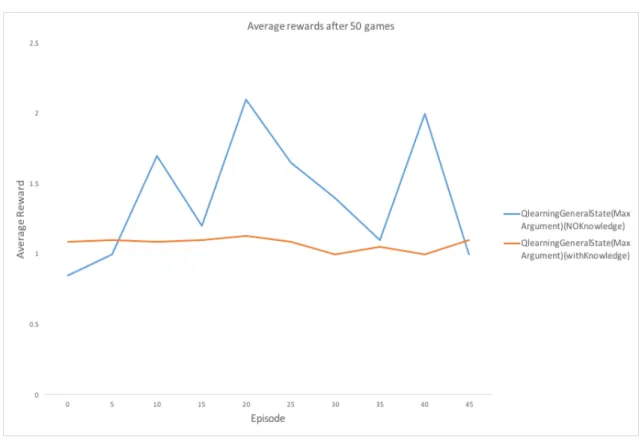
4.3 Cross validation for RL agent with and without knowledge with minimum numbers of arguments . . . 87
4.4 Cross validation for RL agent with and without knowledge with maximum numbers of arguments . . . 88
4.5 Argumentation graph with possibility of winning . . . 88
4.6 Different scenario of argumentation graph . . . 89
5.1 System knowledge base [7], [8] . . . 101
5.2 Sources environment . . . 102
5.3 Capital punishment knowledge base . . . 103
5.4 RL agent against fixed strategy agent . . . 105
5.5 RL agent against Random agent . . . 106
5.6 Average moves count against Fixed strategy agent . . . 109
5.7 Average moves count against DE Random agent . . . 110
5.8 RL agent against DE . . . 112
5.9 RL agent move counts . . . 113
5.10 RL agent against DE Random . . . 114
5.11 RL agent move counts . . . 115
6.1 Incoherent measuring between RL agent and heuristic agent . . . 124
6.2 Irrelevance measuring between RL agent and heuristic agent . . . 125
6.3 Incoherence measuring between RL agent and DE heuristic agent . . . . 126
6.4 Irrelevance measuring between RL agent and DE heuristic agent . . . . 127
6.5 Incoherence measuring between RL agent and DE Random agent . . . . 131
6.6 Irrelevance measuring between RL agent and randomised based agent . 132 6.7 Agents’ performance . . . 137
6.8 RL agent number of moves . . . 138
6.9 Agents’ incoherence . . . 139
6.10 Agents’ irrelevance . . . 140
6.11 Agents’ performance . . . 141
6.12 RL agent number of moves . . . 142
6.13 Agents’ incoherence . . . 143
6.14 Agents’ irrelevance . . . 144
6.15 Agents’ performance . . . 145
6.16 RL agent number of moves . . . 146
6.17 Agents’ incoherence . . . 147
6.18 Agents’ irrelevance . . . 148
6.19 Agents’ performance . . . 149
6.20 RL agent number of moves . . . 150
6.21 Agents’ incoherence . . . 151
6.22 Agents’ irrelevance . . . 152
6.23 Agents’ performance . . . 153
6.24 RL agent number of moves . . . 154
6.25 Agents’ incoherence . . . 155
6.26 Agents’ irrelevance . . . 156
6.27 Agents’ performance . . . 157
6.28 RL agent number of moves . . . 158
6.29 Agents’ incoherence . . . 159
6.30 Agents’ irrelevance . . . 160
6.31 Agents’ performance . . . 161
6.32 RL agent number of moves . . . 162
6.33 Agents’ incoherence . . . 163
6.34 Agents’ irrelevance . . . 164
6.35 Agents’ performance . . . 164
6.36 RL agent number of moves . . . 165
6.37 Agents’ incoherence . . . 165
6.38 Agents’ irrelevance . . . 166
7.2 AgainstBREXIT . . . 177 7.3 Transfer learning from source task (capital punishment) to target task
(BREXIT) . . . 181 7.4 RL agent using transfer learning against DE agent with heuristic strategy182 7.5 RL agent using transfer learning against DE agent with random strategy 183
TABLE Page
2.1 Agent property . . . 15
2.2 Rules for DE move types . . . 34
2.3 Commitment rules . . . 35
2.4 Reinforcement learning elements . . . 45
2.5 <S, A, T, R> tuple . . . 46
3.1 Summary statistics for ADF test . . . 74
3.2 Rewards of RL agent and MaxProb agent at the last episode . . . 74
3.3 Basic statistics RL agent and MaxProb agent at the last episode . . . 74
3.4 Summary statistics for ADF test . . . 75
3.5 Rewards of RL agent and MinProb agent at the last episode . . . 76
3.6 Basic statistics RL agent and MinProb agent at the last episode . . . 76
3.7 Summary statistics for ADF test . . . 77
3.8 Rewards of RL agent and Random agent at the last episode . . . 78
3.9 Basic statistics RL agent and Random agent at the last episode . . . 78
5.1 Summary statistics for ADF test . . . 107
5.2 Rewards of RL agent and DE Random agent at the last episode . . . 107
5.3 Basic statistics RL agent and DE Random agent at the last episode . . . 107
5.4 Summary statistics for ADF test . . . 110
5.5 Summary statistics for ADF test . . . 111
6.1 Summary statistics for ADF test (Incoherence) . . . 127
6.2 Incoherence values of RL agent and DE agent at the last episode . . . 128
6.3 Basic statistics RL agent and DE agent at the last episode . . . 128
6.5 Irrelevance values of RL agent and DE agent at the last episode . . . 130
6.6 Basic statistics RL agent and DE agent at the last episode . . . 130
6.7 Summary statistics for ADF test (Incoherence) . . . 131
6.8 Incoherence values of RL agent and DE Random agent at the last episode 132 6.9 Basic statistics RL agent and DE Random agent at the last episode . . . 132
6.10 Summary statistics for ADF test (Irrelevance) . . . 133
6.11 Irrelevance values of RL agent and DE Random agent at the last episode 134 6.12 Basic statistics RL agent and DE Random agent at the last episode . . . 134
6.13 Suggesting alternative reward functions . . . 135
7.1 ForBREXITclaim dataset . . . 174
7.2 AgainstBREXITclaim dataset . . . 175
7.3 Transfer fromcapital punishmenttoBREXIT . . . 179
7.4 Basic statistics RL agent with TL and RL agent with NO TL against DE agent with heuristic strategy . . . 183
7.5 Basic statistics RL agent with TL and RL agent with NO TL against DE Random agent . . . 184
8.1 Hypotheses test RL agent vs. MaxProb agent.The significance level is 0.05. . . . 192
8.2 Hypotheses test RL agent vs. MinProb agent. The significance level was 0.05. . . . 193
8.3 Hypotheses test RL agent vs. Random agent.The significance level is 0.05. . . . 194
8.4 Hypotheses test RL agent vs. DE Random agent.The significance level is 0.05. . . . 195
8.5 Hypotheses test RL agent moves count (against DE agent).The signifi-cance level is 0.05. . . . 196
8.6 Hypotheses test RL agent moves count (against DE Random agent).The significance level is 0.05. . . . 197
8.7 Hypotheses test RL agent vs. DE heuristic agent (Incoherence). The significance level is 0.05. . . . 198
8.8 Hypotheses test RL agent vs. DE heuristic agent (Irrelevance).The sig-nificance level is 0.05. . . . 199 8.9 Hypotheses test RL agent vs. DE Random agent (Incoherence). The
significance level is 0.05. . . . 200 8.10 Hypotheses test RL agent vs. DE Random agent (Irrelevance).The
sig-nificance level is 0.05. . . . 201 8.11 Hypotheses test RL agent with TL Vs. RL Agent No TL (Against DE
heuristic).The significance level is 0.05. . . . 202 8.12 Hypotheses test RL agent with TL Vs. RL Agent No TL (Against DE
Abbreviations Definition
AAC Ar guin g A gents Com petition
AAS Abstract Ar gumentation S ystem
ADF Au gmented D icke y F ull er T est
AF Ar gumentation F ramework
AI Arti f icial I ntell i gence
BREXIT British Exit (The withdrawal of the United Kingdom (UK) from the
European Union (EU))
CoLLeGE Com puter based Lab f or Lan gua ge Games in Education CS1 Commitment store f or a gent1
CS2 Commitment store f or a gent2 DAI D istributed Arti f icial I ntell i gence
γ D iscount f actor
DL D ial o gue Lo gic
DTP D ecision T heoretic P lannin g Rt+1 I mmed iate reward
KB K nowl ed ge base
α Learnin g rate
MAS Mul ti−A gent S ystems
MDP Markov D ecision P rocess
ML Machine Learnin g
(π) Policy
POMDP P artiall y Observabl e Markov D ecision P rocess
PPD P ermissive P ersuasion D ial o gue
RL R ein f orcement Learnin g
RL agent R ein f orcement l earnin g a gent
<S, A, T, R> <States, A ctions, T ransition f unction, R eward f unction>
TDG T oulmin D ial o gue Game
TL T rans f er l earnin g
C
H A P1
I
NTRODUCTION
1
Background and motivations
A
rtificial intelligence (AI) has seen a significant growth in recent times. This growth can be attributed to the ever increasing interest in building machines that mimic human behaviour. Towards this, AI has been broadly defined as - systems that think like humans, think rationally, act like humans and act rationally [9]. In a computational context, Poole and Mackworth have defined AI as “the field that studies the synthesis and analysis of computational agents that act intelligently” [10, p. 3].At the core of an AI system are autonomous computational entities known as ‘in-telligent agents’. In‘in-telligent agents process inputs received from an environment to perform tasks such that, there is an increased chance of achieving a successful outcome. Therefore, an intelligent agent autonomously performs an action when it interacts with an environment to achieve a goal. On these lines, an intelligent agent is defined by Wooldridge [11] as - a computer system acting in an environ-ment, which is capable of executing an autonomous action to meet its delegated objective [11]. In the last 30 years, agents and AI are said to have become more related [12]. Agents are said to act intelligently when they possess properties such as, appropriateness, flexibility and ability to learn [10]. This implies that, the agents’ actions be appropriate to its goals; the agent is flexible and is capable of adapting to the dynamic changes in its environment and goals; and, the agent is capable of learning from experience to make appropriate choices under the existing perceptual and computational limitations [10].
Achieving enhanced problem-solving and AI capabilities can become extremely limited with individual intelligent agents. Therefore, these are typically achieved using multiple interacting intelligent agents to form a Multi-Agent System (MAS) [13]. Along these lines, an important feature of intelligent agents in MAS, is their ability to interact and/or cooperate with other agents for fulfilling a task [14]. While, a MAS is a group of agents interacting in the same environment to achieve their individual goals [15], these individual goals and motivations are likely be varied for
each agent. Therefore, for successful interaction in a MAS that will lead to achieving the common collective aim, it is essential that agents are able to effectively com-municate by cooperating, coordinating and negotiating as humans do. By allowing to communicate with each other, these interactions are known to bring flexibility to an agents’ behaviour which is important for achieving a successful outcome [16]. Therefore, communication between agents in MAS involves mutual sharing of infor-mation and resolving conflict scenarios that is required for task performance [17, 18].
In recent times, ‘argumentation theory’ has motivated the development of effective communication strategies in intelligent agents in AI [19]. According to Wooldridge [11, p. 337], argumentation is defined as - “providing principle techniques for han-dling inconsistency, and in particular, for extracting rationally justifiable positions from the inconsistent pool of arguments”. In a MAS, argumentation can be used by intelligent agents to resolve conflicts and arrive at conclusions through logical rea-soning. In general, argumentation is a process in which agents attempt to agree on what to believe [11]. Argumentation is of special interest, since each agent provides a rich set of defensive information in an attempt to convince other agents of its view point [17]. In recent years, applying the principle of argumentation to MAS has received increasing attention in the research community [11, 20–23]. This has led to recent developments in the adoption of argumentation models and techniques in the AI field in general and MAS in particular [24]. Rahwan [20] states that, argumentation in MAS has two-fold benefits. On one hand, argumentation based techniques in MAS can be used to specify an autonomous agents’ reasoning such as, belief revision and decision making under uncertainty. These on the other hand can also be used as a mechanism to promote multi-agent interaction. This comes from the fact that, argumentation can provide a platform for analysing, designing and implementing sophisticated interaction types between intelligent agents. These high level insights into the advantages of argumentation have led to some of the solid contributions to the multi-agent dialogue research [11, 13, 20–23, 25].
Given the importance of communication in intelligent agents for achieving their goals [11, 25], argumentation theory has provided significant inspiration for exploring
different abstract and dialogue game forms of dialogues in MAS [20]. This had been classified by Prakken [26] as: argumentation-based inference and argumentation based dialogue. These two approaches are also termed as abstract argumentation and logic-based dialogue game respectively.
Towards this, Baroni and Giacomin [27] state that an abstract argumentation frame-work (AF), as introduced in [28], is simply defined as a pair (A,R) where A is the set of elements called arguments andR is the binary relation between A. The at-tack relation defines which arguments atat-tack each other. Dung’s framework [28] states that assessing whether a set of arguments can be accepted as extensions of these arguments can be evaluated through methods such as preferred and grounded extension [28]. Agents can apply this framework to argue with each other, such as playing an argument game, which is considered to be a dialectical context to exchange arguments between agents as outlined in [6, 25, 29].
On the other hand, argumentation can also be applied as a form of dialogue where agents are required to resolve conflicts of opinion by verbal means [26]. Walton and Krabbe [30] present different forms of such dialogues as dialogues which are: seeking information, inquisitive, persuasive, negotiative and deliberative. McBurney and Parsons [31] suggest that the type of dialogue depends on the information available to participants when starting the dialogue, as well as both their individual and shared goals. This research will focus on persuasion dialogue, as in a MAS, persua-sion dialogue aims to resolve differing opinions of agents by trying to persuade the other party to change its opinion [32]. Prakken [33] also states that - persuasion dia-logue systems regulate how such diadia-logues can be produced and what their outcome is. Hence, when agents engage in a dialogue system in order to debate with other agents, they are required to follow protocols and rules to maintain fairness while still remaining flexible. McBurney and Parsons [31] support the idea that these rules can make interactions between agents more flexible since each agent makes one move before deferring to the other to argue. Following these rules, the winning and losing agent can be identified based on the utility for each agent. Prakken [32] outlines that a dialogue system must have certain elements: a dialogue goal, at least
two agents, a topic language and communication language, a protocol (how to move), effect rules (to specify the effect of utterances on the agents’ commitments), outcome rules (identifying the dialogue outcome), turn-taking rules and termination rules. Once these are established, the agents are ready to argue with each other.
The primary objective in this research is to investigate how an agent can learn to argue. Towards this, it is known that, Machine learning (ML) facilitates learning in intelligent agents [34, 35]. In ML, the data is automatically learnt by agents which improves with experience [36]. This fundamental feature of ML plays an important role in many modern day applications such as speech recognition [37].
Among the ML methods, reinforcement learning (RL) allows an agent to indepen-dently interact with an environment and learn by experience. RL is a learning paradigm about learning how to regulate within a system in order to achieve a long-term goal [38]. Kapoor states that [39], the grand vision of AI has been to build autonomous agents that can interact with the environment and each other [39]. The formulation of learning in an agent using RL is closer to this vision. The aim of RL is to explore a policy by selecting an action which will maximise the cumulative reward through a trial and error method. Theoretically, since, RL is related to decision in the form of sequence of decisions [40], RL will enhance an agents’ effectiveness to engage in either an abstract argument game or dialogue game1. This is due to the fact that, abstract argument and dialogue games are based on individual agents taking turns to move until the terminating move, making it a sequential environment. One of the dialogue game that will be considered in this research is the DE dialogue game [7]. The DE dialogue game is developed by Yuan [7]. The DE dialogue game is based on the the DC dialogue which was originally developed by Mackenzie in 1979 [42] and then developed by Moore in 1993 [43] as the underlying model for the debating sys-tem. The main aim of the DE dialogue game is to pick out the fallacious arguments and common errors occurring through debate [44]. The reason for adopting this game is firstly, due to the property of the DE model, which allows sufficient room for strategic formation that leads to increased flexibility in agents’ while making a move
[7, 44–46]. Secondly, this model has agents that were built with heuristic strategies and it offers benefits over other models in terms of computational tractability and simple dialogue rules [7, 44–46]2.
This research focuses on reinforcement learning where an agent learns indepen-dently through its interactions with the environment. In comparison to supervised learning, which needs to be explicitly told about the correct action that the agent must perform in each situation; RL is based on a rewards paradigm, where an agent learns from the positive and negative consequences of its actions by trial and error [47]. Additionally, Levinet al.[48] suggest that supervised learning is not suitable for optimising dialogue strategy and limits dialogue systems from being evaluated against a fixed corpus. Williams and Young [49] support this view by suggesting that, using supervised learning to generate dialogue policy could be problematic since it makes it difficult to collect a suitable training corpus. On the other hand, unsupervised learning deals with identifying the input pattern without the need to be explicit about the output. However, in unsupervised learning, the agent does not need to interact or know the environment. Unsupervised learning is therefore an exploratory approach where patterns are identified by the learning agent. Whereas, reinforcement learning concentrates on mapping an action for each state by inter-acting with the environment, which therefore allows the agent to observe the state change and learn [38]. Hence, Rieser and Lemon [40] argue that reinforcement learning may be able to develop a dialogue strategy. Thus, an agent could learn to argue, because a dialogue is learned by evaluating feedback so as to increase the long-term reward and exploration which is ideal considering the temporal and dynamic nature of dialogues [40].
In this research, the agents’ ability to learn to argue in different argument games (abstract argument game and dialogue game) using reinforcement learning will be studied. Towards this, the agent, as a dialogue participant, requires sophisticated dialogue strategies to make a move in order to generate high quality dialogue contri-butions. A deep examination of state-of-the-art literature in computerised dialogue
systems, such as from Yuan et al. ([44, 45]), reveals that, dialogue strategies are devised and hard-wired into the computational agent (i.e. strategic heuristics). How-ever, a key issue with this is that, an agent may not be able to handle new dialogue scenarios. Given the dynamic nature of the environment, this could pose challenging for argumentation. It would be ideal to enable an agent to search for an optimal strat-egy on its own, e.g. through trial and error, and thus beat the competition by being the agent with the best strategy [50]. RL tends to meet these challenges by allowing the agent to learn dialogue strategies through interactions. This could therefore offer more flexibility for the agent to make arguments (moves) by exploration.
Further to this, the challenges in enabling a learning agent to generalise its approach for adapting to new environments, motivates the choice of RL for this research. This means that the agent may not be able to find patterns in an abstract argumentation system which would allow it to transfer experience into different argumentation graphs rather than learning from the start. Therefore, it may be reasonable to move from abstract argumentation approach to proposition-based argumentation, where the internal structure of an argument is considered in order to identify patterns that would make an agent easily adapt to a new environment. In fact, with this approach, the agent could not only learn to argue but also improve other attributes, such as minimising the number of moves it takes to win and dialogue quality.
Towards this, it is necessary to consider answering the research questions outlined in the following section.
2
Research questions and objectives
Based on the outlook mentioned in the previous sections, the overarching aim of the research presented in this thesis is:
To build an intelligent agent based on reinforcement learning that is able to learn to argue against baseline agents and demonstrate improved performance.
questions:
RQ1: Is it possible for an RL agent to learn to win an abstract argument game and
demonstrate improved performance?
RQ2: Do the current features of abstract argumentation systems allow an RL agent
to generalise its learning approach to other abstract argumentation graphs?
RQ3: Is a RL agent more likely to win a DE dialogue game with minimum number of
moves using a reward function to improve its performance than DE heuristic agents?
RQ4: Does reshaping the reward function, which takes into account attributes such
as the number of contradictions and switches of focus, improve the quality of the RL agent’s dialogue contributions and makes the dialogue more coherent and relevant?
RQ5: Does using the argument’s internal structure, such as argumentation schemes
and evidence support sources encourage the RL agent to transfer learning to different domains using a DE model?
Chapter 3of this thesis aims to addressRQ1by building new argumentative software
ARGUMENTO+that will allow the RL agent to play against different hard-wired computerised agents.RQ2will be reviewed inChapter 4with the aim of
introduc-ing some features of abstract argumentation, such as the number of attackers. In Chapter 5,RQ3 will be tested by using the DE model to make the agent play against
DE baseline agents.RQ4will be discussed inChapter 6.Chapter 7concerns RQ5
and addresses whether the RL agent could use a transfer learning method as a generalisation approach.
In order to address these questions, the research seeks to fulfil the following objec-tives:
Obj1: To develop an RL agent that improves its performance over time by obtaining
greater rewards compared with baseline agents in an abstract argument game.
Obj2: To analyse whether using current features in abstract argumentation allows a RL agent to transfer experience from one abstract argument graph to another.
Obj3a: To develop a RL agent that can improve its performance to the point of
obtain-ing more wins than the DE agents.
Obj3b: Reshape the reward function to enable a RL agent to outperform the DE agent
by winning with the minimum number of moves.
Obj4: To reshape the reward function such that the RL agent can improve dialogue
quality in terms of increased relevance and coherence in the DE dialogue game.
Obj5: To identify argument patterns, such as argument schemes and evidence
sources, that can enable a DE-style RL agent to transfer learning between argument domains.
The research questions and objectives will also be reviewed and revisited in the conclusion, inChapter 8, to address how well they have been met.
3
Thesis structure
This section provides a brief overview of the subsequent chapters of this thesis:
Chapter 2presents a critical review of the literature. It explores multi-agent systems; argumentation theory, which includes abstract argumentation sys-tems, abstract argument games and logic based dialogue games, reinforcement learning and transfer learning. Additionally, related work in reinforcement learning for argumentation is reviewed.
In Chapter 3 ARGUMENTO+is introduced by building an argumentative reinforcement learning agent which plays against different baseline agents. The latter part of this chapter covers the experiments and analysis of this work.
Chapter 4includes methods to generalise the approach inARGUMENTO+ and its evaluation through experiments. It also examines the limitations of using an abstract argumentation system and the necessity to move to a logic-based dialogue game.
Chapter 5discusses the design of a reinforcement learning agent that plays against baseline agents in a logic-based dialogue game. The chapter also describes the dialogue model that was used and the results.
Chapter 6contains the design of a reinforcement learning agent that is able to learn to improve the dialogue quality, such as coherence and relevance. The chapter also documents experiments in evaluating whether systematic view of the reward function by dropping one attribute in each can learn to improve the quality of the dialogue.
Chapter 7provides an approach for generalisation. Since the RL agent is able to learn to argue and improve performance, it was thought beneficial to transfer its experience into a different domain. This chapter discusses approaches to use transfer learning for generalising this approach into a different domain, i.e. BREXIT, and how the RL agent performs with and without transfer learning.
Chapter 8concludes the thesis by summarising the contributions and results to assess how effectively the research questions have been answered and whether the hypothesis stated in this research were or were not rejected. In addition, some suggestions for further work are presented in this chapter.
C
H A P2
L
ITERATURE REVIEW
T
he present research is primarily concerned with designing an agent that can learn to argue using a reinforcement learning method. In this Chapter, an overview of the current literature related to the questions and objectives of this research are presented. This includes a study of multi-agent system argumen-tation and discussion on inference and dialogue based argumenargumen-tation [26].This chapter consists of four sections covering the relevant literature to address the research goal in a suitably wider context.
I Multi-agent systems and intelligent agents: This section introduces multi-agent systems in general and intelligent multi-agents in particular. It reviews au-tonomous agents and outlines certain properties of agents’ behaviour. It then discusses communication between agents and the main objective of such com-munication.
II Argumentation: This section discusses the general concept of argumentation and its applications in AI. The motivation behind applying argumentation in intelligent agents is also covered here. Two approaches to argumentation are outlined: an abstract argumentation system, and a logic based dialogue game. A description of how agents argue using the argument game and dialogue model and make moves (strategy) are provided. Knowledge representation is also reviewed towards the latter part of this section.
III Reinforcement learning: In this section, reinforcement learning is introduced with a discussion on the components of reinforcement learning and approaches that are applied to solve reinforcement learning problems.
IV Reinforcement learning for argumentation: This section critically discusses related work on the state-of-the-art process of reinforcement learning for argumentation. It presents research that uses reinforcement learning in argu-mentation, as well as its limitations.
1
Multi-agent systems and intelligent agents
In the last few decades, theoretical and practical research on intelligent agents and multi-agent systems (MAS) has seen a remarkable growth [11, 25, 51, 52]. Researchers in artificial intelligence (AI) are constantly exploring ways to make computers more intelligent within MAS. Agents are the principal building blocks of a MAS. In a MAS, multiple autonomously acting agents interact with one another to successfully achieve their individual and shared common goal. The state-of-the-art definition of an agent is given as -“a computer system that is situated in some environment, and that is capable of autonomous action in this environment in order to meet its delegated objectives”[11, p. 21]. In another place, an agent is defined as -“An agent is anything that can be viewed as perceiving its environment through sensors and acting upon that environment through actuators”[53, p. 34]. Leading researchers in this area have suggested that using an intelligent agent is the main approach in AI [9]. From the above definitions of the agent it can be summarised that, agents act directly with the environment by doing actions and receiving feedback from the environment. This process of interaction is pictorially presented in Figure 2.1.
Agents can exist in two forms: (i) physical, such as robots, and (ii) virtual, such as software receiving input from an environment and producing some output [52, 54]. However, a key aspect of agents is their autonomy [11]. An autonomous agent is a computer system that can work autonomously (i.e. independently) within an envi-ronment. They are enhanced to make decisions towards achieving a given goal, i.e. when an agent acts within an environment, it should act with the aim of achieving a specific objective [11, 52].
Additionally, agents are expected to demonstrate rational behaviour in the environ-ment. In this case, rationality refers to doing the "right thing", and behaviour refers to the action that is performed over some sensory input or a sequence of sensory inputs that are received by the agent [52]. Therefore, the behaviour of a rational agent has been defined as:
For each possible precept sequence, a rational agent should select an action that is expected to maximise its performance measure, given the evidence provided by the precept sequence and whatever built in knowledge the agent has [9, p. 37].
From the definition, it can be seen that, an agent’s behaviour is affected by it ability to learn the changes in the environment and its decision on the appropriate actions that need to be taken in the given context.
Wooldridge [11] has proposed that three types of behaviours can be conceptualised in intelligent agents, namely: reactive, pro-active and social. In addition to these, other properties of behaviour of intelligent agents are proposed as, learning/adaptive, mobility and flexibility [9, 53, 55, 56]. The types of behaviour of agents are outlined in Table 2.1 [11, 52, 57, 58].
Studying agents is important because they are the key elements in building large-scale distributed systems that need to operate as a part of complex systems [59]. The building of large-scale, distributed and complex systems will therefore require a MAS, i.e. multiple interacting intelligent agents [11]. Successful interaction between
Property Definition
Reactive Response in time to changes in the environment.
Proactive Exploration of new possibilities and taking the initiative.
Social Communicating with other agents.
Learning/
adaptive Changing behaviour depends on previous experience.
Mobility Capability to move throughout the network.
Flexibility Actions not scripted, able to choose which actions to execute and in what sequence to respond to the state of the environment.
Autonomous Operating without direct intervention of other entities and control-ling its own actions.
Table 2.1: Agent property
agents in a MAS is important to support abilities such as coordination and coop-eration which play a critical role in enabling to achieve shared goals and decision-making. MAS have been extensively used in AI for dealing with large, complex systems, which is their main distinguishing feature compared to single agents. In a MAS, each agent interacts with the environment and works with other agents to achieve a shared goal. Towards achieving a goal, interaction could involve sharing and exchanging of information, cooperating or coordinating with other agents. The action performed by an agent during the process of achieving a goal could be a reactive or proactive type of action [60]. As can be seen in the Table 2.1, the type of action is dependent on the agents’ exploration of the environment and the changes in the environment. Since changes in the environment are dependent on the agents’ own beliefs, Wells [60] states that actions allow agents to perform effective reasoning with respect to their beliefs, their environment and the effect their actions have on their environment.
To successfully achieve a goal in a MAS, the ability to communicate in the involved agents is very important. While, it has been shown that agents are able to
commu-nicate in some cases [58], several factors need to be taken into consideration for establishing effective inter-agent communication. The considerations of inter-agent communication include: (i) choice of a protocol, (ii) illustration of a domain based on the agents’ response in other domains, and, (iii) efficiency of the communication method. The use of protocol in inter-agent communication guarantees that all agents agree on a rule-base that will be followed for sending or receiving a message.
There are a number of approaches to generating high level of interaction proto-cols that give prominence to the types of messages that are sent during the dialogue. Most interaction protocols are motivated from argumentation theory [30]. Argumen-tation allows agents to reconcile conflicting information between different agents through communication [11, 61]. The main goal of MAS communication dialogue is for agents to arrive at a mutually acceptable agreement [22]. An agent could use the argumentation method to perform individual reasoning for itself for resolving conflicting evidence, or it can be used to resolve any conflicts in goals it might have by choosing to pursue only one of them [23]. A MAS uses different approaches to argumentation, such as deliberation, persuasion and conflict resolution [62] to clearly visualise the important connections between argumentation and AI, and particularly in a MAS.
2
Argumentation
Argumentation theory is a rich interdisciplinary area of research covering philosophy, linguistics, computer science, communication studies and psychology [63]. According to van Eemerenet al.[64, p. 5]:
argumentation is a verbal and social activity of reason aimed at increas-ing (or decreasincreas-ing) the acceptability of a controversial standpoint for the listener or reader, by putting forward a constellation of propositions intended to justify (or refute) the standpoint before a rational judge.
Rahwan [20] states that, argumentation can be seen as the rational exchange of different arguments, which are potentially contradictory, in order to achieve a clear conclusion. Therefore, the connection between arguments is perhaps the most crucial
aspect of argumentation [20]. Walton expresses argumentation as a sequence of arguments, where one inference’s assumption is a basis for the next [24]. Therefore, he defines an argument - as a set of propositions which consists of three parts namely conclusion, a set of premises and an inference from the premises to the conclusion [24].
In recent times, formal argumentation models have become increasingly impor-tant in artificial intelligence [19]. Formal argumentation models in argumentation have found a wide range of applications specifying semantics for logic programs, generating natural language text that supports legal reasoning, and facilitating multi-agent dialogue and internet negotiation [21, 23, 61, 63, 65]. For instance, argumentation is used in AI for handling inconsistency in knowledge bases [e.g. 66, 67] and decision making [e.g. 68–70]. Argumentation is seen as “a promising model for reasoning with inconsistent knowledge, based on the construction and the comparison of arguments”by Amgoud and Cayrol [71, p. 197]. Argumentation involves identifying the relevant assumptions or premises to analyse a particular problem [66]. According to Falappaet al.[72] argumentation is primarily concerned with premise-based evaluation of claims for reaching a conclusion.
In MAS, argumentation allows agents to resolve inconsistent information both within themselves and between agents through communication [20]. These core features of argumentation have led to a significant amount of research exploring its application in AI in general and MAS in particular [11, 19, 20, 73, 74]. Notable work on the application of argumentation in MAS includes work by, McBurney and Parsons [31] in dialogue games, Prakken in persuasion dialogue [33], Amgoud in de-cision making [75] and Rahwan and Larson on argumentation with game theory [76].
Bench-Capon and Dunne [19] express that, increase in the presence of informa-tion about uncertainties is the primary factor that has motivated the significant trend of applying argumentation in AI. This suggests that, argumentation was adapted to support the non-monotonic reasoning approach [19, 28]. In MAS, the primary objective of using argumentation between agents is to resolve conflicts and
to inform of an agent’s beliefs [11]. Towards this, autonomy [19] and rationality [77], which are the core characteristics of argumentation, have encouraged its use as a technology in developing multi-agent systems. Autonomy allows an agent to act as an individual entity through attempts at cooperating and coordinating with other agents [11] and persuading its opponents. Argumentation allows agents to act rationally. McBurney [77] states that argumentation is a form of rationality where the agent accepts statements which do not have contradictions, which means that an agent can accept an argument based on reasoning. Rationality is therefore considered as a contributing factor to the advantageous effects of communication between different agents [21, 78]. Based on these characteristic features, argumentation is considered as a useful approach for autonomous agents in not only making decisions but also enhance decision making capabilities [11, 19, 79, 80]. One of the main advantages is that an agent can act rationally. McBurney [77] argues that argumentation can be defined as a form of rationality and the agent accepts statements which do not have contradictions, which means that an agent can accept an argument based on reasoning.
State-of-the-art research in this area shows two approaches of using argumen-tation in AI as, inference based, and dialogue based [26]. Inference based approach deals with inferring conclusions from incomplete or inconsistent information and dialogue based approach to argumentation is aimed at encouraging interactions be-tween agents with the objective of resolving conflicts in point-of-view. In terms of an intermediate idea of argument building, argument attack and argument evaluation, in both these approaches, it can be seen that, argumentation is a non-monotonic notion of logical consequences, in which arguments are seen as constellations of premises and conclusions [26].
In the forthcoming sections (Section 2 .1 and Section 2 .3), we elaborate on argument building with specific focus on abstract and logic-based argumentation systems [28]. Abstract argumentation frameworks take ideas of argument and attack as primitives, with nothing assumed about the internal structure of the argument or the attack relation [26]. Whereas, logic-based argumentation can be seen as a dialogue between
agents to resolve a conflict of opinion. Since, a dialogue game must have protocols (dialogue rules that each agent needs to follow), and strategies (a definition of how an agent will make a move) [26, 29, 45, 81], logic based argumentation forms the basis of dialogue game argumentation which is an important aspect of this thesis. Focusing on these two areas will lead our investigation into understanding whether a reinforcement learning agent will be able to learn to argue using both abstract and logic-based argumentation systems, and study their consequences. Before that can be discussed, more analysis of abstract and logic-based argumentation systems is required which is presented in Sections 2 .1 and 2 .3.
2 .1
Abstract argumentation system
One of the most widely accepted abstract argumentation framework available in literature is Dung’s framework [28]. In this framework, arguments are evaluated by defining a set of arguments with a binary relation between them (an attack relation in a directed graph). Since its original formulation, Dung’s framework is not only well accepted, but is also considered to be enormously influential in making argumentation respectable in AI [26, 70].
In Dung’s framework, the abstract argumentation framework (AF) consists of a pair (A,R). Where, A is defined as a set of arguments andR ⊆ A×Ais a relation that representsattacksordefeats.AFcan be represented as a directed graph, such that nodes are arguments and arcs represent attack relations [45], as shown in Figure 2.21.AF is concerned with the high level abstraction of an argument and does not consider its internal structure, e.g. the premises and conclusion. This can be seen asAFdenoting informal human reasoning in a way that allows a computer to easily perform computation on a collection of arguments. For example, anAFcan decide whether an argument is acceptable and compute various semantics. Thus, an AFto some extent is able to bridge the gap between human and machine reasoning [82].
1This materials and definitions are taken from a lecture by Woltran and Brewka available at http://www.informatik.uni-leipzig.de/ brewka/KRlecture/AF.pdf
TheAFdirected graph, as illustrated in Figure 2.2, shows different arguments within attack relations. TheAFin the argumentation graph in Figure 2.2 has a set of argu-ments:X={a,b,c,d,e}, and a set of relationsR={(a,b), (c,b), (c,d), (d,c), (d,e), (e,e)}, where a attacks b and c attacks d. The conflict freeset in a given AF, F=(A,R), is a set S⊆A, if a,b∈S, (a,b)∉R. For instance in Figure 2.2 conflict free (F)=
{{a,c}, {a,d}, {b,d}, {a}, {b}, {c}, {d}, {;}}.
Mutual defence [28, 83] means one element inSis defended by another element in S. For instance eacha∈Sis defended bySinF,a∈Ais defended byS inF, ifb∈A with (b,a)∈R, and there exists ac∈S, such that (c,b)∈R.
Sis admissible [28, 84], if it is both conflict free and mutually defensive. Given an AF F=(A,R), a setS⊆A, is admissible inF, ifSisconflict freeinFand mutually defen-sive as mentioned before. In Figure 2.2 admissible (F)={{a,c}, {a,d}, {a}, {c}, {d}, {;}}.
Figure 2.2: Example of arguments and relations
Extensions were introduced, to evaluate whether an argument is acceptable or not [28]. According to leading researchers in this area,S is preferred extension, where it is a maximum admissible set [11, 28, 83–85]. A preferred extension is defined as : given an AF,F=(A,R), a setS⊆Aispreferredin F, ifSis admissible inF, and for eachT⊆Aadmissible inT,S*T [86]. In Figure 2.2 pre f(F)={{a,c}, {a,d}}.
A grounded extension is therefore a unique extension, because it has all the ar-guments that are not attacked, as well as the arar-guments that are defended by non-attacked arguments [1, 65]. The grounded extension of an AF, F =(A,R), is given by the least fixed point of the operator ΓF:2A →2A. ΓF (S)={a∈A|a is
defended by S in F} [86]. For instance, in Figure 2.2, ground(F)={{a}}, ais in a grounded extension ifa is guaranteed to be acceptable, which means there is no reason to doubta.
On these terms, every acceptable argument is I N and every argument that is attacked, but not defended by other arguments, will be OU T. Dunne et al. [87, p. 459] identify an algorithm to compute the grounded extension, as shown in Fig-ure 2.32where X is a set of arguments andAis a relation between arguments. Other
Figure 2.3: Grounded Extension Algorithm
extensions, such as complete extensions and stable extensions, are also mentioned in the literature [28, 83]. An admissible set Sis a complete extensioniff all arguments defended by S are also inS [88]. In AF,F=(A,R) a setS⊆A is completein F, if S isadmissiblein F and eacha∈Adefended byS in F is contained inS a∈A is defended by S inF, if for eachb∈Awith (b,a)∈R, there exists ac∈S, such that (c,b)∈R e.g in Figure 2.2 com pl ete(F)={{a}, {a,c}, {a,d}}[89].
On the other hand, a conflict free set of arguments S is a stable extension iff Sattacks each argument that does not belong toS. In AF,F=(A,R), a setS⊆Ais stableinF, ifSisconflict freeinF and for eacha∈A\S, there existsa b∈S, such that (b,a)∈R. In Figure 2.2,stabl e(F)={{a,d}}[86].
In the context of the present research, we consider using grounded extensions as a reward for the learning agent (discussed in Section 3 ). The authority of a grounded extension argument cannot be doubted compared to other arguments, as it has not been attacked [11]. This means the extension argument will be a more acceptable argument. In addition to this, there will exist a set of acceptable argu-ments that have been put forward by the agent [1]. After winning the game in each different episode in reinforcement learning, each agent is interested in maximising the acceptability of its own arguments (discussed in detail below).
2 .2
Abstract argument game
An argument game is a dialectical context in which agents exchange arguments as game play [6]. The idea of argument games were first introduced in an official study into Argumentation by Vreeswijk in 1993 [26, 90]. Since then, argument games have become a topic of considerable research in AI. This has led to the development of several variants of argument games based on abstract argumentation framework such as, Dung’s framework in 1995 [28]. Dung proposed argument games for two logic-programming semantics and defined a framework consisting of argument and attack relations as a pair (A,R) as discussed in previous section. Many formal introductions to argumentation today begin with Dung’s abstract argumentation framework [26, 28]. In these, the notions of argument and attack are taken as primitive without assuming the internal structure of the argument or the nature of attacks. However, evaluation is key for considering an argument to be acceptable. Argument evaluation was first studied by Prakken and contributed significantly towards defining argument evaluation [26].
Prakken and Sartor’s argument game for logic programming in 1997 [91] . They suggested an argument game for their logic programming based on Dung’s grounded semantics. In 1999 Prakken [92] presented the first formal publication on argu-ment games for abstract arguargu-mentation semantics. They put forward the game for grounded semantics as an abstraction of the game of Prakken and Sartor in [26, 91]. Wooldridge [25] proposed an argument game which was based on Dung’s framework [28] in the area of computational dialectics. Yuan et al [6] argue that this game is simple because it makes it easy for players to follow the game rules. Yuan et al [6, 29] adopt this game and proposed a challenging and entertaining game known as ‘ARGUMENTO’ for educational purposes to enable human and agent playing of the game.
Vreeswijk et al. in [85] developed simple and intuitive argument games for both cred-ulous and sceptical reasoning in preferred semantics which was further developed and studied by Dunne and Bench-Capon [93]. A significant contribution for game that was developed by Dunne and Bench-Capon is its positioning of these dialogue
games in the existing body of work based on the relative efficiency of propositional proof methods through the definitions of complexity of disputes [19].
Prakken suggests that incorporating a backtracking strategy in an argument game [94] could be make it more flexible and fair for players. This is because the partic-ipants can provide an explicit answer structure on dialogue where each move can constitute an attack or a surrender to an earlier move by the opponent. Our present research adopts and develops on theARGUMENTO game.ARGUMENTO game previously adopted in Wooldridge game [6, 25, 29] did not allow backtracking for rea-sons of simplicity [6, 29]. Moreover, Prakken [32] suggested rules for backtracking, but it is argued that these rules were strict for the player and therefore could not allow enough room for making moves. Therefore, allowing backtracking has been left for future work which requires developing new game rules to handle backtracking.
In the present research, due to its simplicity, the game described by Wooldridge (2002) [25] is adopted. This game does not allow backtracking [29, 44]. It is also close to the way humans argue which can be summed up using the saying "try to have the last word" [28]. However, to ensure that the game is fair for both player agents, the game described by Wooldridge [25] adopts rules that each player has to follow. Each argument game has a tuple of: G=<A,D,R,P> where: A is the argumentation system; D is the dialogue history which contains a set of moves made by the players; R is the set of rules that players need to follow to make a move; and P is the set of players, normally 2 denoted as 0, 1.
In [25], Wooldridge identifies six rules (R) that each player (agent) needs to fol-low in an argument game:
1. The first move in D is made by player0e.g.P0=0.
2. Players take turns making moves (player 1 turn) Pi= Pi mod 2.
3. Players cannot repeat a move.
4. Each move has to attack (defeat) the previous move.
6. The winner of the game is the player that makes the final move.
Argument games such asARGUMENTO[29] are based on an abstract argumenta-tion system [28]. In an argument game the abstract argumentaargumenta-tion (arguments and relations) are shown as a graph with a set of nodes (arguments) and edges (attack relation) (see Figure 2.4) [29]. In the first part of this research, we consider this model to investigate whether an agent is able to learn to argue at an abstract level (discussed in more detail in Chapter 3).
Figure 2.4: Abstract argumentation graph in ARGU MEN TO game
ARGUMENTO is an example of an implemented argument game, presented in [29].ARGUMENTOis a computer game developed for abstract argumentation [6]. The main purpose ofARGUMENTOis to allow agents to have an openly competitive environment to argue with each other for teaching and developing planning skills in students’ [6]. An abstract argument game should consider rules (protocols), strate-gies (how to play), players and evaluation of the game (e.g. challenging, entertaining etc).
In an abstract argument game, each agent tries to use strategies to win the game. Therefore, in order to ensure that the game is played fairly, the agent that makes the first move is allowed to choose an argument from a predetermined set of arguments, rather than a randomly selected agent [29]. This also prevents an agent from
choos-ing a position that does not have an attack, because this could result in the agent winning the game from the first move, which is unfair.ARGUMENTOis challenging and entertaining [6], and meets the objectives of an abstract argumentation system. ARGUMENTO can be used by students as a tool for studying argument games and abstract argumentation [95]. As the game has different levels based on the complexity of the argumentation system, it can have a motivating effect on students while encouraging them to play and win the game.
Figure 2.5: ARGU MEN TOgame
The agent plays the game based on probability, i.e., they play by selecting the move with the highest probability of winning. This process has been shown in the dialogue tree shown in Figure 2.6. In this game, the agent chooses the next move with the highest utility value.3For example, in the tree in Figure 2.6, if agent 1 choosespthen the best move for agent 2 to win will be q. This abstract argumentation game was improved in different versions, such as Arguing Agents Competition (AAC) [29, 96]. The over all goal was to develop distributed competition between agents, in which
3Utility value means a probability-utility which enables an agent to select the next legal move with a high probability of winning the game [6]. Each node has a computed utility value (values are after /) as shown in Figure 2.6 [6].
they compete with each other using strategies to choose how to move. This is inter-esting and encourages agents to argue with each other based on choosing strategies to win the game. This aspect of making an agent to learn to argue and learn the optimal moves when playing against an opponent has significantly motivated the present research. This encouraged us to upgrade theARGUMENTOgame [29] to ARGUMENTO+as described in [1–3].ARGUMENTO+uses reinforcement learning and is discussed in detail in Chapter 3.
Figure 2.6: Dialogue tree based on probability
2 .3
The logic based dialogue game
The above discussion on abstract argumentation systems, has led us to undertake a closer examination of argumentation-based dialogues. The goal of an agent is to resolve conflicts. However, effective communication, by means of exchange of infor-mation between agents (dialogue) is essential for achieving this goal. Communication languages could be based on Speech Act theory [97]. Communication protocol should be fair in order to meet the primary objective of argumentation which is effective resolution of conflicts for all agents [26]. Behaviour which features strategies or tactics for the agent allows the agent to make moves or arguments [98]. In order to engage agents in argumentation, a dialogue model is required to manage the evolving argument. Literature in this area shows types of argumentation-based dialogue, such as communication languages, protocols and agent behaviour. These
broadly refer to strategies or rules for deciding how the agent makes moves [26].
Dialogue systems for argumentation have been applied in different fields in AI [99] such as: AI and law [100–103], debating technologies [104–106], intelligent tutoring [42, 43, 45] and multi-agent systems [107–111]. The popular paradigm on formal dialogue in argumentation theory was proposed by Prakken [99] as, “in argumentation theory, formal dialogue systems have been developed for so-called ‘per-suasion’ or ‘critical discussion’”. Literature in this area shows that, this is the most widely accepted view on formal dialogue in argumentation theory [7, 30, 42, 43, 94]. Inpersuasion, the agents that are initially in conflict aim to resolve the conflict by stating the agent’s belief [11]. Establishing communication between agents and allow-ing agents to work together to achieve this, is one of the goals of multi-agent systems.
Most communication cannot achieve a satisfactory goal with only one message being sent [107]. Also, agents need to exchange a sequence of messages when arguing with each other. This necessitates for a dialogue system similar to the example above. Along these lines, an example on negotiation is also given in [112], and another one on the type of dialogue requiring a sequence of messages to be sent is given in [30].
One of the goals of dialogue based communication in multi- agent systems is to arrive at an agreement[22]. This requires building of a dialogue system to allow interaction between agents with more flexibility and facilitate a constructive argu-ment process. A dialogue game is one of the more flexible approaches to building dialogue systems. For instance, [29, 45, 94, 113] have a useful approach to allowing two computer systems to have a dialogue with each other.
According to the literature, dialogue model, dialogue strategy and domain knowledge representation are identified as the three main elements that underlie a dialogue system. These are important for allowing agents to communicate and debate with each other. The elements of a dialogue model are shown in Figure 2.7.
Figure 2.7: Main elements of dialogue system
2 .3.1 Dialogue game
According to McBurney and Parsons [114], a dialogue game is defined as - "interac-tions between two or more players, where each player "moves by making utterances according to a defined set of rules". Dialogue games are known to have a historic significance and are considered to have been in existence since the middle ages [115]. Early research in this area points to two important publications by Hamblin which mark the start of study of formal dialogue system for argumentation in the 1970s [116, 117]. The topic was originally discussed within the framework of philosophical logic and argumentation [30, 42, 118].
In recent times, constructing dialogue games has become a popular approach in AI [46]. Dialogue games have been applied in a variety of ways. Mackenzie in 1979 [42] provided the “DC” dialogue game which attracted a lot of interest in the AI research community [46]. As shown by, Amgoudet al.[119], Moore and Hobbs [120], Maudet and Moore [113], Yuanet al.[44, 45] and Reed and Wells [121], the “DC” game [42] is interactive and provides a system that is solid for interactive computer systems applications [46].
Bench-Capon and Dunne [19] state that dialog game approaches feature in many significant contributions dating back to the mid-late 1990s. For instance Gordon’s