About phytoplasmas in general
Phytoplasmas, the gram-positive bacterial pathogens inducing yellows and witches’ broom type diseases on different crops and causing devastating yield losses, are worldwide distributed. Until 1967 these diseases were thought to be caused by viruses due to their similarity of symptoms, transmissibility by insects and they could not be cultured in artificial media. They were named after the disease symptoms they caused on the host plant.
Doi et al. (1967) discovered structures in ultrathin sections of the phloem of plants affected by these diseases. These agents had no rigid cell walls, they were surrounded by a single cell membrane, their shape was spherical or pleomorphic and their size ranges were similar to those of mycoplasmas (80–800 nanometres). Since that time these pathogens were called mycoplasma-like organisms (MLOs) due to the similarity of their morphological and ultrastructural properties to human and animal pathogenic mycoplasmas. Lee & Davis (1986) reported that the plant pathogenic MLOs have an attribute significantly different from that of mycoplasmas as they cannot be cultivated in vitroin any cell-free media. Extensive phylogenetic analyses based on various conserved genes confirmed that MLOs represent a clearly distinct, monophyletic clade within the
class Mollicutes. In 1994, the trivial term of phytoplasma was given to these organisms by the Phytoplasma Working Team at the 10thCongress of the International Organization of Mycoplasmology (Hogenhoutet al.2008).
Recent studies applying advanced molecular techniques provided possibility to further clarify the status of these pathogens and in 2004, a new taxon was created for them. It was proposed that phytoplasmas be placed within the novel genus ‘Candidatus (Ca.)Phytoplasma’ (IRCPM2004).
There are two main systems for the classification of phytoplasmas. In the first system, phytoplasmas are classified into groups and subgroups based on a fingerprint of a segment of the gene that encodes 16S rRNA. The phytoplasma group is designated by a Roman numeral, and each subgroup is marked by a capital letter. In the second system, phytoplasmas are classified into ‘Candidatus (Ca.) Phytoplasma’ species, on the basis of the nucleotide sequence of the 16S rRNA gene. Recently an interactive online phytoplasma classification tool, iPhyClassifier has been also developed (http://plantpathology.ba.ars.usda.gov/ cgi-bin/resource/ iphyclassifier.cgi,Zhaoet al. 2009).
For the detection and identification of phytoplasmas polymerase chain reaction-based procedures have been developed in different variations, including diverse protocols for DNA extraction with phytoplasma enrichment step. Nested PCR, applying universal specific primers for
Phytoplasma diseases of grapevine and the possible
measures to control them
Kölber, M.
FITOLAB Plant Pest Diagnostic and Advisory Ltd, 1031 Budapest, Drótos utca 1. E-mail: [email protected]
Summary:Phytoplasmas are a special group of phloem-living pathogens in several plant species. Grapevine yellows (GY) is a term for phytoplasma diseases occurring onVitis viniferaand inducing the same or very similar symptoms and causing severe losses worldwide. Flavescence Dorée (16SrV) phytoplasma (FD, species name: ‘CandidatusPhytoplasma vitis’) is considered a quarantine pest in several countries due to its epidemic character and high economic loss it provokes. The leafhopper Scaphoideus titanusis the univoltine and monophagous vector of FD. Bois noir disease caused by stolbur (16SrXII-A) phytoplasma (species name: ‘CandidatusPhytoplasma solani’) is described under different disease names in different countries.Hyalesthes obsoletus(Cixiidae)is the only proved polyphagous vector of BN. However, distribution of BN disease is increasing also on those areas whereH. obsoletusis not prevalent or only in a very low number. Therefore the presence of other vectors cannot be concluded. The ‘Tuf-a’type Stolbur phytoplasma is associated with stinging nettle (Urtica dioica)and thetuf-b type one to field bindweed (Convolvulus arvensis). There are only preventive control measures against phytoplasmas: the use of pathogen-free propagating material, hot water treatment of propagating material, as well as control of vectors and weeds.S. titanuscan be efficiently controlled by insecticide treatments. However, in case ofH. obsoletus,insecticides are not effective due to the biological characters and feeding habits of the vector. Weed control can reduceH. obsoletusspecimen and their abundance to a certain extent. Extensive research is needed on wild hosts of GY phytoplasmas especially on BN phytoplasma and its vectors to the better understanding of their epidemiology.
Agroinform Publishing House, Budapest, Printed in Hungary ISSN 1585-0404
Keywords:Grapevine yellows, Flavescence Dorée, Stolbur phytoplasma, Scaphoideus titanus, Hyalesthes obsoletus, propagating material,hot water treatment,Vitis vinifera
preliminary amplification and second universal primers or group specific primer pair for the second amplification, is widely used. Restriction fragment length polymorphism (RFLP) analyses of PCR amplified DNA sequences by using different endonuclease restriction enzymes are routinely applied for differentiation of putative phytoplasmas. In the last years higher sensitive real-time PCR assays with specific primers were also successfully introduced (Bertaccini & Duduk2009).
Phytoplasmas are obligate parasites of plants and insects; their life cycle involves replication in both of them. They live and multiply only in the phloem sieve tube elements of the plants. Phytoplasmas are transmitted by phloem-sap-feeding homopteran insect vectors belonging to the family of Cicadellidae (leaf hoppers), Fulgoridae (plant hoppers) or Psyllidae (psyllids) from infected plants to healthy ones in a persistent manner (Weintraub&Beanland2006). So the host range of phytoplasmas is basically depends on the host range of their vectors (Bertaccini&Duduk2009).
In the phloem phytoplasmas spread from the source to sink by passing through phloem sieve plate pores. The main effect of phytoplasma infections is the hindering of the sieve tube function.
In the diseased plants the phloem transport is inhibited and this leads to turn the accumulation of abnormal amounts of carbohydrates in source leaves, i.e. in mature leaves, and a marked reduction of these essential energy-storage compounds in sink organs: in young leaves, roots. The altered secondary metabolism and disturbed plant hormone balance, possibly mediated by phloem dysfunction could possibly induce the symptoms of phytoplasma infected plants (Marcone2010).
Phytoplasma diseases are classified “auxonic diseases”, indicating the possible interaction with the hormonal balance of the host, although little is known yet about the physiological relationships between phytoplasma and its host plant. Recently more publications have appeared on the effect of phytoplasma infection on host secondary metabolites in certain herbaceous plant species. In case of fruit tree species and grapevine information can only rarely be found on the physiology of phytoplasma infections, as well as the molecular mechanisms of pathogenicity are poorly understood (Musetti2010).
Currently detailed studies are being conducted by several research groups in different countries for the better understanding of the interactions of phytoplasmas with their insect vectors and host plant species, as well as the investigations are in progress for the exploration of the exact mechanisms of symptom development and the genes that control these events (Bertaccini&Duduk2009).
Grapevine yellows diseases in general
Grapevine yellows (GY) is a term for all the phytoplasma diseases occurring on Vitis vinifera cultivars on different continents.
GY diseases include:
– Flavescence dorée (FD), Palatinate grapevine yellows (PGY) and Bois noir (BN, described also as Black wood, Legno nero) in certain countries of Europe;
– North American grapevine yellows (Virginia grapevine yellows, I and III, New York grapevine yellows and grapevine yellows in Canada);
– Australian grapevine yellows (in Australia and New Zealand and Buckland Valley grapevine yellows in Australia);
– Grapevine yellows diseases described in other regions including South Africa and Chile (Martelli & Boudon-Padieu2006).
Symptoms
GY diseases have very similar symptoms, so it is not possible to differentiate them visually. However, they are caused by different phytoplasmas onV. viniferacultivars in any part of the world.
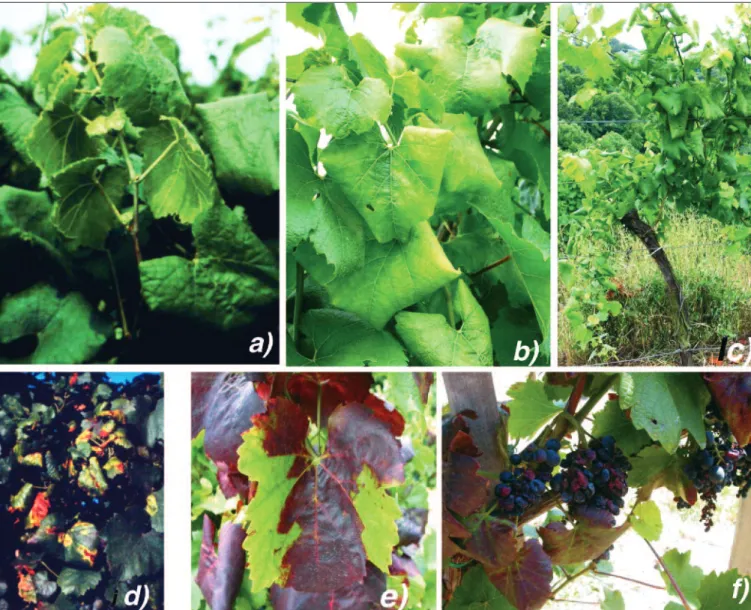
Symptoms of GY may appear on several parts of the grapevine stock: on shoots, leaves, flowers, bunches and on the canes. The first symptoms become visible on young leaves in June-July. The young diseasedV. viniferashoots are weak and the necrosis of their terminal buds is frequent. The shoots have fir-like appearance due to their zig-zag growth and shortened internodes, their leaves are pale and slightly rolling downwards; this rolling of leaves will become more evident during the vegetation (Fig. 1a,b).With passing of time the leaf symptoms grow stronger; their rolling becomes triangle-shape, which is typical for phytoplasma infection (Fig. 1b,c). Discoloration develops on the leaf blade. On white varieties:the pale chlorotic colour turns later yellow to golden and becomes necrotic (Fig. 1d);on the red varieties: reddish to purple colours may appear sectorial or on the entire leaf blade including the veins (Fig.1e). Due to uneven lignifications, the diseased shoots have weeping appearance (Fig. 1c).The rubbery canes become susceptible to frost and die during cold winter. It is common that symptom develops only on one shoot or branch of the plant.Infected flowers wither, may die and fall down. The infected bunches wither, may die or the berries shrivel later in the season(Fig 1f). Transmission
GYphytoplasmas are transmitted in persistent mode by univoltine Hemiptera vectors: leafhopper (Cixiidae) and planthopper (Fulgoridae) species that feed in the phloem of the leaves’ veins. Phytoplasmas multiply in the body of the insects. Getting into the salivary gland and then in the saliva they become injected into the phloem of the plant when the insect vector feeds.
Phytoplasmas spread by their vectors only for short distances within the vineyards and in its vicinity. Phyto-plasmas overwinter in the grapevine plants. Long distance dissemination of GY phytoplasmas occurs by the infected propagating material (Martelli&Boudon-Padieu2006).
Major grapevine yellows diseases in Europe
Flavescence dorée (FD)
Flavescence Dorée (FD) was the first GY disease described byCaudwell(1957) in France. Its causal agent, the Flavescene dorée phytoplasma of the 16SrV phylogenetic group, and the FD isolates belong to subgroups 16SrV-C and –D. Based on the newer classification, the species name is ‘CandidatusPhytoplasma vitis’.
FD phytoplasma is on the A2 Quarantine list of European and Mediterranean Plant Protection Organisation (EPPO 2010), a regulated pest in the European Union (Council Directive2000/29), in the countries of the North American Plant Protection Organization (NAPPO 2009), in South Africa and New Zealand, too. Presence of FD is known in France, Italy, Portugal, Serbia, Slovenia, Spain, and
Switzerland (Martelli & Boudon-Padieu 2006). Quite recently it has been reported also from Croatia and Austria (Seruga Musicet al. 2010;EPPO2010).
FD is highly epidemic and can cause important crop losses. The quantity and quality of the crop of the infected vines are significantly reduced. In case of severe infection the plants may decline in a few years after it became infected (OEPP/EPPO1997).
All theVitis viniferavarieties grown in France, Italy and Spain were found susceptible to FD but they showed various levels of sensitivity. It was observed that the highly susceptible varieties did not recover after infection. FD-infected vines may recover in the second year if they were protected with insecticide sprayings from re-infection. In case of re-infection of plants after recovery, symptoms might appear only on a few shots. The highly sensitive varieties do not recover. The disease is manifested very quickly, and the Fig 1:Typical symptoms of Grapevine yellows (GY) diseases:a) First symptoms on young shoot: zig-zag growths and shortened internodes, pale, downward rolling leaves;b)leaf rolling and chlorosis become more evident during vegetation,c)severe, triangle-shape leaf rolling is typical for GY.d)On white varieties the colour of the leaves turn yellow; leaf blades show yellow areas with necrotic tissues;e)on red varieties reddish to purple colours may appear sectorial (in the centre)or on the entire leaf blade including the veins(left).f)Berries shrivel and die on the infected bunches
plant declines. Sensitive varieties (such as Alicante Bouschet, Grenache, Cabernet Sauvignon, Sauvignon Blanc and Chardonnay) may recover when they are protected from new infections. Symptoms are very rarely found on Syrah. Merlot seems more tolerant although heavily infected plants can be also found (Martelli&Boudon-Padieu2006).
Generally the symptoms develop on the whole plant. According to the observations ofAngeliniet al. (2006) the first symptoms in the season appear on FD-infected grapevines. The symptoms become more pronounced by the autumn and the leaves stay longer on the affected plants. The American rootstocks are generally symptomless carriers of the disease, so they provide dangerous infection source.Vitis ripariarootstocks are latently infected by FD or symptoms only rarely develop. In case of certain rootstock varieties, GY symptoms appear in rolling of leaves and lack of lignification. Necrosis of the terminal bud may occur on rooted cuttings of the infected canes.
FD phytoplasma is transmitted from grapevine to grapevine only by Scaphoideus titanus Ball (Homoptera, Cicadellidae), the American grapevine leafhopper in a persistent manner. It was introduced from North America into Europe by infested propagating material at the beginning of the 20th century and it established in several countries: France, Italy, Spain, Portugal, Serbia, Slovenia, Switzerland, Croatia, Austria and Hungary (Deret al. 2007).
S. titanushas one generation per year and overwinters in form of eggs. The females oviposit under the bark of 2-year-old or 2-year-older shoots. All larval stages and the imago feed only on grapevine (monophagous) and are capable to transmit FD. Infected propagating material is a dangerous source of infection if used for planting in FD-free area where theS. titanusvector is already present. So the risk for introduction and establishment of FD in these areas e.g. in Hungary is very high.
Bois noir (BN)
The BN disease was first described also by Caudwell (1961) in France and later it was reported as Vergilbunsgskrankheit (VK) or Schwarzholzkrankheit from Germany and as Legno nero from Italy. In the 1990s it was found that the causal agents of these diseases were closely related and the same vector, Hyalesthes obsoletus was determined for all of them. Later it was proved that BN and FD diseases are caused by different phytoplasmas (Martelli &Boudon-Padieu2006).
The species name of the causal agent is ‘Candidatus Phytoplasma solani’. The strains of this phytoplasma belong to the ribosomal stolbur phytoplasmas (16SrXII-A) subgroup. Three isolates are associated with BN in grapevine and they have distinctive specificity for certain weed host species.Tuf-atype has specific association to stinging nettle (Urtica dioica) and tuf-b type to field bindweed (Convolvulus arvensis).Tuf-b type has been more frequently found in several countries in eastern and southern regions of Europe. Tuf-ctype has been identified in hedge bindweed
(Calystegia sepium)and only on a limited area of Germany so far. The fourth strain was identified in Reptalus panzeri planthopper (Maixner2011).
BN disease is endemic and widespread in the Medi-terranean region and in countries of Western, Central and Eastern Europe as well as in Lebanon and Israel. Recently it has been reported from Iran and China. However it is not known to be present in North America, Australia, New Zealand or South Africa (Martelli&Boudon-Padieu2006).
The importance of the disease is increasing due to its continuous spread in Europe in the last ten years. The phytoplasma induces severe economic loss due to reduction of the quality and quantity of yield and also vitality of grapevine. Majority of theV. viniferavarieties are susceptible to stolbur. Infection of rootstock varieties has not been reported so far but it cannot be excluded.
BN symptoms can be observed on all parts of the plant but their severity varies between cultivars, e.g. symptoms are generally well expressed on Chardonnay. Frequently, symptoms remain restricted only to one shoot of the infected plant. Symptom remission and recovery of the BN infected vines can be often observed.
Hyalesthes obsoletus (Cixiidae), the polyphagous planthopper is the known vector of BN. It is widespread and occurs in high numbers in Germany, France, Italy, Israel, Switzerland, Serbia and Spain. The main perennial hosts of H. obsoletus, bindweed and stinging nettle are natural reservoirs of Stolbur in several countries. The vector overwinters in juvenile larval stage on roots and stays there until its last developmental stage acquiring stolbur phytoplasma from the roots of weed species and the adults can transmit it onto grapevine during probing. Grapevine is only an occasional feeding host for the adults. Grape to grape stolbur transmission has not been observed so far, soVitisis a dead-end host for stolbur.
In infected vineyards of several countries, like in Hungary, H. obsoletus is present although in very low population densities. In spite of the low abundance of H. obsoletus, BN disease is widely distributed and its importance is continuously developing. Although Reptalus quinquecostatusandEuscelis lineolatus(Cixiidae) were able to transmit stolbur to artificial feeding medium (Pinzauti, 2008; Landiet al, 2009), their eventual vectoring ability on grapevine needs to be studied.Macosteles quadripunctulatus andAnaceratagallia ribautiwere able to infect herbaceous experimental plants in Spain and in Austria (Battle et al. 2008;Riedle-Bauer&Sára2009), so the possibility of their ability to transmit stolbur to grapevine still has to be tested.
Infected propagating material is responsible for the long-distance dissemination of BN disease.
Control measures against GY phytoplasmas
According to the current knowledge, curative methods for phytoplasma-infected plants do not exist; therefore prevention measures have high importance. These areplanting of healthy propagating material and the control of the vector populations.
The application of pathogen-tested (also phytoplasma-tested) propagating materialhaving higher biological value is a key element of establishing new plantations in profitable grapevine industry.
In countries where grapevine growing and wine industry play an economically important role, national certification schemes have been developed and introduced in the course of the last forty years in order to produce pathogen-free propagating material of the valuable varieties and clonal selections under strictly regulated and controlled conditions ensuring trueness-to-type and phytosanitary aspects. These national efforts have been and are also currently supported by international organizations, such as FAO of the United Nations, Regional Plant Protection Organizations (e.g. EPPO, NAPPO), as well as the European Grapevine Clone Selectors Association (AEOCV), providing technical recommendations and guidelines for their members (Frison & Ikin 1991; Mannini 2003; OEPP/EPPO 2008; NAPPO 2009). Within the European Union, the activities related to grapevine propagation and marketing of the vegetative propagated material are regulated including the phytosanitary issues (Council Directive 68/193/EEC; Council Directive 2000/29/EC).
Healthy propagating material can be produced using pathogen-free rootstock and budwood originating from healthy mother plants maintained in virus- and phytoplasma-free surroundings.
In the grapevine growing areas where FD is present, production of propagating material is forbidden in order to avoid the dissemination of the phytoplasma for long distances by means of eventually infected budwood.
Regular and strict phytosanitary inspection of the grapevine mother blocks and the nurseries is of basic importance as the danger of their becoming infected is continuously increasing with the rapid rising of the number of insect vectors due to the global warning. Mother plants of scion varieties, with suspicious symptoms reminding of phytoplasma infection, need to be tested by PCR based procedure. Budwood may not be taken from diseased plants. As on rootstock varieties, symptoms show up only rarely, laboratory testing is required for the detection of their latent infections.
For the successful laboratory diagnosis of GY phytoplasmas main veins and petioles of symptomatic leaves or scrapings of the phloem tissues from the canes are used. Different extraction protocols and PCR-based assays were described to detect FD and BN infection. For routine mass screening of the mother plants real time PCR methods are suggested. Quite recently multiplex nested PCR assay has been developed for simultaneous detection and identification of FD and BN phytoplasmas (Angelini2010).
A special technique, thehot water treatmentof grapevine budwood was developed byCaudwellet al. (1990) in France to eliminate FD from the infected propagating material. It was recommended to use hot water therapy (50
0 C and
agitated there for 45 minutes) only for fully dormant budwood or rooted plants. Since that time the procedure and the mechanization have been further developed ( Boudon-Padieu & Grenan 2002). Only high quality propagating material may be treated just before planting and the treated plant material requires special care. All the recommendations of the protocol have to be strictly followed. Disregarding any of the precautions listed in the description of the procedure could lead to remarkable loss of the planting material.
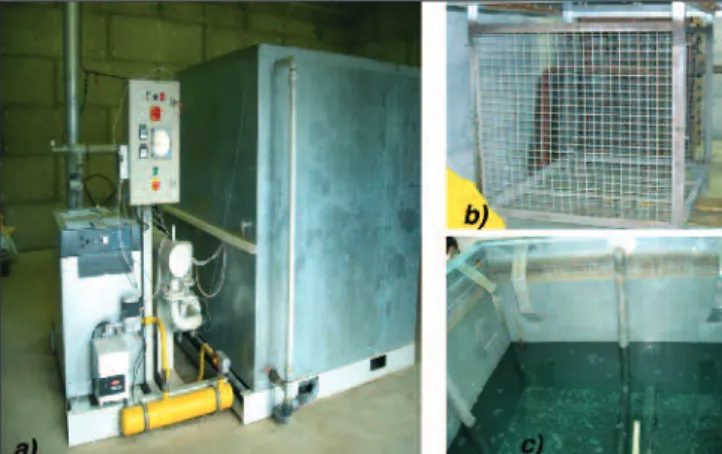
The prototype of the hot water treatment device has been developed by ENTAV, France and patented. Based on intensive studies and experiments of several years, the above method has been introduced and successfully applied for large scale application also against stolbur phytoplasma in France (Fig. 2), Italy and Australia (Mannini et al. 2009). This treatment has a positive effect against several bacterial diseases, certain fungi, pests and insects, as well as for killing the eggs ofS. titanuslaid under the bark.
Hot water treatment of the propagating material and the maintenance of the mother plant blocks providing the “base” material under insect-proof screen-house are proposed to avoid phytoplasma infection (Mannini2007).
Possible control measures against phytoplasmas in the vineyards are based on the biology of their insect vectors. Control measures against FDare compulsory in France and Italy. Indirect but efficient way of control is to apply insecticide treatments against S. titanus vector. Three treatments with chemical insecticides can prevent the development of FD epidemics. The 1sttreatment has to apply 30 days after the emergence of the first-instar larvae. This is the beginning of potential transmission period. The 2nd treatment is to kill the newly emerged insects at the beginning of July and the 3rdtreatment is against the winged adults migrating from nearby vineyards or wild vines in the beginning of August (Martelli &Boudon-Padieu2006). In France, studies on biological control using dryinid Fig 2:Patented device for hot water treatment of high number of grapevine propagating material in France:a)container part from outside (on theright) and the controller part (on the left) of the device;b)basket for the propagating material to be dipped into the hot water of the container; c) inside part of the container, where the propagating material will be soaked with agitation at 50 °C for 45 minutes.
parasitoids from North America are in progress (Maixner 2006).
Management of FD includes rouging of FD-infected grapevine plants in order to avoid or reduce epidemics as otherwise they would serve as continuous infection source. Rouging is compulsory in France.
Control ofBN phytoplasma is more difficult than of FD as BN is more widespread and its epidemic cycle includes more host plant species as inoculum sources. In addition to grapevine, stolbur phytoplasma infects Solanaceae crops, maize and lavender, causing economic damage to them. High number of weed species belongs also to its host range.
Although the mechanical and chemical weed control may reduce the population of the polyphagous vector of BN, but the insecticide treatments are not efficient against H. obsoletusdue to its biology and feeding behaviour. To the development of innovative and specific control strategies further studies are needed on the biology and behaviour of H. obsoletus.
Control of weed host species of BN within the vineyard and also in the surroundings can be a useful measure to decrease the infection pressure. However, it is very important to know that weed control may not be carried out during the flight activity of the adultH. obsoletusas otherwise they are forced to move onto grapevine. Well-managed plant cover can reduce the attractiveness of vineyards (Maixner2006).
New GY outbreaks can be observed in different parts of Europe where the abundance ofH. obsoletusis low and other sufficient explanations are also missing. Several open questions need to be studied in the aetiology and epidemiology of phytoplasmas in order to better understand the possible factors inducing GY epidemics.
References
Angelini, E. (2010): Field assessment and diagnostic methods for detection of grapevine phytoplasmas. pp.: 248–258 in: Delrot, S. Medrano,H. Or, E., Bavaresco, L. & Grando, S. (Eds.) Methodologies and Results in Grapevine Research. Springer, Dordrecht–Heidelberg–London–New York.
Angelini, E., Filippin, L., Michelini, C., Bellotto, D. & Borgo, M. (2006):High occurrence of Flavescence dorée phytoplasma early in the season on grapevines infected with grapevine yellows. Vitis, 45: 151–152.
Battle, A., Altabella, N., Sabate, J. & Lavina, A. (2008):Study on transmission of Stolbur phytoplasma to different crop species by
Macrosteles quadripunctulatus. Annals of Applied Biology, 152: 235–242.
Bertaccini, A. & Duduk, B. (2009):Phytoplasma and phytoplasma diseases: a review of recent research. Phytopathologia Mediterranea, 48: 355–378.
Boudon-Padieu, E. & Grenan, S. (2002): Hot water treatment. www.icgv.ch/methods.htm
Caudwell, A. (1957): Deux années d’études sur la Flavescence dorée, nouvelle maladie grave de la vigne. (A 2-year study on Flavescence dorée, a new severe disease of grapevine). Annales Amél. Plantes, 4: 359–393.
Caudwell, A. (1961):Etude sur la maladie du bois noir de la vigne: ses rapports avec la Flavescence dorée. (Study on the bois noir disease of grapevine: its relationships with Flavescence dorée). Annales Epiphyties, 12 (3): 241–262.
Caudwell, A., Larrue, J., Valat, C. & Grenan, S. (1990): Les traitements à l’eau chaude des bois de vigne atteints de la Flavescence dorée. (Hot water treatment of grapevine shoots infected with Flavescence dorée) Progrès Agricole et Viticole, 107 (12): 281–286.
Council Directive 1968/193/EC of 9 April (1968) on the marketing of material for vegetative propagation of the vine. Official Journal, (OJ) L 156, 15.7. 1967. 30.
Council Directive 2000/29/EC of 8 May (2000) on protective measures against the introduction into the Community of organisms harmful to plants or plant products and against within the Community. Official Journal (OJ) L 169, 10.7. 2000, p. 1.
Dér Zs., Koczor S., Zsolnai B., Ember I., Kolber M., Bertaccini A. & Alma A. (2007):Scaphoideus titanusidentified in Hungary.-Bulletin of Insectology, Vol. LX (2): 199–200.
Doi Y., M. Teranaka, K. Yora & H. Asuyuma (1967): Myco-plasma or PLT group-like microorganisms found in the phloem elements of plants infected with mulberry dwarf, potato witches’ broom, aster yellows or paulownia witches’ broom. Annals of Phytopathological Society Japan, 33: 259–266.
EPPO/CABI (1997): Flavescence Dorée. In: Smith, I. M., McNamara, D. G., Scott, P.R. & Holderness, M. CABI Inter-national, Wallingford, UK, 1011–1021.
Frison, E. A. & Ikin, R. (eds.). (1991) FAO/IBPGR Technical Guidelines for the Safe Movement of Grapevine Germplasm.Food and Agriculture Organization of the United Nations, Rome/ International Board for Plant Genetic Resources, Rome. Pp.1–54. Hogenhout , S. A., OSHIMA, K., Ammar, E.-D., Kakizawa, S., Kingdom, H. N. & Namba, S. (2008):Phytoplasmas: bacteria that manipulate plants and insects. Molecular Plant Pathology, 9 (4): 403–423.
IRPCM Phytoplasma/Spiroplasma Working Team-Phyto-plasma Taxonomy Group (2004): ‘CandidatusPhytoplasma’, a taxon for the wall-less, non-helical prokaryotes that colonize plant phloem and insects. International Journal of Systematic & Evolutionary Microbiology, 54: 1243–1255.
Landi, L., Isidoro, N., & Riolo, P. (2009): Vector-phytoplasma relationship during natural infection of Hyalesthes obsoletus, Euscelis lineolatus, Neoaliturus fenestratus and Psammotettix alienuscaptured in vineyard agro-ecosystems in the Marche region (Central-Eastern Italy). Extended abstracts 16th Meeting ICVG, Dijon, France, 202–203.
Lee I.-M. & Davis, R. E. (1986):Prospects for in vitro culture of plant-pathogenic mycoplasma-like organisms. Annual Review of Phytopathology, 24: 339–354.
Maixner, M. 2006:Grapevine yellows – current developments and unsolved questions. Extended Abtracts 15th Meeting of ICVG,
Stellenbosch, South Africa, 86–87.
Maixner, M. (2011): Recent advances in Bois noir research. pp.: 17–31 in Book of Abstracts of the 2nd European Bois Noir Workshop 2011, Castelbrando, Italy, February27 / March 1. 2011. Mannini, F. (2003):Grapevine clonal and sanitary selection: the point of view of E.U. selectors Extended Abstracts 14thMeeting of ICVG, Locorotondo, Italy, 12–17: 150.
Mannini, F., Argamante, N., Gambino, G. & Mollo, A. (2009): Phytoplasma diffusion through grapevine propagation material and hot water treatment. Extended abstracts, 16thMeeting of ICVG, Dijon, France, 31 Aug–4 Sept 2009, 182–183.
Marcone, C. (2010): Movement of phytoplasmas and the development of disease in the plant. Pp.114–131.in:Weintraub, P. G. & Jones P. (eds.) Phytoplasmas: Genomes, Plant Hosts and Vectors. CAB International, Wallingford
Martelli, G. P. & Boudon-Padieu, E. (2006): Directory of infectious diseases of grapevines and viroses and virus-like diseaes of the grapevine, Bibliographic report 1998–2004. Options méditer-ranéennes, Serie B: Studies and Research, 55: 135–194.
NAPPO (2009):Guidelines for the Movement of Stone and Pome Fruit Trees and Grapevine into a NAPPO Member Country (RSPM35)
OEPP/EPPO (2008): Certification scheme: Pathogen-tested material of grapevine varieties and rootstocks, PM 4/8(2), Bulletin OEPP/EPPO Bulletin, 38: 422–429.
OEPP/EPPO (2010):EPPO A1 and A2 list of pests recommended for regulation as quarantine pests. EPPO Standards. PM1/2(19).
OEPP/EPPO (2010):First report of Grapevine Flavescence Dorée in Austria. EPPO Reporting Service, 132: 6–7.
Pinzauti, F., Trivellone, V. & Bagnoli, B. (2008): Ability of
Reptalus quinquecostatus (Hemiptera: Cixiidae) to inoculate Stolbur phytoplasma to artificial feeding medium. Annals of Applied Biology 153: 299–305.
Riedle-Bauer, M. & Sára, A. (2009): Anaceratagallia ribauti
(Oss.1938) (Hemiptera, Auchenorrhyncha, Agalliinae) transmits Stolbur type phytoplasma. Extended abstracts 16th Meeting of ICVG, Dijon, France, 200–201.
Seruga Music, M., Skoric, D. & Haluska, I. (2011):First report of Flavescence Dorée-related phytoplasma affecting grapevines in Croatia. Plant Disease, 95, 3: 353.
Weintraub, P. G. & Beanland, L. (2006): Insect vectors of phytoplasmas. Annual Review of Entomology, 51: 91–111. Zhao, Y., Wei, W., Lee, I.-M., Shao, J., Suo, X. & Davis, R.E. (2009): Construction of an interactive online phytoplasma classification tool,iPhyClassifier, and its application in analysis of the peach X-disease phytoplasma group (16SrIII). Int. J. Syst. Evol. Microbiol., 59: 2582–2593.