BlobSeer: How to Enable Efficient Versioning for Large
Object Storage under Heavy Access Concurrency
Bogdan Nicolae
University of Rennes 1, IRISA,Rennes, France
Gabriel Antoniu
∗ INRIA, Centre Rennes -Bretagne Atlantique, IRISA,Rennes, France
Luc Bougé
ENS Cachan/Brittany, IRISA, France
ABSTRACT
To accommodate the needs of large-scale distributed P2P systems, scalable data management strategies are required, allowing appli-cations to efficiently cope with continuously growing, highly dis-tributed data. This paper addresses the problem of efficiently stor-ing and accessstor-ing very large binary data objects (BLOBs). It pro-poses an efficient versioning scheme allowing a large number of clients to concurrentlyread, write and appenddata to huge BLOBs that are fragmented and distributed at a very large scale. Scalability under heavy concurrency is achieved thanks to an original metadata scheme, based on a distributed segment tree built on top of a Dis-tributed Hash Table (DHT). Our approach has been implemented and experimented within ourBlobSeerprototype on the Grid’5000 testbed, using up to 175 nodes.
1. INTRODUCTION
Peer-to-peer (P2P) systems have extensively been studied dur-ing the last years as a means to achieve very large scale scalability for services and applications. This scalability is generally obtained through software architectures based on autonomic peers which may take part in a collaborative work process in a dynamic way: they may join or leave at any time, publish resources or use re-sources made available by other peers. P2P environments typically need scalable data management schemes able to cope with a grow-ing number of clients and with a continuously growgrow-ing data, (e.g. data streams), while supporting a dynamic and highly concurrent environment.
As the usage of the P2P approach extends to more and more ap-plication classes, the storage requirements for such a large scale are becoming increasingly complex due to the rate, scale and variety of data. In this context, storing, accessing and processingvery large, unstructured datais of utmost importance. Unstructured data con-sists of free-form text such as word processing documents, e-mail, Web pages, text files, sources that contain natural language text, images, audio and video streams to name a few.
∗Corresponding Author: Gabriel Antoniu, INRIA/IRISA,
Cam-pus de Beaulieu, 35042 Rennes Cedex, France,gabriel.antoniu@ inria.fr
Permission to make digital or hard copies of all or part of this work for personal or classroom use is granted without fee provided that copies are not made or distributed for profit or commercial advantage and that copies bear this notice and the full citation on the first page. To copy otherwise, to republish, to post on servers or to redistribute to lists, requires prior specific permission and/or a fee.
Copyright 200X ACM X-XXXXX-XX-X/XX/XX ...$5.00.
Studies show more than 80% [7] of data globally in circulation is unstructured. On the other hand, data sizes increase at a dramatic level: for example, medical experiments [14] have an average re-quirement of 1 TB per week. Large repositories for data analysis programs, data streams generated and updated by continuously run-ning applications, data archives are just a few examples of contexts where unstructured data that easily reaches the order of 1 TB.
Unstructured data are often stored as abinary large object (BLOB) within a database or a file. However, these approaches can hardly cope with BLOBs which grow to huge sizes. To address this issue, specialized abstractions like MapReduce [4] and Pig-Latin [13] propose high-level data processing frameworks intended to hide the details of parallelization from the user. Such platforms are imple-mented on top of huge object storage and target high performance by optimizing the parallel execution of the computation. This leads toheavy access concurrencyto the BLOBs, thus the need for the storage layer to offer support in this sense. Parallel and distributed file system also consider using objects for low-level storage [5, 16, 6]. In other scenarios, huge BLOBs need to be used concurrently at the highest level layers of applications directly: high-energy physics applications, multimedia processing [3] or astronomy [12]. In this paper we address the problem of storing and efficiently accessing very large unstructured data objects [10, 14] in a dis-tributed environment. We focus on the case where data ismutable and potentially accessed by a very large number of concurrent, dis-tributed processes, as it is typically the case in a P2P system. In this context,versioningis an important feature. Not only it allows to roll back data changes when desired, but it also enables cheap branching (possibly recursively): the same computation may pro-ceed independently on different versions of the BLOB. Version-ing should obviously not significantly impact access performance to the object, given that objects are under constant heavy access concurrency. On the other hand, versioning leads to increased stor-age space usstor-age and becomes a major concern when the data size itself is huge. Versioning efficiency thus refers to both access per-formance under heavy load and reasonably acceptable overhead of storage space.
Related work has been carried out in the area of parallel and dis-tributed file systems [1, 2, 6] and archiving systems [17]: in all these systems the metadata management is centralized and mainly optimized for data reading and appending. In contrast, we rely on metadata decentralization, in order to introduce anefficient version-ingscheme for huge, large-scale distributed BLOBs that are con-currently accessed by an arbitrarily large number of clients which may read, write or append data to BLOBs. Our algorithm guaran-tees atomicity while still attaining good data access performance. Our approach splits a huge BLOB into small fixed-sized pages that are scattered across commodity data providers. Rather than
updat-ing the current pages, completely new pages are generated when clients request data modifications. The corresponding metadata is “weaved” with old metadata in such way as to offer a complete virtual view of both the past version and the current version of the BLOB. Metadata is organized as a segment-tree like structure (see Section 4) and is also scattered across the system using a Dis-tributed Hash Table (DHT). Distributing data and metadata not only enables high performance through parallel, direct access I/O paths, but also favors efficient use of storage space: although a full vir-tual view of all past versions of the BLOB is offered, real space is consumed only by the newly generated pages.
Our approach has been implemented and experimented within our prototype, calledBlobSeer: a binary large object management service. In previous work [12, 11] we have handled versioning in a static way: BLOBs were considered huge storage objects of prede-fined,fixedsizes that are first allocated, then manipulated by read-ing and writread-ing parts of them. However, in most real life scenar-ios, BLOBs need to dynamically grow, as new data is continuously gathered. This paper improves on our previous work as follows. First, we introduce support for dynamic BLOB expansion through atomic append operations. Second, we introduce cheap branch-ing, allowing a BLOB to evolve in multiple, completely different ways through writes and appends starting from a particular snap-shot version. This may be very useful for exploring alternative data processing algorithms starting from the same BLOB version.
The paper is organized as follows. Section 2 restates the speci-fication of the problem in a more formal way. Section 3 provides an overview of our design and precisely describes how data access operations are handled. The algorithms used for metadata manage-ment are discussed in Section 4. Section 5 provides a few imple-mentation details and reports on the experimental evaluation per-formed on multi-site grid testbed. On-going and future work is discussed in Section 6.
2. SPECIFICATION
Our goal is to enable efficient versioning of BLOBs in a highly concurrent environment. In such a context, an arbitrarily large number ofn clients compete to read and update the BLOB. A BLOB grows as clients append new data and its contents may be modified by partial or total overwriting.
Each time the BLOB gets updated, a new snapshot reflecting the changes and labeled with an incremental version is generated, rather than overwriting any existing data. This allows access to all past versions of the BLOB. In its initial state, we assume any BLOB is considered empty (its size is 0) and is labeled with ver-sion 0.(Note that our previous work [12, 11] was relying on dif-ferent assumptions: the BLOB size was statically specified at the initialization time and could not be extended.)
Updates are totally ordered: if a snapshot is labeled by version
k, then its content reflects the successive application of all updates
1..k−1on the initial empty snapshot in this order. Thus generating a new snapshot labeled with versionkis semantically equivalent to applying the update to a copy of the snapshot labeled with version
k−1. As a convention, we will refer to the snapshot labeled with versionksimply bysnapshotkfrom now on.
2.1 Interface
To create a new BLOB, one must call the CREATE primitive: id = CREATE( )
This primitive creates the BLOB and associates to it an empty snap-shot 0. The BLOB will be identified by itsid(the returned value).
Theidis guaranteed to be globally unique.
vw = WRITE(id, buffer, offset , size )
A WRITE initiates the process of generating a new snapshot of the BLOB (identified byid) by replacingsizebytes of the BLOB starting atoffsetwith the contents of the localbuffer.
The WRITE does not know in advance which snapshot version it will generate, as the updates are totally ordered and internally man-aged by the storage system. However, after the primitive returns, the caller learns about its assigned snapshot version by consulting the returned valuevw. The update will eventually be applied to the snapshotvw−1, thus effectively generating the snapshotvw. This snapshot version is said to bepublishedwhen it becomes available to the readers. Note that the primitive may return before snapshot version vw is published. The publication time is unknown, but the WRITE isatomicin the sense of [8]: it appears to execute in-stantaneously at some point between its invocation and completion. Completion in our context refers to the moment in time when the newly generated snapshotvwis published.
Finally, note that the WRITE primitive fails if the specifiedoffset is larger than the total size of the snapshotvw−1.
va = APPEND(id, buffer, size )
APPEND is a special case of WRITE, in which theoffsetis implic-itly assumed to be the size of snapshotva−1.
READ(id, v, buffer , offset , size )
A READ results in replacing the contents of the localbufferwith sizebytes from the snapshot versionv of the BLOBid, starting atoffset, ifvhas already been published. If vhas not yet been published, the read fails. A read fails also if the total size of the snapshotvis smaller thanoffset + size.
Note that the caller of the READ primitive must be able to learn about the new versions that are published in the system in order to provide a meaningful value for thevargument. The BLOB size corresponding to snapshotvis also required, to enable valid s from the BLOB to be read. The following primitives are therefore pro-vided:
v = GET_RECENT(id)
This primitive returns a recently published version BLOBid. The system guarantees thatv≥max(vk), for all snapshot versionsvk
published before the call.
size = GET_SIZE(id, v)
This primitive returns the size of the BLOB snapshot corresponding to versionvof the BLOB identified byid. The primitive fails ifv
has not been published yet.
Since WRITE and APPEND may return before the correspond-ing snapshot version is published, a subsequent READ attempted by the same client on the very same snapshot version may fail. However, it is desirable to be able to provide support for “read your writes” consistency. For this purpose, the following primitive is added:
SYNC(id, v)
The caller of SYNC blocks until snapshotvof BLOBidis pub-lished.
Our system also introduces support for branching, to allow al-ternative evolutions of the BLOB through WRITE and APPEND starting from a specified version.
This primitive virtually duplicates the BLOB identified byidby creating a new BLOB identified bybid. This new BLOB is iden-tical to the original BLOB in every snapshot up to (and including)
v. The first WRITE or APPEND on the BLOBbidwill generate a new snapshotv+ 1for BLOBbid. The primitive fails if versionv
of the BLOB identified byidhas not been published yet.
2.2 Usage scenario
Let us consider a simple motivating scenario illustrating the use of our proposed interface. A digital processing company offers on-line picture enhancing services for a wide user audience. Users up-load their picture, select a desired filter, such as sharpen and down-load their picture back. Most pictures taken with a modern camera include some metadata in their header, describing attributes like camera type, shutter speed, ambient light levels, etc. Thousands of users upload pictures every day, and the company would like to an-alyze these pictures for statistical purposes. For example it might be interesting to find out the average contrast quality for each cam-era type.
One option to address this problem would be to store the pictures in a huge database and perform some query when needed. Unfortu-nately, pictures are unstructured data: metadata is not standardized and may differ from one camera brand to another. Thus, no con-sistent schema can be designed for query optimization. Moreover, it is unfeasible to store variable binary data in a database, because database systems are usually fine-tuned for fixed-sized records.
Let us now consider using a virtually unique (but physically dis-tributed) BLOB for the whole dataset. Pictures are APPEND’ed concurrently to the BLOB from multiple sites serving the users, while a recent version of the BLOB is processed at regular inter-vals: a set of workers READ disjoint parts of the BLOB, identify the set of pictures contained in their assigned part, extract from each picture the camera type and compute a contrast quality co-efficient, and finally aggregate the contrast quality for each cam-era type. This type of computation fits in the class of map-reduce applications. The map phase generates a set of (key, value) pairs from the BLOB, while the reduce phase computes some aggrega-tion funcaggrega-tion over all values corresponding to the same key. In our example the keys correspond to camera types.
Many times during a map phase it may be necessary to overwrite parts of the BLOB. For example, a complex image processing was necessary for some pictures and overwriting the picture with its processed version saves computation time when processing future BLOB versions. Surely, a map with an idempotent reduce reaches the same result with no need to write, but at the cost of creating an output that duplicates the BLOB, which means an unacceptable loss of storage space.
3. DESIGN OVERVIEW
Our system is striping-based: a BLOB is made up of blocks of a fixed sizepsize, referred to aspages. Each page is assigned to a fixed range of the BLOB(k×psize,(k+1)×psize−1). Any range that covers a full number of pages is said to bealigned. These pages are distributed among storage space providers.Metadatafacilitates access to a range(offset, size)for any existing version of a BLOB snapshot, by associating such a range with the page providers.
A WRITE or APPEND generates anewset of pages correspond-ing to the offset and size requested to be updated. Metadata is then generated and “weaved” together with the old metadata in such way as to create the illusion of a new incremental snapshot that actually shares the unmodified pages with the older versions. Thus, two suc-cessive snapshotsvandv+ 1physically share the pages that fall outside of the range of the update that generated snapshotv+ 1.
Consider a read for snapshotvwhose range fits exactly a single page. The physical page that is accessed was produced by some up-date that generated snapshotw, withw≤vsuch thatwis the high-est snapshot version generated by an update whose range intersects the page. Therefore, when the range of a READ covers several pages, these pages may have been generated by different updates. Updates that do not cover full pages are handled in a slightly more complex way, but not discussed here, due to space constraints.
3.1 Architecture overview
Our distributed service consists of communicating processes, each fulfilling a particular role.
Clients may create BLOBs and read, write and append data to them. There may be multiple concurrent clients, and their number may dynamically vary in time.
Data providers physically store the pages generated by WRITE and APPEND. New data providers may dynamically join and leave the system.
The provider manager keeps information about the available stor-age space. Each joining provider registers with the provider manager. The provider manager decides which providers should be used to store the generated pages according to a strategy aiming at ensuring an even distribution of pages among providers.
The metadata provider physically stores the metadata allowing clients to find the pages corresponding to the BLOB snap-shot version. Note that the metadata provider may be im-plemented in a distributed way. However, for the sake of readability, we do not develop this aspect in our presentation of the algorithms we propose for data access. Distributed metadata management is addressed in detail in Section 4.
The version manager is the key actor of the system. It registers update requests (APPEND and WRITE), assigning snapshot version numbers, end eventually publishes these updates, guar-anteeing total ordering and atomicity.
Our design targets scalability and large-scale distribution. There-fore, we make a key design choice in avoiding a static role distribu-tion: any physical node may play one or multiple roles, as a client, or by hosting data or metadata. This scheme makes our system suitable for a P2P environment.
3.2 Reading data
The READ primitive is presented in Algorithm 1. The client contacts the version manager first, to check whether the supplied versionvhas been published and fails if it is not the case. Other-wise, the client needs find out what pages fully cover the requested offset andsize for versionv and where they are stored. To this purpose, the client contacts the metadata provider and receives the required metadata. Then it processes the metadata to generate a set of page descriptors P D. P D holds information about all pages that need to be fetched: for each page its globally unique page id
pid, its indexiin the buffer to be read and the pageproviderthat stores it. (Note that, for the sake of simplicity, we consider here the case where each page is stored on a single provider. Replication strategies will be investigated in future work.) Having this infor-mation assembled, the client fetches the pages in parallel and fills the localbuffer. Note that the range defined by the suppliedoffset andsizemay not be aligned to full pages. In this case the client may request only a part of the page from the page provider.
Algorithm 1READ
Require: The snapshot versionv Require: The localbufferto read to
Require: Theoffsetin the BLOB
Require: Thesizeto read 1: ifvis not publishedthen
2: fail
3: end if
4: P D←READ_METADATA(v, offset, size) 5: for all(pid, i, provider)∈P Din parallel do
6: readpidfromproviderintobufferati×psize
7: end for
8: return success
Note that, at this stage, for readability reasons, we have not de-veloped yet the details of metadata management. However, the key mechanism that enables powerful properties such as efficient fine-grain access under heavy concurrency relates directly to metadata management, as discussed in Section 4.
3.3 Writing and appending data
Algorithm 2 describes how the WRITE primitive works. For simplicity, we first consider here aligned writes only, with page sizepsize. Unaligned writes are also handled by our system, but, due to space constraints, this case is not discussed here. The client first needs to determine the number of pagesnthat cover the range. Then, it contacts the provider manager requesting a list ofnpage providersP P (one for each page) that are capable of storing the pages. For each page in parallel, the client generates a globally unique page idpid, contacts the corresponding page provider and stores the contents of the page on it. It then updates the set of page descriptorsP Daccordingly. This set is later used to build the metadata associated with this update. After successful com-pletion of this stage, the client contacts the version manager and registers its update. The version manager assigns to this update a new snapshot versionvwand communicates it to the client, which then generates new metadata and “weaves” (details in section 4) it together with the old metadata such that the new snapshotvw ap-pears as a standalone entity. Finally it notifies the version manager of success, and returns successfully to the user. At this point, the version manager takes the responsibility of eventually publishing
vw.
Algorithm 2WRITE
Require: The localbufferused to apply the update.
Require: Theoffsetin the BLOB.
Require: Thesizeto write.
Ensure: The assigned versionvwto be published. 1: n←(offset+size)/psize
2: P P←the list ofnpage providers 3: P D← ∅
4: for all0≤i < nin parallel do
5: pid←unique page id 6: provider←P P[i]
7: store pagepidfrombuffer ati×psizetoprovider
8: P D←P D∪(pid, i, provider)
9: end for
10: vw←assigned snapshot version 11: BUILD_METADATA(vw, offset, size, PD) 12: notify version manager of success 13: returnvw
APPEND is almost identical to the WRITE, with the difference that anoffset is directly provided by the version manager at the time when snapshot version is assigned. This offset is the size of the previously published snapshot version.
Note that our algorithm enables a high degree of parallelism: for any update (WRITE or APPEND), pages may be asynchronously sent and stored in parallel on providers. Moreover, multiple clients may perform such operations with full parallelism: no synchro-nization is needed for writing the data, since each update generates new pages. Some synchronization is necessary when writing the metadata, however the induced overhead is low (see Section 4).
4. METADATA MANAGEMENT
Metadata stores information about the pages which make up a given BLOB, for each generated snapshot version. We choose a simple, yet versatile design, allowing the system to efficiently build a full view of the new snapshot of the BLOB each time an up-date occurs. This is made possible through a key design choice: when updating data, new metadata is created, rather than updating old metadata. As we will explain below, this decision significantly helps us provide support for heavy concurrency, as it favors inde-pendent concurrent accesses to metadata without synchronization.
4.1 The distributed metadata tree
We organize metadata as adistributed segment tree[18], one associated to each snapshot version of a given BLOBid. A segment tree is a binary tree in which each node is associated to a range of the BLOB, delimited byoffsetandsize. We say that the nodecovers the range (offset,size). For each node that is not a leaf, the left child covers the first half of the range, and the right child covers the second half. Each leaf covers a single page. We assume the page sizepsizeis a power of two.
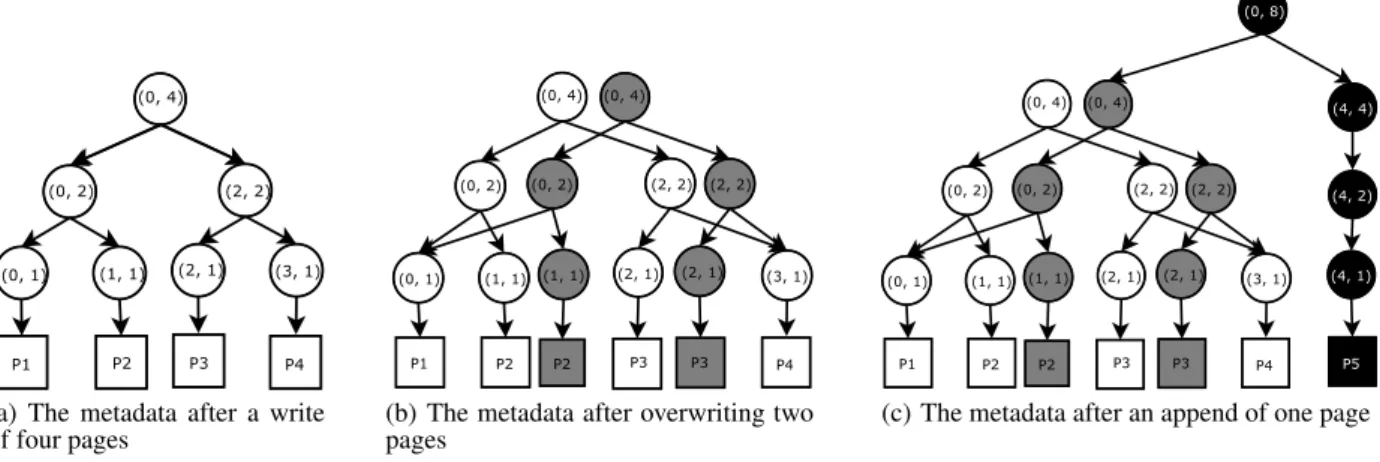
For example, Figure 1(a) depicts the structure of the metadata for a BLOB consisting of four pages. We assume the page size is 1. The root of the tree covers the range(0,4)(i.e.,offset= 0,size = 4 pages), while each leaf covers exactly one page in this range.
Tree nodes are stored on the metadata provider in a distributed way, using a simple DHT (Distributed Hash Table). This choice favors concurrent access to metadata, as explained in Section 4.2. Each tree node is identified uniquely by its version and range speci-fied by the offset and size it covers. Inner nodes hold the version of the left childvland the version of the right childvr, while leaves hold the page idpidand theproviderthat store the page.
Sharing metadata across snapshot versions.
Such a metadata tree is created when the first pages of the BLOB are written, for the range covered by those pages. Note that re-building afull tree for subsequent updates would be space- and time-inefficient. This can be avoided bysharingthe existing tree nodes that cover the BLOB ranges which donotintersect with the range of the update to be processed. Of course, new tree nodes are created for the ranges thatdointersect with the range of the update. These new tree nodes are “weaved” with existing tree nodes gen-erated by past updates, in order to build a a new consistent view of the BLOB, corresponding to a new snapshot version. This process is illustrated on Figures 1(a) and 1(b). Figure 1(a) corresponds to an initial snapshot version (1) of a 4-page BLOB, whereas Fig-ure 1(b) illustrates how metadata evolves when pages 2 and 3 of this BLOB are modified (snapshot version 2). Versions are color-coded: the initial snapshot 1 is white, snapshot 2 is grey. When a WRITE updates the second and third page of the BLOB, the grey nodes are generated:(1,1),(2,1),(0,2),(2,2),(0,4). These new grey nodes are “weaved” with existing white nodes corresponding
(a) The metadata after a write
of four pages (b) The metadata after overwriting twopages (c) The metadata after an append of one page
Figure 1: Metadata representation
to the unmodified pages 1 and 4. Therefore, the left child of the grey node that covers(0,2)is the white node that covers(0,1); similarly, the right child of the grey node that covers(2,2)is the white node covering(3,1).
Expanding the metadata tree.
APPEND operations make the BLOB “grow”: consequently, the metadata tree gets expanded, as illustrated on Figure 1(c). Contin-uing our example, we assume that the WRITE generating snapshot version 2 is followed by an APPEND for one page, which gener-ates snapshot version 3 of the BLOB (black-colored). New meta-data tree nodes are generated, to take into account the creation of the fifth page. The left child of the new black root,(0,8)is the old, grey root of snapshot 2,(0,4).
4.2 Accessing metadata: algorithms
Reading metadata.
During a READ, the metadata is accessed (Algorithm 3) in or-der to find out what pages fully cover the requested rangeR delim-ited byoffsetandsize. It is therefore necessary to traverse down the segment tree, starting from the root that corresponds to the re-quested snapshot version. A nodeN that covers segmentRN is
explored if the intersection ofRN withRis not empty. All
ex-plored leaves reached this way are used to build the set of page descriptorsP Dthat is used to fetch the contents of the pages. To simplify the presentation of the algorithm, we introduce two primi-tives.GET_N ODE(v,offset, size)fetches and returns the con-tents of the node identified by the supplied version, offset and size from the metadata provider. Similarly,GET_ROOT(v)fetches and returns the root of the tree corresponding to versionv.
Writing metadata.
For each update (WRITE or APPEND) producing snapshot ver-sionvw, it is necessary to build a new metadata tree (possibly shar-ing nodes with the trees correspondshar-ing to previous snapshot ver-sions). This new tree is the smallest (possibly incomplete) binary tree such that its leaves are exactly the leaves covering the pages of range that is written. The tree is built bottom-up: first the leaves corresponding to the newly generated pages are built, then the in-ner nodesPare built up to (and including) the root. This process is illustrated in Algorithm 4. Note that inner nodes may have children which donotintersect the range of the update to be processed. For
Algorithm 3READ_M ET A Require: The snapshot versionv Require: Theoffsetof the BLOB
Require: Thesizeto read
Ensure: The set of page descriptorsP D
1: N S←{GET_ROOT(v)} 2: whileN S6=∅do
3: N←extract node fromN S
4: ifNis leafthen
5: i←(N.offset−offset)/psize
6: P D←P D∪(N.pid, i, N.provider)
7: else
8: if(offset, size)intersects(N.of f set, N.size/2)then
9: N S←N S∪GET_N ODE(N.vl, N.of f set, N.size/2)
10: end if
11: if (offset, size) intersects (N.of f set + N.size/2, N.size/2)then
12: N S ← N S ∪ GET_N ODE(N.vr, N.of f set+ N.size/2, N.size/2)
13: end if
14: end if
any given snapshot versionvw, these nodes form theset of border nodesBvw. When building the metadata tree, the algorithm needs
to compute the corresponding versions of such children nodes (vl
orvr). For simplicity, we do not develop here how the set of border nodes is computed before building the tree.
Algorithm 4BU ILD_M ET A
Require: The assigned snapshot versionvw.
Require: Theoffsetin the BLOB.
Require: Thesizeto write.
Require: The set of page descriptorsP D.
Ensure:
1: Q← ∅
2: Bvw←build the set of border nodes
3: for all(pid, i, provider)∈P Ddo
4: N ←N EW_N ODE(vw, of f set+i×psize, psize)
5: N.pid←pid 6: N.provider←provider 7: Q←Q∪ {N} 8: end for 9: V ←Q 10: whileQ6=∅do
11: N ←extract a node fromQ
12: ifNis not rootthen
13: ifN.offset%(2×N.size) = 0then
14: P ←N EW_N ODE(vw, N.offset,2×N.size)
15: position←LEF T
16: else
17: P ← N EW_N ODE(vw, N.offset−N.size,2× N.size)
18: position←RIGHT
19: end if
20: ifPnot∈V then
21: ifposition=LEF Tthen
22: P.vl←vw
23: P.vr←extract right child version fromBvw
24: end if
25: ifposition=RIGHTthen
26: P.vr←vw
27: P.vl←extract left child version fromBvw
28: end if 29: Q←Q∪ {P} 30: V ←V ∪ {P} 31: end if 32: end if 33: end while
34: for allN ∈V in parallel do
35: writeNto the metadata provider 36: end for
Why WRITEs and APPENDs may proceed in parallel.
Building new metadata tree nodes might seem to require serial-ization. Consider two concurrent clientsC1andC2. Let us assume that, after having written their pages in parallel, with no synchro-nization, that contact the version manager to get their snapshot ver-sions. Let us assumeC1 gets snapshot versionsvwandC2 gets snapshot versionvw+ 1. The two clients should then start to build their metadata tree nodes concurrently. However, it may seem that clientC2must wait for clientC1to complete writing metadata, be-cause tree nodes built byC1may actually be part of the set of bor-der nodes ofC2, which is used byC2to build its own tree nodes.As our goal is to favor concurrent WRITEs and APPENDs (and,
consequently, concurrent metadata writing), we choose to avoid such a serialization by introducing a small computation overhead. Note thatC2may easily compute the border node setB2 by de-scending the tree (starting from the root) corresponding to snapshot
vwgenerated byC1. It may thus gather all left and right children of the nodes which intersect the range of the update corresponding to snapshotvw+ 1. If the root of snapshotvw+ 1covers a larger range than the root of snapshotvw, then the set of border nodes contains exactly one node: the root of snapshotvw. Our main dif-ficulty comes from the nodes that are build byC1that can actually be part of set of border nodes ofC2, because all other nodes of the set of border nodes ofC2can be computed as described above, by using the root of the latest published snapshotvpinstead of the root ofvw.
Our solution to this is to introduce a small computation over-head in the version manager, who will supply the problematic tree nodes that are part of the set of border nodes directly to the writer at the moment it is assigned a new snapshot version. This is pos-sible because the range of each concurrent WRITE or APPEND is registered by the version manager. Such operations are consid-ered said to beconcurrentwith the update being processed if they have been assigned a version number (after writing their data), but they have not been published yet (e.g. because they have not fin-ished writing the corresponding metadata). By iterating through the concurrent WRITE and APPEND operations (which have been assigned a lower snapshot version), the version manager will build the partial set of border nodes and provide it to the writer when it asks for the snapshot version. The version manager also supplies a recently published snapshot version that can be used by the writer to compute the rest of the border nodes. Armed with both the par-tial set of border nodes and a published snapshot version, the writer is now able to compute the full set of border nodes with respect to the supplied snapshot version.
4.3 Discussion
Our approach enables efficient versioning both in terms of per-formance under heavy load and in terms of required storage space. Below we discuss some of the properties of our system.
Support for heavy access concurrency.
Given that updates always generate new pages instead of over-writing older pages, READ, WRITE and APPEND primitives called by concurrent clients may fully proceed in parallel at the application-level, with no need for explicit synchronization. This is a key fea-ture of our distributed algorithm. Internally, synchronization is kept minimal: distinct pages may read or updated in a fully parallel way; data access serialization is only necessary when the same provider is contacted at the same time by different clients, either for reading or for writing. It is important to note that the strategy employed by the provider manager for page-to-provider distribution plays a central role in minimizing such conflicts that lead to serialization.
Note on the other hand that internal serialization is necessary when two updates (WRITE or APPEND) contact the version man-ager simultaneously to obtain a snapshot version. This step is hov-erer negligible when compared to the full operation.
Finally, the scheme we use for metadata management also aims at enabling parallel access to metadata as much as possible. The situations where synchronization is necessary have been discussed in Section 4.2.
Efficient use of storage space.
Note that new storage space is necessary for newly written pages only: for any WRITE or APPEND, the pages that are NOT updated
are physically shared by the newly generated snapshot version with the previously published version. This way, the same physical page may be shared by a large number of snapshot versions of the same BLOB. Moreover, as explained in Section 4, multiple snapshot ver-sions may partially share metadata.
Atomicity.
Recent arguments [8, 9, 15] stress the need to provide atomic-ityfor operations on objects. An atomic storage algorithm must guarantee any read or write operation appears to execute instanta-neously between its invocation and completion despite concurrent access from any number of clients. In our architecture, the ver-sion manager is responsible for assigning snapshot verver-sions and for publishing them upon successful completion of WRITEs and APPENDs. Note that concurrent WRITEs and APPENDs work in complete isolation, as they do notmodify, but ratheradddata and metadata. It is then up the the version manager to decide when their effects will be revealed to the other clients, by publishing their assigned versions in a consistent way. The only synchronization occurs at the level at the version manager. In our current imple-mentation, atomicity is easy to achieve, as the version manager is centralized. Using a distributed version manager will be addressed in the near future.
Waiting for a version to get published.
Clients that need to make sure that a specific version of the BLOB has already been published will call SYNC (see Section 2.1) be-fore calling READ. To implement SYNC, we internally employ a publish-subscribe scheme. The clients simply subscribe to receive new versions that are published by the version manager and wait until the desired version was announced, then unsubscribe.
5. EXPERIMENTAL EVALUATION
We experimented and evaluated the approach developed above within the framework of our BlobSeer prototype. To implement the metadata provider in a distributed way, we have developed a custom DHT (Distributed Hash Table), based on simple static distribution scheme. This allows metadata to be efficiently stored and retrieved in parallel.
Evaluations have been performed on the Grid’5000 [19] testbed, an experimental Grid platform gathering 9 sites geographically dis-tributed in France. In each experiment, we used at most 175 nodes of the Rennes site of Grid’5000.
Nodes are outfitted with x86_64 CPUs and 4 GB of RAM. In-tracluster bandwidth is 1 Gbit/s (measured: 117.5MB/s for TCP sockets with MTU = 1500 B), latency is 0.1 ms.
We first ran a set of experiments to evaluate the impact of our metadata scheme over the performance of the APPEND operation (in terms of bandwidth), while the BLOB size continuously grows. In these experiments, a single client process creates an empty BLOB and starts appending to it, while we constantly monitor the band-width of the APPEND operation.
We use two deployment settings. We deploy each the version manager and the provider manager on two distinct dedicated nodes, and we co-deploy a data provider and a metadata provider on the other nodes, using a total of 50 data and metadata providers in the first setting and 175 data and metadata providers in the sec-ond setting. In each of the two settings, a client creates a BLOB and starts appending 64 MB of data to the BLOB. This process is repeated two times, using a different page size each time: 64 KB and 256 KB.
Results are shown in Figure 2(a): they show that a high
band-width is maintained even when the BLOB grows to large sizes, thus demonstrating a low metadata overhead. A slight bandwidth decrease is observed when the number of pages reaches a power of two: this corresponds to the expected metadata overhead increase caused by adding a new level to the metadata tree.
A second set of experiments evaluates the bandwidth perfor-mance when multiple readers access disjoint parts of the same BLOB. We use again 175 nodes for these experiments. As in the previ-ous case, the version manager and the provider manager are de-ployed on two dedicated nodes, while a data provider and a meta-data provider are co-deployed on the remaining 173 nodes.
In a first phase, a single client appends data to the BLOB until the BLOB grows to 64 GB. Then, we start reading the first 64 MB from the BLOB with a single client. This process is repeated 100 times and the average bandwidth computed. Then, we increase the number of readers to 100. The readers are deployed on nodes that already run a data and metadata provider. They concurrently read distinct 64 MB chunks from the BLOB. Again, the process in re-peated 100 times, and the average read bandwidth is computed. In a last step the number of concurrent clients is increased to 175 and the same process repeated, obtaining another average read band-width.
Note that, even there is no conflict for accessing the same data, the readers concurrently traverse the metadata tree, whose nodes may be concurrently requested by multiple readers. Note also that, as the number of pages of the BLOB is very large with respect to the total number of available metadata and data providers, each physical node may be subject to heavily concurrent requests.
The obtained results are represented in Figure 2(b), where the average read bandwidth is represented as a function of the number of concurrent readers, interpolated to fit the three experiments. We observe a very good scalability: the read bandwidth drops from 60MB/s for a single reader to 49MB/s for 175 concurrent readers. Considering the clients run on the same nodes as the providers and metadata providers, an extra of performance can be expected when running the clients on distinct nodes.
6. CONCLUSION
As more and more application classes and services start using the P2P paradigm in order to achieve high scalability, the demand for adequate, scalable data management strategies is ever higher. One important requirement in this context is the ability to efficiently cope with accesses to continuously growing data, while support-ing a highly concurrent, highly distributed environment. We ad-dress this requirement for the case of hugeunstructureddata. We propose an efficient versioning scheme allowing a large number of clients to concurrentlyread, write and appenddata to binary large objects (BLOBs) that are fragmented and distributed at a very large scale. Our algorithms guarantees atomicity while still achieving a good data access performance. To favor scalability under heavy concurrency, we rely on an original metadata scheme, based on a distributed segment tree that we build on top of a Distributed Hash Table (DHT). Rather than modifying data and metadata in place when data updates are requested, new data fragments are cre-ated, and the corresponding metadata are “weaved” with the old metadata, in order to provide a new view of the whole BLOB, in a space-efficient way. This approach favors independent, concurrent accesses to data and metadata without synchronization and thereby enables a high throughput under heavy concurrency. The proposed algorithms have been implemented within ourBlobSeerprototype and experimented on the Grid’5000 testbed, using up to 175 nodes: the preliminary results suggest a good scalability with respect to the data size and to the number of concurrent accesses. Further
55 60 65 70 75 80 85 90 95 100 105 0 200 400 600 800 1000 1200 Bandwidth (MB/s) Number of pages 64K, 175 providers 256K, 175 providers 64K, 50 providers 256K, 50 providers
(a) Append throughput as a BLOB dynamically grows
0 10 20 30 40 50 60 70 80 1 100 175 Bandwidth (MB/s)
Number of concurrent readers 64KB page size, 175 providers
(b) Read throughput under concurrency
Figure 2: Experimental results: data throughput
mentations are in progress, which aim at demonstrating the benefits of data and metadata distribution. We also intend to investigate ex-tensions to our approach allowing to add support for volatility and failures.
7. REFERENCES
[1] Lustre file system.http://www.lustre.org, 2007.
[2] P. H. Carns, Iii, R. B. Ross, and R. Thakur. Pvfs: a parallel file system for linux clusters. InALS’00: Proceedings of the 4th annual Linux Showcase & Conference, page 28, Berkeley, CA, USA, 2000. USENIX Association. [3] M. A. Casey and F. Kurth. Large data methods for
multimedia. InProc. 15th Intl. Conf. on Multimedia (Multimedia ’07), pages 6–7, New York, NY, USA, 2007. [4] J. Dean and S. Ghemawat. MapReduce: simplified data
processing on large clusters.Commun. ACM, 51(1):107–113, 2008.
[5] A. Devulapalli, D. Dalessandro, P. Wyckoff, N. Ali, and P. Sadayappan. Integrating parallel file systems with object-based storage devices. InSC ’07: Proceedings of the 2007 ACM/IEEE conference on Supercomputing, pages 1–10, New York, NY, USA, 2007. ACM.
[6] S. Ghemawat, H. Gobioff, and S.-T. Leung. The Google File System.SIGOPS Oper. Syst. Rev., 37(5):29–43, 2003. [7] S. Grimes. Unstructured data and the 80 percent rule.
Carabridge Bridgepoints, 2008. Available at:
http://clarabridge.com/default.aspx?tabid= 137&ModuleID=635&ArticleID=551.
[8] R. Guerraoui, D. Kostic, R. R. Levy, and V. Quema. A high throughput atomic storage algorithm. InICDCS ’07: Proceedings of the 27th International Conference on Distributed Computing Systems, page 19, Washington, DC, USA, 2007. IEEE Computer Society.
[9] D. R. Kenchammana-Hosekote, R. A. Golding, C. Fleiner, and O. A. Zaki. The design and evaluation of network raid protocols. Technical Report RJ 10316 (A0403-006), IBM Research, Almaden Center, 2004.
[10] M. Mesnier, G. R. Ganger, and E. Riedel. Object-based storage.IEEE Communications Magazine, 41(8):84–90, 2003.
[11] B. Nicolae, G. Antoniu, and L. Bougé. Distributed
management of massive data: an efficient fine-grain data access scheme. InInternational Workshop on
High-Performance Data Management in Grid Environments (HPDGrid 2008), Toulouse, France, June 2008. VECPAR. [12] B. Nicolae, G. Antoniu, and L. Bougé. Enabling lock-free
concurrent fine-grain access to massive distributed data: Application to supernovae detection. InCluster 2008, Poster Session, Tsukuba, Japan, September 2008. Cluster/Grid. [13] C. Olston, B. Reed, U. Srivastava, R. Kumar, and
A. Tomkins. Pig latin: a not-so-foreign language for data processing. InSIGMOD ’08: Proceedings of the 2008 ACM SIGMOD international conference on Management of data, pages 1099–1110, New York, NY, USA, 2008. ACM. [14] A. Raghuveer, M. Jindal, M. F. Mokbel, B. Debnath, and
D. Du. Towards efficient search on unstructured data: an intelligent-storage approach. InCIKM ’07: Proceedings of the sixteenth ACM conference on Conference on information and knowledge management, pages 951–954, New York, NY, USA, 2007. ACM.
[15] Y. Saito, S. Frolund, A. Veitch, A. Merchant, and S. Spence. Fab: building distributed enterprise disk arrays from commodity components.SIGARCH Comput. Archit. News, 32(5):48–58, 2004.
[16] S. A. Weil, S. A. Brandt, E. L. Miller, D. D. E. Long, and C. Maltzahn. Ceph: a scalable, high-performance distributed file system. InOSDI ’06: Proceedings of the 7th symposium on Operating systems design and implementation, pages 307–320, Berkeley, CA, USA, 2006. USENIX Association. [17] L. L. You, K. T. Pollack, and D. D. E. Long. Deep store: An
archival storage system architecture. InICDE ’05: Proceedings of the 21st International Conference on Data Engineering, pages 804–8015, Washington, DC, USA, 2005. IEEE Computer Society.
[18] C. Zheng, G. Shen, S. Li, and S. Shenker. Distributed segment tree: Support of range query and cover query over dht. InIPTPS’06: the fifth International Workshop on Peer-to-Peer Systems, Santa Barbara, USA, Feb. 2006. [19] The Grid’5000 project. Available at