Liu, C.-C. et al. (Eds.) (2014). Proceedings of the 22
ndInternational Conference on
Computers in Education. Japan: Asia-Pacific Society for Computers in Education
Learning Analytics Interoperability
–
looking for Low
-Hanging Fruits
Tore Hoel a* & Weiqin Chen b
aOslo and Akershus University College of Applied Sciences, Norway bUniversity of Bergen, Norway
Abstract:
When Learning Analytics is seeking a wide community, the
challenge of efficiently and reliably moving data between systems becomes
important. This paper gives a summary of the current status of Learning
Analytics Interoperability and proposes a framework to help structuring the
interoperability work. The model is based on a three dimensional Enterprise
Interoperability Framework mapping concerns, interoperability barriers and
potential solutions. The paper also introduces the concept of low-hanging
fruits in prioritising among solutions. Data gathered from a small group of
Norwegian stakeholders are analysed, and a list of potential interoperability
issues is presented.
Keywords:
Interoperability, Standards, Learning Analytics, Educational Data
Mining, Sharing Data Sets
1.
Introduction
Learning Analytics (LA) is an emerging research field where we are starting to see contributions from a diversity of research disciplines, and development of a range of tools, techniques and applications used by LA researchers and practitioners (Siemens, 2013). However, large-scale implementations of LA in an educational sector, a region, an industry, – or even in an institution, remain to be seen. Scaling up LA means to go beyond research prototypes or the innovative solution of a single vendor who keeps the data under tight control within a closed ecosystem, the analytics magic in a black box, and only exposes the results to the users in colourful dashboards. Unless scaling up means ‘winner takes all’, we need to address a range of new issues posed by the needs of actors, systems, organisations, and cultures to interoperate.
Data lies at the heart of learning analytics. This does not necessarily mean that data sharing and interoperability has been a main concern for LA research or development till now. Interoperability involves different aspects of how systems at large (both organisations and ICT systems) communicate on different levels (e.g., technical, semantic, organisational, political, and legal). New challenges are posed when scenarios foresee third party LA tools analysing data from diverse sources by national and international organisations sharing and comparing data. In addition, moving from prototypes to large-scale implementations opens up a raft of new issues, – organisational capacity and privacy being only two of them (Scanlon et al., 2013; Siemens, 2013).
We suggest using the concept of interoperability as an overarching term for this new level of discourse on scaling up applications of LA. By doing so, we bring a new set of actors to the table, underlining that user groups, implementers, standardisation experts and bodies, local authorities, and others have a role to play in order to reap the benefits of bringing analytics to education (MacNeill & Campbell, 2014). Interoperability as a term will be discussed below. However, we would also suggest to apply the concept of “low-hanging fruits” in framing the discourse on LA interoperability, as “the way ahead to get results sometime soon requires care (..) a middle way seems necessary, in which a little time is spent on discussing the most promising and the best-understood targets, i.e. to look for the low hanging fruit” (Cooper, 2013b).
This proposal to identify low-hanging fruits addresses the problem of how to conceptualise the solution space for learning analytics. Our background in the standards community has made us wary
Authors’ preprint, to be presented at The 1st ICCE Workshop on Learning Analytics (LA2014), Nara, Japan, December 2014 - https://sites.google.com/site/la2014ws/
of big and “complete” designs never leaving the researchers’ drawing pad. LA have the potential to associate numbers with any aspect of the learning process, and as a consequence requires immensely complex data models for exchange of information. With ambitions of large-scale implementations based on an ill-defined problem space, a piecemeal and lightweight approach might be more advisable (Hoel, 2014a; Sales et al., 2012). Consequently, there is a need to find a way to identify the low-hanging fruits.
In this paper we have carried out a pilot study exploring the Learning Analytics Interoperability (LAI) problem space by interviewing a small number of representatives of LA stakeholders. The rest of this paper is organised as follows: First, the concepts of interoperability and low-hanging fruits are reviewed. Then a small explorative study of stakeholder groups’ views on interoperability in the context of learning analytics is presented. The results are discussed in relation to an Enterprise Interoperability Framework, searching for approaches to interoperability that could be characterised as low-hanging fruits.
1.1
Learning Analytics Interoperability
A search in Google Scholar on ‘learning analytics’ AND ‘interoperability’ gives in mid-2014 just above 400 hits; while searching for ‘learning analytics’ AND ‘data sharing’ gives less than 100 hits. In 2013, Cooper surveyed academic and formal publications as well as informal publications and noted that “only a small group of people, largely researchers, have drawn attention to LAI and a significant amount of the literature has been produced by a few people” (Cooper, 2013a). He also found no references to LAI from software suppliers.
“The way LAI is covered by these works will be identified as being of three kinds: assertion or argument in favour of interoperability in general; references to interoperability for a particular purpose or context; interoperability as a significant or key topic. Assertion and argument about interoperability are usually concerned with the lack of it” (Cooper, 2013a).
There has been little work on interoperability specifications by the educational technology community; first in August 2014 the ISO committee working on learning technology standards established an ad hoc group to develop scope for new work items on LAI.
Interoperability is a multidimensional term with many interpretations and definitions. According to the Institute of Electrical and Electronics Engineers interoperability is “the ability of two or more systems or components to exchange information and to use the information that has been exchanged” (Geraci, 1991). Cooper (2014) states that “a broad interpretation of “systems” that includes people and the activities they undertake using these digital technologies captures the true essence of interoperability as a means to achieve human aims and objectives”. However, without describing the different dimensions of interoperability the term tends to get a merely technical interpretation, leading to a focus on exchange of data when there is a need to zoom out and look at the social, political and organisational motivators and barriers to interoperability. We would suggest that a perspective inspired by Enterprise Interoperability (EI) should be applied at this early stage of exploring LA Interoperability (LAI) challenges. In the EI setting interoperability is defined as the “ability to (1) communicate and exchange information; (2) use the information exchanged; (3) access to functionality of a third system” (Chen & Daclin, 2006).
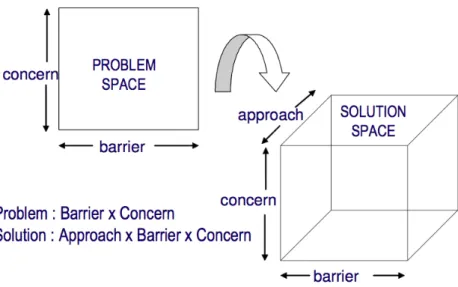
Applying an enterprise perspective to interoperability foregrounds the two dimensions that make up the problem space (barriers and concerns), and highlights the need to explore the solution space looking into alternative approaches, as illustrated in Figure 1 (Chen & Daclin, 2006). Analysing the barriers it will make sense to group them in the broad categories of conceptual, technological and organisational barriers. The concerns however, need to be derived by studying the domain characteristics of education as a particular instance of an enterprise. The dimensions identified in the ATHENA Interoperability Framework (http://athena.modelbased.net) with concerns related to data, services, processes and business, might help the analysis.
Figure 1. Problem space vs. Solution space (Chen & Daclin, 2006)
A key task in the analysis of the problem space and the solution space will be to identify LA solutions that address stakeholder concerns and overcome interoperability barriers. When the solution space is mapped, the next step is to choose strategy; and it is here we will introduce the concept of low-hanging fruits.
1.2
Low-Hanging Fruits
By using tools and data that are already in place the community could benefit right away from the development of new knowledge and new designs. This is the basic idea behind the approach of reaping the low-hanging fruits. To extend the fruits metaphor, one should refrain from extensive pruning (e.g., changing the context or the system) until the gardener knows more about the trees and the garden. Within Learning Analytics and Educational Data Mining this may make sense, since it is difficult getting data out of information systems. However, the hunger for tasting the benefits of LA is great; the potential data sources are diverse; and the range of methods and experience is growing (Cooper, 2013b). By going for the low-hanging fruits we allow stakeholders time to argue their case for specific LA solutions before deciding on approaches with far-reaching implications.
2. Related work
In 2011 SOLAR, the Society for Learning Analytics Research, issued a proposal to design, implement and evaluate an open platform to integrate heterogeneous learning analytics techniques under the name of Open LA (Siemens et al., 2011). The proposal was a high level argument in favour of openness of process, algorithms and technologies; and modularized integration, – asking for development of common language for data exchange and open repository of anonymised data. It is still early days to deliver on this proposal; in 2014 a follow up meeting was organised where SOLAR joined forces with the Apereo Foundation, an umbrella organisation for a number of open source projects. Their aim for a LA Initiative is now to “accelerate the operationalization of Learning Analytics software and frameworks, support the validation of analytics pilots across institutions, and to work together so as to avoid duplication” (Cooper, 2014a).
LA Interoperability initiatives are also launched by the standards community. Since 2010 the Advanced Distributed Learning (ADL) initiative have developed an eXperience API (xAPI), also called TinCan API, based on the idea of tracking activity streams (ADL, 2014). A similar approach is adopted by IMS Global in their Caliper project (IMS, 2013), initiated late 2013. When ISO/IEC JTC 1/SC36 late 2014 starts to work on LAI it is assumed that they will begin by defining an abstract framework in what eventually could become a multipart international standard (Hoel, 2014b).
The Open LA and the xAPI initiatives represent the opposite parts of the LAI continuum. While the former is more an interoperability dream, the latter represents a very concrete approach to
exchange data on any activity that is related to learning, storing statements of the form “I did this”, linking an actor to an object via a verb. However, the main parts of the LAI continuum are still to be addressed. Cooper (2014) has reflected on the “big picture” of LAI exploring what should be the scope of work in this field. He identified three areas of discourse defined by these questions:
• Models and Methods: How can we transfer information about statistical and data mining
methods, the parameters used, and the predictive models?
• Analytical Results: How can we transfer individual-level and grouped numerical results?
How can we track data provenance, quality and processing methods?
• Data for Analysis: How can we get data out of the operational systems? (Cooper, 2014)
One takeaway from Cooper’s briefing (2014) is that LAI is very complex and involves interoperability specifications that are not generally known within the educational technology community. As an example, Cooper mentions PMML, the Predictive Model Markup Language (dealing with interoperability of models and methods); and SDMX, the Statistical Data and Metadata eXchange standard (dealing with interoperability of analytical results). To further LAI one needs to invest in knowledge building to deal with this complexity, which is not only of technical nature, but also have issues concerning consensus about the objectives of LA as a whole.
3. Soliciting stakeholders’ interoperability requirements
When Big Data is promoted by global consultancy firms as “the next frontier for innovation, competition and productivity” (Manyika et al., 2011), and research is pointing to large datasets as the key to improving learning and the environments in which it takes place (Ferguson, 2013), it is essential to solicit the views of stakeholders who play vital roles in delivering and analysing the data and using the results. Data sharing and interoperability between IT systems are about tearing down unwanted barriers. It is important to note that this is only one perspective, and that the flip side of barriers could be boundaries people have established to protect themselves. We only know what perspectives will influence design and implementation of LA applications when we have involved the stakeholders.
This paper presents a pilot study aiming to structure the discourse on interoperability and give input to scoping of the first work items for standardisation in this field. We have interviewed eight representatives of students, teachers, support staff, and policy makers in Norway asking them to elaborate on interoperability in the context of LA. The semi-structured interviews focussed on what are the things to agree upon (that need to interoperate) to realise the potential of LA, aims of LA applications, and what data sources could be used for LA. The interviews were supported by an online sticker board, resulting in graphical summaries of the interviews giving a rough sense of the priorities of the respondents.
This research is positioned in the first Relevance Cycle of the three research cycles of Design Science (Hevner, 2007; Hevner et al., 2004), addressing requirements and field testing. The purpose is to come up with candidate concepts that describe the problems and opportunities in the application domain from a people, organisational systems, and technical systems perspective. The study is offered as an approach that could be replicated within other regional or national communities or sectors in order to gather requirements for LAI.
4. Results
The first results are an unordered list of concerns of the respondents being asked to reflect upon LA. The interviews are by no means representative for Norwegian communities or for the different stakeholder groups. Nevertheless, this study indicates that it is still early days for the idea of using LA in schools and higher education. There is little experience with LA solutions, and there is a general need for overview and understanding of the basic ideas. Even if the concerns reflected the respondents’ role in education, the issues they brought forward reflected more or less the same views on the problem space. Support for the individual learner, and emphasis on privacy and control of the data generated through interaction with the systems were in the foreground of every interview. The concerns mentioned were:
Student interviews
• Personal development and support for learning and career planning as primary aim; helping
the institutions, e.g., to improve retention, as a secondary aim
• Non-intrusive guidance (not being evaluated & tested all the time) • Privacy & Control over personal information
• Trust - school or university as a trusted “partner” in LA
• Consent to allow data flow between systems - transparency to who sees what • Access to data for LA: Students have a mixed use of tools that do not exchange data
• Educational tools policy: More emphasis on institutional tools, like LMS, will prevent
students from using social networking tools for learning. Latter group of tools important for life-long learning.
• Control over LA results: Students want to be in control of interaction with their data -
ownership to analysis and results, not only to data
• Data should be open, based on agreements between the partners involved
• Coordination and coherence among services: Students enrolled in different courses, learning
on different platforms - in order to get a coherent picture teachers, data, etc. need to be coordinated
• LA solutions should allow for two-way interaction, user control, consent, time to think before
giving data away, etc.
• Non-intrusive LA (no extra time on using LA tools)
Teacher interviews
• Understanding the affordances of LA: To get a conceptual understanding of the domain, from
different perspectives, not only technological aspects
• Prioritising benefits in this order: Individual (adaptive), teaching, institutional / organisational • Making sense of ‘contexts’ and ‘activities’: One cannot make sense of data, unless one knows
their context. How to describe contexts and activities?
• LA implementation without losing control of «pedagogy» (technology or market driven vs.
pedagogically motivated innovation)
• Learner Control and ownership to data; and control over how data are used, e.g., through
anonymisation / pre-processing (removing personal information)
• User Control over tools & services
• Getting the statistics out of the tools that are currently used
• In listing potential sources of LA data, institutionally controlled data sources, e.g., LMS, are
mentioned first
Support staff interviews
• Interpretations of LA results: What do we measure - and what does the results mean related to
the different stakeholders’ use of the LA results?
• Control over data: Do students have the right to reserve themselves against participating in
LA, sharing data from LA, etc.?
• Agreeing about contexts for analytics. What to do with ‘context free data’ that make no sense
for analysis?
• Primary LA beneficiaries should be the learner
• Need to improve the interoperability of legacy systems in order to get data for LA • Need to agree upon realistic aims for the use of LA
• Promote institutional control of data generated in (cross-institutional or international) MOOC
systems
• Develop and introduce systems that give enough data to allow LA, e.g., MOOCs
• Start using non-controversial data - e.g., data showing if watched videos are too long, before
using data identifying the individual
• Creating a culture for LA - mapping the incentives to make use of LA and develop a strategy • Privacy and Ownership to data - Open Badges approach to data (owning your own data) • Interpreting data: How to avoid measuring the wrong data and making invalid conjectures? • The ultimate aim is to get empirical support for pedagogical choices, improve quality of
learning resources, and further adaptive learning. However, also institutional aims are important, e.g., better retention and early warnings of drop outs
• We should discuss who should store the data; should it be nationally controlled or distributed?
Concerns can be grouped along a continuum starting with data in the bottom row, climbing up via Tools and Technology Support (Services), Learning Activities (Process), and ending with Aims (Business) at the top row. We have chosen these dimensions as a refinement of the categories used in Enterprise Interoperability Analysis (Chen & Daclin, 2006). This tradition looks at Conceptual, Technological and Organisational barriers as the categories for the barrier axis fitting well with the investigation of our study.
4.1 Problem space
Table 1 presents the results of populating the LA problem space with the data from the stakeholder interviews. The numbers in the table both refer to the concern/barrier nexus described in the text below, and give an indication of urgency or priority gleaned from repeated rounds of qualitative analysis of the interviews by two independent researchers (1 representing the highest urgency/priority).
Table 1. Learning Analytics Problem Space (concern and barrier matrix)
Concern/Barriers Conceptual Technological Organisational
Aims (1)
Learning activities (3) (2)
Tools and
Technology support (5)
Data (4)
(1) Privacy, Trust & Control of Data: This nexus between enterprise aims and organisational barriers relates to the complex issues of how interoperating LA systems get access to data without violating the privacy of users; and how to maintain legitimacy of these systems while giving the users control of their data.
This problem is situated in the most abstract corner of this two dimensional space. It relates barriers to interoperability on all levels. However, there is no conceptual or technological fix to this problem; it is clearly up to organisations and their members to agree upon questions like how much private information has to be exposed in order to reap the benefits of more adaptive systems, more support to learning, etc.; what institutions within education can be trusted to manage personal information for which groups of learners, with what kind of procedures; and what kind of control will the system give the originator of data throughout the LA cycle. And perhaps most importantly, what aims should have priority, e.g., if there are conflicts between the aim of an institution to reduce drop out and the privacy of the student?
(2) LA affordances and application domains: This interoperability problem arises when there is no consensus about the benefits of LA, and what domains LA should be applied to.
This problem is related to strategies for policy development and implementation for institutions, sectors and governments. Even if the barriers are organisational, at this early stage of LA conceptual barriers (e.g., lack of shared vocabularies) are part of this problem.
(3) LA Context & Learning Activities: This is the “blind data” problem that arises when there is no context information provided with data from a learning activity.
This is a conceptual barrier due to the lack of linkage between learning activity streams and their pedagogical contexts.
(4) Legacy system interoperability - information model for LA data exchange: This is the classic learning tools interoperability problem where systems have data in silos without any possibility of aggregating data to get a coherent view of the activities in a class or a school.
When LA is added as yet another system this data integration problem is brought to the attention again.
(5) LA implementation best practice guide: This interoperability problem relates to the market vs. policy driven implementation of LA systems and lack of open institutional or regional LA policies.
Technical interoperability is not always first priority for an enterprise developing an innovative LA solution. Organisations may find they need guidance to best practice for implementing LA solutions in order to support other educational policies.
4.2 Searching for solutions and low-hanging fruits
Having mapped the problem space, the next step is to develop the solution space, adding a new approach dimension to our model. As explained in Figure 1, a Solution Space is formed when Approach, Barrier, and Concern intersect. At this stage we are not searching for any solution but the one that can be picked as a low-hanging fruit.
Our interviews only indirectly pointed to solutions. However, the results reported in Table 1 give a prioritisation of problems, which is a first step towards designing an approach. Our data clearly shows that the non-technical issues are seen as the most imminent and important problems that could jeopardise uptake of learning analytics. The barriers are mainly organisational and conceptual, with the only identified technological problem being related to legacy systems.
The following approaches are based on a second analysis of our data to extract possible ideas for solutions.
Privacy, Trust & Control of Data
Strictly speaking, this complex set of issues is not related to LA in particular. Some experts may even say it is out of scope for LAI. Our respondents, however, see this issue as major stumbling block that needs to be dealt with, even before discussing the potential benefits of innovative LA solutions now being marketed. It is also an issue that is manageable, at least from a conceptual and technological point of view. The challenge is to engage in this work a new group of stakeholders (e.g. teachers, policy makers) whose primary interest is not with technology development.
Privacy laws are in place for schools and universities. Too strict interpretations may stifle new use of technologies and new learning practices as seen in reluctance to use non-institutional controlled services (e.g., cloud services). There is a need to clarify rules and practices (e.g., lay down principles for which services to trust). This may prove difficult, as the new learning practices that push the boundaries away from institutionally controlled, teacher-led education towards learner-centred, socially situated life-long learning may challenge existing privacy and data protection paradigms.
Our respondents pointed to learner control over data and teacher control over pedagogy as principles to pursue. We will come back to this point in the Discussion section of this paper.
LA affordances and application domains
Our respondents see the benefits of LA, but have a lot of questions mixed with fears about potential adverse effects. Are we measuring the right things? Do we discern between causation and correlation? Are we able to draw the right conclusions from the LA dashboards? To improve interoperability between LA systems one needs a more granular picture of LA activities. Academic analytics to prevent dropouts from school is a different activity to Learning analytics capabilities built into a digital textbook to support adaptive learning. As one respondent put it, “if we only have data for when
a video loses the audience (not knowing it was Peter), we should focus on improving the video, not dreaming of supporting a particular person”.
The interviews requested more conceptual clarity to the field of LA. This is a feasible task that could be organised as a consensus process.
LA Context & Learning Activities
The approach to solve the problem of missing context descriptions in relation to learning activities is to launch a traditional standardisation project developing the necessary vocabularies and find ways to describe relations among the concepts. These are continuous activities within learning technology development. However, the new interest in LA may contribute to speed up this activity and bring new stakeholders on board.
Legacy system interoperability - information model for LA data exchange
LA could potentially be a driver for revisiting the interoperability problems due to siloed legacy systems. However, as one respondent said, nobody is going to rebuild the student information system that is working well for all higher education institutions in Norway. The solution may be in establishing some kind of aggregated system, raising the question of who should run such a system, and how should the data be stored. Again, in order to make progress on this problem, the first problem cluster discussed above needs to be sorted out.
LA implementation best practice guide
To lead by example is a good principle. A best practice guide may help institutions to implement LA, as such guides need to be clear about what the actors of the implementations should be. Developing a guide as a consensus document may help the different levels of the educational system to identify other interoperability problems and to prioritise among them. Starting in the nontechnical end of interoperability work may first, help address the concerns of the stakeholder groups represented in our survey; and second, take the focus away from technical LA challenges, making it easier to address the semantic, organisational, political and legal interoperability problems posed by putting numbers in the service of learning, education and training.
5. Discussion
Traditionally, ISO/IEC JTC 1/SC36 had published a number of multipart standards within the learning technology domain. When launching an LA project, this international standardisation group would be expected to fall into the old pattern starting with a first part being a LA Framework standard, and the other parts filling the different puzzles of an all encompassing LA jigzaw. This paper can be read as a warning against such an approach. The explorative interviews we have reported make it clear that detailed information models alone will not ease the uptake of learning analytics in schools and higher education. In order to foster interoperability among actors in this sector there is a need to find solutions on all levels where two systems interoperate. The big question, however, is to find which puzzle to start with that will make it easier to see the pattern and find the solution to the other pieces.
We have suggested designing a solution space by soliciting input from stakeholders that do not necessarily know much about LA, but who eventually will play a crucial role in its adoption. In this study, the respondents highlighted above all the softer issues related to privacy, trust and control. It is worth exploring if the solution space related to this issue could be established as a kind of baseline for further design of LA systems.
Often the Big Data hype is used to sell Learning Analytics (Ferguson, 2012), triggering stories of aggressive and subtle marketing and manipulation from a commercial context. LA needs to distance itself from the setting of marketing and sales, as learning and education have very little in common with the motivational arm-twisting of commerce. From a liberal, and some may say Western perspective, the ethos of learning and education is that the learner should be in control and the supporting institutions should only do what is in the interest of the learner. Therefore, it should be easy to argue for learner control over her own data; transparency controlled by the individual learner; trust built bottom-up; etc. The counterargument would be that such an approach will not give the
amount of data needed for LA, as only centrally run systems where all are subscribed would give enough data. However, in a civic society the individual has some rights to opt out of education. And privacy protection and trust are not opposites. Trust does not need to be blind; it can be a dynamic property, ultimately controlled by the learner, but also maintained by institutions, e.g., the school, the university or the educational authorities.
What happens if the learners (and their parents) lose trust in LA systems is vividly illustrated by the US InBloom case:
Protests began in earnest when it was discovered that inBloom’s software had more than 400 optional data fields that schools could fill out—asking for potentially sensitive information such as the nature of family relationships, learning disabilities, and even Social Security numbers. Although there were no reported leaks, parents were uncomfortable without an absolute guarantee of that data’s safety or a clear indication of who could access it. (Slate future tense, 24 April 2014)
InBloom “was meant to extract student data from disparate school grading and attendance databases, store it in the cloud and funnel it to dashboards where teachers might more effectively track the progress of individual students” (New York Times, 21 April 2014). In April 2014, after a period of heated public debate, the system had to close down after the New York state passed legislation prohibiting the state department of education from giving student information to data aggregators like inBloom.
Giving priority to the solution of privacy, trust and control issues could help identifying the LA systems with the best possibilities to succeed within the nearest timeframe. Trust is built in concentric movements starting with the learners, co-learners, school, other community of learners, etc. Local, distributed, transparent and adaptive systems supporting the learner seem to be easier to sustain than systems that are more distant and leave the user with more questions of who is in control. On the other hand, we know that learners use cloud services and social media systems where they have minimal control.
If the systems are found useful, they tend to be used and the users freely give access to their data. In the case of social media, however, the educational institutions are not acting as intermediators between the users and the systems. In formal education, institutions have to follow standards, and it is therefore problematic to mandate use of tools with poor or unknown data protection policies. It would therefore be helpful to have a consensus about how tools outside institutional control are used and what privacy, trust and control models education would promote (Slade & Pinsloo, 2013). This is an argument for engaging in a process on clarifying LA affordances and application domains, the second approach coming out of our stakeholder survey.
Establishing learner control as a design baseline would help identify which LA contexts that need specification. One might assume that smaller systems that are able to demonstrate benefits to the learner would be easier to introduce, and as such represent the low-hanging fruits of learning analytics. While ideas about more complex and institutionally motivated systems, e.g., with institutional, regional or even national learning record stores, should be left to ripen before brought to standardisation. It is also reasonable to think that once the idea of complex and integrated systems are put on the back-burner, new ideas could be foreseen how analytics can be carried out to improve education with existing data and systems. In an emergent field there is a need to showcase and demonstrate best practices that work before investing too heavily in wild dreams.
6. Reflections and Outlook
This research was conducted in accordance with design science guidelines (Hevner et al., 2004) to develop a support framework for structuring work on LAI. Stakeholders were interviewed about their concerns about LA in order to construct a problem space along the dimensions of concerns and interoperability barriers. The interview data was then analysed in order to identify approaches that could be dealt with within a reasonable timeframe, given the dynamic nature of current learning analytics development. The analysis gave five candidate issues that are potential new work items for LAI standardisation.
The results of this study need to be validated through further field-testing in order to see if the same issues are prioritised by more representative selections of stakeholders and respondents from other countries. Furthermore, the relevance of the barriers used in this study should be tested. It is possible that a more fine-grained categorisation may be needed, especially to understand the technological barriers to LAI.
The concept of low-hanging fruits should also be further developed. In this paper we have used the concept to add a strategic dimension to the approach axis of the solution space. We have also indicated that selecting the low-hanging fruits may alter the space itself, giving priority to a certain group of applications, repurposing others. In developing this framework related existing work on quality models for standards looking into aspects of product quality, process quality, and quality in practice (Folmer, 2011) should be explored.
References
ADL (2014). Training & Learning Architecture (TLA): Experience API (xAPI). Retrieved September 1st, 2014, from www.adlnet.gov/tla/experience-api
Chen, D., & Daclin, N. (2006). Framework for enterprise interoperability. Proc of IFAC Workshop EI2N. Cooper, A. R. (2013a). Learning Analytics Interoperability - a survey of current literature and candidate
standards. Online at http://blogs.cetis.ac.uk/adam/2013/05/03/learning-analytics-interoperability, accessed 2014-08-01
Cooper, A. R. (2013b). Learning Analytics Interoperability – some thoughts on a “way ahead” to get results sometime soon. Online at http://blogs.cetis.ac.uk/adam/2013/10/17/learning-analytics-interoperability-some-thoughts-on-a-way-ahead-to-get-results-sometime-soon, accessed 2014-08-01
Cooper, A. R. (2014). Learning Analytics Interoperability – The Big Picture in Brief. Online at http://laceproject.eu/publications/briefing-01.pdf, accessed 2014-08-01
Cooper, A. (2014a). Open Learning Analytics – progress towards the dream, blog post of 2014-04-14, online at http://www.laceproject.eu/blog/open-learning-analytics-progress-towards-dream/, accessed 2014-08-02 Geraci, A. (1991). IEEE Standard Computer Dictionary: Compilation of IEEE Standard Computer Glossaries.
IEEE Press, Piscataway, NJ, USA.
Ferguson, R. (2012). Learning analytics: drivers, developments and challenges. International Journal of Technology Enhanced Learning, 4(5/6), 304. doi:10.1504/IJTEL.2012.051816
Ferguson, R. (2013). Learning Analytics for Open and Distance Education, 1–8.
Folmer, E. (2011). Quality model for semantic IS standards. 8th International Conferanse “Standarization, Prototypes and Quality: a Means of Balkan Countries' Collaboration,” Thessaloniki, October 2011. IMS (2013) IMS Global Learning Consortium, Learning Measurement for Analytics Whitepaper, September 19,
2013. Retrieved September 1st, 2014, from http://www.imsglobal.org/IMSLearningAnalyticsWP.pdf Hevner, A. (2007). A Three Cycle View of Design Science Research. Scandinavian Journal of Information
Systems, 2007, 19(2):87-92, 1–6.
Hevner, A., March, S. T., Park, J., & Ram, S. (2004). Design science in information systems research. Mis Quarterly, 28(1), 75–105.
Hoel, T. (2014a). LA on the agenda for international standardisation, blog post of 2014-07-4, online at http://www.laceproject.eu/blog/la-agenda-international-standardisation/, accessed 2014-08-02 Hoel, T. (2014b). Standards as enablers for innovation in education - the breakdown of European
pre-standardisation (pp. 185–189). Presented at the 2014 ITU Kaleidoscope: Living in a Converged World - Impossible without Standards? (K-2014), IEEE. doi:10.1109/Kaleidoscope.2014.6858496
MacNeill, S., & Campbell, L. M. (2014). Analytics for Education. Journal of Interactive Media in Education. Online at http://jime.open.ac.uk/jime/article/viewArticle/2014-07/html
Manyika, J., Chui, M., Brown, B., Bughin, J., Dobbs, R., et al. (2011). Big Data: The next frontier for innovation, competition and productivity. McKinsey report online at
http://www.mckinsey.com/insights/business_technology/big_data_the_next_frontier_for_innovation, accessed 2014-08-01
Sales, B., Darmois, E., Papadimitriou, D., & Bourse, D. (2012). A Systematic Approach for Closing the Research to Standardization Gap. In The Future Internet (Vol. 7281, pp. 18–29). Berlin, Heidelberg: Springer Berlin Heidelberg. doi:10.1007/978-3-642-30241-1_3
Scanlon, E., Sharples, M., Fenton-O'Creevy, M., Fleck, J., Cooban, C., Ferguson, R., … & Waterhouse, P. (2013). Beyond Prototypes: Enabling Innovation in Enhanced Learning. Technology-Enhanced Learning Research Programme, London.
Siemens, G., Gasevic, D., Haythornthwaite, C., Dawson, S., Shum, S. B., Ferguson, R., ... & Baker, R. S. J. D. (2011). Open Learning Analytics: an integrated & modularized platform. Proposal to design, implement
and evaluate an open platform to integrate heterogeneous learning analytics techniques. Online at http://www.solaresearch.org/OpenLearningAnalytics.pdf. Accessed 2014-08-01
Siemens, G. (2013). Learning Analytics The Emergence of a Discipline. American Behavioral Scientist, 57(10), 1380–1400. doi:10.1177/0002764213498851
Slade, S., & Prinsloo, P. (2013). Learning Analytics: Ethical Issues and Dilemmas. American Behavioral Scientist, 57(10), 1510–1529. doi:10.1177/0002764213479366
Slate future tense (2014). What the Failure of inBloom Means for the Student-Data Industry, Online at
http://www.slate.com/blogs/future_tense/2014/04/24/what_the_failure_of_inbloom_means_for_the_studen t_data_industry.html, accessed 2014-08-01