An Intercompany Dispatch Support System for Intermodal Transport Chains
Hans-Jürgen Bürckert, Petra Funk, Gero Vierke
German Research Center for Artificial Intelligence
DFKI Saarbrücken,Stuhlsatzenhausweg 3, D-66123 Saarbrücken, Germany
Email: {hjb, funk, vierke}@dfki.de
Abstract
A critical problem in an intermodal transport chain is the direct meet at the transhipment nodes. This requires in-formation technology and modern communication facili-ties as well as close collaboration between all the con-cerned transport operators in the chain. The TELETRUCK system – currently under development at the German Research Center for Artificial Intelligence (DFKI) – is a dispatch support system that tackles this problem. Inter-company planning, scheduling, and monitoring of inter-modal transport chains will be supported by our system. It aims at providing smooth access to railway time tables and rail-based transport services and – much more im-portant – at allowing for the planning of both, exclusively road-based and combined journeys and showing their cost-effectiveness. We describe our approach – based on intelligent agent technology – both the current state of implementation and our goal of the very next future.
1
Introduction
Freight transport in Europe has immensely grown during the last decade and is expected to increase even more in the next future. Due to the drawbacks of purely road-based transport, such as congestion, environmental problems, traffic noise and social impact, intermodal transport plays an important role in the economic and social development of the European countries:
"The growing demand for the transport of people and goods in Europe presents transport users, operators and public authorities with increasing problems, notably con-cerning cost-effectiveness, congestion and environmental impact. Whereas, in the past, we have tended to think about specific modes of transport – road, rail, air and waterborne – there is now growing recognition that sus-tainable mobility is about inter-connecting transport sys-tems which have to provide a door-to-door service. This is what I call intermodality." [9]
The development of information and communication technology (ICT) supporting planning, optimisation, and
monitoring of freight haulage for terminals as well as for all other service providers of intermodal transport chains is one of the most challenging application domains for computer and business sciences in the transportation sec-tor. The integration of the Trans-European Networks (TEN) of transports and telecommunications, comprising equipment of transport vehicles, departments and compa-nies with telecommunication facilities linked with assis-tance software for logistics engineers and dispatch offi-cers as well as drivers and transport operators, is a main goal of the next decade. It will provide the fundamental building grounds for keeping the growing Trans-European transport demand controllable and manageable: Outsourcing, depot free production, just-in-time delivery will still increase transport intensity. Freight transport within the European Union is expected to grow by an-other 70% during the next ten years [4].
The European Commission (EC) had recognised that dramatic development and intermodality got a growing interest within European transport politics: The EC Task Force on Transport Intermodality elaborated recommen-dations for the future development of intermodal transport (Intermodal Freight Village 2000+, Intermodal Freight Network 2000+, Transport Town 2000+, etc.) and several actions are addressing different aspects of improving and supporting intermodal transport chains [12].
Most of the European transport companies are small or medium sized enterprises widely focussing on road trans-portation. They are working in a highly competitive framework still sharpened by the low cost competitors from Eastern Europe. Rail transportation is yet much to inefficient, in order to be competitive, at least for dis-tances below 700 km. Combined rail-road transportation can become a much more interesting alternative in the near future. However, this requires software products which support dispatch officers in their daily work by providing smooth access to railway time tables and rail-based transport services and – much more important – by allowing for the planning of both, exclusively road-based and combined journeys and showing their cost-effective-ness, where- and whenever possible.
Intermodal freight transport makes high demands on planning, scheduling, and monitoring: Selection of the best suited mode for every subtour in a transport chain, determination of an optimal sequence of the different modes, scheduling timely meets of the means of transport in the chain, in order to avoid unnecessary delays for transhipment, and of course, optimal planning of the sin-gle subtours as well as monitoring of plan execution. GPS and board communication systems at trucks, satellite-based tracking and tracing facilities for containers, com-puter-based dispatch support and information systems at all transport service providers in the chain have to be connected for direct communication between these sys-tems, in order to allow an elaborated organisation and management of intermodal transport chains.
At the German Research Center for Artificial Intelli-gence (DFKI) we currently develop the TELETRUCK sys-tem for supporting collaborating transport operators in planning, scheduling, and monitoring of intermodal trans-port chains. This task is conducted in close collaboration with forwarders, terminal operators, and transport engi-neers.
In the next section we will describe the problem of in-termodal transport planning. It is followed by an intro-duction of the multi-agent technology and the procedures we are using for the solution of the transport planning and optimisation problem. The architecture of our current implementation and an outlook of further extensions con-cludes the paper.
2
Intermodal Transport Problems
In general we can define an intermodal transport as any kind of transport, which combines at least two different transport modes and thus needs a transhipment process between these two. Usually the pre-carriage or onward carriage is carried out by road, while the main carriage may be done by the other means of transport, namely train, ship or plane.
We focus on combined road-rail transport, the classic combination of modes in Europe since the sixties. How-ever, any other combination of modes can also be tack-eled with our approach. In our case, we have road based pre- and end-haulage, while the main carriage is done by rail. Currently rail-based transport imposes the main con-straint on the processing of an intermodal transport: We assume a time-tabled mode which does not offer much flexibility in terms of pick-up or delivery times of the goods to be transported, but offers frequent transport services with effective and planable transhipment. Goods, filled in Intermodal Transport Units (ITU – it can be any kind of container, semi-trailer or other transport bin), need to be in time at the intermodal terminal connecting road and rail, in order to be transhipped. The road based car-riages of the intermodal transport have to provide the
flexibility required to process the intermodal transport as a whole, such that – at the intermodal terminals – we get an optimal meet of the two involved means of transport, trucks and trains.
2.1
Planning Orders for Intermodal Transport
Chains
The most crucial process connected with intermodal transports is the transition from one transport mode to the next. While on the physical side many efforts to enhance transhipment procedures are undertaken, eg., in the EU-Projects IMPULSE and COREM, smooth transition pro-cedures and policies on the software side are yet to be designed. Planned arrivals of trucks in a terminal can help to deal with the usual congestion at gate opening and it can support the use of terminal resources in terms of peo-ple or equipment during otherwise idle times. Scheduling of delivery (or pick-up) just in time, ie., planning the arrival of trucks, such that a direct meet between the train and trucks is possible, will avoid storage times and thus reduce transportation times – and hence transportation costs – substantially. This can make intermodal transports competitive – also for medium distance haulage.
The planning of intermodal transport orders to be processed within an intermodal transport chain, requires to adapt the planning process to the individual character-istics of each transport mode. Modern, parallel tranship-ment technology, which allows for simultaneous tran-shipment of ITUs between several waggons and trucks, as well as new ways of time-tabled freight trains with high frequent connections between big freight terminals – similar as for todays passenger transport – and booking and reservation procedures for train capacities have to be supported by modern information and communication technology. Road based feeder transport has to be planned and optimised dynamically, such that just in time arrival of trucks is possible. Modern telematics technology al-lows for a planning process that takes into account the current status and positions of the trucks. AI technology can be used for a flexible online planning and optimisa-tion procedure based on intelligent agents.
2.2
Intercompany Planning of Transport
Chains
In the highly competitive transportation domain opti-misation of transport planning is a crucial issue. The op-timisation potential of a transportation company corre-sponds to the amount of freight that has to be transported. Therefore, small and medium sized enterprises are at a disadvantage. One approach to overcome these difficul-ties is to form unions of small and medium sized enter-prises in order to optimise transport planning coopera-tively.
The main challenge of this approach is to establish a long-term cooperation among competing companies. In general a company is self-interested and tries to optimise its local profit. These local goals conflict with the global optimisation. In order to achieve global optimisation, incentive mechanisms that transfer the global utility to local utility need to be applied.
Negotiation techniques based on market like mecha-nisms (simulated auction and simulated trading protocols) using intelligent agent technology and telecommunication connections for the partner companies' planning systems can support such forms of cooperation.
3
Holonic Multi-Agent Technology
As mentioned above intelligent agents can be used in order to realise a highly flexible, online planning and optimisation procedure for intermodal and intercompany transport planning. Our TELETRUCK system is a multi-agent system (MAS) [10]: We model the basic objects and processes of our transportation planning domain as autonomous, continuous software processes which are
• re-active (they observe and influence their real or
virtual environment;)
• pro-active (they execute actions in a forward
plan-ning and goal-directed manner;)
• inter-active (they communicate, negotiate, and
co-operate with other agents.)
Therefore, these agents are equipped with planning skills, knowledge about the individual resources of the objects they represent, negotiation and communication facilities for interaction and cooperation among each other. The transport domain is rich in tasks requiring coordinated and cooperative actions, which can be smoothly solved by such a decentral approach. Dividing the transport request according to intermodal or intercom-pany requirements can be done by the planning agents in our agent society.
Our agent society is organised as a holonic MAS [8]. That means agents can unify into a holonic agent or a
holon1 and partially loose their autonomy, in order to collaborate, eg., for resource sharing. For planning and execution of cooperative tasks, single agents melt together to a new, holonic entity, tackling the task and separating afterwards.
3.1
The T
ELET
RUCKAgent Society
From a technical point of view, our MAS is distributed on several computers located at the different transport service operators in the intermodal transport network. Each of the local systems is a copy of our TELETRUCK
1
Derived from holos (Greek) which means the whole and the Greek suffix -on denoting parts or particles.
system, which can be used both as a stand-alone planning and scheduling system for the local service provider and as a cooperative planning and scheduling system which interacts with the systems of the partners. That means the whole TELETRUCK network2 is a distributed MAS that cooperatively plans intermodal transport chains. Orders are splitted or combined, distributed and exchanged among the connected systems.
Orders Initial Leg Order Final Leg Order Fi nal L e g Plan In it ia l Leg Plan Main Leg Order Main Leg
Plan Set [....] IPnEU IPnEU IPnEU 20.14 oxox ox 22.10 ox ox 23.05 o xo 0.10 ox oxox
Rail Service Agent Logistics Service Center
Road Service Agent
Logistics Service Center Road Service
Agent
Figure 1. IPnEUs, road and rail service agents The local TELETRUCK systems in turn are organised as multi-agent systems. Each of them is headed by a
com-pany agent, representing the whole system to the partners'
systems (ie., their company agents) in the network and coordinating further internal agents of the local system.
Customers send their transport order to any of these lo-cal service providers. Special internal agents lo-called IPnEUs (intermodal plan'n'execute units) of the local systems take the responsibility for planning and execution of the tasks by intermodal transport chains (cf. Figure 1). For each order, an IPnEU is invoked, which manages all the planning and scheduling activities required. The IPnEUs split the transport of an order into an initial, main, and final leg (or even further sub-journeys) to be executed in different modes. They announce subtasks to corre-sponding partners in the network:
• train booking and reservation departments at termi-nals, who know about the trains' time tables and free capacities, and are responsible for train booking and reservation;
• the road forwarders or logistics service centers in the regions around the source and destination termi-nals of the rail based main leg, respectively, who coordinate the initial and the final leg of the inter-modal transport chain in the regions.
2
In the following we will refer to the local systems as TELETRUCK
systems and to the whole network of TELETRUCK systems as TELETRUCK network
The local systems of the train booking and reservation departments are realised as intelligent rail service agents in our multi-agent network – one might think of them as reduced TELETRUCK systems without any other agents than the company agents. The local systems of the logis-tics service centers are again implemented as reduced TELETRUCK systems with a company agent, called road
service agent, and with instances of IPnEUs but without
further internal agents. The road service agents know about road forwarders which collaborate with the logistics service centers and which are staffed by complete TELETRUCK systems. The road service agents contact the company agents, called dispatch agents, of the forward-ers' local systems for execution of the road based local transport (cf. Figure 2). Forwarder C Dispatch Agent Transport Agents Forwarder A Dispatch Agent Transport Agents
Logistics Service Center Road Service Agent ELE RUCK ELE RUCK Forwarder B Transport Agents Dispatch Agent
Figure 2. Road service, dispatch, and transport agents In addition to dispatch agents and the instances of IPnEUs in our complete TELETRUCK systems at the road forwarders also the physical transport means of each transport service operator are internally represented as agents, thus physical transport units like trucks, trains, ships etc. are modelled by agents, too. Via GPS and board
communication systems these transport agents3 know
status and position of the physical objects they represent. Based on that information they can accept or reject trans-port orders announced by the dispatch agent and plan their tours. They can also exchange orders with other transport agents within the local agent society. Exchange of orders with partner systems, however, is only possible on the dispatch agents' level.
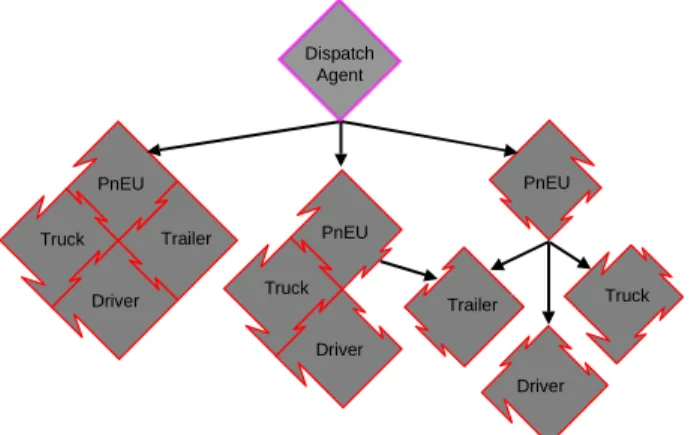
The transport agents are the holons of our approach (cf. Figure 3): A transport unit of a road carrier, for ex-ample, consists of several physical components,
• a motor component (truck or truck tractor),
• the chassis components (trailer or semi-trailer),
• the loading spaces (container or swap-body),
3
Currently train agents are not implemented, instead we manage their transport resources by a booking procedure realised by a contraint solver for time and capacity constraints.
• and the driver.
PnEU Trailer Truck Driver PnEU Trailer Truck Driver PnEU Truck Driver Dispatch Agent
Figure 3. Transport holons with component agents Each component including the driver is represented by an agent as well. These component agents provide differ-ent resources for the planning task. They interact with the other component agents in order to achieve self-organised compositions of the whole transport units according to the transport needs. To coordinate the composition of such subagents into transport holons we introduced planning and execution agents, the PnEUs (plan'n'execute units), which play the role of the heads of our transport holons. The PnEUs organise the holonic structure during planning and execution of the road-based transport parts and repre-sent the transport holons to the other agents in the TELETRUCK system.
This holonic multi-agent system approach allows for a very flexible organisation of transport planning. As the agents directly represent all the physical objects of the domain, they can be adapted to the needs of the different partners of TELETRUCK network. The types of vehicles and their components as well as different requirements of drivers are modelled explictely. They can be adapted acording changing requirements. A typical example could be the driver. Provided we equip the driver agents with suitable user interfaces the drivers themselves could modify the properties of their agents depending on their personal needs and desires. According to the distributed realisation planning and optimisation take into account such modifications automatically – without any need for changes in the overall planning and optimisation algo-rithm itself.
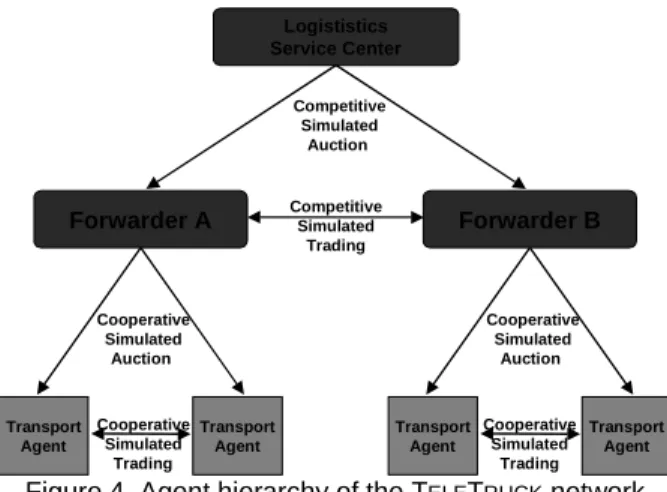
Communication and negotiation of the agents are driven by auction and trading protocols (cf. Figure 4): Agents of the upper level act as brokers for the agents of the next level announcing the tasks or subtasks, eg., the need for a truck tractor, a driver or for a certain loading capacity. The lower agents in this sequence bid for the tasks on the basis of their free resources, eg., loading capacities, driving times etc. This auction mechanism is realised through contract net protocols (cf. Section 3.2).
In order to optimise the plans tasks are exchanged be-tween agents organised by a simulated trading protocol (cf. Section 3.3): The agents ask for buying or selling tasks in order to optimise their plans. The broker of the upper level coordinates this in choosing "best matches" of buy and sell requests, in order to improve also the global plan of that level.
Competitive Simulated Trading Cooperative Simulated Auction Competitive Simulated Auction Logististics Service Center Forwarder B Forwarder A Cooperative Simulated Trading Transport Agent Transport Agent Cooperative Simulated Trading Transport Agent Transport Agent Cooperative Simulated Auction
Figure 4. Agent hierarchy of the TELETRUCK network
The optimisation process can be interrupted at any time yielding a sub-optimal but feasible plan. Since the two protocols are interleaved, new orders can be an-nounced during the optimisation process. The resulting procedure therefore allows for dynamic planning as well as for re-planning in case of dynamic changes of orders. Also online planning and optimisation is possible, be-cause – as mentioned above – the agents know about status and position of the physical objects they represent. Hence they are able to plan, re-plan, and optimise plans also during plan execution – for those parts of the plans not yet finished.
These market-oriented mechanisms are realised on all levels in order to obtain globally optimised intermodal transport plans assuming the overall system can run long enough.
3.2
Contract Net Protocol – An Auction
Mechanism for Order Distribution
For the distribution of goods onto means of transport, we apply an extension of the contract net protocol, a popular DAI allocation mechanism. In its original version [11] this protocol is rather simple (cf. Figure 5): A man-ager announces a task to a set of contractors. Based on their local cost estimations, these contractors compute bids and send them to the manager. The manager selects the best bid, rejects all other bids, and grants the task to the best bidder. This contractor is committed to report the success or failure of the task's execution to the manager.
In the TELETRUCK system the dispatch agent plays the role of the manager who distributes transportation tasks to the contractors, the PnEUs. Three situations are possible for a PnEU:
• The PnEU heads a transport holon having all the
needed resources at its disposal to plan the task. It can directly compute the costs and reply its bid to the dispatch agent.
• The transport holon does not have enough resources and cannot include further component agents. It cannot reply a bid.
• Additional resources can be provided by idle com-ponent agents – for instance, a trailer can be con-nected. The PnEU starts a contract net protocol with those idle component agents that provide the needed resources.
We will consider that third situation in more detail for the special case of an idle PnEU. It has to compose a fresh transport holon from the idle components. This is done again by a contract net protocol: The PnEU announces the need for a motor and a driver to the motor and the driver agents, each motor agent in turn announces its need for chassis’, and the chassis agents finally announce the needed loading capacities to container agents. The lower agents in this sequence check their resources, compute their costs and reply their bids. Grant and reject answers of the upper agents followed by acknowledgements of the lower ones complete these cascading contract nets (see Figure 6). This approach allows for local compatibil-ity checks between the resources and results in a self-organising composition of transport units [2].
In the common contract net protocol the announced tasks are treated as indivisible. Since in our case, how-ever, large orders may exceed the capacity of one truck, they have to be split into subtasks of smaller amount in order to distribute them to more than one truck. In the intermodal case, the transport requests to be executed by several means of transport, has to be split into subtasks covering different parts of the total distance. Hence, a more flexible extension of the traditional protocol is re-quired. select s best b id bid fo r task s announ ces ta sk s ...... ......
Figure 5. Contract Net Protocol
The extended contract net protocol as described in [5] allows to split a task into subtasks of fewer amount and to distribute these subtasks to several contractors. Like in the
original version of the contract net, the manager an-nounces the task to the contractors. The contractors may not only place bids for the complete task, but may also bid for parts of the task. The manager selects the best of the bids, and grants it temporarily, ie., the manager has the authority to withdraw the grant. Then the manager rejects the other bids and subtracts the temporarily granted sub-task from the complete sub-task. The remaining part is an-nounced iteratively. When bids for all the subtasks are present and temporarily granted, the manager sends de-finitive grants to the involved contractors and confirms the distribution. If the manager fails to allocate all sub-tasks to the contractors the temporal grants are withdrawn and the task cannot be planned.
The splitting of tasks' routes, in order to bundle smaller tasks that are to be transported over long distance on larger trucks or by train, requires more than one parameter to split. There may be many possibilities to plan the tasks using different modes of transport and different interme-diate locations for the exchange of modes. Furthermore, the time constraints of the subtasks are naturally con-nected. announces task awards/rejects task reply bids reply bids reply bids reply bids reply bids acknowledge acknowledge acknowledge acknowledge acknowledge Dispatch Agent PnEUs Motor Agents Driver Agents Chassis Agents Container Agents award/reject task award/reject task award/reject task award/reject task announce task announce task announce task announce task
Figure 6. Interaction diagram of cascading contract nets In our intermodal scenario, the intermodal planning agent IPnEU chooses the shortest intermodal route, and splits the task into three subtasks: the rail based main-run and the road based pre- and end-run. Firstly, for the main-run the rail service agent is requested for a reservation on a train. The reservation is temporarily granted, the time constraints are propagated to the pre- and end-run, and the pre- and end-run are announced to the road service agents which in turn start a contract net with the dispatch agents. When there are reasonable bids for all subtasks, they are definitively granted.
So far the current state of development of our system is described. Our envisioned system, however, shall even go further. Since different modes of transportation are to be evaluated, different possible routes have to be checked. In the integrated system the IPnEU will select both purely
road-based routes and road-rail combinations. Several extended contract nets as in the intermodal case will be triggered in parallel. The set of bidders that provides the best transportation chain will finally be granted the task.
In the intermodal as well as in the integrated scenario, the extended contract net protocol is used for agent com-munication. Nevertheless, the allocation mechanism be-hind the protocol goes beyond the approach of [5]: in our system the intelligent partitioning of tasks into subtasks is done by the manager based on global knowledge.
3.3
Simulated Trading Protocol – A
Market-Mechanism for Plan Optimisation
The contract net protocol, as it has been described above, is used to achieve an initial, usually suboptimal solution. In order to improve that plan, we apply a heuris-tic optimisation procedure called simulated trading [1]. Suboptimal initial solutions are improved stepwise to-wards globally optimal plans by an extension of that dis-tributed optimisation approach [5].
Simulated trading is a randomised algorithm that real-ises a market mechanism (cf. Figure 7): The transport holons optimise their plans by successively selling and buying tasks. Trading is done in several rounds. Each round consists of a number of decision cycles. In each cycle the transport agents submit one offer to sell a task or to buy one from the selling list. At the end of each round the dispatch agent matches the sell and buy offers of the trucks for the best exchange, in order to decrease the costs of the global solution. This implements a kind of hill-climbing algorithm. Like in simulated annealing a deriva-tion that decreases from round to round can be specified such that in early rounds the dispatch agent is willing to accept a worsening of the global solution which helps to deal with local maxima in the solution space. Neverthe-less, maxima that are left are saved, such that, when the algorithm terminates before a better solution is found, the best solution found up to this point in time is returned. Thus, simulated trading procedure results in an interruptible anytime algorithm.
...... ...... ...... ...... se lli ng lis t best exchange sell buy nop sell buy nop se lli ng lis t
...
Figure 7. Decision cycles of a simulated trading round Since we required both, the optimisation of the plans and of the allocation of resources to plans, we extended the simulated trading procedure. For example a good
route plan might not be efficient because the allocation of resources to the plan is bad, eg., a big truck is not full while a smaller truck could need some extra capacity to improve its own plan. In our extended version of the algo-rithm, the PnEUs in a transport holon are allowed to sell or buy component agents representing the resources of the transport holons. Obviously, the loss of a resource might cause tour plans to become invalid. In order to allow the exchange of resources which are essential for the execu-tion of the plans, we introduced a dependency relaexecu-tion between the sell and buy offers. Such a relation enables the agents, to submit, eg., a sell offer under the condition that it may only be accepted if the offer on the following decision level is accepted as well. Thus, at the end of each trading round, the manager considers only those matches where all tour plans are valid.
For the planning procedures required for cooperating forwarders we need further extensions of the simulated trading procedure, since it cannot be applied analogously to optimise intercompany plans. The companies have a primary interest in their local profit and the profit of the consortium is considered secondary. Hence, a company will prefer the most profitable trades. Perfectly rational agents will only agree on such profitable trades. Due to this problem, compensation payments for order exchange were included in the model. Side payments allow to com-pensate local deteriorations which are needed to improve the global solutions. An additional problem is that dete-riorations in the global solution can only be profitable for each of the companies if compensation payments from the outside are paid. For example if the manager disposes of financial resources to subsidise trades that decrease the quality of the global solution.
In our approach the road service agents are equipped with financial resources, in order to influence the trading process. For every trade the road service agent acts as broker and charges a positive or negative commission. Whenever a trade is profitable for both partners, the road service agent keeps a part of the profit. This resources may be used in later stages of the trading process to sub-sidise unprofitable trades that improve the global solution or to deteriorate the global solution in order to open up new optimisation potential.
In our scenario the participating companies are autonomous and self-interested agents. Hence, their bids do not necessarily correspond to their internal utility measure, but may include a profit that is calculated strate-gically. Therefore, those bids are evaluated using game theoretic criteria.
Optimisation of the overall intermodal transport chain needs further extensions. In the current state of the system we have a simple optimisation approach on that top level. That is, we have local optimisation of the initial and final legs by the intercompany simulated trading procedure sketched above and local optimisation of the main leg by
selection of the best solution of the train booking solver. However, global optimisation of the connection of the three legs is not yet implemented.
3.4
Dynamic Plan Optimisation by Interlaced
CNP and STP
In the dynamic domain of transport scheduling the planner has to react in real time to unpredictable events like new incoming tasks, changes in already scheduled tasks, and changes in the availability of the resources.
In order to handle these dynamics the TELETRUCK
system offers three operating modes:
• The Insertion Mode: Solutions are generated and
extended incrementally by sequential insertion of orders into plans using the contract net protocol.
• The Optimisation Mode: The incrementally
com-puted plans are optimised by controlled exchange of orders among the vehicles with the simulated trad-ing procedure.
• The Modification Mode: The automatic planning
and optimisation process can be interrupted either by the user, in order to adapt the solution, or by automatic modification requests due to dynamic changes, ie., incoming fresh orders, changes or can-celation of already scheduled orders, or starting of the execution of orders.
As a default simulated trading runs permanently to im-prove the current solution as long as no dynamic changes of the tasks or resources occur and as long as the user does not interrupt it. Whenever new tasks arrive, optimi-sation is interrupted and the new tasks are inserted se-quentially. Changes of the scheduled tasks or delays in the plan execution may cause the solution to become invalid; in this case the plan is repaired as far as possible by re-moving the tasks, that cause the unfeasibility, from the plan and inserting them again like fresh orders.4 The se-quential insertion guarantees a feasible solution within a short period of time. After the insertion, the simulated trading is triggered again.
The user may switch between the modes at any time. For instance it is possible to start by generating an initial solution and to edit the solution before starting the opti-misation process, which can be interrupted again in order to insert additional orders by hand or by the incremental insertion mode.
As an alternative to the above approach we also con-sidered permanent simulated trading. In this process, incoming tasks could be announced while the trading is running. Repairs of the plans during the trading process can be realised by selling critical tasks with high priority
4
If the repair is not possible, eg., in the case that the good is already loaded on the delayed truck, the feasibility is reached by relaxing the time constraints of that task and, if necessary and possible, by removing the following up tasks of that truck for fresh insertion.
and relaxing the constraints of critical tasks that cannot be sold.
This dynamic version of simulated trading has two crucial shortcomings:
• A lack of transparency for the user who is not able to control the dynamic planning and re-planning of new and of critical tasks.
• The lack of global utility criteria for the measure-ment of the quality of the solutions.
A prototype implementation of this procedure in a predecessor system of TELETRUCK is described in [7].
4
The T
ELET
RUCKArchitecture
We have developped our prototype of the TELETRUCK network in several main steps:
• TELETRUCK-FM is a pure intracompany planning
system, which we already have implemented for the fleet management in a single company without any intercompany cooperation [2].
• TELETRUCK-CC is an extension to a TELETRUCK network for intercompany, but unimodal transport planning, which is currently under final implemen-tation and evaluation [3].
• For intermodal transport planning we also have a
running, but non-distributed prototype, which is re-stricted to local optimisation [6].
• The extension towards a prototype of an intermodal transport planning network is planned to be finished until the first quarter of Year 2000.
4.1
T
ELET
RUCK-FM for Fleet Management of
a Single Company
An overview of the modules that form the TELETRUCK system is given in Figure 8: The relevant information about the companies' means of transport, customers, or-ders, as well as geographical and traffic information, are stored in an SQL-database.
The trucks of the shipping company are equipped with on-board computers that contain commercial communi-cation software and a global positioning system (GPS) that allows to determine the precise position of the truck. The incoming GPS information and messages from the driver are collected at the dispatch center and stored in the database. This data allows the system and its user to con-trol plan execution and to react dynamically, if plan exe-cution is going to fail.
A commercial routing module computes the distances and driving times between any two locations on the refer-ence map, as being used for the tour planning of the transportation orders. The incorporation of on-line traffic information to refine the statistical data of the distance system is planned as a future extension.
The core of the architecture is the holonic multi-agent system as described in the previous section. It is responsi-ble for the composition of the components to transporta-tion holons, for the tour planning of transportatransporta-tion orders, and for the optimisation of the resulting schedule.
Finally, a user interface allows for visualisation of the map and the truck positions and for interaction with the dispatch officer. It presents the configuration of the trans-portation entities and the computed plans and enables the dispatcher to modify them by hand. It also gives access to the databases where incoming orders, GPS information, messages of the drivers as well as all necessary data of customers, transportation fleet, employees, partners and sub-contractors etc. are stored.
MultiAgent Planner and Scheduler
Trucks, Orders, Customers, Cities, … Telecommunication Interface User Inter-face Distance Computation
Figure 8: TELETRUCK system architecture
4.2
T
ELET
RUCK-CC
– A T
ELET
RUCKNetwork
for Cooperating Companies
For the implementation of a high performance coop-erative network of forwarders, the telecommunication interface, the user interface, and the agent system have been modified. The new functionality of the agent society is implemented exclusively within the dispatch agent as described earlier.
The functionality of the user interface is extended to allow for the control of the additional parameters that are important for the cooperation functionalities, and for the control of the automatic optimisation process itself. Addi-tionally, the user interfaces can be directly linked together in order to allow the dispatch officers to share their plans with their partners, and to plan cooperatively on the basis of common information.
Besides the communication with the trucks and the on-line traffic information, the telecommunication interface now also links several TELETRUCK systems together into
a TELETRUCK network. It enables the agent systems to communicate and cooperate directly; and it also links the user interfaces together to enable cooperative planning.
4.3
An Intermodal Transport Planning
Net-work
In an intermodal transport planning network we inte-grate transport service operators for different means of transport. Each transport service operator is represented by an intelligent agent respectively a fine grained holonic agent society. This extension of the unimodal TELETRUCK network to an intermodal transport planning network will prototypically be implemented. The goal is to demonstrate and evaluate our approach by a small network of intermo-dal TELETRUCK systems each running on a standard PC. Each local system will have a database with transport orders, simulated as continuous input stream. The orders have to be scheduled and executed as intermodal trans-ports. Execution will be simulated and visualised by a simple map on the screen showing the routes and moving transport units on the routes.
Each PC and thus each system can be controlled by a user who can interact with the system, eg., for interrupting planning and modifying the plans or the orders by hand – for those parts which are under the control of his or her TELETRUCK version.
During planning the agents locally reside at their host machine and negotiate through the network, composing holonic structures for the transports. Upon execution time, the holonic agent structure is formed at the origin trans-port service operator's PC (eg., a forwarder for the road-based precarriage). While the cargo is moved and tran-shipped IPnEUs and PnEUs will monitor the transport execution.
Since the cargo comprised in a transport order may be splitted onto several trucks (or, eg., for a rail-based car-riage several trains), electronic accompaniment requires the IPnEU (the agent associated with the transport order), to be present in several holonic structures. In order to guarantee constant transport supervision for tracking and dynamic replanning, the IPnEU agent clones itself. Thus, it can reside at a forwarders PC until the last road-based transport of the order is executed, while other parts of the cargo are already transhipped and moved on the next means of transport, eg., rail. Mobile agents, cloning them-selves provide us with a flexible, dynamic planning, tracking, and replanning methodology within intermodal transport chains.
5
Conclusion
The dispatch support system for intercompany plan-ning of intermodal transport chains we presented in this paper may easily be adapted to other modes of transport.
Instead of truck owners we can model ship owners or freight airlines by modified versions of the TELETRUCK system. Analogously as described in this paper for com-bined rail-road haulage any combination of such systems in an according multimodal transport planning network is possible.
For real usage of the system at transport operators the simulated order input stream must be replaced by a real input of orders. Each transport vehicle should be staffed with on-board systems including GPS, in order to provide its corresponding transport agent – ie., the PnEU – with online data of truck status and position.
Like the PnEUs are in direct contact with their physical representatives, the transport units, the IPnEUs are in touch with the orders they are responsible for. They move through the TELETRUCK network, such that they always are under control of that TELETRUCK system which is processing the order at hand. While an order's cargo is moved through the physical world – on the roads, rail-ways, waterways or through the air – its controlling IPnEU is accompanying it through the corresponding virtual world – the network of TELETRUCK servers of the transport operators.
This fits quite well into a vision for the future of freight haulage in Europe (and the whole world). The networks of transportation will be coupled with the net-works of telecommunications. Haulage via multiple modes of transportation will be supported by intelligent mobile agent technology and Telematics.
Acknowledgements. The work reported in this paper is
funded by the INTERREG II programme Saar-land/Lothringen/Pfalz and the Transport RTD Programme of the European Commission as well as by Telecommuni-cation Initiative Saar of the Saarland Government. The authors are indebted to the Logistische Dienstleistung-szentrum LDZ Saarland GmbH and the Internationale Spedition Josef Konz GmbH & Co. KG, especially Tho-mas Ellmers, Werner Konz, and Joachim Linsenmeier, for their support in problem specification.
We also like to thank our partners in the PLATFORM project: Ingegneria dei Transporti srl, IT Roma, Istituto Dalle Molle di Studi sull' Intelligenzia Artificiale, IDSIA Lugano, Electronic Trafic Investigaciòn y Desarollo, ETRA Valencia, Finanaza Investimenti Trasporti srl, FIT Roma, Asociaciòn para el desarollo de la logistica, ADL Valencia, CEMAT spa, Milano, NOVATRANS, Paris, EURO-SAAR-LOR Groupement Logistique sarl, ESL St. Avold.
Finally we would like to thank our students, Irene Al-brecht, Andreas Gerber, Malte Hübner, Volker Rückel, Rainer Siedle, and Ingo Zinnikus, who are supporting us with the ongoing implementation.
6
References
[1] A. Bachem, W. Hochstättler, and M. Malich. Simulated
Trading: A New Approach for Solving Vehicle Routing Problems. Technical Report 92.125, Mathematisches Institut
der Universität zu Köln, 1992.
[2] H.-J. Bürckert, K. Fischer, and G. Vierke. “Transportation Scheduling with Holonic MAS – The TeleTruck Approach.” In H.S. Nwama and D. T. Ndumu (eds.), Proceedings of The
Third International Conference on Practical Application of Intelligent Agents and Multi-Agent Technology (PAAM’98),
1998.
[3] H.-J. Bürckert and G. Vierke. “Simulated Trading Mechanismen für Speditionsübergreifende Transportplanung.” (in German) In H. Kopfer and Chr. Bierwirth (eds.), Logisitk Management – Intelligente I+K
Technologien, pp. 135–146, Springer, 1999.
[4] L. Carroué. “La ruinease maladie du «tout-routier» – une Europe des transports menacée d'embolie.” Le Monde
Diplomatique, pp. 18–19, December 1997.
[5] K. Fischer, J. P. Müller, and M. Pischel. “Co-operative Transportation Scheduling: An Application Domain for DAI.” Journal of Applied Artificial Intelligence. Special
Is-sue on Intelligent Agents, 10 (1), 1996.
[6] P. Funk, G. Vierke, and H.-J. Bürckert. “A Multi-Agent Systems Perspective on Intermodal Transport Chains.” In H. Kopfer and Chr. Bierwirth (eds.), Logistik Management –
Intelligente I+K Technologien, pp. 159–170, Springer, 1999.
[7] C. Gerber, C. Ruß, and G. Vierke. An Empirical Evaluation
on the Suitability of Market-Based Mechanisms for Telemat-ics Applications. DFKI Technical Memo No. TM-98-02;
DFKI GmbH Saarbrücken, Germany, 1998.
[8] C. Gerber, J. Siekmann, and G. Vierke. “Flexible Autonomy in Holonic Agent Systems.” In D. Musliner and B. Pell “Agents with Adjustable Autonomy.” Proceedings of the
AAAI Spring Symposium, pp. 52-58, 1999.
[9] N. Kinnock, EU Commissioner for Transport. Foreword of the Task Force Intermodality Brochure. http://www.cordis.lu /transport/src/taskforce/src/intbrch2.htm; 1995.
[10] G. M. P. O'Hare and N. R. Jennings (Eds.). Foundations of
Distributed Artificial Intelligence. Wiley and Sons, Inc.;
ISBN 0-471-00675-0; 1996.
[11] R. G. Smith. “The Contract Net Protocol: High-Level Communication and Control in a Distributed Problem Solver.” IEEE Transactions on Computers, Series C-29, 12, pp 1104–1113; 1980.
[12] Task Force Transport Intermodality. Final Report:
Prioriti-sation of RTD Tasks. http://www.cordis.lu/transport/src