Specification-driven Unit Test Generation for
Java Generic Classes
Francisco R. de Andrade2, Jo˜ao P. Faria2,3, Ant´onia Lopes1, and Ana C.R. Paiva2
1
Faculdade de Ciˆencias da Universidade de Lisboa 2
Departamento de Engenharia Inform´atica, Faculdade de Engenharia, Universidade do Porto 3 INESC Porto
[email protected],{francisco.andrade,jpf,apaiva}@fe.up.pt
Technical Report TR-QUEST-2011-01 cFEUP 2011 Work supported by FCT under contract PTDC/EIA/103103/2008
Abstract. Algebraic specifications have been successfully used for the formal specification of ADTs, and several approaches exist to automatically derive test cases that check the conformance of the implementation of ADTs with respect to their specification. However, existing approaches lack support for the testing of implementations of ADTs defined by generic classes. In this technical report, we present a novel technique to automatically derive unit test cases for Java generic classes that, in addition to the usual testing data, encompass implementations for the type parameters of the classes. The proposed technique relies on the use of a model finder tool — Alloy Analyzer, which is used to find model instances for each test goal. JUnit test cases and Java implementations of the parameters are extracted from these model instances.
1
Introduction
Algebraic specifications have been successfully used for the formal specification of abstract data types (ADTs) and several approaches exist to automatically derive test cases that check the conformance of the implementation of ADTs with respect to their algebraic specifications (eg. [4,2,17,11,8]). In these approaches, because ADTs are de-scribed in an axiomatic way, the derivation of tests involves choosing some instantia-tions of the axioms or their consequences. Then, concrete tests are generated to check if these properties hold in the context of the implementation under test.
Many data types (e.g.,set) admit slightly different versions in different applications (e.g.,sets of strings, dates, numbers). Nowadays, the implementation of these data types in mainstream object-oriented languages, s.a. Java and C#, strongly relies on generic classes (e.g.,ArraySet<E>). Existent methods and techniques to automatically generate test suites from specifications cannot be directly applicable in these cases.
Genericity poses new difficulties for testing. To write tests for a generic class one has to commit to a set of types for its parameters but this raises the following problems: (i) in the case of non trivial parameters, types for instantiating the parameters may not be available at test time; (ii) the types available for instantiating the parameters may not
cover all the possibilities allowed by the parameters’ specifications (e.g., using an exist-ing type with a total orderexist-ing to test aPartiallyOrderedSet<E>); (iii) in order to isolate the source of possible failures, one may not want to depend on the implementation of other types besides the one under test (this is a unit testing best practice). A technique that is often used to overcome these difficulties in manual test generation is the use of mock objects [14]. One of the challenges in automatic test generation for generic classes is the automatic generation of mock or fake objects for their parameters. This also enables a higher degree of test automation, because the user needs not to indicate the types to use for instantiating the parameters of the generic type.
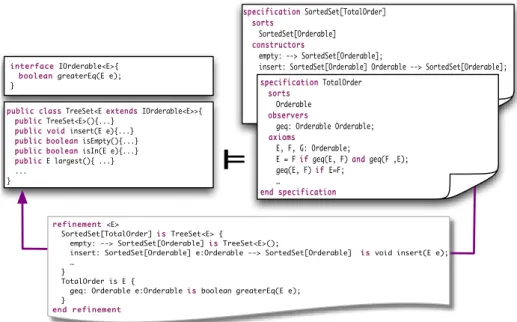
In this technical report we address the generation of test cases for implementa-tions of ADTs defined in terms of Java generic classes, that comprise automatically generated mock classes and mock objects that can be used to instantiate the generic classes’ parameters. As illustrated in Fig. 1, we consider that ADTs are described by parameterized specifications and that the abstraction gap between the specifications and the implementations is bridged through refinement mappings. Parameterized specifica-tions, as defined for instance in [6], are supported by several specification languages. In contrast, refinement mappings were defined in [16] for the specifications supported by CONGU, a tool-based approach to runtime conformance checking of Java programs against algebraic specifications [15,3]. Herein, we revisit this notion and reformulate it in a more general setting.
interface IOrderable<E>{ boolean greaterEq(E e); }
public class TreeSet<E extends IOrderable<E>>{ public TreeSet<E>(){...}
public void insert(E e){...} publicboolean isEmpty(){...} publicboolean isIn(E e){...} public E largest(){ ...} ... } specification TotalOrder sorts Orderable observers
geq: Orderable Orderable;
axioms
E, F, G: Orderable;
E = F if geq(E, F) and geq(F ,E); geq(E, E);
geq(E, F) ifnot geq(F, E); geq(E, G) if geq(E ,F) and geq(F, G);
end specification specification SortedSet[TotalOrder] sorts SortedSet[Orderable] constructors empty: --> SortedSet[Orderable];
insert: SortedSet[Orderable] Orderable --> SortedSet[Orderable];
observers
isEmpty: SortedSet[Orderable]; isIn: SortedSet[Orderable] Orderable; largest: SortedSet[Orderable] -->? Orderable; xx: SortedSet[Orderable] int;
yy: SortedSet[Orderable] SortedSet[Orderable];
domains
S: SortedSet[Orderable]; largest(S) if not isEmpty(S);
axioms
E, F: Orderable; S: SortedSet[Orderable]; isEmpty(empty());
not isEmpty(insert(S, E)); not isIn(empty(), E);
isIn(insert(S,E), F) iff E = F or isIn(S, F); largest(insert(S, E)) = E if isEmpty(S);
largest(insert(S, E)) = E if not isEmpty(S) and geq(E, largest(S));
largest(insert(S, E)) = largest(S) if not isEmpty(S) and not geq(E, largest(S)); insert(insert(S, E), F) = insert(S, E) if E = F;
insert(insert(S, E), F) = insert(insert(S, F), E);
end specification interface IOrderable<E>{ boolean greaterEq(E e); }
public class TreeSet<E extends IOrderable<E>>{ public TreeSet<E>(){...}
public void insert(E e){...} publicboolean isEmpty(){...} publicboolean isIn(E e){...} public E largest(){ ...} ... } specification TotalOrder sorts Orderable observers
geq: Orderable Orderable;
axioms
E, F, G: Orderable;
E = F if geq(E, F) and geq(F ,E); geq(E, E);
geq(E, F) ifnot geq(F, E); geq(E, G) if geq(E ,F) and geq(F, G);
end specification specification SortedSet[TotalOrder] sorts SortedSet[Orderable] constructors empty: --> SortedSet[Orderable];
insert: SortedSet[Orderable] Orderable --> SortedSet[Orderable];
observers
isEmpty: SortedSet[Orderable]; isIn: SortedSet[Orderable] Orderable; largest: SortedSet[Orderable] -->? Orderable; xx: SortedSet[Orderable] int;
yy: SortedSet[Orderable] SortedSet[Orderable];
domains
S: SortedSet[Orderable]; largest(S) if not isEmpty(S);
axioms
E, F: Orderable; S: SortedSet[Orderable]; isEmpty(empty());
not isEmpty(insert(S, E)); not isIn(empty(), E);
isIn(insert(S,E), F) iff E = F or isIn(S, F); largest(insert(S, E)) = E if isEmpty(S);
largest(insert(S, E)) = E if not isEmpty(S) and geq(E, largest(S));
largest(insert(S, E)) = largest(S) if not isEmpty(S) and not geq(E, largest(S)); insert(insert(S, E), F) = insert(S, E) if E = F;
insert(insert(S, E), F) = insert(insert(S, F), E);
interface IOrderable<E>{ boolean greaterEq(E e); }
public class TreeSet<E extends IOrderable<E>>{ public TreeSet<E>(){...}
public void insert(E e){...} publicboolean isEmpty(){...} publicboolean isIn(E e){...} public E largest(){ ...} ... } specification TotalOrder sorts Orderable observers
geq: Orderable Orderable;
axioms
E, F, G: Orderable;
E = F if geq(E, F) and geq(F ,E); geq(E, E);
geq(E, F) ifnot geq(F, E); geq(E, G) if geq(E ,F) and geq(F, G);
end specification specification SortedSet[TotalOrder] sorts SortedSet[Orderable] constructors empty: --> SortedSet[Orderable];
insert: SortedSet[Orderable] Orderable --> SortedSet[Orderable];
observers
isEmpty: SortedSet[Orderable]; isIn: SortedSet[Orderable] Orderable; largest: SortedSet[Orderable] -->? Orderable; xx: SortedSet[Orderable] int;
yy: SortedSet[Orderable] SortedSet[Orderable];
domains
S: SortedSet[Orderable]; largest(S) if not isEmpty(S);
axioms
E, F: Orderable; S: SortedSet[Orderable]; isEmpty(empty());
not isEmpty(insert(S, E)); not isIn(empty(), E);
isIn(insert(S,E), F) iff E = F or isIn(S, F); largest(insert(S, E)) = E if isEmpty(S);
largest(insert(S, E)) = E if not isEmpty(S) and geq(E, largest(S));
largest(insert(S, E)) = largest(S) if not isEmpty(S) and not geq(E, largest(S)); insert(insert(S, E), F) = insert(S, E) if E = F;
insert(insert(S, E), F) = insert(insert(S, F), E);
end specification specification TotalOrder sorts
Orderable observers
geq: Orderable Orderable;
axioms
E, F, G: Orderable;
E = F if geq(E, F) and geq(F ,E); geq(E, F) if E=F; … end specification refinement <E> SortedSet[TotalOrder] is TreeSet<E> { empty: --> SortedSet[Orderable] is TreeSet<E>();
insert: SortedSet[Orderable] e:Orderable --> SortedSet[Orderable]
is void insert(E e); isEmpty: SortedSet[Orderable]
is boolean isEmpty(); isIn: SortedSet[Orderable] e:Orderable
is boolean isIn(E e); largest: SortedSet[Orderable] -->? Orderable
is E largest(); }
TotalOrder is E { geq: Orderable e:Orderable
is boolean greaterEq(E e); } end refinement refinement <E> SortedSet[TotalOrder] is TreeSet<E> { empty: --> SortedSet[Orderable] is TreeSet<E>();
insert: SortedSet[Orderable] e:Orderable --> SortedSet[Orderable]
is void insert(E e); …
}
TotalOrder is E { geq: Orderable e:Orderable
is boolean greaterEq(E e); }
end refinement
sorts
Orderable observers
geq: Orderable Orderable;
axioms
E, F, G: Orderable;
E = F if geq(E, F) and geq(F ,E); geq(E, F) if E=F; … end specification refinement <E> SortedSet[TotalOrder] is TreeSet<E> { empty: --> SortedSet[Orderable] is TreeSet<E>();
insert: SortedSet[Orderable] e:Orderable --> SortedSet[Orderable]
is void insert(E e); isEmpty: SortedSet[Orderable]
is boolean isEmpty(); isIn: SortedSet[Orderable] e:Orderable
is boolean isIn(E e); largest: SortedSet[Orderable] -->? Orderable
is E largest(); }
TotalOrder is E { geq: Orderable e:Orderable
is boolean greaterEq(E e); }
end refinement
refinement <E>
SortedSet[TotalOrder] is TreeSet<E> {
empty: --> SortedSet[Orderable] is TreeSet<E>();
insert: SortedSet[Orderable] e:Orderable --> SortedSet[Orderable] is void insert(E e); …
}
TotalOrder is E {
geq: Orderable e:Orderable is boolean greaterEq(E e); }
end refinement
interface IOrderable<E>{ boolean greaterEq(E e);
Fig. 1.The aim is the generation of unit tests for checking if a set of generic classes correctly implements an ADT.
Following the tradition of specification-based testing, the technique we propose in-volves considering some abstract tests obtained through the instantiation of the axioms. The difference is that, in our case, this instantiation is not exclusively achieved at the syntactical level by substitution of axiom variables by ground terms; it also involves fixing an evaluation for some variables into a specific model of the parameter specifi-cation. For the generation of this type of abstract tests, the proposed technique relies on Alloy Analyzer [13], a tool that finds finite models of relational structures. Abstract tests are then translated into JUnit tests for a given implementation of the specification. This translation takes into account the correspondence between sorts and Java types and between operations and methods defined by the given refinement mapping between the specification and its implementation.
The organisation of the report is as follows. Sec. 2 presents the specifications we have considered in our approach and their semantics. In Sec. 3, we introduce a notion of abstract test appropriate for parameterized specifications and present a technique for the generation of these tests that relies on the encoding of specifications into Alloy and on Alloy Analyzer for finding model instances. In Sec. 4, we show how to automatically translate abstract tests to JUnit tests for a concrete implementation. Sec. 5 presents some evaluation experiments, Sec. 6 presents additional examples to illustrate some features and applicability of the approach proposed, and Sec. 7 concludes the report and discusses future work.
2
Specifications of Generic Data Types
In algebraic specification, the description of ADTs that admit different versions – which we designate by generic data types – is supported by parameterized specifications [6]. The description of algebraic specifications in general, and parameterized specifications in particular, is supported by different languages (e.g., [6,1,7]) with significant varia-tions in terms of syntax and semantics. In this section, we discuss the specificavaria-tions considered in our approach and their semantics.
Table 1 presents a summary of some preliminary notation and definitions.
2.1 Specifications
In this work, we restrict our attention to a set of parameterized specifications that can be described in CONGU. More concretely, we consider specifications in which operation symbols are classified asconstructorsorobserversand that are obtained through the extension of a given specificationSpecwith:
i. a single sorts,
ii. constructors that produce elements of sorts,
iii. observers and predicate symbols that take an element of sortsas first argument, iv. axioms that express properties of the new operation and predicate symbols only.
Table 1.Summary of preliminary notation and definitions
Notation Description Example
Σ=hS, F, Pi Σ- many-sorted signature
S- set of sorts
F- set of operation symbols
P- set of predicate symbols
S={Orderable}
F ={}
P ={geq}
Spec=hΣ, Axi Spec- specification
Ax - set of axioms described by formulas in first-order logic (with equality)
TotalOrder(see Fig. 1)
Ax={∀e, f :Orderable.geq(e, f)∧ geq(f, e)⇒e=f, ...}
PSpec= hParam,Bodyi
PSpec- parameterized spec
Param- formal parameter spec
Body- body spec (must include
Param)
SortedSet[TotalOrder](see Fig. 2)
Param=TotalOrder Body=SortedSet.
Body−Param Sorts, operations, predicates and axioms inBodybut not in
Param
{SortedSet[Orderable]},
{empty, insert, largest},
{isEmpty, isIn},{several axioms}
Spec+Specs The extension ofSpec with an increment centred on sorts
Specs1+. . .+Specsn Sequence of increments.
T ermΣ Set of ground terms built over
Σ
CT ermΣ Set of canonical ground terms
built over Σ (i.e., terms de-fined exclusively in terms of constructors)
T ermΣ(X) Terms built over a setXof
vari-ables typed by sorts inΣ
CT ermΣ(X) Canonical terms built over a set
Xof variables typed by sorts in
Σ
F ormΣ(X) Formulas built over a setX of
variables typed by sorts inΣ A=h{As}s∈S,F,Pi A-Σ-algebra
As- carrier set of sorts F - interpretation of operation symbols as partial functions
P - interpretation of predicate symbols as relations
JtK
A
Interpretation of a ground term
tin aΣ-algebraA
ρ Assignment ofXintoA, i.e., a function that assigns a value in
Asto each variablex:sinX.
JtK
A,ρ
Interpretation of a term t in
T ermΣ(X) with an
public class OrderableMock implements IOrderable<OrderableMock>{
private HashMap<LinkedList<Object>, Boolean> greaterEqMap =
new HashMap<LinkedList<Object>, Boolean>();
public boolean greaterEq(OrderableMock x){
return greaterEqMap.get(x); }
public void add_greaterEq(OrderableMock e, boolean result){
greaterEqMap.put(params, result); } } specification SortedSet[TotalOrder] sorts SortedSet[Orderable] constructors empty: --> SortedSet[Orderable];
insert: SortedSet[Orderable] Orderable --> SortedSet[Orderable];
observers
isEmpty: SortedSet[Orderable]; isIn: SortedSet[Orderable] Orderable; largest: SortedSet[Orderable] -->? Orderable;
domains
S: SortedSet[Orderable]; largest(S) if not isEmpty(S);
axioms
E, F: Orderable; S: SortedSet[Orderable]; isEmpty(empty());
not isEmpty(insert(S, E));
largest(insert(S, E)) = E if isEmpty(S);
largest(insert(S, E)) = E if not isEmpty(S) and geq(E, largest(S));
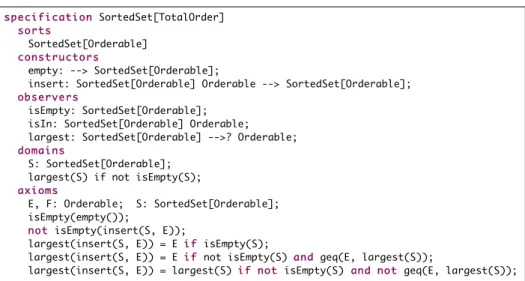
largest(insert(S, E)) = largest(S) if not isEmpty(S) and not geq(E, largest(S)); ...
end specification
Fig. 2.Specification of a sorted set in CONGU.
These elements definean increment, which can define a specification by itself or rely on sorts, operations and predicates available in the base specificationSpec (see the notation for representing increments and sequences of increments in Table 1). For the body of a parameterized specificationPSpec, it is also required that all increments different fromParaminclude at least onecreator, i.e., a constructor that does not have elements of the introduced sort among its arguments.
It is not difficult to confirm that specifications TotalOrder and SortedSet ful-fil these requirements: TotalOrder is an extension of the empty specification while SortedSet is an extension ofTotalOrder that indeed introduces one creator (empty) of the introduced sort (SortedSet[Orderable]).
In what concerns the axioms, we assume they have one of the following forms: – ∀x1:s1. . .∀xn:sn. φ
– ∀x1:s1. . .∀xn:sn. ψop⇒defined(op(x1, ..., xn))
whereop : s1, ..., sn → sis an operation symbol andφ, ψop are quantifier-free
first-order logic formulas built overΣ.
The first type of axioms is used for expressing usual properties of operations and predicates while the second type of axioms supports the definition of a domain condition of an operation (also called definedeness condition), i.e., the condition under which the operation must be defined. Domain conditions are needed because operations can be interpreted as partial functions.
InSortedSet[TotalOrder], all operations butlargestmust be interpreted by total functions and, hence, their domain conditions aretruewhilelargesthas to be defined for non empty sets:∀s:SortedSet[Orderable].¬isEmpty(s)⇒defined(largest(s)).
We further assume there is exactly one domain condition for each operation, which allows us to define the formuladefined∗(t)that, as we will see later on, defines suffi-cient conditions for the termtto be defined.
Definition 1. defined∗(t)is the formula defined inductively in the structure of termt
as follows:
1. defined∗(x) =trueifxis a variable,
2. defined∗(op(t1, ..., tn)) =defined∗(t1)∧. . .∧defined∗(tn)∧ψop[t1/x1, . . . tn/xn] ifop : s1, ..., sn → sis an operation with domain condition∀x1 : s1. . .∀xn :
sn. ψop⇒defined(op(x1, ..., xn)). 2.2 Semantics
Specifications are interpreted in terms ofΣ-algebras (see definition and notation ofΣ -algebras in Table 1). Given that operation symbols can be interpreted by partial func-tions, the interpretation of a termJtKA,ρmight not be defined. In fact,
JtK
A,ρis defined
if and only ifA, ρdefined(t). The interpretation of equality also has to take into ac-count the possibility of terms not being defined. Equality is interpreted as being strong, i.e.,t1=t2holds in aΣ-algebraAwhen the values of both terms are defined and equal or both are undefined. In what concerns predicates, when they are applied to undefined terms they are always false (as defined in [1]).
There are various forms of semantic construction in the algebraic approach to spec-ification of ADTs [5]. For the purpose at hand, the appropriate construction is loose se-mantics. This construction associates to a specificationSpec=hΣ, Axithe class of all
Σ-algebras which satisfy its set of axiomsAx; these are calledSpec-algebras. Accord-ing to this semantics, an implementation of the ADT in which all specified properties hold is considered to be correct.
Proceeding by induction on the structure of terms it is easy to prove that the formula defined∗(t)indeed defines sufficient conditions for the termtto be defined:
Proposition 1. For everySpec-algebraAand termt∈T ermΣ(X),
A, ρdefined∗(t)⇒defined(t)
In what concerns parameterized specifications, loose semantics associates toPSpec= hParam,Bodyithe class of functionsTBodywhich assign to eachParam-algebraA, a Body-algebraTBody(A)that coincides withAwhen restricted toParam. In this way, an implementation of a parameterized specification is correct if it has all the specified properties, when instantiated with any correct implementation of its parameter.
3
Generation of Abstract Tests
As mentioned before, the envisaged strategy for deriving test cases for implementa-tions of generic data types encompasses the generation of tests for their parameter-ized specifications. We call them abstract tests because their target are abstract models (Σ-algebras). For testing Java implementations, we need to convert them into object-oriented tests (JUnit tests, in our case).
3.1 Tests for Parameterized Specifications
A test for an algebraicSpecis usually defined as a ground and quantifier-free formula that is a semantic consequence ofSpecand, hence, valid in everySpec-algebra [8]. This idea can be easily generalised to parameterized specifications but the result is not partic-ularly interesting as specifications used as parameters are not expected to have creators and, in this situation, the corresponding set of ground terms is empty. In fact, specifica-tions used as parameters are not expected to have constructors as they often correspond to a required “ability”. For instance, in our example,TotalOrder corresponds to a re-quirement for the actual parameter of a sorted set to have a comparison operation that defines a total order. The notion of test that we found useful for parameterized specifi-cations is one in which we fix a specificParam-algebra.
Definition 2. Aclosed testfor a parameterized specificationPSpec=hParam,Bodyi is a tuple
hA, X, φ, ρP, ρBi where
– Ais aParam-algebra;
– Xis a finite set of variables typed by sorts inBody;
– φis a quantifier-free logic formula inF ormΣ(X);
– ρP is an assignment ofXPintoA, whereXPis the set of variables inX typed by sorts inParam;
– ρBis a function that assigns a termρB(x)inT ermsΣ(XP)to eachx:sinXB=X\XP such that, for everyTBodyin the semantics ofPSpec,
TBody(A), ρP ρ∗B(φ) whereρ∗B(φ)is the translation of formulas induced byρB.
Notice that, in these tests, the instantiation of the variables in the formula is achieved through the combination of
1. a syntactic replacement of variables inXBby terms and
2. an assignment of variables inXPinto the fixedParam-algebra.
In this way, we can exercise the test in anyΣBody-algebra that extendsA.
We are particularly interested in the generation of tests that result from the instan-tiation of axioms of the form∀x1:s1. . .∀xn:sn. φ. Because closed tests may involve
the replacement of variables by terms and the interpretation of these terms in a specific
ΣBody-algebra might be undefined, this instantiation needs to be conditioned by the de-finedeness of these terms. Because the formuladefined∗(t)provides a sufficient condi-tion for the termtto be defined, we can use the formula∧x∈XBdefined
∗
(ρB(x))⇒φ. The proposition below expresses this idea.
Proposition 2. Let PSpec = hParam,Bodyi be a parameterized specification and ∀x1:s1. . .∀xn:sn. φan axiom inBody. IfAis aParam-algebra,X is a set of vari-ables including {x1:s1, . . . , xn:sn},ρP is an assignment ofXP into Aand ρB is a function that assigns a termρB(x)inT ermsΣ(XP)to eachx:sinXB, then
hA, X,(∧x∈XBdefined ∗
is a closed test forPSpec.
Proof. Let∀x1:s1. . .∀xn:sn. φbe an axiom inBodyand hA, X,(∧x∈XBdefined
∗(ρ
B(x)))⇒φ, ρP, ρBi
a tuple as defined in the proposition statement. Then, what we need to prove is that, for everyTBodyin the semantics ofPSpec:
TBody(A), ρP ρ∗B((∧x∈XBdefined ∗(ρ
B(x)))⇒φ)
LetM = TBody(A). Then, because the terms ρB(x)do not involve variables inXB
anddefined∗(t)is a term that only involves variables used in t (see Def. 1), this is equivalent to prove that
M, ρP (∧x∈XBdefined ∗(ρ
B(x)))⇒φ[ρB(x)/x:x∈XB] (∗)
BecauseM is aBody-algebra,
M ∀x1:s1. . .∀xn:sn. φ
Hence, for every assignmentρofXintoM M, ρφ (∗∗)
Consider a variablex∈X, a termtinT ermΣ(Y)withY disjoint fromX. From (**),
it follows that, for every assignmentρ∗ofX∪Y intoM we also have M, ρ∗defined(t)⇒φ[t/x]
This happens becauseJtK
M,ρ∗is defined if and only ifM, ρ∗
defined(t). By Prop. 1, then we have
M, ρ∗defined∗(t)⇒φ[t/x]
By applying this reasoning successively to each variable inXBwe can conclude(∗).2
As an example, let us consider the axiom∀s:SortedSet[Orderable].∀e:Orderable. ¬isEmpty(insert(s, e))ofSortedSet. As a result of Prop. 2, we have that
– theTotalOrder-algebra TO2 with two elements, say,Ord0 andOrd1 andgeq
interpreted as the relation{(Ord1, Ord0),(Ord1, Ord1),(Ord0, Ord0)}
– the set of variables{s:SortedSet[Orderable], e:Orderable}
– the formulatrue⇒ ¬isEmpty(insert(s, e))
– ρP:{e:Orderable 7→Ord0}andρB:{s:SortedSet[Orderable]7→empty()}
defines a closed test forSortedSet[TotalOrder]. According to Def. 1,defined∗(empty())
3.2 Generation Technique
When tests are obtained through ground instantiation of axioms, performing a test ex-periment just requires evaluating a ground formula in the implementation under test. The generation of closed tests for parameterized specifications also involves the instan-tiation of axioms, but this instaninstan-tiation is only partial — the instaninstan-tiation of an axiom involving a set of variablesXis limited to the variables inXB. Hence, the generation
of closed tests involves the generation of models for the parameter specification and evaluations in these models for the variables inXP. In this subsection, we describe a
technique for the generation of abstract test suites for parameterized specifications that can be subsequently translated into JUnit test suites for testing Java implementations.
As pointed out in [8], test thoroughness is increased by generating multiple test cases for each axiom, following a partition testing strategy. In general, this amounts to partition each axiom into a finite set of (possibly non-disjoint) “cases”, either by succes-sively unfolding the premises of equational axioms (axioms of the formψ→t1 =t2) or by considering the conjunctive terms in the Disjunctive Normal Form (DNF) of the axiom expression. In our case, since axioms are not restricted to equational ones, DNF partitioning is more directly applicable, with the advantage of not mixing together dif-ferent axioms. To further assure that the difdif-ferent cases are disjoint, and hence avoid generating redundant tests, we take a special DNF form — the Full Disjunctive Normal Form (FDNF). The FDNF of a logical formula that consists of Boolean variables con-nected by logical operators is a canonical DNF in which each Boolean variable appears exactly once (possibly negated) in every conjunctive term (called a minterm) [9].
The technique consists in considering each of the axioms
∀x1:s1. . .∀xn:sn. φ
inBody−Param that do not express a domain condition and start by converting the axiom to FDNF. Assuming that the result is
∀x1:s1. . .∀xn:sn. φ1∨. . .∨φk
then, for every1≤i≤k, the technique involves using Alloy Analyzer to find aBody -algebraM such that:
1. Mis finite (i.e.,Msis finite, for every sorts);
2. Msatisfies sort generation constraints for sorts inBody−Param, i.e., each of these sorts is constrained to be generated by the declared constructors;
3. M satisfies a stronger version of the domain condition of every operationopin Body−Param:∀x1:s1. . .∀xn:sn. ψop⇔defined(op(x1, ..., xn));
4. Msatisfies∃x1:s1. . .∃xn :sn. φi.
Only axioms inBody−Param are considered because these are the axioms that express the properties of the generic data type that we are interested to check that hold in the implementation under test (the other axioms concern properties that are expected to hold in actual parameters). Although domain conditions are not considered directly, they are subsumed in the generated tests for the other axioms because of condition 3.
In what concerns the constraints imposed on the search of theBody-algebra: con-dition 1 is a requirement imposed by the model finder tool, which limits search to finite models; condition 2 excludes models that have junk in the carrier sets as we will need to subsequently convert the elements of this model to arbitrary ΣBody-algebras that
extendM|Param; condition 3 avoids the generation of some models that define an eval-uation for terms that are undefined in otherBody-algebras; condition 4 ensures we get from the model finder tool an assignmentρof the variables inφi intoM satisfying it.
Since the formula is in FDNF, all variables of the axiom occur inφiand, hence,ρis an
assignment ofX={x1:s1, . . . , xn:sn}intoM.
BecauseM restricted to sorts inBody−Paramis a generated model, for eachxin
XB, there exists (i) a canonical termtx∈CT ermΣ(Yx)for some set Yx of variables
typed by sorts inParam and disjoint fromX, and (ii) an assignmentρxofYxintoM
such thatJtxK
M,ρx =ρ(x). This family of terms and assignments allow us to define the
following closed test forPSpec:
hM|Param, X0, φ0, ρP, ρBi
– M|Paramis the restriction ofM toParam – X0=∪x∈XBYx∪X
– φ0is the formula(∧x∈XBdefined ∗
(ρB(x)))⇒φ
– ρP coincides withρforXP and withρxforYx, for everyx∈XB
– ρBis the function that maps eachxinXBintotx
The correction of the proposed technique is an immediate result of Prop. 2. Proposition 3. The tuplehM|Param, X0, φ0, ρP, ρBiis a closed test forPSpec.
Consider, for instance, the axiom ofSortedSet[TotalOrder]:
∀s:SortedSet[Orderable].∀e:Orderable. isEmpty(s)⇒largest(insert(s, e)) =e
One minterm of the corresponding FDNF is¬isEmpty(s)∧¬largest(insert(s, e))=e
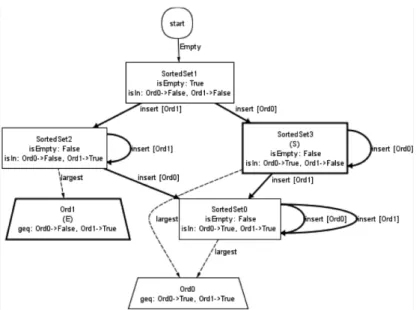
and, hence, the application of the technique just described would involve to use Alloy Analyzer to obtain aSortedSet-algebra satifying the four conditions described before. Fig. 3 presents an example of one of these algebras (referred as SS2 in the sequel), represented as an Alloy model instance. In fact, this instance also defines an assignment
ρ:{e:Orderable7→Ord1, s:SortedSet[Orderable]7→SortedSet3}
intoSS2. The last step is to find a pairht
s, ρsithat representsSortedSet3. Through
the analysis ofSS2, we find the term
insert(empty(), f)
and the assignment
ρs:{f :Orderable 7→Ord0}
As a result, we obtain the closed test forSortedSet[TotalOrder] hT O2, X0, φ0, ρP, ρBi
Fig. 3.A model instance defining aSortedSet-algebra and an assignment to variableseands.
– X0={s:SortedSet[Orderable], e:Orderable} ∪YswithYs={f:Orderable}
– φ0isdefined∗(insert(empty(), f))⇒(isEmpty(s)⇒largest(insert(s, e))=e), withdefined∗(insert(empty(), f)) =true∧true∧true
– ρP is the assignment{e7→Ord1, f7→Ord0}
– ρBis the function{s7→insert(empty(), f)}.
The number of tests generated for each axiom is in general smaller than the number of minterms in the corresponding FDNF since a minterm may not be satisfiable by Body-algebras. In particular, this happens in minterms that require the satisfaction of the negation of the definedeness condition of some term. This is the case of a minterm of the 4th axiom presented in Fig. 2 that involvesisEmpty(s)and the termlargest(s). 3.3 From Algebraic Specifications to Alloy and Back
The technique just described requires the ability to generate Alloy models from a pa-rameterized specificationPSpec=hParam,Bodyi, to generate model finding commands for Alloy Analyzer (Alloy “run” commands) and, in the end, to extract abstract closed tests from the model instances found by Alloy Analyzer.
Encoding of algebraic specifications in Alloy.The encoding ofPSpecin Alloy takes into account the sorts, operations, predicates and axioms inBodyand, at the same time, has to ensure conditions 2 and 3 of Sec. 3.2: there is no junk in the parameterized sorts and partial operations are defined iff their domain condition holds.
Fig. 4 shows an excerpt of the Alloy model produced forSortedSet[TotalOrder]. Sorts are translated into Alloy signatures. A special signature startwith a single in-stance is defined to represent the root of the graph view of each model inin-stance found
! !
sig Orderable {
geq: Orderable -> one BOOLEAN/Bool }
sig SortedSet {
insert: Orderable -> one SortedSet, isEmpty: one BOOLEAN/Bool,
isIn: Orderable -> one BOOLEAN/Bool, largest: lone Orderable
}
one sig start {
empty: one SortedSet }
fact SortedSetConstruction {
SortedSet in (start.empty).*{x: SortedSet, y: x.insert[Orderable]} }
fact domainSortedSet0 { all S:SortedSet |
S.isEmpty != BOOLEAN/True implies one S.largest else no S.largest }
fact axiomSortedSet4 {
all E: Orderable, S: SortedSet |
(S.isEmpty = BOOLEAN/True implies (S.insert[E].largest = E)) }
// … other axioms of Orderable and SortedSet run axiomSortedSet4_1 {
some E : Orderable, S : SortedSet |
(S.isEmpty ! = BOOLEAN/True and (S.insert[E].largest != E)) } for 6 but exactly 2 Orderable
// … other run commands for other minterms and axioms !
"#$%!&!'()*+,-!./!-0*!122.3!4,*)#/#)5-#.6!567!+86!).995674!,+.78)*7!/.+!-0*!*(59,2*!#6!"#$%:!567!"#$%;%!!! !
<.+-4!5+*!-+56425-*7!#6-.!4#$65-8+*4!#6!122.3%!1!4,*)#52!4#$65-8+*!!"#$"!=#-0!5!4#6$2*!#64-56)*!#4!7*/#6*7!-.! +*,+*4*6-!-0*!+..-!./!-0*!$+5,0!+*,+*4*6-5-#.6!./!*5)0!9.7*2!/.867!>3!122.3!16523?*+!@"#$%AB%!124.C!-0*! )+*5-.+! ).64-+8)-.+4! 5+*! +*,+*4*6-*7! 54! /#*274! ./! -0*!!"#$"! 4#$65-8+*! @%&'"(! #6! "#$%&! 567! "#$%AB%! D,*+5-#.64!@*()*,-!)+*5-.+!).64-+8)-.+4B!567!,+*7#)5-*!439>.24!5+*!*6).7*7!54!/#*274!./!-0*!4#$65-8+*! ).++*4,.67#6$!-.!-0*#+!/#+4-!5+$89*6-%!E.!522.=!-0#4!*6).7#6$!/.+!,+*7#)5-*4!=#-0.8-!/8+-0*+!5+$89*6-4! @48)0! 54!)!*&'"(BC! ,+*7#)5-*! 439>.24! 5+*! 05672*7! 54! .,*+5-#.64! ./! +*-8+6! -3,*! F..2*56%! G5+-#52! .,*+5-#.64!@48)0!54!+#$,%!"!#6!"#$%!&B!.+#$#65-*!/#*274!=#-0!+-.%!982-#,2#)#-3!@H!.+!:B!567!5!/5)-!*6).7#6$! -0*#+!7.95#6!).67#-#.6!@=#-0!-0*!4-+.6$*+!)//!#6-*+,+*-5-#.60%!E.!*()287*!I86J!#6!-0*!,5+59*-*+#?*7!4.+-!!C! #-!#4!#6-+.78)*7!5!/5)-!@48)0!54!1-$"%21%"3-.!"$45")-.6#5"!#6!"#$%!&B!#9,.4#6$!-05-!522!#64-56)*4!./!!!5+*! $*6*+5-*7!>3!5,,23#6$!).64-+8)-.+4!@5!)+*5-.+!).64-+8)-.+!/.22.=*7!>3!.-0*+!).64-+8)-.+4B%!1(#.94!5+*! *6).7*7!54!/5)-4!#6!122.=!#6!5!4-+5#$0-/.+=5+7!=53!@48)0!54!5(#.9<.+-*7<*-K!#6!"#$%!&B%!!!! !"#"$%&'(#)(*)+(,"-)*'#,'#.)/(++%#,0)
Fig. 4.Excerpt of the Alloy model and run commands forSortedSet[TotalOrder].
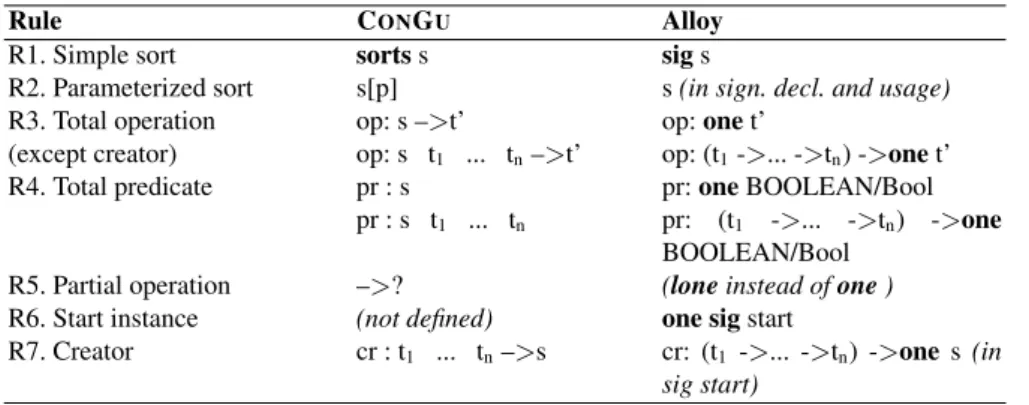
by Alloy Analyzer (see Fig. 3), holding fields corresponding to the creators of all sorts (s.a. empty). Other operations and predicates are encoded as fields of the signature corresponding to their first argument. To allow this encoding for predicates without further arguments (s.a.isEmpty), predicates are handled as operations of return type
Boolean. Partial operations (s.a.largest) originate fields withlonemultiplicity (0 or 1) and a fact encoding their (strong) domain condition. To exclude junk for a sorts, a fact is introduced (s.a.SortedSetConstructionF actin Fig. 4) imposing that all its instances are generated by applying constructors (a creator followed by other construc-tors). When constructors have extra arguments that have also to be constructed, it is also necessary to ensure that all instances can be constructed in an acyclic way, e.g., by imposing in the construction fact that, in each step, it is possible to construct an instancey by using only instancesx1, ...,xn that precedey in a partial ordering (to
Alloy facts (seeaxiomSortedSet4in Fig. 4). Tables 2, 3 and 4 present a summary of the translation rules.
Table 2.Translation rules from CONGUto Alloy - syntax
Rule CONGU Alloy
R1. Simple sort sortss sigs
R2. Parameterized sort s[p] s(in sign. decl. and usage) R3. Total operation op: s –>t’ op:onet’
(except creator) op: s t1 ... tn–>t’ op: (t1->... ->tn) ->onet’
R4. Total predicate pr : s pr:oneBOOLEAN/Bool pr : s t1 ... tn pr: (t1 ->... ->tn) ->one
BOOLEAN/Bool R5. Partial operation –>? (loneinstead ofone) R6. Start instance (not defined) one sigstart
R7. Creator cr : t1 ... tn–>s cr: (t1 ->... ->tn) ->one s (in
sig start)
Table 3.Translation rules from CONGUto Alloy - construction facts
Algebraic specification
Parameterized sortswith creator constructors
ci:si1, ..., siki→s (i= 1, ..., n)
and other constructors
tj:s, s0j1, ..., s 0
jwj →s (j= 1, ..., m)
Alloy construction fact
factsConstruction{sin(γ1+ ... +γn).∗ {x:s, y:τ1 + ... +τm} } whith
γi=start.ci[si1]...[siki], if none of thesi1, ..., sikiis a constructed type
γi={x:start.ci[si1]...[siki]|somea1:si1, ..., aki :siki|x=start.ci[a1]...[aki]
andprecedes[a1, x]and...andprecedes[aki, x]}, otherwise
and τj=x.tj[s0j1]...[s 0 jwj], if none of thes 0 j1, ..., s 0 jwj is a constructed type τj={y:x.tj[s0j1]...[s 0 jwj]|somea1:s 0 j1, ..., awj :s 0 jwj |y=x.tj[a1]...[awj] andprecedes[x, y]andprecedes[a1, y]and...andprecedes[awj, y]}, otherwise
where
precedes[x, y]is a predicate that checks ifxprecedesyin a partial ordering (to be determined by Alloy Analyzer) of all generated instances.
Generation of model finding commands.In order to find a model instance that satis-fies each minterm of the FDNF representation of each axiom inBody−Param, a “run”
Table 4.Translation rules from CONGUto Alloy - axiom and domain restriction facts
Constraint (CONGU) Fact (Alloy)
kthaxiomin sorts: factaxiomsk{
v1 :s1;...;vn:sn; allv1:s1, ..., vn:sn|
f ormula(v1, ..., vn); f ormula0(v1, ..., vn)
}
kthdomainrestriction in sorts: factdomainsk{
v1 :s1;...;vn:sn; allv1 :s1, ..., vn:sn|
op(v1, ..., vn)if cond0(v1, ..., vn)
cond(v1, ..., vn); implies oneop0(v1, ..., vn)else noop0(v1, ..., vn)
}
command that encodes condition 4 of Sec. 3.2 is generated. This is illustrated in the bottom of Fig. 4 for the same axiom and minterm used in the example of Sec. 3.2. The exploration bounds can be manually configured by the user. In the example of Fig. 4, we are searching for models with at most 6 instances of each signature and exactly 2 instances ofOrderable.
Extraction of abstract tests from the model instances found.When a “run” command is executed, each model instance found by Alloy Analyzer can be visualized as a graph as illustrated in Fig. 3. From this instance an abstract test can be extracted as partially explained in Sec. 3.2. The canonical term to be assigned to each variablex inXB
(s.a.S:SortedSet in Fig. 3) is obtained by following a path from thestartnode to the node assigned to that variable (s.a.SortedSet3in Fig. 3). When constructors have extra parameters that have also to be constructed, only paths obeying the partial ordering of all instances imposed by the construction fact are considered. In this example, the extracted Alloy expression would bestart.empty.insert[Ord0]. Since, by definition, a canonical term can contain variables but not elements of carrier sets, values of parameter sorts (Ord0in this case) are replaced by variables in the expression of the canonical term, and their values are recorded in a separate function (ρP).
Prop. 2 ensures the correction of the test generation technique in abstract terms. Obviously, the preservation of this correctness result depends on how specifications are encoded into Alloy. Concretely, it is necessary to ensure that all model instances of the generated model, restricted to the elements ofParam, define aParam-algebra. For the encoding technique presented in this section, we have in fact a stronger result: all model instances of the generated Alloy model define aBody-algebra (the proof of this result is out of the scope of this report).
4
From Abstract Tests to JUnit Tests
In this work, we focus on Java implementations of ADTs. Hence, we consider imple-mentations of parameterized specifications to be sets of Java classes and interfaces, some of them defining generic types. The challenge we address in this section is the translation of the abstract tests generated for the parameterized specification with the
help of Alloy Analyzer to concrete JUnit tests. The goal of these tests is to exercise the implementation under test, instantiating its parameters with mock classes and mock objects derived from the abstract tests.
The translation of abstract into concrete tests requires that a correspondence be-tween what is specified algebraically and what is programmed is defined. We assume this correspondence is defined in terms of a refinement mapping. This notion, defined in the context of CONGUspecifications in [16], is formulated in a more general setting. 4.1 Refinement Mappings
The correspondence between specifications and Java types as well as between opera-tions/predicates and methods can be described in terms of what we have called a re-finement mapping. We will restrict our attention to the set of specifications described in Sec. 2.1. Hence, in the rest of this section we will consider a parameterized specification PSpecwithBody defined by
B=Specs1+. . .+Specsn+Specp+Spect1+. . .+Spectk
in whichSpecpcorresponds to the parameter specification. Moreover, to ease the pre-sentation, we will consider thatSpecphas a single sort and all incrementsSpect
idepend
onSpecp(i.e., they cannot be moved to a position on the left ofSpecp). For the same reason, we also consider only Java generic types with a single parameter.
Definition 3. Arefinement mappingfromBto a setCof Java types consists of a type variableV4and an injective refinement functionRthat maps:
– eachsito a non-generic type defined by a Java class inC;
– eachtito a generic type with a single parameter, defined by a Java class inC;
– pto the type variableV;
– each operation/predicate ofSpecs, withs∈ {s1, . . . , sn, t1, . . . , tk}, to a method of the corresponding Java typeR(s)with a matching signature:(i) every n-ary creator corresponds to an n-ary constructor; (ii) every other (n+1)-ary opera-tion/predicate symbol corresponds to an n-ary method (object this corresponds to the first parameter of the operation/predicate);(iii)every predicate symbol cor-responds to a boolean method;(iv)every operation with result sortscorresponds to a method with any return type, void included, and every operation with a result sort different fromscorresponds to a method with the corresponding return type; (v)the i-th parameter of the method that corresponds to an operation/predicate symbol has the type corresponding to its (i+1)-th parameter sort;
– each operation/predicate ofSpecpto a matching method signature and such that, for every1≤i≤k, we can ensure that any typeKthat can be used to instantiate the parameter of the generic typeR(ti)possesses all methods defined byRfor type variableV after appropriate renaming — the replacement of all instances of the type variableV byK.
4Although this type variable is not strictly needed here because we are only considering a single
parameter sort, it helps to make the bridge with what can be defined in CONGUrefinement language used in the example, which supports not only several parameters but also subtype relations between them.
import java.util.HashMap;
public class OrderableMock implements IOrderable<OrderableMock> {
private HashMap<OrderableMock, Boolean> greaterEqMap =
new HashMap<OrderableMock, Boolean>();
public boolean greaterEq(OrderableMock o) {
return greaterEqMap.get(o); }
public void add_greaterEq(OrderableMock o, boolean result) { greaterEqMap.put(o, result);
} }
Fig. 5.Mock class generated from the refinement mapping in Figure 1.
Fig. 1 partially shows an example of a refinement mapping fromSortedSet[TotalOrder]
to the Java types{TreeSet<E>, IOrderable<E>}, using CONGUrefinement language. We can check if the last condition above holds by inspecting in the class TreeSet
whether any bounds are declared for its parameterE, and whether those bounds are consistent with the methods that were associated to parameter type E by the refine-ment mapping —booleangreaterEq(E e). This is indeed the case: the parameter E
ofTreeSet is bounded to extendIOrderable<E>, which, in turn, declares the method booleangreaterEq(E e).
4.2 Mock Classes and JUnit Tests
In order to test generic classes against their specifications, finite “mock” implementa-tions of their parameters are automatically generated, comprisingmock classes, that are independent of the generated abstract tests, andmock objects, instances of mock classes that are created and set up in each test method according to a specific abstract test. Mock classes. For the parameter sort p, a mock class named pMock is generated. This class will be used to instantiate the parameter of all generic types R(ti) and, hence, has to implement all the interfaces that bound these parameters. For instance, in our example, the class OrderableMock was generated (see Fig. 5) implementing
IOrderable<OrderableMock>because the parameterEofTreeSetis bounded to extend
IOrderable<E>. The mock class defines extensional implementations of all interface methods that correspond to operations or predicates of the parameter specification (in our example, just the methodgreaterEq). More concretely, for each interface method
m, the mock class provides: a hash mapmMap, to store the method return values for allowed actual parameters; anadd mmethod, to be used by the test setup code to define the above return values; and an implementation ofm itself, that simply retrieves the value previously stored in the hash map.
JUnit tests: axiom tester method.Each axiom∀x1:s1. . .∀xn:sn. φinBody−Param
that does not express a domain condition is encoded as a method (to be reused by all test methods generated for that axiom) with the axiom variables as parameters and a body that evaluates and checks (withassertTrue) the value ofφfor the given parameter values (seeaxiomSortedSet4Testerin Fig. 6). In the case of a variablexk of a parameterized
sort sk, since operations of sk may be mapped to methods with side effects (see the
case of insert in Figs. 1 and 6), a factory object (of typeFactory<sk>) is expected
as parameter instead of an object of typesk, to allow the creation of as many copies
as needed of xk (a copy for each occurrence of xk inφ) without depending on the
implementation ofclone. This way, methods with side effects can be invoked on one copy without affecting the other copies. Sub-expressions involving operations mapped tovoidmethods are evaluated in separate instructions (seeinsert in Fig. 6). Equality is evaluated with theequalsmethod.
JUnit tests: test methods encoding abstract tests.For each abstract test
hA, X,∧x∈XBdefined ∗(ρ
B(x))⇒φ, ρP, ρBi
generated according to the technique described in Sec. 3.2, a concrete JUnit test method is generated comprising three parts (for an example, see Fig. 6):
– Mock objects:Creation of mock objects (instances of mock classes) for the values in the carrier set ofA, and addition of tuples for the functions and relations inA. – Factory objects:Creation of a factory object of typeFactory<s>for each variable
x:s inXB, that constructs an object of typesupon request according to the term
ρB(x)and the mappingρP. The verification of the conditiondefined∗(ρB(x))is
performed incrementally in each step of the construction sequence, by checking the domain condition before applying any operation with a defined domain condition and issuing a warning in case it does not hold (not needed in the example). – Axiom verification: Invocation of the method that checksφ, passing as actual
pa-rameters the factory objects prepared in the previous step (for the variables inXB)
and the values defined inρP (for the remaining variables).
5
Evaluation
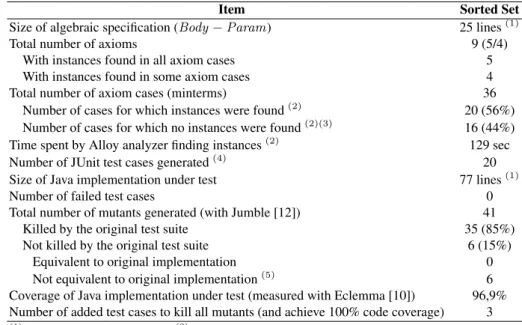
To assess the efficacy (defect detection capability of the generated test cases) and ef-ficiency (time spent) of the proposed technique, an experiment was conducted using different specifications. Herein, we report on the results of the experiment with our running example —Sorted Set.
We started by generating abstract test cases for the specificationSortedSet. We measured the time spent by Alloy Analyzer on finding model instances for the several run commands (axiom cases) and the number of run commands for which instances were found. For the ones that Alloy Analyzer could not find instances, a manual anal-ysis was conducted to determine whether they could be satisfied with other search set-tings (exploration bounds). After that, JUnit test cases generated from abstract tests and the refinement mapping toTreeSetandIOrderablewere executed to check the correct-ness of the implementation and of the test suite. Subsequently, a mutation analysis was performed to assess the quality of the test suite. Mutants not killed by the test suite were manually inspected to determine if they were equivalent to the original code, and ad-ditional test cases were added to kill the non-equivalent ones. A test coverage analyses
}
public class TreeSet<E extends IOrderable<E>>{ public TreeSet<E>(){...}
public void insert(E e){...} publicboolean isEmpty(){...} publicboolean isIn(E e){...} public E largest(){ ...} ...
}
private interface Factory<T> {T create();}
private void axiomSortedSet4Tester(Factory<TreeSet<OrderableMock>> sFact, OrderableMock e) { TreeSet<OrderableMock> s_0 = sFact.create(); TreeSet<OrderableMock> s_1 = sFact.create(); if(s_0.isEmpty()) { s_1.insert(e); assertTrue(s_1.largest().equals(e)); } }
@Testpublic void test0_axiomSortedSet4_1(){
// mock objects for the parameter
final OrderableMock ord0 = new OrderableMock();
final OrderableMock ord1 = new OrderableMock(); ord0.add_greaterEq(ord0, true);
ord0.add_greaterEq(ord1, false); ord1.add_greaterEq(ord0, true); ord1.add_greaterEq(ord1, true);
// factory objects for the axiom var’s of parameterized type
Factory<TreeSet<OrderableMock>> sFact = new Factory<TreeSet<OrderableMock>>() {
public TreeSet<OrderableMock> create() {
TreeSet<OrderableMock> s = new TreeSet<OrderableMock>(); s.insert(ord0);
return s; } };
// checking the axiom
axiomSortedSet4Tester(sFac, ord1); }
//… other axioms and test cases
Fig. 6.Excerpt of JUnit test code generated corresponding to the model instance shown in Fig. 3.
was also performed as a complementary test quality assessment technique. The exper-iment was conducted on a portable computer with a 32 bits Intel Core 2 Duo T6600
@2.20 GHz processor with 2.97 GB of RAM, running Microsoft’s Windows 7. The results are summarized in Table 5.
In terms of efficiency, we concluded that the time spent in finding model instances (∼2 minutes) is not a barrier for the adoption of the proposed approach. The percentage of axiom cases for which a model instance was not found was significant (44%). A manual analysis showed that these cases were not satisfiable. Mutation analysis revealed some parts of the implementation that were not adequately exercised, due to the use of an partially unspecified and manually crafted implementation ofequals, and due to the fact that the behaviour of operations outside their domain (in the example, the behaviour oflargestover an empty set) is not specified and consequently not tested.
6
Additional Examples
This section presents additional examples to illustrate the features and applicability of the proposed technique.
6.1 Example with Less Trivial Parameters – POSet
In the example of the generic type used throughout the report (SortedSet), one could argue that a standard Java type with a natural ordering, likeStringor a wrapper class,
Table 5.Experimental results for the SortedSet example
Item Sorted Set
Size of algebraic specification (Body−Param) 25 lines(1)
Total number of axioms 9 (5/4)
With instances found in all axiom cases 5
With instances found in some axiom cases 4
Total number of axiom cases (minterms) 36
Number of cases for which instances were found(2) 20 (56%) Number of cases for which no instances were found(2)(3) 16 (44%) Time spent by Alloy analyzer finding instances(2) 129 sec
Number of JUnit test cases generated(4) 20
Size of Java implementation under test 77 lines(1)
Number of failed test cases 0
Total number of mutants generated (with Jumble [12]) 41
Killed by the original test suite 35 (85%)
Not killed by the original test suite 6 (15%)
Equivalent to original implementation 0
Not equivalent to original implementation(5) 6 Coverage of Java implementation under test (measured with Eclemma [10]) 96,9% Number of added test cases to kill all mutants (and achieve 100% code coverage) 3
(1)Ignoring comments and blank lines.(2)In this experiment, the exploration was limited to at most 12 instances per sort, but exactly 3Orderable. (3)Manual analysis showed that these cases were not satisfiable.(4)Only one test case was generated for each satisfiable axiom case (corresponding to the first instance retrieved by Alloy Analyzer).(5)Related to method invocation outside the domain and to insufficient testing ofequals.
could be used to instantiate the parameter of the generic type and adequately test the generic type (according to the FDNF criteria), with no need for generating mock ob-jects. To illustrate a situation where such an approach would not yield adequate testing, we present here a slightly different generic type - a partially ordered set (POSet).
Fig. 7 presents the specification of this data type. The main differences with respect to theSortedSet example are the removal of the totality axiom inPOrderable when compared withOrderable, and the replacement of thelargestoperation inSortedSet by the maximal operation inPOSet, returning the set of maximal elements in the POSet. An element xis a maximal element of aPOSet sifsdoes not contain any other elementygreater thanx.
Fig. 8 presents an excerpt of the corresponding encoding in Alloy, including a run command that generates the model instance shown in Fig. 9. If a standard Java type with a natural ordering, likeStringor a wrapper class, was used directly to instantiate the parameter ofP OSet, this run command would not be satisfiable, because all pairs of elements would be comparable. By relying on Alloy Analyzer for finding an appropriate instantiation for the parameter of the generic type under test, such a problem does not arise, assuring adequate testing of the type under test.
specification PartialOrder
sorts
POrderable // Partially Orderable
observers
geq: POrderable POrderable; axioms
E, F, G: POrderable;
E = F if geq(E,F) and geq(F,E); geq(E,E);
geq(E,G) if geq(E,F) and geq(F,G);
end specification
specification POSet[PartialOrder] sorts
POSet[POrderable] // Partially Ordered Set
constructors
empty: --> POSet[POrderable];
insert: POSet[POrderable] POrderable --> POSet[POrderable]; observers
isEmpty: POSet[POrderable]; isIn: POSet[POrderable] POrderable;
maximal: POSet[POrderable] --> POSet[POrderable]; hasComparable: POSet[POrderable] POrderable; // auxiliary axioms E, F: POrderable; S: POSet[POrderable]; isEmpty(empty()); not isEmpty(insert(S,E)); not isIn(empty(),E);
isIn(insert(S,E),F) iff E = F or isIn(S,F); insert(insert(S,E),E) = insert(S, E); insert(insert(S,E),F) = insert(insert(S,F),E); maximal(empty()) = empty();
maximal(insert(S,E)) = insert(S,E) isEmpty(S); if
maximal(insert(insert(S,E),F))) = maximal(insert(S,F)) if geq(F,E); maximal(insert(insert(S,E),F))) = maximal(insert(S,E)) if geq(E,F); maximal(insert(insert(S,E),F))) = insert(maximal(insert(S,E)),F) if not hasComparable(insert(S,E),F);
not hasComparable(empty(),E); hasComparable(insert(S,E),F)
iff geq(E,F) or geq(F,E) or hasComparable(S,F);
end specification
openutil/boolean as BOOLEAN one sig start {
empty: one POSet }
sig POrderable {
geq: POrderable -> one BOOLEAN/Bool
}
// … encoding of axioms of POrderable omitted sig POSet {
insert: POrderable -> one POSet,
isEmpty: one BOOLEAN/Bool,
isIn: POrderable ->one BOOLEAN/Bool,
maximal: one POSet,
hasComparable: POrderable -> one BOOLEAN/Bool
}
// … encoding of other axioms and construction fact of POSet omitted fact axiomPOSet10 {
all E, F: POrderable, S: POSet |
S.insert[E].hasComparable[F] = BOOLEAN/False implies
S.insert[E].insert[F].maximal = S.insert[E].maximal.insert[F] }
// … other run commands omitted
run run_axiomPOSet10_1{
some E, F: POrderable, S: POSet |
S.insert[E].hasComparable[F] = BOOLEAN/False and
S.insert[E].insert[F].maximal = S.insert[E].maximal.insert[F] } for 4
Fig. 8.Excerpt of the encoding in Alloy of the specification of the partially ordered set.
classIntervalTree<EextendsComparable<E>,TextendsHasInterval<E>>
available in the Stanford JavaNLP API (http://nlp.stanford.edu/nlp/javadoc/javanlp/). It admits as second parameter a type that extends the interface
interfaceHasInterval<EextendsComparable<E>>
which defines a method
Interval<E>getInterval()
No implementation of this interface, nor ofInterval<E>, is readily available in standard Java types nor in the framework.
6.2 Example with Underspecified Constructors – Set
The next example illustrates the need, in the general case, to check the definedeness of the terms used to replace variables in axiom expressions (see Sec. 3.1), as well as the need to check the complete axiom expression instead of minterm expressions (see Section 3.2). This need arises in special cases as will be shown in a fabricated case.
The example is a genericSetwhose elements are inserted with a special constructor insertOneOf(S, E, F). This constructor inserts in setSone of the elementsE orF, with the restriction that it can only be applied if at least one of these elements is not yet inS. If none of the elements exist in setS, the implementation is free to choose one of the values. Fig. 10 presents the specification of this data type in CONGU.
Assume that we generate tests based on models in which the first element takes precedence (i.e., in case neitherE norF exists inS,Eis inserted), whilst the imple-mentation under test behaves the opposite way. More concretely, the impleimple-mentation under test in case neitherE norF exists in S, insertsF; if one already exists raises an exception. For example, consider one generates the following expression (a valid expression under the assumption above stated) to replace some variableSin an axiom under test:
insertOneOf(insertOneOf(empty(), Elem0, Elem1), Elem1, Elem1)
A direct translation of this expression into Java code (assuming the same names are used in the implementation under test) would be:
Set<Element>s =newSet<Element>(); s.insertOneOf(elem0, elem1);
s.insertOneOf(elem1, elem1);
But, if the implementation under test behaves as stated above, the last instruction will cause an exception, becauseelem1already exists in the set. So, a safe encoding requires checking the domain condition before applying any operation with a defined domain condition and issuing a warning in case it does not hold (see Sec. 4.2):
Set<Element>s =newSet<Element>();
if (s. isIn (elem0) and s.isIn(elem1)){
return; }
s.insertOneOf(elem1, elem1);
if (s. isIn (elem0) and s.isIn(elem1)){
warn(”DomainConditionNotMet:insertOneOf.”);
return; }
s.insertOneOf(elem1, elem1);
Similar reasons justify the need to verify the axiom expression instead of minterm expressions. Assume one wants to test the minterm
isIn(insertOneOf(S, E, F), E) ∧ (isIn(S, E) ! = isIn(S, F))
of the FDNF expression of the axiom
isIn(insertOneOf(S, E, F), E) if isIn(S, E) ! = isIn(S, F)
using the following assignment (satisfying the minterm, according to our assumptions):
E7→Elem0
F7→Elem1
S7→insertOneOf(empty(), Elem0, Elem2)
Since the set S in the implementation under test will contain Elem2 instead of
Elem0(according to the above stated assumptions), and the result ofinsertOneOf(S, E, F)
isF to be inserted in the set, none of the clauses of the minterm will hold in the im-plementation under test. However, the axiom still holds (by definition, it holds for any variable assignment). This is the justification for verifying the axiom expression instead of the minterm expression in the generated test case (see Sec. 4.2).
Hence, in both situations, the approach followed ensures that the generated test cases are correct (i.e., do not fail in the presence of a correct implementation), even if test coverage is less guaranteed. Nevertheless, the potential negative impacts in test coverage can be mitigated by generating multiple test cases for each minterm.
6.3 Example of a Constructor with Constructed Arguments – Set Union
The next example illustrates the features designed in the Alloy encoding and abstract test extraction to properly handle constructors that have arguments that have themselves to be constructed (see Sec. 3.2).
Fig. 11 shows the specification of a genericSetwith theemptyandsingleton cre-ators, and auniontransformer to generate sets with more than one element (taking as arguments two sets). Fig. 12 shows the corresponding encoding in Alloy. The main dif-ferences wrt the normal encoding are underlined. Since the arguments of the constructor
unionare themselves of a constructed type, the more complex form of the construction fact has to be used, to ensure that all instances can be constructed in an acyclic way
specification Set[Element] sorts
Set[Element] constructors
empty: --> Set[Element];
insertOneOf: Set[Element] Element Element -->? Set[Element]; observers
isEmpty: Set[Element]; isIn: Set[Element] Element; domains
E, F: Element; S: Set[Element];
insertOneOf(S, E, F) if not isIn(S, E) or not isIn(S, F); axioms
E, F, G: Element; S: Set[Element]; isEmpty(empty());
not isEmpty(insertOneOf(S, E, F)); not isIn(empty(), E);
isIn(insertOneOf(S,E,F),G) = isIn(S,G)
if G != E and G != F and (not isIn(S, E) or not isIn(S, F)); isIn(insertOneOf(S,E,F),E) if isIn(S, E) != isIn(S, F); isIn(insertOneOf(S,E,F),F) if isIn(S, E) != isIn(S, F);
isIn(insertOneOf(S,E,F),E) = (E=F or !isIn(insertOneOf(S,E,F),F)) if not isIn(S, E) and not isIn(S, F);
end specification
Fig. 10.Specification of a generic set in CONGUwith an “underspecified” constructor.
(see Table 3). The construction fact imposes that, in each step, it is possible to construct an instanceyby using only instancesx1, ...,xnthat precedeyin a partial ordering (to
be found by Alloy Analyzer) of all instances. Such partial ordering is provided by the signatureAnyand predicateprecedes.
Fig. 13 shows a model instance found by Alloy Analyzer when the run command in the bottom of Fig. 12 is executed. In this case, the canonical term to be assigned to each variable xinXB (in this example,S1,S2 andS3) is obtained by following a
path from thestartnode to the node assigned to that variable, ignoring all the edges
s → t withconstrOrd(s) ≥ constrOrd(t)or that involve some argument awith
constrOrd(a) ≥ constrOrd(t). Hence, a possible assignment (written using Alloy notation) is:
S17→start.singleton[Element0]
S27→start.singleton[Element1]
S37→start.singleton[Element0].union[Set2], withSet2 =singleton[Element1]
6.4 Example of Generation of Actual Method Parameters – SortedSet with Comparator
This example illustrates how the presented approach can also be applied to automat-ically generate actual parameters for methods where the formal parameters are of in-terface types. The example is aSortedSet in which the elements are not compared by natural order, but instead by using a comparator that is passed as parameter to the
specification Set[Element] sorts
Set[Element] constructors
empty: --> Set[Element]; singleton: Element --> Set[Element];
union: Set[Element] Set[Element] --> Set[Element]; observers
isEmpty: Set[Element]; isIn: Set[Element] Element; axioms
E, F: Element;
S, S1, S2, S3: Set[Element];
union(S, empty()) = S; // neutral element union(S, S) = S; // idempotence
union(S1, S2) = union(S2, S1); // commutativity
union(union(S1, S2), S3) = union(S1, union(S2, S3)); // associativity isEmpty(empty());
not isEmpty(singleton(E));
isEmpty(union(S1, S2)) iff isEmpty(S1) andisEmpty(S2); not isIn(empty(), E);
isIn(singleton(E), F) iff E = F;
isIn(union(S1,S2), E) iff isIn(S1,E) or isIn(S2, E);
end specification ! ! ! ! ! ! ! ! ! ! ! ! ! ! ! ! specification Comparator[Element]
Fig. 11.Specification of a genericSetwith aunionconstructor in CONGU.
constructor (creator) – a possibility commonly available in the Java Collections Frame-work.
Fig. 14 presents the specification of this data type. Fig. 15 presents an excerpt of the corresponding encoding in Alloy, including a run command that generates the model instance shown in Fig. 16. Figs. 18 and 17 show the corresponding test code generated from the model instance in Fig. 16.
6.5 Example of an ADT that does not admit finite models - Stack
The fact that Alloy Analyzer only performs model-finding over restricted scopes con-sisting of a user-defined finite number of objects imposes a limitation of the approach presented so far: the inability to generate tests for ADTs that do not admit finite models. A simple example is the case of an unboundStack: since the domain ofpushis true, it is always possible to create a bigger stack.
To overcome this problem, we have defined a modified set of translation rules from CONGUto Alloy, that encompasses transforming constructors into partial functions in Alloy and inserting definedeness guard conditions in the axioms that use those con-structors. The translation rules from Alloy to JUnit are not changed.
Fig. 19 presents a specification of a genericStack. Fig.20 presents the correspond-ing encodcorrespond-ing in Alloy. The differences with respect to the normal translation rules (un-derscored in Fig. 20) are:
open util/boolean as BOOLEAN
open util/integer as INTEGER
abstractsig Any { constrOrder : one Int }
pred precedes [x : Any, y : Any] { x.constrOrder < y.constrOrder }
onesig start {
empty: one Set,
singleton : Element -> one Set
}
sig Element extends Any {}
sig Set extends Any {
union : Set -> one Set,
isEmpty: one BOOLEAN/Bool,
isIn: Element -> one BOOLEAN/Bool
}
fact SetConstruction {
Set in (start.empty + {x: start.singleton[Element] | some a1:Element |
x=start.singleton[a1] and precedes[a1,x]}).*
{x: Set, y: {y: x.union[Set] | some a1: Set |
y=x.union[a1] and precedes[x,y] and precedes[a1,y]}}
}
fact axiomSet0{ all S:Set | S.union[start.empty] = S }
fact axiomSet1{ all S:Set | S.union[S] = S }
fact axiomSet2{ all S1, S2:Set | S1.union[S2] = S2.union[S1] }
fact axiomSet3{
all S1, S2, S3:Set | (S1.union[S2]).union[S3] = S1.(union[S2].union[S3])
}
fact axiomSet4{ start.empty.isEmpty = BOOLEAN/True }
fact axiomSet5{ all E: Element | start.singleton[E].isEmpty = BOOLEAN/False}
fact axiomSet6{
all S1, S2: Set | S1.union[S2].isEmpty = BOOLEAN/True
iff (S1.isEmpty = BOOLEAN/True and S2.isEmpty = BOOLEAN/True)
}
fact axiomSet7{ all E:Element | start.empty.isIn[E] = BOOLEAN/False }
fact axiomSet8{ all E,F: Element | start.singleton[E].isIn[F]=BOOLEAN/Trueiff (E=F)}
fact axiomSet9{
all S1, S2: Set, E: Element | S1.union[S2].isIn[E] = BOOLEAN/True
iff (S1.isIn[E] = BOOLEAN/True or S2.isIn[E] = BOOLEAN/True)
}
// ... other run commands omitted
run run_axiomSet3_0{
some S1, S2, S3:Set | (S1.union[S2]).union[S3] = S1.(union[S2].union[S3])
and (S1 != S2) and (S2 != S3) and (S1 != S3)
} for 8 butexactly 2 Element

![Fig. 4. Excerpt of the Alloy model and run commands for SortedSet [TotalOrder ].](https://thumb-us.123doks.com/thumbv2/123dok_us/1429564.2691393/12.892.203.718.170.681/fig-excerpt-alloy-model-run-commands-sortedset-totalorder.webp)