Discovery, The Student Journal of Dale Bumpers College of
Agricultural, Food and Life Sciences
Volume 14
Article 11
Fall 2013
Evaluation of cover crops in high tunnel vegetable
rotation
Tyler A. Patrick
University of Arkansas, Fayetteville
Neal Mays
University of Arkansas, Fayetteville
Jason McAfee
University of Arkansas, Fayetteville
Curt R. Rom
University of Arkansas, Fayetteville
Follow this and additional works at:
https://scholarworks.uark.edu/discoverymag
Part of the
Agricultural Economics Commons
,
Agronomy and Crop Sciences Commons
,
Plant
Breeding and Genetics Commons
, and the
Soil Science Commons
This Article is brought to you for free and open access by ScholarWorks@UARK. It has been accepted for inclusion in Discovery, The Student Journal of Dale Bumpers College of Agricultural, Food and Life Sciences by an authorized editor of ScholarWorks@UARK. For more information, please [email protected], [email protected].
Recommended Citation
Patrick, Tyler A.; Mays, Neal; McAfee, Jason; and Rom, Curt R. (2013) "Evaluation of cover crops in high tunnel vegetable rotation,"
Discovery, The Student Journal of Dale Bumpers College of Agricultural, Food and Life Sciences. University of Arkansas System Division of Agriculture. 14:58-65.
Evaluation of cover crops in high
tunnel vegetable rotation
Tyler A. Patrick*, Neal Mays
†, Jason McAfee
§and Curt R. Rom‡
ABSTRACT
Organic vegetable production within high tunnels allows for an extended growing season, crop protection, and environmental control. The USDA National Organic Program (NOP) standards mandate evidence that the soil has been maintained and improved over the course of production. Previous studies have indicated the potential of cover crops for reducing competitive vegetation, and improving soil quality, thus resulting in greater plant growth, nutrient uptake, and yield. However, there has been limited work in the confines of high tunnels as part of a tunnel-system rotation. Ten nitrogen-fixing and ten non-legume cover crops were established under a high tun-nel and evaluated for their effects on the yield of ‘De Cicco’ broccoli (Brassica oleracea L. var. ital-ica) and ‘Champion’ collards (Brassica oleracea L. var. acephala), aboveground biomass, and plant C and N contents. All treatments received recommended levels of appropriate certified organic fertilizers, water status was maintained, and vegetables received standard organic maintenance for insects and disease. The cover crops hairy indigo (Indigofera hirsuta L.), Catjang cowpea (Viana unguicalata L.), and Sunn hemp (Crotalaria juncea L.) consistently produced higher yields than Tifleaf III hybrid pearl millet (Pennisetum glaucum L.), Dairymaster brown midrib (BMR) hybrid grain sorghum (Sorghum spp.), and Wild Game Food sorghum (Sorghum bicolor L.). Nitrogen-fixing legumes produced horticulturally significantly higher yields than the non-nitrogen-Nitrogen-fixing grass species. This experiment demonstrated that not all cover crops are equal; they created varia-tion in response. Cover crops provide a viable opvaria-tion for organic producers to maintain or im-prove soil quality over the course of production.
* Tyler A. Patrick is a May 2013 graduate with a major in Horticulture, Landscape, and Turf Sciences and minors in Environmental Science and Wildlife Management.
† Neal Mays was a Ph.D. candidate in the Department of Horticulture while participating in this research. § Jason McAfee is a Program Technician II in the Department of Horticulture.
INTRODUCTION
The rate of plant growth, yield, and health is closely re-lated to the environment and soil quality in which a crop is cultured. High tunnels (minimally structured, tempo-rary greenhouse-like structures), offer the opportunity for management and control of both the environment and soil quality. The majority of high tunnels contain a hoop-like structure covered by greenhouse-grade plastic, use side curtains for passive ventilation, and are sited on soil. Greenhouse-grade plastics may include polyethyl-ene film, spunbonded polyester and spunbonded poly-propylene (Wells, 1996). Other materials used to modify the internal environment include co-extruded copolymer resin tri-layer film, overwintering white film, PVC vinyl, and shade cloth. High tunnels may be constructed to be semi-permanent, movable, or temporary. Despite having been invented in the United States (Emmert, 1955), high tunnel production has just recently gained popularity among specialty crop producers in the U.S.
The extended growing season in high tunnels allows for production during the dormant stage of insect and disease cycles. However, they may increase the rate of soil organic matter (SOM) and plant available nutrient deple-tion during the growing season. Certified organic pro-ducers must follow the USDA National Organic Program
(NOP) standards that specify how physical, chemical, and biological conditions of the soil must be maintained or improved. The soil cannot be contaminated with chemi-cals or compounds such as heavy metals or disallowed pesticide residues (NOP §205.203a; NOP §205.203c; USDA, 2011). Research is necessary to provide organic vegetable producers in high tunnels with alternative soil management practices supported by experimental data. Healthy soil should allow farmers to produce greater plant biomass and yield.
Recent increase in public desire for organic, sustain-able, or “naturally” produced food has increased the de-mand for sustainable soil management. Cover crops are plants grown between cropping cycles for the purpose of improving soil quality and health. Often they are called “green manures”. Cover crops can contribute to a more sustainable soil fertility status by improving soil structure characteristics including aggregation, porosity, bulk den-sity, and permeability (Rogers and Giddens, 1957).
Legumes, grasses, and non-legume broadleaf’s are the three primary types of cover crops (Verhallen et al., 2003). This experiment focused on legumes and grasses as the two main categories of cover crops for high tunnel vegetable rotations. Legumes have the unique ability to fix atmospheric nitrogen into plant available ammonia. Nitrogen fixation occurs through a symbiotic relation-MEET THE STUDENT-AUTHOR
I am from Harrison, Arkansas, and I graduated from Harrison High School in 2008. I graduated in May 2013 with a B.S. of Hor-ticulture, Landscape, and Turf Science, a minor in Environmental Science, and a minor in Wildlife Management. My passion for hor-ticulture comes from my desire to aid in the development of a more sustainable tomorrow. Growing up on a farm in Arkansas opened my eyes to the difficulties of growing quality crops in the transition zone from warm to cool season crops. My desire was to conduct research measuring the sustainability of high tunnel production in Arkansas vegetable production. During my academic career at the University of Arkansas, I have held various officer positions in Hor-ticulture club and GroGreen campus community garden and con-ducted an undergraduate research project.
I would like to thank Dr. Curt Rom for his extensive help and guidance through my undergraduate research project. With the ad-ditional assistance from Jason McAfee, Neil Mays, Heather Freder-ick, and Spencer Fiser, I received awards from American Society for Horticultural Science and Gamma Sigma Delta Honors society for my undergraduate research project. The experience conducting a research project, and presenting the results will prove to be a useful experience to overcome future challenges.
ship between legumes and Rhizobium bacteria. This pro-cess of symbiotic nitrogen fixation is the major naturally occurring mechanism by which nitrogen is introduced into soil, and the ecological and agricultural importance of this process has provided incentive to study this plant-microbe relationship (Franssen et al., 1992).
Nitrogen fixation does not occur in grass crops, which require nitrogen to be present as ammonium, or nitrate in the soil. Grasses are grown as cover crops for their ability to produce large amounts of biomass and suppress competitive vegetation. Some grasses contain allelopath-ic properties that can inhibit growth of competitive veg-etation. Sorghum has particularly high allelopathic prop-erties from root exudation and stem residual biomass (Cheema et al., 2007). Weed control can range as high as 75% for sorghum cover crops (Urbano et al., 2006). An evaluation of nitrogen-fixing legumes and non-nitro-gen-fixing cover crop species in vegetable rotation will determine if vegetable yields show variation in response to different types of cover crops.
MATERIALS AND METHODS
This experiment was conducted in the organic block at the University of Arkansas Agricultural Research and Extension Center in Fayetteville, Arkansas. The site is located on a Captina silt loam soil. The soil was amend-ed with poultry litter at the rate of 2.24 Mg/ha in early March, 2011, and seedbeds were prepared using a power takeoff (PTO) driven rototiller prior to planting. The experimental design was a randomized complete block with three replications in a 42.6 m × 6.1 m Quonset style high tunnel. Each replication was grown in a 3.0 m × 1.0 m plot that was seeded at a rate of 74 grams per plot using a 0.9-m Gandy drop seeder.
The ten nitrogen-fixing cover crops include alyceclo-ver (Alysicarpus ovalifolius (Schumach.), partridge pea (Chamaecrista fasciculata (Michx.), sunn hemp ( Crota-laria juncea L.), quail haven soybean (Glycine max L.), Kester’s Bobwhite trailing soybean, Hutcheson soybean, hairy indigo (Indigofera hirsuta L.), rongai lablab (Lablab purpureus L.), sainfoin (Onobrychis viciifolia Scop.), and catjang cowpea (Viana unguicalata L.). Non-legume cov-er crops included mancan buckwheat (Fagopyrum escul-entum Moench), Tifleaf III hybrid pearl millet ( Pennise-tum glaucum L.), Dove proso millet (Panicum miliaceum
L.), Japanese millet, (Echinochloa esculenta, A Braun), piper sudangrass (Sorghum vulgare Pers.), Dairymaster brown midrib (BMR) hybrid grain sorghum (Sorghum
spp.), Egyptian wheat sorghum, Wild Game Food sor-ghum, Hegari sorsor-ghum, and Sugargrazer II sorghum su-dangrass. Cover crops were planted on 7 July 2011. Irri-gation was provided using hand-line sprinklers for three
weeks after planting. After the initial establishment the cover crops received no further irrigation throughout the summer.
Cover crops were allowed to grow in the high tun-nel from early July to mid-August. Non-legume cover crop species had begun to produce seed by mid-August, and all grasses were mowed to a height of 30 cm using a string trimmer. Legumes were not cut but were allowed to go dormant, flower, set seed, and then cut using hand shears. After all of the cover crops were cut down, each plot received three passes using a walk behind sickle mower on 12 January 2012 to reduce the aggregate size of the cover crop debris and aid in decomposition. The crop debris was incorporated into the soil 30 January with a PTO driven rototiller to a depth of approximately 10 cm. To prevent contamination between plots, the plant de-bris was removed from the tines before proceeding to the next plot. Plots then received a light watering with lawn sprinklers and the high tunnel was completely enclosed to increase soil and air temperature for 30 days.
Organic ‘De Cicco’ Broccoli (Brassica oleracea var.
italica) and ‘Champion’ Collards (Brassica oleracea var.
acephala) seed was started in 5.7 cm × 6 cm × 8.25 cm 6-cell packs in a greenhouse 12 February and grown for 25 days before planting into the high tunnel. Each plot received 2.27 kg of Bradford Organics™ Luscious Lawn and Garden 3-1-5 fertilizer, which was incorporated us-ing a PTO driven rototiller at the beginnus-ing of March. The plots were then covered with landscape fabric to prevent competitive vegetation prior to planting. Three broccoli plants were planted in each plot in a straight line, spaced approximately 0.5 m apart, on the inside half of the plots, and six collards oriented in two staggered rows of three were planted in the outside half of the plots.
Cutworms (Agrotis spp.) were observed in the high tunnel in mid-March causing minor damage to the broc-coli and collards. Javelin® WG, an organically certified
bacillus thuringiensis (BT) pesticide, was applied with a SCHURflo® backpack sprayer on 30 March, at a rate of 0.448 fg/ha. Cabbage loopers [Trichoplusia ni (Hübner)] emerged the first, third, and fourth week of April causing damage to the broccoli and collard leaves. Javelin® WG was applied a second time at the rate of 0.18 kg/acre on 9 April and once again on 20 April with SHURflo® back-pack sprayer. Deliver™, a more potent BT insecticide, was applied 30 April at the rate of 0.448 kg/ha.
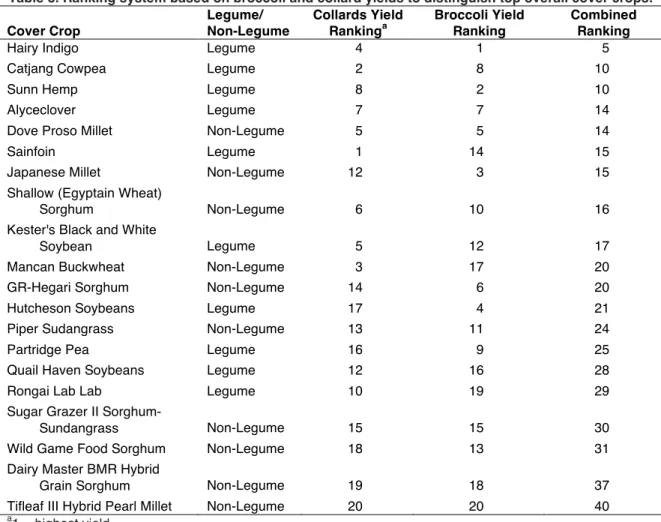
Each vegetable crop received two harvests during the 2012 production season. Collard leaves were collected and weighed as individual plots on 20 April and 6 May. The broccoli was harvested and weighed on 5 and 16 May. After the last harvest, leaf samples were collected from each plant, and plant biomass was recorded. Cover crops were ranked from 1 to 20 with 1 representing the highest
total broccoli and collard yields. The broccoli and collard scores were then added together to create an overall cover crop ranking (Table 1). Carbon and nitrogen concentra-tion and content was determined from leaf samples col-lected after the final harvest 16 May 2012 for both crops. Leaf tissue from each test crop per plot was forced-air dried at approximately 50 °C for 2 weeks and ground into a fine powder using a rotating-blade coffee grinder. Ap-proximately 10 mg (+/- 0.3 mg) of each leaf sample was loaded into tin boats and placed in an Elementar vario EL cube (Elementar Americas, Inc., Philadelphia, Pa.) for analysis of total % C and % N by incinerating the samples at high temperature combustion at approximately 1200 °C. Total leaf % C and % N concentrations were obtained for the leaf samples in each treatment plot as derived by Elementar software, and all were expressed as mg/kg on a dry weight basis. Statistical Analysis Software (SAS) us-ing least significant difference (LSD) was used to analyze test crop yield, total plant biomass, and leaf sample % C and % N.
RESULTS AND DISCUSSION
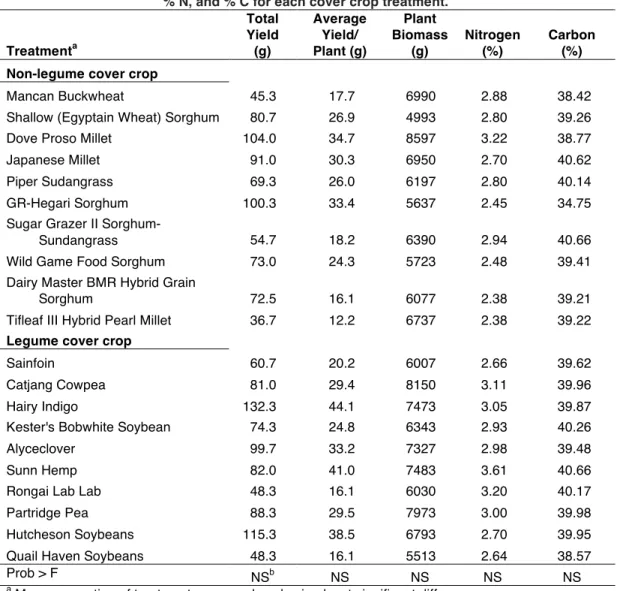
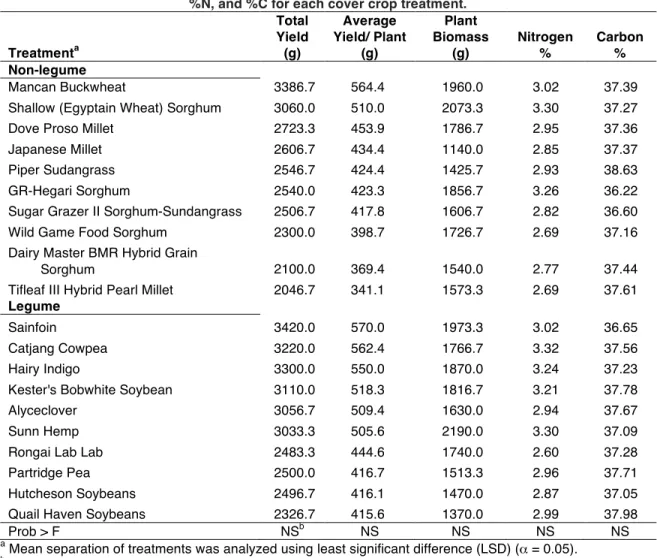
All cover crops in a high tunnel vegetable production rotation were not equal; different cover crop species cre-ated variation in vegetable crop response. Data were col-lected on broccoli and collard total yield, average yield per plant, plant biomass, and % C and % N (Tables 1 and 2) and treatments resulted in no statistical differences. Despite the lack of statistical differences, the vegetable yield data showed horticultural significance. The yield of ‘De Cicco’ Broccoli (Brassica oleracea var. italica) and ‘Champion’ Collard (Brassica oleracea var. acephala) was affected by the cover crops that preceded them in rota-tion (Table 3). Broccoli demonstrated greater variarota-tion in response to the different cover crop treatments; this could be due to differences in growth habit and nutrient requirements between broccoli and collard greens. The cover crops hairy indigo (Indigofera hirsuta L.), catjang cowpea (Viana unguicalata L.), and sunn hemp ( Cro-talaria juncea L.) ranked as the top three overall cover crops (Table 3). Tifleaf III hybrid pearl millet ( Pennis-etum glaucum L.), Dairymaster (BMR) hybrid grain sor-ghum (Sorghum spp.), and Wild Game Food sorghum (Sorghum bicolor L.) ranked as the bottom three cover crops based on a combined broccoli and collard overall ranking scale. Four out of the top five cover crops were nitrogen fixing, and six out of the top ten cover crops were nitrogen fixing.
No statistically significant variation among the treat-ments was observed; however the broccoli yields did show differences that may have horticultural signifi-cance. Horticulturally important variation in total yield,
average yield per plant, plant biomass, and % C and % N (Tables 1 and 2) was observable. Sainfoin ( Onobry-chis viciifolia Scop.), Sugargrazer II sorghum sudangrass (Sorghum spp.), quail haven soybean (Glycine max L.), mancan buckwheat (Fagopyrum esculentum Moench), Dairymaster (BMR) hybrid grain sorghum (Sorghum
spp.), rongai lablab (Lablab purpureus L.), and Tifleaf III hybrid pearl millet (Pennisetum glaucum L.) produced less than 50% of the highest achieved total broccoli yield produced though harvest from hairy indigo ( Indigo-fera hirsuta L.) (Table 1). Broccoli and collards exhib-ited similar performance when comparing legume and non-legume cover crops (Table 3). Both test crops had marginally better results when preceded by legume cover crops. Four out of the top five ranking cover crops for collards were nitrogen-fixing crops (Table 3). On aver-age, the nitrogen fixing cover crops ranked higher than the non-nitrogen fixing cover crops. Although there were no significant differences due to treatments, there were slight increases in broccoli yield (14%), average yield per plant (22%), biomass (8%), and %N (11%) of plants grown after a legume compared to those following non-legumes. There was no significant relationship between foliar N content and either broccoli yield or average yield per harvest. Total broccoli biomass was significantly re-lated to increased leaf N although with a small relation-ship (r2 = 0.34). Collards planted after legumes had 12% greater harvested yield, 13% greater average yield, 4% greater residual biomass and 4% greater foliar N. Both total yield and average yield were related to foliar N con-tent (r2 = 0.47, and 0.31, respectively). These data provide some evidence that leguminous crops which fix N sym-biotically may provide a residual or supplemental source of N to enhance subsequent crop growth. No soil test was conducted to determine the soil-available N after the cover crops. Conversely, the microbial decomposition of nonlegumes may have resulted in sequestered-N that was not available for crop growth although this premise was not tested. It is well documented that increased available N can enhance plant growth and cropping, while limited available N may limit growth and cropping.
Continued research on cover crops incorporated into high tunnel vegetable rotations may provide a viable al-ternative soil management plans to help maintain or im-prove the soil over years of production. However, further research is needed to find the most appropriate cover crop or cover crop mix for high tunnel vegetable production. The next steps of research should focus on how cover crops affect competitive vegetation, and the need for soil amendments, nutrient cycling, and water management. Future research on the subject should make amendments to the experimental design, create more replications of each cover crop treatment, and increase the plot size.
ACKNOWLEDGEMENTS
I would like to thank Heather Friedrich, Horticulture Program Technician III, for her guidance on the project, Luke Freeman Horticulture, Technician II, for his help editing, and Spencer Fiser, undergraduate student in Horticulture, for his help collecting data.
LITERATURE CITED
Cheema, Z.A., A. Khaliq, M. Abbas, and M. Farooq. 2007. Allelopathic potential of sorghum (Sorghum bicolor L. Moench) cultivars for weed management. Allelopathy J. 20:167–178.
Emmert, E.M. 1955. Low cost plastic greenhouses. Ken-tucky Ag. Ex. Station Progress Report no. 28.
Franssen, H.J., I. Vun, W.C. Yang, and T. Bisseling. 1992. Developmental aspects of the Rhizobium-legume sym-biosis. Plant Mol. Biol. 19, 89-107.
Rogers, T.H. and J.E. Giddens. 1957. Green manure and cover crops. pp. 252-257 In: Soil, the 1957 Yearbook of
Agriculture. U.S. Government Printing Office, Wash-ington, DC.
Urbano, B., F. González-Andrés, and A. Ballesteros. 2006. Allelopathic potential of cover crops to control weeds in barley. Allelopathy J. 17:53-64.
(USDA) United Stated Department of Agriculture. 2011. National Organic Program Regulations. Subpart C–organic production and handling requirements. http://ecfr.gpoaccess.gov/cgi/t/text/textidx?c=ecfr& sid=3f34f4c22f9aa8e6d9864cc2683cea02&tpl=/ec-frbrowse/Title07/7cfr205_main_02.tpl Revised De-cember 8, 2011.
Verhallen, A., A. Hayes, and T. Taylor. (n.d.). 2003 Cover Crops: Cover Crop Types. Ontario Ministry of Rural Affairs/Ministry of Agriculture and Food/Ministère des Affaires rurales/ministère de l’Agriculture et de l’Alimentation de l’Ontario. http://www.omafra.gov. on.ca/english/crop
Wells, O.S., 1996. Rowcover and high tunnel growing systems in the United States. HortTechnology 6: 172-176.
Table 1. Broccoli test crop total yield, average yield per plant, plant biomass, % N, and % C for each cover crop treatment.
Treatmenta Total Yield (g) Average Yield/ Plant (g) Plant Biomass (g) Nitrogen (%) Carbon (%) Non-legume cover crop
Mancan Buckwheat 45.3 17.7 6990 2.88 38.42
Shallow (Egyptain Wheat) Sorghum 80.7 26.9 4993 2.80 39.26
Dove Proso Millet 104.0 34.7 8597 3.22 38.77
Japanese Millet 91.0 30.3 6950 2.70 40.62
Piper Sudangrass 69.3 26.0 6197 2.80 40.14
GR-Hegari Sorghum 100.3 33.4 5637 2.45 34.75
Sugar Grazer II
Sorghum-Sundangrass 54.7 18.2 6390 2.94 40.66
Wild Game Food Sorghum 73.0 24.3 5723 2.48 39.41
Dairy Master BMR Hybrid Grain
Sorghum 72.5 16.1 6077 2.38 39.21
Tifleaf III Hybrid Pearl Millet 36.7 12.2 6737 2.38 39.22
Legume cover crop
Sainfoin 60.7 20.2 6007 2.66 39.62
Catjang Cowpea 81.0 29.4 8150 3.11 39.96
Hairy Indigo 132.3 44.1 7473 3.05 39.87
Kester's Bobwhite Soybean 74.3 24.8 6343 2.93 40.26
Alyceclover 99.7 33.2 7327 2.98 39.48
Sunn Hemp 82.0 41.0 7483 3.61 40.66
Rongai Lab Lab 48.3 16.1 6030 3.20 40.17
Partridge Pea 88.3 29.5 7973 3.00 39.98
Hutcheson Soybeans 115.3 38.5 6793 2.70 39.95
Quail Haven Soybeans 48.3 16.1 5513 2.64 38.57
Prob > F NSb NS NS NS NS
a Mean separation of treatments was analyzed using least significant difference
(LSD) (α = 0.05).
b NS = No significance.
Table 2. Collard test crop total yield, average yield per plant, plant biomass, %N, and %C for each cover crop treatment.
Treatmenta Total Yield (g) Average Yield/ Plant (g) Plant Biomass (g) Nitrogen % Carbon % Non-legume Mancan Buckwheat 3386.7 564.4 1960.0 3.02 37.39
Shallow (Egyptain Wheat) Sorghum 3060.0 510.0 2073.3 3.30 37.27
Dove Proso Millet 2723.3 453.9 1786.7 2.95 37.36
Japanese Millet 2606.7 434.4 1140.0 2.85 37.37
Piper Sudangrass 2546.7 424.4 1425.7 2.93 38.63
GR-Hegari Sorghum 2540.0 423.3 1856.7 3.26 36.22
Sugar Grazer II Sorghum-Sundangrass 2506.7 417.8 1606.7 2.82 36.60
Wild Game Food Sorghum 2300.0 398.7 1726.7 2.69 37.16
Dairy Master BMR Hybrid Grain
Sorghum 2100.0 369.4 1540.0 2.77 37.44
Tifleaf III Hybrid Pearl Millet 2046.7 341.1 1573.3 2.69 37.61
Legume
Sainfoin 3420.0 570.0 1973.3 3.02 36.65
Catjang Cowpea 3220.0 562.4 1766.7 3.32 37.56
Hairy Indigo 3300.0 550.0 1870.0 3.24 37.23
Kester's Bobwhite Soybean 3110.0 518.3 1816.7 3.21 37.78
Alyceclover 3056.7 509.4 1630.0 2.94 37.67
Sunn Hemp 3033.3 505.6 2190.0 3.30 37.09
Rongai Lab Lab 2483.3 444.6 1740.0 2.60 37.28
Partridge Pea 2500.0 416.7 1513.3 2.96 37.71
Hutcheson Soybeans 2496.7 416.1 1470.0 2.87 37.05
Quail Haven Soybeans 2326.7 415.6 1370.0 2.99 37.98
Prob > F NSb NS NS NS NS
a Mean separation of treatments was analyzed using least significant difference (LSD) (α = 0.05).
Table 3. Ranking system based on broccoli and collard yields to distinguish top overall cover crops.
Cover Crop Legume/ Non-Legume Collards Yield Rankinga Broccoli Yield Ranking Combined Ranking
Hairy Indigo Legume 4 1 5
Catjang Cowpea Legume 2 8 10
Sunn Hemp Legume 8 2 10
Alyceclover Legume 7 7 14
Dove Proso Millet Non-Legume 5 5 14
Sainfoin Legume 1 14 15
Japanese Millet Non-Legume 12 3 15
Shallow (Egyptain Wheat)
Sorghum Non-Legume 6 10 16
Kester's Black and White
Soybean Legume 5 12 17
Mancan Buckwheat Non-Legume 3 17 20
GR-Hegari Sorghum Non-Legume 14 6 20
Hutcheson Soybeans Legume 17 4 21
Piper Sudangrass Non-Legume 13 11 24
Partridge Pea Legume 16 9 25
Quail Haven Soybeans Legume 12 16 28
Rongai Lab Lab Legume 10 19 29
Sugar Grazer II
Sorghum-Sundangrass Non-Legume 15 15 30
Wild Game Food Sorghum Non-Legume 18 13 31
Dairy Master BMR Hybrid
Grain Sorghum Non-Legume 19 18 37
Tifleaf III Hybrid Pearl Millet Non-Legume 20 20 40