POLICY IMPLEMENTATION EVALUATION OF THE ENVIRONMENTAL DEVELOPMENT PROGRAM FOR IMPROVING THE ENVIRONMENTAL QUALITY: At PT. Krakatau Steel,
Cilegon City Alpano Priyandes Abstract:
The purpose of this study is to evaluate the policy impelementation of the environmental quality in the area around Krakatau industrial estate and how the policy form of Environmental Development Programs as well as how its policy implementation process that run by PTKS. By using a qualitative method and content analysis approach to evaluate the policy implementation of Environmental Development Program, hence the result of this research indicates that the implementation of the Environmental Development Program does not run optimal particularly in the planning process and monitoring process. Therefore, the Environmental Development Program has not able to resolve the environmental problems and also social problems around the industrial area, whereas the essence of Environmental Development Program is expected to solve those problems.If the process of policy implementation of the Environmental Development Program runs properly, then it could improve the environmental quality in the area around the industrial estate. Morefor, managing the the quality of our the environment would been effectitive more.
Keywords: Policy Evaluation, Corporate Social Responsibility, Environmental Quality
In the context of current development, the company is no longer just an economic activity to create a profit, but also responsible for being able to contribute to the people and preservation of the surrounding environment in a sustainable manner. Based on concern over the increasing cases of the environmental degradation caused by large-scale industrial
activity in an area such as Krakatau industrial estate in Cilegon, where there are many large companies engaged in the chemical industry, metal and steel, one of them is PT. Krakatau Steel (Persero) Tbk (abbreviated PTKS) which is the largest steel production companies in the region, hence the importance and seriousness of the attention in increasing of industry (corporate) *Bagian dari Disertasi di bawah bimbingan Prof. Dr. Nadiroh, M.Pd dan Prof. Dr. Rukaesih A. Maolani, M.Si
responsibility for the environmental quality in the area around the industrial estate.
The development of industrial sector in a region directly has an impact on society and the environment conditions in the surrounding areas. These impacts can be positive impacts in terms of increased in welfare, and the negative impact in terms of environmental damage. Based on the research conducted by Fatah (2009: 76) shows that the industrial development in the Cilegon City particularly the Krakatau industrial estate very rapidly and significantly influence to the pattern of land use change, land conversion awakened and social dynamics as well as the potential for environmental degradation around Krakatau industrial area that is environmental pollution in the form of liquid, gas/air and solids due to heavy industrial activity as well as the technical problems related to the limitations of the raw water source, the source of energy and the industrial waste management control so that impact on environmental degradation.
The impact of industrialization on the environmental quality has been an alarming stage in Cilegon.From the observation conducted by the Environment Agency of Cilegon and previous research regarding of air levels in the Cilegon area, the result shows that the levels of hydrocarbons and dust at some point exceed the thresholds monitored air quality standards, this was due to the activity of the production process as well as operational vehicles and heavy
equipments issued exhaust gas and dust making it one of the highest contributors of hydrocarbons in the air rate. Not surprisingly, when referring to data released by the Cilegon Statistics Agency in 2013 shows that the correlation in the increase and high disease of Upper Respiratory Tract Infection (ISPA) in Cilegon reached about 81.075 patients. On the other side, according to the number of Target Households (Rumah Tangga Sasaran/ RTS) in 2013 from the Regional Planning Agency of Cilegon shows that the District of Ciwandan has the most number of poor people in Cilegon is about 2,810 RTS or 20,8% of the total Cilegon that as many as 11,537 RTS.
From those problems mentioned above indicate that PTKS less attention to the environmental quality in the area around industrial estate particularly covering four districts which intersect directly to industrial area that is District of Ciwandan, District of Citangkil, District of Grogol and District of Purwakarta with its indication is the increasing of environmental pollution and even high levels of poor people increase as well over the years so that resulting in environmental
degradation and impact on residents’
health. Wali (2010: 3) stated that the environment is an overall which there is surrounding our lives.Therefore, humans as social beings who are always interacting with the surrounding environment both biotic environment and non-biotic environment need proper environmental management in utilizing natural resources to be able
to minimize the negative impact of its activities.
As a corporate responsibility over environmental degradation continues occur around the Krakatau industrial area that are covered four Districts, PTKS has had a policy of Social and Environmental Responsibility to cope with this negative impacts. The Social and Environmental Responsibility policy is a concept of values and standards made by the company to act ethically and contribute to the improvement of the economic, social and environmental quality. This concept relates to the treatment of stakeholders, both inside (internal) or outside (external) with responsibility both ethically and socially. Kotler (2005: 68) stated that Corporate Social Responsibility (CSR) is a commitment to improve community well-being through discretionary business practices and contributions of corporate resources, while Hopkins (2007: 23) stated that CSR deals with treating the stakeholders of the company in an ethical or socially responsible manner.
PTKS which is the State Owned Enterprises (BUMN) and Limited Liability Company (Perseroan Terbatas/ PT) as well, run the Social and Environment Responsibility based on two existing legislation, namely Law No. 19/2003 about BUMN and Law No. 40/2007 about Perseroan Terbatas. As a BUMN, the implementation of the Social and Environmental Responsibility in PTKS must endeavor to the Ministry Regulation of BUMN Number PER-05/MBU/2007 about the Partnership
Program with the Small Business and Environmental Development Program, so that the Board of Directors of PTKS issued a regulation in the form of Directors Decree Number 69/C/DU-KS/Kpts/2009 about Guidelines on Social and Environmental Responsibility Program.
The Social and Environmental Responsibility policy is carried out the Environmental Development Program that is the social condition of the community empowerment program by the BUMN through the use of funds from the profits of BUMN are allocated to support social empowerment through provision of assistance in the area around the company's business operation area. Form of assistance that is responsive
to natural disasters,
education/training, health, infrastructure and public facilities development as well as places of worship development and nature conservation. One of the purposes of the Environmental Development Program is to improve the environmental quality, but the realization of the programs that are run still do not touch the real root of problems.
According to the European Commission (2002: 5), the substance of Social and Environmental Responsibility rather than on aspects of fund raising and infrastructure development only, but how the company (corporate) is able to integrate attention to the social and environmental aspects of the company's business operations and in their interaction with stakeholders on
the basis of volunteerism. Conceptually, CSR as a corporate concern based on three basic principles is known as the Triple Bottom Lines triggered by Elkington in 1997. This concept emphasizes on economic prosperity, environmental quality and social justice, which the company is not just pursuit of profits, but should be involved in the fulfillment of the community welfare and the environmental improvement in a sustainable manner.
Figure 1. Triple Bottom Line (Elkington, 2007: 137)
According to Elkington (2007: 138), the Triple Bottom Lines known
as “3P” which includes:
a. Profits are an important element and the main goal of any business activity. Activities that can be taken to boost profits by greatly increasing the productivity and cost efficiency, so the company has a competitive advantage that can provide added value as possible.
b. People. The operations of the company potentially affect to the surrounding community. Therefore, companies need to do a variety of activities that touch the community's needs. The point is, if a company wants to existence and acceptable, then it should be included the social responsibility.
c. Planet. If the company wants to continue to existence it must include also the responsibility to the
environment. The
environment is something that is related to all areas of public life. By preserving the environment, the public would benefit more, especially in terms of health, comfortable, in addition to the availability of resources is guaranteed continuance. Look at the explanation above, it shows that there is still a gap between the reality of the environmental conditions in the area around the industrial estate to the policy objectives of Social and Environmental Responsibility in PTKS through the Environmental Development Program. The Environmental Development Program conducted by PTKS has not able to resolve the main problems of environmental degradation and also includes the social quality of society. Therefore, this study will be focused on the evaluation of policy implementation on the Social and Environmental Responsibility particularly on the Environmental Development Program for year
period 2012-2013 and will be limited to the issues related to the
implementation of PTKS’s Directors
Decree Number
69/C/DU-KS/Kpts/2009 in order to realize the
programs of Social and Environmental Responsibility with a large fund can be appropriate and well targeted and provide long-term benefits to the community in the area around Krakatau industrial estate in improving the quality of the environment effectively.
According to Dunn (2004: 80-85), the evaluation can be likened to an appraisal, rating and assessment. Evaluation function according to Dunn is: 1) Provide valid information and can be trusted on the performance of the policy; 2) Provide a donation to the clarification and critique of the values underlying the selection of objectives and targets; 3) Provide a donation to the application of analytical methods other policies, including the formulation of the problem and recommendations. Dunn described the analysis at each
stages of the policy process are as follows:
Thereby, the problem in this study can be formulated as follows:
"How the policy implementation of Environmental Development Program that is run by PTKS for improving the environmental quality in the area around the Krakatau industrial estate?"
METHOD
The method used in this research is qualitative method with descriptive concept and content analysis approach. Design research for policy research by Haas and Fried (1998: 74) will go through these following stages:
Techniques that is used in obtaining qualitative data, consists of: 1) In-depth interviews, 2) Observation, and 3) Documentation. The steps of analysis data in this research consists of: 1) data reduction, 2) Organizing the data into Problem Structuring Forecasting Recommendation Monitoring Evaluation Agenda Setting Policy Formulation Policy Adoption Policy Implementation Policy Assessment Figure 2. Policy Analysis Model (Dunn, 2004: 97)
an information, 3) Conducting the interpretation and analysis, 4) Conclusion, and 5) Verification. The stages in the data collection for the data validation, consists of: 1) Extends participation, 2) Persistence of observation, 3) Triangulation, and 4) Conduct discussion.
RESULT
As an impact of the high growth of Cilegon development that initially as an agriculture city turned into an industrial city makes the environmental quality decrease. Based on the data obtained and previous research indicates that air quality conditions in the Cilegon City relatively still quite good especially in rural areas, but there are some parameters that air pollutants has increased significantly, and in some locations have approached and even above the threshold value (NAB). The increasing of the air pollution parameters has occurred especially in urban areas prone to congestion, in industrial areas, ports, tourist areas, etc.
Based on the research conducted by Faikoh (2008: 36-49) stated that the air quality in the city of Cilegon in 1990, 1995, 1998, 2002, 2004 and 2006 showed the levels of gas and air in an industrial area are higher and some of which exceed a predetermined threshold standard
that is dust and hydrocarbons. In 2004, the rate of dust as much as 464
μg/m3 and hydrocarbons as much as 784 μg/m3, then in 2006 the rate of dust as much as 686 μg/m3 and hydrocarbons as much as 686 μg/m3.
While the results of the observations made by the Environment Agency of Cilegon in the period July 2010 shows that air pollutant parameters have exceeded the quality standard which has been determined by the Government Regulation (PP No.41/1999) at six sampling locations, those parameters are dust (231-1.461 μg/m3), Hydrocarbons
(176-392 μg/m3), and carbon
monoxide (15.886-16.000 μg/m3).
This condition is likely to increase from the results of observations made in the previous year 2009 at the same location, where only two parameters pollutant that exceeds the quality standard that is dust and hydrocarbons. This condition was much influenced by the transport conditions and the presence of large-scale industries around the observation. Air pollution in Cilegon City derived from stationary sources dominated by Nitrogen Dioxide (NO2)
in the amount of 1,776,768 tons/year, followed by Carbon Dioxide (CO2) emissions in the
amount of 726,712,117 tons/year. While pollution is considered to be a source of contaminants to air quality from mobile sources generated such Define the problem Plan research Conduct research
Prepare and present findings and recommendation Problem statement Research design statement Conduct
research final report Draft and Figure 3. The Series of Policy Research Process (Haas and Springer, 1998: 74)
as the engine/motor vehicles both on land and at sea as well as gas turbines, the largest parameter is Nitrogen Oxide (NO) in the amount of 1,316,362 tons/year.
Related to the condition of the road infrastructure in the area around the industrial estate, the user of Cilegon-Anyer Highway especially in the Sub-District of Ciwandan feels uncomfortable with the road conditions. The results of the field observations and interviews with the local community shows that the Highways of Cilegon-Anyer around the District of Ciwandan precisely fulfilled by the spilled soil, this condition causes the road conditions become bumpy. Many trucks of industry exceeds the carrying capacity of the material and do not use the cover on the truck so that to be a major cause of many land scattered on the road. The condition of Cilegon-Anyer Highway also very dusty and breathing interferes to the motorcyclist and pedestrians.
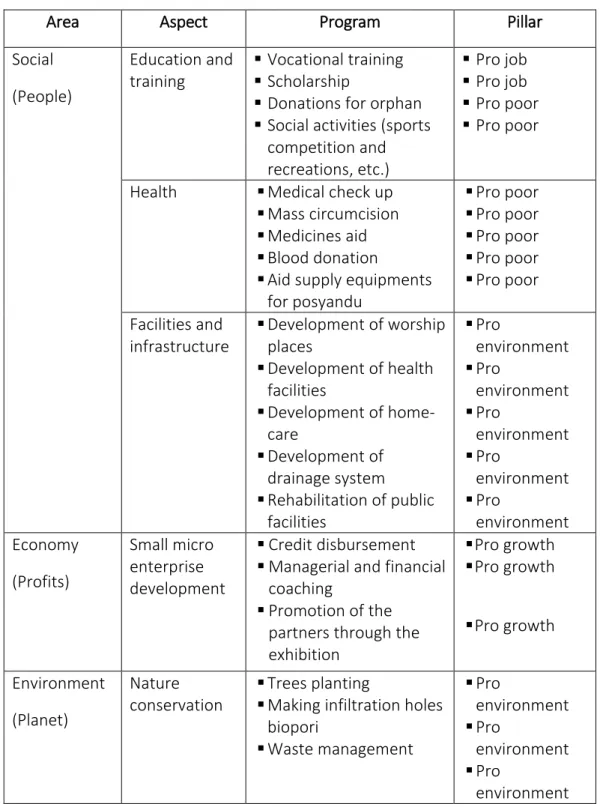
Based on the evaluation above, it can be seen that the quality of the environment in the four districts that are District of Ciwandan, District of Citangkil, District of Grogol and District of Purwakarta are at a fairly alarming condition, and the District of Ciwandan is the most vulnerable to the impacts of industrial activity compared with other districts. When look at the policy of Environmental Development Program at PTKS that addressed to those districts, it shows that programs that are run by PTKS in 2012-2013 have been covering the social aspects (people), economic
(profits) and the environment (planet) with its four pillars, namely pro-growth, pro-poor, pro-job and pro-environment as in table below:
8
Table 1. Environmental Development Program
Area Aspect Program Pillar
Social (People) Education and training Vocational training Scholarship
Donations for orphan
Social activities (sports competition and recreations, etc.) Pro job Pro job Pro poor Pro poor
Health Medical check up
Mass circumcision
Medicines aid
Blood donation
Aid supply equipments for posyandu Pro poor Pro poor Pro poor Pro poor Pro poor Facilities and infrastructure Development of worship places Development of health facilities Development of home-care Development of drainage system Rehabilitation of public facilities Pro environment Pro environment Pro environment Pro environment Pro environment Economy (Profits) Small micro enterprise development Credit disbursement
Managerial and financial coaching
Promotion of the partners through the exhibition Pro growth Pro growth Pro growth Environment (Planet) Nature conservation Trees planting
Making infiltration holes biopori Waste management Pro environment Pro environment Pro environment (Source: Secondary Data and Analysis)
9
10 The implementation of Social and Environmental Responsibility policy in the form of Environmental Development Program had a positive impact to the people (local community). In Pro Job, PTKS has conducted vocational training, scholarships and business practices for trained partners (such as automotive, welding, etc.). In Pro Poor is filled with medical check-up and various charitable donations. Meanwhile, for Pro Environment, PTKS do development for facilities and infrastructure, BUMN care, nature conservation and assistance to victims of natural disasters. While for Pro Growth, PTKS do Partnership Program in distributing the credit funds, managerial and financial coaching as well as promotional for trained partners through the exhibition.
Related to the process of policy implementation, the implementation process is part of the management. According to Stonner (2005: 63), management is the process of planning, organizing, directing and monitoring the efforts of the organization members and the use of other organizational resources to achieve the goals that is determined. Based on the interviews and documentation obtained, the process of policy implementation in PTKS for Environmental Development Program also consists of planning, organizing, implementing, monitoring and evaluation.
The planning process begins with identifying the aspects that need priority attention and appropriate measures for the implementation of the Environmental Development Program effectively. In identifying the needs of those programs, there are two categories that become inputs: 1) Internal Driven Program, is a programs which own initiative by internal of PTKS based on the mapping problems through the social data, economic data, and environmental data which is derived from the sub-district authority or the local community itself and viewed from the importance and urgency of its aspects; 2) External Driven Program is a program that is originated from the external of PTKS in the form of proposals submitted by the institutions such as NGOs, district authority, universities and so on, in which the proposed program is intended or destined for the public (community). The grant is not provided to institutions that propose, but directly distributed to the peoples (local community), while the institution that is propose only as a facilitator for accountability related with funding.
The process of policy implementation of the Environmental Development Program should be in the corridors of corporate strategy to achieve the basic objectives of business companies. The steps are carried out by Division of Community Development of PTKS in conducting of Environmental Development Program is a linear and continuous process from planning, organizing, implementing, monitoring and evaluation as well as reporting. Based on observations and interviews on the field, there are constraints on the level of monitoring. The monitoring performed has not able to accommodate the progress data of development, such as data of health quality progression, data of infrastructure quality progression and data about the environmental quality progression. The results of monitoring conducted is very necessary for the reporting stage, it is expected from the reporting point can be determined whether or not the programs are effectively implemented considering the number of trained partners and development area as a target of distributing fund is increasing from year to year.
DISCUSSION
Environmental Development Programs conducted by PTKS mostly based on internal driven programs which are initiated by PTKS, it indicates that the majority of those programs
11 more as corporate desire to build a good reputation to meet local community demands. There are also programs that are based on adherence to do business in supporting for government programs. Generally, this situation shows that how Social and Environmental Responsibility policy particularly Environmental Development Program at PTKS does not touch the real root cause of local community and it more oriented on caritative activities so that the environmental interests away from the context of sustainable. When observed at macro level, the implementation of Environmental Development Program does not mapped well systematically for long term with its targets and benefit less clearly. The programs are made only for the short term and sometimes it does not well plan due to made only by the demands and interests of the moment. Some of programs partially implemented and separated from each other as well as there are incidentally implemented without any structured frame in a planned manner. In other cases, a program designed looks fairly systematic, but in practice it has not integrated between sub-programs with each other.
The Environmental Development Program that is run has not able to resolve the main problems around the industrial area in the District of Ciwandan, District of Citangkil, District of Grogol and District of Purwakarta from environmental degradation and also social problems, whereas the essence of Environmental Development Program is expected to solve those problems, especially the cost that is issued by PTKS for social and environmental programs every year is quite large, so that the policy of Environmental Development Program has not run effectively and efficiently in the aim to improve the environmental quality.
Above all indicate that PTKS in running the Environmental Development Program is still not optimal and there are many activities that cannot be measured in implementing Environmental Development Program oriented on improving environmental quality. This can be occurred due to information gaps and lack of proper planning in the implementation of the
Environmental Development Program on the field as well as a lack of companies’
understanding of the community needs. Some of programs that have made still incomplete on its implementation and also have not solved the problems, even it increases local community dependency on the company so that forget about the concept of sustainability, whereas the Environmental Development Program aims to minimize the negative impacts and maximize the contribution of the positive impact of social and environmental change. Certainly there are several limitations in this study that are: 1) From three principles of Triple Bottom Lines, only Planet and People are discussed completely, while the Profits are still less discussed due to time and research data limited; 2) The type of this research is qualitative which the results are subjective and accompanied by theory that supports its analysis. 3) The Environmental Development Program using the data from 2012 to 2013 that are less able to demonstrate the development of CSR in complete and actual.
CONCLUSSION
If the process of policy implementation of the Environmental Development Program runs properly, then it can improve the environmental quality in the area around the industrial estate. However, the process of policy implementation requires systematic stages. The main problems from this policy implementation are: 1) The planning process in term of environmental mapping problem does not run well on the field, and also lack of understanding
12 of the company towards the local community needs in the absence of early monitoring of the environmental condition; 2) The monitoring process has not able to accommodate the progress data of development and does not maximize socialized the Environmental Development Program properly in the local community causes there are still programs that are not running as it should be. Therefore, the Environmental Development Program is still not optimum on the implementation and less long-term benefits to society and environment.
REFERENCES
Dunn, William N. Pengantar Analisis Kebijakan Publik, terjemahan Samodra Wibawa, dkk. Yogyakarta: Gajah Mada University Press, 2004.
Elkington, John. Cannibals with Fork: The Triple Bottom Line of the 21st Century. Oxford: Capstone, 1997.
European Commission, “A Business Contribution to Sustainable Development 2002 (COM, 347
final).” Accesed at http://ec.europa.eu/. (on March 4th 2014).
Faikoh. “Deteksi Perubahan Ruang Terbuka Hijau di Kota Industri Cilegon.” Skripsi, Arsitektur Lansekap, IPB, 2008.
Fatah. “Strategi Pengelolaan Kawasan Industri Menuju Eco Industrial Park, Studi pada Kawasan Industri Cilegon Provinsi Banten.” Disertasi, PPS IPB, 2009.
Haas, Peter J., and Springer J. Fried. Applied Policy Research Concept and Cases. New York: Garland Publishing Inc., 1998.
Hopkin, Michael. Corporate Social Responsibility and International Development: Is Business The Solution?.London: Earthscan, 2007.
Mohan, Wali K., Falih Evrendilek, and M. Siobhan Fennesy. The Environment: Science, Issues and Solutions. Florida: CRC Press Taylor and Francis Group, 2010.
Phillip, Kotler and Nancy Lee. Corporate Sosial Responsibility: Doing the Most Good for Your Company and Your Cause. New Jersey: John Wiley & Sons Inc., 2005.