ECONOMISCHE WETENSCHAPPEN
ONDERZOEKSRAPPORT NR 9515
The Limitations of Signalling
by
the Choice of Accounting
Methods: The Depreciation Method Case
by
Ann GAEREMYNCK
Katholieke Universiteit Leuven
The Limitations of Signalling
by
the Choice of Accounting
Methods: The Depreciation Method Case
by
Ann GAEREMYNCK
CASE
Ann Gaeremynck ABSTRACT
This paper discusses the limitations of signalling by income increasing accounting methods, such as linear depreciation. Because legislation only allows the discrete choice between linear and accelerated depreciation, signalling by an income increasing accounting method is only possible in industries where all firms perform well. The industry characteristics would not influence signalling by the depreciation method if legislation allowed all levels of depreciation. Moreover, successful fimrswould not signal their type by an income increasing accounting method but by an income decreasing accounting method. Finally, the contracting structure, raising the capital by issuing new shares or by the sale of existent shares influences the tax rate environment needed to solve asymmetries in information. This paper shows that the comments on the inventory signalling model of Hughes and Schwartz (1988) are general for all models explaining the signalling function by the choice of an income increasing accounting method.
1.
INTRODUCTION
Pre- and post-contractual asymmetries In information influence the choice of accounting methods. The
choice of certain accounting methods creates agency costs although accounting information is also able to avoid market failure and adverse selection between potential investors and the firm. By indirectly revealing information, such as the choice of an auditor (Titman and Trueman, 1986; Feltham et
at.
1990; Datar etat.
1991), the replacement of an auditor (Dye, 1991), the expected cash flows (Hughes, 1986) or the inventory accounting method (Hughes and Schwartz, 1988), a firm tries to influence the beliefs of the investors and the value of the firm. In this paper, I investigate the signalling function of the accounting depreciation method and I show that the comments on the inventory accounting signalling model (Hughes and Schwartz, 1988; Fellingham, 1988) are general comments for all models explaining the signalling function by the choice of income increasing accounting methods.
First, I discuss the influence of accounting methods on the expected bankruptcy costs. The model of Hughes and Schwartz (1988) assumes that bankruptcy costs are fixed and all firms become bankrupt at the same moment. There are three reasons. why it is. better to eliminate debt and expected bankruptcy costs from the signalling models by the choice of accounting methods. The increase in expected bankruptcy costs is not always larger for the less successful firms because empirical evidence shows that the size of bankruptcy costs and the market value are positively correlated (Warner, 1977; Ang et
at.
1982; Altman, 1984, Weiss, 1990; Wruck, 1990). Moreover, the equal amount of debt for all types is a serious disadvantage of their model. Ifdebt is introduced in the model,. it must be a decision variable and it can be used as a signalling device, such as in the model of Ross (1977). In this case, the chance is big that signalling by the debt level is preferred because it is non-dissipative. In the equilibrium the manager of the successful firm does not bear a signalling cost, for example an increase in expected bankruptcy costs. Finally, given the limited liability of owners not owners but debt holders and auditors often carry the costs of bankruptcy. I investigate whether signalling by the choice of accounting methods, the depreciation accounting method, is still possible when bankruptcy costs are eliminated.
In order to answer that question I build a model, where the manager-owner of a new firm sells a fixed percentage of the ownership to invest in a new project; this project can be successful (high cash flows) or not
(low cash flows). The owner-manager can choose between linear and accelerated depreciation in order to influence the beliefs of the investors and the price received for the shares. If both types of firms realise sufficiently large cash flows accelerated depreciation results in the smallest amount of taxes paid. Therefore, the manager - owner of the successful firm can only signal its type by choosing linear depreciation. He receives a higher price for his shares sold but at the end of the project additional taxes must be paid. However, this equilibrium can only occur when the manager of the unsuccessful firm does not have an incentive to imitate the successful firm. Contrary to signalling by the choice of an auditor (Titman & Trueman, 1988), the choice of a depreciation method does not offer additional information next to its signalling value. Therefore, linear depreciation results in the same increase in share price for both types at the start of the project. In this case, a signalling equilibrium is only possible when linear depreciation results in a smaller increase in the taxes paid for the successful firm. The characteristics of the tax rate environment necessary for achieving a difference in the additional taxes paid from using linear depreciation is a concave and increasing tax rate
function. Moreover, the same depreciation method must be used for accounting and tax purposes. If different
methods could be used, the manager-owner would use linear depreciation for accounting purposes without paying extra taxes and the absence of the signalling cost would make a separating equilibrium impoBsible. In conclusion, if expected bankruptcy costs and debt are eliminated, signalling by the choice of accounting methods remains possible but it becomes more difficult.
In a second part, I try to find an explanation why the empirical evidence for the signalling function of the inventory and the depreciation method is weak (Fellingham, 1988). Empirical evidence shows that unsuccessful firms typically use FIFO or linear depreciation and that prices react negatively to the switch to linear depreciation (Holthausen, 1981; Cheng and Coulombe, 1993). I show that the contracting structure, the industry characteristics and the legal environment limit signalling by the choice of accounting methods.
First, I investigate the effect of a changed contracting structure. If the manager-owner of a firm raises the capital by issuing new shares and he does not buy any of these new shares, his part of the cash flows realised drops. This decrease depends On the number of new shares issued and the number of new shares needed to raise the capital decreases as the price received goes up. Because the price offered depends on the beliefs of the investors, the choice of the depreciation method influences the number of new shares issued. If investors
observe linear depreciation, they believe that they invest in a successful firm and the number of new shares issued is smaller than when accelerated depreciation is used and a lower price is received. Therefore, if the current owner uses linear depreciation the number of new shares issued is smaller and he receives a larger part of the cash flows realised at the end of the project. As these cash flows are larger for the successful firm, the benefit from using linear depreciation is larger for the successful firm. Compared to the basic model, signalling by the depreciation accounting method is facilitated. Because the signalling revenue depends on the
firm type the choice of a deprecation method can reveal the firm type also in a fixed tax rate environment. If
the tax rate is concave and increasing, signalling by linear depreciation can occur in both environments. Because the method of raising the capital determines the possibility of signalling, not all successful firms can reveal their positive inside information.
A second reason for the lack for empirical evidence is the influence of industry characteristics. If in a certain industry some firms report losses, linear depreciation is the value maximizing choice for those firms. In this case, the successful firms will prefer to hold accelerated depreciation and they will never use linear depreciation. If they use linear depreciation, they pool with the unsuccessful firms and the price received for the shares sold decreases. Because in all industries firms reporting losses exist, I expect that in practice linear depreciation is only used by unsuccessful firms.
In a last part I show that industry characteristics would not be important if legislation was less restrictive. If
the depreciation rate could be chosen freely the successful firms would signal their type not by a lower but by a higher depreciation rate than the unsuccessful firm. Because the successful firms signal their type by a higher depreciation rate the occurrence of firms reporting losses does not eliminate signalling by the depreciation method and industry characteristics do not influence the possibility of signalling.
This paper is organised as follows. Section 2 discusses the basic model where the assumptions, the sequence of the game and the equilibrium strategies for the investors and the manager-owner are described. Section 3 outlines the limitations of the model: the influence of the contracting structure, the importance of the industry characteristics and the impact of legislation on the signalling function of the depreciation accounting method. Finally, in Section 4 some concluding remarks are made.
2.
THE MODEL
2.1 ASSUMPTIONS
1. There are two categories of players: the manager-owner of the firm and the investors, who compete with
one other in the competitive market for equity 1.
2. Each manager-owner commits himself to start a new firm and to invest a fixed amount of K in a project
but he does not possess all funds needed. Therefore, he sells a fraction a 1 of the ownership.
3. At the start of the project each manager-owner privately observes whether the project will be successful
or not: H (high cash flows) or L (low cash flows). The distribution of types in the population is commonly known: there is a probability g that the manager runs a H - firm and a probability of (I-g) that he manages a L - firm. The type of the firm does not change over time. The type of the firm is q and the set of feasible types is T = { H, L} according to the probability function Prob, where Prob (H) = g, Prob (L) = 1 - g.
4. A two period model is assumed, j is the period and j E = {1,2}. In each period the firm realises u h or u I as cash flows depending on the firm type 2. At time zero each manager - owner determines the depreciation method: linear (s) or accelerated depreciation (a). More generally, dE D is the first period depreciation rate and dE D
=
{s, a}, where s=
112 or a > 112. The reported earnings equal Xqdj' whereq E T, d E D andj E J. Hence, for example xHal
=
% -
aK, xHsl=
uh - Kl2, xLa2=
uI- (l-a)K.5. At the moment the manager wants to start the project and he sells a part of his shares, the depreciation method can serve as a signal towards the potential investors, where the set of feasible messages is {s, a}. Given the observed depreciation method and their beliefs, the investors determine the price they are willing to pay for the shares sold. The decision of the investors is not whether they should invest but only what price they are prepared to pay for the shares sold 3. The price, the investors are willing to offer for the total project, varies between a 1 V o(L, d) and a 1 V o(H, d) where d E D 4. The value of the project V o(q, d) equals:
v
o(q, d): ug:1 :
t(Xqdj):
the value of the project, where d is the first period's depreciation rate and q is the firm's type;
the level of cash flows for a q-type project; the risk free interest rate;
the con~ave and. increasing tax rate for a q-type firm in a period j reporting Xqdj as accountmg earmngs.
6. At the end of the project the asymmetries in information are solved and the cash flows realised are paid as a dividend to the owners. The cash flows realised at the end of the first period are invested in a risk free asset at an interest rate i after a fixed tax rate t. I assume that the income from risk-free investments is always taxed separately. If no dividends are paid at the end of the first period, the manager-owner receives a share (l-a 1) of the cash flows realised at the end of the project. The present value of the income of the current owner-manager over the total life of the project equals:
Vt(q, d): is the project's value at time t;
a 1: is the part of the shares sold by the current manager-owner;
K: the investment amount;
1: the risk-free interest rate.
Insert here Figure 1
Figure 1: The extensive form of the game
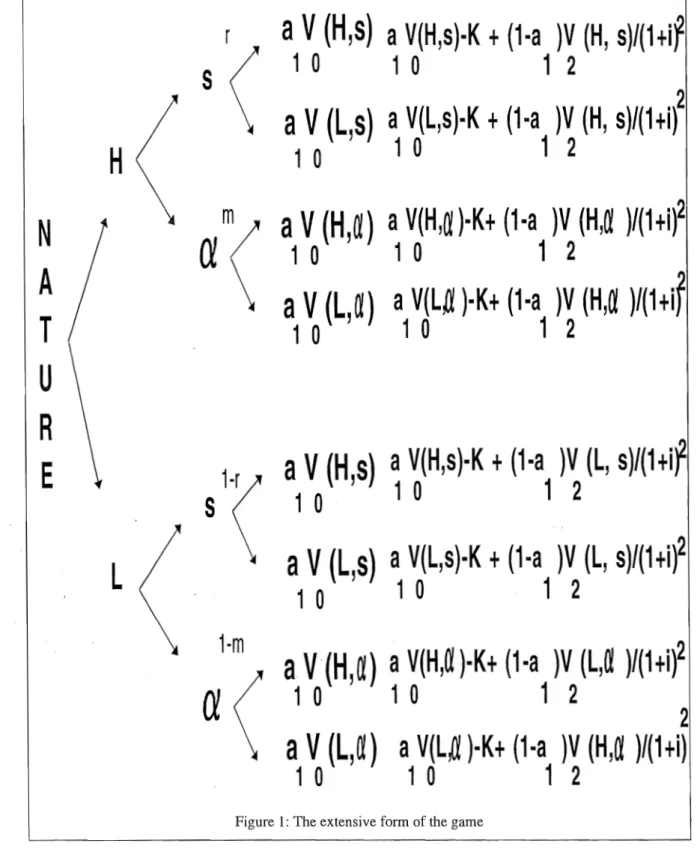
Figure 1 shows the sequence of the game:
1. Nature determines the type of the firm: a H-firm or a L-firm;
2. The owner-manager chooses the depreciation method: linear (s) or accelerated depreciation (ex);
3. Investors observe the depreciation method and in a incomplete information environment they form a
belief pattern about the success. In an incomplete information environment, they form a belief pattern, whether a successful firm or an unsuccessful firm uses that method. If linear depreciation is used, investors believe that it is a successful firm with a probability of r and a unsuccessful firm with a probability of (l-r). If investors observe accelerated depreciation, they believe that it is a H-firm with a probability of m and an L-firm with a probability of (l-m).
4. The beliefs determine the price they are prepared to pay for the shares a 1 V o(H, d) or a IV o(L, d). In a perfect competitive market without asymmetries in information the price always equals the value of the project. Therefore, investors will never be prepared to offer a 1 V 0(H, d) for an L-firm.
5. The owner-manager sells the shares to the highest bidder. Therefore, in a perfect competitive market without asymmetries in information the offer of a 1 V o(L, d) for a H-firm is never an equilibrium strategy; there are other investors, who are prepared to pay a 1 V o(R, d).
In a complete information environment, if the cash flows are sufficiently high, both types choose accelerated depreciation in order to reduce the taxes paid (see Appendix 1, proposition 1). In this case, I identify under which circumstances the depreciation method can serve as a signalling device.
2.2 EQUILIBRIUM STRATEGIES FOR THE INVESTORS AND THE MANAGERS
Proposition 1: If law only allows the discrete choice between linear and accelerated depreciation, accelerated depreciation is the value maximizing choice for all types and the manager-owner sells a part of the current shares in order to raise K, the manager of a H-firm can reveal its success by using linear depreciation only in a concave and increasing tax rate environment.
A certain strategy can only be an equilibrium when neither the managers nor the investors want to deviate from their chosen strategies. After observing a certain depreciation method, the investors formulate a belief whether it is a H-firm or a L-firm choosing that particular depreciation method. Given two possible depreciation methods and two types of firms, in a separating equilibrium two different belief patterns are possible: either the investors believe that accelerated depreciation is used only by H-firms, or they believe that accelerated depreciation is only applied by L-firms 6.
Only the last belief pattern can be an equilibrium strategy (m=O, r=1). If linear depreciation is used, the firm is identified as a successful firm and a larger price is received for the shares sold, alV o(H, s) instead of a 1 V o(L, ex). However, at the end of the project the cash flows realised are smaller, (l-a I)V 2(H, ex) is larger than (l-al)V2(H, s). The manager of the H-firm will make a trade off and he will not have an incentive to deviate when the increase in the price received at the start of the project is larger than the decrease in discounted cash flows at the end of the project:
(a)
The manager of the unsuccessful firm must realise the highest income by choosing accelerated depreciation. If he uses accelerated depreciation, he receives a smaller price for the shares sold, a 1 V 0 (L, ex) instead of a 1
V 0 (H, s), but at the end of the project the cash flows realised are larger, (l-a l)V o(L, ex) instead of
(1-al)V o(L, s). Again the manager of the L-firm will make a trade off and the belief pattern, that linear depreciation is only used by successful projects (m=O and r=I), is only reliable when:
(b)
or al V o(H, s) - al V o(L, ex) < (l-al)(Vo(L, ex) - V o(L, s»
By defining a reliable belief pattern, the signalling conditions are developed. Two conclusions can be drawn. First, it is not surprising that the belief pattern, in which the L-firm uses linear depreciation, is not reliable. Using linear depreciation creates a cost if accelerated depreciation is the best choice in an complete information setting. Since an environment of incomplete information is advantageous for the owner -manager of a L-firm, he is never prepared to carry the cost of a deviating behaviour and thereby reveal the type of the firm. This is contrary to the owner of the H-firm, who receives a smaller price for the shares compared to a complete information environment, and who tries to reveal the type of the firm by using linear depreciation 8.
Secondly, the two signalling conditions show that the revenue from linear depreciation, i.e. an increase in the project's value at the start of the project, a 1 (V 0(H, s) - V o(L,
ex»,
is independent of the firm's type. The reason is that, next to the information value of the signal, no other information becomes available to the investors. This is different from the auditor's information value when the role of the auditor is not limited to an attestation role. A high quality auditor reveals more favourable information, when auditing a H-firm instead of a L-firm (Titman and Trueman, 1986).An absence of a difference in the signalling revenue makes a difference in the signalling cost, the additional taxes paid from using linear depreciation, necessary in order to reach a separating equilibrium.
Insert here Figure 2
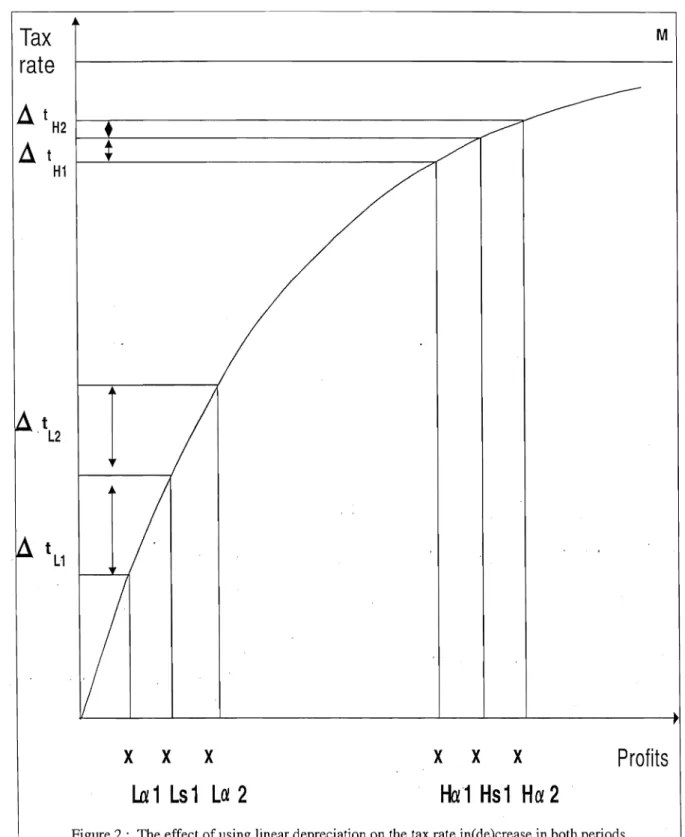
Figure 2: The effect of using linear depreciation on the tax rate inC de )crease in both periods
In a concave and increasing tax rate environment the additional taxes paid from using linear depreciation can be higher for the L-firm than the H-firm because the tax rate change from using linear depreciation is type dependent. Figure 2 shows that using linear depreciation results in a larger amount of profits (xLsl > xLcx,l, xHsl > xHcxl) and a tax rate increase for both types in the first period. The concave nature of the tax rate function is the reason why an increase in the tax rate is larger for the L-firm than the H-firm (~ tLI > ~ tHI). The larger increase in the tax rate can cancel out the advantage of a smaller tax base (xLsl
<
xHsI), and the extra taxes paid from using linear depreciation in the first period can be greater for the L-firm than the H-firm. In the second period a larger amount can be written off using linear depreciation (xLs2 < xLcx2' xHs2 < xHcx2) such that the tax rate decrease (~ tH2<
~ tL2) is larger for the L-firm than the H-firm but the tax base is smaller (xLs2 < xHs2). Because the difference between the tax rate increase in the first period and the decrease in the second period is larger for the L-firm (~tu -~ tL2) than the H-firm (~ tHI -~ tH~ , the linear depreciation cost can be larger for the former. In appendix proposition 2 the difference in cost condition is developed given the characteristics of a concave and increasing tax rate environment.This analysis illustrates that expected bankruptcy costs are not necessary to explain the signalling function of accounting methods. However, compared to the model of Hughes and Schwartz (1988) the number of separating equilibria diminishes, signalling by accounting methods is no longer possible in a fixed tax rate environment.
In the next section I discuss the limitations of signalling by accounting methods. These limitations are illustrated for the depreciation accounting method, although these are general for all accounting methods used as a signalling device.
3.
LIMITATIONS
In the previous section I showed that linear depreciation can be a signal of a successful project. In this part I show that the signalling power of linear depreciation is limited by many factors. Because the circumstances determine to a large extent the signalling function of the depreciation method, empirical evidence that linear depreciation is mainly used by successful firms will be very difficult to find.
3.1 THE CONTRACTING STRUCTURE
In this section I investigate the effect of a different contracting structure on the signalling function of linear depreciation. I study the signalling problem in an environment, where the manager of an existing firm raises the capital by the issue of new shares.
In the general model I assume that the manager of a new firm obtains the needed funds by the sale of a
fraction a 1 of the ownership. However, situations also exist, where the manager of an existing firm raises the capital by the issue of new shares. The number of new shares issued is determined by the price received for the shares. As the price increases, the number of new shares needed to raise K decreases and the manager's part of the final cash flows grows. Given this method of raising the capital the manager-owner tries to maximize the liquidation value of his shares:
K
or where aq = 11 (1 + )
Vo (q, d)
Because it is an existing firm, the cash inflow from the issue of new shares does not belong to the current owners but to the firm. Therefore, the current owner only receives an income at the end of the project aq V 2(q, d). The realised cash flows V 2 (q, d) are not influenced by the beliefs of the investors because at the end of the project asymmetries in information are already solved. However, the total number of shares is influenced by the beliefs and the depreciation method used. The manager-owner possesses all the current shares (100 %) but he does not buy any of the new shares issued. If the firm uses linear depreciation, investors believe that it is a H-firm and K / V 0 (H, s) is the number of new shares needed to raise K. In this
case, the total number of shares equals 1
+
KI V 0 (H, s). If the firm uses accelerated depreciation, investorsbelieve that it is a L-firm and more shares must be issued to raise K and the total number of shares becomes 1 + KI V 0 (L, ex). In this environment the chosen depreciation method influences the manager's part of the
cash flows realised.
Given complete information the manager will also use accelerated depreciation in order to minimize the taxes paid. I investigate whether signalling by the depreciation method is possible not only in a concave and increasing tax rate environment but also in a fixed tax rate environment.
Proposition 2: If law only offers the discrete choice between linear and accelerated depreciation, accelerated depreciation is the value maximizing choice for both types and the manager-owner raises the capital by the issue of new shares, the manager-owner of a H-firm can reveal its type by using linear depreciation in a fixed tax rate environment.
As in the basic model the H-firm can only signal its success by using linear depreciation. In order to know whether a separating equilibrium, where the H-firm uses linear depreciation and the L-firm prefers accelerated depreciation, can occur I have to check whether the H-firm has an incentive to use linear depreciation without imitation by the L-firm. If the H-firm uses linear depreciation instead of accelerated depreciation his share of the cash flows realised increases from aL to aH. However, the cash flows realised at the end of the project decrease because linear depreciation results in additional taxes paid (V 2 (H, s) < V 2 (H, a)). The H-firm is only prepared to use linear depreciation when:
aHx V2(H,s)/(l+i)2 ~ aL x V2(H,a)/(I+i)2
or (uh (1 - t) (1/(1 +i) + 1/(1 +i)2) (aH - au
~ aL t (aK/(1 +i) + (1 - a)K/(l +i)2) - aH t «K/2)/(l +i) + (K/2)/(l +i)2) (c)
However, the L-firm may not have an incentive to imitate the H-firm. Or, the income increase from receiving a larger part of the cash flows must be smaller than the income decrease from an increase in the additional taxes paid.
aH x V2(L,s)/(I+i)2 < aL x V2 (L,a)J(1+i)2
or (ul (1 - t)(1/(1 +i) + 1/(1 +i)2) (aH - aL)
< aL t (aK/(I+i) + (1 - a)K/(I+i)2) - aH t «K/2)/(l+i) + (K/2)J(l+i)2) (d)
In inequality (c) and (d) the right side shows the cost from using linear depreciation; as in theprevious model the cost is independent of the firm type in a fixed tax rate environment. The signalling revenue is shown on . the left-hand side and is dependent upon the type of the firm. By using linear depreciation, a larger amount of the final cash flows can be obtained. These cash flows are without question larger for the H-firm than for the L-firm. The revenue from using linear depreciation, obtaining a greater amount of the final cash flows, can be large enough for the successful firm to recuperate the income decrease from the additional taxes paid, while
the L-firm can not recoup this income decrease from the additional taxes paid. In a concave and increasing tax rate environment, the additional taxes paid may even be larger for the successful than the unsuccessful firm and the H-firm can still reveal its type.
This analysis clearly shows that the method of raising the needed capital influences the signalling function of accounting methods and the depreciation method in particular. Because objective functions differ between firms, signalling by the depreciation method is difficult to observe in practice. Assume a fixed tax rate environment and two successful projects, one owner issues new shares while the other sells a part of the current shares. In this case, only the first firm can reveal its type by using linear depreciation, while both firms are successful.
3.2 INDUSTRY CHARACTERISTICS
The signalling function of the depreciation method is studied in an environment, where accelerated depreciation is the value maximizing choice for all types; all firms in the population perform relatively well. However, in almost all industries firms reporting losses exist. Because linear depreciation is the value maximizing choice for those firms (see Appendix proposition 1), the successful firms prefer to use accelerated depreciation and they are not prepared to signal their type by using linear depreciation. If they chose linear depreciation they would be identified as a unsuccessful firm and the price received for the shares would be lower.
The importance of the industry characteristics can also be illustrated by considering the possibility of entry. If
a new entrant performs poorly, the successful firms will not continue to use linear depreciation because then they pool with the new unsuccessful firms. The well performing incumbent firms have an incentive to switch to accelerated depreciation and to pool with the incumbent unsuccessful firms, that realise higher cash flows than the new entrants. However, a change from linear to accelerated depreciation is mostly not allowed by law. Therefore, if the manager determines the depreciation method, he will also consider the possibility and the success of entry. If entry is likely to occur and this entry is not expected to be successful, the successful incumbent firms are not prepared to identify their type by using linear depreciation, they prefer to pool with the incumbent unsuccessful firms.
In conclusion, linear depreciation is not expected to be used as a signalling device because in most industries unsuccessful firms exist. Because legislation only allows the discrete choice between two methods and linear depreciation is the value maximizing choice for firms reporting losses, the successful firms can not use linear depreciation in order to reveal their success. In the next section I show that signalling by the depreciation method would be much easier, industry characteristics would not playa part and empirical evidence would
easier found if legislation \vas less restrictive.
3.3 THE LEGAL ENVIRONMENT
In practice only the discrete choice between linear and accelerated depreciation method exists. If the depreciation rate could be chosen freely, the successful firm would prefer to reveal its type not by a smaller but by a larger depreciation rate in the first period than the unsuccessful firm and signalling by the depreciation method could become less expensive. The influence of a continuous depreciation rate on the possibility of signalling will be illustrated by the use of indifference curves (Gibbons, 1992).
Gibbons (1992) illustrates the information role of education in the job market by the use of indifference curves. If I want to apply the concept to the depreciation issue, I have to create an employer - employee relationship. I assume that the manager is no longer the owner of the company, the owner sells a part of the shares to raise K. The manager has an incentive to reveal the firm type because his income depends on the price received for the shares and it equals f + a1 V o(q, d) - K, where f is a fixed income and a1 V 0 (q, d) - K
is a bonus received depending on the price received for the shares. Contrary to the model of Gibbons (1992), the price offered for the shares sold reaches a maximum f + a 1 V 0 (q, d *) (Proof see Appendix proposition 3).
That could be expected because a value maximizing depreciation rate d * exists for each cash flow level. At the end of the project the manager receives from the company a fixed income f(1 +i)2. However, in his wage contract an indemnification for the current owners is added if the manager has not chosen the value maximizing depreciation rate d*. This indemnification equals (1 - a 1) (V 2 (q, d *) - V 2 (q, d))/(l +i)2 and it must not be paid to the new shareholders, who bought a fraction a 1 because they paid a lower price a 1 V o(q, d) instead of al V o(q, d*). If the value maximizing method is used, no indemnification must be paid. The manager's income in the second period equals f/(1 +i)2 - (1 - a 1) (V 2 (q, d *) - V 2 (q, d))/(l +i)2.
Given this scenario, the owner offers the manager an income of 2f + a 1 V 0 (q, d) - K and the manager's utility
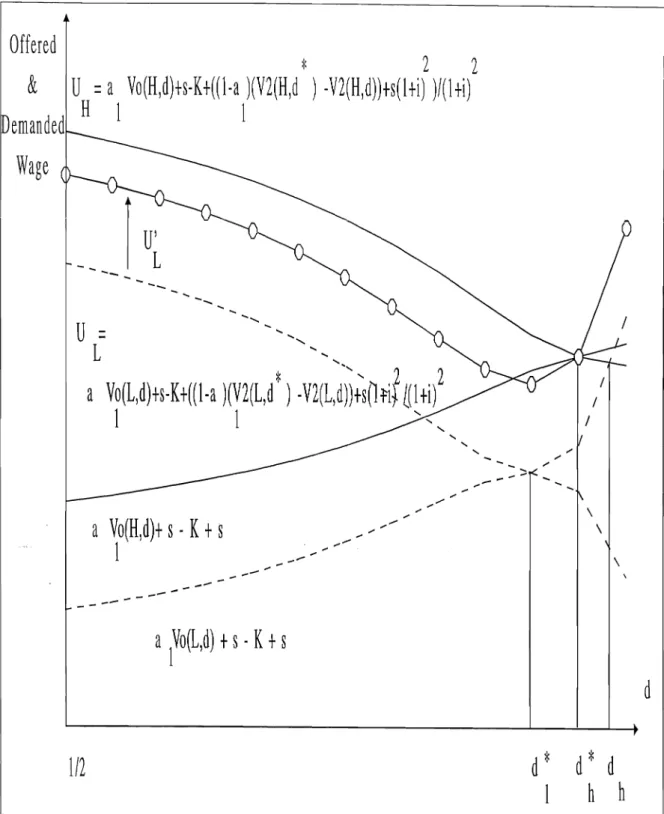
equals 2f + a1 V 0 (q, d) - K -(l - a1) (V2 (q, d*) - V2 (q, d))j(1+i)2. In Figure 3, the offered wage is larger for the H-firm than the L-firm because the present value of the cash flows and the project's value are larger for the successful project (2f + a 1 V 0 (L, d) - K - (1 - a 1) (V 2 (L, d *) - V 2 (L, d))j(l +i)2 < 2f + a 1 V 0 (H, d)
-K - (1 - a1) (V2 (H, d*) - V2 (H, d))j(1+i)2). The indifference curves UL and UH show the demanded income by the manager to reach the same level of utility ( 2f + a IV 0 (q; d) - K). As the depreciation rate is closer to the value maximizing depreciation rate d *, the indemnification paid is smaller, the offered wage is larger and the demanded wage to reach the same level of utility is smaller.
Insert here Figure 3
Figure 3: The effect of a continuous depreciation rate on the possibility of signalling by the depreciation rate
In a complete information environment the H- firm and the L-firm certainly choose different depreciation rates (dh * for the H-firm and dl * for the L-firm). Because profits are larger for the successful firm additional tax savings can be realised for larger depreciation rates (Proof see Appendix proposition 4). Assume a situation, where the profits of the L-firm equal zero, the L-firm does not have an incentive to increase the depreciation rate because profits become negative and no additional tax savings from increasing the depreciation rate can be realised. However, the profits of the H-firm are still positive, additional tax savings can be realised by increasing the depreciation rate and the project's value increases.
In a situation of incomplete information the H-firm can not hold dh *, the L-firm envies the H-firm and he can increase his utility by UL' if he mimics the H-firm. In order to reveal the firm type the H-firm has to increase the depreciation rate to dh because then the L-firm does no longer have an incentive to mimic, only the same utility level can be reached. In this case, the H-firm does not reveal its type by a lower but by a higher depreciation rate than the L-firm (dh > dh * > dl)'
Compared to linear depreciation, the manager of the successful firm reaches a higher level of utility. Moreover, even if linear depreciation becomes the value maximizing choice for the L-firm, the H-firm can still reveal its type. Therefore, industry characteristics influence the signalling outcome because only the discrete choice between linear and accelerated depreciation exists. Finally, if the depreciation rate is
the two types differs a lot, the L-firm could not increase its utility by mimicking the H-firm. This clearly illustrates that legislation limits signalling by accounting methods. If the depreciation rate could be chosen freely, signalling by the depreciation method would be easier, and the results using the signalling hypothesis would be more convergent with other possible explanations, such as the debt covenant hypothesis.
4.
CONCLUSIONS AND COMMENTS
This paper is an extension of the inventory signalling model of Hughes and Schwartz (1988). Just like FIFO linear depreciation can be a signal of a successful project when a manager - owner starts a new firm and he raises a part of the ownership.
Hughes and Schwartz (1988) introduce debt and fixed expected bankruptcy costs in the model. That creates many problems because owners do not carry the bankruptcy costs and these costs depend on the firm type. Moreover, if debt is introduced it can be used as a signalling device. I show that the introduction of expected bankruptcy costs is not needed to assign a positive information role to the depreciation method. However, contrary to the Hughes and Schwartz paper this situation can only be reached in a concave and increasing tax rate environment. Although I was able to eliminate this disadvantage, I show that the other comments mentioned by Fellingham (1988) are general drawbacks of signalling models by the choice of an income increasing accounting method.
First, economic circumstances such as the method of raising the capital influence the signalling outcome. If
an existent firm raises the capital by the issue of new shares, signalling by linear depreciation is facilitated because a separating equilibrium, where the successful firm uses linear depreciation and the unsuccessful firm prefers accelerated depreciation, can also be reached in a fixed tax rate environment. However, industry characteristics can still make signalling by the depreciation method impossible. Accounting methods can only fulfil a signalling function in industries, where all firms perform relatively well. Because linear depreciation is the value maximising choice for firms reporting losses, in those industries successful firms can not signal their type by using linear depreciation. They would be· identified as an unsuccessful firm and the price received for the shares sold would be smaller. Because firms reporting losses exist in almost all industries, empirical evidence is difficult to find. That is consistent with the empirical evidence found by Holthausen
(1981) and Chen and Coulombe (1993) that the average abnormal return of firms switching back to linear depreciation is negative around the announcement date. In this case, the results are also consistent with the debt covenant hypothesis, less successful firms use linear depreciation in order to avoid debt covenant default (Hagerman and Zmijewski, 1979, Zmijewski and Hagerman, 1981; Lilien et al. , 1988). However, empirical evidence also exists, which confirms our hypothesis. De Angelo et al.(l994) find evidence that bad performing firms report negative accruals because they renegociate contracts with labour unions, lenders, lobby for governance assistance or have management changes. Defond and Jiambalvo (1994) also find evidence that firms violating debt covenants report negative abnormal accruals in the year of violation.
The reason why empirical evidence is mostly not consistent with the developed hypothesis is the characteristics of the legal environment. In the last part I illustrate by using indifference curves that the manager of the successful project would not signal its type by a lower but by a higher depreciation rate if the depreciation rate could be determined freely. Moreover, compared to other accounting methods signalling by the depreciation method is a more powerful signal because it could become non-dissipative.
The general conclusion of this paper is that signalling by the choice of accounting methods is only possible under strict conditions because compared to other signalling devices legislation has a very large impact. Because only the discrete choice between two methods (FIFO or LIFO, linear or accelerated depreciation) exists, the choice of an accounting method is an expensive signalling device and it can only occur in industries, where all firms perform well.
APPENDIX
Proposition 1:
If
cash flows are sufficiently large, accelerated depreciation is the value maximizing choice and linear depreciation creates a cost.A concave and increasing tax rate environment in x can be written as follows: t(x d·) - M - e - b (x d·) q J - q J
M: the maximal tax rate;
b: the slope of the tax rate function;
e: the exponential function;
q: the type of the firm;
Using this tax rate function, accelerated depreciation can only be the value maximizing choice when the project's value is larger using accelerated than linear depreciation: V 0 (q, ex) > V 0 (q, s) or
Xqs1 (M - e -bxqs1 ) - Xqex1 (M - e -bxqa1 )
(1+i)
+
Xqs2 ( M - e -bxqs2) - Xqex2 ( M - e -bxqa2)
>0
Because Xqdj (M - e-bxqdj) is a concave and increasing function of profits for values of Xqdj larger than 21b,
accelerated depreciation is the value maximizing choice for large profit levels. If profits are realised between 1/b and 21b, accelerated depreciation can be the value maximizing choice only for high risk free interest rates. Accelerated depreciation can never be the value maximizing choice for profits smaller than 1/b. In conclusion, accelerated depreciation is always the value maximizing choice for high levels of cash flows. If a firm reports losses, profits are certainly smaller than lib and linear depreciation is the value maximizing choice.
Proposition 2: In a concave and increasing tax rate environment a separating equilibrium is possible where the H-firm uses linear depreciation and the L-firm prefers accelerated depreciation because the increase in the additional taxes paid can be larger for the H-firm that the L-firm.
From the signalling conditions (a) and (b) and the assumptions, the difference in cost condition can be derived. The successful firm faces a smaller increase in the taxes paid from using linear depreciation when:
(M-e -b xHs1 ) xHs1 / (1 + i) + (M - e-b xHs2 ) xHs2 / (1 + i)2 (M - e -b xHa1 ) xHa1 / (1 + i) - (M - e-b xHa2 ) xHa2 / (1 + i)2
(M-e -b xLs1 ) (xLs1) / (1 + i) + (M -
e
b xLs2 ) xLs2 / (1 + i)2 (M - e -b xLa1 ) (xLa1) / (1 + i) - (M - e -b xLa2 ) xLa2 / (1 + i)2The concave increasing nature of the function (M - e-bXqdj) Xqdj for values of Xqdj larger than 2/b proves that the linear depreciation cost can be higher for the L-firm than the H-firm 9. In equilibrium, a situation can occur, where the owner-manager of the successful firm can reveal the firm type by using linear depreciation without imitation by the unsuccessful firms.
Proposition 3: If the depreciation rate d is continuous, a value maximising depreciation rate d* exists.
In order to determine the optimal d* the first order derivative of the project's value V 0 (q, d) to d must be
determined. The first order derivative equals:
l I e -b (uq - dK) K ( b(uq-dK) -1 )
MK( - - - ) +
(1 +i) (l +i)2 (l +i)
e -b (uq - (l-d)K) K (b(uq - (l-d)K) -1 )
(1 +i)2
Depending on the values of the exogeneously determined variables, uq, i, K and b, the first order derivative will be positive, negative or zero. The first term is always positive while the second term can be positive as well as negative. If the first order derivative equals zero, an optimum is reached and the project's value is maximized because the second order derivative is negative. The second order derivative equals:
e -b (uq _ dK) K ( b(uq-dK) - 2 )
(l +i)
+
e -b (uq _ (l-d)K) K ( b(uq - (l-d)K) - 2)
(1 +i)2
If the first order derivative equals zero the sum of the exponential terms is negative because the first term of the first order derivative is positive. In this case, the second order derivative will certainly be negative
because ( b(uq-dK) - 2 ) is smaller than ( b(uq-dK) -1 ).
Proposition 4: The optimal depreciation rate d* is larger for the H-firm than for the L-firm.
The first order derivative of V o(q, d) to d of proposition 3 can be rewritten as:
or
where:
( be boX
(1+i)
b e b (l-a)K ] __ 1_ K (e baK (1 + baK) _ e b (I-a) K (l + b (1 -a) K) ]
(l+i) 2 ebuq (l+i) (l+i) 2
MK + -(1 +i)
b
eb
(I-a)K] K
(1 +i) 2 ( e baK (1 + baK) (I+i) e b (I-a) K (1 + b (I-a) K) (l+i) 2If the project's value is maximized for the H-firm, the first order derivative equals:
or
C2 MK MK
- - +
-ebuh (l+i)2 (l+i)
o
C - e b uh ( MK _ MK) - C 1 = 0
1 (1 +i) (l +i)
Because all terms in uh are positive, the first order derivative of V o(L, d) to d is certainly negative if it equals zero for the H-firm. In other words, if the project's value of the H-firm is maximized for a certain value of d the project's value of the L-firm is already a decreasing function of the depreciation rate.
ACKNOWLEDGEMENTS
I gratefully acknowledge the comments of Prof. R. De Bondt, Prof. R. Veugelers, Prof. G. Van Herck, Prof.
C. Van Hulle, Prof. A. Jongbloed and Prof. C. Lefebvre. The comments of the staff (especially Prof. R. Ball)
REFERENCES
J. Ang et al.(1982). The administrative costs of corporate bankruptcy: a note, The Journal of Finance, 37, 219-26
E.1. Altman, (1984). The success of business failure prediction models, Journal of Banking and Finance, 8, 171-98
R. Ball and C.W. Smith (1993). The economics of accounting policy choice, Mc Graw-Hill inc.
S. Bhattacharya (1980). Non-dissipative signalling structures and dividend policy, Quarterly Journal of
Economics, 94, 1-24
P. Cheng and D. Coulombe (1993). Voluntary income-increasing accounting changes, Contemporary
Accounting Research, 10,247-72
S. Datar et al. (1991). The role of audits and audit quality in valuing new issues, Journal of Accounting and
Economics, 13, 3-37
H. De Angelo et al. (1994). Accounting choice in troubled companies, Journal of Accounting and Economics, 17,113-43
M. Defond and J. Jiambalvo (1994). Debt covenant violation and the manipulation of accruals, Journal of
Accounting and Economics, 1994, 17, 147-76
R. Dye (1991). Informationally motivated auditor replacement, Journal of Accounting and Economics, 13,
347-63
J. Fellingham (1988). Discussion of The LIFOIFIFO Choice: an asymmetric information approach, Journal of Accounting Research, 1988, 10, supplement, 59-62,
G. Feltham et al (1991). Empirical assessment of the impact of auditor quality on the valuation of new issues,
Journal of Accounting and Economics, 13, 375-99
R. Gibbons (1992). Game Theory for applied economics, Princeton University Press, New Yersey
R. Hagerman and M. Zmijewski (1979), Some economic determinants of accounting policy choice, Journal
of Accounting and Economics, 1, 141-61
P. Healy (1985). The effect of bonus schemes on accounting decisions, Journal of Accounting and
Economics, 7,85-107
R. Holthausen (1981). Theory and Evidence of the effect of bond covenants and management compensation
contracts on the choice of accounting techniques: the case of the depreciation switchback, Journal of
Accounting and Economics, 3, 79-109
P. Hughes (1986). Signalling by direct disclosure under asymmetric information, Journal of Accounting and
Economics, 8,119-142
P. Hughes and E. Schwartz (1988). The LIFO-FIFO choice: an asymmetric information approach, Journal of
Accounting Research, 10, supplement, 41-58
R. Khilstrom and M.Riordan (1984). Advertising as a signal, ,Journal of Political Economy, 92, 427-50
J. Kose and J. Williams (1985). Dividends dilution and taxes: a signalling equilibrium, Journal of Finance,
40, 1053-69
S. Lilien et al. (1988), Accounting changes: successful versus unsuccessful firms, The Accounting Review, 68, 642-56
N. Melumad and L. Thoman (1990). On auditors and courts in an adverse selection setting, Journal of
Accounting Research, 28 70-120
P. Milgrom and J. Roberts (1992). Economics, organization and management (Engel wood Cliffs, Prentice Hall)
S. Ross (1977). The determination of financial structure: the incentive signalling approach, The Bell Journal
of Economics, 8, Spring, 23-40
M. Spence (1973). Job market signalling, Quartely Journal of Economics, 87,355-74
Y. Suh (1990). Communication and income smoothing through accounting method choice, .Management
Science, 36, 704-18
S. Titman and B. Trueman (1986). Information quality and the valuation of new issues, Journal of Accounting
and Economics, 8, 159-72
J.B. Warner (1977). Bankruptcy costs: some evidence, The Journal of Finance, 1977,38 337-47
R. Watts and J. Zimmerman (1990). Positive Accounting Theory: a ten years perspective, The Accounting
Review, 65 131-56
L.A. Weiss (1990). Bankruptcy resolution: direct costs and the violation of priority claims, Journal of
K.H. Wruck (1990). Financial distress, reorganization and organizational efficiency, Journal of Financial Economics, 419-44
M. Zmijewski and L. Hagerman (1981). An income strategy approach to the positive theory of accounting
NOTES
1. Melumad and Thoman (1990) assume a similar environment, where two sets of firms need debt financing in a competitive debt market.
2. No uncertainty about the cash flows realised is assumed because the probability and the expected costs of bankruptcy are not considered.
3. This is very similar to the model of Spence (1973), where the employee is hired but the level of education determines the wage level. In the model of Kihlstrom and Riordan (1984), the level of advertisements determines the price for the product but not the decision to buy. 4. Different depreciation methods cause different tax savings and the size of these tax savings
determines the value of the firm ebcause the sanTe method must be used for tax a.nd reporting purposes.
5. The discount rate for the cash flows is equal to the risk free interest rate after taxes. The reason is that no uncertainty about the realised cash flow level exists.
6. The belief that linear depreciation is only used by the L-firm (r=O, m=l) can never be an equilibrium because the manager~owner of the L ~ firm always has an incentive to deviate. He does not only receive a higher income at the start of the project by using accelerated depreciation (a1 Vo(H, ex) > a1 Vo(L, s» but he also receives a larger income at the end of the project, (1-a1)V2(q, ex) is larger than (1-a1)V2(q, s).
7. Vo (q, d) = V2(q, d)/(1+i)2 because no cash flows are paid as a dividend at the end of the first period, they are invested in a risk-free asset at an interest rate i after a fixed tax rate t and this income is always taxed separately.
8. An unexpected accounting method can serve as a signal; this has also been proven in other studies. The association between FIFO and high cash flows is reliable because the use of LIFO is expected in a complete information environment (Hughes and Schwartz, 1988). The investors believe that commitments to payor payments of high dividends are only made by successful firms, although in a complete information setting no such commitments would be made (Bhattacharya,1980; Kose and Williams, 1985). And hiring a high reputable auditor also signals high cash flows because in a complete information setting the auditor who asks the lowest fee would have been chosen (Titman and Trueman, 1986). Retained ownership together with the choice of an auditor can reveal the privat~ information although in a complete information situation the firm would not hire an auditor nor would the manager, given his risk aversion, become a shareholder (Datar et al., 1991). In the debt market the choice of an auditor and the type of the audit report determine the interest rate at which the funds can be borrowed. In a complete information environment the risk is known by all the investors and no auditor would be hired (Melumad and Thoman, 1990).
9. A fixed tax rate for both types of firms does not lead to this needed difference. The cost from using linear depreciation is independent of the cash flows and it equals t(exK-K/2)(1/(1+i)-1/(1+i)2). In an environment with that type of revenue function and a fixed tax rate, there must be other explanations for differences in the chosen depreciation method, one of which could be the existence of a management compensation scheme with a lower bound. If the profit level of the L-firm is less than this lower bound, the manager will always prefer accelerated depreciation to increase the probability of a bonus in the future, while the . manager of the H-firm will prefer linear depreciation (taking a bath, Healy, 1985).
N
A
T
U
R
E
H
L
r
a
V (H,s)
a V(H,s)-K + (1-a )V (H, s)/(1+if
s(
10
10
12
\ a
V
(L,s)
a
V(L,s)·K +
(1·a
)V (H, s)/(1+i)2
1 0
1 0
1
2
\ m/
a
V (H,a)
a V(H,a )-K+ (1-a )V (H,a )/(1 +i)2
a
10
10
12
\ a V (L
a)
a
V(L~
)·K+
(1·a
)V (H,a )/(1+if
10'
10
12
1-r
a
V
(H,s)
a
V(H,s)·K +
(1·a
)V (L, s)/(1+iY
sf
10
10
12
\ a V (L,s)
a
V(L,s)·K +
(1·a
)V (L, s)/(1+iY
1 0
1 0
1
2
1·m
a
10
10
12
2
a
V
(L,a) a V(La )-K+ (1-a )V (H,a )/(1 +i)
1 0
1 0
1
2
Tax
rate
~
~t ~~~
tH2~=~.============================~~~--~
________________~~
H1II
I
x x x
La
1 Ls 1 Lc¥ 2
x x
x
Ha1 Hs 1 Ha 2
MProfits
Offered
&
Wage
*
2
2
U
=
a Vo(H,d)ts-Kt((l-a )(V2(H,d ) -V2(H,d))ts(lti) )/(lti)
H
1
1
--U'
L
--
-... ... ...
U
=
"
L
,
*
-, ,
2
2
a Vo(L,d)ts-Kt((l-a )(V2(L,d ) -V2(L,d))ts0ri+ [(lti)
1 1 '
a Vo(H,d)t s -K t s
1
-
---a IVo(L,d) t s -K t s
1/2
-
...'"
....--
... .... -/ / / \ \ \d
*
d
*
d
I
h h
Figure 3: The effect of a continuous depreciation rate on the possibility of signalling by the depreciation rate