WS-Replication: A Framework for
Highly Available Web Services
∗Jorge Salas, Francisco P´erez-Sorrosal, Marta Pati˜no-Mart´ınez, Ricardo Jim´enez-Peris
School of Computer ScienceUniversidad Polit´ecnica de Madrid Madrid, Spain
{
jsalas,fpsorrosal,mpatino,rjimenez
}@fi.upm.es
ABSTRACT
Due to the rapid acceptance of web services and its fast spread-ing, a number of mission-critical systems will be deployed as web services in next years. The availability of those systems must be guaranteed in case of failures and network disconnections. An ex-ample of web services for which availability will be a crucial issue are those belonging to coordination web service infrastructure, such as web services for transactional coordination (e.g., WS-CAF and WS-Transaction). These services should remain available despite site and connectivity failures to enable business interactions on a 24x7 basis. Some of the common techniques for attaining avail-ability consist in the use of a clustering approach. However, in an Internet setting a domain can get partitioned from the network due to a link overload or some other connectivity problems. The un-availability of a coordination service impacts the un-availability of all the partners in the business process. That is, coordination services are an example of critical components that need higher provisions for availability. In this paper, we address this problem by provid-ing an infrastructure, WS-Replication, for WAN replication of web services. The infrastructure is based on a group communication web service, WS-Multicast, that respects the web service auton-omy. The transport of WS-Multicast is based on SOAP and relies exclusively on web service technology for interaction across orga-nizations. We have replicated WS-CAF using our WS-Replication framework and evaluated its performance.
Categories and Subject Descriptors
H.3.5 [Information Systems]: Online Information Systems—
On-line Information Storage Retrieval, Information Services, Web-Based Services; C.2.4 [Computer Systems Organization]:
Computer-Communication Networks—Distributed Systems, Client/server; C.4
[Computer Systems Organization]: Performance of Systems—
fault tolerance, reliability, availability, and serviceability; H.2.4
[Information Systems]: Database Management—Transaction
pro-cessing
∗This work has been partially supported by the Spanish
Sci-ence Foundation (MEC) under grant TIN2004-07474-C02-01, the Madrid Regional Research Council (CAM) under grant P-TIC-285-0505, and the European EUREKA/ITEA S4ALL project under grant FIT-340000-2005-144 from the Spanish Ministry of Industry (MITyC).
Copyright is held by the International World Wide Web Conference Com-mittee (IW3C2). Distribution of these papers is limited to classroom use, and personal use by others.
WWW 2006, May 23–26, 2006, Edinburgh, Scotland. ACM 1-59593-323-9/06/0005.
General Terms
Reliability, Performance
Keywords
Web services, group communication, availability, transactions, WS-CAF
1. INTRODUCTION
Web service technology is witnessing a rapid acceptance in all fields. If this trend continues, an increasing number of mission critical web services will start to be deployed during the next few years. However, current web service technology still has serious lacks for providing the levels of availability required by mission critical systems. Although there are specifications dealing with re-liable message exchange (e.g. WS-Reliability [32]) availability has been largely overlooked.
After some level of maturity of basic web service infrastructure specifications such as SOAP [42], WSDL [43] and UDDI [31], a wide number of specifications are being developed to support more sophisticated applications and providing stronger guarantees. Among these new efforts, a number of them addresses the support for transactional business processes across different business do-mains [25]. Two recent efforts in this direction are OASIS Web Service Composite Application Framework (WS-CAF) [33] and WS-Coordination, WS-Transaction [26] promoted by IBM, Mi-crosoft and BEA. These specifications provide support for inter-operable transactional context propagation and transactional coor-dination. Transactional coordination requires among other things the appointment of a site as transaction coordinator. The designa-tion of a coordinadesigna-tion entity presents an inherent weakness; if the coordinator becomes unavailable the coordination protocol blocks, what has an impact in the availability of all partners participating in the transaction that cannot progress anymore. This means that co-ordination services become a critical infrastructure requiring higher levels of availability.
Traditional clustering solutions are not enough in an Internet set-ting in which network partitions are more likely than in LANs (e.g. due to link overloads, site and connectivity) and that can separate the domain where the coordinator entity lies from the rest of the net-work. In this paper, we address precisely the issue of web service availability and present a framework, WS-Replication, for WAN replication of web services. WS-Replication uses multicast (i.e, group communication [9]) to communicate with the replicas of a web service. One of the main challenges of this work is how to replicate web services preserving the underlying web service au-tonomy principle avoiding the use of ad hoc mechanisms, such as the opening of ad hoc ports at partner sites. For this purpose,
we have developed a web service for group communication, WS-Multicast, that uses SOAP as transport protocol. The paper also presents an evaluation of the Replication framework. Replication has been used to replicate an implementation of WS-CAF and has been evaluated through an instrumented version of WS-I.
The contributions of the paper are: the design and implementa-tion of an infrastructure for seamlessly providing high availability of web services in a WAN setting based exclusively on web ser-vice technology; and a multicast web serser-vice component that can be used independently. These contributions have been thoroughly evaluated through micro-benchmarks and a replicated version of WS-CAF.
The rest of the paper is organized as follows. Section 2 intro-duces replication and group communication. Section 3 describes the components of the replication framework. A case of study (WS-CAF) is presented in Section 4 and evaluated in Section 5. Finally, related work and conclusions are presented in Sections 6 and 7.
2. REPLICATION AND GROUP
COMMU-NICATION
Replication is the main technique to provide high availability. Availability is achieved by deploying the same service in a set of sites (replicas), so if one site fails, the others can continue pro-viding the service. There are three different process replication techniques: active replication, semi-active replication and passive replication. In active replication [39], all requests to a replicated service are processed by all the replicas. Service requests must be processed in the same order in all the replicas to guarantee that all replicas have the same state. Moreover, replicas must be de-terministic. That is, with the same sequence of requests, they act deterministically producing the same output. With this approach, if one replica fails, the rest of the replicas can continue provid-ing service in a transparent way for the client, without loosprovid-ing any state. Depending on the level of reliability, the client can re-sume its processing after obtaining the first reply from a replica, a majority of replies or all the replies. If the server code is non-deterministic, it is possible to use semi-active replication [41] in which all sites process all requests, but non-deterministic actions are executed only by a site appointed as master. The master sends the resulting state to the other sites, named followers, after exe-cuting a non-deterministic action. A complementary approach is passive replication [10]. In this approach, one of the servers is appointed as primary and the other as backups. Clients submit re-quests to the primary that processes them and sends the resulting server state to the backups. That is, only the primary executes client requests. Upon failure of the primary, one of the backups takes over as new primary. In this case, failover is not totally transparent from the client point of view. That is, the last request issued by a client may need to be resubmitted (the primary failed before replying) and a duplicate removal mechanism is needed in the backups (the new primary may have already received the state produced by that request in the failed primary).
One of the main building blocks for implementing a replicated system is group communication. Group communication systems
(GCS) providemulticastand the notion ofview[9]. A set of
pro-cesses may join a group (group members). A view contains
cur-rently connected and active group members. Changes in the
com-position of a view (member crashor new members) are
eventu-ally delivered to the application. Multicast messages are sent to a group. Multicast primitives can be classified attending to the order
guarantees and fault-tolerance provided. FIFO orderingdelivers
all messages sent by a group member in FIFO order. Total order
ensures that messages are delivered in the same order by all group members. With regard to reliability,reliable multicastensures that
all available members deliver the same messages. Uniform
reli-able multicastensures that a message that is delivered by a member (even if it fails), it will be delivered at all available members.
Replicas of a server form a group in order to implement repli-cation1. Failures of replicas are detected when a new view is de-livered excluding members of the previous view. Total order mul-ticast is used to propagate requests in the active replication model to guarantee that all replicas deliver requests in the same order and therefore, they will reach the same state. FIFO order is used in pas-sive and semi-active replication to send the state or the result of the non-deterministic actions. Since this information is only sent by one replica, the application of those messages in FIFO order will guarantee that all the replicas reach the same state. Depending on the consistency level needed by the application, multicast messages are either reliable or uniform.
Two important properties of GCSs areprimary component
mem-bershipandstrong virtual synchrony[11]. In a primary component membership, views installed by all members are totally ordered (there are no concurrent views), and for every pair of consecutive views there is at least one member that survives from one view to the next one. Strong virtual synchrony ensures that messages
are delivered in the same view they were sent (also calledsending
view delivery) and that two members transiting to a new view have
delivered the same set of messages in the previous view (virtual
synchrony) [11].
Several group communication toolkits have been developed in the last two decades. Isis was the first one and since then, others have been developed i.e., Horus [38], Ensemble [17], Transis [14], Totem [29], NewTop [16], JGroups [20] and Spread [3]. Some of these toolkits are implemented as a stack of micro-protocols. Each micro-protocol is in charge of implementing a reliability, ordering or view property. Horus was the first to adopt this architecture and others followed, such as Ensemble and JGroups.
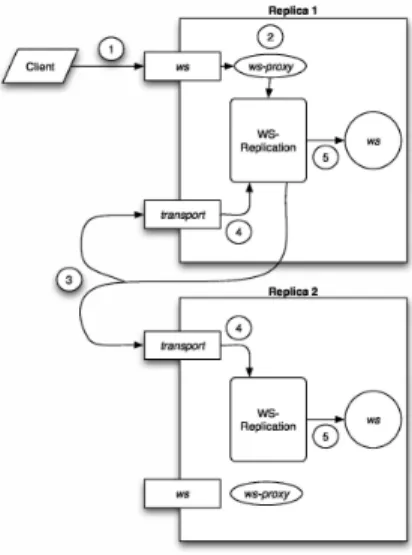
Figure 1: High Level View of WS-Replication
1Note that group communication is not required by any replication
3. WS-REPLICATION: A REPLICATION
FRAMEWORK FOR WEB SERVICES
WS-Replication is a framework for seamless active replication of web services, that is, it respects web service autonomy and provides transparent replication and failover. The communication within the framework is exclusively based on SOAP without forcing the use of an alternative communication means. WS-Replication allows the deployment of a replicated web service using web service tech-nology and SOAP for transporting information across sites. What is more, clients invoke a replicated web service in the same way they invoke a non-replicated one. Internally, WS-Replication takes care of deploying the web service in a set of sites, transparently transforming a web service invocation into a multicast message to replicate the invocation at all sites, awaiting for one, a majority or all replies, and delivering a single reply to the client.
Figure 1 depicts the high level vision of WS-Replication. Let us
assume that the web service we want to replicate is namedws. In
the figure, we can see a replicated web service,ws, deployed at two replicas represented by large rectangles, using active replication. We distinguish among its WSDL interface (shown as a rectangle with the name of the web service), the proxy (shown as an ellipse)
and thewsimplementation (shown as a circle). The client is local
to the replica on the top of the figure2.
The client invokes a web servicewswith exactly the interface
of the target web service (step 1 in the figure). Internally, the WS-Replication framework intercepts the request through a proxy (step 2) and takes care of reliably multicasting in total order this invoca-tion to all the replicas using a private transport web service (step 3). Upon reception of the multicast message (step 4), the mes-sage is processed by the WS-Replication framework to provide the required delivery guarantees (e.g. total order). Finally, the web service is locally executed at each replica (step 5).
WS-Replication consists of two major components: aweb
ser-vice replication componentand areliable multicast component (WS-Multicast).
3.1 Replication Component
The replication component enables the active replication of a web service. The service to be replicated has to behave as a state machine [39], that is, the service should produce the same output if the same input sequence is provided. The replication compo-nent enables the replication of stateful services even with persistent state.
The web service replication component consists of aweb service
deployer, aproxy generatorfor seamless web service replication,
and aweb service dispatcher(WS-Dispatcher).
The deployer provides a distributed deploying facility in the form of a web service that enables the deployment of a service to be replicated at different sites from a central location. It takes a web service bundle as argument that contains all what is necessary to deploy the web service in a single file (like ear or jar bundles for Java applications) and deploys it at all replicas.
The proxy generator generates a proxy for each operation of the web service that intercepts the invocation and interacts with the dispatcher to replicate the invocation. The proxy code carries out two tasks at the site where the invocation is issued: 1) it intercepts invocations to the replicated web service and forwards them to the dispatcher; 2) upon reception of the reply from the dispatcher, it returns it to the client.
2If needed, WS-Replication also supports to deploy proxies at sites that do not hold replicas of the web service. This is useful when clients are remote to all replicas.
The web service dispatcher is a component that interfaces with the group communication and takes care of the matching between invocations and messages. More concretely, the dispatcher imple-ments two functionalities. As a sender (the instance collocated with the client), it transforms web service invocations forwarded by the proxy into multicast messages using the underlying multicast in-frastructure. As a receiver (collocated with a replica), it recon-structs the web service invocation from the multicast message and invokes the target web service using a particular deployment style. Depending on the required degree of dependability the dispatcher can return control to the client (via the proxy) after receiving the first reply, a majority of replies or all replies. The treatment of replies is indicated in the deployment descriptor of the replicated web service.
There are two types of deployment for a replicated web service: as a private web service or as a Java implementation. The former enables to deploy any web service as a replicated web service, al-though the price of this flexibility is an extra SOAP message in-volved in each invocation (the one from the dispatcher to the web service). The latter only works for Java implementations of the web service, but it benefits from saving that SOAP message which is re-placed by a Java method invocation, which is significantly cheaper. This (SOAP) Java invocation corresponds to step 5 in Figure 1.
A more detailed view of the path of a replicated web service in-vocation is shown in Figure 2. The client invokes the replicated web service as a regular web service (step 1 in the figure). The invocation is intercepted by the proxy that delegates it to the dis-patcher (step 2). The disdis-patcher multicasts the invocation through WS-Multicast (step 3). WS-Multicast uses the transport web ser-vice to multicast the message to all replicas (step 4). Upon recep-tion of this message (step 5), WS-Multicast enforces the delivery properties of the message (ordering and reliability properties) pos-sibly exchanging other messages between micro-protocols. When the message fulfils its delivery properties, WS-Multicast delivers it to the dispatcher (step 6). The dispatcher executes locally the target web service (step 7). The reply of the local web service invo-cation is returned to the dispatcher (step 8). The dispatcher where the request was originated will just wait for the specified number of replies (first, majority, all). The dispatchers at other replicas use WS-Multicast (step 9) to send the reply back via unicast to the dispatcher where the request was originated (step 10). When each reply is received (step 11), the local WS-Multicast forwards the re-ply to the local dispatcher (step 12). The dispatcher will deliver the reply to the client via the proxy once it has compiled the specified number of replies (step 13).
Since all replicas have received the invocation and all replicas are returning the resulting reply, replica failures are masked as far as there is an available replica. That is, the replicated service will be available and consistent. The proxy will return to the client as soon as it compiles the required number of replies despite failures. Note that by collocating a proxy with the client the client can access the replicated web service as far as there are enough replicas available.
3.2 Multicast Component
The WS-Multicast component provides group communication based on SOAP. More concretely, it consists of a web service in-terface for multicasting messages, an equivalent Java inin-terface for multicasting and receiving messages, a reliable multicast stack for group communication, and a SOAP-based transport.
WS-Multicast as a web service exhibits a WSDL interface that is used to attain the reliable multicast functionality using a SOAP transport. It consists of two parts: a user interface and an internal interface. The user interface enables the creation and destruction
(a)Request Path (b)Reply Path Figure 2: Low Level View of WS-Replication and WS-Multicast
of groups (via channels that act as group handles) and their con-figuration. It also allows discovering the members of a group as well as unicasting and multicasting messages. The second inter-face is used internally by the GCS to disseminate multicast mes-sages, perform failure detection, and other tasks to achieve group communication properties. Failure detection is achieved through a specific SOAP based ping micro-protocol that monitors the group members. A private operation of the WS is a transport operation
(shown astransportin Figure 2) that takes an array of bytes as
parameter, and is used to transfer messages with a SOAP transport. The group communication stack implements the multicast func-tionality. In order to reuse some well-known micro-protocols such as those for total order and reliability, our SOAP group communi-cation support has been integrated into an existing group commu-nication stack, JGroups [20]. In this way, WS-Multicast can use micro-protocols of JGroups, and JGroups can be used over SOAP. A similar approach can be used with other stack-based GCSs. WS-Multicast also relies on a SOAP engine to enable web service inter-action for transporting messages over SOAP. Our implementation uses Apache Axis SOAP engine [4].
Both the public web service interface and the Java one of WS-Multicast provide the same operations. The Java interface is exactly the same as the one provided in JGroups. In order to send (receive) multicast messages to (from) a group, the sender (receiver) has to create and connect to a channel (the channel is like a socket or file
handle). The parameter of thecreateChanneloperation is the list
of properties to configure the micro-protocols in the group commu-nication stack. To join a group, the group member must connect to a channel providing the name of the group, after connecting to a
channel. Thesendoperation is used both for multicast and unicast
messages. The send operation has three arguments: the message destinations, the source address and the message to be sent. The message destination may be null, then the message is multicast to all members of the group. If it is not null, the message is unicast to that address. The source address indicates the recipients of the response to that message (null indicates the channel address).
Thereceiveoperation is used to receive messages, views, sus-picions and blocks. Internally, messages are stored in a queue. When the receive operation is invoked, the message in the head of the queue is removed and returned. This operation blocks, if there are no messages. The receive operation can return an application message, a view change, a SuspectEvent (indicating that a group member is suspected to be failed), or a BlockEvent (indicates the application to stop sending messages in order to implement strong virtual synchrony).
Finally, thedisconnectoperation removes the invoker from the
group membership. The closeoperation destroys a channel
in-stance and the associated protocol stack.
4. A CASE STUDY: REPLICATION OF
WS-CAF
Web Services Composite Application Framework (WS-CAF) is a framework for WS coordination at different levels of sophistica-tion, from context sharing to advanced transactional models, such as long running activities (LRAs) [33]. WS-CAF consists of a set of three related specifications: Web Services Context (WS-CTX), Web Services Coordination Framework (WS-CF) and Web Ser-vices Transactions (WS-TXM).
WS-CTX defines a standard extensible context structure that en-ables different business partners to propagate, interpret and extend
this context. The basic operations are creation, update and termina-tion of a context. The basic context stores a context identifier and might be extended to store additional information.
WS-CF extends WS-CTX by defining the coordinator role that takes charge of submitting notification messages to WSs in a partic-ular context. Finally, WS-TXM defines different transaction coor-dination protocols: two phase commit (2PC) for traditional ACID transactions, long running activities (LRAs) and business process transactions. These transaction coordination protocols aim to agree on a common transactional outcome among the transaction partici-pants. In this paper we will replicate (active replication) and evalu-ate the performance of LRAs.
The LRA model is designed for business interactions that can expand for long periods of time. An LRA is structured as a set of basic ACID activities. When a basic ACID activity completes its effects are visible. LRAs provide atomicity despite relaxing isola-tion using compensaisola-tion. A compensating acisola-tion logically reverses the effects of an LRA (e.g. a cancellation reverses a booking). LRA activities can be nested. The work performed by LRAs is required to remain compensatable till the enclosing LRA informs that compensation is no longer needed. The coordinator registers the compensator through the LRA protocol before the LRA activity terminates.
The LRA protocol consists of three messages: Complete, Forget and Compensate. Complete is sent as a notification of successful completion. Compensate compensates work that has already been completed by an LRA. The information needed to compensate is kept till a Forget message is received at that time it can be garbage collected. We have implemented WS-CAF (version 0.1). The im-plementation is available as an open source project at ObjectWeb3. In order to evaluate the performance of WS-Replication with a real application we have replicated WS-CAF using active replica-tion. The replicated services are the operations of WS-CTX (the context management services, activity services, and ALS services), WS-CF (coordinator services) and WS-CAF (LRA services).
5. EVALUATION
The evaluation has been performed in two steps. First of all, a micro-benchmark was conducted to understand the overheads of the proposed framework. In a second stage, the replication frame-work was used to build a replicated WS-CAF that was benchmarked using an implementation of WS-I application enriched with LRAs [45].
The micro-benchmark is based on a simple web service: a web service that implements a counter. It just takes an integer and adds it to a local counter. This simple web service will let us show the overhead of the GCS. We conducted an evaluation that led to a se-ries of improvements in the WS-Replication framework (Section 5.1). Then, we evaluated and compared WS-Replication with two baselines: (1) the non-replicated web service with SOAP transport; (2) the replicated service with group communication based on TCP transport. Baseline (1) measures the cost of a SOAP invocation. It enables to measure the cost of replication with respect a non-replicated web service. Baseline (2) measures the cost of repli-cating an invocation using group communication based on TCP transport. Therefore, Baseline (2) enables to quantify the cost of introducing a SOAP transport in group communication compared to TCP-based one. This evaluation was run both in a LAN and a WAN (Section 5.2).
In order to show the performance in a realistic application, the aforementioned replicated version of WS-CAF was built based on 3ObjectWeb JASS project. http://forge.objectweb.org/projects/jass/
the WS-Replication framework. This replicated version was used by an implementation of WS-I enriched with the LRA advanced transactional model supported by WS-CAF. The benchmark was run in a WAN (Section 5.3).
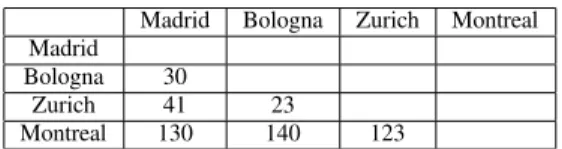
Four locations were used for the WAN evaluations: Madrid (Spain), Montreal (Canada), Bologna (Italy), and Zurich (Switzerland). The distances among locations in terms of message latency (in ms) are summarized in Table 2. They have been obtained running 10 times the ping command between each location pair and taking the aver-age among them. The hardware configuration at each site is shown in Table 1. All sites run linux 9.0, Axis 1.1 with JBoss 3.2.3 and PostgreSQL 7.3.2.
Site # Processors CPU Memory
Madrid Bi-processor AMD Athlon MP 2 GHz 0.5 GB RAM
Bologna Quad-processor Intel Xeon 1.8 GHz 2 GB RAM
Zurich Bi-processor Intel Pentium IV 3 GHz 1 GB RAM
Montreal Bi-processor Intel Pentium IV 3 GHz 1 GB RAM
Table 1: Hardware configuration at each site
Madrid Bologna Zurich Montreal
Madrid
Bologna 30
Zurich 41 23
Montreal 130 140 123
Table 2: Average time (ms) returned by ping between pairs of endpoint locations
5.1 Evolution of WS-Replication
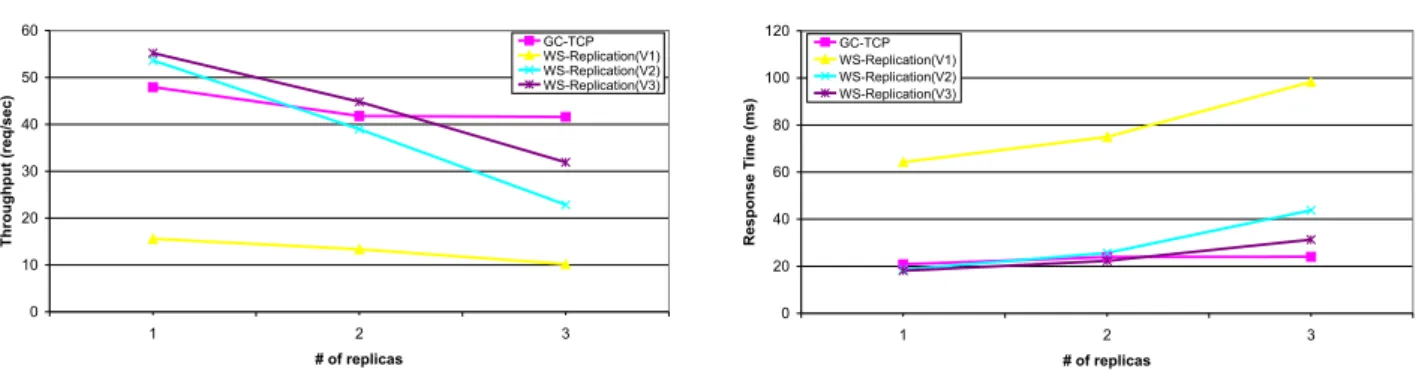
This experiment uses the counter web service to show the over-head of the framework. The experiment was run with a range of 1-3 replicas and a single client in a LAN. Each experiment consists of an overall number of 10,000 requests. There is a single client that submits a request, waits for the reply, and immediately after submits a new request. The results are shown in Figure 3.
When comparing WS-Replication (WS-Replication (v1) in the figure) with the performance of a replicated web service using TCP-based group communication (GC-TCP), it turned out that there was a huge performance degradation even for a single replica. In terms of throughput WS-Replication (v1) behaved 3 to 4 times worse than using TCP transport (GC-TCP), which it is an upper bound on the performance achievable by WS-Replication. In terms of response time, it did relatively worse, from 3 to 5 times fold increase in response time with respect the TCP based group communication. The reason for the overhead was that the serialization performed at the web service level (the SOAP message) for a multicast message (send operation) was generating a 1KB message for an invocation with a single integer parameter, whilst a regular invocation with SOAP was generating a 40 bytes message. The send operation of WS-Multicast has the destination of the message, the source and the message itself as parameters. The message contains the name of the invoked operation, the parameters and the corresponding stub class. Even Java serialization was still very inefficient, although more efficient than the one of web services. A non-negligible num-ber of bytes was being generated for a class without any attribute. The solution was to define a streamable interface that enabled the serialization into basic types and a multicast transport web service with a single generic parameter, an array of bytes. The alternative of rewriting the serialization methods was not enough since it did not provide enough control over the generated stream. It serialized
Throughput 0 10 20 30 40 50 60 1 2 3 # of replicas T h ro u g h p u t (r e q /s e c ) GC-TCP WS-Replication(V1) WS-Replication(V2) WS-Replication(V3) Response Time 0 20 40 60 80 100 120 1 2 3 # of replicas R e s p o n s e T im e (m s ) GC-TCP WS-Replication(V1) WS-Replication(V2) WS-Replication(V3)
Figure 3: Different implementations of WS-Replication and WS-Multicast in a LAN
class information that was not needed. Note that the serialization improvements are only performed on the private transport web ser-vice so they do not affect to WS interoperability. This is just an internal communication means based on SOAP transport for the replicas to communicate among them.
These improvements where evaluated in WS-Replication (v2) in Figure 3. We can observe a substantial improvement, especially for one and two replicas. The throughput for two replicas was very close to the one of TCP-based group communication and in-creased almost four times compared to WS-Replication (v1). For three replicas, the improvement in throughput although it was sig-nificant, it showed a high degradation compared to the one showed by two replicas. The response time of WS-Replication (v2) was significantly reduced to a third of the one of WS-Replication (v1) and almost matched the one of GC-TCP, except for three replicas.
Another source of the overheads was related to the fact that each web service invocation produced three web service invocations: the one made by the client and intercepted by the proxy, one to the transport operation and finally, another one to invoke the web ser-vice replica. Since the implementation of the web serser-vice is in Java, we used the Java deployment style of WS-Replication. This deployment style enables to forward the invocation to the web ser-vice through a plain Java invocation. Of course this performance saving only works for WS Java implementations. WS-Replication (v3) shows the results of this deployment style. It can be observed that the throughput increases for two and three replicas. The re-sponse time for three replicas now increases smoothly compared to WS-Replication (v2).
All these improvements (WS-Replication (v3)) prevented the bot-tlenecks created with 3 replicas in WS-Replication (v2) resulting in a reduction of the response time and an increased throughput.
It should be noted that with one replica WS-Replication (v2) and WS-Replication (v3) behaved better than the TCP-based group communication. The reason is that the TCP implementation cre-ates dynamically the invocations from TCP messages, whilst WS-Replication generates specific stubs upon deployment. This re-sulted in better performance when there was no replication (1 replica).
It can be concluded that the throughput attained by the final ver-sion of WS-Replication was very close to its ceiling, the TCP-based group communication (GC-TCP). In terms of response time, it was almost the same as the one shown using TCP-based group com-munication. This means that the engineering performed in WS-Replication has been very effective in minimizing the overheads induced by group communication and SOAP.
5.2 Performance of WS-Replication
The experiment in this section compares the performance of WS-Replication with the two baselines previously discussed, a non-replicated web service (SOAP in the graphs), and a non-replicated web service using group communication based on TCP transport (GC-TCP in the graphs). We show the performance from 1 to 3 replicas for an increasing load for both the TCP-based group communica-tion and WS-Replicacommunica-tion. The load is increased by augmenting the number of clients submitting requests. Each client submits a re-quest and as soon as it gets the reply, it submits a new rere-quest. The
total number of requests sent by each client is 1/nof the
over-all number of requests (10,000), wherenis the number of clients.
The experiments have been conducted both in a LAN and a WAN setting. The client and the web service replicas were located at different sites. In the WAN setting, the client was in Madrid and the replicas in Bologna, Zurich and Montreal. The replicated web service was configured to wait for the first response.
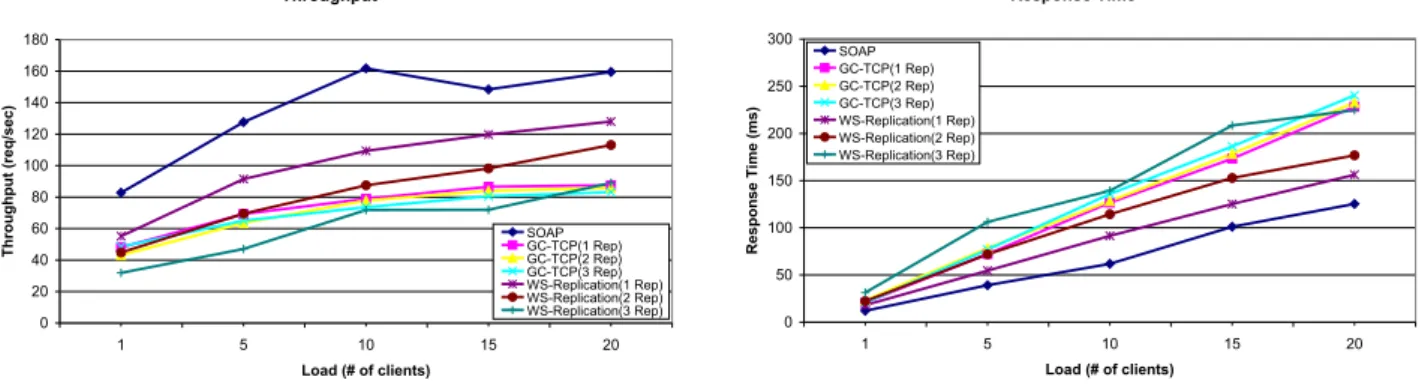
In a LAN we can see that for one replica WS-Replication per-forms better than GC-TCP (Figure 4). As explained in the previous section, this is an artifact of the experiment. The GC-TCP imple-mentation has a generic code to manipulate and build web service invocations. This generality results in a lower performance. In contrast, WS-Replication generates specific handling code for each replicated web service that results in a lower serialization and in-vocation construction overheads that compensate the use of SOAP instead of TCP for one replica. That is, the overhead due to ma-nipulation of serialization and invocations has a higher impact than the overhead introduced by the less efficient SOAP transport. The cost of using group communication and replication is shown com-paring the SOAP curve with the 1-replica curves of GC-TCP and WS-Replication.
When looking at the curves for more than one replica in a LAN setting, one interesting observation is that for two replicas WS-Replication is still slightly better than GC-TCP both in terms of response time and throughput, and only for three replicas the higher overhead in the transport layer becomes the dominant factor over the serialization and invocation handling cost.
The results for the WAN are illustrated in Figure 5. In order to quantify the impact of the distance in the throughput and response time we show the performance of a single replica at the three dif-ferent sites (BOLogna, ZURich and MONtreal). As one would ex-pect, the farthest site from the client (located in Madrid), Montreal, yields the worst throughput and response time. The comparison of the SOAP and 1-Rep-BOL curves shows that the overhead of the
Throughput 0 20 40 60 80 100 120 140 160 180 1 5 10 15 20 Load (# of clients) T h ro u g h p u t (r e q /s e c ) SOAP GC-TCP(1 Rep) GC-TCP(2 Rep) GC-TCP(3 Rep) WS-Replication(1 Rep) WS-Replication(2 Rep) WS-Replication(3 Rep) Response Time 0 50 100 150 200 250 300 1 5 10 15 20 Load (# of clients) R e s p o n s e T im e (m s ) SOAP GC-TCP(1 Rep) GC-TCP(2 Rep) GC-TCP(3 Rep) WS-Replication(1 Rep) WS-Replication(2 Rep) WS-Replication(3 Rep)
Figure 4: Evaluation of WS-Replication and WS-Multicast in a LAN
Throughput 0 20 40 60 80 100 120 140 160 180 1 5 10 15 20 Load (# of clients) T h ro u g h p u t (r e q /s e c ) SOAP(BOL) WS-Replication(1 Rep-BOL) WS-Replication(1 Rep-ZUR) WS-Replication(1 Rep-MON) WS-Replication(2 Rep-BOL-ZUR) WS-Replication(3 Rep-BOL-ZUR-MON) Response Time 0 50 100 150 200 250 300 350 1 5 10 15 20 Load (# of clients) R e s p o n s e T im e (m s ) SOAP(BOL) WS-Replication(1 Rep-BOL) WS-Replication(1 Rep-ZUR) WS-Replication(1 Rep-MON) WS-Replication(2 Rep-BOL-ZUR) WS-Replication(3 Rep-BOL-ZUR-MON)
Figure 5: Evaluation of WS-Replication and WS-Multicast in a WAN
replication framework with respect to SOAP is smaller than in a LAN in relative terms (from about a 50% to a 25%) for the closest replica.
The overhead introduced by the coordination among replicas is shown comparing the 2-replica curve with the 1-replica ones at Bologna and Zurich. The overhead of two replicas in terms of throughput is about a 20%. If we look at the overhead of a 3-replica setting, it can be seen that it has a slightly higher overhead than two replicas, but it behaves better than a single replica at Montreal. The reason is that the experiment was configured to wait only for the first reply. With three replicas, Bologna or Zurich always replied before Montreal. In terms of response time, the triplicated version is significantly better than the 1-replica located at Montreal. This means that clients by using replication will get an average perfor-mance respect to the closest replicas, despite the existence of some distant replica.
As a summary we can conclude from the LAN experiment that the engineering performed in WS-Replication was very effective in attaining a performance competitive with a TCP-based group com-munication. The overhead with respect to a non-replicated web service is higher in terms of throughput, due to the extra CPU con-sumption spent in manipulating extra messages. However, in terms of response time is less significant. The WAN experiment shows that the relative overheads are smaller than in a LAN. What is more, it shows that a triplicated web service will behave better than a sin-gle distant replica. An important observation is that this experiment
is using an almost null web service, so it measures the pure over-head introduced by extra communication. This means that using a realistic web service with some relevant processing associated to each request (i.e. performing some relevant CPU processing and possibly some IO), this performance loss will be much smaller in relative terms, as we will show in the next experiment.
5.3 Replication of WS-CAF
In this experiment we use the WS- I application to evaluate the performance of a replicated WS-CAF. WS-I is a supply chain man-agement application [45]. It consists of four roles: consumers (clients), retailer, warehouses, and manufacturers. The latter three exhibit a web service interface. A retailer offers goods to con-sumers. The retailer places orders to warehouses to fulfil consumer requests. Orders should be served completely by a retailer. The warehouses have to keep stock levels for the items they offer. If the stock of an item falls below certain threshold, the warehouse must refill the stock of the item from a manufacturer. Figure 6(a) shows the interactions among the different actors in WS-I.
We have enriched the WS-I application with advanced transac-tions, more concretely with LRAs, in order to evaluate our WS replication framework. The interaction between the client and the retailer is modeled as a top level LRA that may include several nested activities. Nested LRAs model the interaction between the retailer and a warehouse, or between a warehouse and a manufac-turer. Warehouses and manufacturers are registered as participants
(a) Participants and Interactions (b) Transaction Nesting Figure 6: WS-I application
in the active LRA when they include items in an order or when they have ordered or manufactured, respectively. These interactions can be compensated if the client interaction (top-level LRA) is not fully accomplished (i.e. if the warehouses cannot deliver the whole order to the client).
Figure 6(b) shows a potential scenario of LRA nesting in which the retailer contacts warehouse A and warehouse B. Warehouse A needs to contact manufacturer A, whilst warehouse B contacts both manufacturers B and C. The whole client request is a top-level LRA that encompasses three nested LRAs, corresponding to each inter-action between warehouses and manufacturers to refill the stock of a particular item. When a nested LRA completes, it registers the corresponding compensators with its parent. This enables compen-sation in case the top-level LRA does not succeed.
5.3.1 WS-CAF Evaluation
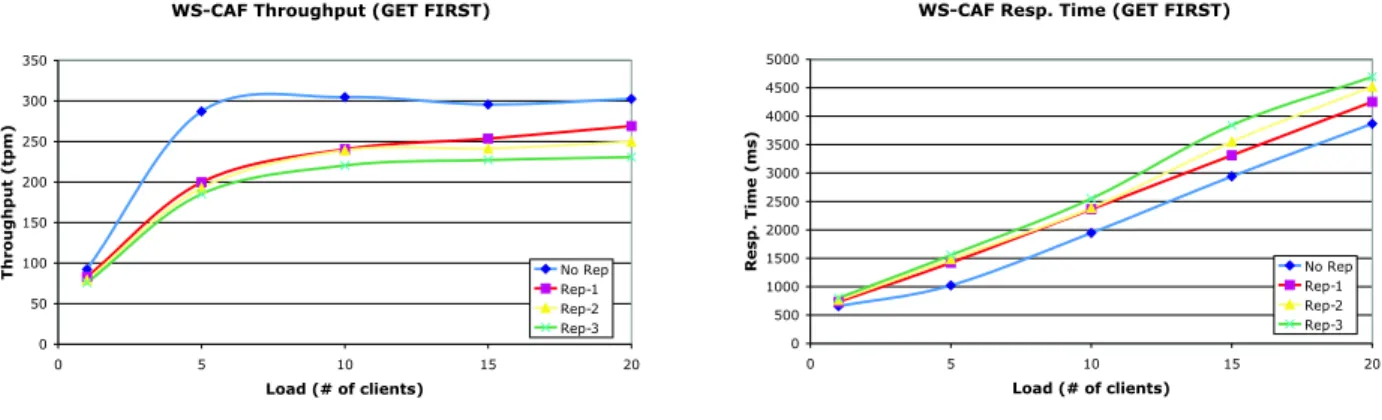
Figure 7 shows the results of the WS-I application evaluating the replicated WS-CAF implementation in a WAN setting. The client and the WS-I application were run in Madrid at two different sites in all the experiments. For comparison purposes we run the same experiment without replicating CAF. In this case WS-CAF was located in Zurich (No Rep curve in Fig.7). Then, we run the experiments with one replica in Bologna (Rep-1), two replicas adding Zurich (Rep-2) and three replicas, adding Montreal (Rep-3). Each client submits 100 requests during which the measurements are done plus 25 warm-up and 25 cold down requests.
It can be noted that the difference between 1-3 replicas is very small in terms of response time, around a 15%. This is mainly due to the stub configuration that is set up to return to the client af-ter receiving the first reply from a replica. Awaiting the first reply is sufficient for many applications and can be considered the de-fault case. In a later experiment we compare the performance of getting the first reply with the one of getting a majority of replies. Comparing the throughput curves for 2-3 replicas with the non-replicated one we can observe that the throughput degradation is smaller for higher loads than for lower loads. The reason is that the non-replicated setting achieves its maximum throughput with 5 clients. After that, the throughput does not increase anymore. The replicated case achieves the maximum throughput with a highest load. Interestingly, the overhead of replication in terms of response
time is much smaller in relative terms. The increase in response time between one and three replicas is smaller than a 10% for the higher load. This is quite beneficial because the main concern in WAN replication is response time and the obtained overheads are very affordable.
In Figure 8 we show the performance difference when the repli-cated web service is configured to wait for a majority of the re-sponses before returning to the client. For two replicas waiting for a majority of replies means to wait for all the replies. As one might expect, the throughput decreases. However, the overhead is not very high especially in the case of three replicas which have a 13% lower throughput. Regarding response time the relative overhead is slightly higher. This is unavoidable, since one has to wait for the second slowest reply, when waiting for a majority of responses.
6. RELATED WORK
Several specifications have been developed that tackle different aspects of web service dependability. For instance, WS-Reliability [32] deals with quality of service in the delivery SOAP messages. For example, a message is sent at most once, exactly once or at least once. Transactional semantics has been addressed by OA-SIS WS-CAF [33] and WS-Transaction and WS-Coordination [26]. Basically, they provide a means to describe a transactional context, appoint a coordinator entity for transactions and distributed coor-dination protocols (either two-phase commit for ACID transactions or more sophisticated coordination for advanced transactions). To the best of our knowledge none of the WS specifications have ad-dressed the availability issue yet. WS-Replication addresses this issue and provides a framework for replication of web services ex-clusively based on web service technology.
An architecture for web services availability has been presented in [8]. The proposed system does not rely exclusively on web ser-vice technology. Instead, it relies on TCP to provide group commu-nication across sites. They provide a (LAN) clustered intermediary message queue for reliable message exchange that is resilient to site failures but not to WAN connectivity failures. WS-Replication pro-vides a more complete infrastructure that deals with highly avail-able web services and deals with both site and connectivity failures. Replication of a particular web service, UDDI, has been researched in [40]. The paper presents an implementation of a replicated UDDI
WS-CAF Throughput (GET FIRST) 0 50 100 150 200 250 300 350 0 5 10 15 20 Load (# of clients) T h r o u g h p u t ( tp m ) No Rep Rep-1 Rep-2 Rep-3
WS-CAF Resp. Time (GET FIRST)
0 500 1000 1500 2000 2500 3000 3500 4000 4500 5000 0 5 10 15 20 Load (# of clients) R e s p . T im e ( m s ) No Rep Rep-1 Rep-2 Rep-3
Figure 7: WS-I performance in a WAN waiting for the first response
WS-CAF Throughput (GET FIRST vs ABS. MAJORITY)
0 50 100 150 200 250 300 0 5 10 15 20 Load (# of clients) T h r o u g h p u t ( tp m )
Get First 2 Rep Get Abs. Majority 2 Rep Get First 3 Rep Get Abs. Majority 3 Rep
WS-CAF Resp. Time (GET FIRST vs ABS. MAJORITY)
0 1000 2000 3000 4000 5000 6000 7000 0 5 10 15 20 Load (# of clients) R e s p . T im e ( m s )
Get First 2 Rep Get Abs. Majority 2 Rep Get First 3 Rep Get Abs. Majority 3 Rep
Figure 8: WS-I performance in a WAN comparison of majority and first
registry using TCP-based group communication and compares it against the replicated UDDI specification [30]. There are two dif-ferences between this work and ours. The first difference is that it is a TCP-based solution. Thus, they do not rely exclusively on web service technology. However, unlike the previous approach, they deal with connectivity failures since they perform WAN replication as we do. An additional difference is that the reported approach is particular for UDDI and not a generic framework for WAN repli-cation of web services like the one provided by WS-Replirepli-cation.
The techniques used for replicating web services exhibit some similarities with the replication of other middleware platforms. The first breed of replicated middleware was possibly fault-tolerant CORBA that finally led to the FT-CORBA specification [34]. Different ap-proaches were proposed for replicating CORBA either transpar-ently, as we proposed for web services, or explicitly by exporting some services to build fault-tolerant applications [28, 27, 13, 22, 6]. Some recent work has studied the clustering of application servers [46, 5, 36] in the context of the Adapt project [1, 7].
The replication of transactional applications has also been stud-ied in other contexts such as object oriented systems (i.e., Arjuna [24]) and databases (Postgres-R [21], Middle-R [35, 23], Ganymed [37]). Regarding advanced transactions there was a lot of theoreti-cal work on proposing advanced transaction models [19, 15], how to model their atomicity and isolation properties [12], and their ap-plications, e.g. to workflows [2, 44]. This research has resulted in the current specifications for implementing advanced transactions
such as CORBA Activity Service [18] or WS-CAF that we have used as case study for benchmarking WS-Replication.
7. CONCLUSIONS
In this paper, we have presented WS-Replication a replication framework for seamless replication of web services. The frame-work allows the deployment of a web service in a set of sites to increase its availability. One of the distinguishing features of WS-Replication is that replication is done respecting web service au-tonomy and exclusively using SOAP to interact across sites. One of the major components of WS-Replication is WS-Multicast that can also be used as a standalone component for reliable multicast in a web service setting. The evaluation shows that with an adequate engineering, the overhead of replication on top of SOAP can be-come acceptable. We have tested WS-Replication with a complex service, WS-CAF, using a realistic application such as WS-I. We believe that the kind of support provided by WS-Replication will be essential for the upcoming breed of critical web services with more exigent availability requirements.
8. REFERENCES
[1] Adapt: Middleware Technologies for Adaptive and Composable Distributed Components. IST-37126.
http://adapt.ls.fi.upm.es/adapt.htm.
[2] G. Alonso, D. Agrawal, A. Abbadi, M. Kamath, R. G¨unth¨or, and C. Mohan. Advanced transaction models in workflow
contexts. InProc. of the IEEE Int. Conf. on Data Engineering (ICDE), pages 574–581, 1996.
[3] Y. Amir, C. Danilov, and J. R. Stanton. A low latency, loss tolerant architecture and protocol for wide area group
communication. InDSN, 2000.
[4] Apache.Axis SOAP Engine. http://ws.apache.org/axis/.
[5] O. Babaoglu, A. Bartoli, V. Maverick, S. Patarin,
J. Vuckovic, and H. Wu. A Framework for Prototyping J2EE
Replication Algorithms. InProc. of Int. Symp. on Distributed
Objects and Applications (DOA), pages 1413–1426, 2004. [6] R. Baldoni and C. Marchetti. Three-tier replication for
ft-corba infrastructures.SPE, 33(8):767–797, 2003. [7] A. Bartoli, R. Jimenez-Peris, B. Kemme, C. Pautasso,
S. Patarin, S. Wheater, and S. Woodman. The adapt framework for adaptable and composable web services.
IEEE Distributed Systems On Line, September 2005. [8] K. Birman, R. van Renesse, and W. Vogels. Adding High
Availability and Autonomic Behavior to Web Services. In
Proc. of Int. Conf. on Software Engineering (ICSE), 2004.
[9] K.P. Birman.Building Secure and Reliable Network
Applications. Prentice Hall, NJ, 1996.
[10] N. Budhiraja, K. Marzullo, F. Schneider, and S. Toueg. Primary–backup protocols: Lower bounds and optimal
implementations. InProc. of DCCA, September 1992.
[11] G. V. Chockler, I. Keidar, and R. Vitenberg. Group
communication specifications: A comprehensive study.ACM
Computer Surveys, 33(4), 2001.
[12] P. K. Chrysanthis and K. Ramamritham. ACTA: A
Framework for Specifying and Reasoning about Transaction
Structure and Behavior. InProc. of ACM SIGMOD Int. Conf.
on Management of Data, pages 194–203, 1990. [13] M. Cukier, J. Ren, C. Sabnis, D. Henke, J. Pistole, W. H.
Sanders, D. E. Bakken, M. E. Berman, D. A. Karr, and R. E. Schantz. AQuA: An Adaptive Architecture that Provides
Dependable Distributed Objects. InIEEE SRDS’98.
[14] A.Y. Dolev, D. Krameer, and S. Malki. Transis: A Communication Sub-system for High Availability . In
FTCS-22, 1992.
[15] A. K. Elmagarmid, Y. Leu, J. G. Mullen, and O. Bukhres.
Introduction to Advanced Transaction Models. InDatabase
Transaction Models. 1992.
[16] P. D. Ezhilchelvan, R. A. Macˆedo, and S. K. Shrivastava. Newtop: A fault-tolerant group communication protocol. In
ICDCS, pages 296–306, 1995.
[17] M. Hayden. The Ensemble System. Technical Report TR-98-1662, Department of Computer Science. Cornell University, January 1998.
[18] I. Houston, M. C. Little, I. Robinson, S. K. Shrivastava, and S. M. Wheater. The CORBA Activity Service Framework for
Supporting Extended Transactions.Software Practice and
Experience, 33(4):351–373, 2003.
[19] S. Jajodia and L. Kerschberg, editors.Advanced Transaction
Models and Architectures. Kluwer, 1997.
[20] JGroups: A Toolkit for Reliable Multicast Communication. http://www.jgroups.org.
[21] B. Kemme and G. Alonso. Postgres-R, a new way to
implement database replication. InVLDB, 2000.
[22] M.O. Killijian, J.C. Fabre, J.C. Ruiz-Garcia, and S. Chiba. A Metaobject Protocol for Fault-Tolerant CORBA
Applications. InProc. of IEEE Symp. On Reliable and
Distributed Systems (SRDS), 1998.
[23] Y. Lin, B. Kemme, M. Pati˜no-Mart´ınez, and R. Jim´enez-Peris. Middleware based data replication providing snapshot isolation. InProc. of the ACM Int. Conf. on Management of Data (SIGMOD). ACM Press, 2005. [24] M. C. Little and S. K. Shrivastava. Object Replication in
Arjuna. Technical Report 50, BROADCAST Project, 1994. [25] Mark Little. Models for web services transactions. In
SIGMOD Conf., page 872, 2004. [26] Microsoft, IBM, and BEA.
WS-Coordination/WS-Transaction Specification, 2005. [27] G. Morgan, S.K. Shrivastava, P.D. Ezhilchelvan, and M.C.
Little. Design and Implementation of a CORBA
Fault-tolerant Object Group Service. InProc. of DAIS, 1999.
[28] L. E. Moser, P. M. Melliar-Smith, P. Narasimhan, L. Tewksbury, and V. Kalogeraki. The Eternal System: An
Architecture for Enterprise Applications. InEDOC, 1999.
[29] L.E. Moser, P.M. Melliar-Smith, D.A. Agarwal, R.K. Budhia, and C.A. Lingley-Papadopoulos. Totem: A Fault-Tolerant Multicast Group Communication System.
Communications of the ACM, 39(4):54–63, April 1996.
[30] OASIS.UDDI Replication Specification.
[31] OASIS.Universal Description, Discovery and
Integration(UDDI). http://uddi.org/.
[32] OASIS.Web Service Reliable Messaging, 2004.
[33] OASIS.Web Services Composite Application Framework
(WS-CAF), 2005.
[34] OMG.Fault Tolerant CORBA. OMG, 2000.
[35] M. Pati˜no-Mart´ınez, R. Jim´enez-Peris, B. Kemme, and G. Alonso. Middle-r: Consistent database replication at the
middleware level.ACM TOCS, 2005.
[36] F. P´erez-Sorrosal, J. Vuckovic, M. Pati˜no-Mart´ınez, and R. Jim´enez-Peris. Highly Available Long Running Transactions and Activities for J2EE Applications. In
ICDCS, 2006.
[37] C. Plattner and G. Alonso. Ganymed: Scalable replication for transactional web applications. InProc. of the ACM/IFIP/USENIX Int. Middleware Conf., 2004. [38] R. Van Renesse, K.P. Birman, and S. Maffeis. Horus: A
Flexible Group Communication System.Communications of
the ACM, 39(4):76–83, April 1996.
[39] F. B. Schneider. Implementing Fault-Tolerant Services Using
the State Machine Approach: A Tutorial.ACM Computing
Surveys, 22(4):299–319, 1990.
[40] C. Sun, Y. Lin, and B. Kemme. Comparison of UDDI
Registry Replication Strategies. InICWS, 2004.
[41] P. Verissimo, P. Barret, A. Hilborne, L. Rodrigues, and D. Seaton. The Extra Performance Architecture (XPA). In D. Powell, editor,Delta-4: A Generic Architecture for Dependable Distributed Computing, pages 211–266. 1991.
[42] W3C.Simple Object Access Protocol (SOAP) 1.1.
http://www.w3.org/TR/soap/.
[43] W3C.Web Services Description Language (WSDL).
http://www.w3.org/TR/wsdl.
[44] D. Worah and A. P. Sheth. Transactions in transactional
workflows. InAdvanced Transaction Models and
Architectures, pages 3–34. Kluwer Academic Press, 1997.
[45] WS Interoperability Organization.Web Service
Interoperability (WS-I), 2005.
[46] H. Wu and B. Kemme. Fault-tolerance for stateful
application servers in the presence of advanced transactions patterns. InSRDS, 2005.