Middleware for Dependable Network Services in
Partitionable Distributed Systems
Alberto Montresor
Renzo Davoli
Ozalp Babao ˘glu
¨
Technical Report UBLCS-99-19
October 1999; Revised April 2000
Department of Computer Science
University of Bologna
Mura Anteo Zamboni 7
40127 Bologna (Italy)
The University of Bologna Department of Computer Science Research Technical Reports are available in gzipped PostScript format via anonymous FTP from the areaftp.cs.unibo.it:/pub/TR/UBLCSor via WWW at URLhttp://www.cs.unibo.it/. Plain-text abstracts organized by year are available in the directoryABSTRACTS. All local authors can be reached via e-mail at the address last-name@cs.unibo.it. Questions and comments should be addressed [email protected].
Recent Titles from the UBLCS Technical Report Series
98-12 The Jgroup Reliable Distributed Object Model, A. Montresor, December 1998 (Revised March 1999). 99-1 Deciding and Axiomatizing ST Bisimulation for a Process Algebra with Recursion and Action Refinement, M.
Bravetti, R. Gorrieri, February 1999.
99-2 A Theory of Efficiency for Markovian Processes, M. Bernardo, W.R. Cleaveland, February 1999 (Revisied March 2000).
99-3 A Reliable Registry for the Jgroup Distributed Object Model, A. Montresor, March 1999.
99-4 Comparing the QoS of Internet Audio Mechanisms via Formal Methods, A. Aldini, M. Bernardo, R. Gorrieri, M. Roccetti, March 1999.
99-5 Group-Enhanced Remote Method Invocations, A. Montresor, R. Davoli, ¨O. Babao ˘glu, April 1999. 99-6 Managing Complex Documents Over the WWW: a Case Study for XML, P. Ciancarini, F. Vitali, C. Mascolo,
April 1999.
99-7 Data-Flow Hard Real-Time Programs: Scheduling Processors and Communication Channels in a Distributed Environment, R. Davoli, F. Tamburini, April 1999.
99-8 The MPS Computer System Simulator, M. Morsiani, R. Davoli, April 1999. 99-9 Action Refinement, R. Gorrieri, A. Rensink, April 1999.
99-10 Proceedings of the Workshop on Virtual Documents, Hypertext Functionality and the Web, M. Milosavljevic, F. Vitali, C. Watters, May 1999.
99-11 An Algebraic Model for Evaluating the Performance of an ATM Switch with Explicit Rate Marking, A. Aldini, M. Bernardo, R. Gorrieri, June 1999.
99-12 Simulative and Experimental Analysis of an Adaptive Playout Delay Adjustment Mechanism for packetized Voice across the Internet, M. Roccetti, V. Ghini e G. Pau, June 1999.
99-13 Theory and Application of Extended Markovian Process Algebra (PhD Thesis), Bernardo, M., July 1999. 99-14 A Methodology for the Specification of Java Components and Architectures (PhD Thesis), Cimato, S., July
1999.
99-15 Parallel Discrete Event Simulation Supported by Coordination Languages Based on the Generative Paradigm (PhD Thesis), Fabbri, A., July 1999.
99-16 Analysis and Automatic Detection of Information Flows in Systems and Networks (PhD Thesis), Focardi, R., July 1999.
99-17 A Simple Game Semantics Model of Concurrency, Asperti A., Finelli M., Franco G., Marchignoli D., July 1999.
99-18 A Complete Axiomatization for Observational Congruence of Prioritized Finite-State Behaviors, Bravetti, M., Gorrieri, R., July 1999.
99-19 Middleware Support for the Development of Distributed Applications in Partitionable Systems, A. Montresor, R. Davoli, O. Babaoglu, October 1999.
99-20 Performance Analysis of Software Architectures via a Process Algebraic Description Language, Bernardo, M., Ciancarini, P., Donatiello, L., November 1999 (Revised March 2000).
99-21 Real-Time Traffic Transmission Over the Internet, Furini, M., Towsley, D., November 1999.
99-22 On the Expressiveness of Event Notification in Data-Driven Coordination Languages, Busi, N., Zavattaro, G., December 1999.
2000-1 Compositional Asymmetric Cooperations for Process Algebras with Probabilities, Priorities, and Time, Bravetti, M., Bernardo, M., January 2000 (Revised February 2000).
Middleware for Dependable Network Services in
Partitionable Distributed Systems
2Alberto Montresor
2Renzo Davoli
2¨
Ozalp Babao ˘glu
2Technical Report UBLCS-99-19
October 1999; Revised April 2000
AbstractWe describe the design and implementation of Jgroup: a middleware system that integrates group technol-ogy with distributed objects and is based on Java RMI. Jgroup supports a programming paradigm called object groups and enables development of dependable network services based on replication. Among the novel features of Jgroup is a uniform object-oriented interface for programming both services and their clients. The fact that Jgroup exposes network effects, including partitions, to applications makes it partic-ularly suitable for developing highly-available services in partitionable distributed systems.
2. Partial support for this work was provided by Sun Microsystems, Inc. through a Collaborative Research Grant and
the Italian Ministry of University, Research and Technology.
2. Department of Computer Science, University of Bologna, Mura Anteo Zamboni 7, Bologna 40127 (Italy), Email: fmontresor,davoli,[email protected]
1
Introduction
Traditional file-based operating systems are ill suited as a computing base for modern network services and applications. Inclusion of communication protocols (e.g., TCP/IP, FTP, HTTP) is a first step towards opening them up to the network but fail in providing sufficiently high-level ab-stractions for application development. Middleware has proven to be an effective technology for addressing this mismatch between the underlying system and applications. Middleware plat-forms for distributed application development have evolved from being message-based (e.g., Isis [21], PVM [16]) to being object-based (e.g., OMG CORBA [19], Microsoft DCOM [35], Sun Java Remote Method Invocation (RMI) [26]). This is in recognition of the importance of object-oriented technology in addressing software reuse, interoperability and portability in distributed application development.
Distributed services are being called on to perform increasingly critical functions in our ev-eryday lives such that errors or delays in their results may compromise human safety or result in economic loss. Thus, distributed services have to be dependable: they need to perform actions or furnish results that are correct and they need to remain available despite the inherent unreliability of their environment. Replication is the principal technique for rendering services dependable. By performing the same service at several replicas distributed over the system, we can guarantee both its correctness and availability as long as failures are independent and their number can be bounded.
Existing middleware platforms for distributed application development are ill suited for man-aging replication since they lack primitives for reliable “one-to-many” interactions between ob-jects. This, however, turns out to be the natural interaction style both for obtaining a (replicated) service on the part of clients, and for maintaining the consistency of the replicated service state on the part of servers. In its absence, existing middleware platforms require simulation of one-to-many interactions through multiple one-to-one interaction primitives, adding to the already complex and error-prone task of distributed service development. This shortcoming has been ac-knowledged by the OMG and is the subject of a recent “Request for Proposals” for fault-tolerant CORBA [18].
In this paper we present the Jgroup middleware system and argue why it is an effective basis for developing dependable distributed services. Jgroup integrates group technology and dis-tributed objects based on the Java Remote Method Invocation (RMI) facility [26]. Group technol-ogy adopted by Jgroup follows the object group paradigm [13, 23] where functions of a distributed service are replicated among a collection of server objects that make up the logical object group for the service. Client objects interact with an object group implementing some distributed vice through an external group method invocation (EGMI) facility. Jgroup hides the fact that ser-vices may be implemented as object groups rather than single objects so that clients using them through EGMI need not be reprogrammed. Servers making up the object group cooperate in order to provide a dependable version of the service to their clients. This cooperation has to maintain the consistency of the replicated service state and is achieved through an internal group method invocation (IGMI) facility. Strong guarantees provided by Jgroup for both EGMI and IGMI in the presence of failures and recoveries (including partitioning and merging of the communi-cation network) greatly simplify the task of applicommuni-cation developers.
Jgroup includes numerous innovative features that make it interesting as a basis for develop-ing modern network services:
It exposes network effects to applications, which best know how to handle them. In
par-ticular, operational objects continue to be active even when they are partitioned from other object group members. This is in contrast to most existing systems that try to hide as much as possible network effects from applications by limiting activity to a single primary par-tition while blocking activity in all other parpar-titions. An important property of Jgroup is providing each object a consistent view of all other objects that are in the same partition as itself. This knowledge is essential for partition-aware application development where the availability of services is dictated by application semantics alone and not by the underlying system. Partition-awareness as supported by Jgroup can be seen as a modern
interpreta-tion of the end-to-end argument originally made with respect to communicainterpreta-tion reliability alone [33].
In Jgroup, all interactions within an object group implementing some service and all
re-quests for the service from the outside are based on a single mechanism — remote method invocations. Jgroup is unique in providing this uniform object-oriented interface for pro-gramming both servers and clients. Other object group systems typically provide an object-oriented interface only for client-server interactions while server-server interactions are based on message passing. This heterogeneity not only complicates application develop-ment, it also makes it difficult to reason about the application as a whole using a single paradigm.
Jgroup includes a state merging service as systematic support for partition-aware application
development. Reconciling the replicated service state when partitions merge is typically one of the most difficult problems in developing applications to be deployed in partition-able systems. This is due to the possibility of the service state diverging in different par-titions because of conflicting updates. While a general solution to the problem is highly application dependent, Jgroup simplifies this task by providing support for stylized inter-actions that occur frequently in solutions.
Finally, Jgroup derives all of the benefits of its Java base. Most importantly, Jgroup
pro-motes a “language-based” application development methodology that is independent of the complexities of underlying operating systems. Entire applications built with Jgroup can be understood and reasoned about as programs.
In the following sections we describe the main features and properties of Jgroup, give a brief description of its implementation and discuss in detail a realistic application built using Jgroup. The application we consider is a reliable version of the Java Registry Service and forms an im-portant component of Jgroup itself.
2
The Jgroup Distributed Object Model
The context of our work is a distributed system composed of client and server objects intercon-nected through a communication network. The system is asynchronous in the sense that neither the computational speeds of objects nor communication delays can be bounded. Furthermore, the system is unreliable and failures may cause objects and communication channels to crash whereby they simply stop functioning. Once failures are repaired, they may return to being op-erational after an appropriate recovery action. Finally, the system is partitionable in that certain communication failure scenarios may disrupt communication between multiple sets of objects forming partitions. Objects within a given partition can communicate among themselves, but can-not communicate with objects outside the partition. When communication between partitions is re-established, we say that they merge.
Above properties are necessary for faithfully modeling practical distributed systems such as the Internet. Developing dependable applications to be deployed in these systems is a complex and error-prone task due to the uncertainty resulting from asynchrony and failures. The desire to render services partition-aware to increase their availability adds significantly to this difficulty. The Jgroup middleware system has been designed to simplify partition-aware application de-velopment by transforming complex system properties such as failures, recoveries, partitions, merges and asynchrony into simpler, high-level abstractions with well-defined semantics.
Jgroup promotes dependable application development through replication implemented as object groups [13, 23]. Distributed services that are to be made dependable are replicated among a collection of server objects that implement the same set of remote interfaces and form a group in order to coordinate their activities and appear to clients as a single server. Client objects access a distributed service by interacting with the group identified through the name of the service. Jgroup handles all details such that clients need not be aware that the service is being provided by a group rather than a single server object. In particular, clients are unaware of the number, lo-cation or identity of individual servers in the group. Communilo-cation between clients and groups
takes the form of group method invocations, that result in methods being executed by one or more servers forming the group, depending on the invocation semantics. For clients, group method invocations are indistinguishable from standard RMI interactions: clients obtain a representative object called a stub that acts as a proxy for a group, and perform invocations on it. Stubs handle all low-level details of group method invocations, such as locating the servers composing the group, establishing communication with them and returning the result to the invoker.
Jgroup extends the object group paradigm to partitionable systems through three major com-ponents: a partition-aware group membership service (PGMS), a group method invocation service (GMIS) and a state merging service (SMS). A major contribution of Jgroup is the fact that properties guaran-teed by each of its components can be formally specified, thus admitting formal reasoning about the correctness of applications based on it [29]. Due to space constraints, in this work we give only short informal descriptions in the following sections.
2.1 The Partition-aware Group Membership Service
Groups are collections of server objects that cooperate in providing distributed services. For increased flexibility, the group composition is allowed to vary dynamically as new servers are added and existing ones removed. Servers desiring to contribute to a distributed service become a member of the group by joining it. Later on, a member may decide to terminate its contribu-tion by leaving the group. At any time, the membership of a group includes those servers that are operational and have joined but have not yet left the group. Asynchrony of the system and pos-sibility of failures may cause each member to have a different perception of the group’s current membership. The task of a partition-aware group membership service (PGMS) is to track volun-tary variations in the membership, as well as involunvolun-tary variations due to failures and repairs of servers and communication links. All variations in the group membership are reported to its members through the installation of views. Installed views consist of a membership list along with a unique view identifier, and correspond to the group’s current composition as perceived by those members included in the view.
A useful PGMS specification has to take into account several issues. First, the service must track changes in the group membership accurately and in a timely manner3
such that installed views indeed convey recent information about the group’s composition within each partition. Next, we require that a view be installed only after agreement is reached on its composition among the servers included in the view. Note that this may cause proposals for new view com-positions to shrink during the installation phase in case agreement fails among the initial con-stituents. Finally, PGMS must guarantee that two views installed by two different servers be installed in the same order. These last two properties are necessary for server objects to be able to reason globally about the replicated state based solely on local information, thus simplifying significantly their implementation. Note that the PGMS we have defined for Jgroup admits co-existence of concurrent views, each corresponding to a different partition of the communication network, thus making it suitable for partition-aware applications.
In Jgroup, the basic API for PGMS is provided by theGroupManagerclass. Every server that wants to become member of a group must request a group manager (GM) object from Jgroup by invoking a method of the group manager factory. Each group manager is associated with exactly one member object, while member objects may join several groups and thus have several group managers (one per group). Group managers need a reference to the member object they serve, in order to notify them of view change events. In order to receive these notifications, every group member must implement theMemberinterface.
2.2 The Group Method Invocation Service
Jgroup differs from existing object group systems due to its uniform communication interface based entirely on group method invocations. Clients and servers alike interact with groups by
3. Being cast in an asynchronous system, we cannot place time bounds on when new views will be installed in response
to server joins, leaves, crashes, recoveries or network partitionings and merges. All we can guarantee is that new view installations will not be delayed indefinitely.
remotely invoking methods on them. In this manner, benefits of object-orientation are extended to internal communication among servers. Although they share the same intercommunication paradigm, we distinguish between internal group method invocations (IGMI) performed by servers and external group method invocations (EGMI) performed by clients. There are several reasons for this distinction:
Visibility: Methods to be used for implementing a replicated service should not be visible
to clients. Clients should be able to access only the “public” interface defining the service, while methods invoked by servers should be considered “private” to the implementation.
Transparency: Jgroup strives to provide an invocation mechanism for clients that is
com-pletely transparent with respect to standard RMI. This means that clients are not required to be aware that they are invoking a method on a group of servers rather than a single one. Servers, on the other hand, that implement the replicated service may have differ-ent requiremdiffer-ents for group invocations, such as obtaining a result from each server in the current view.
Efficiency: Having identical specifications for external and internal group method
invoca-tions would have required that clients become members of the group, resulting in poor scalability of the system. In Jgroup, external group method invocations have semantics that are slightly weaker than those for internal group method invocations. Recognition of this difference results in a much more scalable system by limiting the higher costs of full group membership to server, which are typically far fewer in number than clients [6]. When developing dependable distributed services, internal methods are collected to form the internal remote interface of the server object, while external methods are collected to form its exter-nal remote interface. The next step in server object development is the creation of appropriate proxy classes for invoking external and internal group methods. Proxies for external group method in-vocations are called stubs as in standard Java RMI, while internal group method inin-vocations are delegated to the group managers that handle all communication between server objects through group method invocations. Stubs implement the same external interface for which they act as a proxy, while group managers implement a multi-response interface derived from the internal re-mote interface. Multi-response interfaces differ from the corresponding internal rere-mote interface due to the fact that internal invocations may return an array of results, rather than single values. Stubs, multi-response interfaces and group managers are all generated by the Jgroup toolgmic
(group method invocation compiler), that extends the standardrmiccompiler of Java RMI [26] to handle group method invocations.
In order to perform an internal group method invocation, servers must invoke the method on the appropriate group manager. Clients that need to interact with a group, on the other hand, must request a stub from a dependable registry service [28]. A dependable registry service allows servers to register themselves under a group name represented as a character string. Clients look up desired services by name in the registry and obtain their stub. The dependable registry service is an integral part of Jgroup and is implemented as a replicated service using Jgroup itself. In Section 4 we describe its implementation to illustrate how Jgroup can be used to develop reliable and high-available services.
In the following sections, we discuss how internal and external group method invocations work in Jgroup, and how internal invocations substitute message multicasting as the basic com-munication paradigm. In particular, we describe the reliability guarantees that group method invocations provide. They are derived from similar properties that have been defined for mes-sage deliveries in mesmes-sage-based group communication systems [4]. We say that an object (client or server) performs a method invocation at the time it invokes a method on a group; we say that a server completes an invocation when it terminates executing the associated method. Method in-vocations are uniquely identified such that it is possible to establish a one-to-one correspondence between performing and completing them.
2.2.1 Internal Group Method Invocations
Unlike traditional Java remote method invocations, internal group method invocations (IGMI) return an array of results rather than a single value. IGMI comes in two different flavors:
syn-chronous and asynsyn-chronous. In synsyn-chronous IGMI, the invoker remains blocked until an array con-taining results from each server that completed the invocation can be assembled and returned to it (from which servers result values are contained in the return array is discussed below). There are many programming scenarios where such blocking may be too costly, as it can unblock only when the last server to complete the invocation has produced its result. Furthermore, it requires programmers to consider issues such as deadlock hat may be caused by circular invocations. In asynchronous IGMI, the invoker does not block but specifies a callback object that will be noti-fied when return values are ready from servers completing the invocation. If the method being invoked returnsvoid, the invoker has two possibilities: it can specify a callback object to receive notifications about the completion of the invocation, or it can specifynull, meaning that the in-voker is not interested in knowing when the method completes.
Completion of IGMI by the servers forming a group satisfies a variant of “view synchrony” that has proven to be an important property for reasoning about reliability in message-based systems [34]. Informally, view synchrony requires two servers that install the same pair of con-secutive views to complete the same set of IGMI during the first view of the pair. In other words, before a new view can be installed, all servers belonging to both the current and the new view have to agree on the set of IGMI they have completed in the current view. This enables a server to reason about the state of other servers in the group using only local information such the his-tory of installed views and the set of completed IGMI. Clearly, application semantics may require that servers need to agree on not only the set of completed IGMI but also the order in which they were completed. For example, a distributed shared whiteboard would require that IGMI completions at participating servers be totally-ordered. In Jgroup, different ordering semantics for IGMI completions may be implemented through additional layers on top of the basic group method invocation service.
We now outline some of the main properties that IGMI satisfy. First, they are live: an IGMI is guaranteed to terminate either with a reply array (containing at least the return value computed by the invoker itself), or with one of the application-defined exception contained in the throws clause of the method. Furthermore, if an operational serverScompletes some IGMI in a view, all
servers included in that view will also complete the same invocation, orSwill install a new view.
Since installed views represent the current failure scenario as perceived by servers, this property guarantees that an IGMI will be completed by every other server that is in the same partition as the invoker. IGMI also satisfy “integrity” requirements whereby each IGMI is completed by each server at most once, and only if some server has previously performed it. Finally, Jgroup guarantees that each IGMI be completed in at most one view. In other words, if different servers complete the same IGMI, they cannot complete it in different views. In this manner, all result values that are contained in the reply array are guaranteed to have been computed during the same view.
2.2.2 External Group Method Invocations
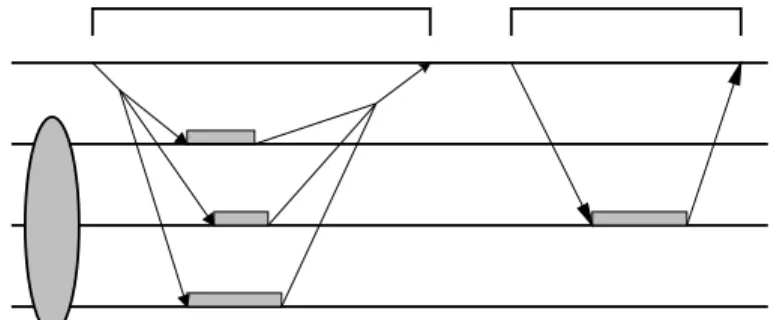
External group method invocations (EGMI) that characterize client-to-server interactions are completely transparent to clients that use them as if they were standard remote method invo-cations. When designing the external remote interface for a service, an application developer must choose between two different invocation semantics (see Figure 1):
Anycast invocation: An EGMI performed by a client on a group will be completed by at
least one server of the group, unless there are no operational servers in the client’s parti-tion. Anycast invocations are suitable for implementing methods that do not modify the replicated server state, as in query requests to interrogate a database.
Multicast invocation: An EGMI performed by a client on a group will be completed by every
server of the group that is in the same partition as the client. Multicast invocations are suitable for implementing methods that may update the replicated server state.
The choice of which invocation semantics to associate with each method rests with the pro-grammer of the distributed service when designing its external remote interface. The default semantics for an external method is anycast invocation semantics. Inclusion of the tag Mcas-tRemoteExceptionin thethrowsclause of a method signals that it needs to be invoked with
mul-S
S
Client
Multicast invocation Anycast invocation
S
1 2 3
Figure 1. External method invocations with multicast and anycast semantics
ticast semantics. When generating the stub for an external interface,gmicanalyzes the throws clause using Java reflection [2] and produces the appropriate stub code.
Our implementation of Jgroup guarantees that EGMI are live: if at least one server remains operational and in the same partition as the invoking client, EGMI will eventually complete with a reply value being returned to the client. Furthermore, an EGMI is completed by each server at most once, and only if some client has previously performed it. These properties hold for both anycast and multicast versions of EGMI. In the case of multicast EGMI, Jgroup also guarantees the view synchrony property defined in the previous section.
Internal and external group method invocations differ in an important aspect. Whereas an IGMI, if it completes, is guaranteed to complete in the same view at all servers, an EGMI may complete in several different concurrent views. This is possible, for example, when a server completes the EGMI but becomes partitioned from the client before delivering the result. Failing to receive a response for the EGMI, the client’s stub has to contact other servers that may be available, and this may cause the same EGMI to be completed by different servers in several concurrent views. The only solution to this problem would be to have the client join the group before issuing the EGMI. In this manner, the client would participate in the view agreement protocol and could delay the installation of a new view in order to guarantee the completion of a method in a particular view. Clearly, such a solution may become too costly as group sizes would no longer be determined by the number of server objects (degree of replication of the service), but by the number of clients, which could be very large.
The fact that EGMI may complete in several different concurrent views has important conse-quences for dependable application development. Consider an EGMI that is indeed completed by two different servers in two concurrent views due to a partition as described above. Assume that the EGMI is a request to update part of the replicated server state. Now, when the partition is repaired and the two concurrent views merge to a common view, we are faced with the problem of reconciling server states that have evolved independently in the two partitions. The problem is discussed in length below but what is clear is that a simple-minded merging of the two states will result in the same update (issued as a single EGMI) being applied twice. To address the prob-lem, Jgroup assigns each EGMI a unique identifier. In this manner, the reconciliation protocol can detect that the two updates that are being reported by the two merging partitions are really the same and should not both be applied.
One of the goals of Jgroup has been the complete transparency of server replication to clients. This requires that from a clients perspective, EGMI should be indistinguishable from standard Java RMI. This has ruled out consideration of alternative definitions for EGMI including multi-value results or asynchronous invocations.
2.3 The State Merging Service
While partition-awareness is necessary for rendering services more available in partitionable sys-tems, it can also be a source of significant complexity for application development. This is simply
a consequence of the intrinsic availability-consistency tradeoff for distributed applications and is independent of any of the design choices we have made for Jgroup.
Being based on a partitionable group membership service, Jgroup admits partition-aware applications that have to cope with multiple concurrent views. Application semantics dictates which of its services remain available where during partitionings. When failures are repaired and multiple partitions merge, a new server state has to be constructed. This new state should reconcile, to the extent possible, any divergence that may have taken place during partitioned operation.
Generically, state reconciliation tries to construct a new state that reflects the effects of all non-conflicting concurrent updates and detect if there have been any non-conflicting concurrent updates to the state. While it is impossible to automate completely state reconciliation for arbitrary applica-tions, a lot can be accomplished at the system level for simplifying the task [3]. Jgroup includes a state merging service (SMS) that provides support for building application-specific reconciliation protocols based on stylized interactions. The basic paradigm is that of full information exchange — when multiple partitions merge into a new one, a coordinator is elected among the servers in each of the merging partitions; each coordinator acts on the behalf of its partition and diffuses state information necessary to update those servers that were not in its partition. When a server receives such information from a coordinator, it applies it to its local copy of the state. This one-round distribution scheme has proven to be extremely useful when developing partition-aware applications [5, 28].
SMS drives the state reconciliation protocol by calling back to servers for “getting” and “merg-ing” information about their state. It also handles coordinator election and information diffusion. To be able to use SMS for building reconciliation protocols, servers of partition-aware applica-tions must satisfy the following requirements:
Each server must be able to act as a coordinator; in other words, every server has to
main-tain the entire replicated state and be able to provide state information when requested by SMS.
A server must be able to apply any incoming updates to its local state. This assumption
restricts the applicability of SMS. For example, applications with high-consistency require-ments may not be able to apply conflicting updates to the same record. Note, however, that this is intrinsic to partition-awareness, and is not a limitation of SMS.
In order to elect a coordinator, SMS requires information about “who can act on the behalf of whom”. At a given time, we say that server s
1 is up-to-date with respect to server s 2 if all information known bys 2is known also by s 1. A server s
1may act as a coordinator on the behalf
of a server s 2 if
s
1 is up-to-date with respect to s
2. Initially, a server is up-to-date only with
respect to itself. After having received information from other servers through the execution of its “merging” callback method, it can become up-to-date with respect to these servers. On the other hand, a server ceases to be up-to-date with respect to other servers upon the installation of a new view excluding them. Consider for example a servers
1installing a view
vthat excludes
servers
2. Since the state of s
2may be evolving concurrently (and inconsistently) with respect to s
1, SMS declares s
1as being not up-to-date with respect to s
2.
The complete specification of SMS is contained in another work [29]. Here we very briefly outline its basic properties. The main requirement satisfied by SMS is liveness: if there is a time after which two servers install only views including each other, then eventually each of them will become up-to-date with respect to the other (directly or indirectly through different servers that may be elected coordinators and provide information on behalf of one of the two servers). Another important property is agreement: servers that install the same pair of views in the same order are guaranteed to receive the same state information through invocations of their “merg-ing” methods in the period occurring between the installations of the two views. This property is similar to view synchrony, and like view synchrony may be used to maintain information about the updates applied by other servers. Finally, SMS satisfies an integrity property such that SMS will not initiate a state reconciliation protocol without reasons (e.g.., if all servers are already up-to-date).
JVM 2 JVM 3 JVM 1 S S S C C Daemon Daemon GM GM GM Stub
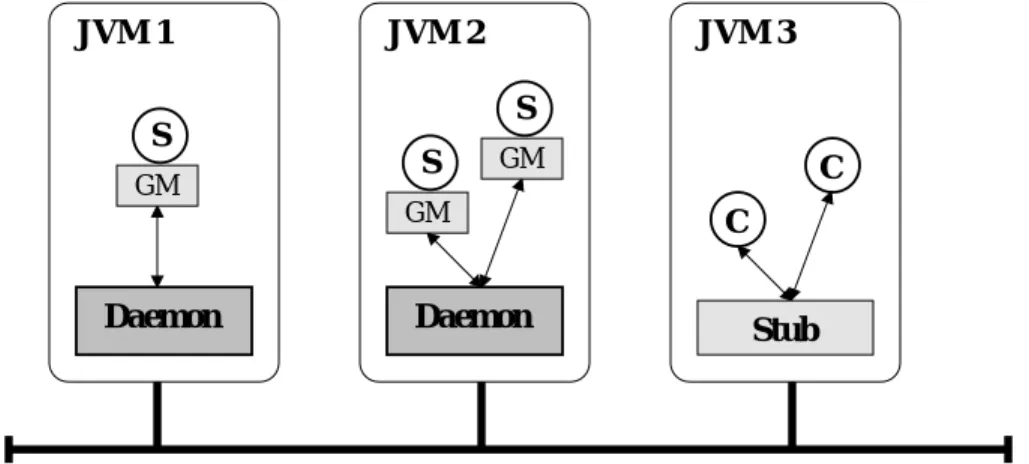
Figure 2. The overall Jgroup architecture. A service that is replicated three-fold is distributed over the first two Java Virtual Machines (JVM). Servers participate in the distributed computation through their respective group managers and the per-site Jgroup daemon. Clients request services and receive results through the stub object for the service.
3
The Jgroup Implementation
In this Section we give an overview of the Jgroup architecture and the principal algorithms used to implement it. Details can be found in another work [29]. The Jgroup architecture is illustrated in Figure 2. As discussed in the previous Section, object group facilities are provided to client and server objects through stubs and group managers, respectively. Stubs act as proxies for clients performing external group method invocations on the group, while group managers are used by servers to perform internal group method invocations. Group managers are also responsible for notifying servers of group events such as view changes and method invocations issued by other client or server objects. Each stub and group manager is associated with exactly one group; stubs may serve several clients concurrently, while each group manager is associated with exactly one server object (see Figure 2).
On the client side, stubs have total responsibility for handling external invocations. On the server side, group managers implement only a subset of the object group services described in the previous section. Basic group membership and multicast communication facilities are im-plemented in a separate module called the Jgroup daemon. In each Java Virtual Machine (JVM) hosting Jgroup servers, a single instance of the Jgroup daemon is executed. There are several reasons for not putting the entire group service in the group managers but factoring out certain functions to the per-site Jgroup daemons. First, the number of messages exchanged to establish group communication is reduced; low-level services such as failure detection are implemented only once per-JVM and not replicated at every server object. Furthermore, this model enables the distinction between server objects local to a given JVM and those that are remote. Servers local to a given JVM share the same destiny with respect to failures: the crash of a JVM causes the crash of all servers hosted on it, and if a JVM becomes partitioned from the rest of the system, all its local servers stop communicating with remote servers. Thus, two distinct membership lists are maintained: one regarding local servers, and the other regarding remote daemons (and their associated servers). Voluntary variations in the membership due to join and leave operations are translated into single messages modifying the list of servers hosted at a daemon, without requiring complex agreement protocols.
Implementing the group membership services directly on top of a point-to-point unreliable, unsequenced datagram transport service provided by the network would be very difficult. For this reason, Jgroup daemons have a layered structure (Figure 3) with each layer providing higher-level abstractions as follows:
net-Network
Group Manager Group Manager Group Manager
Partitionable Group Membership Layer Multi-Send Layer Layer Reliable Multicast
Figure 3. The architecture of a Jgroup Daemon
work by transforming the unreliable, point-to-point network communication primitives to their best-effort, one-to-many counterparts. Informally, MSL tries to deliver messages sent through it to all daemons in some destination list. Moreover, it keeps daemons informed about with which servers communication is possible and which are suspected to be parti-tioned or crashed.
Partitionable Group Membership Layer (PGML): Services provided by MSL are used by PGML
in order to construct and install views as defined by the PGMS specification. The task of PGML is to manage the membership of multiple groups by serving join and leave requests issued by servers, and to translate the possibly inconsistent suspicion sets generated by MSL into agreed views.
Reliable Multicast Layer (RML): The task of RML is to provide a message-based reliable
mul-ticast service. RML is integrated with the partitionable group membership layer and im-plements the message-based version of the view synchrony properties as discussed in Sec-tion 2.2.1.
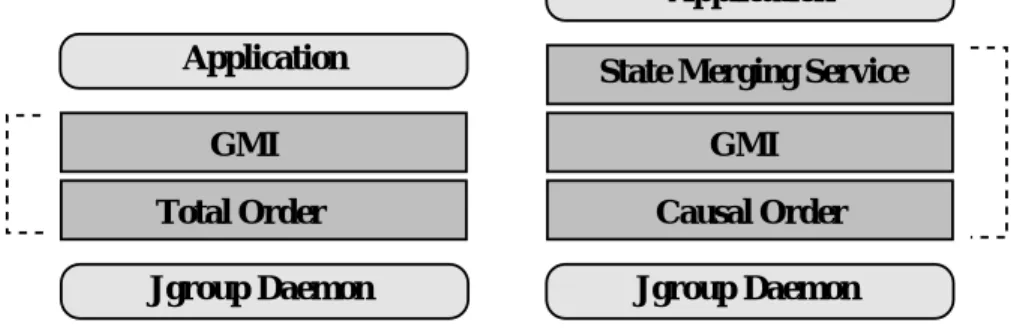
Jgroup daemons are the basic building blocks of the Jgroup architecture; they provide the fun-damental portions of the group communication service, such as failure detection, group mem-bership and reliable message multicasts. All other facilities specified in the previous Section are provided directly by group managers. Like Jgroup daemons, group managers have a layered architecture. A group manager is composed specifically to satisfy the needs of a given server by including the necessary components (Figure 4). Group manager components that are currently available in Jgroup include group method invocation service, state merging service and several different ordering properties. Additional group manager components can be easily added to Jgroup in order to provide new facilities to developers.
We now describe in more detail each of the layers making up the Jgroup architecture. The Multi-Send Layer is a transport protocol based on UDP that also does message routing and failure detection [11]. Explicit routing at this layer is necessary to get around the lack of transitivity at the UDP layer. This phenomenon is not uncommon in large-scale distributed systems including the Internet [25]. The failure detector is necessary to guarantee the termination of the group membership protocol despite the asynchronous nature of the system, and is based on information obtained from the routing algorithm. Each change in the perceived communication state of the system (corresponding to server crashes, recoveries, partition, merges) is notified by MSL to the group membership service.
The group membership and reliable multicast layers included in Jgroup have been extensively discussed in a previous work [4]. When MSL notifies a variation in the communication state, a coordinator-based agreement protocol is initiated. Each daemon sends its estimate of the new
Group Manager Group Manager Application Jgroup Daemon GMI Total Order Application Jgroup Daemon State Merging Service
GMI Causal Order
Figure 4. Two group managers with different configurations.
group composition to a coordinator daemon chosen deterministically from within that estimate. When the coordinator observes an agreement on the group composition among all daemons included in an estimate, the estimate is translated to a view and is sent to all daemons interested in it. Each daemon delivers the view to the servers that are local to it and are included in the view itself. Termination of the algorithm is guaranteed by the fact that during the agreement phase, estimates sent by daemons are monotonically decreasing sets. In the limit, agreement will be guaranteed on singleton sets and each server will install a new view containing itself alone.
The GMIS implements IGMI and EGMI facilities on top of the daemon, in cooperation with remote stubs residing at client sites. Servers interact with group managers alone, while clients interact only with stubs. Stubs are obtained by interrogating the dependable registry service (c.f. Section 4). Object groups are located by a stub through group references that contain a stan-dard Java RMI remote reference for each server. Group references are only approximations to the group’s actual membership as known by the registry at the time of the interrogation. This is done to avoid updating a potentially large number of stubs that may exist in the system every time a variation in a group’s membership occurs. On the negative side, group references may become stale, particularly in systems with highly-dynamic, short-lived server groups. Conse-quently, when an external group method invocation fails because all servers known to the stub have since left the group, the stub contacts the registry again in order to obtain fresher informa-tion about the group membership.
In the case of external invocations with anycast semantics, stubs select one of the servers composing the group and try to transmit the invocation to the corresponding group manager through a standard RMI interaction. The contacted group manager dispatches the method at the server and sends back the return value to the stub. If the selected server cannot be reached (due to a crash or a partition), the RMI system throws a remote exception. In this case, the stub selects a new group manager and tries to contact it. This process continues until either a server completes the method and a return value is received, or the list of group managers is exhausted. In the latter case, GMIS throws a remote exception to the client, in order to notify that the requested service cannot be accessed.
At the client stub, external invocations with multicast semantics proceed just as those with anycast semantics. The group manager receiving the invocation multicasts it to all members in its current view. A single return value (usually the one returned by the group manager initially contacted) is returned to the client stub. Note that a direct multicasting of the invocation to all servers cannot be used since the actual composition of a group may be different from that of the group reference maintained by a stub. In any case, an additional communication step among servers is necessary in order to transmit the invocation to servers not included in the group reference and to guarantee view synchrony.
Stubs are also responsible for the creation of invocation identifiers. Invocation identifiers are used by group managers to detect and discard duplicate executions of the same method on the same server, and may be used by application servers to identify invocations. Each invocation
RS RS C AS AS AS RS
1. service = bind(groupname, server) 2. service = drs.lookup(groupname)
3. service.method(arguments)
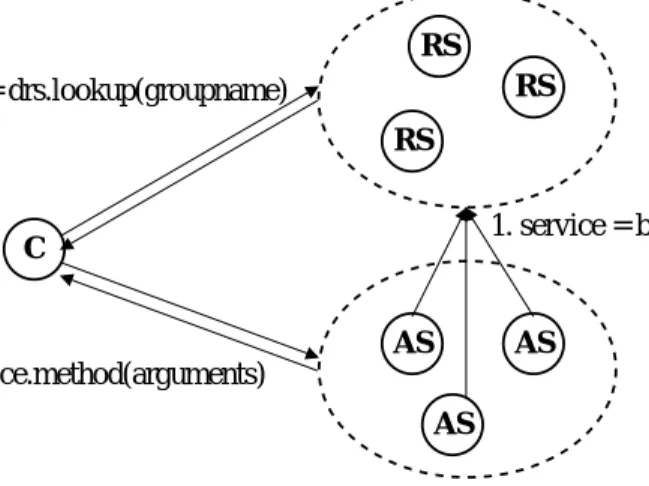
Figure 5. Interactions among registry servers, application servers and clients.
identifier is composed of the client identifier (the IP address of the machine hosting the JVM), an incarnation number (used to distinguish different virtual machines residing at the same host) and an invocation counter (incremented at each invocation). Invocation identifiers are transmitted together with the method name and the invocation arguments.
Unlike client stubs, group managers are located at server sites and are continuously notified about view changes by Jgroup daemons. In this manner, internal group method invocations issued by servers may be multicast directly to the group managers in the current view of the invoker using the reliable multicast service of Jgroup. When a group manager delivers an invo-cation, it invokes the corresponding method on the server and sends back the return value to the invoker. Return values are collected by the invoking group manager, which returns them to the associated server as an array of replies.
The state merging service (SMS) is implemented on top of the Jgroup daemon and GMIS. Whenever a new view is installed, SMS verifies that each member included in it is up-to-date with respect to the others. If not, a new state reconciliation protocol is started. SMS drives each reconciliation protocol by performing the following operations. First, it elects a set of coordi-nators; then, SMS calls back to coordinators to obtain the application-dependent information needed to update the other members. Finally, this information is diffused through an internal group method invocation of the “merging” method, whose task is to merge data coming from other servers into the local state. Note that the coordinator election step is based on the local information about the up-to-date relation maintained by Jgroup daemons, and does not require any exchange of messages. Generally, the state reconciliation protocols driven by SMS are very simple: when two partitions merge, two coordinators are elected and each of them updates the servers contained in the other partition. SMS, however, can tolerate more complex scenarios. If, for example, a coordinator fails before being able to provide the necessary information, a new view is installed and a new state reconciliation protocol is started.
All of Jgroup is implemented entirely in Java. Unlike other systems, Jgroup does not rely on any additional facilities that may be written in languages other than Java [7]. This assures that Jgroup is fully portable to every architecture for which a JVM is available. The Jgroup prototype is still in a preliminary stage, and many optimization are under development. For this reason, no performance measurements are available at the moment.
4
Programming with Jgroup: Dependable Registry Service
We conclude our description of Jgroup by outlining how a realistic application can be imple-mented using it. The application we have chosen is the Dependable Registry Service (DRS) that
is part of the Jgroup distribution. DRS is a dependable replacement for the standard registry service that is included in Java RMI [26]. Note that Java RMI alone is an inappropriate platform for building dependable services due to its single-client, single-server interaction model and the fact that the (non-replicated) registry service represents a single point of failure for those appli-cations that rely on it. Once the registry service fails or becomes partitioned, all objects that are registered with it become inaccessible. Furthermore, the Java RMI registry is unable to handle groups of server objects registered under the same name. Our DRS implementation uses the group membership service, state merging service and EGMI facilities of Jgroup so as to provide a replicated repository. Distributed applications (replicated and non) advertise their services by registering with DRS and clients obtain stubs to access them after a look up.
DRS is an instance of a larger class of partition-aware applications with lose consistency re-quirements. Clients can access services even in the presence of partitions as long as they can contact at least one DRS replica that knows about them. In the same way, servers may register a service on the DRS replicas contained in their partition. Obviously, services that have been registered in other partitions (at other DRS replicas) will not be accessible until partitions merge and DRS replicas reconcile their registry states. When the reconciliation protocol is executed, in-formation about servers that have been registered or removed is exchanged. If a service has been registered in multiple concurrent partitions under the same name, composition of the associated group will be the union of the servers present in the merging partitions. Note that DRS renders only the look up phase of a distributed service dependable and partition-aware. To render the service itself dependable and partition aware requires that it be replicated as an object group using Jgroup.
DRS is implemented as a collection of Registry Servers (RS) that actively maintain a database of bindings between application servers (AS) and group names. Figure 5 illustrates the interactions among registry servers, application servers and clients. First, each application server in the group registers itself with DRS under a group name, using thebindmethod (step 1). A client that needs to access the service implemented by the group invokes thelookupmethod on DRS in order to obtain a stub for the service (step 2). The client then uses this stub to perform method invocations on the group (step 3). Note that application servers act as clients of DRS. In other words, both
bindandlookupmethods are included in the external remote interface of DRS. DRS is an instance of a general-purpose distributed hash table manager that can retrieve values given a key and that can insert/delete key-value pairs. DRS that is included in Jgroup is indeed implemented as an instance of this class that is included in a library of distributed collection classes.
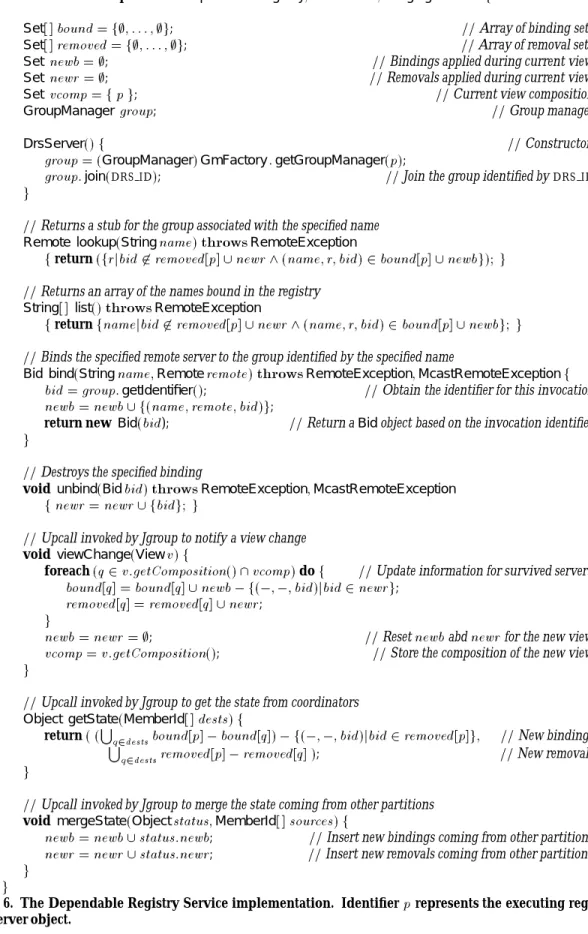
In Figure 6 we sketch the algorithm used to implement DRS at registry server
p
. TheDrsServer class implements the external remote interface DependableRegistrywhich is the counterpart ofjava.rmi.registryand includes support for replication. Both interfaces provide the same set of methods; the only major difference is in the use of a binding identifierBidin theunbindmethod. In fact, inDependableRegistrynames are bound to several distributed objects and not to a single one as in the Java registry. This requires theunbindmethod to distinguish which binding needs to be removed. Moreover,DrsServerimplements an empty internal remote interfaceInternalDrs since internal group method invocations are not necessary. The interfaceMergingMemberis used by Jgroup to notify registry servers of events generated by the group membership service and by the state merging service.
Variables maintained by a registry server are initialized in the constructor. Variables
bound
andremoved
are dynamic arrays indexed by registry server identifiers. At registry serverp, thevariable
bound
[q ]contains the set of bindings thatpknows that some other registry serverqhasadded to its database. The variable
removed
[q ]contains the set of bind identifiersBidthatpknowsthatqhas removed. Clearly, partitionings may cause these sets to differ from the actual sets of
bindings and removals applied byq. They are used to reduce the amount of information
ex-changed during the state reconciliation protocol. The sets
bound
[p]andremoved
[p]maintainedby registry serverphave a slightly different meaning. They represent sets of bindings and
re-movals actually applied bypitself, with the exception of bindings and removals applied during
the current view, which are recorded in variables
newb
andnewr
, respectively. When a new view is installed, view synchrony guarantees that operations included innewb
andnewr
have been1 class DrsServer implements DependableRegistry;InternalDrs;MergingMemberf
2
3 Set[]
bound
=f;;:::;;g; ==Array of binding sets4 Set[]
removed
=f;;:::;;g; ==Array of removal sets5 Set
newb
=;; ==Bindings applied during current view6 Set
newr
=;; ==Removals applied during current view7 Set
vcomp
=fp
g; ==Current view composition8 GroupManager
group
; ==Group manager9
10 DrsServer()f ==Constructor
11
group
=(GroupManager)GmFactory:getGroupManager(p
);12
group
:join(DRS ID); ==Join the group identified byDRS ID13 g
14
15 ==Returns a stub for the group associated with the specified name
16 Remote lookup(String
name
)throwsRemoteException17 freturn(fr j
bid
62removed
[p
][newr
^(name
;r;bid
)2bound
[p
][newb
g); g18
19 ==Returns an array of the names bound in the registry
20 String[] list()throwsRemoteException
21 freturnf
name
jbid
62removed
[p
][newr
^(name
;r;bid
)2bound
[p
][newb
g;g22
23 ==Binds the specified remote server to the group identified by the specified name
24 Bid bind(String
name
;Remoteremote
)throwsRemoteException;McastRemoteExceptionf25
bid
=group
:getIdentifier(); ==Obtain the identifier for this invocation26
newb
=newb
[f(name
;remote
;bid
)g;27 return new Bid(
bid
); ==Return aBidobject based on the invocation identifier28 g
29
30 ==Destroys the specified binding
31 voidunbind(Bid
bid
)throwsRemoteException;McastRemoteException32 f
newr
=newr
[fbid
g;g33
34 ==Upcall invoked by Jgroup to notify a view change
35 voidviewChange(Viewv )f
36 foreach(q2v :
getComposition
()\vcomp
)dof ==Update information for survived servers37
bound
[q ]=bound
[q ][newb
;f(;;;;bid
)jbid
2newr
g;38
removed
[q ]=removed
[q ][newr
;39 g
40
newb
=newr
=;; ==Resetnewb
abdnewr
for the new view41
vcomp
=v :getComposition
(); ==Store the composition of the new view42 g
43
44 ==Upcall invoked by Jgroup to get the state from coordinators
45 Object getState(MemberId[]
dests
)f46 return((
S
q 2dests
bound
[
p
];bound
[q ]);f(;;;;bid
)jbid
2removed
[p
]g; ==New bindings47
S
q 2dests
removed
[
p
];removed
[q ]); ==New removals48 g
49
50 ==Upcall invoked by Jgroup to merge the state coming from other partitions
51 voidmergeState(Object
status
;MemberId[]sources
)f52
newb
=newb
[status
:newb
; ==Insert new bindings coming from other partitions53
newr
=newr
[status
:newr
; ==Insert new removals coming from other partitions54 g
55 g
Figure 6. The Dependable Registry Service implementation. Identifier
p
represents the executing reg-istry server object.applied by all registry servers that survived from the previous view. This information is used to update variables
bound
andremoved
at each view installation. Each item inbound
andnewb
is a triple formed by the name of the service, the remote reference of a single server and aBid identifier. Recall thatBidholds binding identifiers, returned by thebindmethod and used in the unbindmethod to explicitly remove the particular binding. Variablevcomp
is used to record the composition of the previous view and is updated at every view installation. Finally, variablegroup
is a reference to the group manager used to join the dependable registry service group. In the initialization, variablesbound
,removed
,newb
andnewr
are set to be empty, while the variablevcomp
containspitself. A new group manager is obtained by invokinggetGroupManageron theGmFactoryclass. This method takes a reference to the object that will receive notifications of group-related events like view changes and group method invocations. Finally, the server joins the dependable registry service group identified byDRS ID.
Implementation of methods included in the external remote method interface is very simple. Methodslookupand list are read-only methods used to inspect the database of bindings main-tained by DRS, whilebindandunbindare update methods used to modify this database. As the database is replicated at every registry server forming the DRS group, read-only methods are ex-ecuted using anycast invocation semantics, while update methods are based on the multicast in-vocation semantics. For this reason, methodsbindandunbindinclude theMcastRemoteException
in their throws clause. Methodlookupinspects the local database and returns a stub containing a reference for each of the application servers that has been registered under the desired name and has not yet been removed. Methodlistreturns the list of names currently in use at the local database. Methodbindinserts the triple(
name
;remote
;bid
)in variablenewb
, wherename
andremote
are provided as parameters of the method, andbid
is a binding identifier obtained from the invocation identifier returned by the invocation of methodgetIdentifieron the group manager. Finally, methodunbindinserts a binding identifier innewr
.Under stable conditions (i.e., no new failures or repairs for sufficiently long periods), the set of registry servers contained in a given partition will eventually install the same view and execute the same set of external method invocations. Every update to the binding database applied by any one of these servers will also be applied by every other server in the partition. When new failures occur, the group membership service reacts by installing new views, and registry servers must react appropriately to the new failure scenario. This reaction is at the core of the algorithm. When installing a new view, serverpadds the updates contained in
newb
andnewr
tobound
[q ]and
removed
[q ], respectively, for each replicaqin the intersection between the new view and theprevious one. Furthermore, it removes from
bound
[q ]bindings whose identifiers are containedin
newr
. In this manner we avoid unbounded growth ofbound
. Finally, it updates variablevcomp
to reflect the new view composition. If a state reconciliation protocol is needed, Jgroup elects a coordinator for each one of the merging partitions. At the coordinators, Jgroup invokes thegetState method, requiring them to return updates that may be missing at registry servers contained indests
. In order to reduce the amount of information exchanged, contents of arraysbound
andremoved
are used. As discussed in Section 2, information provided by the coordinators is diffused to other registry servers by invoking methodmergeStateon them, which results in updates being inserted tonewb
andnewr
.To keep the description of DRS simple, we have made certain choices that need to be modified in a real implementation. First, variables
bound
andremoved
need to be implemented as hash tables instead of generic sets in order to simplify searches and improve performance. Second, variableremoved
as implemented above, may grow without bound since identifiers of removed bindings need to be kept forever. In order to avoid the unbounded growth of this set, bindings in the registry can be implemented as leases: bindings are removed automatically from the database after a certain time period unless their leases are renewed by the application servers. The content ofbound
needs to be inspected periodically in order to find and remove expired bindings. Vari-ableremoved
needs to contain only the identifiers of the bindings that have been removed before their natural expiration. The task of periodically renewing active bindings should be delegated to group managers such that application developers need not be concerned with them.5
Related Work
The absence of one-to-many interaction mechanisms in existing object systems complicates con-siderably design and implementation of dependable services. The CORBA Object Transaction Service (OTS) [17] and the Java Transaction Service [27] offer limited support for fault tolerance based on the transaction paradigm. While transactions can be used to build reliable services, they are not appropriate for satisfying availability requirements of applications.
The problem of integrating group communication [9] and distributed object technologies such as CORBA [19] and Java RMI [26] has been the subject of intense investigation [22, 32, 15, 8, 30, 7]. Most of the research effort has been dedicated to CORBA and resulting object group systems may be classified into three categories [15]. The integration approach consists of modifying and enhanc-ing an object request broker (ORB) usenhanc-ing existenhanc-ing group communication services. CORBA invo-cations are passed to the group communication service that multicasts them to replicated servers. This approach has been pursued by the Electra system [22]. In the interception approach, low-level messages containing CORBA invocations and responses are intercepted on client and server sides and mapped to group communication services. This approach does not require any modification to the ORB, but relies on OS-specific mechanisms for request interception. Eternal [32] is based on the interception approach. Finally, the service approach provides group communication as a separate CORBA service. The ORB is unaware of groups, and the service can be used in any CORBA-compliant implementation. The service approach has been adopted by object group systems such as OGS [15], Doors [12] and Newtop [30]. The service approach has also influ-enced many of the proposals responding to the OMG “Request of Proposals” on fault-tolerant CORBA [18].
Unlike CORBA, the specification of Java RMI enables programmers to implement their own remote references, thus extending the standard behavior of Java RMI. We have exploited this feature by developing the concept of group reference, whose task is to manage interactions be-tween clients and remote object groups. The resulting system provides transparent access to object groups and completely satisfies the specification of Java RMI. Other Java-based middle-ware systems include Filterfresh [8] and JavaGroups [7]. Filterfresh shares the same goals as Jgroup: integration of the object group paradigm with the Java distributed object model. Filter-fresh is rather limited, as it provides neither external remote method invocations with multicast semantics nor internal remote method invocations among servers. JavaGroups is a message-based group communication toolkit written in Java providing reliable multicast communication. In its current version, JavaGroups uses group communication protocols provided by the Ensem-ble system [20]. The remote method invocation facility of JavaGroups is not transparent, as it is based on the exchange of objects that encode method invocation descriptions.
Besides Filterfresh and JavaGroups, there have been other efforts in rendering Java-based ap-plications fault-tolerant. iBus [24] is a commercial product written in Java and aimed at sup-porting intranet applications such as content delivery systems, groupware and fault-tolerant client/server systems. The iBus architecture does not integrate group communication with Java RMI. Instead, iBus is based on the concept of multicast channels mapped to IP multicast groups. Clients can subscribe to multicast channels and can push or pull messages over a subscribed channel. The current version of the system has no well-defined reliability properties such as view synchrony. In particular, there is no guarantee that pull operations (i.e., message deliveries) are synchronized with view changes. This limits the possibility for servers to reason about the state of other servers, and makes development of reliable applications more difficult.
What distinguishes Jgroup from existing object group systems is its focus on supporting highly-available applications to be deployed in partitionable environments. Most of the exist-ing object group systems [15, 12, 8] are based on the primary-partition approach and thus cannot be used to develop applications capable of continuing to provide services in multiple partitions. Very few object group systems abandon the primary-partition model [30, 32] but do not provide adequate support for partition-aware application development.
6
Conclusions
We have presented the design and implementation of Jgroup, an extension of the Java distributed object model based on the group communication paradigm. Unlike other group-oriented exten-sions to various existing distributed object models, Jgroup has the primary goal of supporting reliable and high-available application development in partitionable systems. This addresses an important requirement for modern applications that are to be deployed in networks where parti-tions can be frequent and long lasting. In designing Jgroup, we have taken great care in defining properties for group membership, remote group method invocation and state merging service so as to enable and simplify partition-aware application development.
Jgroup enables meeting of reliability and availability requirements of applications through replication: services are implemented by groups of remote objects that use Jgroup facilities to cooperate in order to maintain the consistency of their state. Remote object groups simulate the behavior of standard, non-replicated remote objects by implementing the same set of remote in-terfaces. Jgroup allows clients to access replicated services transparently using standard Java RMI mechanisms. Jgroup is the first object group system with a uniform communication model based entirely on remote group method invocations. This allows us to exploit the characteristics and ad-vantages of object-orientation for the application as a whole. Systems that base server-to-server interactions on message passing require programmers to cope with two different paradigms in reasoning about the correctness of applications.
Being based on Java, Jgroup inherits all of its advantages for distributed applications develop-ment. Most importantly, Jgroup enables modern software engineering techniques to be applied to dependable application development. Desirable properties such as software reuse, interoper-ability and portinteroper-ability can be achieved in programming clients as well as servers with Jgroup due to its uniform object-oriented model. Secondly, being Java based, Jgroup promotes a “language-based” approach to dependable application development. This is in contrast to the traditional “operating system-based” approach that not only ties applications to specific environments, it also excludes the possibility to reason about the correctness of applications based on program-ming language tools and techniques.
Development of Jgroup has presented both design and engineering issues. In our original design, clients were allowed to perform only external invocations with anycast semantics. Later on we added multicast external invocations and realized that this paradigm could be the basis for internal invocations as well. Defining the precise semantics for internal invocations with appropriate reliability properties has been the most time consuming task in our design.
In implementing the Jgroup prototype, the principal engineering issue was: how can group communication be integrated transparently with an existing client-server communication para-digm such as Java RMI? Transparency with respect to clients meant that they had to continue accessing the services as if they were being provided by single, non-replicated objects. The de-sired transparency has been obtained in part through existing mechanisms of Java RMI that al-low users to extend the protocol, and in part through workarounds where Java RMI support has proven to be insufficient. Jgroup is the subject of a collaborative research project between Sun Microsystems and the University of Bologna and our experiences in building Jgroup will be valuable for the evolution of the Java RMI API.
Acknowledgments We are grateful to Bill Joy for his comments on an early draft of this work.
References
[1] E. Anceaume, B. Charron-Bost, P. Minet, and S. Toueg. On the Formal Specification of Group Membership Services. Technical Report TR95-1534, Dept. of Computer Science, Cornell Uni-versity, August 1995.
[2] Ken Arnold and James Gosling. The Java Programming Language. Addision-Wesley, 2nd edition, 1998.