Creatine
Technical Document
Developed by INDI/SNIG for the Irish Sports Council
Creatine
Databases Pubmed and Google Scholar were searched for human studies published in peer-reviewed
journals from 2009-2014.
Search terms:
‘Creatine’, ‘Creatine Monohydrate’, ‘Athletes’, ‘Sport’, ‘Exercise’.
The reference list from the creatine articles retrieved was searched for any additional papers that were
relevant to the development of this document and the history of creatine in sport.
Inclusion Criteria
Human studies published in English
Healthy subjects
Original investigations assessing the use of creatine and exercise
Incorporated the use of an indistinguishable placebo
Sufficient statistical power
Reviews
Exclusion Criteria
Combined supplement studies
Qualitative studies assessing supplement use in both the general and athletic population
Animal/
in vitro
studies
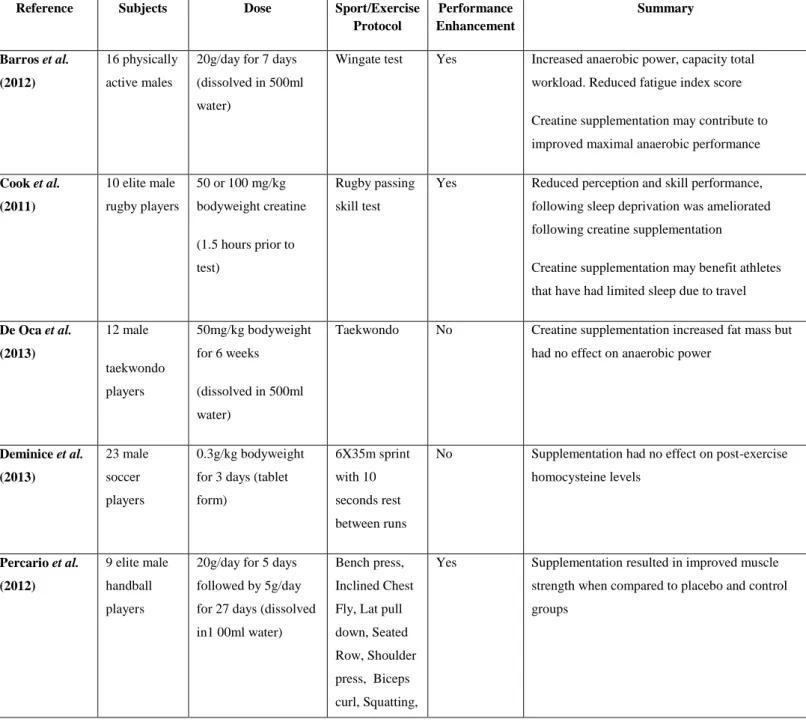
8 studies and 1 review satisfied the inclusion criteria with findings outlined in table 1.
(For studies published 2006-2009 see table 2)
Introduction
Creatine is a compound derived from amino acids, produced endogenously by the liver and to a lesser
extent by the kidneys and pancreas (Burke
et al.
2003; Cooper
et al.
2012). Creatine is synthesised
from three amino acids, arginine, glycine and methionine that are predominantly located in skeletal
muscle (SM) tissue (Bemben and Lamont 2005).
Following hepatic production, creatine is transported via the circulatory system to target
tissues/organs including the brain and SM. SM is the storage site for approximately 95% of creatine
and here, uptake is primarily facilitated by sodium-chloride-dependent Creat1 transporter proteins that
enable creatine accumulation within SM (Persky e
t al.
2003; Schoch
et al.
2006). However it is
important to recognise that SM creatine stores have a finite capacity owing to the intrinsic
downregulation of Creat1 transporters, resulting in excretion of excess creatine via urine.
Approximately 60% of creatine exists in its phosphorylated form, phosphocreatine (PCr). There are
many proposed mechanisms of action by which creatine supplementation may promote maximal
performance. These have been reviewed in detail (see Persky
et al.
2003 or Cooper
et al.
2012).
Sources
Creatine can be derived from consumption of a limited range of food products including red meat
(350mg creatine/100g), eggs and fish (Williams, 2007). Alternatively creatine can be obtained by
consuming creatine monohydrate supplements, available in powdered or liquid form. Creatine
monohydrate supplementation has a long history in a wide range of sports including weightlifting,
American football, soccer, handball, track sprinting, squash, track-and-field athletes and cyclists.The
powdered form of creatine appears to be the most commonly used in the literature and also in the
field. Creatine in liquid form has been used in research, but has failed to demonstrate ergogenic
effects when compared with creatine consumed in powder form. This lack of benefit from liquid
creatine supplementation is likely due to the small amount of creatine found in such products (Gill et
al. 2004, Harris et al. 2004). It is also important to recognise that creatine is not stable in solution, and
those products sold in liquid form are unlikely to contain any significant amount of creatine.
Dosage
According to the International Society for Sports Nutrition position statement (2007), the following is
defined as an effective creatine supplementation protocol:
Loading phase of 0.3g/kg/day creatine monohydrbufbate/day for at least 3days
Followed by
3-5g/day to maintain elevated stores
(Buford
et al.
2007)
Proposed benefits
ATP/PCr activity
PCr is an essential component of the ATP/PCr energy system which provides rapid
oxygen-independent energy during the initial 30 seconds of maximal activity. Sports primarily utilising this
system include track sprinting, weightlifting, and athletic events such as high jump and shot put
(Burke et al. 2003).
Creatine may promote SM hypertrophy by up-regulating anabolic compounds such as insulin-like
growth factor (IGF-1) (Burke
et al.
2008). Creatine supplementation is associated with increased
contractile protein content and SM fibre cross-sectional area, although this does not always translate
into enhanced performance and has only been demonstrated when combined with carbohydrate and
protein (Cribb
et al.
2007).
Glucose transport and glycogen depletion
Glucose transporter proteins (GLUT) facilitate glucose absorption and enable the accumulation of
glycogen within SM stores. Creatine supplementation has been shown to increase the number of these
proteins, suggesting that creatine may hinder early-onset glycogen depletion in endurance athletes
(Cooper
et al.
2012).
Oxidative stress/damage
Recent studies in this field have yielded mixed results depending on the inflammatory marker
analysed, with many showing no beneficial effect of creatine on exercise-induced oxidative
stress/damage (Deminice
et al.
2011; Rahimi 2011). Further studies are required in order to identify or
rule out an antioxidant effect of creatine following intense exercise.
Psychomotor ability
Creatine may help to counter cognitive deficits following sleep deprivation, although causality is yet
to be established (McMorris et al. 2006; Cook
et al.
2011).
Hydration status
It is well documented that creatine consumption results in intracellular water retention, increasing
bodyweight and that this process is catalysed in the presence of carbohydrate. This may be of benefit
to athletes training in hot and humid environments by attenuating thermal and cardiovascular strain
under these conditions (Beis
et al.
2011).
Concerns
Contamination
A recent study highlighted that in 33 commercially available creatine supplements, 50% contained
contaminants including heavy metals, at levels exceeding the maximum limit recommended by the
European Food Safety Authority in 2004 (Moret
et al.
2011). It is therefore advisable to consult a
performance nutritionist before consuming any creatine-based or creatine-containing supplement.
As mentioned above, creatine promotes intracellular water retention, increasing bodyweight. This
should be taken into account when weight-class athletes are considering creatine supplementation.
Range of movement
A recent study also suggests that intracellular water retention from acute creatine supplementation
may hinder athlete’s upper and lower-body range of movement. The study speculates that this may be
due to the water retention directly or via reduced neural outflow and increase anterior compartment
pressure (Sculthorpe
et al.
2010).
Table 1: Recent Literature Supporting a Role of Creatine Supplementation in Performance
(2009-Present)
Reference Subjects Dose Sport/Exercise Protocol Performance Enhancement Summary Barros et al. (2012) 16 physically active males
20g/day for 7 days (dissolved in 500ml water)
Wingate test Yes Increased anaerobic power, capacity total workload. Reduced fatigue index score Creatine supplementation may contribute to improved maximal anaerobic performance
Cook et al. (2011) 10 elite male rugby players 50 or 100 mg/kg bodyweight creatine (1.5 hours prior to test) Rugby passing skill test
Yes Reduced perception and skill performance, following sleep deprivation was ameliorated following creatine supplementation
Creatine supplementation may benefit athletes that have had limited sleep due to travel
De Oca et al. (2013) 12 male taekwondo players 50mg/kg bodyweight for 6 weeks (dissolved in 500ml water)
Taekwondo No Creatine supplementation increased fat mass but had no effect on anaerobic power
Deminice et al. (2013) 23 male soccer players 0.3g/kg bodyweight for 3 days (tablet form)
6X35m sprint with 10 seconds rest between runs
No Supplementation had no effect on post-exercise homocysteine levels Percario et al. (2012) 9 elite male handball players
20g/day for 5 days followed by 5g/day for 27 days (dissolved in1 00ml water)
Bench press, Inclined Chest Fly, Lat pull down, Seated Row, Shoulder press, Biceps curl, Squatting,
Yes Supplementation resulted in improved muscle strength when compared to placebo and control groups
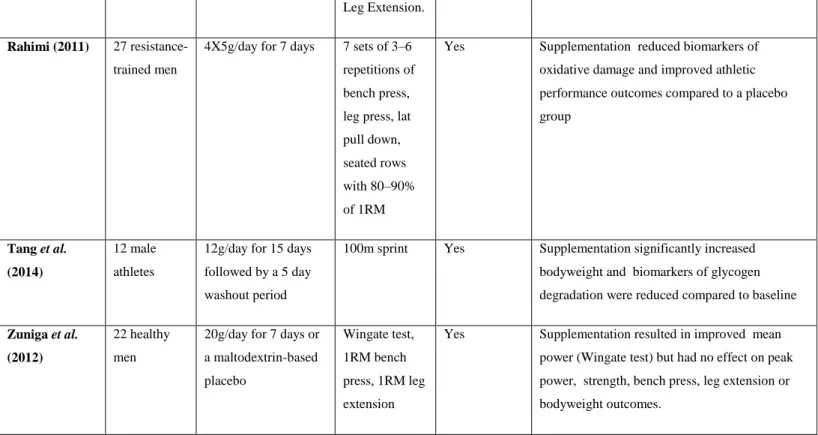
Leg Extension.
Rahimi (2011) 27 resistance-trained men
4X5g/day for 7 days 7 sets of 3–6 repetitions of bench press, leg press, lat pull down, seated rows with 80–90% of 1RM
Yes Supplementation reduced biomarkers of oxidative damage and improved athletic performance outcomes compared to a placebo group
Tang et al. (2014)
12 male athletes
12g/day for 15 days followed by a 5 day washout period
100m sprint Yes Supplementation significantly increased bodyweight and biomarkers of glycogen degradation were reduced compared to baseline
Zuniga et al. (2012)
22 healthy men
20g/day for 7 days or a maltodextrin-based placebo Wingate test, 1RM bench press, 1RM leg extension
Yes Supplementation resulted in improved mean power (Wingate test) but had no effect on peak power, strength, bench press, leg extension or bodyweight outcomes.
Table 2: Literature Supporting a Role of Creatine Supplementation in Performance
(2006-2009)
Reference Subjects Dose Sport/Exercise Protocol Performance Enhancement Summary Chilibeck et al. 2007 18 rugby union football players 0.1 g·kg–1·d–1 CrM or placebo per day for 8 weeks.
Players trained 2 x per week for approx 2 hours and played one 80 min game per week.
Yes CrM supplementation during a rugby union season is effective for increasing muscular endurance, but has no effect on body composition or aerobic endurance.
Reardon et al. 2006 13 healthy physically active, 9 male and 4 female. 6g of CrM or placebo 4 x per day for 7 days
4 week endurance training program
No CrM supplementation does not effect metabolic adaptations to endurance training. McMorris et al. 2006 5 male and 13 male sport science students 5g of CrM or placebo 4 times per day for 7 days
Subjects completed tests of random movement generation, verbal and spatial recall, choice reaction time, static balance and
Yes CrM supplementation had a
positive effect on mood state and tasks that place a heavy
mood state pre-test & after 6, 12 and 24 h of sleep deprivation, with intermittent exercise. McConnell et al 2005 7 well trained males 21g of CrM or placebo per day for 5 days
45 min cycling at 78% VO2peak then a time trial
Yes Increased muscle CrM before exercise improved the ability to maintain energy balance during intense exercise.
Ostojic et al. 2004 20 young male soccer players
3 x 10g doses of CrM or placebo for 7 days.
Soccer specific drills before and after supplementation.
Yes CrM ingestion improved soccer specific drills in young males.
Koenig et al. 2008 60 active males
25g of CrM, carbohydrate or placebo for 5 consecutive days.
Repeated jump height before and after supplementation
Yes The carbohydrate and CrM groups maintained repeated bouts of high-intensity activity as measured by repeated static jumps.
Herda et al. 2009 58 healthy males 5g of CrM, small dose of polyethylene glycosylated creatine, moderate dose of polyethylene glycosylated Creatine or a placebo for 30 days. High intensity anaerobic activities such as 1RM and Wingate assessed before and after supplementation
Yes CrM increased body mass and muscle strength, but did not impact on peak power output, mean power output, or muscle endurance when compared to placebo.
Cramer et al.2007 25 healthy males
10.5g of CrM or placebo 2 x per day for days 1-6 and 1 x per day for days 7-8.
3 days of isokinetic resistance training
Yes Peak torque increased but acceleration decreased from pre to post training.
Wright et al. 2007 10 physically active males
4 x 5g of CrM per day or placebo for 6 days
6 x 10 sec maximal sprints of cycle ergometer in a hot environment
No CrM does not produce any
thermoregulatory responses to intermittent sprint exercises in the heat.
Silva et al. 2007 16 female swimmers
20g of CrM or placebo for 21 days
2 x 25m swimming bouts with 3 min recovery pre and post supplementation
No CrM supplementation produced significant effects on gross and propelling efficiency during swimming but did not influence performance, body composition or body weight. Hoffman et al. 2005 40 physically active males 6g of CrM or placebo for 6 days
Wingate test before and after
No Reduce fatigue rate was seen in subjects supplemented with CrM but no other
supplementation differences observed. Cornish et al. 2006 17 competitive male ice-hockey players 0.3g of CrM per kg of body mass per day for 5 days or placebo
Repeated sprints till exhaustion on skating treadmill
No CrM was not effective in enhancing performance in ice-hockey players.
Okudan et al. 2005
23 untrained males
5g of CrM or placebo 4 x daily for 6 days
Wingate test before and after
supplementation
Yes CrM supplementation enhanced total power output during the Wingate test.
Cancela et al. 2008 14 male footballer players 15g of CrM or placebo for 7 days, then 3g of CrM or placebo for 49 days.
Football specific training
Not assessed CrM supplementation had no negative effects on blood and urinary clinical health markers. CrM supplementation may be associated with increased creatine in case activity, improving efficiency of ATP resynthesis.
Sale et al. 2009 9 healthy males 4 x 5g·day-1 CrM for 5 days or 20 x 1g·day-1 CrM for 5 days 24 hour urine collections at dat 1-2 and 3-7 post supplementation.
Not assessed Less CrM was excreted when CrM was ingested as 20x 1g doses, which suggests greater retention by the body and probably the muscles. Gotshalk et al. 2008 Thirty 58-71 year old females CrM (0.3g·kg BM) or placebo for 7 days
1RM resistance training assessments + lower body and upper body ergometry.
Yes Short term CrM supplementation resulted in increased strength, power, and lower-body motor functional performance in older women. Levesque et al. 2007 9 male cyclists 20g CrM or placebo per day for 6 days
3 x 25.2km sprint trials with 5 x 200m sprints every 5km.
No CrM did not enhance repetitive sprints when intense activities occur between bouts.
Basta et al. 2006 20 elite rowers
20g of CrM or placebo per day for 5 days then 10g daily for 30 days
Graded rowing on ergometer
No CrM did not increase rowers power on ergometer. Ferguson et al. 2006 26 resistance trained females CrM 0.3g·kg BM for first 7 days then 0.03g·kg BM for the next 9 weeks
Resistance training 4 days per week
No CrM + resistance training did not improve strength or lean body mass more than resistance training only.
Glaister et al. 2006
42 physically active males
5g CrM 4 x per day or placebo for 5 days
15 x 30m sprints repeated at 35 sec intervals
No CrM did not benefit multiple running sprint performances
Watson et al. 2006
12 active males
21.6g per day of CrM or placebo for 7 days
Once 2% dehydrated, subjects completed an 80 min exercise heat tolerance test which involved 4 min rest, 3 min walk, 1 min high intensity run.
Not applicable Short term CrM did not increase the incidence of symptoms or comprise hydration status in dehydrated men.
Havenetidis et al. 2005
7 male active subjects
25g of CrM for 4 days 3 x Wingate tests Yes CrM Supplementation increased muscle ATP and creatine phosphate and enhanced performance in the Wingate test.