common consolidated corporate
tax base?
A Belgian case study
corporate tax base?
ABSTRACT
This paper analyzes the views of Belgian politicians on the Common Consolidated Corporate Tax Base (CCCTB), an ambitious project to harmonize corporate taxation in the EU. Applying case study method-ology, the results show that most politicians were proponents of this new tax system. During the discus-sions in several political institutions, the politicians referred to the macro-economic impact, the legal certainty and their party’s view to found their opinion. Besides several agreements, certain aspects of CCCTB like the optionality and the applied tax rate involved clear differences in view between left and right-wing politicians, which could hamper a political agreement on CCCTB.
Dit artikel analyseert de visie van Belgische politici m.b.t. de Common Consolidated Corporate Tax Base, een ambitieus Europees project om de vennootschapsbelasting te harmoniseren. Gebruikma-kend van case studie methodologie, toont deze studie aan dat de meerderheid van de Belgische politici voorstander is van dit nieuwe belastingsysteem. Tijdens de discussies in talrijke politieke instellingen, hanteerden de politici economische, juridische en partijpolitieke argumenten om hun visie te onder-bouwen. Ondanks de vele overeenkomsten, waren er o.a. duidelijke links-rechts tegenstellingen m.b.t. de optionaliteit van CCCTB en het toepasselijk tarief, wat een compromis m.b.t. CCCTB kan bemoeilij-ken.
Keywords: CCCTB – corporate tax harmonization – European Union – Belgian politicians – case study
ACKNOWLEDGMENTS
We thank Bertel De Groote, Ignace De Beelde, Machteld Van den Bogaerd and conference participants of the EAA Annual congress in Glasgow for helpful comments on an earlier version of this paper.
1. INTRODUCTION
On 16 March 2011, the European Commis-sion (EC) launched its proposal for a Council Directive on a Common Consolidated Corpo-rate Tax Base (CCCTB). According to this pro-posal, the implementation of CCCTB would be optional for groups, i.e. they would be able to choose between the CCCTB and the existing national corporate tax system. In the EU, each group company opting for CCCTB would use
a common set of rules to calculate its individ-ual taxable profit. These individindivid-ual tax bases would then be summed up to the consolidat-ed tax base. This consolidation of tax bases would result in the elimination of intra-group transactions and off-set of losses. Thereafter, the consolidated tax base would be allocated among the individual companies according to their proportions in the group’s total of la-bour, sales, and tangible assets, i.e. ‘formula apportionment’. Finally, as the Commission would not have the intention to introduce a harmonised corporate tax rate, each member state would preserve the right to apply its own tax rate to the obtained share of the overall tax base. Under CCCTB, groups of companies would be able to use a ‘one-stop-shop’ sys-tem, i.e. they could file a single consolidated tax return for all their activities in the EU with the principal tax authority (EC, 2011).
Annelies Roggeman Ghent University Philippe Van Cauwenberge Ghent University Isabelle Verleyen Ghent University Carine Coppens
What do politicians think of the common consolidated corporate tax base?
Since the launch of the CCCTB proposal in 2011, furtherdevel-opments took place at the political level. Within eight weeks from the publication of the CCCTB proposal, all national par-liaments had the right to assess whether the CCCTB propos-al complied with the generpropos-al principles of subsidiarity and proportionality (EU, 2012). About one year later, on 19 April 2012, the Members of the European Parliament (MEPs) casted their votes on the EC’s proposal for a CCCTB (EP, 2012a). At present, the proposal is negotiated in the Council which has final decision power on the adoption of a CCCTB (Council of the European Union, 2016). Very recently, the Commission re-launched CCCTB as it believes the tax system needs a stepwise approach to reach an agreement (EC, 2016). This relaunch will be assessed again by the national parliaments, the European Parliament and the Council.
Using documentation and archival records, this paper discuss-es the views of Belgian politicians on the 2011 CCCTB proposal in the Belgian Parliament, the European Parliament and the Council of the European Union. In general, this research is use-ful to gain insight in the political feasibility of the (re-launched) CCCTB and its future developments.
Elabo-rating on the development of CCCTB from a Belgian point of view, this paper contributes to the literature in three more ways. First, al-though exceptional in the CCCTB literature, the case study methodology was chosen for this purpose. As CCCTB implies a complex
political process of negotiations at several levels, the use of case study methodology was considered as more opportune in terms of gaining insights compared to other methodologies (Yin, 2003). Second, to the best of our knowledge, studies ex-amining the political views on CCCTB in one particular
coun-try are lacking1. In addition, Belgium is a likely candidate for
the procedure of ‘enhanced cooperation’ where a minimum number of nine member states would introduce CCCTB (gian Chamber of Representatives, 2011b). So, studying the Bel-gian point of view is interesting as this view will be relevant in further developments of CCCTB. Third, current literature ap-proaches this new tax system from an economic or legal per-spective only. This case study attempts to draw a full picture by combining literature from the fields of economics, tax law and political science.
1 Roggeman, Verleyen, Van Cauwenberge & Coppens (2015) covered for 28 EU member states the relationship between the voting behaviour of members of the European Parliament on CCCTB and the estimated economic impact of CCCTB. However, this large-scale study does not give insight into the discussions, reasonings and personal beliefs of these politicians.
The paper is organized as follows. Section 2 theoretically de-scribes which factors could play a role in the politicians’ opin-ion about CCCTB. Sectopin-ion 3 explains the methodology used in this paper. Section 4 discusses the findings and section 5 con -cludes.
2. THEORETICAL FRAMEWORK 2.1. Macro-economic effects
The economic principle of ‘efficiency’ is widely recognized for evaluating the desirability of tax systems (Desai & Hines, 2003). An efficient tax system implies that taxes should not influence the taxpayer’s economic decisions. However, if taxation at the micro-level is not efficient, this would also lead to an alloca -tion which is not Pareto-optimal (Musgrave & Musgrave, 1989; Schäfer, 2006). In the context of the introduction of a CCCTB, only a limited number of macro-economic studies investigated if this new corporate tax system would be more efficient or Pa -reto improving compared to the current twenty-eight national
corporate tax systems in the EU (e.g. Runkel & Schjelderup, 2011). Otherwise said, these studies investigated if CCCTB would make member states better off without making oth -er memb-er states worse off. In the lit-erature, however, no consensus is reached on how such a Pareto improvement should be meas-ured (Avi-Yonah & Clausing, 2008). Most studies only consid-ered the corporate tax revenues of member states, while other studies also took into account other criteria like welfare, GDP, investments and employment.
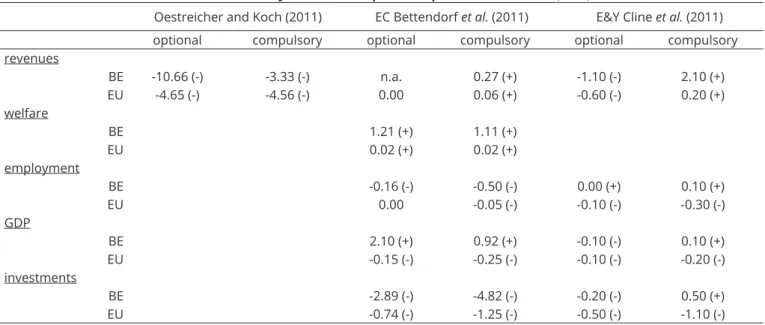
Table 1 summarizes the results of three empirical studies2
which appeared after the publication of the CCCTB proposal (EC, 2011). At the country level, we only report the results for Belgium as this is the focus of our paper.
2 Despite the merits of the empirical studies of Fuest, Hemmelgarn, & Ramb (2007) and Devereux & Loretz (2008), we do not consider these older studies as they substantially deviate from the proposal.
“
CCCTB is one of themost ambitious projects to harmonize corporate
The findings show that the EU as a whole would mostly lose from introducing CCCTB, which suggests that it would be rath-er unlikely that a move towards CCCTB would be Pareto-im-proving. All three studies agree that the EU would not be better off in terms of employment, GDP and investments. However, the studies disagree with respect to the change in corporate tax revenues. Looking at the economic impact measures for Belgium, significant differences can be observed between the three studies, so that it is difficult to draw general conclusions. Although it is not the purpose of this paper to explain these differences between the three impact studies, they could be attributed to divergent databases, different parameters under -lying the simulations, various approaches to proxy for taxable income, deviations in the applied formula apportionment or the choice of a static versus a behavioural approach.
2.2. Party ideology
Studies of Bowler & Farrell (1995) and Corbett, Jacobs, & Shak-leton (2011) have shown that politicians with functions like chair, vice-chair, rapporteur, expert or party group coordinator play a key role in the opinion formation of legislative proce-dures. However, these initiators are subject to ‘party discipline’. Party discipline implies that party leaders are able to impose sanctions on politicians who deviate from the party position. Strong party leaders could enforce this discipline by controlling the (re)election prospects and future leadership positions of politicians (Faas, 2003; Hix, Noury, & Roland, 2005).
With respect to voting behaviour in the EP, Hix (2002) found that Members of the European Parliament (MEPs) were ex-posed to national party discipline as well as European party discipline. In particular, MEPs had to follow the instructions of the principal who controlled their EP election, i.e. the national party, and the instructions of the principal who controlled their influence in the EP, i.e. the EP party. Long term studies in the EP revealed that the extent to which party members vote in the same way, i.e. ‘cohesion’, has become stronger over time, both at the national and European party level. Further, these studies showed that national cohesion was higher for Euro-sceptical parties and topics of great national importance (Faas, 2003; Hix et al., 2005).
In the literature, two ideological dimensions can be distin-guished with respect to the position of the party. First, the pro/ anti Europe dimension deals with the party’s attitude towards European integration. In particular, this dimension concerns the question how fast and far-reaching European integration should proceed. Centrist parties like the socialist, liberals and conservatives are typically the ardent supporters of integration while more left and right oriented parties in Europe are more hesitant to give up national autonomy (Aspinwall, 2002; Hix, Noury, & Roland, 2007; Hix & Noury, 2009). Second, a tradi-tional left-right dimension can be distinguished among parties. In general, left parties favour more strict government regula-tion whereas right parties prefer a more liberal ‘laissez faire’ economic policy (Aspinwall, 2002; Hix et al., 2007; Hix & Noury, 2009; Osterloh & Debus, 2012).
Table 1. Summary results of empirical impact studies CCCTB (in %)
Oestreicher and Koch (2011) EC Bettendorf et al. (2011) E&Y Cline et al. (2011)
optional compulsory optional compulsory optional compulsory
revenues BE -10.66 (-) -3.33 (-) n.a. 0.27 (+) -1.10 (-) 2.10 (+) EU -4.65 (-) -4.56 (-) 0.00 0.06 (+) -0.60 (-) 0.20 (+) welfare BE 1.21 (+) 1.11 (+) EU 0.02 (+) 0.02 (+) employment BE -0.16 (-) -0.50 (-) 0.00 (+) 0.10 (+) EU 0.00 -0.05 (-) -0.10 (-) -0.30 (-) GDP BE 2.10 (+) 0.92 (+) -0.10 (-) 0.10 (+) EU -0.15 (-) -0.25 (-) -0.10 (-) -0.20 (-) investments BE -2.89 (-) -4.82 (-) -0.20 (-) 0.50 (+) EU -0.74 (-) -1.25 (-) -0.50 (-) -1.10 (-)
What do politicians think of the common consolidated corporate tax base?
2.3. Legal certainty
Legal certainty is one of the most fundamental legal values which also applies to taxation. According to the legal philoso-pher Fuller (1969), laws should be clear, stable and enforceable in order to achieve legal certainty. Clear and transparent rules would ensure that laws would have an accurate meaning and that they would be unambiguous by those who are subject to it. The requirement of stability would imply that laws should not be changed too frequently as this would make it hard for citizens to behave in accordance with these laws. Finally, the enforcement of laws would deal with the use of public agents to detect and sanction violators of legal rules and this should occur in a cost-effective way (Fuller, 1969; Raitio, 2003). In the context of the CCCTB proposal, the legal certainty of the proposed rules was assessed in several tax law studies. Freed-man & McDonald (2008) evaluated the preliminary documents of CCCTB with respect to the common tax base. They argued that CCCTB should explicitly refer to IFRS and combine this reference point with an autonomous set of tax principles. The study of de La Feria & Dorado (2008) assessed the introduction
of a thin capitalization rule3 in the context of a CCCTB.
Accord-ing to the authors, the introduction of a specific instead of a general anti-abuse rule would increase the legal certainty of thin capitalization. In addition, the rule should be compatible with EC law and the EC provisions on the fundamental free-doms like the free movement of capital. The recent studies of Lang (2012) and Lang, Pistone, Schuch, Staringer, & Storck (2013) evaluated the legal impact of CCCTB in relationship to third countries. In particular, the authors discussed the arti-cles of the proposal with respect to, for example, interest de-ductibility, transfer of assets, transparent entities, withholding
taxation, and double taxation conventions. In general4, it was
concluded that the CCCTB proposal represented an impressive legal achievement. However, the legal certainty was problem-atic in several aspects.
First, difficulties with interpretation appeared as the definition of dividends, for example, was not aligned with other interna-tional tax law. In order to increase clarity, the authors suggest-ed that CCCTB would follow the wording of provisions of an already existing Directive, for example the Parent-Subsidiary Directive. Second, conflicts existed between the rules of CCCTB and Double Tax Conventions (DTCs). For example, a DTC could avoid double taxation of dividends by the credit method where-3 Thin capitalization rules limit a firm’s debt-to-equity ratio to control
highly leveraged financing structures.
4 A detailed discussion of all considered articles is beyond the scope of this paper. For more details we refer to Lang (2012) and Lang et al. (2013).
as CCCTB would apply the exemption method5. In this respect,
Lang et al. (2013) are advocates of a European Union-wide DTC. Such an EU DTC would harmonize all existing bilateral tax trea-ties and would be a promising way to apply CCCTB in a correct way. The study of Panayi (2013) stressed that it would be very likely that the enforcement of CCCTB would entail high admin-istrative costs for tax authorities. In particular, tax authorities would be faced with two distinct tax systems, namely CCCTB and the applicable national corporate tax system. Also, the cross-border nature of tax audits and the frequent interactions with other tax authorities would result in additional costs.
3. RESEARCH QUESTIONS AND METHODOLOGY
Referring to the findings in the literature (cfr. section 2), we ex-amine the following research questions:
- To what extent and how did Belgian politicians refer
to the macro-economic impacts of CCCTB as an argu-ment to support or refuse CCCTB?
- To what extent and how were Belgian politicians influ -enced by party ideology?
- To what extent and how did Belgian politicians attach
importance to legal certainty when expressing their views about CCCTB?
As in-depth studies concerning the political view about CCCTB are lacking, a case study approach was chosen to produce more detailed information on this topic. Moreover, to describe the political view in relation to the macro-economic, ideological and legal perspectives, the use of a case study would be more opportune in terms of gaining insights into this relationship. Or as Yin (2003) generally declares: “case studies are the preferred strategy when ‘how’ or ‘why’ questions are being posed, when the investigator has little control over events, and when the fo-cus is on a contemporary phenomenon within some real-life context” (Yin, 2003).
Our Belgian case study employs an embedded design (Eisen-hardt, 1989) as three levels of analysis are involved in the case. In particular, we discuss the Belgian position at the level of the politician, the party level and at the country level. However, as our research questions are defined at the individual level, the politician is considered as our primary unit of analysis (Yin, 2003). In the context of CCCTB, an embedded design is pre-ferred above a holistic design as CCCTB implies a complex po-5 Under the exemption method the country of residence exempts the
received income of the source country. Under the credit method both countries tax the income, but the country of residence grants a credit for the tax paid in the source country.
litical process of negotiations at several levels. For that reason, our case study not only focuses on the primary unit of analysis, but also considers the larger units of analysis.
In order to enhance the reliability of the findings, multiple
sources of data6 were obtained and analyzed (Patton, 2002;
Silverman, 2005). First, documentation – like letters, minutes of meetings, written reports, articles – were collected and put into a database. Second, archival records were collected and these records contained vote outcomes, party
names, personal names and other personal data like gender and age. Further, the theoret-ical framework was replicated as the Belgian politicians’ views were analyzed at three dif-ferent development stages of CCCTB, namely the developments in the Belgian Parliament,
the European Parliament and the Council. Finally, to enhance the validity of our study, a key informant reviewed the accu-racy of the actual facts presented in the case report. Also, this review was useful as new materials and alternative interpreta-tions of the findings could be added.
4. FINDINGS CASE STUDY 4.1. Belgian Parliament
According to Protocol nr. 2 of the Lisbon Treaty, member states have the right to assess whether legislative proposals by the European Commission comply with the general principles of ‘subsidiarity’ and ‘proportionality’. The subsidiarity principle means that in areas of shared competence, as is the case with CCCTB, the EU can only act insofar the objectives of the pro-posed action cannot be sufficiently achieved by the member states themselves. Proportionality entails that the least oner-ous measure should be chosen and that the disadvantages may not be disproportionate to the aims pursued (EU, 2012). Within eight weeks from the publication of the CCCTB propos-al, all national parliaments could send their reasoned opinions to the Commission. Each unicameral national Parliament
dis-posed of two votes and if a bicameral system applied7, each
chamber had one vote. If the number of reasoned opinions represented at least one-third of the total votes, the so-called ‘yellow card procedure’ had to be applied. In that case the Com-mission should re-consider the proposal and decide whether to maintain, amend or withdraw it (EU, 2012). However, the CCCTB proposal could escape this yellow card procedure. The 6 The collection of information from multiple sources is called ‘data
tri-angulation’ (Patton, 2002).
7 The Belgian Federal Parliament is a bicameral parliament consisting of the Chamber of Representatives and the Senate.
minimum number of yellow cards, notably 18 votes (i.e. one third of 54 votes) was not reached. In total, 13 negative votes were counted coming from Bulgaria, Malta, the Netherlands, Poland, Romania, Slovakia, Ireland, the United Kingdom and Sweden (Belgian Chamber of Representatives, 2011a).
The Commission of Finance and Budget of the Belgian Par-liament (CFB) examined the subsidiarity and proportionality
principle of the CCCTB proposal on the 11th and 17th of May,
2011. Each party8 disposed of a fixed number
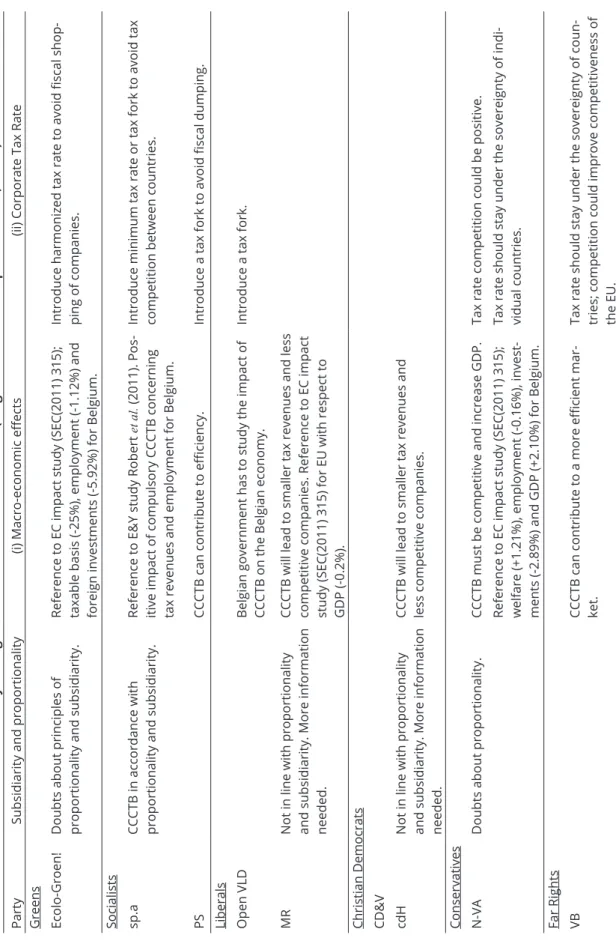
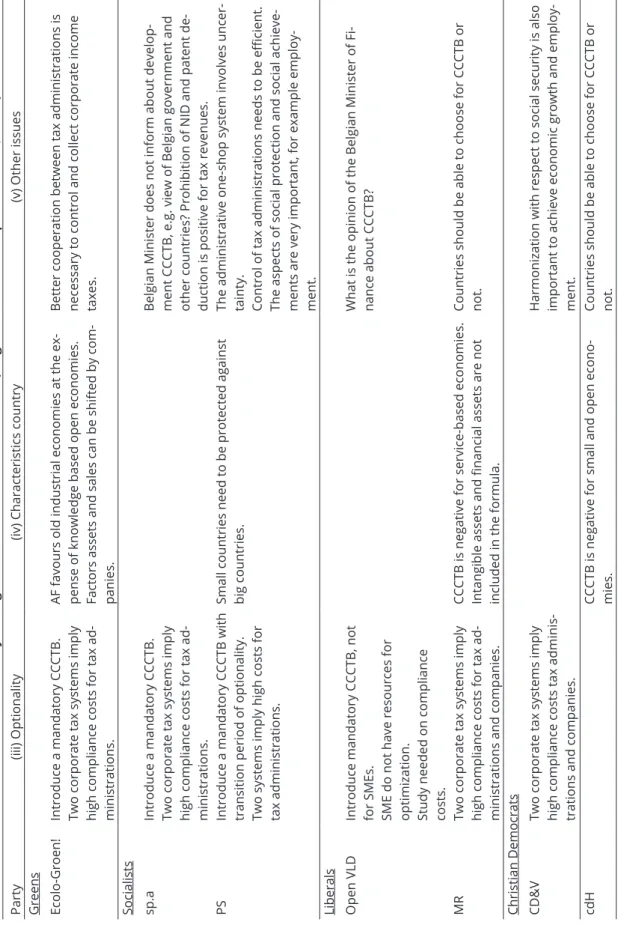
of members in the CFB who put forward their opinion. Table 2 gives an overview of the argu-ments used by the members of the CFB. For practical reasons, we only mention the names of the political parties in the text and no per-sonal names. The perper-sonal names of the CFB members are reported in Appendix 1. As the CFB members ex-amined if CCCTB complied with the principles of subsidiarity and proportionality, it could be argued that this opinion would not include a comprehensive judgment about CCCTB. Howev-er, as CCCTB was very broadly discussed the evaluation of this new tax system was not limited to these principles.
In general, most members were positive about the CCCTB proposal and found that the principles of subsidiarity and pro-portionality were not violated. However, the members of the Walloon liberal (MR) and christian-democratic party (cdH) did not agree with this position. According to them, more infor-mation was needed to take this decision (Belgian Chamber of Representatives, 2011a). When analyzing the discussions of the members into more detail, we could distinguish five subjects of discussion: (i) macro-economic effects, (ii) corporate tax rate, (iii) optionality, (iv) characteristics country and (v) other issues (Belgian Chamber of Representatives, 2011a).
8 In the federal parliament of Belgium most political families consist of a Flemish and Walloon party.
“
The Belgian politiciansreferred to macro-economic, legal and party related arguments to found their
What do politicians think of the common consolidated corporate tax base?
Table 2. Summary of Belgian views about CCCTB in the CFB (Belgian Chamber of Representatives, 2011a)
Party
Subsidiarity and proportionality
(i) Macro-economic effects
(ii) Corporate Tax Rate
Greens Ecolo-Groen! Doubts about principles of proportionality and subsidiarity. Reference to EC impact study (SEC(2011) 315); taxable basis (-25%), employment (-1.12%) and foreign investments (-5.92%) for Belgium.
Introduce harmonized tax rate to avoid fiscal shop
-ping of companies.
Socialists sp.a CCCTB in accordance with proportionality and subsidiarity.
Reference to E&Y study Robert
et al.
(2011). Pos
-itive impact of compulsory CCCTB concerning tax revenues and employment for Belgium. Introduce minimum tax rate or tax fork to avoid tax competition between countries.
PS
CCCTB can contribute to efficiency.
Introduce a tax fork to avoid fiscal dumping.
Liberals Open VLD Belgian government has to study the impact of CCCTB on the Belgian economy.
Introduce a tax fork.
MR
Not in line with proportionality and subsidiarity. More information needed.
CCCTB
will
lead to smaller tax revenues and
less
competitive companies. Reference to EC impact study (SEC(2011) 315) for EU with respect to GDP (-0.2%).
Christian Democrats CD&V cdH Not in line with proportionality and subsidiarity. More information needed. CCCTB will lead to smaller tax revenues and less competitive companies.
Conservatives N-VA
Doubts about proportionality.
CCCTB must be competitive and increase GDP.
Tax rate competition could be positive.
Reference to EC impact study (SEC(2011) 315); welfare (+1.21%), employment (-0.16%), invest
-ments (-2.89%) and GDP (+2.10%) for Belgium.
Tax rate should stay under the sovereignty of indi
-vidual countries.
Far Rights VB
CCCTB can contribute to a more efficient mar
-ket.
Tax rate should stay under the sovereignty of coun
Table 2. Continued Summary of Belgian views about CCCTB in the CFB (Belgian Chamber of Representatives, 2011a)
Party
(iii) Optionality
(iv) Characteristics country
(v) Other issues
Greens Ecolo-Groen! Introduce a mandatory CCCTB. Two corporate tax systems imply high compliance costs for tax ad
-ministrations.
AF favours old industrial economies at the ex
-pense of knowledge based open economies. Factors assets and sales can be shifted by com
-panies.
Better cooperation between tax administrations is necessary to control and collect corporate income taxes.
Socialists sp.a Introduce a mandatory CCCTB. Two corporate tax systems imply high compliance costs for tax ad
-ministrations.
Belgian Minister does not inform about develop
-ment CCCTB, e.g. view of Belgian govern-ment and other countries? Prohibition of NID and patent de
-duction is positive for tax revenues.
PS
Introduce
a mandatory CCCTB
with
transition period of optionality. Two systems imply high costs for tax administrations. Small countries need to be protected against big countries.
The administrative one-shop system involves uncer
-tainty. Control of tax administrations needs to be efficient. The aspects of social protection and social achieve
-ments are very important, for example employ
-ment.
Liberals Open VLD
Introduce mandatory CCCTB, not for SMEs. SME do not have resources for optimization. Study needed on compliance costs.
What is the opinion of the Belgian Minister of Fi
-nance about CCCTB?
MR
Two corporate tax systems imply high compliance costs for tax ad
-ministrations and companies.
CCCTB is negative for service-based economies. Intangible assets and financial assets are not included in the formula. Countries should be able to choose for CCCTB or not.
Christian Democrats CD&V Two corporate tax systems imply high compliance costs tax adminis
-trations and companies.
Harmonization with respect to social security is also important to achieve economic growth and employ
-ment.
cdH
CCCTB is negative for small and open econo
-mies.
What do politicians think of the common consolidated corporate tax base?
Conservatives N-VA
AF favours old economies at the expense of knowledge and service-based economies. Intangible assets and financial assets are not included in the formula.
Consolidation and tax declaration in country of parent company could be negative for Belgium. The NID has increased equity of Belgian companies. High compliance costs for companies as a result of a separate bookkeeping system and corporate tax system. Belgian Minister of Finance does not inform about development of CCCTB at European level.
Far Rights VB
CCCTB can contribute to administrative simplifica
A striking finding is that all members referred to the mac -ro-economic impact of CCCTB (i) to defend their interests. Some spoke in general terms, whereas others picked out re-sults of specific impact studies. For example, a representative of the socialist party referred to the E&Y study by Cline, Neubig, Philips, Sanger, & Walsh (2011) and informed that under a com-pulsory CCCTB tax revenues and employment would increase for Belgium. A member of the conservative party N-VA men-tioned the EC study by Bettendorf, van der Horst, de Mooij, De-vereux, & Loretz (2011) and quoted the impact for Belgium in terms of welfare (+1.21%), employment (-0.16%), investments (-2.89%) and GDP (+2.10%) (Belgian Chamber of Represent-atives, 2011a). The literature review under section 2 showed that we could not draw general conclusions for Belgium. How-ever, the members of the CFB did not sketch the full picture as they limited themselves to a selection of certain results. In some respect, the findings suggest that the CFB members were cherry picking to defend their interests.
Further, all members agreed that CCCTB should be mandatory as the legal enforcement of an optional system (iii) would imply high compliance costs for tax administrations. However, a so-cialist member would provide for a transition period, whereas a liberal member would only impose a mandatory CCCTB for big companies. Further, members from centrist parties stressed that under an optional system, not only tax administrations but also companies, would suffer from high compliance costs. In particular, in order to make their choice companies should call in professional advice. Further, green and socialist members feared that the cooperation between the different tax adminis -trations (v) would be problematic. However, an efficient collec -tion and control of the different corporate income taxes would be essential to achieve legal certainty. By contrast, a member of VB argued that CCCTB would give the opportunity to achieve administrative simplification (Belgian Chamber of Representa -tives, 2011a).
Another discussion dealt with the applied tax rate under CCCTB. According to the CCCTB proposal, each member state would apply its own national tax rate (ii) to the received part of the consolidated tax base (EC, 2011). During the discussions in the CFB, a clear difference in view appeared between members of the left and right parties. Members of left parties preferred to extend European integration by introducing a harmonized tax rate, a minimum tax rate or range of tax rates to tackle the harmful effects of tax competition. By contrast, members of right parties argued that tax rate competition would improve the competitiveness of the EU and therefore the determina-tion of the corporate tax rate should stay under the sovereign-ty of the individual countries. Further, right oriented members regretted the prohibition to apply (v) the notional interest
de-ductions (NID), whereas left oriented members welcomed this decision (Belgian Chamber of Representatives, 2011a).
An element which we did not anticipate in the theoretical sec-tion, is that all members evaluated CCCTB not only in terms of efficiency, but also in terms of equity. In an international context, equity means that the source country has the right to tax the profits which are generated within its jurisdiction (Mus -grave, 2000). According to the EC, the factors tangible assets, labour and sales are the dominant factors in the generation of profit and considered as fair factors to include in the appor -tionment formula (EC, 2011). However, during the discussions in the CFB all members agreed that the apportionment formu-la would not be fair as it would favour old industrial economies at the expense of knowledge and service based open econo-mies (iv). Some politicians proposed to include intangible as-sets and financial asas-sets in the formula (Belgian Chamber of Representatives, 2011a).
Eventually, the CFB reached a consensus on the advice of the Belgian Parliament concerning the subsidiarity and propor-tionality of the CCCTB proposal. The advice of the CFB was
approved with 12 votes in favour and 4 abstentions9. In the
text, it was mentioned that the subsidiarity principle was not violated as the EU would be more appropriate to achieve the objectives of CCCTB compared to Belgium. In particular, when applying a CCCTB the EU would be able to abolish fiscal ob -stacles hampering growth in the internal market and limit the negative impacts of tax competition. With respect to the prin-ciple of proportionality, the CFB did not express its view yet. Pending its decision, it asked for a detailed impact study car-ried out by the Belgian federal government. In particular, the study should look to what extent the impact of CCCTB would be related to the openness and size of a country as well as the size of companies opting for CCCTB. The study should also ex-amine to what extent the introduction of CCCTB would lead to additional costs resulting from the existence of two different corporate tax systems and the need to keep separate fiscal ac -counts. Moreover, the CFB stressed the importance of studying the impact of CCCTB on Belgium’s economic growth, employ-ment and social protection. Also, the advantages and disadvan-tages of the optionality of CCCTB should be examined in detail, as well as the opportunity to harmonize national corporate tax rates (Belgian Chamber of Representatives, 2011a).
4.2. European Parliament
Immediately after the announcement of the EC’s proposal for a CCCTB in March 2011, the proposal was transferred to the 9 No individual vote outcomes were made public.
What do politicians think of the common consolidated corporate tax base?
European Parliament (EP). At that moment, the EP consistedof 754 elected members spread over seven European political
parties and a group of independents10. According to Article 115
of the Treaty on the functioning of the European Union (TFEU), the consultation procedure applies to decisions concerning di-rect taxation such as the CCCTB. This ‘special legislative’ proce-dure describes the EP’s role as a consultative one. So, it could
be argued that the EP’s opinion about CCCTB is not binding11.
However, the consultation procedure would also imply that the members of the EP were not inhibited to express their real opinion.
Each member of the EP (MEP) was invited to introduce amend-ments to the proposal. In total, 425 amendamend-ments were submit-ted. As Belgium is the focus of this paper, we only mention the 14 amendments which were submitted by the Belgian member Philippe Lamberts. At that time, he was vice-chairman of the Greens-European Free Alliance (EP, 2011). In summary, these 14 amendments dealt with five subjects. First, the Belgian member was a proponent to introduce a minimum tax rate of 15% in 2013, 20% in 2015 and 25% in 2017. Second, CCCTB should be compulsory except for SMEs. Third, CCCTB should provide for an additional EU corporate income tax of 5% ap-plied to big companies as a resource to support poor regions within the EU. Fourth, losses incurred before the introduction of CCCTB should be disregarded and the carry forward of new losses should be limited to five years. Finally, a third country would be considered as a tax heaven if its tax rate would be below 100% of the average statutory rate in the EU (EP, 2011). The demands to introduce a minimum tax rate and mandatory CCCTB were also claimed by the representative of the Belgian Green party in the CFB (see section 4.1).
10 Parties of the seventh European Parliament: European United Left-Nordic Green Left (GUE-NGL), the Greens-European Free Alliance (Greens/EFA), Progressive Alliance of Socialists and Democrats (S&D), Alliance of Liberals and Democrats for Europe (ALDE/ADLE), European People’s Party (EPP), European Conservatives and Reformists (ECR), Europe of Freedom and Democracy (EFD) and the Non-Inscrits or in-dependents (NI).
11 Kardasheva (2009) studied consultation procedures in the EP over the period 1999-2007. The results showed that the EP would become
more influential when it gets support from the EC. On 19 April 2012,
the EC largely agreed with the amended CCCTB proposal of the EP.
Considering all 425 amendments submitted in the EP’s Com-mittee on Economic and Monetary Affairs, Belgian rapporteur Marianne Thyssen finally adapted the initial EC’s proposal by
including 38 amendments12. We mention the most striking
amendments of Thyssen’s text13 (EP, 2012a). First, a
mandato-ry CCCTB was recommended for all companies except SMEs, whereas the EC originally proposed an optional system for all companies. Another remarkable amendment was the intro-duction of a more strict general anti-abuse rule. In particular, Article 80 of the EC’s proposal was adjusted by formulating that “artificial transactions carried out mainly instead of sole-ly for the purpose of avoiding taxation should be ignored for purposes of calculating the tax base” (EP, 2012a, p. 20). A third amendment dealt with the design of the apportionment for-mula. A formula was proposed where sales by destination, la-bour and assets were weighted at 10%, 45% and 45% respec-tively, while the EC proposed a sharing formula in which these factors were equally weighted. It was argued that the adjusted formula would guarantee that exporting countries would not be disadvantaged in the apportionment. In the text of Thyssen, it was also written that the procedure for ‘enhanced coopera-tion’ should be started up if the Council failed to decide unani-mously on CCCTB (EP, 2012a).
12 No information was made public on the selection (discussions and voting results in the EP) of the individual submitted amendments. The third and fourth demand of the Belgian member of the European
Greens party was not taken into consideration in the final text of Mar -ianne Thyssen.
Table 3. Summary of views about CCCTB proposal in the EP (EP, 2012b)
Arguments
Vote Advice
Greens-European Free Alliance (Greens/EFA)
Mandatory CCCTB for big companies is good decision.
positive
Companies will use optionality to optimize tax payments
Important that proposal will also be adopted in the Council.
Progressive Alliance of Socialists and Democrats (S&D)
Mandatory CCCTB for big companies is good decision.
positive
Companies will use optionality to optimize tax payments
Harmonization of tax bases is good to avoid
harmful tax competition in the EU.
Proposal does not include a minimum tax rate, which is a pity.
However, a clause is included stating that this will be re-examined.
Alliance of Liberals and Democrats for Europe (ALDE/ADLE)
Harmonization of tax bases will improve efficiency of internal
positive
market. Proposal will ease administrative burden for companies to
invest cross-border. Doubts if mandatory CCCTB is the right decision No big weight on sales by destination is good decision.
This is more fair for countries with big export sector.
European People’s Party (EPP)
Mandatory CCCTB for big companies is good decision.
positive
CCCTB will remove tax obstacles and will lead to a healthier
tax competition between member states.
European Conservatives and Reformists (ECR)
Tax competition is good. A clause to harmonize tax rates is
negative
unacceptable. CCCTB should be voluntary.
Europe of Freedom and Democracy (EFD)
Harmonization is stealing from wealth-creating sectors. CCCTB is like
negative
a vampire sucking the lifeblood of the economy. CCCTB would
banish manufacturing to the Far East and the Indian subcontinent.
What do politicians think of the common consolidated corporate tax base?
During the debates on 18 April 2012, the representatives of theEuropean parties recommended how to vote on the proposal of rapporteur Thyssen on the next day. Thyssen opened the debate as follows (EP, 2012b):
“… With this CCCTB, we will be making it fiscally simpler and administratively cheaper for companies to develop transnationally, which will definitely open up new oppor -tunities for SMEs. Moreover, we will be making taxation more transparent. We will be preventing overtaxation and double taxation, as well as manipulation undertaken for the purpose of tax evasion. And, we will undoubtedly be making Europe more attractive for foreign investors …” Table 3 gives an overview of the opinions of the several Euro-pean parties. In line with the study of Hix & Noury (2009), we rank the political parties from the most left to the most right party. In general, representatives of the Greens, S&D, ALDE and EPP advised to vote positively on the proposal. By con-trast, representatives of the right parties ECR and EFD advised to vote negatively on the proposal. The opposition of the right parties suggests evidence for the aversion of right parties to more European integration and a more strict government reg-ulation. Going into more detail, all parties discussed the impact of tax competition under CCCTB. According to the left and cen-trist parties, a harmonization of the tax bases would lead to a healthier tax competition, thereby increasing the efficiency of the internal market. However, the S&D stressed that the dis-regarding of a minimum tax rate was a lost opportunity. Right parties declared that the EU should not intervene as tax base competition between members states would be good in terms of efficiency. During the debate, no reference was made to the results of specific economic impact studies. The Greens, S&D and EPP agreed that the introduction of a mandatory CCCTB would increase the legal certainty as tax minimizing behav-iour of companies would be decreased and the administrative burden for member states reduced. By contrast, ALDE casted doubts on this decision and ECR and EFD were opponents of a mandatory system. Finally, ALDE mentioned that a smaller
weight on the sales by destination factor would create a more fair allocation for countries with a big export sector (EP, 2012b).
On 19 April 2012, this proposal was approved in the EP with 452 votes in favour (68%), 172 against (26%) and 36 absten-tions (5%) (VoteWatch Europe, 2012). Members from Bulgaria, the Czech Republic, Hungary, Ireland, Malta, Poland and Great Britain were the most sceptical about the amended CCCTB pro-posal as more than 50% of their votes were ‘no’ votes. When looking at Table 4, 18 of a total of 22 Belgian MEPs voted ‘yes’, 2 voted ‘no’ and 2 were absent. In general, 82% of the Belgian MEPs were positive about CCCTB. In line with the study of Hix & Noury (2009), the variable ‘party left right’ ranks the political parties from 1 being the most left and 7 being the most right
party14. Table 4 shows that all present MEPs followed the
Euro-pean parties’ advice (see Table 3) on how to vote on the CCCTB proposal. In particular, Belgian MEPs of the Greens, S&D, ALDE and EPP voted positively, whereas a member of the ECR voted negatively. Two members were absent at the day of the voting, namely one member of the Greens and one member of the EFD party. The personal names of the Belgian MEPs are report-ed in Appendix 1.
Beside the declarations of the European parties’ representa-tives, two Belgian members made an additional statement dur-ing the debates in the EP. Vice-chairman of the Greens party Philippe Lamberts declared (EP, 2012b):
“I believe, Ms Thyssen that you have gone as far as you can if you wish to gain a large majority for CCCTB in this Par-liament … it is unthinkable for us to establish a voluntary
28th corporate tax system alongside the 27 Member State
systems, as evidently who will use it if it is optional, other than companies for whom it would constitute a lower ef-fective tax rate than if they were to use their national sys-14 Independent MEPs are considered as far right oriented (Hix & Noury,
2009).
Table 4. Voting results CCCTB of Belgian MEPs
N=22 Total GUE-NGL Greens/EFA S&D ALDE/ADLE EPP ECR EFD NI
Vote yes (82%) 18 0 3 5 5 5 0 0 0 no (9%) 2 0 0 0 0 0 1 0 1 abstain (0%) 0 0 0 0 0 0 0 0 0 absent (9%) 2 0 1 0 0 0 0 1 0 Party left-right 1 2 3 4 5 6 7 7
tem? Indeed, I think that it is essential to make this system obligatory for large companies.”
Derk Jan Eppink, the Belgian vice-chairman of the ECR who vot-ed negatively, explainvot-ed his choice as follows (EP, 2012b):
“…When Member States collect corporation tax from com-panies operating in several Member States, they have to divide the revenues between them. The allocation key which the Commission has devised for this purpose ad-versely affects competitive and exporting countries. They are fiscally punished and lose revenue from corporate tax … and, yet, we have not carried out any thorough research into the fiscal effects of the allocation key proposed by the Commission … I therefore say: I am not going with this …”
4.3. Council of the European Union
The final decision on the adoption of a CCCTB, however, rests with the Council of Ministers of the European Union. Under the Irish Presidency in 2013, all member states committed to en-gage in the technical discussions even if they were opponents of corporate tax harmonization. Since then, general issues (e.g. scope, definitions) and elements of the common tax base (e.g. calculation, timing, depreciation, losses) have been extensive-ly discussed. At the end of 2014, discussions were shifted to-wards the anti-abuse rules (e.g. interest limitation rule, switch-over clause) included in the CCCTB proposal. In general, the debates in the Council have advanced with difficulty and hot potatoes like tax consolidation have been postponed. Impor-tant to mention is that the published compromise texts of the Council should on no account be considered to be the final views of member states. Because of confidentiality, those texts do not elaborate on the individual positions adopted by mem-ber states (Council of the European Union, 2013, 2014, 2015).
With respect to the position of the Belgian government, expla-nations by the previous and current Ministers of Finance (chris-tian-democrats and liberals) are scarce. Several parties in the Belgian Parliament criticized the lack of communication of the Belgian government concerning its position on CCCTB and the lack of information on the developments taking place in the Council. However, in line with previous declarations (Belgian Senate, 2013) current Minister of Finance Johan Van Overtveldt pronounced the following in 2015 (Belgian Chamber of Repre-sentatives, 2015a: 112):
“… The Belgian government defends the principle of a Common Consolidated Corporate Tax Base and will sup-port more fiscal harmonization, but on condition that it will not prevent a balanced budget …”
Other explanations in the Parliament show that the Belgian government rather takes a wait and see attitude and looks at the positions of big countries, especially France and Germany, by which it maintains close economic relations (Belgian Senate, 2012; Belgian Chamber of Representatives, 2015a).
Documents of Ihli (2011) and De Vos (2012) give a more de-tailed insight into the Belgian views at the level of the articles mentioned in the 2011 EC’s proposal. In spite of its supportive attitude, the Belgian tax administration made several com-ments to the proposal, which are summarized in Table 5. For a detailed technical explanation, we refer to Appendix 2.
What do politicians think of the common consolidated corporate tax base?
Current tax law literature on CCCTB has shown that sever-al difficulties appear with the interpretation of concepts and that many conflicts exist between CCCTB and the DTCs, which would be problematic to ensure legal certainty. The majority of Belgian comments in Table 5 are dealing with these prob-lems. In particular, incompatibilities occur with respect to ar-ticles concerning foreign permanent establishments (PEs). In response to these conflicts, the Commission obliged member states to renegotiate all DTCs in order to align them with the CCCTB rules (EU, 2012, Art. 351). For Belgium, this would imply that almost all DTCs would have to be renegotiated, leading to a considerable amount of compliance costs (De Vos, 2012). In addition, Belgium seems to worry about the preservation of the corporate income tax revenues (see e.g. Art. 26 and Art. 76) and its attractiveness for domestic and foreign investments (see e.g. Art. 14 and Art. 102-103). In 2006, previous Belgian Minister of Finance Didier Reynders already expressed these concerns (Belgian Senate, 2006: 6500):
“… several member states like Belgium fear that the in-troduction of a CCCTB will have a negative impact on the national corporate tax rates and on the national budget of several member states. In addition, it would not be al-lowed for member states to apply fiscal incentives like the notional interest deduction to enhance the competitive-ness of their economy. In the long run, this would harm
a healthy tax competition … also, Belgium wonders if the national tax administrations are able to cooperate in an efficient way to collect and control corporate taxes …” Several years later, these concerns are still present (Belgian Chamber of Representatives, 2015a: 112; 2015b: 216):
“… In order to obtain an efficient and fair internal market in the EU, more fiscal transparency should take absolute priority … however, it is necessary that member states can pursue their own policy sufficiently in order to secure a healthy tax competition … In all respects, Belgium will in-sist on a detailed impact assessment of CCCTB”.
In order to adopt CCCTB, unanimity by the Council is required but the Treaty on the functioning of the European Union (TFEU) includes articles (Art. 20(2), 82, 329(1)) which allow CCCTB to be introduced under the ‘enhanced co-operation procedure’. Enhanced cooperation is a procedure where a minimum num-ber of nine memnum-ber states could introduce CCCTB. In 2011, the Belgian government declared that it would like to participate at such an enhanced cooperation, but only if its neighbouring countries would join the system (Belgian Chamber of Repre-sentatives, 2011b: 32).
Table 5. Objections of Belgian government to CCCTB proposal (Ihli, 2011; De Vos, 2012)
Proposal on a CCCTB Directive (EC,2011) Belgian comments
Articles conflicting with Belgian DTA
Art. 5 Foreign PE definition incompatible with existing DTAs
Art. 11(e) Exempt income foreign PE unclear article
Art 14(1) g) Non-deductible costs foreign PE unclear article
Art.31 Transfer of assets to foreign PE unclear article
Art. 73 Switch-Over clause overruled by existing DTAs
Income foreign PE
Foreign dividend income
Other articles
Art. 11 Exempt income; remove articles a) and b)
subsidies a) and proceeds of pooled assets b)
Art. 14(1) j) Non-deductible taxes listed in Annex III remove article j)
Art. 26 Pension provisions apply national deduction to apportioned tax base
Art. 76 Interest and royalties income taxed at source introduce specific anti-abuse rules
Art. 102 and 103
“… if not all countries of the EU could reach a consensus, a fiscal harmonisation between a limited number of coun -tries would already be a positive evolution … if it would be possible to reach a fiscal harmonisation with Germany and France, so why not for the Benelux? ...”
5. CONCLUSIONS
On 16 March 2011, the European Commission (EC) launched its long-expected proposal for a CCCTB. By introducing corpo-rate tax harmonization in the EU, the EC had
the intention to remove the tax obstacles cur-rently harming the international competitive-ness of European companies. Applying case study methodology, this study investigated the views of Belgian politicians on the CCCTB in the Belgian Parliament, the European Par-liament and the Council. The findings indicate that the majority of Belgian politicians were proponents of CCCTB. During the discussions
in each of the political institutions, the politicians referred to the macro-economic impact, legal certainty and party ideology to found their opinion. The same discussion items reappeared and only slightly differed in form and content. Figure 1 syn -thesises the determinants which played a role in the Belgian politicians’ support or resistance to CCCTB.
Figure 1. Determinants of political support for CCCTB
Figure 1: Determinants of political support for CCCTB
Political support for CCCTB
Macro-economic effects
• corporate tax revenues
• employment
• FDI
• GDP
• welfare
national and EU level
Equity Taxation of profit generating factors
• Choice allocaton factors
apportionment formula Efficiency
Effects tax minimizing behaviour
• Tax competition versus
harmonization of tax base/rate
• Tax compliance costs
companies
Party ideology
• national and european level
• pro/anti dimension on
European integration
• left-right dimension on strict
government regulation Legal certainty
• clearness and transparency of rules
• enforceability:
orelationship with DTAs
ocoordination tax administrations
ocompliance costs tax administrations
Certain item of CCCTB like the optionality of the system, the applied tax rate and the notional interest deduction involved clear differences in view between left and right-wing politi -cians. These differences could hinder the formulation of a clear Belgian position on CCCTB.
Like other studies, this research suffers from a few shortcom -ings. First, we assumed that the politicians’ personal ideological beliefs corresponded to those of their party. However, Hines (2002) showed that these beliefs could deviate from each other. Moreover, we did not take into account other
individ-ual characteristics like age, gender or educa-tion. Surveys investigating individual factors influencing the opinion about CCCTB would be an interesting contribution to the litera-ture. Second, even though case studies are difficult to generalize, we are convinced that these findings are applicable to most of the EU countries. Nevertheless, similar case stud-ies in other EU-countrstud-ies could investigate the robustness of our findings.
Finally, we like to mention that very recently the Commission re-launched CCCTB as it believes the Council will not be able to reach an agreement without a staged approach (EC, 2016). The new proposal would first apply the rules for calculating the common corporate tax base (CCTB) and postpone the consol-idation and allocation (CCCTB) until agreement would be se-cured on the common corporate tax base. One of the striking differences with the 2011 proposal, is that the re-launched initiative would be mandatory for big groups, introduce rules against debt bias in the form of an allowance for corporate equity and provide a super-deduction for R&D (EC, 2016). The revised proposal will again be assessed by the national parlia-ments, the European Parliament and the Council. In the light of the findings of this study, we believe this revised proposal would give rise to similar discussions as the old one.
“
Most Belgian politiciansare pro CCCTB. However, left-right differences appeared concerning items like the optionality and the applied tax rate. This could hamper an univocal Belgian
What do politicians think of the common consolidated corporate tax base?
Appendix 1
CFC members participating in CCCCTB debates (Belgian Chamber of Representatives, 2011a)
Ecolo-Groen! Muriël Gerkens
sp.a Dirk Van der Maelen
PS Christianne Vienne, Guy Coëme, Olivier Henry
Open Vld Gwendolyn Rutten
MR Philippe Goffin, Damien Thiéry
CD&V Servais Verherstraeten
cdH Josy Arens
N-VA Veerle Wouters, Peter Dedecker, Steven Vandeput
VB Hagen Goyvaerts
Belgian MEPs voting on amended CCCTB proposal (EP, 2012b)
Green/EFA S&D ALDE/ADLE EPP
Frieda Bepoels Frédéric Daerden Philippe De Backer Ivo Belet
Isabelle Durant Véronique De Keyser Louis Michel Jean-Luc Dehaene
Philippe Lamberts Saïd El Khadraoui Annemie Neyts Anne Delvaux
Bart Staes Marc Tarabella Frédérique Ries Mathieu Grosch
Kathleen Van Brempt Guy Verhofstadt Marianne Thyssen
ECR EFD NI
Derk Jan Eppink Frank Vanhecke Philip Claeys
Appendix 2. Technical explanation of Table 5
The Belgian tax administration has the opinion that the definition of a permanent establishment (PE) could lead to difficulties in relation with third countries when taking into account the existing network of Double Tax Agreements (DTAs). For example, according to Article 5 of the EC’s proposal “A building site or construction or installation project should constitute a PE only if it lasts more than twelve months” (EC, 2011, p. 20). A DTA between Belgium and a third country, however, could determine a PE if it lasts more than six months. According to Article 11(e) of the EC proposal all “income of a PE in a third country would be exempt from corporate tax” (EC, 2011, p. 23). For Belgium it is unclear if exempted income would relate to the gross or net income of the foreign PE. Another problem deals with the application of the switch-over clause as described in Article 73. Article 73 states that received profit distributions, proceeds from a disposal of shares and income of a PE in a third country cannot be exempt if it originates from a third country where “tax on profits are taxed at a statutory rate lower than 40% of the average statutory cor -porate tax rate applicable in the Member States” (EC, 2011, p. 43). However, several Belgian DTAs will only refuse exemption if no effective taxation has taken place in the third country, i.e. the ‘subject to tax rule’. Further, Article 14(1) g) mentions that “costs incurred by a company for the purpose of deriving foreign PE income which is exempt to Article 11; such costs shall be treated as non-deductible and be fixed at a flat rate of 5% of that income” (EC, 2011, p. 23). The Belgian tax administrator wonders how the 5% of income would be calculated. Also, the prohibition to deduct expenses related to foreign PE would be in conflict with the double tax treaties. Belgium agrees with Article 31 stating that a transfer of an asset towards a third country should be taxa-ble. However, it remains unclear if a transfer of an asset from a PE outside the EU towards another PE outside the EU would be covered by the current article (Ihli, 2011; De Vos, 2012).
The Belgian tax authority also criticises articles which are not dealing with foreign PEs. According to Article 11 subsidies of fixed assets subject to depreciation (a) and proceeds from the disposal of pooled assets (b) are exempt from corporate tax. How-ever, Belgium has the opinion that they are effectively taxed over the depreciation period as the amount of the subsidies and proceeds diminishes the basis on which the depreciations of the assets are calculated. Article 14(1) j) mentions that all local taxes which raise more than 20 % of the total amount of corporate tax in the member state are non-deductible expenses. For Belgium, this implies that registration duties are non-deductible. Nevertheless, Belgium doubts whether registration duties paid by corporations are more than 20% of the total corporate tax. It believes that the Commission has taken into account the total amount of registration duties. According to Article 26 pension provisions will be estimated using actuarial techniques and by reference discounted to Euribor for obligations with a maturity of 12 months. These provisions can be deducted without any limitation. As several European countries disallow pension deductions or limit these deductions, the Belgian tax administration believes the national legislation should apply. In case of a CCCTB group, the deduction of pension provisions should be applied to the apportioned share of the group members resident in that country. Article 76 mentions that received interest and royalties may be deducted from the tax liability when they have been taxed in another member state or third country. Belgium finds this article too generous and proposes to introduce specific anti-abuse provisions which prohibit the creation of artificial con -structions between CCCTB companies and third parties with the sole aim to obtain the tax deduction. Finally, Articles 102 and 103 of the EC proposal forbid any additional deductions from the apportioned profit. For Belgium, this means that national tax incentives like the notional interest deduction, patent income deduction and investment deduction are lost for CCCTB groups (Ihli, 2011; De Vos, 2012).
BIOGRAPHY
Annelies Roggeman (°Wetteren, 1981) holds a Master’s de-gree of Science in Business Engineering (UA, 2004). In 2015, she obtained her PhD in Applied Economics at the Ghent Univer-sity. There, she is currently assistant professor at the Depart-ment of Accountancy, Corporate Finance and Taxation. Anne-lies teaches the courses ‘research methods in taxation’, ‘intro-duction to taxation’ and ‘local and regional’ taxes. Her research focuses on international and European initiatives to harmonize corporate taxation and fight tax abuse by companies. Annelies’ research was published in The Journal of Business Economics and Management, Transformations in Business & Economics and De Economist.
Philippe Van Cauwenberge (°Ghent, 1971) holds a Master’s degree in Applied Economics (Ghent University, 1993) and is Master of Science in Economics (KUL, 1995). After having worked several years as an equity funds manager for a Belgian financial institution, he returned to Ghent University in 2004. There, he is currently associate professor at the Department of Accountancy, Corporate Finance and Taxation, where he teach-es coursteach-es in rteach-esearch methods, IFRS and financial analysis. His research focuses on the relation between the government sec-tor and the financial success of companies. His research was published in journals like Small Business Economics, Environ-ment and Planning, Public Choice, Public Money and Manage-ment, The Journal of Business Economics and ManageManage-ment, Transformations in Business & Economics, The Service Indus-tries Journal, Accounting and Finance, Abacus, and the Interna-tional Review of Law and Economics.
Isabelle Verleyen (°Kortrijk, 1985) holds a Master’s degree in Applied Economics (Ghent University, 2008). She obtained her PhD in Applied Economics in 2015. For several years she was coordinator of the program Accountancy and Taxation at the University College Ghent. As from 2019 she is an assistant professor at the Department of Accountancy, Corporate Fi-nance and Taxation of the Ghent University. She teaches the courses ‘Fiscal planning and strategy’ and ‘Corporate Taxation’. Her research was published in De Economist, The Journals of Business Economics and Management and Transformations in Business and Economics.
Carine Coppens is head lecturer and head of the department of Financial Management at the University College Ghent, Fac-ulty of Business and Information Management. Her teaching domains are Financial Accounting, Consolidation and Taxation. She coordinated several research projects in the field of ac -counting and taxation. These projects focused on the harmoni-zation of corporate taxation in Europe (CCCTB) and on the role of external accountants as service providers for SMEs. Recent research deals with acquisitions in the sector of assurance bro-kers.
REFERENCES
Aspinwall, M. (2002). Preferring Europe: ideology and natio-nal preferences on European integration. European Union Poli-tics, 3(1), 81-111.
Avi-Yonah, R., & Clausing, K. (2008), Commentary more open issues regarding the Consolidate Corporate Tax Base in the Eu-ropean Union. Tax Law Review, 62(1), 119-124.
What do politicians think of the common consolidated corporate tax base?
Belgian Chamber of Representatives. (2015a). Report DOCQRVA 54 011. Brussels: Belgian Chamber of Representatives. Belgian Chamber of Representatives. (2015b). Report DOC QRVA 54 032. Brussels: Belgian Chamber of Representatives.
Belgian Chamber of Representatives. (2011a). Report DOC 53 1507/001. Brussels: Belgian Chamber of Representatives.
Belgian Chamber of Representatives. (2011b). Report DOC CRIV 53 COM 333. Brussels: Belgian Chamber of Representati-ves.
Belgian Senate. (2013). Report DOC 5-219 COM. Brussels: Bel-gian Senate.
Belgian Senate. (2012). Report DOC 5-48. Brussels: Belgian
Senate.
Belgian Senate. (2006). Report DOC 3-66. Brussels: Belgian
Senate.
Bettendorf, L., van der Horst, A., de Mooij, R., Devereux, M., & Loretz, S. (2011). The economic effects of EU-reforms in corpo-rate tax systems. CPB Netherlands for Economic Policy Analysis and Oxford University Centre for Business Taxation. Study for the European Commission Directorate General for Taxation and Customs Union.
Bowler, S., & Farrell, M. (1995). The organization of the Eu-ropean Parliament: committees, specialization and
co-ordi-nation. British Journal of Political Science, 25(2), 219-243. DOI:
10.1017/S0007123400007158.
Cline, R., Neubig, T., Phillips, A., Sanger, C., & Walsh, A.
(2011). Study on the Economic and Budgetary Impact of the
In-troduction of a Common Consolidated Corporate Tax Base in the European Union. Ernst & Young. Study for the Irish Department of Finance.
Corbett, R., Jacobs, F., & Shackleton, M. (2011). The European Parliament. London: John Harper. ISBN 978-0956450852.
Council of the European Union. (2016). Conclusions on buil-ding a fair, competitive and stable corporate tax system 727/16. Brussels: Council of the European Union.
Council of the European Union. (2015). Report DOC 14509/15 LIMITE FISC 169. Brussels: Council of the European Union.
Council of the European Union. (2014). Report DOC 15756/14 ADD1 LIMITE FISC 197. Brussels: Council of the European Union.
Council of the European Union. (2013). Report DOC 7830/13 LIMITE FISC 60. Brussels: Council of the European Union.
de la Feria, R., & Dourado, A. (2008). Thin capitalization rules in the context of the CCCTB. Oxford University Centre for busi-ness taxation, Oxford University: Working Paper No. 804.
Desai, A., & Hines, J. (2003). Evaluating international tax re-form. National Tax Journal, 56(3), 487-502.
Devereux, MP., & Loretz, S. (2008). The effects of EU formula apportionment on corporate tax revenues. Fiscal Studies, 29(1), 1-33.
De Vos, P. (2012). Voorstel voor een richtlijn betreffende een gemeenschappelijke geconsolideerde heffingsgrondslag voor
de vennootschapsbelasting. Bulletin de Documentation, 72(4),
5-34.
Eisenhardt, K. (1989). Building theories from case study
research. The Academy of Management Review, 14(4), 532-550.
DOI: 10.2307/258557.
European Commission. (2016). Proposal for a Council Direc-tive on a Common Corporate Tax Base. Report COM(2016) 685 fi-nal 2016/0337 CNS. Strasbourg: European Commission.
European Commission. (2011). Proposal for a Council Di-rective on a Common Consolidated Corporate Tax Base. Report COM2011 121/4. Brussels: European Commission.
European Parliament. (2012a). Report on the proposal for a Council Directive on a Common Consolidated Corporate Tax Base (CCCTB) A7-0080/2012. Brussels: European Parliament.
European Parliament. (2012b). Common Consolidated Cor-porate Tax Base: Debate 18 April 2012 [Retrieved 2014-12-10] Available at: http://www.europarl.europa.eu.
European Union. (2012). Consolidated versions of the Tre-aty on the European Union and the TreTre-aty on the Functioning of the European Union. Official Journal of the European Union, C326, 47-390.
Faas, T. (2003). To defect or not to defect? National, institu-tional and party group pressures. On MEPs and their conse-quences for party group cohesion in the European Parliament. European Journal of Political Research, 42(6), 841-866. DOI: 10.1111/1475-6765.00106.
Freedman, J., & Macdonald, G. (2008). The tax base for CCCTB: the role of principles. Oxford University Centre for business taxation, Oxford University: Working Paper No. 08/07.
Fuest, C., Hemmelgarn, T., & Ramb, F. (2007). How would the introduction of an EU-wide formula apportionment affect the distribution and size of the corporate tax base? An analysis based on German multinationals. International Tax and Public Finance, 14(5), 605-626.
Fuller, L. (1969). The morality of law. London: Yale University Press. ISBN 0300010702.
Hix, S., & Noury, A. (2009). After enlargement: voting pat-terns in the sixth European Parliament. Legislative Studies Quar-terly, 34(2), 159-174. DOI 10.3162/036298009788314282.
Hix, S., Noury, A., & Roland, G. (2007). Democratic politics in the European Parliament. Cambridge: Cambridge University Press. ISBN 13-9780521694605.
Hix, S., Noury, A., & Roland, G. (2005). Power to the parties: cohesion and competition in the European Parliament
1979-2011. British Journal of Political Science, 35(2), 209-234. DOI:
10.1017/S0007123405000128.
Hix, S. (2002). Parliamentary behaviour with two princip-als: preferences, parties, and voting in the European Parlia-ment. American Journal of Political Science, 46(3), 688-698. DOI 10.2307/3088408.
Ihli, U. (2011). Common Consolidated Corporate Tax Base (CCCTB) and its impact on Belgian corporate taxation. European Commission Taxation and Customs Union.
Kardasheva, R. (2009). The power to delay: the European Parliament’s influence in the Consultation Procedure. Journal of Common Market Studies, 47(2), 385-409. DOI: 10.1111/j.1468-5965.2009.00809.x.
Lang, M. (2012). The principle of territoriality and its imple-mentation in the proposal for a Council Directive on a Common Consolidated Corporate Tax Base (CCCTB). WU Austria: Institute for Austrian and International Tax Law: Research paper Series No. 2012-09.
Lang, M., Pistone, P., Schuch, J., Staringer, C., & Storck, A. (2013). Corporate Income Taxation in Europe: The Common Con-solidated Corporate Tax Base (CCCTB) and third countries. Chel-tenham: Edward Elgar Publishing. ISBN 978-1782545415.
Musgrave, P.B. (2000). Interjurisdictional equity in company taxation: principles and applications to the European Union, In Cnossen, S. (ed.), Taxing capital income in the European Union: issues and options for reform (pp. 46-77). University of Oxford: Oxford University Press.
Musgrave, RA., & Musgrave, PB. (1989). Public finance in the-ory and practice. New York: McGrawhill.
Oestreicher, A., & Koch, R. (2011). The revenue consequen-ces of using a Common Consolidated Corporate Tax Base to determine taxable income in EU member states. Finanzarchiv, 67(1), 64-102. DOI: 10.1628/001522111X574191.
Osterloh, S., & Debus, M. (2012). Partisan politics in corpo-rate taxation. European Journal of Political Economy, 28(2), 192-207. DOI: 10.1016/j.ejpoleco.2011.11.002.
Panayi, C. (2013). European Union Corporate Tax Law. Cam-bridge: Cambridge University Press. ISBN 9781139093828.
Patton, M.Q. (2002). Qualitative research and evaluation me-thods. California: SAGE publication. ISBN 0-7619-1971-6.
Raitio, J. (2003). The principle of legal certainty in EC law. Dor-drecht: Kluwer Academic Publishers.
Roggeman, A., Verleyen, I., Van Cauwenberge, P. & Coppens, C. (2015). Did the economic impact of a Common Consolidated Corporate Tax Base (CCCTB) affect the voting behaviour of the European Parliament? Economist-Netherlands 163(1), 1-23.
Runkel, M., & Schjelderup, G. (2011). The choice of appor-tionment factors under formula apporappor-tionment. Internati-onal Economic Review, 52(3), 913-934. DOI 10.1111/j.1468-2354.2011.00654.x.
Schäfer, A. (2006). International Company Taxation in the Era of Information and Communication Technologies: issues and opti-ons for reform. Universität Mannheim Gabler Wiesbaden: Ga-bler edition wissenschaft.
Silverman, D. (2005). Doing qualitative research. London: SAGE publications. ISBN 0-7619-1971-6.
VoteWatch Europe (2012). Common Consolidated Corporate Tax Base [Retrieved 2014-12-10] Available at: http://www.vote-watch.eu.
Yin, R. (2003). Case study research: design and methods. Lon-don: SAGE publications. ISBN 978-1452242569.