Worcester Polytechnic Institute
Digital WPI
Masters Theses (All Theses, All Years)
Electronic Theses and Dissertations
2016-01-25
Kernel Methods for Collaborative Filtering
Xinyuan Sun
Worcester Polytechnic Institute
Follow this and additional works at:
https://digitalcommons.wpi.edu/etd-theses
This thesis is brought to you for free and open access byDigital WPI. It has been accepted for inclusion in Masters Theses (All Theses, All Years) by an authorized administrator of Digital WPI. For more information, please [email protected].
Repository Citation
Sun, Xinyuan, "Kernel Methods for Collaborative Filtering" (2016).Masters Theses (All Theses, All Years). 135. https://digitalcommons.wpi.edu/etd-theses/135
Worcester Polytechnic Institute
Kernel Methods for Collaborative
Filtering
by
Xinyuan Sun
A thesis
Submitted to the Faculty of the
WORCESTER POLYTECHNIC INSTITUTE in partial fulfillment of the requirements for the
Degree of Master of Science in
Data Science
January 2016 APPROVED:
Professor Xiangnan Kong, Advisor:
Abstract
The goal of the thesis is to extend the kernel methods to matrix factoriza-tion(MF) for collaborative filtering(CF). In current literature, MF methods usually assume that the correlated data is distributed on a linear hyper-plane, which is not always the case. The best known member of kernel methods is support vector machine (SVM) on linearly non-separable data. In this thesis, we apply kernel methods on MF, embedding the data into a possibly higher dimensional space and conduct factorization in that space. To improve kernelized matrix factorization, we apply multi-kernel learning methods to select optimal kernel functions from the candidates and intro-duce`2-norm regularization on the weight learning process. In our empirical
study, we conduct experiments on three real-world datasets. The results sug-gest that the proposed method can improve the accuracy of the prediction surpassing state-of-art CF methods.
Contents
1 Introduction 1 1.1 Motivation . . . 1 1.2 Contribution . . . 4 1.3 Structure of Thesis . . . 5 2 Problem Statement 6 2.1 Notaions . . . 6 2.2 Matrix Factorization . . . 82.3 `2-norm multiple kernel learning . . . 9
3 Multiple Kernel Collaborative Filtering 11 3.1 Kernels . . . 11
3.2 Dictionary-based Single Kernel Matrix Factorization . . . 12
3.3 Multiple Kernel Matrix Factorization . . . 13
4 Experiments 17 4.1 Datasets . . . 17
4.2 Baselines . . . 18
4.3 Evaluation Metric . . . 20
4.4 Settings . . . 20
4.5 Results and Discussion . . . 20
5 Related Works 24
5.1 Memory-based Approaches . . . 24 5.2 Model-based Approaches . . . 25
Chapter 1
Introduction
In this project, we applied multiple kernel matrix factorization(MKMF) for collaborative filtering. Conventionally, the typical application of multiple kernel learning(MKL) is to improve the performance of classification and regression tasks. The basic idea of MKL is combining multiple kernels in-stead of using a single one. The thesis incorporates the method to perform low-rank matrix factorization in a possibly much higher dimension feature space, learning nonlinear correlations toward the data in original space. Our goal is to improve the accuracy of prediction for collaborative filtering that serving the recommender systems. This chapter will give an overview about motivation, challenges as well as contributions of this work.
1.1
Motivation
The increasing demand on e-commerce brings out online data growing ex-ponentially. A critical challenge for modern electronic retailers is to provide customers with personalized recommendations among large variety of offered products. Collaborative filtering(CF), which mainly serves for recommender systems making automatic predictions, is one of the technologies that ad-dress this challenge. Recommender systems are particularly useful for
en-tertainment products such as movies, music and TV shows. Some famous examples of recommender systems includes Amazon.com and Netflix.
Differed from other approaches, such as content based models, CF relies only on past user behavior, for example, previous transactions or browsing history, without requiring the creation of explicit profiles. One major appeal of CF is that it is domain free, yet it can address aspects of the data that are often elusive and very difficult to profile. Given how applicable it is, in recent years, CF has been widely researched and has achieved further progress with the extensive study on matrix factorization technologies.
In the basic form of matrix factorization, suppose we have a partially filled rating matrix, where each row stands for a user and each column denotes an item in the system, matrix factorization models map both users and items to a joint latent factor space of dimensionalityf, such that user-item interactions - the user’s overall interest in the user-item’s charactaristics, are modeled as inner products in that space. As a result, the problem becomes predicting the missing entries with the inner product of latent feature vectors for useri and itemj.
The existing works and models [4, 6, 16] for matrix factorization are mainly induced by Singular Value Decomposition(SVD) of the user-item ob-servation matrix. SVD assumes that the ratings are distributed on a linear hyperplane which can be represented by the inner products of two low-rank structures. However, in many practical situations, the data of matrix R is nonlinearly distributed, which makes it hard or impossible to recover the full matrix by solving low-rank factorizations in linear way. In such cases, kernel methods can be helpful. Kernel methods work by embedding the data into a possibly higher dimensional feature space, in which the embeddings can be distributed on a linear hyperplane, thus it can be factorized into two feature matrices in that space. The inner products of two embedded items in the Hilbert feature space can be inferred by the kernel function, which is
5 3 ? ?
? 4 2 4
3 5 ? 2
? ? ? 5
? 1 ? ?
U
=
Hilbert Feature SpaceV
Kernel 1 Kernel 2 Kernel 3
Original Space
+
+
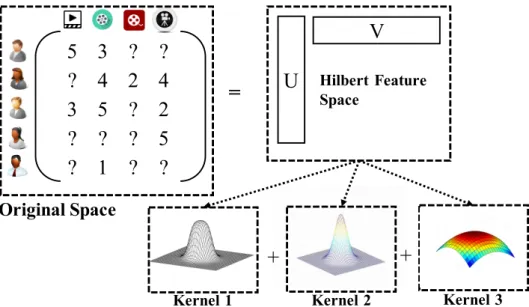
Figure 1.1: An illustration of kernelized low-rank matrix factorization for predicting the unobserved ratings. The two latent factor matricesU andV
are embedded into a high-dimensional Hilbert feature space by a linear com-bination of kernel functions. The products of the two latent factor matrices reconstruct the rating matrix in original space nonlinearly.
also called the kernel trick.
Incorporating kernel methods into matrix factorization for collabora-tive filtering, however, is very challenging for the following three reasons: First, while the inner products of the embedding can be inferred by the kernel function,e.g., for polynomial kernel, κ(x1,x2) =< φ(x1), φ(x2)>=
(x1Tx2+c)d, the mappingφis usually implicitly defined. As a result, as to the kernerlized matrix factorization problems, the matrices of latent factors of users and items are implicitly defined. In that case, minimizing the ob-jective function becomes more challenging since applying alternating least square(ALS) or gradient descent approaches is hampered by the implication of the latent factors. Thus, it is critical to devise effective kernel methods for the purpose of matrix completion.
factoriza-tion approaches [13, 28] usually require side informafactoriza-tion such as metadata, social graphs, text reviews etc. However, in the context of real-world rec-ommender systems, such information is not always available, which limits the applicability of these approaches. Thus, without the help from side in-formation of the users or items, applying kernel methods on pure matrix factorization is a more challenging task.
Third, combining multiple kernels in terms of large scale collaborative filtering tasks. A kernel function can capture a certain notion of similarity and efficiently embed data into a much higher dimensional space, but using one single kernel may still lead to suboptimal performance. To address this problem, many methods have been proposed in the literature to learn lin-ear combinations of multiple kernels, which are also an appealing strategy for improving kernelized matrix factorization. Despite its value and signifi-cance, few effort has been made on combining multiple kernel learning and matrix factorization. Existing multiple kernel learning strategies are mostly designed for classification and regression models, such as SVM, ridge regres-sion,etc.. Moreover, it is even more challenging when considering the kernel weight learning process with `2-norm considering large-scale problems.
To solve the above issues, we propose a solution, `2-norm Mkmf, that
combining matrix factorization with kernel methods and multiple kernel learning. Applying kernel methods on pure matrix factorization without side information,`2-normMkmfcan effectively capture the non-linear
rela-tionships in the rating data. Empirical studies on real-world datasets show that the proposedMkmfcan improve the accuracy of prediction for
collab-orative filtering.
1.2
Contribution
In this thesis, we introduce a new matrix-factorization algorithm for collabo-rative filteringMkmfwith`2-norm constraint on the kernel weight learning
process, which is based on multiple kernel learning and matrix factorization for collaborative filtering. We have implemented this algorithm on high di-mensional datasets in real-world domain. A special optimization is known as a quadratic constrained quadratic programming is introduced regarding the kernel weight learning process to achieve better prediction accuracy on the rating data.
1.3
Structure of Thesis
The rest of the thesis is organized as follows. Chapter 2 describes the pre-liminary concepts and an overview of the problem. Chapter 3 introduces the proposed Mkmfapproach. Chapter 4 reports the experiments and results.
Chapter 5 gives a brief introduction of the related works of collaborative filtering. Chapter 6 concludes this work with our advancements.
Chapter 2
Problem Statement
2.1
Notaions
In this section, we briefly describe the general problem setting of collabora-tive filtering with some preliminaries of our proposed method.
We reserve special indexing letters for distinguishing users from items: for usersu, and for itemsi. Each observed rating is a tuple (u, i, rui) denoting
the preference by useru of itemi, where the rating values rui∈R. Notice
that the matrix R contains m×n entries, where m denotes the number of users and n is the number of items. Each user is assumed to rate an item only once, so all such ratings can be arranged into anm×nmatrixR
whoseui-th entry equalsrui. The missing entires inRcorresponding to the
unobserved rating, which is what we try to make prediction. The observed entries indexed by the set Ω ={(u, i) : rui } is observed, and the number
of the observed ratings is |Ω|. Typically |Ω| is much smaller than m×n
because of the sparsity problem.
We use Ωu to denote the indices of observed ratings of the u-th row ru,
and Ωi the indices of observed ratings of thei-th columnr:,i. For examples,
ifru’s ratings are all unobserved except the 1st and the 3rd values, then;
• Ωu = (1,3)T and rΩu = (ru1, ru3)
• Given a matrix A, A:,Ωu denotes a sub matrix formed by the 1st column and 3rd column of A.
Similarly, ifr:,i’s ratings are all unobserved except the 2nd and the 4th
values, then;
• Ωi = (2,4)T and r:,Ωi = (r2i, r4i)T.
• Given a matrix A, A:,Ωu denotes a sub matrix formed by the 2nd column and 4th column of A.
The goal of collaborative filtering is to estimate the unobserved ratings
{rui|(u, i)∈/Ω} based on the observed ratings.
Table 2.1: Important Notations. Symbol Definition
Rand ˆR The partially observed rating matrix and the inferred dense rating matrix
UandV The user latent factors matrix and the item latent factors matrix Ω ={(u, i)} The index set of observed ratings, for (u, i)∈Ω, therui is
observed inR
Ωu Indices of observed ratings of theu-th row of R Ωi Indices of observed ratings of thei-th column of R
A:,Ωu orA:,Ωi Sub matrix ofAformed by the columns indexed by Ωuor Ωi
{d1, ...,dk} The set of dictionary vectors
φ(.) The implicit mapping function of some kernel
Φ = (φ(d1), ..., φ(dk)) The matrix of embedded dictionary in Hilbert feature space auandbi The dictionary weight vector for useruand the dictionary
weight vector for itemi
AandB The dictionary weight matrix of users and the dictionary weight matrix for items
{κ1, ..., κp} The set of base kernel functions
2.2
Matrix Factorization
Matrix factorization is one of the most successful realizations of collaborative filtering. The idea of matrix factorization is to approximate the observed matrix R as the product of two low-rank matrices:
R≈UTV
whereU is ak×m matrix andV is ak×nmatrix. Herek stands for the rank of the factorization, which also denotes the number of latent features for each user and item. Note that in most cases, we havek min(m, n).
The model map both users and items to a joint latent factor space of dimensionalityf. Accordingly, each useru is associated with a vector uu ∈
Rf, and each itemiis associated with a vector vi ∈Rf. The prediction for rating assigned to item iby user u, as mentioned before, is done by taking an inner product: ˆ rui= k X j=1 ujuvji =uTuvi (2.1)
where uju denotes the j-th row and u-th column of matrix U, vji denotes
the element in j-th row and i-th column of matrix V, uu denotes the u-th column of U, and vi denotes thei-th column of V.
Modern systems modeling directly only the observed ratings, while avoid-ing overfittavoid-ing through a regularization term. The low-rank parameter ma-trices Uand V can be found by solving the following problem:
minimize
U,V ||PΩ(R−U
>
V)||2F +λ(||U||2F +||V||2F) (2.2) where the projection PΩ(X) is the matrix with observed elements of X
preserved, and the unobserved entries replaced with 0, || · ||2
F denotes the
Frobenius 2-norm andλis the regularization term for avoiding over-fitting. This problem is not convex in terms ofU andV, but it is bi-convex. Thus, alternating minimization algorithms such as ALS [7,10] can be used to solve
equation (2.2). SupposeUis fixed, and we target to solve (2.2) forV. Then we can decompose the problem into n separate ridge regression problems, for thej-th column ofV, the ridge regression can be formalized as:
minimize
vj
||r:,Ωj −U>:,Ωjvj||2F +λ||vj||2 (2.3)
wherer:,Ωj denotes thej-th column ofRwith unobserved element removed, the corresponding columns of U are also removed to derive U:,Ωj, as we defined in Section 2.1. The closed form solution for above ridge regression is given by:
ˆ
vj = (U:,ΩjU>:,Ωj+λI)−1U:,Ωjr:,Ωj. (2.4) Since each of the n separate ridge regression problems leads to a solution of ˆv ∈ Rk, stacking these n separate ˆv’s together gives a k×n matrix
ˆ
V. Symmetrically, with V fixed, we can find a solution of Uˆ by solvingm
separate ridge regression problems. Repeat this procedure until convergence since it is a local convex problem eventually leads to the solution ofUˆ and
ˆ V.
2.3
`
2-norm multiple kernel learning
Since the right choice of kernel is usually unknown, applying single kernel function may still lead to suboptimal results. As a result, multiple ker-nel learning(MKL) works to learn an optimal linear combination of kerker-nels
K =Pm
j=1µjKj with non-negative coefficients µ together with the model
parameters. One conventional approach to multiple kernel learning employ
`1-norm constraints on the mixing coefficients µ to promote sparse kernel
combinations. However, when features encode orthogonal characterizations of a problem, sparseness may lead to discarding useful information and may thus result in poor generalization performance [9]. Thus, we impose`2-norm
quadratic programming(QCQP). QCQP has the basic form as minimize 1 2µ >P0µ+q0Tµ subject to 1 2µ > Piµ+qiTµ+ri ≤0 for i= 1, ..., m, Aµ=b (2.5)
where P0, ..., Pm are n-by-nmatrices and µ∈Rn is the optimization
vari-able. The optimization problem is considered convex when P0, ..., Pm are
all positive semi-definite. In this thesis, the kernel weight learning process using `2-norm regularization also solved as the QCQP convex problem.
Chapter 3
Multiple Kernel
Collaborative Filtering
Traditional matrix factorization recover the full matrix by solving low-rank factorization linearly. In this chapter, we introduce the kernel methods that aim to add non-linearity to MK problem assuming the collaborative filtering data is distributed on a nonlinear hyperplane.
3.1
Kernels
Kernel methods work for turned linear model into a non-linear model by embedding data into much higher dimensional (possibly infinite), implicit feature space. It follows the Mercer’s theorem that an implicitly defined function φ exists whenever the space χ can be equipped with a suitable measure ensuring the kernel function K satisfies mercer’s condition. While the embedding is implicit here, the inner product of data point in the feature space can be inferred, such that φ(x1)Tφ(x2) = κ(x1,x2) ∈ R, where κ
denotes the kernel function of the corresponding kernel. For example, for polynomial kernel with degree-d, κ(x1,x2) =< φ(x1), φ(x2) >= (x1Tx2+
thus can be viewed as capturing different notions of correlations.
3.2
Dictionary-based Single Kernel Matrix
Fac-torization
One challenge for incorporating kernel methods into matrix factorization, as mentioned in Chapter 1, is the implicity of the latent factors of users and items. To address the challenge, we use the dictionary-vectors for the computing of Gram matrix.
Suppose we havekdictionary vectors{d1, . . . ,dk}, whered∈Rd. Then we assume that the feature vectorφ(uu) associated touucan be represented as a linear combination of the dictionary vectors in kernel space as follows:
φ(uu) =
k
X
j=1
aujφ(dj) =Φau, (3.1)
whereauj ∈Rdenotes the weights of each dictionary vector,φ(di) denotes the feature vector of di in Hilbert feature space, au = (au1, . . . , auk)> and
Φ = (φ(d1), . . . , φ(dk)). Similarly we also assume that the feature vector
φ(vi) associated to vi can be represented as:
φ(vi) =
k
X
j=1
bijφ(dj) =Φbi, (3.2)
where bij is the weight for each dictionary vector and bi = (bi1, . . . , bik)>.
Thus for each useru∈ {1, . . . , m}we have a weight vectorau, for each item
i∈ {1, . . . , n}, we have a weight vector bi.
Consider the analog of (2.3), when all φ(uu) are fixed, i.e. the weight matrixA= (a1, . . . ,am) is fixed, and we wish to solve for allφ(vi), i.e. to
solve for the weight matrixB= (b1, . . . ,bn)
minimize
φ(vi)∈H
X
u
It is easy to see
φ(uu)>φ(vi) =au>Φ>Φbi =a>uKbi, (3.4)
φ(vi)>φ(vi) =bi>Φ>Φbi =b>i Kbi, (3.5)
whereK=Φ>Φis the Gram matrix (or kernel matrix) of the set of dictio-nary vectors{d1, . . . ,dk}. So we can rewrite (3.3) as
minimize bi∈Rk X u (rui−a>uKbi)2+λb > i Kbi (3.6) which is equivalent to minimize bi∈Rk ||r:,Ωi−A>:,ΩiKbi||2F +λb>i Kbi, (3.7)
(3.7) is similar to kernel ridge regression, the closed form solution is given by
ˆ
bi = (K>A:,ΩiA>:,ΩiK+λK)†K>A:,Ωir:,Ωi (3.8) Stacking n separate ˆb together, we get the estimated ˆB = (bˆ1, . . . ,ˆbn),
which is ak×nmatrix. Symmetrically, withBfixed, we can find a solution of Aˆ by solving m separate optimization problem like (3.7). In this case, the closed form solution for each ˆau is given by:
ˆ au= (K>B:,ΩuB > :,ΩuK+λK) † K>B:,ΩurΩu (3.9)
3.3
Multiple Kernel Matrix Factorization
Multiple kernel learning(MKL) [1, 5, 12] has been widely used on improving the performance of classification and regression tasks, the basic idea of MKL is combine multiple kernels instead of using a single one.
Formally, suppose we have a set ofppositive definte base kernels{K1, . . . ,Kp},
then we aim to learn a kernel based prediction model by identifying the best linear combination of the p kernels, that is, a weighted combinations
Algorithm 1 Multiple Kernel Matrix Factorization
Require: k, d,{κ1, . . . , κp},R,Ω, λ, itermax
1: allocateA∈Rk×m,B∈ Rk×n, µ∈Rp,D={di ∈Rd : 1≤i≤k},{Ki ∈ Rk×k: 1≤i≤p},K∈Rk×k 2: initializeµ= (1p, . . . ,p1)>,A,B,D 3: fori←1, pdo 4: Ki←(κi(dh,dj))1≤h,j≤k 5: end for 6: iter←0 7: repeat 8: K←Pp i=1µiKi 9: UpdateB as shown in (3.8) 10: UpdateA as shown in (3.9) 11: Updateµ by solving (3.11) 12: untiliter=itermax or convergence
µ= (µ1, . . . , µp)>. The learning task can be cast into following optimization: minimize au,bi∈Rk X (u,i)∈Ω (rui− p X j=1 µja>uKjbi | {z } υui>µ )2+ λ(b>i p X j=1 µjKjbi+a>u p X j=1 µjKjau | {z } γ> uiµ ) (3.10)
where µ ∈ Rp+ and µ>1p = 1. It is convenient to introduce the vectors
υui = (a>uK1bi, . . . ,a>uKpbi)>, γui = (a>uK1au +b>i K1bi, . . . ,a>uKpau+ b>i Kpbi)>. Rearrange optimization (3.10), minimize µ>Yµ+Zµ subject to µ0 kµk2 ≤1 (3.11) where Y = P (u,i)∈Ωυuiυ > ui and Z = P
(u,i)∈Ω(λ−2rui)γui. When all υui
and γui are fixed, i.e. A and B are fixed, we impose`2-norm constraint on
µ, make the optimization problem (3.11) is known as aquadratic constrained quadratic programming. Unlike `1-norm regularization,
minimize µ>Yµ+Zµ
subject to µ0
1>pµ= 1
(3.12)
which is a quadratic programming optimization problem, the `2-norm
regularization is more challenging, but it can also be solved in principle by general purpose optimization toolboxes such as Mosek1. Notice that, we
constraint µ0 to make sure the kernels are positive definite.
Now we can put all optimization problems together to build up our multiple kernel matrix factorization algorithm, which is summarized in al-gorithm 1. Initially, given rank value k, the dictionary dimension d and
p base kernel functions {κ1, . . . , κp}, the algorithm randomly initializes k
dictionary vectors D = (d1, . . . ,dk), then computes the p base kernel
ma-trices asKi = (κi(dh,dj))1≤h,j≤k. The algorithm also initializes the kernel
weight vector as µ0 = (1p, . . . ,1p)>, and generates low-rank matrix A0 and
B0 randomly. So initially, the compound kernel matrixK0 =P
1≤i≤pµ0iKi.
After obtaining all above instantiations, we first let A0 and µ0 fixed, find
B1 by solving m separate optimization problems like (3.7), each solution can be obtained directly by computing the closed form expression shown in 3.8. Similarly, we then let B1 and µ0 fixed, following the same approach to get A1. At last, A1 and B1 are fixed, we can obtain µ1 by solving 3.12 using convex optimization package mentioned before. Repeat this ALS-like procedure until the algorithm converges or reaches the predefined maximum number of iterations. We then define optimal solutions obtained by above iterative procedure are
∗ A,
∗
Bandµ∗, the corresponding compound kernel ma-trix is denoted as
∗
K=Pp
i=1
∗
µiKi. Thus, for each test tuple (u, i, rui), the
prediction made by our algorithm is ˆrui=a>u ∗
Kbi, which also is the element in theu-th row andi-th column of the recovered matrix ˆR=
∗ A> ∗ K ∗ B. The rating inference is also summarized in algorithm 2.
Algorithm 2 Rating Inference
Require: Ωˆ, ∗ K, ∗ A, ∗ B 1: allocateP 2: foru, i∈Ωˆ do 3: rˆui← ∗ a>u ∗ K ∗ bi 4: add ˆrui toP 5: end for 6: ReturnP.
Chapter 4
Experiments
4.1
Datasets
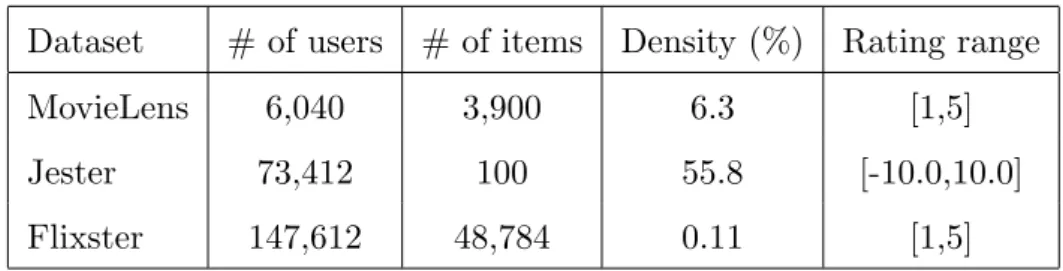
The proposed method is experimented and evaluated on 3 real-world col-laborative filtering datasets: MovieLens, Jester and Flixster. The details are summarized in Table 4.1. Note that the scale of rating in each dataset is different. For instance, the ratings in Jester dataset are continuous val-ues ranges from -10 to 10, while the Flixster dataset contains only 5 rating classes from 1 to 5. For each dataset, we sampled a subset with 1,000 users and 1,000 items. The 1000 users are selected randomly while the 1000 items selected are most frequently rated items (Jester dataset only contains 100 items).
Table 4.1: Summary of compared methods.
Dataset # of users # of items Density (%) Rating range MovieLens 6,040 3,900 6.3 [1,5] Jester 73,412 100 55.8 [-10.0,10.0] Flixster 147,612 48,784 0.11 [1,5]
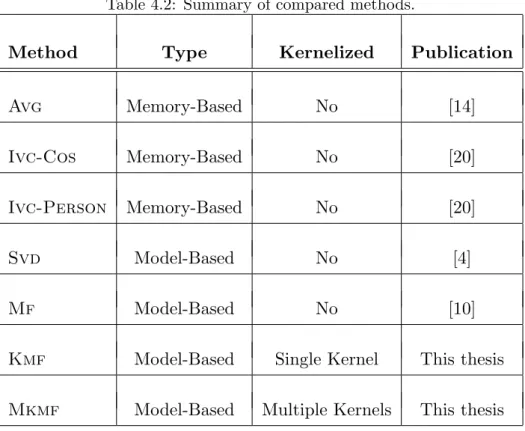
Table 4.2: Summary of compared methods.
Method Type Kernelized Publication
Avg Memory-Based No [14]
Ivc-Cos Memory-Based No [20]
Ivc-Person Memory-Based No [20]
Svd Model-Based No [4]
Mf Model-Based No [10]
Kmf Model-Based Single Kernel This thesis
Mkmf Model-Based Multiple Kernels This thesis
4.2
Baselines
We compare our proposed method, `2-norm Mkmf, with multiple sets of
baselines, among which AVG, IVS-COS and IVC-PERSON are memory-based methods while SVD, MF, KMF and MKMF are model-memory-based methods.
1) avg: A naive baseline called AVG which predicts the unobserved rating
assign to itemiby useruas ˆrui=αi+βu, whereαiis the mean score of
itemiin training data, andβuis the average bias of userucomputed as
βu= P (u,i)∈Ωrui−αi k{(u, i)∈Ω}k , where αi = P (u,i)∈Ωrui k{(u, i)∈Ω}k
2) Ivc-cos: (Item-based + cosine vector similarly): For memory based
itemiby useruby searching for the neighboring set of items rated by useru using cosine vector similarity [20].
3) Ivc-pearson: (Item-based + Pearson vector similarly): Another
mem-ory based method we compare with is the item based model which uses Pearson correlation [20]. It is similar to Ivs-Cos except using different metric of similarity.
4) svd: A model based method called Funk-SVD [4]. It is similar to the
matrix factorization approach we discussed in Section 2.2, but it is im-plemented by using gradient descent instead of alternative least square.
5) Mf: textscMf (Matrix Factorization) is a model-based CF method that
discussed in Section 2.2.
6) kmf: We also compare the proposedmkmfwith its single-kernel version
KMF which only employs one kernel function at a time, the details are discussed in Section 3.2.
7) `1-norm mkmf: mkmf that employ `1-norm constraints on the weight
coefficients. The difference betweenmkmfandkmfis thatmkmf
com-bine multiple kernel functions while KMF only use one kernel function. The details of mkmfare discussed in Section 3.3.
8) `2-norm mkmf: The proposed mkmf that imposing an `2-norm
con-straint on the weight coefficients.
For a fair comparison, the maximum number of iterations in the meth-odsSvd, Mf, Kmf andMkmfare all fixed as 20.
4.3
Evaluation Metric
The performance metric for rating accuracy used here is the root mean square error (RMSE):
RM SE= s P (u,i)∈Ω(rui−ˆrui)2 |Ω| (4.1)
4.4
Settings
For each dataset, we select the 1,000 most frequently rated items and ran-domly draw 1,000 users to generate a matrix with the dimension of 1000×
1000 (1000×100 for Jester). Two experimental settings are tested in this paper respectively. In the first setting, we randomly select one rating from each user for test and the remaining ratings for training. The random se-lection is repeated 5 times independently for each dataset. In the second setting, we randomly select 3 ratings from each user for test and the re-maining ratings for training. The random selection is also repeated 5 times independently for each dataset. We denote the first setting asLeave 1, and the second setting asLeave 3, which has sparser training matrix than the setting ofLeave 1. The average performances with the rank of each method are reported.
4.5
Results and Discussion
Following the setting of [12], we first use a small base kernel set of three simple kernels: a linear kernel function κ1(x,x0) = x>x, a 2-degree
poly-nomial kernel function κ2(x,x0) = (1 +x>x)2, and a Gaussian kernel (rbf
kernel) functionκ3(x,x0) = exp(−0.5(x−x0)>(x−x0)/σ) withσ= 0.5. We
implement the proposedMkmfmethod to learn a linear combination of the three base kernels by solving the optimization problem (3.10). The proposed
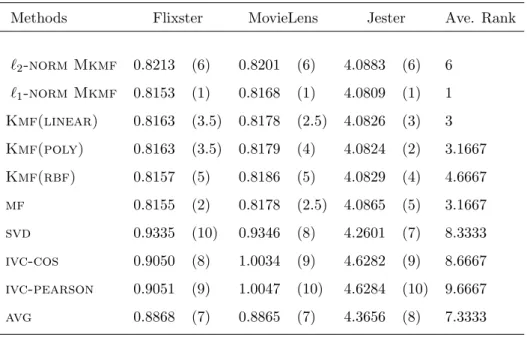
Empirical results on the three real-word datasets are summarized in Ta-ble 4.3 and 4.4.
Table 4.3: Results (RMSE(rank)) of Leave 1 on the real-world datasets.
Methods Flixster MovieLens Jester Ave. Rank
`2-norm Mkmf 0.8274 (2) 0.8233 (2) 4.0515 (5) 3 `1-norm Mkmf 0.8270 (1) 0.8223 (1) 4.0398 (1) 1 Kmf(linear) 0.8290 (5) 0.8241 (4.5) 4.0471 (2.5) 4 Kmf(poly) 0.8289 (4) 0.8241 (4.5) 4.0472 (4) 4.1667 Kmf(rbf) 0.8292 (6) 0.8246 (6) 4.0471 (2.5) 4.8333 mf 0.8286 (3) 0.8235 (3) 4.0549 (6) 4 svd 0.9441 (10) 0.9406 (8) 4.2794 (7) 8.3333 ivc-cos 0.9223 (8) 1.0016 (9) 4.6137 (9) 9 ivc-pearson 0.9226 (9) 1.0020 (10) 4.6142 (10) 9.6667 avg 0.9006 (7) 0.8887 (7) 4.3867 (8) 7.3333
Table 4.4: Results (RMSE(rank)) of Leave 3 on the real-world datasets.
Methods Flixster MovieLens Jester Ave. Rank
`2-norm Mkmf 0.8213 (6) 0.8201 (6) 4.0883 (6) 6 `1-norm Mkmf 0.8153 (1) 0.8168 (1) 4.0809 (1) 1 Kmf(linear) 0.8163 (3.5) 0.8178 (2.5) 4.0826 (3) 3 Kmf(poly) 0.8163 (3.5) 0.8179 (4) 4.0824 (2) 3.1667 Kmf(rbf) 0.8157 (5) 0.8186 (5) 4.0829 (4) 4.6667 mf 0.8155 (2) 0.8178 (2.5) 4.0865 (5) 3.1667 svd 0.9335 (10) 0.9346 (8) 4.2601 (7) 8.3333 ivc-cos 0.9050 (8) 1.0034 (9) 4.6282 (9) 8.6667 ivc-pearson 0.9051 (9) 1.0047 (10) 4.6284 (10) 9.6667 avg 0.8868 (7) 0.8865 (7) 4.3656 (8) 7.3333
• The proposed `2-norm Mkmf generally outperforms the other
base-lines, except `1-norm Mkmf, on two of the three datasets in Leave 1; The result of `1-norm Mkmf, on the other hand, surpassing all
other methods in both Leave 1 and Leave 3. Such experimental re-sult shows that incorporating kernels into matrix factorization helps the model capturing the non-linear correlation among the data.
• In regard to self-comparison, the performance of both`1-normMkmf
and `2-normMkmf is worse inLeave 3 than in Leave 1 while Kmf
keeps unaffected. It indicates that the multiple kernel learning algo-rithm is more sensitive to the sparsity problem than solving kernel ridge regression.
• Notice that `2-norm Mkmf outperformed by `1-norm Mkmf in all
cases. Though generally`2-norm regularization provides more precise
solution, in matrix factorization problem, the sparse kernel combina-tion using `1-norm regularization proves to be more robust. While
the test performance is less ideal than what we expected, the training RMSE of`2-normMkmfremains to be low in both two settings.
4.6
Parameter Studies
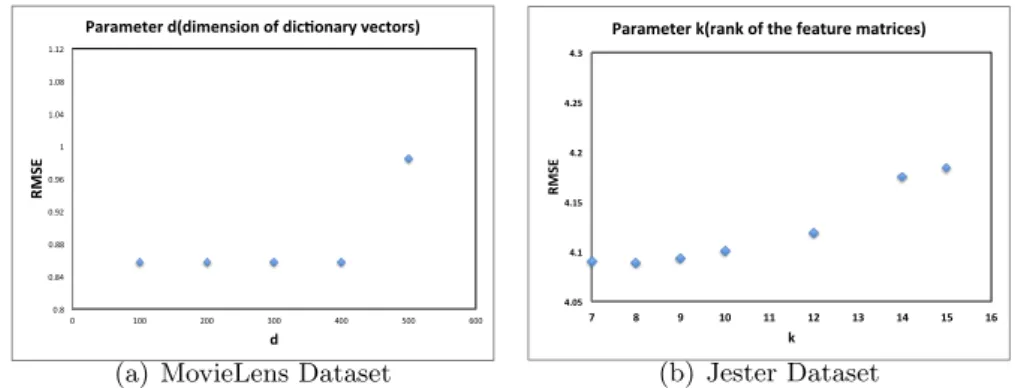
Figure 4.1(a) shows the kernelized methods’ sensitivity of parameterd, which stands for the dimensions of the dictionary vectors. Generally, according to the figures, Mkmf are not very sensitive to the value of donce we choose
relatively larged. For MovieLens dataset, the optimal choice of dis around 100. The situations of other datasets are similar, so they are omitted here due to the page limitation. Intuitively, the larger d we choose, the more information can be captured by the dictionary. However, since in bothKmf
and Mkmf, the dictionary vectors are eventually embedded into a Hilbert
0.8 0.84 0.88 0.92 0.96 1 1.04 1.08 1.12 0 100 200 300 400 500 600 RMS E d
Parameter d(dimension of dic4onary vectors)
(a) MovieLens Dataset
4.05 4.1 4.15 4.2 4.25 4.3 7 8 9 10 11 12 13 14 15 16 RMS E k
Parameter k(rank of the feature matrices)
(b) Jester Dataset Figure 4.1: Parameter studies overdand k
the insensitive pattern is shown in Figure 4.1(a).
Besides, we also study the performances of our proposed methods upon different values ofk, which denotes the rank of the two low-rank feature ma-trices. It is well-known the parameterkshould be tuned via cross-validation or multiple rounds of training/test split to achieve best performance for con-ventional matrix factorization [4, 16]. Figure 4.1(b) shows the performances of Mkmf on Jester dataset upon different values of k. The optimal rank
for Jester dataset isk= 8. It also shows thatMkmfare overfitting whilek
Chapter 5
Related Works
In current research, collaborative filtering(CF) works in one of two areas: memory-based approach and model-based approach. In this section, we introduces both two approaches briefly.
5.1
Memory-based Approaches
The memory-based CF approach is also called neighbor-based CF, in which user-based methods and item-based methods are included. Neighbor-based CF method estimates the unobserved ratings of a target user or item as follows, it first find the observed ratings assigned by a set of neighboring users or the observed ratings assigned to a set of neighboring items, then it aggregates the neighboring ratings to derive the predicted rating of the target user or item. In order to find the neighboring set of a target user or item, similarity measures such as correlation-based similarity [19], vector cosine-based similarity [2] and conditional probability-based similarity [8] are usually used. Memory-based CF methods are usually easy to implement, and new data can be added into the model easily without re-training. But they are known to suffer from the sparsity problem which makes the algorithm hard to find highly similar neighboring sets. Several relaxation approaches
were proposed to address the sparsity problem to fill in some of the unknown ratings using different techniques [15, 26]. Neighbor-based CF methods also have limited scalability for large datasets since each prediction is made by searching the similar users or items in the entire data space. When the number of users or items is large, the prediction is very expensive to obtain, which makes it difficult to scale in the online recommender system.
5.2
Model-based Approaches
Model-based approach is an alternative approach that can better address the sparsity problem than memory-based approach does, since it allows the system to learn a compact model that recognizes complex patterns based on the observed training data, instead of directly searching in rating database. Generally, classification algorithms can be employed as CF models for the dataset with categorical ratings, and regression models can be used if the ratings are numerical. Popular models used in this category include ma-trix factorization [16], probabilistic latent semantic analysis [6], Bayesian networks [17], clustering [3] and Markov decision process [23].
As to the matrix factorization approaches relevant to our work, [22] gen-eralizes probabilistic matrix factorization to a parametric framework and requires the aid of topic models. [24] introduces a nonparametric factoriza-tion method under trace norm regularizafactoriza-tion. The optimizafactoriza-tion is cast into a semidefinite programming (SDP) problem, whose scalability is limited. A faster approximation of [24] is proposed by [18], which, in fact is very simi-lar to the formulation of SVD [4]. [27] proposes a fast nonparametric matrix factorization framework using an EM-like algorithm that reduce the time cost on the large-scale dataset.
Chapter 6
Conclusion
In this thesis, we have introduced a matrix factorization model, `2-norm
MKMF, for collaborative filtering. The proposed model can capture the
non-linear distribution of latent factor effectively. The`2-norm MKMF
ex-tends `1-norm MKMF to impose `2-norm constraint on the weight
coeffi-cients regarding kernel weight learning. The`2-norm constraint on the
con-straint result in a QCQP optimization. As demonstrated in the experiments, our proposed method improve the accuracy of prediction and surpassing the results of multiple state-of-art collaborative filtering methods.
Bibliography
[1] F.R. Bach, G. Lanckriet, and M.I. Jordan. Multiple kernel learning, conic duality, and the smo algorithm. In ICML, page 6. ACM, 2004.
[2] J.S. Breese, D. Heckerman, and C. Kadie. Empirical analysis of predic-tive algorithms for collaborapredic-tive filtering. In Proceedings of the Four-teenth conference on Uncertainty in artificial intelligence, pages 43–52, 1998.
[3] S. Chee, J. Han, and K. Wang. Rectree: An efficient collaborative filtering method. InData Warehousing and Knowledge Discovery, pages 141–151. Springer, 2001.
[4] S. Funk. Netflix update: Try this at home, 2006.
[5] M. G¨onen and E. Alpaydın. Multiple kernel learning algorithms. The Journal of Machine Learning Research, 12:2211–2268, 2011.
[6] T. Hofmann. Latent semantic models for collaborative filtering. TOIS, 22(1):89–115, 2004.
[7] Y. Hu, Y. Koren, and C. Volinsky. Collaborative filtering for implicit feedback datasets. In ICDM, pages 263–272. IEEE, 2008.
[8] G. Karypis. Evaluation of item-based top-n recommendation algo-rithms. In CIKM, pages 247–254. ACM, 2001.
[9] Marius Kloft, Ulf Brefeld, Pavel Laskov, and S¨oren Sonnenburg. Non-sparse multiple kernel learning. InNIPS Workshop on Kernel Learning: Automatic Selection of Optimal Kernels, volume 4, 2008.
[10] Y. Koren, R. Bell, and C. Volinsky. Matrix factorization techniques for recommender systems. Computer, (8):30–37, 2009.
[11] G. Lanckriet, T. De Bie, N. Cristianini, M.I. Jordan, and W.S. No-ble. A statistical framework for genomic data fusion. Bioinformatics, 20(16):2626–2635, 2004.
[12] G. Lanckriet, N. Cristianini, P. Bartlett, L.E. Ghaoui, and M.I. Jor-dan. Learning the kernel matrix with semidefinite programming. The Journal of Machine Learning Research, 5:27–72, 2004.
[13] N.D. Lawrence and R. Urtasun. Non-linear matrix factorization with gaussian processes. In ICML, pages 601–608. ACM, 2009.
[14] C. Ma. A guide to singular value decomposition for collaborative filter-ing, 2008.
[15] H. Ma, I. King, and M.R. Lyu. Effective missing data prediction for collaborative filtering. In SIGIR, pages 39–46. ACM, 2007.
[16] A. Paterek. Improving regularized singular value decomposition for collaborative filtering. InProceedings of KDD cup and workshop, pages 5–8, 2007.
[17] D.M. Pennock, E. Horvitz, S. Lawrence, and C.L. Giles. Collaborative filtering by personality diagnosis: A hybrid memory-and model-based approach. InProceedings of the Sixteenth conference on Uncertainty in artificial intelligence, pages 473–480, 2000.
[18] J. Rennie and N. Srebro. Fast maximum margin matrix factorization for collaborative prediction. InICML, pages 713–719. ACM, 2005.
[19] P. Resnick, N. Iacovou, M. Suchak, P. Bergstrom, and J. Riedl. Grou-plens: an open architecture for collaborative filtering of netnews. In Proceedings of the 1994 ACM conference on Computer supported coop-erative work, pages 175–186. ACM, 1994.
[20] B. Sarwar, G. Karypis, J. Konstan, and J. Riedl. Item-based collabo-rative filtering recommendation algorithms. In WWW, pages 285–295. ACM, 2001.
[21] B. Sch¨olkopf and A.J. Smola. Learning with kernels: Support vector machines, regularization, optimization, and beyond. MIT press, 2002.
[22] H. Shan and A. Banerjee. Generalized probabilistic matrix factoriza-tions for collaborative filtering. InICDM, pages 1025–1030. IEEE, 2010.
[23] G. Shani, R.I. Brafman, and D. Heckerman. An mdp-based recom-mender system. In Proceedings of the Eighteenth conference on Un-certainty in artificial intelligence, pages 453–460. Morgan Kaufmann Publishers Inc., 2002.
[24] N. Srebro, J. Rennie, and T.S. Jaakkola. Maximum-margin matrix factorization. In Advances in neural information processing systems, pages 1329–1336, 2004.
[25] X.Liu, C.Aggarwal, Y.Li, X.Kong, X.Sun, and S.Sathe. Kernelized matrix factorization for collaborative filtering. SDM, 2016.
[26] G. Xue, C. Lin, Q. Yang, W. Xi, H. Zeng, Y. Yu, and Z. Chen. Scalable collaborative filtering using cluster-based smoothing. In SIGIR, pages 114–121. ACM, 2005.
[27] K. Yu, S. Zhu, J. Lafferty, and Y. Gong. Fast nonparametric matrix factorization for large-scale collaborative filtering. InSIGIR, pages 211– 218. ACM, 2009.
[28] T. Zhou, H. Shan, A. Banerjee, and G. Sapiro. Kernelized probabilistic matrix factorization: Exploiting graphs and side information. InSDM, volume 12, pages 403–414. SIAM, 2012.