The Role of Socio-Cognitive Process in
Construction Workers’ Safety Behaviors
by
Byungjoo Choi
A dissertation submitted in partial fulfillment
of the requirements for the degree of
Doctor of Philosophy
(Civil Engineering)
in the University of Michigan
2018
Doctoral Committee:
Associate Professor SangHyun Lee, Chair
Professor Richard P. Bagozzi
Professor Vineet R. Kamat
ii
DEDICATION
iii
ACKNOWLEDGEMENTS
Firstly, I would like to thank my advisor, Dr. SangHyun Lee, for all his help and
guidance that he has given me during my PhD study over the past four years, and I
would like to thank my PhD committee members, Dr. Richard P. Bagozzi, Dr. Vineet
R. Kamat, and Dr. Carol C. Menassa, for their thoughtful advice for my dissertation.
I would also like to thank the scholars who have directly influenced my PhD, Dr.
Hyun-Soo Lee, Dr. Moonseo Park, and Dr. Seungjun Ahn. I have been very fortunate
to have been able to discuss my research with these great scholars.
Next, I would like to thank my colleagues and friends. My colleagues who I spent
countless hours with at the University of Michigan discussing our research in general:
Dr. Kyle Anderson, Dr. JoonOh Seo, Dr. Sungjoo Hwang, Dr. Kwonsik Song,
Meiyin Liu, Houtan Jebelli, Daeho Kim, Gaang Lee, Alan Yin, and Nurie Kim. Their
assistance, cooperation, and experience were essential for the completion of my PhD
study.
Last but not least, I would like to thank my family for their unwavering support and
patience. This dissertation would not have been completed without their support.
iv
TABLE OF CONTENTS
DEDICATION... ii
ACKNOWLEDGEMENTS ... iii
LIST OF TABLES ... viii
LIST OF FIGURES ... x
LIST OF APPENDICES ... xii
ABSTRACT ... xiii
CHAPTER 1 INTRODUCTION ... 1
1.1 BACKGROUND ... 1
1.2 SOCIO-COGNITIVE ASPECT OF WORKERS’ SAFETY BEHAVIORS ... 2
1.2.1 Cognitive Model of Safety Behaviors ... 2
1.2.2 Social Influence on Safety Behaviors ... 4
1.3 PROBLEM STATEMENTS ... 5
1.4 RESEARCH OBJECTIVES AND APPROACHES ... 7
1.5 THE STRUCTURE OF THE DISSERTATION ... 10
CHAPTER 2 CURRENT STATUS OF SAFETY NORMS AND SOCIAL IDENTITIES AT CONSTRUCTION SITES ... 12
2.1 INTRODUCTION ... 12
2.2 RESEARCH OBJECTIVE AND HYPOTHESES ... 14
2.3 METHOD ... 16
2.3.1 Measurement of safety norms shared by workers and shared by managers ... 16
2.3.2 Measurement of the salience of social identities ... 19
2.3.3 Participants and Procedure ... 20
2.4 RESULTS ... 21
2.4.1 Misalignment between workers’ perceived group norms and the norms desired by project managers ... 21
v
2.4.3 Salience of social identities in construction workers ... 26
2.4.4 Impact of the salience of social identities on the influence of group norms on personal standards ... 28
2.4.5 Relationship between time spent in a group and salience of social identity ... 29
2.5 DISCUSSION ... 30
2.5.1 Theoretical and practical Implications ... 30
2.5.2 Methodological Merits ... 34
2.5.3 Limitations and Future Directions ... 34
2.6 CONCLUSIONS ... 35
CHAPTER 3 THE ROLE OF SAFETY NORMS AND SOCIAL IDENTIFICATIONS IN CONSTRUCTION WORKERS’ SAFETY BEHAVIORS ... 37
3.1 INTRODUCTION ... 37
3.2 THEORETICAL MODEL OF CONSTRUCTION WORKERS’ SAFETY BEHAVIOR UNDER SOCIAL INFLUENCE ... 38
3.2.1 The Influence of Perceived Management Norm and Perceived Workgroup Norm on Workers’ Safety Behaviors ... 39
3.2.2 The Role of Project Identity and Workgroup Identity in the Social Influence on Safety Behaviors ... 41
3.2.3 The Role of Personal Attitude in Safety Behaviors ... 42
3.2.4 Collective Self-Concept as a Control Variable ... 43
3.3 METHODS ... 43
3.3.1 Participants and Procedure ... 43
3.3.2 Measures ... 45
3.3.3 Analytical Procedure ... 48
3.4 RESULTS ... 49
3.4.1 Measurement Assessment... 49
3.4.2 Descriptive Statistics and Correlation ... 50
3.4.3 Results of Hypothesis Testing ... 52
3.5 DISCUSSION ... 57
vi
3.5.2 Managerial Implications ... 59
3.5.3 Limitations and Future Direction ... 60
3.6 CONCLUSIONS ... 61
CHAPTER 4 THE EFFECTS OF CULTURAL BACKGROUNDS AND ORGANIZATIONAL STRUCTURES ON SOCIAL INFLUENCE PROCESS ... 63
4.1 INTRODUCTION ... 63
4.2 CULTURES AND ORGANIZATIONAL STRUCTURES IN THE U.S., KOREA, AND SAUDI ARABIA ... 65
4.3 METHODS AND PARTICIPANTS ... 66
4.4 RESULTS AND DISCUSSIONS ... 68
4.4.1 Project Identity and Workgroup Identity ... 69
4.4.2 Perceived Management norm, Perceived Workgroup Norm, and Own Opinion ... 72
4.4.3 Results of Regression Analyses ... 76
4.5 CONCLUSIONS ... 81
CHAPTER 5 AN EMPIRICALLY BASED AGENT-BASED MODEL OF THE SOCIO-COGNITIVE PROCESS OF CONSTRUCTION WORKERS’ SAFETY BEHAVIOR . 84 5.1 INTRODUCTION ... 84
5.2 METHODS ... 85
5.2.1 Purpose ... 86
5.2.2 Entities, State Variables, and Scales ... 86
5.2.3 Process overview and Scheduling ... 87
5.2.4 Design Concept... 88 5.2.5 Submodels ... 89 5.2.6 Initialization ... 94 5.3 VALIDATION ... 95 5.4 EXPERIMENTS ... 100 5.5 RESULTS ... 102 5.6 DISCUSSION ... 112 5.7 CONCULSIONS ... 115
vii
CHAPTER 6 POTENTIAL OF PHYSIOLOGICAL SENSORY DATA TO
UNDERSTAND CONSTRUCTION WORKERS’ PERCEIVED RISK ... 117
6.1 INTRODUCTION ... 117
6.2 METHODS ... 119
6.2.1 Subjects ... 119
6.2.2 Data Collection Procedure ... 120
6.3 DATA ANALYSIS ... 121
6.3.1 Artifacts Removal ... 121
6.3.2 EDA Decomposition... 122
6.3.3 Activity Labeling and Downsampling ... 123
6.4 RESULTS & DISCUSSION ... 124
6.5 CONCLUSION ... 132
CHAPTER 7 CONCLUSIONS AND RECOMMENDATIONS ... 133
7.1 SUMMARY OF RESEARCH ... 133
7.2 FUTURE RESEARCH ... 135
7.3 Final Remark ... 136
APPENDICES ... 138
viii
LIST OF TABLES
Table 2.1 Norm Elicitation Protocol Structure ... 19
Table 2.2 Mean and Standard Deviation for Participants’ Appropriateness Rating ... 22
Table 2.3 Results of Independent t-tests between Managers' Desired Norms and Workers' Perceived Group Norms ... 24
Table 2.4 Results of OLS Regression for the Relationship between Workers' Personal Standards and Perceived Group Norms ... 26
Table 2.5 Means, Standard Deviations, and Reliability Scores for Social Identity Measures ... 26
Table 2.6 Results of Paired t-tests between Social Identities ... 28
Table 2.7 Correlation between Workers tenure and Salience of Social Identity ... 29
Table 3.1 Measures, Factor Loadings, and Reliabilities ... 47
Table 3.2 Descriptive Statistics and Correlation Coefficients ... 51
Table 3.3 Model for Project Identity as a Moderator Variable ... 54
Table 3.4 Conditional Effects of Perceived Management Norm and Perceived Workgroup Norm on Safety Behavior ... 56
Table 3.5 Model for Workgroup Identity as a Moderator Variable ... 57
Table 4.1 Demographics of Participants in the Three Countries ... 68
Table 4.2 Descriptive statistics and reliability in the three countries ... 69
Table 4.3 Paired t-tests between Project Identity and Workgroup Identity in the Three Countries ... 71
Table 4.4 Within Group Agreement on Perceived Management Norm in the Eight Projects ... 76
Table 4.5 Result of Multiple Regression Analysis of the U.S. Sample ... 77
Table 4.6 Result of Multiple Regression Analysis of Korea Sample ... 78
Table 4.7 Result of Multiple Regression Analysis of Saudi Arabia Sample ... 79
ix
Table 6.2 Each Subject’s Descriptive Statistics (EDR and EDL) ... 126 Table 6.3 Result of Hierarchical Linear Modeling ... 130
x
LIST OF FIGURES
Figure 1.1 Research Framework ... 9
Figure 2.1 Workers' Perceived Group Norms and Managers' Desired Norms ... 23
Figure 2.2 Workers' Personal Standards and Managers' Belief about Workers' Safety Norms ... 25
Figure 2.3 Current Staus of Worekrs' Social Identifications ... 27
Figure 3.1 Theoretical Model for Social Influence on Workers' Safety Behaviors ... 39
Figure 3.2 Management Norm, Workgroup Norm, and Workers' Own Opinion ... 52
Figure 4.1 Project Identity and Workgroup Identity in the Three Countries ... 70
Figure 4.2 Management Norm, Workgroup Norm, and Workers' Own Opinion in the Three Countries ... 74
Figure 5.1 Model Process Flowchart ... 88
Figure 5.2 Agent Behavioral Rules ... 90
Figure 5.3 Changes in Workgroup Norm, Management Norm, and Risk Acceptance in the Baseline Model ... 97
Figure 5.4 Relationship between Risk Attitude and Risk Acceptance in the Baseline Model ... 98
Figure 5.5 Interaction between Project Identity and Social Norms in the Baseline Model ... 99
Figure 5.6 Distribution of Actual Risk in the Three Site Risk Conditions ... 102
Figure 5.7 Direct Effects of the Interventions in Moderate Site Risk ... 104
Figure 5.8 Effects of Interactions between the Interventions in Moderate Site Risk ... 105
Figure 5.9 Direct Effect of the Interventions in High Site Risk ... 107
Figure 5.10 Effects of Interactions between the Interventions in High Site Risk... 108
Figure 5.11 Direct Effect of the Interventions in Low Site Risk ... 110
Figure 5.12 Effects of Interactions between the Interventions in Low Site Risk ... 111
Figure 6.1 EDA Data Collection ... 121
xi
Figure 6.3 Example of cvxEDA Decomposition (S4) ... 123
Figure 6.4 Examples of Activity Labeling ... 124
Figure 6.5 Changes in Each Subject's Normalized EDA (Morning Session) ... 125
Figure 6.6 Changes in Each Subject's Normalized EDA (Afternoon Session)... 125
Figure 6.7 Distribution of All Subjects’ EDR and EDL in Low & High Risk Activities ... 127
Figure 6.8 Distribution of Each Subject's EDR in Low Risk Activities and High Risk Activities ... 128
xii
LIST OF APPENDICES
Appendix A: Survey Questionnaire 1...………138 Appendix B: Survey Questionnaire 2...………150 Appendix C: Source Code for Agent-Based Model..………161
xiii
ABSTRACT
Despite continuous efforts to reduce its number of accidents, construction still remains one of the most hazardous industries in most countries. The vast majority of accidents in construction are associated with workers’ unsafe behaviors. As a result, researchers and practitioners have devoted considerable effort to investigating various approaches to reduce workers’ unsafe behaviors. Still, a noticeable lack of research and practices investigating how workers’ cognitive processes and their interactions with the environment (e.g., coworkers, managers, and site risk) affect safety behaviors persists. With this background in mind, three broad objectives have been established in this research: (1) to identify the mechanism of social influence on workers’ safety behavior, (2) to characterize how workers’ decision-making processes and the environmental factors interact to affect safety behaviors, (3) to develop research methods to overcome the limitations in previous worker behavior studies. To achieve these research objectives, five interrelated and interdisciplinary studies such as survey analyses, behavioral economic experiments, agent-based modeling and simulation of human behavior, field experiments, and physiological sensor data analysis were conducted. Through these studies it was found that: (1) safety norms shared by managers are significantly stricter than safety norms shared by workers; (2) workers’ safety behaviors are not only influenced by coworkers’ safety behaviors (i.e., workgroup norm) but also subject to managers’ safety feedback (i.e., management norms); (3) workers’ social identification with their project intensifies positive influence of management norms and attenuates negative influence on workgroup norms to improve workers’ safety behaviors; (4) project identity is the least salient in construction workers’ self-concept among diverse organizations at construction sites (e.g., workgroup, company, union, trade, project); (5) the effects of different safety management strategies (i.e., stricter safety feedback, more frequent
xiv
safety feedback, and stimulation of project identification) on workers’ safety behavior vary based on site risk conditions (low, moderate, high-risk conditions); (6) electrodermal response (EDR) collected from workers’ wristband has a great potential to understand risk perception during their ongoing work. These findings identify the socio-cognitive mechanism of workers’ safety behaviors and provide insight into how to improve workers’ safety behavior and ultimately to reduce accidents in construction by promoting positive social influence regarding safety behaviors.
1
CHAPTER 1
INTRODUCTION
11.1BACKGROUND
Despite continuous efforts to reduce the number of accidents, construction still remains one of the most dangerous industries in the U.S. and around the globe (Jebelli et al. 2016). In 2014, for example, the U.S. construction industry reported the largest number of fatalities (N = 894), with a fatal injury rate 2.88 times higher than the average of all industries (US BLS 2016a). Although the construction industry employs 4.1% of the U.S. workforce (US BLS 2015), it accounted for more than 18% of all work-related deaths in 2014 (US BLS 2016a). In 2015, the construction industry reported that a total of 79,840 nonfatal injuries resulted in days away from work. The injury rate was 43.6% higher than the national average rate (US BLS 2016b). It is estimated that fatal and nonfatal injuries at construction sites result in over $15 billion in direct cost (Tixier et al. 2014). Furthermore, the poor safety performance of the construction industry has been a major concern in not only the United States, but also throughout the United Kingdom (Haslam et al. 2005), European Union (Meliá et al. 2008; Törner and Pousette 2009), Asia (Fang et al. 2006), and Australia (Lingard et al. 2010).
Accident investigations have demonstrated that workers’ unsafe behavior, which refers to the behavior that deviates from safety work procedure, is one of the main causes of construction accidents. Heinrich et al. (1950) examined 75,000 accident cases and reported that 88% of all industry accidents were caused mainly by human errors. Based on the investigation of occupational
1Part of this chapter is adopted from Choi, B. and Lee, S. (2018) “An Empirically Based Agent-Based Model of the Sociocognitive Process of Construction Workers’ Safety Behavior.” Journal of Construction Engineering and Management, 144(2), 04017102.
2
fatalities between 1985 and 1990 in Finland, and serious accidents at work in 1988 and 1989, Salminen and Tallberg (1996) found that 84–94% of accidents were primarily caused by unsafe actions of people. Suraji et al. (2001) affirmed this in their study of 500 records of construction accidents in the United Kingdom (UK HSE) (2002) also noted that workers’ unsafe behavior is attributable to approximately 80% of accidents in the workplace. Hinze (2006) showed that over 75% accidents in construction were caused by the unsafe behaviors of workers.
Such alarming figures have prompted construction practitioners to pay greater attention to workers’ unsafe behaviors. In practice, efforts to reduce workers’ unsafe behaviors have mainly relied on external formal controls such as penalties for violations of safety rules (Mitropoulos et al. 2009; Törner and Pousette 2009). These approaches, however, may not be effective in reducing workers’ unsafe behaviors because formal rules do not consider the complex and dynamic situations that occur during a given construction operation (Andersen et al. 2015). Work conditions in one project cannot be equated to other projects because every construction project possesses a unique nature with respect to design, location, participants, and so on. Also, progress in a construction project results in dynamic changes in work conditions within the same project. Therefore, it is challenging and impractical to prescribe behavioral safety rules in every possible situation in such complex and dynamic construction operations. In this context, construction workers’ safety behavior would be the result of their discretionary decisions rather than their reactions to the external controls. The formal rule enforcement could also cause unexpected adverse effects due to workers’ psychological resistance to the management. Given these limitations of external controls, more attention has been paid to the mechanisms of how to shape and change workers’ safety behavior.
1.2SOCIO-COGNITIVE ASPECT OF WORKERS’ SAFETY BEHAVIORS
1.2.1Cognitive Model of Safety Behaviors
Given the importance of workers’ behaviors in construction safety, there has been increased interest in the cognitive process of workers’ safety behaviors. Such researchers have suggested that workers’ unsafe behaviors are the result of human errors in the workplace. The human error refers to “individuals’ misjudgment or inappropriate decision in the cognitive process” (Chi et al.
3
2013). Reason (1990) suggested the Generic Error Modeling System (GEMS) that focuses cognitive factors in human error and proposed three categories of human error: skill-based, rule-based, and knowledge-based error. Rasmussen (1986) proposed the Step Ladder Model (SLM), consisting of eight stages in the decision-making process: “activation, observation, identification, interpretation, evaluation, goal selection, procedure selection, and execution.” Wickens (1984) suggested an information-processing model describing individuals’ cognitive processes when an individual interacts with the outside environment. This model consists of four cognitive stages, “sensory processing, perception, response selection, and response execution,” and three functional modules, “attention resources, working memory, and long-term memory.” Based on the information processing model, workers’ unsafe behaviors are the result of cognitive failures in the cognitive process. In this regard, Jiang et al. (2014) developed a system dynamics model to investigate the causes of construction workers’ unsafe behavior. Also, Fang et al. (2016) proposed a Cognitive Model of Construction Workers’ Unsafe Behaviors (CM-CWUB) that consists of obtaining information, understanding information, perceiving responses, selecting responses, and taking action. Although these different models vary in details, they all emphasize risk perception, risk assessment, and decision making.
The factors of risk perception, risk assessment, and decision making have been included in theoretical models of health behavior such as Health Belief Model (HBM) (Rosenstock 1974) and Protection Motivation Theory (PMT) (Rogers 1975). Considering that individuals’ health behaviors are a proactive action to prevent health risk (e.g., disease), health behavior would be in line with workers’ safety behavior from the perspective of the cognitive process. The HBM, which is widely accepted in public health research, suggested that an individual’s intention to engage in recommended health actions is determined by the combined levels of perceived risk of the disease and perception of benefits and barrier of the recommended actions. In construction safety literature, Weidman et al. (2016) adopted HBM to develop managerial interventions to encourage worker’s adoption of a ventilated dust-control tool that reduces dust exposure in the workplace. Also, PMT posited that an individual’s likelihood of accepting recommended health behavior is influenced by his/her appraisal of health risk and recommended behavior. In this regard, Rodríguez-Garzón et al. (2014) provided empirical evidence on the association between perceived risk and safety training in construction industry based on the PMT.
4 1.2.2Social Influence on Safety Behaviors
Since construction workers work in a social context, workers’ safety behaviors are not only results of the cognitive process of isolated individuals but also of their interaction with others. In this regard, social aspects of workers’ safety behavior also have drawn considerable interests in safety research. Many researchers have shown that workers’ safety behaviors are under the influence of social controls such as safety culture, safety climate, and safety norms. Safety climate refers to “employees shared perception of organizational safety policies, procedures, and practices” (Zohar 1980). Results from previous studies have demonstrated a significant association between safety climate and safety behavior (Siu et al. 2004; Seo 2005; Fang et al. 2006; Beus et al. 2010; Fugas et al. 2012). Social norms refer to a shared expectation of what is normal and acceptable behavior in a group (Gundlach et al. 1995). A number of previous studies have noted that workers’ safety behaviors are influenced by safety norms (Törner and Pousette 2009; Jiang et al. 2010; Fugas et al. 2011). Since safety climate serves as a frame of reference that guides expected safety behaviors by providing information for behavior-outcome contingencies in an organization (e.g., consequences of working fast but unsafely) (Zohar and Luria 2005), it would play a critical role in forming social norms among the workers. Social norms can be very powerful in regulating workers’ safety behavior because they can account for those varied and situational behaviors in which it becomes difficult for a worker to judge the appropriateness of the behavior (Deutsch and Gerard 1955; Barling et al. 2008). Also, since social influence is involved with the process of genuine internalization of social norms rather than superficial compliance, behavioral changes driven by social norms would be more durable and cost-effective than formal controls (Akerlof and Kranton 2000; Hogg and Smith 2007).
The process of behavioral changes driven by social norms can be explained by Social Identity Theory (SIT). Social identity is defined as “the individual’s knowledge that he/she belongs to certain social group together with some emotional and value significance to the group membership” (Hogg and Terry 2000). According to the SIT, if a particular group becomes salient in one’s self-concept through the social identification process, he/she internalizes of and conforms with the group norms because he/she defines themselves as the exemplar of the group (Terry and Hogg 1996; Bagozzi and Lee 2002; Hogg and Smith 2007). On the other hand, individuals may not be influenced by the group norms if he/she does not identify with the reference group. Based
5
on the SIT, there have been numerous research efforts to understand employees’ organizational behaviors (e.g., work satisfaction, motivation, organizational citizenship behavior, and communication) from the perspective of their organizational identification (i.e., employees’ social identification with their organization). These studies found that employees’ organizational identification is a powerful mechanism that regulates behavior in the organization (Dutton et al. 1994; Riketta 2005; Walumbwa et al. 2008; He and Brown 2013).
1.3PROBLEM STATEMENTS
Although previous studies have made a significant contribution to our understanding of the socio-cognitive aspect of construction workers’ safety behaviors, several key limitations exist throughout much of literature. First, while previous studies have provided empirical evidence on the existence of social influence on workers’ safety behaviors, very little attention has been given to the fundamental characteristics of construction workforces, which make safety norms uniquely complex in construction. In a traditional long-term organization, all organization members and different levels of management (e.g., top and front-line management) share a company identity as their common background, which forms a favorable environment for coherent social norms in the organization (Litwin and Stringer Jr 1968; Tyagi 1982). However, in the case of construction, most members and managers have different organizational backgrounds. For example, a project manager from a general contractor and supervisors of subcontractors belong to different companies. Workers, meanwhile, have a strong identification with their trades (or unions) and workgroups (i.e., crews). As a result, multiple organizational backgrounds and social norms coexist in construction projects, which makes it very challenging to develop and maintain coherent safety norms in a construction project. Furthermore, since crew members brought by a general contractor and subcontractors are hired temporarily for a specific project, their tenure at a construction site is relatively short. The limited time employees’ interactions with management more task-oriented than relationship-oriented and this can hinder the development of coherent norms in a temporary organization (Bryman et al. 1987; Clarke 2003). However, these fundamental characteristics of construction workforce organizations affect social influence process on workers’ safety behaviors are not well understood (Bartels et al. 2007; Peters et al. 2013)
6
Additionally, despite the increasing attention paid to the socio-cognitive aspect of workers’ safety behaviors, there is a notable paucity of studies investigating the mechanism behind the relationship between cognitive process, social influence, and safety behavior. While previous studies have suggested theoretical models of the cognitive process of safety behavior and provided empirical evidence on the social influence on safety behavior, little is known about how the cognitive process interacts with social influence process. Also, while a few studies have incorporated social aspects in the cognitive model of safety behavior, they have not yet paid sufficient attention to how the socio-cognitive process interacts with different environmental conditions (e.g., different site risk and safety management practices). Although the cognitive model explains the cognitive steps involved when a worker interacts with the environment (i.e., site risk), it is limited to investigating how different site risk conditions interact with the socio-cognitive process to affect safety behaviors. Furthermore, empirical evidence on the relationship between management actions and safety behavior from the previous studies is not enough to explain how different safety management strategies induce workers’ behavioral changes in the construction projects.
Further, relatively little is currently known as to how workers’ safety decision-making processes respond to actual risk during their work. In the safety decision-making process, risk perception is very important because it is the step that directly interacts with the risk during making safety decisions. Traditionally, risk perception has been understood as the result of the analysis. In these approaches, perceived risk is determined by individual’s assessment of the likelihood and severity of the accident (Reference). Surveys and interviews have been conducted to measure construction workers’ perceived risk during their work (Hallowell 2010; Tixier 2014). However, current approaches to measure workers' perceived risk are post hoc and thus incapable of showing dynamic changes during ongoing work. Also, it may not be free from the self-reported bias which is inherent in the subjective scale (Morris 1995; Wang and Cheong 2006). Finally, asking workers to respond to the questionnaire could be cumbersome and interrupt their ongoing tasks. As a result, there is an increased need for objective and nonintrusive methods that can continuously measure workers’ perceived risk.
7
1.4RESEARCH OBJECTIVES AND APPROACHES
With this background, the overarching goal of this research is threefold: 1) to improve our understanding of the role of different safety norms and social identities in workers' safety behaviors; 2) to enhance our understanding of how workers’ safety decision-making processes and their interaction with the environments (i.e., coworkers, managers, risk conditions, safety management practices) affect workers’ safety behaviors; and 3) to explore advanced methods to deepen our understanding of interaction between safety decision-making process and risk during the work.
1. To identify the current status of safety norms and social identities at construction sites: Multiple organizational backgrounds in construction projects and workers’ short tenure make it very challenging to develop and maintain coherent safety norms in construction projects. However, little is known about the misalignment between different safety norms in construction projects workers’ social identification with different groups in their projects. Before exploring the social influence on workers’ safety behavior, the current status of safety norms and social identities should be understood first.
2. To explore the effect of different safety norms and social identities on workers’ safety behaviors: It is not clear at this time how different safety norms and social identities contribute to workers’ safety behaviors in construction. Since previous studies have focused on proving the existence of social influence, we have a limited understanding of under what condition and through which processes social norms influence workers’ safety behaviors. To enhance our understanding of social influence, the relationship between workers’ perceptions of different safety norms, social identities, and their safety behaviors needs to be identified.
3. To identify the impact of different cultural backgrounds and organizational structure on social influence process: Since culture is involved with individuals’ shared beliefs and values regarding how things ought to be or how one should behave, cultural background can shape an individual’s response to social influence. More, the construction industry’s unique organizational structure (i.e., subcontract) makes social influence more complicated in a construction project. However, there is a notable paucity of studies investigating the
8
effects of different cultural backgrounds and organizational structures on social influence processes.
4. To create a formal behavioral model for safety behaviors in order to explore the mechanism behind the link between social influence, decision-making process, and safety behaviors: A formal model to represent the socio-cognitive processes of workers’ safety behavior will help improve our understanding of the mechanisms behind the relationship between cognitive process, social influence, and safety behaviors. Once validated, the model can be used to conduct hypothetical experiments and test the effectiveness of different safety management strategies to reduce workers’ unsafe behaviors in different site risk conditions.
5. To examine the potential of advanced technologies (i.e., wearable devices) for continuously monitoring of workers’ perceived risk: Methodological hurdles to measuring workers’ response to risk had remained the primary obstacle for continuous monitoring of workers’ perceived risk. Recent advancements in psychophysiology and wearable technologies make it possible to overcome the methodological limitations. Since an aroused autonomic nervous system by an external stimulus results in changes in physiological responses within our bodies, physiological responses could be an important source to understand workers’ perceived risk. However, the potential of using physiological responses collected from wearable devices to understand perceived risk has not been investigated.
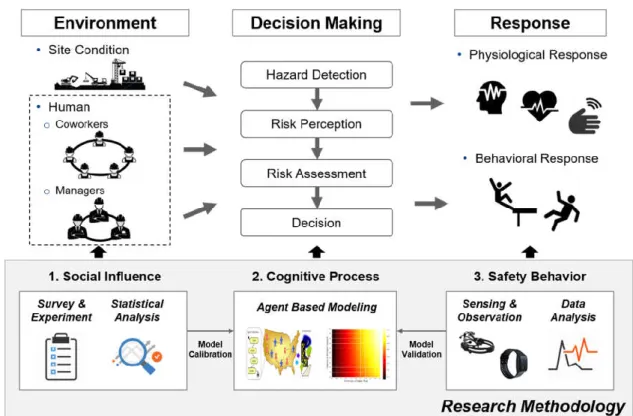
To achieve these research objectives, I have developed a research framework that applies an interdisciplinary research approach as shown in Figure 1.1. When a worker confronts a potential hazard, he/she observes the environment (e.g., site condition, coworkers, and managers) to acquire the information needed to make a decision. Based on the information, the worker performs the cognitive process, and it results in a behavioral response (i.e., safe or unsafe action). In addition, there will be physiological responses during the decision-making process. For example, if the worker perceives a significant risk, his/her nervous system reacts, and distinguishable changes in physiological responses will occur.
9
To incorporate all the processes, the current status of safety norms and social identities are identified using behavioral economic experiments and surveys and statistical analyses (Research Objective #1). Based on the findings from the first study, a theoretical model of the social influence of construction workers’ safety behaviors has been developed and empirically tested (Research Objective #2). Group analyses have been conducted to examine the different patterns of social influence in different cultural backgrounds and organizational structures (Research Objective #3). A computer simulation modeling that integrates workers' safety decision-making processes and social influence has been developed to explore the effects of the socio-cognitive mechanism of safety behaviors (Research Objective #4). Finally, field study has been conducted to examine the potential of using workers' physiological sensory data collected from wearable devices to understand their perceived risk during ongoing work (Research Objective #5).
10
1.5THE STRUCTURE OF THE DISSERTATION
This dissertation is a compilation of the studies used to achieve the proposed research objectives. This dissertation is composed of seven chapters. Chapter 1 and Chapter 7 provide the introduction and conclusion of this work. Chapters 2 through Chapter 6 introduce each of the studies that corresponds to an aforementioned research objective. The following is the list of the chapters.
Chapter 1: Introduction. This chapter introduces the background, problem statements, and objectives and approaches of the entire research effort.
Chapter 2: Current Status of Safety Norms and Social Identities at Construction Sites. This chapter presents the results of behavioral economic experiments that measure and compare safety norms shared by workers as opposed to safety norms by managers to identify the current status of safety norms in construction projects. Additionally, this chapter also presents an explanatory analysis of workers’ social identification with different groups in their job site (i.e., workgroup, company, project, union, and trade)
Chapter 3: The Role of Safety Norms and Social Identifications in Construction Workers’ Safety Behaviors. This chapter develops and empirically tests a theoretical model that explains the relationship between different safety norms, social identities, and safety behaviors. Additionally, relationships among the variables are analyzed using statistical analyses.
Chapter 4:The Effects of Cultural Backgrounds and Organizational Structures on Social Influence Process. This chapter compared the patterns of social influence and workers’ social identification in different cultural backgrounds (i.e., individualistic culture and collective culture) and different organizational structure (i.e., subcontracting system and direct hiring of workers) using group analyses.
Chapter 5: An Empirically Based Agent-Based Model of the Socio-Cognitive Process of Construction Workers’ Safety Behavior. This chapter presents a study that details the creation and development of a behavioral model for workers’ safety behavior grounded in empirical findings from previous chapters. This model then used to test different safety management strategies in different site risk conditions.
11
Chapter 6: Potential of Physiological Sensory Data to Understand Construction Workers’ Perceived Risk. This chapter investigates the effect of high-risk activities on workers’ physiological responses during their ongoing work. This chapter also presents the results of field studies that examine the feasibility of wearable devices to understand workers’ perceived risk during at construction sites.
Chapter 7: Conclusions and Recommendations. This chapter provides a summary of the conclusions that can be drawn from the research. Several recommendations for future work stemming from this research are also provided.
12
CHAPTER 2
CURRENT STATUS OF SAFETY NORMS AND SOCIAL IDENTITIES AT
CONSTRUCTION SITES
22.1INTRODUCTION
An accident occurs when workers’ unsafe behavior coincides with unsafe work conditions (Heinrich et al., 1950; Lingard and Rowlinson, 2005; Choudhry and Fang, 2008). Traditionally, the efforts to improve construction safety have been focused on improving the physical work environment and work procedures on construction sites (Fogarty and Shaw, 2010; Chen and Jin, 2013), and as a result of these efforts, there have been considerable improvements in work environment and procedures in construction over the past several decades (Shin et al., 2014). However, given that 80 – 90% of accidents are associated with workers’ unsafe behaviors (Heinrich et al., 1980; Suraji et al., 2001; Choudhry and Fang, 2008), attention to the improvement of workers’ behavior for safety is on the rise, resulting in the development of programs designed to improve workers’ safety attitudes and behavior—i.e., behavior-based safety (Seo, 2005; Chen and Jin, 2013; Fang et al. 2015).
A large number of factors, including predisposition, experience, education, training, cultural backgrounds, contractual conditions, and organizational settings, can affect workers’ safety behavior (Sawacha et al. 1999). Among such factors, the social aspect of workers’ safety behavior
2 This chapter is adopted from Choi, B., Ahn, S., and Lee, S. (2017) “Construction Workers’ Group
Norms and Personal Standards Regarding Safety Behavior: Social Identity Theory Perspective.” Journal of Management in Engineering, 33(4), 04017001
13
has recently commanded increased attention as more evidence demonstrates that workers’ safety behavior is under the great influence of collective perception and social norms related to safety policies and required safety behavior—often referred to as safety climate and safety norm. Such research efforts focusing on workers’ safety behavior have shown that workers’ shared perceptions and consensus about safety play an important role in shaping their safety attitudes and behavior in organizations (Glendon and Litherland, 2001; Jiang et al., 2014; Choi and Lee 2016). A number of empirical studies have demonstrated that workers’ safety behavior is influenced by their perception of organizational safety policies, procedures, and practices—often referred to as safety climate (Zohar, 1980; Neal et al., 2000; Mohamed, 2002; Clarke and Ward, 2006; Zhang et al. 2016)—and by their perception of others’ behavior—often referred to as safety norms (Brondino et al., 2012; Zhang and Fang, 2013; Goh and Binte Sa’adon, 2014; Choi et al. 2015). Therefore, it is important to make sure that workers have favorable perceptions and consensus about safety behavior for achieving safety in construction projects.
However, the complex nature of the construction workforce makes it very challenging to develop and maintain favorable perception and consensus about safety behaviors in construction projects. Construction workers hold multiple identities while working on a project. Examples of the groups with which construction workers might identify themselves while working on a project are union, trade, workgroup, company, and project. Sharing the same identity plays an important role in forming and maintaining coherent safety norms among the project participants. According to the social identity theory, an individual’s identification with the group is an important mechanism that moderates the effects of group norms on an individual’s behavior (White et al. 2009). In other words, people who strongly identify with a group are more likely to internalize and adhere to the group norms (Wood 2000; Smith et al. 2007; Smith and Louis 2008). On the other hand, the group norms may not be influential to people who do not identity with the group. Therefore, construction workers’ social norms might be distant from management norms regarding safety behavior if workers do not identify themselves with the project. However, it is currently unclear regarding misalignments among safety norms and the currents status of workers' social identification in construction projects.
14
2.2RESEARCH OBJECTIVE AND HYPOTHESES
Despite the importance of group norms and social identities in individuals’ behaviors in organizations, little is known about to the current status of safety norms and social identities, what extent construction workers’ safety attitudes and behavior are influenced by group norms, and to what extent social identification is involved in this process. To reduce the knowledge gap, this study aims to identify: (1) the current status of safety norms and social identities, (2) the influence of group norms on construction worker’s personal standards regarding safety behavior and (3) the impact of social identification on the influence that group norms have on construction workers’ personal standards regarding safety behavior.
Specifically, the following five hypotheses are tested with empirical data in this study: • Hypothesis 1: Perceived group norms, which refer to the perception of coworkers’ attitudes
and behavior are significantly different from the norms desired by project managers regarding safety behavior.
• Hypothesis 2: Perceived group norms are significantly correlated with construction workers’ personal standards regarding safety behavior.
• Hypothesis 3: The salience of social identity is significantly different between the multiple social identities that construction workers have at work.
• Hypothesis 4: Construction workers’ salience of social identity with a workgroup is significantly correlated with the alignment between their perceived workgroup norms and personal standards regarding safety behavior.
• Hypothesis 5a and 5b: Construction workers’ time spent in a workgroup or a project is significantly and positively correlated with the salience of social identity with the workgroup (5a) or the project (5b).
These hypotheses are conjectured based on the characteristics of the construction workforce and the social identity theory. Hypothesis 1 tests whether or not safety norms shared by construction workers are aligned with the norms desired by project managers. Considering the multiple organizational backgrounds in a construction project due to its unique organizational
15
structure (i.e., temporary organizations based on subcontracting), one can hypothesize that safety norms shared by construction workers not be aligned with project managers’ desired norms if workers’ unsafe actions have been observed. In other words, a test of Hypothesis 1 is thought to shed some light on the current status of safety norms at construction sites.
Hypothesis 2 tests whether or not group norms influence individual construction workers’ personal standards regarding safety behavior. Many researchers have provided theoretical and/or empirical evidence that an individual’s behavior is influenced by the behavior and social norms of others in his/her group (Festinger 1954; Bandura 1991; Deutsch and Gerard 1955; Asch 1956; Cialdini et al. 1991; White et al. 2009). In addition, a number of studies have specifically presented empirical evidence of social influence on safety behavior (Cooper 2000; Neal et al. 2000; Mohamed 2002; Clarke and Ward 2006; Choudhry et al. 2007). If empirical data support Hypothesis 2, therefore, it can be proven that construction workers’ safety behavior is under the influence of group norms. Hypothesis 3 tests whether or not there is a difference in the salience of social identity within the different groups construction workers belong to. This hypothesis addresses the unique nature of employment and membership of construction workers. As mentioned previously, due to the multiple and temporary nature of membership, construction workers’ social identities with the different groups they belong to may have different levels of significance to them. Hypothesis 3 tests this idea.
Hypothesis 4 tests whether or not construction workers’ acceptance of the safety-behavior-related norms of a group is affected by their level of social identification with the group. The social identity theory states that group norms are internalized through social identification with the group and this is the process by which individuals’ behavior is put under the influence of social norms (Ashforth and Mael 1989; Terry and Hogg 1996; Hogg and Terry 2000). Hypothesis 4 tests this idea within the context of construction workers’ safety behavior. If empirical data support this hypothesis, it can be proven that construction workers’ identification with a group drives their acceptance of the norms of the group regarding safety behavior.
Last, Hypothesis 5 tests whether there is any significant impact of the time spent with a temporary group—e.g., a project or a workgroup—on the salience of social identity with the group. According to the social identity theory, the degree by which an individual observes other group members and its consequences are an important factor of his/her social identification with the
16
group because frequent interactions with group members can increase the cognitive accessibility of the group identity (Oakes et al., 1991; Turner et al., 1994). Therefore, one can assume that construction workers who have spent a long time within a project or a workgroup would have a strong feeling of membership and identify themselves with the group. Hypothesis 5 tests this idea.
2.3METHOD
2.3.1Measurement of safety norms shared by workers and shared by managers
To measure safety norms in construction projects, a behavioral economic experiment following the norm elicitation protocol developed by Burks and Krupka (2012) was used in this study. The norm elicitation protocol has been used to quantify group norms in various contexts such as ethical dilemmas in a financial service organization (Burks and Krupka 2012), a three-person gift change (Gächter et al. 2013) and a dictator game (Erkut et al. 2015). In this protocol, participants are given a situation where several different actions can be taken in a given circumstance and asked to rate the appropriateness of each of the different actions in an incentivized coordination game structure (Ahn et al. 2015).
Among the situations concerning safety behavior, the working at a height situation was used in this study. Because fall protection is one of the most frequently cited violations and main causes of fatalities in the construction industry in U.S., using “the height situation” is particularly appropriate (OSHA 2014; Jebelli et al. 2015). During the experiment, participants read a statement that describes a hypothetical situation as follows: “Please imagine that Robert is a member of your workgroup, and he works at a workspace where a fall protection is required by the OSHA regulation.” After reading it, participants were asked to evaluate the appropriateness of different actions that Robert might choose in the given situation. Five action scenarios related to connecting “snap hooks”—a common tying system for fall protection equipment—were developed for this experiment, as follows:
• Action 1. Robert does not connect his snap hooks to an anchor point even if he works on a dangerous task and the fall protection system does not bother his work.
17
• Action 2. Robert connects his snap hooks to an anchor point only when he perceives a danger of falling and the fall protection system does not bother his work.
• Action 3. Robert connects his snap hooks to an anchor point only when he perceives a danger of falling.
• Action 4. Robert always connects his snap hooks to an anchor point whenever a fall protection is required. However, he continues to work even if he cannot find an object onto which he can securely connect his snap hooks.
• Action 5. Robert always connects his snap hooks to an anchor point. If he cannot find an object he can securely connect his snap hooks to, he does not continue to work.
Here, these five actions are presented in order of appropriateness as conjectured prior to the experiment (Action 1 is least appropriate, and Action 5 is most appropriate). However, they were presented in a random order in the experiment to minimize the response order effect.
Then, participants of this experiment were asked to rate the appropriateness of each of these five actions on a 4-point Likert scale (‘very inappropriate,’ ‘somewhat inappropriate,’ ‘somewhat appropriate,’ and ‘very appropriate’). The norm elicitation protocol adopts a 4-point Likert scale to prevent a focal point from emerging by just having a central/neutral term in the options (Burks and Krupka 2012). To capture construction workers’ perception of group norms and personal standards separately, worker participants were asked to complete the rating task twice. On the first pass, worker participants were asked to try to match their appropriateness rating with those of a typical member of their group. They were told that their responses would be compared with the responses of a randomly selected member of their group, and that they would be rewarded for every matched response—i.e., a coordination game structure. Participants were informed that 10 % of all the participants will be randomly selected at the end of this experiment, and the selected individual will receive $10 for each matched response. For example, a participant received $50 if he/she was selected and his/her responses for all five actions were identical with those of another randomly selected participant. With the expectation of the incentives, participants are encouraged to think about how others would evaluate those actions, and this is how shared group norms can be elicited through the experiment. The responses collected from the worker participants’ first pass
18
can be interpreted as the perception of attitudes of his/her group members, i.e., perceived group norms.
On the second pass, worker participants were asked to provide their own personal ratings without trying to match anyone else’s ratings. Therefore, the responses collected from the worker participants’ second passes can be interpreted as workers’ personal standards. In order to prevent the effect of consistency motif (Podsakoff et al. 2003) between the two passes, five actions were presented in a different order in the two passes. Based on the randomly determined order of the actions in the first pass, the order of the actions in the second pass was manipulated so that the order is not the same from the first pass. In addition, in order to ensure that responses in the second pass are made separately from the first pass, respondents were given the tasks of the second pass after a short break (approximately five minutes). During the break, the experiment administrators provided participants with instructions for how to respond to the items in the second pass. In determining what is elicited in the first and second pass, the authors considered how personal standards or workgroup norms are intuited. Personal standards mean that a set of behaviors are intuitively acceptable or legitimate to the person. On the other hand, group norms are usually perceived unconsciously, and thereby more difficult to recall or describe. Therefore, to prevent the response to the items regarding personal standards from overriding or contaminating the response to the items regarding group norms, in the norm elicitation protocol the group norms are elicited first using the coordination game setting and then the personal standards are elicited (e.g., Burks and Krupka 2012; Gächter et al. 2013; Erkut et al. 2015).
Likewise, project manager participants were also asked to conduct the rating task twice. On the first pass, project manager participants were asked to try to match their appropriateness rating with those of a typical worker at their site, and they were told that their responses would be compared with the responses of a randomly selected worker and be rewarded for every matched response. Therefore, the responses collected from the project manager participants’ first pass can be seen as project managers’ beliefs about social norms shared by the workers in their project, i.e., project managers’ perception of worker’s safety norms. On the second pass, they were asked to try to match their appropriateness ratings with the fellow managers at their site, and they were told that their responses would be compared with the responses of a randomly selected manager and be rewarded for every matched response. Therefore, the responses collected from the project manager
19
participants’ second passes can be interpreted as the norms desired by project managers. Table 2.1 summarizes the norms and personal standards that are elicited from each pass in the experiment.
Table 2.1 Norm Elicitation Protocol Structure Participants Target to match with
Workers
Other workgroup members No others Workers’ perceived
group norms
Worker’s personal standards
Managers
Workers Other managers Manager’s belief about
worker’s safety norms
Manager’s desired norms
2.3.2Measurement of the salience of social identities
Previous research efforts to measure the salience of social identity used three interrelated dimensions of social identity—i.e., cognitive dimension, affective dimension, and evaluative dimension (Ellemers et al., 1999; Bergami and Bagozzi, 2000; Bagozzi and Lee, 2002; Jackson, 2002). The cognitive dimension of social identity refers to the awareness of one’s membership in a group (Tajfel, 1978). To measure the cognitive dimension, two survey items were adapted from Mael and Ashforth (1992)’s questionnaire items and used in this research: “When I talk about my workgroup, I usually say we rather than they,” and “When someone criticizes my workgroup, it feels like I am criticized.” The affective dimension of social identity refers to the sense of emotional involvement with the group (Ellemers et al., 1999; Bergami and Bagozzi, 2000). To measure the affective dimension, two survey items were adapted from Bergami and Bagozzi (2000)’s questionnaire items and used in this research: “I am happy to be a member of my workgroup” and “I am attached to my workgroup”. The evaluative dimension of social identity refers to a positive or negative value or connotation attached to the group membership (Ellemers et al., 1999; Bagozzi and Lee, 2002). To measure evaluative dimension, two items were adapted from Ellemers et al. (1999)’s questionnaire items and used in this research: “I am proud to be a member of my workgroup” and “I have respect for my workgroup”. Every item was measured on a 7-point Likert scale was used: -3 = ‘strongly disagree’, -2 = ‘disagree’, -1 = ‘somewhat disagree’, 0 = ‘neither disagree nor agree’, 1 = ‘somewhat agree’, 2 = ‘agree’, 3 = ‘strongly agree’. This kind
20
of 7-point Likert scale items have been widely used in social identity measurement (e.g., Ellmers et al. 1999; Schubert and Otten 2002; Jackson 2010).
As mentioned previously, construction workers may have multiple social identities while working on a job site, and the level of social identification for each identity may vary. Five groups with which a typical construction worker may identify him/herself were identified prior to the surveys: union, trade, workgroup, company, and project. Every item for measuring the dimensions of social identity was repeated for all of the five groups (i.e., identities) in the survey questionnaire. Hence, the survey questionnaire contained a total of 30 items (2 items per each social identity dimension × 3 dimensions × 5 identities) for measuring all the dimensions of social identity for all the groups.
2.3.3Participants and Procedure
For data collection, three different building construction sites were approached. Site A was a new research facility building construction project. The data were collected from this site during May 2014. Site B was a large sized library building retrofit project. The data were collected from this site during September 2014. Site C was a large sized research facility retrofit project. The data were collected from this site during December 2014. A total of 106 workers (26 workers from site A, 45 workers from site B, and 35 workers from site C) and 9 project managers (3 project managers from each site) participated in the study. All of these three construction sites were located in Ann Arbor, Michigan, US. All worker participants were male union workers, and the workers had been involved in their current project for 4.6 months on average. All project manager participants were male, had 10+ years of experiences in construction management, and had been involved in their current project from the project’s onset.
Before the data collection, the data collection instruments and experiment/survey procedures were reviewed and approved by Institutional Review Board (IRB) of the University of Michigan. The behavioral experiment along with the survey was taken in sequence on the same day. Workers participated in both the behavioral experiment (i.e., norm elicitation) and the survey (i.e., social identity measurement), whereas project managers participated only in the experiment. The experiment and surveys took place during break times to avoid interruptions on the construction tasks. One week prior to the experiment, the administrators advertised the purpose
21
and process of the study to the foremen in a weekly meeting, and the foremen advertised the study to their workgroup members. Then, the workers at the sites voluntarily participated in the behavioral experiment and surveys using their break times. Before starting the experiment, the administrators provided a brief explanation of the purpose and processes of the study including the information about the incentives. The experiment and the survey took approximately 25–30 minutes in total to complete. Every participant was paid a $10 participation fee.
After the data collection, 14 responses from a total of 106 responses from workers were removed from the sample due to incompleteness. Additionally, 10 responses from a one-person-group—only one group member from a particular group participated in the experiment—were also removed from the sample because of the impossibility of defining the group norms of their group based on a single response. After removing these incompatible responses, a total of 82 responses from workers (of 12 different trades, of 13 different companies, and of 19 different groups) and 9 responses from project managers were used in the data analysis.
2.4RESULTS
2.4.1Misalignment between workers’ perceived group norms and the norms desired by project managers
Participants’ appropriateness ratings of the actions collected from the behavioral experiment were converted into numerical scores for quantitative analysis: -1 = ‘very inappropriate’, -1/3 = ‘somewhat inappropriate’, 1/3 = ‘somewhat appropriate’, and 1 = ‘very appropriate’. The mean and the standard deviation of the appropriateness ratings from each pass for each action are presented in Table 2.2.
22
Table 2.2 Mean and Standard Deviation for Participants’ Appropriateness Rating Worker’s perceived group norms (N=82) Worker’s personal standards (N=82) Manger’s belief about worker’s safety norms (N=9) Manager’s desired norms (N=9)
Mean SD Mean SD Mean SD Mean SD
Action 1 -0.87 0.38 -0.89 0.32 -0.78 0.33 -1.00 0.00 Action 2 -0.33 0.69 -0.37 0.66 -0.11 0.75 -0.78 0.33 Action 3 -0.36 0.65 -0.36 0.69 -0.11 0.69 -0.85 0.44 Action 4 -0.45 0.64 -0.46 0.61 -0.19 0.73 -0.85 0.29 Action 5 0.78 0.41 0.76 0.44 0.48 0.65 1.00 0.00
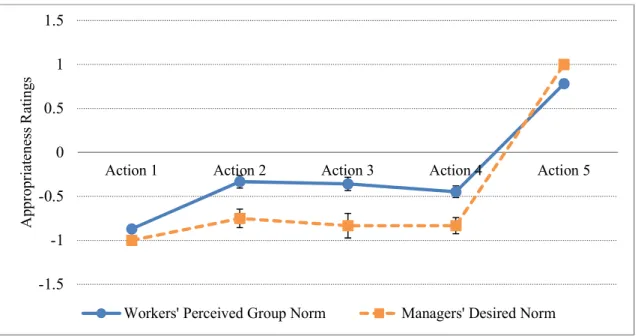
The average of workers’ perceived group norms and the average of the norms desired by project managers are shown in Figure 2.1. Figure 2.1 shows that there were measurable differences between workers’ perceived group norms and the norms desired by project managers regarding safety behavior; project managers agreed that Actions 1 – 4 are very inappropriate and only Action 5 is very appropriate, while workers agreed that Action 1 is very inappropriate, but Actions 2 – 4 are only somewhat inappropriate. This shows that group norms shared by workers regarding safety behavior were more lenient in general than the norms desired by project managers. Figure 2.1 also shows that the misalignment was relatively large for Actions 2, 3, and 4, while the misalignment was very small for Action 1 and 5. This shows that the misalignment between construction workers’ perceived group norms and the norms desired by project managers is small for obviously appropriate or inappropriate actions, and the misalignment is relatively large for the actions with subtleties.
23 Note: Mean evaluations with stanard errors
Figure 2.1 Workers' Perceived Group Norms and Managers' Desired Norms
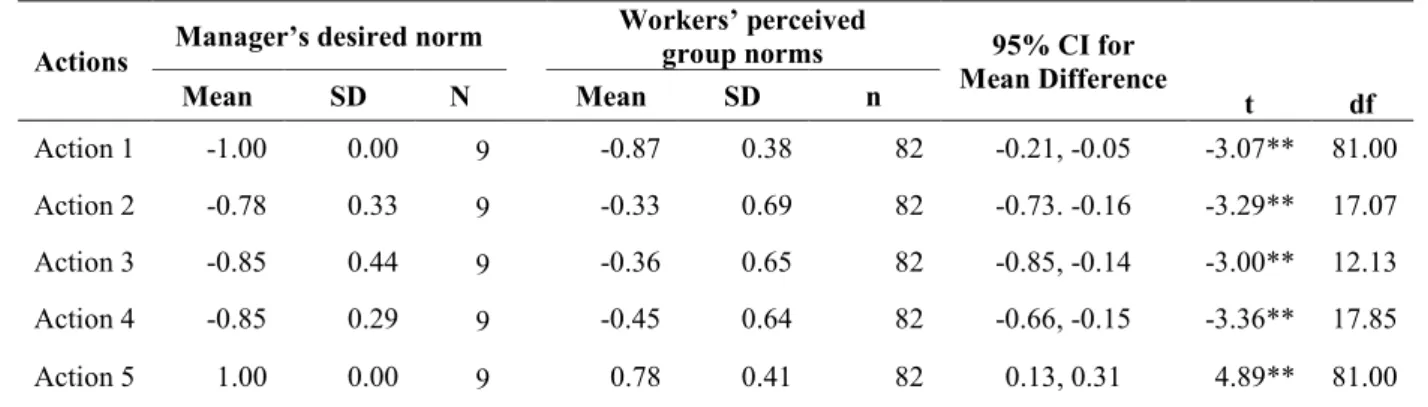
To statistically test the difference between workers’ perceived group norms and the norms desired by project managers (i.e., Hypothesis 1), independent sample t-tests were conducted for each action. As shown in Table 2.3, the result of the tests shows that that the misalignment between workers’ perceived group norms and the norms desired by project managers was significant for every action. Specifically, negative mean differences were found for the inappropriate actions (-0.13 for Action 1, -0.45 for Action 2, -0.49 for Action 3, and -0.40 for Action 4), and a positive mean difference was found for the appropriate action (0.22 for Action 5). This means that project manager’s desired norms were statistically significantly stricter than workers’ perceived group norms regarding safety behaviors. For example, for Action 3 (“Robert connects his snap hooks to an anchor point only when he perceives a danger of falling”), workers’ perceived group norms 0.36) were close to ‘somewhat inappropriate’, whereas the norm desired by project managers (-0.85) was close to ‘very inappropriate.’ With these results, Hypothesis 1 was accepted.
-1.5 -1 -0.5 0 0.5 1 1.5
Action 1 Action 2 Action 3 Action 4 Action 5
A p pr o priat eness R at in gs
24
Table 2.3 Results of Independent t-tests between Managers' Desired Norms and Workers' Perceived Group Norms
Actions Manager’s desired norm
Workers’ perceived
group norms 95% CI for Mean Difference t df Mean SD N Mean SD n Action 1 -1.00 0.00 9 -0.87 0.38 82 -0.21, -0.05 -3.07** 81.00 Action 2 -0.78 0.33 9 -0.33 0.69 82 -0.73. -0.16 -3.29** 17.07 Action 3 -0.85 0.44 9 -0.36 0.65 82 -0.85, -0.14 -3.00** 12.13 Action 4 -0.85 0.29 9 -0.45 0.64 82 -0.66, -0.15 -3.36** 17.85 Action 5 1.00 0.00 9 0.78 0.41 82 0.13, 0.31 4.89** 81.00 Note: Welch-Satterthwaite approximation employed due to unequal group variances.
* p < .05, ** p < .01
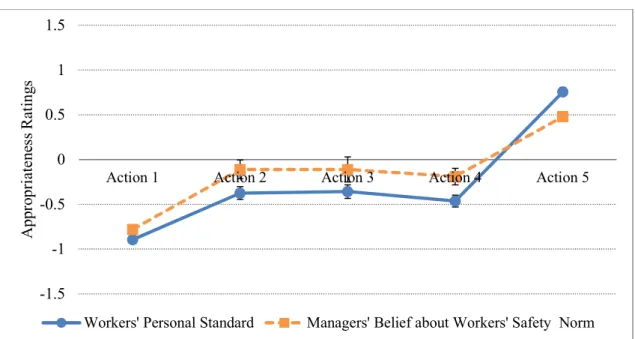
In addition, the average of workers’ personal standards and the average of the project managers’ belief about workers’ safety norms are shown in Figure 2.2. Figure 2.2 shows that there is also some difference between workers’ personal standards and project managers’ belief about the workers’ group norms for Action 2 – 5; workers evaluated that Action 2 – 4 are somewhat inappropriate, while Action 5 is very appropriate. On the other hand, project managers believed that their workers will evaluate that Action 2 – 4 is neither appropriate nor inappropriate, while Action 5 is only somewhat appropriate. This shows that project managers tended to believe that workers’ personal standards regarding safety behavior are even more lenient than they actually are. However, independent t-tests showed that the difference between project managers’ beliefs about workers’ group norms and workers’ actual group norms was not statistically significant for every Action.
25 Note: Mean evaluations with standard errors
Figure 2.2 Workers' Personal Standards and Managers' Belief about Workers' Safety Norms
2.4.2Influence of group norms on personal standards
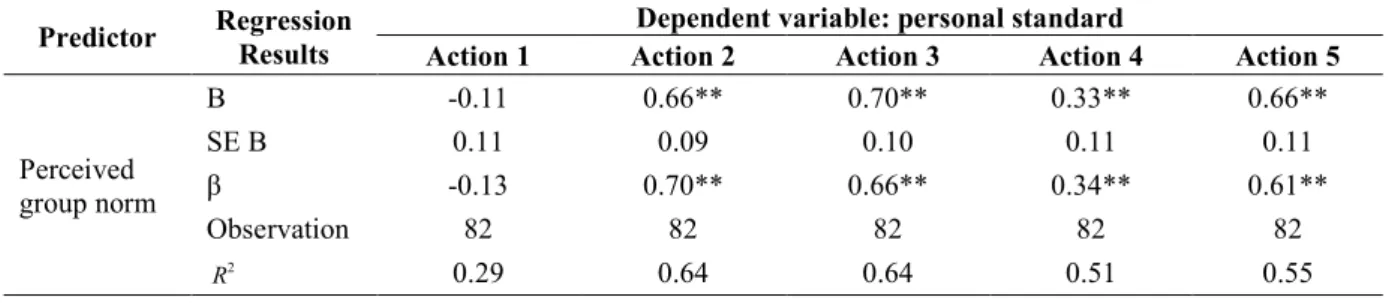
Next, whether or not workers’ personal standards are significantly correlated with their perceived group norms (i.e., Hypothesis 2) was tested by using Ordinary Least Squares (OLS) regressions. Table 4 shows the results of the OLS regressions. As shown in Table 2.4, workers’ personal standards were significantly correlated with the perceived group norm for Action 2 (β = 0.70, t(55) = 6.97, p < 0.01), Action 3 (β = 0.66, t(55) = 6.84, p < 0.01), Action 4 (β = 0.34, t(55) = 2.94, p < 0.01), and Action 5 (β = 0.61, t(55) = 5.66, p < 0.01). The regression coefficient was not significant for Action 1 (β = -0.13, t(55) = -1.00, p > 0.32). Therefore, Hypothesis 2 was marginally accepted. -1.5 -1 -0.5 0 0.5 1 1.5
Action 1 Action 2 Action 3 Action 4 Action 5
A pp ro pri ate ne ss R at ing s
26
Table 2.4 Results of OLS Regression for the Relationship between Workers' Personal Standards and Perceived Group Norms
Predictor Regression Results
Dependent variable: personal standard
Action 1 Action 2 Action 3 Action 4 Action 5
Perceived group norm B -0.11 0.66** 0.70** 0.33** 0.66** SE B 0.11 0.09 0.10 0.11 0.11 β -0.13 0.70** 0.66** 0.34** 0.61** Observation 82 82 82 82 82 2 R 0.29 0.64 0.64 0.51 0.55 Note: ** p < .01
2.4.3Salience of social identities in construction workers
Table 2.5 shows the mean, standard deviation, and reliability score of the social identity measures for different groups. In general, the reliability scores from the different items used to measure the dimensions of social identity exceeded the acceptable level of 0.6 (Hair et al. 2006; Patel and Jha 2016), which reaffirmed that the three dimensions of social identity are reliable.
Table 2.5 Means, Standard Deviations, and Reliability Scores for Social Identity Measures Group Dimension Level of Social Identification (N = 82)
Mean SD Reliability Workgroup Overall 1.92 0.68 0.70 Cognitive 1.65 1.17 0.72 Affective 1.87 0.85 0.62 Evaluative 2.23 0.71 0.84 Company Overall 1.47 1.11 0.88 Cognitive 0.98 1.69 0.90 Affective 1.48 1.18 0.76 Evaluative 1.96 0.96 0.89 Project Overall 1.20 1.06 0.85 Cognitive 0.29 1.48 0.67 Affective 1.32 1.14 0.66 Evaluative 2.00 1.07 0.92 Trade Overall 2.27 0.82 0.88 Cognitive 1.95 1.26 0.78 Affective 2.32 0.87 0.86 Evaluative 2.54 0.63 0.93 Union Overall 1.89 1.25 0.93 Cognitive 1.62 1.57 0.88 Affective 1.93 1.32 0.91 Evaluative 2.13 1.23 0.89
27
Figure 2.3 shows a graphical representation of the descriptive analysis. In Figure 2.3, each vertex of a triangle is the mean score of the sample for each dimension of social identity, and each of five triangles represents an identity (i.e., union, trade, workgroup, company, and project). The larger the size of the triangle, the more salient the identity is. Therefore, Figure 2.3 shows that workers in general had the highest level of social identity with their trade, and the lowest level of social identity with the project. It is worth noting that the cognitive dimension of workers’ project identity was minimal when compared to the cognitive dimensions of other identities.
Figure 2.3 Current Staus of Worekrs' Social Identifications
To demonstrate the statistical significance of this pattern, whether or not the salience of social identity is different between the social identities (i.e., Hypothesis 3) was tested using paired t-tests for all possible pairs of social identities. To prevent false positive errors associated with multiple comparisons, results of the paired t-test were corrected by Bonferroni correction. Table 2.6 shows the result of the paired t-tests.
0.0 0.5 1.0 1.5 2.0 2.5 3.0 Cognitive Affective Evaluative