AUTHOR(S):
TITLE:
YEAR:
Publisher citation:
OpenAIR citation:
Publisher copyright statement:
OpenAIR takedown statement:
This is the ______________________ version of an article originally published by ____________________________ in __________________________________________________________________________________________ (ISSN _________; eISSN __________).
This publication is distributed under a CC ____________ license. ____________________________________________________
Section 6 of the “Repository policy for OpenAIR @ RGU” (available from http://www.rgu.ac.uk/staff-and-current-students/library/library-policies/repository-policies) provides guidance on the criteria under which RGU will consider withdrawing material from OpenAIR. If you believe that this item is subject to any of these criteria, or for any other reason should not be held on OpenAIR, then please contact [email protected] with the details of the item and the nature of your complaint.
CRAWFORD, L., HELLIAR, C. and POWER, D.
The temporal nature of legitimation: the case of IFRS8.
2016
CRAWFORD, L., HELLIAR, C. and POWER, D. 2016. The temporal nature of legitimation: the case of IFRS8. Accounting in Europe [online], 13(1), pages 43-64. Available from: https://dx.doi.org/10.1080/177449480.2016.1160136
CRAWFORD, L., HELLIAR, C. and POWER, D. 2016. The temporal nature of legitimation: the case of IFRS8. Accounting in Europe [online], 13(1), pages 43-64. Held on OpenAIR [online]. Available from: https://openair.rgu.ac.uk
AUTHOR ACCEPTED TAYLOR AND FRANCIS
Accounting in Europe 1744-9480 1744-9499
The Version of Record of this manuscript has been published and is available in Accounting in Europe, 2016, http://www.tandfonline.com/10.1080/177449480.2016.1160136.
BY-NC-ND 4.0 https://creativecommons.org/licenses/by-nc-nd/4.0
For Peer Review Only
The temporal nature of legitimation: the case of IFRS8
Louise Crawford*, Christine Helliar** and David Power***
*Aberdeen Business School, Robert Gordon University, Aberdeen, Scotland, [email protected]
** School of Commerce, University of South Australia, SA 5000, Phone: +61 8302 7025, [email protected].
***School of Social Science, University of Dundee, Dundee, Scotland, DD1 4HN, Phone: +1382 384854, [email protected]. 2 3 4 5 6 7 8 9 10 11 12 13 14 15 16 17 18 19 20 21 22 23 24 25 26 27 28 29 30 31 32 33 34 35 36 37 38 39 40 41 42 43 44 45 46 47 48 49 50 51 52 53 54 55 56 57
For Peer Review Only
The temporal nature of legitimation: the case of IFRS8Legitimation can operate on an episodic or continual basis (Suchman, 1995). We examine the temporal legitimation of the International Accounting Standards Board (IASB)’s actions during the adoption and review of International Financial Reporting Standard (IFRS) 8 ‘Operating Segments’. We conceptualise the controversy surrounding IFRS8 as an episode when the IASB sought segmental reporting convergence with the US standard, SFAS 131. Interpreting evidence from 15 (20) semi-structured interviews undertaken in 2009 (2011), before (after) entities reported under IFRS8, reveals its adoption precipitated an episodic legitimacy threat from selected audiences to the actions of the IASB. We discuss the IASB’s attempt to influence legitimation for this episode through commitment to a post-implementation review (IFRS Foundation, 2011) of IFRS8. Interpreting legitimacy concerns across diverse audiences about specific actions of the IASB (the introduction of IFRS8) enables us to draw conclusions about the resilience of the IASB as a standard setting organisation, in itself.
Keywords: legitimation, IFRS8, segmental reporting, episodic, temporal 2 3 4 5 6 7 8 9 10 11 12 13 14 15 16 17 18 19 20 21 22 23 24 25 26 27 28 29 30 31 32 33 34 35 36 37 38 39 40 41 42 43 44 45 46 47 48 49 50 51 52 53 54 55 56 57 58
For Peer Review Only
1. IntroductionThe current paper examines the temporal nature of legitimation through the actions of the International Accounting Standards Board (IASB) in relation to its adoption of International Financial Reporting Standard (IFRS) 8 ‘Operating Segments’. There are two divergent theoretical approaches to examining organisational legitimacy: strategic and institutional (Suchman, 1995). In the current paper we use the strategic approach, which conceptualises legitimation as an operational resource of the organisation seeking to gain, maintain or repair legitimacy. By contrast, the institutional approach conceptualises legitimacy as a set of embedded institutions, cultures, norms and beliefs that are cognitively accepted as part of organisational life. The IASB is often thought to legitimise its existence with diverse audiences using a number of strategies to manage conflicts between different constituencies’ “systems of beliefs or points of view” (Suchman, 1995, p576), so that IFRSs are perceived as “desirable, proper and appropriate”. Suchman (1995) also argues that legitimation has a temporal dimension, distinguishing between legitimation dynamics that “operate on an episodic or transitory basis from those that are continual and long-lasting” (p583). In this paper, we conceptualise the controversy surrounding IFRS8 as an episode in time when the IASB set out to converge segmental reporting practice with the US standard, Statement of Financial Accounting Standard 131 (SFAS), and sought legitimation for this action from its diverse constituencies1.
We report evidence from 15 semi-structured interviews undertaken in 2009 before entities reported under IFRS8 and 20 further semi-structured interviews in 2011, after IFRS8 became operational. Our research is interpreted through the theoretical lens of legitimacy, with a particular focus on the temporal nature of pragmatic and moral legitimation. We argue that 2 3 4 5 6 7 8 9 10 11 12 13 14 15 16 17 18 19 20 21 22 23 24 25 26 27 28 29 30 31 32 33 34 35 36 37 38 39 40 41 42 43 44 45 46 47 48 49 50 51 52 53 54 55 56 57
For Peer Review Only
the episode surrounding the controversial adoption of IFRS8 precipitated a legitimacy threat from selected audiences to the actions of the IASB. Specifically, audience concern was raised about the IFRS8’s potential impact on financial reporting and the IASB’s due process surrounding the adoption of this standard. Interpreting legitimacy concerns across diverse audiences about the episodic actions of the IASB (the introduction of IFRS8) enables us to draw conclusions about the resilience of the IASB as a standard setting organisation in itself. We discuss the extent to which the IASB’s attempt to influence legitimacy for this IFRS8 episode, through committing to a post-implementation review of the new standard, was successful.
The IASB is a private organisation responsible for setting IFRSs to be applied by reporting entities operating across the globe. As a result, it relies on support from diverse audiences to legitimise its behaviour; that it is “operating [actions] in a desirable, proper and appropriate manner” and that the IASB, as an organisation, “is desirable, proper and appropriate in itself [its essence]” (Suchman, 1995, p583). There is evidence that the IASB’s “essence” (p583) is widely perceived as legitimate based on the support that it receives from several supranational organisations, for example, the International Monetary Fund (IMF), the World Bank (WB) and the Basel Committee (IFRS Foundation, 2015). 2 In addition, at the national level, the fact that many countries either require or allow IFRS to be used by public listed companies when reporting in their jurisdictions suggests evidence of support.3 Indeed, the Financial Stability Board (FSB) specifies IFRS as one of its “Key Standards for Sound Financial Systems”; IFRS are featured in The Compendium of Standards which: “lists the various economic and financial standards - by both subject area and issuing body - that are internationally accepted as important for sound, stable and well-functioning financial systems.” (Financial Stability Board, 2015). It could be argued that the IASB as an 2 3 4 5 6 7 8 9 10 11 12 13 14 15 16 17 18 19 20 21 22 23 24 25 26 27 28 29 30 31 32 33 34 35 36 37 38 39 40 41 42 43 44 45 46 47 48 49 50 51 52 53 54 55 56 57 58
For Peer Review Only
organisation, in “essence” (Suchman, 1995), has achieved a store of legitimacy, where it has become a taken-for-granted setter of international financial reporting standards.
However, legitimacy of an organisation, once gained, must be maintained, and repaired if damaged. For the IASB, legitimacy of its actions rests with the “acceptability and credibility [of] … those it seeks to govern” (Black, 2008, p144); hence, in the context of a particular standard, such as IFRS8, the practices prescribed should embrace the ideological values and beliefs of the IASB’s audiences as to how reporting entities should identify, measure and communicate segmental information; this should be managed effectively through the IASB’s open, transparent and consultative due process over standard setting. If IFRS practice as encapsulated in one standard is accepted as legitimate, then such legitimation of the IASB’s operation should reinforce legitimation of the IASB itself as “…who and what is legitimised in the process” of accepting practice is pertinent (Georgiou & Jack, 2011, p313). However, if a practice, such as that articulated in IFRS8, is contested, then the legitimacy of the IASB as a standard setter may be temporarily or permanently damaged.
However, despite evident acceptance of the IASB as a legitimate standard setting organisation, operational actions of standard setting may be controversial and trigger episodic challenges to its legitimacy. Arguably, such a challenge occurred in 2006 when the IASB announced that it was replacing International Accounting Standard (IAS)14R “Segmental Reporting” with IFRS8 “Operating Segments” for accounting periods starting on or after 1st January 2009 (IASB, 2006a, para IN2). This new standard mimicked the US’s SFAS 1314 and attracted a lot of controversy during its adoption process (European Commission, 2007; Crawford, Helliar & Power, 2010; Crawford, Ferguson, Helliar & Power, 2014) with the Exposure Draft (ED) 8 ‘Operating Segments’ (IASB, 2006c)5 eliciting 182 comment letters 2 3 4 5 6 7 8 9 10 11 12 13 14 15 16 17 18 19 20 21 22 23 24 25 26 27 28 29 30 31 32 33 34 35 36 37 38 39 40 41 42 43 44 45 46 47 48 49 50 51 52 53 54 55 56 57
For Peer Review Only
(IASB, 2006b). After analysing these comment letters, the IASB concluded that there was overall support for the approach which it proposed to mandate in IFRS8 (IASB, 2006d).
At the same time, in 2007, the IASB amended its due process (IFRS Foundation, 2011) to include a post-implementation review (PIR) “of each new IFRS or major amendment” two years after the implementation of new IFRS requirements (IFRS Foundation, 2013a, p32). In 2012, IFRS8 became the first standard to be subject to this PIR process. IFRS8 provided the platform through which the PIR process itself was developed (Crawford, Extance, Helliar & Power, 2012; Moldovan, 2014). For example, during the development of the PIR process, the European Financial Reporting Advisory Group’s (EFRAG) suggestions to include an open Request for Information (IFRS Foundation, 2013a, p30) was incorporated. This request now forms the first part of a two-stage PIR process which encompasses: (i) setting the scope of the PIR and deciding upon the questions to be asked in the ‘Request for Information’; and (ii) analysing information from this consultation (IFRS Foundation, 2013c, para 6.52-6.54). During this second stage, the process includes an option for the IASB to gather additional evidence from: reviewing the academic literature and other relevant research; conducting outreach events with “relevant parties”; and/or analysing financial statement disclosures (IFRS Foundation, 2013c, para 6.60). As such, the IASB’s first Request for Information was in regard to IFRS8’s implementation, and it undertook over 60 outreach events across the world as part of IFRS8’s PIR; more than half of these events were targeted at European audiences (IFRS Foundation, 2013a). Further outreach events were held solely with 17 investors. In addition, the IASB specifically sourced non-US6 research to be considered during the post-implementation review in order to provide independent evidence of how IFRS8 was working in practice rather than relying on findings about the earlier implementation of SFAS 131 in the USA.
2 3 4 5 6 7 8 9 10 11 12 13 14 15 16 17 18 19 20 21 22 23 24 25 26 27 28 29 30 31 32 33 34 35 36 37 38 39 40 41 42 43 44 45 46 47 48 49 50 51 52 53 54 55 56 57 58
For Peer Review Only
Studying the individual standard setting actions of the IASB in relation to the adoption of IFRS8 and separating this episode from the widespread acceptance of the IASB as a global standard setter, enables us to contribute to the literature by examining the temporal nature of legitimation and its impact on elements of pragmatic and moral legitimacy. In part, this analysis answers Deephouse and Suchman’s (2008) and Durocher and Fortin’s (2010) calls for more research on legitimation at multiple levels within different organisational fields, and extends the use of Suchman’s (1995) legitimation typology to critically examine the interactions between a supranational organisation, the IASB, and its diverse audiences.
The remainder of the paper is structured as follows. In the next section we discuss the temporal dynamic of legitimation and how this relates to Suchman’s typology of pragmatic and moral legitimacy. We then provide a brief history about the controversy surrounding IFRS8’s introduction and identify issues that caused concern amongst some audiences. The third section describes the research method employed which is followed by our discussion of findings. Finally we present our conclusions.
2. The temporal nature of legitimation
This section focuses on the temporal nature of legitimacy. We first distinguish between pragmatic, moral and cognitive notions of legitimacy, before discerning which specific subtypes illuminate the temporal dynamic of legitimation relating to the IASB’s action of developing and reviewing IFRS8.7
Understanding the reasons why audiences may grant legitimacy to the standard setting activity of the IASB is important, especially as various audiences may (or may not) perceive 2 3 4 5 6 7 8 9 10 11 12 13 14 15 16 17 18 19 20 21 22 23 24 25 26 27 28 29 30 31 32 33 34 35 36 37 38 39 40 41 42 43 44 45 46 47 48 49 50 51 52 53 54 55 56 57
For Peer Review Only
accounting practice as legitimate for different reasons. For example, granting legitimacy may depend upon an audience’s view of the standard itself, in this case IFRS8, and their beliefs or expectations in relation to the prescribed accounting practice and/or the due process underpinning the standard’s adoption (i.e., the process leading to the IASB’s adoption and review of IFRS8). Legitimacy can be analysed in three broad types: pragmatic, moral and cognitive legitimacy (Suchman, 1995); such analysis has been used in the literature to interrogate international standard setting (Durocher, Fortin & Cote, 2007; Crawford, Helliar, Monk & Venezian, 2014) as well as to other spheres of regulatory activity (Black, 2008; Georgio & Jack, 2011; O’Dwyer, Owen & Unerman, 2011).
Pragmatic legitimacy is based on audience evaluation of practice from a self-interested perspective and is easiest to obtain from those constituents most likely to support the practice (O’Dwyer, Owen & Unerman, 2011). Pragmatic legitimacy can be analysed further into exchange, influence and dispositional legitimacy. By way of illustration, if an audience perceives that: (i) it will benefit directly from IFRS8’s implementation; (ii) it can influence the development of IASB standards; and (iii) its interests are reflected in the goals and actions of the IASB, then that audience will confer exchange, influence and dispositional legitimacy respectively in respect of IFRS8.
Moral legitimacy, of which there are four subtypes (consequential, procedural, personal and structural) is based on audience evaluation of whether a practice is “the right thing to do” (Suchman, 1995, p 579) from a public interest perspective (Georgiou & Jack, 2011, p313). Thus, an audience will confer consequential legitimacy if it deems that socially valued outcomes have or will emerge from the IASB’s actions. Such consequences may relate to the belief that IFRS8 disclosures will produce decision-useful information, in line the IASB’s 2 3 4 5 6 7 8 9 10 11 12 13 14 15 16 17 18 19 20 21 22 23 24 25 26 27 28 29 30 31 32 33 34 35 36 37 38 39 40 41 42 43 44 45 46 47 48 49 50 51 52 53 54 55 56 57 58
For Peer Review Only
conceptual framework (IASB, 2010). Procedural legitimacy will be granted if audiences determine that the development and implementation of IFRS8 embraces socially accepted techniques and procedures, for example, the IASB’s due process. Finally, if audiences value organisational leaders as representing diverse audience interests, and perceive the IASB as an appropriate organisation to set international standards, then personal and structural legitimacy will be conferred, respectively. Finally, cognitive legitimacy does not involve audience evaluation; it reflects an institutionalised, enduring, “taken-for-granted acceptance” of an organisation and/or its practice (Georgio & Jack, 2011, p313). Cognitive legitimacy is not malleable as an organisational resource and lends itself to explaining legitimacy from an institutional perspective (Suchman, 1995).
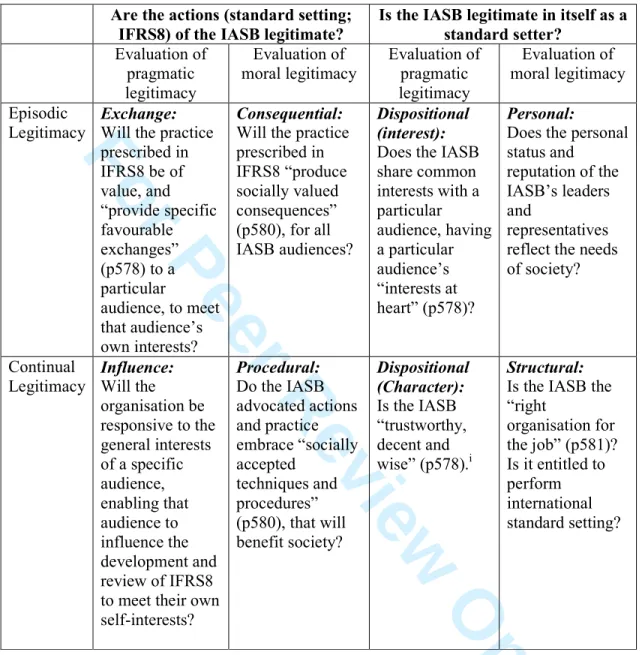
Our research is framed through the lens of strategic legitimacy and considers the temporal elements of pragmatic and moral legitimacy which involve audience evaluation of ‘what is’ and ‘what should be’, respectively (Crawford et al., 2014a). Legitimation has a “temporal texture” (Suchman, 1995, p583) and can operate at an episodic, transitory level or on a long-lasting, continual basis.8 Thus, temporal legitimacy granted, or challenged, in respect of IFRS8, will represent an episode in time on a continuum in terms of legitimacy gained and maintained by the IASB for its existence and its actions. The subtypes of pragmatic and moral legitimacy can be distinguished according to this temporal dynamic as they relate to legitimation of actions [IFRS8] and the organisation [IASB]. In such a matrix, exchange and consequential legitimacy are aligned with audiences granting episodic legitimacy for the actions of an entity, whereas influence and procedural legitimacy relate to the granting of continual legitimacy for the actions of an entity.9 Table 1 elaborates on this matrix highlighting episodic and continual legitimacy for an organisation’s actions and its essence, in the context of IFRS8 and the IASB, respectively. Using this matrix to inform our research, 2 3 4 5 6 7 8 9 10 11 12 13 14 15 16 17 18 19 20 21 22 23 24 25 26 27 28 29 30 31 32 33 34 35 36 37 38 39 40 41 42 43 44 45 46 47 48 49 50 51 52 53 54 55 56 57
For Peer Review Only
we interpret from our interviewee responses, whether there is evidence of temporal legitimacy granted or withheld in response to the controversy surrounding IFRS8.10
Insert Table 1 about here
3. The IFRS8 controversy
Disclosure of segmental data should not in itself be controversial11 as it involves information that should help users understand the performance of a business’s activities as well as the economic environments in which the reporting entity operates (IFRS8, para 1). Nevertheless, the underlying philosophy of IFRS8 was contested as it focussed on the ‘management approach’ to identifying segments which requires:
“….identification of operating segments on the basis of internal reports that are regularly reviewed by the entity’s chief operating decision maker [CODM] in order to allocate resources to the segment and assess its performance”. (IFRS8 para IN11)
In the case of IFRS8, the practice espoused was contested by key audiences with continued opposition to the standard throughout the adoption and implementation process (Crawford, Ferguson, Helliar & Power, 2014). Indeed, the European Parliament suggested that the segmental reporting practice mandated in IFRS8 would not produce “segmental information sufficient to allow users to assess the risks and drivers of the business in terms of geography”. For the first time in its history the European Parliament12- a powerful actor in the legitimation of standards issued by the IASB - did not rely solely on the findings of the IASB’s due process; instead, as part of its own comitology procedure, the European Parliament asked the European Commission to carry out a ‘potential-impacts’ assessment and report back to Parliament before it would endorse IFRS8 for use within the European Union (EU) (European Commission, 2007; Crawford et al., 2014). When IFRS8 was eventually endorsed into European law, the European Parliament noted a number of concerns and requested that 2 3 4 5 6 7 8 9 10 11 12 13 14 15 16 17 18 19 20 21 22 23 24 25 26 27 28 29 30 31 32 33 34 35 36 37 38 39 40 41 42 43 44 45 46 47 48 49 50 51 52 53 54 55 56 57 58
For Peer Review Only
the European Commission “…follow closely the application of IFRS8 and report back to the parliament no later than 2011…” and that “if the Commission discovers deficiencies in the application of IFRS8 it has a duty to rectify such deficiencies” (European Parliament, 2007).13
The adoption of IFRS8 caused concern (IASB, 2006a – IFRS8, Basis for Conclusions; IASB, 2006b; European Commission, 2007) amongst diverse constituents about: (i) the management approach, including the impact of the chief operating decision maker (CODM) and non-IFRS measures on determining, aggregating and reporting segmental information; (ii) the lack of mandatory geographical segments; (iii) potential inconsistency with the IASB’s conceptual framework regarding consistency, comparability and decision-usefulness; and (iv) the prioritisation by the IASB on convergence with FASB standards over meeting the needs of other constituencies.
Management approach, CODM, Non-IFRS measures and aggregations
This CODM term is common in the US but, at the time of IFRS8’s adoption, the term was not commonly used elsewhere in the world, or employed by the IASB in any of its others standards. This concern resonated with notions of dispositional legitimacy, where the style and characteristics embodied in IFRS8 reflected US practice, potentially alienating non-US audiences from accepting the standard. Indeed, a major constituent in the IASB’s standard setting process - the European Parliament - queried the meaning of the term “chief operating decision maker” (European Parliament, 2007). IFRS8’s guidance on determining the CODM, at the time, confused executive and operational functions, stating that the CODM could be “the chief executive officer or the chief operating officer, or … a group of executive directors … the board of directors” (IFRS8, para 7-8), or the “segment manager for some 2 3 4 5 6 7 8 9 10 11 12 13 14 15 16 17 18 19 20 21 22 23 24 25 26 27 28 29 30 31 32 33 34 35 36 37 38 39 40 41 42 43 44 45 46 47 48 49 50 51 52 53 54 55 56 57
For Peer Review Only
operating segments” (para 9) or whoever or whatever allocates resources to, and assesses the performance of, the operating segments of the entity.
Nevertheless, supporters of the standard argued that the management approach would allow a user to “see an enterprise ‘through the eyes of management’ [which] enhances a user’s ability to predict actions or reactions of management that can significantly affect the enterprise’s prospects for future cash flows” (IASB, 2006a - IFRS8, Appendix A, para 60). Proponents of this view may have given exchange and consequential legitimacy to the standard since it accorded with their values in terms of the supply of decision-useful information. Indeed, although Hermann and Thomas (2000) suggested that when the management approach of SFAS131 (Financial Accounting Standards Board, 1997) was first used in the US it had been problematic, the consistency of segmental information provided was possibly enhanced: (i) as the same definitions of operating segments were used internally and externally; and (ii) the reporting entity had to explain the basis of its measurement for segment results and assets.
It was argued that there was a lack of clear guidance in IFRS8 about identifying segments and, as materiality was not defined, the CODM could avoid disclosing useful disaggregated information about customers, products/services and geographical areas. IAS 14R had mandated how segments were to be identified, as well as the type and measurement of segmental revenues, expenses, results, assets and liabilities that were to be reported. By contrast, under IFRS8, management would have much more discretion over how operating segments were identified, with the possibility of a reduction in the number of segmental line item disclosures, especially those involving geographic information.
2 3 4 5 6 7 8 9 10 11 12 13 14 15 16 17 18 19 20 21 22 23 24 25 26 27 28 29 30 31 32 33 34 35 36 37 38 39 40 41 42 43 44 45 46 47 48 49 50 51 52 53 54 55 56 57 58
For Peer Review Only
Legitimacy concerns were also raised by the financial press because, under IFRS8, information that was produced for internal management decisions would be supplied for external audiences, rather than being prepared specifically for this purpose; thus management would determine the level of aggregation employed by deciding upon the composition of a group’s segments, and the performance measures to be used for reporting on these segments’ activities (for example see: Neveling, 2007; Murphy, 2007 and Surkhaj, 2007a and 2007b). There was also concern over the level of aggregation among segments based on materiality grounds (Nichols & Street, 2007).
Under the management approach, segmental information must be disclosed using non-IFRS measures if such information is supplied to the CODM. Any reconciling items between the financial statements and the IFRS8 disclosures only have to be based on “the total segment amounts to the amounts recognised in the entity’s financial statements” rather than on a line-by-line basis (IASB, 2006a - IFRS8, para 28). Indeed, there was concern that there could be sizeable reconciling items conflating unallocated items, such as overhead expenses with differences arising from non-IFRS measures thereby hindering the comparability and consistency of reported information over time and across companies (Crawford, Helliar & Power, 2010; Gordon & Gallery, 2012; Nobes, 2013). Commentators were also concerned that although IFRS8 would require material reconciling items to be disclosed separately, the standard did not define what was meant by the term ‘material’ (IFRS8, para 28). As a result some audiences complained bitterly during the standard setting process. For example, Murphy (2007: 7) stated that:
“The data doesn’t have to reconcile with the audited accounts, which is staggering. And they don’t have to use the same process of accounting for segments as they do for the rest of the accounts. Therefore the accounts are totally and utterly open to manipulation”.
2 3 4 5 6 7 8 9 10 11 12 13 14 15 16 17 18 19 20 21 22 23 24 25 26 27 28 29 30 31 32 33 34 35 36 37 38 39 40 41 42 43 44 45 46 47 48 49 50 51 52 53 54 55 56 57
For Peer Review Only
Geographic disclosuresThe European Parliament expressed “reservation … that disclosure of geographical information would in practice … be reduced compared to IAS14[R]” (European Parliament, 2007). Although entity-wide geographic disclosures are required under IFRS8, such disclosures are not mandatory if “the necessary information is not available and the cost to develop it would be excessive” (IFRS8, para 33). In addition, entity-wide disclosures are based on IFRS measures, which may be inconsistent with management approach measures prescribed in IFRS8 for segmental information, and the disclosures required are fewer than those previously mandated in IAS14(R)14. Indeed, Sukhraj (2007b) suggested that investors were “spitting mad … [and] perturbed by the removal of geographical segmentation which they deemed as important to them”15. Hence a lot of ‘noise’ in the financial press surrounded concerns about IFRS8 marginalising some constituent groups such as governments in developing countries (see for example, Murphy, 2007; Neveling, 2007 and Sukhraj, 2007a and b). Thus the legitimacy of IFRS8 may have been viewed differently depending upon the audience that was granting such legitimacy.
Consistency with conceptual framework
IFRS8 was also criticised because it contradicted the IASB’s own conceptual framework mirroring the US debate on the introduction of SFAS 131; critics pointed to a reduction in the comparability and consistency of segmental information relative to disaggregated data provided under IAS 14R. For example, under both SFAS 131 and IFRS8 management can vary what to disclose by changing internal reporting practices each year and management in different companies may choose to disclose similar information in different ways (Vernon, 2007; IASB, 2006d)16. Arguably, consequential legitimacy may have been withheld for 2 3 4 5 6 7 8 9 10 11 12 13 14 15 16 17 18 19 20 21 22 23 24 25 26 27 28 29 30 31 32 33 34 35 36 37 38 39 40 41 42 43 44 45 46 47 48 49 50 51 52 53 54 55 56 57 58
For Peer Review Only
IFRS8 as some audiences may have questioned why the proposed standard did not align with the IASB’s conceptual framework in providing decision-useful information.
Convergence and Post-implementation review
Finally, another major concern was that convergence with the FASB was the sole motivation for adopting the management approach of IFRS8 (Vernon, 2007; European Parliament, 2007). Indeed, the term CODM was taken directly from the US standard SFAS 131 and was criticised for being “vague and represent[ing] … US [requirements] over European accounting methods” (Neveling, 2007), and reflecting the convergence agenda of the IASB with the FASB.
Concern relating to IFRS8’s due process and prioritising FASB convergence were evident. There was no discussion paper issued as part of IFRS8’s development; interested parties could only participate in the standard setting process during the IASB’s consultation over Exposure Draft (ED) 8 ‘Operating segments’ which closely mimicked the contents of SFAF131. The IASB received 182 comment letters in response to ED8, which exceeded the usual number of letters submitted by interested parties for other standards around that time. Only 6 comment letters were submitted from investors and analysts as ‘traditional’ users of financial statements17 In comparison, 47 comment letters were received from preparers. The IASB also reported that 80 comment letters received from members of the Publish What You Pay (PWYP) coalition18 (IASB, 2006d) were excluded from the IASB’s analysis that underpinned their Basis for Conclusions “because [these PWYP] comments [were] not related to the management approach” (IASB, 2006d). The focus on FASB convergence and comment letter analysis dominated by preparer views could imply that the IASB was less concerned with attracting consequential and procedural legitimacy from diverse audiences 2 3 4 5 6 7 8 9 10 11 12 13 14 15 16 17 18 19 20 21 22 23 24 25 26 27 28 29 30 31 32 33 34 35 36 37 38 39 40 41 42 43 44 45 46 47 48 49 50 51 52 53 54 55 56 57
For Peer Review Only
and were more interested in meeting the pragmatic legitimacy concerns of the FASB and preparers.
4. Research Method
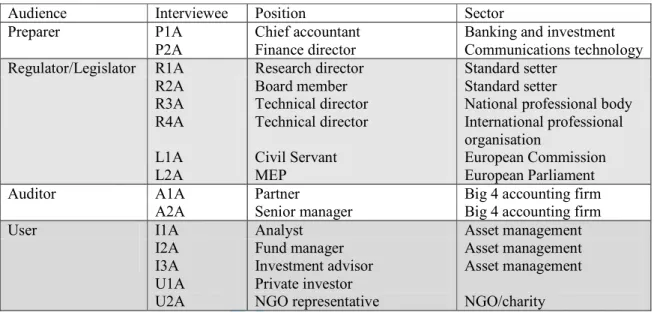
Two sets of interviews were carried out for this study. First, a series of 15 semi-structured interviews with key audiences was undertaken before IFRS8 became mandatory during 2009 and the interviewer profile and stakeholder grouping of this cohort is shown in Panel A of Table 2. Second, 20 further interviews were undertaken, after the adoption of IFRS8 in 2011, as shown in Panel B of Table 2, all of whom were in the UK. Thus 35 interviews were undertaken in total with representatives of the key constituent groups which IFRS8 addresses. These interviewees were drawn from the authors’ contacts with key stakeholders at the time of the research. In the first set of interviews which took place before the standard was implemented, Legislators/ Regulators were approached whilst the topic was still current and visits were made to the European Commission (EC) in Brussels in order to understand the context surrounding the adoption of this accounting standard in Europe. All the other interviewees (Preparers, Auditors and Users (both institutional investor and non-institutional investor) were based in the UK. In the second set of interviews, the views of preparers, auditors and users were sought, reflecting the three audience groups discerned as the focus for the PIR consultation (IFRS Foundation, 2013). 1920
[Table 2 about here]
Semi-structured questionnaires with several sections were developed and piloted on a number of academics and practitioners.21 22. Specifically, interviewees were asked questions relating to four controversial areas arising during IFRS8’s adoption which potentially challenged the legitimacy of the new standard (IASB, 2006 – IFRS8 Basis for Conclusions; European Commission, 2007): (i) the management approach; (ii) whether geographical disclosures 2 3 4 5 6 7 8 9 10 11 12 13 14 15 16 17 18 19 20 21 22 23 24 25 26 27 28 29 30 31 32 33 34 35 36 37 38 39 40 41 42 43 44 45 46 47 48 49 50 51 52 53 54 55 56 57 58
For Peer Review Only
should be mandatory; (iii) whether the standard was principles-based or rules-based and whether it was compatible with the IASB’s own conceptual framework; and (iv) the extent to which IFRS8 had been influenced by a desire among regulators for international harmonisation.
Each interview lasted about one hour and was attended by two members of the research team with a semi-structured questionnaire document being used by the team to ensure that a consistent set of questions was asked. All interviews were digitally recorded and these recordings were supplemented with notes made during the interviews. All recordings were fully transcribed and then analysed by the research team in conjunction with the notes that had been taken. A table was constructed to summarise the responses of the interviewees to the questions asked and this table was used when writing up the findings.
5. Discussion of findings
The interviews were analysed across the four controversial areas that were discussed in Section 3, and responses are interpreted in this part of the paper using the framework presented in Table 1.
Management Approach
IFRS8 adopts a new way of reporting segmental information – that of the management approach. Thus the interviewees were asked about their thoughts on this approach. Interviewee A2 argued that from an auditors’ point of view, this management approach was unhelpful:
“This idea of effectively allowing the users to see segmental information as if it was the management accounts, which is what the objective is, it’s just not realistic. It’s not a realistic goal in my view. And I don’t think it’s realistically achievable.”
2 3 4 5 6 7 8 9 10 11 12 13 14 15 16 17 18 19 20 21 22 23 24 25 26 27 28 29 30 31 32 33 34 35 36 37 38 39 40 41 42 43 44 45 46 47 48 49 50 51 52 53 54 55 56 57
For Peer Review Only
He continued by noting that:“Sometimes there’s anecdotal evidence of companies actually changing their internal reporting prior to implementing the standard … I haven’t seen it, but I’ve got anecdotal evidence of companies doing it. I haven’t seen it, but I’ve had other people tell me that they’ve seen it.”
Investors were also less than enthusiastic about the management approach and claimed that it would allow companies to hide unfavourable news from users of financial statements. For example, user U2A suggested that the basis of identifying segments in IFRS8 was “fundamentally flawed” and ignored the possible self-interested behaviour of boards. U6 was also sceptical and noted that:
“I can’t live with [the management approach] personally because I don’t feel that I can rely on [the resulting segmental information] as an investor... Because as a knowledgeable investor perhaps I know what goes into some of these things and I think it’s open for manipulation and it’s open for companies disguising poor performance... - to my mind you’re mixing apples and oranges. The annual report is not management information per se, it’s financial accounting data and it should remain that. There is scope in there for manipulation, [if] you take [revenues or expenses] out of one division [and] put it in another division.”
User U1 agreed with this view. Specifically, he stated that:
“.. the reason they created [the current set of operating segments], was so they couldn’t tell us what was in them. Let’s say one of the motivating factors behind creating them was to hide stuff from us...It’s useful if management can be trusted but some management teams can be trusted and some can’t...If they are presenting information in such a way that we are able to forecast operating margins, all well and good; if they are playing games and saying “let’s take the fastest growing division and lets sort of put all the good stuff into that one to sort of extrapolate from it and come out with a higher total figure” [its unhelpful for investors]. So in a sense it depends again on what's in the hearts of people presenting the information to us...so I think it’s quite difficult to see through because there are choices as to how you create segments.”
Legislators and regulators were also concerned about the management focus of IFRS8. For example L2A was worried that the management approach was “a bit … too business convenient”. L1A agreed with this concern when he suggested that IFRS8 might allow 2 3 4 5 6 7 8 9 10 11 12 13 14 15 16 17 18 19 20 21 22 23 24 25 26 27 28 29 30 31 32 33 34 35 36 37 38 39 40 41 42 43 44 45 46 47 48 49 50 51 52 53 54 55 56 57 58
For Peer Review Only
management to “manipulate” information in order “to present [the firm] in a favourable light or conceal [adverse aspects of performance]”.
With regard to the term CODM and the decision as to who this person or group might be, some of the interviewees suggested that it would be a CEO (possibly in conjunction with the FD), others indicated that it would be the Board of Directors and some claimed that they just did not know. Even one of the preparers highlighted that, if the CODM was the Board there could be problems; the CEO and FD “see a whole lot of things that never [get] to the Board’ and these would not have to be disclosed under IFRS8; they act as gatekeepers”. He thus implied that it would be easy for management to hide information simply by providing details to the FD and CEO and withholding it from the board. Further U4 noted that:
“In company law there is only one group who are responsible and that is the board, it can’t be anyone else; if it is, you are … building in an … American concept into European thinking without any change in company law. Therefore you would have a direct conflict between the board being responsible for a set of accounts and having a chief operating decision maker who may actually be management, quite distinct from the board [deciding on what segmental information is included in these financial statements].”
Investor I2A was not atypical when he noted that this issue was problematic:
“I am not sure exactly how you would define it and how you get to what that particular role [is all about] because it … probably differs between different organisations and perhaps different segments of the business as well. So I am a bit sceptical as to how, ultimately, it works”.
User U2 was more forthright about the identity of the CODM when he noted that it was an “alien concept to Anglo-Saxon thinking”.
Overall, our interview evidence suggests that the users did not grant exchange legitimacy, expressing concern that the management approach would create segmental information that 2 3 4 5 6 7 8 9 10 11 12 13 14 15 16 17 18 19 20 21 22 23 24 25 26 27 28 29 30 31 32 33 34 35 36 37 38 39 40 41 42 43 44 45 46 47 48 49 50 51 52 53 54 55 56 57
For Peer Review Only
was unreliable and not helpful to them. Consequential legitimacy was seemingly withheld by all interview groups in relation to the management approach and the lack of guidance over the CODM meaning that reporting entities might be able to manipulate segmental information in their own favour. Finally, dispositional legitimacy was threatened in relation to the use of American terminology (CODM), which did not resonate with the interests of the interviewee groups in this current paper. Indeed, users were less favourably disposed to IFRS8 than any of the other constituent groups. In part, this result accords with the findings of Kwok and Sharp (2005) who noted that preparers preferred the management approach to the risk and reward approach of IAS 14, and that the non-preparer groups preferred standardised segmental results.
However, preparers also expressed concern that compliance with IFRS8 would result in disclosure of commercially sensitive23 information, suggesting that, in this regard, exchange and dispositional legitimacy have been withheld by preparers from IFRS8 and the IASB, respectively. For example, Auditor A4 was especially worried about the issue of commercial sensitivity for smaller companies:
“One sometimes hears the point made in smaller companies that segmental disclosure can bear unfairly down on them in the sense that because they wouldn’t have as many segments … it is obvious who they were dealing with in a key area.”
Indeed, a preparer (P1) in a small company agreed that the publication of some segmental information could put his firm at a competitive disadvantage. He stated that: “There’s always an element of commercial sensitivity [in disaggregated data], provided by small firms.” He continued in the same vein that: “the segmentation and legal entity don’t match up exactly … the way we segment the business is different” and to get over commercial sensitivity he 2 3 4 5 6 7 8 9 10 11 12 13 14 15 16 17 18 19 20 21 22 23 24 25 26 27 28 29 30 31 32 33 34 35 36 37 38 39 40 41 42 43 44 45 46 47 48 49 50 51 52 53 54 55 56 57 58
For Peer Review Only
owned up to “the fact that [his firm] are taking advantage effectively of the fact that one segment is over 75%.”
However, Auditor A2 noted that preparers could still avoid disclosing sensitive information; and suggested that “anecdotally they probably deal with that through the CODM definition”. Auditor A3 thought it was an interesting issue – especially when related to the use of transfer pricing:
“The transfer pricing one then gets interesting because again the standard is quite clear in terms of what you’re supposed to put in your segmental disclosure; it is supposed to use the same basis of transfer pricing as you use for management reporting and you’re supposed to disclosure to what extent that’s on an arm’s length basis or an agreed transfer prices basis, That's really the hyper sensitive stuff, on the basis that you’re supposed to put your management reporting in you can’t play around with it that much. There is no point in having management reporting where you go and change your transfer pricing just because you don’t want to put that information in your segmental reporting, because you lose sight of actually how you’re managing your business.”
It would appear therefore, that although preparers may not have supported the standard as it threatened disclosure of commercially sensitive information, there was a view amongst interviewees that the management approach and the CODM offered enough flexibility and choice to preparers to attenuate this concern.
The management approach of IFRS8 requires the use of non-IFRS measures if these are used internally to report segmental information to the CODM. P3 was critical of the use of non-IFRS measures in general, noting that:
“I would say that non-GAAP [non-IFRS] measures have the greatest prominence, when people want to give you the earnings before bad news basically.” 2 3 4 5 6 7 8 9 10 11 12 13 14 15 16 17 18 19 20 21 22 23 24 25 26 27 28 29 30 31 32 33 34 35 36 37 38 39 40 41 42 43 44 45 46 47 48 49 50 51 52 53 54 55 56 57
For Peer Review Only
U3 was confused about non-IFRS numbers and questioned how they linked with the rest of the annual report:
“Oh look they have a figure here which says one thing but in this note it says something totally different. There is normally a very rational explanation for why a number that appears to represent an entity in one place is different in another, and it might just be that you, the reader, misunderstood what they are actually talking about.”
On the issue of reconciling items I1A pointed that that ‘non-GAAP [non-IFRS] measures may result in a ‘lump’ of corporate costs as the reconciling item which is not very useful”. Analyst I2A was even more emphatic about this point:
“Lack of reconciliation is wrong; [segmental data] should reconcile back [to the main financial statements] and [the fact that it doesn’t] will reduce the usefulness of the information [non-IFRS]. The size of the reconciliation amount between any non- GAAP segmental information and the numbers in the financial statements [will be important]”.
Both of these analysts (I1A and I2A) suggested that this issue would not be an insurmountable hurdle for “sophisticated analyst users” who may be able to get information about any reconciliation amount “through meetings with the company”. For ordinary investors, however, they thought that this aspect of IFRS8 was problematic. Indeed U6 commented that:
“You have to give me the ability to understand in great detail what it is I’m looking at, and just putting in management information with lump sum reconciling items is just not good enough.”
Thus, the use of non-IFRS measures did not receive exchange nor consequential legitimacy from users, perceiving that they would not be able to understand the information disclosed, rendering it not useful.
Non-mandatory geographical information 2 3 4 5 6 7 8 9 10 11 12 13 14 15 16 17 18 19 20 21 22 23 24 25 26 27 28 29 30 31 32 33 34 35 36 37 38 39 40 41 42 43 44 45 46 47 48 49 50 51 52 53 54 55 56 57 58
For Peer Review Only
Adding to the controversy over IFRS8 was the fact that IFRS8 no longer mandated the disclosure of geographical information. This was a particular concern publicised by the PWYP coalition of international not-for-profit organisations (PWYP, 2005 & 2006), raising moral legitimacy concerns relating to lack of transparency in segmental reporting. Our interviewees were of the view that disclosures by geographic area were useful to investors. Indeed, investor I2A benefited from segmental information which he used “to build models” of a company’s performance in different regions; I2A admitted that without such geographic data exchanges his approach to security valuation would be “up the Swanee”. In addition, I2A also expressed consequential legitimacy concerns that “NGOs should be interested in where a company is operating, what assets it’s got [in different locations], and [if there were] environmental or [human] rights issues [affecting] the firm”. User U6 expressed a similar view regarding the usefulness of geographic information:
“My general impression is [that this geographical disclosure is] really helpful information to me as an investor and as a reader of the accounts. [I tend to ask whether] I understand what it’s actually telling me and it is consistent with the rest of the annual report or is it trying to mix apples and oranges. … I am really going to rely on that to make [many] decisions. So it’s just a question of what is it I’m seeing [and] what is the story I’m being told.”
However, one auditor (A1) believed that geographical disclosure “was still required” based upon her reading of paragraph 33 of IFRS8 and “was not convinced” that for many companies IFRS8 geographic disclosures would be different from information supplied under IAS 14R. However, auditor (A2) was more pessimistic about the consequences of IFRS8, stating it:
“ probably doesn’t [require mandatory disclosure of geographical operating segments] if you don’t operate across lots of geographical segments. If you operate in more than one country, then yes it does. To a certain extent some of the information which you used to get under IAS 14 has been lost in terms of geographic [disclosures].”
2 3 4 5 6 7 8 9 10 11 12 13 14 15 16 17 18 19 20 21 22 23 24 25 26 27 28 29 30 31 32 33 34 35 36 37 38 39 40 41 42 43 44 45 46 47 48 49 50 51 52 53 54 55 56 57
For Peer Review Only
This pessimistic view was held by U2 who commented:“Yeah. So why put together Malaysian and Indonesian business as opposed to [divisions from other countries] … they’re different economies, different underlying exchange rates, so actually split it out and let us see what’s going on in both.”
Hence, again there is evidence that users did not see the ‘exchange’ benefit of IFRS8, indicating a concern that the IASB did not share their dispositional interest in what constituted useful information for them. Auditors to a lesser extent were concerned about the consequential legitimacy of the standard, musing that IFRS8 would not precipitate significant segmental reporting changes compared to its predecessor IAS14(R).
The aggregation issue and materiality question were pertinent for preparers as larger companies might have a sizeable number of segments; a number of interviewees worried about what level of detail was needed and what amount of aggregation was permissible. For example, P3 pointed out that:
“[There] are five [segments] in our annual report. However you then have distinct units within these segments which are defined [within the company] but which we don’t talk about in this annual report document, and then some of those units have further units... the justification might be that business activities are not dissimilar. So we’ve already got five [operating segments in the financial statements bit], if you go the next level, you know, you’re going to go on to ten or twelve, which is beginning to get a bit unreal...What is actually monitored by a group executive committee is 55 business units.”
Overall, the interviewees did not grant consequential legitimacy to IFRS8 as they had concerns about the lack of guidance over the aggregation of units into operating segments and were worried about the absence of a definition about materiality. Preparers were most concerned about commercial sensitivity and hence, exchange legitimacy was more apparent with preparers. 2 3 4 5 6 7 8 9 10 11 12 13 14 15 16 17 18 19 20 21 22 23 24 25 26 27 28 29 30 31 32 33 34 35 36 37 38 39 40 41 42 43 44 45 46 47 48 49 50 51 52 53 54 55 56 57 58
For Peer Review Only
Conceptual frameworkRegarding the conceptual framework, there was a general agreement among the interviewees that IFRS8 was not consistent with the principle that financial information had to be decision useful. In particular, there were consequential legitimacy concerns that the information supplied under IFRS8 would not satisfy the criteria for usefulness as outlined in the conceptual framework,, as user U4 stated:
Although IAS 14 was certainly more prescriptive, it was easier to understand … at least there was consistency in it, … We are definitely losing comparability because the choice of segment and the choice of emphasis within segmental reporting has been broadened and therefore what we are seeing is an inevitable loss of comparability. … We are losing one of the key qualities of accounting information as a result and if we are losing that key quality then you are undermining the value of the reports that are being produced. As a result, if you are trying to encourage the effective allocation of resources, which is what they say they're doing, they're reducing the quality of the information which is available to ensure that resources are being allocated effectively. So by their own yard stick of what is the purpose of accounting, I believe that IFRS8 is a failure, they don’t agree I'm sure, but I'm not sure that the IASB is committed to what it says it is anyway.”
This user also continued to raise concerns suggesting that, in particular the European constituents, were unsure of awarding personal and structural legitimacy of the IASB as a legitimate international standard setting organisation:
“I have no problem, if [IFRS8 disclosures are] considered to be useful by an investor, but I don’t think it supplants the obligation to supply consistent ongoing information which is of use to the long term investor, who actually is looking at a stewardship function, and to those beyond, because I think there are other users of financial information. I think that IASB, if it is really going to produce a single set of accounting standards, has to consider the needs of multiple users. Its attempt to reduce it to one group of users is where it’s going wrong. That's clearly, political. Let’s be honest, Europe gave it its power and they are mighty fed up, you know. I think that there is a real risk that [the IASB] are going to alienate what was the source of their power and they just treat them with contempt; you can’t take us to court, you can’t involve politics in what we’re doing, they say. But all accounting is political.”
2 3 4 5 6 7 8 9 10 11 12 13 14 15 16 17 18 19 20 21 22 23 24 25 26 27 28 29 30 31 32 33 34 35 36 37 38 39 40 41 42 43 44 45 46 47 48 49 50 51 52 53 54 55 56 57
For Peer Review Only
Convergence agenda and the post-implementation review processRegulators and legislator interviewees pointed out that the US origin of IFRS8’s content could be problematic; a number questioned the IASB’s disposition, which, in their minds, prioritised convergence with FASB, over meeting the interests of other audiences. For instance, R4A said that “I think we often have some problems with things going the American way”. R2A further elaborated reflected on the procedural legitimacy leading to IFRS8 adoption, stating that
“I thought it was extremely bad to copy an American standard on principle because of the way they are worded and developed to deal with specific American problems and American law. In particular with IFRS8 I thought it was very bad to not have consistent accounting for segments, consistent with GAAP … I just didn’t like this copying of what FASB did because the wording and the way their statements are framed always annoy me. You know, I just felt we should at least write it in our language but this was part of the US convergence and if you read the IASB’s reasons for doing it it’s substantially to converge with the US and I don’t like the idea.”
Interviewees were asked if they thought the post-implementation review of IFRS8 would mitigate against concerns raised about IFRS8’s development and its potential impact on segmental reporting. Preparers in general indicated that IFRS8 had met their pragmatic needs and did envisage they would contribute to a PIR. Specifically, P3 said: [IFRS8]’s not a standard you necessarily think or would be demanding, or shouting for a review”, and P2 echoed this, saying the standard was not “disagreeable”. P6 explained that compliance with IFRS8 had “been fairly smooth”; however, they indicated that consequential legitimacy needs had to be met for users, saying that:
“analysts to take part in a review of how good [IFRS8] has been in terms of providing them with information than it would be for someone like me who prepares the accounts to take part in a review … we've kind of ticked that box as a preparer but it might be useful to go back and review it from who it was meant to benefit in the first place and has it met that requirement?
Auditors interviewed did not express a great deal of enthusiasm about engaging in a PIR of IFRS8, as arguing that “things have moved on … I’m not too sure that it would serve a huge 2 3 4 5 6 7 8 9 10 11 12 13 14 15 16 17 18 19 20 21 22 23 24 25 26 27 28 29 30 31 32 33 34 35 36 37 38 39 40 41 42 43 44 45 46 47 48 49 50 51 52 53 54 55 56 57 58
For Peer Review Only
amount of purpose” (A2). One Big4 partner (A3) also suggested “it’s perhaps [too] early to be doing post implementation reviews”, while another (A7) stated that:
I think if they are going to spend the money they would be better of spending their time doing something else, which would be looking at the overall usefulness of the accounts not focusing in on is IFRS8 been a good thing or not. As with the preparers interviewed, A2 also suggested that the PIR would only be of interest to users/investors if they felt “ they weren’t getting as good information as they were getting previously”.I2A, expressed support for the PIR, and implied that users might be able to influence potential amendment of IFRS8 by engaging in the process and raising their concerns about the quality of IFRS8 prescribed segmental information:
“… some form of follow up is required, because there's that much divergence in interpretations that [IFRS8] maybe have actually impinged on the information that companies are giving. So I suppose it goes back to how people have interpreted it and how it's been actually implemented. And if you've got two companies in the same industry that are materially disclosing something that's dissimilar, I think that just raises a big question as to how it's been implemented and what information the companies have had internally and what information the auditors have had. In terms of why are they having to sign off on it this way or that way.
From our interviewee responses, it would appear that the focus of the IASB on converging with the US FASB led regulators and legislators to question the dispositional legitimacy of the IASB and also its procedural legitimacy relating to ‘copying’ a US standard. In considering whether the PIR would mitigate against process and outcome concerns relating to IFRS8, it would appear that auditors and preparers have accepted IFRS8 as legitimate for their own purposes (exchange legitimacy), but are aware that the consequences of IFRS8 for users of segmental reporting remain problematic.
2 3 4 5 6 7 8 9 10 11 12 13 14 15 16 17 18 19 20 21 22 23 24 25 26 27 28 29 30 31 32 33 34 35 36 37 38 39 40 41 42 43 44 45 46 47 48 49 50 51 52 53 54 55 56 57
For Peer Review Only
6. Discussion and ConclusionIn this paper, we present evidence of the temporal dynamic of legitimation by examining audience perceptions of the adoption and post-implementation review of IFRS8. Through interpretation of 35 semi-structured interviews, undertaken in 2009 and 2011, we conclude that the predominant subtypes of legitimation threatened during the adoption of IFRS8 relate to episodic legitimacy. Specifically, pragmatic/exchange and moral/consequential legitimacy of the IASBs actions and pragmatic/dispositional legitimacy of the IASB in itself were arguably threatened during the IFRS8 episode.
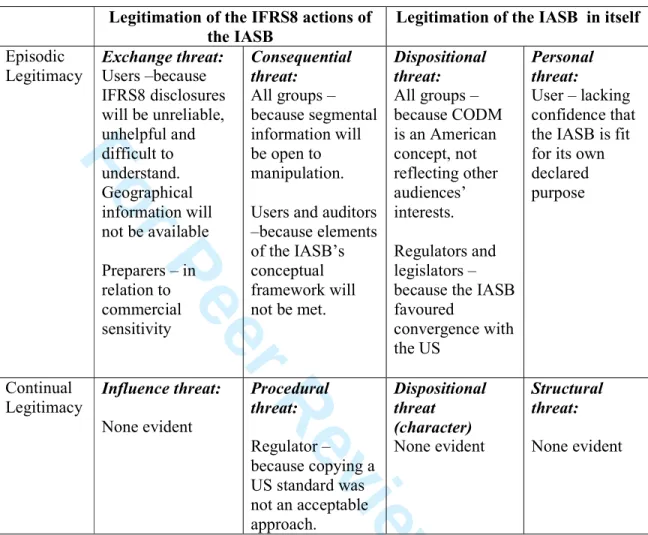
Examples of areas where the granting of legitimacy for the adoption and potential impact of IFRS8 by certain audiences has been threatened are presented in Table 3- illuminated through the dynamics of episodic and continual legitimacy. It would appear from our analysis that the events surrounding the development and potential reporting outcomes of IFRS8 did not expressly raise continual legitimacy concern from audiences about the IASB’s actions, with the exception of a regulator’s worry about the “bad practice” associated with copying a US standard.
Insert Table 3 about here
Specifically, we evidence from our interviews that exchange legitimacy was not granted by users in a number of areas relating to: the management approach, the concept of the CODM and the use of non-IFRS measures; the lack of cohesion with the conceptual framework; and the decision not to mandate the disclosure of geographical segmental information. The users were particularly worried that preparers could conceal information and render segmental reporting under IFRS8 less useful than that previously disclosed under IAS14(R). Arguably, auditors and regulators were not affected by the standard at a pragmatic exchange legitimacy level but preparers in general granted exchange legitimacy as their views were generally 2 3 4 5 6 7 8 9 10 11 12 13 14 15 16 17 18 19 20 21 22 23 24 25 26 27 28 29 30 31 32 33 34 35 36 37 38 39 40 41 42 43 44 45 46 47 48 49 50 51 52 53 54 55 56 57 58
For Peer Review Only
supportive of the standard, apart from concerns about commercial sensitivity (see also Kwok & Sharp, 2005).
The standard also appeared to raise consequential legitimacy concerns from all interviewee groups as the quality of segmental information disclosed under IFRS8 could potentially conflict with the objective and characteristics of the IASB’s conceptual framework. Additionally, the IASB’s disposition of pursuing convergence with US practice at the expense of reflecting other audience interests was, for regulators, a concern, as was the procedure of ‘copying’ the US standard. In contrast to Durocher and Fortin (2010) who examine practice from the standard setters’ perspective, this paper reviews the case of a particular standard from the perspective of constituents other than the standard setter. Durocher and Fortin (2010) find that standard setters devote more energy to maintaining moral legitimacy over pragmatic legitimacy. Our research implies that the IASB can perhaps rely on its reputation and the general acceptance of its role as an international standard setter to counter temporary challenges from a number of audiences to the episodic legitimacy of individual standards.
Regardless of this reliance on previously gained legitimacy, the IASB amended its standard setting due process in 2007 to include a PIR process (IFRS Foundation, 2011). The PIR afforded audiences with an opportunity to confer elements of continual legitimacy on the IASB in relation to IFRS8; audiences could potentially influence (see Table 1) any amendment of IFRS8 to reflect their own pragmatic needs, and moral concerns, through participating in the PIR consultations and outreach events. However, our interview findings suggest that a willingness to contribute to the PIR was not evident amongst the auditors and preparers, though they recognised the potential influence legitimacy that users might confer if 2 3 4 5 6 7 8 9 10 11 12 13 14 15 16 17 18 19 20 21 22 23 24 25 26 27 28 29 30 31 32 33 34 35 36 37 38 39 40 41 42 43 44 45 46 47 48 49 50 51 52 53 54 55 56 57
For Peer Review Only
they participated in the PIR process. However, the IASB published the outcome of its first, newly constituted, PIR of IFRS8 in 2013 and concluded that there was no need to amend IFRS8. Somewhat surprisingly, despite concerns raised: (i) at the time of IFRS8’s adoption (European Commission, 2007; European Parliament; 2007; Crawford et al., 2010); (ii) during the standard’s implementation (ESMA, 2011; FRRP, 2010; Crawford et al., 2012), and (iii) in submissions to the PIR (IFRS Foundation, 2012a, 2012b and 2013b staff papers), the IASB decided that “the standard achieved its objectives and improved financial reporting” (IFRS Foundation, 2013a).
The IASB’s response to its own PIR consultation and outreach events suggests that the IASB is not inclined to act on the concerns raised by certain audiences in relation to a particular standard such as IFRS8. Engaging with key audiences during the PIR of IFRS8 might have been viewed as an opportunity for the IASB to repair evident fluctuations in episodic legitimacy, arguably lost during the adoption of IFRS8. This suggests that repairing fluctuations in episodic legitimacy is not a priority for the IASB. Perhaps the IASB believes that its “stock” of legitimacy for its “essence”, as an international accounting standard setter has not been sufficiently threatened over the controversial IFRS8 episode. However, at some point, such incremental, episodic legitimation damage could precipitate a crisis of legitimation for the IASB, which will necessitate the IASB to devote resources to repairing legitimacy if it wants to retain its position as an accepted standard setter for international financial reporting. 2 3 4 5 6 7 8 9 10 11 12 13 14 15 16 17 18 19 20 21 22 23 24 25 26 27 28 29 30 31 32 33 34 35 36 37 38 39 40 41 42 43 44 45 46 47 48 49 50 51 52 53 54 55 56 57 58
For Peer Review Only
ReferencesBlack, J. (2008). Constructing and contesting legitimacy and accountability in polycentric regulatory regimes. Regulation and Governance, 2, 137-164.
Botzem, S. & Dobusch, L. (2012). Standardisation cycles: a process perspective on the formation and diffusion of transnational standards. Organization Studies, 33, 5-6, 737-762. Chiapello, E. & Medjad, K. (2009). An unprecedented privatisation of mandatory standard setting: the case of European accounting policy. Critical Perspectives on Accounting, 20, 448-468.
Crawford, L., Helliar, C. V., Monk, E., & Veneziani, M. (2014a). International Accounting Education Standards Board: Organisational legitimacy within the field of professional accountancy education. In Accounting Forum, 38, 67-89.
Crawford, L., Ferguson, J., Helliar, C. V., & Power, D. M. (2014b). Control over accounting standards within the European Union: the political controversy surrounding the adoption of IFRS8. Critical Perspectives on Accounting, 25(4), 304-318.
Crawford, L., Extance, H., Helliar, C.V. & Power, D.M. (2012). Operating segments: The usefulness of IFRS8. Edinburgh: ICAS
Crawford, L., Helliar, C.V. & Power, D.M. (2010). IFRS8: Exploring stakeholder perceptions of the new standard and its EC endorsement process. London: ICAEW.
Danjou, P. & Walton, P (2012). The Legitimacy of the IASB. Accounting in Europe, 9(1) 1-15.
Deephouse, D.L. & Suchman, M. (2008). Legitimacy in Organizational Institutionalism – in Greenwood, R., Oliver, C., Sahlin, K. Suddaby R (Eds), The Sage Handbook of
Organizational Institutionalism 49-77 London Sage.
Durocher, S. & Fortin, A. (2010). Standard-setting institutions’ user-oriented legitimacy management strategies - The Canadian case, Qualitative Research in Accounting and Management 7(4), 476-504.
Durocher, S. & Fortin, A. (2011). Practitioners’ participation in the accounting standard-setting process, Accounting and Business Research. 41(1), 29-50.
Durocher, S., Fortin. A. & Cote, L. (2007). Users’ participation in the accounting standard-setting process: A theory-building study. Accounting, Organizations and Society, 32, 29-59. Edwards, P. & Smith, R.A. (1996). Competitive disadvantage and voluntary disclosures: the case of segmental reporting. British Accounting Review, 28, 155-172.
Emmanuel, C.R., Garrod, N.W., McCallum, C. & Rennie, E.D. (1999). The impact of SSAP 25 and the 10% materiality rule on segment disclosure in the UK. British Accounting Review, 31, 127-149. 2 3 4 5 6 7 8 9 10 11 12 13 14 15 16 17 18 19 20 21 22 23 24 25 26 27 28 29 30 31 32 33 34 35 36 37 38 39 40 41 42 43 44 45 46 47 48 49 50 51 52 53 54 55 56 57