PERPUSTAKAAN UMP
STUDY LOM
(SLMS)
WITH
0000103240
MOHAMAD SAIFUL ANUAR BIN YUSOF
BACHELOR OF COMPUTER SCIENCE (SOFTWARE ENGINEERING)
WITH HONOURS
FACULTY OF COMPUTER SYSTEM & SOFTWARE ENGINEERING
UNIVERSITI MALAYSIA PAHANG
ABSTRAK
Universiti ABC mempunyai masalah dengan pelajar sistem pengurusan pinjaman mereka
untuk memindahkan pinjaman kira pelajar masing-masing. Universiti ABC adalah sangat sukar
untuk menguruskan pemindahan pinjaman kerana mereka mempunyai banyak akaun pelajar dan
mempunyai banyak kategori penyedia pinjaman seperti PTPTN, MARA, JPA, Yayasan Negeri
dan lain-lain. Jadi, mereka perlu menganibil banyak masa untuk kejayaan atau melengkapkan
pemindahan pinjaman ke akaun pelajar masing-masing. Pertama, mereka perlu mengasingkan
mengikut kategori yang memberi pinjaman kerana jumlah pembekal pinjaman sama sekali
perbezaan contohnya PTPTN memberi pinjaman bagi setiap semester untuk setiap pelajar adalah
RM3500 untuk pelajar ijazah dan RM2500 untuk pelajar diploma. Manakala bagi JPA, mereka
menyediakan RM7000 bagi setiap semester untuk setiap pelajar. Oleh itu, mereka sangat sukar
dan mengambil masa yang lebih untuk memindahkan pinjaman kepada akaun pelajar. Jadi,
daripada masalah itu, Jabatan Hal Ehwal Pelajar di Universiti ABC telah membuat keputusan
dan mereka ingin memberikan perkhidmatan yang lebih balk untuk permohonan pinjaman
pelajaran. Pinjaman kajian akan meluluskan permohonan itu dan memindahkan pinjaman kira
pelajar masing-masing. Jabatan Hal Ehwal Pelajar dikaitkan dengan pembekal pinjaman dan satu
ABSTRACT
ABC University have problem with their student loan management system to transfer the
loan into respective student's account. ABC University are very difficult to manage the loan
transfer because they have a lot of student's account and have many categories of loan providers
such as PTPTN, Mara, JPA, Yayasan Negeri and others. So, they need to take much time to
success or complete the loan transfer to respective student's account. Firstly, they need to
separate by category of loan provider because the amount of loan provider totally difference for
example PTPTN provide a loan for every semester to each student is RM3500 for degree student
and RM2500 for diploma student. While for JPA, they provide RM7000 for every semester to
each student. So, they are very difficult and take a much time to transfer the loan to the student's
account. So, from that problem, Student Affairs Department at ABC University have decided and
they want to provide a better service for study loan application. The study loan will approve the
application and transfer the loan into respective student's account. Student Affairs Department is
associated with study loan providers and one objective of this project is to leverage the study
loan automated service.
TABLE OF CONTENT
CHAPTER TITLE PAGE
TITLE PAGE i
STUDENT'S DECLARATION ii
SUPERVISOR'S DECLARATION lii
DEDICATION iv
ACKNOWLEDGEMENT v
ABSTRAK vi
ABSTRACT vii
TABLE OF CONTENT viii
LIST OF TABLES xii
LIST OF FIGURES xiv
x INTRODUCTION 2 1.1 Introduction 2 1.2 Problem Statement 5 1.3 Objective 6 1.4 Scope 6 1.5 Methodology 7 1.6 Thesis Organization 9 2 LITERATURE REVIEW 10 2.1 Introduction 10 2.2 Function in SLMS 11
2.2.1 Manage Student Function 11
2.2.1.1 Add New Student Function 12
2.2.1.2 Update Student Function 13
2.2.1.2 Delete Student Function 14
2.2.2 Manage Student's Account Function 15
2.2.1.1 Add Account Function 15
2.2.1.2 Delete Student Function 16
2.2.3 Manage Loan Function 17
2.2.1.1 Deposit Function 17
2.2.1.2 Withdraw Function 18
2.2.4 Balance Enquiry Function 19
2.2.5 Report Function 20
2.3 Benefit Of Student Loan Management System 21
2.4 Existing System 21
2.4.1 Loan Management System (LMS) 22
2.4.1.1 Security Module 22
2.4.1.2 Customer and Loan Transaction Module 23
2.4.1.2 Query Module 24
2.4.2 Education Loan Management System (ELMS) in India 25 2.4.3 Loan Approval Management System (LAMS) 27
2.4.3.1 Key Features 28 2.4.3.1.1 Online Loan Submission 28 2.4.3.1.2 Loan Management Workflow 29
2.4.3.1.3 Vendor Registration 29
2.4.3.1.4 Web enable Back-end Support System 29
2.4.3.1.5 Document Management System 30
2.4.3.1.6 Full-text Search 30
2.4.3.1.7 Email Alert 30
2.4.3.1.8 Scheduler 30
2.5 Problem With Current System 31
2.5.1 Loan Management System (LMS) 31
2.5.2 Education Loan Management System (ELMS) in India 31
2.5.3 Loan Approval Management System (LAMS) 31 2.6 Comparison Between Existing System 32
2.7 Concept of .SLMS 33 2.7.1 MVC Model Framework 33 2.7.2 Java Serviet 35 2.7.3 GSM Modem 37 3 METHODOLOGY 38 3.1 Introduction 38 3.2 Methodology Of Project 39 3.3 Phase Of Methodology 39
3.3.1 Requirement Analysis Phase 41
3.3.2 System Design Phase 43
3.3.2.1 Flow Chart Diagram of SLMS 43 3.3.2.2 Use case Diagram of SLMS 45
3.3.2.3 Context Diagram of SLMS 46
3.3.3 Implementation Phase 46
3.3.3.1 Hardware Requirement 47
Xi
3.3.3.3 Other Requirement 50
3.3.4 Testing Phase 50
3.3.4.1 Black Box Testing 51
3.3.4.2 White Box Testing 51
3.3.5 Deployment Phase 52
3.3.6 Maintenance Phase 53
4 DESIGN AND IMPLEMENTATION PLAN 54
4.1 Introduction 54 4.2 Database Construction 55 4.2.1 Database Structure 55 4.2.2 Login Table 56 4.2.3 Student Table 57 4.2.4 Account Table 58 4.2.5 TransactionLog Table 59
4.3 User Interface Construction 60
4.3.1 Login Page 60
4.3.2 Home Page 61
4.3.3 Manage Student Page 61
4.3.3.1 Add Student Page 62
4.3.3.1 Update Student Page 63
4.3.3.1 Delete Student Page 64
4.3.4 Manage Account Page 65
4.3.4.1 Add Account Page 65
4.3.4.1 Delete Account Page 66
4.3.5 Deposit Page 67
4.3.6 Withdraw Page 68
4.3.7 Balance Enquiry Page 69
4.3.8 Report Page 70
4.4 Process Flow 71
4.6 Conclusion 72
5 RESULT AND DISCUSSION 73
5.1 Introduction 79 5.2 Expected Result 73 5.3 System Result 74 5.4 Achievement 75 5.5 Decision 76 5.6 Future Enhancement 76 6 CONCLUSION 77 6.1 Introduction 77
6.2 Summary of Literature Review 78
6.3 Summary of Methodology 78
LIST OF TABLES
TABLE NO TITLE PAGE
2.1 Comparison between Existing Systems 32
3.4 Hardware requirements 47
3.1 Software requirements 49
LIST OF FIGURES
FIGURE NO TITLE PAGE
1.1 Methodology of Study Loan Management System (SLMS) 7
2.1 Basic Interface for Add Student in Study Loan Management 12 System (SLMS)
2.2 Example error message for Add Student in Study Loan 12 Management
2.3 Example interface for Update Student in Study Loan 13 Management System (SLMS)
2.4 Example result interface for Update Student in Study Loan 13 Management System (SLMS)
2.5 Example interface for Delete Student in Study Loan Management 14
System (SLMS)
2.6 Error Message in Study Loan Management System (SLMS) 14
2.7 Example interface for Add New Account in Study Loan 15 Management System (SLMS)
2.8 Example interface for Delete Account in Study Loan 16 Management System (SLMS)
2.9 Example interface result for Delete Account in Study Loan 16 Management System (SLMS)
2.10 Example interface for Deposit Amount in Study Loan 17 Management System (SLMS)
2.11 Example interface for Withdraw Amount in Study Loan 18 Management System (SLMS)
2.12 Example interface result for Withdraw Amount in Study Loan 18 Management System (SLMS)
2.13 Example interface for Balance Enquiry in Study Loan 19 Management System (SLMS)
2.14 Example Error Message for Balance Enquiry in Study Loan 19 Management System (SLMS)
2.15 Example Error Message for Balance Enquiry in Study Loan 20 Management System (SLMS)
2.16 Example Interface for Account Report in Study Loan 20 Management System (SLMS)
2.17 Use case Diagram for Education Loan Management System 26
2.18 Collaboration Diagram for Education Loan Management System 26
2.19 Functionality Overview of Loan Approval Management System 27 (LAMS)
2.20 Diagram of MVC Model 34
2.21 Flow of Java Serviet 36
2.22 Sample of GSM Modem 37
3.1 Sample of GSM Modem of Study Loan Management System 40 (SLMS)
3.2 Flow Chart Diagram of Study Loan Management System (SLMS) 44
3.3 Use case Diagram of Study Loan Management System (SLMS) 45
3.4 Context Diagram of Study Loan Management System (SLMS) 46
4.1 Database Structure of Study Loan Management System (SLMS) 55 xv
4.2 Database Structure of Study Loan Management System (SLMS) 56
4.3 Login Table of Study Loan Management System (SLMS) 56
4.4 Login Table of Study Loan Management System (SLMS) 56
4.5 Student Table of Study Loan Management System (SLMS) 57
4.6 Student Table of Study Loan Management System (SLMS) 57
4.7 Account Table of Study Loan Management System (SLMS) 58
4.8 Account Table of Study Loan Management System (SLMS) 58
4.9 TransactionLog Table of Study Loan Management System 59
(SLMS)
4.10 TransactionLog Table of Study Loan Management System 59
(SLMS)
4.11 Login Page of Study Loan Management System (SLMS) 60
4.12 Home Page of Study Loan Management System (SLMS) 61
4.13 Manage Student Page of Study Loan Management System 61 (SLMS)
4.14 Add Student Page of Study Loan Management System (SLMS) 62
4.15 Error Message of Study Loan Management System (SLMS) 62
4.16 Update Student Page of Study Loan Management System 63 (SLMS)
4.17 Result for Update Student of Study Loan Management System 63 (SLMS)
4.18 Delete Student Page of Study Loan Management System (SLMS) 64
4.19 Error Message of Study Loan Management System (SLMS) 64
4.20 Manage Account Page of Study Loan Management System 65 (SLMS)
4.21 Add Account Page of Study Loan Management System (SLMS) 66
4.22 Delete Account of Study Loan Management System (SLMS) 66
4.23 Result for Delete Account of Study Loan Management System 67 (SLMS)
4.24 Deposit Page of Study Loan Management System (SLMS) 67
4.25 Withdraw Amount Page of Study Loan Management System 68 (SLMS)
4.26 Result Page for Withdraw Amount of Study Loan Management 68 System (SLMS)
4.27 Balance Enquiry Page of Study Loan Management System 69 (SLMS)
4.28 Error Message for Balance Enquiry in SLMS 69
4.29 Result Page for Balance Enquiry of Study Loan Management 70 System (SLMS)
4.30 Report Account Page of Study Loan Management System 70 (SLMS)
4.31 Process Flow of Study Loan Management System (SLMS) 71
5.1 Login Page of Study Loan Management System (SLMS) 74
5.2 Home Page of Study Loan Management System (SLMS) 75 xvii
LIST OF ABBREVIATIONS
SLMS Study Loan Management System
PTPTN Perbadanan Tabung Pendidikan Tinggi Nasional
Mara Majlis Amanah Rakyat
JPA Jabatan PerKhidmatan Awam
RM Ringgit Malaysia
LMS Loan Management System
EMI Equated Monthly Installment
ELMS Education Loan Management System
ASP Active Server Page
SQL Structure Query Language
LAMS Loan Approval Management System
PFC Power Finance Corporation
MVC Model View Controller
API Application Program Interface
JSP Java Server Page
HTTP Hypertext Transfer Protocol
Java EE Java Enterprise Edition
XML Extensible Markup Language
URL Uniform Resources Locator
xix
ESTI European Telecommunications Standards Institute
2G Second-Generation
1G First-Generation
GPRS General Packet Radio Services
EDGE Enhanced Data rates for GSM Evolution
3G Third-Generation
4G Fourth-Generation
ETSI European Telecommunication standard Institute
INTRODUCTION
1.1 INTRODUCTION
Nowadays, all the college and university even at Malaysia or international have a student loan system to manage their student's loan. So, some department that responsible to manage this system to manage all the transfer loan to respective student's account. According Michael Simkovic, In the United States, there are two types of student loans: federal loans sponsored by the federal government and private student loans.[1][2] which broadly includes state-affiliated non-profits and institutional loans provided by schools.[3] The overwhelming majority of student loans are federal loans.[l] Federal loans can be "subsidized" or "unsubsidized." Interest does not accrue on subsidized loans while the students are in school. Student loans may be offered as part of a total financial aid package that may also include grants, scholarships, and/or work study Opportunities.
Prior to 2010, federal loans were also divided between direct loans (which are originated and funded by the federal government) and guaranteed loans, originated and held by private lenders but guaranteed by the government. The guaranteed lending program was eliminated in 2010 because of a widespread perception that the government guarantees boosted student lending companies' profits but did not benefit students by reducing student loan costs.[1][4]
ABC University have problem with their student loan management system to transfer the loan into respective student's account. ABC University are very difficult to manage the loan transfer because they have a lot of student's account and have many categories of loan providers such as PTPTN, Mara, JPA, Yayasan Negeri and others. So, they need to take much time to success or complete the loan transfer to respective student's account. Firstly, they need to separate by category of loan provider because the amount of loan provider totally difference for example PTPTN provide a loan for every semester to each student is RM3500 for degree student and RM2500 for diploma student. While for JPA, they provide RM7000 for every semester to each student. So, they are very difficult and take a much time to transfer the loan to the student's account.
Student Affairs Department at ABC University have decided and they want to provide a better service for study loan application. The study loan will approve the application and transfer the loan into respective student's account. Student Affairs Department is associated with study loan providers and one objective of this project is to leverage the study loan automated service. This system is designed to help students pay for university fees, books, and living expenses. It may differ from other types of loans in that the interest rate may be substantially lower and the repayment schedule may be deferred while the student is still in school. It also differs in many countries in the strict laws regulating renegotiating and bankruptcy. This system will send a SMS notification to student if there are successfully create the loan account by staff. If staff do the deposit into student account and withdraw from student account, this system also will send a SMS notification to tell student that their loan has been transfer into their account.
are repaid over time via a supplementary tax, using a sliding scale based on taxable income. As a consequence, loan repayments are only made when the former student has income to support the repayments. The debt does not attract normal interest, but grows with CPI inflation. Discounts are available for early repayment [5].
According to Goingtouni, Korea's student loans are managed by the Korea Student Aid Foundation](KOSAF) which was established in May 2009. According to the governmental philosophy that Korea's future depends on talent development and no student should quit studying due to financial reasons, they help students grow into talents that serve the nation and society as members of Korea [1] Through the management of Korea's national scholarship programs, student loan programs, and talent development programs, KOSAF offers customized student aid services and student loan program is one of the their major tasks.
1.2 PROBLEM STATEMENT
Student Affair Department at ABC University have problem with their student loan management system to transfer the loan into respective student's account. They are very difficult to manage the loan transfer because they have a lot of student's account and have many categories of loan providers such as PTPTN, Mara, JPA, Yayasan Negeri , and others. So, they need to take much time to success or complete the loan transfer to respective student's account. Firstly, they need to separate by category of loan provider because the amount of loan provider totally difference for example PTPTN provide a loan for every semester to each student is RM3500 for degree student and RM2500 for diploma student. While for JPA, they provide RM7000 for every semester to each student. So, they are very difficult to manage it and take a much time to transfer the loan to the student's account.
Students also need to wait until the process has been complete, then they get the loan payments into their account. So, this situation very disturb for poor student to get or buy something that related of study for example book, learning tools and the most important is their living, how they want to support their living if they don't have loan payment from loan provider.
Students also do not know when their loan will be transfer into their account because the previous systems don't have a function to give a notification to student. This system will use the GSM Modem as a device to send SMS notification to student. This system will send a SMS notification to student if there are successfully create the loan account by staff. If staff do the deposit into student account and withdraw from student account, this system also will send a. SMS notification to tell student that their loan has been transfer into their account.
The objectives of the research are to:
i. To developed and provide a better service for study loan application which is to approve the application and transfer the loan into respective student's account. ii. To leverage the study loan automated service for SLMS.
iii. Easy for staff to manage student loan for every semester let say to register an new student, register a new student account, to update and delete the student information and their account if they are graduated, to manage the transfer loan into respective student's account and etc.
iv. To accelerate the process loan transfer into respective student's account so that they can use for their living at university.
v. To tell student that loan has been transfer into their account and withdraw from their account by send SMS notification to student.
1.4 SCOPE
i. System Functionality
This function of this system is to provide an application for SLMS. This system will help the staff to approve the application and transfer the loan into respective student's account. It also helps staff ease to manage the student loan.
ii. System User
The system target user is ABC University students. The staff of Student Affair Department at ABC University will used this system to manage the loan transfer into respective student's account. Student will receive their loan payment from the loan providers.
iii. System Database
This system is developed to store the database of Study Loan Management. The data will save directly into database. Student Affairs Department at ABC University has used the Apche Tomcat 7.0.55 server to store all the database of the Study Loan Management.
1.5 METHODOLOGY
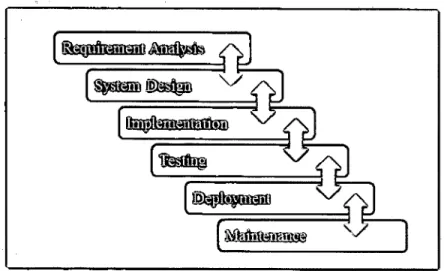
SLMS are used waterfall model for the methodology because the Waterfall Model Waterfall approach was first SDLC Model to be used widely in Software Engineering to ensure success of the project. In the Waterfall approach, the whole process of software development is divided into separate phases. In Waterfall model, typically, the outcome of one phase acts as the input for the next phase sequentially. It is also referred to as a linear-sequential life cycle model. It is very simple to understand and use.
Figure 1.1: Methodology of Study Loan Management System (SLMS)
Figure 1.1 shows the methodology is choose for Study Loan Management Systems (SLMS). There are six phase of waterfall model which is requirement analysis, system design, implementation, testing, deployment and the last one is maintenance.
i. Requirement Analysis
All possible requirements of the system to be developed are captured in this phase and documented in a requirement specification doc.
ii. System Design
The requirement specifications from first phase are studied in this phase and system design is prepared. System Design helps in specifying hardware and system requirements and also helps in defining overall system architecture.
iii. Implementation:
With inputs from system design, the system is first developed in small programs called units, which are integrated in the next phase. Each unit is developed and tested for its functionality which is referred to as Unit Testing.
iv. Integration and Testing
All the units developed in the implementation phase are integrated into a system after testing of each unit. Post integration the entire system is tested for any faults and failures.
v. Deployment of system
Once the functional and don-functional testing is done, the product is deployed in the customer environment or released into the market.
vi. Maintenance
There are some issues which come up in the client environment. To fix those issues patches are released. Also to enhance the product some better versions are released. Maintenance is done to deliver these changes in the customer
1.6 THESIS ORGANIZATION
This thesis consists of five
(5)
chapters:Chapter 1 is about introduction of this system. We discussed the background of the
project, problem statement, objective and scope of my project.
Chapter 2 will present about literature review. There are six topic will cover in chapter 2
which is introduction, Function in Smart Matric Card system, The existing system, The problems with the current systems, Comparison of technologies, Tools are choosing.
Chapter 3 is about research methodology. It contains waterfall model that we used for
this project.
Chapter 4 will cover about design and implementation plan. For this chapter, we explain
in detail the design and structure of this system.
Chapter 5 will cover about result and discussion. For this chapter, we will analyze the
data and discuss the result that I have
Chapter 6 is about conclusion. This chapter will describe the summary of the result,
limitation of the study, suggestions for further study based on the research outcome and concluding remarks.
LITERATURE REVIEW
2.1 INTRODUCTION
This chapter will review On some materials in order to get knowledge and understanding on the techniques had been proposed. All those techniques have the same aim which is used for detection purpose. The requirements in terms of software and hardware will also be listed. Developer can understand all the features that are available in the requirement of this system before proceeding to the proposed project. In SLMS, it will use web base as a platform to manage the loan transfer into respective student's account. This chapter also will take brief explanations on study of previous or existing system that related to the proposed system, based on the development process, tools and platform used. The purpose of reviewing previous work is to guide through the kind of work that others have done related to the project field.