The effects of party–issue associations
on the voting decision process
Romain Lachat Universitat Pompeu Fabra
Paper prepared for the 1st European Conference on Comparative Electoral Research, 1–3 December 2011, Sofia
Abstract
Parties are often associated with specific issues. They can “own” an issue when they develop a reputation of competence and attention in that domain and they can strategically emphasize specific issues in their campaign. This paper suggests that these associations lead voters to weight issues differently when evaluating different political parties. An issue associated to a given party should have a stronger impact on citizens’ evaluations of that party than on the evaluation of its competitors. These hypotheses are tested in the case of the 1994 and 1998 Dutch elections. The results clearly show that the impact of issues on party evaluations varies across parties. The results further support the hypothesis that this variation is related to issue ownership. Short-term associations resulting from campaign strategies, in contrast, do not appear to influence how citizens evaluate parties.
Political issues play a central role in theories of political representation. Congruence between the issue preferences of citizens and the positions of their representatives is seen as an
important condition for an effective system of political representation (Powell 2004; Thomassen and Schmitt 1997). It is thus not a surprise that issue preferences are central explanatory factors in many models of voting choice. The impact of issues on the vote is most often analyzed in the framework of spatial models (Enelow and Hinich 1984, 1990; Merrill and Grofman 1999). Following the tradition of Downs (1957), such models rest on the central assumption that voting choices are influenced by the relative positions of voters and parties in the political space. Various specifications have been suggested of how citizens compare their own issue preferences to the positions advocated by parties (e.g., Adams, Merrill, and
Grofman 2005; Duch, May, and Armstrong 2010; Kedar 2005). But virtually all spatial models share one central assumption: A voter evaluates all parties with the same set of criteria. This fits with a conception of the voting decision process in which citizens choose among the competing alternatives by evaluating them on the basis of a given “vote function.” In such a model, each citizen has a fixed set of criteria with which all parties are evaluated. For example, if citizens’ voting choices are influenced by their attitudes towards taxation, immigration, and environmental protection, these issue preferences will play the same role in the evaluation of all parties in competition. The question of immigration will not matter more for explaining how a voter stands to a conservative party than to a social-democratic party.
This article argues that this assumption is too restrictive and it proposes an alternative model of the role played by issue preferences in the voting decision process. It suggests that the weight attached to the criteria influencing citizens’ evaluations of parties may vary across parties. This expectation is derived from the observation that parties are often associated with specific issues. Parties may develop a reputation of attention and competence in some
political domain (Petrocik 1996). They may also try to channel the political debate in a preferred direction, focusing on their priority issues and avoiding the issues favoured by their competitors (Budge and Farlie 1983a, 1983b). Social-democratic parties, for instance, are often associated with welfare state issues. This is one of their long-standing priorities and they often emphasize these issues in electoral campaigns. In a similar fashion, right-wing populist parties are frequently associated with the issue of immigration. This article investigates the effects of these party–issue associations on the voting decision process. It suggests that some issues may matter more to explain support for some parties than for others. When citizens consider the various parties, evaluating which ones represent attractive options for their voting choice, they may weight issues differently when evaluating different parties. Turning
again to the example of attitudes towards immigration, voters’ preferences in that matter may strongly influence their support for a right-wing populist party, but be of less importance to explain how they stand to other party families. Similarly, preferences in the domain of environmental protection may be central for evaluating Green parties, but not for Liberals or Conservatives. In other words, I suggest that voters do not necessarily apply exactly the same set of issues for evaluating all parties or that the weight of these issues varies across parties.
The next two sections elaborate this model of the voting decision process. I first discuss the traditional conception of the role of issues in the voting decision process, based on the proximity model of voting choice. Then, I explain in more detail why party–issue
associations lead me to reassess this traditional conception. These ideas are formalized into a new model of the voting decision process and of the relations between issue preferences and party evaluations. Then, I discuss which types of associations between parties and issues are expected to be relevant. I suggest that the impact of a given issue should be stronger on the evaluation of the party that has traditionally “owned” it, that strongly emphasizes this issue in the campaign, and which takes a relatively extreme position on this issue. The hypotheses are tested by combining individual-level data from the 1994 and 1998 Dutch election studies with party-level data on issue positions and priorities. The results offer strong support for the hypothesis of cross-party variation in the impact of issues. They also reveal a strong impact of issue ownership: The effect of an issue on party utilities is stronger for the party owning that issue than for other parties. The salience with which parties address issues, and the extremity of their issue position, by contrast, do not have such an impact. The paper concludes by discussing the implications of these findings for the analysis of electoral competition.
The role of issue preferences in the voting decision process
The voting decision process is usually conceived as a parallel evaluation of the competing parties. It is seen as the product of a direct comparison of the parties on a fixed set of criteria. Enelow and Hinich (1984, 3), for instance, expect that “each voter will compare the package offered by the candidate with that offered by his opponent(s) and vote for the candidate whose package is most favorably evaluated. Viewed in simplest spatial terms, the voter will cast his vote for the candidate ‘closest’ to him in a space that describes all the factors that are of concern to the voter.” This conception implies that voters use the same criteria to evaluate all parties in competition. There may be differences across voters, with some citizens relying for example more strongly on issues than others (e.g., Rivers 1988). But for a given voter, all parties are evaluated on the basis of the same set of criteria. This logic can be illustrated with
the proximity model of voting choice (Downs 1957; Merrill and Grofman 1999), which is probably the spatial model most often used to analyze the impact of issue preferences on the vote. In a proximity model with K issue dimensions, the utility of citizen i (i = 1, …, n) for party j (j = 1, …, J) can be defined as
ij k jk ik k j ij x p y
2 , (1)where xik is the position of citizen i on issue dimension k, p is the position of party j on that
issue dimension, as perceived by citizen i, j is a party specific constant,k measures the strength of the impact of issue dimension k on the voter’s utility, and ij is a random error term.1 In this model, voter–party distances on issue dimension k have the same impact for all parties, captured by the parameter k. Other spatial models have been suggested, which differ from the proximity model in how issue preferences relate to party utilities. Citizens may focus on the direction in which parties want to change the status quo, rather than on party positions (Rabinowitz and Macdonald 1989). Or they may focus on the expected policy outcomes, rather than on party positions, accounting for the fact that parties in a governing coalition may be forced to compromise on their preferred policies (Duch, May, and
Armstrong 2010; Kedar 2005). Still another alternative to the traditional proximity model is that voters’ party utilities are also affected by non-policy factors, such as voters’ traditional attachments to a given party (Adams, Merrill, and Grofman 2005). While each of these conceptions models voters’ utilities in a different way, all of them share the assumption of the proximity model that the impact of issues is not party-specific.
The frequent associations between parties and issues may however lead one to question this assumption. Such associations have been emphasized, for example, in the “saliency theory” of electoral competition (Budge and Farlie 1983b) and in the “issue ownership theory” (Petrocik 1996). The saliency theory of party competition is based on the idea that parties strategically choose which issues to emphasize in their campaign. “Parties […] do not compete by arguing directly with each other, but by trying to render their own areas of concern most prominent” (Budge and Farlie 1983b, 23). This strategic behavior is
1
This specification differs on two points from the standard presentation of the proximity model (e.g., Adams, Merrill, and Grofman 2005, 17). First, I add rather than subtract the effects of the spatial distances. This simply reverses the sign of the estimated coefficients, without implying any substantial change to the model. Second, equation 1 includes party-specific constants (j), to allow for variations across parties in the average voter
linked with associations between parties and issues. Parties are usually perceived as being more competent on some issues than on others. Many issues are thus associated with specific parties—the welfare state with the social-democrats or defense with conservative parties, for instance. A related account of the nature of party competition is suggested by Petrocik’s “issue ownership theory” (Petrocik 1996; Petrocik, Benoit, and Hansen 2003). It argues that parties can have a reputation at being particularly good at handling specific issues. Parties seek to give more importance to these issues in voters’ decisions, by emphasizing them during the campaign (Petrocik 1996). As in the work of Budge and Farlie, the existence of party– issue associations is central to the theory of Petrocik.
I expect such associations between parties and issues to matter for explaining how citizens evaluate parties, as they may affect the accessibility of specific issues in voters’ memory. Attitudes that are frequently activated, or that have been activated recently, have a higher degree of accessibility (Iyengar and Kinder 1987). They are more likely to influence voters’ evaluations of parties or candidates (Iyengar 1990; Krosnick 1988, 1990). If a party regularly emphasizes a given issue, or if it is frequently put in relation with that issue in the media, this should strengthen the corresponding party–issue association in voters’ minds. If a green party repeatedly emphasizes the issue of environmental protection, citizens should come to associate the two. When citizens think about this party, their attitudes towards environmental protection should be more easily activated than their preferences regarding other issues about which this party rarely talks. As a consequence, the preferences toward environmental protection should play an important role in explaining citizens’ evaluations of that party. This mechanism has some similarity to that underlying the issue ownership model. The latter theory rests on the idea that parties’ issue emphases “prime their salience in the decisional calculus of the voters” (Petrocik, Benoit, and Hansen 2003, 599). In the issue ownership theory, however, the effects of these party–issue associations are not considered to be party specific. Parties compete with one another in trying to render their priority issue more salient. They are expected to influence the vote function that voters apply to all parties. The model advocated here differs by arguing that an association between a party and an issue should only matter for explaining the voters’ utility for that specific party. In other words, rather than a parallel evaluation of parties based on a common set of criteria, I expect voters to evaluate the attractiveness of parties separately from one another. I do not mean to imply that voters will use entirely different criteria for each party. Some issues may well play an important role in the evaluation of all parties. But I expect to observe party-specific patterns.
In the next but one section, I will discuss how such associations between parties and issues may be created and reinforced, and how they can be measured. Before doing that, however, I discuss how the general hypothesis I have presented can be formalized into a model of the voting decision process.
A model of party utilities with cross-party variation in the impact of issue distances
The model proposed here is based on the proximity model of voting choice (equation 1), but differs from it by letting the impact of issue preferences vary across parties. In this model, the utility of voter i for party j is defined as:
ij k jk ik kj j ij x p y
2 . (2)This model is identical with the model of equation 1, except for the parameters kj, which are now allowed to vary across both issue dimensions (k) and parties (j). I expect these
parameters, which capture how strongly voter–party distances on a given issue influence party utilities, to be related to the strength of the association between party j and issue dimension k. This type of effect can be illustrated with the salience of a given issue in a party’s electoral campaign, which is one of the indicators of party–issue associations used in this paper’s empirical analyses. If, during the campaign, a right-wing populist party emphasizes the immigration issue more strongly than its competitors do, voters’ preferences on the
immigration issue should be more strongly related to their utility for this right-wing populist party than to their utilities for other parties.
To better understand how the proposed model differs from other spatial models, it is necessary to emphasize a distinction between two sides of the voting decision process: the
formation of party utilities, on the one hand,and the choice which party to vote for, on the other. While voting choice is the ultimate behavior students of elections try to explain, spatial models are usually formulated as models of voters’ party utilities. These are the dependent variables in both the proximity model of equation 1 and in the model introduced in equation 2. These models aim to explain the degree to which voters consider a party to be an attractive option for their voting choice. While the distinction between party utilities and voting choice is quite clear in the literature on spatial models, it is also made, at least implicitly, in other research traditions (Van der Eijk et al. 2006). Party utilities are the basis on which citizens make their voting choice. The probability that citizen i votes for party m is a function of the
voter’s utility for party m compared to the utilities for all parties. This probability can be expressed as (e.g., Adams, Merrill, and Grofman 2005; Kedar 2005):
J j ij im i y y m vote 1exp exp Pr . (3)The relation between party utilities and probability of voting choice expressed in equation 3 applies equally to the traditional proximity model of equation 1 and to the modified model introduced in equation 2.
Empirical tests of spatial models are based sometimes on voting choice (e.g., Erikson and Romero 1990; Iversen 1994), sometimes on party utilities, measured by citizens’
evaluations of parties (e.g., Rabinowitz and Macdonald 1989; Westholm 1997). Several authors have emphasized the advantages of focusing on party utilities rather than on voting choice (e.g., Van der Eijk et al. 2006; Macdonald, Rabinowitz, and Listhaug 1995; Westholm 1997). The latter is dichotomous in nature and contains less information than party utilities. Furthermore, spatial models really are theories about the formation of party utilities and they make predictions about voters’ utilities for all parties. They do not simply predict for which party a voter has the highest expected utility. Focusing on utilities allows thus for a more complete test of these theories. But in spite of these potential advantages of models of party utilities over models of voting choice, both types of empirical analyses are frequently
encountered in the literature. There is little controversy regarding the choice among these two strategies, probably because the expected impact of issue preferences usually is the same with both dependent variables. If one expects a given issue to be relevant in the voting decision process, the expected consequences can generally be observed independently of choosing party utilities or voting choice as the dependent variable to be modeled empirically.
In the case of the model proposed here, however, this choice is consequential. The effects of the expected heterogeneity in the impact of issues are not the same when looking at party utilities and when looking at voting choice. While the model suggested in equation 2 lets the impact of issue preferences on voters’ utilities vary across parties, voting choice
depends on the utilities for all parties, as shown in equation 3. The impact of issues on voting choicehas the character of a zero-sum game: The sum of the probabilities of choosing any of the choice alternatives is always equal to 1. If a change in the issue preferences of a voter increases the probability to vote for one of the parties, it must reduce the chances to support other parties. For each explanatory factor, positive and negative effects on the predicted
voting probabilities must sum to zero. As a consequence, the expected variation across parties in the impact of issues can only be meaningfully observed by modeling party utilities. To clarify this point, let us consider a hypothetical two-party system, with a social-democratic party campaigning on welfare issues, and a conservative party emphasizing questions of immigration. Let us assume further that citizens’ attitudes towards immigration influence their expected utility for the conservative party, but that these attitudes are unrelated to their utility for the social-democratic party. If a voter moves closer toward the conservative party and away from the social-democratic party on the immigration issue, their expected utility for the conservative party will increase. Their utility for the social-democratic party, however, will remain unaffected by the change. In terms of voting choice, however, a decrease in the distance to the conservative party will also decrease the probability of supporting the social-democratic party—even if the corresponding party utility does not vary. Because the
probabilities of choosing any of the parties are constrained to sum to 1, any change affecting the chances of supporting the conservative party must also influence the likelihood of voting for its opponent.
One may ask, “should we care about potential differences across parties in the factors influencing party utilities, if they do not necessarily matter for explaining voting choice?” My answer would be a clear yes! For one, as emphasized above, spatial models are first and foremost theories about the determinants of party utilities. So, there are important reasons for focusing on these utilities and for trying to understand how they are formed. More
importantly still, even if one cares only about voting choice, differences across parties in the determinants of voters’ utilities may still matter in significant ways. Think for example about which party strategies may be deduced from an empirical analysis of voters’ preferences. Based on the above example, the results of the model of voting choice will lead one to advise the social-democratic party to move towards the conservative party on the immigration issue, in order to attract voters whose attitudes towards immigration are located between the
positions of the two parties. The model of voters’ utilities, on the other hand, offers nothing to justify such a strategy.
Sources of party–issue associations
The expected differences in the determinants of party utilities should result from associations between parties and issues. To specify further my hypotheses, it is necessary to discuss the nature and origin of these associations. This study considers three sources of party–issue associations: issue ownership, the salience of issues in parties’ campaign, and the extremity of
parties’ issue positions. The concept of issue ownership was introduced by Petrocik (1996, 826): It is “the ability to resolve a problem of concern to voters. It is a reputation for policy and program interests, produced by a history of attention, initiative, and innovation toward these problems.” A party owning an issue is perceived as being more willing to address this issue and as being more competent at solving it. Such reputations take time to develop and are likely to be relatively stable (Petrocik 1996). Issue ownership represents thus a long-term association between parties and issues.
Party–issue associations may also result from the salience with which parties address different issues during the campaign. As emphasized by the saliency theory of electoral competition (Budge and Farlie 1983b), parties try to prime the issues they view as most favorable to their electoral prospects. If a party owns an issue, it is likely to try to render it more salient in this way. But even issues which are not “owned” by any party may be
strategically accentuated. Parties’ issue emphases will be reflected in their party programs, in the topics they address in speeches or during party rallies, as well as in their campaign posters and advertisements. The media are also likely to play an important role in creating or
reinforcing such associations. We know from research on priming effects that the media influence which issues voters consider to be important (Iyengar, Peters, and Kinder 1982; Johnston et al. 1992; Krosnick and Kinder 1990).
Finally, in addition to issue ownership and issue salience, variability in the determinants of party preferences may also be linked to the extremity of parties’ issue
positions. The impact of a given issue on party evaluations should be larger for parties taking more extreme positions on that issue. A related hypothesis has been discussed in the literature regarding the overall impact of ideology and issue dimensions. The higher the level of party system polarization on a given dimension is, the stronger is the impact of that dimension on voting decisions (Alvarez and Nagler 2004; Dalton 2010; Kroh 2009; Lachat 2008a, 2010) . This effect has been related to the salience of the corresponding issue dimensions. Alvarez and Nagler (2004), for example, argue that parties will invest less effort in communicating their issue stances on topics where they do not diverge from other parties. In such cases, voters should be less certain of the party position and the corresponding issue or ideological dimension should be less accessible when making evaluations (Knutsen and Kumlin 2005). I expect a similar effect for voters’ utilities for specific parties. Party utilities should be more strongly influenced by issues for which the corresponding party’s position is rather extreme.
To sum up my hypotheses, I expect the impact of issue preferences on party utilities to vary across parties. The impact of a given issue should be larger for parties that are frequently
associated with that issue. I will consider three (direct or indirect) indicators of party–issue associations: issue ownership, the salience of issues in parties’ campaigns, and the extremity of parties’ issue positions. The next section introduces the data with which these hypotheses are tested.
Data and operationalization
To analyze the impact of issues on party utilities, this study relies on data from the 1994 and 1998 Dutch election studies (Aarts, van der Kolk, and Kamp 1999; Anker and Oppenhuis 1997).2 Several reasons have guided this choice. An important consideration is that the hypotheses can be more convincingly tested if the number of “party × issue” combinations is sufficiently large. Furthermore, there should be enough variation in parties’ issue priorities and positions. These requirements are best met by considering a multiparty system, in which parties compete on a variety of issues. This situation certainly applies to Dutch elections. Then, of course, this diversity in terms of issues must be reflected in the corresponding election studies. At the individual level, I need measures of voters’ positions on several issue dimensions, as well as of their perception of parties’ positions on these issues. Such
individual-level information is available in the 1994 and 1998 Dutch election studies.
Furthermore, the relevant party-level characteristics can be aggregated from individual-level variables or are available from additional data sources.
An additional reason for investigating these elections is linked with the measurement of the dependent variable. As emphasized above, it is essential to have direct measures of party utilities. Such measures are available in many national election studies, in the form of like–dislike scales, thermometer ratings, or probabilities of future vote. While all of these questions measure the “attractiveness” of parties, they are not equivalent to one another. Van der Eijk and Marsh (2007) have shown that questions on “probabilities of future vote” fare better than alternative measures on several central criteria (see also Van der Eijk et al. 2006; Tillie 1995). In particular, such probabilities of future vote display a stronger relationship with actual vote choice (Van der Eijk and Marsh 2007, 11–4). This is central as I expect party utilities to be the basis on which the actual voting choice is made. Probabilities of future vote were measured by asking respondents how likely it is that they “will ever vote” for each of a series of parties.3 Respondents answered using a ten-point scale, ranging from “certainly
2
More information on the election studies used (sampling procedure, timing, response rate, etc.) can be found in the appendix.
3
The wording of all questions used in this study can be found in the appendix. It also contains summary statistics on the variables’ distributions.
never” to “sometime certainly” (coded from 0 to 1 for the present analyses). These party utilities were measured for up to eleven parties, but I can use only part of these in my analyses, as questions on the perceived issue positions were asked for a smaller number of parties. More precisely, I can use the measures of party utilities for four or five parties: the Social Democrats (PvdA), the Liberals (VVD), the liberal-radical Democrats ’66 (D66), the Christian Democrats (CDA), and, only in 1998, the Greens (Groenlinks).
Voters’ and parties’ positions were measured on the following issues: Euthanasia, crime (only in 1994), income differences, nuclear plants, ethnic minorities, European
unification, asylum seekers (only in 1998), and social benefits (only in 1998). On all of these issues, respondents’ positions and their perceptions of party positions were measured with seven-point scales (recoded here to the 0–1 range). These variables also allow measuring the extremity of party positions, which is defined as the squared distance on a given dimension between a party position and the average voter position.
Information on issue salience comes from two different sources. First, I use data from the Comparative Manifesto Project (Budge et al. 2001). In the framework of this project, the electoral programs of parties in the Netherlands and many other countries were coded,
counting the frequency with which parties addressed various issues. The second type of data I rely on comes from a content analysis of the print media during the electoral campaign, performed by Kriesi et al. (2006, 2008). They coded all articles related to the election in two major Dutch newspapers during the two months preceding each election. All issue statements of political actors were coded.4 Both datasets allow determining the salience with which a party addressed—or was put in relation with—a given issue. They differ however in the type of material used. Party programs are strategic documents, in which parties are free to select the problems they want to emphasize. They may thus be particularly appropriate for
identifying parties’ issue priorities. The content of the media, on the other hand, better reflects the type of information voters may have been confronted with. During the campaign, parties may have to respond to issues raised by their competitors, even if they chose not to do so in their party program. The two sources of data should thus be seen as complementing each other. With both of them, the salience of a given issue is computed as the number of issue statements in the corresponding category, as a percentage of the total number of issue statements for that party. These variables, coded in per cent, can range in theory from 0 to 100. But the highest issue salience in my data is quite lower, being just around 25 per cent.
4
Unfortunately, there is not a perfect correspondence between the issues used in the survey data and the issue categories available in manifesto and media data. In some cases, the latter are more general than the specific issues about which voters were asked in the election surveys. Table 1 shows how I matched the issue categories of the various datasets for the purpose of computing the salience variables.5
Table 1. Issue salience: correspondence between the issue categories used in the different datasets
Issue in election studies Categories in manifesto data a) Categories in media data b)
Euthanasia Traditional Morality: Positive,
Traditional Morality: Negative
Cultural liberalism
Crime Law and Order Security
Income differences Social Justice Economic liberalism
Nuclear plants Environmental protection Environmental protection
Ethnic minorities Multiculturalism: Positive, Multiculturalism: Negative
Cultural liberalism European unification European Community: Positive,
European Community: Negative
European integration
Asylum seekers Underprivileged Minority Groups:
Positive, Non-economic Demographic Groups: Positive
Immigration
Social benefits Welfare State Expansion: Positive, Welfare State Limitation: Positive
Welfare
a) For a definition of these issue categories, see Budge et al. (2001, 222–8). b) For a definition of these issue categories, see Kriesi et al. (2006, 932f.).
To determine issue ownership, finally, I rely on questions from the national election studies. In 1994, respondents were asked which parties have the best ideas to solve various current problems. Of the six problems with which respondents were confronted, four can be related to an issue used in this study’s model of voting choice. To determine the ownership of the issue of income differences, I consider which party respondents deem best able to solve the
problem of “safeguarding pensioners’ income.” Two questions can be used to establish the ownership of the crime issue: a question on solving the problem of “crime” and one on solving the problem of “social welfare fraud.” Ownership of the issue of nuclear plants,
5
The correspondence with the categories of the manifesto data is problematic for the issue of asylum seekers. Not only do the manifesto categories refer to more general types of social groups, but they also refer only to positive mentions. This is especially problematic as the issue of asylum seekers is mainly articulated by right-wing populist parties, which defend more restrictive immigration rules. However, the estimated effect of salience does not change substantially when this potential problematic issue category is excluded. With media data, the main problem is that two issues, euthanasia and ethnic minorities, are related to the same general category of cultural liberalism.
finally, is derived from respondents’ opinion on which party has the best ideas to solve the problem of “environmental pollution.” For each of these problems, one party was mentioned much more frequently than the others as having the best ideas: the PvdA for safeguarding pensioners’ income, the VVD for both crime and social welfare fraud, and Groenlinks for solving the problem of environmental pollution.6 I consider these parties as owning the corresponding issue and measure it with a dummy variable in the statistical model. Party utilities for Groenlinks cannot however be included in 1994, as the party’s issue positions were not measured in that year (see above).
Such questions on parties’ perceived competence were not asked in the 1998 election study. However, respondents were invited to rate the importance of five issues for six
different parties. Two of these correspond closely to an issue included in this article’s model of voting choice. The perceived importance of a “cleaner environment”can be related to the attitudes towards nuclear plants, and the importance of the problem of “refugees”is related to the attitudes towards asylum seekers. The first of these issues is perceived as being more important for Groenlinks than for the other parties.7 As a consequence, I attribute the ownership of the nuclear issue to that party. In contrast, respondents do not consider the problem of refugees to be much more important for one party than for the others. Therefore, I do not attribute the ownership of this issue to any party.8
Still in 1998, I attribute the ownership of the issue of income differences to the
PvdA—similarly to the 1994 case. This issue clearly corresponds to a traditional core issue of the Social-Democrats. I also consider that the issue of social benefits is owned by the PvdA. This issue dimension was not part of the 1994 study. It is however very close to the question on solving the problem of pensioners’ income, asked in 1994, for which a PvdA ownership appeared clearly. Finally, for both elections, I attribute ownership of the euthanasia issue to the CDA. This issue has been a central topic in Dutch politics for years (Andeweg and Irwin 2002). It is part of the issues dealing with Christian ethics, the ownership of which is
generally attributed to the CDA (e.g., Kleinnijenhuis and De Ridder 1998). Table 2
summarizes the information about the issue owners for all the issue dimensions included in the model of voting choice. While the data and information used to attribute issue ownership
6
The percentages of respondents indicating that the corresponding party has the best ideas are: 42 per cent for the PvdA on safeguarding pensioners’ income (next party: CDA with 13%), 50 per cent for the VVD on social welfare fraud (next: PvdA, 19%), 43 per cent for the VVD on crime (followed by the CDA with 21%), and 51 per cent for Groenlinks on environmental pollution (next: D66, 18%). These percentages were computed by taking only the parties that respondents mentioned first, and by considering only valid answers.
7
The average perceived importance, on a 1–10 scale, is 8.8 for Groenlinks, while it varies from 6.6 to 7.4 for the other parties.
8
No party stands out in the average perceived importance of that issue: 7.5 for the PvdA and Groenlinks, 7.1 for the CDA and D66, and 7.0 for the VVD.
is somewhat heterogeneous, all of the associations listed in Table 2 correspond to traditional perceptions of the issues owned by the corresponding party families.
Table 2. Issue owners
Issue 1994 1998
Euthanasia CDA CDA
Crime VVD – a
Income differences PvdA PvdA
Nuclear plants (Groenlinks)b Groenlinks
Ethnic minorities no owner no owner
European unification no owner no owner
Asylum seekers –a no owner
Social benefits –a PvdA
a. This issue dimension cannot be included in the spatial model in that year, as voters' positions were not measured.
b. Ownership can be attributed to Groenlinks, but voters’ utilities for this party cannot be modeled in 1994.
Statistical model
The statistical model to be estimated with these data is specified as follows. I first repeat equation 2, which shows how the utility of voter i for party j relates to the voter–party distances on k issue dimensions:
ij k jk ik kj j ij x p y
2 . (2)I assume a normal distribution for the random error term ij, with mean value 0 and standard deviation 2y. The parameters kj are a function of the characteristics of the corresponding “party × issue” combination:
kj
0 1salienceCMPkj 2saliencemediakj kj kj
kj
3 ownership 4 extremity (4)
where “salience CMPkj,” “salience mediakj,” “ownershipkj,” and “extremitykj” are the
characteristics of party j with respect to issue k, as defined above. Still in equation 4, kj is a random error term and the parameters are constants to be estimated.
The model defined by equations 2 and 4 has a multilevel structure, including
characteristics measured both at the level of individuals and at the level of “parties × issues.” Ideally, this model would be estimated as a hierarchical model in a Bayesian framework.
However, the structure of the above model makes this particularly challenging. The theoretical model suggests that the issue-specific characteristics of parties have the same impact on all issues. The estimated effect of issue ownership, for instance, should be the same for the issue of crime than for the issue of nuclear plants. This effect is captured by the
parameter 3 in equation 4 and it is not issue-specific (i.e., it is not indexed by k). While there is one set of coefficients for each issue in the individual-level model, the model at the level of “party × issue” includes a single coefficient for each characteristic of parties. Translating this into a multilevel model implies imposing a complex set of constraints on the values of the covariance matrix—with the unfortunate consequence that these models fail to converge. The alternative procedure used in this study is to estimate this model with a two-step method (Jusko and Shively 2005; Lewis and Linzer 2005). I first estimate equation 2 separately for each party. In a second step, I pool the estimated coefficients from all of these models and use them as the dependent variable of a feasible generalized least squares (FGLS) regression, following the procedure suggested by Lewis and Linzer (2005, 351f.). The second step of this procedure corresponds thus to the estimation of the model of equation 4. The drawback of this approach is that one must assume that the individual-level coefficients are uncorrelated. While this is a simplifying assumption, this procedure seems to be the only available estimation method in this case.
I expect the parameters to be negative or not significantly different from 0. A negative value would indicate that a party utility becomes smaller with an increasing voter– party distance on the corresponding issue. A non significant value would show that this issue does not contribute to explaining the corresponding party utility. Most important for my hypotheses are the estimated values of the coefficients. I expect these parameters to be negative. As the variables measuring party–issue associations are all coded so that a higher value means a stronger association, a negative value of would show that a stronger association strengthens the impact of the corresponding issue.
Results
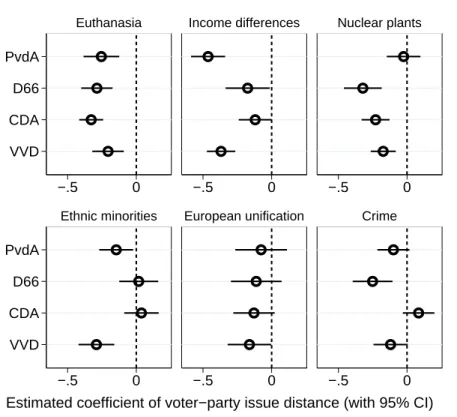
I start the analysis by examining the variation across parties in the impact of spatial utilities. To this end, I estimate the model of equation 1 separately for each party. Figure 1 presents the results for the 1994 election. Each panel corresponds to one issue and shows the estimated impact of the voter–party issue distance for each party, with the associated 95 per cent
confidence interval. The dashed vertical lines indicate the value of 0 (i.e., no effect). The 1998 results are presented in a similar way in Figure 2.
VVD CDA D66 PvdA VVD CDA D66 PvdA −.5 0 −.5 0 −.5 0 −.5 0 −.5 0 −.5 0
Euthanasia Income differences Nuclear plants
Ethnic minorities European unification Crime
Estimated coefficient of voter−party issue distance (with 95% CI)
Figure 1. Impact of voter–party issue distances on party utilities, 1994 election. Estimated coefficients and 95% confidence intervals.
VVD CDA D66 GroenLinks PvdA VVD CDA D66 GroenLinks PvdA −.5 0 −.5 0 −.5 0 −.5 0 −.5 0 −.5 0 −.5 0
Euthanasia Income differences Nuclear plants Social benefits
Ethnic minorities European unification Asylum seekers
Estimated coefficient of voter−party issue distance (with 95% CI)
Figure 2. Impact of voter–party issue distances on party utilities, 1998 election. Estimated coefficients and 95% confidence intervals.
Most issues have a significant and negative impact. The utility for a given party tends to become smaller as the voter–party issue distance gets larger. Most interesting, however, is the degree to which these results vary across parties. As expected, we can observe substantial differences between parties in the impact of issues. In 1994 (Figure 1), this appears very clearly for the issues of nuclear plants, ethnic minorities, European unification, and crime: They have a significant impact for some parties but not for others. Voters’ attitudes toward ethnic minorities, for instance, do not influence the utilities for D66 or the CDA. But they strongly influence the perceived attractiveness of the VVD. The variation in the impact of attitudes towards income differences is also striking. While this issue dimension turns out to be significant for all four parties, the size of the point estimates varies by a factor of one to four. The picture is similar in 1998 (Figure 2). Four of the seven issues (income differences, social benefits, ethnic minorities, asylum seekers) have a significant impact on the utilities for some parties, but not others. Attitudes towards euthanasia and nuclear plants significantly influence the utilities for all parties, but with substantial variation in the magnitude of the effects. Variation is only absent for the issue of European unification: It does not contribute to the explanation of party utilities, for any of the parties.
The central question is whether this variability is related to issue ownership, issue salience, and extremity. To test these hypotheses, I turn to the second step of the estimation. Tables 3 and 4 indicate the effects of parties’ characteristics on the individual-level
coefficients in the 1994 and 1998 elections, respectively. In both tables, Model 1 includes all four indicators of party–issue associations. As the number of observations is relatively small (24 in 1994, 35 in 1998), I also estimate additional models including each only a single covariate (Models 2–5).
The hypotheses that issue salience or the extremity of parties’ issue positions affect the strength of issue voting clearly are not supported by these results. The three corresponding indicators are not significant in 1994 and 1998, neither in Model 1 nor in the models
including only the corresponding independent variable. In contrast, Model 1 reveals that the impact of issue ownership is significant in 1998, and that it is very close to being significant in 1994. In the latter case, the p-value is just under 0.11, which may be seen as acceptable given the small number of observations. Furthermore, Model 4 shows that this variable is clearly significant when it is included as the only covariate, both in 1994 (Table 3) and in 1998 (Table 4). The corresponding coefficients are negative, as expected. Party utilities are negatively related to voter–party distance, and this negative effect is stronger in the case of the issue owner. Not only is this issue ownership effect significant, it is also substantially
important. In 1994, the effect of the voter–party distance on party utility is about –0.16 for parties which do not own the corresponding issue, as indicated by the point estimate of the intercept in Model 4 (Table 3). When the voter–party distance increases from the minimum value of 0 to the maximum value of 1, the party utility decreases by a value of 0.16 on a 0–1 scale. For a party owning an issue, by contrast, the effect of the voter–party distance on this issue is about twice as strong. The issue ownership effect is even slightly stronger in the 1998 election (Table 4, Model 4).
Table 3. Effects of party–issue associations on the relation between issue distances and party utilities, 1994 election. Coefficients (standard errors in parentheses) estimated with FGLS.
Model 1 Model 2 Model 3 Model 4 Model 5
Salience, manifesto 0.00 (0.01) 0.01 (0.01) Salience, media 0.01 (0.01) 0.01 (0.01) Issue ownership –0.13 (0.08) –0.15† (0.08) Extremity –0.48 (0.50) –0.66 (0.52) Constant –0.23** (0.07) –0.20*** (0.05) –0.26*** (0.06) –0.16*** (0.03) –0.15*** (0.03) R2 0.28 0.02 0.10 0.14 0.07 N 24 24 24 24 24 † p<0.10; * p<0.05; ** p<0.01; *** p<0.001
Table 4. Effects of party–issue associations on the relation between issue distances and party utilities, 1998 election. Coefficients (standard errors in parentheses) estimated with FGLS.
Model 1 Model 2 Model 3 Model 4 Model 5
Salience, manifesto –0.01 (0.01) –0.01 (0.01) Salience, media 0.00 (0.00) 0.00 (0.00) Issue ownership –0.17* (0.08) –0.21** (0.07) Extremity –0.45 (0.56) –0.72 (0.57) Constant –0.14* (0.06) –0.14** (0.04) –0.18*** (0.05) –0.17*** (0.02) –0.17*** (0.03) R2 0.24 0.07 0.01 0.22 0.05 N 35 35 35 35 35 † p<0.10; * p<0.05; ** p<0.01; *** p<0.001
Discussion
This paper analyzed the role of issue preferences in the voting decision process. It suggested that the impact of issue distances on party utilities should vary across parties, influenced by the associations between parties and issues. The results obtained for the 1994 and 1998 Dutch elections clearly show that the impact of issue preferences varies across parties. These
findings strongly support the hypothesis that citizens’ evaluations of parties are not explained by a single vote function. Citizens do not weight issues equally when evaluating the electoral attractiveness of different parties.
In the second part of the analyses, I estimated how the strength of the relations between issue preferences and party utilities was influenced by party–issue associations. Following the saliency theory and the issue ownership model, I postulated that party utilities should be more strongly influenced by the issues a party is associated with. The results were mixed. I found no evidence for an effect of issue salience. Evaluations of parties do not depend more strongly on issues that are particularly salient in their program, or issues on which they frequently take position during the campaign. This conclusion is strengthened by the use of two different indicators of salience, based on alternative data sources, which lead to equally negative results. At the same time, however, the measures of issue salience were based on more general categories of issues than those included in the model of voting choice. These imperfect indicators of issue salience could also be a reason for the absence of
observable effects.
The analyses presented here did not either reveal an effect of the extremity of party positions. This factor was expected to have an indirect effect on issue salience, with parties investigating more efforts in communicating their positions when they differ strongly from their competitors. On the other hand, the results clearly show that issue ownership matters. Parties who own an issue—such as nuclear plants for the Greens or income differences for the PvdA—are more strongly evaluated on the corresponding dimension than other parties.
Judging from these results, the determinants of party utilities seem to be more strongly influenced by traditional associations between parties and issues than by the content of the campaign. The criteria on which voters evaluate parties are influenced by the long-term
party–issue associations. This implies that while the voting decision process depends on party characteristics, parties themselves have only limited possibilities to influence the criteria by which they are evaluated. At least in the short run.
The analyses presented in this study show the importance of issue ownership for explaining voters’ preferences. However, they offer a different interpretation of how
ownership matters. The “standard” theory of issue ownership postulates that parties compete by trying to prime the issue they own in voters’ decision (Petrocik 1996). Parties each try to prime a specific issue and the most successful one determines the issue on which all parties are evaluated. In contrast to this, this study has argued and shown that ownership has party-specific effects. It is not a competition among parties about making one’s preferred issue most salient. Owning an issue matters, but it does so mainly for the evaluation of the owner—and less so for explaining how citizens evaluate the electoral attractiveness of this party’s
References
Aarts, K., H. van der Kolk, and M. Kamp. 1999. Dutch Parliamentary Election Study 1998
[Computer file]. Amsterdam, NIWI-Steinmetz Archive & Dutch Electoral Research Foundation [producers]. NIWI-Steinmetz Archive, Zentralarchiv fuer Empirische Sozialforschung & Inter-university Consortium for Political and Social Research [distributors].
Adams, J.F., S. Merrill III, and B. Grofman. 2005. A Unified Theory of Party Competition. A Cross-National Analysis Integrating Spatial and Behavioral Factors. Cambridge:
Cambridge University Press.
Alvarez, R.M., and J. Nagler. 2004. Party System Compactness: Measurement and Consequences. Political Analysis 12:46–62.
Andeweg, R.B., and G.A. Irwin. 2002. Governance and Politics of the Netherlands. Houndmills: Palgrave Macmillan.
Anker, H., and E. Oppenhuis, 1997. Dutch Parliamentary Election Study 1994 [Computer file]. 2nd ICPSR Version. Amsterdam, Dutch Electoral Research Foundation &
Netherlands Central Bureau of Statistics [producers]. Steinmetz Archive & Inter-university Consortium for Political and Social Research [distributors].
Budge, I., and D. Farlie. 1983a. Party Competition – Selective Emphasis or Direct Confrontation? An Alternative View with Data. In Western European Party Systems –
Continuity and Change, eds. H. Daalder and P. Mair. Beverly Hills: Sage.
Budge, I., and D.J. Farlie. 1983b. Explaining and Predicting Elections: Issue Effects and Pary Strategies in Twenty-Three Democracies. London: George Allen & Unwin.
Budge, I., H.-D. Klingemann, A. Volkens, J. Bara, and E. Tanenbaum. 2001. Mapping Policy Preferences: Estimates for Parties, Electors, and Governments 1945–1998. Oxford: Oxford University Press.
Dalton, R.J. 2010. Left–Right Orientations, Context, and Voting Choices. In Citizens, Context and Choice: How Context Shapes Citizens’ Electoral Choices, eds. R.J. Dalton and C.J. Anderson. Oxford: Oxford University Press.
Dolezal, M. 2008. The design of the study: the distinguishing characteristics of our approach. In West European Politics in the Age of Globalization, eds. H. Kriesi et al., 53–74.
Cambridge: Cambridge University Press.
Downs, A. 1957. An Economic Theory of Democracy. New York: Harper and Row.
Duch, R.M., J. May, and D.A. Armstrong II. 2010. Coalition-Directed Voting in Multiparty Democracies. American Political Science Review 104:698–719.
Enelow, J., and M. Hinich. 1984. The Spatial Theory of Voting: An Introduction. Cambridge: Cambridge University Press.
Enelow, J.M., and M.J. Hinich, eds. 1990. Advances in the Spatial Theory of Voting. Cambridge: Cambridge University Press.
Erikson, R.S., and D.W. Romero. 1990. Candidate Equilibrium and the Behavioral Model of the Vote. American Political Science Review 84:1103–26.
Iversen, T. 1994. Political Leadership and Representation in West European Democracies: A Test of Three Models of Voting. American Journal of Political Science 38:45–74.
Iyengar, S. 1990. Shortcuts to Political Knowledge: The Role of Selective Attention and Accessibility. In Information and Democratic Processes, eds. J.A. Ferejohn and J.H. Kuklinski, 160–85. Urbana: University of Illinois Press.
Iyengar, S., and D.R. Kinder. 1987. News that matters. Chicago: The University of Chicago Press.
Iyengar, S., M.D. Peters, and D.R. Kinder. 1982. Experimental Demonstrations of the ‘Not-So-Minimal’ Consequences of Television News Programs. American Political Science Review 76:848–58.
Johnston, R., A. Blais, H. Brady, and J. Crete. 1992. Letting the People Decide: The Dynamics of a Canadian Election. Stanford: Stanford University Press.
Jusko, K.L., and W.P. Shively. 2005. Applying a Two-Step Strategy to the Analysis of Cross-National Public Opinion Data. Political Analysis 13:327–44.
Kedar, O. 2005. When Moderate Voters Prefer Extreme Parties: Policy Balancing in Parliamentary Elections. American Political Science Review 99:185–99.
Kleinnijenhuis, J., and J.A. De Ridder. 1998. Issue news and electoral volatility. A
comparative analysis of media effects during the 1994 election campaigns in Germany and the Netherlands. European Journal of Political Research 33:413–37.
Knutsen, O., and S. Kumlin. 2005. Value Orientations and Party Choice. In The European Voter. A Comparative Study of Modern Democracies, ed. J. Thomassen, 125–66. Oxford: Oxford University Press.
Kriesi, H., E. Grande, R. Lachat, M. Dolezal, S. Bornschier, and T. Frey. 2006. Globalization and the transformation of the national political space: Six European countries compared.
European Journal of Political Research 45:921–56.
Kriesi, H., E. Grande, R. Lachat, M. Dolezal, S. Bornschier, and T. Frey. 2008. West European Politics in the Age of Globalization. Cambridge: Cambridge University Press. Kroh, M. 2009. The Ease of Ideological Voting: Voter Sophistication and Party System
Complexity. In The Comparative Study of Electoral Systems, ed. H.-D. Klingemann, 220– 36. Oxford: Oxford University Press.
Krosnick, J.A. 1988. The Role of Attitude Importance in Social Evaluation: A Study of Policy Preferences, Presidential Candidate Evaluations, and Voting Behavior. Journal of
Personality and Social Psychology 55:196–210.
Krosnick, J.A. 1990. Government Policy and Citizen Passion: A Study of Issue Publics in Contemporary America. Political Behavior 12:59–92.
Krosnick, J.A., and D.R. Kinder. 1990. Altering the Foundations of Support for the President through Priming. American Political Science Review 84:497–512.
Lachat, R. 2008a. The impact of party polarization on ideological voting. Electoral Studies
27:687–98.
Lachat, R. 2008b. Technical appendix. In West European Politics in the Age of Globalization, eds. H. Kriesi et al., 345–65. Cambridge: Cambridge University Press.
Lachat, R. 2011. Electoral Competitiveness and Issue Voting. Political Behavior 33:645–63. Lewis, J.B., and D.A. Linzer. 2005. Estimating Regression Models in Which the Dependent
Variable Is Based on Estimates. Political Analysis 13:345–64.
Macdonald, S.E., G. Rabinowitz, and O. Listhaug. 1995. Political Sophistication and Models of Issue Voting. British Journal of Political Science 25:453–83.
Merrill III, S., and B. Grofman. 1999. A Unified Theory of Voting: Directional and Proximity Spatial Models. Cambridge: Cambridge University Press.
Petrocik, J.R. 1996. Issue Ownership in Presidential Elections, with a 1980 Case Study.
American Journal of Political Science 40:825–50.
Petrocik, J.R., W.L. Benoit, and G.J. Hansen. 2003. Issue Ownership and Presidential Campaigning, 1952–2000. Political Science Quarterly 118:599–626.
Powell, Jr., G.B. 2004. Political Representation in Comparative Politics. Annual Review of Political Science 7:273–96.
Rabinowitz, G., and S.E. Macdonald. 1989. A Directional Theory of Issue Voting. American Political Science Review 83:93–121.
Rivers, D. 1988. Heterogeneity in Models of Electoral Choice. American Journal of Political Science 32:737–57.
Thomassen, J., and H. Schmitt. 1997. Policy Representation. European Journal of Political Research 32:165–84.
Van der Eijk, C., and M. Marsh. 2007. Don’t expect me to vote for you just because I like you, even if you do make me feel warm inside: A comparison of the validity of
non-ipsative measures of party support. Paper presented at the Annual Meeting of the American Political Science Association, Chicago.
Van der Eijk, C., W. van der Brug, M. Kroh, and M. Franklin. 2006. Rethinking the dependent variable in voting behavior: On the measurement and analysis of electoral utilities. Electoral Studies 25:424–47.
Westholm, A. 1997. Distance versus Direction: The Illusory Defeat of the Proximity Theory of Electoral Choice. American Political Science Review 91:865–83.
Appendix
Table A1. Descriptive statistics: individual-level variables
1994 1998
Mean Std. dev. Mean Std. dev.
Party utilities PvdA 0.56 0.35 0.66 0.30 D66 0.60 0.29 0.54 0.30 CDA 0.45 0.33 0.49 0.32 VVD 0.50 0.35 0.53 0.35 Groenlinks – – 0.50 0.32
Squared voter–party distances
Euthanasia 0.17 0.25 0.16 0.24 Crime 0.15 0.21 – – Income differences 0.17 0.23 0.14 0.20 Nuclear plants 0.20 0.25 0.13 0.18 Ethnic minorities 0.15 0.21 0.13 0.19 European unification 0.09 0.15 0.10 0.16 Asylum seekers – – 0.12 0.18 Social benefits – – 0.08 0.13
Note: All individual-level variables can range from a minimum of 0 to a maximum of 1. The voter–party distances are computed as the distance between a voter’s position and his or her perception of the corresponding party’s position.
Table A2. Descriptive statistics: characteristics of “party × issue” combinations
Mean Std. dev. Min. Max.
1994 Ownership 0.13 0.34 0.00 1.00 Salience, manifesto 3.69 2.89 0.19 10.51 Salience, media 8.67 4.49 0.00 18.60 Extremity 0.04 0.05 0.00 0.16 1998 Ownership 0.11 0.32 0.00 1.00 Salience, manifesto 5.11 3.55 0.43 13.90 Salience, media 10.16 6.42 2.63 24.00 Extremity 0.03 0.04 0.00 0.18
Table A3. Impact of voter–party issue distances on party utilities, 1994 election. Coefficients and standard errors estimated with OLS regressions.
PvdA D66 CDA VVD Constant 0.73*** (0.02) 0.73*** (0.02) 0.62*** (0.02) 0.74*** (0.02) Euthanasia –0.25*** (0.07) –0.29*** (0.06) –0.33*** (0.04) –0.21*** (0.06) Crime –0.10 (0.06) –0.25*** (0.07) 0.08 (0.06) –0.12 (0.06) Income differences –0.46*** (0.06) –0.18* (0.08) –0.12* (0.06) –0.37*** (0.05) Nuclear plants –0.02 (0.06) –0.32*** (0.07) –0.23*** (0.05) –0.17*** (0.05) Ethnic minorities –0.15* (0.06) 0.02 (0.07) 0.04 (0.06) –0.29*** (0.07) European unification –0.08 (0.10) –0.11 (0.09) –0.13 (0.08) –0.16** (0.08) N 621 541 592 562 R2 0.22 0.17 0.19 0.35 * p<0.05; ** p<0.01; *** p<0.001
Table A4. Impact of voter–party issue distances on party utilities, 1998 election. Coefficients and standard errors estimated with OLS regressions.
PvdA D66 CDA VVD Groenlinks
Constant 0.80*** (0.01) 0.66*** (0.01) 0.69*** (0.02) 0.77*** (0.02) 0.69*** (0.02) Euthanasia –0.38*** (0.05) –0.44*** (0.04) –0.40*** (0.04) –0.18*** (0.05) –0.25*** (0.05) Income differences –0.48*** (0.06) –0.11 (0.07) –0.04 (0.08) –0.32*** (0.04) –0.41*** (0.06) Nuclear plants –0.25*** (0.06) –0.18* (0.07) –0.32*** (0.06) –0.22*** (0.05) –0.41*** (0.06) Ethnic minorities –0.04 (0.05) –0.15* (0.07) 0.02 (0.07) –0.21** (0.07) –0.17** (0.05) European unification –0.09 (0.05) –0.00 (0.07) 0.01 (0.08) 0.03 (0.06) –0.08 (0.07) Asylum seekers –0.00 (0.06) –0.03 (0.07) –0.25** (0.08) –0.23*** (0.06) –0.08 (0.06) Social benefits –0.21** (0.08) –0.28** (0.10) –0.18 (0.12) –0.27*** (0.07) –0.11 (0.08) N 971 840 841 913 699 R2 0.19 0.19 0.23 0.32 0.29 * p<0.05; ** p<0.01; *** p<0.001
Information on the election studies used
The datasets of the 1994 and 1998 Dutch election studies are available from the Data
Archiving and Networked Services (http://www.dans.knaw.nl/en). Both election studies were two-wave panel studies. In 1994, the first wave was conducted from March 5 to April 22, and the second wave from May 9 to June 30, after the election of May 3. The design of the study conducted at the occasion of the May 6, 1998 election was similar, with a pre-electoral wave (March 30 to May 5) and a post-electoral wave (May 11 to July 4). In both studies, all interviews were realized face to face. In 1994, a two-stage sampling procedure was used. First, household were selected from an address register based on the national mail delivery register. Then, one person within each household was randomly selected. 1812 interviews were realized in the first wave, corresponding to a response rate of 47.5% (completed interviews/number of valid households). 1527 of these (84.3%) also took part in the second wave of interviews. The 1998 study relied on a different sampling design. First, a sample of municipalities was drawn and individuals were then drawn from the population register within each of the selected municipalities. 2101 respondents took part in the pre-electoral wave (response rate of 49.9%) and 1814 or 86.3% of these also agreed to participate in the second wave.
Question wording
The wording of the questions used in this study is indicated below in the original Dutch version and in an English translation (based on the election studies’ codebook). For each variable, I also mention the name of the variables in the dataset, as well as the wave (pre-electoral or post-(pre-electoral) in which the corresponding questions were asked.
Probabilities of future vote (party utilities)
1994: var472–var474, var476 (post-electoral wave) 1998: v0830–v0834 (post-electoral wave)
Voor sommigen is het heel zeker dat zij altijd op dezelfde partij zullen stemmen. Anderen bekijken elke keer opnieuw aan welke partij zij hun stem geven. Ik noem u een aantal partijen. Wilt u voor elke partij aangeven hoe waarschijnlijk het is dat u er ooit op zult stemmen? Noemt u maar het cijfer dat van toepassing is.
Als u een partij niet kent of het niet weet, zeg het gerust, we gaan dan verder met de
volgende partij.
De PvdA? En de VVD? Etc.
1. ik zal zeker nooit op deze partij stemmen 2.
… 9.
10. ik zal zeker weleens op deze partij stemmen
Some people are quite certain that they will always vote for the same party. Others reconsider each time to which party they will give their vote. I will mention a number of parties. Would you indicate for each party how probable it is that you will ever vote for that party? Mention to me the number that applies to the party. If you do not know a party or if you have no answer, feel free to say so and we shall continue with the next party.
The PvdA? And the VVD? Etc. 1. certainly never
2. … 9.
Issue positions: Euthanasia
1994: parties, var057–var060, respondent, var061 (pre-electoral wave) 1998: parties, v0110–v0114, respondent, v0116 (pre-electoral wave) Als een arts het leven van een patiënt op
diens verzoek beëindigt noemen we dat euthanasie.
Sommige mensen en partijen vinden dat euthanasie verboden moet zijn. Anderen vinden dat een arts altijd euthanasie mag toepassen als de patiënt daarom vraagt. Natuurlijk zijn er ook mensen met een mening die daar tussenin ligt.
Stel: de mensen (en partijen) die vinden dat euthanasie verboden moet zijn staan aan het begin van de lijn (bij cijfer 1) en de mensen (en partijen) die vinden dat de arts altijd euthanasie mag toepassen als de patiënt daarom vraagt staan aan het einde van de lijn (bij cijfer 7).
Ik ga u eerst vragen om politieke partijen te plaatsen op deze lijn. Als u helemaal niet weet welk standpunt een partij heeft, zegt u het dan gerust.
Waar zou u het CDA op de lijn plaatsen? En waar de PvdA? Etc. En waar zou u zichzelf op de lijn plaatsen?
1. het moet verboden zijn dat een arts het leven van een patiënt op diens verzoek kann beëindigen
2. … 6.
7. een arts mag altijd als een patiënt daartoe de wens te kennen geeft diens leven beëindigen
When a doctor ends the life of a person at the latter's request, this is called euthanasia. Some people think that euthanasia should be forbidden by law. Others feel that a doctor should always be allowed to end a life, if the patient makes that request. Of course, there are also people whose opinions lie
somewhere in between.
Suppose that the people (and parties) who think that euthanasia should be forbidden are at the beginning of this line (at number 1), and the people (and parties) who feel that a doctor should always be allowed to end a life upon a patient's request are at the end of the line (at number 7).
I will ask you first to place some political parties on the line. If you have no idea at all which position a party has, then please feel free to say so.
Where would you place the CDA on this line? And where the PvdA? Etc. And where would you place yourself on the line? 1. forbid euthanasia
2. … 6.
7. allow euthanasia
Issue positions: Crime
1994: parties, var062–var065, respondent, var066 (pre-electoral wave) Sommige mensen en partijen zijn van
mening dat in Nederland door de overheid veel harder zou moeten worden opgetreden tegen de misdaad. Anderen vinden dat dit optreden momenteel hard genoeg is en dat het niet nodig en nuttig is harder op te treden. Uiteraard zijn er ook mensen die een mening hebben die daar tussen zit.
Aan het begin van de lijn staan de personen
Some people and parties think that in the Netherlands the government should be much tougher on crime. Others find that the current policies are tough enough and that it is not necessary nor useful to act tougher. Of course, there are also people whose opinion is somewhere in between.
At the beginning of this line are the people (and parties) who think that the government
(en partijen) die vinden dat de overheid veel harder zou moeten optreden tegen de
misdaad (dus bij cijfer 1); aan het einde van de lijn staan de personen (en partijen) die vinden dat het optreden van de overheid tegen de misdaad momenteel hard genoeg is (dus bij cijfer 7).
Waar zou u het CDA op deze lijn plaatsen? En waar de PvdA? Etc. En waar zou u zichzelf op deze lijn plaatsen?
1. de overheid moet veel harder optreden tegen de misdaad
2. … 6.
7. optreden van de overheid tegen de misdaad is hard genoeg
should act much tougher on crime (at number 1); at the end of the line are the people (and parties) who think that the government is currently acting tough enough on crime (at number 7).
Where would you place the CDA on this line? And the PvdA? Etc. And where would you place yourself on the line?
1. act much tougher 2.
… 6.
7. currently tough enough
Issue positions: Income differences
1994: parties, var067–var070, respondent, var071 (pre-electoral wave) 1998: parties, v0117–v0121, respondent, v0123 (pre-electoral wave) Sommige mensen en partijen vinden dat de
verschillen in inkomens in ons land groter moeten worden (bij cijfer 1). Anderen vinden dat deze verschillen kleiner moeten worden (bij cijfer 7). Natuurlijk zijn er ook mensen met een mening die hier ergens tussenin ligt. Waar zou u het CDA op deze lijn plaatsen? En waar de PvdA? Etc. En waar zou u zichzelf op deze lijn plaatsen?
1. de verschillen in inkomens in ons land moeten groter worden
2. … 6.
7. de verschillen in inkomens in ons land moeten kleiner worden
Some people think that the differences in incomes in our country should be increased (at number 1). Others think that these differences should be decreased (at number 7). Of course, there are also people whose opinion is somewhere in between.
Where would you place the CDA on this line? And the PvdA? Etc. And where would you place yourself on the line?
1. larger differences 2.
… 6.
7. smaller differences
Issue positions: Nuclear plants
1994: parties, var072–var075, respondent, var076 (pre-electoral wave) 1998: parties, v0737–v0741, respondent, v0743 (post-electoral wave) Zoals u misschien weet bestaat bij sommige
mensen en partijen de vrees dat er binnen afzienbare tijd een tekort aan energie in de wereld zal ontstaan. Een manier om in dit tekort te kunnen voorzien is het bouwen van kerncentrales.
As you may know, some people fear that within the foreseeable future a shortage of energy will occur in the world. One means of fulfilling this need is to build nuclear power plants. Some people, therefore, believe that the Netherlands should quickly increase the