Technological University Dublin Technological University Dublin
ARROW@TU Dublin
ARROW@TU Dublin
Dissertations School of Electrical and Electronic Engineering
2011-01-10
Developing Anaerobic Digestion Cooperatives in Ireland
Developing Anaerobic Digestion Cooperatives in Ireland
Aoife NÍ RuanaighTechnological University Dublin John McGrory
Technological University Dublin, [email protected]
Follow this and additional works at: https://arrow.tudublin.ie/engscheledis
Part of the Electrical and Computer Engineering Commons
Recommended Citation Recommended Citation
Ni Ruanaigh, A.:Developing Anaerobic Digestion Cooperatives in Ireland. Masters Dissertation. Technological University Dublin, 2011
This Dissertation is brought to you for free and open access by the School of Electrical and Electronic Engineering at ARROW@TU Dublin. It has been accepted for inclusion in Dissertations by an authorized
administrator of ARROW@TU Dublin. For more information, please contact
[email protected], [email protected], [email protected].
This work is licensed under a Creative Commons Attribution-Noncommercial-Share Alike 3.0 License
The School of Electrical Engineering Systems - Faculty of Engineering
This Report is submitted in partial fulfillment of the requirements of the Master of Engineering in Sustainable Electrical Energy Systems of the Dublin Institute of Technology
Masters of Science in Energy Management
Developing Anaerobic Digestion Cooperatives in Ireland
Author: Aoife NÍ Ruanaigh
Supervisor: Dr John McGrory
1
A
BSTRACTAnaerobic Digestion (AD) is a natural process of decomposition and decay that takes place in the absence of oxygen and by which organic matter is broken down to its simpler chemical components
AD plants could help Ireland meet its requirements under a number of EU Directives as landfills release far more greenhouse gas emissions than other forms of waste treatment. It is estimated that 37 million tonnes per year of animal manure are stored on farms before disposal. There are also 676,000 tonnes of municipal food and garden waste produced annually. This waste could be used in AD plants to produce electricity which would be considered to be a renewable technology. The objective of this study is to determine if cooperatives for anaerobic digestion (AD) could be developed. The study will address the feasibility of an anaerobic digestion cooperative using the following influencing factors: economical, financial, logistical, participation of farmers and local communities, sizing perspective, waste material required, assistance from government and related agencies and national and EU legal requirements. The impact anaerobic digestion plants could have on the rural domestic electricity network will be discussed. A model will be proposed addressing the above. There is no cooperative such as this in Ireland; therefore the ideas behind cooperatives for AD in Europe will be examined.
2
D
ECLARATIONI hereby certify that the material, which is submitted in this project is entirely my own work and has not been submitted for any other academic assessment other than as part fulfillment of the assessment procedures for the programme Masters of Science in Energy Management DT015.
SIGNATURE
Aoife NÍ Ruanaigh
3
A
CKNOWLEDGEMENTSI would like to thank various people for their assistance over the course of writing this paper. I would like to thank my supervisor Dr John McGrory for his guidance. I would like to thank my family for their support. Lastly, I would like to thank my friends and Chris for putting up with me over the past year.
4
T
ABLE OFC
ONTENTS Chapter 1 Introduction...10 1.1 Background ...10 1.2 Objectives...11 1.3 Methodology...11 1.4 Chapter Summary ...11Chapter 2Literature Review...13
2.1 Anaerobic digestion ...13
2.2 Legislation ...19
2.2.1 Nitrates Directive ...19
2.2.1 (A) National Action Programme under the Nitrates Directive ...21
2.2.2 Regulation (EC) No 1774/2002 regarding animal by-products . ...23
2.2.2 (A) SI No 252 of 2008. EC (Transmissible Spongiform Encephalopathies and Animal By Products) Regulations 2008. ...27
2.2.2 (b) SI No 253 of 2008. Diseases of Animals Act 1996 (Transmissible Spongiform Encephalopathies) (Fertilisers and soil improvers) Order 2008 ...27
2.2.3 SI No 12 of 2009 Diseases of Animals Act 1996 (Prohibition on the use of swill). (Amended) Order 2009 ...28
2.2.4 Council Directive 99/31/EC on the landfill of waste ...28
2.2.4 (A) National Strategy on Biodegradable Waste 2006 ...31
2.2.5 Directive 2009/98/EC on the promotion of the use of energy from renewable sources ...33
2.2.6 Kyoto Protocol ...33
2.2.7 Copenhagen Accord...34
2.2.8 Cancun Agreement ...34
2.2.9 Integrated Pollution Prevention and Control Licensing...35
2.2.10 Planning Permission...36
2.3 Cooperatives...36
2.4 AD Cooperatives...39
2.5 Case Studies ...40
2.6 Feedstocks...46
2.7 Potential of AD Cooperatives in Ireland...49
5
2.9 Economics ...52
Chapter 3 Model...54
3. 1 Logistics and location...55
3.2 Manure availability and Digester Sizing...55
3.3 Mesophilic or Thermophilic ...56
3.4 Feedstocks...58
3.5 Participation of Farmers and local communities in the cooperative ...61
3.6 Assistance from Government and related agencies ...66
3.7 Economics ...67
Chapter 4 Results and Analysis...70
4.1 Logistics and location ...70
4.2 Manure availability and Digester Sizing ...71
4.3 Mesophilic or Thermophilic ...72
4.4 Feedstocks...72
4.4 Participation of farmers and local communities ...73
4.6 Assistance from Government and related agencies ...78
4.7 Legislation ...81
4.8 Cooperatives ...82
4.9 Commercial Aspect ...82
4.10 Economics ...84
4.11 Electricity and Gas Consumption in Ireland ...88
4.12 Comparison to Wind Farms ...89
Chapter 5 Conclusion...91
References ...97
6 TABLE OF FIGURES
Figure 1 - Steps involved in anaerobic digestion Figure 2 - Anaerobic digester situated on a farm Figure 3 – Picture of plant in Nysted, Denmark Figure 4- Hazardeous waste flowchart.
Figure 5 - Waste management hierarchy depicts
Figure 6 – Stored slurry estimation on a county by county basis
Figure 7 - Slurry storage and the IPPC licenses for intensive agriculture, food and beverage processing
7 TABLE OF TABLES
Table 1 - Anaerobic Digestion temperatures.
Table 2 - Comparison of the gas production of manure in mesophilic and thermophilic ranges. Table 3 - Periods when application of certain types of fertiliser is prohibited.
Table 4 - Overview of the different ABP categories, the potential use, recovery methods and constraints.
Table 5 - Differences in cooperative enterprises in Ireland, Germany and Denmark. Table 6 - Biogas yield from feedstocks
Table 7 - Proportion of energy requirements necessary for an AD plant. Table 8 - Amalgamation of case studies.
Table 9 – Denmark case studies comparing temperatures and feedstocks
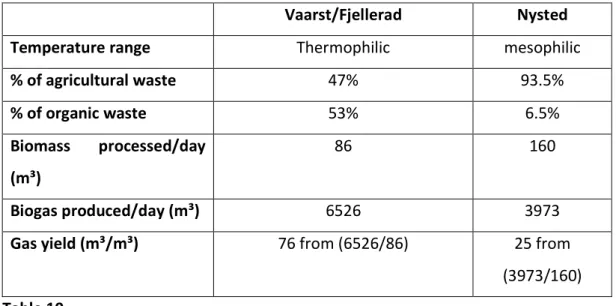
Table 10 - Interpreted data from the above table. It can be seen that the plant that uses the thermophilic temperature range, which codigests manure with organic waste, has the higher gas yield. This is in agreement with the literature discussed previously
Table 11 – Waste and energy production of the model Table 12 – Revenue generated from the model. Table 13 – summary of comments from survey
Table 14 – EPA waste and energy production estimates Table 15 – EPA profit estimation
9 NOMENCLATURE
ABP – Animal By Products AD - Anaerobic Digestion AG – Attorney General
DAFF – Department of Agriculture, Fisheries and Food
DCMNR – Department of Communication, Marine and Natural Resources DEHLG – Department of Environment, Heritage and Local Government EA UK – Environmental agency UK
EC – European Commission
EIA – Energy Information Administration EPA – Environmental Protection Agency IEA – International Energy Agency
10
C
HAPTER1 I
NTRODUCTION‘A civilization built on renewable resources, such as the products of forestry and agriculture, is by this fact alone superior to one built on non-renewable resources, such as oil, coal, metal, etc. This is because the former can last, while the latter cannot last. The former co-operates with nature, while the latter robs nature. The former bears the sign of life, while the latter bears the sign of death’
E. F. Schumacher 1911-1977
The aim of this chapter is to provide an overview of the background behind the title. The aims will be set out, the methodology and a summary of chapters will be provided.
1.1 BACKGROUND
The aim of this study is to develop a plan for AD cooperatives in Ireland. Anaerobic Digestion is a natural process of decomposition and decay that takes place in the absence of oxygen and by which organic matter is broken down to its simpler chemical components i.e. biogas. AD plants can be on farm or can be centralised. This study will propose centralised AD plants using a cooperative model. AD plants will reduce our greenhouse gas emissions and also enable farmers to produce electricity from a renewable resource. AD plants are an accepted renewable energy technology throughout Europe. The government supports anaerobic digestion through various incentives and national programmes; these will be discussed in detail. Legislative requirements must be addressed before an AD cooperative could be considered and these will be discussed below. The cooperative model will enable farmers and communities to become sustainable and to generate an extra income. If the plant is large enough, they should generate enough electricity for their own community. If there was surplus, it could be sold to the electricity pool. Anaerobic digestion plants will
11
help facilitate Ireland meeting the landfill directive targets and the recently set renewable energy targets.
1.2 OBJECTIVES
• Establish the feasibility of an anaerobic digestion cooperative using the following influencing factors:
Economically Financially Logistically
Farmer and local community participation Sizing perspective
Waste material required
Assistance from government and related agencies National and EU Legislation
• Analyse the energy requirements of rural areas and evaluate the impact an AD plant will have on the grid.
• Implement a model
• Critically review the research and model.
1.3 METHODOLOGY
This research was undertaken in a professional and ethical manner. The majority of the data was obtained online. Specialists in the field were contacted. A site visit was undertaken to the AFBI plant in Northern Ireland. It had been intended to visit the Ballyshannon plant but this did not happen. A survey was conducted using the online forum Survey Monkey. The survey was circulated among acquaintances with agricultural contacts.
12
Chapter 1 provides an introduction to the topic. Chapter 2 provides a detailed review of the literature surrounding anaerobic digestion and anaerobic digestion cooperatives. It includes the AD process, legislation, the cooperative model, case studies, economics and government assistance. Chapter 3 contains the proposed model for an anaerobic digestion cooperative. Chapter 4 contains a discussion and review of the literature and the proposed model. Chapter 5 contains the conclusion.
13
C
HAPTER2 L
ITERATURER
EVIEWThis chapter explores the process of the anaerobic digestion under numerous headings. Section 2.1 focuses on the anaerobic digestion process and describes the complexity of the system. Section 2.2 sets out the legislative requirements. Section 2.3 to section 2.6 focuses on the availability of raw processing materials, the resultant energy produced, cooperatives are discussed and finally case studies are explored. Section 2.7 discusses the potential of anaerobic digestion in Ireland and the potential slurry that would be available. Section 2.8 provides an overview of commercial interest and finally section 2.9 discusses the economics.
2.1
ANAEROBIC DIGESTIONThis section explains the anaerobic digestion process. It examines the temperatures at which anaerobic digestion is carried out. It provides an outline of how an anaerobic digestion plant would fit in on a farm. The aim of this section is to explain what anaerobic digestion is and how it works.
Anaerobic digestion is a natural process of decomposition and decay that takes place in the absence of oxygen and by which organic matter is broken down to its simpler chemical components i.e. biogas. It is mostly a mixture of methane, carbon dioxide and water vapour. The following are the four 4 steps involved in anaerobic digestion (AD)
14
FIGURE 1.
1. Hydrolysis: Organic matter is decomposed into smaller units
2. Acidogenesis: the smaller decomposed units are converted into methanogenic substrates
3. Acetogenesis: Carbon chains are oxidised into acetate, carbon dioxide and hydrogen. 4. Methanogenesis: During this stage, hydrogen is converted into methane. 70% of the
methane originates from acetate, 30% is produced from conversion of hydrogen and carbon dioxide according to the following chemical equation:
15
Methanogenic bacteria
Acetic acid methane + carbon dioxide
Methanogenic bacteria
Hydrogen + carbon dioxide methane + water
The last step is a critical step in the AD process as it is the slowest biochemical reaction of the process. It is heavily influenced by operating conditions such as feedstock composition, feeding rate, temperature and ph level. Methane will not be produced if the digester is overloaded, if there are temperature changes or if there is a large entry of oxygen.
Anaerobic Digestion takes place at 3 different temperatures:
Name Temperature (°C) Minimum retention time
(days)
Psychrophilic < 20 70 – 80
Mesophilic 30 – 40 30 – 40
Thermophilic 43 – 55 15 – 20
Table 1.
According to the Denmark biogas handbook (Teodorita Al Seadi and Silke Volk, 2008) the thermophilic temperature is the most popular in Denmark as it has more advantages over the other two. However the literature indicates that mesophilic temperature is the most popular outside of Denmark. The most significant advantage of the thermophilic temperature range is the lower retention time which is the length of time the feedstock spends in the digester. However the thermophilic temperature range requires more input energy. The report states that thermophilic plants have a higher gas yield.
16
Several pieces of literature have shown that thermophilic AD is better than mesophilic AD for co- digestion. Codigestion is when manure is processed in the anaerobic digester with another material. Denmark favours thermophilic AD with a retention time of 11-22 days. No one piece of literature really compares different feedstocks biogas yields at thermophilic and mesophilic ranges. According to a study carried out by Cavinato et al, (Cavinato et al., 2009) the biogas yield for thermophilic range has a 15% increase compared to the mesophilic range. Vindis et al (P. Vindis, 2009) compared mesophilic and thermophilic AD using 3 different maize varieties. Vindis et al discovered that biogas yield for mesophilic ranged from 315-409NI kg VS¯¹ and biogas yield for thermophilic AD ranged from 494-611 NI kg VS¯¹. Vindis also states that the biogas quality produced in thermophilic temperature range is better than biogas quality produced in mesophilic ranges and has a higher biogas yield. It was shown that Municipal Solid Waste (MSW) at a thermophilic range produced 2 to 3 times the gas compared to the mesophilic range (Cecchi et al., 1991)
Mackie et all (Mackie and Bryant, 1995) compared the gas production of manure in mesophilic and thermophilic ranges. The following table shows their results:
Loading rate (gVS¯¹ reactor volume per day)
Total gas production Mesophilic (1day ¯¹)
Total gas production Thermophilic (1day ¯¹) 3 3.18 3.60 6 5.58 6.67 9 6.45 9.74 12 7.22 11.68 Table 2.
As previously stated methane will not be produced if there is a temperature change. Thermophilic digesters can sustain a +/- 1°C change, mesophilic digesters can sustain a +/-3°C change (Teodorita Al Seadi and Silke Volk, 2008)
17
The following picture depicts how an anaerobic digester would be situated on a farm (2005)
FIGURE 2.
Process:
1. Manure is collected in a pre storage tank, close to the digester and can be pumped into the digester. The digester is a gas tight tank made of steel or concrete, with draw off points for the biogas. It is insulated to maintain the necessary constant temperature. A heating system is used to maintain optimum temperature. The digester is heated by circulating hot water through a heating exchanger located in or outside of the digester. The hot water is produced by a biogas boiler or a CHP unit.
2. Biogas is produced from the methane and can be used in a combined heat and power (CHP) unit for electricity and heat production. The biogas is stored in the biogas storage tanks.
3. The solids and liquids are called effluent and are stored in digester tanks. The digester contains a stirring system which is responsible for mixing and homogenising the substrate and it also minimises the risk of swimming layers and sediment formation. There would also be a method for loading and unloading digestate.
18
4. The liquid digestate can be spread on land as a fertiliser. The solid digester can be used to spread on land as a fertiliser but can also be processed further and sold as a compost
The following picture indicates the area required for an AD plant. This one is in Nysted, Denmark and processes 227m³ per day and 35 farmers are involved in the plant(Hjort-Gregersen, 1999).
FIGURE 3.
In summary anaerobic digestion is a natural occurring process. It involves a four step process that can be undertaken at 3 temperatures. Manure and other materials are placed in a tank for 15 – 30 days. As the material is broken down a biogas is produced which is utilised for energy production. A digester effluent is also produced and this is stored in digester tanks.
19
2.2
L
EGISLATIONThis section describes the legislation that would impact anaerobic digestion and it also describes the legislation that could be impacted due to anaerobic digestion. One of the difficulties with implementing an anaerobic digestion cooperative is the extent of legislation that must be followed and as the legislation forms the basis of the concept, it will be discussed in detail. The aim of this section is to examine the EU Directives and National laws that need to be considered.
2.2.1 NITRATES DIRECTIVE:DIRECTIVE 91/676/EEC CONCERNING THE PROTECTION OF WATERS AGAINST POLLUTION CAUSED BY NITRATES FROM AGRICULTURAL SOURCES (EC,1991)
The aim of this directive is to reduce water pollution caused or induced by agricultural sources and to prevent further such pollution. Article 3.2 specifies that Member States shall designate all known areas of land in their territories which drain into the waters as vulnerable zones. Member States were required to notify the Commission of initial designation within 6 months and may revise or add to the designation of vulnerable zones at least every 4 years. Member States do not have to designate vulnerable zones if they establish and apply an action programme to the entire territory, as per article 5(2).
Article 4 requires Member States to establish codes of good agricultural practice which should be implemented voluntarily by farmers. The Directive contains recommended provisions regarding the codes of good agricultural practice. Examples of these provisions are (a) periods when land application of fertiliser is inappropriate and (b) capacity and construction of storage vessels for livestock manures (Annex IIA). It is also recommended that a training and information programme is set up for farmers; this links in with the education principle of a cooperative, which will be discussed in detail further on.
Article 5.1 specifies that each Member State must establish an action programme regarding designated vulnerable zones. Action programmes must take the following into account:
20
(a) Available scientific and technical data, with reference to respective nitrogen contributions originating from agricultural sources.
(b) Environmental conditions in the relevant regions of the Member State concerned. As previously stated Member States do not have to designate vulnerable zones if they apply the action programme to the entire territory. According to a report, from the Commission to the Council and the European Parliament on implementation of Council Directive 91/676/EEC concerning the protection of waters against pollution caused by nitrates from agricultural sources for the period 2004-2007, ten Member States applied Article 5(2) including Ireland.
Article 5.4 states that the action programme must be implemented within 4 years of its establishment and must consist of a number of mandatory measures. These measures include rules relating to periods when applying certain types of fertiliser to land is prohibited, rules relating to the capacity of storage vessels for livestock manure and rules around the limitation of land application of fertilisers which must take into account soil conditions, climate conditions, rainfall and the foreseeable nitrogen requirements of the crops. Nitrogen helps crops and plants to grow but high concentrations of nitrogen are harmful to humans and the environment. The main measure that must be observed is that the amount of livestock manure applied to the land each year, including the animals themselves, shall not exceed 170kg of nitrogen per hectare. Member States may apply for derogation on this amount if certain criteria are met such as long growing seasons and crops with high nitrogen uptake. The action programme must also contain measures around the codes of good agricultural practice established in Article 4.
In 2006 Ireland submitted a request to allow the application of 250kg nitrogen per hectare per year on farms which comprise of at least 80% grassland. The Commission agreed in Article 5(1) (EC, 2007) that ‘the amount of livestock manure from grazing livestock applied to the land each year on grassland farms, including by the animals themselves, shall not exceed the 250 kg nitrogen/hectare, subject to certain conditions’. These conditions include each farm keeping and maintaining a fertilisation plan, analysing the nitrogen and phosphorus content of the soil
21
every 4 years, and not spreading manure in the autumn before grass cultivation. One of the requirements of the fertilisation plan is to include the amount and type of manure delivered outside the farm or to the farm. This requirement would have an impact on the amount of paperwork a farm participating in an AD cooperative would have to complete if they were one of the farms under the 250kg/hectare. It is important to note that farmers must individually apply, annually, to the competent authority (i.e. The Department of Agriculture and Food, the relevant local authorities and the Environmental Protection Agency (EPA) are the competent authorities in Ireland for the purposes of implementing the action programme) for the 250kg/hectare allowance.
Article 5.6 requires Member States to design and implement monitoring programmes to gauge the success of the action programme.
2.2.1(A) NATIONAL ACTION PROGRAMME UNDER THE NITRATES DIRECTIVE 28THJULY 2005
Ireland’s action programme under the Nitrates Directive is given statutory effect by the European Communities (Good Agricultural Practice for the Protection of Waters) Regulations 2009 (DEHLG, 2005)
The Nitrates Directive requires Member States to include rules relating to the following in their action programme:
• Periods when the land application of certain types of fertiliser is prohibited • The capacity of storage vessels for livestock manure
• Limitations on the land application of fertilisers consistent with good agricultural practice
• Limits to the amount of manure applied per year per hectare; 170kg of nitrogen per hectare; 250kg in Ireland as per the conditions discussed above.
22
The Republic of Ireland has been divided into 3 zones based on soil type, rainfall and length of growing season.
Zone A: Carlow, Cork, Dublin, Kildare, Kilkenny, Laois, Offaly, Tipperary, Waterford, Wexford, Wicklow.
Zone B: Clare, Galway, Kerry, Limerick, Longford, Louth, Mayo, Meath, Roscommon, Sligo, Westmeath.
Zone C: Cavan, Donegal, Leitrim, Monaghan.
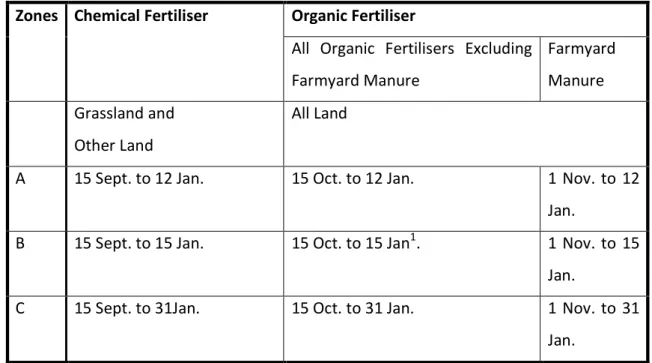
Table 3 below shows periods when application of certain types of fertiliser is prohibited (inclusive of dates)
Organic Fertiliser Zones Chemical Fertiliser
All Organic Fertilisers Excluding Farmyard Manure Farmyard Manure Grassland and Other Land All Land
A 15 Sept. to 12 Jan. 15 Oct. to 12 Jan. 1 Nov. to 12
Jan.
B 15 Sept. to 15 Jan. 15 Oct. to 15 Jan1. 1 Nov. to 15 Jan.
C 15 Sept. to 31Jan. 15 Oct. to 31 Jan. 1 Nov. to 31
Jan. Table 3.
These dates show that manure must be stored from 1st Nov to 12th, 15th or 31st Jan depending on the zone. The storage capacity should be adequate for the full housing period and should
23
provide an ample level of storage for difficult years. Livestock holdings shall have the following minimum storage capacity for bovine livestock manure:
Zone A – 16 weeks Zone B – 18 weeks
Zone C – 20 or 22 weeks. 20 weeks for Donegal and Leitrim due to the high water quality and less intensive agricultural production.
The minimum storage capacity with respect to sheep, goats and deer is 6 weeks. Pigs and poultry are 26 weeks. If there are less than 100 pigs; the storage capacity is the same as the bovine capacity.
All livestock manure, other organic fertiliser, soiled water and silage effluent must be collected and stored in an appropriate storage facility prior to application to land or other treatment.
2.2.2 REGULATION (EC)NO 1774/2002 OF THE EUROPEAN PARLIAMENT AND OF THE COUNCIL OF 3
OCTOBER 2002 LAYING DOWN HEALTH RULES CONCERNING ANIMAL BY-PRODUCTS NOT INTENDED FOR HUMAN CONSUMPTION.
This is possibly one of the most important and complex laws around AD as it lays down the rules around what can and cannot be used in an AD plant. This regulation refers to health rules concerning animal by products (ABP) not intended for human consumption (EC, 2002). This regulation is 170 pages and there are 14 subsequent amendments so an overview will only be provided on relevant data.
Article 2 defines ABP as ‘entire bodies or parts of animals or products of animal origin referred to in Article 4, 5 and 6 not intended for human consumption, including ova, embryos and semen’. It is necessary to ensure that all ABP used in AD plants have sufficient pathogen reduction and that recontamination is prevented. This will ensure safe application of the treated material.
24 ABP are divided into 3 categories.
Category 1 material is not allowed to be processed in biogas plants due to its nature. A detailed description of Category 1 materials and Category 2 materials can be found in Appendix A. Manure, digestive tract content, milk, colostrum are Category 2 materials and can be processed in a biogas plant.
Category 3 material can be processed in a biogas plant. Category 3 material is comprised of ABP of the following description, or any material containing such by-products. Only the relevant points are included.
• Parts of slaughtered animals, which are fit for human consumption but are not intended for human consumption for commercial reasons
• Parts of slaughtered animals, not fit for human consumption and have no signs of diseases
• Former foodstuffs of animal origin, other than catering waste, which are no longer intended for human consumption for commercial reasons
• Raw milk originating from animals with no signs of diseases • Fish or sea mammals caught in the open sea
• Shells, hatchery by-products and cracked egg by products showing no signs of diseases • Blood, hides and skins, hooves, feathers, wool, horns, hair and fur origination from
animals showing no signs of diseases
• Catering waste other than international catering waste.
The following table provides an overview of the different categories, the potential use, recovery methods and constraints.
25 Category Potential
Use
Disposal or recovery method Constraints
1. Nothing Incineration or approved
processing plant n/a 2. Manure, digestive tract content, milk, colostrum Biogas plant
Processed in a biogas plant, disposed of in a landfill site, composted
Must adhere to the National Standard approved by the DAFF.
Max particle size: 400mm Min temperature: 60°C Min time in the unit: 48 hrs Manure and digestive tract content requires no pre-treatment, while all other materials in category 2 must be sterilised with steam pressure.
3.
Feather, former foodstuffs, raw milk, fish or fish byproducts, shells, hatchery by products, cracked egg by products, catering waste Biogas plant
Processed in a biogas plant, disposed of by landfill, or composted
Must adhere to the EU Standard.
Max particle size: 12mm Min temperature: 70°C Min time in the unit: 1 hour
26
The EC considers catering waste as waste from premises on when food is produced for direct consumption. This includes restaurants, catering facilities and kitchens. It may include sandwich outlets producing food for direct consumption. It does not include supermarkets or food factories that produce food for retail sale; this is referred to as former food stuffs.
Article 7 refers to rules around collection, transportation and storage of ABP. Member States may decide not to apply the rules around the transportation of manure between 2 points on the same farm or between farms and users located in the same Member State. Extensive research did not provide any clarity as to whether Ireland applies Article 7. However manure is exempt from licensing or permit requirement under the Waste Management Acts 1996 to 2008 (Acts). ABP must be collected and transported by approved licenses hauliers; the licenses are issued by the DAFF
Article 15 refers to the approval of biogas and composting plants. Approval of biogas and composting plants will be considered if the plant meets the requirements in Annex VI, Chapter II, Part A. This chapter covers specific requirements for a biogas plant regarding premises, hygiene requirements, processing standards, digestion residues and compost. It has been amended by Commission Regulation (EC) No 208/2006 amending Annexes VI and VIII to Regulation (EC) No 1774/2002 of the European Parliament and of the Council as regards processing standards for biogas and composting plants and requirements for manure (EC, 2006). The amended regulation states that biogas plants must have a pasteurization/hygienisation unit that cannot be bypassed.
Biogas and composting plants in Ireland are subject to approval by the competent authority, which is the Department of Agriculture Fisheries and Food. The use of ABP must be approved by the DAFF by completing an application form. As shown in the above table ABP used in a biogas plant must adhere to the EU standard or the national standard depending on the category.
27
The animal by products application to anaerobic digestion plants is highly complex. The document entitled ‘Conditions for approval and operation of Biogas Plants treating Animal By-Products in Ireland’ sets out the requirements for a biogas plant in Ireland that accepts ABP. (DAFF, 2009)The document lists the permitted ABP that can be processed in a biogas plant in accordance with the EU Directive and National Law and can be found in the table above.
The document covers specific requirements on location, equipment required at the plant, hygiene requirements, processing and treatment standards, record keeping requirements, HACCP plans, collection and transport of materials, and restrictions around organic fertiliser.
The Irish National laws under EU Regulation 1774 are:
2.2.2(A)SINO 252 OF 2008.EC(TRANSMISSIBLE SPONGIFORM ENCEPHALOPATHIES AND ANIMAL BY
PRODUCTS)REGULATIONS 2008(OAG,2008B).
The regulation refers to the sale and supply of ABP and the import of ABP. It states that ‘a person shall not operate a biogas plant other than in accordance with an approval granted for the purposed of Article 15 of the ABP Regulation.
2.2.2(B)SINO 253 OF 2008. DISEASES OF ANIMALS ACT 1996(TRANSMISSIBLE SPONGIFORM
ENCEPHALOPATHIES)(FERTILISERS AND SOIL IMPROVERS)ORDER 2008(OAG,2008C).
The regulation refers to the control and use of fertilisers and soil improvers. One is not allowed use a biogas plant to produce a soil fertiliser or soil improver that consists of animal proteins, except if an animal protein fertiliser licence has been granted.
Farmed animals are not allowed have access to land where a fertiliser or soil improver has been spread that consists of category 2 material, other than manure, or category 3 material for (a) 21 days or (b) 60 days for pigs after spreading.
Farmed animal are not allowed have access to a fertiliser or soil improver that consists of category 2 materials or category 3 materials and fertiliser and soil improvers are not allowed come in contact with animal feedingstuff.
28
Hay or silage cannot be made on land where fertiliser or soil improver containing category 2 or category 3 materials, has been spread in the previous 21 days.
The document ‘Conditions for approval and operation of Biogas Plants treating Animal By-Products in Ireland’(DAFF, 2009) confirms the above conditions that organic fertiliser/soil improvers produced in a plant from the list of permitted ABP can be spread on land under the following conditions:
• Farmed animals (apart from pigs) must not be allowed access to the land for at least 21 days following land application
• Pigs must not be allowed access to the land for at least 60 days following land application
2.2.3SINO 12 OF 2009DISEASES OF ANIMALS ACT 1996(PROHIBITION ON THE USE OF SWILL).
(AMENDED)ORDER 2009(OAG,2008A).
This SI is an amended version of SI 597/2002 to allow collection, assembly, processing and storage of swill at approved composting and biogas plants. Swill includes eggs, table waste, catering waste, kitchen refuse, and fish waste.
2.2.4COUNCIL DIRECTIVE 99/31/EC OF 26THAPRIL 1999 ON THE LANDFILL OF WASTE (EC,1999)
The objective of this Directive is to prevent or reduce, as far as possible, the negative effects on the environment for the landfilling of waste, by introducing requirements for waste and landfill. The Directive focuses on the pollution of surface water, groundwater, soil and air.
There are different categories of waste defined in Article 2 of the directive:
(a) Waste is defined as any substance or object covered in Directive 75/442/EEC which has since been codified and can be found in Directive 2006/12/EC of the European Parliament and of the Council of 5 April 2006.
(b) Municipal waste is defined as ‘waste from households, as well as other waste which, because of its composition or nature, is similar to waste from households.
29
(c) Hazaderous waste which is defined in the Waste Management Act 1996 and 2001. (d) Non hazardeous waste
(e) Inert waste defined as waste that does not change or alter in anyway. The pollutant content must be insignificant and not endanger the quality of surface water and/or groundwater.
Article 5 (1) requires Member States to set up a National Strategy for the implementation of the reduction of biodegradable waste going to landfills. The strategy must include measures on how to achieve the targets set out in Article 5(2) by recycling, composting, biogas production or materials/energy recovery.
Article 5(2) must ensure that biodegradable waste going to landfills must be reduced to: • 75%, of the total amount of biodegradable waste produced in 1995, by 2006 • 50%, of the total amount of biodegradable waste produced in 1995, by 2009 • 35%, of the total amount of biodegradable waste produced in 1995, by 2012
If Member States sent more than 80% of waste to landfill in 1995, they were allowed postpone the attainment of the above targets by 4 years. Ireland applied for, and was granted, this 4 year extension and therefore, the following target apply to Ireland:
• 75%, of the total amount of biodegradable waste produced in 1995, by 2010 • 50%, of the total amount of biodegradable waste produced in 1995, by 2013 • 35%, of the total amount of biodegradable waste produced in 1995, by 2016
The EPA has combined a consolidated collection of the European Waste Catalogue and the hazardous waste list and three subsequent amendments. It sets out the classification of waste and hazardeous waste and the legislation associated with each (EPA, 2002)
30
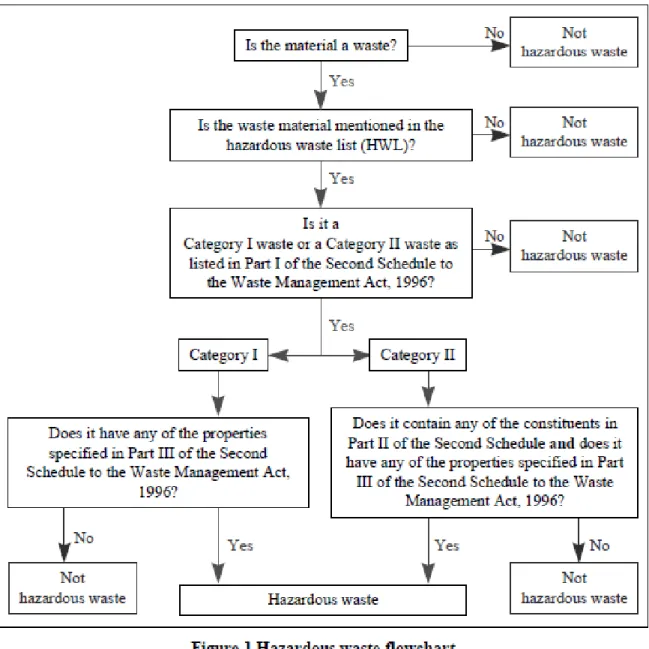
Figure 4 below is an extract from the document referred to above of a hazardeous waste flowchart.
31
2.2.4(A)NATIONAL STRATEGY ON BIODEGRADABLE WASTE 2006
As stated above Article 5 of the landfill directive requires Member States to produce a National Strategy on Biodegradable Waste. Ireland’s National Strategy on Biodegradable Waste was published in April 2006. It contains measures to progressively remove biodegradable municipal waste from landfill sites in accordance with the Landfill directive.
The National Strategy on Biodegradable Waste 2006 (DEHLC, 2006) states that ‘biodegradable waste accounts for approximately three-quarters of the municipal solid waste produced by homes and businesses’. The main biodegradable components of municipal waste are paper, cardboard, foodwaste and garden waste.
The policy statement entitled ‘Waste Management Changing Our Ways’ advises that there is scope for public/private partnership in all areas of waste management (DEHLC, 2006)The report states that ‘private participation can contribute capital investment in infrastructure, specialist expertise in the application of alternative and energy technologies. The report suggests (pg 14 7.6) that the scope for the application of the AD process in Ireland should be examined.
The government policy statement on ‘Preventing and Recycling Waste - Delivering Change’ (DEHLG, 2002)recommends that the following should be addressed for each potential form of biological treatment:
(i) Capability to control the quality of raw materials (ii) Flexibility of AD systems
(iii)Initial capital costs
(iv)Proven reliability of performance of technology of the required capacity (v) Security of supply of raw materials
(vi)Adaptability of the national grid (vii) Economics of scale
32
The waste management hierarchy depicts the most suitable way for waste handling.
FIGURE 5.
In July 2010 Minister John Gormley opened a public consultation on a draft statement for waste policy. The draft statement identifies that the municipal waste recovery increased from 28% in 2003 to 38% in 2008. Key objectives of the policy statement are:
• Implement a sustainable production and consumption approach to waste management • Maximise economic benefit, including the revenue that can be gained from maximising
the resource potential of waste
• Maximise opportunities for enterprise in reuse, remanufacturing and reprocessing • Minimise climate impacts.
Submissions were accepted until 1st October 2010 so the outcome is currently unknown. Most attractive
33
2.2.5 DIRECTIVE 2009/98/EC ON THE PROMOTION OF THE USE OF ENERGY FROM RENEWABLE SOURCES
(EC,2009)
This directive repeals 2001/71/EC and 2003/30/EC. It creates a framework to use renewable energy sources to reduce greenhouse gas emissions. Under the directive, Member States are required to set a renewable energy target for 2020. The directive also requires Member States to establish a National Renewable Energy Action Plan (NRECP) using a template devised by the European Commission. The purpose of the NRECP is to ensure that Member States adhere to the Directive.
The Irish National Renewable Energy Action Plan has been submitted for approval. Ireland has set a target of 40% of electricity to be produced from renewable sources, and 12% of heat produced to come from renewable sources.
2.2.6KYOTO PROTOCOL
The Kyoto Protocol set binding targets on reducing greenhouse gas emissions for 37 industrialized countries and the European Community (EPA)Ireland agreed to limit the growth in greenhouse gas emissions to 13% above 1990 levels under the Kyoto Protocol by 2012. It is an international agreement linked to the United Nations Framework Convention on Climate Change (UNFCCC) and 184 parties of the Convention have ratified the Kyoto Protocol to date.
A press release from the EPA in October 2010 declared that although Ireland’s position with the Kyoto Protocol targets won’t be known until after 2012, the EPA has estimated that after the 1st two years (2008-2010) Ireland is currently a total of 6.2 million tonnes above target when the impact of the EU Emissions trading scheme and approved forest sinks are taken into account. Ireland’s greenhouse gas emissions fell by 5.4 million tonnes (7.95) in 2009. Ireland’s limit under KP is 62.84mt for the period 2008-2012. These figures show that Ireland’s combined emissions in 2008 and 2009 were 6.2 million tonnes above this limit when account is taken of the Emissions trading scheme and approved forest sinks. Dr Mary Kelly, Director General of the
34
EPA, has said that this 7.9% reduction ‘is welcome in terms of meeting our KP targets….and we should not rely on a recession to meet our future targets’. This was specified as there was a 20% reduction in greenhouse gas emissions in the industry sector in 2009, which has been attributed to the downturn in the economy.
2.2.7COPENHAGEN ACCORD
The second last meeting of the UNFCCC took place in December 2009 in Copenhagen. It was an opportunity for the international community to agree a successor to the Kyoto Protocol. However, it failed and there is no new binding agreement. The Copenhagen Accord was ‘noted’ by the relevant parties. It sets out a goal of limiting global warming to below 2°C above pre-industrial times. It leaves each nation to set its own targets for 2020.
2.2.8CANCUN AGREEMENT
The most recent meeting of the UNFCCC took place in December 2010 in Cancun. It was more successful than its predecessor but still requires more work if a successor to the Kyoto Protocol is to be agreed next year. The main themes to emerge out of the Cancun Agreement are (1) the Kyoto Protocol’s clean development mechanisms have been strengthened to drive more major investments and technology into environmentally sound and sustainable emission reduction projects in the developing world, (2) a set of initiatives and institutions will be launched to protect the vulnerable from climate change and to deploy the money and technology that developing countries need to plan and build their own sustainable future, (3) a initial fund of $30 million has been set up, to come from industrialised countries, (up to 2012) to support climate action in the developing world and an intention to raise $100 million by 2020, (4) a scheme to provide financial support for countries to preserve their forests, in a bid to combat deforestation which accounts for almost a fifth of global annual emissions .
35
2.2.9 INTEGRATED POLLUTION PREVENTION AND CONTROL LICENSING
Legislation covering IPPC licensing is a codified IPPC Directive; 2008/1/EC (EC, 2008). The purpose of the Directive is to have an integrated prevention and control of pollution arising from Annex 1 of this Directive. It sets out measures to prevent or, where it is not practical, to reduce emissions in air, water and land.
The Environmental Protection Agency Act 1992 was amended in 2003 by the Protection of the Environment Act 2003 and this gave effect to the IPPC Directive. The EPA is fully responsible for the IPPC licensing process. The aim of the IPPC licence is to prevent or reduce emissions to air, water and land, to reduce waste and use energy resources efficiently. An IPPC licence is a single integrated licence and covers all emissions from the facility and its environmental management.
IPPC licenses are required for an AD plant and an application must be made to the EPA. Legislation to obtain an IPPC licence is set out in the EPA (Licensing) Regulations, 1994 (SI no 85 of 1994 and amendments SI 76 of 1995, SI 240 of 1996, SI 394 of 104, SI 382 of 2008).
A waste collection permit is required to move organic material on to a site. Waste Management (Collection Permit)(Amendment) 2008 (SI 87 of 2008) 2(j) states that ‘the nominated authority shall attach to each waste collection permit granted by it conditions requiring the permit holder to ensure that where biowaste collected under the waste collection permit is transferred to a biogas facility for the purposes of treatment and where ABP from all or part of that biowaste, that the facility has been approved by the nominated authority and there is in force an appropriate veterinary authorisation’.
36 2.2.10 PLANNING PERMISSION
Planning permission must be obtained for an anaerobic digestion plant and an environmental impact statement will be included in this. Planning permission in Ireland can be slow especially for non straightforward buildings. It is estimated that planning permission for an anaerobic digestion plant will take approximately one year.
2.2.11 Energy White Paper 2007 Delivering a Sustainable Energy Future for Ireland. The Energy Policy Framework 2007 – 2020.
The Energy White Paper (DCMNR, 2007) aims to promote a sustainable future for Ireland. The paper declares that the government is ‘committed to harnessing the full potential of our renewable and bioenergy resources’. Strategic goal 3.8.4 of the paper is to ‘deliver an integrated approach to the sustainable development and use of bioenergy resources’. It also states that there will be an investment in specific research and development and the supply side will be addressed.
2.3
C
OOPERATIVESThe literature testifies that cooperatives have been in existence since the beginning of mankind. Cooperatives are formed for a variety of reasons but the main reason in modern farming is to provide sources of supplies at a reasonable cost that would be otherwise unattainable. An example of a well known cooperative in Ireland is the Credit Union. The first agricultural cooperative in Ireland was established in Co Limerick by Sir Horace Plunkett in 1889. His motto was ‘Better farming, better business, better living. Interestingly, he and his colleagues had observed how cooperative creameries had raised farming standards in Denmark since 1882. Kerry Group PLC started out as a cooperative in 1974 and had sales of €29 million that year.
37
The Irish Cooperative Organisation Society (ICOS) defines cooperatives as ‘an autonomous association of persons united voluntarily to meet their common economic, social and cultural needs and aspirations through a jointly owned and democratically controlled enterprise’.
Cooperatives are based on the values of self help, self responsibility, democracy, equality, equity and solidarity. The cooperative principals are based on guidelines by which cooperatives put their values into practice. They are as follows:
1. Voluntary and open membership
2. Democratic member control: members are involved in policy making decision 3. Member Economic Participation:
4. Autonomy and Independence: self help organisations controlled by the members. If they enter into agreements with other organisations including governments or raise capital from external sources, they do so on terms that ensure democratic control by their members and maintain the cooperative identity
5. Education, training and information
6. Cooperation among cooperatives: cooperation among the cooperative movement by working together through local, national, regional and international structures
7. Concern for community: cooperatives work for the sustainable development of their communities through policies approved by their members.
There are 4 different types of cooperatives: 1. Customer
2. Producer
3. Employee owned 4. Community operated 5.
The Waterford County local authorities are involved in a project called the Energy Self Supply in Rural Communities (WCLA). It is a pilot rural self supply cooperative/network in Ireland, Wales,
38
Portugal and Bulgaria. The energy self supply cooperative aims to support farmers in developing sustainable energies
• Electricity generation • Heat production
• Producing sustainable fuels
• Developing a market for renewable energy
However, the outcomes of this project are not yet known.
There are 725 million people worldwide who are cooperative members. In 1998 US farming cooperatives achieved their highest ever market share, marketing one third of the nation’s farm commodities. The report identifies biodiversity as a reason why cooperatives are becoming popular again. Using cooperatives, communities can build unique solutions to specific problems, as well as making it possible for local businesses to creatively participate in the global economy. In Ireland an anaerobic digestion cooperative could contribute to security of supply
Kerry Group had the 6th highest turnover of the European Cooperatives in 2003. They have now grown to be one of the leading food supply groups in Ireland and also export vast quantities to the UK and beyond.
In 2010 Cooperatives Europe had 123 million members owning 160,000 cooperatives and represented a force for economic growth and social change. These 160,000 cooperatives employed 5.4 million citizens (Scribd, 2010)
The following table shows the differences in cooperative enterprises in Ireland, Germany and Denmark. Germany and Denmark were selected for comparison as they have the most successful AD cooperatives in Europe. Denmark also has a similar population and country area size.
39
Ireland Denmark Germany
Enterprises Members Employed Population Total area 183 152,000 18,869 4.5 million 70,000km² 523 1,840,803 70, 757 5.5 million 43,094km² 7,415 20,509,973 830, 258 82 million 356,854km² Table 5.
2.4
AD COOPERATIVESAnaerobic digestion cooperatives are widely successful in Europe. Case Studies will be used to show that they can also be successful in Ireland.
Energy4all is a UK company who claim to be the UK’s leading expert in community owned renewable energy systems. It was established in 2002 in order to expand the number of renewable energy cooperatives in the UK. Energy4all was created out of Baywind Cooperative, which was set up (in 1996) to allow a Cumbrian community invest in a local wind farm. Baywind carried out two share offers which raised over £1.9 million. They used local contractors for site development, maintenance and support. The first wind farm is located in Harlock Hill in Cumbria and has been producing electricity since 1997. It has generated between 2,188MWh to 5,817MWh per year. All of the profits from electricity generation are paid back to the share holders.
Westmill Wind farm is the first wind farm to be constructed in the South East of England and it is 100% community owned. There are 5 turbines that produce electricity for over 2,500 homes.
40
Kedco Plc is an energy company in the UK and Ireland that specializes in anaerobic digestion to name one. They have set up a business model to go into partnership with farmers to establish an anaerobic digestion plant. It is a 50:50 partnership where the farmer provides the land and feedstock supplies and Kedco supply the technical expertise. The returns are split 50:50.
2.5
C
ASES
TUDIESDenmark
Denmark is seen as a leader in anaerobic digestion plants, as well as most other renewable energy technologies. Denmark has 20 CAD plants and 60 on farm plants (Holm-Nielsen, 2008) Ribe Anaerobic Digestion Plant (Holm-Nielsen, 2008) (NYSERDA, 2006)
• Built in 1990
• Produces 18,000m³ of biogas per day
• Overall capacity of 150,000 (424,752m³) tonnes per year; 120,000 manure, 30,000 organic waste
• Cost $5.5 million dollars
Ribe in Denmark is run as a cooperative and was established in 1990.
There are 17,000 people living in the Ribe commune. The plant uses the manure from 69 livestock farmers, and the organic waste to provide power to the town’s central heat and power plant. The facility collects manure in one large tank and two smaller ones. The trucks offload the manure and reload with digester effluent. Industrial and food wastes are taken into the facility and put into a separate feed tank. Feed from the 2 waste tanks is pumped into 3 parallel anaerobic digesters every two hours. The digester effluent is stored in 2 ground covered tanks which are not aerated. The gas is stored in a balloon tank with a 4 hour capacity. Ferric chloride is added to the process to reduce the sulfide content of the biogas; this is done as sulplur can damage engines. The effluent is transported to storage tanks near the fields where it will be spread. The tanks are standard open top tanks made of precast concrete
41
panels and ribs. They are used throughout Denmark and can store 9 months of digester effluent. The biogas is transferred via power lines to a power plant 3km from the biogas plant. The power plant produces 2MW of electricity and 1.8MW of heat from the biogas.
The plant is owned by a cooperative and divided out as follows: • 40% member farms
• 20% fish processing • 20% green investors • 20% insurance companies
The composition of the member farms is 80 animal farms: (70% dairy, 30% pig), and 40 agrifarms (no animals but crops are grown). Each farm put in $2,500.
Germany
Germany has the most anaerobic digestion plants in Europe. The German government amended their Renewable Energy Sources Act (EEG) in 2009 to guarantee fixed feed in tariffs for electricity for 20 years with a bonus for heat utilisation (Government, 2008). The Act states ‘the tariff paid for electricity from biomass shall amount to:
1. 11.67 c/kWh for the 1st 150kW of output 2. 9.18 c/kWh for 150kW – 500kW
3. 8.25 c/kWh for 500kW – 5MW 4. 7.79 c/kWh for 5MW – 20MW
The tariffs above will increase for electricity which is generated in CHP by 3c/kWh.
Jühnde Anaerobic Digestion Plant • Built in 2006
• Produces 6,500MWh per year heat and 5,000MWh electricity per year • capacity per year 18,178 tonnes per year
Liquid manure: 9,000 m³ per year = 3,178 tonnes Energy crops: 15,000 tonne per year = 42,475 m³ • Cost €1.3 million
42
Jühnde is a village in lower Saxony in Germany with 800 inhabitants and is Germany’s first bioenergy village. The village contains a biogas CHP plant, fed with liquid manure and whole plant silage of different crops. In the winter, there is a wood chip boiler to supply high heat demand. The system is backed up by a conventional oil boiler. The heat is distributed via a district heating grid providing 145 houses. The electricity produced is fed into the local public utility grid. (IEA)
The project in Jühnde was part funded by the German Ministry of Food, Agriculture and Consumer Protection. It was selected for the project due to economy, infrastructure, nature and society in the location. The village founded a cooperative to plan the project and to obtain the investment subsidies. 70% of the inhabitants are members and each paid a €1,500 fee for voting rights.
The energy plant comprises:
(a) Biogas plant located on the edge of the village (b) Wood chip fuelled boiler
(c) A district heading network for the 145 houses Sizing:
• Digester volume: 3,000m³ • Storage tank: 4,400m³
• CHP: 700kWelectric, 750kWthermal • Wood chip boiler: 550kWth
• Wood chips: 350 tonner per year • Peak load oil boiler: 1,600kWth
AFBI Plant Northern Ireland • Built in 2008
• Produces 8681.6m³ of biogas/month • Capacity 559.7 tonnes slurry/month • Cost is unknown.
43
A visit was undertaken to the anaerobic digestion plant in the Agri Food and Biosciences Institute. The Agri Food and Biosciences Institute (AFBI) was created in 2006 as an amalgamation of the Department of Agriculture and Rural Development Science Service and the Agricultural Research Institute of Northern Ireland. It carries out research for government departments, public bodies and commercial companies. It is a similar set up to Teagasc in the Republic of Ireland.
The AFBI installed an AD plant to conduct research into the performance and economics of an on farm AD plant. The plant was installed in 2008. It took 6 months to get planning permission (I asked Dr Frost this when up there). The main research objectives are as follows:
1. Determine the baseline performance of on-farm digestion utilising, in the first instance, dairy cow slurry.
2. Research methods for enhancing digester performance. 3. Research post digestion treatments of digestate.
4. Research methods for efficient use of energy produced.
5. Determine the contribution of AD to plant nutrient management. 6. Determine lifecycle benefits of AD.
Staff have completed objective 1 above which took 19 months, and they are working on 3-6. Objective 2 has not yet begun due to a delay from the plant supplier (AFBI)
The AD plant contains an insulated digester tank of 600m³ which is a continuously stirred tank reactor (CSTR) operating at a mesophilic temperature of 37°C. There is a secondary digester but this is for research purposes only.
Over the 19 month period, the digester: • Processed 10,634 tonnes of dairy slurry
• Produced 164,950m³ of biogas with an energy value of 920.2MWh.
This equates to 559.7 tonnes slurry/month, 8681.6m³ of biogas/month, 48.4MWh/month. It is noted in the interim report that ‘performance figures for the digester were at the low end of the commonly quoted ranges, which are often based on laboratory studies using small scale
44
digesters’. This provides additional evidence that proposed models should be based on real life plants.
On average, in the plant, 1 tonne of slurry produced 15.5m³ of gas with an energy value of 5.5kWh/m³ of gas. 37% of the biogas produced is used to maintain the temperature of 37°C, and 5.4kWh per tonne is used for pumps and mixing.
1 tonne = 15.5m³ biogas = 5.5kWh per m³ of biogas.
15.5m³ biogas = 85.3kWh – this concurs with the figure in the report.
37% of 85.3kWh is used to maintain the temperature, which leaves 53.8kWh minus the 5.4kWh leaves a total of 48.4kWh, which is 56% of the total amount of biogas produced left for use.
Case study in Minnesota, USA. • Built in 1999
• Produces 1,950m³
• Capacity 75m³ per day of manure only • Cost €319,500 ($355,000)
Haubenschild farm is a 1000 acre site which has been owned and operated by the same family for four generations. The Haubenschild’s wanted to expand their dairy operation from 100 cows, to 500 cows to 1000 cows (Carl Nelson, 2002) AgSTAR is a national programme in the United States and is sponsored by the EPA, The Department of Energy and the Department of Agriculture. A charter farm is set up and used to demonstrate the digester system at various livestock farms. The farm was accepted as an AgSTAR ‘Charter farm’. They received some funding from various government agencies and nonprofit agencies as the family agreed to allow it as a study reference site. It is a mesophilic AD plant. It is important to note that there are no tankers required in such a venture and therefore it will have a lower cost than other AD plants. The report states that the electricity generation is 5.5kWh per cow per day. The US operates its electricity system differently to Ireland. According to the US Energy Information Administration there are 3,273 traditional utility companies in the US (EIA). The electric utility
45
companies can be investor-owned, publicly-owned, cooperatives, and Federal. The Haubenschild’s entered into a contract with a local electric cooperative called East Central Energy and it was the first company in the entire US to offer such a contract for electricity generated from digesters; they call it ‘cow power’! It may be considered easier to get grid connection when there is more than one electricity utility company.
Holsworthy AD Plant UK • Built in 1998
• Produces 4 million m³ biogas • Capacity 100,000 tonnes • Cost €8.2 million
Holsworthy biogas plant, Devon, is a CAD plant which began operation in 1998 and was the first CAD plant in the UK. As of 2006, it was the only operational CAD in the UK (K. D. Monson and Dinsdale, 2006)It is now owned by the Summerleaze Group. It processes manure, food waste and abattoir waste. The case study (K. D. Monson and Dinsdale, 2006)shows that, in 2006, the plant processed approximately 100,000 tonne per year = 283,168m³
The manure is collected in tankers, similar to the ones seen in the AFBI AD plant, from 17 farms in a 6 mile radius. The slurry is collected 5 days of the week which equates to 85 tanker trips per week for the manure. Holsworthy is a traditional Devon market town, located near the sea and Devon would be on the UK tourist trail. The plant is located 2km outside the town and is not visible from the public road.
The plant adheres to the 12mm particle size and waste being heated at 70°C for an hour. It is a CSTR with a retention time of 27 days. It operates at the mesophilic temperature range but there is no reason given as to why. As this plant is commercial, there is no money exchanged between the plant and the farmers but the slurry is collected and digestate delivered (and paid for) by the plant. The digestate is stored on site and delivered to the farms when required. It also reduces the smell of slurry when it is applied to the land. Such a plant requires the cooperation of farmers. The farmers do not receive any monetary compensation but they benefit as they do not have to store the digestate and will save on fertiliser costs.
46
The case study states that 100,000 tonne of waste per year will produce approximately 40m³ biogas per tonne which is 4 million m³ biogas produced in one year. 90% of the energy produced is exported to the National Grid; the remaining 10% is used within the plant. The case study acknowledges that it was difficult to obtain a loan for the project and it was funded by a grant of 50%. It is noted that this plant cost €8.2 million (in 1998). The case study states that 14.4 million kWh electricity will be produced.
2.6
F
EEDSTOCKSFeedstocks are the material that is used in an anaerobic digester. A variety of feedstocks can be used in an anaerobic digester. The SEAI suggests slurry, energy crops, food waste, canteen waste, silage and ABP. The aim of this section is to explain how feedstocks impact the biogas yield.
There are 3 million tonnes of municipal waste generated in Ireland each year. In 2005, 23% of this was recycled or composted which leaves 67% as potential feedstock.
According to IEA Bioenergy report there are over 1.2 billion tonnes per year, in the EU, of potential feedstock. Manure and slurry are rich in plant nutrients as animals do not use nutrients efficiently. The SEAI is currently designing a calculator that will enable users to see how many kWh can be produced from different feedstocks. An AD cost calculator has been created by Andersons centre on behalf of The National Non Food crops Centre (NNFCC) in the UK. It is a very comprehensive tool which allows one to input a range of feedstocks, the DM content, the potential biogas yield, the amount of tonnes expected, revenue from REFIT, capital costs and annual running costs. It seems to be an excellent tool.
47
The following table shows the biogas yield from feedstocks (Biogasinfo):
Feedstock Dry Matter (%) Biogas Yield
m³/tonne kWh Cattle slurry Pig slurry Poultry Maize silage Grass silage Maize grain 10 8 20 33 28 80 15-25 15-25 30-100 200-220 160-200 560 85 – 138 85 – 138 165 – 550 1100 – 1210 880 – 1100 3080 Table 6.
(The kWh was worked out using Dr Peter Frosts observation that 1m³ of biogas = 5.5kWh) Dr Frost deduced from experiments using manure, discussed above, that 15.5m³ biogas = 85.3kWh.
It is evident from reading the literature that there are different values for different feedstocks. A paper by Pöschl et al uses empirical values from Becker et al to describe the biogas yield from 3 different feedstocks; agricultural waste, energy crops and municipal solid waste (MSW). They assumed a wet mesophilic two stage AD process. However the figures in this are different to Dr Frost’s figures and the figures above from biogasinfo.co.uk.
Each tonne of food waste produces approximately 100 – 150m³ of biogas which in turn has the potential to generate 300kWh of electricity (Ireland, May 2009)
Composition of feedstocks is variable and as previously stated feedstock quality will affect biogas yield. Codigestion of feedstocks will also produce a higher gas yield.