Credence goods, experts and risk aversion
Olivier Bonroy, St´
ephane Lemari´
e, Jean-Philippe Tropeano
To cite this version:
Olivier Bonroy, St´ephane Lemari´e, Jean-Philippe Tropeano. Credence goods, ex-perts and risk aversion. Economics Letters, Elsevier, 2013, 120 (3), pp.464-467. <10.1016/j.econlet.2013.05.033>. <hal-00976890>
HAL Id: hal-00976890
https://hal.archives-ouvertes.fr/hal-00976890
Submitted on 10 Apr 2014HAL is a multi-disciplinary open access archive for the deposit and dissemination of sci-entific research documents, whether they are pub-lished or not. The documents may come from teaching and research institutions in France or abroad, or from public or private research centers.
L’archive ouverte pluridisciplinaire HAL, est destin´ee au d´epˆot et `a la diffusion de documents scientifiques de niveau recherche, publi´es ou non, ´emanant des ´etablissements d’enseignement et de recherche fran¸cais ou ´etrangers, des laboratoires publics ou priv´es.
Credence Goods, Experts and Risk Aversion
Olivier BONROY
∗†, St´ephane LEMARI´
E
∗†and Jean-Philippe TROP´
EANO
दAbstract
The existing literature on credence goods and expert services has overlooked the importance of risk aversion. In this paper we extend a standard expert model of credence goods with verifiable service quality by considering risk-averse consumers. Our results show that the presence of risk aversion reduces the expert’s incentive to invest in diagnosis and may thus lead to consumers’ mistreatment.
Keywords: Credence goods, Expert services, Risk aversion. JEL Codes: L15, D82.
∗INRA, UMR 1215 GAEL, F-38000 Grenoble, France
†Univ. Grenoble Alpes, UMR 1215 GAEL, F-38000 Grenoble, France ‡Paris School of Economics
§Universit´e de Paris 1
1
Introduction
In a number of activities, one agent’s expertise substantially reduces the risk incurred by another agent. For instance, in agriculture, experts provide advice on the right use of pesticides, which dramatically lowers the output risk. In health care, medical doctors diagnose illnesses and prescribe the appropriate treatment. For legal services, the lawyer suggests the best strategy to win the trial. As a result, the customer’s risk aversion is likely to play a crucial role in the expert’s incentives to acquire information on the most efficient treatment. At the same time, expertise has a credence good dimension (see Darby and Karni, 1973 or Emons, 1997) since the information collected by the expert is usually not observed by the agent. The agent’s risk-aversion could therefore also cause the expert not to conduct a thorough diagnosis, and instead to propose useless but risk-free costly treatment.
In this paper we examine theoretically the impact of risk aversion on the expert’s incentives to collect information in order to avoid either overtreatment or undertreatment in a credence good context with verifiable service quality.
For that purpose, we develop a simple model of an expert-customer relationship with risk-averse consumers, inspired by Dulleck and Kerschbamer (2006) and (2009). We show that in a credence good context, risk aversion reduces rather than increases the incentives of the expert to exert effort to provide the right treatment.
Our starting point is the well-established result where the expert provides an efficient treatment if the following three assumptions hold (see Dulleck and Kerschbamer, 2006 and 2009): i) consumers are homogenous, ii) consumers are committed to an expert once the expert makes a recommendation, and iii) the type of treatment provided and the diagnostic effort are verifiable. The key to this result is that, at the equilibrium, the expert charges the same markup for all possible treatments, removing any incentive to provide an inefficient treatment. The expert then has the right incentive to acquire information on the efficient treatment. In the present paper we extend this framework by considering risk-averse consumers, and show that the efficiency result may not hold. Our result is driven by the tension between the equal mark-up pricing and the risk borne by the consumers under this type of tariff. Even if it is known in principal-agent games that the optimal contract is second best when the agent is risk averse, we show that the
mechanism by which risk aversion leads to inefficiency is somewhat different in a basic model of credence goods.
The model is presented in the next section. We then analyze the expert’s equilibrium strategy (Section 3) and its consequences for efficiency (Section 4).
2
The model
We use a standard expert model of credence goods similar to Dulleck and Kerschbamer (2006). We assume a continuum of identical consumers with a total mass of 1. Each consumer has a problem which can be major or minor. Two treatments are available: a minor treatment can only solve a minor problem while a major treatment can solve both types of problem. The parameter v is the gross gain of a consumer when his problem is solved, otherwise he gets 0. The consumer knows that he has a problem but he does not know the type. Ex-ante, each consumer expects that his problem is major with a probability h and minor with a probability (1−h). The consumers are supposed to be risk averse. Their utility follows a Von Neumann-Morgenstern form u(x) with u(0) = 0,
x being the consumer’s net gain.
An expert can detect the true type of the problem only by conducting a proper di-agnosis. Without diagnosis, the expert can not supply an appropriate treatment and can only choose to always supply a minor treatment (undertreatment) or a major one (overtreatment). The cost of a major treatment is c, and the cost of a minor treatment is
c, withc > c. If a diagnosis is performed, the expert bears a costd that is charged to the consumers. We assume that the type of treatment provided by the expert is verifiable.
In the first period of the game, the expert posts pricespandprespectively for a major and a minor treatment, and commits to conducting a diagnosis or not. Consumers observe these actions and decide whether to visit the expert or not (second period). In the third period, nature determines the type of the consumer’s problem (major or minor). In the fourth period, the expert conducts a diagnosis or not, recommends a treatment, charges for it and provides it. The action of making a diagnosis is observed by the client1
but the
1
Unlike Dulleck and Kerschbamer (2009), we do not consider here the case of unobservable diagnosis effort.
result of this diagnosis is not.
3
The expert’s price-setting strategy
First, consider prices p, p
that ensure equal markup for the expert for both treatments
p−c=p−c
. If the expert performs a diagnosis, he is induced to provide the right treatment, so that the consumer’s expected utility is equal tohu(v−p−d) + (1−h)u(v−
(p−c+c)−d). The expert chooses prices that drive the consumer’s expected utility down to 0. The consumer incurs a risk premiumδ ∈(0,(1−h) (c−c)] which is such that:
u(v−p−d+ (1−h) (c−c)−δ) =h u(v−p−d) + (1−h) u(v−(p−c+c)−d) = 0 (1) Therefore, the expert posts prices satisfying:
p=v −d+ (1−h) (c−c)−δ and p=p−c+c (2) The expert could decide instead to post prices p, pthat induce him to always provide the major treatment (i.e. p−c > p−c). No diagnosis is then required and the prices posted are:
p=v and p < p−c+c (3)
The consumers’ risk aversion plays no role here.
Finally, the expert could also post prices p, pthat always lead to a minor treatment (i.e. p−c < p−c). The consumer does not pay any cost for diagnosis but bears the risk of an insufficient treatment. As a consequence there exists a risk premiumγ ∈(0,(1−h)v] such that:
u((1−h)v−p−γ) = h u(−p) + (1−h) u(v−p) = 0 (4) and the expert posts prices satisfying:
p= (1−h)v−γ and p < p−c+c (5) The subgame perfect Nash equilibrium is the result of the comparison of previous profits.
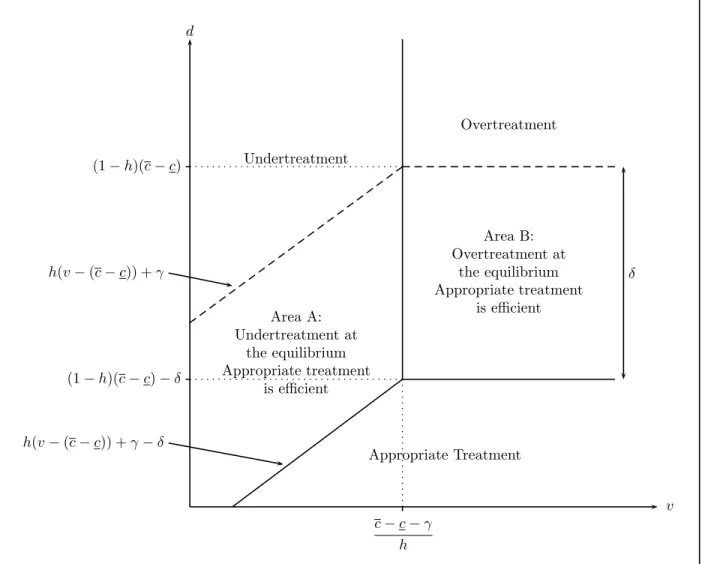
Lemma 1 The equilibrium prices p, p satisfy: (1) p−c=p−c with p=v −d+ (1−h) (c−c)−δ, for d≤M in ( (1−h) (c−c), h(v−(c−c)) +γ ) −δ
(2) p−c > p−c with p=v, for d ≥(1−h) (c−c)−δ and v ≥ c−c−γ
h ,
(3) p−c < p−c with p= (1−h)v−γ, for d≥h(v−(c−c)) +γ−δ and v ≤ c−c−γ
h .
In case 1, the expert conducts the diagnosis and proposes the appropriate treatment. In cases 2 and 3, the expert does not conduct a diagnosis and proposes either overtreatment (case 2) or undertreatment (case 3). Solid lines in Figure 1 delineate these 3 different cases.
This lemma shows that the consumers’ risk aversion, captured by positive risk-premia
δ and γ, clearly induces the expert to bias his pricing strategy towards full insurance of the consumer i.e. overtreatment. In the presence of risk aversion, the expert is thus more inclined than in the risk neutral case not to invest in diagnosis.
4
Efficiency analysis
We now determine whether risk aversion leads the expert to bias his behavior with respect to the case where the diagnostic outcome is observed. For that purpose, we first derive the efficient solution, i.e. the equilibrium under symmetric information on the diagnostic outcome.
If the expert wants to follow an overtreatment strategy, his profit does not depend on the information available so he does not need to conduct a diagnosis. If we denote byπO∗
the expert’s profit under symmetric information with overtreatment (O) and by πO the
expert’s profit under asymmetric information with overtreatment, we have πO∗ = πO ≡ v −c. In the same way, undertreatment (U) does not require diagnosis so that using a similar notation we have πU∗ =πU ≡(1−h)v−γ−c.
Suppose now that the expert makes a diagnosis and provides the appropriate treatment (AT). His profit under symmetric information is thus given by πAT∗ ≡ h(p−c) + (1−
h)(p−c), which is maximized forp=p=v−d, and his profit is given by:
πAT∗ ≡v−d−c−h(c−c) (6)
So an expert who provides an appropriate treatment earns a higher profit than under asymmetric information since: πAT∗ > πAT ≡v−d−δ−c−h(c−c).
The following Lemma presents the equilibrium under symmetric information, and Proposition 1 concludes on the efficiency of the equilibrium stated by Lemma 1.
Lemma 2 The efficient solution is such that:
(a) the expert sets a price pif the major treatment is diagnosed and a price pif the mi-nor treatment is diagnosed withp=p=v−d, ford≤M in{(1−h) (c−c), h(v −(c−c)) +γ},
(b) the expert does not undertake diagnosis and sets a price p = v for the major treatment only for d≥(1−h) (c−c) and for v ≥ c−c−γ
h ,
(c) the expert does not undertake diagnosis and sets a price p= (1−h)v−γ for the minor treatment only for d≥h(v−(c−c)) +γ and v ≤ c−c−γ
h .
Based on Lemmata 1 and 2, we have the following implication:
Proposition 1 With risk-averse consumers, the expert strategy leads to an inefficient equilibrium for the intermediary level of the diagnostic cost:
d∈ " M in ( (1−h) (c−c), h(v−(c−c)) +γ ) −δ, M in ( (1−h) (c−c), h(v−(c−c)) +γ )#
Figure 1 illustrates Proposition 1. In both areasA andB, the expert inefficiently does not conduct a diagnosis under asymmetric information2
.
Let us explain these two inefficient areas. With symmetric information on the diag-nostic outcome, if the expert undertakes the diagnosis, he chooses the same price for both treatments and then provides the appropriate treatment. The information symmetry on the diagnostic outcome allows the combination of a risk-free tariff and the completion of
2
Our results are consistent with Proposition 1 of Dulleck and Kerschbamer (2006) and Lemma 1 of (2009): for risk-neutral consumers (γ=δ= 0), the market leads to the efficient outcome.
the appropriate treatment. With asymmetric information, in order to induce a truthful disclosure of the diagnosis result, the expert is constrained to differentiate the price accord-ing to the treatment proposed. In other words, full insurance and information disclosure are no longer compatible. Thus, under symmetric information, the full insurance allows the expert to capture the risk premium while under asymmetric information the expert is constrained to leave that risk premium to the consumer. If the expert provides instead an overtreatment, there is no risk since the consumer always pays for the treatment and the diagnostic cost is saved. This choice is inefficient as long as the diagnostic cost is not too high but could be preferred by the expert that is no longer constrained to leave the risk premium to the consumer. The expert could also save the diagnostic cost and choose the undertreatment. As above, information asymmetry increases the risk incurred under appropriate treatment and thus biases the expert choice between undertreatment and appropriate treatment, towards undertreatment.
The usual efficiency result resurfaces when undertreatment is prohibited by a liability clause. With a liability clause undertreatment is de facto prohibited. Hence, the expert provides an appropriate treatment for any price such that p−c ≥ p−c. This crucial effect of liability on efficiency is consistent with the recent experimental study of Dulleck
et al. (2011). These experiments show that, contrary to the predictions of the theoretical literature, verifiability of the treatment provided alone has no significant impact on the degree of efficiency, whereas the addition of liability has a highly significantly positive impact on the degree of efficiency.
Our results also hold under Bertrand competition. The intuition is basically the same. The appropriate treatment requires equal mark-up but the introduction of competition drives the mark-up down to zero. To fully ensure the consumers, an expert could be induced to deviate from that equilibrium by providing overtreatment at a higher price because of the risk premium. Nevertheless, since the equilibrium prices with competi-tion are lower than under monopoly, the risk premium δ changes. When the consumer is characterized by a decreasing absolute risk aversion (DARA) utility function (respec-tively IARA), the risk premium is lower (respec(respec-tively higher) and the deviation is less (respectively more) likely to be profitable.
5
Conclusion
In a credence good market, information disclosure may require that all treatments be sold at the same profit margin. With risk-averse consumers, such equal margin tariffs generate a risk premium that may drive the expert to abstain from diagnosis and supply an inefficient treatment. We show that a liability clause fixes this inefficient behaviour. Insurance on consumers’ final income may also increase the expert’s incentives to provide an appropriate treatment, by reducing the individual risk premium3
. Finally, our result opens the discussion on experts’ behaviors when customers differ in their level of risk aversion4
. Dulleck and Kerschbamer (2006) show that consumers’ heterogeneity in their probability of needing different treatments triggers inefficient rationing or discrimination. Are same behaviors observed when consumers differ in their level of risk aversion?
Acknowledgement
The authors thank the anonymous referee, as well as Pierre Regibeau, Paolo Garella, and participants at the seminars in economics of the universities of Bologna, Khent, Milano and Rennes, and at the 37th Annual Conference of the EARIE and the 44th Annual Conference of the Canadian Economics Association, for their comments. This work has been funded by the French National Research Agency (Project POPSY-ANR-08-12-STRA).
References
Darby, M., Karni, E., 1973. Free Competition and the Optimal Amount of Fraud. Journal of Law and Economics, 16, 67-88.
Dulleck, U., Kerschbamer, R., 2006. On Doctors, Mechanics, and Computer Special-ists: The Economics of Credence Goods. Journal of Economic Literature, 44, 5-42.
Dulleck, U., and Kerschbamer, R. 2009. Experts vs. Discounters: Consumer Free-Riding and Experts Withholding Advice in Markets for Credence Goods. International Journal of Industrial Organization, 27 (1), 15-23.
3
As an anonymous referee suggests, extending our model to allow for insurance would be interesting: insurance is potentially an alternative to expertise by reducing the outcome risk but may also lead the expert to propose the appropriate treatment by reducing the risk on the final income.
4
Dulleck, U., Kerschbamer, R., Sutter, M., 2011. The Economics of Credence Goods: An Experiment on the Role of Liability, Verifiability, Reputation and Competition. Amer-ican Economic Review, 101, 526-555.
Emons, W., 1997. Credence Goods and Fraudulent experts. Rand Journal of Eco-nomics, 28 (1), 107-119
v d c−c−γ h (1−h)(c−c)−δ (1−h)(c−c) h(v−(c−c)) +γ h(v−(c−c)) +γ−δ δ Undertreatment Overtreatment Appropriate Treatment Area B: Overtreatment at the equilibrium Appropriate treatment is efficient Area A: Undertreatment at the equilibrium Appropriate treatment is efficient