e-brief
FFIINNAANNCCIIAALL SSEERRVVIICCEESS
Lifting the Veil: Regulation and Shadow Banking
INDEPENDENT
REASONED
RELEV
ANT
January 20, 2011 The growth of shadow banking in recent decades has changed the concept of banking. It has meant less deposit-taking and lending and more market-oriented banking activities, including in particular a growing trade in securitized products. However, shadow banking is opaque; a problem that was underlined in the recent financial crisis.
Does the experience of the financial crisis and its links to the riskiness of banking mean bank re-regulation is necessary? In the Canadian context at least, better reporting of bank risk seems to be a more appropriate way than re-regulation to prevent financial turmoil from arising in this area. Market-oriented operations should be more exposed to daylight, to enable a better evaluation of true bank risk, and regulatory agencies should require detailed reports on activities generating noninterest income.
Better indicators of leverage need also to be developed, owing to leverage’s role as the principal channel of bank risk-taking.
The advent of shadow banking has fundamentally altered the nature of banking. Where once banks were mainly in the traditional business of taking deposits and making loans, they have come to rely on market-oriented and off-balance-sheet activities to generate a major share of their income. The problem: these activities are utterly opaque, as underlined by their role in the sub-prime financial crisis. The question: what to do about it? Is re-regulation the answer or is there a better way to avoid a repeat of the financial turmoil that originated in this shadowy area?
The Background
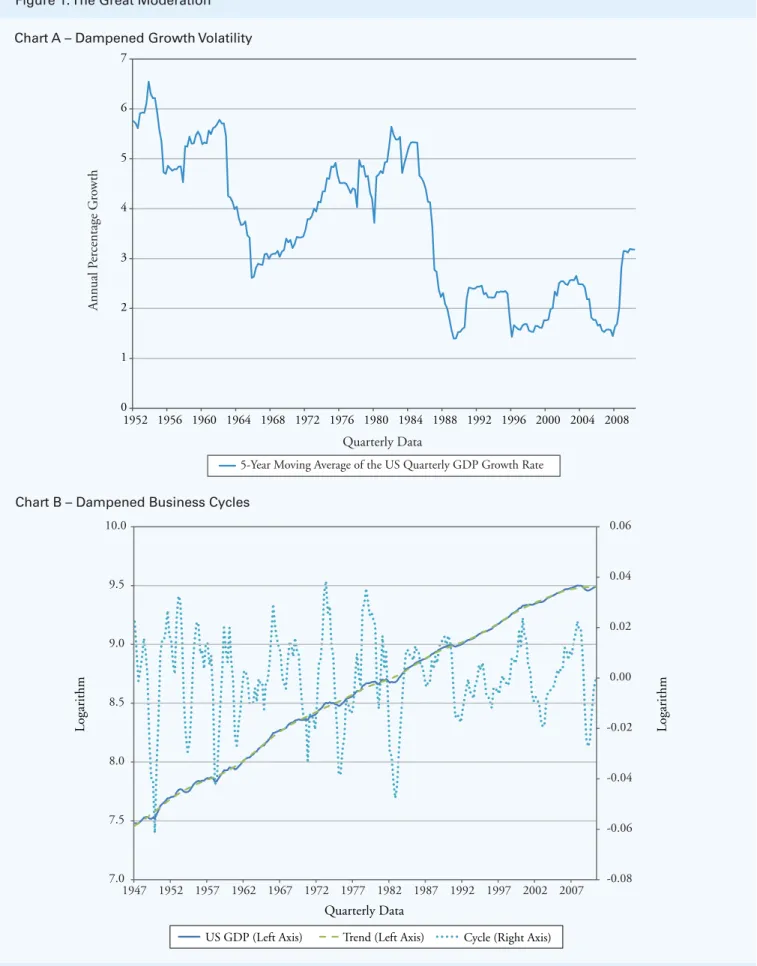
Before the sub-prime financial crisis of 2007, the Canadian banking system’s stability was considered robust. As with most industrialized countries, Canada had entered the “Great Moderation” (Stock and Watson 2002), a period that began in the late 1980s and was characterized by dampened volatility in economic growth and business cycles (Figure 1); this climate tended to foster financial stability (Quagliariello 2008).
We thank Céline Gautier and Étienne Bordeleau, Bank of Canada economists, for providing their data on Canadian banks, and Finn Poschmann for his guidance throughout this project. Detailed data and analysis of the issues discussed in this e-brief appear in Calmès and Théoret, 2010, “The Impact of Off-balance-sheet Activities on Banks Returns: An Application of the ARCH-M to Canadian Data,” in the Journal of Banking and Finance,volume 34(7).
By
Christian Calmès and Raymond Théoret
I N D E P E N D E N T
R E A S O N E D
R E L E V A N T
0 1 2 3 4 5 6 7 Annual P er centa g e G ro wth5-Year Moving Average of the US Quarterly GDP Growth Rate
1952 1956 1960 1964 1968 1972 1976 1980 1984 1988 1992 1996 2000 2004 2008
Quarterly Data Figure 1: The Great Moderation
-0.08 -0.06 -0.04 -0.02 0.00 0.02 0.04 0.06 7.0 7.5 8.0 8.5 9.0 9.5 10.0 Lo g arithm
US GDP (Left Axis) Trend (Left Axis) Cycle (Right Axis) 1947 1952 1957 1962 1967 1972 1977 1982 1987 1992 1997 2002 2007
Quarterly Data
Lo
g
arithm
Sources: US Department of Commerce; authors’ calculations. Chart A – Dampened Growth Volatility
I N D E P E N D E N T
R E A S O N E D
R E L E V A N T
During the same period, however, the banking sector evolved. Traditionally, banks’ primary function had been to take deposits that were guaranteed, in turn, by a diversified portfolio of loans to merchants.1In other words, an
institution was considered a bank to the extent that its liability instruments were used as media of exchange, or “money” (Neufeld 1972). But the concept of banking changed, through a trend toward disintermediation and more market-oriented banking activities, or financial deepening, including in particular a growing trade in securitized products. To preserve their profitability and to remain competitive with nonbanks that engaged in bank-like activities, banks expanded their non-traditional business lines, like securitization and securities trading.
In Canada, for example, banks’ loan-to-assets ratios declined sharply, from a high of 70 percent at the beginning of the 1980s, to a low of 47 percent at the onset of the subprime crisis (Figure 2). Their noninterest income share – the revenues associated with these new banking activities – rose from a low of 20 percent to a high of 56 percent during the period, and noninterest income has tended to exceed interest income since 1998 (Figure 3). Interest income was (and is) no longer the principal source of revenue for Canadian banks. With the emergence of more market-oriented banking, or shadow banking, the concept of a traditional bank has tended to obsolesce.
Less Financial Stability?
The subprime crisis that began in the United States in August 2007 shook the banking system – with the result that financial stability emerged as a serious concern. The new bank business lines, it turned out, could be riskier than traditional ones (Calmès and Théoret 2010). The credit ratings assigned to the cash-flow from securitized assets were 1 In Canada, the function of banking has been extended to loans to individuals and corporations since 1850.
40 45 50 55 60 65 70 75 Pe rcenta g e 1983 1985 1987 1989 1991 1993 1995 1997 1999 2001 2003 2005 2007 2009 Quarterly Data Figure 2: Canadian Bank Loan-to-Assets Ratio
I N D E P E N D E N T
R E A S O N E D
R E L E V A N T
I N D E P E N D E N T
R E A S O N E D
R E L E V A N T
sometimes overstated, creating for buyers a false impression of safety. Examples in the US include securitized subprime mortgages – mortgages with a lower probability of being repaid – and asset-backed commercial paper which, while generating good returns, was considered safe. The ratings assigned to tranches of collateralized debt obligations were also overstated.
As a result, the banks most involved in market-oriented activities recorded big losses during the subprime crisis. The collateral these banks pledged to lenders, often comprising securitized assets, was no longer accepted by investors. Consequently, their borrowings failed to roll over, and illiquidity emerged in many financial markets, eventually asphyxiating many banks in the US and Europe (Shin 2009).
Why did Banks Move to Shadow Banking and Take More Risk?
What were the causes of this financial mess? The first cause, as mentioned previously, stems from the increased risk banks took with their new business lines; risks that were largely underestimated.
The second reason was the overleveraging of banks off-balance-sheet (OBS) activities, which compounded bank risk. Under the 1988 Basel Accord, which imposed new regulatory capital standards on banks, regulatory capital arbitrage increased, giving an incentive to financial institutions to use new conduits, such as off-balance-sheet activities that required less capital than commercial loans (Brunnermeier 2010). The risks associated with these activities are greater than with traditional lending, but the accounting measure of bank leverage, or the ratio of balance-sheet assets to equity, was not designed to capture this OBS risk. In other words, the standard measures of risk, and especially leverage, were no longer reliable indicators of the degree of leverage banks were actually taking, and hence their risk exposures.
0.0 0.5 1.0 1.5 2.0 2.5 3.0 3.5 1983 1985 1987 1989 1991 1993 1995 1997 1999 2001 2003 2005 2007 2009
Interest Income (Per $100 of Assets) Noninterest Income (Per $100 of Assets)
In
come ($) per $100 of Assets
Quarterly Data Figure 3: Canadian Bank Interest and Noninterest Income
I N D E P E N D E N T
R E A S O N E D
R E L E V A N T
Substituting off-balance-sheet activities for on-balance-sheets ones, however, may have been seen as a necessity (Gorton 2010). Amid financial deepening and the flow of new entrants in banking activities, loan demand became increasingly competitive, putting downward pressure on the value of a bank’s charter. When, previously, the demand for loans had been exposed to less competition, banks could transfer to their customers the cost of high regulatory-capital ratios. But this transfer became increasingly difficult as disintermediation made its way through the financial sector, and it is why banks reacted by developing new business lines with lower regulatory capital requirements. Expanding OBS activity allowed banks to circumvent increasing regulatory capital, take on more risk and prevent their profits’ decline.
Re-regulating the Canadian Banking System Is Not the Solution
In this context, re-regulation could be tempting. It would present a complex problem, however, and its result could well be an increase in the risk taken by banks. In particular, if regulation became more stringent, it would likely increase banks’ regulatory capital arbitrage. Indeed, it would induce banks to expand in less regulated activities, such as hedge fund activities, which are riskier than traditional business lines (Gorton 2010).
The Canadian banking environment is different from that of the US, and also from the situation prevailing in many European countries. The Canadian banking system is more resilient than others (Ratnovski and Huang 2009), and it is very concentrated: the six biggest banks control more than 90 percent Canadian bank assets. Moreover, the presence of foreign banks is relatively low, and the Canadian banking system tends to be relatively more funded by deposits than in the US or Europe.
More importantly, the return on Canadian bank assets (ROA) has displayed a clear tendency to increase since the end of the 1980s (Figure 4). This rise in ROA is partly due to the inclusion of a risk-premium pricing the greater risk of off-balance-sheet activities (Calmès and Théoret 2010). In other words, the higher levels of ROA are already in line with the increased risk of the Canadian banking system.
The subprime crisis was also much less damaging to the Canadian banking system than to the US system. Canadian bank profits decreased, but they remained positive for the six major Canadian banks. Securitized assets flowed from off-the-balance-sheet back on to it, and lending did not suffer as much during the crisis. It is not so obvious, accordingly, that any particular regulation or reregulation of OBS activities, or an increase in Canadian banks’ regulatory capital, are necessary.2
Improving Information on Bank Risk
In the Canadian context at least, better reporting of bank risk seems to be a more appropriate way to prevent future turmoil. Shadow banking is utterly opaque, and this should change. Market-oriented operations should be more exposed to daylight, to enable a better evaluation of bank true risk, and regulatory agencies should require detailed reports on activities generating noninterest income.
Better indicators of leverage have also to be developed, leverage being the principal channel of bank risk-taking. As underlined earlier, accounting measures of leverage are largely inadequate to gauging the kinds of risk associated with the new banking environment. In this respect, time-varying leverage and leverage elasticity measures, like the elasticity of profits to operating income, or of noninterest income to interest income, could be useful tools to measure bank leverage.
I N D E P E N D E N T
R E A S O N E D
R E L E V A N T
2 However, it may be reasonable to argue that Canadian banks’ noninterest income share, to which the increase in bank risk is related, should not exceed the levels observed at the onset of the subprime crisis.
I N D E P E N D E N T
R E A S O N E D
R E L E V A N T
Redefining Banking
Whatever our reservations about re-regulating Canadian banking, doing so would not be sensible without good information. In the absence of a good information system, asymmetric information will prevail, giving way to moral hazard and agency problems.
More fundamentally, the concept of banking must adapt to the reality of current banking activities. Currently, savers and lenders count on banks to honour their claims, and to produce reliable money, while the banks’ individual and collective risks are not fully observable. How best to manage this, and to shed light on the banking system’s risks, is a question policymakers should address before plunging into re-regulation.
0.3 0.4 0.5 0.6 0.7 0.8 0.9 1990 1992 1994 1996 1998 2000 2002 2004 2006 2008 2010 0 10 20 30 40 50 60 Pe rcenta g e R
eturn($) per $100 of Assets
Return on Assets (Left Axis) Ratio of Noninterest Income to Total Income (Right Axis) 5-year Moving Average Quarterly Data
Figure 4: Canadian Bank Return on Assets and Ratio of Noninterest Income to Total Income.
I N D E P E N D E N T
R E A S O N E D
R E L E V A N T
This e-briefis a publication of the C.D. Howe Institute.
Christian Calmès, Chaire d’information financière et organisationnelle, ESG-UQAM; Member, Laboratory for Research in Statistics and Probability, LRSP; and Professor, Université du Québec (Outaouais).
Raymond Théoret, Professor, Université du Québec (Montréal), School of Management; Associate Professor, Université du Québec (Outaouais); Chaire d’information financière et organisationnelle, ESG-UQAM.
Philippe Bergevin, Policy Analyst, C.D. Howe Institute, 416-865-1904; email: [email protected]. This e-briefis available at www.cdhowe.org.
Permission is granted to reprint this text if the content is not altered and proper attribution is provided. References
Brunnermeier, M.K., 2009. “Deciphering the Liquidity and Credit
Crunch 2007-2008.” Journal of Economic Perspectives23, 77-100.
Calmès, C., Théoret, R., 2010. “The Impact of Off-balance-sheet Activities on Banks Returns: An Application of the ARCH-M
to Canadian Data.” Journal of Banking and Finance34, 1719-1728.
Gorton, G.B., 2010. Shaped by the Invisible Hand: The Panic of
2007. Oxford: Oxford University Press.
Quagliariello, M., 2008. “Does Macroeconomy Affect Bank
Stability? A Review of the Empirical Evidence.” Journal of
Banking Regulation9, 102-115.
Neufeld, E. P., 1972. The Financial System of Canada: Its Growth
and Development.Toronto: Macmillan Canada.
Ratnovski, L., Huang, R., 2009. “Why are Canadian Banks More Resilient?” Working paper, IMF.
Shin, H.S., 2009. “Securitization and Financial Stability.” Economic
Journal119, 309-332.
Stock, J., Watson, M., 2002. “Has the Business Cycle Changed and