A Batching and Scheduling Algorithm for the Diffusion
Area in Semiconductor Manufacturing
Claude Yugma, St´
ephane Dauz`
ere-P´
er`
es, Christian Artigues, Olivier Sibille
To cite this version:
Claude Yugma, St´
ephane Dauz`
ere-P´
er`
es, Christian Artigues, Olivier Sibille.
A Batching
and Scheduling Algorithm for the Diffusion Area in Semiconductor Manufacturing.
Inter-national Journal of Production Research, Taylor & Francis, 2012, 50 (8), pp.
2118-2132.
<
10.1080/00207543.2011.575090
>
.
<
hal-00515701
>
HAL Id: hal-00515701
https://hal.archives-ouvertes.fr/hal-00515701
Submitted on 7 Sep 2010
HAL
is a multi-disciplinary open access
archive for the deposit and dissemination of
sci-entific research documents, whether they are
pub-lished or not.
The documents may come from
teaching and research institutions in France or
abroad, or from public or private research centers.
L’archive ouverte pluridisciplinaire
HAL
, est
destin´
ee au d´
epˆ
ot et `
a la diffusion de documents
scientifiques de niveau recherche, publi´
es ou non,
´
emanant des ´
etablissements d’enseignement et de
recherche fran¸
cais ou ´
etrangers, des laboratoires
publics ou priv´
es.
A Batching and Scheduling Algorithm for the Diffusion Area in
Semiconductor Manufacturing
Claude Yugma
1 ∗St´
ephane Dauz`
ere-P´
er`
es
1Christian Artigues
2Alexandre Derreumaux
1Olivier Sibille
31
Ecole des Mines de Saint-Etienne, Centre Microlectronique de Provence - Site Georges
´
Charpak, 880, Avenue de Mimet, F-13541 Gardanne, France
2
LAAS-CNRS, 7 avenue du Colonel Roche, 31077 Toulouse, France
3ATMEL, Zone industrielle, 13790 Rousset, France
Abstract
This paper proposes an efficient heuristic algorithm for solving a complex batching and scheduling problem in a diffusion area of a semiconductor plant. Diffusion is frequently bottleneck in the plant and also one of the most complex areas in terms of number of machines, constraints to satisfy and the large number of lots to manage.
The purpose of this study is to investigate an approach to group lots in batches and to schedule these batches on machines. The problem is modeled through a disjunctive graph formulation. A constructive algorithm is proposed and improvement procedures based on iterative sampling and Simulated Annealing are developed. Computational experiments, carried out on actual industrial problem instances, show the ability of the iterative sampling to significantly improve the initial solution. The Simulated Annealing enhances the results of the iterative sampling. The constructive algorithm has been embedded in a software and is currently being used.
Keywords: Batch, Scheduling, Disjunctive graph, Local search, Simulated Annealing, Wafer fabrication.
1
Introduction
Semiconductor wafer fabrication can be described as a multistage process with re-entrant flows. The pro-cessing is done layer by layer. Each layer requires several steps of propro-cessing such as chemical-mechanical polishing, diffusion, film deposition, photolithography, implant (doping) and etching. For each of the product types, and depending on the technology, a wafer goes through more than 400 process steps over a period of a few weeks. Wafer fabrication planning and scheduling is a complex task due to the large number of products and machines involved. It is further complicated by additional constraints such as re-entrant flow of operations Kumar [Kum94], setup issues, preventive maintenances, random machine breakdowns, Ovacik and Uzsoy [OU97], Sze [Sze01], etc. The importance of scheduling on the perfor-mance of semiconductor wafer fabrication facilities (fabs) is known for many years see Wein [Wei88] and Sze [VS06].
In this paper, we focus on an important part of the manufacturing process. Among the complex operations involved in the fabrication of a wafer, the diffusion phase is of critical importance since the batching decisions that are involved may affect the performance of the entire wafer fab Ibrahim et al. [ICN+03] and M¨onch and Habenicht [MH03]. The processing time of the operations in the diffusion
area can be large (10h) compared to other operations in the fab. Mehta and Uzsoy [MU98] state that optimizing batching operations results in good performance measures of the whole production process. Lots regularly arrive in the diffusion area and the diffusion phase is primarily used to alter the type and
level of conductivity of semiconductor materials.
The purpose of this article is to develop efficient methods to partition lots in batches and to schedule batches on machines in the diffusion area of a semiconductor plant while taking into account numerous constraints and optimizing three main production criteria: maximize the number of operations (moves), maximize the batch sizes and minimizing the total tardiness.
The remaining sections of this paper are organized as follows. In Section 2, we provide some back-ground on existing related batch and scheduling problems. In Section 3, the problem is stated. We present in Section 4, a disjunctive graph representation of the problem. The method for computing an initial solution and improvement procedures based on iterative sampling and Simulated Annealing are described in Section 5. Experimental results on real problem instances and comparison with a literature algorithm are given and discussed in Section 6. Section 7 concludes the paper with recommendations for further research.
2
Previous related work
The operations of batching and scheduling jobs is a common practice in a manufacturing system espe-cially in semiconductor manufacturing systems, see Mathirajan et al. [MS06a]. For examples reasons for batching are the reduction of setups, the ability of machines to process several jobs simultaneously, etc. With the classification given by authors by Mathirajan et al. [MS06a], we notice that there is not much literature on scheduling batch problems taking into account the re-entrance features of the system as for example we can name Cigolini et al. [CPPZ02], Mason and Oey [MO03] [OM01]. The work proposed by M¨onch et al. [MFDP+09] presents a scheduling problems in semiconductor manufacturing. Typical
scheduling problems found in semiconductor manufacturing are identified in particular batching prob-lems.
The problem addressed in this paper deals with:
• Multiple machines at each stage. The authors in Mehta and Uzsoy [MU98] presented a prob-lem of minimizing total tardiness on a batch processing machine with incompatible job families. They proposed a dynamic programming to solve the problem. The paper of Balasubramanian et al. [BMFP04] extends solutions of Mehta and Uzsoy [MU98] to a batching problem with incom-patible jobs on parallel machines which aims at minimizing weighted total tardiness. The authors in Kim et al. [KJC10] focused on a problem of scheduling wafer lots on diffusion workstations in a semiconductor wafer fabrication facility. In their considered diffusion workstation, there are multi-ple identical machines, and each of them can process a limited number of wafer lots at a time. Their scheduling problem at the diffusion workstation is a problem of scheduling multiple job families on identical parallel batch-processing machines.
• Multiple stages. The described problem for the diffusion area takes into account all the different stages of this area which can reach 4. In the literature, the number of stages does not generally exceed 2. The author Su [Su03] considered a hybrid two-stage flow shop with a batch processor in stage 1 and a single processor in stage 2. This is also the case in articles Sun and Min [SM01] and Sung and Kim [SK03] which consider a batch problem on 2 stages. Oulamara et al. [OFKK09] studied a two-machine flow shop problem with conventional and batching machines in the first and second stage, respectively, and arbitrary job compatibilities.
• Multiple criteria. The goal of the paper is to simultaneously optimize three indicators. These indi-cators are the number of lots going through the line (to maximize), the number of wafer in a batch (to maximize) and the waiting time of lots (to minimize). Generally, articles in the literature tackled scheduling batch problems by considering one single indicator to optimize. Uzsoy in [Uzs95] tackled the problem with the objective of minimizing the completion time of jobs, Hung [Hun98] has an objective of maximizing the batch processing machine utilization. Perez et al. [PFC05] studied the problem of minimizing the total weighted tardiness on a single machine and Mathirajan and Sivaku-mar [MS06b] focused on the minimization of the total weighted tardiness on heterogeneous batch processing machines under condition of dynamic arrival of jobs, incompatible job families and non-identical job sizes. Few articles deal with different criteria simultaneously. Pfund et al. [PBF+08] adapted the Shifting Bottleneck Heuristic to facilitate the multi-criteria optimization of Makespan,
cycle time and total weighted tardiness using a desirability function.
Furthermore, in our problem, setup times (loading and unloading) are not depending on the sequence and the complexity is added by the maximum times lags between batching operations.
Our problem is a complex variant of job shop problem. These types of problems can be found in Mason et al. [MFC02] and Ovacik and Uzsoy [OU97]. These problems are frequently analyzed using a method known as the shifting bottleneck (SB) procedure see for example Adams et al. [ABZ88]. Sev-eral aspects, like identifying appropriate sub problem solution procedures can be found in Demirkol and Uzsoy [DU00] and Uzsoy and Wang [UW00]. In Mason et al. [MFC02], a scheduling problem in semi-conductor manufacturing close to the one tackled in this paper is solved by a modified SB heuristic. We propose to model solutions of the considered batching and scheduling problem through a variant of the disjunctive graph proposed in Mason et al. [MFC02].
3
Problem description
The diffusion area defines a batching and scheduling problem of wafer lots on two types of equipment: cleaning and furnaces machines. These resources are able to perform several lots simultaneously. Each lot requires one or more consecutive operations on the equipment and each operation has a recipe (speci-fication on a process on how it should be executed on a tool; This pertains to requirements of maintaining proper temperature, pressure, and metal composition, among others) which determines its duration and the set of machines that are able to process it. On a 24-hour basis, each operation has to be assigned to an equipment, and included into a batch, i.e. a set of operations of the same recipe that are processed simultaneously by the equipment. The constraints in the diffusion area are divided into three types: equipment constraints, process constraints and line management constraints.
3.1
Constraints
Some of these constraints are common to the two types of resources while others are dedicated to furnaces.
3.1.1 Equipment constraints
• Common constraints
Dedicated equipment: Any equipment is able to process a limited set of recipes.
Maximum batch size: Any equipment defines a maximum batch size corresponding to the capacity of that equipment.
Loading and unloading times: A time may be needed to load and unload a batch on the equipment.
Unavailability periods: The equipment may be unavailable during some periods (defined by time windows) due to qualification, repair, maintenance etc.
In process jobs: The equipment may be occupied at the beginning of the time horizon by in-process operations that have to be completed before the equipment becomes available.
• Specific furnace constraints
Minimum time between two batches on an furnace: Furnaces must be inspected after completing each batch.
3.1.2 Process constraints
• Common constraints
Precedence: Operations must be performed following the manufacturing process of the lot. The operations of a lot are chained and no operation can start before the end of its predecessor, except for the first operation of each lot.
Minimum time lag: There is a fixed handling and transport time between every two successive operations of a lot.
lot cannot be scheduled before its release date. Because the diffusion area is a stage of the complex global production process, release dates are estimated by a simulation tool.
Fixed recipe: Each operation of a lot is associated with a recipe, i.e. the lot should be processed on resources that are qualified for the corresponding recipe. This implies that all lots in the same batch must be processed with the same recipe.
Process time: The process time of a batch on an equipment depends on the recipe.
Maximum time lag: A time limit is given for two successive operations x and y of a lot. The difference between the starting time of y and the completion time of xcannot exceed this limit. Maximum time lags depend on the operationsxandy. They can correspond to the maximum time limit between cleaning and furnace equipment.
3.1.3 Line management constraints
• Specific furnace constraints
Minimum time between two batches of same recipe: There is a minimum time between the beginning of two batches of the same recipe on two different furnaces.
3.2
Objective
In semiconductor fabs, several indicators are used to measure the performance. The interested reader can refer to [MT05] for more details. We describe thereafter the indicators that are relevant in our study. • Number of moves (to maximize): It corresponds to the number of completed operations on the planning horizon, which can be compared to the target number fixed by the production managers. • Batching coefficient (to maximize): Defined on the planning horizon, it is calculated as the number of moves divided by the sum of the number of batches performed on each machine, times the maximum capacity of that machine. Note that the denominator is the number of lots that could be performed if the equipment was loaded up to their maximum capacities.
• X-factor (to minimize): This indicator is used to evaluate the waiting times of lots in the diffusion area in order to reduce the cycle times. For a given lot, this factor is calculated as the total staying time of the lot in the diffusion area over its processing time.
These three indicators will be used to evaluate solutions in the fab.
Other indicators could be relevant. Among them, the Work-In-Process (WIP), is defined as the number of wafers being in the fab at a given period, either in a production state or in a non-production state (e.g. transport and waiting). The law of Little [Lit61] establishes that if a system is stable and stationary then the average WIP is proportional to the average cycle time. Thethroughput is defined as the outgoing number of wafers of the fab per unit of time. The evolution of the throughput in time makes it possible to know if the system is stable i.e. to know if there is no accumulation of lots in the fab or if the system evolves according to forecasts. Glassey and Resende [GR88], observed that there is a relation between the increasing of the throughput and the output of a fab. The cycle time drastically increases when throughput is close to the maximal capacity of the fab. Hence for both WIP and throughput indicators, the X-factor indicator is adequate.
The goal is to optimize the various performance measures, while taking into account the numerous complex constraints.
The next subsection described the mathematical formulation of the problem.
3.3
Problem formulation
The scheduling problem can be formulated as follows. For sake of clarity, the above-described Unavail-ability periods,In-process jobs andMinimum distance between batches of the same recipeconstraints are not included. In Section 4, we describe how we tackle these characteristics.
A set of jobs (lots)J ={Ji|i= 1, . . . , n} has to be processed on a horizon T by a set of machines
M = {Mk|k = 1, . . . , m}. Each job Ji is made of ni operations such that each operation Oij has a
durationpij >0 and a setMij ⊆ Mof machines (the furnaces or the cleaning machines) able to process
value ofpij and the elements of the setMij are determined by the recipe of operationOij denoted ρij.
In general we haveMij ⊂ Msince each machine cannot be configured for all recipes. Each operationOij
has to be included in a batch on a resourcek∈ Mij. Each machine has a finite capacityRk which gives
the maximal number of lots in the same batch. On each machine k, Sk denote the setup time needed before starting a new batch,Dk denote the removal time needed after the completion of a batch andsk
denote the constant setup time needed between two different batches. s0k denotes the initial setup time on machine k, depending on the state of the resource at time 0. Two consecutive operations Oij and Oi(j+1)of the same job are linked by minimal and maximal time lags. Once the batch ofOijis completed
and removed fromk, the setup for the batch ofOi(j+1)cannot start before a minimal time lagτijminand
has to start before a maximal time lag τmax
ij . Let O ={Oij|i = 1, . . . , n;j = 1, . . . , ni} denote the set
of all operations. Each job Ji has a relative priorityci (ci < cj means thatJi is more urgent thanJj).
Each job corresponds to a numberwi of wafers produced when the job is completed. Table 1 summarizes the notations used.
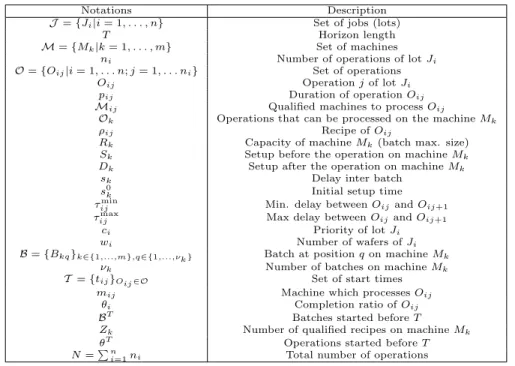
Notations Description
J={Ji|i= 1, . . . , n} Set of jobs (lots)
T Horizon length
M={Mk|k= 1, . . . , m} Set of machines
ni Number of operations of lotJi
O={Oij|i= 1, . . . n;j= 1, . . . ni} Set of operations
Oij Operationjof lotJi
pij Duration of operationOij
Mij Qualified machines to processOij
Ok Operations that can be processed on the machineMk
ρij Recipe ofOij
Rk Capacity of machineMk(batch max. size)
Sk Setup before the operation on machineMk
Dk Setup after the operation on machineMk
sk Delay inter batch
s0k Initial setup time
τmin
ij Min. delay betweenOijandOij+1
τijmax Max delay betweenOijandOij+1
ci Priority of lotJi
wi Number of wafers ofJi
B={Bkq}k∈{1,...,m},q∈{1,...,νk} Batch at positionqon machineMk
νk Number of batches on machineMk
T ={tij}Oij∈O Set of start times
mij Machine which processesOij
θi Completion ratio ofOij
BT Batches started beforeT
Zk Number of qualified recipes on machineMk
θT Operations started beforeT
N=Pn
i=1ni Total number of operations
Table 1: Summary of notations used to formalize the problem
Finding a feasible solution for the problem lies in making four types of decisions: D1 - Partition the operations into batches,
D2 - Select a resource to process each batch, D3 - Order the batches on each resource, D4 - And assign a start time to each batch.
Decisions D1-D3 can all be represented by a family of batchesB ={Bkq}k∈{1,...,m},q∈{1,...,νk} where
Bkqis the batch sequenced at positionqon machineMk. νk ∈ {0, . . . ,|Ok|}denote the number of batches
assigned to machine Mk. Decision D4 lead to a family of start times T ={tij}Oij∈O assigned to the
operations. Once a solution{B,T }is determined, we have a machine assignment{mij}Oij∈Owheremij
denote the machine Oij is assigned to, i.e. verifying that ∃q ∈ {1, . . . , νk} such that Oij ∈Bmijq. To
be feasible, a solution{B,T }and its corresponding assignment{mij}Oij∈Ohave to satisfy the following
constraints. The operations of the same batch must have the same recipe, i.e.
Each operation must be assigned to a machine able to process its recipe.
mij ∈ Mij ∀Oij ∈ O (2)
The batch capacity cannot be exceeded and each batch includes at least one operation.
1≤ |Bkq| ≤Rk ∀Bqk∈ B (3)
An operation appears in only one batch, i.e.
B∩B0=∅ B, B0∈ B, B6=B0 (4)
All operations are included in a batch
∪B∈BB=O (5)
The start time of the first operation of each lot cannot exceed the lot release date:
ti1≥ri ∀Ji∈ J (6)
Each operationOij,j >1, cannot start before a minimal time lag after the end of its preceding operation
Oi(j−1), which takes into account of the removal time of the batch ofOi(j−1), the minimal time lagτimin(j−1)
and the setup time of batch ofOij:
tij−ti(j−1)≥Dmi(j−1)+pi(j−1)+τ
min
i(j−1)+Smij
∀i∈ {1, . . . , n},∀j∈ {2, . . . , ni} (7)
Each operation Oij, j > 1, has to start before a maximal time lag after the end of its preceding
operationOi(j−1), which takes account of the removal time of the batch ofOi(j−1), the maximal time lag
τmax
i(j−1)and the setup time of batch ofOij:
tij−ti(j−1)≤Dmi(j−1)+pi(j−1)+τ
max
i(j−1)+Smij
∀i∈ {1, . . . , n},∀j∈ {2, . . . , ni} (8)
The start times of two operations of the same batch must be equal:
tij =txy ∀B∈ B,∀Oij, Oxy∈B (9)
An operation of a batch which is not at the first position on its machine cannot start before the end of the preceding batch on the machine, plus the necessary removal time of the preceding batch, plus the minimal setup time on the machine between two batches, plus the necessary setup time for the next batch.
tij−txy≥pxy+Dk+sk+Sk
∀Bkq,q>1∈ B,∀Oij∈Bkq,∀Oxy∈Bk(q−1) (10)
An operation of a batch in the first position on its machine cannot start before the initial setup time for this batch (we assumeS0
k ≤Sk+Dk+sk,∀Mk∈ M):
tij≥s0mij ∀Oij∈ O (11)
By definition, a feasible solution includes each operation inside a batch. In our problem, the scheduling horizon is limited to a scheduling horizonT. Hence only those batches released in the interval [0, T] must be taken into account. Several criteria are used to measure the quality of a feasible solution. The number of moves is the number of wafers produced in [0, T]:
fmov = X θij∈θ
where θij = 1 when the job is completed beforeT andθi ∈[0,1[ denotes the completion ratio of job i
before timeT, otherwise.
θij = P Oij,tij+pij<=T pij+ P Oij,tij<T <tij+pij (T−tij) Pni j=1pij
The batching coefficient is the average ratio of the actual size of each batch divided by its maximal size. LetBT ={B∈ B|tij < T,∀Oij∈B}denote the set of batches started before time periodT.
Batching coefficient = P k P Bkq∈BT|Bkq|/Rk |BT| (13) fbatch = P k P Bkq∈BT |Bkq|/(Rk+ Zk 100) |BT| (14)
whereZk means the total number of qualified recipes on machineMk.
The weighting of the batching coefficient by the number of qualified recipes on the concerned machine makes it possible to use the least general-purpose machines initially.
The average X-factor is the average of the X-factor of each job weighted by the job priority. All the jobs do not have the same priority. Certain jobs are more important than others (important customers, tests to be carried out quickly, delay to catch up with, etc). Thus, a weight is assigned to the job to reflect its priority. LetJT ={Ji∈ J |tin
i+pini ≤T} denote the set of jobs completed beforeT.
X-fac = P Ji∈JT(tini−ri)/pini |JT| (15) fX-fac = P Ji∈JT ci(tini−ri) |JT| (16)
The choice made together with the decision makers of the production unit is to combine these different objectives into a single one by maximizing the following weighted sum:
f =αfmov +βfbatch−γfX-fac (17)
where α, β and γ are adjustable weights allocated to each objective function. The objective functions have been designed to integrate some requests of managers. In the calculation of fX−f ac, the delay of
each lot is multiplied by its priority, in order to accelerate the urgent lots. In the calculation of the total batching coefficient, the batching coefficient of each equipment is multiplied according to the number of qualified recipes on this equipment. This leads to choose in priority the machines that are able to process less recipes, and thus to maintain the availability of the most flexible equipment.
The objective of the problem is to search for a feasible selection{B,T }such that f is maximized. Note that, given a (feasible) solution{B,T },f can be computed inO(N) time whereN =Pn
i=1niis the total
number of operations.
4
The disjunctive graph representation
The considered problem can be seen as an extension of the job-shop problem and, consequently, the disjunctive graph model can be used for batching and scheduling problems as proposed by Mason et al. [MFC02]. In their article, the authors consider a different objective function (total weighted tardiness). Sequence-dependent setup times and reentrant flows are also considered but there are no maximum time lags. Unfortunately, these constraints considerably increase the difficulty of the problem Gentner et al. [GNST04]. Let us explain how the problem is modeled using disjunctive graphs.
We define the disjunctive graphG= (V, C, E) as follows.
• V is a set of nodes where there is one node per operation, denotedVij, plus a dummy start node denoted 0.
• C is the set of conjunctive arcs representing the release dates and minimal and maximal time lags. There is an arc from node 0 to node Vi1of each jobJi. There is an arc fromVij toVi(j+1)and an
arc fromVi(j+1)toVij , for each consecutive operationsOij andOi(j+1)of each jobJi.
• Eis the set of disjunctive arcs which represent the decisions of the problem. There are two opposite conjunctive arcs (Vij, Vxv)k and (Vxy, Vij)k for any machine k∈ Mand for any pair of operations Oij, Oxy∈ Ok,Oij6=Oxy. These arcs represent the sequencing or the batching decision concerning Oij andOxy on machine k.
LetBdenote a partial or complete batching for the problem satisfying at least Constraints (1) through (4). B is a complete batching if Constraint (5) is also verified, otherwise it is a partial batching. Recall thatB also defines the machine assignmentmij, for allOij ∈ ∪B∈BB. We assumemij = 0 ifOij is not
batched inB, i.e. ifOij 6∈ ∪B∈BB.
Bunambiguously defines a selectionS as follows. For each distinct operationsOij andOxysuch that mij =mxy =k6= 0, select arc (Vxy, Vij)k ifOxy is in a batch sequenced before the batch of Oij, select
arc (Vij, Vxy)k ifOij is in a batch sequenced before the batch ofOxy, and select both arcs (Vij, Vxv)k and
(Vxy, Vij)k ifOij andOxy are assigned to the same batch.
Once a selection is computed, we define a graphG(S) = (V, C∪ S) where arcsC∪ S are valued as follows (we assumes0
0=s0=S0=D0= 0):
• Each arc from 0 to the first operation Oi1 is valued by max(ri, Sm0ij), the maximal value between
the release date of jobiand the initial setup time for machinemi1.
• Each arc fromVij andVi(j+1)is valued by Dmij +pij +τ
min
ij +Smi(j+1), the value of the minimal
time lag betweenOij andOi(j+1) plus the setup and removal times linked to the assignment of the
operations.
• Each arc fromOi(j+1) and Oij is valued by−(Dmij +pij+τ
max
ij +Smi(j+1)), the (negative) value
of the maximal time lag betweenOij andOi(j+1)plus the necessary setup and removal times.
• Each arc (Vij, Vxv)kis valued either bypij+Dk+sk+Sk if the opposite arc is not selected or by 0 if
the opposite arc is selected. Indeed, in the first case this arc represents the decision to sequenceOxy
after Oij on machinekwhereas in the second case, both arcs (Vij, Vxv)k and (Vxv, Vij)k represent
the synchronization of the operations included in the same batch.
We can state that the (partial) solution represented by the (partial) batchingBand its selectionS is feasible if and only if longest path problems from node 0 to each nodeVij in G(S) have a solution. In the positive case and ifB is complete, a feasible scheduleT can be obtained by settingtij to the length of the longest path from 0 toVij. FurthermoreT is the best schedule compatible withBone can obtain when the objective is to maximizef.
The problem can be formulated as follows: Find the batchingBverifying Constraints (1) through (5) such that the corresponding selectionS is feasible and maximizesf.
As stated in the previous sections, the actual data issued from the fab have other characteristics that have been tackled, such as in-process jobs and machine down times. We can model easily these characteristics thanks to the disjunctive graph formulation. They can be both represented by operations with fixed start times on the involved machine. A start timetcan be fixed by linking the node with node 0 by two opposite arcs valued byt and−t. As stated in Section 3, the actual problem also includes an important line management constraint: a minimum time between the start time of two batches of the same recipe scheduled on two different batches has to be respected. This can also be tackled through the disjunctive graph representation. A fictitious machine can be associated to each recipe and disjunctive arcs linking two operations of the same recipe can be defined. Then, whenever the two operations are batched on two different machines (furnaces), the disjunctive arc has to be oriented. Once oriented the arc is valued by the minimum required distance.
5
Solution Methods
We propose a two-phase heuristic method and a metaheuristic to solve the problem. The first phase of the heuristic is a constructive heuristic based on successive job insertions. The second phase is a local
search method which aims at improving the initial solution. Both phases are based on the evaluation of a (complete or partial) selection through longest path calculations. For the metaheuristic, we propose a Simulated Annealing algorithm.
5.1
Evaluation of a partial or complete batching
Any partial or complete batchingBand its selectionS can be evaluated through the calculation of start timetij, equal to the longest path from 0 toVij inG(S) of each operationOij. To compute such longest paths, since the graph includes arcs with negative weights, we use the Bellman-Ford algorithm which has aO(N|S ∪C|) time complexity. If the algorithm finds a path of positive length, then the partial or complete solution is unfeasible. Otherwise the algorithm returns start timestijand the objective function valuef can be determined.
5.2
Computing an initial solution by a priority rule-based constructive
heuris-tic
The initial solution (selection) is computed by a job insertion method. The jobs are first sorted in a list
Laccording to the order: jobs involving maximal time lags first, then increasing release dates, then job priority.
The method starts with an empty batching. Then, the jobs are taken in the order given by the list and inserted one by one in the current batching. The insertion of Ji is made as follows. Let
B = {Bkq}k∈M,q∈1,...,νk denote the current batching including jobs located before Ji in L. For each
operation Oij of Ji and for each resourcek ∈ Mij, there are 2νk+ 1 insertion positions of Oij in the
batch sequence of machineMk: indeed, for each batchBkq, we may insertOij inside batchBkqor create a new batch at any position. Each of these insertion positions is evaluated with the algorithm described in the previous section and the one that maximizesf is kept to updateB. If none of the insertion positions is feasible for an operationOij, then all these partial solutions violate a maximal time lag and there exists
insertion positions that violate only maximal time lag betweenOi(j−1)andOij (the last position on each
resource ofMij, for instance). Hence we have to remove Oi(j−1) from B, the previous operation of job
Ji, and insert it at a later insertion position. If this is not feasible, they are not scheduled and delayed
from the list of operations. Note that at most Pni
j=1
P
k∈Mij2νk + 1 insertion positions are tested per
inserted lot. Thereafter, we will call by Priority-rule Based Insertion Algorithm (PBIA), the algorithm described above.
5.3
Improving the initial solution by iterative sampling
Iterative random sampling consists in iteratively applying the constructive algorithm presented in Section 5.2 and randomly changing each time the input operation list. Two different iterative sampling methods are proposed. In the first random sampling method the input list is initialized at each iteration as a random permutation. We call this algorithm Random Iterative Algorithm by Priority-rule Based Insertion (RIA-PBIA). In the second random sampling method, the list is changed by making few random modifications on the sorted list. It consists in dividing the list into intervals and, for each interval, in making a random modification following a uniform law. We call this algorithm Pseudo-Random Iterative Algorithm by Priority-rule Based Insertion (PRIA-PBIA).
5.4
Simulated Annealing
Simulated annealing (SA) belongs to the class of randomized local search algorithms and has been devel-oped by [KGV83] to handle hard combinatorial problems. The use of simulated annealing supposes the definition of neighborhood. The neighborhood we consider is defined by the following moves:
1. ”Batch move”. A batch is moved randomly (both equipment and position can change).
2. ”Operation move”. An operation is moved randomly in an existing batch or a new batch is created (both equipment and position can change).
3. ”Operation switch”. Two batches with the same recipe are randomly selected. Then two randomly selected operations are switched.
In our implementation, 50% of the considered moves are batch moves, 25% are operation moves and 25% are operation switches. According to randomly generated moves, we proceed as follows. All random selections are made according to the uniform law. If a move is impossible due to a violation of a con-straint, we restore the previous solution and try another move. Each neighbor solution is evaluated by means of the longest path computations presented in Section 5.1.
The algorithm starts with an initial solutions0 and then tries to find better solutions by searching in its neighborhood (obtained by the moves described above), and applying a stochastic acceptance criterion. When a neighbor (a solution s) of the current solution is selected we compare the difference ∆f =
f(s)−f(s0). If the difference ∆f is negative, the neighbor replaces the current solution. Otherwise, the neighbor is accepted with a probability based upon the Boltzmann distributionPaccept(∆f)≈exp(−kT∆f) where k is a constant and the temperature T is a control parameter. This temperature is gradually lowered following a geometrical law functiong(T) : g(T) =αT withα <1.
6
Computational experiments
We coded the proposed algorithms in Java and we tested them on a 1 GigaOctet RAM and 3.4 gigahertz processor computer. We conducted two types of experiment tests: the first type of tests is conducted on actual fab data and compared to the constructive initial solution obtained by PBIA solutions, with pseudo and random lists and the Simulated Annealing (SA) solutions. In the second type of tests, we compared the proposed heuristic PBIA to an algorithm for scheduling jobs on parallel batch processors with incompatible job families and unequal ready times problem proposed by M¨onch et al. [MBFP05] as it is close to the one tackled in this paper.
6.1
Experimental tests on actual fab data
These tests have been performed on actual instances issued for two months of production. There are 700 jobs yielding a total number of 1400 operations with about 50 different recipes to schedule on 70 furnaces and 12 cleaning machines. Each furnace has a capacity of 4 or 6 lots and each cleaning machine of 2 or 4 lots. The time needed to load and unload a batch varies between 10 and 30 minutes. The minimum and maximum time lags varie from 10 minutes to 4 hours. The target time horizon is 24 hours. The weights of the components of the objective function have been computed both to normalize the different indicators and to take account of the user preferences. For the experiments, we selectedα = 601, β = 1500001,
γ= 41.
The number of replications is 5 for the simulated annealing and 20 for the pseudo and random lists. The computational time of the simulated annealing for one instance does not exceed 5 minutes and the constructive heuristic and the random and pseudo lists is limited to 1 minute. The percentage is calcu-lated on the average relative improvement brought on the considered method over the reference solution obtained by the constructive heuristic (initial), i.e. M ethod solutionInitial solution−Initial list
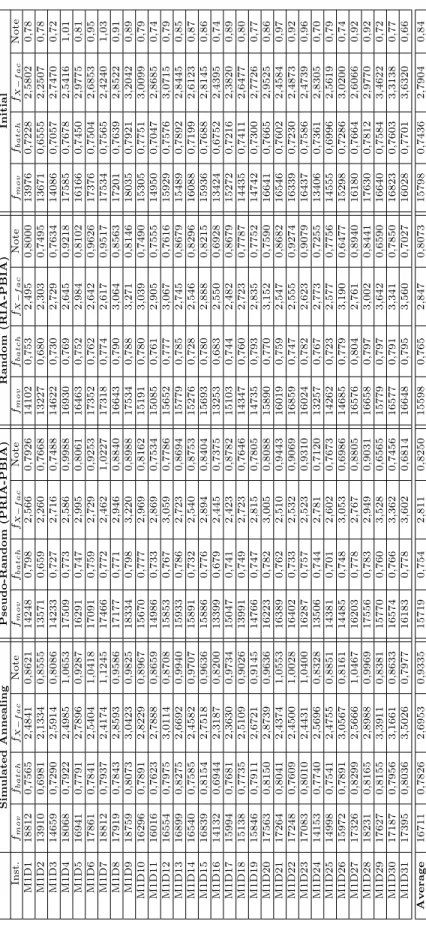
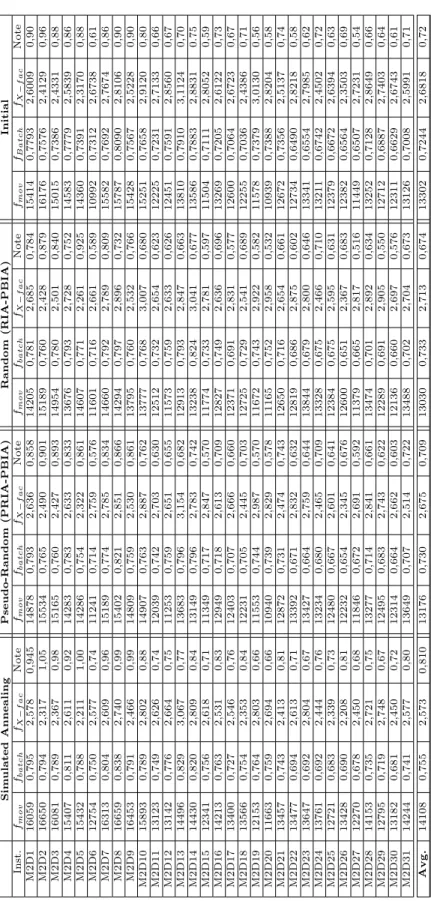
From Table 2 and Table 3, we displayed the objective function solution values (note), the number of moves (fmov), the batching coefficient (fbatch) and the X-factor (fX−f ac) obtained from the three
methods: Simulated Annealing (SA), Pseudo (PRIA-PBIA) and Random (RIA-PBIA) algorithms on the basis of solutions obtained by PBIA (Initial). It is important to note that the Simulated Annealing starts from the best solution of (PRIA-PBIA) and (RIA-PBIA).
We can notice that on average we improve solutions with the simulated annealing algorithm on the two considered months. An improvement of 47,05% on the number of movesfmov is noticed (resp. 6,6% for the second month), the batching coefficient fbatch of 33,04% (resp. 4,15% for the second month), thefX−f acincreases by 41% (resp. is improved of 4,07% for the second month) and the objective value
(note) is improved of 11,13% for the first month (resp. 12,61% for the second month).
moves (resp. slightly deteriorated of 0,95% on second month), the batching coefficient of 28,23% (resp. 0,70% on the second month) and X-factor increases of 47,07% (resp. improved of 0,26% on the second month) and the objective function slightly decreases of 1,71% (resp. 1,42% on the second month). For the Random solutions (RIA-PBIA), the number of moves is improved of 37,26% (resp. decreased of 2,05% on the second month), the batching coefficient is improved of 29,96% (resp. 1,17% on the second month), the X-factor is deteriorated of 48,93% (resp. 1,16% on the second month) and the note slightly decreased of 3,86% (resp. 6,30% on the second month).
In the Pseudo and random cases, we can notice that some indicators are sometimes slightly deteriorated (more in the case of Random lists) due to the fact we have a larger search space when using random lists than pseudo-random lists and then there is a capability of reaching better solutions but also worse see Table 4.
Sim ulated Annealing Pseudo-Random (PRIA-PBIA) Random (RIA-PBIA) Initial Inst. fmov fbatch fX − f ac Note fmov fbatch fX − f ac Note fmov fbatch fX − f ac Note fmov fbatch fX − f ac Note M1D1 18812 0,7565 2,4841 0,8621 14248 0,798 2,566 0,7926 14102 0,753 2,495 0,8000 13976 0,7228 2,5802 0,78 M1D2 13910 0,6981 2,1334 0,8555 13571 0,659 2,260 0,7668 13227 0,680 2,303 0,7495 13671 0,6555 2,2507 0,78 M1D3 14659 0,7290 2,5914 0,8086 14233 0,727 2,716 0,7488 14622 0,730 2,729 0,7634 14086 0,7057 2,7470 0,72 M1D4 18068 0,7922 2,4985 1,0653 17509 0,773 2,586 0,9988 16930 0,769 2,645 0,9218 17585 0,7678 2,5416 1,01 M1D5 16941 0,7791 2,7896 0,9287 16291 0,747 2,995 0,8061 16463 0,752 2,984 0,8102 16166 0,7450 2,9775 0,81 M1D6 17861 0,7841 2,5404 1,0418 17091 0,759 2,729 0,9253 17352 0,762 2,642 0,9626 17376 0,7504 2,6853 0,95 M1D7 18812 0,7937 2,4174 1,1245 17466 0,772 2,462 1,0227 17318 0,774 2,617 0,9517 17534 0,7565 2,4240 1,03 M1D8 17919 0,7843 2,8593 0,9586 17177 0,771 2,946 0,8840 16643 0,790 3,064 0,8563 17201 0,7639 2,8522 0,91 M1D9 18759 0,8073 3,0423 0,9825 18334 0,798 3,220 0,8988 17534 0,788 3,271 0,8146 18035 0,7921 3,2042 0,89 M1D10 16296 0,7891 2,8229 0,8967 15670 0,777 2,969 0,8162 15191 0,780 3,039 0,7490 15305 0,7751 3,0099 0,79 M1D11 16016 0,7623 2,7888 0,8659 14986 0,733 2,869 0,7534 15085 0,761 2,905 0,7555 14950 0,7047 2,8685 0,74 M1D12 16554 0,7975 3,0114 0,8708 15853 0,767 3,059 0,7786 15652 0,777 3,067 0,7616 15929 0,7576 3,0715 0,79 M1D13 16899 0,8275 2,6692 0,9940 15933 0,786 2,723 0,8694 15779 0,785 2,745 0,8679 15489 0,7892 2,8445 0,85 M1D14 16540 0,7585 2,4582 0,9707 15891 0,732 2,540 0,8753 15276 0,728 2,546 0,8296 16088 0,7199 2,6123 0,87 M1D15 16839 0,8154 2,7518 0,9636 15886 0,776 2,894 0,8404 15693 0,780 2,888 0,8215 15936 0,7688 2,8145 0,86 M1D16 14132 0,6944 2,3187 0,8200 13399 0,679 2,445 0,7375 13253 0,683 2,550 0,6928 13424 0,6752 2,4395 0,74 M1D17 15994 0,7681 2,3630 0,9734 15047 0,741 2,423 0,8782 15103 0,744 2,482 0,8679 15272 0,7216 2,3820 0,89 M1D18 15138 0,7735 2,5109 0,9026 13991 0,749 2,723 0,7646 14347 0,760 2,723 0,7787 14435 0,7411 2,6477 0,80 M1D19 15846 0,7911 2,6721 0,9145 14766 0,747 2,815 0,7805 14735 0,793 2,835 0,7752 14742 0,7300 2,7726 0,77 M1D20 17563 0,8150 2,8739 0,9636 16223 0,782 3,005 0,8088 15890 0,770 3,152 0,7590 16641 0,7665 2,9525 0,86 M1D21 17264 0,8041 2,4374 1,0553 16389 0,762 2,510 0,9443 16019 0,759 2,547 0,8682 16546 0,7602 2,4584 0,97 M1D22 17248 0,7609 2,4500 1,0028 16402 0,733 2,532 0,9069 16859 0,747 2,555 0,9274 16339 0,7230 2,4873 0,92 M1D23 17083 0,8010 2,4431 1,0400 16287 0,757 2,523 0,9310 16024 0,782 2,623 0,9079 16437 0,7586 2,4739 0,96 M1D24 14153 0,7740 2,5696 0,8328 13506 0,744 2,781 0,7120 13257 0,767 2,773 0,7255 13406 0,7361 2,8305 0,70 M1D25 14998 0,7541 2,4755 0,8851 14381 0,701 2,602 0,7673 14262 0,723 2,577 0,7756 14555 0,6996 2,5619 0,79 M1D26 15972 0,7891 3,0567 0,8161 14485 0,748 3,053 0,6986 14685 0,779 3,190 0,6477 15298 0,7286 3,0200 0,74 M1D27 17326 0,8299 2,5666 1,0467 16203 0,778 2,767 0,8805 16576 0,804 2,761 0,8940 16180 0,7664 2,6066 0,92 M1D28 18231 0,8165 2,8988 0,9969 17556 0,783 2,949 0,9031 16658 0,797 3,002 0,8441 17630 0,7812 2,9770 0,92 M1D29 17627 0,8155 3,3911 0,8381 15770 0,760 3,528 0,6565 15779 0,797 3,642 0,6590 16640 0,7584 3,4622 0,72 M1D30 17187 0,7956 3,1661 0,8633 16574 0,766 3,362 0,7456 16577 0,791 3,341 0,7850 16823 0,7603 3,3138 0,77 M1D31 17395 0,8036 3,5026 0,7977 16183 0,778 3,602 0,6814 16648 0,795 3,560 0,7027 16028 0,7701 3,6320 0,66 Av erage 16711 0,7826 2,6953 0,9335 15719 0,754 2,811 0,8250 15598 0,765 2,847 0,8073 15798 0,7436 2,7904 0,84
Sim ulated Annealing Pseudo-Random (PRIA-PBIA) Random (RIA-PBIA) Initial Inst. fmov fbatch fX − f ac Note fmov fbatch fX − f ac Note fmov fbatch fX − f ac Note fmov fB atch fX − f ac Note M2D1 16059 0,795 2,578 0,945 14878 0,793 2,636 0,858 14205 0,781 2,685 0,784 15414 0,7793 2,6009 0,90 M2D2 16650 0,794 2,317 1,05 15534 0,765 2,490 0,901 15189 0,760 2,428 0,879 16176 0,7576 2,4129 0,96 M2D3 16081 0,789 2,367 0,98 15165 0,760 2,427 0,893 14954 0,780 2,501 0,840 15015 0,7386 2,4331 0,88 M2D4 15407 0,811 2,611 0,92 14283 0,783 2,633 0,833 13676 0,793 2,728 0,752 14583 0,7779 2,5839 0,86 M2D5 15432 0,788 2,211 1,00 14286 0,754 2,322 0,861 14607 0,771 2,261 0,925 14360 0,7391 2,3170 0,88 M2D6 12754 0,750 2,577 0,74 11241 0,714 2,759 0,576 11601 0,716 2,661 0,589 10992 0,7312 2,6738 0,61 M2D7 16313 0,804 2,609 0,96 15189 0,774 2,785 0,834 14660 0,792 2,789 0,809 15582 0,7692 2,7674 0,86 M2D8 16659 0,838 2,740 0,99 15402 0,821 2,851 0,866 14294 0,797 2,896 0,732 15787 0,8090 2,8106 0,90 M2D9 16453 0,791 2,466 0,99 14809 0,759 2,530 0,861 13795 0,760 2,532 0,766 15428 0,7567 2,5228 0,90 M2D10 15893 0,789 2,802 0,88 14907 0,763 2,887 0,762 13777 0,768 3,007 0,680 15251 0,7658 2,9120 0,80 M2D11 13123 0,749 2,626 0,74 12039 0,742 2,703 0,630 12512 0,732 2,654 0,623 12225 0,7231 2,7133 0,66 M2D12 13142 0,776 2,664 0,75 11253 0,759 2,651 0,655 11573 0,759 2,633 0,626 12451 0,7591 2,8560 0,67 M2D13 14496 0,829 3,067 0,77 13683 0,796 3,154 0,682 12913 0,793 2,847 0,663 13810 0,7910 3,1124 0,70 M2D14 14430 0,820 2,809 0,84 13149 0,796 2,783 0,742 13238 0,824 3,041 0,677 13586 0,7883 2,8831 0.75 M2D15 12341 0,756 2,618 0,71 11349 0,717 2,847 0,570 11774 0,733 2,781 0,597 11504 0,7111 2,8052 0,59 M2D16 14213 0,763 2,531 0,83 12949 0,718 2,613 0,709 12827 0,749 2,636 0,696 13269 0,7205 2,6122 0,73 M2D17 13400 0,727 2,546 0,76 12403 0,707 2,666 0,660 12371 0,691 2,831 0,577 12600 0,7064 2,6723 0,67 M2D18 13566 0,754 2,353 0,84 12231 0,705 2,445 0,703 12725 0,729 2,541 0,689 12255 0,7036 2,4386 0,71 M2D19 12153 0,764 2,803 0,66 11553 0,744 2,987 0,570 11672 0,743 2,922 0,582 11578 0,7379 3,0130 0,56 M2D20 11663 0,759 2,694 0,66 10940 0,739 2,829 0,578 11165 0,752 2,958 0,532 10939 0,7388 2,8204 0,58 M2D21 13457 0,743 2,413 0,81 12872 0,731 2,474 0,743 12650 0,716 2,654 0,661 12672 0,7356 2,5137 0,74 M2D22 13477 0,694 2,613 0,71 13392 0,671 2,832 0,632 12819 0,686 2,875 0,602 12734 0,6490 2,8218 0,58 M2D23 13647 0,692 2,804 0,67 13427 0,664 2,759 0,644 13844 0,679 2,800 0,646 13341 0,6554 2,7985 0,62 M2D24 13761 0,692 2,444 0,76 13234 0,680 2,465 0,709 13328 0,675 2,466 0,710 13211 0,6742 2,4502 0,72 M2D25 12721 0,683 2,339 0,73 12480 0,667 2,601 0,641 12384 0,675 2,595 0,631 12379 0,6672 2,6394 0,63 M2D26 13428 0,690 2,208 0,81 12232 0,654 2,345 0,676 12600 0,651 2,367 0,683 12382 0,6564 2,3503 0,69 M2D27 12270 0,678 2,450 0,68 11846 0,672 2,691 0,592 11379 0,665 2,817 0,516 11449 0,6507 2,7231 0,54 M2D28 14153 0,735 2,721 0,75 13277 0,714 2,841 0,661 13474 0,701 2,892 0,634 13252 0,7128 2,8649 0,66 M2D29 12795 0,719 2,748 0,67 12495 0,683 2,743 0,622 12289 0,691 2,905 0,550 12712 0,6887 2,7403 0,64 M2D30 13182 0,681 2,450 0,72 12314 0,664 2,662 0,603 12136 0,660 2,697 0,576 12311 0,6629 2,6743 0,61 M2D31 14244 0,741 2,577 0,80 13649 0,707 2,514 0,722 13488 0,702 2,704 0,673 13126 0,7008 2,5991 0,71 Avg. 14108 0,755 2,573 0,810 13176 0,730 2,675 0,709 13030 0,733 2,713 0,674 13302 0,7244 2,6818 0,72
Table 3: Results on instances issued of the second month of the fab
One objective of this study was to develop and propose an efficient scheduler algorithm to support fabrication operators and improve the principal indicators in the diffusion area. Our proposed algorithm
Sim ulated Annealing Pseudo-Random (PRIA-PBIA) Random (RIA-PBIA) fmov fbatch fX − f ac Note fmov fbatch fX − f ac Note fmov fbatch fX − f ac Note Avg. std. on 1 st Mon th 0,51% 0,62% 0,62% 1,01% 1,76% 0,58% 1,05% 2,52% 3,93% 1,60% 2,26% 5,76% Avg. std on 2 nd Mon th 0,93% 0,50% 1,09% 1,44% 1,73% 0,60% 0,99% 2,21% 4,21% 1,74% 2,57% 6,33%
Table 4: Standart deviation values on the first and second month
(PBIA) has been implemented in this area and is actually running. We summarize some results obtained after the algorithm has been implemented. The comparison is done before and after using our algorithm. For confidential reasons, we are not allowed to describe the real values of the fab. This is why, with the agreement of the staff, we give results on equipment Type 1 and Type 2. They are respectively clean equipment and furnace equipment. Two indicators are presented: the X-factor and the batching coefficient.
For the first month, the X-factor on the Type 1 equipment (resp. the Type 2 equipment) is improved of 26% (resp. 17% for the Type 2 equipment). The batching coefficient is also improved by 20% for the
Oxidation and 29% for the Deposition equipment. For the second month, the X-factor is improved by 36% for the Type 1 and 23% for the Type 2 equipment. On the other hand, the batching coefficient is deteriorated by 6% for the Oxidation equipment and an improvement of 2% is noticed on the Deposition equipment. Substantial productivity improvements have been achieved in the diffusion area of the plant thanks to Priority-based Insertion algorithm (PBIA).
6.2
Experimental tests on data issued from M¨
onch et al. [MBFP05]
We want to compare our algorithm (PBIA) to an algorithm proposed in the literature for a close problem. We decided to compare it to a scheduling of jobs on parallel machines with incompatible job families and unequal ready times M¨onch et al. [MBFP05].
We show through experimental tests that the constructive heuristic PBIA we designed for the spe-cific problem of batching and scheduling in a diffusion area can be easily adapted to solve the problem described by M¨onch et al. [MBFP05]. Furthermore, our proposed heuristic outperforms the heuristic de-scribed in their article on some instances for the problem of minimizing Total Weighted Tardiness (TWT).
The aim of the problem tackled in M¨onch et al. [MBFP05] consists in scheduling of parallel batch processing machines with incompatible job families and unequal ready times of jobs to minimize TWT include:
• Jobs of the same family have the same processing time. • All the batch processing machines are identical in nature.
• Once a machine is started, it cannot be interrupted, i.e. no preemption is allowed.
To solve this NP-hard problem the authors proposed two different decomposition approaches. The first approach constructs fixed batches, then assigns these batches to the machines using a genetic algorithm (GA), and at last, sequences batches on each machine. The second approach first assigns jobs to machine using a GA, then constructs the batches on each machine for the jobs assigned to it and at last, sequences these batches. In conclusion, among the tested algorithms, the authors proved on their tests that the algorithm GA 2 BATC-II which is in the second type of approach provides in average better results. As the authors used a genetic algorithm, the Table 5 summarized the different parameters used in their algorithm (see M¨onch et al. [MBFP05]).
Parameter Value Population 200 Crossover probability 0.80 Mutation probability 0.01 Replacement probability 0.60 Diversity 0.03 Number of generations 1000
Table 5: Parameter settings GA for approach 2 M¨onch et al. [MBFP05]
After taking the 162-instances (randomly generated) from the authors, we have conducted experiment tests on the same computer as one described in the subsection 6.1.
Let us recall that in this subsection the objective function is the TWT and the goal is to compare the TWT obtained from our proposed heuristic (PBIA) to algorithm GA 2 BATC-II proposed in M¨onch et al. [MBFP05].
As it is known, the input of our proposed algorithm is a list. Then, to give a list to PBIA, we retain the best one list between two considered lists as follows. The first list is ordered by increasing order of due date and the second one is ordered by decreasing order of the priority of jobs. As the evaluation of a list does not require much time (less than 3 minutes), for each of the two lists we calculate the TWT and we retained the minimum one. With the solution obtained by the minimum one, we apply local search improvement (see Subsection 5.3). We have reported in Table 6 the assessment of this comparison.
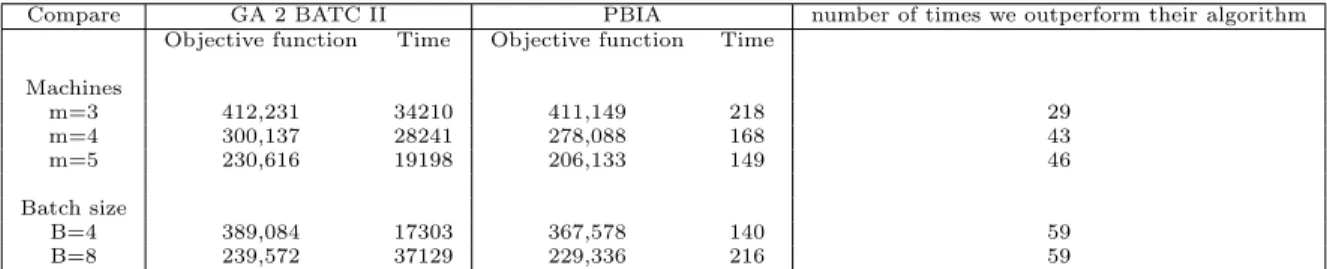
From Table 6, we notice that on average as well as for the case ofm= 3,m= 4 andm= 5, our heuris-tic (PBIA)is better in terms of objective function and computational times. In the considered arheuris-ticle, the
Compare GA 2 BATC II PBIA number of times we outperform their algorithm Objective function Time Objective function Time
Machines m=3 412,231 34210 411,149 218 29 m=4 300,137 28241 278,088 168 43 m=5 230,616 19198 206,133 149 46 Batch size B=4 389,084 17303 367,578 140 59 B=8 239,572 37129 229,336 216 59
Table 6: Comparison between our proposed algorithm and one of the best algorithm in M¨onch et al. [MBFP05]
authors in one of the phase of their algorithm used genetic procedure. In general, this requires relative long computation times. The proposed constructive heuristic requires low computing time in comparison to GA 2 BATC-II. On 162 tested instances, PBIA outperforms GA 2 BATC-II on 118 instances in less than 200 seconds. Furthermore, with batch size of 4, PBIA outperforms 59 times on 81 and on batch size of 8, we outperformed 59 times on 81.
We have used a heuristic which was not originally designed for the problem of minimization of TWT on parallel batch machines with incompatible job families and unequal ready times of jobs. The results of the tests showed that our heuristic outperformed in the majority of the cases the GA 2 BATC-II: we had better objective function values and less computation times.
7
Concluding remarks
We proposed a model and a method based on a disjunctive graph for batching and scheduling problem in a semiconductor manufacturing factory while taking into account complex constraints and optimizing multiple measures. A constructive algorithm has been proposed to solve the problem, local search im-provements based on the disjunctive graph representation have been defined and a simulated annealing algorithm has been developed. The computational tests made on real instances of the factory plant showed that we obtain quality solutions in fast calculation times. For the industry, very substantial productivity improvements have been achieved in the diffusion area and also on the overall fab thanks to the use of the proposed algorithm named Priority rule-Based constructive algorithm (PBIA).
With adjustments, the Priority-rule Based Insertion Algorithm (PBIA) has been embedded in a software used by the industry. The use of a disjunctive graph brings significant improvements for interactive scheduling at the fab level. A prototype software gives the graphical user interface of the software. It includes the off-line batching and scheduling phase and also an interactive module that allows the decision-makers to make modifications and to test options directly on the proposed plan.
Regarding, the simulated annealing algorithm, the procedures significantly improve the different cri-teria (number of moves, batching coefficient and X-factor) in comparison with a local search method. We also compared our algorithm to an algorithm designed for a problem of scheduling of jobs on parallel batch machines with incompatible job families and unequal ready times M¨onch et al. [MBFP05] as it is close to the one tackled in this article. The computational tests showed that for more than half of the instances our heuristic called Priority-rule Based Insertion (PBIA) outperforms the algorithm proposed by M¨onch et al. [MBFP05].
This research can be extended in many ways. Other types of moves such as the simultaneous move of two jobs linked by a maximum time lag should be tested. The maximal time lags are currently hard constraints. However in practice some of them can be relaxed and treated as soft constraints or objectives. Another important issue can be in a multicriteria analysis study. Computing several Pareto optimal solutions are useful particularly when the situation frequently changes as it is usually the case of semiconductor manufacturing.
Acknowledgments
This work was part of the MEDEA+ European project HYMNE (High Yield driven MaNufacturing Excellence in sub 65 nm CMOS), partly funded by the “Minist`ere de l’ ´Economie, de l’Industrie et de l’Emploi” (French Ministry of Economy, Industry and Employment).
References
[ABZ88] J. Adams, E. Balas, and D. Zawack. The shifting bottleneck procedure for job shop schedul-ing. Management Science, 34:391–401, 1988.
[BMFP04] H. Balasubramanian, L. M¨onch, J.W. Fowler, and M.E. Pfund. Genetic algorithm based scheduling of parallel batch machines with incompatible job families to minimize total weighted tardiness. International Journal of Production research, 48(8):1621–1638, 2004. [CPPZ02] R. Cigolini, M. Perona, A. Portioli, and T. Zambelli. A new dynamic look-ahead scheduling
procedure for batching machines. Journal of scheduling, 5(2):185–204, 2002.
[DU00] E. Demirkol and R. Uzsoy. Decomposition methods for reentrant flow shops with sequence dependent setup-times. Journal of Scheduling, 3:155–177, 2000.
[GNST04] K. Gentner, K. Neumann, C. Schwindt, and N. Trautmann. Batch production scheduling in the process industries. In J.Y.T. Leung, editor,Handbook of Scheduling: Algorithms, Models and Performance Analysis, pages 48.1–48.21. CRC Press, Boca Raton, 2004.
[GR88] C. Glassey and M. Resende. Closed-loop job release control for vlsi circuit manufacturing.
IEEE Transactions on Semiconductor manufacturing, 1(1):36–46, 1988.
[Hun98] Y.-F. Hung. Scheduling of mask shop e-beam writers. IEEE Transaction of Semiconductor Manufacturing, 11(1):165–172, 1998.
[ICN+03] K. Ibrahim, M. A. Chik, W.S. Nizam, N. L. Fem, and N.F. Za’bah. Efficient lot
batch-ing system for furnace operation. InIEEE/SEMI Advanced Semiconductor Manufacturing Conference, pages 322–324, 2003.
[KGV83] S. Kirkpatrick, C. Gelatt, and M. Vecchi. Optimization by simulated annealing. Science, tome 220(4598):671–680, 1983.
[KJC10] Y.-D. Kim, B.-J. Joo, and S.-Y. Choi. Scheduling wafer lots on diffusion machines in a semi-conductor wafer fabrication facility. IEEE Transactions on Semiconductor Manufacturing, 23(2):246–254, 2010.
[Kum94] P.R. Kumar. Scheduling semiconductor manufacturing plants. IEEE Control Systems Mag-azine, 14(6):30–40, 1994.
[Lit61] J. Little. A proof for the queuing formula l=λw. Operations Research, 16:651–665, 1961. [MBFP05] L. M¨onch, H. Balasubramanian, J.W. Fowler, and M.E. Pfund. Heuristic scheduling of
jobs on parallel batch machines with incompatible job families and unequal ready times.
Computers & Operations Research, 32:2731–2750, 2005.
[MFC02] S.J. Mason, J.W. Fowler, and W.M. Carlyle. A modified shifting bottleneck heuristic for minimizing total weighted tardiness in complex job shops. Journal of Scheduling, 5(3):247– 262, 2002.
[MFDP+09] L. M¨onch, J.W. Fowler, S. Dauz`ere-P´er`es, S. Mason, and O. Rose. Scheduling semiconductor manufacturing operations: Problems, solution techniques, and future challenges. In 4th Multidisciplinary International Conference on Scheduling: Theory & Applications, Dublin, Ireland, 2009.
[MH03] L. M¨onch and I. Habenicht. Simulation-based assessment of batching heuristics in semi-conductor manufacturing. In S. Chick, P.J. Sanchez, D. Ferrin, and D. J. Morrice, editors,
Winter Simulation Conference, pages 1338–1345. ACM, 2003.
[MO03] S.J. Mason and K. Oey. Scheduling complex job shops using disjunctive graphs: a cycle elimination procedure. International Journal of Production Research, 5(41):981–994, 2003. [MS06a] M. Mathirajan and A. I. Sivakumar. A literature review, classification and simple meta-analysis on scheduling of batch processors in semiconductor manufacturing. International Journal of Advanced Manufacturing Technology, 29:990–1001, 2006.
[MS06b] M. Mathirajan and A. I. Sivakumar. Minimizing total weighted tardiness on heterogeneous batch processing machines with incompatible job families.International Journal of Advanced Manufacturing Technology, 28:1038–1047, 2006.
[MT05] J. Montoya-Torres. Manufacturing performance evaluation in wafer semiconductor factories.
International Journal of Productivity and Performance management, 55(3/4):300–310, 2005. [MU98] S. Mehta and R. Uzsoy. Minimizing total tardiness on a batch processing machine with
incompatible job families. IIE Transactions, 30:165–178, 1998.
[OFKK09] A. Oulamara, G. Finke, and A. Kamgain Kuiten. Flowshop scheduling problem with batch-ing machine and task compatibilities. Computers and Operations Research, 36(2):391–401, 2009.
[OM01] K. Oey and S. Mason. Scheduling batch processing machines in complex job shops. In Pro-ceedings of the Winter Simulation Conference, pages 1200–1207, Arlington, USA, December 2001.
[OU97] I. Ovacik and R. Uzsoy. Decomposition methods for complex factory scheduling problems. Kluwer Academic Publishers, 1997.
[PBF+08] M.E. Pfund, H. Balasubramanian, J.W. Fowler, S.J. Mason, and O. Rose. A multi-criteria
approach for scheduling semiconductor wafer fabrication facilities. Journal of Scheduling, 11(1):29–47, 2008.
[PFC05] I.C. Perez, J.W. Fowler, and W.M. Carlyle. Minimizing total weighted tardiness on a single batch process machine with incompatible job families. Computers and Operations Research, 32(2):327–341, 2005.
[SK03] C.S. Sung and Y.H. Kim. Minimizing due date related performance measures on two-batch processing machines. European Journal of Operational Research, 147:644–656, 2003. [SM01] C.S. Sung and J. Min. Scheduling in a two-machine flowshop with batch processing machines
for earliness/tardiness measure under a common due date. European Journal of Operational Research, 131:95–106, 2001.
[Su03] L-H. Su. A hybrid two-stage flow shop with limited waiting time constraints. Computers and Industrial Engineering, 44:409–424, 2003.
[Sze01] S.M. Sze. Semiconductor devices: Physics and technology. John Wiley & Sons, Second Edition, 2001.
[UW00] R. Uzsoy and C.-S. Wang. Performance of decomposition procedures for job-shop scheduling problems with bottleneck machines.International Journal of Production Research, 38:1271– 1286, 2000.
[Uzs95] R. Uzsoy. Scheduling batch processing machines with incompatible job families. Interna-tional Journal of Production research, 33:2685–2708, 1995.
[VS06] A. Varadarajan and S.C. Sarin. A survey of dispatching rules for operational control in wafer fabrication. In A. Dolgui, G. Morel, and C. E. Pereira, editors,12th IFAC Symposium on Information Control Problems in Manufacturing, pages 715–726, 2006.
[Wei88] L.M. Wein. Scheduling semiconductor wafer fabrication. IEEE Transactions on Semicon-ductor Manufacturing, 1(3):115–130, 1988.

![Table 5: Parameter settings GA for approach 2 M¨ onch et al. [MBFP05]](https://thumb-us.123doks.com/thumbv2/123dok_us/1177162.2657939/16.918.351.571.718.838/table-parameter-settings-ga-for-approach-onch-mbfp.webp)