Research and Application of Management Software for Examination
Database
WANG Weihong, CUI Yiling
College of Software, Zhejiang University of Technology, Hangzhou, P.R.China,310032
Abstract: Based on the development of standard examination database management software(EDMS), we propose a generic model for EDMS by analyzing the process of practical examination, highlight existing problems and solutions in EDMS, especially in question management, paper organization and paper marking process. Then taking discrete mathematics exam as an example, we design and implement a Discrete Mathematics Examination Database management system, which has been successfully applied in practice.
Keywords: examination database management software, paper organization, paper marking, discrete mathematics
1. Introduction
According to available literature, to meet the needs of some enterprises and higher education systems, existing similar domestic systems have basically fulfilled the functions of question management, paper organization, online-examination, paper marking and score release. However, we can also see that there are some problems in management software when dealing with concrete steps in basic processes. For example, during question setting, most systems only set subjective question. In paper organization, although they use a variety of ways such as automatic and manual paper organization, which are flexible, there are still some restrictions on the paper factors of difficulties and distinction. In paper marking, as they generally only set objective question, they use on-line paper marking, which can give the score to the examinee immediately thus saving time and manpower. Despite all these available functions in existing systems, we should realize that in practical examinations, especially those in university, the examination must include both subjective and objective questions, so we must find a more flexible method that is able to mark the paper with automatic and manual interaction.
2. Research on Management Software for Examination Database
2.1 The necessity of this research
The development and wide application of network technology make people's lives and work more convenient, online teaching is one of its beneficiaries. It enables students exempted from time and space constraints to do various kinds of teaching and learning activities through the networks.
Examination database management system is an important part of on-line teaching. In traditional examination the teachers usually organize the examination paper beforehand. On one hand, it increases the workload of the teachers; on the other hand, it isn’t conducive to the centralized management of the papers and the control of the difficulty Levels, the ratio of questions and so on. For the examinee, they must be gathered and monitored by the teacher to prevent cheating. Faced with this situation, it is very important for us to establish the rich and standard examination database, and then automatically manage it. As the computer organizes paper automatically, marks paper automatically or semi-automatically, the system implements the standardization and automation for the examination, which will improve the teaching efficiency.
2.2 problem and solution for the examination database management software design
This paper mainly uses question-raising and problem-solving method to study and explore the system solution.
2.2.1 The problem and solution for the question input
In real examination, such as mathematics exam, it will inevitably include some formulas, Fig and so on, examinees may also need to do some special operations, such as drawing, formula writing, which we can not use ordinary text to achieve.
To solve this problem, we can use two methods:
⑴ Embed an existing editor
There are many popular and practical editors on the web. Web editors, which are similar to word editor, can be embedded in the language of HTML. By embedding the editor, at the time of writing, we can paste from the word document or use its own formula editor, special symbols and drawing tools to achieve some special entries, at the same time, the examinees can also use this editor to complete their operations.
⑵ Embed a user-defined editor
If in some examinations there are some special symbols or formulas, which aren’t available in existing editor that can be embedded, or user request is relatively simple and there is no need to use so many functions, the user can write an editor to meet the special request. By embedding such a relatively small but fully functional editor, we can meet special requirements of question input and examinee answer.
2.2.2 The problem and solution for paper organization
Computer Aided Organized Paper system is a kind of Design Expert System. According to the parameters, such as the type of questions, difficulty factors, distinction between degrees, the scale of the knowledge, the time to complete the question and so on, computers randomly select questions from the examination database and then organize the examination paper, which is a typical multi-binding goal of solving the problem.
In our system, we have two more important paper organized factors: the difficulty factor and distinction between degrees.
⑴ Difficulty factor of the question
When questions firstly inputted, the difficulty factor of the question does not really reflect the real situation, so we adopt the method of a combination of the original and dynamic factor, then according to statistical data computers automatically calculate the difficulty factor of the question.
In general examination paper includes subjective and objective questions, the difficulty factor calculation method in accordance with this standard can also be divided into two categories:
① The difficulty factor calculation method of objective questions: K
1
R
d
N
= −
R represents the number of people who give the right answer of this question. N represents the number of people who answer this question.② The difficulty factor calculation method of subjective questions: Z
1
S
d
S
= −
S
represents the average score of this question. S represents the full score of this question.The difficulty of questions affects the difficulty of the whole paper. In general we set the difficulty factor of the papers to 0.5, while the difficulty factor of questions is between 0.3 and 0.7.
⑵Distinction between degrees of the questions
Like the calculation of the difficulty factor, the calculation of the distinction between degrees also can be divided into two categories:
① The distinction between degrees calculation method of the objective questions:
H L K H L
R
R
P
N
N
=
−
HR
represents the number of the examinee in high score group who give the right answer. HL
R
represents the number of the examinee in low score group who give the right answer. LN
represents the total number of the examinee in low score group.② The distinction between degrees calculation method of the subjective questions:
(
)
HN LN Z H LS
S
P
N S
S
−
=
−
HNS
represents the total score of the high score group in this question. LNS
represents the total score of the low score group in this question. HS
represents the highest score of this question. LS
represents the lowest score of the question.N represents the total number of the examine.
Generally the examination paper’s distinction between degrees is above 0.3. If it is less than 0.3, there are something wrong with it and if it is less than 0, then there are serious problems and we should consider deleting the examination paper.
After examination, we can calculate the difficulty factor and distinction, the difficulty factor can help us to balance the difficulty of the papers, in general we take questions, whose difficulty factor are between 0.3 and 0.7, to compose the examination paper; The distinction is one of the important evaluations of the goodness of the examination paper, if the distinction is lower than 0.3, we may consider deleting or re-input the item, thus the distinction of the paper could be in an appropriate value. When we input the distinction of the paper, system will select appropriate questions, whose distinction is 0.2 larger or smaller than it. By adjusting the two parameters, the paper organization can meet the requirements of the practical examination.
2.2.3 The problem and solution for paper marking
In actual examination it inevitably includes objective and subjective questions. In the objective item the system is easy to achieve automatic paper marking, but because of the flexibility of the subjective part, the automatic paper marking is inadequate. Now there are some algorithms, which aiming at the subjective item, but they are still lack of accuracy in some special problems, so we can take a method that is a combination of manual and automatic, to increase the speed of paper marking without losing accuracy.
3. Application on Management Software for the Discrete Mathematics
Examination database
3.1 design of the system
3.1.1 Design of the functions
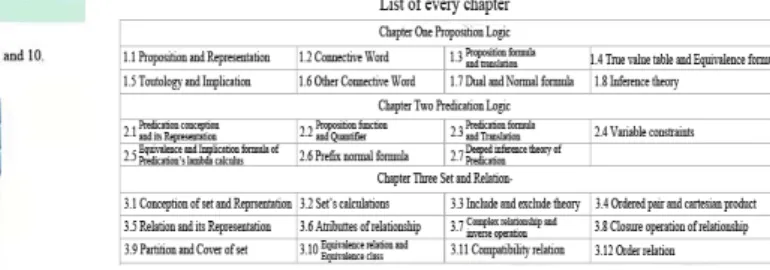
According to the needs of the examination and the special requirements of discrete mathematics course, the management system for examination database should have three main functions:
⑴ Management of questions and papers
Teachers could add, modify and delete the questions through the background control system. Before examination, teachers could set the information of the examination, such as the kind, count and difficulty of questions, distinction between degrees and the length of the examination, so the system can generate the papers based on the paper organization parameters.
⑵ Examination and practice functions
Students have normal exams, make-up exams and practice on different date. The system has countdown timer in the process of examination. Students can submit papers by themselves or wait until the time up. The system will save the answers and basic information of students into database. Practice is done according to the chapters. System selects questions randomly.
⑶ Marking papers and publishing results functions
papers. System would mark the objective items automatically. Teachers mark these questions, and give comments about the answer. In the end, the system could calculate the marks of each student and store them into the database.
3.1.2 The design of system database
According to the requirements of the system, the database is composed of four tables.
⑴ Questions information table: includes choice questions, judgment questions, blank-fill questions, proof questions and answer questions information table. It stores the information of questions, such as question number, type, chapter, section, the selected questions, standard answer, difficulty and distinction between degrees, as shows in table 1.
Table 1 table of proof questions information
Field Chapter Section Question Answer DBD Dif
Description Chapter section question Standard answer
distinction between degrees
difficulty
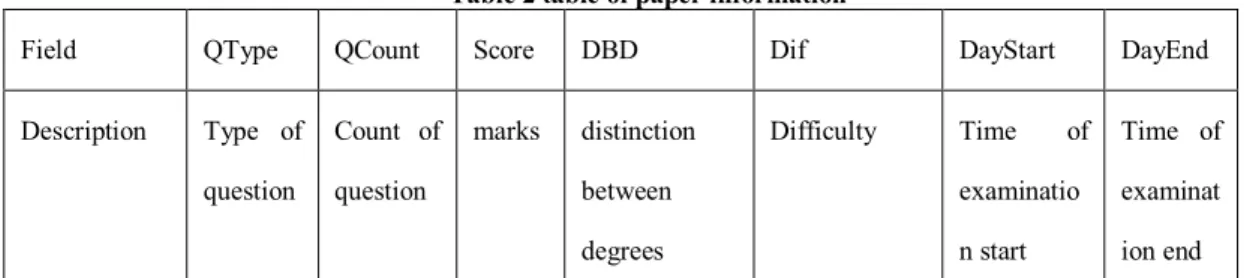
⑵ Paper information table: include the basic information of papers, such as how many kinds of questions, the count of each kind, the mark of every question, the difficulty of paper, the distinction between degrees and so on., as the table 2 shows.
Table 2 table of paper information
Field QType QCount Score DBD Dif DayStart DayEnd
Description Type of question Count of question marks distinction between degrees Difficulty Time of examinatio n start Time of examinat ion end
⑶ Student’s paper information table: it stores the questions and answer of every student. After teachers mark the question, the system stores it and calculates the score. And the system could calculate the difficulty and distinction between degrees of each question and paper, to improve the quality of paper, as shows in table 3.
Table 3 table of students’’’’ paper information
Field StuNum ExamID Qtype QID Qscore Answer Score
description Student number Paper number Type of question Number of question Marks of every question answer The whole marks
3.2 implementation of the system
3.2.1 Examination and practice pageWhen a student starts the examination, the countdown timer is started, as Fig 1shows.
normal text and keyboard, so we embedded an editor like Word, that makes examinee enter symbols and graphs easily.
Students could have online practice at any time. After selecting a chapter, the system will list the question to students, as it is shown in Fig 2.
Fig 1 the examine page Fig 2 the practice page 3.2.2 The design of background management page
⑴ Paper management page
Teacher could set the basic information of examination paper in this page, as the Fig 3shows.
Fig 3 page management page
⑵ Paper marking page
To inquiry the paper that is not marked, teachers should get into the paper marking page, mark the subjective items of each paper, and give the comments. The system will mark objective items automatically. After each question of a paper has been marked, system will add up the marks together, and save them to the database for inquiry from students. If necessary, teachers could correct the paper in the page again.
4. Conclusion
Based on the analysis of the entire step’s major problem in actual examination, the partition of the examination database management system’s function modules, we proposed a genetic model of the examination database management system by using the method of problem raising and problem solving, and applied this model in a discrete mathematics examination database management system. Future work includes continuous maintaining and updating of the system, in which other function such as heuristic item selection algorithm will be added.
References
[1] Xu Yufeng. ASP+SQL Server Typical Web Site Construction Cases. Beijing: Qing Hua Univercity Press,2006
[2] Wan Jiannan. The Elaborate Explain for the ASP Database Management Project. Beijing: Aviation Industry Press,2006
[3] Wang Xueyou, Smart Examination Paper Organization Algorithm Research and System Realization for Simulation Electron Technology Examination database. Electrical and Electronic Journal of Teaching,2004: 85~89
Acknowledgments
This research was supported by the National High Technology Research and Development Program of China(863 Program, 2006AA10Z235).