Spatial Interfaces
Editors: Bernd Froehlich and Mark LivingstonBeaming: An Asymmetric Telepresence System
Anthony Steed, William Steptoe, Wole Oyekoya, Fabrizio Pece, Tim Weyrich, and Jan Kautz University College LondonDoron Friedman
Interdisciplinary Center Herzliya Angelika Peer
Technische Universität München
Massimiliano Solazzi, Franco Tecchia, and Massimo Bergamasco Scuola Superiore Sant’Anna
Mel Slater
ICREA University of Barcelona
M
ost collaboration tools such as video-conferencing and collaborative virtual environments (CVEs) provide symmet-ric access to the shared medium. For example, in videoconferencing, each person usually sees a view of the other participants and their surroundings. Although these systems can be configured simi-larly to face-to-face meetings, they lack some of those meetings’ immediacy. Researchers (includ-ing some of us) have argued that this is due partly to the systems’ technical limitations, including the lack of representation of the full 3D space of the conversation.One alternative that supports full 3D space is collaborative VR in which each user is surrounded by and immersed within the display systems.1 However, technologies tend to be laboratory based and relatively uncommon. So, participants nor-mally can’t access these systems without leaving their usual work or living spaces.
The Beaming project (Being in Augmented Mul-timodal Naturally Networked Gatherings; www. beaming-eu.org) has tackled technological and access issues head on. We’ve abandoned the sym-metry of access to the collaboration technology and the notion of a novel virtual environment in which collaboration happens. Instead, we focus on recreating, virtually, a real environment and hav-ing remote participants visit that virtual model. The display systems can be in any reasonable space such
as an office or meeting room, domestic environ-ment, or social space.
An Overview
Figure 1 gives an overview of the Beaming sys-tem. The destination is a real space populated with people we call locals. The transporter is a high-end VR system equipped with 3D surround visuals, 3D surround audio, tactile and haptic systems, and biosensing. The visitor is the transporter’s user. The system aims to capture the destination and display it to the visitor and simultaneously capture the visitor and display him or her to the locals.
One goal of Beaming is that the destination shouldn’t be a laboratory space with carefully cali-brated equipment. Any technical intervention must be portable or mobile, self-calibrating, and dynami-cally configurable. It should also be as unobtrusive as possible so that it doesn’t interfere with the locals’ behavior. Figure 2 represents potential in-terventions, which include mobile robots, situated displays, wall or environment projections, aug-mented reality, camera capture, and audio capture.
User Experience Goals
Amy Voida and her colleagues noted that through-out more than 20 years of media space research, a recurrent theme has been the pursuit of sym-metry, which has both social and technological components.2 Social symmetry is desirable so that
no participant is disadvantaged in his or her abil-ity to interact with or influence other participants. Technologies such as videoconferencing and CVEs generally feature technological symmetry to en-sure that the same sensory cues are available to all parties. Both these technologies have limita-tions. Videoconferencing poorly supports eye gaze between participants3 and spatial references be-tween users and objects in their environment.1,4 CVEs typically involve a restricted interface so that users see the virtual world as if through a window.
Steve Benford and his colleagues suggested that the interest in spatial approaches to computer-supported cooperative work might be viewed as a shift of focus toward supporting the context in which distributed work takes place, rather than the process of the work itself.5 The destination-visitor paradigm in Beaming is fundamentally technologically asymmetric but aims to support symmetric social interaction between the visitor and locals. That social interaction should be able to exploit the objects at the destination because this is a key component of the context in which the interaction takes place.
The long-term goal for Beaming-like systems is to provide collaborative mixed-reality environ-ments that grant symmetrical social affordances and sensory cues to all connected users whether they’re locals or visitors. Put another way, al-though the mediating technologies are highly asymmetric between the destination and trans-porter sites, visitors’ behavior shouldn’t be hin-dered because of their remote location. Also, they should be represented to the locals with a virtual or physical embodiment. Using terminology from the virtual-environments field, we might say that we strive to give a sense of spatial presence within
the destination for visitors and a sense of copres-ence among both locals and visitors.
Consequently, we claim that the visual display at the visitor site must be an immersive display such as a head-mounted display (HMD) or a dis-play similar to a CAVE (cave automatic virtual environment). This is because, to strive for social symmetry, the system must provide similar sen-sory experiences, particularly the dominant visual mode, to all parties. Locals need no visual media-tion to perceive the destinamedia-tion as being realistic and spatial because they perceive the actual physi-cal location. However, stimuli representing the destination must be transmitted in real time to
Transporter Destination
Figure 1. The Beaming system recreates a real environment (the destination) populated with people (locals). A remote participant (the visitor) visits that virtual model via the transporter. The arrow labels indicate the four major technical challenges.
\ \\\\ Augmented-reality displays Wide-angle projectors Mobile platform Surround cameras and microphones Displays
Figure 2. Types of technical intervention at the destination. The user experience goals, which arise from access issues, constrain the space of potential interventions.
Spatial Interfaces
the visitor site. Moreover, the technological dis-play properties used by the visitor must foster the impression of being physically at the destination. To this end, Ralph Schroeder considered immersive technology as an end state in that synthetic and multiuser environments that are displayed to the senses can’t be developed further than fully sur-rounding and spatial immersive systems.6 We ex-pect that immersive presentation will increase the social symmetry in an asymmetric, heterogeneous system architecture.
A Beaming Example
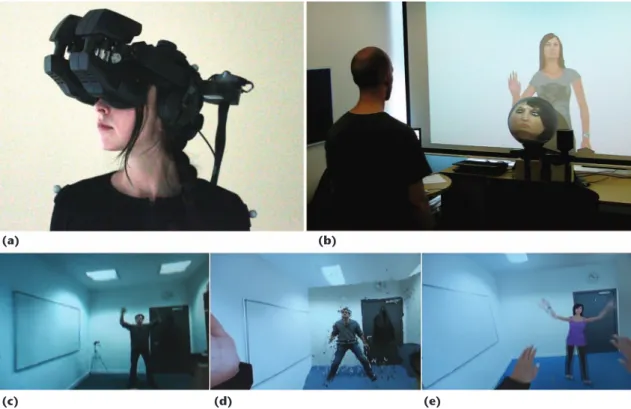
One test case for the Beaming concept has been remote rehearsal between two actors and a direc-tor.7 Figure 3 shows the capture and display de-vices used to connect the actors. In this example, the visitor was an actor using an HMD and wear-ing a motion capture suit so that her movements were accurately tracked (see Figure 3a). The single local was also an actor in an office environment. In that office, a SphereAvatar display showed the visitor’s head and viewing direction, and a large projection screen showed her body movements (see Figure 3b). The local could choose between the two representations.
At this time, we hadn’t used any augmented-reality or robotic representations. We captured the local with Microsoft Kinect and a surround cam-era, a Point Grey Research Ladybug 3. We had con-structed the office offline via photogrammetry. So, the visitor could see one of three visualizations: a surround image (see Figure 3c), a 3D model with an inserted depth video of the local (see Figure 3d), and the 3D model with an animated avatar of the local (see Figure 3e). The two actors wore wireless microphones and talked to each other us-ing Skype.
A theatrical rehearsal aims to practice and re-fine the performance of a scene. We chose a scene consisting of rich conversation, spatial action and interaction, direction of attention, and ob-ject handling, which are all common practice in general social interaction and collaborative work. So, through repeated and evolving run-throughs of the scene with professional actors and directors, this structured activity formed an excellent basis for analytic knowledge regarding the system’s suc-cesses and failures.
The rehearsals explored the central aspects of spatiality and embodiment. Overall, the common spatial frame of reference (the destination) was
(a) (b)
(c) (d) (e)
Figure 3. The Beaming acting scenario. (a) The visitor actor wears a head-mounted display and a motion-tracking suit. (b) The local actor is at the destination, seeing visualizations of the visitor actor on a SphereAvatar display and a wall projection. A Kinect camera tracks the local actor, and a surround camera is below and to the right of the SphereAvatar. The visitor actor can see three visualizations of the local actor: (c) the image from the surround camera, (d) the reconstructed point cloud from the Kinect depth map inserted in a static 3D model of the destination, and (e) an avatar of the local from the Kinect skeleton tracking inserted in the static 3D model.
performing and reacting to facial expressions and subtle gestures were less successful. We expect SphereAvatar to be more useful when it can dy-namically present the visitor’s facial expressions.
The Beaming Technical View
The user experience goals set many technical chal-lenges. In the Beaming project, we’re investigating many of these in a range of modalities including visual, audio, and haptic scanning, representation, and display, and emotion recognition and display. We eventually want to reconstruct the whole des-tination in real time. However, in early demon-strations we’re using a variety of prebuilt models of spaces and objects (visual, audio, and haptic), either directly for rendering or to act as a source for trackers. Here, we give examples of technical demonstrators we built and how we’re integrating them to achieve the project’s long-term goal.
Robot Representation
Beaming uses two forms of robots.
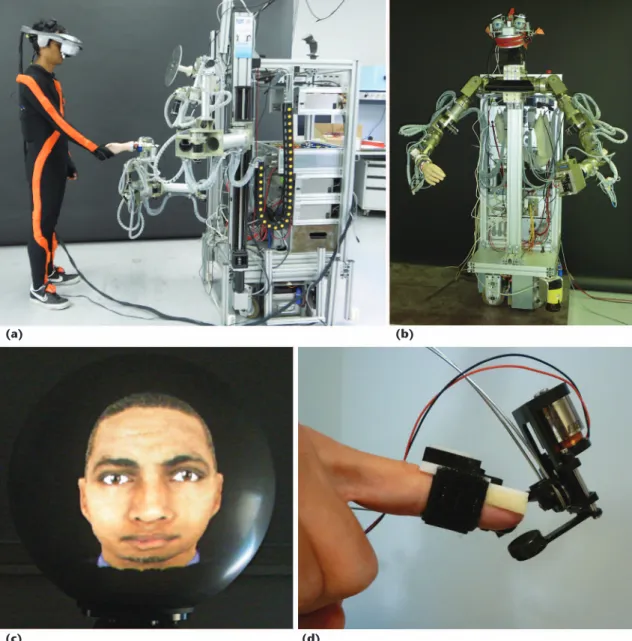
Encountered-type haptic devices. Interaction with encountered-type haptic devices (see Figure 4a) lets the visitor perceive interaction with the ob-jects at the destination or with locals. Such hap-tic devices approach the visitor only when contact needs to be rendered, thus guaranteeing perfect rendering of free space.
Different end effectors, including a prosthetic hand and a universal object that can morph its shape, dis-play a series of human-human and human-object interactions. For example, in Figure 4a, the robot is presenting a hand to mimic a local’s actions. In this situation, the visitor is seeing a representation of the local and the destination through the HMD. The visitor can see the local’s movement, which the robot matches.
In this situation, the challenge is to haptically reconstruct the destination in real time and
re-Mobile robot avatars. This avatar represents the visi-tor at the destination (see Figure 4b). Unlike the encountered-type haptic device, which the visitor and locals don’t see, the robot avatar is broadly anthropomorphic, with two robotic arms and hands and an emotion-expressing head. The visi-tor’s arm and hand movements are tracked by the motion capture suit and mapped to the robot’s movements. A camera looks underneath the HMD to capture facial expressions; the system analyzes them to recognize emotional states, which the emotion-expressing head then conveys.
Key aspects of the robot avatar’s development are the remote streaming of the visitor’s move-ment and real-time remapping of the visitor’s movements to the robot’s degrees of freedom. This shares some similarities with previous telepres-ence research, such as the telexisttelepres-ence systems.8 However, Beaming emphasizes reconstruction of a 3D model of the destination for the visitor to interact with, so as to allay some issues of la-tency and dynamics of movement. Unlike previ-ous research on remote haptic interaction,9 our two haptic devices aren’t directly slaved together. They’re better described as loosely coupled; the encountered-type haptic device mimics the desti-nation, and the robot avatar mimics the visitor’s movements.
A Situated Display to Represent the Visitor
An emerging form of telecollaboration is situated displays at a physical destination that virtually represent remote visitors. SphereAvatar (see Figure 4c) is a situated display that’s visible from all sides so that locals can determine the visitor’s iden-tity from any viewpoint. Flat displays are visible from only the front and lack spherical displays’ 360-degree and multiview capabilities. Exploiting spherical displays’ unique characteristics might
Spatial Interfaces
bestow greater social presence on the participant represented on the sphere. SphereAvatar is small enough to situate almost anywhere in a room; for example, it could be on a seat next to a table or on a mobile platform. It can show either video cap-tured from camera arrays around the visitor or a photorealistic computer-generated head.
Depth Camera Streaming from the Destination
Cameras that can acquire a continuous stream of depth images are commonly available—for in-stance, Microsoft Kinect. They’re particularly use-ful for Beaming because they let us easily capture the destination’s geometric and texture informa-tion (for example, see Figure 3d). Streaming the raw data consumes significant bandwidth, socom-pressed streaming is desirable. Although much re-search exists on compressed streaming of (8-bit color) videos, little research exists on streaming (16-bit) depth videos. In particular, no codecs for depth compression are publicly available.
We adapted existing video encoders for depth streaming for two reasons.10 First, they’re widely available. Second, using the same video codec to transfer both color and depth frames enhances consistency and simplifies the streaming architec-ture. We use a robust encoding of 16-bit depth values into 3 × 8 bits. This is essentially a variant of differential phase shift encoding, such that the depth maps suffer from few compression artifacts. Using this encoding, we can stream depth maps over standard VP8 and H.264 codecs. This
fur-(a) (b)
(c) (d)
Figure 4. Beaming technologies in development. (a) A visitor interacting with an encountered-type haptic device that mimics the form of the destination and the locals’ interactions. (b) A robot avatar that mimics the visitor’s movements and emotions. (c) A representation of the visitor on SphereAvatar. (d) A portable system for the visitor to get localized haptic feedback from the destination.
resentation are readily interpreted as changes to the body. The most famous example of this is Mat-thew Botvinik and Jonathan Cohen’s rubber-hand illusion.11 Tapping on a rubber hand on a table in front of a participant while tapping on the partici-pant’s corresponding obscured real hand led to the illusion that the rubber hand felt as if it were the participant’s real hand. Researchers have applied this technique at the whole-body level using video streaming through HMDs to generate out-of-the-body-type illusions and whole-body transforma-tion illusions.
A body transformation illusion can also work strongly in VR. In one example, researchers gave men the illusion that their body was that of a small girl.12 This research also showed that see-ing the virtual body from the first-person per-spective contributed critically to the experience of ownership.
An important goal of Beaming is to give visitors the strong sensation of ownership regarding their body representation at the destination. Because visitors see their body representation naturally from the first-person perspective, a degree of such ownership will likely occur. In addition, the haptic and visual feedback together provides multisensory feedback that enhances the ownership illusion. In applications in which it’s desirable to transform the visitor’s representation (for example, in acting rehearsals), such transformations have also been shown to preserve body ownership.
A Visitor Proxy
We can envisage a future in which some sort of auto-mated proxy partly fulfills people’s communication needs. In Beaming, we’ve implemented a communi-cation proxy that can not only represent visitors for a short period of time (for example, a phone inter-ruption) but also replace them in a whole meeting or presentation. (For instance, see the video at youtu. be/43l739kKFfk.)
The proxy’s implementation presents several chal-lenges. The software must observe both the visitor and the real environment (that is, sensors at the destination). Beaming’s software architecture sup-ports this through a loosely coupled heterogeneous platform in which sensors, actuators, and displays collaborate through a shared data service. The proxy then needs traditional AI components such as gesture recognition and speech interpretation.
The proxy can also operate in a mixed mode. For example, while representing its owner in a meet-ing, if it’s asked a question it doesn’t understand, it can open a voice connection to the owner and re-lay the question. The owner can answer the ques-tion, taking over the representation for a short while before returning control to the proxy.
Extending Haptic Feedback for the Visitor
We’re investigating finger-mounted portable de-vices that can display the transition between con-tact and nonconcon-tact of the fingers (see Figure 4d). Such devices have three potential advantages: un-like with desk-mounted devices, their range of op-eration has no intrinsic limits; they’re not likely to interfere with the user; and constructing systems with multiple contacts for the fingers is easier.
B
y acknowledging the varied ways in which much collaborative work and socializing oc-cur, Beaming’s destination-visitor paradigm could provide an integrated approach to high-quality telecommunication. The paradigm presents inter-esting technical challenges: high-fidelity real-time reconstruction of the destination and locals invisitors the strong sensation of ownership
regarding their body representation at the
destination.
Spatial Interfaces
multiple modalities and presentation of the visi-tor in multiple modalities to the locals. Our ex-perience from early example applications and integrations is that participants can understand the situation and exploit the 3D spatial nature of the communication in both directions. This has been true for both the acting application we dis-cussed and a medical application that naturally exploits Beaming’s asymmetry.13
Clearly, the Beaming project and concept raise serious ethical and legal issues. For example, ■ someone could misuse transformation or the
proxy to mislead locals,
■ someone in one country could use a robotic em-bodiment to commit a crime in another coun-try, or
■ a body transformation experience could cause psychological problems.
Widespread implementation of this concept would entail profound changes in law and societal rela-tionships. The Beaming project takes these issues seriously, dedicating an entire strand of research to them.
Recent advances in camera technology, particu-larly depth cameras, have made some aspects of the system more easily deployable. We expect sig-nificant advances in the ability to visually recon-struct populated spaces in real time in the near future, and we’ll exploit these advances to build multimodal representations of the destination. Our next-generation systems will also combine robots with novel types of display to afford more effective representations of the visitor.
Acknowledgments
The European Commission supports Beaming under the FP7 Information and Communication Technolo-gies Work Programme. Investigators in the project in-clude Martin Buss (Technische Universität München), Antonio Frisoli (Scuola Superiore Sant’Anna), Maria Sanchez-Vives (August Pi i Sunyer Biomedical Research Institute), Miriam Reiner (the Technion), Giulio Ruffini (Starlab Barcelona), Matthias Harders and Gábor Székely (Swiss Federal Institute of Technology Zurich), Benjamin Cohen (IBM Haifa Research Lab), and Dorte Hammershøi (Aalborg Universitet). We also thank the associated research fellows and students.
References
1. D. Roberts et al., “Communicating Eye-Gaze across a Distance: Comparing an Eye-Gaze Enabled Immersive
Collaborative Virtual Environment, Aligned Video Conferencing, and Being Together,” Proc. 2009 IEEE
Conf. Virtual Reality, IEEE CS, 2009, pp. 135–142.
2. A. Voida et al., “Asymmetry in Media Spaces,” Proc. 2008 ACM Conf. Computer Supported Cooperative
Work (CSCW 08), ACM, 2008, pp. 313–322.
3. M. Chen, “Leveraging the Asymmetric Sensitivity of Eye Contact for Videoconference,” Proc. 2002 SIGCHI Conf. Human Factors in Computing Systems
(CHI 02), ACM, 2002, pp. 49–56.
4. R. Wolff et al., “A Review of Tele-collaboration Technologies with Respect to Closely Coupled Collaboration,” Int’l J. Computer Applications in
Technology, vol. 29, no. 1, 2007, pp. 11–26.
5. S. Benford et al., “Shared Spaces: Transportation, Artificiality, and Spatiality,” Proc. 1996 ACM Conf.
Computer Supported Cooperative Work (CSCW 96),
ACM, 2006, pp. 77–86.
6. R. Schroeder, “Being There Together and the Future of Connected Presence,” Presence: Teleoperators and
Virtual Environments, vol. 15, no. 4, 2006, pp.
438–454.
7. W. Steptoe et al., “Acting Rehearsal in Collaborative Multimodal Mixed Reality Environments,” to be published in Presence: Teleoperators and Virtual
Environments.
8. S. Tachi, Telexistence, World Scientific, 2009.
9. J. Kim et al., “Transatlantic Touch: A Study of Haptic Collaboration over Long Distance,” Presence:
Teleoperators and Virtual Environments, vol. 13, no. 3,
2004, pp. 328–337.
10. F. Pece, J. Kautz, and T. Weyrich, “Adapting Standard Video Codecs for Depth Streaming,” Proc. Joint
Virtual Reality Conf. EuroVR (JVRC), Eurographics
Assoc., 2011, pp. 1–8.
11. M. Botvinick and J. Cohen, “Rubber Hands ‘Feel’ Touch That Eyes See,” Nature, vol. 391, no. 6669, p. 756. 12. M. Slater et al., “First Person Experience of Body
Transfer in Virtual Reality,” PLoS ONE, vol. 5, no. 5, 2010, e10564; www.plosone.org/article/ info%3Adoi%2F10.1371%2Fjournal.pone.0010564. 13. D. Perez-Marcos et al., “A Fully Immersive Set-up for
Remote Interaction and Neurorehabilitation Based on Virtual Body Ownership,” Frontiers in Neurology, vol. 3, no. 110, 2012.
Anthony Steed is the head of the Virtual Environments and Computer Graphics group in the Department of Com-puter Science at University College London. Contact him at [email protected].
William Steptoe is a postdoctoral research fellow in the Virtual Environments and Computer Graphics group in the Department of Computer Science at University College Lon-don. Contact him at [email protected].
Jan Kautz is a professor of visual computing in the De-partment of Computer Science at University College London. Contact him at [email protected].
Doron Friedman heads the Advanced Virtuality Lab at Inter-disciplinary Center Herzliya. Contact him at [email protected].
Angelika Peer is a senior researcher and lecturer at the Institute of Automatic Control Engineering and Carl von Linde Junior Fellow at the Institute for Advanced Study of Technische Universität München. Contact her at angelika. [email protected].
lona and a professor of virtual environments at University College London. He’s the Beaming technical manager. Con-tact him at [email protected].
Contact department editors Bernd Froehlich at bernd. [email protected] and Mark Livingston at mark. [email protected].
Selected CS articles and columns are also available for free at http://ComputingNow.computer.org.
PURPOSE: The IEEE Computer Society is the world’s largest association of computing professionals and is the leading provider of technical information in the field.
MEMBERSHIP: Members receive the monthly magazine Computer, discounts, and opportunities to serve (all activities are led by volunteer members). Membership is open to all IEEE members, affiliate society members, and others interested in the computer field.
COMPUTER SOCIETY WEBSITE: www.computer.org
Next Board Meeting: 5–6 Nov., New Brunswick, NJ, USA
EXECUTIVE COMMITTEE President: John W. Walz*
President-Elect: David Alan Grier;* Past President: Sorel Reisman;* VP, Standards Activities: Charlene (Chuck) Walrad;† Secretary: Andre Ivanov
(2nd VP);* VP, Educational Activities: Elizabeth L. Burd;* VP, Member & Geographic Activities: Sattupathuv Sankaran;† VP, Publications: Tom M.
Conte (1st VP);* VP, Professional Activities: Paul K. Joannou;* VP, Technical & Conference Activities: Paul R. Croll;† Treasurer: James W. Moore, CSDP;*
2011–2012 IEEE Division VIII Director: Susan K. (Kathy) Land,CSDP;† 2012–
2013 IEEE Division V Director: James W. Moore, CSDP;† 2012 IEEE Division
Director VIII Director-Elect: Roger U. Fujii†
*voting member of the Board of Governors †nonvoting member of the Board of Governors
BOARD OF GOVERNORS
Term Expiring 2012: Elizabeth L. Burd, Thomas M. Conte, Frank E. Ferrante, Jean-Luc Gaudiot, Paul K. Joannou, Luis Kun, James W. Moore, William (Bill) Pitts
Term Expiring 2013: Pierre Bourque, Dennis J. Frailey, Atsuhiro Goto, André Ivanov, Dejan S. Milojicic, Paolo Montuschi, Jane Chu Prey, Charlene (Chuck) Walrad
EXECUTIVE STAFF
Executive Director: Angela R. Burgess; Associate Executive Director, Director, Governance: Anne Marie Kelly; Director, Finance & Accounting: John Miller; Director, Information Technology & Services: Ray Kahn; Director, Membership Development: Violet S. Doan; Director, Products & Services: Evan Butterfield; Director, Sales & Marketing: Chris Jensen COMPUTER SOCIETY OFFICES
Washington, D.C.: 2001 L St., Ste. 700, Washington, D.C. 20036-4928 Phone: +1 202 371 0101 • Fax: +1 202 728 9614
Email: [email protected]
Los Alamitos: 10662 Los Vaqueros Circle, Los Alamitos, CA 90720-1314 Phone: +1 714 821 8380 • Email: [email protected]
MEMBERSHIP & PUBLICATION ORDERS
Phone: +1 800 272 6657 • Fax: +1 714 821 4641 • Email: [email protected] Asia/Pacific: Watanabe Building, 1-4-2 Minami-Aoyama, Minato-ku, Tokyo 107-0062, Japan
Phone: +81 3 3408 3118 • Fax: +81 3 3408 3553 Email: [email protected]
IEEE OFFICERS
President: Gordon W. Day; President-Elect: Peter W. Staecker; Past President: Moshe Kam; Secretary: Celia L. Desmond; Treasurer: Harold L. Flescher; President, Standards Association Board of Governors: Steven M. Mills; VP, Educational Activities: Michael R. Lightner; VP, Membership & Geographic Activities: Howard E. Michel; VP, Publication Services & Products: David A. Hodges; VP, Technical Activities: Frederick C. Mintzer; IEEE Division V Director: James W. Moore, CSDP; IEEE Division VIII Director: Susan K. (Kathy) Land, CSDP; IEEE Division VIII Director-Elect: Roger U. Fujii; President, IEEE-USA: James M. Howard