Calhoun: The NPS Institutional Archive
Center for Information Systems Security Studies and Research (CISR)Faculty and Researcher Publications
2001-03-01
Data Integrity Limitations in Highly
Secure Systems
Irvine, Cynthia E.
Proceedings of the International System Security Engineering Association Conference
Proceedings of the International System Security Engineering Association Conference, Orlando, FL, March 2001
Data Integrity Limitations in Highly Secure Systems
Cynthia E. Irvine
Department of Computer Science
Naval Postgraduate School
Monterey, CA 93943
Timothy E. Levin
Anteon Corporation
c/o Department of Computer Science
Naval Postgraduate School
Monterey, CA 93943
Abstract
We discuss a class of computer/network architec-tures that supports multilevel security while utiliz-ing commercial-off-the-shelf (COTS) workstations and COTS productivity software applications. We show that a property of these architectures is that, while supporting multilevel confidentiality policies, they do not generally support partially ordered in-tegrity policies: specifically, these architectures do not support the maintenance of data that is higher in integrity than the integrity level of the COTS components.
1
Introduction
Data integrity is defined as “the property that data has not been exposed to accidental or malicious al-teration or destruction.” [14]
A person who has integrity is identified as being one who acts based on a set of internalized prin-ciples that are founded on a system of ethics. A person is reliable if others perceive them as avail-able and consistent. In contrast, high integrity in-formation is inin-formation that can be relied upon as the basis for critical decisions. An example will il-lustrate what we mean by information integrity. A company may store a trade secret in its information system. This trade secret is used on a regular ba-sis to manufacture the product. If the trade secret is subjected to malicious modification, the company’s product will be affected. Some trade secrets are: formulas used by chemical companies, a food ven-dor’s “secret sauce” or “classic” formula, and the closed source code of software vendors.
High integrity information may be used to sup-port critical “intelligence” decisions. This may in-clude both government intelligence as well as cor-porate intelligence. Highly reliable information can also be used to determine the course of diplomatic,
military or corporate decisions. Another sector in which there is concern regarding information re-liability and integrity is in the area of consumer information. This includes financial, educational, health and other records.
High assurance systems are intended to ensure
the enforcement of policies to protect the confi-dentiality and integrity of information. The in-tent of this paper is to provide an overview of a subtle aspect of system security that is not often openly addressed by the developers of high assur-ance trusted systems: that is, a system can only be trusted to manage data whose integrity is at or below that of its weakest component. Some devel-opers may admit that the problem we characterize here is something “we have always known about,” yet for the consumers of these systems, the prob-lem may not be fully appreciated. Our premise is that builders of systems designed to provide high assurance enforcement of non-discretionary secu-rity policies often ignore the impact of component and architectural choices on the integrity of data that users intend to protect. Although the prob-lem is exacerbated in systems designed to imple-ment mandatory integrity models, such as the Biba model [6], it is implicit in systems intended to sup-port confidentiality policies. The former systems have explicit integrity requirements, whereas the latter may have implicit integrity expectations.
The remainder of this paper is organized as fol-lows. Section 2 provides a review of concepts associated with confidentiality and integrity, and continues with a discussion of the challenges to integrity encountered in commercial productivity software. Section 3 follows with a description of a model architecture which we believe character-izes a wide variety of modern distributed secure systems. Several example systems are described. A description of integrity limitations in systems based on the model architecture is provided in Section 4.
Conclusions and discussion in Section 5 complete the paper.
2
Background
This section sets the context for the presentation of the model architecture and its attendant integrity limitations.
2.1
Confidentiality and Integrity
Confidentiality and integrity policies are often en-countered in complex systems and are sometimes not clearly differentiated. In the military sector, secret information is often treated as reliable. Intel-ligence information of both high and low integrity is often handled as highly classified. Classification may be related to sources and methods. If the infor-mation is disconnected from its source, confiden-tiality may not be required, but a means of attesting for the reliability of the information is needed.
A given piece of information will have a integrity value as well as a separate confidentiality value. This is the case whether or not the information has been explicitly associated with an integrity or confidentiality “label,” as is done in “multilevel” systems. These confidentiality and integrity values apply to code as well as data objects.
The confidentiality value attributed to a da-tum may reflect the damage caused to the owner by unauthorized disclosure of the information;
whereas the integrity value may reflect the damage caused by unauthorized modification of the
infor-mation. For code, “integrity” carries the additional meaning that the code works the way it is supposed to, and performs no other, e.g. hidden, functions.
Is there an example of information that is high confidentiality and low reliability? Potentially crit-ical information from an unreliable source might fall in this category. It may be held in strict confi-dentiality pending confirmation by a more reliable source.
Information that is high integrity but low con-fidentiality might be “selected, well established facts.” For example, the Oxford English Dictionary is considered to be a highly reliable (and definitive) source for definitions of words used by English speaking peoples.
Low integrity and low confidentiality informa-tion might be the boasts of the children on the play-ground.
As noted earlier, high confidentiality, high in-tegrity information could be a trade secret.
The Biba model [6] is intended to describe an tegrity policy that ensures the protection of high in-tegrity entities (viz, abstractions of active subjects and passive objects) from corruption. This corrup-tion can occur by way of a high-integrity subject reading or executing low integrity data (thus cor-rupting the behavior of the subject), or by a low integrity subject writing to a high-integrity object (corrupting the value of the object). A proper im-plementation of the integrity policy will prevent these corruptions.
2.2
Integrity of COTS Components
There is a tension between integrity and productiv-ity in both the development and the acquisition of commercial computer systems. For development, fast time-to-market product cycles are in conflict with the type of methodical development processes capable of yielding high-integrity products. For ac-quisition, the desire for feature-rich ubiquitously-available software functionality is in conflict with the need to for products that have been carefully built to ensure security policy enforcement.
Organizations find commercial software produc-tivity suites highly seductive because of the re-sulting productivity enhancement of the workforce. These productivity suites may include word pro-cessing, spread sheet, presentation, time manage-ment, and database tools. However, commercial-off-the-shelf (COTS) components1, both OS and application, are considered to be of low assur-ance.2 In the absence of universally recognized integrity labels, we will designate low assurance software components to have an implicit integrity label of low assurance. In Section 2.3 we describe a number of techniques that support the produc-tion of high integrity components. In general, rapid production of software in a time-to-market-driven economy discourages the application of these tech-niques. Two detrimental effects enabled by low
1
We define COTS components to be either unevaluated by independent third parties, or evaluated below Class B2/EAL5. [13, 3]
2
The evaluation classes below Class B2 and EAL5 do not require either substantial configuration management or code inspection for malicious artifacts during evaluation, and components in these classes are considered to be “low assurance.”[11]
integrity production techniques are incorrect soft-ware functionality and subversive softsoft-ware arti-facts. As we will see, such low integrity software can have a negative effect on the data it handles.
There is clear evidence that subversion of com-mercial software is more common than generally perceived. Entire websites [4] are devoted to de-scribing clandestine code which may be activated using undocumented keystrokes. Frequently this code merely provides an animated list of the soft-ware developers’ names. Sometimes these anima-tions are extremely elaborate as in the case of a flight simulator embedded in many versions of the Microsoft Excel spreadsheet software. That these “Easter Eggs” are merely the benign legacy of the programming team is perhaps a reflection of the general good intentions of the programmers. Ma-licious insertions are just as easily possible.
An indication of the serious nature of the prob-lem was indicated in April 2000 when news reports created a mild hysteria surrounding the possibility of a trapdoor in the code of a widely used web server. Code investigations revealed that instead of a trapdoor3, the code contained disparaging re-marks about corporate competitors and well as vi-olations of company coding standards. The fact remains, however, that when rumors of the trapdoor were initially published, few believed that artifices of this type were possible in such a popular soft-ware product. (However, millions of users do not eliminate the problem of low integrity.)
In his Turing Prize Lecture, Ken Thompson de-scribed a trapdoor in an early version of the Unix operating system [18]. The cleverness of the ar-tifice was evident in that the arar-tifice was inserted into the operating system executable code by the compiler, which had been modified so that recom-pilations of the compiler itself would insert the trapdoor implantation mechanism into its own exe-cutable while leaving no evidence of the trapdoor in either the source code for Unix or the source code for the C-language compiler. The existence of this such an artifact in commercial compilers remains a subject of speculation.
2.3
Production Techniques for High
In-tegrity Systems
To produce a high integrity system, its components must be implemented properly and reflect lack of
3
A trapdoor is an artifact that allows illicit entry into the system.
subversion. Various approaches exist for ensuring these characteristics. The primary approaches are (1) post development testing; (2) abstract process certification such as the Capability Maturity Model [2, 15] and ISO 9001 [1]; and (3) rigorous engi-neering processes [3, 13].
There is ample evidence that testing alone is in-sufficient to ensure against malicious artifices [8]. The abstract certification approaches are not spe-cific to high assurance or high integrity (although they can be used to manage a rigorous engineering approach), so they are not discussed further. Under the managed engineering approach the system is:
1. thoroughly documented with respect to func-tionality and correct use
2. critically tested with respect to its documenta-tion
3. critically examined in its source form with re-spect to its documentation
4. under strict configuration management during its life-cycle
5. delivered to users with evidence of non-tampering
We assert that to understand the behavior of, and have confidence in the pedigree of COTS software, one must both test the software to validate that it behaves the way it is documented and examine its code in conjunction with the specifications to verify that it is not encoded to do anything else. Addi-tional assurance against against malicious artifacts is provided by the maintenance of strict configu-ration control, such that all changes to the software are accounted for and related to documentation dur-ing the lifetime of the software. This configuration control may encompass all software development tools and the development environment itself.
A mechanism must be in place to ensure that the delivery of software from the vendor to customers does not provide opportunities for the modification, and thus subversion, of the code. This mechanism can range from the use of couriers to automated techniques. A robust, high integrity public key in-frastructure can facilitate the trustworthy delivery of software. Certified public keys can be used to provide digital signatures so that both the source and the integrity of electronically transmitted soft-ware components can be verified.
Finally, the product must be used correctly (in-stalled, configured, administrated and operated) to
perform correctly, and the procedures for proper use must be clearly documented (see item 1, above), and rigorously followed. Likewise, the sys-tem must have a suitable security design to be able to protect itself and maintain its own integrity dur-ing operation.
3
Model Architecture Described
In this section, we describe a class of potentially high assurance multilevel architectures that support multilevel security and unmodified COTS produc-tivity applications while utilizing (primarily) COTS components. The architectures in this class are characterized as distributed systems consisting of the following components:
COTS terminals and workstations
COTS user interfaces, applications and appli-cation servers
COTS storage devices
Multilevel management components
TCB extensions
COTS network interconnections
where the components and their relationships are described as follows.
Client terminals or workstations are
logically-or physically-separate terminals logically-or wlogically-orkstations each of which is configured to operate at a sin-gle user security level at a time (thus differenti-ating them from multilevel workstations or com-partmented mode workstations). Each workstation executes COTS office productivity applications. A characteristic of the client terminals and worksta-tions is that they are purged between user sessions at different security levels in order to achieve object reuse objectives, e.g. [13]. It is worth noting that the workstations may be equipped with a plug-in hardware component that can be used to establish a trusted path from the user to a high assurance mul-tilevel component on the network. The trusted path would be used for user identification and authenti-cation as well as session level (re)negotiation. The workstation operates at the selected, single, secu-rity level for the duration of a given session.
Storage devices may be storage disks or other
media. More than one security level of data can be
stored on these devices. For some approaches, mul-tiple levels of information are stored on the same disk, while in others there is one level per disk.
Multilevel management components consist of
trusted servers, operating systems, or device man-agers, and any attendant hardware. These com-ponents are topographically interposed between clients and storage media such that all communica-tions and data flowing between the client worksta-tion and the storage media must pass through the multilevel management component. The manage-ment software is responsible for enforcing manda-tory policies with respect to data on storage de-vices.
Data at different security levels can be separated logically or physically. In logical approaches, mul-tilevel device managers ensure that requests for data are always bound to a particular security level and that policy enforcement is correctly applied to data access requests. Naturally, one form of de-vice manager is a full-blown high assurance trusted computing base incorporating a reference valida-tion mechanism. Alternative managers could pro-vide more limited functionality. In the case of phys-ically separate single level storage subsystems, a multilevel component might ensure that data access requests are shunted to the appropriate subsystem. Clearly, not all architectures relying upon physical separation of storage media will be able to support “read down” functionality (e.g., where a user ses-sion at a high security level can read data at a lower level) without gross covert backchannels.
When components are separated from the mul-tilevel management component by network con-nections, there will generally need to be a “TCB extension” associated with the component to reli-ably identify the component and its session level to the multilevel management component.
COTS user interfaces, applications and appli-cation servers are either commercial products or
freeware. COTS system applications provide use-ful user-level functionality, such as office produc-tivity programs and database management services. Application servers may provide system applica-tion funcapplica-tionality to remote (e.g., “thin”) clients. User interface applications translate user requests to the system application. System applications may be modified to be “multilevel aware” in their inter-actions with the Multilevel Management Compo-nent, such that they can return advisory markings to clients (user interface applications), or they can be purely single level [9].
COTS User Interface Storage Devices Management System Multilevel COTS Applications Workstation
Figure 1: Single Process Architecture. (Network Connections are degenerate.)
The last component of our architecture is the
COTS network connection. These are logically or
physically separate single level wires used for com-munication between other components. In some cases they may multiplex transmissions at differ-ent security levels on the same physical medium. In this case, cryptography may be used to trans-form intrans-formation at various security levels to that of the transmission medium. Often different cryp-tographic keys are used for different levels.
3.1
Example Architectures
In this section we describe several examples of the model architecture. We make no judgment or rep-resentation as to the adequacy of systems built to these architectures to enforce their declared or im-plied security policies.
A non-distributed instantiation of the model ar-chitecture is shown in Figure 1. In this layout, the architecture is process internal, where the lowest layer (e.g., “ring”) of the process is a multilevel kernel, with an application server (e.g., multilevel-aware RDBMS) and application in higher layers. Examples of this version of the architecture are the Seaview project [7, 12], and “Purple Penelope” [16] (this includes a degenerate case of an multi-level management component).
A simple distributed instantiation is shown in Figure 2. Here, there are logically separate single-level workstations connected by a switch to differ-ent single level data-managemdiffer-ent subsystems. An example of this version of the architecture is that of the Starlight project [5], which is designed to allow low confidentiality to flow through the switch to
Figure 2: Switch-Based Architecture.
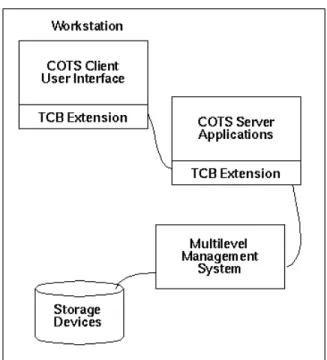
high sessions. The third instantiation of the model architecture is shown in Figure 3. In this layout, there are logically separate single level terminals (multiplexed by purging of state between session-level changes) connected via TCB extensions to multilevel aware application server(s) and then to the multilevel component. An example of this ver-sion of the architecture is that of the NPS MLS LAN project [10].
Figure 3: Distributed Multilevel Server Architec-ture
4
The Integrity Problem
In a system of components such as shown in Fig-ures 1, 2 and 3, a centralized component that con-trols access to a set of protected objects can enforce a confidentiality policy on those objects with re-spect to the actions of other system components. Specifically, if the protected objects are partitioned into protection domains, this type of enforcement can ensure that data from high confidentiality mains does not exfiltrate to low confidentiality do-mains (other than, perhaps, through covert chan-nels). However, this does not mean that high in-tegrity data can be managed and protected by such a system. Rather, the integrity of data managed by a system can be no greater than the greatest lower bound (GLB)4 of the integrity of all of the system components that may modify the object. This is the case whether or not the system enforces Biba integrity (or some other data or program [17] in-tegrity policy).
If the system in question does not enforce an in-tegrity policy, then high-inin-tegrity input data may be corrupted by low-integrity components in the sys-tem. This degradation is possible because the low integrity component may modify an object in an incorrect way, so modified objects take on the in-tegrity of the greatest lower bound of the inin-tegrity of the modifying component and the original in-tegrity of the object. Essentially, objects modified by low integrity components become low integrity objects.
On the other hand, if the system enforces an in-tegrity policy correctly, then it will restrict the input of writable data to be only those objects whose integrity labels are less than or equal to the in-tegrity of the least trusted system component that may modify the object. This is due to the integrity policy restriction that prevents integrity “write up” (i.e., a subject may not modify an object that has higher integrity).
Thus, in either case, the system is limited to maintaining data that is at or below the integrity level of its least trusted component. To illustrate this limitation, if a system consists of these compo-nents, all of which may modify user data:
a medium integrity client application
a low integrity COTS operating system
4We use greatest lower bound, rather than “minimum,”
be-cause some integrity labels may not be comparable, meaning that the labels form a partial, rather than linear, ordering.
a high integrity TCB Extension
a high integrity TCB
and a medium integrity application protocol server
Then the limit of integrity that the system can maintain is the GLB of (medium, low, high, high,
medium) = low.
5
Conclusion and Discussion
We have shown that a system can only manage and protect data whose integrity is at or below that of its lowest integrity component. The hy-brid security architecture (HSA) systems discussed here contain COTS components through which all user data flows and which have “low assurance” integrity. Therefore, HSA systems are only capa-ble of maintaining “low assurance” data. These systems should not be used in automated informa-tion processing environments where there are high-integrity data requirements.
Many organizations have a “good enough” atti-tude regarding data security in multi-user environ-ments, whereby the marketplace of commercially-available security solutions dictates the level of security provided to customer and corporate data. Losses associated with data security failures are considered part of the cost of doing business and are factored into customer pricing as well as cor-porate tax strategies. Nevertheless, each organiza-tion must make strategic decisions regarding which corporate and customer assets to expose to these shared environments. There is increasing compet-itive pressure for businesses to open their books to internet and other data-sharing environments. We expect that one impact of this paper will be to increase the level of understanding, and help quantify, the level of trust regarding data integrity that one should place in network/computer archi-tectures that are based on COTS components.
One might ask if protection of high integrity data is ever achievable. The answer is yes, but only in architectures that prevent low-assurance compo-nents from modifying user data. An example is a client-server architecture where both client and server are of high integrity, and the data is protected (e.g., through carefully constructed protocols with high quality encryption) from modification when transiting low integrity portions of the network.
References
[1] Quality Systems – Model for Quality Assurance in
Design, Development, Production Installation and Servicing . Number ISO 9001. Geneva, 1994.
[2] A Systems Engineering Capability Maturity
Model, Version 1.1. Number
CMU/SEI-95-MM-003. Pittsburg, PA, 1995.
[3] ISO/IEC 15408 - Common Criteria for Informa-tion Technology Security EvaluaInforma-tion. Technical Report CCIB-98-026, May 1998.
[4] The Easter Egg Archive. http://www.eeggs.com/, last modified 19 May 2000.
[5] M. Anderson, C. North, J. Griffin, R. Milner, J. Yesberg, and K. Yiu. Starlight: Interactive Link. In Proceedings 12th Computer Security
Ap-plications Conference, San Diego, CA, December
1996.
[6] K. J. Biba. Integrity Considerations for Secure Computer Systems. Technical Report ESD-TR-76-372, MITRE Corp., 1977.
[7] D. E. Denning, T. F. Lunt, R. R. Schell, W. Shock-ley, and M. Heckman. Security policy and inter-pretation for a class a1 multilevel secure relational database system. In Proceedings 1988 IEEE
Sym-posium on Security and Privacy, Oakland, CA,
April 1988. IEEE Computer Society Press. [8] E. W. Dijkstra. A Discipline of Programming.
Prentice Hall, Englewood Cliffs, NJ, 1976. [9] C. E. Irvine, T. Acheson, and M. F.
Thomp-son. Building Trust into a Multilevel File System. In Proceedings 13th National Computer Security
Conference, pages 450–459, Washington, DC,
Oc-tober 1990.
[10] C. E. Irvine, J. P. Anderson, D. Robb, and J. Hack-erson. High Assurance Multilevel Services for Off-The-Shelf Workstation Applications. In
Pro-ceedings of the 20th National Information Systems Security Conference, pages 421–431, Crystal City,
VA, October 1998.
[11] T. M. P. Lee. A Note on Compartmented Mode: To B2 or not B2? In Proceedings of the 15th
Na-tional Computer Security Conference, pages 448–
458, Baltimore, MD, October 1992.
[12] T. F. Lunt, R. R. Schell, W. Shockley, M. Heck-man, and D. Warren. A Near-Term Design for the SeaView Multilevel Database System. In
Pro-ceedings 1988 IEEE Symposium on Security and Privacy, pages 234–244, Oakland, 1988. IEEE
Computer Society Press.
[13] National Computer Security Center. Department
of Defense Trusted Computer System Evaluation Criteria, DoD 5200.28-STD, December 1985.
[14] National Computer Security Center. Trusted
Network Interpretation of the Trusted Computer System Evaluation Criteria, NCSC-TG-005, July
1987.
[15] M. C. Paulk. A Comparison of ISO 9001 and
the Capability Maturity Model for Software, Com-puter Security Technology Planning Study. Tech-nical Report CMU/SEI-94-TR-12, Software Engi-neering Institute, Pittsburg, PA, July 1994.
[16] B. Pomeroy and S. Weisman. Private Desktops
and Shared Store. In Proceedings 14th Computer
Security Applications Conference, pages 190–200,
Phoenix, AZ, December 1998.
[17] L. J. Shirley and R. R. Schell. Mechanism Suffi-ciency Validation by Assignment. In Proceedings
1981 IEEE Symposium on Security and Privacy,
pages 26–32, Oakland, 1981. IEEE Computer So-ciety Press.
[18] K. Thompson. Reflections on Trusting Trust .
Communications of the A.C.M., 27(8):761–763,