CGIAR STRATEGY AND RESULTS
FRAMEWORK 2016-2030
CGIAR STRATEGY AND RESULTS
FRAMEWORK 2016-2030
CONTENTS
FOREWORD ... 1
EXECUTIVE SUMMARY ... 3
1. SOCIETAL GRAND CHALLENGES AND CGIAR ... 7
2. CGIAR’S VISION, MISSION, GOALS, AND PEOPLE WHO WILL BENEFIT ... 10
3. HARNESSING NEW OPPORTUNITIES ... 13
4. RESULTS FRAMEWORK ... 14
5. CGIAR SYSTEM LEVEL OUTCOMES (SLOS) AND RESEARCH PRIORITIES ... 17
6. PARTNERSHIP AND CAPACITY DEVELOPMENT STRATEGY ... 24
7. HOLDING OURSELVES ACCOUNTABLE ... 26
ANNEX 1. CGIAR CENTERS AND PROGRAMS ... 28
ANNEX 2. DONORS TO CGIAR ... 29
ANNEX 3. TARGET JUSTIFICATION ... 31
ANNEX 4. HOW CGIAR GOALS ALIGN WITH THE SUSTAINABLE DEVELOPMENT GOALS (SDGS) ... 35
ACRONYMS ... 36
REFERENCES ... 37
We are proud to present CGIAR’s second comprehensive Strategy and Results Framework (SRF).
CGIARi,ii is the only worldwide partnership
addressing agricultural research for development, whose work contributes to the global effort to tackle poverty, hunger and major nutrition imbalances, and environmental degradation. Our Strategy responds and will contribute directly to the achievement of the Sustainable Development Goals (SDGs) outlined by the United Nations, in particular to reduce poverty, to improve food and nutrition security for health, and to improve natural resources systems and ecosystems services. In order to feed the predicted global population of 9 billion people by 2050, food availability (increasing production and reducing losses) needs to expand by 60% globally and up to 100% in developing countries. Currently, over a billion people live on less than US$ 1.25 per day and more than 800 million are acutely or chronically undernourished. Under-nutrition remains the underlying cause of death for at least 3.1 million children a year, accounting for 45% of all deaths of children under 5 and stunting the growth of another 165 million. Women remain particularly disadvantaged, lacking access to productive resources. An estimated 3.5 billion hectares (ha) of degraded
land now lie unproductive due to overexploitation, unsustainable water use threatens 40% of the world’s grain production, and climate change is projected to reduce developing countries pastoralism and further reduce yields of major cereals, such as wheat and maize.
We cannot simply tread familiar paths in response to these statistics.
Over the next few years we must redouble our focus on women and young people, extend our efforts to improve dietary quality among the poor and vulnerable, and intensify our work on climate-smart agriculture – all given new prominence in our research agenda. At the same time we will continue to build on our long record of achievement in research to improve the productivity of staple foods, livestock and fish, and to restore and protect the natural resources used to produce them – our traditional areas of strength.
This SRF reflects the collective expectations
of the donor communityiii, to whom we express
our sincere gratitude for their continuing support. Many people have contributed to development of this SRF: those who direct and lead our research within CGIAR Centers; our partners in the wider research and development community; and, most importantly, those whom we seek to benefit –
poor farmers, food producers and consumers of the developing world.
Not content to hear only from known sources, we have also proactively sought the views of people and organizations external to the CGIAR system. A stakeholder consultation convened by the Global Forum for Agricultural Research (GFAR) garnered many valuable insights and inputs. We are highly appreciative of all contributions. Collectively, they have greatly strengthened our strategy.
We have aligned the time horizon of our strategy, that is - 2030, with the SDGs. Our CGIAR development targets aim to demonstrate the contribution agricultural research for development can make to achievement of the SDGs. To be comparable, our SRF is based on the same end point.
We believe this SRF provides a firm foundation for the research we must work on with our partners in the coming fifteen years if we are to achieve our vision of a world free of poverty, hunger, and environmental degradation.
Investing in research of CGIAR with partners is a strong and effective investment to tackle those challenges.
We call upon all our stakeholders to support it – and to help implement it.
FOREWORD
i Endnotes and Annexes are used to provide the majority of details and justifications throughout this document, except where it is recognized it is more helpful to the reader to have the information immediately below in a footnote. ii CGIAR Centers and Programs are set out in Annex 1
Agri-food system research is an effective investment to end poverty and hunger. Directly observed benefits of past CGIAR investments are already twice the level of costs, and benefits are likely to go as high as 17 times costs as they are harvested over the lifetime of projects.iv Just over half of the world’s rice land is sown to high yielding varieties derived from CGIAR breeding materials. Launched in 2006, Drought Tolerance Maize For Africa (DTMA) has produced more than 100 new maize varieties with drought tolerance that have been adopted on a total of one million hectares across East and Southern Africa, giving an average yield advantage of 20-50%.
In today’s world, over a billion people live on less than US$ 1.25 per day and more than 800 million are acutely or chronically undernourished. The number of people suffering from micronutrient deficiency or ‘hidden hunger’ is even greater, around 2 billion. Women remain particularly disadvantaged, lacking equal access to productive resources and providing much of the labor for agriculture without fully sharing in its financial returns. Meanwhile, threats to the natural resource base needed for future food production are rising steadily. An estimated 3.5 billion ha of degraded land now lie unproductive due to overexploitation. Unsustainable water use threatens 40% of the world’s grain production. The number of people affected by drought or floods each year has risen to 150 million. Between 1980
and 2008, climate change brought about global yield
declines of 3.8% for maize and 5.5% for wheat.1
Collectively agriculture and food systems contribute up to 29% of global greenhouse gas emissions and
will need to be much more climate smart.2
CGIAR is a global research partnership that is a leading provider of research and development to address such challenges in agriculture (including crops, livestock, aquaculture and forestry).
Our vision is a world free of poverty, hunger and environmental degradation.
Our mission is to advance agricultural science and innovation to enable poor people, especially women, to better nourish their families, and improve productivity and resilience so they can share in economic growth and manage natural resources in the face of climate change and other challenges.
CGIAR’s 2016 – 2030 Strategy and Results Framework (SRF) defines CGIAR’s aspirations and strategic actions to deliver on our mission. Our SRF defines how CGIAR will build on past successes and investments and find new and creative solutions to barriers to success – it defines how we will harness new opportunities.
Our SRF is ambitious: By 2030, the action of CGIAR and its partners will result in 150 million fewer hungry people, 100 million fewer poor people – at least 50% of whom are women, and 190 million ha less degraded land.
We plan to deliver on our SRF by focusing on the following three goals (System Level Outcomes or SLOs), and their Intermediate Development Outcomes (IDOs):
As we work, we will also ensure a clear focus on 4 key crosscutting themes that are critical to attaining our goals and targets:
¡ Mitigating and adapting to climate change risks
and shocks
¡ Ensuring gender and youth equity and inclusion
¡ Strengthening the policy and institution enabling
environment
¡ Developing the capacity of national partners
and beneficiaries
These goals and targets reflect and are aligned with increasing worldwide political convergence on necessary actions to meet the competing demands of global development.
Specifically, CGIAR’s new SRF will help achieve global ambition reflected in the following: SDGs, United Nations’ Zero Hunger Challenge, G8 Nutrition for Growth Compact, Global Alliance for Climate Smart Agriculture (GACSA)’s commitment, IUCN’s Bonn Challenge on Landscape Restoration, and the Convention on Biodiversity’s Aichii Targets.
With a US$1 billion annual budget in 2015 - and a resource mobilization goal of US$1.5 billion by 2025 – CGIAR and its partners’ contribution to
EXECUTIVE SUMMARY
iv An aggregate ex-post benefit cost ratio of all CGIAR research investment 17.26, ‘Plausible, extrapolated to 2011’ (figure 1). Renkow, M., and Byerlee, D. The impacts of CGIAR research: A review of recent evidence. Food Policy (2010),
the achievement of these global goals have been quantified and are summarized in table 1 that follows for two time periods: By 2022 to reflect outcomes from the 6-year next generation CGIAR Research Programs (CRPs) commencing in 2017, and 2030 to align with the SDGs.
To reach these targets, we will focus on the following eight research priorities where CGIAR has a comparative advantage to develop to tackle these pressing global needs:
¡ Genetic improvement of crops, livestock, fish
and trees, to increase productivity, resilience to stress, nutritional value and efficiency of resource use.
¡ Agricultural systems, adopt a systems
approach to optimize economic, social and environmental co-benefits in areas with high concentrations of poor people.
¡ Gender and inclusive growth, creating
opportunities for women, young people and marginalized groups.
¡ Enabling policies and institutions, to
improve the performance of markets, enhance delivery of critical public goods and services, and increase the agency and resilience of poor people.
¡ Natural resources and ecosystem services,
focusing on productive ecosystems and landscapes that offer significant opportunities to reverse environmental degradation and enhance productivity.
¡ Nutrition and health, emphasizing dietary
diversity, nutritional content and safety of foods, and development of value chains of particular importance for the nutrition of poor consumers.
¡ Climate-smart agriculture, focusing on
urgently needed adaptation and mitigation options for farmers and other resource users.
¡ Nurturing diversity, ensuring that CGIAR
in-trust plant genetic resources collections are safely maintained, genetically and phenotypically characterized to maximize the exploitation of these critical resources for food
security, productivity, nutrient rich crops and resilient farming systems.
We will concentrate our research and our impact in specific geographies: Africa (over 50% of investments), Asia (about 30% of investments) and poverty hotspots in Latin America (about 20% of investments), where the majority of the world’s poor and hungry live. We will periodically review these investments in light of new political, demographic and climate change imperatives so that our research is aligned to major development goals.
We will align with national agricultural priorities in the countries where we work, through national consultations as part of the Global Conference on Agricultural Research for Development (GCARD).
To make sure our research outputs have impact, we will build on earlier GCARD consultation processes and put in place a theory of change: This will identify the expected changes and benefits for the next users of these outputs, and what needs to occur for these outputs to be translated into
FIGURE 1: SRF SYSTEM LEVEL AND INTERMEDIATE DEVELOPMENT OUTCOMES
Increased resilience of the poor to climate change and other
shocks Enhanced smallholder market access Increased incomes and employment Increased productivity Enhanced benefits from ecosystem goods and services Natural capital enhanced and protected, especially from climate change Improved human
and animal health through better agricultural practices Improved food security Improved diets
for poor and vulnerable people
More sustainably managed agro-
ecosystems
REDUCED POVERTY IMPROVED FOOD AND NUTRITION SECURITY FOR HEALTH IMPROVED NATURAL RESOURCES AND ECOSYSTEM SERVICES
SLOs
IDO
TABLE 1: ASPIRATIONAL CGIAR AND PARTNERS’ DEVELOPMENT TARGETS FOR 2022 AND 2030
TARGETS: 2022 V TARGETS: 2030
SYSTEM LEVEL OUTCOME 1: REDUCED POVERTY
¡ 100 million more farm households have adopted improved varieties, breeds
or trees, and/or improved management practices
¡ 30 million people, of which 50% are women, assisted to exit poverty
¡ 350 million more farm households have adopted improved varieties, breeds or
trees, and/or improved management practice
¡ 100 million people, of which 50% are women, assisted to exit poverty
SYSTEM LEVEL OUTCOME 2: IMPROVED FOOD AND NUTRITION SECURITY FOR HEALTH
¡ Improve the rate of yield increase for major food staples from current <1%
to 1.2-1.5%/year
¡ 30 million more people, of which 50% are women, meeting minimum dietary
energy requirements
¡ 150 million more people, of which 50% are women, without deficiencies
of one or more of the following essential micronutrients: iron, zinc, iodine, vitamin A, folate, and vitamin B12
¡ 10% reduction in women of reproductive age who are consuming less than
the adequate number of food groups
¡ Improve the rate of yield increase for major food staples from current <2.0 to
2.5%/year
¡ 150 million more people, of which 50% are women, meeting minimum dietary
energy requirements
¡ 500 million more people, of which 50% are women, without deficiencies of one
or more of the following essential micronutrients: iron, zinc, iodine, vitamin A, folate, and vitamin B12
¡ 33% reduction in women of reproductive age who are consuming less than the
adequate number of food groups SYSTEM LEVEL OUTCOME 3: IMPROVED NATURAL RESOURCES SYSTEMS AND ECOSYSTEMS SERVICES
¡ 5% increase in water and nutrient (inorganic, biological) use efficiency in
agro-ecosystems, including through recycling and reuse
¡ Reduce agriculturally-related greenhouse gas emissions by 0.2 Gt CO2-e
yr–1 (5%) compared with business-as-usual scenario in 2022
¡ 55 million hectares (ha) degraded land area restored
¡ 2.5 million ha of forest saved from deforestation
¡ 20% increase in water and nutrient (inorganic, biological) use efficiency in
agro-ecosystems, including through recycling and reuse
¡ Reduce agriculturally-related greenhouse gas emissions by 0.8 Gt CO2-e
yr–1 (15%) compared with a business-as-usual scenario in 2030
¡ 190 million ha degraded land area restored
¡ 7.5 million ha of forest saved from deforestation
CGIAR 2016 – 2030 SRF - WHAT ARE WE DOING DIFFERENTLY
¡ Looking outwards, recognizing the changing context, global commitments, and nature of research, priorities and expectations of investors.
¡ Ensuring that our research puts more emphasis on poverty, nutrition for health, resilience, degraded land, the agri-data revolution, and on the overarching
interactions with climate change.
¡ Focusing on societal grand challenges through the identification of eight research priorities where CGIAR has a comparative advantage, further potential and a
commitment to build with partners’ capacity to deliver impact.
¡ Strategically building a more coherent and integrated portfolio of second generation CRPs that will collectively deliver System Level Outcomes. ¡ Using the theory of change and linking to partners to transform research outputs into outcomes for the targeted populations.
¡ Emphasizing entrepreneurship and innovation along the agri-food supply chain to provide major opportunities for youth employment. ¡ Committing to closing the gender gap by equitable access to resources, information and power in the agri-food system.
¡ Establishing a new accountability framework providing clear, measurable development targets, metrics and outcomes. ¡ Learning to operate more efficiently and effectively by reducing duplication and transaction costs.
¡ Seeking out strategic partnerships, including public-private partnerships, that add value and leverage new sources of funding.
outcomes among the targeted groups. Learnings from the GCARD consultations will contribute directly to the identification of partners to scale up outcomes to deliver impact.
We will ensure that we are diligent when making investment choices at every step of the research evaluation phase. CGIAR’s Independent Science and Partnership Council (ISPC) will strengthen the quality, relevance, and impact of new investments through the provision of expert scientific guidance through an appropriate qualitative prioritization for the next generation of CRPs at both pre-proposal and final proposal stage. This will ensure that only
the strongest, most directly relevant CRP proposals are approved for funding.
We will develop Site Integration Plans to bring together the work of CGIAR Centers and programs in key countries, where CGIAR innovations are expected to reach millions of people.
We will work closely with partners, including the world’s most advanced research institutes, national agricultural institutions and, increasingly, the private sector, to supply the best upstream research; as well as with governments, national research partners, non-governmental organizations and the local private sector to ensure our research is up- and out-scaled.
We will focus on enhancing the capacity to innovate and further advance strategies for capacity development.
We will work to achieve gender equity throughout CGIAR. CGIAR’s goal is to continue to emphasize equitable access to resources, information and power in the agri-food system for men and women and we are committed to closing the gender gap by 2030.
We will focus explicitly on the role of youth in agri-food systems, to embrace the dynamism of agriculture and innovation to create growth, income and jobs, particularly in rural areas.3
The challenges of the 21st century are bounded by finite natural resources and continued population and income growth, which drive global food demand and put increased pressure on the natural resources: land, water, and biodiversity – all used to produce food and forest products. Agriculture is acknowledged as an important driver pressing against these bio-physical planetary
boundaries.4 Research is needed to ensure that
the agri-food system both produces sufficient and nutritious food to meet the growing global demand while at the same time reduces these pressures. Specifically, these pressures include:
¡ Competition for land from multiple sources:
food and feed crops, livestock, bio-fuels and biomaterials, forest products, conservation, urban expansion, and a host of other ecosystem services.
¡ Soil degradation of farmed land, particularly
where new land being brought into production is poorly suited for intensive agriculture.
¡ Overdrawn and polluted water supplies
threatening social breakdown and rising levels of conflict.
¡ Unsustainable harvests of fish and other
aquatic products undermining marine habitats and the future of oceanic systems.
¡ Climate change threatening agriculture,
and agriculture as a substantial producer of greenhouse gases.
1. SOCIETAL GRAND CHALLENGES AND CGIAR
¡ Diminishing genetic resources. Between 7
and 25% of vascular plant species are under threat of extinction by 2050.5
¡ The insidious effects of malnutrition. Nutritious
and diverse agri-food systems and diets are becoming more important. Increased consumption of animal products, fruits and vegetables alongside traditional cereal staples offers scope to improve nutritional and health outcomes among the under-nourished.
¡ Post-harvest losses of crop, livestock, fish,
and tree-products to pests, spoilage and
spillage are estimated at 30% to 50% globally.6
Reducing these losses offers considerable opportunities to improve the availability and the affordability of food.
¡ Food safety is essential for health, food
preservation and trade. Demand for meat, fish, eggs and dairy products is outpacing that for staple grains in both low- and middle-income countries, creating an urgent need to manage associated risks of food safety and disease, including diseases which can be transmitted from animals to humans (zoonotic diseases).
¡ Age and labor in agriculture. New
entrepreneurial and job opportunities are emerging from changing patterns of agri-food demand. These opportunities augment agriculture’s traditional role as a vehicle for reducing poverty.
CGIAR’S RESPONSE TO THESE SOCIETAL GRAND CHALLENGES
Over the past 40 years, CGIAR Centers and research programs have had a marked impact on the lives and livelihoods of people in the developing world.
Directly observed benefits of past CGIAR investments are already twice the level of costs, and benefits are likely to go as high as 17 times costs as they are harvested over the lifetime of projects (as referenced above).
The current CRPs were developed to provide broader outcome-oriented programs with CGIAR Centers forming collaborative links with each other and with other research and development partners. Designed to provide agricultural solutions for people in context, they optimize CGIAR’s contribution to global efforts in tackling the interconnected problems posed society’s grand challenges (itemized above). Formal reviews of the current CRPs are in progress. However, initial observations indicate that those CRPs that have built on existing strengths such as commodity breeding programs are performing well. As one would expect those CRPs that are adopting a systems-approach are taking longer to develop momentum, absorb and develop new skills and capacity. Overall the CRP portfolio has stimulated much greater collaboration across Centers, which is reflected in publication output and other measures of performance, demonstrating that the CRP approach provides a solid platform to implement CGIAR research for development.
THE BENEFITS OF CGIAR RESEARCH: WHAT PAST INVESTMENTS HAVE DELIVERED
¡ The economic benefits of CGIAR as a whole were estimated to range from about US$14 billion to more than $120 billion.
Even under quite conservative assumptions, the benefits of research have been roughly double the investment.
¡ About 60 percent of the food crop area planted with improved varieties includes many of the approximately 7,250 varieties
resulting from CGIAR research.
¡ In the late 1980s, Africa witnessed one of CGIAR’s most spectacular research achievements since the Green Revolution
— biological control of two devastating insect pests of the tropical root crop cassava. The economic returns — reaching a current value US$9 billion for research on just one of the pests, the cassava mealybug — far exceed CGIAR’s total investment in Africa since 1971.
¡ A 2007 review of investments in agricultural research carried out by five CGIAR Centers and their partners in South Asia
during the post-Green Revolution period (i.e. since the early 1980s) found average annual benefits of more than $1 billion from research on maize, rice and wheat alone, far above CGIAR’s total annual expenditures in the region.
¡ A 2009 study aimed at quantifying benefits from CGIAR research on yield stability estimated that the global economic
value of genetic resistance to various wheat diseases amounts to as much as $2.0 billion annually.
2. CGIAR’S VISION, MISSION, GOALS, AND PEOPLE WHO WILL BENEFIT
Our vision: A world free of poverty, hunger and environmental degradation.
Our mission: To advance agricultural science and innovation to enable poor people, especially women, to better nourish their families, and improve productivity and resilience so they can share in economic growth and manage natural resources in the face of climate change and other challenges.
Our goals, or System Level Outcomes (SLOs):
¡ Reduce poverty
¡ Improve food and nutrition security for health
¡ Improve natural resource systems and
ecosystem services
People who will benefit: Poor producers and consumers in developing countries:
¡ Producers: small holder farmers,
agro-pastoralists, agro-pastoralists, forest users and fisher folk.
¡ Consumers: poor consumers in rural and
urban areas; particularly targeting women and children in the poorest households.
¡ Social groups: women, young people and
producers who are marginalized or excluded from mainstream development.
¡ Processors and traders: who add value along
the chain from producer to consumer.
Geographic focus: currently, we concentrate our research in Africa (over 50% of investments), Asia (about 30% of investments) and poverty hotspots in Latin America (about 20% of investments) where the majority of the world’s poor and hungry live. This reflects the political commitment of our donors, the demographics of food and nutrition security, the projected impact of climate change, and the research capacity of beneficiary regions/countries. We will be responsive and agile and adapt investment in light of changing needs.
CGIAR’S COMPARATIVE ADVANTAGE
CGIAR has a unique role as the world’s leading publicly-funded partnership for research and development for sustainable agri-food systems in developing countries.
¡ There is no other research organization that
has the capacity in terms of people, partners, infrastructure and a presence on the ground in over 60 countries to work on breakthrough discovery research all the way to integrated delivery to millions of farmers.
¡ CGIAR can play a critical role as a convener
and facilitator of major international initiatives especially as the agri-food research agendas of developed and developing countries overlap in areas such as climate change or food safety, or for crops of common interest such as wheat. CRPs such as the Global Rice Science Partnership (GRiSP) or on Climate Change,
Agriculture and Food Security (CCAFS) have a leading role in setting the global research agenda in their subject areas.
¡ CGIAR has a strong track-record in leading
and conducting interdisciplinary research that combines biophysical and social sciences to combat poverty, hunger, and environmental degradation in developing countries.
¡ Its accomplishments in such areas as plant
breeding and genetics, crop, livestock and fish production, natural resource management research and food policy are on par with the world’s leading universities and research institutes.8 More recently, CGIAR has embarked
on new research areas that cross-sectoral boundaries, for example on agriculture and climate change, nutrition and health, or data management.
¡ CGIAR produces public goods (from global
to sub-national) through its research and innovations, such as improved agricultural or silvicultural systems mitigating climate change, nutrition programs, or methods to store more carbon in restored soils.
According to recent climate modeling within the next several decades, higher temperatures will become the primary threat to bean production. This suggests that the area suited for this crop in eastern and central Africa could shrink up to 50% by 2050. CGIAR researchers have identified 30 “elite” lines that
show strong tolerance to temperatures 4 degrees Centigrade above the crop’s normal “comfort zone.”
CGIAR holds in trust unique genetic resources for agriculturally significant species of central importance to advancing and sustaining productivity for the world’s smallholders in the 21st century.
CGIAR characterizes, uses and shares these resources, while developing and supporting policies that facilitate the use and exchange of genetic resources. The international flow of genetic diversity critically depends on the CGIAR system. As much as 92% of all material shared across borders within the multilateral system of the International Treaty on Plant Genetic Resources for Food and Agriculture comes from CGIAR genebanks.
In future we will place more emphasis on the collection, characterization and use of species and breeds8 important for such fields as human nutrition,
agro-forestry and climate resilient agriculture, in addition to biotic and abiotic resistance to emerging pests and diseases. The role of in situ conservation (in farmers’ fields), alongside the collections held in genebanks, will continue to grow together with data integration.
¡ CGIAR can develop the research capacity of
national research institutions in developing countries. Many partners have developed capabilities that can be augmented by the specialized training and opportunities for hands on research as part of multidisciplinary teams which remains a unique CGIAR advantage.
¡ CGIAR convenes partners, brokers research,
and mobilizes expertise to understand needs, build capacity, accelerate innovation
and achieve impact through long-term collaborative relationships among all partners. CGIAR provides knowledge platforms and infrastructure to link CGIAR Centers and CRPs with national agricultural research and extension systems, advanced research Institutes, policy bodies, non-government organizations (NGOs) and private-sector companies.
¡ CGIAR research informs global debate on
sustainable agri-food systems, from gender issues to issues of food policy, food safety and climate smart agriculture. CGIAR aims to provide key research-based information and knowledge that informs high level policy and advocacy work in global fora, from the United Nations General Assembly and specialized multilateral channels, to key countries and multi stakeholder platforms.
¡ CGIAR and its partners have generated a rich
trove of multi-location, multi-disciplinary, and long-term data and associated information, which is accessible for sharing, interrogation, or repurposing. CGIAR is implementing an ‘Open Access’ strategy to increase the data and information that is easily and rapidly accessible online.
Achieving and maintaining global food security, improving nutrition, and reducing rural poverty all require increased and targeted agricultural research to be supported by an efficient and effective governance and oversight framework, together with more predictable and sustainable
funding. CGIAR has continued to evolve to meet the changing times and demands during its existence.
Decisions taken by CGIAR donors in 2015 that bring the CGIAR system under one unified governance structure provide the framework, incentives and conditions through which CGIAR, its Centers and CRPs, can deliver results. Implementation of the governance reforms over 2016 – 2017 will deliver improved coordination, accountability and transparency in decision making throughout the CGIAR system as a whole. However, this will also require an agreed and sustainable funding envelope to support the portfolio of CRPs expected to be approved in November 2016.
The role of in situ
conservation (in
farmers’ fields),
alongside the
collections held
in genebanks, will
continue to grow
together with data
integration
According to recent climate modeling within the next several decades, higher temperatures will become the primary threat to bean production. This suggests that the area suited for this crop in eastern and central Africa could shrink up to 50% by 2050. CGIAR researchers have identified 30 “elite” lines that show strong tolerance to temperatures 4 degrees Centigrade above the crop’s normal “comfort zone.”
3. HARNESSING NEW OPPORTUNITIES
Besides new challenges, the context of CGIAR’s work over the coming fifteen years offers exciting opportunities: new global initiatives; new knowledge and understanding of agriculture and its contributions to other sectors; and very importantly, new scientific tools and, with them, new partnerships.
NEW GLOBAL INITIATIVES
As a new generation of leaders emerges to set the agenda at national level, new international mechanisms involving, for example, United Nations agencies, the G20, the revamped Committee on World Food Security, and an expanded range of development partners, are creating new ways of coordinating and delivering support, often with private-sector participation. In September 2015, the United Nations and its partners launched a new set of SDGs that have been taken on board by CGIAR. CGIAR also signed the G8 Nutrition Challenge, the IUCN’s Bonn Challenge on Landscape Restoration, and is a member of the Global Alliance for Climate Smart Agriculture. CGIAR will contribute to the Convention on Biodiversity’s Aichii Targets as well as the United Nations’ Zero Hunger Challenge. CGIAR is participating in setting targets and indicators, which it will work closely with its partners to achieve. NEW UNDERSTANDING
Agriculture and the health, energy and environmental issues associated with it are gaining global attention. The double burden of under-nutrition and obesity
has increased. The rapid growth of bio-fuels and biomaterials has linked agricultural and energy
markets.10 The past focus of environmentalists on
strict conservation has broadened to encompass the management of landscapes for multiple purposes, with tradeoffs and synergies between conservation
and productive uses.11 As a consequence,
agriculture is increasingly positioned within health
and environment agendas.12
NEW SCIENCE AND TECHNOLOGY
Advances in science and technology are also creating new opportunities for the work of CGIAR and its partners. Breakthroughs in nutrition, genetics, informatics, modeling, communication technologies, satellite imaging, remote sensing, meteorology, precision farming and conservation agriculture are driving global investments in agriculture, often with the private sector. Breakthroughs in satellite imagery and remote sensing, soil and water monitoring in agro-ecological practices, and precision farming are also specifically reducing the energy and environmental footprint of agriculture.
Solutions implied by a ‘landscape’ approach to meeting the dual goals of food security and
environmental sustainability13 will be particularly
important for the sustainability of farming systems. By 2020 the genomes of all the major commodities under research by CGIAR will have been sequenced, opening up the potential to improve yields, climate resilience, and nutritional quality, while
reducing environmental impact. Rapid domestication of novel crops will combine the production of new kinds of food with that of the raw materials for energy generation. Genomic selection for livestock will open the way for more diverse traits to be selected. High resolution phenotyping will help identifying new traits in different physical contexts.
The most exciting advances are occurring at the interface between disciplines. Applications of synthetic biology promise better microbial systems with superior plant nutrition and disease resistance. Understanding the rhizosphere microbiome can enhance plant productivity and ecosystem functioning. New breeding techniques combined with environment and management practices are likely to lead to breakthroughs in photosynthesis and nutrient
management, such as C4 rice14 and nitrogen-fixing
cereals.15 These areas of ongoing discovery research
for CGIAR require continued support to achieve breakthrough results within the next 5-10 years.
The collation and application of insights from the study of large integrated data sets is starting to deliver benefits across genetics, economics, agronomy, hydrology, and soil science. These insights and their associated predictive power have the potential to increase the resilience of food systems and reduce the risks associated with the management of water and nutrients. Data-intensive methods and new ways of gathering data will increase our capacity to monitor sustainability at different levels.
In sum, agriculture is now seen to be at the core
of the new bio-economy16, a user of and contributor
to big data for innovation, part of the solution to environmental problems, an engine of economic
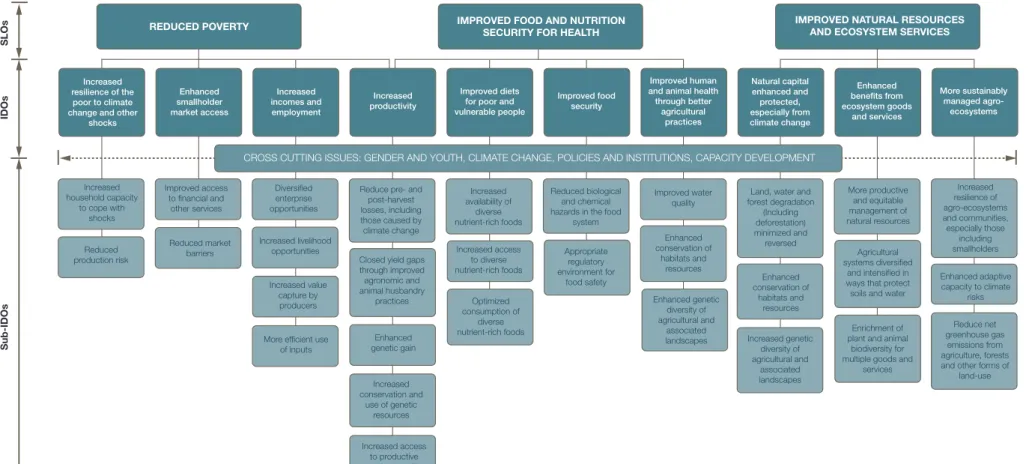
CHALLENGES, IMPACT PATHWAYS, THEORIES OF CHANGE AND RESULTS FRAMEWORK CGIAR’s Results Framework (Figure 2) describes the vision, mission and three strategic goals, or System Level Outcomes (SLOs), for the work of CGIAR and its partners over the 15-year period to 2030 set by our funders.
CGIAR work will contribute to the reduction of poverty (and creation of wealth), to improved food and nutrition security (leading to better health), and to better management of natural resources (leading to improved ecosystem services).
The SLOs are the higher-level goals for the CGIAR system aligned with international development imperatives (specifically, the SDGs: with Annex 4 setting out the linkage between the two). They cannot be achieved by CGIAR or by research alone. Progress must be driven by national governments and by international development organizations and agreements, and other partners.
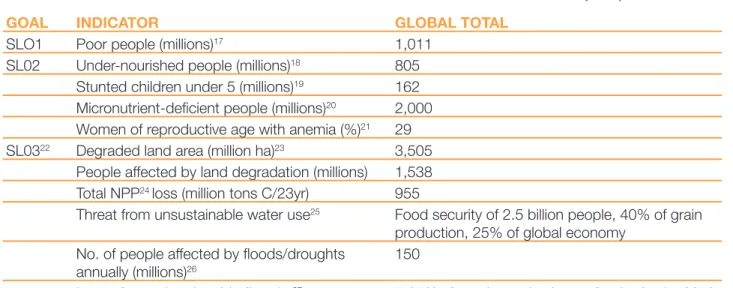
As set out in table 2 below, the scale of these challenges is sobering.
TABLE 2. DIMENSIONS OF THE CHALLENGE BY SYSTEM LEVEL OUTCOMES (SLO) AS OF 2015
GOAL INDICATOR GLOBAL TOTAL
SLO1 Poor people (millions)17 1,011
SL02 Under-nourished people (millions)18 805
Stunted children under 5 (millions)19 162
Micronutrient-deficient people (millions)20 2,000
Women of reproductive age with anemia (%)21 29
SL0322 Degraded land area (million ha)23 3,505
People affected by land degradation (millions) 1,538
Total NPP24 loss (million tons C/23yr) 955
Threat from unsustainable water use25 Food security of 2.5 billion people, 40% of grain
production, 25% of global economy No. of people affected by floods/droughts
annually (millions)26 150
Loss of vascular plant biodiversity27 7-25% of species under threat of extinction by 2050
4. RESULTS FRAMEWORK
growth, and the source of healthy diets.
CGIAR, with its unique mandate for agricultural research across the world’s developing countries, will both harness and contribute to these advances in
science and technology. Now CGIAR must go still further to get outcomes, entering new partnerships and coalitions whenever these are needed to develop and spread new knowledge and practices.
IMPACT PATHWAYS AND THEORIES OF CHANGE To ground these SLOs at the level of research activities, CGIAR has introduced the concept of Intermediate Development Outcome (IDOs), which enable researchers to think through the contexts in which their outputs might contribute to development outcomes.
Below this level are Sub-Intermediate Development Outcome (sub-IDOs), which represent research outcomes adopted by immediate users
such as National Agricultural Research Systems
(NARS) researchers and national policy makers.
The IDOs and sub-IDOs will be adopted or adjusted by each CGIAR research program, according
to program- and peer-reviewed assessments of priorities and what can be delivered.
Targets at the
sub-IDO level will be determined and validated
at the pre-proposal phase to ensure alignment
with the Results Framework, with the qualitative
prioritization exercise to be undertaken by
ISPC prior to the approval of pre-proposals.
This process will bring rigor to the selection of
pre-proposals prior to advancement to the full
proposal stage.
Implicit in figure 2 are theories of change about how outcomes are achieved, how they interact with each other and what characteristics define the enabling environment required to secure them.
CRPs will further develop our theories of change, the pathways through which impact will be achieved,
and the milestones we will use to hold ourselves accountable for progress. The new generation CRPs will clearly demonstrate their linkage to one or more of the SLOs. We will test the validity of our theories of change in practice and adapt them as our understanding evolves. The SRF is therefore a living document and will be periodically updated with new challenges and opportunities that reflect lessons learnt.
FIGURE 2: CGIAR RESULTS FRAMEWORK
Increased resilience of the
poor to climate change and other
shocks Enhanced smallholder market access Increased incomes and employment Increased productivity Enhanced benefits from ecosystem goods and services Natural capital enhanced and protected, especially from climate change Improved human
and animal health through better agricultural practices Improved food security Improved diets
for poor and vulnerable people
More sustainably managed agro-
ecosystems
REDUCED POVERTY IMPROVED FOOD AND NUTRITION SECURITY FOR HEALTH IMPROVED NATURAL RESOURCES AND ECOSYSTEM SERVICES
Improved access to financial and other services Diversified enterprise opportunities
Reduce pre- and post-harvest losses, including those caused by climate change More productive and equitable management of natural resources Land, water and
forest degradation (Including deforestation) minimized and reversed Improved water quality Reduced biological and chemical hazards in the food
system Increased availability of diverse nutrient-rich foods Increased resilience of agro-ecosystems and communities, especially those including smallholders Reduced production risk Reduced market
barriers Increased livelihood opportunities
Closed yield gaps through improved agronomic and animal husbandry practices Agricultural systems diversified and intensified in ways that protect soils and water Enhanced conservation of habitats and resources Enhanced conservation of habitats and resources Appropriate regulatory environment for food safety Increased access to diverse
nutrient-rich foods Enhanced adaptive
capacity to climate risks Increased value capture by producers Enhanced genetic gain Enrichment of plant and animal
biodiversity for multiple goods and
services Increased genetic diversity of agricultural and associated landscapes Enhanced genetic diversity of agricultural and associated landscapes Optimized consumption of diverse
nutrient-rich foods greenhouse gas Reduce net
emissions from agriculture, forests and other forms of
land-use More efficient use
of inputs Increased conservation and use of genetic resources Increased access to productive assets, including natural resources
CROSS CUTTING ISSUES: GENDER AND YOUTH, CLIMATE CHANGE, POLICIES AND INSTITUTIONS, CAPACITY DEVELOPMENT Increased household capacity to cope with shocks SLOs IDO s Sub-IDOs
A wide expanse of wheat plots seen from the air at CIMMYT’s CENEB station (Campo Experimental Norman E. Borlaug, or The Norman E. Borlaug Experiment Station), near Ciudad Obregón, in the state of Sonora, northern Mexico. CENEB is used by the Global Wheat Program for irrigated trials over the winter season (November-May), and is the largest of CIMMYT’s sites. In conjunction with the Toluca and El Batán stations in the Mexican highlands, it allows for accelerated “shuttle” breeding with two growing seasons each year.
CGIAR and partners’ ambitious targets are set out in table 1 and represent two time periods: 2022 and 2030, respectively. They demonstrate the CGIAR system’s commitment to the goals and targets established by the international community.
In addition to the CGIAR system’s commitment to contribute to achievement of the SDGs, CGIAR has signed the G8’s Nutrition for Growth Compact, which
has committed, inter alia, to reaching 500 million
5. CGIAR SYSTEM LEVEL OUTCOMES (SLOS) AND RESEARCH PRIORITIES
pregnant women and children with effective nutrition interventions by 2030, prevent at least 20 million children under the age of five from having stunted growth, and save at least 1.7 million lives by reducing stunting, increasing breast-feeding, and treating severe acute under-nutrition. CGIAR also co-founded the 2014 Global Alliance for Climate Smart Agriculture, which has undertaken to reach 500 million farms with climate-smart interventions by 2030.
It should be noted that numbers in table 1 are not additive and that there is considerable overlap in the target populations. For example, many of the poor people lifted out of poverty (SLO 1, target 1.2) will be those farmers that have adopted improved practices (SLO 1, target 1.1) and/ or will also meet minimum dietary requirements (SLO 2, target 2.2) and/or be without deficiencies of one or more of the essential micronutrients (SLO 2, target 2.4).
TABLE 1. ASPIRATIONAL CGIAR AND PARTNERS’ DEVELOPMENT TARGETS FOR 2022 AND 2030 (REPRODUCED FROM EXECUTIVE SUMMARY, WITH ADDITIONAL NOTES)
TARGETS: 2022vi TARGETS: 2030 (ALIGNED TO THE SDGS)
SYSTEM LEVEL OUTCOME 1: REDUCED POVERTY
¡ 100 million more farm households have adopted improved varieties, breeds or
trees, and/or improved management practicesvii
¡ 30 million people, of which 50% are women, assisted to exit povertyviii
¡ 350 million more farm households have adopted improved varieties, breeds or
trees, and/or improved management practice
¡ 100 million people, of which 50% are women, assisted to exit poverty
SYSTEM LEVEL OUTCOME 2: IMPROVED FOOD AND NUTRITION SECURITY FOR HEALTH
¡ Improve the rate of yield increase for major food staples from current <1% to
1.2-1.5%/year
¡ 30 million more people, of which 50% are women, meeting minimum dietary
energy requirements
¡ 150 million more people, of which 50% are women, without deficiencies of one
or more of the following essential micronutrients: iron, zinc, iodine, vitamin A, folate, and vitamin B12
¡ 10% reduction in women of reproductive age who are consuming less than the
adequate number of food groups
¡ Improve the rate of yield increase for major food staples from current <2.0 to
2.5%/yearix
¡ 150 million more people, of which 50% are women, meeting minimum dietary
energy requirements
¡ 500 million more people, of which 50% are women, without deficiencies of one
or more of the following essential micronutrients: iron, zinc, iodine, vitamin A, folate, and vitamin B12
¡ 33% reduction in women of reproductive age who are consuming less than the
TABLE NOTES
vi The targets for 2022 have been assembled based on the projections to 2030 but recognizing that adoption rates are non-linear and will build on the work of the existing CRP portfolio.
vii Improved management practices include climate-smart agriculture, ecological intensification, conservation agriculture, and any management practice that sustainably increases resource-use efficiency and productivity (such as water-saving
technologies) and/or reduces cost of production.
viii The model by Christiaensen, Demery and Kuhl (2010) was used to compute impacts on poverty from CGIAR and NARES investments in agriculture. The model was estimated to capture direct and indirect effects of agricultural growth,
based on estimated yield growth rates on 10 major crops and their estimated areas, adjusted by inputs to derive a measure of increase in total factor productivity. We also tried to identify the incremental contribution of CGIAR, but we recognize that this will be delivered only through complementary efforts of many partners, the most important of which are the poor, themselves, who are agents of their own development. Calculations carried out by IFPRI, March 2015 (courtesy Alejandro Nin Pratt).
ix The productivity gains described will be achieved by both genetic improvement and reduction of food waste, involving the reduction of pre- and post-harvest losses. x This includes agriculture-driven deforestation, i.e. AFOLU (Agriculture, Forestry and Other Land Uses)
We will achieve this by focusing on the following eight global research priorities where CGIAR has a comparative advantage, further potential and a commitment to build with partners, capacity to deliver impact:
¡ Genetic improvement of crops, livestock, fish
and trees, to increase productivity, resilience to stress, nutritional value and efficiency of resource use.
¡ Agricultural systems, adopt a systems
approach to optimize economic, social and environmental co-benefits in areas with high concentrations of poor people.
¡ Gender and inclusive growth, creating
opportunities for women, young people and marginalized groups.
¡ Enabling policies and institutions, to improve
the performance of markets, enhance delivery
SYSTEM LEVEL OUTCOME 3: IMPROVED NATURAL RESOURCES SYSTEMS AND ECOSYSTEMS SERVICES
¡ 5% increase in water and nutrient
(inorganic, biological) use efficiency in
agro-ecosystems, including through recycling and reuse
¡ Reduce agriculturally-relatedx greenhouse gas emissions by 0.2 Gt CO2-e
yr–1 (5%) compared with business-as-usual scenario in 2022
¡ 55 million ha degraded land area restored
¡ 2.5 million ha of forest saved from deforestation
¡ 20% increase in water and nutrient (inorganic, biological) use efficiency in
agro-ecosystems, including through recycling and reuse
¡ Reduce agriculturally-related greenhouse gas emissions by 0.8 Gt CO2-e
yr–1 (15%) compared with a business-as-usual scenario in 2030
¡ 190 million hectares (ha) degraded land area restored
¡ 7.5 million ha of forest saved from deforestation
of critical public goods and services, and increase the agency and resilience of poor people.
¡ Natural resources and ecosystem services,
focusing on productive ecosystems and landscapes that offer significant opportunities to reverse environmental degradation and enhance productivity.
¡ Nutrition and health, emphasizing dietary
diversity, nutritional content and safety of foods, and development of value chains of particular importance for the nutrition of poor consumers.
¡ Climate-smart agriculture, focusing on urgently
needed adaptation and mitigation options for farmers and other resource users.
¡ Nurturing diversity, ensuring that CGIAR
in-trust plant genetic resources collections
are safely maintained, genetically and phenotypically characterized to maximize the exploitation of these critical resources for food security, productivity, nutrient rich crops and resilient farming systems.
The following section describes how CGIAR together with its partners and people who will benefit will work together to develop research outputs, including public goods, technologies, best practices, policy advice, evidence and knowledge that will contribute to each System Level Outcome. SYSTEM LEVEL OUTCOME 1 – REDUCED POVERTY
CGIAR activities will contribute to this System Level Outcome through a number of different pathways.28 The key pathways will differ across
Research and policy change are needed to reduce market barriers, whether these barriers are legal, social or physical – such as poor infrastructure and transport links.
Enabling farmers to profit from innovation will often require improved access to financial and other services – for example, veterinary services when livestock are introduced. Another route to improved margins is the development and dissemination of practices that lead to the more efficient use of inputs, especially fertilizers and pesticides. Lastly, when rural people can process their produce on or near the farm, they can raise their incomes through increased value capture.
The heterogeneity of the poor is important in determining the kinds of intervention that will reduce poverty. In some contexts, the poor are overwhelmingly landless rural laborers; in others, they tend to be concentrated in urban areas. In some areas, poverty may be concentrated among women – or perhaps even more intensively concentrated among specific classes of women (e.g. widows or adolescent girls).
It is critical for CGIAR research to recognize that no single pathway to poverty reduction will hold across all settings. Indeed, technological innovation does not always reduce poverty; under some circumstances, it even has the potential to exacerbate inequality, creating, for example, widespread structural change in farming systems and increased urban migration.
Recognizing this complex reality is a starting point for all research by CGIAR and its partners. Research to reduce material poverty also needs to
address the increased resilience of the poor, where resilience is defined as the ability to maintain key system functions and structure while absorbing economic or environmental shocks, such as extreme fluctuations in the price of food, or the devastation of crops caused by a violent storm, or by a plant disease.
The development and dissemination of integrated technical, institutional and policy options should, in time, lead to increased household capacity to cope with shocks. But it will be vital to assess the full range of outcomes from these options rigorously – and to learn from experience. SYSTEM LEVEL OUTCOME 2 – IMPROVED FOOD AND NUTRITION SECURITY
Food security encompasses the availability, access, utilization and stability of a healthy food supply. Availability includes food provided locally or through imports. Access is defined at the level of individuals and includes affordability as well as priority within the household when supplies are scarce. Utilization refers to an individual’s ability to metabolize food through being in good health and ingesting food under sanitary conditions. Stability refers to the persistence of food supply in the face of shocks or across seasons and years.
Much that CGIAR does in the field of crop and commodity improvement (breeding and management, integrative systems approaches) seeks to enhance the availability of food, particularly of staple crops and animal products. Improved affordability of food comes through more efficient agri-food systems from better farm contexts, reflecting the diversity of livelihood
strategies pursued by the poor. They will also vary depending on the overall shape and capacity of the national economy.
Where the poor are predominately smallholder farmers, increased productivity and resilience to shocks may be an important pathway to poverty reduction, if it leads to increased incomes and employment opportunities. Productivity increases can be achieved through increased conservation and use of genetic resources, leading to enhanced genetic gain, especially when yield gaps can be closed through improved agronomic and animal husbandry practices. This is the classic route to increased productivity pursued by CGIAR Centers and programs in the past and it will continue to be an important part of our work.
For women especially, increased access to productive assets such as land and water will unlock further productive potential. Diversified enterprise opportunities can include moving into higher value products such as livestock, fish, vegetables, fruit or other tree crops and are important ways of stabilizing incomes as well as increasing them. These are feasible ways forward for many smallholders when demand is growing fast, as it is in the case of livestock and aquaculture products, and when improved technologies and adequate information and support services are also at hand.
Increased livelihood opportunities may result from enhanced smallholder market access that can lower the prices farmers pay for inputs and raise the margin they obtain on the goods they sell.
Smallholder dairy producers remain the main suppliers for lower income consumers in many countries. Key to increasing dairy supply is achieving economies of scale by organizing producers and promoting business development services.
production practices and technology, via better storage, processing and transportation, to better functioning markets. The stability of supply can result, for example, from shortening the growing cycle of a crop to avoid stressful climatic conditions and/or introducing mixed farming systems with a diversified range of commodities that spread risk.
While concern over food supply typically focuses on calories, nutritional security is not measured by a single dietary component but instead reflects improved diets from a range of food groups which need to be carefully targeted to poor and vulnerable people. CGIAR recognizes the need to prioritize women in order to foster improvements in family nutritional security. Increased availability of diverse nutrient-rich foods can be achieved by introducing fruits, vegetables, legumes, livestock and fish into the farming system, a good way forward provided the necessary inputs and services are available.
A complementary strategy, also researched by CGIAR, is to develop and disseminate bio-fortified crops. Besides availability, increased access to nutrient-rich foods is also essential. When food is sourced outside the farm, access depends on affordability, but also whether marginalized people in the community or household – mothers and infants, the old, the ill, the widowed – receive their fair share. This will be an important topic to pursue through research on gender and inclusion. Lastly, optimized consumption of these foods will ensure that the right amounts of missing nutrients are introduced into the diet, especially in the case of
livestock products. These can be important for people on low-calorie and nutrient-poor diets.
Many nutrient-rich foods, such as vegetables and animal-source foods, are perishable. Food safety is thus a critical nutrition and health concern as well as a barrier to markets for poor producers, processors and traders. Here again, a strong focus on women will be required. CGIAR can contribute to improved food safety through the better management of production and processing in agri-food systems. This covers a wide range of possible interventions, from the development and use of aflatoxin-resistant crop varieties, through the management of slurry to avoid pollution from livestock enterprises, to the prevention of spoilage and contamination during storage and processing – all of which can lead to reduced biological and chemical hazards in the food system.
CGIAR will make additional contributions to improved human and animal health through better agricultural practices, such as agricultural and aquaculture practices that lead to improved water quality and increased safe use of inputs. Integrated pest management can help to reduce pesticide overuse. A combination of improved management and more effective disease surveillance can contribute to the control of zoonotic and vector-borne diseases (e.g. those associated with irrigation). Control can be augmented by longer-term strategies for the development and use of resistant or tolerant varieties and breeds. Such interventions will also lead to reduced livestock and fish disease risks, especially those associated with intensification
and climate change. Cross-sectorial approaches will be required, targeting children under 5 and women of childbearing age in particular. CGIAR will harness increased expertise in nutrition through partnerships and coalitions with a wide range of partners, including leading NGOs and private-sector companies as well as government agencies. Alignment with key national, regional and international processes will be critical.
CGIAR recognizes that, for an agricultural research organization, improving nutritional
outcomes is not ‘business as usual’.29 New
approaches need to be adopted.
SYSTEM LEVEL OUTCOME 3 – IMPROVED NATURAL RESOURCE SYSTEMS AND ECOSYSTEM SERVICES
A primary aim of this SLO is to ensure that natural capital is enhanced and protected, from climate change as well as from overexploitation and other forms of abuse. The great gains made in food production over the past 50 years have in some areas come at a high environmental cost: degraded lands/soils, polluted water, depleted forest cover, and greatly reduced biodiversity. Now climate change threatens to accelerate this damage.
This is an immense challenge that calls for new approaches, including payment for ecosystem services, the certification and effective marketing of specialized products that meet environmental standards, increased consumer awareness, and the deployment of new financial instruments such as the REDD+ concept developed by the United
Nations (UN).30 These approaches, not all of
which lie within CGIAR’s remit, can ensure that land, water and biodiversity degradation (including deforestation) is minimized and reversed, particularly if efforts are on a large enough scale and have strong government and international backing.
In some areas, particularly those at high risk, enhanced conservation of habitats and resources will be needed. This can be achieved by switching away from traditional livelihood strategies to alternatives that provide a motive to conserve biodiversity, particularly woodland or forest.
The multi-functionality of agriculture is an important concept here, involving the enrichment of plant and animal biodiversity for multiple good and services, including pollination. The result will be enhanced benefits from ecosystem goods and services and a more productive agricultural sector in the long run.
Ensuring that local people control and manage local resources, and have the means to do so efficiently, will be critical for success, leading to more productive and equitable management of natural resources. Another essential ingredient will be agricultural systems that are diversified in ways that protect soils and water – two vital inputs that have often been compromised by past approaches to intensification, which have led to erosion or to deteriorating soil structure and to the inefficient use of scarce water supplies, often accompanied by pollution. As well as helping to control soil erosion and improve soil organic
matter content, increased above- and below-ground biomass will be essential for storing carbon and hence for mitigating climate change.
A third key area of research towards this System Level Outcome is more sustainably managed agro-ecosystems. Land degradation is defined as a reduction or loss of the biological or economic productivity and complexity of rain fed or irrigated cropland, rangeland, pasture, forest and woodland resulting from land use or off-take, combined with natural processes such as soil erosion, deterioration of the physical, chemical and biological properties of soil, and long-term loss of natural vegetation, especially tree cover. Agro-ecosystems may be already degraded now, in which case they need restoring, or vulnerable to degradation in the future unless they are better protected. An important ingredient contributing to this outcome is the increased resilience of agro-ecosystems and communities, which will be essential for absorbing price or climate shocks. CROSS-CUTTING ISSUES
Although research conducted by CGIAR and its partners can and will contribute to the achievement of more than one System Level Outcome, four issues cut across the whole research agenda:
¡ Climate change. All research and development
activities need to build in resilience to climate shocks and a focus on adaptation to and mitigation of climate change. Agriculture including forestry could be the most efficient contributor to the reduction of greenhouse gases through storage in the biomass and the
healthy soils. CGIAR is committed to devoting at least 60% of its research to those issues.
¡ Gender and youth. Research conducted
by CGIAR and its partners must be gender-sensitive and promote gender equity – that is, it is adapted to both the needs and the aspirations of poor women. The needs of young people must also be taken into account. Prioritizing rural and food sector entrepreneurship along agri-food supply chains will provide major opportunities for youth employment.
¡ Policies and institutions. Research must
provide evidence as a basis for reforming agri-food policies and institutions to make them more conducive to pro-poor development, to improved nutrition and the sustainable management of natural resources. Again, this spans most CGIAR and partner research activities with a special need in economic and social sciences.
¡ Capacity development. The need for
capacity development arises in all fields of agri-food research, but is particularly pressing in new areas such as data management and communication technologies, landscape analysis and climate-smart agriculture. Besides addressing the needs of the research community, capacity development should seek to enhance innovation throughout the agri-food system, including farmers and other groups along the value chain.
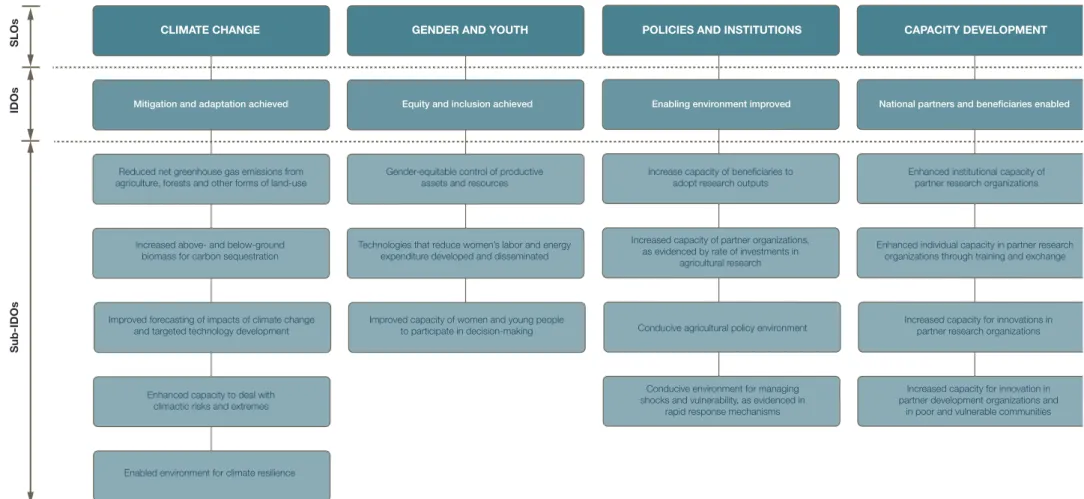
These issues, together with the IDOs and sub-IDOs that relate to them, are shown in figure 3.
FIGURE 3: SRF CROSS-CUTTING ISSUES AND OUTCOMES AT THE INTERMEDIATE DEVELOPMENT OUTCOME (IDO) AND SUB-IDO LEVELS
SLOs
IDO
s
Sub-IDOs
CLIMATE CHANGE GENDER AND YOUTH POLICIES AND INSTITUTIONS CAPACITY DEVELOPMENT
Mitigation and adaptation achieved Equity and inclusion achieved Enabling environment improved National partners and beneficiaries enabled
Reduced net greenhouse gas emissions from
agriculture, forests and other forms of land-use Gender-equitable control of productive assets and resources Increase capacity of beneficiaries to adopt research outputs Enhanced institutional capacity of partner research organizations
Increased above- and below-ground
biomass for carbon sequestration Technologies that reduce women’s labor and energy expenditure developed and disseminated
Increased capacity of partner organizations, as evidenced by rate of investments in
agricultural research
Enhanced individual capacity in partner research organizations through training and exchange
Improved forecasting of impacts of climate change
and targeted technology development Improved capacity of women and young people to participate in decision-making Conducive agricultural policy environment Increased capacity for innovations in partner research organizations
Enhanced capacity to deal with climactic risks and extremes
Conducive environment for managing shocks and vulnerability, as evidenced in
rapid response mechanisms
Increased capacity for innovation in partner development organizations and
in poor and vulnerable communities
6. PARTNERSHIP AND CAPACITY DEVELOPMENT STRATEGY
PARTNERSHIPS FOR IMPACTPartnership will be critical to the achievement of CGIAR’s goals, especially given the disparity between the magnitude of the problems and the resources that CGIAR alone can bring to bear on
them.31 CGIAR partnerships will be increasingly
diverse, extending beyond the system’s traditional collaboration with national and regional research and extension programs to a broadening circle of advanced research institutes, development agencies, NGOs, policy bodies and private-sector companies. The contributions of all partners will be explicitly recognized, and the general expectation will be of burden sharing and parallel finance, rather than internal transfer from one partner to the others. Future CGIAR partnerships will be guided by the following principles, based on relevant lessons from experience:32
¡ A common agenda. All partners must share
a vision for change, including a common understanding of the problems and a joint approach to solving them.
¡ Shared measurement. Collecting data and
measuring results consistently across all locations ensures that efforts remain aligned and partners hold each other accountable.
¡ Mutually reinforcing activities. Partners should
have distinct roles, which need to be coordinated through a mutually reinforcing plan of action.
¡ Continuous communication. Consistent and
open communication lines are critical in order
to build trust and ensure the realization of shared objectives.
¡ Backbone support. Creating and managing
collective impact requires a designated entity with staff and specific skill sets, to serve as the backbone for the partnership.
In some cases, particularly where countries have recently emerged from conflict or crisis or national research systems are severely under-resourced, the capacity of partners may not be sufficient to support relationships as defined above. In such cases, CGIAR will, upon invitation, work with implementation partners (often international NGOs or development organizations) and national clients to define the knowledge agenda and capacity development needed to accompany a development intervention.
CGIAR research program theories of change now explicitly acknowledge the role of the private sector. CGIAR can make important contributions in the pre-competitive space for innovations that will eventually be taken up and spread by private firms. Further work on intellectual property and related matters will be needed to harness the full potential of these growing partnerships.
Multi-stakeholder platforms and alliances convened around major global issues are promising instruments for involving partners from the private sector, as well as others.
SCALING UP
Achieving impact at scale is one of the greatest challenges facing the development community. Research by CGIAR and its partners can support the drive to disseminate innovations, but the scaling up effort must be led by national institutions, supported by regional or international development organizations where appropriate. The private sector also has a major role to play.
To support scaling up we will adopt a five-fold strategy of:
¡ Deliberate prioritization of research efforts to
target constraints of wide applicability and regions of concentrated poverty and hunger;
¡ Close alignment of efforts by centers and CRPs
in selected areas, to capture synergies;
¡ Coordinated planning with implementation
partners so that the knowledge of CGIAR and the financial and programmatic resources of these partners complement each other;
¡ Commitments from clients and national partners
to make complementary investments and policy reforms where CGIAR is investing; and
¡ Institutionalization of a culture of regular
monitoring and evaluation to gauge progress towards impact and to learn from experience. CAPACITY DEVELOPMENT
Capacity development is a strategic enabler of impact for both CGIAR and its partners. It goes far beyond the transfer of knowledge and skills through training, and