Persistence to Completion of Doctoral Degrees in Light of Student Creativity
A Dissertation Submitted to the Faculty
of
Drexel University by
Helene Maliko-Abraham in partial fulfillment of the requirements for the degree
of
Doctor of Education September 2016
© Copyright 2016
Signature Page
This Ed.D. Dissertation Committee from The School of Education at Drexel University certifies that this is the approved version of the following dissertation:
Persistence to Completion of Doctoral Degrees in Light of Student Creativity Helene Maliko-Abraham, Ed.D.
Committee:
Fredricka Reisman, Ph.D.
Brian Smith, Ph.D.
Dedication
I dedicate this work to my mother, who instilled in me from a young age the importance of an education. In the words of Abraham Lincoln, “All that I am, or ever hope to be I owe to my angel Mother”. Our bond continues on and will never be broken. I know you are always at my side cheering and encouraging me on, regardless of your absence on this early plane.
Acknowledgements
There are several individuals whose support and guidance have made this journey possi-ble. First, I would like to acknowledge my supervising professor, Dr. Fredricka Reisman. Dr. R. from the first moment we met, I knew you would become a guiding force in my life. Words simply can’t do justice to the amount of respect and admiration I have for you. Under your tute-lage, you have helped to shape and mold me into the scholar I have become. Your wisdom is awe inspiring, and you have taught me the true meaning of the word mentor. My heartfelt appre-ciation and gratitude are forever yours, I couldn’t have asked for a better chair.
To my two committee members, Dr. Brian Smith and Dr. Craig Bach. Thank you for your time, input and critique of my work. Please know how appreciative I am of the amount of time you dedicated to helping me to develop my dissertation into the work that it has become.
To my husband Andy. I can’t imagine having taken this journey without you by my side. Your love and support have enabled me to chase and realize my dreams. You are my rock, my inspiration, my voice of reason. And at the very best of times, my co-conspirator! I love you to the moon and back.
To my sister, confidant and best friend, Suzanna. Thanks for being there throughout this journey, your support and encouragement have been priceless. As you get ready to embark on your own doctoral journey, I am honored to be there by your side. The world, and C-SPAN awaits you, and the best part is that I get to have a seat right up front where I will be able to watch it all evolve.
I’d also like to take this opportunity to thank Tsz Kwok. From the first day of class that we met, I knew that we would see this journey through to completion. Your kindness and gener-osity of spirit are awe inspiring and I am blessed to call you my friend. To my other Cohort #4 mate, Lucy Heacock, you are woman of great strength and determination and I am proud to call you my friend. To Bruce Chelucci, your teaching and coaching skills extend far beyond the golf course. Your support has been palpable and your friendship is priceless. You have truly become the brother I never had. To the participants of this study, without you this research could not have been realized. I’m very much aware of the amount of time that I asked of you, and am humbled by your generosity of time and spirit. I am proud to have walked this journey with you, and cannot wait to pay your kindness forward.
Finally, thank you Dr. Paul E. Torrance. From my very first creativity course, I was hooked and knew that my dissertation had to somehow incorporate the study of creativity. It was a privilege and honor to have been able to incorporate the TTCT-Figural into my research de-sign. Your manifesto will forever be a part of my life.
E. Paul Torrance’s Manifesto
Don’t be afraid to fall in love with something and pursue it with intensity.
Know, understand, take pride in, practice, develop, exploit, and enjoy your greatest strengths. Learn to free yourself from the expectation of others and walk away from the games they
im-pose upon you.
Free yourself to play your own game.
Find a great mentor or teacher who will help you. Don’t waste energy trying to be well-rounded. Do what you love and can do well.
Table of Contents
List of Tables ... ix
List of Figures ... xi
Abstract ... xii
Chapter 1: Introduction to the Research ...1
Introduction to the Problem ...1
Statement of the Problem to be Researched ...8
Purpose Statement and Significance of the Problem ...9
Research Questions ...10
Conceptual Framework ...10
Definition of Terms ...13
Limitations and Delimitations ...14
Summary ...15
Chapter 2: Literature Review ...16
Introduction ...16
Conceptual Framework ...16
Literature Review ...18
Research Foundation 1: Doctoral Program Attrition ...18
Research Foundation 2: Creativity ...23
Research Foundation 3: Persistence ...33
Summary ...37
Chapter 3: Research Methodology...38
Introduction ...38
Research Design and Rationale ...39
Site and Population ...39
Research Methods ...43
Ethical Considerations ...48
Chapter 4: Findings, Results and Interpretations ...50
Findings ...50
Results and Interpretations ...95
Summary ...105
Chapter 5: Conclusions and Recommendations ...106
Introduction ...106
Conclusions ...106
Recommendations ...109
Summary ...113
List of References ...114
Appendix A: Interview Protocol ...125
Appendix B: Reisman Diagnostic Creativity Assessment (RDCA) ...126
Appendix C: Multiple Stimulus Types Ambiguity Tolerance – 1 (MSTAT-1) ...133
Appendix D: Risk Taking Assessment (RTA)...134
Appendix E: Torrance Test of Creative Thinking – Figural (TTCT-Figural) ...135
Appendix F: Participant Demographic Questionnaire ...136
Appendix G: Participant Invitation Letter ...138
Appendix H: Participant Electronic Consent Form – Phase 1 ...139
Appendix I: Participant Consent Form – Phase 2 ...142
Appendix J: Phase One z Score Data Distribution ...146
Appendix K: Phase One RDCA ANOVA Tables...149
Appendix L: Phase One RDCA Creativity Factors ANOVA Tables ...150
Appendix M: Phase One MSTAT-1 Statistical Analysis ...155
Appendix N: Phase One RTA Statistical Analysis ...157
List of Tables
1. Reisman Diagnostic Creativity Assessment Factors and Definitions ...29
2. Composition of Participants ...40
3. Demographic Composition of Phase One Participants ...53
4. Demographic Composition of Phase One Completers ...53
5. ANOVA RDCA Total Score ...54
6. RDCA Descriptive Statistics Total Score by Age ...54
7. RDCA Descriptive Statistics Total Score by Degree ...55
8. RDCA Descriptive Statistics Total Score by Year in Program ...56
9. ANOVA - RDCA Creativity Factors ...58
10. RDCA Creativity Factor – Originality Total Scores by Age ...58
11. RDCA Creativity Factor – Fluency Total Score by Age ...59
12. RDCA Creativity Factor – Flexibility Total Score by Age ...60
13. RDCA Creativity Factor– Tolerance of Ambiguity Total Score by Age ...61
14. RDCA Creativity Factor – Divergent Thinking Total Score by Age ...62
15. RDCA Creativity Factor – Intrinsic Motivation Total Score by Age ...63
16. RDCA Creativity Factor – Extrinsic Motivation Total Score by Age ...64
17. RDCA Creativity Factor - Originality Total Score by Gender ...65
18. RDCA Creativity Factor – Tolerance of Ambiguity Total Score by Gender ...66
19. RDCA Creativity Factor – Convergent Thinking Total Score by Gender...66
20. RDCA Creativity Factor – Risk Taking Total Score by Gender ...67
21. RDCA Creativity Factor - Originality Total Score by Degree ...67
22. RDCA Creativity Factor – Risk Taking Total Score by Degree ...68
23. RDCA Creativity Factor – Intrinsic Motivation Total Score by Degree ...68
24. RDCA Creativity Factor – Intrinsic Motivation Total Score by Year in Program ...69
25. RDCA Creativity Factor – Fluency Total Score by Year of Completion ...70
26. RDCA Creativity Factor - Divergent Thinking Total Score by Year of Completion ...71
27. RDCA Creativity Factor – Convergent Thinking Total Score by Year of Completion ...71
28. RDCA Creativity Factor – Risk Taking Total Score by Year of Completion ...72
30. RTA Total Score by Age ...74
31. RTA Total Score by Year in Program ...75
32. RTA Total Score by Year of Completion ...76
33. Demographic Composition of Phase Two Participants ...77
34. Demographic Composition of Phase Two Participant Completers ...77
35. Means and Standard Deviations for the TTCT-Figural ...78
36. TTCT-Figural Creative Abilities ...79
37. TTCT-Figural Creativity Index Total Score ...80
38. ANOVA - TTCT-Figural Creative Abilities Total Scores ...81
39. TTCT-Figural Standard Score – Fluency Total Score by Age ...81
40. TTCT-Figural Standard Score - Originality Total Score by Age ...82
41. TTCT-Figural Standard Score - RPC Total Score by Age ...83
42. TTCT-Figural Standard Score – Fluency Total Score by Gender ...84
List of Figures
1. Conceptual Framework ...12
2. Conceptual Framework ...17
3. S. K. Gardner’s Doctoral Student Development Model ...21
4. B. Lovitts Model of Factors that Influence Degree Completion ...25
5. E. Paul Torrance’s Model for Studying and Predicting Creative Behavior ...27
6. B. Whelan’s Model of Persistence ...34
7. Wao and Onwugbuzie’s Integrated Conceptual Scheme of TTD ...36
8. Phases of Research Under Study ...48
9. Word Query of the 100 Most Common Words Spoken During Interviews ...86
10. Four Major Themes Derived from the Interview Process ...87
11. Distribution of Participant Age Groups by Degree Program ...98
12. RDCA Tolerance of Ambiguity Total Participant Scores ...99
13. MSTAT-1 Total Participant Scores ...100
14. RTA Total Participant Score ...101
15. RDCA Risk Taking Factor Total Participant Scores ...102
16. RDCA Participant Total Score...102
Abstract
Persistence to Completion of Doctoral Degrees in Light of Student Creativity
Helene A. Maliko-Abraham, Ed.D. Drexel University, September 2016
Chairperson(s): Fredricka Reisman; Brian Smith; Craig Bach
The problem in this study is the lack of an objective creativity assessment that can be added to existing doctoral program selection criteria to possibly help decrease doctoral program attrition rates. This study built upon existing research with undergraduate admissions and exam-ined prospective student creativity as an admission option in an attempt to identify those students with hidden talents who do not do well on traditional admission assessments but who may be successful doctoral students.
Understanding participant possession of creativity, tolerance for ambiguity and risk tak-ing in those participants who were either progresstak-ing or have completed a doctoral degree pro-gram, was the primary focus of this research study. Scholars have studied attrition rates in doc-toral programs for decades in an effort to ameliorate them. One solution may lie within the se-lection criteria of potential students into doctoral programs. Creativity assessments could poten-tially be included in the current battery of selection criteria for admission to identify those appli-cants who are creative problem solvers, especially those who tolerate ambiguity and are risk tak-ers.
This mixed methods convergent parallel research design employed both quantitative and qualitative data collection efforts. Research efforts were conducted in two phases. Creativity
as-sessments were administered to 326 participants during Phase One efforts. Sixty of these partici-pants were selected and administered an additional assessment and a personal interview during Phase Two efforts. Results of this research indicate that this participant sample was homogenous as a group, and they were creative as measured by the assessments utilized in this study. Partici-pants selected for inclusion in the interview process of Phase Two of this research study were aware of their individual creativity, and they demonstrated their creativity, tolerance of ambigu-ity and risk taking in their approaches to creative problem solving in their professional, personal and academic lives. Eight major themes emerged from this research: 1) Age differences and cre-ativity, 2) Gender differences and crecre-ativity, 3) Degree differences and creativity assessment scores, 4) Creativity awareness, 5) Tolerance of ambiguity awareness, 6) Risk taking awareness, 7) Creativity demonstration, and 8) Relationship between high scores on creativity related as-sessments and degree persistence.
Chapter 1: Introduction to the Research Introduction to the Problem
Studies indicate that between 40% and 60% of students enrolled in a doctoral program fail to achieve their goal of obtaining their intended degree (Council of Graduate Schools Ph.D. Completion Report, 2008; Gardner, 2009; Golde, 2015; Lovitts, 2001; Nettles & Millet, 2006; Perkins & Lowenthal, 2014). Golde (2000) states, “Paradoxically, the most academically capa-ble, most academically successful, most stringently evaluated, and most carefully selected stu-dents in the entire higher education system--doctoral stustu-dents--are the least likely to complete their chosen academic goals” (p. 199). Berelson (1960), identified time to degree for doctoral students as a major concern in higher education. The exploration of the time to degree phenome-non for doctoral students has continued in the current literature (Bair and Haworth, 1999; Bowen & Rudenstein, 1992; Tuckman, Coyle &Bae, 1989; Rockinson-Szapkiw, Spaulding & Bade, 2014). The National Science Foundation (2013) reports that the time between entering graduate school and obtaining a doctoral degree has increased, especially in the field of education. Bair & Haworth (1999) propose that a relationship exists between doctoral program time to degree com-pletion and attrition.
Attrition is costly and is incurred not only by the students enrolled in these programs but also by the institutions themselves and the faculty. There are a myriad of reasons for attrition that range from personal, to economic and social, but the current literature does not identify one factor that is more prevalent than any other. Attrition rates vary not only on a departmental level, but on a university level as well (Lovitts, 2001). Cassuto (2013) refers to the Council of Graduate Schools who report that in most science and math fields students that are going to leave their intended doctoral programs do so by year 3, and adds, “The humanities are another story,
and not a happy one: Only half of all attrition takes place by the third year. The other half of the humanities non-completers—25 percent of those who enter graduate programs—trickle out over the following seven years”
.
The majority of research that has been conducted to date involves attrition rates for Ph.D. (Doctor of Philosophy) programs. Zambo, Zambo, Buss, Perry and Wil-liams (2014) report that while research associated with Ph.D. programs is prolific, research asso-ciated with Ed.D. (Doctor of Education) students is scarce. Doctoral program attrition rates are particularly difficult to examine. While nationwide databases exist for doctoral program com-pletion (National Science Foundation, 2013), reports on attrition are inaccessible at best, because records are often kept on the departmental or program level of individual universities (Bair and Haworth, 1999, Bowen & Rudenstein, 1992).A possible solution to lowering attrition rates may lie within the selection criteria of po-tential students for admission into doctoral programs. These selection criteria have not changed for decades and are mostly composed of prior academic success, standardized test scores, per-sonal references and applicant essays (Perkins & Rowenthal, 2014). While prior academic suc-cess as measured by individual student Grade Point Averages (GPA’s) and standardized tests such as the Graduate Record Examination (GRE) provide numerical scores, personal references and applicant essays can prove harder to rate because most attrition occurs after the completion of formal coursework, qualifying exams have been passed, and students have entered the disser-tation phase of their doctoral program of choice. Identifying research questions as part of the dissertation proposal process appears to be the breaking point. Individual student research ques-tions provide the structure for ensuring their continued activity (e.g., literature review expanded, identifying the methodology, designing the study, etc.) – all of which require creative problem solving.
Ulibarry, Cravens, Cornelius, et al (2014) suggest, “… successful Ph.D. candidates and innovative researchers seek early feedback on their ideas, generate numerous potential research questions, and have concrete methods to identify which questions to pursue” (p. 252). Students who experience failure and give up are those students who do not possess creative problem solv-ing skills (Ulibarry et al, 2014). In fact, the authors further state that by equippsolv-ing doctoral stu-dents with creative problem solving tools they may then be able to “…view failure as a source of new skills while maintaining their efficacious attitude, logic follows that they are more likely to succeed both in solving problems and in producing more innovative ideas” (p. 252). However the current literature does not address creativity assessments as a part of the selection criteria for admission into doctoral programs, nor identify a need for such tests.
The purpose of selection criteria is to enable educational institutions to determine an ap-plicant’s potential for future success. Smallwood (2004) postulates that while some students leave doctoral programs because of their lack of ability, other students’ attrition “can be at-tributed to grad schools having made bad admissions selections” (p. A11). Smallwood (2004) offers that even students who attend doctoral programs on National Science Foundation graduate research fellowships still only have a 75 percent completion rate. Dodge and Derwin (2008) state, “In order to break down the barrier of admission requirements, it is important to determine alternatives to the GRE and GPA in predicting success in graduate school” (p. 4). Since the utili-zation of existing doctoral program selection criteria has not amended attrition rates experienced at institutes of higher learning across the country, a need exists to enhance the selection criteria that has been in use for decades.
The time has come to look towards new selection criteria that identify those attributes possessed by students who are enrolled and successfully persisting, or who have completed their
doctoral degree program of choice. Fricke (2010) identifies creativity as a part of the process necessary to becoming what he terms, “doctoral”. He states, “doctoral becoming requires an alignment between how students view themselves in relation to the research process of becoming a scholar (ontology), how they relate to different forms of knowledge (epistemology), how they know to obtain and create such knowledge (methodology), and how they frame their interests in terms of their values and ethics within the discipline (axiology)” (as cited in Broden & Frick (2011), p. 134). Further, Lovitts (2005) proposes that creativity is an important component of graduate education because it produces, “the knowledge workers who ensure the ultimate suc-cess and survival of all the major institutions of society by preserving, creating, and developing the ideas, information, and technology necessary for them to persist and advance” (p. 140). Duckworth, Peterson, Mathews & Kelly (2007) in their research, have explored individual differ-ences that predict success. Their focus on grit, which they define as, “… perseverance and pas-sion for long-term goals. Grit entails working strenuously toward challenges, maintaining effort and interest over years despite failure, adversity, and plateaus in progress" (p. 1087). They fur-ther postulate that, "grit is essential to high achievement evolved during interviews with profes-sionals in investment banking, painting, journalism, academia, medicine, and law" (p. 1088). Grit related to this research can be defined as a quality that allows some doctoral students to per-sist and succeed when others may abandon a task, course of study or project altogether. Grit is specifically related to tolerance for ambiguity. The addition of creativity assessments, particu-larly those that are easily scoreable and utilize Likert-type scoring could provide admission boards with easy to use measures that can be added to their already existing admission criteria. Studies have been performed that analyzed the inclusion of creativity measures into already ex-isting selection criteria of applicants on the undergraduate level. Sternberg (2009) developed the
Rainbow Project that was aimed at enhancing university admissions procedures on the under-graduate level. This project was based on the idea that, “…broadening the range of skills tested in order to go beyond analytic skills and to include practical and creative skills as well, might significantly enhance the prediction of undergraduate performance beyond current levels” (p. 280). The Rainbow Project utilized participant SAT scores and high school GPAs as baseline measures. Participant creative skills were measured utilizing multiple choice and performance based items that included writing and orating short stories. Results revealed that the addition of creativity measures to already existing selection criteria added significantly to the prediction ca-pability of the SAT alone. Additionally, Sternberg (2009) stated that his findings “… make a compelling case for furthering the study of the measurement of analytic, creative and practical skills for predicting success in the university” (p. 283). While Sternberg’s (2009) study involved the examination of the possession of creativity of participants on the undergraduate level, the current literature does not identify any studies to date that have expanded his work to include the examination of creativity in the admissions selection criteria process of doctoral program candi-dates, nor a need for such tests.
This study delved into the existing research on doctoral program attrition rates, and ex-amined this phenomenon through the lenses of creativity, and the related component factors of tolerance for ambiguity, and risk taking. This Ed.D. study is rooted in the topic of leadership. One quality that Puccio, Mance & Zacko-Smith (2013) identify that leaders possess is creativity. The author’s state:
“…for leaders to be most effective and successful, whether in positions of power or as self-directed/self-governing entities, they must be able to successfully manage change processes and resolve the complex problems generated by an almost constant evolution of
ideas and needs; we believe success and effectiveness in a world of continuous flux has rendered creativity a core leadership competency” (p. 17)
Reisman (2010) suggests that creative individuals possess certain characteristics such as “a high level of curiosity, willingness to learn from experience, preparedness to take risks, persistence in situations of failure, and high levels of energy” (p. 3). Definitively, Reisman (2010) states, “As both a result and precondition of these traits, creative people typically tolerate contradictions, ambiguities and uncertainties in their work” (p. 3). Cravens, Ulibarri, Corneilus, Royalty & Nabergoj (2014) state, “Developing a creative mindset is particularly important for graduate students” (p. 232). The authors conducted a study that examined how scholars mentor doctoral students in the research process. They state:
“In contrast to many of the graduate students we have taught, who are often afraid to be perceived to fail even temporarily and are anxious when facing uncertainty, the success-ful scholars we interviewed appeared comfortable with ambiguity and risk, viewing it as a normal part of the process of producing original research” (p. 237).
Individuals who tolerate ambiguity, according to Zenasni, Besancon and Lubart (2008), are those individuals that “…may be able to work effectively on a larger set of stimuli or situa-tions, including ambiguous ones, whereas intolerant individuals will avoid or quickly stop treat-ing such information. In fact, tolerance of ambiguity allows individuals to optimize creative po-tential” (p. 62). The authors further state that the more tolerant a person is of ambiguous ob-jects, “…the more the person can deal with them. Thus, tolerance of ambiguity will allow indi-viduals to continue to grapple with complex problems, to remain open, and increase the probabil-ity of finding a novel solution” (p. 62).
Risk taking (adventurous), according to Reisman (2010), is also a term that represents creativity. Sternberg, Grigorenko and Singer (2004) posit that risk taking is one of the traits that comes up regularly in discussions about traits of creativity. Spaulding and Rockinson-Szapkiw (2012) state, “Given attrition statistics, beginning a doctoral degree involves risk” (p. 200), and further that, “…candidates beginning doctoral degrees in education are particularly at high risk given statistics suggesting that the likelihood that they will earn their doctorate hovers between 50% and 30%” (Ivankova & Stick, 2007; Nettles & Millet, 2006). Runco (2014) posits that risk taking helps us to understand the creative tendencies of individuals, because creative ideas them-selves are risky, and states, “there is, then, a risk involved in considering or sharing ideas, and the more original the idea, the larger the risk” (p. 299).
By focusing on creativity and the component factors of tolerance for ambiguity and risk taking, this research may help to increase the understanding of the need to include additional se-lection criteria measures, specifically, creativity assessments, into already existing doctoral pro-gram admissions criteria. The addition of assessments that examine these factors may assist in lowering doctoral program attrition rates. Sternberg (1999) states,
“Universities, businesses, the arts, entertainment and politics – in other words all of the, major institutions of society – are each driven by their ability to create and solve prob-lems originally and adaptively, that is, creatively. Therefore, the ultimate success and survival of these institutions depend on their ability to attract, select and maintain creative individuals” (p. 289).
Johnson-Motoyama, Petr and Mitchell (2014) add, “Clearly doctoral programs have a vested in-terest in admitting students who are the most likely to succeed” (p. 549). And further that, “if programs knew more about the factors associated with program completion, admissions criteria
and retention efforts could be improved” (p. 549). Wergin (2011) further suggests, “…one of the most important roles of the expert educator is to disrupt, to challenge, to disorient---all in the ser-vice of enhancing critical reflection, creativity and transformative learning” (p. 126).
Statement of the Problem to be Researched
The problem in this study is the lack of inclusion of objective creativity assessments into existing doctoral program selection criteria to possibly help decrease doctoral program attrition rates. The costs of doctoral attrition are high, and are not only incurred by the students enrolled in these programs, but also on an institutional level. Tinto (1993) states, “An institution’s capac-ity to retain students is directly related to its abilcapac-ity to reach out and make contact with students and integrate them into the social and intellectual fabric of institutional life” (p. 204). Further, Rockinson-Szapkiw, Spaulding & Bade (2014) posit, “Attrition also negatively effects the productivity and production of a program” (p. 294). And further that, “Loss of doctoral students in programs result in loss of student-faculty collaboration and research” (as cited in Nettles & Millet, 2006). Attrition in doctorate programs leave a shortage of doctorate credentialed individ-uals for universities to hire full time faculty positions (as cited in Magner, 2009). Although a na-tional database on attrition from doctoral programs is non-existent, institution specific studies have contributed to the current literature as to the reasons for attrition. There are a myriad of reasons for attrition. Gardner (2008) states “…scholars have found that attrition rates are higher among students who are in the humanities and social sciences, are women, students of color, have less funding, and are less integrated with their peers and faculty members” (p. 99). The current literature provides insight into the effects of attrition from both a student and institutional perspective (Cockrell & Shelley, 2011; Fischer, L., Gokalp, G., Gupton, J., Pena, E. V., & West,
I. J. Y. 2011; Stallone, 2004; Wao & Onwuegbuzie, 2011), however it does not identify one con-cept that is more prevalent than any other (Bair & Haworth, 1999; Gardner, 2009; Lovitts, 2001). One solution to attrition may lie within the selection criteria of potential students into doctoral programs. More specifically the investigation of those students who are successfully enduring and persisting as well as those students who have successfully completed their doctoral degree program of choice, through a human abilities approach. This study focused on these particular participants in an effort to examine and understand how their individual abilities contribute to their successful doctoral program persistence and completion.
The addition of creativity assessments could provide admission boards with critical infor-mation regarding the expectation of applicant degree completion. These assessments may serve to be better predictors of doctoral program persistence and follow on student completion. Crea-tivity assessments could potentially be included in the current battery of selection criteria for ad-mission to identify creative problem solvers, especially those who tolerate ambiguity and are risk takers.
Purpose and Significance of the Problem
The purpose of this research was to explore and understand the possession of creativity and the related factors of tolerance of ambiguity and risk taking by students enduring and persist-ing as well as those who have successfully completed their doctoral programs, specifically, Ed.D. and Ph.D. students. The importance of enhancing creative problem solving in higher edu-cation research and academic endeavors in general, as well as producing a workforce who will establish creative environments in industry settings to solve complex problems (IBM, 2010), un-derlies the purpose of this investigation. This study administered creativity assessments to stu-dents who were currently enrolled and persisting and those who have successfully completed
their doctoral degree program of choice. If these students demonstrate varying levels of creativ-ity, tolerance for ambiguity and risk taking, these assessments may prove to be valuable indica-tors that can aid in the selection of future applicants. These future applicants may be most likely to successfully persist and complete their degree program of choice. These assessments, when used in conjunction with existing doctoral program selection criteria, may then prove to be one solution towards mediating attrition rates.
Research Questions
This study addresses the following research questions:
1. Are students in different stages of doctoral degree completion, including doctoral pro-gram completers aware of their creativity?
2. How do doctoral program students demonstrate their creativity, especially, tolerance of ambiguity and risk taking as they progress through coursework and other milestones to-wards degree completion?
3. What products or processes do doctoral program completers demonstrate as evidence of their creativity, especially tolerance of ambiguity and risk taking?
4. Is there a relationship between high scores on selected creativity related assessments for doctoral program students in different stages of doctoral program year in status, including doctoral program completers?
Conceptual Framework Researcher’s Stance and Experiential Base
This mixed methods convergent parallel research design allowed the researcher to collect both qualitative and quantitative data. The data was analyzed, compared and then interpreted in
an effort to provide a complete understanding of proposed solutions to the research problem (Creswell, 2011). The strength of this design lies within the researcher’s ability to generalize the data (Creswell, 2012). The researcher is a pragmatist whose skill set lies in both qualitative and quantitative data collection and analysis methodologies from her professional background where she regularly performed applied research. More specifically, the researcher’s interests lie in se-lection criteria, and these same principles were applied to this research study, through the analy-sis of the possession of creativity, tolerance of ambiguity and risk taking of study participants that are currently persisting as well as those who have completed their doctoral program of choice.
Implementing a human abilities approach (where individual abilities are utilized to ana-lyze job tasks) afforded the researcher a glimpse into the abilities that doctoral program persisters and doctoral program completers possess. In her profession, the researcher has performed hu-man computer analysis utilizing a requirements ability approach. This approach requires that, “…tasks are described, contrasted, and compared in terms of the abilities that they require of the operator. Abilities are relatively enduring attributes of the individual performing the task” (Fleishman and Quaintance (1984) p. 153). While the researcher did not observe participants completing tasks during the conduct of this research study, she did apply her knowledge of hu-man abilities in helping her to understand and examine the possession of participant persistence and completion of their doctoral program of choice.
Conceptual Framework of Three Research Streams
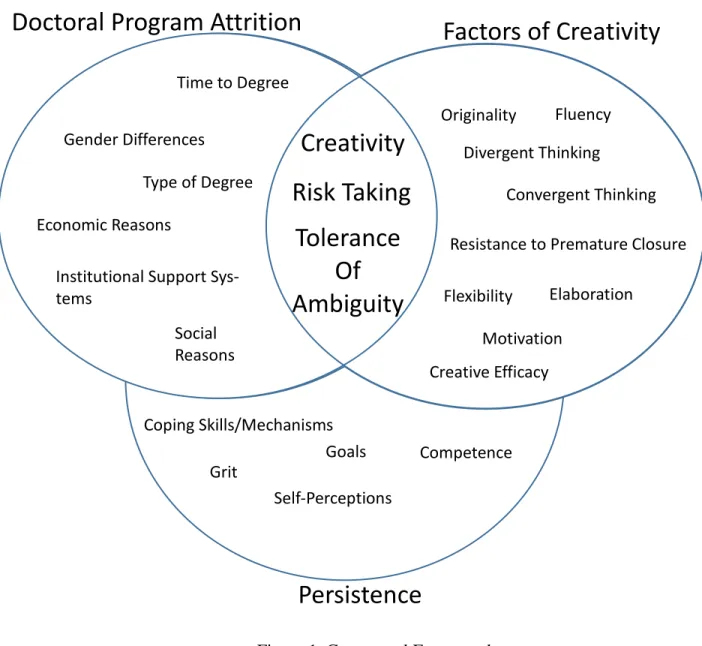
The conceptual framework of this study is represented by a Venn diagram in Figure 1. This Venn diagram depicts the three variables for this study: Doctoral program attrition, creativ-ity, and persistence. The intersection of these three variables illustrate the focus of this study by
examining the concepts that underlie doctoral program persistence and doctoral program attri-tion, namely, creativity and the related factors of tolerance for ambiguity and risk taking. Schol-arly research was consulted as well as reports published by such organizations as the Council of Graduate Studies. These organizations publish reports that provide information regarding doc-toral program attrition rates at institutions of higher learning in the United States.
Figure 1. Conceptual Framework
Persistence
Factors of Creativity
Originality FluencyFlexibility Elaboration
Resistance to Premature Closure Convergent Thinking Divergent Thinking Motivation Type of Degree Gender Differences Economic Reasons Self-Perceptions Competence Coping Skills/Mechanisms
Risk Taking
Tolerance
Of
Ambiguity
Goals Creative Efficacy Institutional SupportSys-tems
Grit
Creativity
Doctoral Program Attrition
Time to Degree
Social Reasons
Definition of Terms
Creativity – is defined by Torrance (1979) as, “…infinite. It is shaking hands with the future. And genius is a creative mind adapting itself to the shape of things to come” (p. 194) Amabile (2013) as, “the production of a novel and appropriate response, product, or solution to an open-ended task” (p. 3), and Sternberg (2006) as, “creativity requires a confluence of six distinct but interrelated resources: intellectual abilities, knowledge, styles of thinking, personality, motiva-tion, and environment" (p. 88).
Doctoral Degree Attriters – those students who did not successfully complete all the require-ments for degree completion, and have either withdrawn from their individual doctoral degree program of choice, or have exceeded the university maximum time to degree completion. Doctoral Degree Completers – those students who have successfully completed all of the re-quirements (coursework, comprehensive exams, clinical internship (only required for some pro-grams) and dissertation completion) for degree completion.
Doctoral Degree Persisters – those students who were successfully persisting through their in-dividual doctoral degree program.
Doctoral Student – students enrolled in a doctoral program of study. Programs offered where this study was performed are defined in the study as; Doctor of Philosophy (Administration; Ap-plied Sciences; Arts; Basic Sciences; Chemistry; Criminology; Design; Education; Engineering; Informatics; Literature; Music; Physical Education; Psychology; Science; Social Science) and Doctor of Education.
Persistence – a personality trait represented by perseverance, continuance, tenacity, determina-tion, doggedness, dedication or resolve.
Risk Taking – a personality trait such as adventurous that represents individual creativity (Ei-senman, 2001; Reisman 2010; Sternberg, Kaufman and Grigorenko, 2008).
Tolerance of Ambiguity – how an individual perceives and handles unknown situations and stimuli (Furnham, 1994; Furnham and Marks, 2013; Zenasni, Besancon & Lubart, 2008).
Limitations and Delimitations Limitations
A limitation of this study was that the researcher could only collect information during a finite period of time. Because of this, the researcher was unable to perform a longitudinal study that could help to distinguish if the possession of the creativity and related factors of tolerance for ambiguity and risk taking, aid in the completion of doctoral programs. As a result, this study could only examine the possession of creativity and the related factors of tolerance for ambiguity and risk taking that participants demonstrate during the conduct of this study.
Another limitation of this study was that the researcher did not examine those students who have attrited from their individual doctoral degree program of choice. While the inclusion of this group would have provided the researcher with an extreme measure of persistence, the ability to capture responses from a group that was no longer a part of the university system would have been difficult at best. These students have already disengaged from the university and may not have been willing to participate in a study that was being conducted where they no longer have any associations. Student email accounts are deleted immediately upon withdrawal. Delimitations
A delimitation of this study is that the researcher examined the possession of the creativ-ity and related factors of tolerance for ambigucreativ-ity and risk taking only in those students who were
currently enrolled and were persisting in doctoral programs of their choice, or had successfully completed their doctoral degree program within one university.
Summary
This proposed research study explored the possession of creativity; and related factors of tolerance for ambiguity and risk taking in students that were enduring and persisting as well as students who had successfully completed their doctoral degree program of choice. Doctoral pro-gram attrition rates remain high, and employing creativity assessments in the admissions selec-tion criteria process may help to potentially lower these rates. By administering self-report measurement instruments to students enrolled and persisting and those students who have suc-cessfully completed doctoral programs, and if those students are found to possess what the self-report measurement instruments are designed to collect (creativity, tolerance for ambiguity and risk taking), it may prove to substantiate these measures as valuable indicators of not only future student performance, but on completion of their intended doctoral programs.
Chapter 2: Literature Review Introduction to Chapter 2
The problem in this proposed study is a lack of an objective creativity assessment that can be added to existing doctoral program selection criteria to possibly help decrease doctoral program attrition rates. This literature review explores doctoral program attrition rates through the lens of creativity.
Conceptual Framework
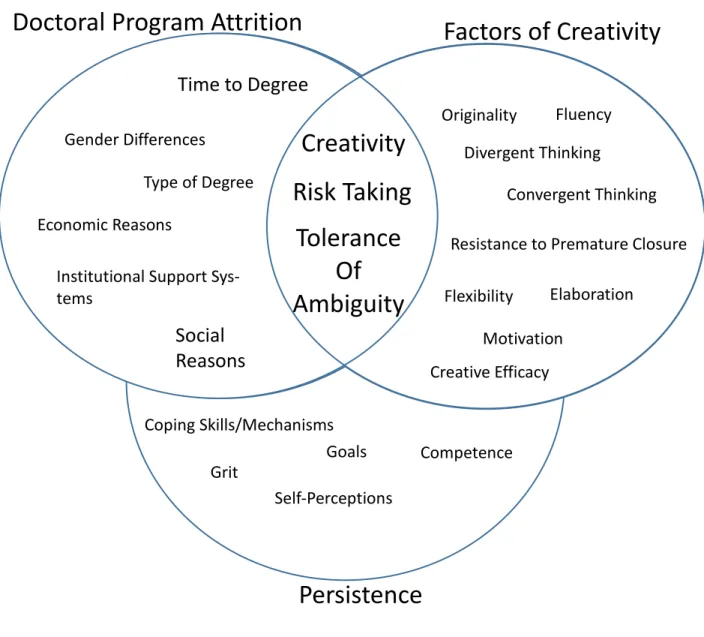
The conceptual framework of this study is represented by a Venn diagram in Figure 2. This Venn diagram depicts the three variables for this study, which are doctoral program attri-tion, creativity, and persistence. The intersection of these three variables, illustrate the focus of this study that underlie doctoral program attrition, which are creativity and the related factors of tolerance for ambiguity and risk taking. Scholarly research was consulted, as well as reports published by such organizations as the Council of Graduate Studies. These organizations publish reports that provide information regarding doctoral program attrition rates at institutions of higher learning in the United States.
This study addressed the following research questions:
1. Are students in different stages of doctoral degree completion, including doctoral pro-gram completers aware of their creativity?
2. How do doctoral program students demonstrate their creativity, especially, tolerance of ambiguity and risk taking as they progress through coursework and other milestones to-wards degree completion?
3. What products or processes do doctoral program completers demonstrate as evidence of their creativity, especially tolerance of ambiguity and risk taking?
4. Is there a relationship between high scores on selected creativity related assessments for doctoral program students in different stages of doctoral program year in status, including doctoral program completers?
Figure 2 – Conceptual Framework
Persistence
Factors of Creativity
Originality FluencyFlexibility Elaboration
Resistance to Premature Closure Convergent Thinking Divergent Thinking Motivation Type of Degree Gender Differences Economic Reasons Self-Perceptions Competence Coping Skills/Mechanisms
Risk Taking
Tolerance
Of
Ambiguity
Goals Creative Efficacy Institutional SupportSys-tems
Grit
Creativity
Doctoral Program Attrition
Time to Degree
Social
Reasons
The research reviewed in this literature review revolves closely amongst the three re-search foundations; doctoral program attrition; and the factors of creativity and persistence. The first stream, doctoral program attrition, focuses on the major studies that have undertaken an ex-amination of doctoral program attrition. The second foundation focuses on creativity theorists and research, with particular focus on tolerance for ambiguity and risk taking. The third research foundation delves into the literature on persistence. This study provides the reader with an un-derstanding of how all of these research foundations intertwine, and illustrates the focus of this study by examining the concepts that underlie persistence and doctoral program attrition, namely; creativity and the related factors of tolerance for ambiguity and risk taking.
Literature Review
Research Foundation 1: Doctoral Program Attrition
Studies indicate that between 40% and 60% of students enrolled in a doctoral program fail to achieve their goal of obtaining their intended degree (Council of Graduate Schools Ph.D. Completion Report, 2008; Gardner, 2009; Golde, 2015; Lovitts, 2001; Nettles & Millet, 2006; Perkins & Lowenthal, 2014). Bair (1999) reports that these levels have remained at this level over the past 50 years. Currently, while there are national databases that track doctoral program completion (Survey of Earned Doctorates by the National Research Council), there are no na-tional databases that track doctoral program attrition levels. More specifically, Bair (1992) states, “Doctoral student attrition as an area of study is highly complex, largely because there are often no systematic data collection processes within programs, within graduate schools, or within college/university records offices” (p. 2).
In an attempt to examine the phenomenon surrounding Doctoral program attrition, sev-eral national studies have been conducted over the past three decades that delve into the causality of these high attrition rates. Most of these studies have been focused on Ph.D. programs, and have examined attrition rates at select institutions. The first of these studies identified for inclu-sion in this literature review was conducted in 1991 by the Andew W. Mellon Foundation, which was called the Graduate Education Initiative (GEI). The GEI was conducted from 1991 – 2000, and provided $58 million to 54 different departments at 10 major research universities. The overall goal of the study was to improve the structure and organization of Ph.D. programs in the humanities and social sciences, in an attempt to address high attrition rates, and long time-to-de-gree rates. Ehrenberg et al. (2007), posited that there were several key characteristics that the GEI focused on as contributing to high rates of attrition, such as, “unclear expectations, a prolif-eration of courses, elaborate and sometimes conflicting requirements, intermittent supervision of doctoral students, epistemological disagreements on fundamentals, and inadequate funding” (p. 135). Further, Rockinson-Szapkiw, Spaulding & Bade (2014) state, “Persistence can be exam-ined in how well institutions establish an environment to meet student’s basic needs which in turn motivate their choices and behaviors” (p. 295).
The Council of Graduate Schools (2004), conducted the Ph.D. Completion Project to ex-amine attrition in doctoral programs. The objective of the first phase of the project was to collect baseline data from 30 participating universities. The results of this first phase revealed a comple-tion rate of 57% within a ten-year time frame that spanned from a high complecomple-tion rate of 64% in the engineering field to a 49% completion rate in the humanities. This project has identified six institutional and programmatic characteristics that can help to influence attrition rates as,
selec-tion into doctoral programs; mentoring of students; providing financial support; doctoral pro-gram environment; research mode of the field, and processes and procedures of the educational institution.
S. K. Gardner (2009a) conducted research that explored the issue of attrition from a fac-ulty and student perspective. The author conducted her study by utilizing a face-to-face inter-view structure. Her findings revealed three themes from both a faculty and student perspective. Faculty participants expressed that students should not have come, student personal problems, and “that the student was lacking in ability, drive, focus, motivation or initiative, as their top three themes. S. K. Gardner (2009) stated “that these were cited most often by the faculty in her study as the reason for doctoral student departure in their departments, and accounted for about half of the total reasons given by the faculty” (p.104). Student participants expressed personal problems, departmental issues and wrong fit in that order as their reasoning for attrition. S. K. Gardner (2009) adds, “…students pointed to several main programmatic issues related to the stu-dents’ decision to leave, including bad advising, lack of financial support, faculty attrition, and departmental policies. Of interest is that while both groups expressed personal problems as one of the top three themes of their respective participant groups, faculty participants cited personal problems at the bottom ranking of the three themes and students cited personal problems at the top of their three rankings.
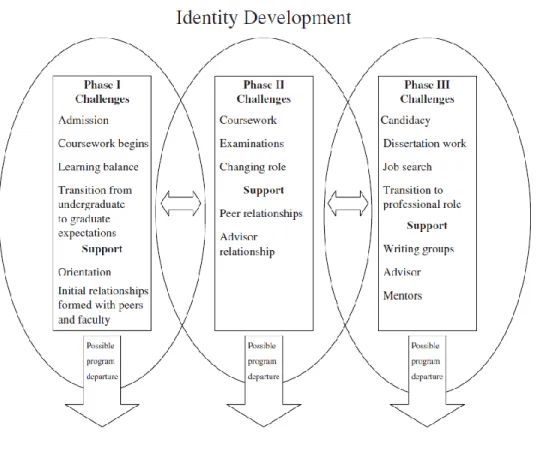
In a monograph by S. K. Gardner (2009b) she presented her model of Doctoral student development (see Figure 3) in an attempt to help understand doctoral program attrition. It’s im-portant to note that Gardner’s model consists of fluid overlapping phases which students enter and then re-enter throughout the conduct of their doctoral program journey. Phase I represents
the time period of acceptance up to commencement of individual student coursework, where stu-dents are just beginning to make the transition to doctoral study and they begin to form
relation-ships with colleagues and professors. Phase II represents the stage where students are actively progressing through their coursework and working towards candidacy. Phase III represents the last stage of the model and is one where students begin to work independently on their individual research studies. S. K. Gardner (2009b) states that her model, “addresses the doctoral experience
from both a programmatic and developmental perspectives, which is to say that the model en-compasses an understanding wherein the student not only changes professionally but also
per-sonally and interperper-sonally” (p.9).
Figure 3. S. K. Gardner’s Doctoral Student Development Model. Source, “The development of Doctoral students: Phases of challenges and support” by S. K. Gardner, 2009, ASHE Higher Ed-ucation Report, 34(6), p. 8. Copyright 2009 by The Association for the Study of Higher Educa-tion. Adapted with permission.
In yet another study, Groen, et al. (2007), examined the effects of the Graduate Educa-tion Initiative (GEI), on attriEduca-tion rates and time-to-degree. The authors collected annual data from the participating institutions of the GEI, where they tracked this data over a 21 year period. They authors posit that by doing so it allowed them to examine and uncover any changes on an annual basis. Their findings revealed that the GEI contributed to the reduction in attrition rates, reducing the time-to-degree and increasing completion rates. The authors state that while the GEI had an impact, it was also aided by individual institutional implementation of lower cohort sizes, an increase in the amount of financial aid available to students as well as an increase in student quality (p. 113).
Bair (1999) performed a meta-synthesis of the literature on doctoral program attrition and persistence. Her analysis revealed that the reasons for attrition varied by such concepts as field of study; program of study; institutional culture; departmental culture; student interpersonal rela-tionships with faculty and dissertation advisor; peer support; financial support as well as student difficulties on an academic level. This study provides a starting point towards the examination of the available research that has been conducted, and offers a wide lens view of the examination of the phenomenon of attrition in doctoral programs.
Doctoral program attrition rates continue to remain high (Bair, 1999; Lovitts, 2001), and further the reasons that students choose to leave their degree program of choice are often not known. It is difficult to elucidate reasoning for attrition from an individual that is no longer pre-sent in a degree program. The literature reprepre-sented here discusses a few of the major studies that were conducted that address doctoral program attrition, as well as the researchers that have
undertaken studies aimed at causation. It is important to present the current literature in an at-tempt to first understand the phenomenon of doctoral program attrition, so that the discovery of potential solutions may arise.
Research Foundation 2 – Creativity
The second foundation is creativity. Creativity, according to Runco (2014) is difficult to define. He states that this difficulty, “…is due in part to it diverse expression; creativity plays a role in technical innovation, education, business, the arts and science, and many other fields” (p. xi). Further he offers that, “…the creative process is multifaceted, and worse yet for those trying to define it, it is extremely complex. An eclectic approach is necessary” (p. xi). Amabile (1997) posits, “At its heart, creativity is simply the production of novel, appropriate ideas in any realm of human activity” (p. 40).
Teresa Amabile’s (1983, 1988, 1996, 2013) theory is a componential model of creativity, meaning that it doesn’t require a stepwise process. Her theory is composed of four components. Three of the four are from within the individual, domain relevant skills, creativity relevant pro-cesses and task motivation. The fourth component is external to the individual, it is the social environment of the individual. Her theory focuses on these components and how they aid in the process of individual creativity. Central to Amabile’s theory is intrinsic motivation. Amabile (1997) states, “…intrinsic motivation resides in a person’s own personality. Some people are more strongly driven than others by the enjoyment and sense of challenge in their work” (p. 40). And further that an individual is at their most creative when, “…they are intrinsically motivated, rather than extrinsically motivated by expected evaluation, surveillance, competition with peers, dictates from supervisors or the promise of rewards” (p. 39).
Lovitts (2008) presents a model of doctoral program completion that places student crea-tive performance at the center. Lovitts (2008) states:
“Contemporary work on creativity has focused on creativity as a social phenomenon that takes place within a social context and involves a sociocultural judgment of the novelty, appropriateness, quality, and importance of a product (as cited in Amambile, 1996; Csikszentmihaly, 1996; Sternberg, 1997a; Sternberg & Lubart, 1995)”.
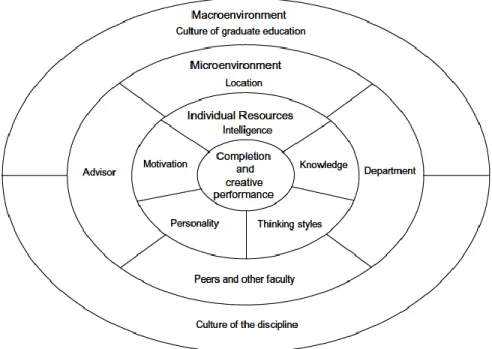
Lovitts (2005) points to the works of Sternberg and Lubart (1995) and Amabile (1996) as sup-porting her model by presenting that the work of these authors provide three components com-prised of six personal and social resources that are needed for creative work: domain-relevant skills (intelligence and knowledge); creativity relevant processes (thinking styles and personal-ity); and task motivation (motivation and environment). Lovitts (2008, 2005) model is com-posed of five rings with completion and creative performance residing in the center ring. The author identifies five resources that students, not only bring with them, but also develop as a re-sult of doctoral program process. Lovitts (2005) states, “These resources are embedded in, inter-act with, and are influenced by finter-actors in the microenvironment (third ring), which are in turn embedded in, interact with, and influenced by factors in the macroenvironment ring (4th ring)” (p. 298), see Figure 4.
Figure 4. Lovitts Model of Factors that Influence Degree Completion and Creative Performance. Source, “The transition to independent research: Who makes it, who doesn’t, and why”, by B. E. Lovitts, 2008, The Journal of Higher Education, 79, p. 298. Copyright 2008 by The Ohio State University.
Lovitts (2005) postulates that by changing variables in the micro and macro environments in her model, that “degree completion and the quality of students’ creative performance can be en-hanced” (p. 151). Further, the author states, changes to the macro environment can bring about a change that deemphasizes the educational systems’, “over-valuation of analytical intelligence and other norms in graduate education that promotes intellectual conformity” (p. 151). Changes to the micro environment, according to Lovitts (2005) could potentially:
“…increase students; integration in their programs, and to better enhance and support the development of the subcomponents identified as most critical to creative performance;
practical and creative intelligence, informal knowledge, a creative style of thought, perse-verance in the face of frustration/failure, tolerance of ambiguity, self-direction, a willing-ness to take risks and intrinsic motivation” (p. 151).
Sternberg, Kaufman and Grigorenko (2008) present the idea that in order for individuals to be considered to be creative, they need to “…regularly and continually step outside the box that themselves as well as others have created for them” (p. 304). And further the authors posit that, “creativity is an essential component of learning and problem solving, because virtually any problem, by the virtue of the definition, imposes on its solver some ambiguity that needs to be overcome in order to find the solution” (p. 304).
Csikszentmihalyi’s (1999) systems theory of creativity is composed of three elements, the domain, which is composed of rules, procedures and/or instructions for action; the field, which is composed of gatekeepers - or decision makers; and finally the individual. Sternberg (1999), fur-ther elaborates on Csikszentmilhalyi’s theory by stating that the theory encompasses, “the inter-action of the individual, the domain and the field. An individual draws upon information in a do-main and transforms or extends it via cognitive processes, personality traits, and motivation” (p., 10). Reisman (2010) adds that according to Csikszentmilhalyi’s theory, “creativity occurs only when an individual, who has mastered his subject matter (domain), is acknowledged by the gate-keepers of his field” (p. 6). For without this acknowledgement, creativity has little chance to flourish.
In an interview with E. Paul Torrance in 1998, Shaughnessy (1998) asked the theorist about his personal definition of creativity. Torrance offered that he had struggled with his per-sonal definition of creativity for 40 years, but his most satisfying definition was what he referred to as his survival definition. “When a person has no learned or practiced solution to a problem,
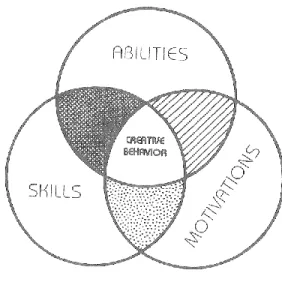
some degree of creativity is required” (p. 443). Torrance suggested in the interview that when trying to conceptualize an individual definition of creativity, one should look towards analogies to help them in the process. Two of his suggested analogies are, “Creativity is like singing in your own key, and creativity is like shaking hands with tomorrow” (as cited in Shaughnessy (1998) ). In his book, The search for Satori & Creativity, Torrance (1979) presents his model for studying and predicting creative behavior. Torrance’s model (as seen in Figure 5), addresses the abilities, skills and motivations that enable individual creativity.
Figure 5. E Paul Torrance’s model for studying and predicting creative behavior. Source: The Search for Satori & Creativity by E. Paul Torrance, 1979.
Torrance states, “A high level of creative achievement can be expected consistently only from those who have creative motivation (commitment) and the skills necessary to accompany the cre-ative abilities” (p. 12).
Torrance (1995, 1962) created the Torrance Tests of Creative Thinking (TTCT). The TTCT is a subjective measure of creativity that uses a psychometric approach to evaluate an in-dividual’s level of creativity. The TTCT uses a similar approach to the work of J. P. Guilford (1950) in that they both examine divergent thinking factors effect on creativity. The TTCT was Torrance’s attempt to develop a measure that was not only quantifiable, but one that would em-ploy the use of scientific measures to examine creativity. Upon its original release, the TTCT was composed of four scales, which included, fluency; flexibility; originality and elaboration. Creativity is assessed using the TTCT via two methods, a figural or verbal assessment. The ver-bal method is composed of five different parts, Ask-and-Guess, Product Improvement, Unusual Uses, Unusual Questions, and Just Suppose. The figural method employs the use of three sepa-rate tasks which are picture construction, incomplete figures and repeated figures to which par-ticipants draw their response.
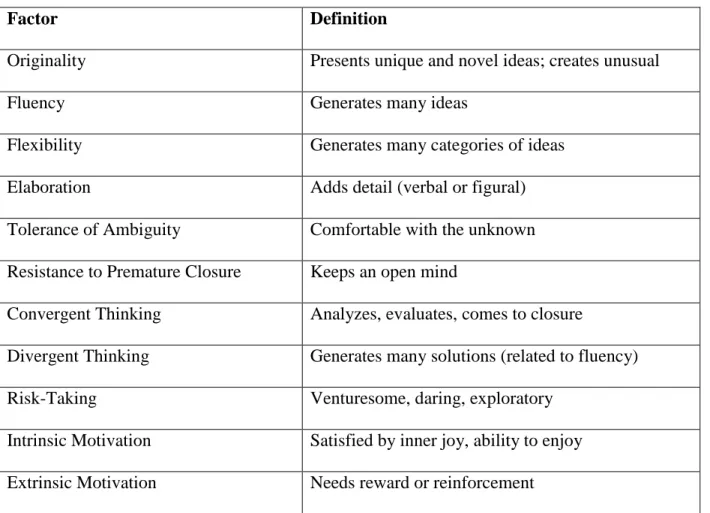
The Reisman Diagnostic Creativity Assessment (RDCA), (Reisman, 2010) is grounded in the work of the TTCT, which is based on the work of Guilford (1967), and his Structure of the Intellect Model. The RDCA is a diagnostic self-report 40-item Likert type measure that exam-ines an individual’s self-perception of 11 major creativity factors that have emerged from the creativity research. These 11 factors and their definitions are described in Table 1.
Table 1. Reisman Diagnostic Creativity Assessment Factors and Definitions
Factor Definition
Originality Presents unique and novel ideas; creates unusual
Fluency Generates many ideas
Flexibility Generates many categories of ideas Elaboration Adds detail (verbal or figural) Tolerance of Ambiguity Comfortable with the unknown Resistance to Premature Closure Keeps an open mind
Convergent Thinking Analyzes, evaluates, comes to closure
Divergent Thinking Generates many solutions (related to fluency) Risk-Taking Venturesome, daring, exploratory
Intrinsic Motivation Satisfied by inner joy, ability to enjoy Extrinsic Motivation Needs reward or reinforcement
Source: Creativity in Business, 2014 KIE Conference Book Series, Research Papers on Knowledge, Innovation and Enterprise Volume II. Chapter 1, Page 21.
According to Reisman (2014), the RDCA has been designed to:
“…be used diagnostically to identify one’s creative strengths, rather than to predict crea-tivity. The RDCA results can be used to provide the assessment taker with the following information: an instant creativity score; scores to identify specific creativity factors in which the taker may already be strong; factors they may be personally satisfied with and wish to strengthen” (p. 25).
For the purposes of this study the researcher focused on two of the 11 major creativity factors identified by Reisman (2014); those being tolerance for ambiguity and risk taking. One of the personality traits that creative individuals possess is that of tolerance of ambiguity (Reis-man, 2008; Sternberg, Kaufman and Grigorenko, 2008; Zenasni, Besancon and Lubart, 2008). Sternberg, Kaufman and Grigorenko (2008) describe tolerance for ambiguity by also placing it in the context of creativity. The authors posit that creative ideas usually develop over time, and fur-ther that, “…the period in which the idea is developing tends to be uncomfortable. Without time, or the ability to tolerate ambiguity, many may jump to a less than optimal solution” (p. 300). Tolerance for Ambiguity
Tolerance for ambiguity is a component of creativity, and can best be described as an in-dividual’s ability to handle ambiguous situations. Zenasni, Besancon and Lubart (2008) posit that individuals who are tolerant of ambiguity, “may be able to work effectively on a larger set of stimuli or situations, including ambiguous ones, whereas intolerant individuals will avoid or quickly stop treating such information” (p. 62). The authors also present that tolerance for ambi-guity is what allows individuals to optimize their creative potential. Their study examined the relationship between tolerance for ambiguity and creativity in 68 volunteer participants that con-sisted of 34 pairs of adolescents and their parents. The authors utilized 3 measures of creativity, a divergent thinking task, a story writing task and a self-evaluation of creative attitudes and be-haviors. To measure tolerance for ambiguity, they utilized two separate measures, a shortened version of the Measurement of Ambiguity Tolerance (MAT) by Norton (1975) and the Behavior Scale of Tolerance/Intolerance of Ambiguity (BSTIA) by Stoycheva (1998, as cited in Zenasni, Besancon and Lubart (2008). Their findings not only revealed that participants had a positive
relationship between tolerance for ambiguity and creativity but that there was also a positive cor-relation wherein that the more that individuals are tolerant of ambiguity, the more creative they become.
Individuals that tolerate ambiguity, according to Zenasni, Besancon and Lubart (2008), are those individuals that “…may be able to work effectively on a larger set of stimuli or situa-tions, including ambiguous ones, whereas intolerant individuals will avoid or quickly stop treat-ing such information. In fact, tolerance of ambiguity allows individuals to optimize creative po-tential” (p. 62). The authors further state that the more tolerant a person is of ambiguous ob-jects, “…the more the person can deal with them. Thus, tolerance of ambiguity will allow indi-viduals to continue to grapple with complex problems, to remain open, and increase the probabil-ity of finding a novel solution” (p. 62). Tolerance of ambiguprobabil-ity is one of the personalprobabil-ity traits that this study examined, and risk taking is the other personality trait that scholars agree is a trait of creative individuals (Reisman, 2008; Sternberg, Kaufman and Grigorenko, 2008; Zenasni, Besancon and Lubart, 2008).
Risk Taking
Risk taking is a personality trait that represents individual creativity (Reisman 2010; Ei-senman 2001; Sternberg, Kaufman and Grigorenko, 2008). Sternberg, Kaufman and Grigorenko (2008), posit that risk taking is one of the traits that comes up regularly in discussions that ad-dress the individual traits of creativity. In further support, Runco (2014) presents that risk taking helps us to understand the creative tendencies of individuals, because creative ideas themselves are risky. He states, “There is, then, a risk involved in considering or sharing ideas, and the more original the idea, the larger the risk” (p. 299). Golde (2015) states, “A doctoral program is punc-tuated by a series of high stakes tests and hurdles. Throughout the process the stakes are high,
and students are expected to perform at a very high level. Surviving the tests makes them stronger” (p. 212).
According to Reisman (2010), creative individuals possess certain characteristics such as, “a high level of curiosity, willingness to learn from experience, preparedness to take risks, per-sistence in situations of failure, high levels of energy” (p. 3). Runco (2014) adds, “The creative personality can be described with some combination of the following: …tolerance of ambiguity, risk taking or risk tolerance” (p. 314).
Risk taking according to Eisenman (2001) is defined as the phenomenon that occurs when, “creative people take risks by coming up with new ideas that challenge the way something is understood” (p. 189). The author further defines risk taking in creative individuals as, “…go-ing against the intellectual tide in one’s field and risk“…go-ing professional reputation by com“…go-ing up with a very new idea” (p. 189). Sternberg, Kaufman and Grigorenko (2008) add to this discus-sion by stating that, “Nearly every major discovery or invention entailed some risk” (p.298). And further, that when an individual sets out to take a risk, they “…must realize that some of them just will not work, and that is the cost of doing creative work” (p. 299).
Creativity and the component factors of tolerance for ambiguity and risk taking, may help to increase the understanding of the need to include additional selection criteria measures, specif-ically, creativity assessments, into already existing doctoral program admissions criteria. The addition of creativity assessments could provide admission boards with critical information re-garding the expectation of applicant degree completion. These assessments may serve to be bet-ter predictors of doctoral program persistence and follow on student success.
Research Foundation 3 – Persistence
Doctoral program persistence and the factors that allow for successful navigation of the degree program is a topic that many have studied (Spaulding and Rockinson-Szapkiw 2012; Lovitts, 2008; Bair and Haworth, 1999; Bowen & Rudenstine, 1992, Golde, 2000). A review of the literature reveals that persistence in doctoral programs is resultant of student interaction, on an institutional as well as a social level (Spaulding & Rockinson-Szapkiw (2012).
Welhan (1997) performed a study where she examined persistence amongst doctoral pro-gram nursing students. Her model of persistence (Figure 6) is based on her identification of an-tecedents and consequences of persistence. In her model, anan-tecedents are composed of goal identification, energy for involvement, necessary skills, and incentives, and consequences are composed of goal attainment and goal readjustment. Further, Whelan defines persistence as, “…a complex phenomenon that is defined as a personal characteristic in which an individual dis-plays voluntary enduring commitment to a goal or course of action despite obstacles and/or op-position” (p. 26).
Figure 6. Whelan’s model of persistence. Adapted with permission from An explication of the concept of persistence and its application to nursing education by Beverly Lutz Welhan, 1997.
Grit has also been related to persistence. Duckworth, Peterson, Mathews & Kelly (2007) define grit as, “… perseverance and passion for long-term goals. Grit entails working strenu-ously toward challenges, maintaining effort and interest over years despite failure, adversity, and plateaus in progress" (p. 1087). And further, the authors postulate that, "grit is essential to high achievement evolved during interviews with professionals in investment banking, painting, jour-nalism, academia, medicine, and law" (p. 1088). Grit is what allows some individuals to succeed when others may abandon a task, course of study or project altogether.
In their study, Kelly, Mathews and Bartone (2014), examined the selection criteria of po-tential candidates to West Point Academy. Their study utilized a less traditional non-aptitude or non-cognitive factor that they used for the prediction of performance. The author’s state,