Performance characterization and optimization of
in-memory data analytics on a scale-up server
Ahsan Javed Awan
ADVERTIMENT La consulta d’aquesta tesi queda condicionada a l’acceptació de les següents condicions d'ús: La difusió d’aquesta tesi per mitjà del r e p o s i t o r i i n s t i t u c i o n a l UPCommons (http://upcommons.upc.edu/tesis) i el repositori cooperatiu TDX (h t t p : / / w w w . t d x . c a t /) ha estat autoritzada pels titulars dels drets de propietat intel·lectual
únicament per a usos privats emmarcats en activitats d’investigació i docència. No s’autoritza
la seva reproducció amb finalitats de lucre ni la seva difusió i posada a disposició des d’un lloc aliè al servei UPCommons o TDX. No s’autoritza la presentació del seu contingut en una finestra o marc aliè a UPCommons (framing). Aquesta reserva de drets afecta tant al resum de presentació de la tesi com als seus continguts. En la utilització o cita de parts de la tesi és obligat indicar el nom de la persona autora.
ADVERTENCIA La consulta de esta tesis queda condicionada a la aceptación de las siguientes condiciones de uso: La difusión de esta tesis por medio del repositorio institucional UPCommons (http://upcommons.upc.edu/tesis) y el repositorio cooperativo TDR ( http://www.tdx.cat/?locale-attribute=es) ha sido autorizada por los titulares de los derechos de propiedad intelectual
únicamente para usos privados enmarcados en actividades de investigación y docencia. No se autoriza su reproducción con finalidades de lucro ni su difusión y puesta a disposición desde un sitio ajeno al servicio UPCommons No se autoriza la presentación de su contenido en una ventana o marco ajeno a UPCommons (framing). Esta reserva de derechos afecta tanto al resumen de presentación de la tesis como a sus contenidos. En la utilización o cita de partes de la tesis es obligado indicar el nombre de la persona autora.
WARNING On having consulted this thesis you’re accepting the following use conditions: Spreading this thesis by the i n s t i t u t i o n a l r e p o s i t o r y UPCommons (http://upcommons.upc.edu/tesis) and the cooperative repository TDX ( http://www.tdx.cat/?locale-attribute=en) has been authorized by the titular of the intellectual property rights only for private uses placed in investigation and teaching activities. Reproduction with lucrative aims is not authorized neither its spreading nor availability from a site foreign to the UPCommons service. Introducing its content in a window or frame foreign to the UPCommons service is not authorized (framing). These rights affect to the presentation summary of the thesis as well as to its contents. In the using or citation of parts of the thesis it’s obliged to indicate the name of the author.
Performance Characterization and Optimization of
In-Memory Data Analytics on a Scale-up Server
AHSAN JAVED AWAN
Doctoral Thesis in Computer Architecture
Universitat Politècnica de Catalunya
Departament d’Arquitectura de Computadors,
Barcelona, Spain 2017
and
Doctoral Thesis in Information and Communication Technology
KTH Royal Institute of Technology
School of Information and Communication Technology
Stockholm, Sweden 2017
TRITA-ICT 2017:23 ISBN: 978-91-7729-584-6
KTH School of Information and Communication Technology SE-164 40 Kista SWEDEN Akademisk avhandling som med tillstånd av Kungl Tekniska högskolan framlägges till offentlig granskning för avläggande av teknologie doktorsexamen i informations och kommunikationsteknik fredagen den 15 december 2017 klockan 09.00 i Sal-C, Electrum, Kungl Tekniska högskolan, Kistagången 16, Kista.
© Ahsan Javed Awan, Dec 2017. All previously published papers were reformatted from the pre-print version
Joint Thesis Defence Committee
The joint thesis defence committee comprises following members • Moderator:
Assoc. Prof. Jim Dowling, KTH Royal Institute of Technology, Sweden. • Opponent:
Prof. Lieven Eckhout, Ghent University, Belgium. • Grading Board for both KTH and UPC:
Prof. Babak Falsafi, Ecole Polytechnique Fédérale de Lausanne (EPFL), Switzerland.
Prof. Dimitrios S. Nikolopoulos, Queen’s University of Belfast, North-ern Ireland, UK.
Prof. Avi(Abraham) Mendelson, Technion Israel University of Technol-ogy, Israel.
• External Reviewers for UPC:
Prof. Avi(Abraham) Mendelson, Technion Israel University of Technol-ogy, Israel.
Assoc. Prof. Johnny Öberg, KTH Royal Institute of Technology, Swe-den.
• Advance Reviewer for KTH:
Assoc. Prof. Johnny Öberg, KTH Royal Institute of Technology, Swe-den.
Abstract
The sheer increase in the volume of data over the last decade has trig-gered research in cluster computing frameworks that enable web enterprises to extract big insights from big data. While Apache Spark defines the state of the art in big data analytics platforms for (i) exploiting data-flow and in-memory computing and (ii) for exhibiting superior scale-out performance on the commodity machines, little effort has been devoted to understanding the performance of in-memory data analytics with Spark on modern scale-up servers. This thesis characterizes the performance of in-memory data analyt-ics with Spark on scale-up servers.
Through empirical evaluation of representative benchmark workloads on a dual socket server, we have found that in-memory data analytics with Spark exhibit poor multi-core scalability beyond 12 cores due to thread level load imbalance and work-time inflation (the additional CPU time spent by threads in a multi-threaded computation beyond the CPU time required to perform the same work in a sequential computation). We have also found that work-loads are bound by the latency of frequent data accesses to the memory. By enlarging input data size, application performance degrades significantly due to the substantial increase in wait time during I/O operations and garbage collection, despite 10% better instruction retirement rate (due to lower L1 cache misses and higher core utilization).
For data accesses, we have found that simultaneous multi-threading is effective in hiding the data latencies. We have also observed that (i) data locality on NUMA nodes can improve the performance by 10% on average, (ii) disabling next-line L1-D prefetchers can reduce the execution time by up-to 14%. For garbage collection impact, we match memory behavior with the garbage collector to improve the performance of applications between 1.6x to 3x. and recommend using multiple small Java virtual machines (JVMs) that can provide up-to 36% reduction in execution time over single large JVM. Based on the characteristics of workloads, the thesis envisions near-memory and near storage hardware acceleration to improve the single-node performance of scale-out frameworks like Apache Spark. Using modeling tech-niques, it estimates the speed-up of 4x for Apache Spark on scale-up servers augmented with near-data accelerators.
Sammanfattning
Det senaste årtiondets ökning av datavolym har uppmuntrat forskning kring ”cluster computing” och hur man möjliggör extrahering av insikter från stora datamängder. Trots att kända ramverk som till exempel Apache Spark definerar hur man utnyttjar beräkningar på strömmande data och på data som ligger resident i minnet, samt hur man uppnår skalbarhet med lätt tillängliga komponenter, så förstår man ännu inte fullt ut prestanda eller de analytiska-aspekterna av beräkning på data resident i minnet hos moderna flerkärniga servrar.
Denna avhandling behandlar karakterisering av minnesresident data analys i Apache Spark. Vi har genomfört empiriska undersökningar på välkända test-program som pekar på att skalbarheten hos Apache Spark är begränsad till 12 processorkärnor. De testprogram lider huvudsakligen av begränsningar i accesser till huvudminnet.
Vi fann att en ökning av problemets storlek (öningen av behandlad datamängd) medförde en 10% snabbare instruktionsexekvering, men även tillförde en ökad last på in- och utmatningsenheter och skräpsamling som gör att skalbarheten försämras ytterligare vid ökning av data-mängd.
We fann att moderna, flertrådade processorer döljer minnes-latenser väldigt bra. Vi har också observerat att det finns möjlighet för upp till 10% för-bättrad prestanda om man tar hänsyn till var data är placerat i minnet. Denna förbättrade kan uppnås i såkallade NUMA system. Vi föreslår även förbättringar i hårdvaran som hämtar data på förhand, där vi har kvantifierat förbättringarna till upp till 14% för första-nivå cachen.
Genom att anpassa skräpsamlingen till användningen av data i program-met har vi har visat på upp till tre gångers förbättrad prestande. Vi föreslår användningen av flera små exekveringsprocesser i Javamotorn som kör pro-grammet, istället för en stor då vi visat att det kan ge upp till 36% uppsnabb-ning.
Abstracto
El gran aumento del volumen de datos en la última década (conocido como Big Data) ha desencadenado un gran esfuerzo de investigación en el marco de la computación en clúster, permitiendo a las empresas de Internet extraer conocimiento de dicho Big Data. Actualmente Apache Spark representa el estado del arte en cuanto a plataformas de análisis de Big Data (i) por su capacidad de explotar la computación data-flow con datos in-memory, y (ii) por un rendimiento y escalado con el numero de procesadores adecuado en las arquitecturas comerciales actuales. Sin embargo, poco esfuerzo se ha dedicado a entender dicho rendimiento y justificar los principales factores que estarían limitándolo en los servidores escalables de hoy en día. Esta tesis caracteriza el rendimiento de estos entornos de análisis de datos en memoria basados en Spark.
A través de una evaluación empírica, utilizando cargas de trabajo de ref-erencia y representativas, en un servidor de doble socket, se ha concluido una falta de escalabilidad más allá de los 12 núcleos, básicamente debida a de-sequilibrios de la carga de trabajo a nivel de threads (flujos de ejecución), al aumento del tiempo de ejecución de cada core respecto a la ejecución se-cuencial, y la latencia de los accesos de los datos que residen en la memoria DRAM. Al aumentar el tamaño de los datos de entrada, el rendimiento de la aplicación se reduce significativamente debido al aumento en el tiempo de espera durante las operaciones de E/S y el garbage collector (GC), a pesar que la finalización de las instrucciones mejora en un 10% (debido a una menor tasa de fallo de la memoria caché L1 y mayor utilización de los núcleos del procesador).Para tolerar la latencia en los accesos a los datos, se ha concluido que el multi-threading simultáneo resulta eficaz y que (i) la mejora de la lo-calidad a nivel de nodos NUMA puede mejorar el rendimiento en un 10% en promedio y (ii) deshabilitar la pre-búsqueda de datos a nivel de L1-D puede reducir el tiempo de ejecución del orden del 14%. En cuanto al impacto del GC, se observa que es posible mejorar el rendimiento de las aplicaciones en un factor entre 1.6x y 3x a base de utilizar múltiples pequeños ejecutores en vez de un único gran ejecutor.
En base a los resultados y análisis realizados en las cargas de trabajo utilizadas, la tesis doctoral analiza las posibilidades de utilizar unidades de cálculo cercanas a la memoria (near-memory) y a los dispositivos de alma-cenamiento (near-storage), mejorando así el rendimiento de los nodos que se utilicen para la ejecución de Apache Spark. Se presenta un modelo que es-tima una mejora de 4x en el rendimiento de Apache Spark usando aceleradores hardware cercanos a los datos.
To my grandfather, "Attah Muhammad" and my grandmother, "Azam
Attah" whom I lost during this PhD
Acknowledgements
I am grateful to Allah Almighty for His countless blessings. I would like to thank my supervisors Mats Brorsson, Vladimir Vlassov at KTH, Sweden and Eduard Ayguade at UPC/BSC, Spain for their guidance, feedback, and encouragement. I am indebted to my fellow Ph.D. students; Roberto Castañeda Lozano for providing the thesis template, Georgios Varisteas, Artur Podobas, Vamis Xhagjika, Nava-neeth Rameshan and Muhammad Anis-ud-din Nasir for discussions on my work and to Ananya Muddukrishna and Artur Podobas for improving the first draft of my papers. With-out Thomas Sjöland taking care of the financial aspects and Sandra Gustavsson Nylén, Susy Mathew, Madeleine Prints looking after the admin-istration stuff, it would not have been a smooth journey. I also thank Jim Dowling for reviewing the Licentiate thesis and acting as the internal quality controller. I am also obliged to Christian Schulte, David Broman, Seif Haridi and Sverker Jansson for their feedback on my progress. I also acknowledge Moriyoshi Ohara, Kazuaki Ishizaki, Lydia Chen, Frank Liu, Thomas Parnell and Peter Hofstee from IBM Re-search. Finally, I am grateful to Marcel Van De Burgwal in particular and Recore Systems in general for providing me both technical input and FPGA device to fin-ish the research work. Johnny Öberg and Ingo Sander from Embedded Systems, Dept, KTH are also deeply appreciated for providing access to Xilinx Tool Chain. I am also obliged to Petar Radojković, David Carrera Perez, and Jordi Torres Vinals from UPC/BSC for providing detailed feedback on the initial draft of the thesis.
This work was supported by Erasmus Mundus Joint Doctorate in Distributed processing (EMJD-DC) program funded by the Education, Audiovisual and Culture Executive Agency (EACEA) of the European Commission. It was also supported by the Spanish Government through Programa Severo Ochoa (SEV-2015-0493), by the Spanish Ministry of Science and Technology through the TIN2015-65316-P project and by the Generalitat de Catalunya (contract 2014-SGR-1051). European Network on High Performance and Embedded Architecture and Compilation (HiPEAC) sup-ported the research through it’s Industrial Ph.D. Mobility Programme and collab-oration grants. Databricks supported the research in disseminating the results to the industry by granting academic passes and invited talks to its industrial events.
Contents
1 Introduction 1 1.1 List of Publications . . . 3 1.2 Chapter Highlights . . . 4 Chapter 3: . . . 4 Chapter 4: . . . 4 Chapter 5 . . . 5 Chapter 6 . . . 6 Chapter 7: . . . 7 Chapter 8: . . . 7 1.3 Thesis Statement . . . 82 Background and Related Work 9 2.1 Horizontally Scaled Systems . . . 9
Spark . . . 10
Spark Streaming . . . 10
Garbage Collection . . . 10
2.2 Vertically Scaled Systems . . . 11
2.3 GPU based Heterogeneous Clusters . . . 11
2.4 FPGA based Heterogeneous Clusters . . . 12
Acceleration on a CPU-FPGA Heterogeneous Platform . . . 13
Acceleration using CAPI . . . 13
Acceleration using Intel Heterogeneous Architecture Research Platform (HARP) [82] . . . 14
Acceleration using Xilinx Zynq SoC [181] . . . 16
Integration of Accelerators into Big Data Frameworks . . . 17
Apache Spark [190] acceleration . . . 17
Apache Hadoop [156] Acceleration . . . 19
MapReduce Acceleration . . . 20
Approaches to integrate native code in java virtual machine based frameworks . . . 21
2.5 Processing in DRAM Memory . . . 22
PIM for Graph Analytics . . . 24
PIM for Machine Learning Workloads . . . 24
PIM for SQL Query Analysis Workloads . . . 25
PIM for Data Reorganization Operations . . . 26
2.6 Processing in Nonvolatile Memory . . . 26
2.7 Processing in Hybrid 3D-Stacked DRAM and NVRAM . . . 31
2.8 Interoperability of PIM with Cache and Virtual Memory . . . 32
2.9 Profiling Bigdata Platforms . . . 32
2.10 Project Tungsten . . . 33
2.11 Hardware Prefetching . . . 34
2.12 New Server Architectures . . . 34
Microservers for Big Data Analytics . . . 34
Novel Server Processors . . . 35
System-Level Integration (Server-on-Chip) . . . 35
3 Identifying the Performance bottlenecks for In-Memory Data Analytics 37 3.1 Introduction . . . 38
3.2 Background . . . 38
Spark . . . 38
Top-Down Method for Hardware Performance Counters . . . 39
3.3 Methodology . . . 40
Benchmarks . . . 40
System Configuration . . . 41
Measurement Tools and Techniques . . . 43
Metrics . . . 43 3.4 Scalability Analysis . . . 44 Application Level . . . 44 Stage Level . . . 44 Tasks Level . . . 45 3.5 Scalability Limiters . . . 47 CPU Utilization . . . 47
Load Imbalance on Threads . . . 48
Work Time Inflation . . . 49
Micro-architecture . . . 50
Memory Bandwidth Saturation . . . 52
3.6 Related Work . . . 52
3.7 Conclusion . . . 56
4 Understanding the Impact of Data Volume on In-Memory Data Analytics 57 4.1 Introduction . . . 58
4.2 Background . . . 59
Benchmarks . . . 59
System Configuration . . . 60
Measurement Tools and Techniques . . . 62
4.4 Scalability Analysis . . . 62
Do Spark based data analytics benefit from using scale-up servers? . 62 Does performance remain consistent as we enlarge the data size? . . 63
4.5 Limitations to Scale-up . . . 63
How severe is the impact of garbage collection? . . . 63
Does file I/O become a bottleneck under large data volumes? . . . . 65
Is micro-architecture performance invariant to input data size? . . . 66
4.6 Related Work . . . 68
4.7 Conclusions . . . 68
5 Understanding the Impact of Data Velocity on In-Memory Data Analytics 71 5.1 Introduction . . . 72 5.2 Background . . . 73 Spark . . . 73 Spark MLlib . . . 73 Graph X . . . 73 Spark SQL . . . 73 Spark Streaming . . . 74 Garbage Collection . . . 74
Spark on Modern Scale-up Servers . . . 74
5.3 Methodology . . . 75
Workloads . . . 75
System Configuration . . . 75
Measurement Tools and Techniques . . . 76
5.4 Evaluation . . . 80
Does micro-architectural performance remain consistent across batch and stream processing data analytics? . . . 80
How does data velocity affect micro-architectural performance of in-memory data analytics with Spark? . . . 83
5.5 Related Work . . . 88
5.6 Conclusion . . . 88
6 Understanding the efficacy of architectural features in scale-up servers for In-Memory Data Analytics 91 6.1 Introduction . . . 92
6.2 Background . . . 93
Spark . . . 93
Spark on Modern Scale-up Servers . . . 93
6.3 Methodology . . . 94
System Configuration . . . 96
Measurement Tools and Techniques . . . 99
Top-Down Analysis Approach . . . 99
6.4 Evaluation . . . 100
How much performance gain is achievable by co-locating the data and computations on NUMA nodes for in-memory data analytics with Spark? . . . 100
Is simultaneous multi-threading effective for in-memory data analyt-ics with Spark? . . . 101
Are existing hardware prefetchers in modern scale-up servers effective for in-memory data analytics with Spark? . . . 105
Does in-memory data analytics with Spark experience loaded laten-cies (happens if bandwidth consumption is more than 80% of sustained bandwidth)? . . . 108
Are multiple small executors (which are java processes in Spark that run computations and store data for the application) better than single large executor? . . . 111
6.5 The case of Near Data Computing both in DRAM and in Storage . . 112
6.6 Related Work . . . 113
6.7 Conclusion . . . 114
7 The Case of Near Data Processing Servers for In-Memory Data Analytics 115 7.1 Introduction . . . 116
7.2 Background and Related Work . . . 117
Spark . . . 117
Near Data Processing . . . 117
Related work for NDP . . . 118
Applications of PIM . . . 118
In-Storage Processing . . . 119
7.3 Big Data Frameworks and NDP . . . 119
Motivation . . . 119
Methodology . . . 120
Workloads . . . 120
System Configuration . . . 120
Measurement Tools and Techniques . . . 122
7.4 Evaluation . . . 124
The case of ISP for Spark . . . 124
The case of PIM for Apache Spark . . . 126
The case of 2D integrated PIM instead of 3D stacked PIM for Apache Spark . . . 128
The case of Hybrid 2D integrated PIM and ISP for Spark . . . 135
8 The practicalities of Near Data Accelerators augmented
Scale-up servers for In-Memory Data Analytics 137
8.1 Introduction . . . 138
8.2 System Design . . . 138
Challenges . . . 138
High Level Design . . . 139
CAPI Specific Optimization . . . 140
HDL vs. HLL . . . 140
Task Pipelining . . . 140
Function Inlining . . . 140
Loop Pipelining . . . 141
Loop Unrolling . . . 141
Performance Limiting Factors and Remedies . . . 141
Array Partitioning . . . 142
Array Reshaping . . . 142
Data Flow Pipelining . . . 142
Function Data Flow Pipelining . . . 142
Loop Data Flow Pipelining . . . 143
Opportunities and Limitations of High-Level Synthesis for Big Data Workloads . . . 143
Programmable Accelerators for iterative map-reduce programming model . . . 144
Advantages of our design . . . 146
8.3 Evaluation Technique and Results . . . 147
8.4 Conclusion . . . 149
9 Conclusion and Future Work 151
Chapter 1
Introduction
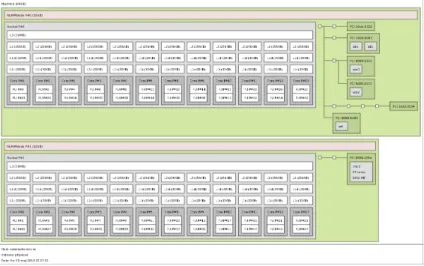
With a deluge in the volume and variety of data collecting, web enterprises (such as Yahoo, Facebook, and Google) run big data analytics applications using clusters of commodity servers. However, it has been recently reported that using clusters is a case of over-provisioning since a majority of analytics jobs do not process really big data sets and those modern scale-up servers are adequate to run analytics jobs [21]. Additionally, commonly used predictive analytics such as machine learning algo-rithms, work on filtered datasets that easily fit into the memory of modern scale-up servers. Moreover, the today’s scale-up servers can have CPU, memory and persis-tent storage resources in abundance at affordable prices. Thus we envision a small cluster of scale-up servers to be the preferable choice of enterprises in near future. While Phoenix [188], Ostrich [40] and Polymer [195] are specifically designed to exploit the potential of a single scale-up server, they do not scale-out to multiple scale-up servers. Apache Spark [190] is getting popular in the industry because it enables in-memory processing, scales out to a large number of commodity machines and provides a unified framework for batch and stream processing of big data work-loads. However, its performance on modern scale-up servers is not fully understood. Knowing the limitations of modern scale-up servers for in-memory data analytics with Spark will help in achieving the future goal of improving the performance of in-memory data analytics with Spark on small clusters of scale-up servers. The scale-up server used for characterization studies in thesis is shown in Fig 1.1
Our contributions are:
• We perform an in-depth evaluation of Spark-based data analysis workloads on a scale-up server. We discover that work time inflation (the additional CPU time spent by threads in a multi-threaded computation beyond the CPU time required to perform the same work in a sequential computation) and load imbalance on the threads are the scalability bottlenecks. We quantify the impact of micro-architecture on the performance and observe that DRAM latency is the major bottleneck.
Figure 1.1: Scale-up Server used for Characterization Studies in the thesis
• We evaluate the impact of data volume on the performance of Spark-based data analytics running on a scale-up server. We find the limitations of using Spark on a scale-up server with large volumes of data. We quantify the variations in micro-architectural performance of applications across different data volumes.
• We characterize the micro-architectural performance of Spark-core, Spark Ml-lib, Spark SQL, GraphX and Spark Streaming. We quantify the impact of data velocity on the micro-architectural performance of Spark Streaming. We analyze the impact of data locality on NUMA nodes for Spark. We analyze the effectiveness of Hyper-threading and existing prefetchers in Ivy Bridge server to hide data access latencies for in-memory data analytics with Spark. We quantify the potential for high bandwidth memories to improve the perfor-mance of in-memory data analytics with Spark. We make recommendations on the configuration of Ivy Bridge server and Spark to improve the perfor-mance of in-memory data analytics with Spark.
• We study which aspect of Near-Data Processing (in-storage processing, pro-cessing in memory) suits better the characteristics of Apache Spark workloads. To answer this, we characterize Apache Spark workloads into compute bound, memory bound and I/O bound. We use hardware performance counters to identify the memory bound applications and OS level metrics like CPU utiliza-tion, idle time and wait time on I/O to filter out the I/O bound applications in Apache Spark.
The thesis is based on following publications. Chapter 2 discusses background information and related work. Chapter 3, 4, 5, 6 and 7 are the reformatted versions
of published papers. Chapter 8 covers the unpublished work. Conclusions and future work are presented in Chapter 9.
1.1
List of Publications
• Chapter 3: [24] A. J. Awan, M. Brorsson, V. Vlassov, and E. Ayguade,
"Performance Characterization of In-Memory Data Analytics on a Modern Cloud server", in 5th IEEE International Conference on Big Data and Cloud Computing (BDCloud), Dalian, China, 2015. (Best Paper Award)
• Chapter 4: [25]A. J. Awan, M. Brorsson, V. Vlassov, and E. Ayguade, "How
Data Volume Affects Spark Based Data Analytics on a Scale-up Server" in 6th International Workshop on Big data Benchmarks, Performance Optimization and Emerging Hardware (BpoE) held in conjunction with 41st International Conference on Very Large Data Bases (VLDB), Hawaii, USA, 2015.
• Chapter 5: [26] A. J. Awan, M. Brorsson, V. Vlassov, and E. Ayguade,
"Micro-architectural Characterization of Apache Spark on Batch and Stream Processing Workloads", in 6th IEEE International Conference on Big Data and Cloud Computing (BDCloud), Atlanta, USA, 2016.
• Chapter 6: [27] A. J. Awan, M. Brorsson, V. Vlassov, and E. Ayguade,
"Node Architecture Implications for In-Memory Data Analytics on Scale-in Clusters" in 3rd IEEE/ACM International Conference on Big Data Comput-ing, Applications and Technologies (BDCAT), Shanghai, China, 2016 • Chapter 7: [28] A. J. Awan, E. Ayguade, M. Brorsson, M. Ohara, K.
Ishizaki, V. Vlassov, "Identifying the Potential of Near Data Processing for Apache Spark" in ACM International Symposium on Memory Systems, Wash-ington, D.C., USA, 2017.
The individual contribution of authors is asunder,
• Ahsan Javed Awan: contributes to, literature review, problems
identifi-cation, hypothesis formulation, experiment design, data analysis and paper writing.
• Eduard Ayguade: contributes to, problem selection and feedback on
exper-iment design, results, conclusions, and draft of the paper.
• Mats Brorsson: contributes to, problem selection and feedback on
experi-ment design, results, conclusions, and draft of the paper.
• Moriyoshi Ohara: contributes to, problem selection and feedback on the
• Kazuaki Ishizaki: contributes to, problem selection and feedback on the
draft of the paper.
• Vladimir Vlassov: contributes to, problem selection and feedback on the
draft of the paper.
1.2
Chapter Highlights
Chapter 3:
In order to ensure effective utilization of scale-up servers, it is imperative to make a workload-driven study on the requirements that big data analytics put on pro-cessor and memory architectures. Existing studies lack in quantifying the impact of processor inefficiencies on the performance of in-memory data analytics, which is an impediment to propose novel hardware designs to increase the efficiency of modern servers for in-memory data analytics. To fill in this, we characterize the performance of in-memory data analytics using Apache Spark framework. We use a single node NUMA machine and identify the bottlenecks hampering the multi-core scalability of workloads. We also quantify the inefficiencies at micro-architecture level for various data analysis workloads.
The key insights are:
• More than 12 threads in an executor pool does not yield significant perfor-mance.
• Work time inflation and load imbalance on the threads are the scalability bottlenecks.
• Removing the bottlenecks in the front-end of the processor would not remove more than 20% of stalls.
• Effort should be focused on removing the memory bound stalls since they account for up to 72% of stalls in the pipeline slots.
• Memory bandwidth of current processors is sufficient for in- memory data analytics
Chapter 4:
This chapter augments chapter 3 by quantifying the impact of data volume on the performance of in-memory data analytics with Spark on scale-up servers. In this chapter, we answer the following questions concerning Spark-based data analytics running on modern scale-up servers:
• Do Spark-based data analytics benefit from using larger scale-up servers? 4
• How severe is the impact of garbage collection on the performance of Spark-based data analytics?
• Removing the bottlenecks in the front-end of the processor would not remove more than 20% of stalls.
• Is file I/O detrimental to Spark-based data analytics performance?
• How does data size affect the micro-architecture performance of Spark-based data analytics?
The key insights are:
• Spark workloads do not benefit significantly from executors with more than 12 cores.
• The performance of Spark workloads degrades with large volumes of data due to the substantial increase in garbage collection and file I/O time.
• Without any tuning, Parallel Scavenge garbage collection scheme outperforms Concurrent Mark Sweep and G1 garbage collectors for Spark workloads. • Spark workloads exhibit improved instruction retirement due to lower L1
cache misses and better utilization of functional units inside cores at large volumes of data.
• Memory bandwidth utilization of Spark benchmarks decreases with large vol-umes of data and is 3x lower than the available off-chip bandwidth on our test machine.
Chapter 5
The scope of previous two chapters is limited to batch processing workloads only, assuming that Spark streaming would have same micro-architectural bottlenecks. We revisit this assumption in chapter 5.
• Does micro-architectural performance remain consistent across batch and stream processing data analytics?
• How does data velocity affect the micro-architectural performance of in-memory data analytics with Spark?
The key insights are:
• Batch processing and stream processing has same micro-architectural behav-ior in Spark if the difference between two implementations is of micro-batching only.
• Spark workloads using DataFrames have improved instruction retirement over workloads using RDDs.
• If the input data rates are small, stream processing workloads are front-end bound. However, the front end bound stalls are reduced at larger input data rates and instruction retirement is improved.
Chapter 6
Simultaneous multi-threading and hardware prefetching are effective ways to hide data access latencies and additional latency over-head due to accesses to remote memory can be removed by co-locating the computations with data they access on the same socket. One reason for severe impact of garbage collection is that full generation garbage collections are triggered frequently at large volumes of input data and the size of JVM is directly related to Full GC time. Multiple smaller JVMs could be better than a single large JVM. In this paper, we answer the following questions concerning in-memory data analytics running on modern scale-up servers using the Apache Spark as a case study. Apache Spark defines the state of the art in big data analytics platforms exploiting data-flow and in-memory computing.
• How much performance gain is achievable by co-locating the data and com-putations on NUMA nodes for in-memory data analytics with Spark? • Is simultaneous multi-threading effective for in-memory data analytics with
Spark?
• Are existing hardware prefetchers in modern scale-up servers effective for in-memory data analytics with Spark?
• Does in-memory data analytics with Spark experience loaded latencies (hap-pens if bandwidth consumption is more than 80% of sustained bandwidth) • Are multiple small executors (which are java processes in Spark that run
computations and store data for the application) better than single large executor?
The key insights are:
• Exploiting data locality on NUMA nodes can only reduce the job completion time by 10% on average as it reduces the back-end bound stalls by 19%, which improves the instruction retirement only by 9%.
• Hyper-Threading is effective to reduce DRAM bound stalls by 50%, HT ef-fectiveness is 1.
• Disabling next-line L1-D and Adjacent Cache line L2 prefetchers can improve the performance by up to 14% and 4% respectively.
• Spark workloads do not experience loaded latencies and it is better to lower down the DDR3 speed from 1866 MT/s to 1333 MT/s
• Multiple small executors can provide up-to 36% speedup over single large executor.
Chapter 7:
The concept of near-data processing (NDP) is regaining the attention of researchers partially because of technological advancement and partially because moving the compute closer to the data where it resides, can remove the performance bottlenecks due to data movement. The umbrella of NDP covers 2D-integrated Processing-In-Memory, 3D-stacked Processing-In-Memory (PIM) and In-Storage Processing (ISP). Existing studies show efficacy of processing-in-memory (PIM) approach for simple map-reduce applications [83, 137], graph analytics [15, 127], machine learn-ing applications [?, 31] and SQL queries [125, 177]. Researchers also show the
potential of processing in non-volatile memories for I/O bound big data appli-cations [36, 143, 173]. However, it is not clear which aspect of NDP (high band-width, improved latency, reduction in data movement, etc..) will benefit state-of-art big data frameworks like Apache Spark. Before quantifying the performance gain achievable by NDP for Spark, it is pertinent to answer which form of NDP (PIM, ISP) would better suit Spark workloads?
To answer this, we characterize Apache Spark workloads into compute bound, memory bound and I/O bound. We use hardware performance counters to identify the memory bound applications and OS level metrics like CPU utilization, idle time and wait time on I/O to filter out the I/O bound applications in Apache Spark and position ourselves as under
• ISP matches well with the characteristics of noniterative batch processing workloads in Apache Spark.
• PIM suits stream processing and iterative batch processing workloads in Apache Spark.
• Machine Learning workloads in Apache Spark are phasic and require hybrid ISP and PIM.
• 3D-Stacked PIM is an overkill for Apache Spark and programmable logic based hybrid ISP and 2D integrated PIM can satisfy the varying compute demands of Apache Spark based workloads.
Chapter 8:
Traditionally, cluster computing frameworks like Apache Flink [35], Apache Spark [190], Apache Storm [164] etc, are being increasingly used to run real-time streaming an-alytics. These frameworks have been designed to use the cluster of commodity
machines. Keeping in view the poor multi-core scalability of such frameworks [27], we hypothesize that coherently attached processor interface (CAPI) [161] based scale-up machines can deliver enhanced performance for in-memory big data ana-lytics.
Our contributions are
• We propose system design for FPGA acceleration of big data processing frameworks on CAPI based scale-up servers.
• We estimate 4x speedup in the scale-up performance of Apache Spark on CAPI based scale-up machines using roof-line model.
1.3
Thesis Statement
Scale-out big data processing frameworks fail to fully exploit the poten-tial of modern off-the-shelf commodity machines (scale-up servers) and require modern servers to be augmented with programmable accelerators near-memory and near-storage.
Chapter 2
Background and Related
Work
Scaling is the ability of the system to adapt to increased demands in terms of data processing. To support big data processing, different plat-forms incorporate scaling in different plat-forms. From a broader perspective, the big data platforms can be categorized into the two types of scaling: 1) Horizontal scaling or Scale-out means distributing the data and workload across many commodity machines in order to improve the processing ca-pability and 2) Vertical scaling or Scale-up includes assembling machines with more processors, more memory and specialized hardware like GPUs as co-processors [146].
2.1
Horizontally Scaled Systems
MapReduce [51] has become a popular programming framework for big data analytics. It was originally proposed by Google for simplified paral-lel programming on a large number of machines. A plethora of research exists on improving the performance of big data analytics using MapRe-duce [57, 110, 147]. Sakr et al. [147] provide a comprehensive survey of a family of approaches and mechanisms of large-scale data processing mechanisms that have been implemented based on the original idea of the MapReduce framework and are currently gaining a lot of momentum in both research and industrial communities. Doulkeridis et al. [57] review a set of the most significant weaknesses and limitations of MapReduce at a high level, along with solving techniques. A taxonomy is presented for categorizing existing research on MapReduce improvements according to the specific problem they target. Based on the proposed taxonomy, a classification of existing research is provided focusing on the optimiza-tion objective. The state-of-art on stream and large-scale graph
process-ing can be found in [75] and [29] respectively. Spark [190] provides a unified framework for batch and stream processing [191]. Graph process-ing [183], predictive analytics usprocess-ing machine learnprocess-ing approaches [122] and SQL query analysis [184] is also supported in Spark.
Spark
Spark is a cluster computing framework that uses Resilient Distributed Datasets (RDDs) [190], which are immutable collections of objects spread across a cluster. Spark programming model is based on higher-order functions that execute user-defined functions in parallel. These higher-order functions are of two types: “Transformations” and “Actions”. Trans-formations are lazy operators that create new RDDs, whereas Actions launch a computation on RDDs and generate an output. When a user runs an action on an RDD, Spark first builds a DAG of stages from the RDD lineage graph. Next, it splits the DAG into stages that contain pipelined transformations with narrow dependencies. Further, it divides each stage into tasks, where a task is a combination of data and compu-tation. Tasks are assigned to executor pool of threads. Spark executes all tasks within a stage before moving on to the next stage. Finally, once all jobs are completed, the results are saved to file systems.
Spark Streaming
Spark Streaming [191] is an extension of the core Spark API for the processing of data streams. It provides a high-level abstraction called discretized stream or DStream, which represents a continuous stream of data. Internally, a DStream is represented as a sequence of RDDs. Spark streaming can receive input data streams from sources such as Kafka, Twitter, or TCP sockets. It then divides the data into batches, which are further processed by the Spark engine to generate the final stream of results in batches. Finally, the results can be pushed out to file systems, databases or live dashboards.
Garbage Collection
Spark runs as a Java process on a Java Virtual Machine(JVM). The JVM has a heap space which is divided into young and old generations. The young generation keeps short-lived objects while the old generation holds objects with longer lifetimes. The young generation is further divided into eden, survivor1 and survivor2 spaces. When the eden space is full, a minor garbage collection (GC) is run on the eden space and objects that are alive from eden and survivor1 are copied to survivor2. The survivor regions are then swapped. If an object is old enough or survivor2 is full,
it is moved to the old space. Finally, when the old space is close to full, a full GC operation is invoked.
2.2
Vertically Scaled Systems
MapReduce has been extended to different architectures to facilitate par-allel programming, such as multi-core CPUs [21,40,104,105,130,144,145, 155,158,162,188,195], GPUs [60,63,77,86,140], the coupled CPU-GPU architecture [38,101], FPGA [54,95,152], Xeon Phi co-processor [117,118] and Cell processors [50].
2.3
GPU based Heterogeneous Clusters
Shirahata et al. [154] propose a hybrid scheduling technique for GPU-based computer clusters, which minimizes the execution time of a sub-mitted job using dynamic profiles of Map tasks running on CPU cores and GPU devices. They extend Hadoop to invoke CUDA codes in order to run map tasks on GPU devices. Herrero [74] addresses the prob-lem of integrating GPUs into existing MapReduce framework (Hadoop). OpenCL with Hadoop has been proposed in [131,182] for the same prob-lem. Zhai et al. [192] provide an annotation based approach to automat-ically generate CUDA codes from Hadoop codes to hide the complexity of programming on CPU/GPU cluster. To achieve Hadoop and GPU integration, four approaches including Jcuda, JNI, Hadoop Streaming, and Hadoop Pipes, have been accomplished in [197].
El-Helw et al. [59] present Glasswing, a MapReduce framework that uses OpenCL to exploit multi-core CPUs and accelerators. The core of Glasswing is a 5-stage pipeline that overlaps computation, communica-tion between cluster nodes, memory transfers to compute devices, and disk access in a coarse-grained manner. Glasswing uses fine-grained par-allelism within each node to target modern multi-core and many-core processors. It exploits OpenCL to execute tasks on different types of compute devices without sacrificing the MapReduce abstraction. Ad-ditionally, it is capable of controlling task granularity to adapt to the diverse needs of each distinct compute device.
Stuart et al. [160] propose standalone MapReduce library written in C++ and CUDA for GPU clusters. Xie et al. propose Moim [178] which 1) effectively utilizes both CPUs and GPUs, 2) overlaps CPU and GPU computations, 3) enhances load balancing in the map and reduce phases, and 4) efficiently handles not only fixed but also variable size data. Guo et al. [72] present a new approach to design the MapReduce framework on GPU clusters for handling large-scale data processing. They use CUDA and MPI parallel programming models to implement
this framework. To derive an efficient mapping onto GPU clusters, they introduce a two-level parallelization approach: the inter-node level and intra-node level parallelization. Furthermore, in order to improve the overall MapReduce efficiency, a multi-threading scheme is used to over-lap the communication and computation on a multi-GPU node. An optimized MapReduce framework has been presented for CPU-MIC het-erogeneous cluster [171, 172].
Shirahata et al. [153] argue that the capacity of device memory on GPUs limits the size of the graph to process and they propose a MapReduce-based out-of-core GPU memory management technique for processing large-scale graph applications on heterogeneous GPU-based supercom-puters. The proposed technique automatically handles memory over-flows from GPUs by dynamically dividing graph data into multiple chunks and overlaps CPU-GPU data transfer and computation on GPUs as much as possible.
Choi et al. [46] presents Vispark, an extension of Spark for GPU-accelerated MapReduce processing on array-based scientific computing and image processing tasks. Vispark provides an easy-to-use, Python-like high-level language syntax and a novel data abstraction for MapReduce pro-gramming on a GPU cluster system. Vispark introduces a propro-gramming abstraction for accessing neighbor data in the mapper function, which greatly simplifies many image processing tasks using MapReduce by re-ducing memory footprints and bypassing the reduce stage.
2.4
FPGA based Heterogeneous Clusters
A detailed survey on re-configurable accelerators for cloud computing [96] outlines that in most of the cases, the speedup is low and emphasis has been given to the energy efficiency of the system. The speedup also depends on whether the proposed accelerator is used as a co-processor or it is used as a complete replacement for the processor. In the latter case, the speedup is usually higher since the whole application is run-ning on the FPGA. Usually, FPGAs are used for the batch processing applications, where a large amount of data are offloaded to the FPGA for acceleration. In the co-processor case, then the overall energy effi-ciency is lower. In such cases, the interface is either PCIe offering a total throughput of 16 GB/s or the AXI4 bus that provides an aggregated throughput of 25.6 GB/s when clocked at 200 MHz. The latter case is when the accelerator is part of multiprocessor system-on-chip (MPSoC). In the former case, multiple FPGA cards can be added in the PCIe allowing easier scalability. In the cases that solution is proposed as a complete replacement for the typical processor, Ethernet is used for the reception and transmission of data packets and a TCP/IP-offload-engine
is used to speed up the processing requirements at the network level.
Acceleration on a CPU-FPGA Heterogeneous Platform
Acceleration using CAPI
Giefers et al. [68] study a fast fourier transform (FFT) accelerator on FPGA, attached via CAPI to a Power 8 processor and show that a coher-ently attached accelerator outperforms device driver based approaches in terms of latency. Experimental results show that bypassing the device driver significantly reduces the communication and control overhead for a PCIe attached co-processor. When using a zero copy mapping of de-vice buffers, the FFT data is instantly passed from the host to the FFT kernel implementation of the FPGA via PCIe link. The streaming of data from host hampers performance so that the zero-copy version of the OpenCL [159] program only achieves 4Gflops. When the kernel can read and write the data from local SDRAM, the performance is much higher. As the accelerator function unit (AFU) sends and receives data through the PCIe link, the performance is not as high as for the DDR OpenCL kernel, but still more than 5x better than the zero-copy version of the OpenCL.
They also compare the latency of software and hardware accelerated FFT kernels. In all cases, the input data is initialized on the host and resides in the cache memory. On the CPU, 4k FFT kernel takes 47.5us on average. The zero copy version of the OpenCL kernel has poor performance and takes 539us. Copying the data to the accelerator memory improves run-time and reduces latency to 344us. Raw kernel operation without the data copy consumes 124us. The CAPI version of the 4k FFT accelerator takes 69us on average and with that, is 5x faster than the OpenCL run-time.
Lee et-al [106] propose ExtraV, a framework for near storage graph pro-cessing. It efficiently utilizes a cache-coherent hardware accelerator at the storage side to achieve performance and flexibility at the same time. ExtraV consists of four main components: 1) host processor, 2) main memory, 3) AFU (Accelerator Function Unit) and 4) storage. The AFU, a hardware accelerator, sits between the host processor and storage. Us-ing a coherent interface that allows main memory accesses, it performs graph traversal functions that are common to various algorithms while the program running on the host processor (called the host program) manages the overall execution along with more application-specific tasks.
Acceleration using Intel Heterogeneous Architecture Research Platform (HARP) [82]
Zhang et al. [194] have implemented CNNs on CPU-FPGA platform with coherent shared memory. They exploit FFT and overlap-and-add to reduce the computational requirements of the convolution layer. They map the 2D convolver design on the FPGA using floating point numbers, propose a data layout in shared memory for efficient communication between the CPU and the FPGA. Their design employs double buffering to reduce the memory access latency and sustain the peak performance of the FPGA. They also exploit concurrent processing on the CPU and FPGA. They implement a fully connected layer on CPU using 16 threads as it can be viewed as matrix-vector multiplication, which is bounded by memory bandwidth. In other words, they exploit data parallelism of 2D-convolver and task parallelism to scale the overall system performance. Abdelrahman et al. [14] present a case study of the design of an FPGA accelerator for a tightly-coupled shared-memory processor-FPGA sys-tem, They use K-means as an example of computationally-intensive ap-plication and design a pipe-lined accelerator for calculating minimum distances between points and centroids. The presence of a shared mem-ory and the ability of the accelerator to directly read from and write to memory allowed a design in which data is only logically partitioned be-tween concurrent CPU threads and the FPGA accelerator. This provides an improvement in performance over using only CPU threads or only the FPGA accelerator. Experimental evaluation shows that the combined use of accelerator and a single CPU thread results in 2.9x performance improvement over the CPU thread alone and 1.1x over the accelerator alone. With 4 CPU threads, the improvements are 1.6x and 1.9x re-spectively. Moreover, increased memory traffic has minimal impact on performance.
Zhang et al. [193] propose to speed up large-scale sorting using a CPU-FPGA heterogeneous platform. They optimize a fully pipe-lined merge sort based accelerator and employ several such designs working in paral-lel on FPGA. The partial results from the FPGA are then merged on the CPU. They target Intel HARP as the experimental platform and show improvement in the throughput by 2.9x and 1.9x compared to CPU-only and FPGA-CPU-only baselines. They employ divide and conquer based strategy to exploit task parallelism on FPGA and the thread parallelism through overlapping an FPGA computation. The divide and conquer strategy is based on the shared memory scheme on HARP such that it allows CPU and FPGA to manipulate data concurrently by continuous data transfer through quick point interconnect (QPI) [198]. The detailed strategy is as under, i) Divide: Break the whole sequence into K blocks. Each block contains M cache lines. ii) Acceleration: CPU continuously
sends blocks of data to FPGA while FPGA keeps sorting unit block data and send back to shared memory through QPI, iii) Conquer: As soon as CPU detects sorted data blocks in shared memory, it will start merging data blocks.
Chen et al. [39] alleviate the memory burden of sorting on FPGA by developing a hybrid CPU-FPGA based sorting design. Parallel bitonic sorting network based accelerators with flexible data parallelism are de-veloped to exploit the massive parallelism on FPGA. Merge-sort tree-based design with less computation load is employed on the CPU. A decomposition-based task partition approach is proposed to partition the input data set into several sub data sets sorted by FPGA acceler-ators in parallel, and then the partial results are merged on the CPU. Based on this hybrid sorting design, they propose streaming join algo-rithms, which are tailored to the target hybrid platform by optimizing the classic CPU-based nested loop join and sort-merge join algorithms. They show that hybrid CPU-FPGA based design outperforms both CPU only and accelerator only approaches.
Weisz et al. [175] argue that FPGA acceleration platforms with direct coherent access to processor memory create an opportunity for accelerat-ing applications with irregular parallelism governed by large in-memory pointer-based data structures. They use the simple reference behavior of a linked list traversal as a proxy to study the performance potentials of accelerating these applications on the shared-memory processor-FPGA system. The linked list is parameterized by node layout in memory, per-node data payload size, payload independence and travel concurrency to capture the main performance effects of the different pointer-based data structures and algorithms. The key results show: i) the FPGA fabric is least efficient when traversing a single list with non-sequential node lay-out and a small payload size; (ii) processor assistance can help alleviate this shortcoming and (iii) when appropriate, a fabric only approach that interleaves multiple linked list traversals is an effective way to maximize traversal performance. Irregular parallel applications operate on very large memory resident, pointer-based data structures (i.e. lists, trees, and graphs), Databases use tree-like structures to store indices for fast searches and combine information from different tables, Similarly ma-chine learning algorithms in big data applications rely on graphs, which use pointers to represent the relationships between data items. The par-allelism and memory access patterns are dictated by point-to relation-ships which can be irregular and sometimes time-varying. This reliance on pointer chasing imposes stringent requirements on memory latency (in addition to bandwidth) over a large main-memory footprint. As such these applications are poorly matched for traditional add-on FPGA ac-celerator cards attached to the I/O bus, which can only operate on a
limited window of locally buffered data at a time. In pointer chasing, the computation is required to de-reference a pointer to retrieve each node from memory, which contains both a data payload to be processed and a pointer to subsequent nodes. The exact computation on the pay-load and the determination of the next pointer to follow depend on the specific data structure and algorithm in use. In this paper, the authors ignore these differences and focus on only the basic effects of memory access latency and bandwidth on pointer chasing.
Ojika et al [132] propose SWiF for integrating FPGA-based accelerators into heterogeneous datacenters. To implement an offload infrastructure, SWiF is prototyped on the Intel Xeon+FPGA hardware platform us-ing the software development kit (SDK): Accelerator Abstraction Layer (AAL). By using SWiF’s API, CPU-intensive workloads are transpar-ently offloaded to the FPGA. The authors demonstrate as a case study the feasibility of accelerating data compression in Apache Spark. Us-ing the AAL SDK and Quartus Prime software, the authors implement the DEFLATE compression algorithm (at the highest compression level) in hardware and program the AFU with the resulting FPGA bitstream. They create a Java-based library that uses Java Native Interface (JNI) to indirectly invoke the FPGA accelerator through AAL and subsequently schedules a CPU thread for offloading to the FPGA. Scheduling a sin-gle thread can potentially leave the FPGA underutilized, another chal-lenge therefore is, efficient sharing of the FPGA accelerator among mul-tiple threads. By overlapping computation and memory accesses among threads, and minimizing the number of buffer instantiations, the pro-posed solution hides many of the data communication overheads between the JVM’s heap memory and the FPGA’s kernel space.
Acceleration using Xilinx Zynq SoC [181]
Umuroglu et al. [166] studied a breadth-first graph traversal using a Xilinx Zynq SoC FPGA that share memory between the ARM cores and programmable logic. Their work assigned different phases of the breadth-first traversal processing on the ARM cores and programmable fabric. Hurkat et al. [80] studied FPGA acceleration of a machine learn-ing algorithm that took advantage of Convey’s special high-throughput interface to a large pool of memory. It is an irregular parallel applica-tion, which requires irregular access over a large memory footprint and creates the opportunity for a tightly coupled processor-FPGA computer system.
Integration of Accelerators into Big Data Frameworks
Apache Spark [190] acceleration
Segal et al. [149] present SparkCL, which uses Aparapi [18] to automat-ically generate OpenCL kernel for Altera FPGAs [81] from Java byte-code and supports FPGAs acceleration on Spark by providing new kernel function types and modified Spark transformations and actions. Their prior work on accelerating Hadoop framework [150] identifies that due to architectural limitations, data transfer overhead and inefficient integra-tion of accelerators into compute fabric, only highly compute intensive tasks should be offloaded. A combination of high computation complex-ity and a large amount of data is required for efficient acceleration and big data frameworks lack in architecture-aware memory allocation and device friendly data types.
Ghasemi et al. [67] create a custom RTL MapReduce framework that is capable of combining map-reduce HLS (high-level synthesis) kernels with a template interface. They provide a mechanism to efficiently share applications data between Spark and the custom accelerator inside the FPGA. Each worker incorporates a processor connected to an FPGA de-vice through a physical medium, providing a two-way data-transfer and a communication link between the CPU and the hardware accelerator. In this approach, Spark master controls the workers at the highest level of granularity, with each worker monitoring the status of the hardware accelerators inside the FPGA. Computation on each unit is assumed to be independent of the rest of the workers. The executor process responds to read and write data blocks from a distributed file system. The ex-ecutor is able to access the device driver through the software interface layer to transfer the input data to the FPGA. The driver also controls the Direct Memory Access (DMA) engine, instantiated inside the FPGA, for fast data transfer between the host memory and custom hardware. They implement a distributed memory architecture where the CPU and the FPGA are using two separate physical memories. Therefore trans-ferring data between CPU and FPGA invokes memory copies between the physical memories. The custom accelerator uses the DMA to access data from the FPGA’s memory. They use JNI to build data transfer link between JVM and FPGA. The memory buffer represents a contiguous block of physical memory that is accessible by the DMA engine inside the FPGA. The driver builds the mmap() system call through which physical memory can be mapped to the virtual address of the calling user process. It outperforms sequential I/O access when transferring high volumes of data.
Huang et.al [78] present Blaze framework, which provides programming API and run-time support for easy and efficient deployment of FPGA
accelerators in data-center. It abstracts FPGA accelerators as a service (FAAS) to efficiently share FPGA accelerators among multiple hetero-geneous threads on a single node and extend YARN with accelerator center scheduling to efficiently share them among multiple computing tasks. Even though the work improves the utilization of the accelera-tor by sharing it between jobs, it does not show how many applications would be required to co-run to fully utilized the FPGA resources. It of-floads the compute-intensive kernels e.g. Hamming distance calculation to the FPGA. A map phase can have different compute intensive ker-nels. When map tasks are scheduled to the executor pool threads, they all process the same compute-intensive kernels but on different data set. In Blaze, the input data from different executor-pool threads performing one compute-intensive kernel is batched, and a task is created that of-floads the data to the accelerator corresponding to the compute kernel. So such tasks are created corresponding to their specific kernel. Those tasks are added to the task queue and it adopts a synchronous commu-nication scheme that overlaps JVM to FPGA data commucommu-nication with FPGA accelerator communication. Moreover, they persist the RDDs on the device memory. Thus, the capacity of FPGA device external memory limits the amount of data to be processed by the accelerators. Furthermore, the data processed by one of the accelerators have to be feedback to the host memory before the next task can start processing. Nakamura et al. [128] propose to offload various one-at-a-time methodol-ogy operations onto FPGA based 10 GbE network interface card (NIC) and combine it with Spark streaming to complement its negative aspect, i.e. micro-batch processing methodology incurs high latency for detect-ing anomaly conditions and change points. This is because incomdetect-ing data is accumulated into a micro-batch and then data analysis is performed for that micro-batch. Their rationale is that most stream processing frame-works are executed as a software program on microprocessors. When high bandwidth stream data is processed by an application program, all the received data are transferred from NIC to an application layer via TCP/IP network protocol stack. That is in a conventional software-based stream data processing, all the data, which may not be necessary for the applications are transferred to the application layer and then data processing tasks, such as filtering and detection, are performed. If data processing can be done at the NIC, the amount of data copied from NIC to the application layer can be reduced drastically and thus in-NIC processing can improve the performance of stream processing.
Kohei et al. [76] explore the management of data partition size to avoid excessive CPU-FPGA communication that can quickly diminish bene-fits of FPGA acceleration of Apache Spark. Using SVM training as a case study, they show that managing the partition size and restricting
data access to facilitate onboard data reuse play a crucial role in the resulting overall application performance. To accelerate only mappers, i.e. computations that are scheduled in parallel over the cluster in the map-reduce frameworks. In order to store one input image in the FPGA, they allow the input training vectors to stay as 8-bit integers for each element since the input images are 256-level grayscale images. Their system consists of CPU cluster where each node has a PCIe-attached FPGA. When the design is kick-started, it sends a command to Xilinx data mover core, and the initial weight vector is streamed in from on-board DDR3-RAM through the 512-bit stream interface, followed by all the training vectors in the RAM. Since the amount of data in the RDD partition might not fit into the DDR3 RAM, it is possible that the core is started multiple times within a single iteration of the algorithm. After processing all the training vectors in the DDR3, the core outputs the loss and the cumulative (sub) gradient back to the DDR3. They provide FPGA driver function to the mapPartitions call of the Spark. The driver function iterates over the RDD partition, stores each input entries into the Java "Byte Buffer", starts a RIFFA Direct Memory Access (DMA) (which avoids copying between kernel and userspace memory) to transfer it from host memory to the FPGA onboard DDR3 memory, and at last transfer and return the completed results when FPGA finishes.
Morcel et al. [126] present a system that consists of FPGA-augmented computing nodes. Each computing node is equipped with system-on-chip, which contains ARM processing system coupled with an FPGA, and uses external DDR3-RAM for external storage, non-volatile mem-ory storage device for storing files, and the Ethernet controller to provide network connectivity. The cluster is managed by HDFS and Spark. They implement custom-designed FPGA-based accelerator for the 2D multi-layer convolution. The middleware multi-layer is responsible for distributing the convolution horizontally while vertically offloading the convolution on each node to the FPGA. They augment Spark middle-ware with cus-tom transformations to offload the execution of convolution tasks sent from the master to FPGA accelerators.
Apache Hadoop [156] Acceleration
Neshatpour [129] shows that offloading the compute-intensive kernels in machine learning algorithms results in more than 100x kernel speedup, which only translates into less than 3x performance improvement in an end-end Hadoop MapReduce environment. This is due to high com-munication cost of moving hotspot functions to the FPGA. Their sys-tem architecture consists of high-performance CPU as the master node, which is connected to several Zynq devices as slave nodes. The master node runs the HDFS and is responsible for job scheduling between all
the slave nodes. Each worker/slave node has a fixed number of map and reduces slots which are statically configured. The Zed board [181] used has ARM Cortex-A9 processor-based system (PS) and the FPGA being the programmable logic (PL). The connections between the PL and PS are established through AXI interconnect. The master and slave nodes communicate with each other through all to all switching network. which is implemented with the PCIe. In this architecture, the overheads include data transfer time between the nodes in the network through the PCI-express, the overhead of the switching network, and the data trans-fer time between the ARM core (PS) and the FPGA (PL). PCIe is used for the communication between the nodes in the system. Based on the number of nodes, the data is transferred among the various nodes in the system. They also assume that the entire input data is passed from the master and slave nodes. Their experiments show that overhead included in speed-up is considerably lower than the zero-overhead speed-up, if the data being transferred is large in size or the acceleration function is called multiple times.
MapReduce Acceleration
Shan et. al [152] presents FPMR, which implements an entire MapRe-duce framework on FPGAs so that data communication overhead can be eliminated. However, FPMR still requires the users to write customized map/reduce functions in RTL. It first generateskey, valuepairs on the host and writes the configuration parameters to register on FPGA. It then initializes DMA data transferring, copy the key, value pairs from the CPU to FPGA board. The processor scheduler then assigns the tasks to each mapper. Mappers process the assignedkey, valueand store the generated intermediatekey, valuein the local memory under the control of data controller. When a mapper finishes its job and there are jobs left, the processor scheduler will assign another job to it. When all the tasks are finished, the results are returned to the host main memory by the data controller.
Axel [165] and [187] are C-based MapReduce frameworks for not only FPGAs but also for GPUs. Both frameworks have straightforward schedul-ing mechanisms to allocate tasks to either FPGAs or GPUs. Melia [174] presents a C++ based MapReduce framework on OpenCL-based Al-tera FPGAs. It generates AlAl-tera FPGA accelerators from user-written C/C++ map/reduce functions and executes them on FPGA, but they do not exploit concurrent processing and CPUs are running roughly idle during the OpenCL kernel execution on FPGA.
In [95], an HW-SW co-design is presented where the map tasks are exe-cuted in the processors and a specialized hardware accelerator is imple-mented for the efficient processing of reduce tasks. The reduce function
in most of the applications is the same (e.g. accumulation or calcula-tion of the average value). Therefore an efficient hardware accelerator is implemented that performs fast indexing of thekey, valuepairs using cuckoo hashing scheme. In the second architecture [94], an integrated framework is proposed where the whole application is mapped to the FPGA. The map computational kernels, that are application specific, are created using high-level synthesis tools and the reduce tasks that are common to most of the applications, are executed using the common reduce hardware accelerator.
Li et al. [112] present map-reduce architecture to implement the k-means algorithm on an FPGA. The optimization they considered includes al-gorithmic segmentation (assignment + accumulation in the map and cluster generation in the reduce phase), data path elaboration, and au-tomatic control (host program is also implemented on FPGA). Moreover, high level synthesis technique is utilized to reduce the development cycle and complexity. Each iteration in k-means is a map-reduce job. This job is segmented into the map phase and reduce phase. Map phase is respon-sible for the sample clustering and accumulation, which are executed by m mappers. The reduce phase mainly takes charge of generating new cluster centroids by division and is executed by the single reducer. Each mapper clusters the input samples by distance calculation and compar-ison then accumulates the samples in each cluster. Each mapper gener-ates two outputs: one consists of labels indicating the cluster that each sample is assigned to, while the other comprises of intermediate results, including the number and the partial sums of samples in each cluster. The intermediate results from mappers are grouped and then sent into the reducer. The reducer accumulates the numbers and the partial sums of samples for each cluster, then generates new cluster centroids by calcu-lating the mean of the samples in each cluster. The new cluster centroids will override the old ones and be used in the next iteration.
Approaches to integrate native code in java virtual machine based frameworks
Anderson et al. [20] show that offloading computation to a message processing interface(MPI) [6] environment from within Spark provides more than 10x speed-up including the overheads. Their approach is to serialize data from Spark RDDs and transfer the data from Spark to inter-process shared memory for MPI processing, Using information from the Spark driver, they execute plain MPI binaries on Spark work-ers with input and output paths in shared memory. The results of the MPI process are copied back to HDFS [32] and then into Spark for further processing. Their work contrast with another approach of in-tegrating native code with Spark, which is to accelerate user-defined