White Rose Research Online URL for this paper:
http://eprints.whiterose.ac.uk/121731/
Article:
Pound, MP, Atkinson, JA, Townsend, AJ et al. (9 more authors) (2017) Deep Machine
Learning provides state-of-the-art performance in image-based plant phenotyping.
GigaScience. gix083. ISSN 2047-217X
https://doi.org/10.1093/gigascience/gix083
Title page
Deep Machine Learning provides state-of-the-art performance in image-based plant phenotyping
Michael P. Pound1, Jonathan A. Atkinson2, Alexandra J. Townsend2, Michael H. Wilson3, Marcus Griffiths2, Aaron S. Jackson1, Adrian Bulat1, Georgios
Tzimiropoulos1, Darren M. Wells2, Erik H. Murchie2, Tony P. Pridmore1, Andrew P. French*1,2
1
School of Computer Science, University of Nottingham, Jubilee Campus, Wollaton Road, Nottingham, NG8 1BB, UK.
2
School of Biosciences, University of Nottingham, Sutton Bonington Campus, Nr Loughborough, LE12 5RD, UK.
3
Centre for Plant Sciences, Faculty of Biological Sciences, University of Leeds, Leeds, UK
*Corresponding author Emails [email protected] [email protected] [email protected] [email protected] [email protected] [email protected] [email protected] [email protected] [email protected] [email protected] [email protected] [email protected]
Abstract
Background In plant phenotyping, it has become important to be able to measure many features on large image sets in order to aid genetic discovery. The
size of the datasets, now often captured robotically, often precludes manual inspection; hence the motivation for finding a fully automated approach. Deep
learning is an emerging field that promises unparalleled results on many data analysis problems. Building on artificial neural networks, deep approaches
have many more hidden layers in the network, and hence have greater discriminative and predictive power. We demonstrate the use of such approaches as
plant phenotyping, and demonstrate state-of-the-art results (>97% accuracy) for root and shoot feature identification and localisation. We use fully
automated trait identification using deep learning to identify quantitative trait loci in root architecture datasets. The majority (12 out of 14) of
manually-identified QTL were also discovered using our automated approach based on the deep learning detection to locate plant features. Conclusions We have
shown deep-learning-based phenotyping to have very good detection and localisation accuracy in validation and testing image sets. We have shown that
such features can be used to derive meaningful biological traits, which in turn can be used in QTL discovery pipelines. This process can be completely
automated. We predict a paradigm shift in image-based phenotyping bought about by such deep learning approaches, given sufficient training sets.
Keywords
Phenotyping; deep learning; root; shoot; QTL; image analysis
Background
The large increase in available genomic information in plant biology has led to a need for truly high-throughput phenotyping workflows to bridge the
increasing genotype-phenotype gap. Image analysis has become a key component in these workflows [1], where automated measurement and counting
has allowed for increased throughput and unbiased, consistent measurement systems. Machine learning has proven to be one of the most flexible and
powerful analysis techniques, with approaches such as Support Vector Machines [2] and Random Forests [3] achieving the highest success rates to date.
Whilst these techniques provide considerable success in many situations [4], their performance is saturating and often falls short of the high accuracy
required for fully automated systems. However, with careful crafting of features, these approaches can have practical application still. What deep learning
promises is the learning of the features themselves; often, given sufficient training data, allowing for increases of accuracy.
Before introducing deep learning, it is helpful to first consider traditional machine learning techniques applied to bioimage analysis. It is generally assumed
that raw images will contain too much information for a machine learning approach to efficiently process. For this reason, much of the established research
in this field involves pre-computation of domain-specific image features; hand-crafted, for example, to detect areas of high contrast such as types of edges
and corners. This pre-processing is intended to capture enough information to represent classes of objects, but contain significantly fewer dimensions than
the full set of original image pixels [4]. The output of this feature detection is passed into a classifier, where classes (here, phenotypic traits) can be
efficiently separated. Crucially, the choice of features is left to the designer, and is often limited to existing sets, popular in the literature. These
hand-crafted features are not guaranteed to provide the subsequent learning algorithm with the optimal description of the data, which in turn will reduce its
effectiveness. It is easy to accidentally limit the application of the algorithm to specific tasks; an approach that performs well in one task may fail to perform
in a different task. There is, therefore, a motivation to produce more general learning approaches.
Early general approaches include the biologically-inspired Artificial Neural Networks (ANNs), which use a set of simulated neuron-like connections, and
transfer inputs via a set of learnt functions to a series of outputs. These represent a set of activations propagating through a network structure, triggered by
input data, and resulting in an output activation pattern. ANNs typically use three layers, one for input, a hidden internal layer, and an output layer. Modern
deep learning approaches extend this concept, and may contain many additional layers of artificial neurons (hence the term deep), and with increased
complexity bring significantly-increased discriminative power [5]. Cutting edge algorithms and computational hardware have bought the training time for
such networks down to practical levels achievable in most labs. Convolutional Neural Networks (CNNs) specialize this representation further, replacing the
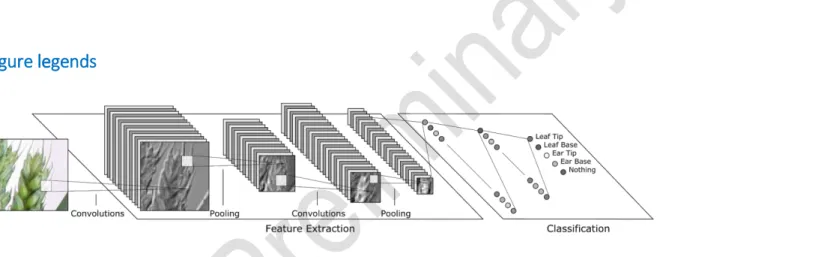
The CNN transforms feature maps from previous layers, creating a rich hierarchy of features that can be used for classification. For example, while the initial
layer may compute simple primitives such as edges and corners, deeper into the network feature maps based on these will highlight groups of corners and
edges. Deeper still, feature maps may contain complex arrangements of features representing real-world objects [9]. It is important to note that these
features are learnt by the CNN training algorithms, and are not hand-coded.
Modern CNNs will typically use many layers which makes training the networks complex, often requiring hundreds, sometimes thousands, of images to
train to the desired accuracy [10]. However, once trained, their accuracy is unrivaled, and they can be transferred to other related domains by re-training
using significantly fewer images [11]. A CNN is trained by iteratively passing example images containing the objects to be detected into the network, and
adjusting the network parameters based on the results. The values of the convolutional filters are automatically adjusted to improve the result the next
time a similar image is seen, a process that is repeated for as many images as possible.
To demonstrate the effectiveness of this deep learning approach, we first trained two separate CNNs on two tasks central to plant phenotyping, framed as
classification problems. In the first, we address the question: given a small section of a root system image, can a CNN identify if a root tip is present? The
access different nutrients and
water within the soil profile. In phenotyping, particularly with high throughput 2D approaches, identifying features such as root tips represents the
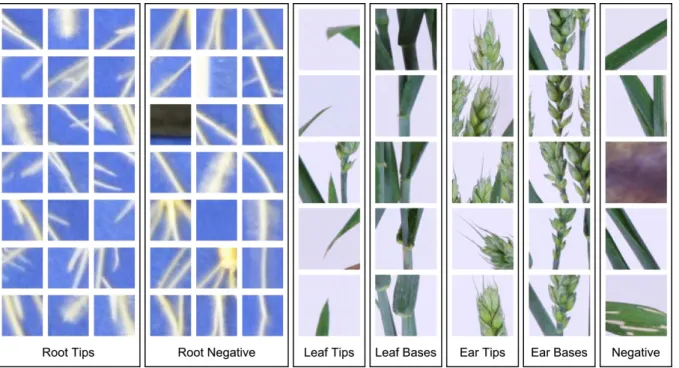
rate-limiting step in data quantification. We prepared training image data in which some images contained root tips, and some did not. This was derived from a
dataset containing 2500 annotated images of whole root systems, and automatically generated classification images, by cropping at the annotated tip
locations (See Figure 2, left side). This dataset is publically available at [12].
In the second classification problem, given an image of a section of plant shoot, we ask can a CNN identify biologically-relevant features such as leaf and ear
tips, bases etc.? This would allow high-throughput phenotyping on an extremely large number of lines based on single images. It also allows 3D shoot
structure to be linked with physiological functioning: for example the separation into individual leaves and organs allows us to place biologically distinct
plant parts within a useful functional context (different leaves, reproductive organs). To do this, we hand-annotated 1664 images of wheat plants, labelling
leaf tips, leaf bases, ear tips, and ear bases. Classification images were then automatically extracted from these images as before (See Figure 2, right side).
This dataset is also publically available at [12].
We then quantify the accuracy of finding the features in the two image sets. We also show how it is possible to localise the features within the image
answering questions such as, where are the root tips located? The Methods section explains in detail the process of preparing the networks and data, and
the training of the CNNs, as well as the localisation approach used.
A common goal of phenotyping studies is the use of mapping populations to investigate the genetic architecture of complex traits by identifying
quantitative trait loci (QTL, Quantitative Trait Loci, regions of DNA that correlate with phenotypic variations). QTL analysis is based on detecting an
association between phenotype and genotypic markers; the markers are used to partition a population into genotypic groups, whereupon trait differences
QTL is of agronomic importance, and feeds into the development of crop species. QTL discovery itself relies on the statistical analysis of phenotypic traits
and has been limited by the lack of unbiased, high-throughput techniques to extract trait values from image sets.
Finally then, we demonstrate than it is possible to automatically derive traits from images using these features, which can be used to identify the underlying
genetic architecture by identifying QTL, a key goal of many phenotyping studies. The output of the root CNN (the detected root tips) is then used to derive
simple descriptive traits automatically, which are then used in a QTL discovery process, and compared to QTL discovery via a more manual approach.
Data Description
Two datasets have been used in this paper, each presenting a unique challenge to the deep learning. By presenting both we wish to highlight the wide
applicability of the approach.
Root Analysis. Bread wheat (Triticum aestivum L.) seeds were sieved to uniform size, sterilised and pre-germinated before transfer to growth pouches in a controlled environment chamber (12h photoperiod: 20°C day, 15°C night, with a light intensity of 400 µmol m 2 s 1 PAR), as per [14]. After 9 days (two-leaf
stage), individual pouches were transferred to a copy stand for imaging using a Nikon D5100 DSLR camera controlled using NKRemote software (Breeze
Systems Ltd, Camberley, UK). Root system architectural traits were extracted from images of 2,697 seedlings using the RootNav software (RootNav,
RRID:SCR_015584) [15] and used to produce the input images for CNN training.
Shoot Analysis. Wheat varieties were grown as detailed previously [16]. Plants in pots were imaged according to the protocol of Pound et al.[17]. The
developmental stage of each plant in both years of trial were the same. At anthesis, wheat plants (roots and shoots) were removed from the field and taken
to a photography studio located close by to prevent wilting and damage to the shoots. They were imaged using three fixed Canon 650D cameras, with a
minimum of 40 images per plant. Images were captured using a revolving turntable, including a fixed size calibration target. This target is used to facilitate
3D reconstruction, which does not feature in this work.
Further details on preparation of the image data for the networks can be found in the Methods section.
Analyses
Classification
Once networks are built and training has completed (see Methods), the learned parameters of the network are then stored and can be used to perform
classification when required. The final accuracy of the networks described in this paper is the result of a final evaluation over all validation images once
For both the root and shoot data, we randomly separated 80% of the data into a training set, and 20% remained for validation. To evaluate the accuracy of
each network, we ran each validation image through the network, obtaining the likelihood of each class. These were then compared to the true label for
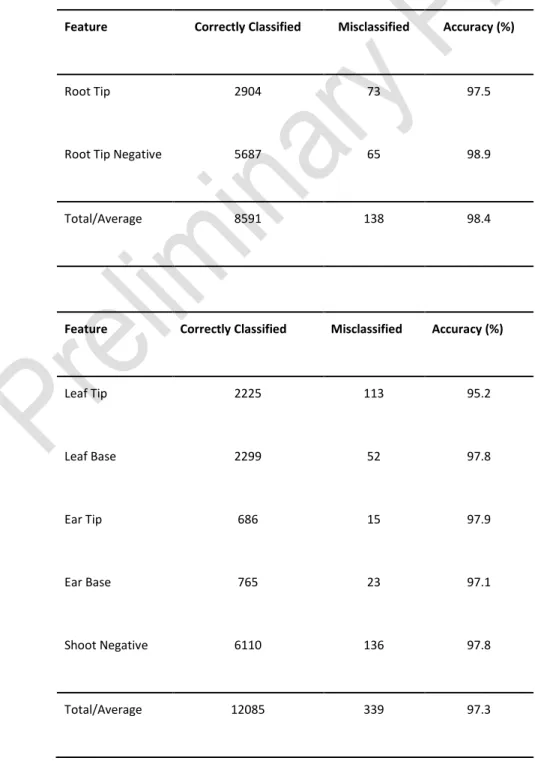
each image to ascertain whether the network had correctly classified the image. Based on this, the accuracy of the root tip detection network was found to
be 98.4%. The shoot dataset, containing 4 classes of shoot features, along with numerous instances of cluttered, non-plant background, represents an even
more challenging task. In this case, the shoot network successfully classified 97.3% of images. In both cases, CNNs here have out-performed recent
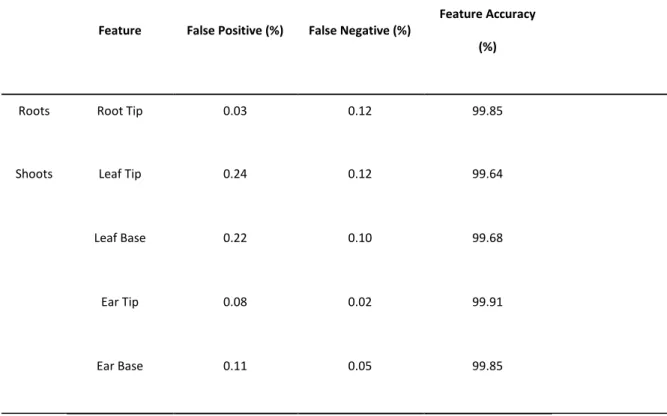
state-of-the-art systems (e.g. accuracies of 80-90% have been typical [2][18]). Accuracy results for individual classes can be seen in Table 1. Note also that both
these scenarios are much more challenging than typical successes seen to date, as the images involved are much less constrained.
Localisation
As well as identifying features by classifying image crops, it is necessary in quantitative phenotyping to locate the features within the larger image. For
example, reliably identifying the locations of root tips is a bottleneck in automated root system analysis [15], and is often omitted from image analysis
software due to the challenges localisation presents. As another example, locating seed feature points must occur before automated tracing in RootTrace
(RootTrace, RRID:SCR_015585) [19]. Localisation of the different biological feature classes for a shoot is vital in capturing the architecture of the plant,
essential for phenotyping. We also later show that automated localisation of such features can be used to identify the underlying genetic architecture of
traits.
We have extended our root and shoot classifiers to perform localisation by scanning over each original image, applying the respective classifier over each
image at regular pixel intervals (often referred to as a stride). Selection of the stride is straightforward, and is a compromise between pixel-wise accuracy of
the resulting classification map, and computational efficiency. A stride of 1 will produce sub-images centred on every pixel, such that images will overlap the
majority of the previous sub-image. This means that a feature visible in one image, will also be visible in a number of consecutive images around it. For both
the root and shoot system images, we chose a stride of 4, which results in a single scan taking under two minutes, and yet will output a classification map
showing each feature location clearly. The scripts we used to perform this classification, and repeat this automatically over any number of images can be
downloaded alongside our models.
As the output of the network is a set of class probabilities, pixels observed as above a likelihood threshold are marked as belonging to a specific class (see
Figure 3).
Testing Localisation Accuracy
We have tested the real-world accuracy of our localisation step by measuring the proportion of location windows containing false positives or negatives.
This testing was performed on unseen test data, comprising 20 images for roots, and 20 for shoots. In both cases no images, or parts of these images, had
been used in the training or validation of either network. Accuracy was measured as the percentage of pixels that were correctly classified as either
true-positives or true-negatives. False true-positives were determined as those pixels that were classified as a feature, but were outside of a radius around any
ground truth features. This radius was set as half of the classification window size, in which any feature should be visible. False negatives were those pixels
within the same radius of a ground truth feature that were not correctly classified as those features. Separate results for roots and shoots, and for each
class, can be seen in Table 2 below; test images and output can be seen in Additional File 2.
The accuracy of the root tip location is 99.85%, the accuracy of the shoot feature location is 99.07%, when totalled over all features. Accuracy that is higher
examples of image features, these examples comprise only a very small fraction of each whole, real-world image. The scripts used for testing will be made
available alongside our models [12].
Application to QTL discovery
So far we have demonstrated the success of the approach in locating features in images. Here, we wish to show the power of a complete pipeline for
phenotyping and discovery. We will use traits derived from features automatically discovered via our deep learning approach to identify significant QTL for
the root system, highlighting the power of the approach for genetic discovery. As a baseline, using the semi-automated software package RootNav [15],
root traits were manually determined from 1709 images of the seedling root systems of 92 members of a wheat doubled haploid mapping population [14].
These trait values were then used to identify 29 root QTL [14], representing five classes of trait. This same image set formed part of the training dataset for
the root tip detection CNN. We will here consider only traits related to root tips as this is the feature our network specialises in, but of course different and
additional features could be learned in the future.
The output of the root tip CNN after scanning over an image is a heatmap of high-likelihood tip locations. This was adapted to produce individual
co-ordinates for each identified root tip. Mathematical morphology was used to erode the heat map with a 3x3 structuring element, using three iterations.
This removes small artefacts output as single pixels in the heat map, and can separate some root tips that are close together. This level of erosion was
chosen as a compromise between effectively removing noise, and removing root tips themselves in error. A connected component algorithm was then
used to find a single centroid of each foreground region, representing the most likely root tip locations. Geometrical traits were then conceived which were
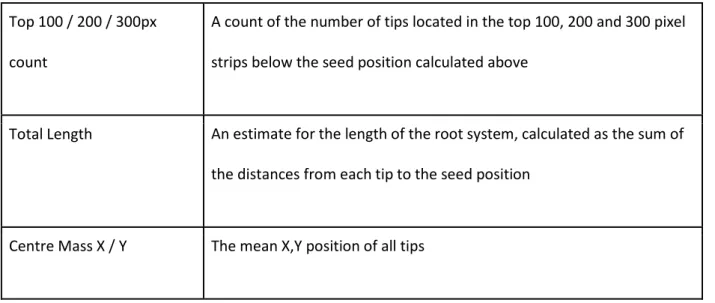
derived from these recorded tip positions (listed in Table 2). Note that if detecting more than just tips of roots (perhaps the seed location, or roots
themselves), much more complex and potentially informative traits could be derived. However, here we demonstrate with simple tip-based traits, and use
these traits to identify QTL via the same pipeline developed for the original RootNav-derived images [14]. Here we make an estimate for seed location
derived from tips alone, taken as the mid-point of the top of the bounding box surrounding all seed tips. This is an estimate only, but is calculated
consistently for all images.
The traits in Table 3 were then used in subsequent QTL analysis. QTL calculation and plotting of logarithm of odds (LOD) scores were conducted using R
QTL model employing the extended Haley-Knott method on imputed genotypes.
Significant thresholds for the QTLs were calculated from the data distribution. Final QTL LOD scores and effects were received from a multiple QTL model,
using the QTL detected in the initial scan. The high-density Savannah ×Rialto iSelect map (Wang et al., 2014) was used, with redundant markers and those
markers closer than 0.5 cM stripped out. Outputs of the analysis program R/qtl [20] are summarised in Table 4. Many of the QTL found in the original
RootNav study were based on measurements of root angle and thus would not be expected to be found using parameters computable from tip positions
alone; thus, these were not considered in these analyses (please see original paper for the full list [14]). However, as can be seen in Table 3, nearly all traits
related to tip location that the semi-automated RootNav approach returned were also picked up by the deep learning.
Traits derived from the CNN resulted in the detection of 12 QTL; all of these coincide with loci discovered using the manual RootNav approach. The QTL on
chromosome 1A C M ss was found using trait values from RootNav.
This trait represents the centre of mass of the root system in the horizontal direction, and only varies by 11 mm across the mapping population in the
detected. Additionally, the trait itself is likely to be of little biological relevance, although it is significant in the RootNav analysis so we include it here for
completeness. Finally, it is worth noting though that a second QTL for the same trait was detected on chromosome 6D using both systems.
Extraction of phenotypic information using RootNav requires a skilled user and a considerable investment of time (the most experienced users take on
average 2 mins to process an image). The CNN-derived tip detection pipeline runs completely unattended, is free from operator-bias, and successfully found
86% of the tip-related QTL previously identified using trait values extracted via the semi-automated RootNav pipeline. This highlights the potential for deep
learning in delivering the automated, high-throughput extraction of useful data from images required for phenotyping studies.
Of course, the benefits of deep learning are only possible given sufficient quantities of representative training data. The deeper the network, the more data
is required. Quality of training data and the training protocol can affect final results. Traditional machine learning may work with smaller quantities of
training data, due to fewer parameters having to be learnt in the models. For comparison, the root architecture dataset presented in this study has also
been used with a crafted feature set and Random Forest classification in a similar phenotyping pipeline; we refer the reader to [21] for more details.
Discussion
CNNs offer unparalleled discriminative performance in classification of images and localisation tasks. Here, we have demonstrated their efficacy of not only
the classification, but also localisation of plant root and shoot features, significantly improving upon the state-of-the-art. To our knowledge, this is the first
demonstration of deep learning applied in the localisation of plant features. The success here parallels the success of deep learning in related image
analysis tasks such as leaf segmentation [22]. We have also demonstrated the ability to derive meaningful traits from simple feature detection as a
demonstrator, from which we successfully identify significant QTL, corroborated by manual methods. The successful application of deep learning in QTL
analysis parallels the application of traditional machine learning on a similar task [21]. To improve our own methods in future work, we will explore the
application of so-called fully convolutional networks, performing segmentation directly, rather than via a scanning approach. We also hope to apply feature
localisation to other datasets, and in particular examine the efficacy of these techniques in field images.
Deep learning is a very general technique, CNNs can be easily applied to other challenging problems, and determine useful features for classification
automatically during training. Microscopy, x-ray, ultrasound, MRI or other forms of medicinal and structural imaging are all targets where deep learning will
yield excellent results. Areas involving challenging, unstructured images - such as those from the field- are of particular interest for future work.
Training of CNN methods of course depends on high quality annotations on which to train. Despite skilled biological experts performing the annotation,
even here we should expect some error in the annotations, over the hundreds of images, and many thousands of features. Whilst we have not quantified
this error on our data, it is worth keeping in mind that we must minimise such occurrences when using CNNs, and that any claim to accuracy depends on
also a time-consuming process, and existing datasets will perform a key role in boot strapping new techniques and applications of deep learning. This will
likely drive a renewed effort in large, publicly available datasets, including high-quality annotations.
Potential implications
We believe that the substantial increase in throughput offered by deep learning will lead to an improvement in the understanding of biological function
akin to other high-throughput improvements in biology such as expression arrays [23] and next-generation sequencing [24], and anticipate numerous
paradigm-shifting breakthroughs over the coming years.
Methods
Training and Validation Image Preparation
Convolutional Neural Networks (CNNs) using traditional neural network layers for classification can be applied to images of any reasonable size, but once
trained at a certain size, this must remain consistent. We chose input sizes of 32x32 pixels for root tip images, and 64x64 pixels for shoot feature images. In
the root domain, a 32x32 image was found to be adequate to capture a root tip feature, along with enough context from the surrounding image. The 64x64
resolution of shoot features was chosen as a compromise between efficiency, and the higher resolution necessary to handle the more complex features
seen in these images. Choosing a size appropriate to the feature of interest whilst maintaining a balance with computational efficiency is key here.
For root images, we obtained root tip positions from an existing database of manually annotated root systems, paired with the captured input images. For
each source image, we created cropped training images centred around each recorded root tip position. This resulted in a variable number of training
images per source image, depending on how many root tips had been annotated by the user. We restricted root tip images to primary and lateral roots that
were longer than half the window size (16 pixels). Avoiding extremely short lateral root avoids ambiguity with root hairs, which appears frequently on many
of the images. For all training images in the root dataset, we cropped source images at 42x42 pixel size, and then performed an additional crop to 32x32
randomly during training. This approach, known as data augmentation, is akin to producing many more training images with variation in the location of the
tips within the cropped windows, such that the root tips do not appear in the exact centre of each training image every time. This approach has been shown
to produce improved accuracy when the classification target is not necessarily in the centre of each image, as may be the case when we use our scanning
localisation approach.
We additionally generated negative training images, which do not contain the features of interest, with two times more negative images than positive ones.
We increased the number of negative images in order to adequately capture the wide variety of different negative images that are possible on in this data.
Half of the negative data was generated at random points on the source image, but limited to areas that contained no root tips. The remaining negative
data was generated at random positions on the known root system, again avoiding root tips. This is a form of hard negative mining, where negative data is
generated on regions that appear similar to the positive data. We want the network to learn that we are only interested in tips of roots, not other
structures on the root. This has been shown to improve the accuracy of machine learning algorithms over negative data produced entirely at random [25].
A similar approach was used for the preparation of shoot feature images. For each source image we selected cropped images at each manually annotated
location, as with the root tips. The shoot images are higher resolution than the root images, so we found that we obtained better accuracy if we cropped
128x128 images, then scaled to 64x64 for use in the network. This simply includes more of each image within the field of view of the smaller windows, ie.
we retain more contextual information. Each type of feature (e.g. leaf tip, ear tip) was summed to produce an overall positive image count, and we then
generated an equal number of negative images per source image. Unlike the root system data, where information on the position of the remaining root
system (derived from the manual annotations) could be used to generate hard negative data, the shoot annotations only included the specific features to
be classified. In order to generate hard negative data, we used a Harris feature detector [26] to generate candidate points of interest, then selected from
this set at random (discounting areas around positive features). This ensured that the negative data contained large amounts of clutter and other plant
material, rather than just plain background regions. Finally, we generated a small number of additional images from truly random locations, to ensure that
areas such as the white background were represented sufficiently. The resulting dataset contained 62,118 images, of which 49,694 were training images,
and the remaining 12,424 were used for validation.
At this point we have constructed suitable training sets of images derived from manual annotations. The next task is to develop the network architecture
itself, and train the subsequent networks.
CNN Architecture Design
We used the Caffe deep learning library [27] to develop each network. In Caffe, networks are described using a series of structured files, along with
information on training and validation, such as how frequently to perform validation when training iterations, and so-called hyperparameters, such as the
learning rate, which will be described below.
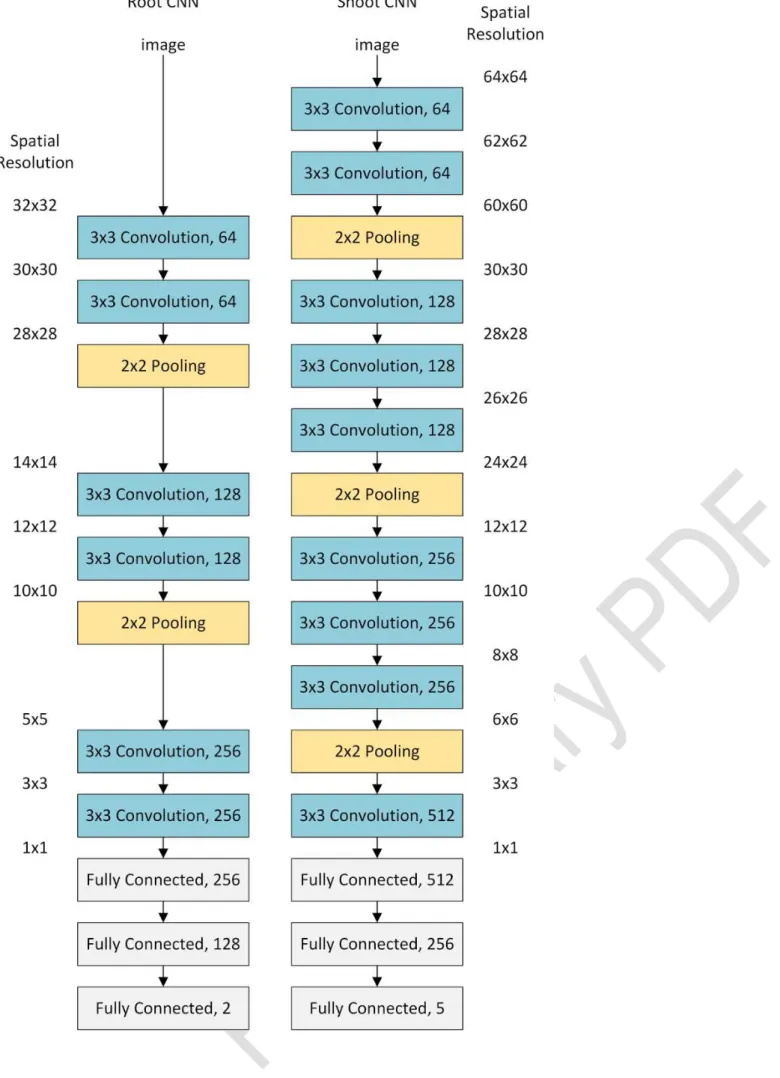
We designed separate CNN architectures for each problem. These architectures are shown in Figure 4; they adopt a common approach to CNN design,
utilising multiple convolutional layers using 3x3 kernels, prior to each pooling layer [28]. The shoot CNN contains more layers to accommodate the larger
input image size. It also includes increased feature counts in deeper layers, to address the more challenging classification task posed by the shoot images.
Both networks end in neural network classification layers (often referred to as fully-connected layers) that reduce the output size to 2 and 5 respectively.
Once trained, these final neurons represent the likelihood that the network has observed each class (e.g. root tip or not-root tip), and can be read to
determine which class the network has identified.
The root CNN contained two groups of two convolutional layers, and one max pooling layer. Following these, two final convolutional layers perform further
feature extraction, before three standard neural network layers performed the classification. The feature size of the convolutional layers was increased
after each pooling layer, beginning at 64 convolutional filters, up to 256 filters. Finally, the neural network layers gradually reduce the feature size back
‘ T ‘ N
The shoot CNN contains three groups of convolutions and pooling layers. The number of convolutional layers between pooling layers varied slightly
throughout the architecture in order to ensure that the spatial resolution of the data was always a multiple of two. A single final convolution is followed by
three neural network layers performing the classification. The feature sizes of the convolutional and neural network layers were also increased beyond that
of the root CNN. Feature sizes started at 64 filters, up to a maximum of 512 filters. The neural network layers decrease this feature size back down to 5,
Recent developments in CNNs have proposed additional components that improve performance. Neural networks require non-linear functions between
layers in order to capture the complex non-linearity of the classification tasks. Traditionally, sigmoid or tanh functions have been used, where the result of
each convolutional filter at each position is passed into a nonlinear function, before being passed to the next layer. More recent work [10] proposed an
‘ . We utilised Relu layers
between all Convolutional layers, and between all fully-connected neural network layers. Other work [29] proposed an approach whereby a percentage of
fully-connected neurons are randomly deactivated during each iteration of training; this has been shown to avoid the overfitting problem, in which the
classification of the training data improves, but at the expense of generality on the unseen data. By deactivating neurons some of the time, the
fully-connected layers are forced to learn from all parts of the network, rather than become focused on a few key neurons. We included dropout layers with a
50% dropout rate between the fully-connected layers.
CNN Training and Validation
The Caffe library is built to perform iterative training and validation for as long as is required. Periodically the accuracy of the networks were measured
using the separate validation data, and learning was halted after a steady state was reached, where no further improvement was seen if the network was
left training. The learning rate specifies how quickly the network attempts to improve based upon the current set of images it is examining. This is an
important feature of network learning; a low learning rate will mean the network does not adapt sufficiently fast to correctly classify images it sees. A
learning rate that is too high may cause the network to wildly over-adapt, meaning it will improve on the current set of images, but at the expense of all
images it has seen previously. As with most modern CNN approaches, we chose a higher learning rate to begin training, then periodically decreased this
W ng rate by a factor of 10 every
20000 iterations. In practice, we found that our networks were robust to changes in this learning rate, but that we stopped seeing any real improvement in
accuracy when the learning rate fell below 1x10⁻³. Before entry into the network, the mean image colour for each dataset was subtracted from each image,
in order to centre pixel values around zero.
Availability of Data and Materials
Data further supporting this work, such as the root and shoot image datasets, as well as the Root Caffe model and Shoot Caffe model, are open and
available in the GigaScience repository, GigaDB [12]. Further details on the methods used in this study are also available in Protocols.io [30].
Declarations
Abbreviations
CNN Convolutional Neural Network
QTL Quantitative Trait Loci
Competing interests
The authors declare that they have no competing interests.
Funding
We would like to acknowledge ERC Advanced Grant FUTUREROOTS (294729) for partial funding of this work.
A
MPP developed the deep learning system and image processing, and carried out the method development along with APF, DMW and TPP. JAA assisted, and
collected and annotated data along with AJB and MG. MHW and EHM assisted with the preparation of the root and shoot datasets respectively. ASJ, AB and
GT provided valuable deep learning expertise. APF, MPP, DWM, JAA and TPP wrote the manuscript, with assistance from all authors.
Acknowledgements
APF and MPP were partially funded by BBSRC grant BB/N018575/1.
References
[1]
A. Walter, F. Liebisch, and A. Hund, “Plant phenotyping: from bean weighing to image analysis,”
Plant Methods, vol. 11, no. 1, pp. 1
–
11,
Mar. 2015.
[2]
P. Wilf, S. Zhang, S. Chikkerur, S. A. Little, S. L. Wing, and T. Serre, “Computer vision cracks the leaf code,”
Proc. Natl. Acad. Sci., vol.
113, no. 12, pp. 3305
–
3310, Mar. 2016.
[3]
T. K. Ho, “Random decision forests,” in
, Proceedings of the Third International Conference on Document Analysis and Recognition, 1995,
1995, vol. 1, pp. 278
–
282 vol.1.
[4]
A. Singh, B. Ganapathysubramanian, A. K. Singh, and S. Sarkar, “Machine Learning for High
-
Throughput Stress Phenotyping in Plants,”
Trends Plant Sci., vol. 21, no. 2, pp. 110
–
124, Feb. 2016.
[5]
Y. Lecun, L. Bottou, Y. Bengio, and P. Haffner, “Gradient
-
based learning applied to document recognition,”
Proc. IEEE, vol. 86, no. 11,
pp. 2278
–
2324, Nov. 1998.
[6]
D. H. Hubel and T. N. Wiesel, “Receptive fields and functional architecture of monkey striate cortex,”
J. Physiol., vol. 195, no. 1, pp. 215
–
243, Mar. 1968.
[7]
J. Zhou and O. G. Troyanskaya, “Predicting effects of noncoding variants with deep learning
-
based sequence model,”
Nat. Methods, vol.
12, no. 10, pp. 931
–
934, Oct. 2015.
[8] A. Esteva et al.
, “Dermatologist
-
level classification of skin cancer with deep neural networks,”
Nature, vol. 542, no. 7639, pp. 115
–
118,
Feb. 2017.
[9]
M. D. Zeiler and R. Fergus, “Visualizing and Understanding Convolutional Networks,” in
Computer Vision
–
ECCV 2014, D. Fleet, T.
Pajdla, B. Schiele, and T. Tuytelaars, Eds. Springer International Publishing, 2014, pp. 818
–
833.
[10]
A. Krizhevsky, I. Sutskever, and G. E. Hinton, “ImageNet Classification with Deep Convolutional Neural Networks,” in
Advances in
Neural Information Processing Systems 25, F. Pereira, C. J. C. Burges, L. Bottou, and K. Q. Weinberger, Eds. Curran Associates, Inc.,
2012, pp. 1097
–
1105.
[11]
J. Long, E. Shelhamer, and T. Darrell, “Fully Convolutional Networks for Semantic Segmentation,”
CVPR Appear, Nov. 2015.
[12] Pound MP, Atkinson JA, Burgess AJ, Wilson MH, Griffiths M, Jackson AS, Bulat A, Tzimiropoulos G, Wells DM, Murchie EH, Pridmore
TP, French AP: Supporting data for "Deep Machine Learning provides state-of-the-art performance in image-based plant phenotyping"
GigaScience Database. 2017. http://dx.doi.org/10.5524/100343
[13] Molecular Breeding for Sustainable Crop Improvement - | Vijay Rani Rajpal | Springer. .
[14] J. A. Atkinson et al.
, “Phenotyping pipeline reveals major seedling root growth QTL in hexaploid wheat,”
J. Exp. Bot., p. erv006, Mar.
2015.
[15]
M. P. Pound, A. P. French, J. A. Atkinson, D. M. Wells, M. J. Bennett, and T. Pridmore, “RootNav: navigating images of comple
x root
[16] A. J. Burgess et al.
, “High
-Resolution Three-Dimensional Structural Data Quantify the Impact of Photoinhibition on Long-Term Carbon
Gain in Wheat Canopies in the Field,”
Plant Physiol., vol. 169, no. 2, pp. 1192
–
1204, Oct. 2015.
[17]
M. P. Pound, A. P. French, E. H. Murchie, and T. P. Pridmore, “Automated Recovery of Three
-Dimensional Models of Plant Shoots from
Multiple Color Images,”
Plant Physiol., vol. 166, no. 4, pp. 1688
–
1698, Dec. 2014.
[18] B. Neumann et al.
, “Phenotypic profiling of the human genome by time
-
lapse microscopy reveals cell division genes,”
Nature, vol. 464, no.
7289, pp. 721
–
727, Apr. 2010.
[19] A. French, S. Ubeda-Tomás, T. J. Holman, M. J. Bennett, and T
. Pridmore, “High
-Throughput Quantification of Root Growth Using a
Novel Image-
Analysis Tool,”
Plant Physiol., vol. 150, no. 4, pp. 1784
–
1795, Aug. 2009.
[20]
K. W. Broman, H. Wu, . Sen, and G. A. Churchill, “R/qtl: QTL mapping in experimental crosses,”
Bioinformatics, vol. 19, no. 7, pp. 889
–
890, May 2003.
[21] Atkinson JA, Lobet G, Noll M, Meyer PE, Griffiths M, Wells DM. Combining semi-automated image analysis techniques with machine
learning algorithms to accelerate large scale genetic studies. GigaScience (In Press).
[22] B. Romera-
Paredes and P. H. S. Torr, “Recurrent Instance Segmentation,” in
Computer Vision
–
ECCV 2016, 2016, pp. 312
–
329.
[23] J. Kilian et al.
, “The AtGenExpress global stress expression data set: protocols, evaluation and model dat
a analysis of UV-B light, drought
and cold stress responses,”
Plant J. Cell Mol. Biol., vol. 50, no. 2, pp. 347
–
363, Apr. 2007.
[24] R. Brenchley et al.
, “Analysis of the bread wheat genome using whole
-
genome shotgun sequencing,”
Nature, vol. 491, no. 7426, pp. 705
–
710, Nov. 2012.
[25]
P. F. Felzenszwalb, R. B. Girshick, D. McAllester, and D. Ramanan, “Object Detection with Discriminatively Trained Part
-
Based Models,”
IEEE Trans. Pattern Anal. Mach. Intell., vol. 32, no. 9, pp. 1627
–
1645, Sep. 2010.
[26] C.
Harris and M. Stephens, “A combined corner and edge detector,” in
In Proc. of Fourth Alvey Vision Conference, 1988, pp. 147
–
151.
[27] Y. Jia et al.
, “Caffe: Convolutional Architecture for Fast Feature Embedding,”
ArXiv Prepr. ArXiv14085093, 2014.
[28]
K. Simonyan and A. Zisserman, “Very Deep Convolutional Networks for Large
-
Scale Image Recognition,”
ArXiv14091556 Cs, Sep. 2014.
[29]
N. Srivastava, G. Hinton, A. Krizhevsky, I. Sutskever, and R. Salakhutdinov, “Dropout: A Simple Way to Prevent Neural Network
s from
Overfitting,”
J Mach Learn Res, vol. 15, no. 1, pp. 1929
–
1958, Jan. 2014.
[30] Pound MP, French AP (2017): Deep Learning for Plant Phenotyping. protocols.io. https://dx.doi.org/10.17504/protocols.io.jcncive
Figure legends
Figure 1: A simplified example of a CNN architecture operating on a fixed size image of part of an ear of wheat. The network performs alternating
convolution and pooling operations (see online methods for details). Each convolutional layer automatically extracts useful features, such as edges or corners, outputting a number of feature maps. Pooling operations shrink the size of the feature maps to improve efficiency. The number of feature maps is
increased deeper into the network to improve classification accuracy. Finally, standard neural network layers comprise the classification layers, which
Figure 2: Example training and validation images from our root tip and shoot feature datasets. Positive samples were taken at locations annotated by a
user. Negative samples were generated on the root system and at random for the root images, and on computed feature points on the shoot images.
Figure 3: Localisation examples. Images showing the response of our classifier using a sliding window over each input image. (a) Three examples of wheat
root tip localisation. Regions of high response from the classifier are shown in yellow. (b) Two examples of wheat shoot feature localisation. Regions of high
response from the classifier for leaf tips are highlighted in orange, leaf bases in yellow, ear tips in blue, ear bases in pink. A portion of the second image has
Figure 4: The architecture of both convolutional neural networks (left: root, right : shoot). In each case convolution and pooling layers reduce the spatial resolution to 1x1, while increasing the feature resolution. All convolutional layers used kernels of size 3x3 pixels, and the number of different filters is
shown at the right of each layer. Following the convolution and pooling layers, the fully connected (neural network) layers perform classification of the
images. We included rectified linear unit (ReLu) layers between all convolutional and connected layers, and dropout layers between each
Table 1: Classification results for both root and shoot datasets. Leaf tips represent the hardest classification problem in the datasets, with large variations in orientation, size, shape, and
colour. In all cases the accuracy has remained above 95%, with the average accuracy of both networks above 97%. The root tip network performs marginally better overall, perhaps to be
expected due to the simpler nature of the image data. Complete confusion matrices can be found in Additional File 3.
Feature Correctly Classified Misclassified Accuracy (%)
Root Tip 2904 73 97.5
Root Tip Negative 5687 65 98.9
Total/Average 8591 138 98.4
Feature Correctly Classified Misclassified Accuracy (%)
Leaf Tip 2225 113 95.2 Leaf Base 2299 52 97.8 Ear Tip 686 15 97.9 Ear Base 765 23 97.1 Shoot Negative 6110 136 97.8 Total/Average 12085 339 97.3
Table 2: Testing results for our image scanning approach over 20 unseen root images, and 20 unseen shoot images. Feature accuracy is the number of true
Feature False Positive (%) False Negative (%)
Feature Accuracy
(%)
Roots Root Tip 0.03 0.12 99.85
Shoots Leaf Tip 0.24 0.12 99.64
Leaf Base 0.22 0.10 99.68
Ear Tip 0.08 0.02 99.91
Ear Base 0.11 0.05 99.85
Table 3: List of root traits derived from the tip-detection CNN output, and how they were computed The name is derived from the trait they can be seen to
estimate or represent.
Name Description
Tip Count The sum of all connected components found
Hull area The area of the convex hull derived from the centroids of all tips
Width / Depth The width and depth of the bounding box surrounding all tips
Width:Depth Ratio Calculated as Width divided by Depth
Mean X / Y The mean X and Y positions of all tips
Top 100 / 200 / 300px
count
A count of the number of tips located in the top 100, 200 and 300 pixel
strips below the seed position calculated above
Total Length An estimate for the length of the root system, calculated as the sum of
the distances from each tip to the seed position
Centre Mass X / Y The mean X,Y position of all tips
Table 4: QTL discovery results from user-supervised (RootNav) and CNN-derived deep learning approaches. RN = RootNav; DL = Deep learning; Chr =
chromosome, Pos = position; CI = confidence interval start and end positions. Note there are two QTL identified using RN which are missed by the DL
approach; all others were identified by both methods.
RN DL
Trait Chr Pos LOD CI Chr Pos LOD CI Additive effect Nearest Marker
Centre of Mass (x) 1A 70.3 2.5 47.7 - 163.6
Width/Depth ratio 4D 4.8 2.7 0.8 - 67.6 4D 2.8 3.2 0.8 - 67.6 0.07 IAAV5065
Total Root Length 6D 4.4 24.0 2 - 53 6D 4.4 12.7 2 - 53 -2201 wsnp_Ex_c4789_8550135
Convex Hull 6D 4.4 17.6 2 - 53 6D 4.4 17.3 2 - 53 -264026 wsnp_Ex_c4789_8550135
Centre of Mass (x) 6D 26 2.8 0 - 92.5 6D 5 17.1 2 - 53 -151 wsnp_Ex_c4789_8550135
Centre of Mass (y) 6D 4.4 19.1 2 - 53 6D 4.4 10.0 0 - 53 -105 wsnp_Ex_c4789_8550135
Lateral Count/Tip Count 6D 4.4 9.1 0 - 53 6D 4.4 10.2 0 - 53 -4.53 wsnp_Ex_c4789_8550135
Maximum Depth 6D 4.4 22.7 2 - 53 6D 4.4 25.1 2 - 53 -388 wsnp_Ex_c4789_8550135
Maximum Width 6D 4.4 6.4 0 - 53 6D 6 15.0 2 - 53 -241 wsnp_Ex_c4789_8550135
Total Root Length 7D 27 9.0 16 - 52 7D 30 3.4 16 - 52 -1122 Kukri_c48125_714
Lateral Count/Tip Count 7D 29 2.4 16 - 101.8 7D 29 4.5 16 - 101.8 -2.76 wsnp_Ra_c8297_14095831
Centre of Mass (x) 7D 19 2.7 16 - 38.8
Convex Hull 7D 34 3.5 16 - 62.4 7D 34 4.4 16 - 62.4 -123896 Kukri_c48125_714