Factors Affecting the Performance of Value Added Tax /VAT/
Revenue Collection Administration Practices: In Case of Wolaita
Zone Revenue Authority, Southern Ethiopia
Lidetu Alemu Anjulo ( Assistant Professor)Lecturer,Department of Management: Wolaita Sodo University, P.O.box:138 Samuel Semma Waje
Wolaita Sodo Agricultural office Livelihood Coordinnator, Southern Ethiopia
Abstract
The study has focused on identifying factors that affecting VAT revenue performanceand its management prcitces in Soddo, Areka, and Boditi towns in wolaita zone. The study raised major research hypothesis related to VAT awareness of the society, tax technology especially using ETRs, VAT evasion, VAT audit and enforcement, Tax payers Service Delivery of the authority, Tax administration, and politico- legal factors. In order to address the hyphothesis, causal research method and purposive and disproportionate stratified simple random sampling techniques were employed and statistical package for social science (SPSS) version 16 soft ware was employed to gather data.
The findings of the study shows that awareness of the society, tax technology, VAT evasion, tax audit and enforcement, VAT administration and politico-legal factors have statistically significant and positive relationship with the performance of VAT revenue collection. On the other hand, the variable service delivery has a positive relationship with VAT revenue collection but found to be statistically insignificant.
Finally based on the findings, possible solutions were given. These include; the authority should conduct a consistent awareness creation programs to update the business community and the society at large about the concepts, rules and regulations, advantages and uses of the Value Added Tax, should increase the number of users of ETRs and improve taxpayer identification and registration, minimize VAT evasion activities, establish effective audit and enforcement mechanisms, and minimize bureaucracy.
Keywords: Value added tax, factors affect tax admisnstration,tax authority, business owners
1.1 . Backgraund of the study
According to Rosen (1988), Value Added Tax (VAT) is a percentage tax on a value added applied at each stage of production. It is a type of indirect tax, nowadays found in more than 130 countries and has become the principal source of revenue for many countries (Keen and Lockwood, 2007). In Ethiopia, according to IMF (2003), one of the focuses of the tax policy reforms is reforming indirect taxation. The main reform to indirect taxation was the introduction of VAT in January 2003. However, weak tax administration, particularly in developing and transitional economies is the principal impediment to the successful implementation of VAT. The same is true in Ethiopia as well in Addis Ababa (Yesigat, 2008). In Addis Ababa, according to BoFED (2009), lack of capital expenditure for public investment has hindered sustained economic development. Value added tax was invented because very high sales taxes and tariffs encourage cheating and smuggling (Worku, 2008). One of the mechanisms in which countries raise revenue to finance government spending on the goods and service that most of government uses as tool taxation.
As compared to the developing countries, the developed countries have been able to generate substantial revenue through imposing of taxes. One of the reasons for this has been the efficient tax system operating in the developed countries unlike the developing economies which are characterized by weak monetization and the low development of the formal sectors. In other words, these countries have employed tax systems that have one or a combination of the following desirable characteristics as economic efficiency, administrative simplicity, flexibility, political accountability and fairness. The tax system need to be economically efficient meaning the tax system should not have an impact on the allocation of resources. The tax system countries should be adopts easy and inexpensive to administer and that should be able to respond to changing economic circumstances. Taxpayers should also be able to determine what they are actually paying so that the political system can more accurately reflect the preferences of individuals (Abraham Tesfaye, 2003). It follows that optimality in a tax system requires absence of distortion in any economic activity (Hancok, 1995).
Considering the significance of VAT Collection, many studies have been conducted in some developing and transitional countries with respect to the main VAT administration tasks and its problem. These studies include (Abraham,2003),( Herouy,2004), (Kerver,2008), ( Clement,2009) ,(Wollela A.,2008),(Taye 2011).
1.2 Statements of the problems
In Ethiopia, VAT collection faces diverse factors internal and external tax administration challenges and issues. Ethiopian Revenue and Customs Authority (ERCA) have recorded significant gaps between VAT revenue targets and the actual amount collected. This means that ERCA has not been achieving an acceptable degree of tax compliance from a fast growing taxpayer population. It has been reported that tax evasion remains particularly high creating a need to improve the situation(Jalata, 2014).
In many under developed countries like Ethiopia, the low revenue yield of taxation can only be attributed to the fact that the tax provisions are not properly enforced, either on account of the inability to collect VAT , or on account of straightforward corruption. But factors on the other side of the system get little attention, i.e. minor attention is given to the tax background of tax payers, their awareness level, tax evasion, low usage of electronic tax machine , compliance behavior and its determinants when designing a given tax system . The tax system must be fair, both to promote the objective of an equitable distribution of income and to assure continued voluntary compliance by the taxpayer (Eckstein, 1979) as cited by (Tulu, 2007 ).
Although studies made internationally on internal factors affecting performance of the collection of local value added tax revenue(Karanja, 2012), tax policy challenges facing in developing countries(Kayanga, 2007), identifying the effective factor for the improvement of tax compliance (Mahmoud Moeinadin, 2014 ) and VAT implementation and its related problems conducted by (Mamo 2011), The impact of Electronic Tax Register on Value Added Tax conducted by (Taye 2011), determinants of Taxpayers’ voluntary compliance with Taxation (Tulu 2007 ) nationally . It is against this background that this study was attempted to assess the main factor which hinders the performance of Value added Tax revenue collection in sodo, Areka and Boditti in wolaita zone of South region, Ethiopia.
Therefore, on the basis of theoretical and empirical framework this research assessed the performance of the VAT revenue collection in Wolaita Zone to yield adequate revenue for the Zone treasury and to foster voluntary tax compliance. Unfortunately, there is no recorded study that has been conducted in the Zone to explore reasons behind under potential revenue collection. Therefore; this study conducted to identify those factors affecting the performance of VAT revenue collection.
1.3 Research Questions/Hypothesis Hypotheses of the Study
HO1: There is no significant influence of Awareness of society about VAT on performance VAT revenue
collection.
HO2: There is no significant influence of technological factor on performance VAT revenue collection.
HO3: There is no significant influence of Tax evasion on performance VAT revenue collection.
HO4: There is no significant influence of VAT Audit and Enforcemnt on performance VAT revenue collection. HO5: There is no significant influence of Service delivery of the authority on performance VAT revenue
collection.
HO6:.There is no significant influence of administrative or Managerial factor on VAT on performance VAT
revenue collection.
HO7: There is no significant influence of politico-Legal factor on VAT on performance VAT revenue
collection.
1.4 Objectives of the study General objective
The main objective of this study is to investigate factors affecting the Performance of Value Added Tax revenue collection and administration practices in Sodo, Areka and Boditti towns in Wolaita zone.
Specific objectives
Specifically this study tries to address the following issues:
To evaluate the performance of VAT Revenue collection in Wolaita zone.
To identify the main factors those affect the performance of VAT revenue collection in the Wolaita
zone.
To know the tax administration practices of the selected towns
2. Literature Review
This section presents a brief review of existing theoretical and empirical literature of Value Added Tax Collection. At the end of the review, an attempt is made to summarize the major drawbacks of the existing empirical studies and to identify the knowledge gap to be filled in by further investigation.
2.1 Overview of Value Added Tax (VAT)
on the value added which is the difference between the value of sales and value of purchase at the point of transaction throughout the production and distribution chain. Any producer owes tax only in the value added; in practice this means that the producer will have refund for VAT paid on all the purchases or inputs.
Despite its name, the VAT is not generally intended to be a tax on value added as such: rather it is usually intended as a tax on consumption. Its essence is that it is charged at all stages of production, but with the provision of some mechanisms enabling firms to offset the tax they have paid on their own purchases of goods and services against the tax they change on their sales of goods and services(Lockwood, 2007).
Although this characteristic feature is very clear-cut, the VATs observed in practice show considerable diversity as regards, among other things, the range of inputs for which tax offsetting is available and the range of economic activity to which the tax applies (that is, the base of the tax). Some major countries (such as china) currently do not grant credits for taxes on capital goods purchases; moreover, of those that allow credits in respect of such purchases, some do not refund excess credits (any excess of tax paid on inputs over tax chargeable on outputs). Most countries exclude exports from the VAT, in the sense that tax is not charged on sales for export but tax paid on inputs is recoverable, although some (in the BRO region, the Baltic countries, Russia, and other countries of the former Soviet Union, at least until recently) have systematically levied VAT on some exports. Some countries extend the VAT only to the manufacturing stage; others do not levy it on services. Practices also vary in how tax offsetting is implemented: by far the most common method is through the use of invoices, but the same effect can be achieved on the basis of books of account (Gebreselassie, 2007).
2.2 VAT Development in Ethiopia
The Ethiopian government has introduced VAT as part of the overall tax reform program. The tax reform program is preceded by establishment of a new Ministry of Revenue as a first step to improve tax collections and to combat fiscal fraud. Various activities have been conducted subsequent to this : the increase in the sales tax and the removal of import duty surcharge in 2000; a new legislation on presumptive taxation and a 5 percent withholding tax on imports became effective in February 2001; legislation was approved in March 2001 to introduce the TIN system to reinforce the collection powers of revenue agencies, and a tax reform implementation task force was established; a large taxpayer was made operational in July 2001; in October 2001, a draft VAT legislation was submitted to parliament and this is approved and implemented beginning January 1, 2003. A revised income tax law has been approved and made operational. This revised law includes enhanced enforcement procedures and an improved penalty regime, with a view to increasing the efficiency of income tax collection, and ensuring the recovery of income tax arrears(Taye, 2011).
Prior to the introduction of VAT, the Ethiopian government has initiated a number of processes (Africa Development Bank, 2003). These include the design and computerization of the taxpayer registration process; the operational development of taxpayer services activities, return process and debit and audit activities; publicity campaign and taxpayer education. These measures are expected to improve the government’s revenue position.
The VAT was projected to be applicable on taxpayers that meet the minimum threshold of 500,000 Birr and above in annual turnover, but will be required to effect 15 percent tax every transaction.
2.3 Factors affecting the performance of value added tax /VAT/ a) Tax culture
Tax culture could be known as the collection of the way of talking, approach and reaction of people’s affronts of tax system. This kind of approach will effect on tax affairs and the way of their relationship that is from ideological, political and economical factors. Citizens of development countries know that the paying tax is one of their most important international duties. One of the very important factors in growing tax payment culture in development countries is the existence of powerful supervisory organizations that ensure the tax payers their tax will spend just for governments ‘budget. (Askari, 2010) as reported by Hamed Erfani,2013.
b) Informing and training in VAT system
Economy activator in value added tax system has a two-side role: it has the role of actor in tax affairs organization and the role of tax accommodation officer for consumer. Any shortage in doing the duties on timely and correctly will have terrible consequences. But from the viewpoint of the organization, due to center role of actor of value added tax system this mean to fail or breakage. Training or education is the most complementary part of the value added tax operation.
Modern nature, short term courses, self representation and majority of actors in contrast with traditional system make it urgent and necessary. In this regard in article 35 of law, the organization of country tax was responsible to prepare the necessary design for developing, equip, train and extending tax culture by media and concerns in the country level and in five year in maximum (shahriari rad and Moshtagh sefat,2009) as cited by Hamed Erfani, 2013
Tax is a method of saving tax liability by a tax payer through fraudulent means or by directly violating tax laws. It usually entails tax payers deliberately miss representing or concealing the true status of their affairs to the tax authorities to reduce their tax liability. Tax evasion is illegal, unethical, uneconomical and highly risky since it may result in may result in penalty, imprisonment and closing up of business. Hence, taxpayers shall find all the legal ways to avoid paying too many taxes and by no means is tax evasion acceptable to a government because it criminal activity. .(Misrak, 2008, Ethiopian Tax Accounting Theory and Practice ,PP 49-51) as cited by (Taye, 2011).
d) Registration for VAT
Registration for VAT is categorized in to three. These are obligatory, voluntary and special business categories. The first category obligatory registration is made for any person conducting a commercial enterprise or intending to conduct a commercial enterprise may apply to be registered for VAT. However if the taxable turnover of the enterprise, that is gross income for 12 calendar months exceeds or is likely to exceed birr 500,000 in Ethiopia, the person conducting the enterprise must register for VAT, (proclamation No 285/2002 Article 8).
e) VAT Audit
There appears to be a considerable VAT evasion in developing countries (Pedone 1982 cited in Jantscher 1990). As Edmiston and Bird (2004) noted the only real solution to the evasion problem is a good tax administration and, especially, a strong VAT audit program. A strong VAT audit program needs, among other things, an appropriate audit case selection method. Jantscher (1990) noted that cross checking purchases and sales data by various taxpayers would provide an effective tool for selecting VAT taxpayers for audit and hence improve audit results.
f) VAT Administration
In developing countries the poor performance of taxes is likely is to be due to weak tax administration (that is, the incapacity of the administration to implement the tax in practice). This is perhaps caused by such factors as resource constraint and designing the tax separately from the administration. Concerning the latter, Bird and Gendron (2005) noted that developing and transitional countries, unlike developed countries, appear to have fragmented economies, large informal sectors, low tax morale, rampant evasion, and total distrust between tax administrators and taxpayers. In these countries, thus simply adopting a successful VAT’s design attributes of developed countries would not make the tax successful (Bird, 2005).Jantscher (1990:179) also stated that “…in developing countries tax administration is tax policy.”
g) Politico-legal factors
Politico-legal factor mainly related with the use the governmental equipment. If the underground is very huge so the executive organization should try more to cover the identify affairs, auditing, and receiving tax because in tax culture, the persons more like tax escape, so executive organization should spend more and more to arrest tax escapers and control them. Totally even the null VAT on production one of the major characteristics of tax, but informal economy has made it like a question (seyed Noorani and azizkhani, 2008).
Attitudes towards the government (Levi, 1988) may affect the taxpayer’s normative commitment to comply with law. Similarly, Due and Friedlaender (1981), also argue that, attitudes toward the general level of taxation and tax increases are dependent, of course, on attitudes about the desirability of governmental programs and on attitudes toward the government itself . On the other hand, (Fjeldstad, 2004) citizens’ willingness to pay taxes voluntarily rests on the local government’s capacity to provide services and its demonstrated readiness to secure the compliance of the otherwise non-compliant. (Lemesa Tulu, 2007:42)
h) Conclusions and knowledge gap
In the context of Ethiopia, the related study conducted by Teklu (2011) mainly assessed the challenges of tax administration in Arada sub city, Addis Ababa, Ethiopia , even if it tries to identify the challenges that tax administration with some variables.
Markos Abraha (2010) examined Value Added Tax (VAT) Administration and Revenue Performance: Challenges and Opportunities in the Mekelle Branch the Ethiopian Revenue and Customs Authority (ERCA). Hailemariam Mamo (2011) also studied the Implementation of Value Added Tax and Its Related Problems in Ethiopia. Hailemariam also fails to disclose the knowledge gap that exists in the area and overlooked some important variables that can significantly affect the performance of VAT revenue collection from the point of view of the theories and previous empirical studies reviewed above.
2.4 Conceptual Framework
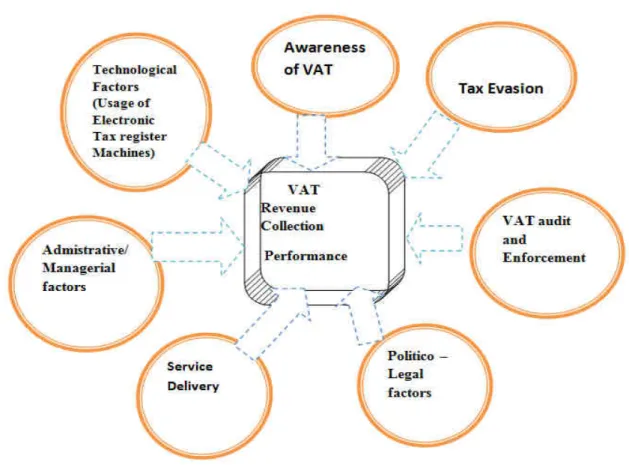
This study proposed that VAT revenue collection is determined by Awareness of people about VAT, the usage of Electronic Machines, Tax evasion, VAT administration (management), Tax Audit and Enforcemnet and service delivery and politico-legal factors:
Figure 2.1:- Conceptual Framework Source: Researchers (2018)
3. Research methodology
3.1.Research Design and target poulation
The type of research design employed under this study was casual. The major purpose of using causal is it interpreting relationships between variables, estimating the integrated influence of the factors on performance of VAT revenue collection on view of VAT registered organizations. The target population is the universe or the entire group of persons or elements from which samples are taken (Karanja, 2012). The target population of this study was 1600(Sodo 748, Areka 448 and Boditi 404) which consists of 1300 from the Value added tax registered organizations, 200 from the ultimate tax payers (consumers of VAT registered organizations’), and 100 Tax officials and from tax experts.
3.2.Sampling Strategy and Procedures
The sodo, Boditi and Areka towns were purposely chosen among 12 woredas and 3 administration towns of wolaita zone, as a study area for this research. This is because most VAT registered organizations’ were found in these towns. Second, the three towns were selected based on their nearness and convenience to collect data in short time.
Table 3.1 Stratification of the population
Strata of population Soddo town Share of Soddo Town Areka Town Share of Soddo Town Boditti Town Share of Soddo Town Total VAT registered firms 598 46 373 28.7 329 25 1300 consumers of VAT registered firms 100 50 50 25 50 25 200
Tax officials and experts
50 50 50 25 50 25 100
Total 748 448 404 1600
Source: wolaita zone revenue authority, 2018
The sample size determined by a simplified formula provided by Yamane (1967) in order to determine the required sample size at 95% confidence level, degree of variability of= 0.5 and with the level of precision of 5% is
Where ‘n’ is sample size, N= is the population size (Tax payers) and ‘e’ is the level of precision (margin of error).
The study used sample frame will be 1600 tax payers as shown above and by using the formula, we have n = N = 1600 = 1600 = 320
1+N (e)2 1+1600(0.05)2 1+1600(0.0025)
3.3.Types and sources of data
In this study, the researcher used both primary and secondary data. The primary data obtained from three different populations. Whereas, the secondary data will be obtained from Wolaita Zone Revenues Authority Branch Office from published and unpublished reports, documents and website.
3.4. Questionnaire Design
The study designed the survey questionnaire in order to determine factors that affect the Value added Tax revenue collection. The questionnaire divided in to three parts. The first part was for the Value added tax registered organizations, and the second part was for the ultimate tax payers (consumers of VAT registered organizations’).
3.5.Reliability and Validity of the Instruments
Bless and Higson-Smith (1995) highlight that reliability is “concerned with the consistency of measures”, thus, the level of an instrument’s reliability is dependent on its ability to produce the same score when used repeatedly (Babbie and Mouton, 1998).
According to Bryma and Bell (2003), the Cronbach’s Alpha result of 0.7 and above implies acceptable level of internal reliability. To meet consistency reliability of the instrument, the questionnaires was distributed to 10 individuals who are VAT registered organizations and Cronbach’s alpha was found to be 0.784 which is above 0.7.
4. Data Presentation, Analysis and Interpretation
Three hundred twenty questionnaires were distributed across the three towns. Out of which 296 were completed and retrieved successfully, representing 92.5% response rate. The numbers of questionnaires retrieved from Value added tax registered organizations from the ultimate tax payers (consumers of VAT registered organizations’), and Tax officials and from tax experts are 239, 37 and 20 respectively. This represents a response rate of 91.92%, 92.5% and 100% for Value added tax registered organizations , the ultimate tax payers (consumers of VAT registered organizations’), and Tax officials and experts respectively.
Table:4.6 Results of Awareness of the society about VAT for sample respondents
N Min Max Mean Std. Deviation
Low level of awareness VAT to taxpayers 239 1 5 3.98 .869
Insufficient trial made to enhance the awareness of taxpayers 239 1 5 3.67 .959
Awareness creation program organized currently the office is not extensive and not sufficient to build tax morale and improve tax compliance by VAT registered organizations.
239 1 5 3.79 .985
Source: Field Survey Result 2018
As could be seen in table 4.6, low level of awareness to the taxpayers about VAT seemed to be the major contributing factor to VAT revenue collection performance with mean and standard deviation of 3.98 and 0.869, respectively; this is followed by the awareness creation program organized currently the office is not extensive and not sufficient to build tax morale and improve tax compliance by VAT registered organizations with mean and standard deviation of 3.79 and 0.985, respectively. From this we can understand that eventhough trial have been made to increase awareness of taxpayers by the authority still there is knowledge gap about VAT to the
n = N
1+N (e
2)
respondents in soddo, Boditti and Areka towns.
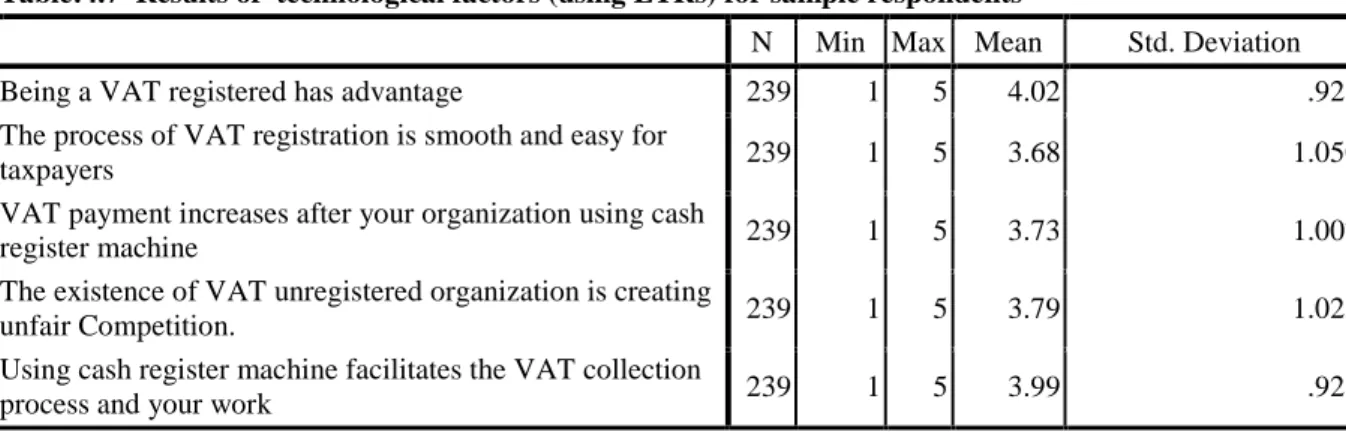
Table:4.7 Results of technological factors (using ETRs) for sample respondents
N Min Max Mean Std. Deviation
Being a VAT registered has advantage 239 1 5 4.02 .926
The process of VAT registration is smooth and easy for
taxpayers 239 1 5 3.68 1.050
VAT payment increases after your organization using cash
register machine 239 1 5 3.73 1.007
The existence of VAT unregistered organization is creating
unfair Competition. 239 1 5 3.79 1.025
Using cash register machine facilitates the VAT collection
process and your work 239 1 5 3.99 .921
Source: Field Survey Result 2018
Table 4.7 reveals the arithmetic mean and standard deviation of the technological systems in which taxpayers replied that VAT registration and identification which is one factor that affect VAT revenue collection considered in this study. As shown from the table, being a VAT registered has an advantage has highest mean and standard deviation of 4.02 and 0.926 respectively which means the respondent believe that registering and identification of taxpayers to VAT has advantage in number of ways. Next to this using cash register machine facilitates the VAT collection process and their work is another indicator with mean and standard deviation 3.99 and 0.921 respectively followed by the existence of VAT unregistered organization is creating unfair Competition with mean and standard deviation 3.8002 and 0.64135, respectively are the indicators of the major factors that affect VAT revenue collection in the selected three towns.
Table:4.8 Results of Tax evasion for sample respondents
N Min Max Mean
Std. Deviation
The cause for tax evasion is high rate of tax 239 1 5 3.79 1.076
Complexity of tax laws will leads to tax evasion 239 1 5 3.59 1.160
Tax evasion by VAT registered organizations is not significant 239 1 5 3.61 1.098
The use of cash register machine reduces tax evasion or fraud. 239 1 5 3.63 1.096
Using cash register machine for VAT collection has indispensable importance
for reduction of corruption 239 1 5 3.91 1.059
Source: Field Survey Result 2018
As it is clearly indicated in the table 4.8, using cash register machine for VAT collection has indispensable importance for reduction of corruption with mean and standard deviation 3.91 and 1.059 respectively. This indicates that electronic cash register machines have great influence on collection of VAT income in the selected three towns. On the other hand the cause for tax evasion is high rate of tax with mean and standard deviation 3.79 and 1.076 respectively. The use of cash register machine reduces tax evasion or fraud is the next point of the respondents with mean 3.63 and standard deviation 1.096.
Table 4.9 Results of Service delivery for sample respondents
N Min Max Mean Std. Deviation
Less customer relationship and handling. 239 1 5 3.87 1.012
The employees are not giving customers individual attention. 239 1 5 3.66 1.037
The office is less using innovative and pioneering in its
service delivery 239 1 5 3.80 1.042
The offices give the service in an unethical way 239 1 5 3.70 1.120
The office delivers its services promptly not on the time 239 1 5 3.47 1.191
Source: Field Survey Result 2018
From Table 4.9 we can refer that there is less customer relationship and handling seemed to be the major contributing factor to VAT income collection with mean and standard deviation of 3.87 and 1.012, respectively; this is followed by the less using innovative and pioneering in its service delivery with mean and standard deviation of 3.80 and 1.042, respectively. Next to this, the employees are not giving customers individual attention and the office delivers its services promptly at the time 3.66 and 1.037; 3.47 and 1.91 respectively are
also the contributing factors.
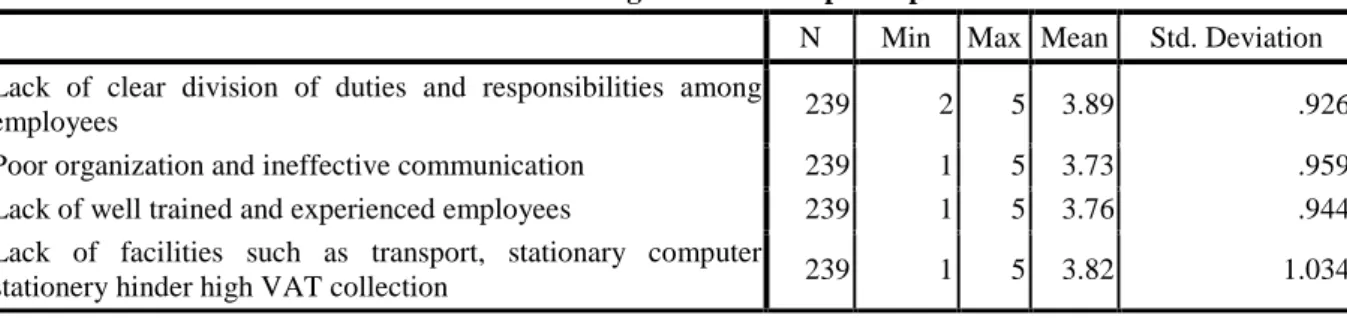
Table 4.10 Results of Tax administration or management for sample respondents
N Min Max Mean Std. Deviation
Lack of clear division of duties and responsibilities among
employees 239 2 5 3.89 .926
Poor organization and ineffective communication 239 1 5 3.73 .959
Lack of well trained and experienced employees 239 1 5 3.76 .944
Lack of facilities such as transport, stationary computer
stationery hinder high VAT collection 239 1 5 3.82 1.034
Source: Field Survey Result 2018
From this we can infer that VAT revenue collection activities are constrained by tax administration (management). Moreover, lack of well trained and experienced employees in the authority and poor organization and ineffective communication with mean and standard deviation 3.76 and 0.944; 3.73 and 0.959 respectively are the next problems which hinder the process of VAT income collection in the selected three towns. From the above data we can conclude that VAT income collection in the three town affected by the variable tax administration. i.e. if there is good tax administration there would be good VAT income collection performance.
Table 4.12 Results of Politico –legal factors for sample respondents
N Min Max Mean Std. Deviation
The VAT levied on my business is not reasonable 239 1 5 4.02 .860
Bureaucracy in registration and identification 239 1 5 3.91 .915
Political intervention 239 1 5 3.81 .997
Lack of accessible information on government regulations of
VAT that are relevant to my business. 239 1 5 3.79 1.047
Source: Field Survey Result 2018
Moreover, political intervention and lack of accessible information on government regulations of VAT that are relevant to business are the next crucial factors for VAT collection problems with the mean and standard deviation 3.81 and 3.79, 0.997 and 0.915 respectively. From the above data we can infer that politico – legal factors is infact the main factor for the Value added tax revenue collection.
Correlation relationship Analysis
Table 4.13: - The relationship between independent variables and performance of VAT
Table 4.13 in appendix, indicates the association between the selected variables and performance of VAT revenue collection for a sample of 239 firms in Soddo and Areka and Boditti towns in wolaita zone.
There is a positive relationship was found Awareness of VAT and performance of VAT income collection (r =.614, p < .01), which is statistically significant at 99% confidence level. Also there is also substantial, however statistically significant relationship between technological factors and performance of VAT revenue collection (r = .602, p <.01). This would imply that, the more technological factors such as electronic tax register machines which is crucial for VAT income collection would used in each firms in the towns, the better performance of VAT revenue collection would be.
The result on table above further indicates that, there is a substantial positive correlation between VAT evasion activities and performance of VAT revenue collection (r = .607, p<0.1), which is statistically significant at 99% confidence level. This implies that VAT evasion is the major factor which affecting the performance of VAT revenue collection performance.
As it is indicated in the table there is significant correlation between VAT audit and enforcement and performance of VAT revenue collection. In other words relationship of VAT audit and enforcement and performance of VAT revenue collection has substantial positive relationship (r=0.560, p<0.01). This also shows that auditing and enforcing the business organization about VAT is one of the contributing factors that affect VAT revenue collection performance.
Pearson correlation test was also conducted to know whether there is significant correlation or not between service delivery of the authority and performance of VAT revenue collection and the results are shown in table 4.13. As it is clearly indicated on the table, the result of correlation analysis prove that service delivery of the authority and performance of VAT income collection are correlated with a low relationship (r=0.250).
There exists a positive relationship between tax administration (management) and performance (r = 0.428, p < 0.01), and politico - legal factors and performance of VAT income collection (r = 0.633, p < 0.01), which are statistically significant at 99% confidence level
5. Conclusion and Recommendations 5.1. Conclusion
Wolaita zone VAT revenue collection performance in the last five years (2002 to 2006 EC) has been less than 100% of the plans. This is proved by this study; lack of awareness of taxpayers, less usage of tax technolohy especially less usage of electronic tax register machines, increasing rate of different VAT evasion activities by business firms and the consumers, less VAT audit and enforcement, service delivery of the authority, VAT administrarion(management), and politico-legal factors..Lastly, the politico-legal factor also has statistically significant and positive relationship with collection performance of VAT. From this we can conclude that political and legal factors such as the not reasonable VAT levied on business firms and bureaucracy in registration; and political intervention and lack of accessible information on government regulations of VAT to business firms are crucial factors for VAT collection which highly affect the perfoemnace of VAT revenue collection.
5.2. Recommendations
The following recommendations are suggested to improve the VAT revenue collection performance in three towns in wolaita zone.
Frist, There is a strong believes that well-informed taxpayer society can be considered as an important asset for
the tax authority. Therefore, the authority should conduct a consistent awareness creation programs to update the business community and the society at large about the concepts, rules and regulations, advantages and uses of the Value Added Tax.
Second, tax technology usage should be increased inorder to collect more VAT revenue. Using ETRs reduces
time and money of tax payers and also reduces VAT evasion.Wolaita zone revenue authorityshould continuously follow up the existing business organizations and make to be registerd those who did not reistered organization for VAT and to use Electronic tax regisrer machines. The process of VAT registration of the authority should be smooth and easy for taxpayers.
Third, Collecting VAT revenue is afeected by different factors. One of the main influencial factors is VAT
evasion and fraud in the wolaita zone. The number of VAT evasion activities have been increased especially products by offering invoices of VAT inclusive and VAT exclusive, resistance from the business community against registration for VAT, preparations of understated financial statements and making a business transaction reports under threshold level after it has launched.
Fourth, Strong audit and enforcement is very important element to enhance VAT revenue collection and to
reduce tax evasions. So, the authority has to audit and enforce VAT registered organizations.The authority should have audit plan based on risk assessment. This enables the authority to focus on targeted areas in order to detect non compliance. So the authority has to establish effective audit and enforcement mechanisms.
Fifith, The finding of this study shows that the service delivery of the organization is statistically
insignificant.This means that there might be good servive delivery their customers. But inorder to continue with good service delivery, the authority should mainly focus customers (taxpayers) satisfaction, to do this the authority focus on customer relation and handling, use innovative and pioneering customer satisfying activities in its service delivery to make work process transparent and ensure accountability in public service delivery.
Finaly, the authority has to take accountability and resposponsibilty with minimizing the non reasonable VAT
payment especially in small business firms, reduces bureaucracy in VAT registration and identification, frequently deliver important information to taxpayers on time, and decrease the political intervention.
The recommendations forwarded towards the taxpayers and the public are:
In addition to the tasks performed by the tax authority, the business communities should also obey the current VAT rules and regulations, develop the culture of Value added taxpaying as a sign of modern thinking, pay attentions towards the government's effort to collect and fund the long run projects carrying out all through the country, take into account as the government‟s main source of income to fund to the social and public affairs is the wealth collected and accumulated from taxes, consider paying tax as a means of directly or indirectly putting one's own contribution on changing the life of each citizen and they perform their activities according to the current VAT laws as well as start to work in cooperation with the authority in fighting against those enterprises that are not registered to VAT revenue.
References
Allingham, M.G. and Sandmo, A.(1972). Income Tax Evasion: A Theoretical Analysis Journal of Public Economics
Barman, Kiran and Bisonoi, Usha (1983), ‘Value Added Tax as an Alternative to Corporation Tax’, 28(4) Economic Affairs, 860-865.
Clusters. Princeton University Press.
Cnossen, Sijbren (1989), ‘The Value Added Tax: Key to a Better Tax Mix’, 6(3) Australian Tax Forum, 265-281.
Jalata, D. M. (, 2014). "The Role of Value Added Tax on Economic Growth of Ethiopia " research Journal,
vol.1.
Karanja, M. N. (, 2012), Internal Factors affecting Performance of Collection of Local Value added tax revenue, Keniyata University .
Kayanga, L. (2007). Tax Policy Challenges Facing Developing Countries Ontario, Queen’s University Kingston, Canada.
Keen, M. and Lockwood, B. (2010) The value added tax: Its causes and consequences, Journal of Development Economics, 92, 138-151.
Gupta, A. S. (2007) Determinants of tax revenue efforts in developing countries, IMF Working Papers 07/184, International Monetary Fund.
Lockwood, M. K. a. B. (, 2007). Value Added Tax: Its Caused and Consequences,. United Kingdom, The University of Warwick. Ph.D Thesis,.
Mahmoud Moeinadin, F. H., Azadeh Harandi (, 2014 ). "Identifying the Effective Factors for the Improvement of Tax Compliance." international journal vol 1.
Mamo, H. (2011). Implementation of Value added tax and its related problems in Ethiopia, Addis Ababa Univeristy.
Parvez, M. n. a. K. (2012). "Effect Of Vat And Tax On Economy: An Analysis In The Context Of Bangladesh."
vol 3.
Taye, Y. (2011). The impact of Electronic Tax Register on Value Added Tax. Accounting and Finance, Addis Ababa University
Tulu, L.(2007) Determinants of Taxpayers' Voluntary Compliance with Taxation , Addis Ababa University
MBA Thesis.
Mahesh C. Purohit (1993). Principles and Practice of Value Added Tax-Lessons for Developing Countries, Gayatri Publications, New Delhi.
Pillai, G.K. (2003). VAT- Problems and Prospects of Adopting Value Added Tax, Jaico Publishing House, Bombay.
Song, Y. and Yarbrough, T. E. (1978). Tax Ethics and Taxpayer Attitudes: A survey. Public Administration Review, Vol.38, No.5, pp.442-452. American Society for Public Administration.
Appendix1: The relationship between independent variables and performance of VAT
VATR AWARVAT TECH VATEV AEVAT SERVDEL ADMINVAT POLE
VATR Pearson Correlation 1 .614 ** .602** .607** .560** .250** .428** .633** Sig. (2-tailed) .000 .000 .000 .000 .000 .000 .000 N 239 239 239 239 239 239 239 239 AWARVAT Pearson Correlation .614 ** 1 .472** .404** .407** .120 .241** .512** Sig. (2-tailed) .000 .000 .000 .000 .064 .000 .000 N 239 239 239 239 239 239 239 239 TECH Pearson Correlation .602 ** .472** 1 .432** .343** .115 .236** .355** Sig. (2-tailed) .000 .000 .000 .000 .075 .000 .000 N 239 239 239 239 239 239 239 239 VATEV Pearson Correlation .607 ** .404** .432** 1 .296** .177** .316** .389** Sig. (2-tailed) .000 .000 .000 .000 .006 .000 .000 N 239 239 239 239 239 239 239 239 AEVAT Pearson Correlation .560 ** .407** .343** .296** 1 .118 .301** .414** Sig. (2-tailed) .000 .000 .000 .000 .069 .000 .000 N 239 239 239 239 239 239 239 239 SERVDEL Pearson Correlation .250 ** .120 .115 .177** .118 1 .206** .229** Sig. (2-tailed) .000 .064 .075 .006 .069 .001 .000 N 239 239 239 239 239 239 239 239 ADMINVAT Pearson Correlation .428 ** .241** .236** .316** .301** .206** 1 .264** Sig. (2-tailed) .000 .000 .000 .000 .000 .001 .000 N 239 239 239 239 239 239 239 239 POLE Pearson Correlation .633 ** .512** .355** .389** .414** .229** .264** 1 Sig. (2-tailed) .000 .000 .000 .000 .000 .000 .000 N 239 239 239 239 239 239 239 239
**. Correlation is significant at the 0.01 level (2-tailed).