Theses and Dissertations
8-1-2012
Integrating "Code Smells" Detection with
Refactoring Tool Support
Kwankamol Nongpong
University of Wisconsin-Milwaukee
Follow this and additional works at:https://dc.uwm.edu/etd Part of theComputer Sciences Commons
This Dissertation is brought to you for free and open access by UWM Digital Commons. It has been accepted for inclusion in Theses and Dissertations by an authorized administrator of UWM Digital Commons. For more information, please [email protected].
Recommended Citation
Nongpong, Kwankamol, "Integrating "Code Smells" Detection with Refactoring Tool Support" (2012).Theses and Dissertations. 13.
Refactoring Tool Support
by
Kwankamol Nongpong
A Dissertation Submitted in Partial Fulfillment of the Requirements for the Degree of
Doctor of Philosophy in Engineering
at
The University of Wisconsin-Milwaukee August 2012
Integrating “Code Smells” Detection with
Refactoring Tool Support
by
Kwankamol Nongpong
The University of Wisconsin-Milwaukee, 2012 Under the Supervision of Professor John Tang Boyland
Refactoring is a form of program transformation which preserves the semantics of the program. Refactoring frameworks for object-oriented programs were first introduced in 1992 by William Opdyke [73]. Few people apply refactoring in mainstream software development because it is time consuming and error-prone if done by hand. Since then, many refactoring tools have been developed but most of them do not have the capability of analyzing the program code and suggestingwhich andwhere refactorings should be applied. Previous work [49, 91, 19, 25] discusses many ways to detect refactoring candidates but such approaches are applied to a separate module. This work proposes an approach to integrate a “code smells” detector with a refactoring tool.
To the best of our knowledge, no work has established connections between refac-toring and finding code smells in terms of program analysis. This work identifies some common analyses required in these two processes. Determining which analyses
cannot be detected by using program analysis alone. In such cases, software metrics are adopted to help identify code smells. This work also introduces a novel metric for detecting “feature envy”. It demonstrates that program analysis and software metrics can work well together.
A tool for Java programs called JCodeCanine has been developed using the dis-cussed approach. JCodeCanine detects code smells within a program and proposes a list of refactorings that would help improve the internal software qualities. The programmer has an option whether to apply the suggested refactorings through a “quick fix”. It supports the complete process allowing the programmer to maintain the structure of his software system as it evolves over time.
Our results show that restructuring the program while trying to preserve its be-havior is feasible but is not easy to achieve without programmer’s declared design intents. Code smells, in general, are hard to detect and false positives could be generated in our approach. Hence, every detected smell must be reviewed by the pro-grammer. This finding confirms that the tool should not be completely automated. An semi-automated tool is best suited for this purpose.
I would like to thank my major professor, Professor John Tang Boyland, for his insights and supports throughout the program. Professor Boyland has been so un-derstanding and supportive through my ups and downs. Without his time and dedi-cation, this work would not have been complete, concise and comprehensive.
I am thankful to the dissertation committee, Professor Ethan Munson, Dr. Adam Webber, Professor Mariam Zahedi and Professor Yi Ming Zou. Their valuable com-ments help cultivate this dissertation.
I thank William Retert who helped develop an analysis. I am also grateful to all members of the UWM’s SLAP group for fruitful discussions on the research. Our weekly meetings have broadened my view to different research areas. I would also like to thank all undergraduate students who willingly donated their code to be used in testing and evaluating this work. Special thanks go to Songsak Channarukul and Tapanan Yeophantong for their encouraging words and suggestions.
Last but not least, I would like to thank my parents and relatives for their endless supports and encouragements. I also thank my sister who always takes my phone calls despite the time zone differences.
1 Introduction 1
1.1 The Problem . . . 1
1.2 Proposed Solution . . . 4
1.3 Contributions . . . 5
1.4 Outline of the Thesis . . . 6
2 Related Work 7 2.1 Refactoring Tools . . . 8
2.2 Finding Refactoring Candidates or Code Smells . . . 11
2.3 Code Smell Detection Tools . . . 15
2.4 Refactoring and Type Constraints . . . 17
3 Refactoring Complexities 19 3.1 Opdyke’s Behavior Preservation Properties . . . 20
3.2 Low-Level Refactorings . . . 22
3.2.1 Rename . . . 22
3.2.4 Consolidate Duplicated Conditional Fragments . . . 30
3.2.5 Swap Statements . . . 31
3.3 High-Level Refactorings . . . 36
3.3.1 Inline Method . . . 36
3.3.2 Move Method . . . 40
3.3.3 Convert Inheritance into Aggregation . . . 43
3.3.4 Move Members between Aggregate and Component Class . . . 45
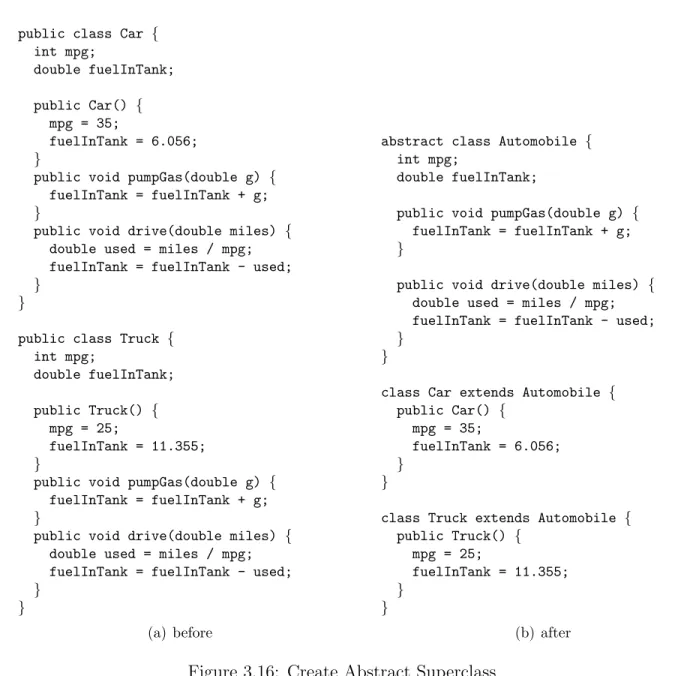
3.3.5 Create Abstract Superclass . . . 49
3.4 Discussion and Summary . . . 51
3.5 Summary . . . 53
4 Code Smells 54 4.1 Duplicated Code . . . 54
4.1.1 Detecting Duplicated Code . . . 55
4.1.2 Refactorings for Duplicated Code . . . 56
4.2 Feature Envy . . . 57
4.2.1 Detecting Feature Envy . . . 57
4.2.2 Refactorings for Feature Envy . . . 58
4.3 Data Class . . . 60
4.3.1 Detecting Data Class . . . 60
4.4.1 Detecting a Switch Statement . . . 65
4.4.2 Refactorings for Switch Statement . . . 67
4.5 Summary . . . 68
5 Metric for Feature Envy Detection 70 5.1 Coupling Measures . . . 70
5.2 Cohesion Measures . . . 72
5.3 Feature Envy Metric . . . 74
5.3.1 Internal Process . . . 77 5.3.2 Choosing wand x. . . 81 5.3.3 Incorporating an Analysis . . . 81 5.3.4 Metric Validation . . . 83 5.4 Summary . . . 85 6 The Framework 87 6.1 Existing Components . . . 87 6.1.1 Fluid . . . 88 6.1.2 Eclipse . . . 89
6.1.3 Incompatibilities between Fluid and Eclipse . . . 89
6.2 Implementation . . . 90
6.2.1 The Architecture . . . 90
6.2.4 Code Smells Resolution . . . 95
6.2.5 Annotation Suggester . . . 96
6.3 JCodeCanine’s Key Features . . . 96
6.3.1 Code Smells Detection and Resolution . . . 97
6.3.2 Stand Alone Refactoring . . . 97
6.3.3 Annotation Suggestions . . . 100 6.4 Summary . . . 101 7 Empirical Results 103 7.1 Code Smells . . . 105 7.2 Refactorings . . . 107 7.3 Code Qualities . . . 109 7.4 Discussion . . . 111 7.4.1 Duplicated Code . . . 114 7.4.2 Feature Envy . . . 114 7.4.3 Data Class . . . 114 7.4.4 Switch Statement . . . 115 7.5 Summary . . . 116 8 Conclusion 117 ix
B Case Studies 123
B.1 Definitely a Feature Envy . . . 123
B.2 Calls on Objects of the Interface Type . . . 124
B.3 Calls on Objects of Library Types . . . 125
B.4 May-be a Feature Envy . . . 126
B.5 Exception Class . . . 127
B.6 Switch Statement . . . 128
3.1 Rename Method Refactoring . . . 24
3.2 Careless Method Renaming . . . 25
3.3 Extract Method . . . 26
3.4 Method Extraction that Requires a Return Statement . . . 27
3.5 Method Extraction inside a Loop . . . 28
3.6 Reverse Conditional . . . 29
3.7 Consolidate Duplicate Conditional Fragments . . . 31
3.8 Bad Statement Swap . . . 32
3.9 Careless Inline Method . . . 38
3.10 Class Hiearchy Analysis . . . 39
3.11 Move Method . . . 42 3.12 Aggregate/Component Relationship . . . 45 3.13 Nonexclusive Components (1) . . . 47 3.14 Nonexclusive Components (2) . . . 47 3.15 Moving members . . . 48 xi
4.1 Feature envy . . . 57
4.2 Remove Feature Envy by Refactorings . . . 59
4.3 Data Class . . . 61
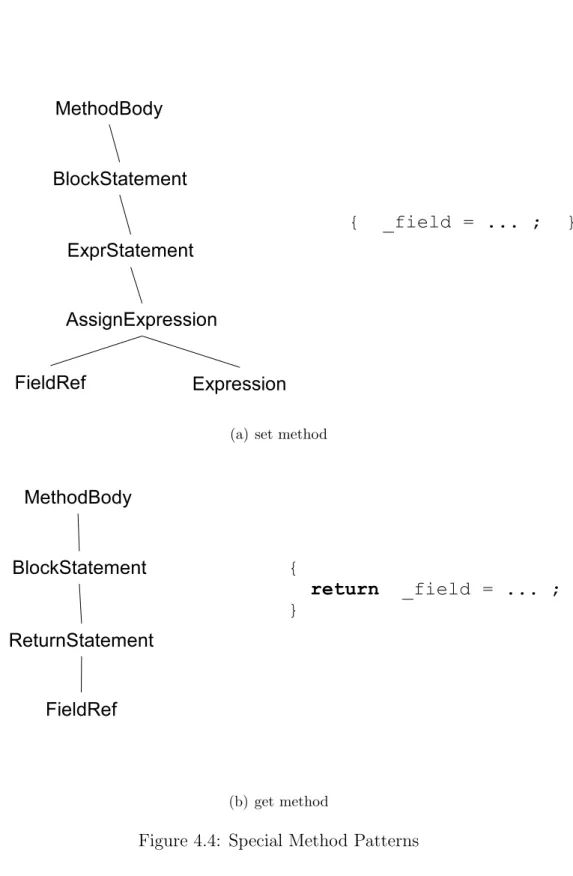
4.4 Special Method Patterns . . . 62
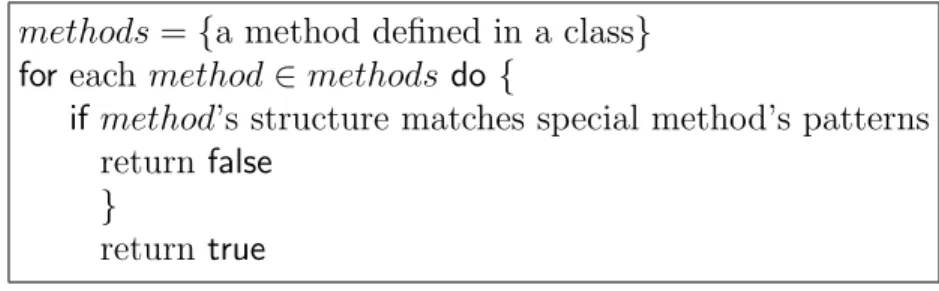
4.5 Algorithm to detect data class . . . 63
4.6 Poor Use of Switch Statement . . . 65
4.7 False Positive for Switch Statement . . . 66
4.8 Algorithm to detect switch statement . . . 66
4.9 Remove Switch Statement . . . 68
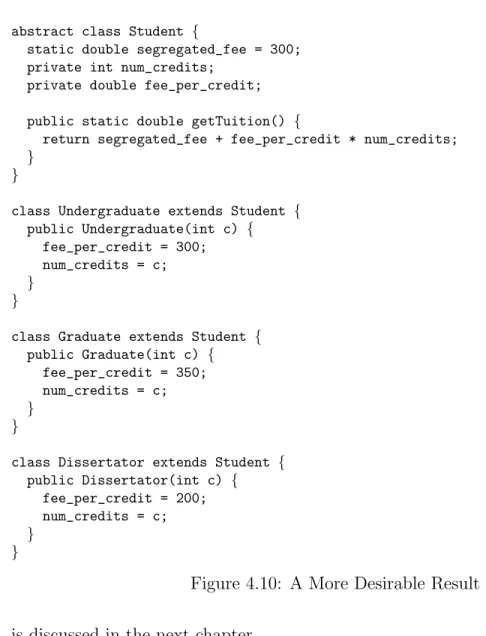
4.10 A More Desirable Result . . . 69
5.1 Feature Envy Candidate . . . 80
5.2 Non Feature Envy Instance . . . 82
5.3 Maybe Feature Envy . . . 83
6.1 Architecture of JCodeCanine . . . 92
6.2 Process Cycle in JCodeCanine . . . 93
6.3 A Snapshot of Feature Envy Detected . . . 98
6.4 A Snapshot of Data Class Detected . . . 98
6.5 Apply Refactoring through Quick Fix . . . 99 6.6 Semantic Conditions Violated ifbought()is Renamed toupdateStock()100
B.1 Feature Envy Instance . . . 124
B.2 Feature Envy on Objects of Library Type . . . 126
B.3 Indirect Usage of Library Class . . . 126
B.4 May-be a Feature Envy . . . 127
B.5 Exception Subclass Detected as a Data Class . . . 128
3.1 Refactorings and Analyses . . . 41
5.1 Cohesion Measurements on Instructor’s Code . . . 75
5.2 Variables in the Metric . . . 80
6.1 Fluid and Eclipse Incompatibilities . . . 90
7.1 Numbers of Code Smells Detected, False Positives and Accuracy . . . 106
7.2 Number of Suggested Refactorings . . . 108
7.3 Objectives for Different Metrics . . . 111
7.4 Comparison of Software Metric Measurements: Low (1) . . . 111
7.5 Comparison of Software Metric Measurements: Low (2) . . . 112
7.6 Comparison of Software Metric Measurements: Trade-off . . . 112 7.7 Impacts on Software Quality (+ Positive, - Negative, = No impact) . 112
Chapter 1
Introduction
This chapter states the current problem in software development process as well as the motivation of this work. It further introduces the idea of this work and describes why the problem is not trivial and how we tackle the problem. The main contributions are also discussed in this chapter.
1.1
The Problem
A software system becomes harder to maintain as it evolves over a period of time. Its design becomes more complicated and difficult to understand; hence it is necessary to reorganize the code once in a while. The most important thing when reorganizing code is to make sure that the program behaves the same way as it did before the reorganization has taken place. Semantic preserving program transformations are known asrefactorings. The idea of refactoring is first introduced by William Opdyke
in 1992 [73]. The behavior preservation criterion is also discussed in his work. In the past, refactorings were not taken into the mainstream development pro-cess because applying refactorings by hand is error-prone and time consuming. The benefits of refactorings are not obvious to many developers because refactoring nei-ther adds new features to the software nor improves any external software qualities. Therefore, many system developers give refactorings low priority. They are afraid that doing so would slow down the process and/or break their working code. Though refactoring does not help improve external software qualities, it helps improve internal software qualities such as reusability, maintainability and readability. It is inarguable that software design changes frequently during the development. Performing refactor-ing introduces a good codrefactor-ing discipline as it encourages reuse of existrefactor-ing code rather than rewriting new code from scratch.
Refactoring is usually initiated/invoked by the developer. Most software develop-ers only refactor their code when it is really necessary because this process requires in-depth knowledge of the software system. While many experienced developers can recognize the pattern and know when to refactor, novice programmers may find this process very difficult.
Even with the knowledge of refactorings, it is not easy for the developer to de-termine which part of their code can benefit from refactorings. Many programmers learn from their experience. New generation programmers are more fortunate since Martin Fowler and Kent Beck address this issue in their book on Refactoring [33].
They provide a list of troubled code patterns which could be alleviated by refactor-ings. Such patterns are widely known as code smells or bad smells. Recent work by Mantyla and others [58] attempts to make Fowler’s long monotonous list of smells more understandable. In their work, smells are classified into 7 different categories. The taxonomy helps recognize relationships between smells and make them more comprehensible to the developer.
Despite the presence of such guidelines, finding code smells is not trivial. First and foremost, the developer has to recognize those patterns. The problem is, even if he can recognize them, he may not realize it when he finds one. Such a task becomes much more difficult for a large scale software system.
The process of detecting and removing code smells with refactorings can be over-whelming. Without experience and knowledge of the design of the particular software, the risks of breaking the code and making the design worse are high. Applying refac-toring carelessly can inadvertently change program behavior. When refacrefac-toring is carefully applied, we not only preserve the program behavior but also avoid introduc-ing new bugs.
Many refactoring tools have been developed [44, 2, 86, 43, 24]. There are also a number of works on finding refactoring candidates [49, 81, 19]. Nonetheless, these two frameworks usually work separately. It is unfortunate to see two related frameworks work on their own and not utilize the benefits to their maximum potentials. The relationship between code smells and refactorings are obvious but not many people have put them together.
1.2
Proposed Solution
Code smells detection and refactoring are connected. While code smells represent de-sign flaws in the software, refactoring is the process which restructures and transforms the software. In other words, code smells tell what the problems are and refactoring can then be used to correct such problems. Integrating these two processes would provide the complete process of locating the design flaws and improving software design. The integrated framework also provides other benefits which include:
1. Clearer Connection between Smells and Refactorings: It is evident that code smells and refactorings are related. However, the connections are abstract and usually obscured by their complexities. Putting them in the same framework presents their relationships in a more concrete way.
2. Analysis Information Reuse: Checking conditions before refactoring and de-tecting code smells require similar analyses (as discussed further in chapters 3 and 4). It is unnecessary to perform an analysis for information that we al-ready have. Reusing analysis information makes the framework more efficient. However, to be able to correctly reuse the information, we have to keep track the parts of the program that change. Then, we must determine which analysis needs to be rerun to address those changes. The overhead of this framework will be keeping tracks of changes made on the code. I believe that such overhead is a small sacrifice for improved efficiency.
can check for code smells and remove them without disrupting the flow of their coding. It encourages the developer to make changes incrementally.
Some code smells introduce design change and require the developer’s assistance. Not all code smells can be automatically detected. Hence, this work focuses only on those that can be detected automatically. A set of code smell detection analyses developed in this research is discussed in chapter 4.
1.3
Contributions
The major contributions of this research are:
1. It defines conditions that must be checked to ensure behavior preservation before refactoring.
2. It identifies analyses required for the condition check.
3. It identifies analyses required to detect code smells.
4. It shows relationships between code smells and refactorings (in terms of analysis used).
5. It introduces metrics to detect code smells.
Though this work implements a tool for Java programs, the theoretical ideas can be adapted not only to other object-oriented languages, but also to other programming language paradigms.
1.4
Outline of the Thesis
Related work is discussed in Chapter 2. In this chapter, we provide observations on current refactoring tools. Existing techniques for finding refactoring candidates are reviewed. Other analyses that could be used to ensure semantic preservation are mentioned in this chapter.
Chapter 3 discusses low-level and high-level refactorings, their complexities and their semantic preserving conditions. It explains the importance of semantic checks and shows examples of how careless refactoring could affect the observable behavior. Chapter 4 describes each code smell and the approach that this work uses for smells detection. Refactorings that can be applied to remove smells are also discussed in this chapter.
In Chapter 5, we discuss some existing cohesion and coupling metrics and why they are unsuitable for feature envy detection. A novel metric to detect feature envy is introduced in this chapter.
Chapter 6 describes the overall framework of our implementation, JCodeCanine which is a tool that analyzes Java source code. It detects code smells discussed in chapter 4 and suggests a list of refactorings that could address the design flaws.
Chapter 7 provides discussion on empirical results. It looks at JCodeCanine’s efficiency in various aspects including the comparison of code quality before and after smells detection and refactoring application.
Chapter 8 concludes the present work and some open problems for future work. Appendix B presents a few case studies for code smells detection.
Chapter 2
Related Work
According to Opdyke [73], each refactoring basically consists of preconditions, me-chanics and postconditions. All preconditions must be satisfied before applying refac-toring. Likewise, all postconditions must be met after refactoring is applied1. These
conditions ensure that the program behavior is preserved. Opdyke also categorizes refactorings into low-level and high-level refactorings. Low-level refactorings are re-lated to changing a program entity (e.g.,create, move, delete). High-level refactorings are usually sequences of low-level refactorings. He also provides proofs of behavior preservation for many refactorings. The behavior preservation proofs of some low-level refactorings are trivial but implementing them is not as trivial. This issue will be discussed in Chapter 3.
1The use of term “postcondition” in this research is different from the standard use of
postcon-ditions. Here we have postconditions apply to perform checks that are difficult to do before the transformation takes place.
2.1
Refactoring Tools
In early 1990s, Don Roberts and his colleagues developed a refactoring tool called the Smalltalk Refactoring Browser [76]. This refactoring browser allows the user to per-form many interesting refactorings automatically (e.g., Rename, Extract/Inline
Method, Add/Remove Parameter). However, this early tool was not popular
because it was a stand-alone tool separate from the integrated development environ-ment (IDE). Developers found it inconvenient to switch back and forth between the IDE (develop code) and Refactoring Browser (refactor code). Thus later refactoring tools have been integrated in the IDEs. The following are refactoring tools for Java.
IntelliJ IDEA [44] This is an expensive commercial IDE. This tool also supports RenameandMove Program Entities (e.g., package, class, method, field), Change Method Signature, Extract Method, Inline Method, In-troduce Variable, InIn-troduce Field, Inline Local Variable, Ex-tract Interface, ExEx-tract Superclass, Encapsulate Fields, Pull
Up Members, Push Down Members and Replace Inheritance with
Delegation.
RefactorIt RefactorIt is a commercial software that supports many automatic refac-torings [2]. It can cooperate with Sun ONE Studio, Oracle 9i JDeveloper and Borland JBuilder. The supported refactorings are: Rename, Move Class, Move Method, Encapsulate Field, Create Factory Method, Ex-tract Method, ExEx-tract Superclass/Interface, Minimize Access
Rights, Clean Imports, Create Constructor, Pull Up/Push Down
Members.
JRefactory [86] JRefactory is a tool that is first developed by Chris Seguin. How-ever, Mike Atkinson has taken over the leadership role since late 2002. This tool allows easy application of refactorings by providing user interface based on UML diagrams as visualization of Java classes. It can cooperate with JBuilder and Elixir IDEs. JRefactory supports the following refactorings: Move Class, Rename Class, Add an Abstract Superclass, Remove Class, Push
Up Field, Pull Down Field, Move Method.
jFactor [43] jFactor for VisualAge Java is a commercial product that provide a set of refactorings. Extract Method, Rename Method Variables, In-troduce Explaining Variable, Inline Temp, Inline Method, Re-name Method, Pull Up/Push Down Method, ReRe-name Field, Pull
Up/Push Down Field, Encapsulate Field, Extract Superclass/Interface.
Transmogrify [85] Transmogrify is a Java source analysis and manipulation tool. This tool is under development and currently is focused on the refactoring tool. It is available as a plug-in for JBuilder and Forte4Java. It supports a limited set of refactorings such as Extract Method, Replace Temp with Query, Inline Temp, Pull Up Field.
Eclipse [24] Eclipse is a generic development environment by IBM. It also has refac-toring support and some analysis. This project is open source. The current ver-sion of Eclipse (Helio verver-sion 3.6.1) supports many types of refactorings which includeMove Method, Rename Method, Encapsulate Fieldsand etc.
Microsoft Visual Studio Microsoft Visual Studio is an integrated development en-vironment. It supports many primitive refactorings.
Generally, refactoring tools provide a list of refactorings in which the user can choose from the menu. Once the user chooses which refactoring to apply, the tool performs analyses in the background checking the required conditions. If those con-ditions are met, then refactoring can be performed. A few tools, like the refactoring support in Eclipse, allow the user to preview the resulting code before committing changes to the code. The preview feature gives the user a better idea of which part of his code will be affected by such a refactoring and whether it corresponds with his intention.
There are many refactoring tools for other programming languages like C++. For instance, Xrefactory also known as xref [95] is a refactoring browser for Emacs, XEmacs and jEdit. CppRefactory [84] is another open source refactoring tool that automates the refactoring process in a C++ project. Though the refactoring frame-work was originally proposed for the object-oriented programming language, many researchers apply the idea of refactoring to other language paradigms as well. Li and his colleagues propose refactoring tool support for functional languages [56]. Saadeh and Kourie [79] developed a refactoring tool for Prolog. The general idea is similar
to that of object-oriented languages but the conditions and mechanics are different. Although most tools discussed in this research apply refactorings by directly ma-nipulating the source code, many software designers think about refactorings at the design level. Researchers who are interested in design-level transformations include Griswold and Bowdidge [40]. They state that it is rather difficult to conceptualize program structure by just observing the program text. Instead of using program text, a graphical representation of program structure is used as it permits direct manipu-lation of the program structure at design level. Gorp et al. [37], Enckevort [26] and Saadeh et al. [78] and propose techniques to apply refactorings to UML diagrams. We omit further discussion regarding design-level transformations, since our work uses source code manipulation approach.
Like Opdyke and Fowler, we believe that refactoring tool cannot be completely automated. A good refactoring tool should give the developers the final authority. It must interact with the developer because inferring design intent is difficult. Some refactorings may introduce a design change which requires software developer’s in-sights because he has the best knowledge of the program context. A tool can facilitate the process by suggesting a set of refactorings and helps ensure that each refactoring is applied correctly.
2.2
Finding Refactoring Candidates or Code Smells
Kataoka et al. [49] propose that program invariants can be used to find refactoring candidates. First, they define patterns of invariants that identify a potential candidate
for each refactoring. If the program invariant match the pattern, it is considered a refactoring candidate. For instance, a parameter can be removed, if it is not used, it is a constant, or its value can be computed from other source. The invariant patterns p for Remove Parameterrefactoring are:
• p =constant
• p =f(a, b, . . . )
Their approach is independent of the technique to find invariants. Either dy-namic or static analysis techniques can be used. The static approach requires the programmer to explicitly annotate his program with his design intent and most pro-grammers consider it troublesome to carry out this task. Sometimes invariants are implicit. An alternative to expecting programmers to annotate code is to automat-ically infer invariants. Invariant inference can be done by performing statautomat-ically [29] or dynamically [27]. With the dynamic approach, the program is instrumented to trace variables of interest. However, the results from dynamic approach depend on the quality of test suites. They are, in general, true only for a set of some program inputs. On the contrary, static analyses are sound with respect to all possible execu-tions. Hence, it is desirable to combine static with dynamic approach but so far, no one has succeeded. A detailed evaluation of static and dynamic invariant inference tools is given by Nimmer and Ernst [70].
Kataoka’s approach is applicable to a limited number of refactorings. Not all refactoring candidates are discoverable from invariants. Determining other refactoring
candidates requires other techniques. Generally, semantic analysis of the program is required.
Melton and Tempero [64] suggest an approach that identifies refactoring oppor-tunities using dependency graphs. According to their statement, long cycles are hard to understand, test and reuse. If someone wants to understand a class in a cycle, he is required to understand every other class in the dependency cycle as well. Hence, cycles should be detected and removed. If a class is involved in many cycles, it is desirable to break the cycle by extracting an interface from such a class.
Many researchers use metrics to identify refactoring candidates [9, 81, 42, 80, 63, 82]. Bieman and Kang define cohesion as a degree to which modules belong to-gether [9]. Simon and others [81] propose adistance cohesion metricwhich represents how close two or more program entities are. They use program visualization as an aid in interpretation of the results. The distance cohesion metric can be applied to a limited set of refactorings such asMove Method, Inline/Extract Class. Singh and Kahlon [82] propose metrics model to identify code smells which include cohe-sion and encapsulation metrics. They argue that encapsulation should be measured from the unity and the visibility of class members and introduce two new metrics for information hiding and encapsulation. In this work, a statistical analysis is applied on a set of software metrics which is then grouped by Mantyla’s bad smell catego-rization [59]. The results show that their new encapsulation and information hiding metrics play a big role in identifying smelly classes.
Tourw`e and Mens [91] introduce an approach that is independent of language syntax by using logic meta-programming. Similar to any logic programming, the key components of this approach are facts and rules. Each program has its own set of facts. Facts (e.g., inheritance hierarchy) can be derived automatically from the code. Rules for finding refactoring candidates, on the other hand, must be defined manually. However, they are true and can be used for any program. This approach can be applied to any language; nonetheless, the results from this approach are in an intermediate form. They must be converted to another form so that they can be used easily in the successive steps. Such a conversion causes some overhead (mapping from program representation to facts and vice versa). The accuracy of results depends on the quality and the completeness of defined rules. Moreover, the intermediate representation may not map well back to the source. For instance, comments may be lost during the mapping.
While many works focus on detection algorithms for specific smells, Moha et al. propose a technique to detect design defects using high-level abstraction through UML class diagrams [65, 66]. They define a meta-model for defects’ specification and algorithms to detect design defects from the meta-model. Their defect correction technique is based on a rule-based language.
A number of researches aim to achieve better accuracy in detecting code smells and/or finding refactoring candidates by performing both structural and semantic analyses [23, 21, 15, 72]. Conceptual relation or semantic information are extracted by information retrieval techniques (Shingles, Latent Semantic Indexing) and natural
language processing techniques. However, some semantic information can only be retrieved at run-time which makes semantic analysis (especially through dynamic metric) a lot more expensive than syntactic or structural-based analysis.
Unlike any previously discussed approaches that consider only the current version of the source code, a number of research works consider code history through change metrics [19, 80]. Demeyer et al. [19] focus on the reverse engineering effort by determining where the implementation has changed. They study the history of the software and find refactorings between successive versions of software based onchange metrics. Three categories of metrics are considered: 1) method size, 2) class size and 3) inheritance. After deriving the metrics for each version of the software, numbers from those metrics are then compared. Any substantial differences imply that there were major changes between versions and that refactorings may have been applied. The cons to this approach is that software logs must be available; hence, unversioned software will not benefit from this approach. However, for versioned software, it helps understand design changes in a software system and learn how it evolves.
2.3
Code Smell Detection Tools
There are a number of tools that support automatic code inspection. The well-known C analyzer LINT [47] and its Java variant JLINT [3] can check for type violations, null references, array bounds errors, etc. These tools focus on improving code quality from a technical perspective. JDeodorant [93, 31] is another code smell detection tool which specifically identifies type-checking bad smells in Java source code. Code
smells that the early version of JDeodorant can detectReplace Conditional with
PolymorphismandReplace Type Code with State/Strategy. JDeodorant,
however, only identifies code smells. It does not provide any suggestions or recom-mendations on how such smells should be removed. Recent version of JDeodorant [31] also identifies God Classes, suggests where to applyExtract Classrefactoring and allows the programmer to perform class extraction in the process.
The work by Eva van Emden and Leon Moonen [25] and RevJava [30] are more closely related to this work as they focus on improving code quality from a program design and programming practice perspective. RevJava is a Java analysis tool that performs design review and and architectural conformance checking. Based on prede-fined and user-deprede-fined design rules, the system analyzes Java bytecode, checks if any rules are violated and reports them to the user. However, RevJava is not suitable for large software systems because it has no support for visualization of rule violations.
Emden and Moonen [25] categorize code smells into two kinds of aspects: primitive smell aspects and derived smell aspects. Primitive smell aspects can be observed directly from the code. Derived smell aspects, on the other hand, are inferred from other aspects according to a set of inference rules. In this architecture, the detection of primitive smell aspects and the inference of derived smell aspects are treated as separate units, and consequently, they are extendable. The programmer can add new code smells by extending the inference rules.
Unlike RevJava, Emden’s work analyzes Java source code because some coding standards cannot be checked on bytecode, since the bytecode contains less information
than the original source code. The code smells detection process is: 1) find entities of interest, 2) inspect them for primitive smells, 3) store information in a repository and 4) infer derived smells from the repository. After the smells have been detected, they are presented to the user by visualizing the source model using graphs.
2.4
Refactoring and Type Constraints
Type constraints are usually used to type check the program. Some researchers adopt this idea and add type constraints to the condition check in order to ensure behavior preservation in refactoring.
Tip et al. [90, 89] use type constraints for a set of refactorings that is related to generalization, e.g., Pull Up Members and Extract Interface. The type constraints are used to verify the refactoring’s preconditions.
Research work by Balaban et al. uses type constraints for library class migra-tion [6]. All methods in legacy classes (e.g., Hashtable and Vector) have been super-seded by classes (HashMap and ArrayList respectively) which provide similar func-tionalities except they allow unsynchronized access to their elements. When replacing legacy classes with unsynchronized, synchronization wrapper. In their research, a set of type constraint rules to migrate program that uses legacy class are defined. The programmer must define a set of migration specifications. Type constraint rules are generated from the given program and migration specifications. The runtime of the analysis is exponential. They also provide an algorithm for Escape Analysis that is used to check for thread safety.
It is inarguable that type constraints is useful for many refactorings. However, its usage restricts to only refactorings that involve types and those that could introduce type violation if applied carelessly.
Chapter 3
Refactoring Complexities
Refactorings are structural changes made to a program that preserve program se-mantics. While many works [33, 88, 10] look at how refactoring could improve the structure and design of a program, this work focuses on the latter issue i.e., how to check that the change is semantics preserving. Behavior preservation is important because if it is not assured, the program could produce different results after the changes. Refactoring, if applied correctly, is ideal for software evolution, since it is guaranteed that no new bugs are introduced.
This chapter presents and analyzes a number of refactorings. While the refactor-ings have been discusssed elsewhere, this work appears to be the first to discuss the analyses necessary to automate the refactorings.
Most refactorings discussed in this chapter are from the refactoring book by Mar-tin Fowler [33]. Two additional simple low-level refactorings were noticed while we were examining an actual case of software evolution: Reverse Conditional and
Consolidate Duplicated Conditional Fragments. This chapter categorizes refactorings as low-level (Section 3.2) and high-level (Section 3.3).
Fowler provides the definition of each refactoring but does not discuss the com-plexities with respect to behavior preservation. His suggestion is to test the code and compare the output after each refactoring. This is an ad-hoc approach. Such an approach is not fool-proof because it relies solely on test cases. Moreover, it could put programmers in a situation where changes have been made but the refactored code produces different results. Testing code after refactoring is necessary but insufficient. This chapter starts with seven properties defined by Opdyke that must be used to ensure behavior preservation. It describes characteristics and complexities of each refactoring. Refactoring complexities will be discussed based on properties identified by Opdyke (Section 3.1). An explanation of why and which analysis is required for each refactoring in order to keep semantics unchanged (Opdyke’s 7th property) is also presented in this chapter. Most code examples are from real world projects. Some are from the Fluid Framework and some are CS552 students and instructors who generously donated their code.
3.1
Opdyke’s Behavior Preservation Properties
Opdyke [73] has determined a set of properties of programs that must be checked to ensure behavior preservation. Such properties are:
2. Distinct Class Names
3. Distinct Member Names
4. Inherited Member Variables Not Redefined
5. Compatible Signatures in Member Function Redefinition
6. Type-Safe Assignments
7. Semantically Equivalent References and Operations
The first six properties are syntactic while the seventh property is semantic. The compiler can usually detect any violations of syntactic properties but not the semantic property. Checking syntax errors after refactoring is necessary but insufficient to guarantee behavior preservation. In order to ensure that a program after refactoring is semantically equivalent to the program before refactoring, the preconditions for each refactoring must be carefully defined.
One of the most well-known refactoring tools in the market is refactoring support in Eclipse IDE. Unfortunately Eclipse’s refactoring support only checks the syntax of the code after applying refactoring. It does not check the conditions related to program semantics. It employs only the first six properties which do not fully ensure behavior preservation. Therefore, using Eclipse’s refactoring tool is unsafe because it may change the semantics of the program. It is conceivable that Eclipse will integrate code smell detection with the refactoring tool in the future. In this case, this dissertation still has a positive contribution in the semantic analyses. Such
semantic conditions can be used in addition to the syntactic checks. Furthermore, the contributions from this work are also applicable to other object-oriented languages and can also be used as a guideline for those who want to implement code smell warnings for other types of refactorings.
3.2
Low-Level Refactorings
The definition of low-level refactoring in this work is somewhat different from that of Opdyke’s. While Opdyke defines low-level refactorings as those that for which it is trivial to show that they are behavior preserving, this work considers a refactoring to be low-level if it does not involve complicated program analyses to ensure behavior preservation.
3.2.1
Rename
Renaming is the most frequently used refactoring. It usually takes place when we find that the name of a program entity does not represent its purpose. It is common that programmers do not the name right the first time.
Complexities
Renaming may sound simple but implementing such a refactoring while trying to preserve semantics is not trivial. Suppose a programmer wants to rename a method. Putting behavior preservation aside, one of the complexities involves updating all references to use the new name. With behavior preservation in mind, it is necessary
to check if the class already has a method with that name before renaming. If such a method exists, two things could happen, 1) if it has the same signature as the one to be renamed, a compile error occurs. 2) if they have different signatures, there may be no compile error but this renaming causes design change, because it introduces overloading which may cause overloading resolution to give a different result. More complexities arise since inheritance must also be taken into consideration. In the object-oriented programming world, looking at the class that defines the method alone is not sufficient. Though it may look like everything works the same way within one class, other classes in the same hierarchy may be affected by that change. We have to go up and down the inheritance hierarchy because renaming without such information can create overriding. Introducing an overloading/overriding method may change semantics of the program.
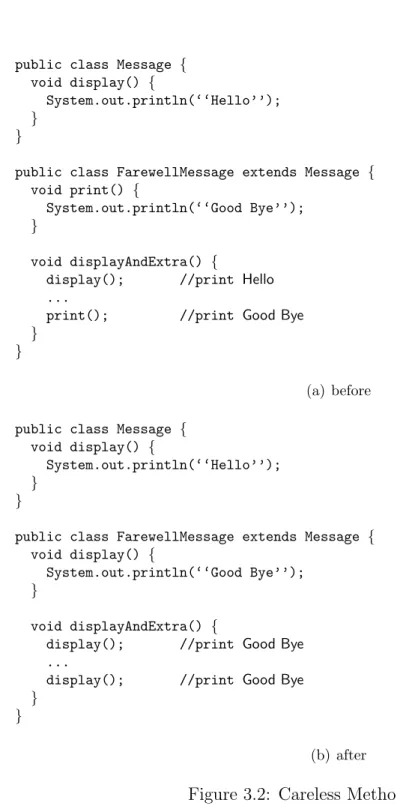
Figure 3.2 demonstrates careless method renaming. Though renaming print method to display in the class FarewellMessage does not introduce compile er-rors. MethoddisplayAndExtra in figure 3.2b behaves differently. Unlike the former code, it shows message Hello instead of Good Bye.
Required Analysis
private void updateWarehouse() { ...
writeWarehouse(); }
private void exitWarehouse() {
...
writeWarehouse(); System.exit(0); }
private void writeWarehouse() {
... }
(a) before
private void updateWarehouse() {
...
saveWarehouse(); }
private void exitWarehouse() {
...
saveWarehouse(); System.exit(0); }
private void saveWarehouse() {
... }
(b) after
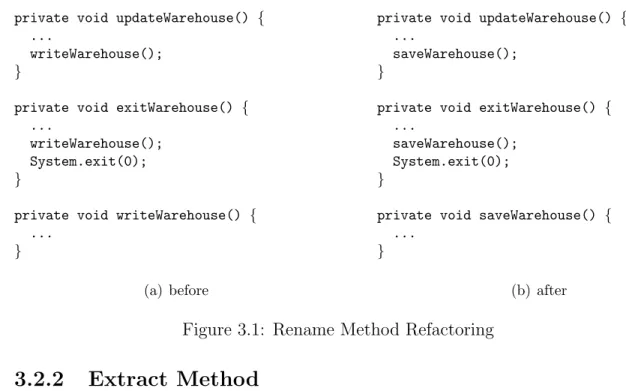
Figure 3.1: Rename Method Refactoring
3.2.2
Extract Method
When a method is too long or is doing too much, we can extract a region of code and make a new method for it. Not only does extracting method make the code more readable, but it also promotes code reuse. An indirect result of extracting a method is improving the code maintainability. Sometimes a method is extracted when the programmer foresees substantial future changes such as adding more responsibilities to a method.
Complexities
Extract Method is done within a class so it is less complicated than refactorings that involve more than one classes. The newly extracted method must have access to all local variables it uses. Therefore, such variables must be passed into the extracted method as parameters. Fields are exceptions, since they are accessible through out the class. Figure 3.3 shows how a method is extracted. The programmer wants to extract
public class Message {
void display() {
System.out.println(‘‘Hello’’); }
}
public class FarewellMessage extends Message {
void print() {
System.out.println(‘‘Good Bye’’); }
void displayAndExtra() {
display(); //print Hello
...
print(); //print Good Bye
} }
(a) before
public class Message {
void display() {
System.out.println(‘‘Hello’’); }
}
public class FarewellMessage extends Message {
void display() {
System.out.println(‘‘Good Bye’’); }
void displayAndExtra() {
display(); //print Good Bye
...
display(); //print Good Bye
} }
(b) after
public void init() {
JTextField textField = _itemPrice; int iCol = 5; textField.setColumns(iCol); textField.setFont(new Font(textField.getFont().getFontName(), Font.BOLD, textField.getFont().getSize())); textField.setBackground(pricePanel.getBackground()); textField.setEditable(false); textField.setBorder(BorderFactory.createEmptyBorder()); pricePanel.add(textField); } (a) before
public void init() {
JTextField textField = itemPrice;
int iCol = 5;
setLabel(pricePanel, textField, iCol); pricePanel.add(textField);
}
private void setLabel(JPanel pricePanel,
JTextField textField, int iCol) { textField.setColumns(iCol); textField.setFont(new Font(textField.getFont().getFontName(), Font.BOLD, textField.getFont().getSize())); textField.setBackground(pricePanel.getBackground()); textField.setEditable(false); textField.setBorder(BorderFactory.createEmptyBorder()); } (b) after
Figure 3.3: Extract Method
a portion of code where several properties of textField are set. Since the extracted code refers to local variables: pricePanel, textField, iCol, they are added to the setLabel method signature.
More complexity arises if the extracted code contains an assignment to a local variable. If that local variable is not used after the extracted code, no other steps are required. If it is used, the extracted method must return the value of that local
static void shipment(Warehouse w, BufferedReader br) { System.out.println("Please enter order");
Order o = new Order(); o.read(br); Order l = o.ship(w); System.out.println("Back-ordered: "); l.write(System.out); } (a) before
static void shipment(Warehouse w, BufferedReader br) {
Order o = readOrder(br); Order l = o.ship(w);
System.out.println("Back-ordered: "); l.write(System.out);
}
static Order readOrder(BufferredReader br) {
System.out.println("Please enter order"); Order o = new Order();
o.read(br); return o; }
(b) after
Figure 3.4: Method Extraction that Requires a Return Statement
variable. This requirement is established to ensure that the original method still has access to the same object after the extraction. However, extracting code that has more than one assignment cannot be done because a method can only return one value. Consequently, it is necessary to check if there is any assignment to local variables in that region of code and if so, we have to further check the number of assignments. If there is only one assignment, we can proceed with the extraction process. If there is more than one assignment, the code cannot be extracted to a new method. Assignments to fields do not have this problem and do not require special treatments, since all methods have access to the class fields. Figure 3.4 illustrates the situation when a “return” statement has to be added to the extracted method.
int currentYear = 2012; int totalCost = 0;
for (int i = 0; i < employeeList.size(); ++i) { Employee e = employeeList.get(i);
int cost = e.getManMonth() * e.getStandardRate(currentYear); //to be extracted
totalCost = totalCost + cost; }
(a) before
int currentYear = 2012; int totalCost = 0;
for (int i = 0; i < employeeList.size(); ++i) { Employee e = employeeList.get(i);
totalCost = totalCost + e.getManMonthCost(currentYear); }
// A newly extracted method in Employee class
public int getManMonthCost(int year) {
return e.getManMonth() * e.getStandardRate(year); }
(b) after
Figure 3.5: Method Extraction inside a Loop Required Analysis
Live Variable Analysis: Live variable analysis [69] is used to determine useless vari-ables. It determines whether a variable will be used in the future. If the variable is not used, it is considered “dead” and can be removed. For method extraction, live variable analysis is used in a different aspect. We use the analysis to identify a set of variables that are used in the extracted code. The result of the analysis represents all live variables that must be passed as parameters into the newly extracted method.
Furthermore, we need live variable analysis to determine variable definition inside a loop. If a variable is redefined inside the loop, the extracted method must return the value for that variable as demonstrated in Figure 3.5
if (!isStronger(a, b)) { winner = b; } else { winner = a; } (a) before if (isStronger(a, b)) { winner = a; } else { winner = b; } (b) after
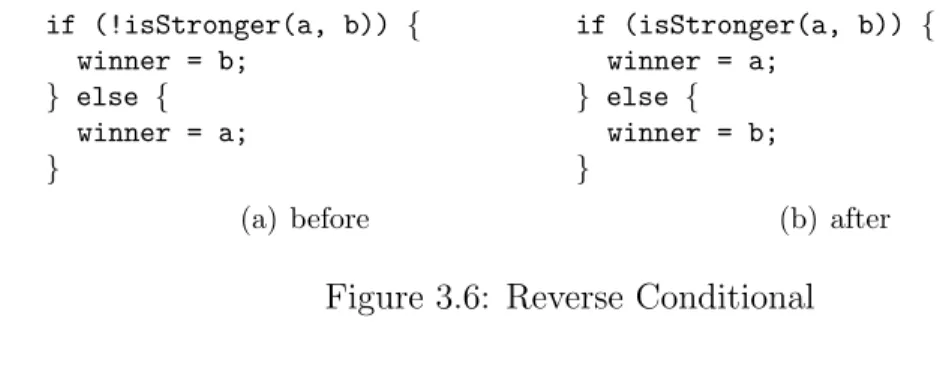
Figure 3.6: Reverse Conditional
3.2.3
Reverse Conditional
Reverse conditional refactoring is one of the refactorings that we identified during the early stages of this research. At that time, we looked at the history of two classes written in Java, studied changes made in 35 versions over 3 years of development. We then determined which changes could be done using refactoring. The code is written and modified by three different people and the final length of the code is XXX lines so it is a non-trivial project.
It is noteworthy to remark that the name Reverse Conditional is defined by Bill Murphy and Martin Fowler. Not long after we discovered this refactoring, they found such a refactoring and gave it an official name on www.refactoring.com.
Reverse Conditional is a very simple refactoring since it does not require any analysis. Proving that this refactoring preserves program behavior is trivial. It is simple to perform and is useful, since it can improve the readability of the code. Both Figure 3.6(a) and Figure 3.6(b) give the same results, the latter code makes more sense than the former code.
Complexities
Required Analysis
None.
3.2.4
Consolidate Duplicated Conditional Fragments
This is another refactoring we discovered that is not in Fowler’s book. It is rec-ommended when similar fragments of code exist in every branch of a conditional statement. It is an instance of code hoisting. Code hoisting is an optimization to reduce code size by eliminating statements that occur in multiple code paths from a single common point in the CFG. Though performing code hoisting on conditional statements does not improve code speed as it does for loop invariants, it simplifies the code and makes the code more manageable. Figure 3.7 shows how statements are consolidated.
Complexities
In order to safely move the duplicated code fragment out of a conditional statement, we must be certain that such fragment is not affected by the code nor have effects on the code inside the branches. In other words, the code inside the branches and the duplicated code fragment must be independent of each other. The code in Figure 3.7 requires no analysis and can be moved out because the statement is at the end of each branch. Hence, there is no statement to check for conflicts in effects. If the statement to be moved is at other locations, it is a general case of statement reordering which requires Effects Analysis. The complexity of statement reordering will be further
depth = 0; if (first < second) { ... depth = depth + 1; } else { ... depth = depth + 1; } (a) before depth = 0; if (first < second) { ... } else { ... } depth = depth + 1; (b) after
Figure 3.7: Consolidate Duplicate Conditional Fragments described in Section 3.2.5.
Required Analysis
Effects Analysis.
3.2.5
Swap Statements
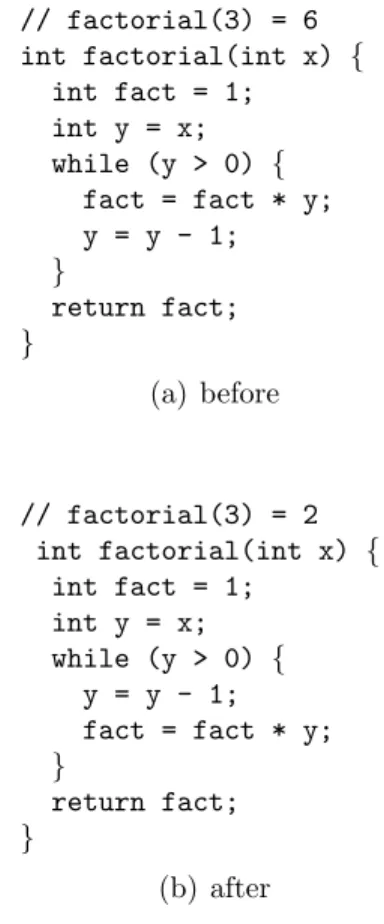
Swapping statements is primarily changing the order of statements. Figure 3.8 demon-strates a careless swap. Swapping two statements inside the while loop without check-ing dependencies causes method factorial to act differently. Using the code in our example to compute factorial(3), Figure 3.8(a) returns 6 whereas Figure 3.8(b) returns 2.
// factorial(3) = 6 int factorial(int x) { int fact = 1; int y = x; while (y > 0) { fact = fact * y; y = y - 1; } return fact; } (a) before // factorial(3) = 2 int factorial(int x) { int fact = 1; int y = x; while (y > 0) { y = y - 1; fact = fact * y; } return fact; } (b) after
Figure 3.8: Bad Statement Swap Complexities
Swapping two statements sounds straightforward but when semantic preservation must be taken into account, it is no longer trivial. Analysis is needed because two statements can be swapped only if they do not “interfere” with each other.
Behavior preservation cannot be guaranteed if a statement does not terminate or throws an exception. The semantic conditions in this research are based on an assumption that both statements terminate normally in all cases.
Required Analysis
Effects Analysis: Boyland and Greenhouse introduce an effects system for object-oriented programming [39]. They define two kinds of effects: read effects and write effects. Read effects are those that may read the contents of a mutable state. Write effects are those that may change or read the contents of a mutable state. Statements interfere with each other if they are flow dependent (write, read), output dependent (write, write) or anti-dependent (read, write). In other words, two effects conflict if at least one is a write effect and they involve targets that may overlap. A target is a mutable variable or a mutable state of an instance of a class.
Let s1 and s2 be two consecutive statements, x be an arbitrary variable or a
mutable object. Statements s1 and s2 do not interfere with each other if:
∀x:s1 and s2 that have an overlapped targetx Effect(s1)63(write, x)∧Effect(s2)63(write, x)
Let’s revisit Figure 3.8 and see how effects analysis plays a crucial role in this refactoring. According to the condition discussed previously, if statements fact = fact - 1andy = y - 1 have effects on a target variable, both statements must not write it. However, when we compute the read/write effects of the two statements, we get the following results:
[5] :fact=fact∗y
[6] :y =y−1
Effect([6]) ={(read,y),(write,y)}
As seen above, statement [6] writes y while statement [5] reads it which violates the semantic preservation condition. Hence, these two statements cannot be swapped without affecting program behavior.
Our condition is not too restrictive. Though the condition requires two statements to be consecutive, it is generalized and can be applied to non-consecutive statements. Swapping non-consecutive statements is literally performing a series of swaps on two consecutive statements. Suppose there is a series of statements (s1; s2; . . .si;) and we want to swap statements si with s1. There will be 2i−3 swaps i.e., i−1 swaps
from moving si in front of s1 and i −2 swaps from moving s1 after si−1. If the
statement is being moved downward in the CFG, we have to compute the effects of such a statement and those below it. Similarly, if it is being moved up the CFG, we have to check its effects against the effects of all statements above it. Below exhibits steps taken when swappingsi with s1.
s1; s2; . . . si−1; si; si+1; . . . sn−1; sn; s1; s2; . . . si; si−1; si+1; . . . sn−1; sn; .. . s1; si; s2; . . . si−1; si+1; . . . sn−1; sn; si; s1; s2; . . . si−1; si+1; . . . sn−1; sn; si; s2; s1; . . . si−1; si+1; . . . sn−1; sn; .. . si; s2; . . . s1; si−1; si+1; . . . sn−1; sn; si; s2; . . . si−1; s1; si+1; . . . sn−1; sn;
It is worth noting that the implementation does not have to perform the interme-diate swaps. It only has to check the effects 2i−3 times. After all effects are checked, we can change the order of s1 and si in one swap.
Special case: If the statement is inside a loop (for, while) and we want to move it up (outside), we must check all effects against itself and their conditions. Moreover, Reaching Definition Analysis [69] is needed to determine loop invariant. However, if a statement is being moved outside an if statement, an extra check is needed i.e.,it must occur in every branch. SeeConsolidate Conditional Fragmentin Section 3.2.4.
3.3
High-Level Refactorings
High-level refactorings are those that are difficult to implement and require program analysis to ensure behavior preservation. Since the definition of high-level refactoring in this work is different than Opdyke’s, many may refer some refactorings in this section as low-level.
3.3.1
Inline Method
Method inlining is basically an inverse of method extraction. This particular refac-toring inlines all invocations of a method and remove its declaration. Sometimes a programmer considers inlining a method if he finds that such a method does not have a lot of responsibilities. There are no apparent rules as to when to extract or inline a method. The decision is made based on each individual’s preference.
Complexities
Inline method involves an opposite issue of that of Extract Method. It is
normal that a method to be inlined has a number of local variable definitions. When inlining, such variables will be introduced to the target method. Hence, our behavior preserving task involves checking if the target has already defined variables with the same names. If the variable names conflict, they have to be renamed. Otherwise, it will introduce variable re-definitions and cause compile errors (if in the same scope) or cause the program to behave differently (if in a different scope).
other parts of the program depending on the type of the methods. No further checks are required for private method because it is invisible to other classes. Hence, the changes have no effects on them. The same issue applies to final methods. When a method is declared final, no other classes can override it so it is safe to perform inlining.
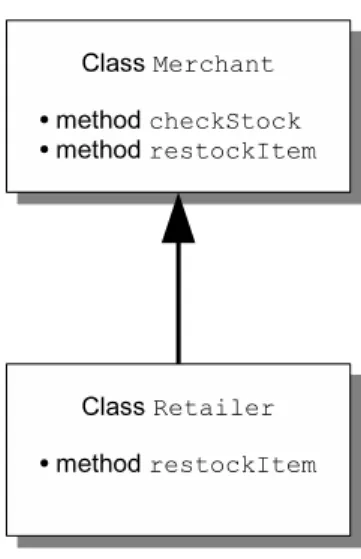
However, if a method could be overridden, there is a high risk in changing the behavior. If the subclasses override the method that is being inlined, their behav-ior will definitely be affected. Consider Figure 3.9 which shows an instance of the problems. Suppose the programmer wants to inline method restockItem in class Merchant. It is obvious that there is no behavioral change for class Merchant. How-ever, Retailer, a subclass of Merchant redefines (overrides) restockItem method. InliningrestockItemintocheckStockaffectsRetailer’s behavior. Retailer.checkStock puts 5 items on the shelves before inlining but it puts 20 items after the change.
Required Analysis
None, if the method to be inlined is final or private i.e., the method cannot be overridden. If it is neitherfinalnorprivate, an approach similar todevirtualization is needed. Devirtualization is an optimization technique to reduce the overhead of virtual (dynamic) method call by replacing a virtual method call with a particular method of a class. Though Inline Method refactoring does not focus on optimiza-tion, their mechanics and complexities are the same.
// Merchant.checkStock - restock 20 items if no item is in stock
class Merchant {
void checkStock(Item item) {
if (getQuantity(item) == 0) restockItem(Item item); }
void restockItem(Item item) {
_shelves.put(item, 20); }
}
// Retailer.checkStock - restock 5 items if no item is in stock
class Retailer extends Merchant {
void restockItem(Item item) {
_shelves.put(item, 5); }
}
(a) before
// Merchant.checkStock - restock 20 items
class Merchant {
void checkStock(Item item) {
if (getQuantity(item) == 0) _shelves.put(item, 20); }
}
// Retailer.checkStock - now restocks 20 item!!
class Retailer extends Merchant {
void restockItem(Item item) {
shelves.put(item, 5); }
}
(b) after
Figure 3.10: Class Hiearchy Analysis
devirtualization. It is a static analysis that determines a set of possible targets of a dynamic method call with the class hierarchy of the whole program. If it is possible to determine that there is no overridden method, the dynamic method call can be replaced with inlined code. CHA can be performed without programmer intervention. Ishizakiet al.claim the accuracy of class hierarchy analysis can be improved by adding type analysis and preexistence analysis [45].
Figure 3.10 illustrates a result of class hierarchy analysis forMerchantandRetailer code. Let’s consider the situation where a programmer wants to inline method restockItem into checkStock. Using CHA, we are able to determine that class Retailer overrides method checkStock which reveals that the inlining should not take place.
A thorough discussion on method inlining can be found in the work by Detlefs and Agesen [20]. Sometimes the system’s performance gets worse because type casts
are usually inserted to preserve typability. Glew and Palsberg [35] discuss type-safe inlining. There are many techniques for devirtualization not discussed here.
3.3.2
Move Method
Move Methodis used to move a method to a different class than the one it is defined in. A method is usually moved when the programmer finds that such a method does not belong in the class in which it is defined. It is collaborating too much with other classes. Such collaboration includes using or being used by more features of other classes than the class it lives in. Consequently, classes become too highly coupled which is poor design.
Moving a method to the superclass/subclass is also known asPull Up Method/ Push Down Method. An example of a method move between unrelated classes is depicted in Figure 3.11.
Complexities
One of the issues when moving a method is to avoid name conflict. Similar to renam-ing, it is necessary to check that the target class does not have a method with the same name. Checking for name conflicts must also be done on the entire inheritance hierarchy to ensure behavior preservation. The reasons behind this issue are already discussed in Section 3.2.1.
The other issue involves the possibility that the method being moved overrides that of its superclass. If it is overridden, any subclasses that override the method will
Refactoring Analysis
Rename None
Move Method None
Extract Method Live Variable Analysis
Inline Method Class Hierarchy Analysis
Reverse Conditional None
Consolidate Duplicated Conditional Fragments Effects Analysis
Swap Statements Effects Analysis
Move Field to Component Class Uniqueness Analysis
Move Method to Component Class Uniqueness Analysis
Move Field to Aggregate Class Uniqueness Analysis
Table 3.1: Refactorings and Analyses
be disturbed. A more detailed discussion was provided in Section 3.3.1. To ensure behavior preservation, our work will not allow the move if it is an overriding method. After a method is moved, it must still be accessible from its callers. To avoid any compile errors, the modifier of the moved method must be changed accordingly. For simplicity, this work always makes the moved method public.
Maruyama and Takayuki also describe the complexities and security issues con-cerningPull Up MethodandPush Down Method[61]. Their concern is mainly on preventing unauthorized external code to access sensitive data. The degree of con-fidentiality or access level are measured and if the access level of the modified source code is decreased or downgraded, they consider the modified code to be vulnerable to attackers.
Required Analysis
public class Driver { ...
private static void writeWarehouse(String strFileName) throws IOException {
File objFile = new File(strFileName); Warehouse objWh = Warehouse.getInstance(); if (objFile.exists() && objFile.canWrite()) {
PrintStream psWrite = new PrintStream(new FileOutputStream(objFile)); objWh.write(psWrite); } else { objWh.write(System.out); } } } (a) before
public class Driver {
...
public void init() {
...
Warehouse.writeWarehouse(‘‘warehouse.dat’’); }
}
public class Warehouse {
public static void writeWarehouse(String strFileName) throws IOException {
File objFile = new File(strFileName);
if (objFile.exists() && objFile.canWrite()) {
PrintStream psWrite = new PrintStream(new FileOutputStream(objFile)); this.write(psWrite); } else { this.write(System.out); } } } (b) after
3.3.3
Convert Inheritance into Aggregation
Inheritance represents “is-a” relationship while aggregation/components represents “has-a” or “whole/part” relationship. According to Foote and Opdyke [32],
Con-vert Inheritance into Aggregation refactoring supports software evolution
and reuse. Changing inheritance into aggregation offers many benefits. Such benefits include “part” encapsulation where Gammaet al. call it “black-box reuse” [34]. The term black-box is derived from the fact that the internal structure of objects is invis-ible to the clients. The implementation of a subclass may become so dependent with its superclass that changes in the superclass will cause the subclass to change. With aggregation, there are fewer implementation dependencies. Moreover, an aggregate could have more than one instance of a component class. While inherited parts are static, aggregation allows a class to change their components at runtime.
Each programmer has different viewpoints and they do not always choose the correct mechanism for modeling a particular relationship [73, 46]. However, as a program evolves, the relationships between classes become more evident. Convert
Inheritance into Aggregation refactoring allows the programmer to convert
a subclass/superclass relationship into an aggregation. Every behavior inherited by the subclass from its superclass before this refactoring will be delegated to a new component, which is an instance of the old superclass.
Consider a classTwoDimensionalArraythat defines a fieldelementsand methods to access and manage its elements and a class Matrixthat implements matrix opera-tions. The original design is that theMatrixclass inherits theTwoDimensionalArray
class. It is later realized that not all matrices should be conveyed in two-dimensional array, for instance using other kinds of representation for a sparse matrix would be more efficient. A matrix is not a representation. It “has” a representation. Hence, it is advisable to convert the original design from inheritance to aggregation.
Complexities
Converting inheritance into aggregation is complicated because it involves changing an inheritance hierarchy. The first thing to consider when inheritance changes is the accessibility to inherited methods and fields as they must still be accessible from the aggregate class when the changes occur. Method and field references must be updated not only in the aggregate class, but also in its clients.
Updating references to inherited fields and methods can be tricky. There is a possibility that the aggregate class has a subclass that overrides a method of the component. Consider a situation where a class UpperTriangularMatrix which is a subclass of Matrix overrides the method putElement so that it prevents putting values other than 0 below the diagonal. The scope of reference updates must be expanded to cover all subclasses of the aggregate. Opdyke does not mention this issue in his work.
Required Analysis
public class Automobile { Engine autoEngine; int numOfPassenger; Tire leftFrontTire; Tire rightFrontTire; Tire leftRearTire; Tire rightRearTire; ... }
Figure 3.12: Aggregate/Component Relationship
3.3.4
Move Members between Aggregate and Component
Class
As discussed in the previous section, aggregation/components represents “has-a” or “whole-part” relationship. The idea of the Whole-Part pattern is to introduce a component (the whole) that encapsulates smaller objects (the parts) which prevents clients from accessing these parts directly.
For instance, an automobile is composed of a body, four tires, a steering wheel and an engine. The car itself is an aggregate component while the tires, steering wheel and engine are parts (components) of the car. Figure 3.12 shows aggregate and component classes. Automobile is an aggregate class, while Engine and Tire are component classes.
It is sometimes necessary to move class members between aggregate and compo-nent classes. The original design may be improper or unsuitable with the current requirements. It may grant or restrict too much client’s access. Moving members to a component class restricts access from other clients. On the contrary, moving members to an aggregate class removes permits direct access from clients.
Moving members between aggregate and component classes is not easy to accom-plish without error. It is a special case of Move Methodso it inherits all complex-ities that were discussed in Section 3.3.2. Typically, the part can only belong to one whole at a time (Figure 3.13). In addition, each part in one whole must be unique (Figure 3.14). Checking these conditions requires uniqueness analysis. Performing these changes automatically with precondition checks eliminates the possibility of inadvertently changing behavior.
• Move Field to Componentrequires uniqueness analysis on the component
field, not the field being moved before moving members from an aggregate to a component class. It is required to determine whether a variable qualifies as a component member variablei.e.,every object assigned to it is not also assigned to another component variable.
• Move Method to Component does not require a component to be an
ex-clusive component of an aggregate class. Methods are different from fields as they are considered as services. However, it does require that a reference to the component class must be reachable whenever a method is called. In addition, the method must still be able to refer to an instance of the aggregate after the move. They are the same requirements as Move Method discussed in Sec-tion 3.3.2. The reference in the latter case could be carried out by adding an extra parameter to the method which creates delegation.
public class AutomobileFactory { Automobile car = new Automobile(); Tire temp = new Tire();
car.leftFrontTire = temp; car.rightFrontTire = temp; }
Figure 3.13: Nonexclusive Components (1)
public class AutomobileFactory {
Automobile car1 = new Automobile(); Automobile car2 = new Automobile(); Tire temp = new Tire();
car1.leftFrontTire = temp; car2.leftFrontTire = temp; }
Figure 3.14: Nonexclusive Components (2)
Component which also requires uniqueness analysis. For the same reason, variables from the component class can be moved to an aggregate class only if the component is exclusive. If an aggregate has more than one instance of a component, moving a field to an aggregate will require adding a variable for each instance.
Complexities
Moving members between aggregate and component classes is a variant of Move Method and Move Field. In addition to complexities discussed in Section 3.3.2, it requires further analysis. It is more complicated than a normal move because it is required that such a component be exclusive. If a component is nonexclusive, the member cannot be moved because doing so will change program behavior.
Consider the code shown in Figure 3.15(a), the Automobile class contains 4 tires and one warranty expiration for each tire. For design reasons, the programmer wants