Kent Academic Repository
Full text document (pdf)
Copyright & reuse
Content in the Kent Academic Repository is made available for research purposes. Unless otherwise stated all content is protected by copyright and in the absence of an open licence (eg Creative Commons), permissions for further reuse of content should be sought from the publisher, author or other copyright holder.
Versions of research
The version in the Kent Academic Repository may differ from the final published version.
Users are advised to check http://kar.kent.ac.uk for the status of the paper. Users should always cite the published version of record.
Enquiries
For any further enquiries regarding the licence status of this document, please contact:
If you believe this document infringes copyright then please contact the KAR admin team with the take-down information provided at http://kar.kent.ac.uk/contact.html
Citation for published version
Jungjit, Suwimol (2016) New Multi-Label Correlation-Based Feature Selection Methods for
Multi-Label Classification and Application in Bioinformatics. Doctor of Philosophy (PhD) thesis,
University of Kent,.
DOI
Link to record in KAR
http://kar.kent.ac.uk/58873/
Document Version
UNSPECIFIED
New Multi-Label Correlation-Based Feature
Selection Methods for Multi-Label
Classification and Application in
Bioinformatics
A Thesis submitted to
the University of Kent at Canterbury in the subject of Computer Science
for the degree of Doctor of Philosophy
By Suwimol Jungjit
Abstract
The very large dimensionality of real world datasets is a challenging problem for classification algorithms, since often many features are redundant or irrelevant for classification. In addition, a very large number of features leads to a high com-putational time for classification algorithms. Feature selection methods are used to deal with the large dimensionality of data by selecting a relevant feature sub-set according to an evaluation criterion. The vast majority of research on feature selection involves conventional single-label classification problems, where each in-stance is assigned a single class label; but there has been growing research on more complex multi-label classification problems, where each instance can be assigned multiple class labels.
This thesis proposes three types of new Multi-Label Correlation-based Feature Selection (ML-CFS) methods, namely: (a) methods based on hill-climbing search, (b) methods that exploit biological knowledge (still using hill-climbing search), and (c) methods based on genetic algorithms as the search method.
Firstly, we proposed three versions of ML-CFS methods based on hill climbing search. In essence, these ML-CFS versions extend the original CFS method by extending the merit function (which evaluates candidate feature subsets) to the multi-label classification scenario, as well as modifying the merit function in other ways. A conventional search strategy, hill-climbing, was used to explore the space of candidate solutions (candidate feature subsets) for those three versions of
ML-CFS. These ML-CFS versions are described in detail in Chapter 4.
Secondly, in order to try to improve the performance of ML-CFS in cancer-related microarray gene expression datasets, we proposed three versions of the ML-CFS method that exploit biological knowledge. These ML-CFS versions are also based on hill-climbing search, but the merit function was modified in a way that favours the selection of genes (features) involved in pre-defined cancer-related pathways, as discussed in detail in Chapter 5.
Lastly, we proposed two more sophisticated versions of ML-CFS based on Ge-netic Algorithms (rather than hill-climbing) as the search method. The first ver-sion of GA-based ML-CFS is based on a conventional single-objective GA, where there is only one objective to be optimized; while the second version of GA-based ML-CFS performs lexicographic multi-objective optimization, where there are two objectives to be optimized, as discussed in detail in Chapter 6.
In this thesis, all proposed ML-CFS methods for multi-label classification problems were evaluated by measuring the predictive accuracies obtained by two well-known multi-label classification algorithms when using the selected features namely: the Multi-Label K-Nearest neighbours (ML-kNN) algorithm and the Multi-Label Back Propagation Multi-Label Learning Neural Network (BPMLL) algorithm.
In general, the results obtained by the best version of the proposed ML-CFS methods, namely a GA-based ML-CFS method, were competitive with the results of other multi-label feature selection methods and baseline approaches. More pre-cisely, one of our GA-based methods achieved the second best predictive accuracy out of all methods being compared (both with ML-kNN and BPMLL used as clas-sifiers), but there was no statistically significant difference between that GA-based ML-CFS and the best method in terms of predictive accuracy. In addition, in the
experiment with ML-kNN (the most accurate) method selects about twice as many features as our GA-based ML-CFS; whilst in the experiments with BPMLL the most accurate method was a baseline method that does not perform any feature selection, and runs the classifier once (with all original features) for each of the many class labels, which is a very computationally expensive baseline approach.
In summary, one of the proposed GA-based ML-CFS methods managed to achieve substantial data reduction, (selecting a smaller subset of relevant features) without a significant decrease in predictive accuracy with respect to the most ac-curate method.
Acknowledgements
Firstly, I would like to thank my supervisor Prof. Alex A. Freitas for the contin-uous support of my Ph.D study and related research, for his kindness, patience and motivation. His guidance helped me in all the time of this research and the writing of this thesis. I could not have imagined having a better supervisor for my Ph.D study.
Besides my advisor, I would like to thank the rest of my thesis supervisory panel: Prof. Howard Bowman and Dr. Peter Rodgers, for their comments, discus-sion and the comprehensive questions which motivated me to expand my research from various perspectives. Also, I would like to thank Prof. Martin Michaelis (School of Bioscience at University of Kent) for providing microarray gene expres-sion datasets used in this research.
I also would like to thank the Thai Royal Government which provided me with a full Ph.D studentship and an opportunity to study abroad. Without their sup-port, I would not be able to undertake my study and do this research.
Last but not the least, I would like to thank my family: my parents, my sister, my nephew and my lovely friends for supporting me spiritually throughout writing this thesis and my life in general.
Contents
Abstract i
Acknowledgements iv
Table of Contents v
List of Tables xii
List of Figures xxiv
1 Introduction 1
1.1 Motivation . . . 1
1.1.1 Feature Selection in Data Pre-processing . . . 1
1.1.2 Multi-Label Classification . . . 2
1.2 The Goals and the Focus of This Research . . . 3
1.3 Original Contributions . . . 3
1.3.1 Multi-Label Correlation-Based Feature Selection (ML-CFS) Methods Based on Hill Climbing Search . . . 4
1.3.2 Multi-Label Correlation-Based Feature Selection (ML-CFS) Methods that Exploit Biological Knowledge . . . 5
1.3.3 Multi-Label Correlation-Based Feature Selection (ML-CFS) Methods Based on Evolutionary Algorithms . . . 5
1.4 The Structure of the Thesis . . . 6
2 Background on Data mining and Bioinformatics 10
2.1 Data Mining and Single-Label Classification . . . 10
2.2 Single-Label Feature Selection for Classification . . . 12
2.2.1 Feature Selection Approaches . . . 13
2.2.2 Feature Selection Methods’ Components . . . 17
2.3 Single-Label Correlation-Based Feature Selection (CFS) . . . 29
2.4 A review of Evolutionary Algorithms for Feature Selection in a Data Preprocessing Phase . . . 30
2.4.1 Individual Representation . . . 33
2.4.2 Fitness Function . . . 35
2.4.3 The Main GA Operators: Crossover and Mutation . . . 39
2.4.4 Other Operations . . . 43
2.5 Background on Gene Expression from a Bioinformatics Perspective 44 2.5.1 Gene Expression . . . 45
2.5.2 Characteristics of DNA Microarray . . . 45
2.5.3 The Challenge of Microarray Data for Data Mining . . . 47
2.6 Summary . . . 47
3 Multi-Label Classification and Feature Selection 49 3.1 Multi-Label Classification Problems . . . 49
3.2 Multi-Label Problem Transformation Methods . . . 50
3.3 Multi-Label Classification Algorithms . . . 54
3.3.1 Multi-Label K-Nearest Neighbours Algorithm . . . 55
3.3.2 Multi-Label Neural Network Algorithm . . . 56
3.4 Multi-Label Feature Selection Methods . . . 59
3.5 Multi-Label Classification Evaluation Measures . . . 63
3.5.1 Hamming-Loss . . . 63
3.5.2 Ranking loss . . . 64
3.5.3 One Error . . . 64
3.5.5 Precision . . . 65
3.5.6 Recall . . . 66
3.5.7 Exact Match . . . 66
3.5.8 Accuracy . . . 67
3.5.9 F-measure . . . 67
3.5.10 Summary of Multi-Label Predictive Accuracy Measures . . . 68
3.6 Summary . . . 69
4 New Multi-Label Correlation-Based Feature Selection Methods Based on Hill Climbing Search 70 4.1 The First Version of the Multi-Label Correlation-Based Feature Se-lection (ML-CFS) Method . . . 71
4.2 Two Generic Extensions of the ML-CFS Method . . . 74
4.2.1 ML-CFS Using the Absolute Value of Correlation Coefficient 75 4.2.2 ML-CFS Using Mutual Information for Class Label Weighting 76 4.3 Datasets Used in the Experiments . . . 79
4.3.1 Pre-processing of the Multi-Label Datasets . . . 80
4.4 Computational Results Comparing the First Version of ML-CFS and the Two Generic Extensions of ML-CFS . . . 81
4.4.1 Experimental Methodology . . . 81
4.4.2 Experimental Results for the First version of ML-CFS and ML-CFS with the Absolute Value of Correlation Coefficient using ML-kNN Classifier . . . 82
4.4.3 Experimental Results for the First version of ML-CFS and ML-CFS with the Absolute Value of Correlation Coefficient using the BPMLL Classifier . . . 86
4.4.4 Experimental Results Comparing ML-CFS with the Abso-lute Value of Correlation Coefficient and ML-CFS Using Mu-tual Information for Class Label Weighting Using the ML-kNN Classifier . . . 88
4.4.5 Experimental Results Comparing ML-CFS with the Abso-lute Value of Correlation Coefficient and ML-CFS Using Mutual Information for Class Label Weighting Using the
BPMLL Classifier . . . 98
4.5 Computational Results Comparing the Best Version of ML-CFS (gmiML-CFS) and Other Multi-Label Feature Selection Methods . . 105
4.5.1 Methods Being Compared and Experimental Methodology . 105 4.5.2 Experimental Results for gmiML-CFS and Other Multi-Label Feature Selection Methods Using the ML-kNN Classifier . . 107
4.5.3 Experimental Results for gmiML-CFS and Other Multi-Label Feature Selection Methods Using the BPMLL Classifier . . . 116
4.6 Conclusion . . . 123
5 Multi-Label Correlation-Based Feature Selection Methods that Exploit Biological Knowledge 126 5.1 A Feature Subset Evaluation Function for Exploiting Biological Knowledge . . . 127
5.2 Three extensions of Multi-Label Correlation-Based Feature Selec-tion (ML-CFS) using KEGG Pathway Information . . . 129
5.2.1 ML-CFS using a Weighted Formula to Combine the Merit Function and KEGG Pathway Information . . . 130
5.2.2 ML-CFS Embedding KEGG Pathway Information into the Merit Function . . . 131
5.2.3 ML-CFS Using as Input Only Genes Occurring in the Se-lected KEGG Pathways . . . 132
5.3 Datasets Used in the Experiments . . . 133
5.4 Experimental Methodology . . . 134
5.5.1 Experimental Results for the First version of ML-CFS and ML-CFS with the Absolute Value of Correlation Coefficient 137 5.5.2 Experimental Results for Five Versions of ML-CFS Using
a Weighted Formula to Combine the Merit Function and
KEGG Pathway Information . . . 139
5.5.3 Experimental Results Comparing the Best Version of ML-CFS Using a Weighted Formula, ML-ML-CFS with the Absolute Value of Correlation Coefficient and ML-CFS Using Mutual Information . . . 142
5.5.4 Experimental Results Comparing the Best Version of ML-CFS Using a Weighted Formula (ML-ML-CFSk91), ML-ML-CFS with Embedded KEGG pathway Information and ML-CFS Using Only Genes that Occur in KEGG Pathway . . . 144
5.5.5 Computational Results Comparing the Best Version of ML-CFS (ML-ML-CFSk91) and Two Other Multi-Label Feature Se-lection Methods . . . 147
5.6 Conclusion . . . 149
6 Multi-Label Correlation-Based Feature Selection Methods Based on Evolutionary Algorithms 151 6.1 Introduction . . . 151
6.2 ML-CFS with a Single-Objective Genetic Algorithm (GA-ML-CFS) 153 6.2.1 Individual (Candidate Solution) Representation and Popu-lation Initialization . . . 154
6.2.2 Parent Selection . . . 155
6.2.3 Genetic Search Operators . . . 156
6.2.4 Population Replacement . . . 158
6.2.5 Fitness (Evaluation) Function . . . 159
6.2.6 Parameters of the Genetic Algorithm . . . 159
6.3 ML-CFS with a Lexicographic Multi-Objective Genetic Algorithm (LexGA-ML-CFS) . . . 161 6.4 Datasets Used in the Experiments . . . 163 6.5 Experimental Methodology . . . 164 6.6 Results for Parameter Optimization of GA-ML-CFS and
LexGA-ML-CFS . . . 168 6.7 Results for GA-ML-CFS and LexGA-ML-CFS on Evaluation Datasets173
6.7.1 ML-kNN’s Results for GA-ML-CFS and LexGA-ML-CFS Using Mutual Information for Class Label Weighting with two parameter optimization approaches: wrapper-like ap-proach versus filter apap-proach . . . 174 6.7.2 BPMLL’s Results for GA-ML-CFS and LexGA-Ml-CFS
Us-ing Mutual Information for Class Label WeightUs-ing with two parameter optimization approaches: wrapper-like approach versus filter approach . . . 182 6.8 Results Comparing the Best Version of GA-ML-CFS (gmiGA-wrap)
and Other Multi-Label Feature Selection Methods . . . 190 6.8.1 Methods Being Compared and Experimental Methodology . 190 6.8.2 Results for the Best Version of GA-ML-CFS (gmiGA-wrap)
and Other Multi-Label Feature Selection Methods using the ML-kNN Classifier . . . 192 6.8.3 Results for the Best Version of GA-ML-CFS (gmiGA-wrap)
and Other Multi-Label Feature Selection Methods using the BPMLL Classifier . . . 201 6.9 Conclusion . . . 210
7 Conclusions and Future Work 213
7.1 Summary of Contributions . . . 215 7.1.1 Multi-Label Correlation-Based Feature Selection (ML-CFS)
7.1.2 Multi-Label Correlation-Based Feature Selection (ML-CFS) Methods that Exploit Biological Knowledge . . . 218 7.1.3 Multi-Label Correlation-Based Feature Selection (ML-CFS)
Methods Based on Evolutionary Algorithms . . . 220 7.2 Future Research Directions . . . 222 7.2.1 Direct Extensions of ML-CFS and GA-based ML-CFS . . . 223 7.2.2 New Methods for ML-CFS . . . 224
List of Tables
2.1 A summary of the literature on Genetic Algorithms for Feature
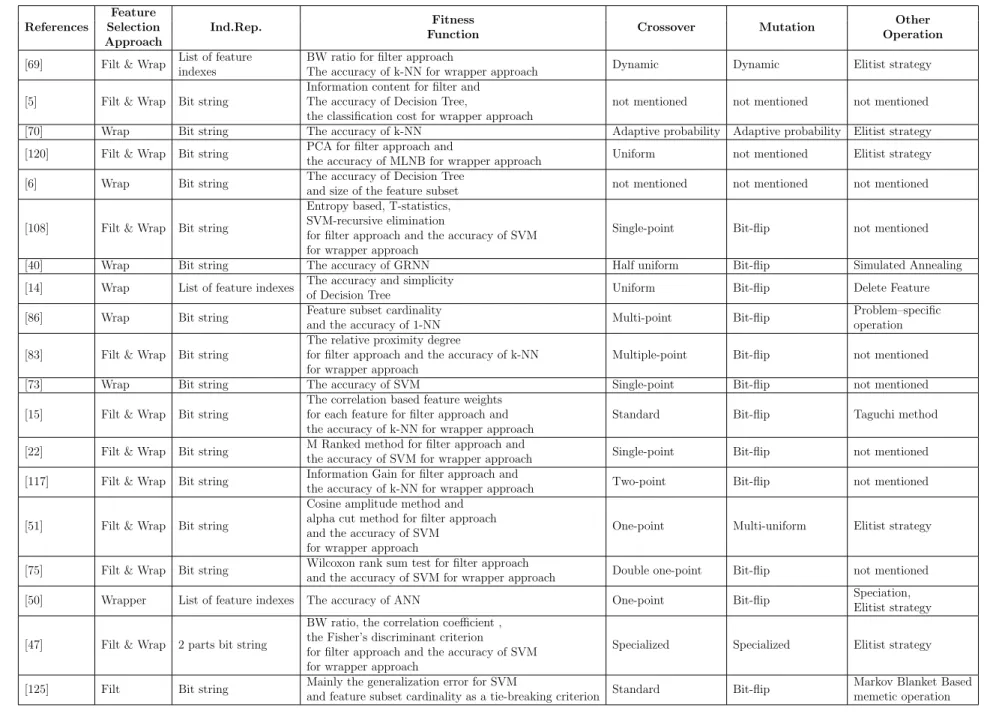
Selection in a data preprocessing phase . . . 38
3.1 An example of multi-label data set . . . 50
3.2 Transformed data using PT1 . . . 51
3.3 Transformed data using PT2 . . . 51
3.4 Transformed data using PT3 . . . 52
3.5 Transformed data using PT4 . . . 52
3.6 Transformed data using PT5 . . . 53
3.7 A comparison of problem transformation methods proposed or dis-cussed in different works. . . 54
3.8 A Summary of work on Filter-based Multi-Label Feature Selection Methods . . . 62
3.9 A summary of multi-label predictive accuracy measures from differ-ent perspectives . . . 69
4.1 Main Characteristics of the Datasets used in the experiments . . . . 78
4.2 Values of five multi-label predictive accuracy measures for the first version of ML-CFS and ML-CFS with absolute value of correlation coefficient using ML-kNN as the classifier - small datasets (with less than 300 features) . . . 83 4.3 Values of five multi-label predictive accuracy measures for the first
version of ML-CFS and ML-CFS with absolute value of correlation coefficient using ML-kNN as the classifier - feature space size = 100 84
4.4 Values of five multi-label predictive accuracy measures for the first version of ML-CFS and ML-CFS with absolute value of correlation coefficient using ML-kNN as the classifier - feature space size = 200 84 4.5 Values of five multi-label predictive accuracy measures for the first
version of ML-CFS and ML-CFS with absolute value of correlation coefficient using ML-kNN as the classifier - feature space size = 300 85 4.6 Values of five multi-label predictive accuracy measures for the first
version of ML-CFS and ML-CFS with absolute value of correlation coefficient using ML-kNN as the classifier - feature space size = 400 86 4.7 Summary of average ranking (AR) and the number of selected
fea-tures (Sel.F) for ML-CFS and ML-CFSabs when using ML-kNN as the classifier . . . 87 4.8 Values of five multi-label predictive accuracy measures for the first
version of ML-CFS and ML-CFS with absolute value of correlation coefficient using BPMLL as the classifier - small datasets . . . 88 4.9 Values of five multi-label predictive accuracy measures for the first
version of ML-CFS and ML-CFS with absolute value of correlation coefficient using BPMLL as the classifier - feature space size = 100 89 4.10 Values of five multi-label predictive accuracy measures for the first
version of ML-CFS and ML-CFS with absolute value of correlation coefficient using BPMLL as the classifier - feature space size = 200 89 4.11 Values of five multi-label predictive accuracy measures for the first
version of ML-CFS and ML-CFS with absolute value of correlation coefficient using BPMLL as the classifier - feature space size = 300 90 4.12 Values of five multi-label predictive accuracy measures for the first
version of ML-CFS and ML-CFS with absolute value of correlation coefficient using BPMLL as the classifier - feature space size = 400 90 4.13 Summary of average ranking (AR) and the number of selected
fea-tures (Sel.F) for ML-CFS and ML-CFSabs when using BPMLL as the classifier . . . 91
4.14 Values of five multi-label predictive accuracy measures for ML-CFSabs and two versions of ML-CFS using mutual information for class label weighting using ML-kNN as the classifier - small datasets 92 4.15 Values of five multi-label predictive accuracy measures for
ML-CFSabs and two versions of ML-CFS using mutual information for class label weighting using ML-kNN as the classifier - feature space size = 100 . . . 93 4.16 Values of five multi-label predictive accuracy measures for
ML-CFSabs and two versions of ML-CFS using mutual information for class label weighting using ML-kNN as the classifier - feature space size = 200 . . . 94 4.17 Values of five multi-label predictive accuracy measures for
ML-CFSabs and two versions of ML-CFS using mutual information for class label weighting using ML-kNN as the classifier - feature space size = 300 . . . 95 4.18 Values of five multi-label predictive accuracy measures for
ML-CFSabs and two versions of ML-CFS using mutual information for class label weighting using ML-kNN as the classifier - feature space size = 400 . . . 96 4.19 Summary of results in terms of average ranking (Avg.R) and the
number of selected (S.F) features of ML-CFSabs and two versions of ML-CFS using Mutual Information for class label weighting using MLkNN as the classifier . . . 96 4.20 Summary of overall average ranking (AR) across four feature space
size for two versions of ML-CFS using MI for class label weighting and ML-CFSabs method using ML-kNN as the classifier . . . 98 4.21 Values of five multi-label predictive accuracy measures for
ML-CFSabs and two versions of ML-CFS using mutual information for class label weighting using BPMLL as the classifier - small datasets 100
4.22 Values of five multi-label predictive accuracy measures for ML-CFSabs and two versions of ML-CFS using mutual information for class label weighting using ML-kNN as the classifier - feature space size = 100 . . . 101 4.23 Values of five multi-label predictive accuracy measures for
ML-CFSabs and two versions of ML-CFS using mutual information for class label weighting using ML-kNN as the classifier - feature space size = 200 . . . 102 4.24 Values of five multi-label predictive accuracy measures for
ML-CFSabs and two versions of ML-CFS using mutual information for class label weighting using ML-kNN as the classifier - feature space size = 300 . . . 103 4.25 Values of five multi-label predictive accuracy measures for
ML-CFSabs and two versions of ML-CFS using mutual information for class label weighting using ML-kNN as the classifier - feature space size = 400 . . . 104 4.26 Summary of results in terms of average ranking (Avg.R)and the
number of selected features (S.F) of ML-CFSabs and two versions of ML-CFS using Mutual Information for class label weighting using BPMLL as classifier . . . 104 4.27 Summary of overall average ranking (Avg.R) across four
individ-ual lengths for two versions of ML-CFS using MI for class label weighting and ML-CFSabs methods using BPMLL as classifier . . . 105 4.28 Values of five multi-label predictive accuracy measures for
gmiML-CFS and other feature selection methods using MLkNN as the clas-sifier - small datasets . . . 108 4.29 Values of five multi-label predictive accuracy measures for
gmiML-CFS and other feature selection methods using MLkNN as the clas-sifier - feature space size = 100 . . . 109
4.30 Values of five multi-label predictive accuracy measures for gmiML-CFS and other feature selection methods using MLkNN as the clas-sifier - feature space size = 200 . . . 110 4.31 Values of five multi-label predictive accuracy measures for
gmiML-CFS and other feature selection methods using MLkNN as the clas-sifier - feature space size = 300 . . . 111 4.32 Values of five multi-label predictive accuracy measures for
gmiML-CFS and other feature selection methods using MLkNN as the clas-sifier - feature space size = 400 . . . 112 4.33 Summary of results in terms of average ranking (AR) and the
num-ber of selected features (Sel.F) of gmiML-CFS and other multi-label feature selection methods using ML-kNN as the classifier . . . 113 4.34 Summary of overall average ranking (AR) for gmiML-CFS and other
multi-label feature selection methods across four feature space sizes using ML-kNN as the classifier . . . 115 4.35 Values of five multi-label predictive accuracy measures for the best
ML-CFS and other feature selection method using BPMLL as the classifier - small datasets . . . 117 4.36 Values of five multi-label predictive accuracy measures for the best
ML-CFS and other feature selection method using BPMLL as the classifier - feature space size = 100 . . . 118 4.37 Values of five multi-label predictive accuracy measures for the best
ML-CFS and other feature selection method using BPMLL as the classifier - feature space size = 200 . . . 119 4.38 Values of five multi-label predictive accuracy measures for the best
ML-CFS and other feature selection method using BPMLL as the classifier - feature space size = 300 . . . 120 4.39 Values of five multi-label predictive accuracy measures for the best
ML-CFS and other feature selection method using BPMLL as the classifier - feature space size = 400 . . . 121
4.40 Summary of results in terms of average ranking (AR) and the num-ber of selected features (Sel.F) of gmiML-CFS and other multi-label feature selection methods using BPMLL as the classifier . . . 122 4.41 Summary of overall average ranking (AR) gmiML-CFS and other
multi-label feature selection methods across four feature space sizes using BPMLL as the classifier . . . 124
5.1 Main Characteristics of the Datasets used in the experiments . . . . 133 5.2 Five different versions of ML-CFS using a weighted formula to
com-bine the merit function and KEGG pathway information . . . 135 5.3 Values of five multi-label predictive accuracy measures for the first
version of ML-CFS and ML-CFS with absolute value of correlation coefficient using ML-kNN as the classifier . . . 138 5.4 Values of five multi-label predictive accuracy measures for the first
version of ML-CFS and ML-CFS with absolute value of correlation coefficient using BPMLL as the classifier . . . 138 5.5 Summary of average ranking (Avg.R) and the number of selected
features (S.F) obtained by the first version of CFS and ML-CFS with absolute value of correlation coefficient using ML-kNN and BPMLL as classifiers . . . 139 5.6 Values of five multi-label predictive accuracy measures for five
ver-sions of ML-CFS using a weighted formula to combine the merit function and KEGG pathway information using ML-kNN as the classifier . . . 141 5.7 Values of five multi-label predictive accuracy measures for five
ver-sions of ML-CFS using a weighted formula to combine the merit function and KEGG pathway information using BPMLL as the clas-sifier . . . 141
5.8 Summary of average ranking (Avg.R) and the number of selected features (S.F.) for five versions of ML-CFS using a weighted formula to combine the merit function and KEGG pathway information us-ing ML-kNN and BPMLL as classifiers . . . 142 5.9 Values of five multi-label predictive accuracy measures for
ML-CFSk91, ML-CFSabs and gmiML-CFS using ML-kNN as the classifier144 5.10 Values of five multi-label predictive accuracy measures for
ML-CFSk91, ML-CFSabs and gmiML-CFS using BPMLL as the classifier144 5.11 Summary of average ranking (Avg.R) and the number of selected
features (S.F) for for ML-CFSk91, ML-CFSabs and gmiML-CFS using ML-kNN and BPMLL as classifiers . . . 145 5.12 Values of five multi-label predictive accuracy measures for
ML-CFSk91, ML-CFS with KEGG pathway information embedded into the Merit Function and ML-CFS selecting only genes that occur in KEGG pathway using ML-kNN as the classifier . . . 146 5.13 Values of five multi-label predictive accuracy measures for
ML-CFSk91, ML-CFS with KEGG pathway information embedded into the Merit Function and ML-CFS selecting only genes that occur in KEGG pathway using BPMLL as the classifier . . . 146 5.14 Summary of average ranking (Avg.R) and the number of selected
features (S.F.) for for ML-CFSk91, ML-CFSemb and ML-CFSflt using ML-kNN and BPMLL as classifiers . . . 147 5.15 Values of five multi-label predictive accuracy measures for
ML-CFSk91 and other feature selection methods using ML-kNN as the classifier . . . 148 5.16 Values of five multi-label predictive accuracy measures for
ML-CFSk91 and other feature selection methods using BPMLL as the classifier . . . 148
5.17 Summary of average ranking (Avg.R) and the number of selected features (S.F.) for for CFSk91, RFML and CFS-U using ML-kNN and BPMLL as classifiers . . . 149
6.1 Datasets used in the experiments . . . 164 6.2 Range of possible settings for each of 6 parameter of the GA-ML-CFS165 6.3 GA-ML-CFS’ Parameter Setting for The Parameter Optimization
Process . . . 165 6.4 Summary of Ranking Results for Parameter Setting Optimization
with the wrapper-like approach using the ML-KNN classifier . . . . 169 6.5 Summary of Ranking Results for Parameter Setting Optimization
with the wrapper-like approach using the BPMLL classifier . . . 170 6.6 Summary of Ranking Results for Merit-Based Parameter Setting
Optimization with the filter approach for GA-ML-CFS . . . 170 6.7 Summary of Ranking Results for Parameter Setting Optimization
for LexGA-MLCFS with the wrapper-like approach using the ML-KNN classifier . . . 171 6.8 Summary of Ranking Results for Parameter Setting Optimization
for LexGA-MLCFS with the wrapper-like approach using the BPMLL classifier . . . 172 6.9 Summary of Ranking Results for Merit-Based Parameter Setting
Optimization with the filter approach for LexGA-ML-CFS . . . 172 6.10 Predictive accuracy for four versions of GA-ML-CFS using mutual
information for class label weighting with two parameter optimiza-tion approaches: wrapper-like approach (gmiGA-wrap/gmiLexGA-wrap) versus filter-like approach (gmiGA-filt/gmiLexGA-filt) with ML-kNN Classifier (individual length = 100) . . . 176
6.11 Predictive accuracy for four versions of GA-ML-CFS using mutual information for class label weighting with two parameter optimiza-tion approaches: wrapper-like approach (gmiGA-wrap/gmiLexGA-wrap) versus filter-like approach (gmiGA-filt/gmiLexGA-filt) with ML-kNN Classifier (individual length = 200) . . . 177 6.12 Predictive accuracy for four versions of GA-ML-CFS using mutual
information for class label weighting with two parameter optimiza-tion approaches: wrapper-like approach (gmiGA-wrap/gmiLexGA-wrap) versus filter-like approach (gmiGA-filt/gmiLexGA-filt) with ML-kNN Classifier (individual length = 300) . . . 178 6.13 Predictive accuracy for four versions of GA-ML-CFS using mutual
information for class label weighting with two parameter optimiza-tion approaches: wrapper-like approach (gmiGA-wrap/gmiLexGA-wrap) versus filter-like approach (gmiGA-filt/gmiLexGA-filt) with ML-kNN Classifier (individual length = 400) . . . 179 6.14 Summary of average ranking (AR) and the number of selected
fea-tures (Sel.F) for four versions of GA-ML-CFS using mutual informa-tion for class label weighting with two parameter optimizainforma-tion ap-proaches: wrapper-like approach (gmiGA-wrap/gmiLexGA-wrap) versus filter-like approach (gmiGA-filt/gmiLexGA-filt) when using ML-kNN as the classifier . . . 180 6.15 Summary of overall average ranking (AR) across four individual
lengths for four versions of GA-ML-CFS using mutual informa-tion for class label weighting with two parameter optimizainforma-tion ap-proaches: wrapper-like approach (gmiGA-wrap/gmiLexGA-wrap) versus filter-like approach (gmiGA-filt/gmiLexGA-filt) when using ML-kNN as the classifier . . . 180
6.16 Predictive accuracy for four versions of GA-ML-CFS using mutual information for class label weighting with two parameter optimiza-tion approaches: wrapper-like approach (gmiGA-wrap/gmiLexGA-wrap) versus filter-like approach (gmiGA-filt/gmiLexGA-filt) with BPMLL Classifier (individual length = 100) . . . 184 6.17 Predictive accuracy for four versions of GA-ML-CFS using mutual
information for class label weighting with two parameter optimiza-tion approaches: wrapper-like approach (gmiGA-wrap/gmiLexGA-wrap) versus filter-like approach (gmiGA-filt/gmiLexGA-filt) with BPMLL Classifier (individual length = 200) . . . 185 6.18 Predictive accuracy for four versions of GA-ML-CFS using mutual
information for class label weighting with two parameter optimiza-tion approaches: wrapper-like approach (gmiGA-wrap/gmiLexGA-wrap) versus filter-like approach (gmiGA-filt/gmiLexGA-filt) with BPMLL Classifier (individual length = 300) . . . 186 6.19 Predictive accuracy for four versions of GA-ML-CFS using mutual
information for class label weighting with two parameter optimiza-tion approaches: wrapper-like approach (gmiGA-wrap/gmiLexGA-wrap) versus filter-like approach (gmiGA-filt/gmiLexGA-filt) with BPMLL Classifier (individual length = 400) . . . 187 6.20 Summary of average ranking (AR) and the number and
percent-age of selected features (Sel.F) for four versions of GA-ML-CFS using mutual information for class label weighting with two pa-rameter optimization approaches: wrapper-like approach
(gmiGA-wrap/gmiLexGA-wrap) versus filter-like approach (gmiGA-filt/gmiLexGA-filt) when using BPMLL as the classifier . . . 188
6.21 Summary of overall average ranking (AR) across four individual lengths for four versions of GA-ML-CFS using mutual informa-tion for class label weighting with two parameter optimizainforma-tion ap-proaches: wrapper-like approach (gmiGA-wrap/gmiLexGA-wrap) versus filter-like approach (gmiGA-filt/gmiLexGA-filt) when using BPMLL as the classifier . . . 188 6.22 Values of five multi-label predictive accuracy measures for ML-kNN
classifier with six different multilabel feature selection methods -feature space size = 100 . . . 193 6.23 Values of five multi-label predictive accuracy measures for ML-kNN
classifier with six different multilabel feature selection methods -feature space size = 200 . . . 194 6.24 Values of five multi-label predictive accuracy measures for ML-kNN
classifier with six different multilabel feature selection methods -feature space size = 300 . . . 195 6.25 Values of five multi-label predictive accuracy measures for ML-kNN
classifier with six different multilabel feature selection methods -feature space size = 400 . . . 196 6.26 Summary of results in terms of average ranking (AR) and the
num-ber of selected features (Sel.F) of gmiGA-wrap and other multi-label feature selection methods (using ML-kNN as the classifier) . . . 197 6.27 Summary of overall average ranking (AR) across four individual
lengths for gmiGA-wrap and other Multi-Label feature Selection methods using ML-kNN as classifier . . . 199 6.28 Comparing the computational time of GA-ML-CFS and CFS-U
with ML-kNN on three different datasets . . . 201 6.29 Values of five multi-label predictive accuracy measures for BPMLL
classifier with six different multilabel feature selection methods -feature space size = 100 . . . 203
6.30 Values of five multi-label predictive accuracy measures for BPMLL classifier with six different multilabel feature selection methods -feature space size = 200 . . . 204 6.31 Values of five multi-label predictive accuracy measures for BPMLL
classifier with six different multilabel feature selection methods -feature space size = 300 . . . 205 6.32 Values of five multi-label predictive accuracy measures for BPMLL
classifier with six different multilabel feature selection methods -feature space size = 400 . . . 206 6.33 Summary of results in terms of average ranking (AR) and the
num-ber of selected features (Sel.F) of gmiGA-wrap and other multi-label feature selection methods using BPMLL as classifier . . . 207 6.34 Summary of overall average ranking (AR) across four individual
lengths for four versions of gmiGA-wrap and other multi-label fea-ture selection methods using BPMLL as the classifier . . . 207 6.35 Comparing the computational time of GA-ML-CFS and BPMLL
List of Figures
1.1 Summary of Original Contributions: ML-CFS methods . . . 4
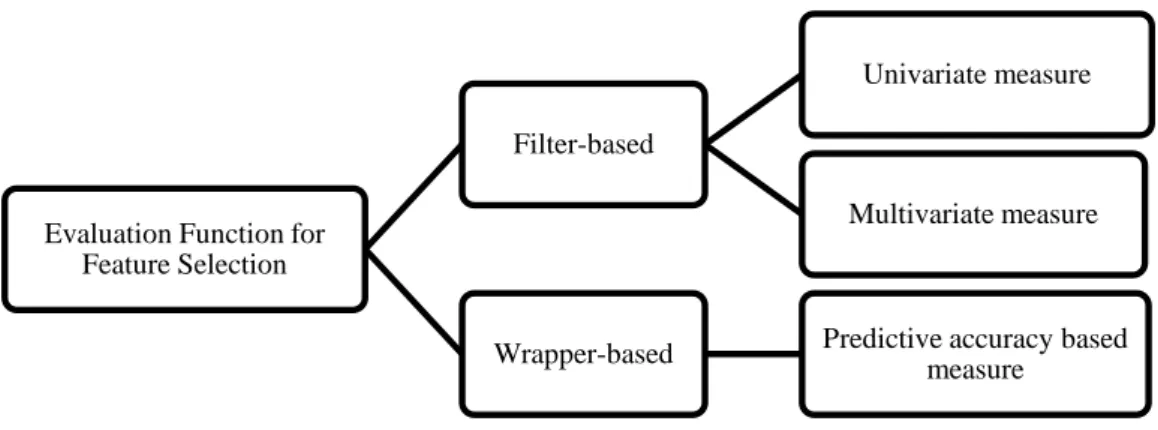
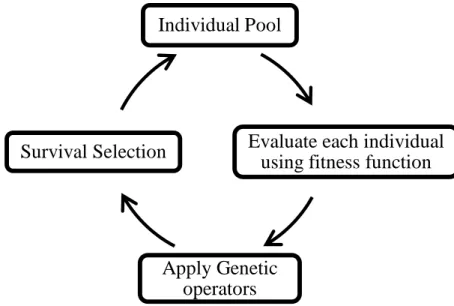
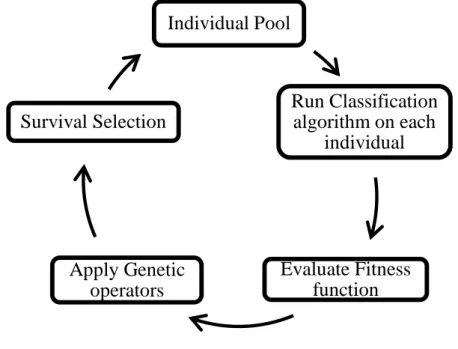
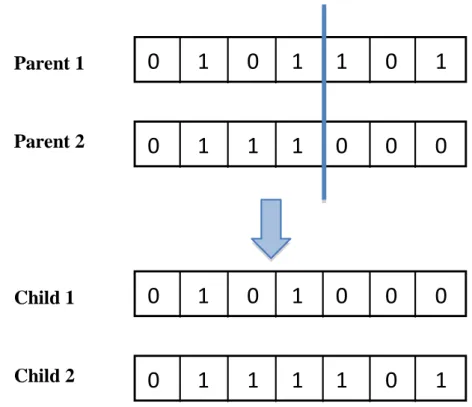
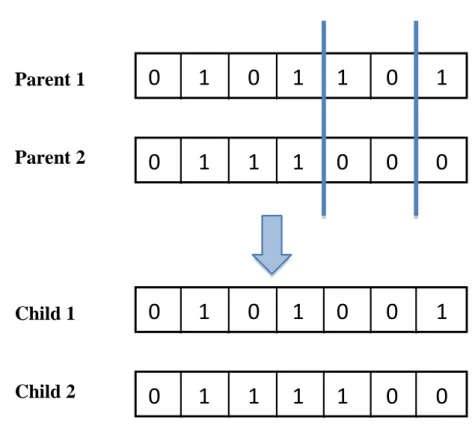
2.1 The three phases of the Knowledge Discovery Process . . . 11 2.2 The filter approach for feature selection (adapted from [76]) . . . . 14 2.3 The wrapper approach for feature selection (adapted from [76]) . . 15 2.4 General Flowchart of Genetic Algorithms . . . 21 2.5 General Flowchart of Simulated Annealing Algorithms . . . 23 2.6 Types of Evaluation Function for Feature Selection . . . 24 2.7 Bit String individual representation . . . 33 2.8 A list of feature indexes individual representation . . . 34 2.9 A two-part individual representation . . . 35 2.10 General scheme of GAs based on the filter approach . . . 36 2.11 General scheme of GAs based on the wrapper approach . . . 37 2.12 One-Point Crossover . . . 40 2.13 m-Point Crossover, m=2 . . . 41 2.14 Uniform Crossover . . . 42 2.15 Sequential process for protein synthesis from DNA . . . 45 2.16 Two types of data structure to store microarray data: (a) table or
(b) matrix . . . 46
3.1 Backpropagation Multi-Label Learning (BPMLL) architecture (adapted from [123]) . . . 57
4.1 Overall average ranking (AR) for gmiML-CFS and the other multi-label feature selection methods plotted against the average size of selected features across all datasets and feature space sizes, when using ML-kNN as the classifier . . . 114 4.2 Overall average ranking (AR) for gmiML-CFS and the other
multi-label feature selection methods plotted against the average size of selected features across all datasets and feature space sizes, when using BPMLL as the classifier . . . 123
6.1 Overall average ranking (AR) for four versions of GA-ML-CFS plot-ted against the average number of selecplot-ted features across all datasets and feature space sizes, when using ML-kNN as the classifier . . . . 181 6.2 Overall average ranking (AR) for four versions of GA-ML-CFS
plot-ted against the average number of selecplot-ted features across all datasets and feature space sizes, when using BPMLL as the classifier . . . . 189 6.3 Overall average ranking (AR) for gmiGA-wrap and the other
multi-label feature selection methods plotted against the average number of selected features across all datasets and feature space sizes, when using ML-kNN as the classifier . . . 198 6.4 Overall average ranking (AR) for gmiGA-wrap and the other
multi-label feature selection methods plotted against the average number of selected features across all datasets and feature space sizes, when using BPMLL as the classifier . . . 208
Chapter 1
Introduction
1.1
Motivation
1.1.1
Feature Selection in Data Pre-processing
Feature selection is a type of data pre-processing method (a part of the broader process of Knowledge Discovery [109]) which aims to select a relevant feature sub-set according to an evaluation criterion [76]. In the real world, the amount of stored data grows significantly and fast in many application domains. For example, mi-croarray gene expression data analysis and document classification (a type of text mining) are applications where datasets usually have thousands of features. As a result, the very large dimensionality of the data is a crucial challenge for classifi-cation algorithms. A very large number of features leads to a high computational time for the classification algorithm and often most features are irrelevant or noisy, potentially leading to an overfitting of the classification model to the data [39, 115].
Feature selection methods directly address the large dimensionality of the data in the data pre-processing phase. A variety of feature selection methods has been proposed in the literature. Broadly speaking, feature selection for classification can be done using two approaches [19, 20, 25, 39, 44, 67, 76, 77, 79, 90, 97]: an embedded approach (where the feature selection process is performed during the
run of a classification algorithm) or a data preprocessing approach, where a fea-ture subset is selected and then given to the classification algorithm. This research focuses on the data preprocessing approach, which is more generic than the em-bedded approach.
1.1.2
Multi-Label Classification
Classification is a data mining task where the system is given a dataset of instances (records, objects) – each one described by a set of feature values and belonging to a class – and then the system has to extract, from the dataset, a classification model that predicts the class value (label) for an unseen instance, given the values of the features describing that instance [116].
Multi-label classification is different from traditional single-label classification because in multi-label classification each instance can be associated with a set of class labels [21, 24, 92], while in traditional single-label classification each instance is associated with only one class label.
The vast majority of research projects in classification involve single-label clas-sification. However, there is a growing research trend in tackling the more difficult problem of multi-label classification [15, 24, 26, 103, 105, 108, 111, 113]. This is motivated by a number of real-world classification problems that are naturally described as multi-label problems. For example, an article about social media can be classified to both information technology and social activity class labels. A document can be classified to the class labels education and linguistic at the same time. A gene can be associated with many biological functions in an organism, and an image can be annotated with sea, forest and mountain class labels.
1.2
The Goals and the Focus of This Research
This research focuses on feature selection, with the two related goals of proposing new multi-label feature selection algorithms for multi-label classification problems and evaluating the proposed algorithms’ predictive performance in a set of multi-label datasets. The major research question addressed by this thesis is whether the proposed multi-label feature selection methods can select the most relevant and non-redundant features and improve the predictive accuracy when compared with other multi-label feature selection methods in the literature.Most of the multi-label feature selection methods proposed in this thesis are generic in the sense that they can be applied to multi-label classification datasets from any application domain. However, Chapter 5 of this thesis proposes fea-ture selection methods specially designed for exploiting biological knowledge about cancer-related pathways, in microarray gene expression datasets having more than 20,000 features, as will be described later.
1.3
Original Contributions
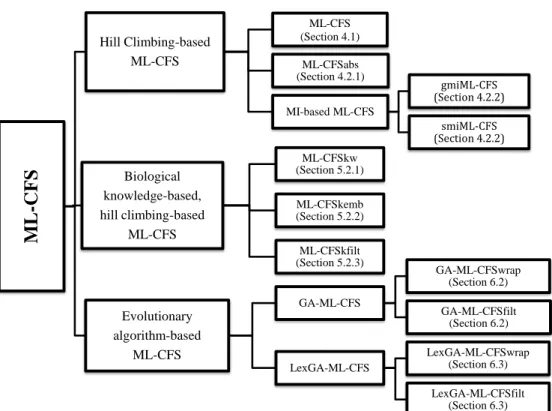
This thesis propose three types of new Multi-Label Correlation-based Feature Se-lection (ML-CFS) methods, namely: (a) methods based on hill-climbing search, (b) methods that exploit biological knowledge (still using hill-climbing search), and (c) methods based on genetic algorithms as the search method. The summary of the original contributions of this thesis is presented in Figure 1.1.
ML
-CFS
Hill Climbing-based ML-CFS ML-CFS (Section 4.1) ML-CFSabs (Section 4.2.1) MI-based ML-CFS gmiML-CFS (Section 4.2.2) smiML-CFS (Section 4.2.2) Biological knowledge-based, hill climbing-based ML-CFS ML-CFSkw (Section 5.2.1) ML-CFSkemb (Section 5.2.2) ML-CFSkfilt (Section 5.2.3) Evolutionary algorithm-based ML-CFS GA-ML-CFS GA-ML-CFSwrap (Section 6.2) GA-ML-CFSfilt (Section 6.2) LexGA-ML-CFS LexGA-ML-CFSwrap (Section 6.3) LexGA-ML-CFSfilt (Section 6.3)Figure 1.1: Summary of Original Contributions: ML-CFS methods
1.3.1
Multi-Label Correlation-Based Feature Selection
(ML-CFS) Methods Based on Hill Climbing Search
We propose three versions of a new ML-CFS method that is an extension of the single-label CFS method proposed by Hall [44] to the multi-label classification problem. In essence, these ML-CFS versions extend the original CFS method by extending the merit function used by the method to evaluate candidate solutions, as discussed in detail in Chapter 4. These versions have in common the fact that they use the same conventional search strategy to explore the space of candidate solutions (candidate feature subsets), namely a well-known hill-climbing search strategy.
1.3.2
Multi-Label Correlation-Based Feature Selection
(ML-CFS) Methods that Exploit Biological Knowledge
We propose three versions of the ML-CFS method that exploit biological knowl-edge, more precisely, the knowledge that some genes are involved in cancer-related pathway. The motivation for this is to try to improve the performance of ML-CFS in cancer-related microarray gene expression datasets, where features represent genes, so that feature selection corresponds to selecting relevant genes to predict a cancer-related class label. These ML-CFS versions are also based on hill-climbing search (like the versions mentioned in the previous subsection), but they modify ML-CFS’ evaluation function or the original set of features in a way that favours the selection of genes (features) involved in pre-defined cancer-related pathways, as discussed in detail in Chapter 5.1.3.3
Multi-Label Correlation-Based Feature Selection
(ML-CFS) Methods Based on Evolutionary Algorithms
We propose two versions of a Genetic Algorithm (GA)-based ML-CFS method, de-noted GA-ML-CFS. These versions replace the simple hill-climbing search method used by the previous ML-CFS versions by a more sophisticated GA. The first ver-sion of GA-ML-CFS is based on a conventional single-objective GA, where there is only one objective to be optimized, namely ML-CFS’ evaluation function. The second version of GA-ML-CFS is based on a somewhat more sophisticated type of GA that performs lexicographic multi-objective optimization, where there are two objectives to be optimized – namely ML-CFS’ evaluation function and the number of selected features – and the objectives are optimized in decreasing or-der of priority (called a lexicographic approach), as discussed in detail in Chapter 6.1.4
The Structure of the Thesis
This Section outlines the structure of the remaining Chapters of this thesis. In essence, Chapters 2 and 3 describe the background on classification, feature selec-tion and multi-label classificaselec-tion. Chapters 4 through 6 describe all versions of the Multi-Label Correlation-based Feature Selection (ML-CFS) methods proposed in this thesis. The summaries of Chapters 2 through 7 are as follows:
Chapter 2 – Background on Conventional Single-Label Classification and Bioinformatics: This chapter will contain background about knowledge dis-covery and data mining, focusing on conventional single-label feature selection for the classification task. In particular, it will review both hill-climbing-based and evolutionary algorithm-based methods for feature selection. It will also describe the single-label correlation-based feature selection (CFS) method proposed by Hall [44], which was the inspiration for the multi-label feature selection methods pro-posed in this thesis. This chapter will also briefly describe general background on bioinformatics and molecular biology, especially on microarray gene expression data and other bioinformatics topics related with our research (e.g. KEGG Path-way). This background is relevant for a better understanding of Chapter 5, which focuses on feature selection for gene expression data.
Chapter 3 – Background on Label Classification and Multi-Label Feature Selection: This chapter will present a survey of the multi-label classification area. It will include multi-label problem transformation methods, which transform a multi-label classification problem into one or more conventional (single-label) classification problems. In addition, two well-known multi-label clas-sification algorithms which are used in this thesis will be described: the Multi-Label K-Nearest neighbours (ML-kNN) algorithm and the Multi-Label Back Propaga-tion Multi-Label Learning Neural Network (BPMLL) algorithm. Also, multi-label classification evaluation measures, and multi-label feature selection methods, will
be reviewed.
Chapter 4 – The Proposed Multi-Label Correlation-Based Feature Selection Method Based on Hill Climbing Search: This Chapter will pro-pose new correlation-based feature selection methods, which are extensions from the single-label CFS proposed by Hall [44], for the multi-label scenario. All ML-CFS versions described in this Chapter are based on hill-climbing search. In gen-eral, we describe the first version of ML-CFS and also other two types of extended ML-CFS versions: (1) ML-CFS with the absolute value of correlation coefficient and (2) ML-CFS using mutual information for class label weighting. This Chapter will also present all details of our experiments; such as dataset descriptions, the results from extensive experiments, comparisons with the results of other multi-label feature selection methods, and the corresponding discussion of those results.
Chapter 5 – The Proposed Multi-Label Correlation-Based Feature Selection Methods that Exploit Biological Knowledge: This Chapter will describe the extensions of ML-CFS specific to microarray gene expression datasets, which use background biological knowledge to help to guide the search for good fea-ture subsets. This Chapter proposes three extensions of the ML-CFS method, in-volving three different approaches to exploit knowledge about cancer-related genes to select the most relevant features (genes) in microarray gene expression datasets. Then, the experimental results of these extended versions of the ML-CFS method will be presented and discussed.
Chapter 6 – The Proposed Multi-Label Correlation-Based Feature Selection Methods Based on Evolutionary Algorithms: This chapter will describe different versions of the ML-CFS method where a Genetic Algorithm (GA) and a lexicographic multi-objective GA were used as the search method, rather than using the simpler hill-climbing search method as in Chapters 4 and 5. The experimental results of the GA-based ML-CFS methods will be presented
and discussed in this Chapter.
Chapter 7 – Conclusions and Future Research: This chapter will present a summary of the contributions of the thesis and also discuss the weaknesses and strengths of the proposed multi-label feature selection methods. Interesting future research directions will also be introduced at the end of this chapter.
1.5
Publications derived from this Research
The research described in this thesis has led to the publication of five peer-reviewed papers, mentioned next in chronological order of publication. The first and fifth papers below were publiched in the proceedings of workshops colocated with in-ternational conferences, whilst the other three papers were published in the pro-ceedings of international conferences.
• S. Jungjit, A.A. Freitas, M. Michaelis and J. Cinatl, “A Multi-Label
Correla-tion Based Feature SelecCorrela-tion Method for the ClassificaCorrela-tion of Neuroblastoma microarray data”, in Advances in Data Mining: 12th Industrial Conference (ICDM 2012): Workshop Proceedings–Workshop on Data Mining in Life Sci-ences (DMLS 2012), pp. 149–157, I. Bichindaritz, P. Perner, G. Rub, and R. Schmidt, Eds, IBAI Publishing, July 2012.
• S. Jungjit, A.A. Freitas, M. Michaelis and J. Cinatl, “Two Extensions to
Multi-Label Correlation-Based Feature Selection: a case study in bioinfor-matics,” in Proceedings of the 2013 IEEE International Conference on Sys-tems, Man and Cybernetics, pp. 1519–1524, Manchester, UK, 2013.
• S. Jungjit, A.A. Freitas, M. Michaelis and J. Cinatl, “Extending
Multi-Label Feature Selection with KEGG Pathway Information for Microarray Data Analysis,” in Proceedings of the 2014 IEEE International Conference on Computational Intelligence in Bioinformatics and Computational Biology (CIBCB2014), pp. 1–8, Hawaii, USA, 21-25 May 2014.
• S. Jungjit, A.A. Freitas, “A New Genetic Algorithm for Multi-label
Correla-tion Based Feature SelecCorrela-tion” In: Proceeding of the 23rd European Sympo-sium on Artificial Neural Networks, Computational Intelligence and Machine Learning, pp. 285–290, 22-14 April, 2015, Bruges, Belgium.
• S. Jungjit, A.A. Freitas, “Lexicographic Genetic Algorithm for Multi-label
Correlation Based Feature Selection” In: Proceeding of the Evolutionary Rule-based Machine Learning Workshop: GECCO- Genetic and Evolution-ary Computation Conference, pp. 989–996, 11-15 July, 2015, Madrid, Spain.
Chapter 2
Background on Data mining and
Bioinformatics
This chapter contains background about knowledge discovery and data mining focusing on the single-label classification task, feature selection for the classifi-cation task, and evolutionary algorithms for feature selection. This chapter also briefly describes general background on bioinformatics and molecular biology, in particular on microarray data and other topics relate with our research. The more complex task of multi-label classification will be discussed in Chapter 3.
2.1
Data Mining and Single-Label Classification
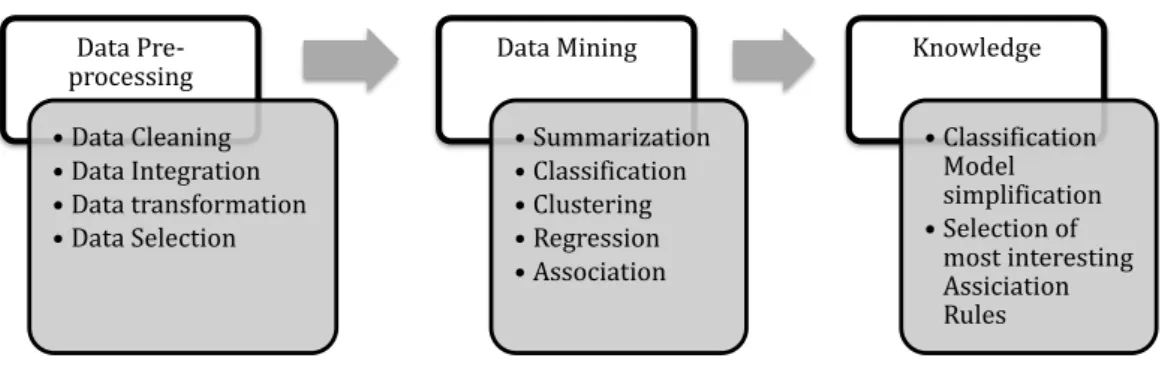
Data mining is one of three main phases of the Knowledge Discovery Process (KDP), which aims to discover knowledge/patterns from data in a given appli-cation domain. More precisely, as shown in Figure 2.1, the process of knowledge discovery can be divided into 3 broad processes, or phases: (1) Data pre-processing (2) Data mining and (3) Knowledge Post-processing [8, 13, 33, 45, 46, 62, 110]. The third phase is out of the scope of this thesis, so we discuss next the first two phases.
Data Pre-processing Data Cleaning Data Integration Data transformation Data Selection Data Mining Summarization Classification Clustering Regression Association Knowledge Classification Model simplification Selection of most interesting Assiciation Rules
Figure 2.1: The three phases of the Knowledge Discovery Process
Data pre-processing step: The purpose of the data pre-processing phase is transforming raw input data to an appropriate format for the data mining algo-rithm. Data cleaning deals with noisy, missing values and irrelevant data. Data integration consists of integrating data from a variety of data sources, while data transformation methods consolidate data into an appropriate format before per-forming data mining. Data selection methods select relevant data for the analysis task. Feature selection is the type of data selection method which aims to selects a relevant feature subset according to an evaluation criterion [76, 78], typically a measure of predictive accuracy in the case of the classification task of data mining, as will be explained later.
Data mining: In this phase, many modeling algorithms can be used according to the target data mining task [17, 109, 116]. The summarization task aims to provide a more compact representation of the data set, including visualization and report generation. Clustering aims to group a set of objects based on their simi-larity, where a cluster is a collection of similar objects. Data objects in different clusters should have little or nothing in common. Regression consists of finding a function with minimal prediction error to model the data, when the variable to be predicted is continuous (real-valued). Regression analysis is widely used for pre-diction and forecasting, it is also used to understand which independent variables
(or features) are related to the dependent variable (the variable to be predicted), and to explore the forms of these relationships. Association consists of looking for association relationships or correlation between variables or objects. Typically, associations are expressed in the rule form, showing attribute – values that occur together frequently. Classification is a type of data mining task which aims to learn the relationship between the values of the predictor attributes (or features) of an instance and its class label. This relationship is learned (in the form of a classification model) from pre-classified instances in the training set, and then the learned classification model is used to predict the class label of previously unseen instances in the test set. Note that in classification the class variable takes nomi-nal values (labels) unlike regression, where the predicted variable takes continuous values.
Traditionally, the classification task is defined as a single-label classification problem, where each instance in the data set is associated with just one class label. However, this research addresses a more difficult type of classification problem, namely multi-label classification, as discussed in Chapter 3.
2.2
Single-Label Feature Selection for
Classifica-tion
Feature selection is a process which selects a relevant feature subset according to an evaluation criterion [19, 20, 39, 54, 67, 76, 77, 79, 97]. In this work we are interested in feature selection for the classification task of data mining. The main objectives of feature selection are to avoid model overfitting and improve the pre-dictive performance of the model [97]. Additional objectives of feature selection are to eliminate irrelevant features and to reduce the computational time taken by the classification algorithm (which will use only the selected feature subset). However, this reduction in computational time is truly beneficial only if the time
taken to perform feature selection is smaller than the corresponding reduction in the time taken by the classification algorithm applied to the selected features.
Furthermore, in several types of applications, such as microarray data (review in Section 2.5) and text document analysis, the data typically has a very high dimensionality and a very small number of instances. In such cases, feature selec-tion is particularly important and it can significantly decrease the risk of model overfiting [39].
2.2.1
Feature Selection Approaches
Feature selection methods can be separated into 3 approaches; (1) the filter ap-proach, (2) the wrapper approach and (3) the embedded approach [19, 20, 39, 67, 76, 77, 79, 97].
There are two groups of methods following the filter approach: (I) feature ranking-based methods and (II) search-based methods. In general, a feature ranking-based method applies statistical techniques to measure the relevance (broadly speaking, correlation with class attribute) of each feature separately, ranks fea-tures according to their relevance and selects the top k feafea-tures from the ranked list (where k is a predefined number). The drawback of this technique is that it considers only one feature at a time (univariate method) and ignores the correla-tions between features. One feature that is irrelevant by itself can be significantly informative when considered together with other features [43]. Moreover, it tends to select a redundant feature subset.
Another type of filter approach consists of search-based methods. This type of method considers the relationship between features in a feature subset (being a multivariate method), doing a search in the space of possible feature subsets. Each
Feature subset Generation
Evaluation
Function Good?
Full set of features
Feature subset Quality No Yes Classification Algorithm Testing Classifier Accuracy Best Feature Subset Phase1: Feature Selection Phase2: Evaluation
Figure 2.2: The filter approach for feature selection (adapted from [76])
feature subset considered by the search method represents a candidate solution, which is evaluated by an evaluation function (e.g. a correlation-based function). The advantage of this approach is feature redundancy elimination, assuming the evaluation function penalizes redundant feature subsets. On the other hand, in some cases, features with a moderate degree of redundancy are significantly infor-mative when considered together with other features [43].
According to Figure 2.2, in the search-based filter approach, phase 1, the basic flow of feature selection starts with feature subsets which are generated from the full set of features using a search method. Next, each feature subset is evaluated based on a specific criterion (or evaluation function). Both steps in phase 1 are repeated until a stopping criterion is satisfied, e.g. until a fixed number of iter-ations is performed or the quality of the current best feature subset cannot be improved. Note that all mentioned steps in phase 1 are independent from the classification algorithm, until the system gets the best feature subset. Only in phase 2, executed after we got the best feature subset, the classification algorithm is used. This approach was applied in the design of several feature selection
meth-Feature subset Generation
Classification
Algorithm Good?
Full set of features
subset Accuracy No Yes Classification Algorithm Testing Classifier Accuracy Best Feature subset Phase1: Feature Selection Phase2: Evaluation
Figure 2.3: The wrapper approach for feature selection (adapted from [76])
ods, such as Correlation-based Feature Selection [44] and Fast Correlation-based Feature Selection [39, 115, 119].
The filter approach is fast, scalable and independent of the classifier. More-over, [78] highlighted that the most used feature selection approach in real-world applications where the number of features is very large (such as in microarray data and text mining) is the filter approach, because the structure of filter algorithms is simple and it provides a simple way to calculate the relevance of features in large-scale data in a short time.
On the other hand, the wrapper approach selects the best feature subset by doing a search in the feature space guided by a classifier’s performance, i.e. using a classifier’s accuracy as the evaluation function (Figure 2.3). In the wrapper ap-proach, the classification algorithm used in phase 1 is the same as the algorithm in phase 2, which will use the selected features to build a classifier to be applied to the test set.
The wrapper approach is usually more effective (in terms of maximizing pre-dictive accuracy) than the filter approach because the wrapper approach directly uses the accuracy of the classification model as the evaluation function of a feature subset, but there is a risk of model overfitting [39, 97]. Moreover, the wrapper ap-proach is usually much more computationally expensive than the filter apap-proach because a classification algorithm has to be run for each candidate feature subset, which is not the case in the filter approach.
In the third approach, namely the embedded approach, the search for a good feature subset is embedded into the classifier construction process. Hence, this approach is classifier-specific too, and it also tends to be more computationally expensive than the filter approach. An example of a type of classification algo-rithm performing embedded feature selection is decision tree algoalgo-rithms [93], where during the tree construction process, a feature is selected at each internal node of the tree.
Note that both the filter and the wrapper approaches are performed in a pre-processing step, before applying the classification algorithm; whilst the embedded approach is performed as part of the run of a classification algorithm. In this chap-ter we focus only on feature selection methods performed in a preprocessing phase using the filter approach, i.e., the wrapper and the embedded approach are out of the scope of this work; for the sake of computational efficiency and scalability.
In the context of the filter approach, we can classify feature selection methods into 2 types based on whether or not the method takes into account relationships among features [76]. First, in the univariate filter feature selection approach, the feature selection method measures the quality of just one feature at a time using a given evaluation function, e.g. t-test, F-statistic or information-gain. The ad-vantage of the univariate filter approach is that it fast and scalable [97], but there
are some drawbacks, such as it ignores the dependencies and correlations between features in the feature space.
Second, in the multivariate filter feature selection approach, the feature selec-tion method measures the quality of a feature subset as a whole. That is, the correlation between features in the subset is taken into account. This approach takes more time to generate feature subsets and measure the quality of each fea-ture subset, so it is usually slower than the univatiate approach. Examples of the evaluation functions which are used to measure a feature subset’s quality are the correlation-based feature selection (CFS) [44] and Maximize Relevance Minimize Redundant (MRMR)[25, 90]. These evaluation functions will be discussed later in this Chapter.
2.2.2
Feature Selection Methods’ Components
A feature selection method consists of two main components: (1) the search strat-egy and (2) the evaluation function. The first component is a stratstrat-egy for searching through the space of feature subsets, as discussed next.
2.2.2.1 Search Strategies for Feature Selection
Search strategies can be classified into three broad types: complete, heuristic and stochastic/nondeterministic search [19, 20, 76, 77, 79]
Complete search or exhaustive search evaluates the quality of every candidate feature subset, and returns the best subset. Hence, this method guarantees to find an optimal subset, but its use is not feasible in large-scale datasets, since its time complexity is exponential upon the number of features. Recall that the number of candidate feature subsets is on the order of 2n, where n is the number of features.
Examples of complete search strategies are the well-known depth-first search and breadth-first search [76].
Whereas complete search strategies are too computationaly expensive in prac-tice, a heuristic search method can find a good solution in a relatively short time, although it risks to miss an optimal solution. Well-known examples of heuristic search methods are best-first search and hill climbing search [76]. The latter was used in [44], and in the first version of our proposed feature selection methods [57], to be described later.
Algorithm 2.1 shows the pseudocode of the best-first search method, adapted from [76]. There are two queues of nodes in the Best-First algorithm: OpenQ is the queue of nodes whose children have not been generated yet (open nodes), and CloseQ is the queue of nodes whose children have already been generated (closed nodes). The algorithm starts by initializing the flag Implement with the value true and adding an initial node to OpenQ. Then Cbest is set to the best node in OpenQ. Next, while the value of the Implement flag is true, the algorithm repeats the following steps. First, it sets QualBest to the quality of Cbest and generates the child nodes of Cbest. Second, it removes Cbest from OpenQ and adds it to CloseQ. Third, for each child node, if that node has not been generated before during the search, it adds that child node to OpenQ and evaluates it. Fourth, it sets Cbest to the best child node. Fifth, if the quality of the best child node is greater than QualBest, it sets the Implement flag to true. Otherwise, it sets Cbest to the best node in OpenQ and checks if the best child node’s quality is greater than QualBest. If so, the Implement flag will be set to true, otherwise the Implement flag will be set to false, which will cause the while loop to terminate, and then the algorithm terminates by returning Cbest as the best solution found.
Algorithm 2.1: Pseudocode of Best-First Search()
1) Implement = true
2) OpenQ = a queue of nodes whose children have not been generated yet 3) CloseQ = a queue of nodes whose children have been generated
4) Add initial node to OpenQ 5) Cbest = best node in OpenQ
while Implement = True
do
QualBest = quality of Cbest generate child nodes of Cbest
remove Cbest from OpenQ and add Cbest to CloseQ
for each child node
do
if child node has not been generated earlier
then
add child node to OpenQ evaluate child node Cbest = the best child node
if Cbest’s quality>QualBest
then Implement = True
else
Cbest = best node in OpenQ
if Cbest’s quality>QualBest
then Implement = true
else Implement = False OUTPUT: Cbest
Algorithm 2.2: Pseudocode of Hill-Climbing Search()
CurrentNode = empty feature subset CurrentQuality = 0
Implement = true
while Implement = True
do
generate children of CurrentNode BestChild = child with the best quality BestQuality = quality of the best child
if BestQuality>CurrentQuality then CurrentNode = BestChild CurrentQuality = BestQuality Implement = True
else Implement = False OUTPUT: CurrentNode
Algorithm 2.2 shows the Pseudocode of Hill Climbing search used in [44, 57, 58, 59]. The algorithm starts with the current node representing an empty feature subset and the quality of the current feature subset (CurrentQuality) equal to zero. Also, the flag Implement is set to true. Each iteration of the following while loop performs the following operations. First, the algorithm generates the child nodes from the current node. All child nodes are evaluated using the merit function. After that, the algorithm selects the child node with the best quality, and sets it as the BestChild. Also, the BestQuality is set with the quality of the best child. Next, if BestQuality is greater than CurrentQuality, which means the algorithm found a new child node better than the current node, then CurrentNode is set to BestChild, CurrentQuality is set to BestQuality and the flag Implement is set to True (to make sure the search will continue). Otherwise, the flag Implement is set to false and the while loop terminates. At the end, the algorithm returns the
CurrentNode as the best feature subset found by the hill-climbing search.
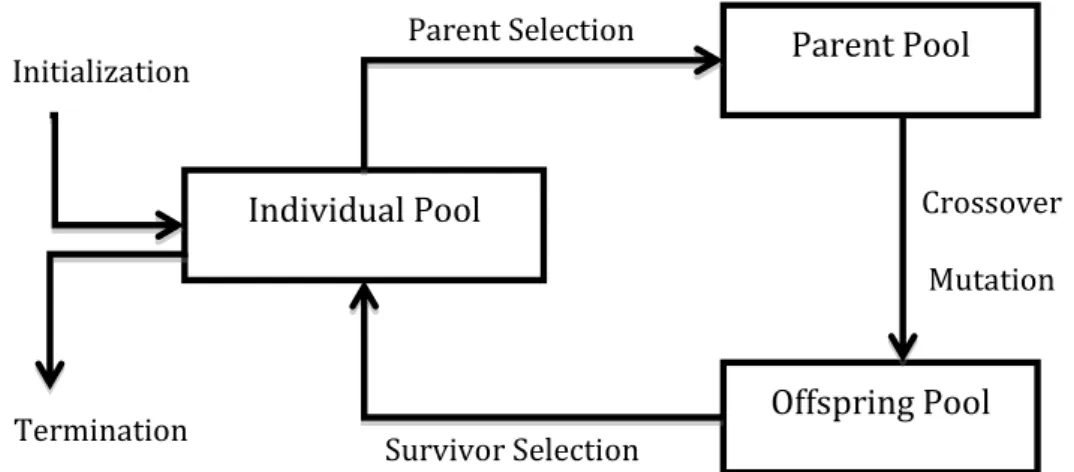
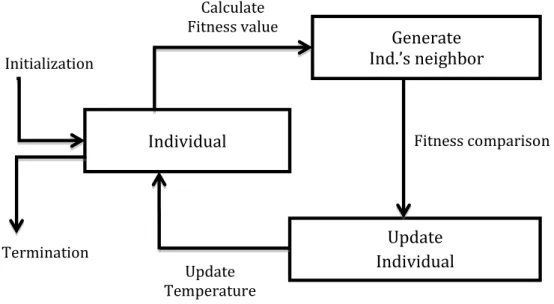
Unlike the complete and heuristic search methods mentioned earlier, a nonde-terministic strategy searches for good feature subsets using random operators to move in the feature subset space [76] Note, however, that in general a nondetermin-istic strategy is not completely random, since the application of random operators is guided by an evaluation function. An example of a type of nondeterministic search method is Genetic Algorithms (GAs), which have been extensively used in feature selection [34]. An example of another type of nondeterministic search methods is Simulated Annealing (SA). The pseudocode and flowchart of GA are shown in Algorithm 2.3 and Figure 2.4, respectively, as described below; whilst the pseudocode and flowchart of SA, described further below, are shown in Algorithm 2.4 and Figure 2.5, respectively. More details about GAs for feature selection will be discussed later in this Chapter. Note also that in general non-deterministic methods are heuristic, i.e., they do not guarantee to find an optimal solution.
Individual Pool Parent Pool Offspring Pool Initialization Termination Parent Selection Crossover Mutation Survivor Selection
Algorithm 2.3: Pseudocode of Genetic Algorithms()
Initialize candidate solutions Evaluate each candidate solution
while (condition is not satisfied)
do 1) Select parents
2) Crossover pairs of parents 3) Mutate the result of Crossover 4) Evaluate new candidate solutions
5) Select individual for the next generation
Genetic Algorithms (GAs) are nondeterministic/random search algorithms based on the evolutionary theory of natural selection and genetics. GAs show a successful exploitation of a random search used to solve optimization problems in many appli-cation domains. The main search operators of GAs are inherited from evolutionary theory proposed by Charles Darwin. The key idea of his theory is the “survival of the fittest”, which means that the individuals better adapted to their environ-ment will survive in nature, while the rest of them will be vanished with time. As shown as in Algorithm 2.3 and Figure 2.4, first, GAs start with a random indi-vidual initialization process which generates a population of indiindi-viduals – where each inividual is a candidate solution to the target problem. Next, GA selects parent individuals from all individual in an individual pool using some selection approach, e.g. tournament selection or roulette wheel approach. Then, crossover and mutation operations are applied to selected parents, in order to create new individuals. Finally, GA selects survival individuals from offspring individuals and go to next generation.