University of Bradford eThesis
This thesis is hosted in Bradford Scholars – The University of Bradford Open Access
repository. Visit the repository for full metadata or to contact the repository team
© University of Bradford. This work is licenced for reuse under a
Creative Commons
Licence
.
A HYBRID MULTIBIOMETRIC SYSTEM FOR
PERSONAL IDENTIFICATION BASED ON FACE
AND IRIS TRAITS
The Development of an automated computer system for the
identification of humans by integrating facial and iris features using
Localization, Feature Extraction, Handcrafted and Deep learning
Techniques.
Alaa Sulaiman Nassar NASSAR
Submitted for the Degree of Doctor of Philosophy from the
University of Bradford
School of Electrical Engineering and Computer
Science
University of Bradford
i
ABSTRACT
Alaa Sulaiman Nassar NASSAR
A Hybrid Multibiometric System for Personal Identification Based on Face and Iris Traits
The Development of an automated computer system for the identification of humans by integrating facial and iris features using Localization, Feature
Extraction, Handcrafted and Deep learning Techniques.
Keywords: Multimodal multibiometric systems, Face recognition, Iris recognition, Iris localization, Deep learning, Feature extraction, Curvelet transform, Fractal dimension, Deep belief network, Convolutional neural network.
Multimodal biometric systems have been widely applied in many real-world applications due to its ability to deal with a number of significant limitations of unimodal biometric systems, including sensitivity to noise, population coverage, intra-class variability, non-universality, and vulnerability to spoofing. This PhD thesis is focused on the combination of both the face and the left and right irises, in a unified hybrid multimodal biometric identification system using different fusion approaches at the score and rank level.
Firstly, the facial features are extracted using a novel multimodal local feature extraction approach, termed as the Curvelet-Fractal approach, which based on merging the advantages of the Curvelet transform with Fractal dimension. Secondly, a novel framework based on merging the advantages of the local handcrafted feature descriptors with the deep learning approaches is proposed, Multimodal Deep Face Recognition (MDFR) framework, to address the face recognition problem in unconstrained conditions. Thirdly, an efficient deep learning system is employed, termed as IrisConvNet, whose architecture is based on a combination of Convolutional Neural Network (CNN) and Softmax classifier to extract discriminative features from an iris image.
Finally, The performance of the unimodal and multimodal systems has been evaluated by conducting a number of extensive experiments on large-scale unimodal databases: FERET, CAS-PEAL-R1, LFW, V1, CASIA-Iris-V3 Interval, MMU1 and IITD and MMU1, and SDUMLA-HMT multimodal dataset. The results obtained have demonstrated the superiority of the proposed systems compared to the previous works by achieving new state-of-the-art recognition rates on all the employed datasets with less time required to recognize the person’s identity.
ii
Acknowledgements
First and foremost, I would like to express my deepest gratitude and numerous thanks to the most merciful, the most beneficent, and the most gracious Almighty Allah who gave me the courage and motivation to complete the research successfully.
This thesis is a collection of not only hard work, perseverance and continuous effort over the past four years, but also encouragement, cooperation and support from many people who deserve to be acknowledged.
I am heartily thankful to my principal supervisor Prof. Rami Qahwaji, whose constant encouragement, guidance and considerable support from the initial to the final stage enabled me to develop an understanding of the subject. Prof. Qahwaji is a supervisor, who truly made a difference in my life, I appreciate his vast knowledge and skill in many areas, whose expertise, understanding, and patience, added considerably to my graduate experience, and without him, the completion of this work could not have been achieved. Besides of being an excellent supervisor, Prof. Qahwaji encouraging me by his personal kindness, and he always was available when I needed his advises.
I also want to express deepest gratitude and thanks to my second supervisor, Dr. Stanly Ipson, whose guidance, keen interest and continuous efforts enabled me to complete this work. Dr. Ipson has offered much advice and insight throughout my research. I have been extremely lucky to work with Dr. Ipson who cared so much about my work, and who responded to my questions and queries so promptly.
I am extremely grateful to my parents for their love, prayers, caring and sacrifices for educating and preparing me for my future. I am very much thankful to my wife (Shumoos Al-Fahdawi) and my sons (Fahad and Taim) for their love, understanding, prayers and continuing support to complete this research work. Also, I express my thanks to my brothers and sisters for their continuous love, support, understanding and good wishes whenever I needed.
I should not forget to acknowledge all my lab members and colleagues for their advice and their willingness to share their bright thoughts with me, for shaping up my research.
Last but certainly not least, I would also like to thanks to people and the government of my country, the Republic of Iraq. I could not have gone through the doctoral program overseas without their financial support. I would like to express my full appreciation to the staff of the Higher Committee for Education Development in Iraq, for their generous support, both financial and moral.
Alaa S. Al-Waisy
iii
Dedication
This work is humbly dedicated to all my valuable
treasures in my life:
To my parents, brothers and sisters,
To my beautiful wife, Shumoos Al-Fahdawi
and
To my little sons, Fahad and Taim
Alaa S. Al-Waisy
iv
List of Publications
Journal Papers:
Alaa S. Waisy, Rami Qahwaji, Stanley Ipson, Shumoos Al-Fahdawi, "A multimodal deep learning framework using local feature representations for face recognition", Machine Vision and Applications-Springer., vol. 29, no. 1, pp. 35–54, 2017.
Alaa S. Waisy, Rami Qahwaji, Stanley Ipson, Shumoos Al-Fahdawi, "A Multi-biometric Iris Recognition System Based on a Deep Learning Approach" , Pattern Analysis and Applications-Springer., pp. 1–20, 2017.
Shumoos Al-Fahdawi, Rami Qahwaji, Alaa S. Al-Waisy, Stanley Ipson, Rayaz A. Malik, Arun Brahma, and Xin Chen, “A fully automatic nerve segmentation and morphometric parameter quantification system for early diagnosis of diabetic neuropathy in corneal images,”
Comput. Methods Programs Biomed., vol. 135, pp. 151–166, 2016.
Tarek A M Hamad Nagem, Rami Qahwaji, Stan Ipson, Zhiguang Wang, and Alaa S. Al-Waisy, “Deep Learning Technology for Predicting Solar Flares from (Geostationary Operational Environmental Satellite) Data,” International Journal of Advanced Computer Science and Applications (IJACSA), vol. 9, no. 1, pp. 492-498, 2018.
Shumoos Al-Fahdawi, Rami Qahwaji, Alaa S. Al-Waisy, Stanley Ipson, Maryam Ferdousi, Rayaz A. Malik, and Arun Brahma, “A Fully Automated Cell Segmentation and Morphometric Parameter System for Quantifying Corneal Endothelial Cell Morphology,” Comput. Methods Programs Biomed., vol. 160, pp. 11–23, 2018.
Conference Papers:
Alaa S. Waisy, Rami Qahwaji, Stanley Ipson, Shumoos Al-Fahdawi, "A Fast and Accurate Iris Localization Technique for Healthcare Security System", 2015 IEEE International Conference on Computer and Information Technology; Ubiquitous Computing and Communications; Dependable, Autonomic and Secure Computing; Pervasive Intelligence and Computing, pp. 1028-1034, 2015.
Alaa S. Waisy, Rami Qahwaji, Stanley Ipson, Shumoos Al-Fahdawi, "A Robust Face Recognition System Based on Curvelet and Fractal Dimension Transforms", 2015 IEEE International Conference on Computer and Information Technology; Ubiquitous Computing and
v
Communications; Dependable, Autonomic and Secure Computing; Pervasive Intelligence and Computing, pp. 548-555, 2015.
Alaa S. Waisy, Rami Qahwaji, Stanley Ipson, Shumoos Al-Fahdawi, "Multimodal Biometric System for Personal Identification Based on Deep Learning Approaches", 2017 Seventh International Conference on Emerging Security Technologies (EST), pp.163-168, 2017.
Shumoos Al-Fahdawi, Rami Qahwaji, Alaa S. Al-Waisy, and Stanley Ipson, “An automatic corneal subbasal nerve registration system using FFT and phase correlation techniques for an accurate DPN diagnosis,” 2015 IEEE International Conference on Computer and Information Technology; Ubiquitous Computing and Communications;
Dependable, Autonomic and Secure Computing; Pervasive
Intelligence and Computing, pp. 1035–1041, 2015.
Demos & Presentations:
Alaa S. Waisy, Rami Qahwaji, Stanley Ipson, Shumoos Al-Fahdawi, "A Multi-biometric Iris Recognition System Based on a Deep Learning Approach", University of Bradford, 12 Oct. 2017.
Shumoos Al-Fahdawi, Rami Qahwaji, Alaa S. Al-Waisy, Stanley Ipson, Rayaz A. Malik, Arun Brahma, Xin Chen, "Automated Diagnosis of Diabetic Neuropathy from Corneal Images", The Digital Health and Wellbeing Festival at the Digital Exchange, University of Bradford, Wed. 29-Thu. 30 June, 2016.
Shumoos Al-Fahdawi, Rami Qahwaji, Alaa S. Al-Waisy, Stanley Ipson, Rayaz A. Malik, Arun Brahma, "A Fully Automated Cell Segmentation and Morphometric Parameter System for Quantifying Corneal Endothelial Cell Morphology", Digital Health Enterprise Zone Academic Launch Event, DHEZ Academic, Phoenix, University of Bradford, Sep. 29, 2017.
Posters:
Alaa S. Waisy, Rami Qahwaji, Stanley Ipson, Shumoos Al-Fahdawi. "A Multimodal Deep Learning Framework Using Local Feature Representations for Face Recognition", Accepted for presentation at the 1st Annual Innovative Postgraduate Research Conference (1st AIERC), University of Bradford, July 17, 2017.
Shumoos Al-Fahdawi, Rami Qahwaji, Alaa S. Al-Waisy, Stanley Ipson, Rayaz A. Malik, Arun Brahma, Xin Chen "A Fully Automatic Nerve Segmentation and Morphometric Parameter Quantification
vi
System for Early Diagnosis of Diabetic Neuropathy in Corneal Images", Accepted for presentation at the 1st Annual Innovative Postgraduate Research Conference (1st AIERC), University of Bradford, July 17, 2017.
Shumoos Al-Fahdawi, Rami Qahwaji, Alaa S. Al-Waisy, Stanley Ipson, Rayaz A. Malik, Arun Brahma, "Automated Diagnosis of Diabetic Neuropathy from Corneal Images" , Digital Health Enterprise Zone Academic Launch Event, DHEZ Academic, Phoenix, University of Bradford, Sep. 29, 2017.
Rami Qahwaji, Shumoos Al-Fahdawi, Alaa Al-Waisy, Rayaz A. Malik, Maryam Ferdousi, and Arun Brahma, "Novel Imaging Technologies for the Quantification of Nerve Structures from Corneal Confocal Images ", The transformative potential of data and image analysis for eye care, The Royal Society, London, 6-9 Carlton House Terrace,
vii
Table of Contents
Abstract
. ... iAcknowledgements
. ... iiDedication
. ... iiiList of Publications
. ... ivTable of Contents
. ... viiList of Figures
. ... xList of Tables
. ... xivList of Abbreviations
. ... xvi1. Chapter One: Introduction
. ... 11.1 Overview. ... 1
1.2 Biometric Systems. ... 3
1.3 Biometric Modalities... 6
1.4 The Limitations of Unimodal Biometric Systems. ... 10
1.4.1 Accuracy. ... 10
1.4.2 Scalability. ... 12
1.4.3 Security and Privacy... 12
1.5 Motivation for Multibiometric Systems ... 13
1.6 Design issues in Multibiometric Systems. ... 15
1.6.1 Multibiometric Systems Architectures. ... 15
1.6.2 The Evidence Sources of Multibiometric Systems. ... 16
1.6.3 Fusion Information Levels in Multibiometric Systems. ... 19
1.7 Aims and Objectives. ... 23
1.8 Thesis Contributions . ... 25
1.9 Outline of the Thesis. ... 27
2. Chapter Two: Related Works
. ... 292.1 Introduction. ... 29
2.2 Research on Face Recognition . ... 29
2.2.1 Handcrafted-Descriptor Approaches. ... 30
2.2.2 Learning-Based Approaches. ... 36
2.3 Research on Iris Recognition. ... 39
2.3.1 Iris Localization Approaches. ... 41
2.3.2 Iris Texture Analysis Approaches. ... 43
2.3.3 Iris Template Matching Approaches. ... 45
2.4 Research on Multibiometric Systems. ... 47
2.4.1 Prior-to-Classification Fusion . ... 48
viii
2.6 Chapter Summary. ... 59
3. Chapter Three: Face Recognition System
. ... 613.1 Introduction . ... 61
3.2 Methodology Overview . ... 63
3.2.1 Curvelet Transform . ... 63
3.2.2 Fractal Dimension. ... 65
3.2.3 Restricted Boltzmann Machine . ... 67
3.2.4 Deep Belief Network . ... 70
3.3 Multimodal Deep Face Recognition Framework . ... 72
3.3.1 The Proposed Curvelet-Fractal Approach . ... 73
3.3.1.1 Curvelet via Wrapping Transform . ... 75
3.3.1.2 Fractal Brownian Motion . ... 80
3.3.1.3 Improved Differential Box Counting. ... 84
3.3.1.4 Face Matching Techniques . ... 87
3.3.2 Learning Additional Features Representations . ... 87
3.4 Experimental Results . ... 90
3.4.1 Description of Face Datasets . ... 90
3.4.2 Face Identification Experiments . ... 93
3.4.2.1 Parameter Settings of the Curvelet-Fractal Approach ... 93
3.4.2.2 MDFR Architecture and Training Details ... 96
3.4.2.3 Comparative Study of Fractal, Curvelet-Fractal, DBN and MDFR Approaches. ... 98
3.4.3 Face Verification Experiments . ... 102
3.4.4 Running Time. ... 106
3.5 Chapter Summary . ... 107
4. Chapter Four: Iris Recognition System
. ... 1084.1 Introduction . ... 108
4.2 Methodology Overview . ... 111
4.2.1 Modified Circular Hough Transform . ... 111
4.2.2 Radon Transform . ... 113
4.2.3 Convolutional Neural Network . ... 113
4.2.4 Softmax Regression Classifier . ... 117
4.3 The Proposed Iris Recognition System . ... 118
4.3.1 The Proposed Iris Localization System . ... 119
4.3.1.1 Specular Reflection Removal . ... 120
4.3.1.2 Pupil Localization . ... 121
4.3.1.3 Iris Localization. ... 122
4.3.1.4 Eyelids and Eyelashes Detection. ... 123
4.3.1.5 Iris Normalization. ... 126
4.3.2 The Proposed IrisConvNet System. ... 127
4.3.2.1 Training Methodology. ... 127
4.3.2.2 Network Architecture. ... 129
ix
4.4 Experimental Results . ... 133
4.4.1 Description of Iris Datasets. ... 133
4.4.2 Iris Localization Experiments. ... 136
4.4.3 Iris Identification Experiments . ... 139
4.4.3.1 Training Parameters Evaluation... 141
4.4.3.2 Network Architecture and Input Image Size Evaluation. ... 143
4.4.4 Running Time. ... 152
4.5 Chapter Summary . ... 152
5. Chapter Five: Multimodal Biometric System
. ... 1545.1 Introduction . ... 154
5.2 The Proposed Hybrid Multimodal Biometric System . ... 156
5.2.1 Face Recognition Matcher . ... 157
5.2.2 Iris Recognition Matcher. ... 160
5.3 Fusion Techniques. ... 160
5.3.1 Score Level Fusion . ... 161
5.3.2 Rank Level Fusion. ... 162
5.4 Experimental Results ... 165
5.4.1 Multiple Algorithms Face Recognition. ... 166
5.4.2 Multiple Instances Iris Recognition . ... 170
5.4.3 Hybrid Multimodal Biometric System. ... 173
5.5 Chapter Summary. ... 176
6. Chapter Six: Conclusions and Future Work
. ... 1776.1 Conclusions . ... 177
6.2 Future Work. ... 181
References
. ... 184x
List of Figures
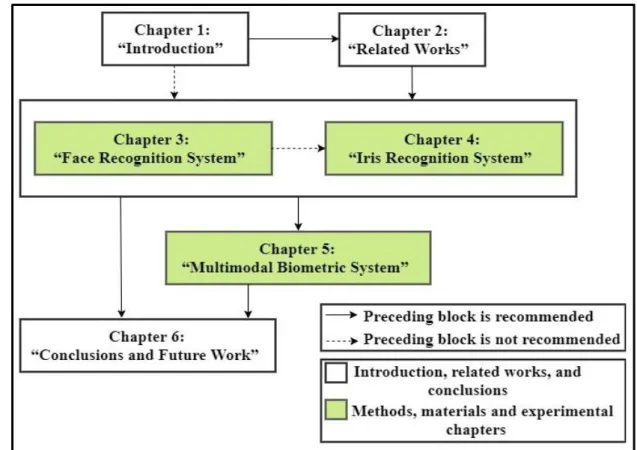
Fig. 1.1: A general structure of a biometric system, adapted from Jain et al.[5]. . 4 Fig. 1.2: The three provided tasks by the biometric system: (a) Enrollment, (b) Authentication and (c) Identification task, adapted from Jain et al. [5]. .. 8 Fig. 1.3: Examples of common biometrics: (a) Physiological, (b) Behavioral and (c) Soft characteristics.. ... 9 Fig. 1.4: Three different examples of the non-universality of a fingerprint trait due to finger dryness ... 11 Fig. 1.5: Example of an intra-class variation of a fingerprint trait obtained from the same user at two different times: (a) Enrollment phase (b) Recognition phase ... 11 Fig. 1.6: Multi-biometric system architectures: (a) Serial scheme, (b) Parallel scheme and (c) Hierarchical scheme, adapted from Ross et al. [3]. .... 17 Fig. 1.7: The five evidences sources of a multimodal biometric system, adapted from Ross and Jain [22]. ... 19 Fig. 1.8: Four levels of fusion used in multi-biometric systems. Rank level fusion, not shown, is used only in the identification task, adapted from Ross [22] ... 23 Fig. 1.9: The chapters' organization and the dependence among dissertation
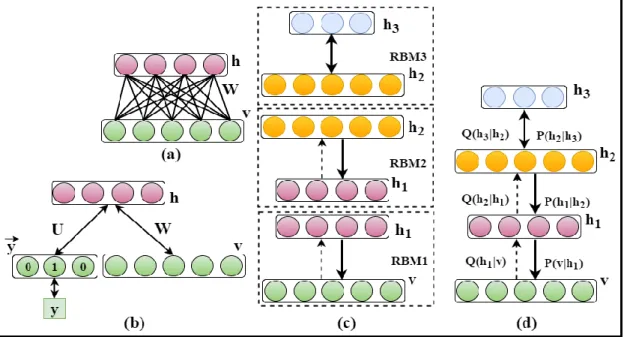
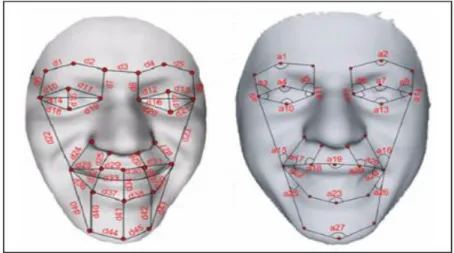
chapters. ... 28 Fig. 2.1: Some examples of geometrical features of the face image... 32 Fig. 2.2: (a) Some examples of the Eigenfaces approach showing the tendency of the PCA to acquire the major variations in the training set (e.g., lighting directions), and (b) Some examples of the Fisherfaces approach show its ability to discard information unrelated to classification [70] . ... 34 Fig. 2.3: The taxonomy of information fusion approaches in multi-biometric systems, adapted from Jain et al.[13]. ... 48 Fig. 3.1: Edge representation: (a) Wavelet transform and (b) Curvelet transform [73].. ... 65 Fig. 3.2: (a) A typical RBM structure, (b) A discriminate RBM modelling the joint distribution of input variables v and target classes y (represented as a one-hot vector by 𝒚⃗⃗ ), (c) A greedy layer-wised training algorithm for the DBN composed of three stacked RBMs, and (d) Three layers of the DBN as a generative model, where the top-down generative path is represented by the P distributions (Solid arcs), and bottom-up inference and the training path are represented by the Q distributions (Dashed arcs). ... 70 Fig. 3.3: A graphical illustration of a single step of the CD algorithm. ... 70 Fig. 3.4: Illustration of the proposed Curvelet-Fractal approach with the MDFR framework. ... 73 Fig. 3.5: The discrete domain of the Curvelet frequency tiling. ... 77
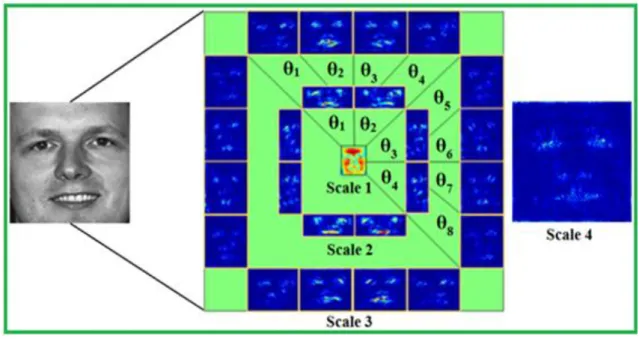
xi
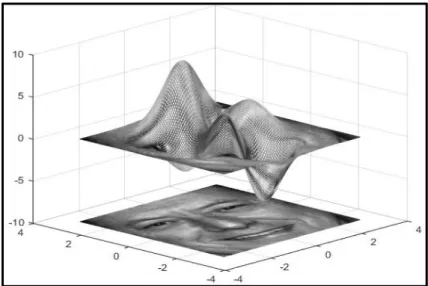
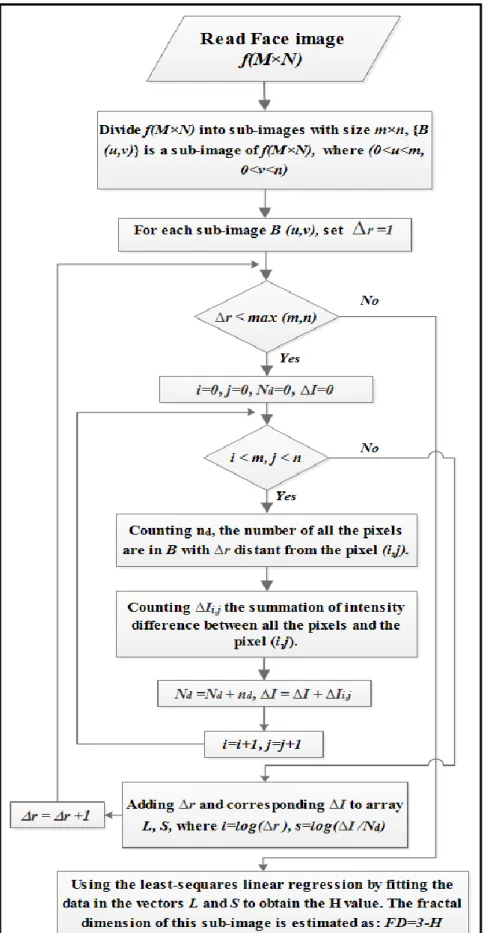
window: (a) before wrapping and (b) after wrapping. ... 77 Fig. 3.7: Illustration of the Curvelet decomposition coefficients obtained from a face image decomposed at scale 4 and orientations 8 ... 79 Fig. 3.8: Output of the image contrast enhancement procedure: (a) The coarse band and (b) The enhanced coarse band. ... 79 Fig. 3.9: The spatial surface corresponding to a grey-scale face image. ... 80 Fig. 3.10: A block diagram of the implementation of the FBM method. ... 83 Fig. 3.11: The top row shows coarse band Curvelet approximation coefficients of four images. The middle row shows the images after applying the contrast enhancement procedure, and the bottom row shows the FBM fractal transformed images. ... 84 Fig. 3.12: Calculating the Fractal dimension by using the traditional (DBC) [253].
... 86 Fig. 3.13: Data augmentation procedure: (a) Detected Face image, (b) The normalized face patches used as input for the MDFR where the (top) row are patches sampled from (a), and the (bottom) row their horizontal flipped versions. ... 90 Fig. 3.14: Examples of face images in four face datasets: (a) SDUMLA-HMT, (b) FERET, (c) CAS-PEAL-R1, and (d) LFW. ... 92 Fig. 3.15: An illustration of the environmental setting during the capturing process of the face image in the SDUMLA-HMT dataset [255].. ... 92 Fig. 3.16: The VAR generated throughout 121 experiments of finding the best regularization parameters. ... 94 Fig. 3.17: Performance comparison between the Curvelet-Fractal and CT-FBM approaches on the SDUMLA-HMT Dataset.. ... 95 Fig. 3.18: CMC curves for the four trained DBNs models over the validation set.
... 98 Fig. 3.19: Performance comparison between the DBN, Curvelet-Fractal and MDFR methods on the SDUMLA-HMT Dataset. ... 99 Fig. 3.20: ROC curves averaged over 10-folds of "View 2" of the LFW-a dataset. Performance comparison between the DBN, Curvelet-Fractal, and MDFR framework on the face verification task. ... 105 Fig. 4.1: The edge points and accumulator space of the CCHT approach. ... 112 Fig. 4.2: An illustration of the CNN architecture, where the grey and green
squares refer to the activation maps and the learnable convolution kernels, respectively. The cross lines between the last two layers refer to the fully-connected neurons………...………...117 Fig. 4.3: Overall stages of the proposed iris recognition system. ... 119 Fig. 4.4: Overall stages of the proposed iris localization procedure. ... 120 Fig. 4.5: Specular reflection removal stage: (a) The original eye image and (b) The output image. ... 121
xii
Hysteresis thresholding method, (c) The output of the morphological operation, and (d) The localized pupil boundary. ... 122 Fig. 4.7: Iris localization stage: (a) The input image, (b) Applying the 2D Gaussian filter, (c) Histogram equalization is employed, (d) Generated edge map, (e) Further processing for removing noise, and (f) The final detected iris boundaries. ... 124 Fig. 4.8: (a) An occluded eye image and (b) the output of the anisotropic diffusion filter. ... 125 Fig. 4.9: Eyelids and Eyelashes Detection: (a) The iris boundary region, (b) The top and bottom parts of iris region, (c) The edge map the top and bottom parts, and (d) The final detected eyelids and eyelashes. ... 125 Fig. 4.10: Daugman’s Rubber Sheet model to transfer the iris region from the Cartesian coordinates to the polar coordinates. ... 126 Fig. 4.11: An overview of the proposed training methodology to find the best CNN architecture, where CRR refers to the Correction Recognition Rate at Rank-1. ... 129 Fig. 4.12: An illustration of applying the dropout method to a standard neural network: (a) A standard neural network with 2 hidden layers before applying dropout method. (b) An example of a reduced neural network after applying dropout method. The crossed units and the dashed connections have been dropped. ... 131 Fig. 4.13: Examples of iris images in five iris datasets: (a) SDUMLA-HMT, (b) CASIA-Iris-V1, (c) CASIA-Iris-V3 Interval (d) MMU1, and (e) IITD. ... 135 Fig. 4.14: Examples of correct localized iris images: The top row represents examples from the CASIA-Iris-V1 dataset, while the second and bottom rows represent examples from the SDUMLA-HMT dataset, the right and left eye image, respectively. ... 137 Fig. 4.15: Examples of failed iris localization: The top row represents examples from the CASIA-Iris-V1 dataset, while the second and bottom rows represent examples from the SDUMLA-HMT dataset, the right and left eye image, respectively. ... 137 Fig. 4.16: An illustration of the IrisConvNet model for iris recognition. ... 139 Fig. 4.17: CMC curves for epoch number parameter evaluation using three different iris datasets: (a) SDUMLA-HMT, (b) CASIA-Iris-V3, and (c) IITD.. ... 142-143 Fig. 4.18: CMC curves for IrisConvNet for iris identification: (a) SDUMLA-HMT, (b) CASIA-Iris-V3, and (c) IITD. ... 147 Fig. 4.19: The feature maps for the first two layers of the IrisConvNet system with corresponding input images from SDUMLA-HMT dataset: The top row shows the input image, while the middle and bottom rows represent the feature maps of the first and second layer, respectively.. ... 148 Fig. 5.1: Block diagram of the proposed hybrid multimodal biometric system for face and both iris biometric traits. ... 157
xiii
approach. ... 159 Fig. 5.3: Block diagram of a less complex face and iris multimodal biometric system using only deep learning approaches. ... 159 Fig. 5.4: Example of score level fusion using five score fusion methods: Product, Sum, Weighted Sum, Max, and Min Rule. ... 164 Fig. 5.5: Example of rank level fusion using the Highest rank, Borda count and Logistic Regression method. ... 165 Fig. 5.6: Flow of information when the proposed multiple algorithms face recognition system operates in the verification mode. ... 169 Fig. 5.7: ROC curves using different score fusion methods. ... 170
xiv
List of Tables
Table 1.1: A comparison of biometric characteristics. High, Medium, and Low are denoted by H, M, and L, respectively.. ... 9 Table 2.1: A literature review of recent multimodal biometric systems. The usage of Real and Chimeric multi-biometric database is denoted by (R) and (C), respectively. ... 56 Table 3.1: Rank-1 identification rates obtained for different DBN architectures using Validation set. ... 97 Table 3.2: The Rank-1 identification rates of different methods on the FERET probe sets. ... 101 Table 3.3: The Rank-1 identification rates of different methods on the
CAS-PEAL_R1 probe sets. ... 102 Table 3.4: Performance comparison between the proposed approaches and the State-of- the-Art approaches on LFW dataset under different evaluation protocols. ... 105 Table 3.5: The average training time of the proposed approaches using different datasets. ... 106 Table 4.1: The characteristics of the adopted iris image datasets. ... 136 Table 4.2: The accuracy rate and running time of the proposed iris localization system. ... 138 Table 4.3: Comparison of the proposed iris localization model with previous approaches using four different iris datasets. ... 140 Table 4.4: Rank-1identification rates obtained for different CNN architectures using the input image size of (64×64) pixels. Each configuration has either 3 or 4 layers and indicates the number of filters in each layer. ... 145 Table 4.5: Rank-1identification rates obtained for different CNN architectures using the input image size of (128×128) pixels. Each configuration has either 4 or 5 layers and indicates the number of filters in each layer. ... 146 Table 4.6: Comparison of the proposed IrisConvNet system with other existing approaches using four different iris datasets. Data labelled by (∗) come from Chowhan et al.. ... 150 Table 4.7: Summary of the compared iris recognition approaches and their evaluation protocols………... .. 151 Table 4.8: The average training time of the proposed deep learning approach.
... 152 Table 5.1: Rank-1 identification rate (%) of the proposed multiple algorithms face recognition system on FERET and CAS-PEAL-R1 dataset using score level fusion. ... 168 Table 5.2: Rank-1 identification rate (%) of the proposed multiple algorithms face recognition system on FERET and CAS-PEAL-R1 dataset using rank level fusion ... 168
xv
face recognition system on LFW dataset using different score fusion methods. ... 170 Table 5.4: Rank-1identification rate (%) of the proposed multiple instance iris recognition system using score level fusion. ... 171 Table 5.5: Rank-1identification rate (%) of the proposed multiple instance iris recognition system using rank level fusion. ... 171 Table 5.6: Comparison of the proposed system with other existing approaches using two different iris datasets. ... 173 Table 5.7: Rank-1identification rate (%) of the proposed hybrid multimodal biometric system (Architecture_1) using different scenarios of fusion at score and rank level fusion... 175 Table 5.8: Rank-1identification rate (%) of the proposed hybrid multimodal biometric system (Architecture_2) using different scenarios of fusion at score and rank level fusion... 175 Table 5.9: Comparison of the proposed multimodal system using face trait with the state-of-the-art approaches on SDUMLA-HMT dataset. ... 175
xvi
List of Abbreviations
Symbol Definition
AAM Active Appearance Model AAR Average Accuracy Rate AER Average Error Rate ANN Artificial Neural Networks ASM Active Shape Models BC Box Counting
BDBN Boosted Deep Belief Network BGS Beacon Guided Search
BPSO Binary Particle Swarm Optimization BSA Backtracking Search Algorithm BSSR1 Biometric Scores Set Release-1 CC Correlation Coefficients
CCHT Coherent Circular Hough Transform CD Contrastive Divergence
CDBN Convolutional Deep Belief Networks CER Classification Error Rate
CHT Circular Hough Transform CMC Cumulative Match Characteristic CNN Convolutional Neural Network CRR Correct Recognition Rate
CS-LBP Centre-Symmetric Local Binary Pattern CSML Cosine Similarity Metric Learning
CT-FBM Curvelet Transform-Fractional Brownian Motion CWT Coiflet Wavelet Transform
DBNs Deep Belief Networks DCT Discrete Cosine Transform
DCTG1 first generation Discrete Curvelet Transform DDML Discriminative Deep Metric Learning DeepID2 Deep Identification-verification features DFD Discriminant Face Descriptor
DNNs Deep Neural Networks DWT Discrete Wavelet Transform EBGM Elastic Bunch Graph Matching EER Equal Error Rate
EMD Empirical Mode Decomposition EMR Electronic Medical Records FAR False Acceptance Rate FBM Fractional Brownian Motion FDCT Fast Discrete Curvelet Transform FER Failure Enrollment Rate
FERET FacE REcognition Technology FFNN Feed Forward Neural Network FFT Fast Fourier Transform
FLD Fisher’s Linear Discriminant FMR False Matching Rate
xvii
GAC Geodesic Active Contours GI Gradient Isolation
GLCM Gray Level Co-occurrence Matrices GMMs Gaussian Mixture Models
GPUs Graphics Processing Units GUIs The Graphical User Interfaces GVF Gradient Vector Field
ICA Independent Component Analysis IDBC Improved Differential Box Counting
iGRVM incremental Granular Relevance Vector Machine ITML Information-Theoretic Metric Learning
KDDA Kernel Direct Discriminant Analysis KFDA Kernel Fisher Discriminant Analysis K-NN K-Nearest Neighbour
LBP Local Binary Patterns
LCRBM Local Convolutional Restricted Boltzmann Machines LDA Linear Discriminant Analysis
LDML Logistic Discriminant based Metric Learning LFW Labeled Faces in the Wild
LGXP Local Gabor XOR Pattern LPP Locality Preserving Projections LQP Local Quantized Patterns
LSML Large Scale Metric Learning
MDFR Multimodal Deep Face Recognition MLP Multi-Layer Perceptron
MM-DFR Multimodal Deep Face Representation MMU1 Multimedia University
MNN Modular Neural Networks
NBP Neighborhood-Based Binary Pattern NLP Natural Language Processing
NNC Nearest Neighbour Classifier PCA Principal Component Analysis PINs Personal Identification Numbers
PMML Pairwise-constrained Multiple Metric Learning QDC Quadratic Discriminant Classifier
RBF Radial Basis Function
RBM Restricted Boltzmann Machine RDE Robust Direction Estimation
RDW-LBP Regional Directional Weighted-Local Binary Pattern ROC Receiver Operating Characteristic
RTT Radon Transform Thresholding SAE Stacked Auto-Encoder
SCER Sparse Coding Error Ratio SGD Stochastic Gradient Descent SIFT Scale Invariant Feature Transform SURF Speeded Up Robust Features SVMs Support Vector Machines TCM Texture Code Matrix
USFFT Unequally-Spaced Fast Fourier Transforms VAR Validation Accuracy Rate
1
Chapter 1
Introduction
1.1 Overview
Over the last few decades, increasing use of many developed and sophisticated techniques of hacking and forgery have led to increasing demands for alternative methods of recognizing a person's identity [1]. Biometric systems are constantly evolving and promise technologies that can be used in automatic systems for identifying and/or verifying a person's identity uniquely and efficiently without the need for the user to carry or remember anything, unlike traditional methods. These systems have been widely employed in many governmental and civilian sensitive applications, especially those including an automatic access control to physical or virtual places, such as border checkpoints, ATM machines, security and surveillance systems, financial transactions, computer/network security, etc. [2]. Personal identification based on biometric features has many advantages over traditional knowledge-based methods (e.g., passwords or Personal Identification Numbers (PINs)) and token-based methods (e.g., driver’s license, passport, ID card, or a simple set of keys), because it is difficult to be transferred, lost, forgotten or duplicated. In addition, employing biometrics in the task of identifying a person's identity is more convenient and user-friendly than traditional methods, so that clients do not need to remember or carry anything with them [3]. Finally, the security level achieved using biometric systems can be higher than those using traditional methods.
Despite the fact that personal identification using biometric characteristics has been a matter of research for more than forty years [4], there has been a growing interest in highly secured and well-designed biometric systems in the last decade. This is evidenced by recently published books [3][5][6][7], specific international conferences on biometrics (e.g., IAPR1, ICBTAS2, etc.), the
1
The 9th IAPR International Conference on Biometrics, 2016.
2
2
expansion of benchmark tools and assessment campaigns for biometric systems [8][9][10]. In addition, considerable attention has been also paid by government3,4, industry5, and international consortia dedicated specifically to biometric systems (e.g., CITeR6, EAB-CITeR7, etc.) in the last few years.
Broadly, biometric systems can be divided into two main types: unimodal and multimodal biometric systems. Unimodal biometric systems are based on using a single source of information (e.g., fingerprint, iris, or face, etc.) to establish the person's identity. This type of system has a number of critical limitations and issues that can affect reliability and performance. These include the possible poor quality of the specific biometric trait of the person, non-universality, lack of uniqueness, spoof attacks, etc. All these drawbacks of unimodal systems can be efficiently addressed by systems combining evidence from multiple sources of biometric information for identifying a person’s identity. Such systems are then referred to as multimodal biometric systems. For instance, face and voice, or two fingerprints (e.g., left and right index fingers), can be employed together to more accurately and robustly verify the person's identity. Hence, multimodal biometric systems can inherently improve the accuracy of unimodal systems by eliminating the dependency on one particular biometric trait as well as providing a wider population coverage [3][5].
In this introductory chapter, basic information on biometric systems is presented, including the overall structure of the biometric systems and their functionalities, some of the most common biometric modalities used in practice, and the limitations of unimodal biometric systems. In this chapter, the motivation behind multimodal biometric systems is outlined along with the challenging issues in designing and implementing such systems, from which the motivation, objectives and tasks of this PhD thesis are also derived. The chapter is finished by stating the thesis, summarizing the research contributions originated from this work and giving an outline of the dissertation.
3
The UK Biometrics Working Group (BWG):
http://www.idsysgroup.com/files/Biometrics%20Advice.pdf.
4 TWS Biometrics Working Group: https://sites.google.com/site/twsbwg/. 5 Biometrics Research Group: Mobile Biometrics Market Analysis 6
CITeR: Center for identification technology research, US, 2011.
7
3
1.2 Biometric Systems
A biometric system is basically a classification and recognition system that captures a biometric trait from an individual, extracts a set of discriminative features from the trait captured, compares the extracted feature set against a template set (or sets) stored in the system's database. Then, the final decision is taken based on the results of this comparison. Thereby, users do not need to remember or carry anything with them, avoiding the loss, sharing or forgetting of personal information. As depicted in Fig.1.1, the overall structure of any biometric system consists of four main stages, that work in a sequential manner to obtain the result from the system [2][11].
1. Sensor Module: this stage represents the interface between the user and the biometric system in which an electronic sensor or reader captures the biometric trait and converts it into a digital form. For example, a digital CMOS camera may be used to capture the patterns (e.g., rings, ridges, crypts, etc.) of the iris region. This is a critical stage since the rest of the biometric system strongly depends on the quality of the scanned trait. Therefore, in some biometric systems, this stage is linked with a quality checking procedure.
2. Pre-processing and Feature Extraction: Typically, the captured biometric trait is subjected to pre-processing operations in order to achieve a required quality. These operations can be divided into three steps. Firstly, an assessment step to evaluate the quality of the captured biometric trait, and then based on a pre-defined threshold either use the trait for further processing or attempt to re-capture the trait from the user. Then a segmentation step, in which the region of interest of the biometric trait is separated from the background noise, for example, detecting the iris region in the eye image. Finally, a number of image quality enhancement algorithms can be applied (e.g., logarithmic transformation, histogram equalization, etc.) on the detected biometric region to improve its quality by reducing the noise level introduced by the camera and illumination variations. After all or some pre-processing operations have been applied, a set, or vector, of discriminative features are extracted from the enhanced biometric trait. Then the extracted feature set is either sent to the matching stage for the purpose of user identification, or is stored in the system’s database as a template in
4
an enrollment phase. Ideally, the extracted features should have minimum intra-class variations and inter-class similarities.
3. Matching Module: here a query trait feature vector provided by the feature extraction module is compared with all the previously stored templates in the system's database to generate matching scores. These scores are measures of either similarities, in which case a higher score indicates a closer match or dissimilarities (distance scores), in which cases a lower score indicates a closer match between the query and the templates.
4. Decision Module: this is the final stage in the biometric system in which the user is identified or a claimed identity is either accepted (authorizing the user) or rejected (not authorizing the user) based on the score generated by the matching module.
Figure 1.1: A general structure of a biometric system, adapted from Jain et al. [5].
In addition to the Enrollment task, the two other tasks which can be provided by a biometric system, depending on the application context, are
verification and identification. In this thesis, the term " recognition" is used in
the general case to refer to these two functionalities [5][11][12]:
Enrollment: the digital representations of the features extracted from the biometric trait captured from the person using a sensor or CCD camera are known as templates. These templates are stored in digital form in the system's database through the enrolment or training process, along with
5
some biographic information (e.g., name, PIN, address, etc.) distinguishing the user, as shown in Fig.1.2 (a). Therefore, it can be used to register a new user or update an old user's templates, and for both of them a quality checker can be used to ensure the quality of the input trait. In some sensitive applications, these templates are kept as encrypted templates because of security and privacy concerns. Finally, this task is always coupled with the other two tasks (verification and identification).
Verification: in this task a one-to-one comparison is conducted between the newly captured image and the claimed identity to decide whether the claim is genuine or not (e.g., "Does this biometric trait belongs to Bob?"). Firstly, the user claims an identity by providing a user-name, ID card, driver's license, or PIN, and their biometric trait to the biometric system at the same time. Secondly, the claimed identity is recalled by the system from its database corresponding to the provided user-name, ID card, driver's license, or Personal PIN, in order to compare it against the newly entered data. Finally, the system will decide if the user is accepted as an authorized user or rejected as an imposter depending on the result of this comparison, as shown in Fig. 1.2 (b). To be accepted, the similarity between the query data and stored data must be equal or higher than the pre-defined threshold set by the system's designer. Typically, the performance of the verification system is evaluated by measuring a number of criteria such as False Rejection Rate (FRR), False Acceptance Rate (FAR) and the Equal Error Rate (EER). A verification system is usually used as a positive recognition system in physical access control systems and ATM systems to prevent multiple users from using the same identity or restricting unauthorized users’ access to specific services.
Identification: this task is more complicated and takes longer than the verification task. In this task, users are asked to provide only their biometric trait to the system, and a one-to-many comparison is conducted by comparing the captured data with all the stored templates in the database, as shown in Fig. 1.2 (c). The user's identity is established by taking either the best match or by listing all the possible matches within the pre-defined threshold and ranking them based on the similarity score. The identification
6
system can be used in both positive and negative recognition applications. In the positive identification system, the question, is this person known to the system, is answered by determining the user's identity from a known set of identities. In contrast, if a user attempts to negatively identify themselves to the system by concealing their real identity, the negative identification system tries to uniquely determine the user's identity to prevent them from using multiple identities. The negative identification system answers the question, whose biometric data is this, and is usually used in forensic applications, background checks, criminal identification and law enforcement. The performance of the identification system is assessed by measuring its Correct Recognition Rate (CRR), Classification Error Rate (CER) or Rank-1 identification rate.
1.3 Biometric Modalities
Many different kinds of pattern recognition systems have been widely used in establishing the identity of a person based on different kinds of biometric characteristics. In a biometric system, these characteristics constitute a substantial and a strong link between the user and their identity [7]. The biometrics characteristics can be divided into two types, physiological characteristics such as those used in Face, Iris, Fingerprint, Hand Veins, etc., recognition or behavioral characteristics such as those used in Signature, Speech, Gait, Voice, Keystroke, etc., recognition [13]. Recently, some additional useful information, such as name, gender, height, weight, ethnicity, eye colour, age, tattoo, etc., referred to as soft biometric characteristics, can also be used to verify a person's identity. However, these biometric traits do not always provide sufficient evidence to accurately recognize the person's identity, therefore they should be incorporated into a primary biometric system along with some additional physiological or behavioral characteristics [14]. Fig.1.3 shows some examples of physiological, behavioral and soft biometric characteristics which can be employed in a biometric personal identification system. The most essential question is what biological measurements (physical/behavioral characteristics) can be interpreted as a biometric trait? Ideally, a set of criteria should be met by any human physiological or behavioral
7
characteristic in order for it to be used as a successful biometric characteristic, and these criteria can be summarized as follows [2][15]:
Uniqueness (Distinctiveness): is the most important requirement for choosing a good biometric trait; it means that the biometric trait should be distinguishable among all members of the community, for instance, the iris trait is unique even between identical twins.
Universality (Availability): means that the characteristic is owned by all members of the community.
Robustness: means that the trait is not affected by different environmental conditions and should be constant for a long period of a person’s lifetime. The face trait, for example, can be affected by ageing.
Accessibility: (also referred to by Collectability and Measurability) means the trait should be easily acquired and measured quantitatively with little user interaction.
In addition to considering all these criteria when selecting the best biometric trait, there are other criteria which should be taken into account when designing and applying any person verification/identification system based on the personal biometric traits, including [5]:
Performance: refers to the ability, reliability and efficiency of the biometric system to achieve a high recognition rate in different environmental conditions and at a reasonable speed and cost.
Acceptability: refers to what extent the biometric system is accepted by the general public and the willingness of people to provide this biometric trait comfortably.
Circumvention: refers to the ability of the biometric system to resist and discover all the fraudulent methods of an imposter, for example, using a fake fingerprint or imitating the behavior of an authorized user such as their signature.
Based on domain-knowledge from the literature, it can be observed that no single biometric trait can satisfy all the criteria mentioned above. For instance, some biometrics have easy collectability and low distinctiveness (e.g., face trait), while other biometrics (e.g., iris trait) have a very high distinctiveness
8
and low collectability properties where iris acquisition devices are very expensive and require more user-cooperation. As reported by Ross et al. [3], the limitations and weaknesses of using a single biometric trait can be overcome by using two or more biometric traits in multimodal biometric systems, thus enhancing the security and reliability in establishing the person's identity. In this thesis, face and iris traits are studied and, as shown in Table 1.1, almost all desired properties are well fulfilled by combining these two traits.
Figure 1.2: The three provided tasks by the biometric system: (a) Enrollment, (b) Authentication and (c) Identification task, adapted from Jain et al. [5].
9
Table 1.1: A comparison of biometric characteristics. High, Medium, and Low are denoted by H, M, and L, respectively. Adapted from Jain et al.[2].
Biometric U n iversa lit y D ist in ct ive n ess Robust n ess Col lect abi lit y P erfo rma n ce Accept abi lit y Ci rcu mven ti on Face H L M H L H H Iris H H H M H L L Fingerprint M H H M H M M Hand Geometry M M M H M M M Gait M L L H L H M Voice M L L M L H H Signature L L L H L H H
Figure 1.3: Examples of common biometrics: (a) Physiological, (b) Behavioral and (c) Soft characteristics.
10
1.4 The Limitations of Unimodal Biometric Systems
Over the last few years, most biometric systems that have been widely employed in sensitive governmental and civilian applications have been unimodal biometric systems. Although these can provide a high level of security in identifying a person's identity, there are a number of critical limitations and problems that can significantly affect the reliability and the performance of these systems. These limitations and problems can be divided into three main types: accuracy, scalability, security and privacy [2][3][16]:
1.4.1 Accuracy
Ideally, any biometric system should be able to offer a high level of accuracy in recognizing a user's identity when a new query sample is presented to the system. However, the accuracy of biometric systems that operate on a single trait is usually affected by a number of factors that can be summarized as follows:
Noise in Sensed Data: there are a number of reasons that lead to the appearance of noise in the scanned data; some of these reasons are environmental conditions that surround the biometric acquisition process. For example, when voice data is captured in a noisy environment, or a user's face image is captured under poor illumination conditions, this affects the accuracy of the biometric system. In addition, sensors must be correctly maintained. For example, the quality of the fingerprint trait could be low as a result of the accumulation of dirt on the surface of the fingerprint reader [17]. The poor quality of the biometric data can result in a significant reduction in the overall accuracy of the system.
Non-Universality: simply means that a sub-set of the population is not able to provide the required biometric trait correctly or do not possess a specific biometric trait. This can lead to increased Failure Enrollment Rate (FER). For example, persons with long eyelashes or eye abnormalities may not be able to provide their iris trait correctly to an iris recognition system. Another example is shown in Fig.1.4, where users having very dry or oily fingers and workers with bruises and cuts have fingerprints that affect and limit the performance of a fingerprint recognition system [2].
11
Figure 1.4: Three different examples of the non-universality of a fingerprint trait due to finger dryness[18].
Intra-Class Variations: refers to the variations between user's samples acquired during the enrollment and recognition phases. These variations could be a result of incorrect operation of the reader (e.g. translation, rotation, and pressure on fingerprint sensor), inherent changes like the scars and bruises in the fingerprint trait as shown in Fig.1.5, a fraudster mimicking a particular behavioral trait, such as the voice, the effect of ageing on the face appearance, the effect of disease on the iris trait, and the use different sensors or modified sensor settings during enrollment and recognition phases. In an ideal biometric system, the features extracted from the biometric trait must be relatively invariant to these variations. However, features are very sensitive to these variations in most cases, and may need complex classification algorithms to handle these variations.
Figure 1.5: Example of an intra-class variation of a fingerprint trait obtained from the same user at two different times: (a) Enrollment phase (b) Recognition
12
Inter-Class Similarities: refers to the lack of individuality (uniqueness) of the biometric trait as a result of increasing number of enrolled users in the database, leading to overlapping biometric characteristics in the feature space and an increase in the FAR. Therefore, each biometric system should have an upper bound on the number of enrolled users, set by the maximum number of users who are discriminated efficiently by the system.
1.4.2 Scalability
This issue refers basically to increasing the number of enrolled users in the database of the biometric system and its effect on the speed and the performance of the system. In fact, this effect is different according to whether verification or identification is the task provided by the biometric system. In a verification system, a worsening effect does not occur with increasing number of enrolled users, because only a one-to-one comparison is needed to verify the user's identity. On the contrary, increasing the number of enrolled users in an identification system has serious negative effects, because the query template will be compared against N templates in the database (a one-to-many comparison) [19]. Thereby, increasing the value of N will decrease the throughput of the biometric system by increasing the elapsed time required for establishing the user's identity. Moreover, it can increase the False Matching Rate (FMR) of the system. To eliminate or reduce this effect on the identification system one question needs to be answered, which is how we can reduce the number of these required comparisons? In fact, there are some approaches working on indexing or filtering the enrolled users based on extrinsic factors (e.g., age, gender, etc.) or intrinsic factors (e.g., fingerprint major classes). Therefore, only a subset of the whole database will be required for comparison purpose, but these approaches still have some limitations [18].
1.4.3 Security and Privacy
This is usually related to biometric spoofing issues and the possibility that the unimodal system can be fooled, for example using a fake fingerprint or iris template. Behavioral characteristics like voice and gait are more vulnerable to such attacks than physical characteristics [3]. One of the most important
13
challenges in biometric systems is how to keep all the users' templates, which are stored in the database, secure from theft. There are different techniques for handling biometric spoofing issues, such as a liveness-detection techniques [20] for physical traits and a challenge-response mechanism [3] for physical traits and behavioral traits. An imposter can use a stolen template in two ways to circumvent a biometric system as follows: (i) the imposter can send the stolen template to the system to get an unauthorized access or (ii) use the stolen template by creating fake templates (physical spoof) to circumvent the system or other systems that operate on the same biometric trait [18].
1.5 Motivation for Multi-biometric Systems
Multi-biometric systems are systems that fuse evidence from multiple sources of biometric characteristics in order to enhance the security and increase the reliability in establishing the person's identity. In other words, the multi-biometric systems are mainly based on the data presented and acquired from multiple resources, as will be explained later. Recently, multi-biometric systems have been adopted for many governmental and civilian applications due to their ability to address and overcome some of the main drawbacks and limitations exhibited by unimodal biometric systems. Some of the advantages of multi-biometric systems over unimodal biometric systems are listed as follows [3][16]:
1. Increasing the efficiency and the reliability of the recognition system by considerably reducing the effect of noise or poor quality in the acquired biometric traits. The availability of other biometric sources in the multi-biometric system can enhance the performance of the system, for example, if a user cannot be identified by their voice trait due to environmental issues, then they can still be identified using another trait, such as a fingerprint.
2. Sufficient population coverage can be achieved using multi-biometric systems, due to their ability to solve problems related to the enrollment phase, such as non-universality. Thereby, a person who cannot present a particular biometric trait, can still be enrolled and identified by presenting another biometric trait, for example, a manual worker who has a poor fingerprint quality, can still be enrolled and identified using traits such as,
14
face, iris, voice, etc. As a result, the FER will be decreased by increasing the population coverage.
3. A multi-biometric system can greatly reduce the overlap among the feature spaces of different persons (Inter-Class similarities) by combining biometric traits and adopting a fusion approach. Combining multiple pieces of evidence from different sources can increase the dimensionality of the feature vector, but the overall accuracy of the biometric system will be increased. For example, two persons from the same family who can have the same voice trait will not have the same iris and fingerprint traits.
4. Multi-biometric systems can provide a higher accuracy and a greater resistance to unauthorized access by an intruder than unimodal biometric systems, due to the difficulty of spoofing or forging multiple biometric traits for a legitimate user at the same time. Furthermore, another mechanism can be coupled with the multi-biometric system, for example by asking users to present their biometric trait randomly at the acquisition time (e.g. fingerprint, followed by face trait and then voice) to ensure that it is a live user who is interacting with the system. This is known as a Liveness Detection or a Challenge-Response Mechanism.
5. Using a multi-biometric system can substantially improve the throughput of a biometric system, especially in the identification task where a one-to-many comparison is required. This can be carried out using the least accurate biometric trait (e.g., Fingerprint trait) to prune the database size down to an acceptable size, and then the most accurate biometric trait (e.g., iris trait) will be used on the rest of the database to make the final decision.
6. Finally, a high degree of flexibility will be offered to the user during the recognition time using a multi-biometric system. Suppose a system is implemented using three biometric traits (e.g., face, fingerprint and voice). Subsequently, at the recognition phase, a user can choose either to provide a subset or all of their biometric traits depending on the nature of the implemented application and the user's convenience.
15
1.6 Design Issues in Multi-biometric Systems
Based on the definition of the multi-biometric system, three main factors must be taken into account when designing and implementing a multi-biometric system. Firstly, the architecture of the multi-biometric system in which the selected biometric traits will be acquired and processed. Secondly, the source of the information used by the multi-biometric system, which could be any of six different sources, as will be explained later on. The third factor is the fusion of the obtained traits and where this takes place in the multi-biometric system. In the next subsections, each factor will be explained in detail.
1.6.1 Multi-biometric Systems Architectures
One of the most challenging issues in designing a multi-biometric system, after the proper biometric traits have been selected to establish the user’s identity is choosing the architecture of the multi-biometric system. In fact, a number of factors play a significant role in deciding and selecting the best architecture type, such as the nature of the application, the required level of security, and the order in which the biometric traits from different resources are captured and processed through the system. Typically, depending on these factors, the architecture of the multi-biometric system can be categorized into three main types: serial, parallel, or hierarchical [2][21]. The serial scheme, also known as a cascade scheme in which the result of one trait can be used to prune the database size down before the next trait is used, especially when the system operates in the identification mode [16]. Therefore, the output of the next trait may be affected by the output of the previous one. For example, a multi-biometric system using iris and fingerprint can use the fingerprint trait to get the best top matches, and then the iris trait is applied to the rest of the database to make the final decision. As a result, the throughput of the system can be increased by making a decision before acquiring all the required modalities. Finally, the applied biometric traits do not have to be captured simultaneously. See Fig. 1.6 (a).
On the other hand, in the parallel scheme multiple biometric traits are acquired and processed independently at the same time, and then the results obtained from them are combined using an appropriate fusion approach to
16
make the final decision [3], as shown in Fig. 1.6 (b). Therefore, the parallel scheme takes a longer recognition time compared to the serial scheme, which makes the serial scheme more convenient to the user. However, the security level is higher in the parallel scheme than the serial scheme, which makes it highly recommended for sensitive applications, such as military applications. Finally, the advantages of both the parallel and serial schemes can be combined in the third scheme, which is known as a hierarchical scheme. In this scheme, a number of problems can be solved such as missing biometric data or noisy biometric traits by combining a different classifier into a tree-like structure, as shown in 1.6 (c). [18]. However, this type of multi-biometric system architecture has not received a lot of attention in the research community.
1.6.2 The Evidence Sources of Multi-biometric Systems
To satisfy the multi-biometric system concept, more than one biometric source, either physiological or behavioral characteristic is required, as illustrated in Fig.1.7. In this section, the question, “What are the sources of biometric data that can be utilized in a multi-biometric system?”, is answered. In general, five scenarios are available in the multi-biometric system, and a sixth scenario refers to the hybrid multi-biometric system, which is the combination two or more of these five scenarios [22]. In these scenarios the evidence sources of the multi-biometric system can be categorized into one of, or a combination of, the following five types:
1. Multiple Sensors/Single Trait: in this system one biometric trait is captured by using more than one sensor in order to get a more diverse set of features, for example, the face trait can be captured using two different cameras (e.g. infrared camera and visible light camera), or use optical and ultrasonic sensors to capture the fingerprint trait.
2. Multiple Algorithms/Single Trait: in this system, only one biometric trait is captured and the results from multiple feature extraction approaches and/or multiple classifiers are concatenated to improve the performance of the system. The multiple algorithms system is less expensive than previous systems due to only one sensor being required, which also reduces the user interaction with sensors.
17
Figure 1.6: Multi-biometric system architectures: (a) Serial scheme, (b) Parallel scheme and (c) Hierarchical scheme, adapted from Ross et al. [3].
18
However, in the multiple algorithm systems the computational complexity and time required are increased, due to multiple feature extraction and matching modules required. For example, the same fingerprint trait can be processed by using texture-based and minutiae-based approaches [16].
3. Multiple Samples/Single Trait: this type of multi-biometric systems is adopted to increase the resistance of the system to variations of the biometric trait using a single sensor to capture more than one sample from the same trait. For example, in the face recognition system, the face trait can be captured from different angles (e.g. frontal, left and right profiles) using a single camera, and then the extracted information is used to address the challenges that arise from the variations of the facial pose [3].
4. Multiple Instances/Single Trait: again one biometric trait is used, but the information is extracted and used from multiple instances of the same biometric trait. For example, the person's identity could be established by extracting the information from his right and left iris trait or his right and left index fingers. This type of systems is cost efficient, due to no new sensors, feature extraction approaches, and/or classification approaches, being required [22].
5. Multiple Biometric Traits: this results in a multimodal biometric system, where multiple physiological and/or behavioral characteristics are employed to recognize the person's identity requiring the use of multiple sensors [16], for example, using the fingerprint and iris trait in establishing the person's identity. The independence of the adopted traits (e.g., fingerprint and iris) ensures that a considerable improvement in performance is obtained. However, some issues need to be addressed in this system, such as the cost of deploying multiple sensors, enrollment time, throughput time, and user’s convenience due to the number of the traits required during the enrollment and recognition phases. Finally, combining more than one trait can lead to an increase in the dimensionality of the feature vector, which results in putting an upper bound on the number of the used traits without affecting the performance [3].
19
Figure 1.7: The five evidences sources of a multimodal biometric system, adapted from Ross and Jain [22].
1.6.3 Fusion Information Levels in Multi-biometric Systems
Other essential challenges for the designer of the multi-biometric system are selecting the best information sources from multiple sources in the system and finding an efficient methodology to fuse them. As it is well known, information in the biometric system can be taken from four different points: the sensor module, the feature extraction module, the matching module and the decision module. Typically, the degree of availability of the information decreases as one moves from the sensor module toward the decision module [16]. Therefore, based on these information sources and the amount of the available information, the fusion method can take place in five different levels, as shown in Fig.1.8. These levels are the sensor level, the feature level, the score level, the rank level and the decision level. The five levels of integrating the biometric information can be broadly classified into two groups. Firstly, the Prior-to-Classification fusion levels, which includes the sensor and feature levels refers to combining the information before applying any matching
20
algorithm. Secondly, the Post-to-Classification fusion levels, which includes the score, rank and decision levels, refers to integrating the information in the matching score and the decision spaces [13][21]. In this section, the five fusion levels are explained as follows:
1. Sensor Level Fusion: in this level of fusion, the sources of information either employ different compatible sensors to capture the same biometric trait or capture multiple instances for the same trait using a single sensor [23]. For example, the fingerprint trait can be obtained by using two different sensors (e.g. Optical and Ultrasonic sensors). Another example is capturing multiple snapshots of the face trait using the same camera. Although the sensor level represents the richest source of data, this data can be contaminated by noise, illumination changes and other enrollment process issues. Finally, it can quite difficult if not impossible to fuse directly two sets of raw data collected from two different modalities due to the incompatibilities between
![Figure 1.4: Three different examples of the non-universality of a fingerprint trait due to finger dryness [18]](https://thumb-us.123doks.com/thumbv2/123dok_us/785164.2599270/30.892.175.809.115.310/figure-different-examples-universality-fingerprint-trait-finger-dryness.webp)
![Figure 1.7: The five evidences sources of a multimodal biometric system, adapted from Ross and Jain [22]](https://thumb-us.123doks.com/thumbv2/123dok_us/785164.2599270/38.892.177.803.115.596/figure-evidences-sources-multimodal-biometric-adapted-ross-jain.webp)
![Figure 2.3: The taxonomy of information fusion approaches in multi-biometric systems, adapted from Jain et al.[13]](https://thumb-us.123doks.com/thumbv2/123dok_us/785164.2599270/67.892.172.814.112.483/figure-taxonomy-information-fusion-approaches-biometric-systems-adapted.webp)