k-NN Boosting Prototype Learning for Object
Classification
Paolo Piro, Michel Barlaud, Richard Nock, Frank Nielsen
To cite this version:
Paolo Piro, Michel Barlaud, Richard Nock, Frank Nielsen. k-NN Boosting Prototype Learning
for Object Classification. WIAMIS 2010 - 11th Workshop on Image Analysis for Multimedia
In-teractive Services, Apr 2010, Desenzano del Garda, Italy. IEEE, pp.1-4, 2010.
<hal-00481725>
HAL Id: hal-00481725
https://hal.archives-ouvertes.fr/hal-00481725
Submitted on 7 May 2010
HAL
is a multi-disciplinary open access
archive for the deposit and dissemination of
sci-entific research documents, whether they are
pub-lished or not.
The documents may come from
teaching and research institutions in France or
abroad, or from public or private research centers.
L’archive ouverte pluridisciplinaire
HAL
, est
destin´
ee au d´
epˆ
ot et `
a la diffusion de documents
scientifiques de niveau recherche, publi´
es ou non,
´
emanant des ´
etablissements d’enseignement et de
recherche fran¸cais ou ´
etrangers, des laboratoires
publics ou priv´
es.
𝐾
-NN BOOSTING PROTOTYPE LEARNING FOR OBJECT CLASSIFICATION
Paolo Piro
1, Michel Barlaud
1, Richard Noch
2, Frank Nielsen
31
CNRS / University of Nice-Sophia Antipolis, France
2
CEREGMIA, University of Antilles-Guyane, France
3
LIX, Ecole Polytechnique, France
ABSTRACT
Object classification is a challenging task in computer vision. Many approaches have been proposed to extract meaning-ful descriptors from images and classifying them in a super-vised learning framework. In this paper, we revisit the clas-sic𝑘-nearest neighbors (𝑘-NN) classification rule, which has shown to be very effective when dealing with local image de-scriptors. However, 𝑘-NN still features some major draw-backs, mainly due to the uniform voting among the near-est prototypes in the feature space. In this paper, we pro-pose a generalization of the classic𝑘-NN rule in a supervised learning (boosting) framework. Namely, we redefine the vot-ing rule as a strong classifier that linearly combines predic-tions from the𝑘closest prototypes. To induce this classifier, we propose a novel learning algorithm, MLNN (Multiclass Leveraged Nearest Neighbors), which gives a simple proce-dure for performing prototype selection very efficiently. We tested our method on 12 categories of objects, and observed significant improvement over classic𝑘-NN in terms of classi-fication performances.
1. INTRODUCTION
In this paper, we address the task of multiclass object cat-egorization. It consists in automatically classifying an un-labeled region extracted from an image (e.g., by segmenta-tion) according to a set of predefined objects. This task is very challenging, and is attracting more and more research effort from the computer vision community, as prompted by the plethora of classification approaches proposed for PAS-CAL 2009 competition1. A wide range of image
descrip-tors has been investigated for object categorization purposes, which generally rely on detecting relevant local characteris-tics of objects (e.g., local shape and appearance). The best known examples of such descriptors are SIFT [1], which are typically combined into Bags-of-Features [2] or Pyramid [3] representations.
Despite lots of works, much remains to be done to chal-lenge human level performances. In fact, images carry only parts of the information that is used by humans to recognize
1http://pascallin.ecs.soton.ac.uk/challenges/VOC/voc2009/
objects, and parts of the information available from images may be highly misleading: for example, real object categories may exhibit high intra-class variability (i.e., visually different objects may belong to the same category) and low inter-class variability (i.e., distinct categories may contain visually simi-lar objects).
Voting classification techniques, like𝑘-nearest neighbors (𝑘-NN), have been shown to be very effective when dealing with local image descriptors. However, they may suffer from high sensitivity to “noisy” prototypes, thus requiring suitable learning procedures for rejecting unreliable matches. More-over, it is a critical challenge to reduce the computational cost of descriptor matching without impairing classification per-formances. In order to cope with these issues, the literature has favored two main approaches so far: improve categoriza-tion by means of local classifiers [4, 5, 6], or filter out ill-defined examples [7].
In this paper, we propose a novel solution: a new provable boosting algorithm for nearest-neighbors (NN) rules in a mul-ticlass framework. Our algorithm, MLNN (Mulmul-ticlass Lever-aged Nearest Neighbors), induces a multiclass leverLever-aged near-est neighbors rule that generalizes the uniform𝑘-NN rule, us-ing directly the examples as weak hypotheses. Finally, the most significant advantage of MLNN lies in its ability to find out the most relevant prototypes for categorization, thus en-abling to filter out the remaining examples.
In the following section we present MLNN, along with the statement of its theoretical properties. Then, we present and discuss experimental results of object categorization.
2. METHOD 2.1. Problem statement and notations
Instead of splitting the multiclass classification problem in as manyone-versus-all(two-class) problems — a frequent ap-proach in boosting [8] — we directly tackle the multiclass
problem, following [9]. For a given query, we compute its
classification scorefor all categories (or classes, or labels). Then, we select the label with the maximum score. We sup-pose given a set𝒮 of 𝑚annotated descriptors arising from images (or image regions). Each image descriptor provides a
trainingexample(𝒙,𝒚), where𝒙is the image feature vector and𝒚 the class vector that specifies the category member-ship of the descriptor. In particular, the sign of component
𝑦𝑐 gives the positive/negative membership of the example to class𝑐(𝑐 = 1,2, ..., 𝐶). Inspired by the multiclass boosting analysis of [9], we constrain the class vector to besymmetric,
i.e.,∑𝐶𝑐=1𝑦𝑐 = 0by setting: 𝑦˜𝑐 = 1,𝑦𝑐∕=˜𝑐 =−𝐶1−1, where
˜
𝑐is the true image category.
2.2. (Leveraged) Nearest Neighbors
The regular𝑘-NN rule is based on majority vote among the
𝑘nearest neighbors in set𝒮, to decide the class of query𝒙. It can be defined as the following multiclass classifier𝒉 = {ℎ𝑐, 𝑐= 1,2, ..., 𝐶}: ℎ𝑐(𝒙) = 1 𝑘 ∑ 𝑖∼𝑘𝑥 [𝑦𝑖𝑐>0] , (1) whereℎ𝑐∈[0,1]is the classification score for class𝑐,𝑖∼𝑘 𝑥 denotes an example(𝒙𝒊,𝒚𝒊)belonging to the𝑘nearest
neigh-bors of𝒙and square brackets denote the indicator function. In this paper, we propose to generalize (1) to the following
leveraged𝑘-NN rule𝒉ℓ={ℎℓ 𝑐, 𝑐= 1,2, ..., 𝐶}: ℎℓ 𝑐(𝒙) = ∑ 𝑗∼𝑘𝑥 𝛼𝑗𝑦𝑗𝑐∈ℝ , (2)
where the𝑘nearest neighbors are searched either in𝒮, or in a sparse subset𝒫 ⊆ 𝒮 obtained after aprototype selection
step, achieved before any query is presented. Each example in𝒫 is a relevant category prototype. Prototype selection is achieved by using the leveraging coefficients𝛼𝑗 (2), which are expected to represent their “confidence ” for classifying new data.
In the following sections we describe the boosting-like procedure we propose to compute the𝛼𝑗’s. In particular, we propose to minimize a particular upperbound of the risk func-tional on training data, thus exploiting a very important trick that has been at the center of major advances in classification over the last ten years.
2.3. Multiclass surrogate risk minimization
In order to fit our classification rule (2) onto training set𝒮, we focus on the minimization of a multiclass exponential (surro-gate2) risk: 𝜀exp(𝒉ℓ,𝒮) . = 1 𝑚 𝑚 ∑ 𝑖=1 exp à −1 𝐶 𝐶 ∑ 𝑐=1 𝑦𝑖𝑐ℎℓ𝑐(𝒙𝒊) ) . (3) This function is an upper bound of theempirical risk:
𝜀0/1(𝒉ℓ,𝒮)=. 1 𝑚𝐶 𝑚 ∑ 𝑖=1 𝐶 ∑ 𝑐=1 [ 𝑦𝑖𝑐ℎℓ𝑐(𝒙𝒊)<0 ] , (4)
2We callsurrogatea function that upperbounds the risk functional we
should minimize, and thus can be used as a primer for its minimization.
which is not differentiable and often computationally hard to directly minimize [10]. Remark that both risks (3, 4) depend on quantity𝑦𝑖𝑐ℎℓ𝑐(𝒙𝒊), the edgeof classifier𝒉ℓ on example (𝒙𝒊,𝒚𝒊) for class 𝑐. This edge is positive iff the category
membership predicted by the classifier agrees with the true membership of the example. Plugging definition (2) into sur-rogate risk (3) gives:
𝜀exp(𝒉ℓ,𝒮)=. 1 𝑚 𝑚 ∑ 𝑖=1 exp ⎛ ⎝− 𝑚 ∑ 𝑗=1 𝛼𝑗r𝑖𝑗 ⎞ ⎠ , (5)
which highlights an essential ingredient of our algorithm,i.e.
themulticlass𝑘-NNedge matrix[r𝑖𝑗]𝑚×𝑚, whose entryr𝑖𝑗is different from zero iff example𝑗is a neighbor of𝑖, whereas the positive (negative) sign ofr𝑖𝑗specifies the membership of the two examples to the same (not the same) class. (See defi-nition (7) in Alg. 1.) Finally, after computing the edge matrix, which is a constant term in (5), the unknown leveraging coef-ficients𝛼𝑗can be fitted by running the algorithm described in the following section, which iteratively minimizes the surro-gate risk.
2.4. MLNN: Multiclass Leveraged𝑘-NN rule
Algorithm Pseudocode of MLNN is shown in Alg. 1. Like common boosting algorithms, MLNN operates on a set of weights𝑤𝑖(𝑖= 1,2, ..., 𝑚) defined over training data. These weights are repeatedly updated based on𝛿𝑗, which is a lo-cal measure of the class density around a given example𝑗. Namely, at each iteration 𝑡 of the algorithm, a weak index chooser oracle WIC({1,2, ..., 𝑚}, 𝑡) determines index 𝑗 ∈ {1,2, ..., 𝑚} of the example to leverage (step I.0). Various choices are possible for this oracle. The simplest is perhaps to compute Eq. (10, 11) for all the training examples, then to pick𝑗maximizing𝛿𝑗:
𝑗ÃWIC({1,2, ..., 𝑚}, 𝑡) : 𝛿𝑗= max 𝑗∈{1,2,...,𝑚}𝛿
𝑡 𝑗 . (6) Furthermore, notice that, when whichever𝑤+𝑗 or𝑤−𝑗 is zero,
𝛿𝑗 in (11) is not finite. We propose a simple strategy to elim-inate this drawback, inspired by [8],i.e., to add1/𝑚to both the numerator and the denominator of the fraction in the log term of (11). This smoothes out𝛿𝑗, guaranteeing its finiteness without impairing convergence of MLNN.
Complexity MLNN shares the property with boosting al-gorithms of being resources-friendly: since computing the leveraging coefficients scales linearly with the number of neigh-bors, its time complexity bottleneck does not rely on boosting, but on the complexity of nearest neighbor search. Further-more, its space complexity is also reduced: since weak hy-potheses are examples, example𝑗can be a classifier only for itsreciprocalnearest neighbors — those examples for which
𝑗itself is a neighbor —, corresponding to non-zero entries in column𝑗 of edge matrix (7). This matrix is thus extremely
Algorithm 1:MULTICLASSLEVERAGED𝑘-NN MLNN(𝒮) Input: 𝒮={(𝒙𝑖,𝒚𝑖), 𝑖= 1,2, ..., 𝑚 , 𝒚𝒊∈ {− 1 𝐶−1,1} 𝐶} Let r𝑖𝑗=. { 1 𝐶 ∑𝐶 𝑐=1𝑦𝑖𝑐𝑦𝑗𝑐 if 𝑗∼𝑘𝑖 0 otherwise (9) Let 𝛼𝑗Ã0, ∀𝑗= 1,2, ..., 𝑚 Let 𝑤𝑖Ã1/𝑚, ∀𝑖= 1,2, ..., 𝑚 for𝑡= 1,2, ..., 𝑇do
[I.0] Weak index chooser oracle: Let𝑗ÃWIC({1,2, ..., 𝑚}, 𝑡); [I.1]Let 𝑤+ 𝑗 = ∑ 𝑖: r𝑖𝑗>0 𝑤𝑖, 𝑤𝑗−= ∑ 𝑖: r𝑖𝑗<0 𝑤𝑖, (10) 𝛿𝑗Ã(𝐶−1) 2 𝐶 log à (𝐶−1)𝑤+ 𝑗 𝑤𝑗− ) ; (11) [I.2]Let 𝑤𝑖Ã𝑤𝑖exp(−𝛿𝑗r𝑖𝑗), ∀𝑖 : 𝑗∼𝑘𝑖; (12) [I.3]Let𝛼𝑗Ã𝛼𝑗+𝛿𝑗 Output: ℎℓ 𝑐(𝒙) = ∑ 𝑗∼𝑘𝑥 𝛼𝑗𝑦𝑗𝑐, ∀𝑐= 1,2, ..., 𝐶
sparse for reasonable values of𝑘. As a consequence, update rule (12) is to be computed on a small number of examples.
Convergence Using known arguments of the boosting the-ory [10], we proved the convergence of MLNN to the min-imum of the surrogate risk, along with a convergence rate, which is based on the followingweak index assumption(WIA):
WIA: let𝑝𝑗 =. 𝑤𝑗+/(𝑤+𝑗 +𝑤−𝑗). There exist some𝛾 > 0 and𝜂 >0such that the following two inequality holds for index𝑗returned by WIC({1,2, ..., 𝑚}, 𝑡):
∣𝑝𝑗−1/𝐶∣ ≥ 𝛾 , (7)
(𝑤+
𝑗 +𝑤𝑗−)/∣∣𝒘∣∣1 ≥ 𝜂 . (8)
We summarize this fundamental convergence property in the following theorem:
Theorem 1 If theWIAholds for𝜏 ≤𝑇 steps, thenMLNN
converges with𝜏 to𝒉ℓrealizing theglobal minimum of the
surrogate risk (3), and𝜀0/1(𝒉ℓ,𝒮)≤exp(− 𝐶
𝐶−1𝜂𝛾2𝜏). Inequality (7) is the usual weak learning assumption, used to analyze classical boosting algorithms [11, 8], when consider-ing examples as weak classifiers. Aweak coverage assump-tion(8) is needed as well, because insufficientcoverageof the reciprocal neighbors could easily wipe out the surrogate risk reduction due to a large𝛾in (7). For a deeper insight into the properties of our𝑘-NN boosting method, see [12].
Fig. 1. Twelve categories from the Caltech-101 database.
40 60 accordion 0 20 40 60 0 200 400 600 airplanes 0 20 40 60 0 200 400 600 car side 0 20 40 60 0 200 400 600 cellphone 40 60 cup 0 20 40 60 0 200 400 600 ewer 0 20 40 60 0 200 400 600 ferry 0 20 40 60 0 200 400 600 grand piano 40 60 laptop 0 20 40 60 0 200 400 600 motorbikes 0 20 40 60 0 200 400 600 watch 0 20 40 60 0 200 400 600 windsor chair n = 6852 n = 12895 n = 9706 n = 4498 n = 11255 n = 14129 n = 4360 n = 10972 n = 8376 n = 2311 n = 14181 n = 3777
Fig. 2. Histograms of prototype leveraging coefficients𝛼𝑗per
category. The overall number of prototypes in each category is reported as well.
3. EXPERIMENTS
In this section we present experimental results of MLNN vs plain𝑘-NN on a database of real objects. We carried out ex-periments in order to investigate the improvements brought by boosting on nearest neighbor voting. Namely, we used 12 cat-egories from the well-known Caltech-101 database for object classification:accordion, airplanes, car side, cellphone, cup, ewer, ferry, grand piano, laptop, motorbikes, watch, Wind-sor chair(Fig. 1). This database contains a large variety of objects, and also exhibits high intra-class variability, i.e., vi-sually different objects may be in the same category.
3.1. Training
We used 40 training images per category, and extracted dense SIFT descriptors [1] from image regions corresponding to ob-jects. For this purpose, we used the ground-truth object masks provided with the database. We computed dense descriptors of16×16patches over a grid with spacing of 8 pixels, as pro-posed in [3]. We used the descriptors of all training objects for learning prototypes, i.e., a subset of relevant object descrip-tors with their leveraging coefficients. Namely, we retained only examples with positive𝛼𝑗 as prototypes for classifying test images. In Fig. 2 we show how values of prototype lever-aging coefficients are distributed in each category. The best represented categories are those maximizing the integral of such histograms, i.e., those containing most of the prototypes with the largest coefficient values. We used all non-training images (2,039 overall) to test classification performances of MLNN.
3.2. Classification
In order to obtain a global classification score for a given test image𝑿, each of the query descriptors 𝒙 ∈ 𝑿 was first classified independently by our leveraged𝑘-NN rule (2). Be-cause prototype classes are highly imbalanced, as displayed in Fig. 2, we smoothed out aggregate scores with a standard technique [13]. Hence, we predict labelˆ𝑐for a query image
𝑸as follows: ˆ 𝑐(𝑿)= arg max. 𝑐 1 𝑚𝒫 𝑐 ∑ 𝒙∈𝑿 ℎℓ 𝑐(𝒙), (13) where𝑚𝒫
𝑐 is the cardinal of retained prototypes of class𝑐. In order to speed up the execution time we used a CUDA GPU implementation of Nearest Neighbor search [14].
Classification results are summarized in Fig. 3, where the mean Average Precision (mAP%) over all test images is shown
for different prototype sets. We computed mAPas the
aver-age of diagonal entries in the confusion table, whereas the size of prototype set is reported as𝜃, that is the ratio of the number of retained prototypes and the overall size of training data. Fig. 3 also reports results of vanilla𝑘-NN (with ran-dom sampling of the prototypes from the training data). We observe that the improvement over regular𝑘-NN is dramatic, even when decreasing the prototype number. E.g., only 14% of prototypes allow for 20% improvement over classic𝑘-NN. (See the marked points in the figure.) Besides this precision improvement, MLNN also enables to drastically reduce the computational complexity with respect to plain𝑘-NN (gain up to a factor 4 when discarding half prototypes).
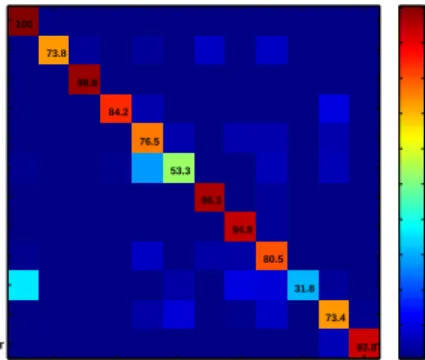
Finally, the confusion table reported in Fig. 4 highlights the difficulty of discriminating between couples of visually similar object categories, like “cup” and “ewer”. Moreover, most of mistakes may be due to an insufficient representa-tion of an object category in the prototype set. Namely, cate-gories with few prototype descriptors, like “motorbikes”, are more likely to be confused with over-represented categories (e.g., “accordion”). Normalizing the number of prototypes per class, e.g., by adapting the resolution of dense descriptors to the actual object size, is expected to improve classification rate in such categories [3].
4. REFERENCES
[1] D. Lowe, “Distinctive image features from scale-invariant
key-points,”IJCV, vol. 60, no. 2, pp. 91–110, 2004.
[2] J. Sivic and A. Zisserman, “Video Google: Efficient visual
search of videos,” vol. 4170 ofLNCS, pp. 127–144. 2006.
[3] S. Lazebnik, C. Schmid, and J. Ponce, “Beyond bags of
fea-tures: Spatial Pyramid Matching for recognizing natural scene
categories,” inCVPR, 2006, pp. 2169–2178.
[4] H. Zhang, A. Berg, M. Maire, and J. Malik, “SVM-KNN:
Dis-criminative nearest neighbor classification for visual category
recognition,” inCVPR’06, 2006, pp. 2126–2136. 0 0.1 0.2 0.3 0.4 0.5 0.6 40 45 50 55 60 65 70 75 80 θ mAP [%] MLNN k−NN
*
*
20%Fig. 3. MLNN classification performances in terms of mAP
as a function of the proportion𝜃of retained prototypes.
100 73.8 98.8 84.2 76.5 53.3 96.3 94.9 80.5 31.8 73.4 93.8 accordion airplanes car_side cellphone cup ewer ferry grand_piano laptop Motorbikes watch windsor_chair 10 20 30 40 50 60 70 80 90 100
Fig. 4. Confusion table when retaining all prototypes with positive leveraging coefficients (𝜃= 0.58,𝑘= 11).
[5] Trevor Hastie and Robert Tibshirani, “Discriminant adaptive
nearest neighbor classification,”PAMI, vol. 18, no. 6, 1996.
[6] J. Davis, B. Kulis, P. Jain, S. Sra, and I. Dhillon,
“Information-theoretic metric learning,” inICML, 2007, pp. 209–216.
[7] H. Brighton and C. Mellish, “Advances in instance
selec-tion for instance-based learning algorithms,”Data Mining and
Knowledge Disc., vol. 6, pp. 153–172, 2002.
[8] R. E. Schapire and Y. Singer, “Improved boosting algorithms
using confidence-rated predictions,” Machine Learning, vol.
37, pp. 297–336, 1999.
[9] H. Zou, J. Zhu, and T. Hastie, “New multicategory boosting
al-gorithms based on multicategory fisher-consistent losses,”
An-nals of Applied Statistics, vol. 2(4), pp. 1290–1306, 2008.
[10] R. Nock and F. Nielsen, “Bregman divergences and surrogates
for learning,”PAMI, vol. 31, pp. 2048–2059, 2009.
[11] Y. Freund and R. E. Schapire, “A Decision-Theoretic
gener-alization of on-line learning and an application to Boosting,” Journal of Computer and System Sciences, vol. 55, 1997.
[12] P. Piro, R. Nock, F. Nielsen, and M. Barlaud, “Boosting k-nn
for categorization of natural scenes,”ArXiv:1001.1221, 2009.
[13] H. Jegou, M. Douze, and C. Schmid, “Hamming embedding
and weak geometric consistency for large scale image search,” inECCV, 2008, vol. I, pp. 304–317.
[14] V. Garcia, E. Debreuve, and M. Barlaud, “Fast k nearest
neigh-bor search using gpu,” inCVPR Workshop on Computer Vision