Wright State University
Wright State University
CORE Scholar
CORE Scholar
Browse all Theses and Dissertations
Theses and Dissertations
2013
Natural Language Document and Event Association Using
Natural Language Document and Event Association Using
Stochastic Petri Net Modeling
Stochastic Petri Net Modeling
Michael Thomas Mills
Wright State UniversityFollow this and additional works at: https://corescholar.libraries.wright.edu/etd_all Part of the Computer Engineering Commons, and the Computer Sciences Commons
Repository Citation
Repository Citation
Mills, Michael Thomas, "Natural Language Document and Event Association Using Stochastic Petri Net Modeling" (2013). Browse all Theses and Dissertations. 789.
https://corescholar.libraries.wright.edu/etd_all/789
This Dissertation is brought to you for free and open access by the Theses and Dissertations at CORE Scholar. It has been accepted for inclusion in Browse all Theses and Dissertations by an authorized administrator of CORE Scholar. For more information, please contact [email protected].
NATURAL LANGUAGE UNDERSTANDING FOR DOCUMENT AND
EVENT ASSOCIATION USING STOCHASTIC PETRI NET MODELING
A dissertation submitted in partial fulfillment of the Requirements for the degree of
Doctor of Philosophy
By
MICHAEL THOMAS MILLS M.S., Wright State University, 1979 B.E.E., The Ohio State University, 1970
_________________________________________________________
2013
WRIGHT STATE UNIVERISTY GRADUATE SCHOOL
May 23, 2013 I HEREBY RECOMMEND THAT THE DISSERTATION PREPARED UNDER MY SUPERVISION BY Michael Thomas Mills ENTITLED Natural Language Understanding for Document and Event Association Using Stochastic Petri Net Modeling BE ACCEPTED IN PARTIAL FULFILLMENT OF THE REQUIREMENTS FOR THE DEGREE OF Doctor of Philosophy.
_________________________________________ Nikolaos G. Bourbakis, Ph.D.
Dissertation Director
_________________________________________ Arthur A. Goshtasby, Ph.D.
Director, Computer Science and Engineering Ph.D. Program
_________________________________________ R. William Ayres, Ph.D.
Interim Dean, Graduate School Committee on Final Examination _____________________________________ Nikolaos G. Bourbakis, Ph.D. _____________________________________ Krishnaprasad Thirunarayan, Ph.D. _____________________________________ Soon Chung, Ph.D. _____________________________________ Arnab K. Shaw, Ph.D., EE Department _____________________________________
Michael Talbert, Ph.D. AFRL/RYA, WPAFB
iii
ACKNOWLEDGEMENT
I would like to thank my advisor Dr. Nikolaos Bourbakis for giving me the
opportunity to be creative and efficient. He encouraged me at difficult times and with
tough challenges, but also his criticism helped me to complete this work.
I would also like to thank the members of my committee Dr. Soon Chung, Dr.
Arnab Shaw, and Dr. T.K. Prasad and Dr. Mike Talbert for their important suggestions
and support.
iv
ABSTRACT
Mills, Michael Thomas Ph.D., Computer Science and Engineering Ph.D. program, Wright State University, 2013. Natural Language Understanding for Document and Event Association Using Stochastic Petri Nets. The purpose of this research is to design and implement a new methodology that captures the natural language understanding of events from English natural language text and model it using Stochastic Petri Nets. To establish a baseline of recent natural language processing (NLP) and understanding (NLU) research, two surveys are presented. One is a general survey in NLP and NLU methodologies for processing multi-documents. It summarizes and presents methodologies in terms of their features, capabilities, and maturity. The second survey focuses on graph-based methods for NL text processing and understanding and analyzes them in terms of their functional descriptions, capabilities and maturities. In recent years, NLP/NLU researchers have narrowed their domain to graph methodologies due to improved efficiency over older methods. Thus, to accomplish our goal, we firstly implemented a NL text to graph conversion method. This method extracts events in terms of their agents, actions, and patients from subject nouns, verbs, and object nouns within each phrase and sentence of a text and produces a graph consisting of nodes representing nouns and verbs and edges representing their relations. A significant effort went into handling complex sentences consisting of multiple phrases, active and passive sentences, and multiple agents, actions, and patients. The graph provides a baseline implementation, which we could relate to other graph methodologies and provide a structured approach to NLP and NLU from text. Next, we embedded a new NL text-graphs to Stochastic Petri Net (SPN) graph conversion methodology into our model to represent events associated with NL text. SPN graphs provide not only a structured representation that graphs provide, but also other capabilities, such as representing and adjusting timing using its transition components, constraining flow with its inhibiting places, stochastic behavior of its markings, and color markings [89, 90]. We use these added capabilities from SPN modeling to capture new NLU capabilities of events from NL text. We demonstrated sentence disambiguation of events.
v
TABLE OF CONTENTS
I.
INTRODUCTION ... 1
II.
GENERAL SURVEY ... 5
A COMPARATIVE SURVEY ON NLP/U METHODOLOGIES ... 5
FOR PROCESSING MULTI-DOCUMENTS
[43]... 5
2.1
Introduction
... 5
2.2
Methodologies and Their Features
... 7
2.2.1
Text Relationship Map with Latent Semantic Analysis (LSA)
... 7
2.2.2
Extraction methods for text summarization
... 8
2.2.3
C
luster based summarization
... 8
2.2.4
Chaining lexically to formulate semantic relations
... 9
2.2.5
Stochastic Petri-Net (SPN) representations for NLU
... 11
2.2.6
Building concept representations from text
... 11
2.2.7
Learning ontology from text
... 13
2.2.8
Redundancy removal for document synthesis
... 18
2.2.9
Generated text semantically meaningful through coherence and logical order
20
2.2.10
Text generation methodologies
... 22
2.2.11
Document processing and understanding
... 22
2.2.12
Other relevant methodologies
... 24
2.3
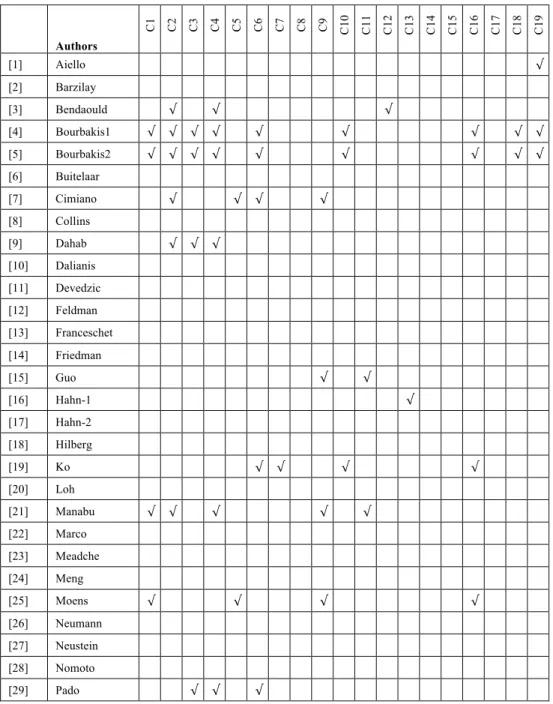
Comparative Analysis of the Methodologies
... 26
2.3.1
Extraction approaches
... 26
2.3.2
Lexical Chaining Approaches
... 28
2.3.3
Building concepts approaches
... 29
2.3.4
Ontology approaches
... 31
2.3.5
Hierarchical approaches to summarizing large documents
... 33
2.3.6
Making generated text semantically meaningful through coherence and local
vi
2.3.7
Text generation methodologies
... 35
2.3.8
Document processing / (low level) understanding
... 35
2.4
Comparative Table of Methodologies
... 35
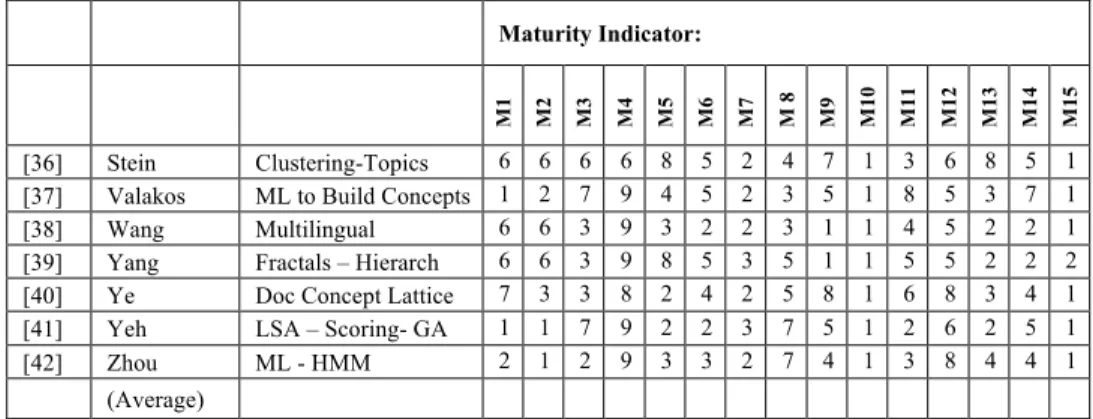
2.5
Comparative Table of Maturity
... 37
2.6
Conclusions
... 40
III.
GRAPH BASED SURVEY ... 42
3.1 INTRODUCTION ... 42
3.2 Methodologies Description ... 44
3.2.1
Classification by clustering
... 44
3.2.1.1
In method 1, Clustering is used to induce (or find) topically related senses from
a graph of nodes representing nouns. Nouns paired by edges are weighted by the number
of paragraphs, which contain co-occurrences of the nouns [44]. ... 45
3.2.1.2
In method 2, clustering finds sets of similar words and hierarchies of concepts
by partitioning weighed undirected graphs [45]. ... 46
3.2.1.3
In method 3 (Moens, et al, 2005) performs multi-document summarization by
clustering objects representing similar sentences [46]. ... 47
3.2.1.4
In method 4, clustering groups together similar documents [47]. ... 48
3.2.1.5
Method 5 (Nomoto and Matsumoto, 2003) finds topical clusters, finds the main
sentence to represent the cluster, and finds the concept diversity in text to reduce
redundancy of its generated summary [48]. ... 48
3.2.1.6
Method 13 (Guo, Y., and Stylios, 2005) creates clusters to build concept
representations from text [56]. See paragraph 3.2.3.5 (Event Indexing) for further
description. ... 49
3.2.1.7
Method 17 (Cimiano, et.al., 2005) Clustering identifies themes of documents
from closely related concepts by using a meta-thesaurus, such as UMLS, and clustering
similar sentences [60]
. Although Method 17 uses clusters, discussion is deferred to
paragraph 3.2.4.4 (since its main contribution is for concepts, relations, and semantics.)
49
3.2.1.8
Method 20 (Pado and Lapata, 2007) (Discussed in paragraph 3.2.4.7) finds
diverse topical clusters from text, identifies the most important sentence for a topic
cluster, and uses that sentence to represent the cluster [63]. ... 49
3.2.2
Methods 3, 6, 7, 8, and 9 by [46, 49, 50, 51, 52] use similarity measure to measure
similarities of meaning (i.e. word sense) and to merge clusters of similar concepts. ... 49
vii
3.2.2.1
Method 3 (discussed in paragraph 3.2.1.4 above) measures similarity between
the most representative sentence object of a cluster and the rest of the objects (sentences)
of each cluster to detect when a threshold is exceeded [46]. ... 49
3.2.2.2
Method 6 (Moschitti and Zanzotto, 2008) uses machine learning to recognize
textual entailment using tree pairs representing syntax in graph form. ... 50
3.2.2.3
Method 7 (Rao, et al, 2008) provides information on distance measures
between nodes in a graph. ... 50
Such distances are useful in measuring weighed relationships between vertices in a graph
and what they represent such as semantic similarities, intended sense (or meaning), etc.
The paper evaluates random walk algorithms, their performance over shortest path
algorithms, and describes a new commute time measure. A pseudo inverse of the
Laplacian is used to drive estimates for commute times between nodes on a graph. The
method uses singular value decomposition to discard least significant eigenvectors. A
random walk algorithm captures graph connectivity as well as path lengths.
... 50
3.2.2.4
Method 8 (Ambwani and Davis, 2010) uses weighed, directed graphs to model
the range of influence of terms within a document and uses context to find the semantic
relatedness of terms (within a sentence). ... 51
3.2.2.5
Method [9] (Minkov and Cohen, 2011) learns word semantic similarity
measures from traversing a graph representation of a corpus of parsed text to extract word
synonyms from text... 52
The method learns different graph walk models while traversing the graph and uses thes
models to extract word synonyms. It constrains paths of its random walk to specific word
types that match the type of the word of interest. It uses history of its random walk to
estimate edge weights to constrain its path, thus pruning paths with probabilities lower
than a predetermined threshold [52].
... 52
3.2.3
Methods 1, 10, 11, 12, 13, 14, and 15 by [44, 53, 54, 55, 56, 57, 58] use nouns
and verbs, including phrases and modifiers, to capture information from text and
represent it in graphs. ... 52
3.2.3.1
Nouns, represented as nodes with weighted edges to other nodes representing
various senses (or meanings), help determine the intended meanings of words [44]. See
3.2.1.1 for parts a through c of method 1. ... 52
3.2.3.2
Subjects, verbs, objects, and verb modifiers are used in graphical relations to
match given questions to corresponding answers derived from the text [53]. ... 53
3.2.3.3
A graph matching algorithm uses verbs with their arguments and nouns with
their modifiers to build syntactic-semantic graphs. These verbs and nouns come from
sentences, clauses, and phrases. Semantic relations are formed from clauses and noun
modifiers and relation classes, including causal, conjunctive, participant, spatial,
viii
temporal, and quality. The most important verb of a sentence is used as a head-word of
the sentence [54]. ... 54
3.2.3.4
Method 11 (Nastase. et al, 2006) is a graph matching algorithm that extracts
pairs of syntactic units from text and assigns a semantic relation to each pair. ... 54
It incrementally learns from previous pairs and relations it has assigned plus some user
feedback. It builds a syntactic-semantic graph as it assigns semantic relations. (See
discussion.) This methodology matches graphs starting with a small amount of encoded
(manually labeled) knowledge from a dictionary. It extracts pairs of text units (such as
clauses, a verb and its arguments, a noun and each of its modifiers). It relies on
previously processed examples (stored as graphs) to find the most appropriate relation for
an extracted pair from text. It incrementally learns from semantic analysis. ... 54
3.2.3.5
An In-Degree algorithm uses nouns, verbs, adjectives, and adverbs to find the
most probable sense (meaning) of words based on their context. Hyponyms found using
similarity measures are included in determining word sense [55]. ... 55
3.2.3.6
Event indexing uses actors (based on current events), time of day (for present
and previous events), causal (past event effects on current events), intention, and goals of
actors (from previous events) to form relations between concepts. Causal connections
consist of subject to object relations, formed from chains of verbs and nouns [56]. ... 56
3.2.3.7
Method 14 by [57] (Kozarevak, Z, 2012) learns terms that express cause-effect
relations from text. It uses graph based metrics to re-rank extracted information and filter
and delete erroneous terms to increase accuracy of cause-effect relations. ... 58
Method 15 by [58] (Liu, H., et.al., 2011) learns event rules by identifying context
dependencies from parsed annotated text. It extracts events by matching subgraphs of
sentences as it searches for a graph of an event rule.
For event recognition, this method
searches for a subgraph that is isomorphic to dependency representations of previously
learned event rules. The dependency of event rules is implemented as a labeled directed
graph. The union of shortest dependency paths, each representing a training sentence,
produces a graph representation of an event [58].
... 58
Performance: This method yields 41% to 52% F-score in detecting and identifying
biological events [58].
... 58
3.2.4
Concept representations and their semantic relations, consisting of graphs and the
methods that create and use them, are important steps toward natural language
understanding (NLU). Methods 16, 19, 20, and 21 by [59, 62, 63, and 21] include the
concept level of representation and manipulation as well as other NLP methods 8, 12, 17
and 18 by [ 51, 55, 60 and 61] that serve as interim steps toward the creation of this level
of representation. ... 59
ix
3.2.4.1
Method 8 by [51] (Ambwani and Davis, 2010) measures semantic relatedness
using connection strength in the form of weights between node representations of terms.
The neighborhood of terms (within a connection strength threshold) increases the
semantic relatedness of other terms. This method is discussed in paragraph 3.2.2.4 (in
similarity measure.) ... 59
3.2.4.2
Method 12 by [55] (Guo and Diab, 2009) incrementally learns semantic
relations from semantic analysis and assigns semantic relations to pairs using a
graph-matching algorithm. Its relation classes include causal, conjunctive, participant, spatial,
temporal, and quality. The discussion is deferred to paragraph 3.4.3.4 (in
subject-verb-object structures). ... 59
3.2.4.3
Method 16 by [59] (Morales, et al, 2008) maps text to concepts using ontology
for concept extraction from text and uses (biomedical) domain knowledge from a
meta-thesaurus to find synonym and “is-a” relations to summarize documents. ... 59
3.2.4.4
Method 17 by [60] (Cimiano, et al, 2005) acquires concept hierarchies using
formal concept analysis that creates concept clusters. ... 60
3.2.4.5
Method 18 by [61] (Yeh, E., et.al., 2009) uses a random walk algorithm over a
graph representation while measuring semantic relatedness of corresponding text. ... 61
3.2.4.6
Method 19 by [62] (Ye, et al, 2007) creates a concept lattice that indexes local
topics within a topic hierarchy. Concepts in the form of topics are represented by nodes
in the lattice. ... 62
3.2.4.7
Method 20 by [63] (Pado and Lapata, 2007) constructs semantic space models
with annotated dependency relations and builds semantic context from a dependency
graph, which maps dependency paths to words. ... 63
3.2.4.8
Method 21 by [64] (Rajaraman and Tan, 2002) generates a concept frame graph
for knowledge discovery by constructing concepts and relations and uses a co-reference
resolution algorithm to extract noun and verb clauses and phrases to generate synonym
sets and relation parameters. ... 63
3.2.5
Other methods 22, 23, 24, 25, 26, 27 by [65, 66, 67, 68, 69. 70] provide graph
based ranking of data in labels, find closest sense of words in labels, detect new
information, generate grammars for a given text, resolve references to events, and
generate graphs from word co-occurance in text. ... 64
3.2.5.1
Method 22 by [65] (Mihalcea, 2005) uses a ranking algorithm to label the
currect meaning of each word represented by a node while random walking over a graph.
It consists of labeling sequence of data (words) by analyzing label dependencies. It is a
sequence data labeling method applied to an all-words word sense disambiguation
(WSD) problem by labeling the most likely sense (or meaning) of each word while
random walking over the graph representing the text. An iterative graph based ranking
x
of the labels uses a graph based ranking algorithm called Page-Rank (Brin and Page,
1998) [65].
... 64
3.2.5.2
Method 23 by [66] (Agirre, E., et al, 2006) uses unsupervised learning by
training on a large sample of text (corpora) to find the sense (meaning) of words for
labeling nodes of a graph. ... 65
3.2.5.3
Method 24 by [67] (Gamon, 2006) detects novelty (text, containing new
information, compared to what is already found) at the sentence level by analyzing
feature sets from graph representations of sentences. ... 65
3.2.5.4
Method 25 by [68] (Muresan, 2008) uses learning to map text to graph based
meaning representation based on grammar induction. ... 66
3.2.5.5
Method 26 by [69] (Herdagdelen, et al, 2009) compairs two approaches for
finding semantic relatedness. ... 67
3.2.5.6
Method 27 by [70] (Chen and Ji, 2009) resolves references within two or more
sentences to events. ... 67
3.2.5.7
Method 28 by [71] (Biemann, 2010) constructs a word co-occurrence graph for
each target (important) word using co-occurrence statistics from a large set of text (20
million sentences from the New York Times corpus). ... 68
Unsupervised learning from the corpus provides graph clusters with features that provide
the kind of information normally used in systems with supervised learning.
Representative graphs with different parameters are generated from the corpus. The
target node in the graph (representing the target word) is directly connected to each node
that represents a word significantly co-occurring with the target word in a sentence.
Weights for each edge is calculated from the log-likelihood of the co-occurrence of the
connected words (derived from relative frequency gathered from the corpus text). Graph
parameters include size (number of co-occurrences or connections) and density. The
Chinese Whispers algorithm (see M6) clusters the neighborhood of the graph by
partitioning the nodes and representing each cluster as a word sense, thus providing
word sense induction [71].
... 68
3.2.5.8
Method 29 by [72] (Rao and Yarowsky, 2009) uses a map reduce algorithm in
a semi-supervised (partially labeled) graph representation of natural language text for
label propagation. ... 69
3.3
Functional components of graph-based methodologies ... 70
3.4
Definitions... 74
3.5
Maturity Tables and Charts ... 76
3.6 Conclusions ... 80
3.6.1
Major functional components ... 81
xi
Clustering can filter out common (relatively unimportant) nouns from a graph, leaving
more pronounce nouns to determine the sense of words. The result is a more efficient,
compressed graph representation of text. It can also calculate similarity measues for
detecting similar documents and reduce redundancy at the concept level. ... 81
3.6.3
Similarity measure: ... 81
3.6.4
Nouns and verbs plus their phrases and modifiers: ... 81
3.6.5
Concept Representations are created in the following ways: ... 82
3.6.6
Other methods not fitting in a group: ... 82
Provide graph based ranking of data in labels, find closest sense of words in labels, detect
new information, generate grammars for a given text, resolve references to events, and
generate graphs from word co-occurance in text. ... 82
3.7 Maturity ... 82
3.7.1
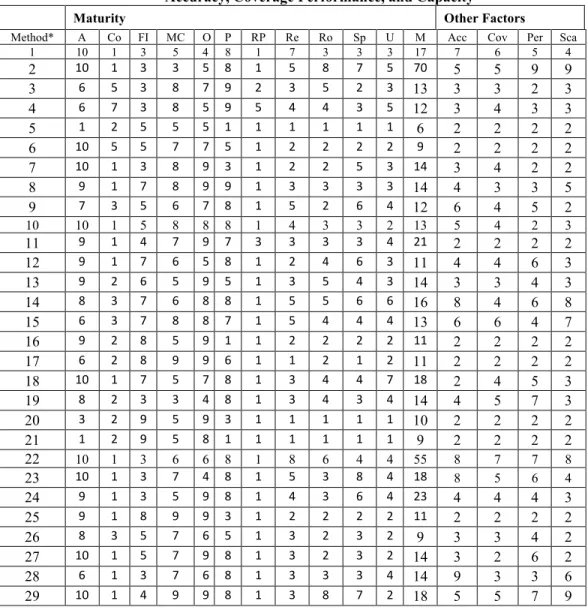
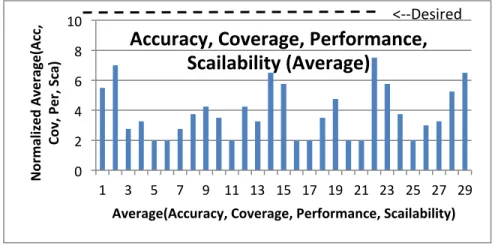
This survey has provided a summarization of graphical NLP and NLU methods
(labeled as 1 through 26) with an analysis of estimated accuracy, coverage, performance,
scalability and estimated maturity based on the information available in the referenced
papers.
83
The tables of values show that this area of research, on the average, needs further
improvement before they meet the desires of developers and users of products from this
research area. Although significant improvements have been made over the years, a
majority of these methods are still in progress. Some of the publications reviewed for
this survey showed that systems have been developed from this research area and are
used mostly in the medical field, but more mature systems are needed. Very little on
maturity has been reported in these research areas. Maturity values calculated in this
survey were estimated based on information provided in the papers. As this research area
continues to progress, more efforts and published results on maturity should help system
developers and users meet their needs in various NLP and NLU applications. ... 83
IV.
NATURAL LANGUAGE TEXT TO GRAPH REPRESENTATION ... 84
4.1 Implementation details ... 84
4.2 Experimental Results of Graph Program ... 93
V.
GRAPH TO STOCHASTIC PETRI NET CONVERSION ... 100
5.1 SPN Visualization ... 100
5.2 SPN Synthesis ... 102
5.2.2
Methods for gathering information needed for SPN synthesis: ... 104
5.2.2
Discussion of tasks with approaches to solutions. ... 105
xii
5.2.3
Detailed steps in SPN synthesis to find event association from context. ... 106
5.2.4
The SPN Synthesis Process ... 106
5.3 SPN results of program output showing conversion from graphs to SPN diagrams. 107
6
IMPLEMENTATION DETAILS AND RESULTS OF SPN SYNTHESIS…...110
6.1
Justification for Using SPNs to Model a State Machine Approach toNLU …...110
6.2
How this modeling approach contributes to natural language understanding…112
6.3
SPN Synthesis for Reducing Event Association Ambiguity ………..113
6.4
SPN Synthesis Example to detect and select interpretations from context ……116
6.5
Compression Algorithm ………..119
6.6
SPN Synthesis of Multiple Image File Descriptions………...…121
7
CONCLUSIONS.………...……...130
REFERENCES ... 133
xiii
LIST OF FIGURES
Figure
Page
3.1
Maturity of Methods (Un-weighted) ...………..…… 76
3.2
Accuracy, Coverage, Performance, Scalability (Average) …….…...………. 76
3.3
Maturity (Weighted Average) ………. 78
3.4
Maturity (Normalized Weighted) ………...……… 78
4.1
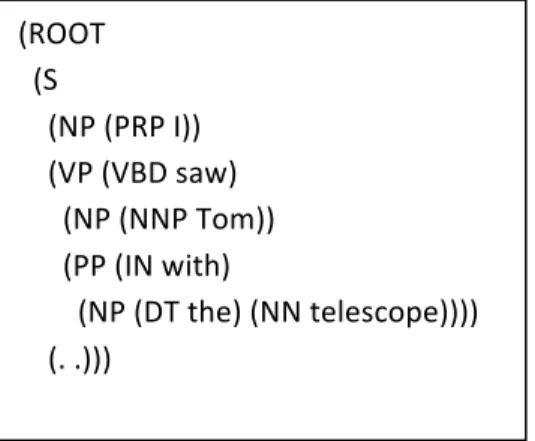
Parsed input from NL parser, used as input to program ………. 82
4.2
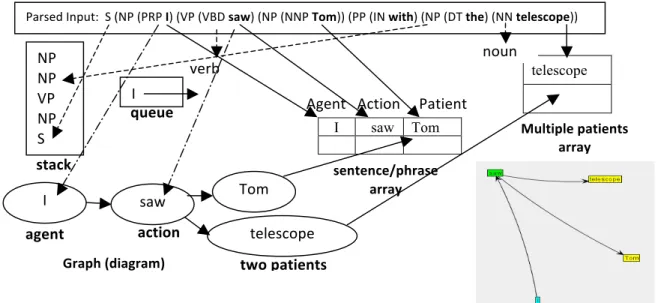
Program’s basic flow ……….. 83
4.3
Array and graph structures containing agents, actions, and patients with phrases..86
4.4
Graph output example with three phrases ………... 86
4.5
Example of a long sentence with several actions impacting patients ………. 87
4.6
A complex sentence containing three phrases ……… 87
4.7
Example graph of ten sentences (Uncompressed and compressed) ………... 88
4.8
Combined graph diagram (after following rules in Table 4.7) ………... 90
4.9
Example graph of two sentences with medical events ……… 91
4.10
Example graph of two sentences with an event causing other events ………...…. 91
4.11
Example graph with three phrases in sentence ………92
4.12
Example graph of a complex sentence with phrases ………...……... 92
4.13
Example of ten sentences revisited (uncompressed vs. compressed) ………. 93
4.14
Example of a long sentence ………...………. 93
xiv
LIST OF FIGURES (CONTINUED)
Figure
Page
4.16
Example of very long text (approximately two pages) …………...……… 97
5.1
Visualization of graph to SPN conversion ………...……….. 98
5.2
Sample code using VertexShapeTransformer ……… 99
5.3
Illustration of SPN synthesis ………..……. 101
5.4
Graph to SPN conversion of medical example (two sentences) ……….. 102
5.5
Graph to SPN conversion of resistor example (two sentences) ……...……… 104
5.6
Graph to SPN conversion of three phrases example ……… 105
5.7
Graph to SPN conversion of complex sentence with phrases example ………...… 105
5.8
Graph to SPN conversion of ten sentences example ………...… 106
5.9
Graph to SPN conversion of long sentence example ……….. 106
5.10
Graph to SPN conversion of long text (image description) example ………… 107
5.11
Graph to SPN conversion of long text (approximately two pages) example …. 107
6.1
Using state machine approach to modeling SPNs
... 110
6.2 The SPN Synthesis Process for finding impact of agents and patients in context….114
6.3 A step by step process in transforming a text file to an SPN synthesis file………..116
6.4 SPN Synthesis Example of detecting and selecting interpretations from context….116
6.5 Diagram of the compression process ………...……….. 119
6.6 Pseudo code of the compression process……….………..120
xv
6.8 Example 1 of associating two different image description files ………123
6.9 Example 2 of associating two different image description files ……… 127
xvi
LIST OF TABLES
Table
Page
2.1
Feature definitions for extraction approaches ………...25
2.2
Comparing extraction approaches ……… 25
2.3
Feature definitions for lexical chaining ……… 26
2.4
Lexical chaining approaches ………. 27
2.5
Performance (Accuracy) ……… 27
2.6
Feature definitions for building concept approaches ………. 28
2.7
Building concept approaches ……….……… 28
2.8
Features for building ontology from text and NLP representation schemes ….. 30
2.9
Comparing approaches to building ontology from text and NLP representation
schemes ……….………... 31
2.10
Factor definitions for hierarchically summarizing redundancy removal ………. 32
2.11
Hierarchically summarizing large documents and redundancy removal ………. 32
2.12
Compatibility definitions ……….. 33
2.13
Comparing key capabilities and approaches in survey ……….... 33
2.14
Maturity of methodologies ……… 35
2.15
Comparison of maturity indicators ……… 35
2.16
User and developer estimated weights for each maturity indicator ………...…… 36
2.17
Comparison of maturity indicators (user and developer weighted) ………... 36
xvii
LIST OF TABLES (CONTINUED)
Table
Page
3.2
Maturity Definitions ……… 73
3.3
Accuracy, Coverage, Performance, Scale ………... 74
3.4
Developer and User Weights ………... 74
3.5
Maturity of Methods (Estimated, Un-weighted) plus their Accuracy, Coverage,
Performance, and Capacity ………...……….. 75
3.6
Maturity Scores of Methods 2 (weight)
x(estimated maturity) ……….. 76
4.1
Rules for combining duplicate vertices within a group when creating chains of
events ………..……… 89
7.1 Summary of Research Contributions ……….. 131
1
I.
INTRODUCTION
In today’s digital communication, information is represented in various forms or modalities [1-90]. The processing and understanding of various forms of information requires the efficient representation and association of multi-modal information. Thus, the association and understanding can be effectively done by converting multiple modalities into one model of representation. In this study the main research modalities involved are NL processing and understanding, image processing and understanding, document processing and computing models. Thus, below we offer a brief description of these research fields before we make their association.
Natural Language (NL) processing and understanding is an old research field with many research achievements and problems. It has been defined as the translation of machine-readable text into an internal representation. This definition provides three ways of viewing NL processing techniques: by the type of text read (e.g. dialogue, story, or scientific articles), by the type of internal representation used to store the transformation (e.g. semantic nets and graphs), or by the type of computational mechanisms (morphological lexicon, syntax, semantic and pragmatic) used to perform the transformation. There are several tools and systems developed for NL processing, such as spelling checkers (WP, MSW, WS, etc), grammar checkers (OW, WSG, etc), multi-lingual dictionaries, machine translation systems (limited use, EUROTRA, TOSHIBA, TAUM-M, etc.), NL search engines for databases [90].
The document processing is a newest field, which lately has being getting extra attention due to synergistic integration of image and NL understanding [90]. Methods deal with document processing and understanding are related with techniques such as segmentation of a page(s), separation of text from images, image analysis and understanding, words recognition, text understanding, association of text and images for knowledge discovery and representation, etc.. Some of these methods, such as document segmentation is presented, which is a "top-down" approach and produces good results under the condition that the examined page can be separated into blocks. Another algorithmic approach is presented, which is a "bottom up" process with good performance in several categories of pages with good spacing features, and "non overlapping" blocks. In addition, a method presented that separates images from text (typed or
2
handwritten) by maintaining their relationships. An extension of the document processing with a variety of applications such as human computer interaction (HCI), knowledge discovery, image/document databases accurate retrieval, etc is the document understanding that combines image understanding-interpretation and natural language processing -understanding.
The SPN model is very successful with many applications, especially in the simulation area and recently in knowledge engineering [90]. One very interesting and successful application of the SPN model is its use as a structural and functional representation scheme. The SPN model has the ability to represent structural knowledge extracted from images, like objects and their attributes, or described by NL language expressions. It also has the ability to efficiently represent the functional behavior of systems. The combination of this formalism with Augmented Semantic Grammars (ASGs) is a new approach to representing knowledge with a synergistic structural and functional model, which provides an efficient testbed for multimodal sources.
The main objective of this dissertation is to develop a new novel methodology to convert NL text sentences into Graphs and then into SPN graphs in an effort to offer an association of event described in NL text or images associated with text. To accomplish such a goal we offer we firstly present two surveys, then present the implementations of our model-methodology in two steps: (1.) An NL text to graph conversion program and (2.) an extension of our program to convert NL text to Stochastic Petri Nets from which we provide the greatest contribution of our research. Results from our research effort are also provided.
The organization of this dissertation is as follows:
Chapter II provides a comparative survey of natural language understanding (NLU) methodologies used for processing multiple documents. The scope of these methodologies is to generate a text output with reduced information redundancy and increased information coverage. The purpose of this chapter is to establish what methodologies exist and present their features, capabilities and maturities based on evaluation criteria selected by users and developers. Tables of comparison, at the end of the survey,
3
provide a quick glance of these technical attributes and maturity indicators abstracted from available information in the publications.
Chapter III provides a survey for transforming natural language sentences to graph representations. Its purpose is to provide a background of recently developed graph methodologies obtained from the literature. It describes various text to graph methodologies developed in recent years. This chapter also presents an analysis of the methodology’s approach, capabilities, and maturity. NL applications from methods in this survey include event resolution (ER), grammar annotation (GrA), information mining (IM), knowledgebase (K), labeling (Lab), novelty detection (ND), question/answer (QA), redundancy reduction (Red), semantic relatedness (SR), similarity measure (SM), summarization (Sum), textual entailment (TE), word sense disambiguation (WSD), and word sense induction (WSI).
Chapter IV describes our Java implementation of a program that transforms NL text into a graph representation. The program captures events described in a text by representing each phrase and sentence in the form of agents that perform actions on patients. Each agent, action, and patient of each phrase and sentence is represented as a node in a graph with their relationships represented as directional edges. The program also combines graph representations of phrases and sentences into more global representations of the text to capture the effects of actions throughout the text. Our program uses the Stanford parser [80, 81, 82] to obtain a parsed input stream of words with parts of speech tags, transforms the stream into data structures containing nouns and verbs representing subjects as agents, verbs as actions, and objects as patients of each phrase and sentence. The implementation generates data structures to support multiple phrases within sentences, multiple agents, actions, and patients per phrase, active and passive sentences, and complex sentences. It accounts for multiple patients impacted by one or more actions and multiple actions caused by one or more agents. It uses the Java Universal Network/Graph framework (JUNG2) [83, 84, 85, 86] containing Java libraries to generate graph visualizations of the agent, action, and patient nodes found within each phrase and sentence of a stream of text. The resulting graphs contain chains of agents, actions, and patients of the entire input text. These chains are formed by compressing multiple agent and patient nodes of the same label into single nodes. Compression of actions are avoided to keep from adding ambiguity such as erroneously adding more influence from agents than what is represented in the text.
4
Chapter V describes our graph to Stochastic Petri Net conversion and representation. It shows results of the same test cases we developed and used for our graph implementation. To provide visualization of each SPN component converted from graph nodes, we (1.) changed the shape of each agent and patient node from rectangles to ellipses, to represent SPN places, and (2.) changed the shape of action nodes from long rectangles to thin (small width) rectangles to represent transitions. We included some sample code we developed in order to use a transformer method from the JUNG2 library. To provide SPN functionality, we added inhibiter places to control SPN transitions, which reduce sentence interpretations based on an SPN synthesis guided by event association throughout the SPN model of the entire text being analyzed. We demonstrate sentence ambiguity reduction by event association using SPN modeling of NL text and present results in the form of SPN graphs.
5
II.
GENERAL SURVEY
A COMPARATIVE SURVEY ON NLP/U METHODOLOGIES
FOR PROCESSING MULTI-DOCUMENTS
1[43]
Abstract: This paper provides a comparative survey of natural language understanding (NLU) methodologies used for processing multiple documents. The scope of these methodologies is to generate a text output with reduced information redundancy and increased information coverage. The purpose of this paper is to inform the reader what methodologies exist and their features, capabilities and maturities based on evaluation criteria selected by users and developers. Tables of comparison, at the end of this survey, provide a quick glance of these technical attributes and maturity indicators abstracted from available information in the publications.
2.1
Introduction
Over the last two decades, information, especially from the internet, has become so vast that professionals, from a number of disciplines, have difficulty keeping up to date within their respective fields. For example, medical doctors devote tremendous amounts of time to capture the latest developments from research areas within their field of specialty. A large amount of this time is wasted reading redundant information from various documents. Needed information may also be lost in the process of summarization. Advanced methods of search, database technologies, data mining, and other areas have helped, but not enough to meet the growing need from these professionals.
For the past 40 years, researchers have tried to address this problem by automatically or semi-automatically capturing information from single and multiple documents into less redundant text, typically in the form of summaries. If a sufficient solution will be found, the resulting increased capability would become a significant breakthrough and help researchers and professionals capture more information to advance their areas of specialty and collectively advance a multitude of technologies. In addition, several methodologies have been developed to advance the area of natural language processing in order to find
1 Mills, M.T. and Bourbakis, A comparative survey on NLP/U methodologies for processing multi-documents, International Journal on Artificial Intelligence Tools, Vol. 21, No. 4 (2012) 1250017 (32 pages), © World Scientific Publishing Company, DOI: 10.1142/S0218213012500170.
6
solutions to this problem. However, no known methodology appears to capture the needed information and generate text with enough quality and speed to satisfy this need. Thus, this survey summarizes and compares current methodologies, which deal with the removal of redundancy for documents retrieved from different resources.
This paper surveys research methodologies related to the area of natural language processing (NLP) and natural language understanding (NLU). The purpose here is to document the progress in natural language understanding research and how it can be applied to capturing concepts from multi-documents and producing non-redundant text while attempting to maximize coverage of the significant information needed by the user. The required information could span from a single or multiple domain coverage. Thus, this paper explores the current state of NLU technology and seeks its robustness, time and space complexity, scalability for handling large numbers (n > 100) of technical documents, and technology gaps needing further research. The information in this survey summarizes papers from various technical journals and conference proceedings.
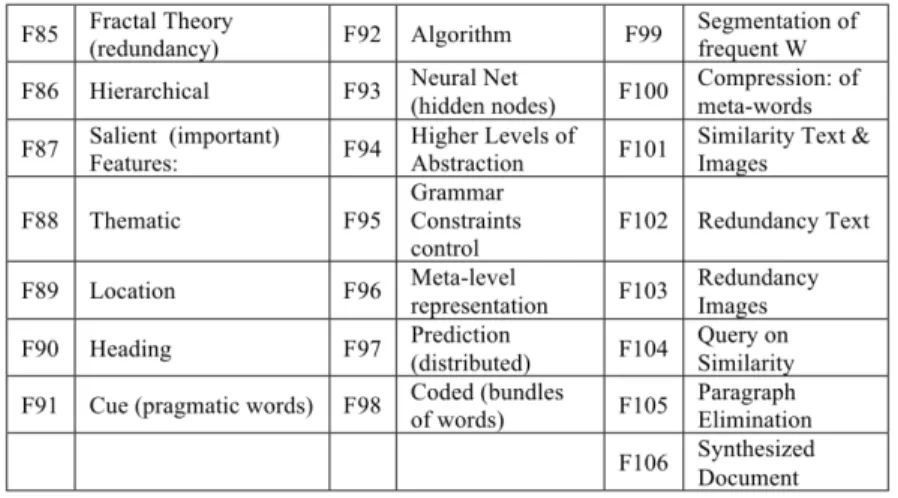
The methodologies under evaluation in this paper cover the following areas: (1) detection of important sentences, (2) concept extraction from text, (3) building concept graphs, (4) attribute and relation structures leading toward knowledge discovery from text, (5) increasing efficiency in the processes leading to concept representations, (6) generation of non-redundant text summaries, and (7) maximizing the readability (or coherence) of automatically generated or extracted text. Technologies used in these methodologies include machine learning, statistical and discrete approaches, cluster indexing, lexical chaining, concept lattices, models that follow cognitive psychology concepts, stochastic Petri-nets (SPNs) and fractal theory. Technologies taken from these areas of research provide a broad spectrum of methodologies or approaches that can provide a baseline for further NLU research. Moreover, methodologies that create summaries of single and multiple documents can be grouped into two major approaches: One approach includes capturing important concepts from text, using a collection of sample texts (called corpus) to train machine learning algorithms, minimizing the number of concepts without losing too much information, generating summarized text, and making the resulting text easily readable. Another approach is extracting the more
7
important sentences (or phrases) that can be directly converted to non-redundant summaries and bypassing the concept capture and generation steps.
2.2
Methodologies and Their Features
In this section we present a variety of methodologies classified according to their features. In particular this section covers the various groups: text relationship map with latent semantic analysis, extraction methods for text summarization, cluster summarization, formulated semantic relations, SPN representation for document understanding, concepts representation for text, learning ontology from text, synthesis of documents, generation of semantically meaningful text using logic order, text generation methods, document structural understanding, and other relevant methods. The methods presented here will be compared and evaluated based on their maturity. The overall results are presented in section 3.
2.2.1 Text Relationship Map with Latent Semantic Analysis (LSA)
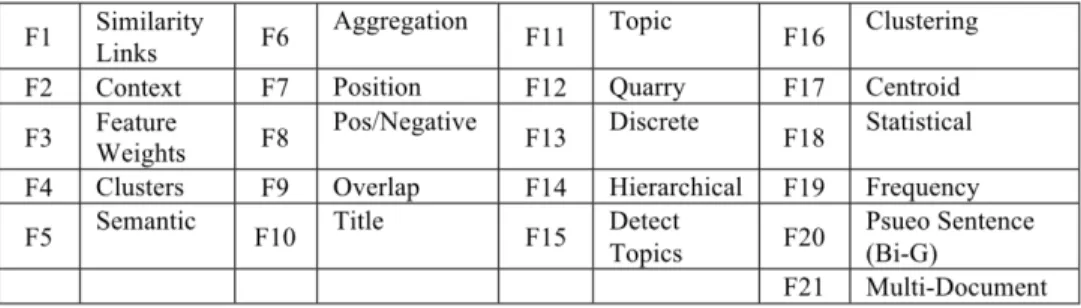
Yeh et al (2008) present the two methodologies, text relationship map and latent semantic analysis, that they use together for text summarization. In particular, the first methodology (2008a) uses feature weights to create similarity links between sentences forming a text relationship map. Sentence position (within a paragraph or document), keywords (that can add or negate), centrality, and resemblance to the title, together determine feature weights that contribute to sentence importance within the document. The authors also use Latent semantic analysis (LSA) to extract and infer relations of words to their expected context. A sentence vs. word matrix analyzes use of words within context. Corpus-based information and scoring functions, using feature weights to trigger the creation of similarity links between
sentences, are represented in a text relationship map (TRM), or graph. [41] Summary: This methodology
captures various features that help in calculating the similarity of sentences throughout one or more documents. Their paper offers significant details about the methodology. This methodology, however, is based on the word level only.
The second methodology (2008b, LSA-based text relationship map (T.R.M.) approach by Yeh et al (2008)), derives semantically salient structures from a document. Latent semantic analysis (LSA) is used for extracting and inferring relations of words with their expected context. The authors use it to derive latent structures from a document. They elaborate an LSA method that derives semantic representation and
8
propose a method for generating a summary from a semantic representation. Four phases include: (1)“Preprocesses partitions sentences using given punctuation and segments sentences into keywords using
a toolkit called AutoTag (Academia Sinica, 1999). (2)Semantic model analysis uses a word-by-sentence
matrix and produces a semantic matrix using singular value decomposition (SVD) and dimension reduction. (3)Text relationship map is produced by the semantic matrix. (4)Sentence selection uses the global bushy path from the text relationship map to select the important sentences that provide the
summary”[41]. Summary: Their paper provides detail about the methodology used. Also, several features
are used in the similarity calculation. This methodology is also based on the word level. The LSA approach uses a Word-Sentence matrix that can get very large due to the number of words in a document or in multi-documents.
2.2.2 Extraction methods for text summarization
Ko and Seo (2008) present a hybrid sentence extraction methodology that uses some context information augmented with mainline statistical approaches to find important sentences in documents. Their model combines two consecutive sentences into a bi-gram pseudo sentence representation to overcome feature sparseness. By using traditional statistical methods, they calculate a score based on sentence similarity to a query, location within a paragraph (first or last sentence, etc.), aggregation, and frequency of the same pseudo sentence. Each of these factors adds to the importance of the corresponding sentence by summing products of weights. A sliding window combines adjacent sentences to form a bi-gram. Once enough bi-gram representations are selected for a summary, each bi-gram is converted back to
two sentences which are used in the resulting summary [19]. Summary: Test results of the hybrid sentence
extraction approach showed that it out performed other approaches listed by a small percentage. What the authors (of the hybrid approach) call context information is limited to two consecutive (i.e., adjacent) sentences with no global context capability implied. Normally, context would imply more extensive surrounding information than groups of two adjacent sentences.
2.2.3 Cluster based summarization
In this subsection we present two methodologies. The first methodology, Moens et al. (2005), extracts important sentences and detects redundant content across sentences. They use generic linguistic
9
resources and statistical techniques to detect important content from topics and patterns of themes throughout text. From this, they build hierarchical topic trees from text. Then, they segment topics and summarize at each level of topic detail. Their parser detects main grammatical constructs and finds semantic relations between content items. They use statistical techniques to cluster lexical and syntactic features of sentences, and then detect redundant content to generate summaries of multiple documents [25].
Summary: Moens et al. methodology provides a significant capability in automatically finding content from text and representing it by hierarchical topics and subtopics. This provides flexibility in selecting how much detail goes into the summary. From competitive testing at DUC 2002 and 2003, the performance of the methodology provided good results, even when compared with trained methodologies. Topic trees and themes are the main information sources to be captured using this methodology. Although these contribute to forming a summary, more queues could be added to enhance the accuracy of this approach. The authors discuss several improvements that could be made. This system incorporates several technologies to provide flexibility. It appears that system integration could be improved to make this a better product.
The second methodology by Radev et al. (2004) uses a Cluster Centroid-Based summarization technique called MEAD which detects topics and tracks to evaluate the results. This methodology measures how many times a word appears in a document, and what percentage of all documents in a collection contains a given word. A cluster is a set of words that are statistically important to a cluster of documents and are used to identify important (or salient) sentences in a cluster [30]. Summary: The authors state that the MEAD algorithms produced summaries similar in quality to summaries produced by humans for the same documents.
Additional factors could be addressed to help provide higher quality output. Scores determined, using this methodology, are limited to word frequency, position, and sentence overlap. More factors could be added to improve redundancy removal of the resulting summary output.
2.2.4 Chaining lexically to formulate semantic relations
This category includes three methodologies. The first methodology by Silber and McCoy (2002) propose an algorithm that improves the execution time and space complexity of creating lexical chains from exponential to linear in order to make their computation feasible for large documents. Lexical chains are created as an intermediate representation to extract the most important concepts from text to be used for
10
generating a summary. They also evaluate their implementation of lexical chains as an efficient intermediate representative format. Silber and McCoy implicitly store every interpretation of source documents without creating each interpretation as a lexical chain, thus reducing the vast number of lexical chains from multiple word senses per noun instance. [35]
Summary: Silber and McCoy’s algorithm provide linear time for calculating lexical chains which is a big step from former exponential time complexity implementations they reference from 1997 implementations and earlier. Their focus is on efficiency of one part of the entire process. They leave some issues left for future work.
The second method by Manabu and Hajime (2000) provides a lexical chaining based on a topic submitted by a user. Lexical chains are sequences of words related to each other that form a semantic unit. This procedure increases coherency and readability of resulting summaries which yields improved accuracy or relevance to the user. (This has an objective increasing coherency and readability of a generated text summary similar to Barzilay and Lapata [2] but applies the lexical chaining methodology.) The methodology constructs lexical chains, calculates scores of the chains based on high connectivity with other
sentences, and constructs clusters of words using the similarity score [21]. Summary: This methodology
provides a higher-level calculation of semantic similarity and offers potential increase in accuracy. Results showed improved accuracy but left possibilities of ignoring other useful information. More improvements need to be made.
The third methodology by Reeve et al. (2006) proposes the implementation of a methodology by using lexical chaining for concept chaining (distinguished from term chaining) to identify candidate sentences for extraction for use in generating biomedical summaries. Their concept chaining process consists of text to concept mapping, concept chaining, identifying strong chains, identifying frequent
concepts and summarizing. They use the resulting sentences to generate the summary [32]. Summary:
Test results (90 % precision and 92 % recall) are high compared to results of other lexical chaining methodologies in this survey. Concept disambiguation is not implemented but planned for future work. Complexity appears not to be addressed. Internal evaluation was specifically toward quality of generated summary.
11
2.2.5 Stochastic Petri-Net (SPN) representations for NLU
The methodology by Bourbakis-Manaris, based on SPNs Modeling of the NL text sentences for Document Understanding, (1998). They describe four levels of processing: lexical to enforce case (subject-verb) agreement, syntactic to combine words into sentences, semantic to assign meaning to words and sentences, and pragmatic to form context from relations to previous sentences, paragraphs, topics, and information from related data. This paper focuses on the more difficult syntactic and pragmatic process. Multiple modalities or external forms of information such as speech, images, text, video, gestures, facial expressions, hand signs, and handwriting are proposed to add to the context formed by the pragmatic
process [4]. Summary: The combination of ASGs and SPNs in this methodology provides significant
capability in not only capturing semantic meaning from text but extracting contextual and other available information to resolve ambiguities. The methodology suggested in this paper shows how SPNs, used with ASGs, can model a tremendous amount of interrelationships that exist in both text and imagery. It provides significant potential for extended areas such as knowledge abstraction and representation and adding to their capabilities. The methodology presented in this paper also illustrates the potential for SPNs to model technologies in ways that significantly enhance their modeling capabilities compared to conventional (main line) approaches in using SPNs. The computational complexity, however, is high.
2.2.6 Building concept representations from text
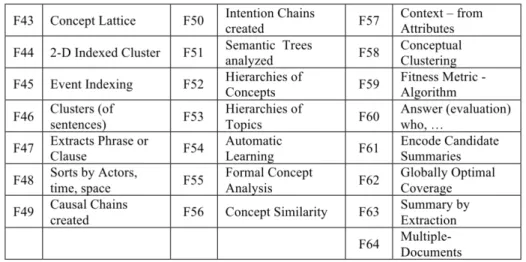
This subsection includes three methods. The first method by Ye et al. (2007) proposes a concept lattice to represent text understanding and to extract text from multiple documents and generate an optimized summary. The concept lattice provides indexing of local topics within a hierarchy of topics. The topics, represented by nodes in the lattice, correspond to concepts that appear frequently throughout the original text or document(s) and sentences that contain these topics. The resulting summary contains an optimized set of local topics and a maximized coverage of concepts for a desired size of summary (number
of sentences) [40]. Summary: The document concept lattice approach provides an efficient way to account
for all possible word senses without calculating them all on line. This provides significant improvement in
accuracy without the computational complexity. The approach reduces complexity from O(!!) to O(1), or
more likely O(n) which is still linear. WordNet is required for this approach. This may limit some of the capabilities of this approach to WordNet implementation constraints.
12
The second method by Guo and Stylios (2005) investigates event indexing by applying cognitive psychology to create clusters for building concept representations from text. Their methodology extracts the most prominent (or important) content by lexical analysis at phrase and clause levels in multiple documents. This approach forms clusters of sentences with the same actor, sorts each actor cluster by time and space displacements, creates causal chains by linking across, creates intention chains by linking sentences (across clusters) with the same goal. The result is a two dimensional indexed cluster representation of groups of sentences. The EIS model parses sentences, analyzes semantic trees, clusters sentences with indices, performs cluster filtering and reduction, controls size, and outputs the resulting text
summary. [15]. Summary: Working at the phrase or clause level is an advantage over word level. This
reduces the number of possible combinations of pairs (phrase, sentence) instead of (word, sentence) for example. Multi-document capability is another plus for the user. Features such as actors, time/space displacements, causal chains, and intention chains add a significantly more capability to detecting sentence similarities. Reducing all this potentially multi-dimensional vector data to two dimensional index clustering is a significant savings in complexity, especially storage complexity. Testing and evaluation of causality and intention indexes were delayed until a future date. (The authors plan to include results in future publications.)
The third method by Cimiano et al. (2005) forms concept hierarchies using formal concept analysis (FCA) through learning. Their methodology automatically acquires (through learning) concept hierarchies from collections of text (corpus). A collection of text is tagged with parts of speech, parsed, converted to normalized form, smoothed, weighted, pruned using a distance threshold, transformed to formal context with implicit relationships between objects, converted to a lattice of concepts (through FCA), and compacted to a partial order representation of concepts. They use distance measure between
vectors to determine concept similarity [7]. Summary: Automatic (unsupervised) leaning approach is a big
plus, reducing the traditional manual work to near zero. The concept similarity calculation uses more characteristics that can result in greater accuracy of output text. The authors state “this is a first time
13
approach.” Similarity calculations are made at the concept and semantic level, using LSA. The approach appears to be integrated with the LoPar parser implementation, but benefits in capability are significant.
2.2.7 Learning ontology from text
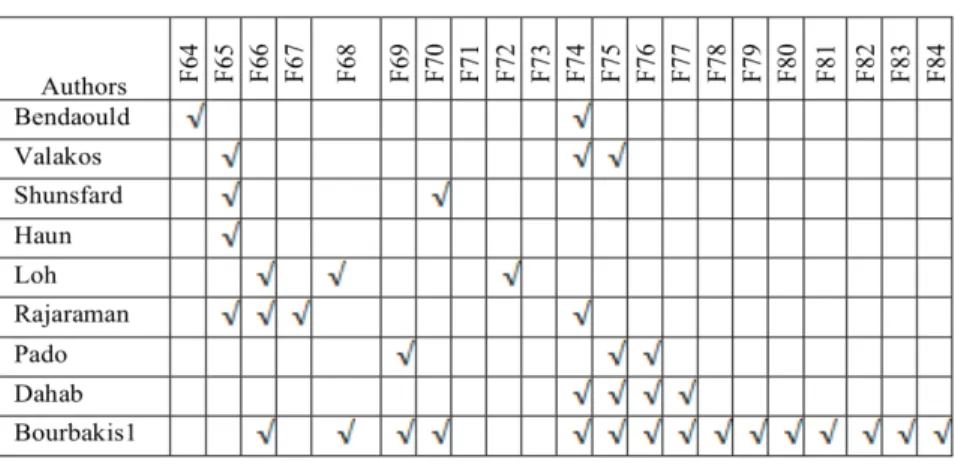
This category includes ten methods. The first method by Bendaould et al. uses relational concept analysis (RSA) to formulate concepts through text-based ontology. The authors present a semi-automatic methodology that builds ontology from a set of terms extracted from resources consisting of text corpora, a thesaurus for a particular domain, and syntactic patterns representing a set of objects. A Description Logic (DL) language in the form of expressions is used to find the exhaustive definition for each concept and each relation of the ontology. Their methodology builds a glossary of terms, concept taxonomies using the Formal Concept Analysis (FCA), and transversal binary relation diagrams using Relational Concept Analysis (RCA) to extract traversal relations. The result is a concept relations and instances to support reasoning, including classification, instantiation, and consistency checking [3]. Summary: This is a very methodological treatment at the higher-level concept representation. This methodology is more for building ontology and less on capturing the information from text, but has significant capability. The computation could have high complexity, just based on the description.
The second method by Valakos et al. (2006) uses machine learning to build and maintain concept representations called allergens ontology. Building an ontology includes: selecting concepts, specifying their attributes and relations (between concepts), and filling (populating) their properties with instances. Their methodologies include: specification, conceptualization, formalization, , and maintenance. Author’s approach automatically creates training examples using the domain ontology with limited size and domain-independent rules. They enrich ontology with a lexico-semantic relation that is unsupervised (fully
automatic) [37]. Summary: Authors machine learning approach provides a way to capture new knowledge
in the form of concepts, their attributes and properties, and relations between them and maintain (or update) the knowledge with what has been established. The approach includes lexical to semantic relations to transform lexical to semantic information, which is a contribution toward proving concepts. Specific details on how to extract information to form concepts is not presented. The approach is specific to
14
maintaining ontology within a medical (allergen) domain but its general principles could be applied to other applications.
The third method by Zhou and Su (2005) uses machine learning to integrate evidence from internal (within the word) and external (context) to formulate named entity recognition, a method which extracts and classifies text elements into predefined categories of information. Their system called PowerNE is implemented using a Hidden Markov Model (HMM) to determine hidden states representing tags corresponding to portions of text or individual words from the text and a constraint recognizer algorithm to deal with data sparseness. The system seeks answers “who, what, and how much” and after further processing determines “what and how.” Evidences from the entity names include (a) internal deterministic evidences such as capitalization and digits, (b) semantic triggers, (c) appearance of a word in a list, and (d) context of a word such as other words in the text that mean the same thing, i.e. aliases of the
word [42]. Summary: This named entity recognition approach provides significant and useful detail that
could be applied to information extraction from text. Machine learning is applied to recognizing named entities and is used along with constraint recognition, Hidden Markov Models to determine tags, and mutual information to increase coverage of non-redundant information. This concept provides significant capabilities on the theoretical level but appears to need further development before product information with metrics is available.
The fourth method by Shunsfard and Barforoush (2004) proposes an automatic ontology building
approach, starting with a small ontology kernel and implements text understanding to construct the ontology. Their model can handle multiple viewpoints, flexible to domain changes, and can build ontology from scratch without a large knowledgebase. Their hypothesis reduction and selection process consists of assigning a probability to each node of hypothesis space and choosing merge sets, priority ordering of child nodes, and depth first traversing without backtracking. The ontology consists of concepts, relations, and axioms which add information to the concept-relation structures. Their natural language processing portion uses some linguistic and world knowledge to extract conceptual knowledge from Persian text. Knowledge
extracting consists of logical, template driven, and semantic analysis [34]. Summary: This system can
15
creating and building ontology. This methodology is based on an integration of learning, clustering and splitting of concepts, similarity measures, and several other techniques that, together, form a unique capability showing promise. The current implementation and testing has been limited to Persian text, but the authors plan to expand the system to other languages.
The fifth method by Hahn and Marko (2002) forms concepts from text through machine learning of both grammars and ontology and use evidence, or background knowledge, to steer refinement of generated text. This methodology is an integrated approach for learning lexical (syntactic) and conceptual knowledge as it is applied to natural text understanding. The lexical portion consists of grammatical knowledge containing a hierarchy of lexical classes which provide constraints on unknown words. Conceptual knowledge (or domain knowledge) provides a classification (or taxonomy) of concepts used to evaluate newly derived concept descriptions based on prior knowledge. The proposed model uses these different types of knowledge simultaneously in order to increase knowledge accuracy while constraining
the growth of hypothesis space to keep the knowledge acquisition process going [16]. Summary:
Evidence within both lexical and conceptual hypotheses is used together to bound the resulting number of hypothesis search space to a manageable quantity while refining the lexical and conceptual quality and, therefore, increasing the accuracy of text understanding. Complexity of the approach can be extensive but tractable.
The sixth method by Loh et al. (2003) provides a text mining approach to form concepts from phrases and analyzes their distributions throughout a document. The approach combines categorization to identify concepts within text and mining to discover patterns by analyzing and relating concept distributions in a collection. Categorization compares each phrase against rules that define a concept. Rules combine positive and negative words. The frequency of the same concept in a document plus how much it is referenced adds to its importance. The mining uses a software tool that counts the number of times a concept is present, generates a vector (or centroid) of concepts with their frequencies in a collection to find document themes, compares centroids to find common themes or differences, and discovers associations between concepts. The methodology combines collections and sub-collections to discover patterns, mines to discover class attributes or descriptors, and uses supervised learning to discover
16
reasoning patterns systems [20]. Summary: This approach captures concepts from phrases, finds patterns
from concept distributions, and discovers themes within a document by collecting concepts and generating centroids to represent the collections. Together, these features contribute to a knowledge discovery technique, which contributes significantly toward mining concepts and relations from text. This approach was developed for decision support systems, thus limiting extensions into other domains. It also uses supervised learning to find reasoning patterns, thus requiring interaction from the user and possibly slowing the response of an implementation of this approach.
The seventh method by Rajaraman and Tan (2002) constructs a conceptual knowledge base, called a concept frame graph, for mining concepts from text. A learning algorithm constructs the concept map which is guided by the user, i.e. supervised learning. The authors’ approach consists of (1) constructing a conceptual knowledge base (CKB) consisting of concepts and relationships that are extracted from text and (2) CBK mining o