
Lee, Zhi Hou (2015) Improved multiple input multiple
output blind equalization algorithms for medical implant
communication. PhD thesis, University of Nottingham.
Access from the University of Nottingham repository:
http://eprints.nottingham.ac.uk/28726/1/PhD_Thesis_LeeZhiHou_2015.pdf
Copyright and reuse:
The Nottingham ePrints service makes this work by researchers of the University of
Nottingham available open access under the following conditions.
·
Copyright and all moral rights to the version of the paper presented here belong to
the individual author(s) and/or other copyright owners.
·
To the extent reasonable and practicable the material made available in Nottingham
ePrints has been checked for eligibility before being made available.
·
Copies of full items can be used for personal research or study, educational, or
not-for-profit purposes without prior permission or charge provided that the authors, title
and full bibliographic details are credited, a hyperlink and/or URL is given for the
original metadata page and the content is not changed in any way.
·
Quotations or similar reproductions must be sufficiently acknowledged.
Please see our full end user licence at:
http://eprints.nottingham.ac.uk/end_user_agreement.pdf
A note on versions:
The version presented here may differ from the published version or from the version of
record. If you wish to cite this item you are advised to consult the publisher’s version. Please
see the repository url above for details on accessing the published version and note that
access may require a subscription.
IMPROVED MULTIPLE INPUT
MULTIPLE OUTPUT BLIND
EQUALIZATION ALGORITHMS
FOR MEDICAL IMPLANT
COMMUNICATION
LEE ZHI HOU, MEng.
Thesis submitted to the University of Nottingham
for the degree of Doctor of Philosophy
Abstract
Medical implant sensor that is used to monitor the human physiology signals is helpful to im-prove the quality of life and prevent severe result from the chronic diseases. In order to achieve this, the wireless implant communication link that delivers the monitored signal to a multiple antennas external device is an essential portion. However, the existing conventional narrow band Medical Implant Communications System (MICS) has low data rate because of the bandlimited channel is allocated. To improve the data rate in the radio frequency communication, ultra-wide band technology has been proposed. However, the ultra-wide band technology is relatively new and requires living human to be the test subject in order to validate the technology performance. In this condition, the test on the new technology can rise ethical challenge. As a solution, we improve the data rate in the conventional narrow band MICS. The improvement of data rate on the narrow band implies the information bandwidth is larger than the allocated channel band-width, and therefore the high frequency components of the information can loss. In this case, the signal suffers the intersymbol-interference (ISI). Instead of that, the multiple antennas external device can receive the signal from other transmitting implant sensor which has the same operating frequency. As a result, the signal is further hampered by co-channel interference (CCI). To recover the signal from the ISI and CCI, multiple-input multiple output (MIMO) blind equalization that has source separation ability can be exploited. Cross-Correlation Constant Modulus Algorithm (CC-CMA) is the conventional MIMO blind equalization algorithm that can suppress ISI and CCI
and able to perform source separation. However, CC-CMA has only been analyzed and simulated in the modulation of Phase Shift Keying (PSK). The performance of CC-CMA in multi-modulus modulation scheme such as 4-Pulse-amplitude modulation (PAM) and 16-Quadrature amplitude modulation (QAM), which has higher data rate than PSK, has not been analyzed. Therefore, our work is to analysis and optimize CC-CMA on the multi-modulus modulation scheme. From our analysis, we found that the cost function of CC-CMA is biased cost function. Instead of that, from our simulation, CC-CMA introduces an unexpected shrinking effect whereby the amplitudes of the equalizer outputs have been reduced, especially in multi-modulus modulation scheme. This shrinking effect is not severe in PSK because the decision of a PSK symbol is based on phase, but not amplitude. Unfortunately, this is severe in multi-modulus modulation scheme. To overcome this shrinking effect in multi-modulus modulation scheme, we propose Cross-Independent Constant Modulus Algorithm (CI-CMA). Based on the convergence analysis, we identify the new optimum dispersion value and mixing parameter in CI-CMA. From the simulation results, we confirm that CI-CMA is able to perform equalization and source separation in the multi-modulus modulation scheme. In order to improve the steady state performance of CI-CMA, we perform the steady state mean square error (MSE) analysis of CI-CMA using the energy preservation theorem that was developed by Mai and Sayed in 2001, and our result is more accurate than the previous work. From our analysis, only the reduction in adaptation step size can reduce the steady state MSE, but it is well known that the MSE is indeed a tradeoff with the speed of convergence. Therefore without sacrificing convergence speed, our last effort is to propose hybrid algorithms. The hybrid algorithms are done by combining a new adaptive constant modulus algorithm (ACMA), a decision directed algorithm and a cross-correlation function. From the simulation results, we found that the hybrid algorithms can show low steady state error and thereby improve the reliability of the communication link. The main achievement of this thesis is the discovery of new dispersion value through the convergence analysis.
Acknowledgements
I would like to express my gratitude to my supervisor, Dr Lim Wee Gin for his guidance and encouragement. I have learned so much from him. Without his patience and understanding, this thesis would never be completed.
I am also grateful to my thesis examiners, Dr Amin Malek Mohammadi and Ir. Dr. Tiong Sieh Kiong. I also would like to thank to my 1st and 2nd year internal accessor, Dr Khalid Al Murrani for his useful feedback.
I am greatly indebted to the Department of Electrical and Electronic Engineering, the Univer-sity of Nottingham Malaysia Campus for awarding me a PhD scholarship and a golden opportunity to become a research assistant.
Contents
Abstract i
Acknowledgements iii
List of Abbreviations viii
List of Figures xi
List of Tables xiv
1 Introduction 1
1.1 Background . . . 2
1.2 Practical Challenges . . . 4
1.3 Practical Objectives and Proposed Solutions . . . 6
1.4 Research Background . . . 7
1.5 Research Limitations and Objectives . . . 10
1.5.1 Robust to 4-PAM and 16-QAM . . . 10
1.5.2 Superior Steady State Performance is required . . . 10
1.6 Contributions . . . 11
1.7 Structure of the thesis . . . 13
2 Literature Review 14 2.1 Introduction . . . 14
2.3 Wearable sensor . . . 15
2.4 Implant sensor . . . 17
2.5 Applications of implant sensor . . . 17
2.5.1 Blood glucose level monitoring . . . 17
2.5.2 Cardiovascular system monitoring . . . 18
2.5.3 Cancer detector . . . 18
2.5.4 Capsule endoscopy . . . 19
2.6 Current and Potential Implant Communications . . . 20
2.6.1 MICS standard . . . 20
2.6.2 UWB communication . . . 21
2.6.3 Human Body Communication . . . 23
2.6.4 Summary . . . 23
2.7 Interferences and MIMO channel equalization . . . 24
2.8 System model and Assumptions . . . 26
2.9 Definition of a Good MIMO Blind Equalizer . . . 30
2.10 Time Domain Identification of Good MIMO Equalizer (with examples) . . . 36
2.11 The way of adaptation in MIMO equalizer . . . 38
2.12 Performance Measurements . . . 39
2.13 Review on SISO Blind Equalization Algorithms . . . 40
2.14 Review on SISO Hybrid Algorithms . . . 44
2.14.1 Stop-And-Go Algorithm Decision Directed Algorithm (SAG) . . . 45
2.14.2 Benveniste-Goursat Algorithm (BG) . . . 46
2.14.3 Reliability Based Algorithm (RBA) . . . 46
2.15 MIMO Blind equalization and source separation algorithms . . . 47
2.15.1 Source separation algorithm . . . 48
2.15.3 Single task algorithm . . . 50
2.15.4 Two tasks algorithm . . . 50
3 Cross-Independent Constant Modulus Algorithm 56 3.1 Introduction . . . 56
3.2 Background . . . 58
3.2.1 System model and assumptions . . . 58
3.2.2 Classical mixed cost approach . . . 60
3.2.3 Motivation: shrinking of the equalizer output . . . 61
3.3 New Cross Independent Constant Modulus Algorithm (CI-CMA) . . . 64
3.3.1 A new BSS cost: the cross independent function . . . 64
3.3.2 Preliminary assumptions and useful notations . . . 65
3.3.3 Extrema analysis . . . 66
3.3.4 Design of new dispersion constant, ˆRj . . . 68
3.3.5 Stability analysis . . . 70
3.3.6 Design of mixing parameter,k0 . . . 72
3.4 Extension to complex modulations . . . 74
3.5 Simulations . . . 76
3.5.1 Simulation Setup . . . 76
3.5.2 Simulation Parameters . . . 78
3.5.3 Performance measurements . . . 80
3.5.4 Simulation results for 2-PAM signal . . . 81
3.5.5 Simulation results for 4-PAM signal . . . 84
3.5.6 Simulation results for 4-QAM signal . . . 87
3.5.7 Simulation results for 16-QAM signal . . . 90
4 Steady State MSE Analysis of the CI-CMA 93
4.1 Introduction . . . 93
4.2 System model and assumptions . . . 94
4.3 The CI-CMA . . . 96
4.4 Steady state MSE analysis of CI-CMA . . . 97
4.4.1 Recap on energy-preserving theorem and assumptions . . . 97
4.4.2 Analysis on L.H.S. of Eq. 4.18 . . . 99
4.4.3 Analysis on R.H.S. of Eq. 4.18 . . . 103
4.4.4 Expression of the Steady State MSE . . . 104
4.5 Simulations . . . 105
4.5.1 Simulation Setup . . . 105
4.5.2 Discussion . . . 109
5 Hybrid Algorithms for MIMO Equalization 111 5.1 Introduction . . . 111
5.2 System model and assumptions . . . 112
5.3 Blind Adaptive Hybrid Algorithms For MIMO Systems . . . 114
5.3.1 General cost function . . . 114
5.3.2 Acquisition, Source Separation and Tracking algorithms . . . 115
5.3.3 MIMO Hybrid algorithms . . . 117
5.3.4 CI-CMA . . . 119 5.3.5 Previous works . . . 119 5.4 Simulations . . . 120 5.4.1 Simulation Setup . . . 120 5.4.2 Performance measurements . . . 122 5.4.3 Simulation results . . . 123 5.4.4 Discussion . . . 130
6 Conclusions and Future works 134 6.1 Conclusions . . . 134 6.2 Future Works . . . 136
A Proof of Equations 137
A.1 Proof of independence of the CI cost (3.7) and (3.19) . . . 137 A.2 Stationary Point Analysis: Derivation of (3.31) . . . 139
References 137
List of Abbreviations
ACMA
Adaptive Constant Modulus Algorithm
ADC
Analog to Digital Convertor
ASK
Amplitude Shift Keying
AWGN
Additive White Gaussian Noises
BG
Benveniste Goursat Algorithm
BPSK
Binary Phase Shift Keying
BSS
Blind Source Separation
BSS-CMA
Blind Source Separation Constant Modulus Algorithm
BSS-MMA
Blind Source Separation Multi Modulus Algorithm
CC
Cross Correlation
CC-CMA
Cross-Correlation Constant Modulus Algorithm
CCI
Co-Channel Interference
CC-SCMA
Cross-Correlation Simplified Constant Modulus Algorithm
CDMA
Code Division Multiplexing Access
CI
Cross Independent
CI-CMA
Crosee-Independent Constant Modulus Algorithm
CMA
Constant Modulus Algorithm
dB
Decibel
DD
Decision Directed
DNA
Deoxyribonucleic Acid
DPSK
Differential Phase Shift Keying
FA
Factor Analysis
FIR
Finite Impulse Responses
FSK
Frequency Shift Keying
HBC
Human Body Communication
HF
High Frequency
i.i.d.
Identical and Independent Distributed
IEEE
Institute of Electrical and Electronics Engineers
IF
Intermediate Frequency
IR
Impulse Radio
ISI
Inter-Symbol Interference
IT
Residual Interference
Kur
Kurtosis
L.H.S.
Left Hand Side
LAN
Local Area Network
LMS
Least Mean Square
MAP
Maximum A Posteriori
MATLAB
Matrix Laboratory
MB-OFDM
Multi Band Orthogonal Frequency-Division Multiple
MCIBG
Modified Cross Independent Benveniste-Goursat Algorithm
MCIRBA
Modified Cross Independent Reliability Based Algorithm
MCISAG
Modified Cross Independent Stop and Go Algorithm
MICS
Medical Implant Communications System
MIMO
Multiple Inputs Multiple Outputs
MIMO-CMA
Multiple Inputs Multiple Outputs Constant Modulus Algorithm
MSE
Mean Square Error
NB
Narrow Band
OFDM
Orthogonal Frequency-Division Multiple
O-MMA
Orthogonal Multi Modulus Algorithm
OOK
On/Off Keying
PAM
Pulse Amplitude Modulation
PAPR
Peak-to-Average Power Ratio
PCA
Principle Component Analysis
PSK
Phase Shift Keying
QAM
Quadrature Amplitude Modulation
QPSK
Quadrature Phase Shift Keying
R.H.S.
Right Hand Side
RBA
Reliability Based Algorithm
RF
Radio Frequency
SAG
Stop-And-Go Algorithm Decision Directed Algorithm
SGA
Stochastic Gradient descent Algorithm
Sim
Simulation
SISO
Single-Input Single-Output
Th
Theoretical
UHF
Ultra High Frequency
UWB
Ultra Wide Band
VHF
Very High Frequency
List of Figures
2.1 Baseband equivalent system forMt= 2 andMr= 3. . . 26
2.2 MIMO system . . . 33
3.1 Baseband equivalent system forMt= 2 andMr= 3. . . 59
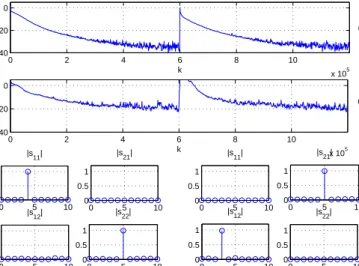
3.2 (a) Residual interference (IT) of equalizer 1. (b) IT of equalizer 2. (c) First half: the averaged global impulse responses taken from time k = 199,000 to time k = 200,000. Source separation is not successful. (d) Second half: the averaged global impulse responses taken from timek= 399,000 to timek= 400,000. Source is not changed in equalizer 2. . 81 3.3 Output signals of equalizers 1 and 2. . . 81 3.4 (a) Residual interference (IT) of equalizer 1. (b) IT of equalizer 2. (c) First half: the
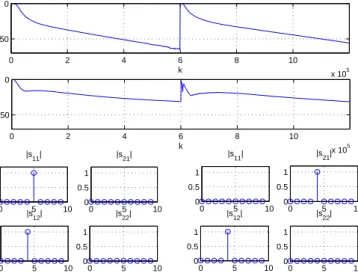
averaged global impulse responses taken from timek= 599,000 to timek= 600,000. The apparent success in source separation is not yet conclusive. (d) Second half: the averaged global impulse responses taken from timek = 1,199,000 to time k= 1,200,000. Source separation is proven successful. . . 84 3.5 Output signals of equalizers 1 and 2. . . 84 3.6 (a) Residual interference (IT) of equalizer 1. (b) IT of equalizer 2. (c) First half: the
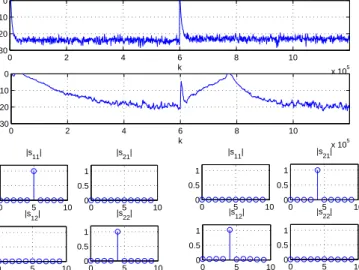
averaged global impulse responses taken fromk= 599,000 tok= 600,000. Source separa-tion is not successful. (d) Second half: the averaged global impulse responses taken from k= 1,199,000 tok= 1,200,000. Source is not changed in equalizer 2. . . 87
3.7 Output signals of equalizers 1 and 2 at steady state. . . 87 3.8 (a) Residual interference (IT) of equalizer 1. (b) IT of equalizer 2. (c) First half: the
averaged global impulse responses taken fromk= 599,000 tok= 600,000. The apparent success in source separation is not yet conclusive. (d) Second half: the averaged global impulse responses taken fromk= 1,199,000 tok= 1,200,000. Source separation is proven successful. . . 90 3.9 Output signals of equalizers 1 and 2 at steady state. . . 90
4.1 Baseband equivalent system forMt= 2 andMr= 3. . . 95
4.2 Simulation and theoretical curves for the steady state MSE as a function of mixing parameter,kj withµj = 1×10⁻⁷ from a 16-QAM constellation for equalizer 2,j= 2.108 4.3 Simulation and theoretical curves for the steady state MSE as a function of step size,
µj with mixing parameter,kj = 1.41 from a 16-QAM constellation for equalizer 2,
j= 2. . . 109
5.1 Baseband equivalent system forMt= 2 andMr= 3. . . 113
5.2 Performance comparison of different algorithms for equalizer 1 and 2. Hybrid algo-rithms provide superior performance than others. . . 123 5.3 Equalizer outputs of CC-CMA at the steady state. The symbols closely match with
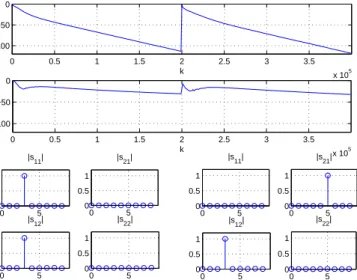
the 16-QAM constellation set for equalizer 1 but the symbols of equalizer 2 have been shrunk. . . 124 5.4 The averaged global impulse responses of CC-CMA taken in the steady state. Source
separation is successful but a down-scaling of 0.2 has been introduced to the equalizer 2. . . 124 5.5 Equalizer outputs of MIMO-CMA at the steady state. The symbols closely match
5.6 The averaged global impulse responses of MIMO-CMA taken in the steady state. Source separation is not successful. . . 125 5.7 Equalizer outputs of CI-CMA at the steady state. . . 126 5.8 The averaged global impulse responses of CI-CMA taken in the steady state. Source
separation is successful. . . 126 5.9 Equalizer outputs of MCIBG at the steady state. . . 127 5.10 The averaged global impulse responses of MCIBG taken in the steady state. Source
separation is successful. . . 127 5.11 Equalizer outputs of MCIRBA at the steady state. . . 128 5.12 The averaged global impulse responses of MCIRBA taken in the steady state. Source
separation is successful. . . 128 5.13 Equalizer outputs of MCISAG at the steady state. . . 129 5.14 The averaged global impulse responses of MCISAG taken in the steady state. Source
List of Tables
3.1 Impulse response of a two-input/three-output real channel [1] . . . 77
3.2 Impulse response of a two-input/three-output complex channel [1] . . . 77
3.3 Simulation Parameters [2] . . . 79
4.1 Impulse response of two-input/three-output complex channel [1] . . . 106
5.1 Impulse response of two-input/three-output complex channel [1] . . . 112
Chapter 1
Introduction
Chronic diseases, also known as non-communicable diseases, are long-lasting illnesses that may lead to death and disability. These diseases are frequently preventable or controllable through early detection, medical treatment and proper life style. Examples of chronic diseases are heart disease, stroke, diabetes, cancer and etc. Unfortunately, World Health Organization has reported that chronic diseases caused 60 percent and 68 percent of all deaths in 2002 and 2012, respectively [3]. This indicates that 8 percent increment in 10 years and the percentage of death caused by chronic diseases probably increases to 76 percent in 2022. Too late in chronic diseases detection is the common reason that causes the death. Therefore, in order to reduce the percentage of death caused by chronic diseases and improve the quality of life, wireless medical sensor can be exploited to monitor the patient and take necessary action once abnormal condition is detected. More precisely, the wireless medical sensor can be used to collect various real time physiological signals such as heart rhythm, blood glucose level, body temperature, blood pressure and etc, without geographical limitation. Through telecommunication network, doctor can access the physiological signals to determine any possible harmful symptom of patient. If harmful symptom is detected by doctor, the patient can be informed to be admitted to hospital for further tests or treatment to avoid any dreadful event.
In general, the wireless medical sensor can be divided into wearable sensor and implant sensor, which are located on-body and in-body, respectively. Wireless wearable medical sensor, is placed on the body or patient’s skin in non-invasive way and it is removable. The applications of this type sensor include blood pressure measurement, body temperature monitoring, heart rhythm monitoring [4], asthma monitoring [5] and etc. Instead of that, the implant sensor is an electronic sensor that is placed inside human body via surgery or swallowing. The applications of the implant sensor include blood glucose level monitoring [6], cardiovascular system monitoring [7], cancer detector, capsule endoscopy [8] and etc. Wireless communication is the essential element of the above sensors. Among the wearable and implant sensors, the wireless communication link of the implant sensor is more challenging than the wearable sensor because the implant sensor is located inside the human body. Therefore, we will focus on the improvement of the wireless communication link for the implant sensor.
1.1
Background
The wireless implant communication link, which connects an implant sensor to a multi-antennas external hand held device, is important in order to ensure the monitored data can be received by doctor in different geographic area. Due to the limited power in the implant sensor, the implant sensor is not able to directly send the monitored data to the cellular network or local area network (LAN). Therefore, the external device, which is required to be placed within 2 meter distance from the implant sensor, is functioned as a gateway because the external device receives the monitored data from the implant sensor and then re-transmits the data to the cellular or LAN. In general, the wireless implant communication is a two way communications link. Therefore, it can be divided into uplink and downlink, which are the communication link from implant to the external device and from the external device to implant, respectively. As a monitoring device, uplink is expected to have high data traffic than downlink because the implant sensor frequently sends the monitored signal to the external device from time to time. In contrary, downlink is expected to have low data
traffic because it is used to configure or reprogram the implant. Therefore, we will put our focus on the improvement of the uplink implant communication.
In the literature, the implant communication can be accomplished through Medical Implant Communications Systems (MICS) standard, Ultra-wideband (UWB) Communication and Human Body Communication. The MICS is a narrowband radio frequency (RF) communication that has been used in cardiac pacemaker and defibrillator to help heart disease patient since 1999 [9, 10, 11]. However, due to the limited channel bandwidth of 300 kHz, MICS has relatively low data rate. To overcome the data rate limitation, UWB which has the channel bandwidth of 500 MHz has been proposed. Instead of that, UWB is relatively immune to frequency selective channel fading and noise [8]. In spite of that, the application of UWB for implant sensor communication has encoun-tered difficulty. Currently, the performance of UWB only has been tested on the simulations and models [11, 8]. The actual result on living human is still unknown. In order to conduct this test, living human is required to be the test subject. Therefore, this is unethical and probably illegal. As a result, the results of simulations and models of UWB are hardly to be validate. Instead of that, human body communication is a relatively new type of non-RF communication where human body is used as the transmission medium. This type of communication provides high security and high fidelity because the transmission medium is not shared by others. However, this type com-munication is unfriendly-user in setup and has a very short transmission range where it is limited to about 100 centimeter distance. Furthermore, the application of human body communication for the implant communication may rise ethical challenge because living human is required to be the test subject.
Due to the reason the application of UWB and human body communication for the implant communication may encounter the ethical challenge, we put our focus on the data rate improvement on the narrowband MICS.
1.2
Practical Challenges
Currently, the operating frequency range of implant communication has been defined from 402 to 405 MHz, which is also known as Medical Implant Communication Service band with the maximum channel bandwidth of 300 kHz since 1999, even 13 years earlier than the first publication of IEEE Body Area Network 802.15.6 [9, 10, 11]. The MICS, which is currently belonged to IEEE Body Area Network 802.15.6, also defines to the uplink and downlink communications. Therefore, the application of implant communication in MICS is legally defined by the document. In order to improve the data rate, the uplink communication of the implant communication can encounter some unique challenges and the challenges are described as following.
i Limited power resource of implant
The implant device requires a safe and reliable power source. In this case, battery can be a good choice since battery has been used in other in-body equipment such as pacemaker for many years and no severe issue has been reported. However, due to the reason that the battery together with implant is located inside human body, the battery is hardly to be recharged or replaced. Therefore, the battery has limited life time and thus it can be considered as expensive resource.
ii Limited computation power and memory of implant
Memory and computation operation consume power and cost. Therefore, in order to save power resource and memory cost, the computation operation should be designed as simple as possible and the memory size should be small enough to achieve the basic tasks. Therefore, in this computation and memory limitation condition, complicated digital signal processing is not encouraged to be performed on the implant.
iii Intersymbol interference (ISI) due to bandlimited channel
Currently, the maximum channel bandwidth of 300 kHz is allocated for implant communi-cation and thus, the bandwidth of the information signal is traditionally restricted below
300 kHz to avoid any undesired distortion. However, the restriction on the information bandwidth also limits the data rate. In order to increase the data rate, we suggest that the information bandwidth to be increased more than the allocated channel bandwidth. In this case, to avoid the transmit signal does not exceed the allocated channel bandwidth, the information signal is passed though a bandlimited filter before the signal is transmitted. Obviously, high frequency components of the information signal are attenuated because the bandlimited filter has lower bandwidth compared to the bandwidth of the information signal. In this situation, due to the high frequency components of the information signal are lost, the receiving external device receives the information signal that is corrupted by intersymbol interference. The ISI can increase the error rate and cause the whole communication link becomes unreliable. Therefore, in order to achieve higher data rate and reduce the error rate in this new approach, the receiving external device is expected to equip with signal processing method that can cope the ISI.
iv Co-channel Interference (CCI)
In a special scenario such as two patients with the same operating frequency implant devices are standing side by side, the receiving node can receive a distorted signal which is the combined signal from the desired and undesired implant devices. This type signal distortion is called co-channel interference because two or more transmitting implant devices are operating in the same channel. CCI can strongly reduce the receiver performance. To overcome this problem, the receiving external device should have a signal processing method that can suppress CCI and perform source separation.
v Expensive communication link
In order to effectively setup the implant, the costs that include devices cost, deployment cost, surgery cost, medical cost and monitoring cost are expected to be paid. Instead of that, the limited battery life time has constraint the duration of the communication link to a finite time. Therefore, from the perspective of the above costs and power resource, the
implant communication link is expensive and thus the method that can produces high data throughput is required.
1.3
Practical Objectives and Proposed Solutions
Based on the above challenges, we can see that a new solution is demanded and the solution should able to achieve the following objectives.
• The solution should have light and moderate signal processing on the transmitting implant and the receiving external device, respectively.
• The solution should have the ability to suppress ISI and CCI simultaneously, and also able to perform source separation.
• The solution is able to improve data throughput.
In order to achieve the objectives, multiple inputs multiple outputs (MIMO) blind equalizer with source separation ability, is called MIMO blind equalizer, is proposed as the solution on the receiver side. Instead of that, pulse-amplitude modulation (PAM) and quadrature amplitude modulation (QAM) are suggested to be the modulation scheme. The reasons of the proposed solutions are justified as below.
• MIMO blind equalizer does not require the transmitting implant to perform any
complicated operation.
In order to established communication link, some common wireless technologies such as Orthogonal Frequency-Division Multiple (OFDM) and Code Division Multiplexing Access (CDMA), require the transmitter to perform Inverse Fast Fourier Transform operation and code spreading operation, respectively. Therefore, these operations can burden the transmit-ting implant. Instead of that, OFDM and CDMA are the wide band technologies. Thus, the performance of the technologies can degrade if they are applied in the narrow band.
Therefore, MIMO blind equalizer is suggested to be applied at the receiving external device because it does not require the above special operations to be performed on the transmitting implant. Due to the receiving external device is located outside human body, the battery replacement or recharge is relatively easy, and thus this allows MIMO blind equalizer to be applied.
• PAM and QAM modulation schemes can improve the data throughput.
MICS communication has relatively low data throughput because of limited channel band-width (i.e. up to 300 kHz) and bandband-width inefficiency. The limited channel bandband-width issue has been explained. Now, we put focus on the bandwidth inefficiency issue. In the literature of MICS, the relatively simple communication modulation schemes such as on/off keying (OOK), amplitude shift keying (ASK) [12, 13], frequency shift keying (FSK) [14, 15, 16] and differential phase shift keying (DPSK) [10] can be found. Compared to multi-modulus PAM and QAM, the above modulations schemes are relatively bandwidth inefficiency and thereby can the data throughput is low.
1.4
Research Background
Multiple-input multiple-output (MIMO) technology such as spatial division multiple access (SDMA) has attracted strong interest in telecommunications field, because of the higher data throughput compared to single-input single-output (SISO) technology [17, 18, 19]. However, the signal recov-ery in the MIMO receiver is more difficult compared to the SISO receiver because two primary obstacles need to be overcome in order to retrieve the all the input signals. Firstly, the signals may suffer from ISI due to the bandlimited channel. The resulting channel is thus commonly known as a frequency selective channel where signals of different frequencies will suffer different levels of at-tenuation. Secondly, due to cochannel system sources, the received signals are overlapped versions of multiple source signals, i.e., a phenomenon called CCI. To overcome ISI and CCI simultaneously,
MIMO equalization which equips with open eye and source separation abilities is used.
Generally, there are two type equalization approaches such as trained equalization and blind equalization. Trained equalization requires the transmitter periodically sends training sequences to the receiver in order to open the channel eye. Least Mean Square (LMS) is an example of trained equalization algorithm [20]. Normally, trained equalization can rapidly suppress interferences. However, the periodical transmission of the training sequence will reduce the data throughput, and therefore blind equalization is developed. The blind equalizer exploits the statistical information of transmitted signals to recover signal instead of training signals. Thus, blind equalization is a good candidate when the communication link is expensive. In practice, blind equalizer depends on its algorithm to compute the optimum coefficient. Therefore, blind equalization algorithm is the key to determine the performance of a blind equalizer.
Many SISO blind equalization algorithms have been developed in the literature. Some blind equalization algorithms that are supported by theoretical analysis are Constant Modulus Algorithm (CMA) [21], Sato algorithm [22], Multimodulus algorithm [23] [24] and Shalvi Weistein Algorithm [25]. Among these algorithms, CMA is widely recognized as the most common algorithm due to its simplicity and its strong ability in open eye even in a severe channel. However, the SISO blind equalization algorithm was developed based on the SISO assumption, thus it may not optimum in MIMO case. To overcome the limitation, MIMO blind equalization algorithms are proposed. In the literature, many MIMO algorithms have been developed but not all algorithms are equipped with source separation ability. In order to identify this function of the algorithm, based on the presented results, we divide the MIMO algorithms into source separation algorithm, pure equal-ization algorithm, single task algorithm and two tasks algorithm, and the definitions are described as follows,
• Source separation algorithm: It is a blind algorithm that can perform source separation but it was designed and tested solely in CCI without ISI. This algorithm also known as blind source separation (BSS). [26, 27, 28, 29, 30, 31, 32, 33, 34]
• Pure equalization algorithm: It is a blind algorithm that can suppress interferences but cannot perform source separation. [35, 36]
• Single task algorithm: It is a blind algorithm that can perform solely one task in a time, either equalization or source separation but not the both. [37, 38]
• Two tasks algorithm: It is a blind algorithm that can perform two tasks of equalization and source separation simultaneously. [39, 40, 41, 2, 31, 42, 43, 44, 45, 46, 47]
Obviously, in order to achieve our objective of equalization and source separation, the two tasks algorithm are the candidate of MIMO equalizer. Instead of that, the detail description of the above algorithms can be found in the chapter of Literature Review.
The two task algorithm can be divided into orthogonal constraint cost function approach or non-constraint cost function approach. In the orthogonal constraint cost function approach, the equalizer is required to minimize a high order cost in order to open the channel eye, and perform matrix decomposition in order to ensure source separation [39, 40, 41]. However, this approach requires the channel order or channel length to be known. In practice, due to the channel is unknown, it is difficult to obtain the channel order. Furthermore, because matrix decomposition requires large computation efforts and large storage, the computation complexity of this method is high. Instead of that, noise has not been considered in the design. Therefore, we will pursue non-constraint cost function approach.
Cross-correlation Constant Modulus Algorithm (CC-CMA) are the non-constraint cost function approach that can mitigate both ISI and CCI and perform source separation. In this algorithm, the CMA which has the open eye ability is combined with a cross-correlation (CC) cost which penalizes correlations between the source signals and including their delayed versions thereby separating them. In fact, CC-CMA was independently proposed by Touzni et al [2] and Papadias et al [31]. CC-CMA has widely been accepted as a good MIMO blind equalization algorithm and the CC-CMA has been extended and enhanced by [48], [44], [49] and [50] based on the assumption
that the jointly goal of open eye and source separation always can be achieved perfectly.
1.5
Research Limitations and Objectives
Some research limitations of CC-CMA are addressed and the research objectives are stated as follows.
1.5.1
Robust to 4-PAM and 16-QAM
CC-CMA is a MIMO equalization algorithm that can be used to open the channel eye and perform source separation. Therefore, it is a potential candidate to be selected as the MIMO equalization algorithm for uplink implant communication. However, the theocratical analysis has only been done and tested for 2-Phase Shift Keying (PSK) or 4-PSK [2, 50, 43] whilst the theocratical analysis for higher order modulation schemes such as 4-PAM and 16-QAM are unknown. The 4-PAM and 16-QAM have different statistical properties with PSK, thus the theocratical analysis for PSK cannot be applied in the higher order modulation scheme. Therefore, a straight forward migration of CC-CMA to higher order modulation schemes are risky because the optimum parameters of CC-CMA for higher order modulation schemes are unclear. To overcome this issue, a new MIMO blind equalization algorithm that is supported by theocratical analysis and robust to 4-PAM and 16-QAM is required.
1.5.2
Superior Steady State Performance is required
Steady state is the condition that the equalizer reaches the stable condition and thereby the statistical properties of the equalizer output do not show any significant change. In other words, if the design is correct, the equalizer is able to produce a sufficiently low error rate in the steady state. Therefore, the performance of the equalizer in the steady state always has been used to imply the reliability of the communication link.
In order to obtain a reliable communication link, low steady state error value is always de-manded. The steady state performance of MIMO blind equalization algorithm has been evaluated in the PSK cases [50], but no relevant information for 16-QAM case can be found. Therefore, the factors that can affect the steady state error for 16-QAM case are required to be found. Instead of that, a new algorithm that can improve the steady state performance is required.
1.6
Contributions
The main objective of the thesis is to develop MIMO blind equalization algorithms that can sup-press ISI and CCI and automatically ensure all source sequences are retrieved without repetition. The contributions of the thesis are summarized as following.
1. Identified the cost function of the CC-CMA is a biased cost function
We have identified the cost function of the CC-CMA, which was the widely accepted unbiased cost function, is a biased method and also we have established some mathematic proofs to prove the bias of the cost function of the CC-CMA. This finding has explained the shrinking effect and the contrary between the convergence analysis in [2] and its results. Furthermore, since the bias of the CC-CMA cost function has not been realized, some researches such as [51], [52] and [53] has claimed that the shrinking effect is unsolvable but only can be mitigated in a limited parameter range such as small number of source or small number of delay spread. Otherwise, the output can shrink to zero value and this implies symbol retrieval failed. This contribution can be found in Chapter 3.
2. Proposed Cross Independent Constant Modulus Algorithm (CI-CMA)
In this thesis, we have proposed an unbiased cost function, CI-CMA to effectively solve the shrinking effect which was previously left unsolvable. Due to it is a new algorithm, we perform convergence analysis to confirm its blind source separation and open eye abilities. We emphasize that our works do not ignore the source statistic in the convergence analysis,
while the previous works such as [51], [52],[2] [53] have always ignored the source statistic for analysis simplicity. Specifically, the source is always assumed to be Binary Phase Shift Keying (BPSK) modulation by the previous works. With the presence of source statistic which we consider in our approach (therefore our result can be extended to any general modulation scheme), the bias that exists in the CC-CMA cost function becomes even clearer, even though the analysis become much more complicated. In our approach, a new dispersion constant value is determined in the CI-CMA to compensate the bias offset in the CC-CMA. Furthermore, the shrinking effect which is due to the bias cost function is simultaneously solved by the new dispersion constant. This contribution also can be found in Chapter 3.
3. Perform Steady State Mean Square Error (MSE) analysis on CI-CMA
We have analytically predicted mean square error steady state (MSE) condition on the new unbiased algorithm, CI-CMA. The analytical MSE curve is closer to the practice MSE curve in comparison to the previous works [50]. It is worth to mention that MSE analytical curve is classically derived based on energy preservation theorem [54] that assumes an algorithm is unbiased. However, since the CC-CMA appears to be biased, the MSE analysis performed is not exactly accurate, because the criteria of energy preservation theorem would have then been violated. Furthermore, we have performed closed form mathematical manipulations on some key equations but the previous works have approximated some key equations without explicitly mathematic proofs given. Finally, with our analytical MSE equation has clearly determined the factors and how do these factors influence MSE value. This contribution can be found in Chapter 4.
4. Proposed Hybrid Algorithms
Following our MSE analysis, we realize that the steady state MSE can only be reduced by minimizing the adaptation step size, which in doing so will slow the convergence of the algorithm. Therefore, three hybrid algorithms, which are Modified Cross Independent Benveniste-Goursat Algorithm (MCIBG), Modified Cross Independent Reliability Based
Al-gorithm (MCIRBA) and Modified Cross Independent Stop and Go AlAl-gorithm (MCISAG), are proposed to improve the steady state performance. The hybrid algorithms are the combi-nation of a new adaptive constant modulus algorithm (ACMA), a decision-directed algorithm and a cross-correlation function. This contribution can be found in Chapter 5.
1.7
Structure of the thesis
The structure of the thesis is described below. Chapter 2 is the chapter of Literature Review that highlights different types of wireless medical sensor and applications, discusses on different types of implant communication system, provides the background of MIMO blind equalization, states the system model, defines a good MIMO equalization condition and reviews some related algorithms. Chapter 3 presents the problems of the CC-CMA, introduces the CI-CMA to overcome the problems and perform convergence analysis on the CMA. Then, steady state MSE of the CI-CMA is analytically established in Chapter 4. Chapter 5 shows the new MIMO hybrid algorithms and the comparisons among the new algorithms. Finally, Chapter 6 describes the conclusion and future works.
Chapter 2
Literature Review
2.1
Introduction
This chapter begins with a general introduction of chronic diseases and wireless medical sensor and a discussion on different types of medical sensors from Section 2.2 to 2.5. The review will focus on the communication of implant sensor, and thus the discussion of current and potential implant communications can be found in Section 2.6. The chapter continues to highlight the interferences issue and MIMO channel equalization in Section 2.7. The typical system model and assumptions will be presented in Section 2.8. The theoretical background of MIMO equalizer can be found from Sec 2.9 to 2.11. Section 2.12 presents the performance measurements of MIMO equalizer. The chapter continues a literature review of blind equalization algorithms from Section 2.13 to 2.15.
2.2
Chronic diseases and wireless medical sensor
Chronic disease is a long-lasting illness that may cause death or disability if the disease has not been controlled well. The disease cannot be spread through virus or bacteria and the factors that can surely cause the disease still remain unknown. However, researches have shown that obesity, physical inactive, uncontrolled in smoking and drinking alcohol, insufficient nutrition, pollution and certain Deoxyribonucleic Acid (DNA) have strong correlation to chronic disease [55, 3, 56, 57]. Examples of chronic disease are heart disease, stroke, diabetes, cancer and etc. Early detection and frequent monitoring of chronic disease is often helpful to avoid severe result.
In order to achieve the detection and monitoring of chronic disease, the human body physiolog-ical signals, such as heart rhythm, blood glucose level, body temperature, blood pressure and etc, are always required to be observed for sufficient long period. In order to obtain the physiological signals, wired medical sensor has conventionally been used. However, the wired medical sensor is heavy and big equipment, and thereby it can restrict patient’s movement. Therefore, battery-operated wireless medical sensor, which is relatively small and light, is developed to perform the similar task. The wireless medical sensor is not solely a sensor, but also has been integrated with processor, memory and radio frequency communication technology [58]. Hence, for the non-emergency case, the wireless medical sensor allows the patient to be home monitored and is helpful to reduce the face-to-face consultation times [59, 60, 61]. In this case, the resources such as pa-tient’s time and hospital space can be saved. In general, wireless medical sensor can be divided into wearable sensor and implant sensor, which are located on-body and in-body, respectively.
2.3
Wearable sensor
Wireless body surface sensor, also known as wireless wearable medical sensor, is placed on the body or patient’s skin in non-invasive way and it is removable. Normally, the suspicious patient, who is suspected with certain disease and required sufficient long period physiological signals to
be confirmed, is advised to wear up this type sensor for several days or months. In contrast to the traditional wired medical sensor, wireless sensor does not restrict patient movement and patient is allowed to go home and work. In this case, since the patient does not need to be admitted in hospital immediately, hospital indirectly can save some resource as well. The applications of this type sensor include blood pressure measurement, body temperature monitoring, heart rhythm monitoring [4], asthma monitoring [5], sleep disorder monitoring [62], breathing monitoring [63], dementia brain disease detection [64, 65] and etc.
The wireless communication of wearable sensor is an essential element. In general, the wireless wearable sensor communication can be divided into narrowband communication, UWB communi-cation and human body communicommuni-cation. The narrowband communicommuni-cation of wireless body surface has the bandwidth range from 300 kHz to 1 MHz and operates in various frequency bands that are within High Frequency (HF), Very High Frequency (VHF) and Ultra High Frequency (UHF). Except for the special case of 2.4GHz band (within UHF) with 10 MHz bandwidth, all the afore-mentioned operating frequency bands are licensed bands, and thereby the wireless communication link is legally protected from interferences by other wireless communications such as television signal or cellular signal. On the contrary, the 2.4GHz band is an unlicensed band and many wire-less communications such as Wi-Fi or Wirewire-less Local Area Network (WLAN) and Bluetooth are operating in this band. In this condition, the wireless body surface sensor that operates in this band is probably interfered by other wireless products. In contrast to narrowband communication, UWB communication is less susceptible to noise and interference. According to IEEE 802.15.6, the operating frequency range of UWB sensor is located within Microwave Frequency band which is 3.1 to 10 GHz with bandwidth nearly 500 MHz [10, 9]. Due to the bandwidth of UWB is higher than narrowband, the sensor that operates in UWB has higher data rate. Impulse radio are highly sug-gested to be the wireless technology for UWB wireless body surface sensor [66, 67, 68, 69, 70, 71]. Instead of that, human body communication performs data transfer by touching the wearable sen-sor and human body is used as the communication channel. This communication provides high
security benefit because the information has not been transfer to the air [72, 73, 74].
2.4
Implant sensor
Implant, also known as implant sensor or in-body medical sensor, is an electronic sensor that is placed inside human body via surgery or swallowing. Recent advanced in miniature technology that reduces the size and weight of traditional medical sensor has made implant becomes a realistic device because the device becomes small enough to be fitted into an organ [75]. Instead of that, with the advanced integrated circuit technology, implant is not just a solely sensor, but also has the ability to compute, memorize and perform wireless communication. Therefore, implant is expected to capture human physiology signals or in-body images and then send the signals or images to a multi-antennas external device, which is located outside the body.
2.5
Applications of implant sensor
Implant sensor has many potential medical applications. Some common application includes blood glucose level monitoring, cardiovascular system monitoring, cancer detector and capsule endoscopy are described as below.
2.5.1
Blood glucose level monitoring
Blood glucose level monitoring is critically important for diabetes patient to ensure the effec-tiveness of insulin dose and thereby avoid excessive blood sugar level which probability leads to complications. The complications include blindness, kidney damage, nerve damage and others. Traditionally, in order to get a blood glucose level reading, a blood sample is obtained by piercing on the finger and then the blood sample is analyzed chemically or electronically by a blood glucose meter. A severe diabetes patient, who requires insulin dose, may need to do the above blood glucose test 3 to 10 times a day. In this condition, the repetitive piercing process for the same area
over several years can damage the nearby tissues and blood vessels. Therefore, as an alternative solution, a implant to monitor the blood glucose level can be deployed into body. In this case, the implant can automatically update the blood glucose level reading to the external device without required any piercing. This reading is useful for the patient to makes decision on the amount of insulin dose, the types of meal and physical activities [76, 6].
2.5.2
Cardiovascular system monitoring
Ischemic and Arrhythmia are the two common heart diseases that may lead to dangerous events such as death, stroke and heart failure. Firstly, in Ischemic heart disease, the blood flow that supplies oxygen to the heart is partially or fully blocked by plaques, such as cholesterol and etc, and then the heart tissues can die because the heart tissues cannot obtain sufficient oxygen supply. Secondly, Arrhythmia is a heart disease that the heart occasionally beats too fast, too slow or irregular heart rhythm. In this unusual heart rhythm event, the blood pressure level is expected to be abnormal and thereby Arrhythmia has the potential to cause stroke and heart failure. For these heart diseases, doctor believes that occasional abnormal heart rhythm may be shown up before the dangerous events. Therefore, for prevention purpose, an implant for heart rhythm monitoring can be used to record and detect the occasional abnormal heart rhythm [7, 77, 78, 16]. Furthermore, a sufficient long record of heart rhythm that is generated by the implant allows doctor has more information to decide the optimum medical treatment.
2.5.3
Cancer detector
According to World Cancer Report 2014, cancer caused about 8.2 million deaths in 2012 [79]. The cancer death cases are expected to increase to 13.2 million in 2030 [80]. This has aroused the research on the prevention death from cancer. Cancer may not necessary cause death, some typical type cancers such as breast cancer, cervical cancer, oral cancer and colorectal cancer has high chance to be controlled or cured if the cancers are detected and treated in the early stage[81].
Therefore, cancer detection in the early stage is helpful to increase the survival rate. Past studies have shown that nitric oxide has an important role in the initiation and growth of cancer cell, and thus nitric oxide can be exploited to detect cancer cell [82]. For healthy people, nitric oxide is a signaling molecule that is important to deliver messages between cells, brain and immune system in order to help the immune system to reduce inflammation, kill bacteria, prevent tumor and etc [83]. On the other hand, for cancer patient, depend on the cancer types, many studies have indicated that unusual saturation level of nitric oxide can be observed in the patient’s blood. For example, increased amount of nitric oxide has been observed in breast cancer patient [82]. Therefore, implant that monitors nitric oxide in the blood in long term can be used to identify the presence of cancer cell. This type implant can be applied for the people who has the frequent record on certain type cancer in the family history. Instead of cancer detection, this implant also provides a way for cancer study on alive human.
2.5.4
Capsule endoscopy
Capsule endoscopy can be used to capture the images along digestive tract in order to allow the doctor to diagnosis digestive tract tumor, ulcer or bleeding. In contrast to the above implants, capsule endoscopy is implant that stays inside human digestive tract for about 8 hours and then is expected to be flushed away naturally. More precisely, capsule endoscopy is a special pill which consists of camera and light, and it is used to capture the images of the entire digestive tract in real time. In order to capture the images in the digestive tract, patient is advised to swallow the pill and then the pill is moved by biological peristalsis. In this condition, the capsule endoscopy can capture the images of entire digestive tract, and the captured images are immediately sent to external device and then forwarded to doctor’s computer through internet or WLAN. Therefore, doctor can diagnoses any tumor or disease in the digestive tract by observing the images. In contrast to the traditional endoscopy, without the restriction of wire, the wireless capsule endoscopy can observe the entire digestive tract [84, 85, 8, 86, 16].
2.6
Current and Potential Implant Communications
In order to connect implant sensor to external device, the wireless implant communication is an essential part. In general, the wireless implant communication is a two way communications link. Therefore, it can be divided into uplink and downlink, which are the communication link from implant to external device and from external device to implant, respectively. Currently, MICS standard is the only legal standard that can be used for implant two way communications. Instead of that, UWB and Human Body Communication for implant communication have been proposed by researchers. Therefore, MICS standard, UWB and Human Body Communication will be reviewed. Finally, a summary will be found the end of this section.
2.6.1
MICS standard
This narrowband RF communication standard has been established since 1999 for cardiac pace-maker and defibrillator to help heart disease patient. The RF operating frequency range is 402 MHz to 405 MHz with maximum channel bandwidth 300 kHz and maximum power of 2 microwatt, which roughly covers distance of 1 to 2 meter. Currently, this is the only approved communication standard for implant sensor on living human body [87, 88, 9, 10, 11, 89].
Compared to other communications, this type communication has two limitations. First, this communication has relatively low data rate because of limited channel bandwidth (i.e. up to 300 kHz) and bandwidth inefficiency. In comparison to 16-QAM modulation scheme, it is bandwidth inefficiency because relatively simple communication modulation schemes such as on/off keying (OOK), amplitude shift keying (ASK) [12, 13], frequency shift keying (FSK) [14, 15, 16] and differential phase shift keying (DPSK) [10] can be found. Second, due to low data rate, this type communication requires longer transmission time to transmit same amount of data, thus it can exhaust the battery faster than any other fast communications.
2.6.2
UWB communication
To overcome the low data rate issue in MISC, RF UWB communication for implant sensor com-munication has been proposed. The UWB has the operating frequency range from 3.1 to 10.6 GHz and the maximum channel bandwidth about 500 MHz. Instead of high data rate due to high bandwidth, UWB is relatively immune to frequency selective channel fading and noise [8].
However, the application of UWB for implant sensor communication has some difficulties. First, due to the reason that UWB is relatively new technology and such wide spectrum resource is an expensive resource, it may be difficult for all countries to allocate this band for this communication. Second, the UWB experiment may raise ethical and juridical issue because the UWB experiment requires living human to be a test subject [11]. To overcome this problem, model and simulation tools have been conducted. However, the models and tools are expensive and thereby limited number of model can be found. By 2013, only two research centers, such as Nagoya Institute of Technology in Japan [90] and Intervention Centre in Oslo University Hospital [91], are able to develop the models and tools. Instead of the high cost on models and tools, due to the prohibition of conducting test on living human, the above researches encounter the difficulty to validate the model results [11].
Currently, impulsive radio and MB-OFDM are the UWB technologies that have been proposed for implant sensor communication and the technologies are described as below.
2.6.2.1 MB-OFDM
MB-OFDM use OFDM technology to perform signal transmission in UWB. In this method, the available frequency bandwidth is divided into many orthogonal overlapping sub-bands and each of the sub-bands is carried by a sub-carrier. Because of the available bandwidth has been fully utilized, it has the highest bandwidth efficiency and highest overall data rate among all the mentioned technologies. Obviously, MB-OFDM is a multi-carrier technology because many sub-carriers can be found. Therefore, it encounters some multi-carrier issues and the issues are described as below.
• Complex hardware and expensive cost are required. In UWB MB-OFDM, inter-mediate frequency (IF) conversion is required to convert the carriers from baseband to the RF and vise versa. Therefore, the radio frequency hardware to perform the up and down conversions are required on transmitter and receiver, respectively. Instead of that, the high value in peak-to-average power ratio (PAPR), which is due to large number of carriers, can cause non-linear amplification and then destroys the orthogonality of OFDM signal. As a result, ISI can be introduced and thereby strongly degrade the performance. To overcome this issue, large linear range amplifier, which is expensive, is required [92, 93].
• Sensitive to carrier frequencies offset. In practice, a minor mismatch on the oscillators between the transmitter and the receiver causes carrier frequency offset in frequency domain, thereby the receiver cannot precisely sample at the sub-carrier frequencies. As a consequence, due to the receiver samples at the incorrect sub-carrier frequencies, the receiver suffers inter-carrier interference and then degrades the overall performance. To overcome this issue, some costly signal processing method is required [94, 95, 96, 97, 98].
2.6.2.2 Impulse Radio (IR)
To overcome the above issues, IR, which is a carrier-free technology, can be used. IR uses very short Gaussian pulses to perform data transmission for short distance communication. Ideally, the time length of the pulse is in a fraction of nanosecond and this implies that the information spectrum has been spread to wider spectrum. In this condition, the entire allocated UWB carries the same information, and thus this technology does not require the receiver to precisely demodulate the sig-nal at certain carrier frequency. Therefore, in contrast to MB-OFDM, this technology is insensitive to carrier frequency offset. Furthermore, carrier-free technology of IR does not cause high PAPR value and thus high quality amplify is not required. Unlike MB-OFDM, direct baseband-to-RF or vise versa conversion can be used in IR. Therefore, the cost for IF conversion can be saved [8].
processing at the receiver is required to detect the transmitting fraction-nanoseconds pulse length. Therefore, high sampling rate of analog to digital convertor (ADC) is required [99]. Second, in order to improve the overall performance, a correlation receiver with precise timing synchronization algorithm is required. However, the timing synchronization algorithm is still an opening challenge [100].
2.6.3
Human Body Communication
Instead of RF channel, data transfer can be done over an inductive link inside human body. In order to establish this link, an implant equipped with a small coil is placed inside body, and an external device with a large coil is located on the body surface. The inductive coupling between this two coils can form a below 30 MHz electromagnetic inductive loop that can be used to transfer data. [101, 102, 103, 88, 76]. This type communication provides higher data security than RF technology because the signal has not been broadcasted to the air. Moreover, due to the non-sharing human body communication channel, the signal does not suffer interference from other sources.
In spite of that, this method has some limitations. First, the setup method is not user-friendly for patient and doctor because the outside coil is required to be accurately positioned over the implant [104]. Second, the link only can provide a very short distance transmission range, roughly below 100 centimeter, whilst RF technology can provide 1 to 2 meter range [16]. Third, this com-munication probably can raise ethical and juridical challenge. The reason is the current standard does not define human body communication for implant sensor, but only defines human body com-munication for wearable sensor [10]. Therefore, this implant experiment or application on human body is prohibited. Model and simulation are allowed but the result is hard to be validated.
2.6.4
Summary
In summary, among the mentioned limitations, ethical and juridical challenge is considered as a serious challenge because this challenge cannot be overcome by high cost. Therefore, to avoid this
challenge, it is possible to improve the implant communication on the conventional MICS standard instead of UWB and Human Body Communication.
2.7
Interferences and MIMO channel equalization
In order to avoid signal distortion, the conventional narrow band MICS imposes that the informa-tion bandwidth is always lower than the allocated channel bandwidth of 300 kHz. However, this limited bandwidth can limit the data rate as well. As a consequence, a prolonged data transmission time is required and thereby it rapidly reduces the battery power. Furthermore, the limited data rate prohibits the capsule endoscopy to transmit high resolution images. Therefore, high data rate in the narrow band is demanded.
In order to achieve higher data rate, the information bandwidth should be increased in the nar-row band channel. However, this increment can result on the case that the information bandwidth is larger than the allocation channel bandwidth. In this situation, due to the channel bandwidth imposed by the authority, the high frequency components of information bandwidth must be re-moved by a bandlimited filter, and thus the transmitting signal always has the bandwidth lower than the allocated channel bandwidth. In this scenario, the information is equivalently passed through a frequency selective channel. Because of the high frequency components of information are discarded, the current information symbol is inevitably combined with the subsequent symbols, therefore the receiver obtains the signal which has been corrupted by ISI. In order to retrieve the symbol from the ISI signal, equalizer is conventionally applied on the receiver. However, the above situation only implies that case of one transmitter and one receiver. In practice, one receiver can obtain the signals from multiple receivers. For example, a multi-antennas external device can re-ceive signals from multiple transmitting implants in the same operating frequency. Therefore, the receiver unavoidably obtains the signals that has been corrupted by CCI due to multiple transmit-ters. In overall, due to multiple transmitters and frequency selective channel, the receiver obtains the combined signal that is corrupted by ISI and CCI simultaneously. The presence of ISI and
CCI at the receiver can strongly degrade the performance of the communication link. Therefore, these interferences must be overcome.
To cope with ISI and CCI, MIMO equalizer can be applied at the receiver. In general, MIMO equalization can be achieved through trained approach and blind approach. In the trained ap-proach, the receiver requires the transmitters periodically sends out pilot sequences in order to open the channel eye. Least Mean Square (LMS) is an example of the trained approach. Normally, trained equalization can rapidly suppress interferences. However, the periodical transmission of the pilot sequence will reduce the data throughput, and thus blind approach is developed. Without any pilot sequence, the blind approach exploits the statistical information of transmitted signals to recover signal from the interferences. Therefore, blind approach is helpful to increase the data throughput especially for the expensive implant communication link.
2.8
System model and Assumptions
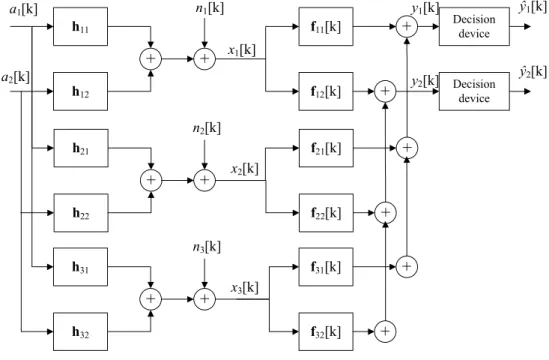
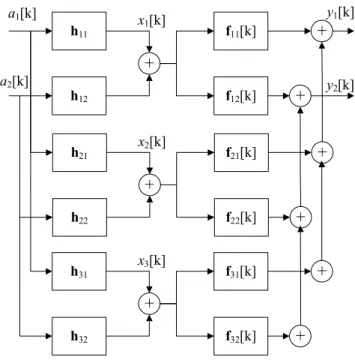
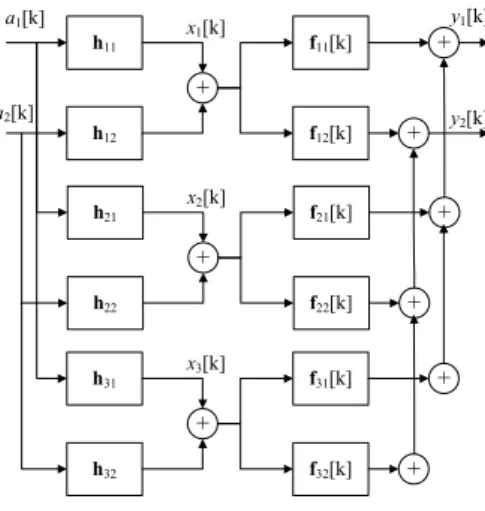
Multiple transmitted sources and multiple received antennas are considered here. In this condition, the received antenna receives the superposition of several source signals. Therefore the MIMO re-ceiver has the burden to mitigate both ISI and CCI simultaneously. Such a scenario can be modeled as aconvolutive MIMO system as shown in Fig. 2.1, rather than the simplerinstantaneousMIMO system, where the channel impulse response is one tap coefficient rather than a vector coefficient. In other words, the difference in the two systems lie in the channel impulse response of the former having memory (and hence a vector), whilst the latter is memoryless (just a complex number). In general, the system model hasMt transmit sources and Mr received antennas. Furthermore,
Mr≥Mt is assumed in this thesis. This assumption means we have more received antennas than
sources, and therefore a unique inverse system possibly exists. Therefore zero forcing equalization is possible in thisoverdeterminedMIMO system. The opposite,Mr< Mtis calledunderdetermined
MIMO system which is another complicated research topic and will not been pursued in this thesis.
h11 a1[k] f11[k]
+
h12 Decision device f12[k] Decision device+
+
a2[k] x1[k] y1[k] y2[k] ŷ1[k] ŷ2[k] h21 f21[k]+
h22 f22[k]+
+
x2[k] h31 f31[k]+
h32 f32[k]+
+
x3[k]+
n1[k]+
n2[k]+
n3[k]Theunderdetermined MIMO system is complicated because its inverse system is ambiguous from a mathematical perspective [105]. Finally, we highlight that the trivial case ofMr= 1 andMt= 1,
the system model is reduced to a convolutive SISO system model. We further make the following assumptions, which are common:
A1 Assumption on sources:
The j-th source, aj[k], where j ∈ (1, Mt), is an independently and identically distributed
(i.i.d.) zero mean discrete time sequence. All sources,aj[k],j ∈(1, Mt) are uniformly selected
from a PAM or QAM alphabet set, Aand therefore aj[k] has zero mean, E{aj[k]} = 0, a
finite power, σ2
A= E{|aj[k]|2}>0 and a finite fourth order moment,m4 = E{|aj[k]|4}>0 where E{·} denotes statistical expectation. Since aj[k] is uniformly picked from a PAM or
QAM alphabet set, aj[k] is circular and sub-Gaussian. Therefore, its normalized kurtosis,
Kur, m4 σ4
A must satisfy Kur<3 for real-valued case [2] and Kur<2 for complex-valued case [36]. In addition, aj[k] and al[k+δ], whereδ∈Zis any integer, l ̸=j and 1≤l≤Mt, are
mutually independent so that
E{aj[k]al∗[k+δ]}= E{aj[k]}E{al∗[k+δ]}= 0 (2.1)
where ∗denotes complex conjugate.
A2 Assumption on channels:
We model the channels fromj-th input toi-th channel output as static finite impulse response
(FIR) vectors and denote them ashij = [hij[0], hij[1],· · ·, hij[Nh−1]]T, wherei∈(1, Mr),
j ∈ (1, Mt), and all channels have the same length, Nh. The properties and descriptions
of channel are stated below. First, the channel is modeled as FIR vector because we focus on a stable bounded-input bounded-output channel which possibly allows a stable inverse system to be exist. Second, the channel is modeled as Nh length FIR vectors because we
assume the channel has memory due to multipath propagation. This type of channel is called frequency selective channel which causes ISI. Third, the channels, which is FIR vectors, can
be rearranged and combined into a channel convolution matrix which is assumed to satisfy left invertibility condition. The left invertibility of the channel convolution matrix is the most important criteria to allow the existence of its inverse system. The conditions of the invertible channel convolution matrix are formulated below. The channel convolution matrix, H which has the dimensionMrL×MtNs whereNs=L+Nh−1 is the convoluted length,
is defined as below H= ¨ H11 H¨12 . . . H¨1Mt ¨ H21 · · · H¨2Mt .. . · · · ... ¨ HMr1 · · · H¨MrMt
where H¨ij is a L×Ns toeplitz matrix which is formulated as
¨ Hij =
hij[0] hij[1] · · · hij[Nh−1] 0 0 . . . 0 0 hij[0] hij[1] · · · hij[Nh−1] 0 . . . 0 0 0 hij[0] hij[1] · · · hij[Nh−1] . . . 0 . . . . .. ... ... ... ... ... ... 0 0 . . . 0 hij[0] · · · hij[Nh−1] .
We assume the channel convolution matrix,His full column rank matrix and thereforeHis left invertible which also implies that its inverse system or zero forcing solution always exists. A3 Assumption on sensor noise(s):
Some noises which are introduced by electronic sensors are modeled as additive white Gaus-sian noise(AWGN). In this condition,ni[k] fori∈(1, Mt) is defined as the zero mean complex
value additive white Gaussian noise with a constant variance, E{|ni[k]|2} =σ2n at thei-th
channel output. Furthermore,ni[k] is independent from all sources,aj[k].
Assumptions above are frequently encountered in the related literatures such as [106, 36, 107, 2, 51]. The observed signal at thei-th sensor, fori∈(1, Mr), at timekis defined as:
xi[k] = Mt ∑ j=1 hij⊗aj[k] +ni[k] = Mt ∑ j=1 hTijaj[k] +ni[k] (2.2) whereaj[k] = [ aj[k],· · · , aj[k−Nh+ 1] ]T
, ⊗andT denote discrete time convolution and vector transposition, respectively. The equalizer output corresponding to the j-th source, where j ∈
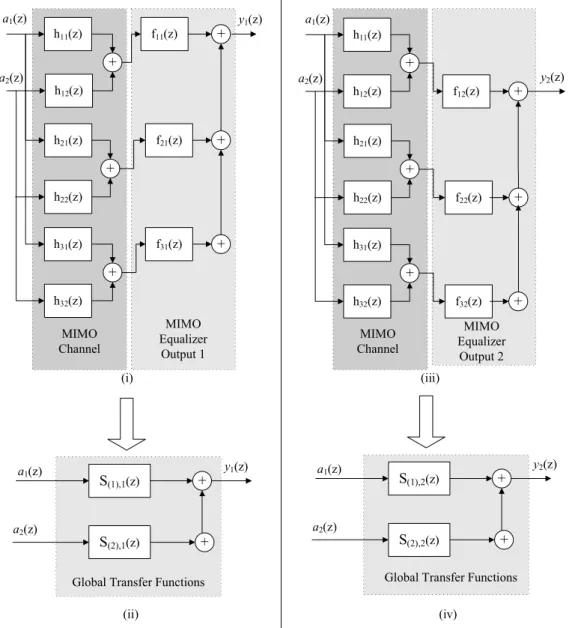
(1, Mt), at timekis denoted as: yj[k] = Mr ∑ i=1 fijT[k]xi[k] (2.3)
wherexi[k] = [xi[k],· · · , xi[k�
![Table 3.3: Simulation Parameters [2]](https://thumb-us.123doks.com/thumbv2/123dok_us/802649.2601446/95.892.167.847.728.1028/table-simulation-parameters.webp)
![Table 4.1: Impulse response of two-input/three-output complex channel [1] h 11 [−0.6 + 0.4j, 1.2 − 0.2j] T h 12 [−0.6 + 0.8j, 0.9 − 0.1j] T h 21 [0.1 + 0.7j, −0.2 − 0.5j] T h 22 [0.4 − 0.3j, −0.2 + 0.2j] T h 31 [0.5 + 0.4j, −1 + 0.3j] T h 32 [−0.1 + 0.8j,](https://thumb-us.123doks.com/thumbv2/123dok_us/802649.2601446/122.892.375.601.159.335/table-impulse-response-input-output-complex-channel-t.webp)