A multi-modal perception based assistive robotic system
for the elderly
Christophe Mollaret, Alhayat Ali Mekonnen, Fr´
ed´
eric Lerasle, I Ferran´
e, J
Pinquier, B Boudet, P Rumeau
To cite this version:
Christophe Mollaret, Alhayat Ali Mekonnen, Fr´ed´eric Lerasle, I Ferran´e, J Pinquier, et al.. A multi-modal perception based assistive robotic system for the elderly. Computer Vision and Image Understanding, Elsevier, 2016, 149, pp.78-97. <10.1016/j.cviu.2016.03.003>. < hal-01300463>
HAL Id: hal-01300463
https://hal.archives-ouvertes.fr/hal-01300463
Submitted on 11 Apr 2016HAL is a multi-disciplinary open access archive for the deposit and dissemination of sci-entific research documents, whether they are pub-lished or not. The documents may come from teaching and research institutions in France or abroad, or from public or private research centers.
L’archive ouverte pluridisciplinaire HAL, est destin´ee au d´epˆot et `a la diffusion de documents scientifiques de niveau recherche, publi´es ou non, ´emanant des ´etablissements d’enseignement et de recherche fran¸cais ou ´etrangers, des laboratoires publics ou priv´es.
A Multi-modal Perception based Assistive Robotic System
for the Elderly
C. Mollareta,b,c, A. A. Mekonnena,b, F. Lerasleb,c, I. Ferran´ea, J. Pinquiera,
B. Boudetd, P. Rumeaud
a
IRIT, Univ de Toulouse, 118 route de Narbonne, 31062 Toulouse Cedex 9, France b
CNRS, LAAS, 7, Avenue du Colonel Roche, F-31400 Toulouse, France c
Univ de Toulouse, UPS, LAAS, F-31400 Toulouse, France d
UMR 1027 Inserm, G´erontopˆole, laboratoire de g´erontechnologie La Grave, CHU Toulouse, Universit´e Toulouse-3, place Lange, TSA 60033, 31059 Toulouse Cedex 9, France
Abstract
In this paper, we present a multi-modal perception based framework to realize a non-intrusive domestic assistive robotic system. It is non-non-intrusive in that it only starts inter-action with a user when it detects the user’s intention to do so. All the robot’s inter-actions are based on multi-modal perceptions which include user detection based on RGB-D data,
user’s intention-for-interaction detection with RGB-D and audio data, and
communica-tion via user distance mediated speech recognicommunica-tion. The utilizacommunica-tion of multi-modal cues in different parts of the robotic activity paves the way to successful robotic runs (94% success rate). Each presented perceptual component is systematically evaluated using appropriate dataset and evaluation metrics. Finally the complete system is fully integrated on the PR2 robotic platform and validated through system sanity check runs and user studies with the help of 17 volunteer elderly participants.
Keywords: Assistive Technology, Elderly Care, Intention Detection, Multi-modal Data Fusion, Human-Robot Interaction, Robotic Perception
1. Introduction
As living conditions and health care facilities improve, the average life expectancy increases leading to a growing elderly population. For example, in France, in 2005, there were five young and adult people for one senior, in 2050, it is expected that there will be ten young and adult people for every seven seniors [1]. Though most people age well,
5
some become frail, at risk of disease and costly dependence. Therefore, the financial and organizational burden on the society is likely to rise. How can we provide quality care to people requiring constant assistance in various aspects, including those suffering
Email addresses: [email protected](C. Mollaret),[email protected](A. A. Mekonnen),
[email protected](F. Lerasle),[email protected](I. Ferran´e),[email protected](J. Pinquier),
[email protected](P. Rumeau)
from deterioration in cognitive capabilities due to aging, head trauma, and Alzheimer’s disease (AD)? This enlightenment has led to a growing necessity for new technologies
10
that can assist the elderly in their daily living. One such technology is the deployment of assistive robots for the elderly. In fact, such kind of robotic systems serving various tasks and purposes in the social care and medical/health sectors beyond the traditional scope of surgical and rehabilitation robots are poised to become one of the most important
technological innovations of the 21st century [2]. But, when robots leave industrial mass
15
production to help with daily living activities, i.e., household chores, the requirements for robot platforms change. While industrial production requires strength, precision, speed, and endurance, domestic service requires a robust navigation in indoor environments, a dexterous object manipulation, and an intuitive way of communicating (speech, gestures, and body language) with users. In this perspective, many issues are still to be solved, such
20
as perception and system integration.
Making a robot a socially competent service provider in all the daily life areas is very challenging. Hence, we focus on the conception of a robotic system that provides mild memory assistance to the elderly, a requirement highly coveted for the elderly whom might exhibit Mild Cognitive Impairment (MCI) or Alzheimer’s disease (AD) [3, 4]. A serious
25
issue for the elderly with MCI is forgetting where they have put objects that they use everyday, for example, keys, remote control, glasses, etc. This leads them to experience stress, loss of confidence, and become irritable, putting them at health risk especially considering their frailty [4]. Consequently, we consider deploying a robotic system that helps the elderly with MCI in locating everyday objects which are hidden (out of the
30
user’s sight), or put in unusual places. The work presented in this paper is part of a
French National Research Agency (ANR) funded research project called RIDDLE1, an
acronym forRobots for perceptual Interactions Dedicated to Daily Life Environment, which
aims to make a step forward in these directions by combining the underlying multiple and uncertain perceptual analyses related to, (1) objects and space regarding the robot’s
35
spatial intelligence, and (2) multi-modal communication regarding the robot’s transactional intelligence.
To paint a clear picture, let us consider the following exemplar scenario. A person suffering from MCI, which we henceforth refer as the user, is carrying his/her normal everyday activity. Then, let us say the user wants to change the channel on the TV but
40
realizes he/she could not remember where the remote control is. The user will then have to pose the question to the robot which is monitoring him/her stowed away in a
non-interfering position. The robot will then answer the user’s questions/riddles about the
object utilizing appropriate actions (speech, displacement, pointing action). Based on this scenario, we identify three main key functional requirements for the robot: (1) detecting
45
the user at all times, (2) detecting when the user wants to interact with the robot, i.e., when the user wants to pose a question to the robot or needs its attention – called user’s
intention-for-interaction, and (3) interaction via speech based communication. In this 1
work, we assume the type and position of the objects are known a priori and we focus only on the highlighted three requirements. The considered objects are specifically eyeglasses,
50
keys, mobile phone, wallet, remote control, and medication – frequently lost objects by the elderly as identified through a pilot study [4].
The entire behavior of the proposed assistive system is based on a widely accepted reactive behavior which cycles through “monitor” and “interact” phases, e.g., [5, 6, 7]. In this behavior, the robot monitors the user until he/she demands it to do something or
55
shows an interest to interact with it. Then the robot continues through the interaction phase where it interacts with the user to provide requested service or assistance. In line
with this, we propose a domestic assistive robot system that incorporates a novel user’s
intention detection mechanism to transition from monitoring phase to interaction phase. Therefore, we propose a scenario where the robot comes into a room, checks the presence
60
of a user in this room, and then stows away at an observation place to monitor the user discretely. When the user expresses his/her intent to interact with the robot – either by looking at it, calling it, or a combination of both – the robot approaches the user and starts
the close interaction phase. We refer to this as anon-intrusive behavior – the robot is not
moving to stalk the user – with three distinct phases: user detection, user monitoring, and
65
interaction phases (see Fig. 1 in Section 3). Initially when the robot correctly detects the user, it goes to the monitoring stage, actively reading the user’s intention. Then, when
it detects the user’s intention-for-interaction, it makes a transition into the interaction
phase which is carried out via speech modalities. During the speech based communication, depending on the utilized sensor, recognition tool, and Human/Robot (H/R) situation
70
(distance variations), the communication quality can be affected [8, 9]. Whenever possible an adaptive mechanism should be put in place to maximize the chances of having an ideal communication given the available resources.
In this work, the robot considers that there is only one user to communicate with. The used language is French; it could be, nevertheless, generalized to any language. The person
75
can freely move in his/her environment. However, when an interaction starts, after the
intention-for-interaction step, the person’s position is fixed during the interaction process. The goal of the interaction phase is for the robot to find a lost object upon request. The robot has to indicate the direction of the object by pointing its head towards it and giving some verbal precisions about its location – at the moment no object displacement
80
is managed by the robot. For example: “the remote control is under the table”. The objects are stored in a user-defined semantic map since the focus of the paper is not on
object detection. All the algorithms presented in this work are embedded on the PR22
robotic platform using the Robot Operating System (ROS) middleware framework [10]. ROS is a collection of software frameworks for robot software development with a very
85
active community and numerous publicly available packages that provide an operating system-like functionality on a heterogeneous computer cluster. Hence, we base all our
2
PR2 (Personal Robot 2) is a robotic platform developed by Willow Garage:
implementations and associate robotic integration on ROS (based on C++ and Python programming languages). Furthermore, all essential algorithms are integrated on the robot, while data visualization modules are seamlessly integrated on an external computer without
90
overloading the PR2 system. All sensors are embedded on the robot. The only exception is an Android smartphone, which is located within 2 meters from the user (in his/her hand or on a table near him/her), that is used to capture audio signal.
This paper makes the following four core contributions:
1. A complete multi-modal perception driven non-intrusive domestic robotic system;
95
2. A novel multi-modal user’s intention-for-interaction detection modality;
3. A fusion method to improve the speech recognition given the user’s position, available sensors, and recognition tools;
4. Details of the complete implemented system along with relevant evaluations that demonstrate the soundness of the framework via an exemplar application. The
ap-100
plication is an assistive scenario whereby the robot helps the user find hidden or misplaced objects in his/her living place.
The proposed framework is further investigated by conducting relevant user studies involv-ing 17 elderly participants.
This paper is organized as follows: Section 2 discusses related work briefly, Section 3
105
presents an overview of the adopted system. Sections 4, 5, and 6 describe the user detection, the user’s intention detection, and close HRI (with speech modality) part, respectively. Then, Section 7 explains how the task-level coordination is realized along with relevant implementation details. Experiments and results on PR2 are detailed in Section 8, and finally, the paper finishes with concluding remarks in Section 9.
110
2. Related Work
As highlighted in the introduction section, we consider to endow the robot with moni-toring and interacting phases similar to most assistive robotic systems, e.g., [5, 6, 7]. During the monitoring phase, the robot remains static and observes the scene until a triggering ac-tion leads it to transiac-tion to the interacting phase, making it begin an interacac-tion with the
115
user. In the literature, the interaction and monitoring phases adopted by various assistive
robotic system are very similar – Broekens et al. [3] provide a review of relevant assistive
social robots in elderly care. The main difference comes from what triggers the transition from monitoring to interaction. Different approaches have been investigated: a user inter-face (on screen) [7], an explicit vocal demand [5], a recognized gesture [11], or a scheduled
120
triggering (e.g., take medicine at 8 am) [6], are some examples. Even though all these triggering mechanisms have led to a successful assistive robotic scenario in their specific context, we argue that further improved system can be reached by triggering mechanism on user’s intention, i.e., start interaction phase whenever the user expresses intent to interact
with the robot. We call this notion the user’s intention-for-interaction. Indeed, endowing
125
robots with the ability to understand humans’ intentions opens up the possibility to create robots that can successfully interact with people in a social setting as humans, stepping
towards proactivity [5]. We use the term non-intrusive to describe the behaviour of this
assistive robotic system. It is non-intrusive in that it only starts interaction with a user when it detects the user’s intention to do so, and before that the robot monitors the person
130
with an RGB-D camera and audio sensor. This is inline with several work in the literature that identify with the term by using cameras for observation without interrupting and/or intruding into the target user [12, 13, 14, 15].
The rest of this section presents related work that pertains to each considered perceptual component, i.e., user detection, intention perception, and speech recognition.
135
2.1. User Detection
User detection in our context falls in the generic research area of automated people detection. Most of the promising approaches rely on visual sensors, primarily classical RGB cameras and RGB-D (D stands for depth) cameras/stereo-heads providing 3D data. To date, several visual (visual camera based) people detectors have been proposed (see
140
comprehensive surveys in [16, 17]). When considering a camera on a moving vehicle, as in a mobile robot, the detector has to rely on information per frame and cannot rely on stationary or slowly changing background assumptions/models. In RGB based sensors, the most relevant works are that of Dalal and Triggs’s Histogram of Oriented Gradients
(HOG) based detector [18], Felzenszwalb et al.’s Deformable Parts Model (DPM) based
145
detector [19], and the Aggregate Channel Feature (ACF) based detector of Dollaret al.[20].
In this vein, further improvements have been achieved by utilizing various heterogeneous pool of features [21, 22]. With the advent of efficient and easy to use RGB-D cameras, e.g., Microsoft’s Kinect sensor, more improved and robust people detectors have been proposed [23, 24]. These RGB-D based propositions have a remarkable impact in the
150
robotics community; in addition to being compelling alternatives to laser range finder based detectors [25], they have various useful qualities: accurate distance to user, better occlusion reasoning, robustness to appearance clutter, etc. As a result, they have recently been a popular choice whenever an RGB-D sensor is involved [23]. Consequently, in our framework, we primarily use an RGB-D based detector and couple it with an RGB based
155
detector for further improvement.
2.2. Intention Perception
Detecting user’s intention has, in recent years, gained significant attention in Human-Robot Interaction (HRI) research. Generally speaking, understanding user’s intentions plays a fundamental role in establishing coherent communication amongst people [26].
160
Inspired by this, different researchers have been working on detecting user’s intention for improved human-machine interaction in general, e.g., [27, 28, 29, 30]. Knowing a user’s true intention opens up several possibilities: (1) understand his/her activity at the earliest (before the activity is even complete); (2) constrain the space of possible future actions and provide context [29]; and (3) correctly understand his/her action, for example, in the
event of a motor neuron disorder where actions might not reflect true user’s intention [31]. In particular, a Parkinson user could emit incoherent gestures for the robot, which could be difficult to interpret.
Intention has previously been synthesized in the literature as “robot-awareness” by
Drury et al. [32]. We can also find a similar concept defined as “attention estimation”
170
in Hommel et al. [33]. However, these terms refer to lots of notions in robotics, such as
“context-awareness”, “user-awareness”, etc. Even “user-awareness” can have more than one meaning. For example, it could mean that the robot needs only to know where the user is, for an obstacle avoidance context, or it could mean that the robot needs to interpret the user’s emotions in the context of human-robot interaction [34]. In this work, we will focus
175
on detecting the intention of a user to interact with the robot, which we call
intention-for-interaction, often simply stated as user intention detection. The usage of the term intention detection is in line with the terminology used in relevant literatures that address similar problems, e.g., [35, 36, 37].
Recently, various work revolving around user intention perception has been burgeoning
180
in the HRI community [31, 29, 38, 39]. The need to understand people’s intention mostly stems from early activity detection [30, 38, 40], context establishment [29, 30], and true intention understanding in case of confusing actions [31]. Intention can be described in several aspects, such as the nature of data (mono-modal, multi-modal, discrete, continuous, etc.), the fusion strategy, and finally the application context. Focusing on the inputs for the
185
intention perception detector, several data channels can be distinguished. First, the most obvious should be the head pose and eye gaze estimation as demonstrated in Martinez
et al. [31]. A second cue comes straightforward with the context awareness in Clair et
al. [29]. Bascetta et al. [40] used an online prediction of user’s trajectory, which can be
associated with a user’s habit. More cues are related with user’s body part orientation.
190
Huber [28] based his work on user’s feet position and orientation, Kuan et al. [38] used
elbow angles and force signals. In order to extract all these features, RGB-D cameras and classical cameras are dominantly chosen for tracking, head pose and eye gaze estimation, but sometimes physiological sensors are used such as muscular electromyography (EMG) and force sensors. Surprisingly, contrary to its pervasive presence, audio sensors/signals
195
have been rarely utilized for intention detection, but rather for user engagement detection in few occasions, e.g., [41].
Evidently, fusing different heterogeneous cues robustifies the estimation step further. When considering multi-modal/multi-cue based intention estimation, the considered fu-sion/inference module plays an important role in robustness. In the literature, the most
200
promising work utilizes probabilistic frameworks for fusion and inference. For instance Dynamic Bayesian Networks [42], Hidden Markov Models [40, 30], and generic recursive Bayesian filters [31]. Generally, all intention perception modules relate to safety considera-tions and improved communication. They are used in a large variety of applicaconsidera-tions: action prediction [29], electric wheelchair’s navigation [31], and guiding or resisting a user as part
205
of a rehabilitation process [38]. These types of perception modules are even used in smart public display in order to determine the intention to read an advertisement [28]. Based
fuses user head orientation, user anterior body orientation, and audio activity – heteroge-neous cues that have not been considered altogether before for detecting intention – in a
210
probabilistic framework.
2.3. Speech Recognition
For many years, researchers have been proposing methods to improve speech recogni-tion accuracy by combining automatic speech recognirecogni-tion (ASR) systems. Different fusion
techniques are described by Lecouteuxet al. in [43], some relying on the posterior merging
215
of the recognition hypotheses, others on acoustic cross-adaptation. These authors have also proposed a driven decoding algorithm integrating the outputs of secondary systems
in the search algorithm of a primary one, improving their results by 14.5% relative Word
Error Rate (WER). In these different cases, each system processes the same audio signal. However, in our context, we consider two different inputs: embedded and external
mi-220
crophones. We also consider that the user can speak from different locations, being close from one microphone and far from another. Depending on the user position, the speech recognition could be more efficient if the input was sometimes taken from one microphone and sometimes taken from another. In many cases, audio and computer vision are used separately. However, approaches based on the user/microphone distance have already been
225
investigated in different contexts. With meeting data, like in Maganti et al. [44], where
the user is tracked in order to extract his position which is then sent to a beam forming algorithm. The beam is created in the direction of the user in order to remove any external
audio interference and retrieve the user’s speech only. In this vein, the work by Onuma et
al. in [8] presents a speech denoising algorithm working with a bank of filters and using
230
the position of the user around two microphones. In both cases, the work is done at the signal level while our fusion approach is carried out at the hypothesis level. In Stiefelhagen
et al. [9], a study on remote microphones and variable distances was carried out. The data was recorded from different “user-to-microphone” distances and the speech recogni-tion system was adapted, with an adaptive algorithm, to use the correct model knowing
235
the distance. In this work a 10 to 15% of WER reduction was reached. In our work we want to take benefit from the specificity and the diversity of existing sensors, and ASR sys-tems in order to exploit the link between multiple Microphone/Speech API combinations, we also want to use the current distance between the user and the sensor capturing the audio input – User/Microphone distance. These distances are inferred by computer vision
240
with the skeleton fitting algorithm [45]. Since there is no one best global combination for each distance, we propose a framework to fuse information from simultaneously running combinations and dynamically select the most adapted or appropriate configuration as a function of the user/microphone distance. The aim is to obtain a reduced Word Error Rate (WER) during an interaction session. This fusion framework, inspired from the work of
245
Erranzet al. in [46] comes to enhance our interaction module and adapt it to more spatial
User Detection (RGB-D data)
User’s Intention-for-Interaction Detection (head/shoulder pose, speech)
Close Human-Robot Interaction (speech) Move to Monitoring Position Move to Interaction Position
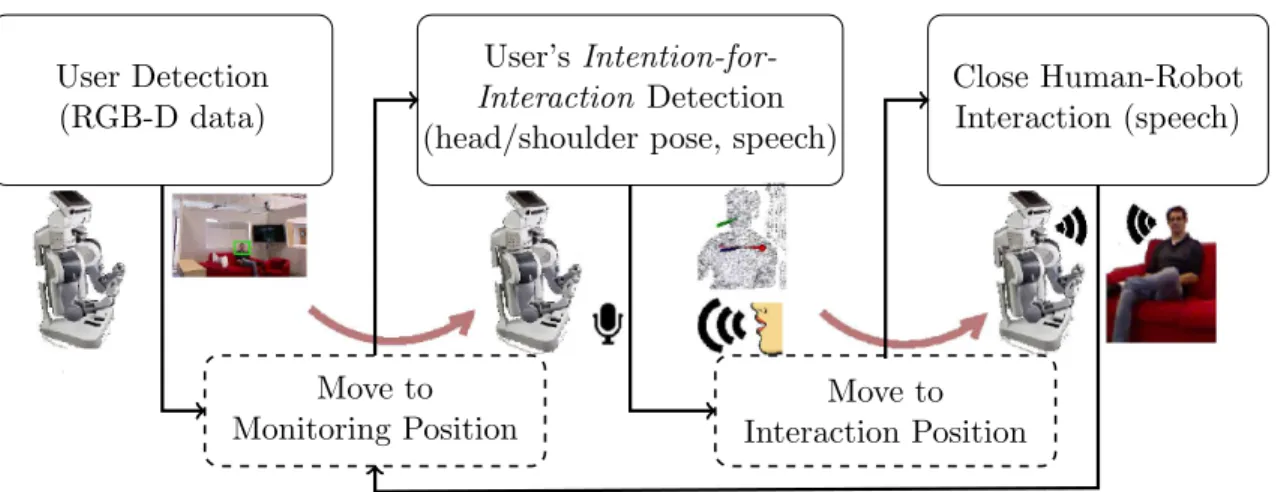
Fig. 1: Framework adopted to realize the complete non-intrusive autonomous assistive robotic system.
3. Complete System Overview
This work is based on the overall framework illustrated in Fig. 1. This framework is generic and can be applied to a whole range of scenarios involving HRI. It can be
summa-250
rized as follows: (1) Find the person in the environment; (2) Go to a predefined monitoring (garage) position and start monitoring the person; (3) Detect the person’s intention-for-interaction (desire to interact with the robot), e.g., name calling, directing gaze, etc.; (4) Approach this person, who becomes the user once intention has been detected, by moving to a convenient position for interaction; And (5) begin close Human-Robot interaction.
255
To elaborate further, first, similar to any system involving HRI, our framework begins by
finding the location of the user-to-be person. This is accomplished with the user detection
modality presented in Section 4. Once the robot has detected the person in the room, it does not start interaction directly as we are interested in a non-intrusive robotic behavior (see Section 1). It rather positions itself in a waiting area monitoring the activity of this
260
person. In our framework, the monitoring step aims to detect the user’s
intention-for-interaction, which is presented in Section 5. When detected, the robot approaches the person and starts the envisaged interaction routine described in Section 6. In Fig. 1, the steps involving robot motion (physical transition) are shown in dashed rectangles; the other blocks, which are also pictorially illustrated, involve some form of sensor driven multi-modal
265
perceptual activity. It goes without saying that the close HRI block is self looping unless explicitly stopped by the user, in which case the robot goes back to the monitoring state. As an instance of this framework, we illustrate a demonstrative application in Section 8 where this framework is used to help a user find various objects in the vicinity of the robot through primarily speech based interaction and knowledge about the user environment.
270
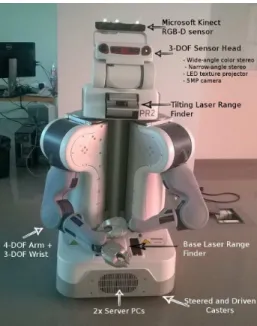
Throughout this work, we use the PR2 robot from Willow Garage Inc. shown in Fig. 2 as the target robotic platform. PR2 is a popular robot that has been used as a test bench by many robotic researchers all over the world. It is composed of an omnidirectional mobile base enabling its movements; two articulated arms; a telescopic spine; two laser sensors,
Fig. 2: The PR2 robot with part of its sensors and hardware information.
one tilting on the torso and another fixed on the base; a pan/tilt capable head; and many
275
more components (which are not listed here as they are not used in this work). The head features an RGB-D sensor (Kinect), two wide-angle color cameras, and two narrow-angle monochrome cameras. Its computing power relies primarily on two Quad-Core i7 Xeon
Processors (8 cores) with 24 GB RAM. The robot is equipped with a 1.3kWh lithium-ion
embedded battery pack that provides 2 hrs approximate runtime – this made cord-less
280
robotic runs possible during experimental sessions. We primarily use the Kinect RGB-D sensor mounted on it for user related perception. Audio data, in addition to the Kinect microphones, is captured using a Samsung Galaxy Note 2 smartphone (running Android 4.2). The smartphone communicates with PR2 via a common Wi-Fi network. Software-wise, our PR2 uses the Groovy instance of the Robotic Operating System (ROS) software
285
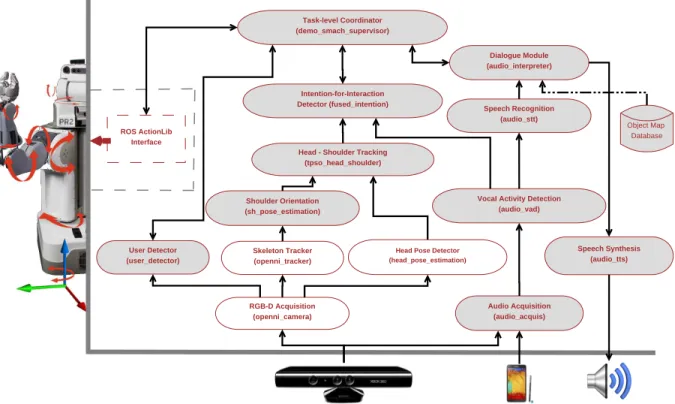
architecture [10]. Fig. 3 illustrates a ROS node based architecture of our perception driven assistive robotic system implementation.
Fig. 3 is presented here to provide a general idea of the overall system structure. Each rounded rectangle represents an individual ROS node with the arrows indicating the data flow between the different nodes. The shaded nodes correspond to the nodes we
imple-290
mented, either from scratch or as a wrapper on top of an existing classical implementation, and the rest denote publicly available implementations. The main perceptual modalities presented in this work rely on the Kinect sensor – RGB-D data for vision related percep-tions and audio data for speech related perceppercep-tions. The intention-for-interaction detector node, labeled “fused intention”, takes shoulder pose estimation, head pose estimation, and
295
the result of Voice Activity Detection (VAD) to measure the intention of the user. On the other hand, the dialogue module, “audio interpret” node, takes speech recognition results and gives the sought objects’ location information (with the help of the speech synthesizer module). The task coordinator, dubbed “demo smach supervisor” node, is the
Speech Synthesis (audio_tts) Vocal Activity Detection
(audio_vad)
Head Pose Detector (head_pose_estimation) Intention-for-Interaction Detector (fused_intention) Audio Acquisition (audio_acquis) RGB-D Acquisition (openni_camera) User Detector (user_detector) Dialogue Module (audio_interpreter) Task-level Coordinator (demo_smach_supervisor) ROS ActionLib Interface Speech Recognition (audio_stt) Shoulder Orientation (sh_pose_estimation) Skeleton Tracker (openni_tracker) Object Map Database
Head - Shoulder Tracking (tpso_head_shoulder)
Kinect Android Phone Speaker
Fig. 3: Illustration of the complete implemented system based on the ROS framework. Each rounded rectangle represents a standalone ROS node and the arrows indicate the message (data) passing pipeline. The shaded nodes correspond to the nodes we implemented or adapted and the rest denote publicly available implementations we utilized.
highest decision maker. It controls the execution of the different steps in the scenario along
300
with their transitions coherently. It acts as the main interface between the robot’s native software that controls its actuators and the developed modalities that leads to consistent coordination and execution of the envisaged scenario. It is worth mentioning here that the robot actually has native software architecture that carries the basic functionalities of an autonomous mobile robot. Some of these functionalities include accurate robot localization
305
within a given map, navigation, obstacle avoidance, system diagnosis, etc. Further details are provided in Section 7.
4. User Detection
As highlighted in Section 3, one requirement of the presented framework is the correct detection and localization of the user in the room. The user detection module should
310
be able to detect the user whether he/she is sitting on a chair or standing in an upright position. It should also be robust to partial body occlusions as much as possible. Even though during close interaction phases the distance between the robot and the user is less
farther distance than that, especially when the robot is initially looking for the user in a
315
room.
Primarily relying on the RGB-D sensor mounted on the robot, we have chosen to use a state-of-the-art upper body detector (head and shoulder) recently proposed by Jafari
et al. [23] with two main improvements. The original detector proposed in [23] has two components: an RGB-D data based upper body detector, and an RGB only full body
320
detector called groundHOG. The upper body detector detects close-by persons upto 5m –
the sensor’s depth operating range, but fails to detect people that are beyond this range. On the other hand, the complementary groundHOG, which is based on Dalal and Triggs HOG detector [18], detects people that are farther effectively – as a person’s full body will be in the camera Field Of View (FOV) – but fails to detect close-by people due to
325
possible cropped out (out of camera FOV) body parts (e.g., legs). Both detections are then directly combined and non-maximal suppression is applied to discard overlapping bounding boxes on the image plane. In this work, we use this combined detector by fur-ther making two important modifications: (1) we replace groundHOG with our optimized Binary Integer Programming (BIP) based full body detector (BIP-HOG) [47], and (2) we
330
employ a greedy data association algorithm [48] to combine the upper body and full body detections with real world spatial consistency. These modifications improve the overall detection performance as demonstrated in Section 8.3.1.
Depth Image Upper-body Detector [23] RGB Image Optimized BIP-HOG Detector [47] Fusion with Spatial Consistency Combined Detections
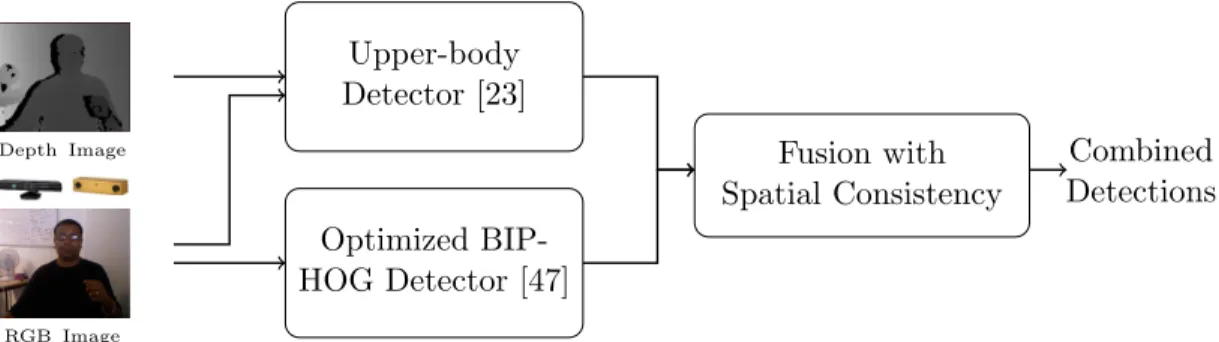
Fig. 4: Block diagram illustrating the utilized user detector.
Fig. 4 shows a block diagram of the combined detector. The upper body detector and the optimized BIP-HOG based detector are used to detect people in the environment
335
independently. Their detections are then combined to try to maximize the chance of detecting all people in the scene. The upper body detector [23] is based on a learned upper body template which is applied on incoming depth images in a sliding window mode. It computes a distance matrix consisting of the Euclidean distance between the template and each overlayed normalized depth image segment, labeling each window whose
340
normalized exponential distance score from the template is above a threshold as a positive instance. Rather than applying the template on all positions, the authors use different techniques to extract Region Of Interest (ROI) based on ground plane estimation and color image segmentation. This step filters out the majority of the image background reducing possible false alarms and speeding up detection rates. The optimized BIP-HOG
detector is a Graphical Processing Unit (GPU) implementation of our detector presented
in Mekonnen et al. [47]. This detector uses discrete optimization to select a subset of
HOG features in a cascade framework that leads to improved frame rate while maintaining comparable detection to the classical Dalal and Triggs HOG detector.
(u1, v1) ⋆ (ud, vd) (u2, v2) u v
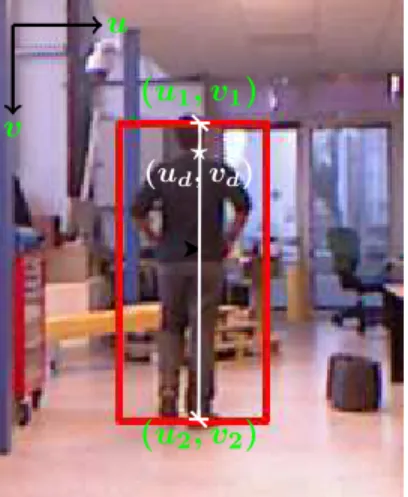
Fig. 5: Illustration of pixel coordinates used to determine an approximate 3D position of a BIP-HOG detection.
To clearly present the adopted fusion strategy in detail, let us denote all the detections
350
obtained from each detector as Dbip =
n
Dbip(k)oNbip
k=1 and Dub =
n
Dub(k)oNub
k=1, where the suffix
bip refers to BIP-HOG and ub for upper body detections. Nbip and Nub stand for the
number of detections from BIP-HOG and upper body respectively. Each detection D is
represented as{r,p, ϑ}, where r specifies the rectangular bounding box, pdenotes the 3D
position, and ϑ denotes the detection confidence score determined by the detector, of the
355
target. For example, for the kth detection D(k)
bip obtained using the BIP-HOG detector, it
is expressed as {r(bipk),p(bipk), ϑ(bipk)}. The r,p, and ϑ for the upper body detector are provided
by the detector (p corresponds to the 3D coordinate of the approximate head position
determined directly from the depth data). For BIP-HOG, r and ϑ are also provided by
the detector directly; to determine the corresponding values forp, we rely on the standard
360
camera calibration parameters (αu, αv, uo, vo [49]) and ahp = 1.75m average human height
assumption. First, given a detection bounding box r, we determine an approximate head
position in pixel corrdinate (ud, vd) by taking a fixed offset from the top bounding box
margin as shown in Fig. 5. Then, the approximate 3D position of the kth detection p(bipk)
(corresponding to the pixel (u(dk), vd(k))) is determined with the help of the assumed hp
365
using Eq. (1) (please cross reference relevant variables with Fig. 5). Finally, the fused
set of detections Df us =
n
Df us(k)oNf us
k=1 are determined by combining Dbip and Dup using
the greedy data association algorithm outlined in Algorithm 1. The algorithm merges all detections arising from the same spatial position and separately adds the rest if they seem reliable.
p(bipk) = x y z (k) bip = hp·αv v1(k)−v(2k) · u(dk)−uo αu v(dk)−vo αv 1 (1) Data: Dbip,Dub Result: Df us 1 Df us =∅,m∈ {1, ...,|Dbip|},n∈ {1, ...,|Dub|}
2 S(m, n): scores for each detection-detection (D(m)
bip ,D
(n)
ub ) pair
3 while Dbip6=∅ and Dup6=∅ do 4 (m∗, n∗) = arg min m,n S (m, n) 5 if S(m∗, n∗)< ρd then 6 d∗← {r(n ∗) ub ,p (n∗) ub , ϑ (m∗) bip +ϑ (n∗) ub } 7 Df us← {Df us∪d∗} 8 else 9 Df us← {Df us∪ D(n ∗) ub } 10 if p(m ∗) bip,z >5m then Df us← {Df us∪ D (m∗) bip } 11 end 12 Dbip← {Dbip\D(m ∗) bip },Dub← {Dub\D (n∗) ub } 13 end 14 while Dbip6=∅ do 15 if p(m) bip,z>5m then Df us← {Df us∪ D (m) bip } 16 Dbip← {Dbip\D(m) bip } 17 end 18 while Dup6=∅do 19 Df us← {Df us∪ D(n) ub },Dub← {Dub\D (n) ub } 20 end 21 return Df us
Algorithm 1: Algorithm for people detection fusion with spatial consistency.
Referring to Algorithm 1, the fusion algorithm begins by computing a distance score matrix S(m, n) for each detection-detection (Dbip(m),Dub(n)) pair as S(m, n) =kpbip(m)−p(ubn)k2
(line 2). Then two detectionsm∗ andn∗ with the least score are associated if their distance
score is less than the thresholdρd(lines 4-8). This associated detection is added to the set of
fused detections withrandptaken from the upper body detector and a detection score set
375
to the sum of the coupled detection scores. The corresponding detections are removed from
thebipandubdetection sets. If associated detections have scores higher than the threshold
(lines 8-12), the upper body detection is directly added to the fused detection set, whereas
the BIP-HOG detection is added only if it is farther than 5m – upper body is more reliable
in close range while BIP-HOG is not. Finally, all unassociated upper body detections are
380
only if they are farther than 5m (lines 14-20). Comparative experimental evaluation of this fused detector and its constituents is detailed in Section 8.3.1.
5. Intention-for-Interaction Detection
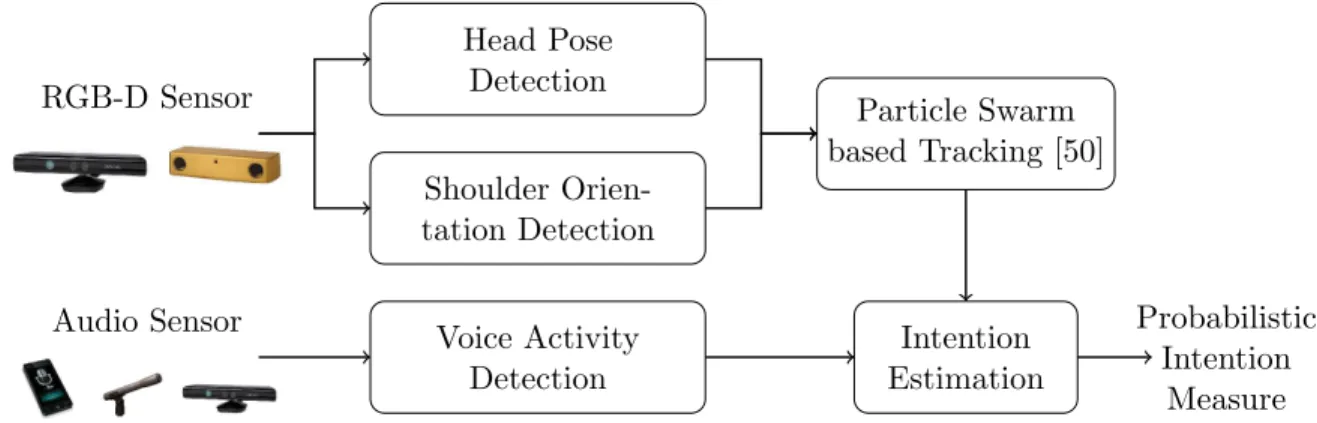
Fig. 6 shows a block diagram of the framework used to estimate user’s
intention-for-385
interaction using an RGB-D camera (e.g., Kinect, stereo rig) and an audio sensor (e.g., smartphone, tablet, microphone, etc.). It estimates the user’s intention based on three important cues: user’s line of sight – inferred from head pose; user’s anterior body direction – determined from shoulder orientation; and speech used to draw attention – captured via Voice Activity Detection (VAD). The head pose detection and shoulder orientation
390
detection modules rely on depth images. The detection outputs are further filtered using
a Particle Swarm Optimization inspired Tracker (PSOT) presented in Mollaret et al.[50].
Both the VAD and tracker output are considered as observation inputs and are fused to provide a probabilistic intention estimate using a Hidden Markov Model (HMM).
RGB-D Sensor Head Pose Detection Shoulder Orien-tation Detection Particle Swarm based Tracking [50]
Audio Sensor Voice Activity
Detection Intention Estimation Probabilistic Intention Measure
Fig. 6: Block diagram depicting the intention-for-interaction detection component.
xt−1 xt
z1
t−1 zt2−1 zt1 zt2
Fig. 7: Probabilistic graphical model used for intention estimation.
The probabilistic graphical model depicted in Fig. 7 illustrates the relationship between
395
the hidden variables, xt and xt−1, which are the intention indicators at time t and t−1
respectively, and the observation variables z1
t, zt2, zt1−1, and zt2−1. The intention indicator
observation variables z1
t, and zt2 are defined according to Eq. (2).
zt1 = θh φh θsh ; zt2 ∈ {vad,¬vad} (2) z1
t is a continuous vector-valued random variable that represents the head orientation
400
(head yaw θh and pitch φh) and shoulder orientation (shoulder yaw θsh) observations from
the particle swarm based tracker that provides estimated head pose (position and orien-tation) in space, and shoulder orientation with respect to the vertical plane of the camera
optical frame in space (yaw). z2
t, on the other hand, is a discrete random variable that
takes on either vad or ¬vad to represent the observation from the voice activity detection
405
module. Further description of these two observation variables along with their associated probability distributions are provided in Sections 5.1 and 5.2 respectively.
With the assumption that the observations are conditionally independent given the state (encoded in the graphical model in Fig. 7), and making use of Bayes rule, the posterior probability distribution over the state P (xt|Z1:t) given all measurements upto time t,Z1:t,
can be expressed with Eq. (3).
P(xt|Z1:t) =ηP z1t|xt P z2t|xt X xt−1 P(xt|xt−1)P(xt−1|Z1:t−1), (3)
where P(xt|xt−1) is the state transition (dynamics) distribution and η is a
normaliza-tion factor. Again here both x and z2 are discrete random variables that take on values
410
{intent,¬intent} and {vad,¬vad} respectively, whereas z1 takes on continuous values given the PSOT tracker output.
5.1. Head and Shoulder Pose Estimation
This observation is based on head pose estimation, shoulder orientation estimation, and particle swarm optimization based tracking for filtered estimates as explained in the
415
previous section.
Head Pose Estimation. This module is based on the work of Fanelli et al. [51] which for-mulates the pose estimation as a regression problem and uses random regression forests on depth images from an RGB-D sensor. This choice is motivated by regression forests capa-bility to handle large training datasets. The regression is based on difference of rectangular
420
patches resembling the generalized Haar-like features in [52]. The training is done using
the Biwi Kinect Head Pose Dataset [51]. The 6D state vector [x′
h,y′h,z′h, θ′h, φ′h, ψ′h]
T
contains the 3D head position and the three orientation angles relative to the sensor. The
claimed precision in the paper is 5.7o mean error in yaw estimation with 15.2o standard
deviation, and 5.1o mean error in pitch estimation with 4.9o standard deviation.
Addi-425
tionally, head pose is detected with a mean error of 13.4mm(±21.1mm).This mode works
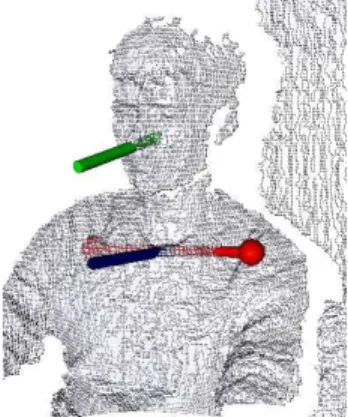
Fig. 8: The head pose is displayed with the green cylinder (head) on the point cloud, while shoulders are displayed in red and their orientation in dark blue (below the neck).
Shoulder Orientation Estimation. For this we primarily rely on OpenNI library [45] which provides a fitted skeleton model of the user based on the depth data. Then, using simple geometry, the user’s shoulder orientation is obtained by computing the vector between
430
the left and right shoulder joint pose determined from the fitted skeleton. The shoulder orientation is expressed with respect to the RGB-D sensor parallel optical plane providing
a yaw angleθ′shfor the tracking step. Illustrative estimated shoulder and head orientations
are displayed in Fig. 8. Following the Kinect – the specific RGB-D camera used in this work – characteristics and OpenNI library, the skeleton tracking algorithm works up to a
435
range of 4.0m.
The head and shoulder poses provided by the above two modules are computed frame by frame without any temporal link. It is also possible to have missing estimates from any of the modules at any times. To alleviate that and provide a smoothed continu-ous estimate, hence filtering, we make use of our PSOT tracker. Given head pose and
440
shoulder orientation in the form of sd= [x′h,y′h,z′h, θ′h, φ′h, ψ′h, θ′sh]
T
from the head pose
and shoulder orientation estimation modules at time frame t, PSOT is used to determine
spatio-temporal posterior point estimates (filtered estimates) of head pose and shoulder
orientation at time frame t with the state vector of the PSOT tracker represented as
s = [xh,yh,zh, θh, φh, ψh, θsh]
T
. The PSOT is a filter adapted from Particle Swarm
Opti-445
mization (PSO) [53] that combines interesting amenities of PSO with Particle Filter [54], namely state dynamic model for improved tracking performance. Contrary to PSO, there
is only one iteration of the PSOT at each time frame (there is no adaptive learning). It
has a linear complexity with the number of particles used (which is 150 in this work), and it does not need an expensive computing resource to work in real time. Also contrary
450
to other particle based algorithms, particles interact with each other with a social and
cognitive component in the update step. This behavior leads to a more efficient estimation of state as there is no particle degeneration phenomenon. For the head pose and shoul-der orientation estimation, the adopted tracker uses a random walk dynamic model and a multivariate Gaussian model with a diagonal covariance matrix as the observation model
455
The distributionP(z1
t|xt) is derived based on the tracker output, i.e., based onθh, φh, θsh
angles. These angles are represented in such a way that when the user is looking right into the optical frame with their anterior body oriented parallel to the image plane, all angles
are 0. With this in mind, P(z1
t|xt) is represented as a multivariate normal distribution,
460
i.e., P(z1
t|xt) =N (zt1; 0,Σ) with zt1 = [θh, φh, θsh]
T
. The covariance matrix Σ is a diagonal matrix; though not applied here, its values can be varied using the tracked head position.
5.2. Voice Activity Detection (VAD)
Audio signal is used for intention detection based on user voice activity detection. Users have the tendency to talk to a robot when they want its attention. Taking advantage of this,
465
we denote the onset of a voice activity as one indicator for user’s intention-for-interaction.
In this work we rely on the voice activity detection module from PocketSphinx C library3.
This algorithm is based on signal energy. It flags the given audio frame as containing speech elements if the signal energy is above a predefined threshold. Since signal energy is affected by the noise in the environment, the implementation in PocketSphinx does an
470
initial calibration stage so as to best separate signal from stationary noise using a statistical-based noise removal method. Depending on the environment ambient noise (robot noise
and room noise), the VAD is estimated properly up to 2m from the audio sensor.
The observation from the VAD module is represented by the random variablez2
t at time
t taking discrete values {vad,¬vad}. Since bothz2
t andxt take binary discrete values, the
475
associated likelihood distributionP(z2
t|xt) is simply represented by four probability values.
6. Close Human-Robot Interaction
During this phase, the human and the robot are engaged in basic interaction. The per-son asks for assistance, and the robot answers by providing a useful response or assistance. This phase is implemented by a static state machine dialogue module that manages the
480
interaction. Each specific question/request coming from the user can trigger transitions to different states leading to robotic service provision.
The close interaction is started when the user’s intention-for-interaction has been
de-tected. The interaction stops when the user explicitly tells the robot that he/she does not need it anymore, for example, by saying the French equivalents of, “thank you, goodbye!”,
485
“thank you, all is ok now”, “goodbye”, and the like. The robot then goes back to its
garage position and resumes the user’s monitoring state until the next user’s
intention-for-interaction is detected.
As an exemplar instance, we implement a scenario where the robot, upon specific in-quiry, helps to find objects that the user has forgotten. Hence, in this specific case the
490
goal of the dialogue is to retrieve targeted object. The basic semantic analysis is done by using keywords in the speech recognition hypothesis and a vote to find the preponderant meaning between the N-Best hypothesis from the interpretation. For example, if the
inter-pretation set is Is = [F IN D, F IN D, GREET, U N KN OW N, U N KOW N, F IN D], the
3
interpretation result will be equal to I =F IN D, moving the interaction to the next state
495
accordingly. The verbal answer will be given to the user by the Google Text To Speech API which contains a set of predefined sentences.
Our contributions in this part do not lie in the interaction per se, but in the improvement of the user’s perception by using multiple input audio streams and multiple ASR systems. In this work, we use the CMU API PocketSphinx and the Google Speech API as ASR
500
systems. We also use two microphones: the embedded microphone of the Kinect sensor, and the microphone from a Samsung Galaxy Note 2 smartphone. We create four combinations of microphone/ASR system, but the global framework could easily be generalized to more combinations with the addition of more microphones or ASR systems. Based on the work of [46], a fusion framework is created as the Bayesian network model illustrated in Fig. 9.
505
The idea is that, for each set of distances d between the user and the microphones, and
for each set of hypothesis U coming from each combination, we want to find the best
combination S. This is illustrated by Eq. (4) where P(S|d, U) represents the probability
of the combination S being the most reliable knowing the distances and the hypothesis.
P(S|d) stands for the probability of the combinationS being the most reliable knowing the
510
distances alone, and [US 6=∅] represents the presence of a hypothesis for the combination
S. [US 6=∅] = 1 if there is a hypothesis or [US 6=∅] = 0 otherwise.
d
U
S
Fig. 9: Bayesian network for homogeneous fusion. argmax
S
(P(S|d, U))∝argmax S
(P(S|d)[US 6=∅]) (4)
In order to dynamically select the best combination S given the user distances and
the hypothesis, we first learn the density P(S|d) which is inversely proportional to the
Word Error Rate (WER) function of the distance. This measure will be further explained
515
in Section 8.2. The density is learned with the dataset presented in Section 8.1 and the
WER values are interpolated using a 3rd degree polynomial. This density is then used in
Algorithm 2, which is an implementation of the Bayesian network previously described.
7. Task-level Coordination and Implementation Details
Deploying the complete system described in this paper on a robotic platform is a
com-520
plex task which needs a coordinating tool to start and stop services whenever required and to make transitions between different services smoothly with proper exception prop-agation. These different services could be thought of as individual robotic tasks that can
1 Result: argmax
S
(P(S|d, U))=Fusion(d, U, P(S|d))
2 Pmax = 0
3 for each system S do
4 Compute [US 6=∅] 5 Compute P(S|d, U)∝P(S|d)[US 6=∅] 6 if P(S|d, U)> Pmax then 7 Pmax=P(S|d, U) 8 end 9 end 10 Compute S =argmax S (P(S|d, U)) 11 return S
Algorithm 2:Fusion algorithm based on a Bayesian network for homogeneous fusion.
Fig. 10: Visualization of the task-level coordination state machine constructed using
smach [55]. Each shaded state machine is a container by itself (consisting of a sub state machine), the outputs of which are shown in red rectangular blocks.
be coordinated to create and launch a complete working robotic demo. For example, in this work, user detection, user’s intention detection, human-robot interaction, and robot
525
control (robot movement or specific joint control) can make up individual tasks. A popular
tool, especially for ROS based systems, adopted here is smach [55]. Smach is a task-level
architecture for rapidly creating complex robot behavior that has been successfully used in many robotic applications, e.g., [58, 59]. The complete system spanning from user de-tection to human-robot interaction is coordinated via different state containers including
530
finite state machines, concurrent state machines, and action state machines. The concur-rent state machine, for example, is used to launch the user detector action in parallel with a robot head pan action to scan the room for possible presence of a person, assuming the person is not obscured by any furniture in the environment. Fig. 10 shows a trimmed down
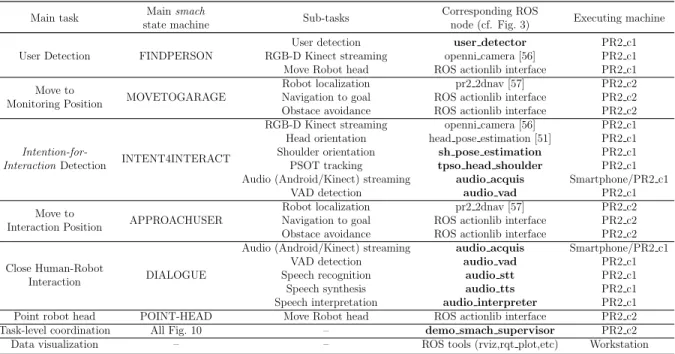
Table 1: List of the main tasks and associated sub-tasks deployed to realize the assistive robotic system presented. Boldface nodes indicate the ones developed in this work.
Main task state machineMainsmach Sub-tasks Corresponding ROSnode (cf. Fig. 3) Executing machine
User Detection FINDPERSON
User detection user detector PR2 c1
RGB-D Kinect streaming openni camera [56] PR2 c1 Move Robot head ROS actionlib interface PR2 c1 Move to
Monitoring Position MOVETOGARAGE
Robot localization pr2 2dnav [57] PR2 c2
Navigation to goal ROS actionlib interface PR2 c2 Obstace avoidance ROS actionlib interface PR2 c2
Intention-for-InteractionDetection INTENT4INTERACT
RGB-D Kinect streaming openni camera [56] PR2 c1 Head orientation head pose estimation [51] PR2 c1 Shoulder orientation sh pose estimation PR2 c1
PSOT tracking tpso head shoulder PR2 c1
Audio (Android/Kinect) streaming audio acquis Smartphone/PR2 c1
VAD detection audio vad PR2 c1
Move to
Interaction Position APPROACHUSER
Robot localization pr2 2dnav [57] PR2 c2
Navigation to goal ROS actionlib interface PR2 c2 Obstace avoidance ROS actionlib interface PR2 c2 Close Human-Robot
Interaction DIALOGUE
Audio (Android/Kinect) streaming audio acquis Smartphone/PR2 c1
VAD detection audio vad PR2 c1
Speech recognition audio stt PR2 c1
Speech synthesis audio tts PR2 c1
Speech interpretation audio interpreter PR2 c1 Point robot head POINT-HEAD Move Robot head ROS actionlib interface PR2 c2
Task-level coordination All Fig. 10 – demo smach supervisor PR2 c2
Data visualization – – ROS tools (rviz,rqt plot,etc) Workstation
version (without subtle intermediary states that make adjustment for detected user
loca-535
tion) of thesmach based state machine for this specific application. The ‘FINDPERSON’
concurrent machine handles the search for user in the room, and the ‘DIALOGUE’ state machine shows a representation of the different states in the close HRI interaction geared by a to-and-fro dialogue.
The main tasks and associated sub-tasks are categorized and listed in Table 1. Each
540
main task has an associated smach state machine shown in Fig. 10. The sub-tasks
rep-resented as ROS node implementations are also shown (cross reference with Fig. 3). The boldface nodes indicate the ones developed in line with this work, while the rest are pub-licly available implementations. The main components of our framework, as presented in
Section 3, have corresponding smach state machines labeled as FINDPERSON,
MOVE-545
TOGARAGE, INTENT4INTERACT, APPROACHUSER, and DIALOGUE respectively. The POINT-HEAD state machine is an intermediary state used to point the head of the robot towards the person before the INTENT4INTERACT and DIALOGUE phases. The corresponding sub-tasks are also detailed clearly showing the link with the corresponding ROS node. For all the robot actions that involve an actuator (robot motion, head
move-550
ment), the ROS actionlib interface specifically developed for the PR2 is used [60]. All the modules presented in Table 1 execute across four heterogeneous machines: two Intel(R) Quad-Core i7 Xeon machines on the PR2 (PR2 c1 and PR2 c2), an Intel(R) Core(TM) i7-2720QM workstation, and a Samsung Galaxy Note 2 smartphone, thanks to ROS’s abstraction that enables seamless TCP/IP communication between these machines. The
555
the workstation is connected via a fixed network cable. In the current implementation, the position of the objects are assumed to be known a priori. This information is stored in the Object Map Database. It contains the position of the various objects in the environment, for example, as “The remote is under the table”. For improved and more realistic scenarios,
560
it will suffice just to update this database with information of detected objects should an automated object detection module become available in the future.
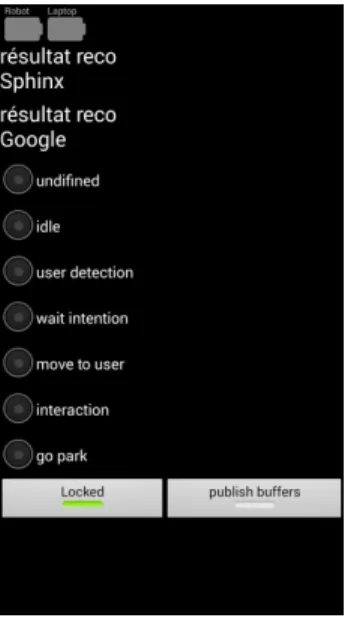
Regarding the audio data from the smartphone, the real-time audio signal used by the ASR system is streamed to the robot from an Android application. This application is
developed in the context of this work using therosjava Android build tool [61] to both use
565
the phone as an input device and a debugging tool when operating the robot. Therefore, the smartphone can be used to visualize the speech recognition hypothesis and the current state of the robot. The audio is streamed to the network with 512 sample buffers of 16bits quantization level. A lock button is set to prevent any unwanted touches on the screen (e.g., from stopping the audio stream accidentally). A screen snapshot of the Android
570
application user interface is shown in Fig. 11.
Fig. 11: A screen snapshot of the developed Android application user interface.
8. Experiments and Results
This section presents the different experimental evaluations carried out to validate and demonstrate the proposed multi-modal perception driven assistive robotic framework along with the obtained results. It is categorized under four headings: (1) the various
575
datasets used for evaluation in Section 8.1; (2) the adopted standard evaluation metrics in Section 8.2; (3) details of the obtained results in Section 8.3; and (4) the conducted user study along with analysis of observations made therein in Section 8.4.
8.1. Datasets
The various components of the presented system rely on multi-modal data acquired
580
using a Kinect sensor (RGB-D and audio) and an Android mobile device (audio). Due to the multi-modal nature and hence the difficulty in finding a public dataset tailored for our application, we have used several proprietary datasets. The datasets include RGB-D image frames for user detection, combined RGB-D and audio for intention detection, and audio only for the speech recognition part. All the datasets described in this section are
585
purposely collected by us for consequent experimental evaluations. Table 2 summarizes the ones used for evaluating the user detection, and intention detection components. Table 2: Summary of the different datasets used for evaluating user detection, tracker precision, and intention detection components. A partial view of the cluttered robotic lab-1 is shown in Fig. lab-14, and that of the cluttered robotics lab-2 in Figs. lab-15 (bottom row), lab-19, and 20. The cluttered office scene is shown in Fig. 15 (top row).
Name Mode Image frames Duration Max persons Ground truth Environment
UserDet-DT RGB-D 235 — 4 Manual annotation Cluttered robotic lab-1
Intent-DT1 RGB-D + Audio 4230 141s 1 Manual annotation Cluttered office
Intent-DT2 RGB-D + Audio 3930 131s 1 Manual annotation Cluttered robotic lab-2
Intent-DT3 RGB-D + Audio 3180 106s 1 Manual annotation Cluttered robotic lab-2
User Detection Dataset (UserDet-DT). To evaluate the user detection module, we use a proprietary RGB-D dataset consisting of 235 image frames intermittently acquired using a Kinect sensor mounted on our mobile robot in our robotic lab (cluttered robotic lab-1 in
590
Table 2). Each frame of the dataset contains at least one person, the majority contain two persons, and a few image frames feature four persons (the maximum number of persons per image frame). In terms of detection targets, there are a total of 521 target occurrences
out of which 182 are situated farther than 5m from the Kinect sensor. Even though
the application context in this work is single user detection, we evaluate the detection
595
module with this dataset containing multiple persons per image frame to characterize its detection capability thoroughly as is done in standard people detection literature [16]. This will increase the chance of testing the detector under broadly varying conditions, e.g., inter-person occlusions, deformations due to articulations, and different person postures (walking, sitting, standing, etc.). Additionally, it will help demonstrate its capability and
600
potential to be used in multi-user scenarios. The dataset is manually annotated to create a complete ground truth by delineating each person in each image frame with rectangular bounding boxes.
Intention Evaluation Dataset (Intent-DT). For user’s intention detection evaluation, we acquire three separate datasets: Intent-DT1, Intent-DT2, and Intent-DT3. Intent-DT1 is
605
acquired merely in an office setting using a standalone Kinect and smartphone, whereas the other two, Intent-DT2 and Intent-DT3, are acquired using the PR2 in a robotic exper-imental area. Their lengths vary between 3180 and 4230 image frames (acquired at 30 fps).
The datasets constitute of RGB-D and audio streams. In all cases, the user seats at an
approximate distance of 1.5m to 2m from the RGB-D sensor and demonstrates
intention-610
for-interaction by facing the Kinect sensor and/or speaking. The datasets are manually annotated to mark intention active regions with the help of the user.
Speech Recognition Evaluation Dataset. To evaluate the microphone/speech recognition API fusion framework, a proprietary dataset (corpus) was collected dedicated to this study involving four speakers. In this corpus, each participant utters 17 French sentences that
615
have been selected to fit out HRI context repeatedly. Each sentence is repeated three times
by each of the four speakers at four different distances: 10cm, 50cm, 1m, and 2m. To
further clarify, during the acquisition session, the same speaker repeats the same sentence a total of 12 times, leading to 204 sentences per speaker. When the user/microphone distance is greater than two meters, the Word Error Rate (WER), see Section 8.2, usually
620
reaches a maximum and no hypothesis is produced by any combination. The acquisition is iterated with a total of four speakers. All in all, this dataset contains 17 sentences uttered 12 times by four speakers – resulting in 816 total number of recorded sentences spanning a total time of 34’03”.
8.2. Evaluation Metrics
625
To quantify the performance of the different perceptual blocks utilized in this work, we make use of various well established metrics.
User Detector Performance. To evaluate the performance of the user detector, we use Miss
Rate (MR) and average False Positives Per Image (FPPI) metrics as defined in Eqs. (5)
and (6) respectively. Both the MR and FPPI are the most widely established evaluation
630
metrics in people detection [16]. MR indicates the proportion of people not detected in
the entire dataset (it is “1−True Positive Rate”). FPPI on the other hand indicates the
false positives averaged over the total number of image frames – it signifies how many false positives are likely to occur when applied on a new image frame.
MR= 1− Nf X i=1 TPi TPi+FNi (5) 635 FPPI= 1 Nf Nf X i=1 FPi (6)
In these Eqs. (5) and (6), i represents the image frame, Nf the total number of image
frames in the dataset, and TPi,FPi,FNi denote True Positives, False Positives, and False
Negatives at the ith test image frame respectively. The evaluation generally results in
an MR – FPPI plot in log-log scale that is generated by varying the threshold (ϑo) on
the final detector score ϑ. For example, increasing the threshold ϑo will increase the MR,
640
less windows will be detected, but it also reduces the number of false positives (hence the
detector. To summarize the performance of the detector, the log-average miss rate is used.
It is computed by averaging miss rate at nine FPPI rates evenly spaced in log-space in the
range 10−2 to 100 (for curves that end before reaching a given FPPI rate, the minimum
645
miss rate achieved is used) [16].
Intention Evaluation. The final inference engine of the intention-for-interaction is based on an HMM. Hence, to quantify its detection performance, we make use of various metrics mostly used in HMM applications in the literature (e.g., [62]) listed below. For easier mathematical notation, let us represent the different measures as follows: let us define
650
the indicator function I(x,y) in Eq. (7) assuming x,y ∈ {intent,¬intent} to be used to flag a true positive, a false positive, and a true negative. Let It,Gt ∈ {intent,¬intent}
represent the intention label assigned by the intention detection module and the ground
truth intention label at time frame t respectively. Let T represent the entire length of the
evaluation dataset which consists of Tintent = {Tintent,j}
NIT
j=1 and T¬intent = {T¬intent,j} NNT j=1
655
disjoint spans where there is and there is no user intention in the ground truth annotation
respectively. NIT is the total number of such spans where there is user intention, and NNT is
the total number of such spans where is no intention. The|.|indicates the duration of a time span, e.g., |Tintent,j| is the duration of the jth intention marked time span. Consequently,
T=Tintent∪T¬intent is satisfied. Finally, let the setJ∗ stand to represent the set of indexes
660
of such time spans where an intention is correctly detected at some point in the span, i.e.,
J∗ ={j|P
t∈Tintent,jI(It,Gt)>0}.
I(x,y) =
(
1, if x =intent and y=intent
0, otherwise (7)
• True Positive Rate (TPR): It is defined as the ratio of correct intention detection (in
accordance with the ground truth) to that of total intention tagged (Gt = intent)
data frames. It is formally expressed using Eq. (8).
665 TPR= 1 P t∈TI(Gt,Gt) X t∈T I(It,Gt) (8)
• False Alarm Rate (FAR): It is the ratio of the number of observation data frames for
which the detection output flags an intention where there is none in the ground truth, to that of the total number of no intention data frames as described with Eq. (9).
FAR = 1 P t∈TI(¬Gt,¬Gt) X t∈T I(It,¬Gt) (9)
• Average Early Detection (AED): Given an observation span j labeled with intent,
Tintent,j, the early detection time is the discrete time td,j the system took to correctly
670
early detection time over all correctly detected intentions. UsingJ∗, the AEDcan be expressed as in Eq. (10). AED=X j∈J∗ td,j |Tintent,j| (10)
• Average Correct Duration (ACD): It is defined in a similar fashion as AED, but
instead considers the correctly detected intention duration. If cd,j represents the
675
discrete time span (duration) through which an intention is correctly detected, the
ACDis determined by averaging over all correctly detected intentions as in Eq. (11).
ACD=X
j∈J∗
cd,j
|Tintent,j|
(11)
Speech Recognition. The evaluation of the speech recognition module is based on the Word
Error Rate (WER) metric. The classic Word Error Rate (WER) is defined by: W ER =
S+D+I
N where S is the number of word substitutions, D is the number of word deletions, I
680
is the number of word insertions and N is the number of words in the reference.
In order to learn P(S|d) that is used by the fusion Algorithm 2, the WER of each
combination function of the distance is first learned. Two sets of metrics are defined and computed on the dataset presented in Section 8.1 (predefined sentences uttered at different
distances) used for the P(S|d) estimation. These metrics are presented below.
685
• total WER (T-WER): in this case, the WER is computed for all utterances, even if
there is no hypothesis found by a speech recognition API. This is the classic mean WER. This metric is used to compare different systems.
• utterance WER (U-WER): in this case, the WER is computed for all utterances, only
if there are hypotheses found, which means that when nothing has been recognized,
690
the hypothesis is discarded. This can be seen as the precision of the recognition of a speech recognition API. This metric is used to learn the mapping matrix.
Considering the N-Best results of each combination, we defined 3 sub-categories of metrics for T-WER and U-WER.
• “best WER”: represents the mean WER computed considering hypotheses with the
695
smallest WER of each spoken sentence.
• “worst WER”: represents the mean WER computed considering hypotheses with the
highest WER of each spoken sentence.
• “likely WER”: represents the mean WER computed considering hypotheses with the
highest likelihood from each spoken sentence,i.e., the first of the N-Best hypothesis.
![Fig. 10: Visualization of the task-level coordination state machine constructed using smach [55]](https://thumb-us.123doks.com/thumbv2/123dok_us/812334.2602715/20.918.107.793.164.442/visualization-level-coordination-state-machine-constructed-using-smach.webp)