M
odeling
N
on
-S
tandard
T
ext
C
lassification
T
asks
Faculty of Media
Bauhaus-Universität Weimar
Germany
Dissertation of
Nedim Lipka
To obtain the academic degree of
Dr. rer. nat.
Advisor:
Prof. Dr. Benno Stein
Reviewer:
Dr. James G. Shanahan
Contents
Abstract v Notation vii 1 Introduction 1 1.1 Thesis structure . . . 3 1.2 Contributions . . . 62 The history of text classification 11 2.1 Who is speaking . . . 12
2.2 What is the text about . . . 15
2.3 To whom is the text addressed . . . 16
2.4 Which channel is used . . . 17
2.5 What is the effect of the text . . . 17
2.6 A comprehensive task: Web genre analysis . . . 19
3 Supervised learning 23 3.1 An explanatory model of generalization: inductive bias . . . 23
3.2 Inductive biases of common learning algorithms . . . 28
3.3 Optimization for learning algorithms . . . 29
3.4 Evaluation of text classification solutions . . . 34
4 Feature engineering for non-standard text classification tasks 37 4.1 Co-stems in non-standard text classification tasks . . . 38
4.2 Core-vocabularies in Web genre analyses . . . 45
4.3 N-grams in information quality analyses . . . 55
4.4 N-grams in short text language identification . . . 59
4.5 Function words in authorship verification analyses . . . 63
4.6 Style markers in intrinsic plagiarism analyses . . . 67
4.7 Bibliography . . . 79
5 Towards effective text classification in the wild 83 5.1 Improving generalization capabilities via robust feature engineering 84 5.2 Sampling informative examples via advanced active learning . . 89
5.3 Learning target classes via one-class classification . . . 95
5.4 Improving one-class classification via ensembles . . . 100
6 Model selection for text classification in the wild 107
6.1 Expected effectiveness under subclass distribution shifts . . . 109
6.2 An expected effectiveness estimate . . . 110
6.3 An expected effectiveness heuristic . . . 111
6.4 Model selection via expected effectiveness . . . 114
6.5 Validation of prior assumptions . . . 115
6.6 Application and conclusions . . . 118
6.7 Bibliography . . . 120
7 Conclusions 123
Abstract
Text classification deals with discovering knowledge in texts and is used for extracting, filtering, or retrieving information in streams and collections. The discovery of knowledge is operationalized bymodeling text classification tasks, which is mainly a human-driven engineering process. The outcome of this pro-cess, a text classification model, is used to inductively learn a text classification solution from a priori classified examples. The building blocks of modeling text classification tasks cover four aspects:
(1) the way examples are represented (2) the way examples are selected
(3) the way classifiers learn from examples (4) the way models are selected
The goal of this thesis is to explore methods that improve the prediction quality of text classification solutions for unseen examples, especially for non-standard tasks where standard models do not fit. In what follows, I will summarize my original contributions, sorted by the aforementioned aspects of modeling: (1) The number of text classification tasks beyond topical categorization in-creased in the last decade. This thesis proposes topic-orthogonal representations for a great deal of these tasks.1
(2) In general, a classifier is trained on labeled examples that are sampled from the text population of a given task. Sampling influences the effectiveness of the resulting classifier. This thesis examines a new active learning strategy that goes beyond standard sampling.
(3) The majority of non-standard text classification tasks suffer from the fact that in a real-world scenario (“in the wild”) examples occur that are not represented by the training sample. With a sample that represents at least the target class, a one-class classifier can be trained. This thesis proposes one-class ensembles for improving the one-class classification effectiveness.
(4) The classification of texts drawn from the Web introduces nontrivial problems such as unknown class balances, mislabeled training examples, and drifts of the underlying target concepts. This thesis proposes a model selection framework to cope with the resulting subclass distribution shifts.
1The paper on the new representation “co-stems” was nominated for the best paper award at
Notation
Elements & Sets
D population of documents
d ∈ D document (an unstructured text unless otherwise mentioned) Y ={+1,−1}(binary) class scheme
y ∈Y class label
D population of feature vectors
d ∈ D feature vector that represents the documentd
S ∈2D sample of feature vectors (2D denotes the power set of D)
Classification
c : D →Y target concept or ground truth
α : D→D feature engineering function β: D→ {0, 1}sampling strategy
h: D→Y classifier or hypothesis
L: 2D →H learning algorithm (2D denotes the power set of D)
H hypothesis space
T= (D,Y) text classification task M = (α,β,L) text classification model m = (α,h) text classification solution
NB naïve bayes classifier
SVM support vector machine
Probability
X random variable that models the document distribution over D
Y random variable that models the class distribution overY
H random variable that models the hypothesis distribution over H
E expected value P probability Effectiveness measures Acc accuracy F F-measure P, Prec precision R, Rec recall
AUC area under ROC curve
Chapter 1
Introduction
This thesis deals with technologies for automatic text classification based on machine learning and aims to improve the effectiveness of classifying unseen texts. The focus is on non-standard text classification tasks.
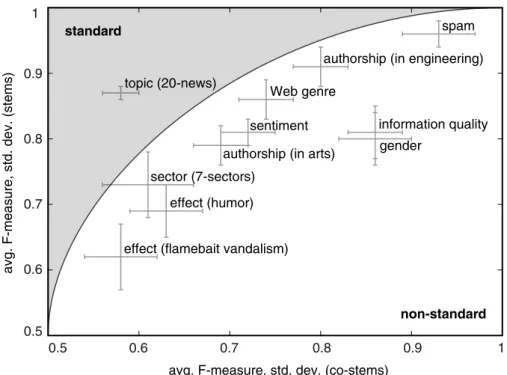
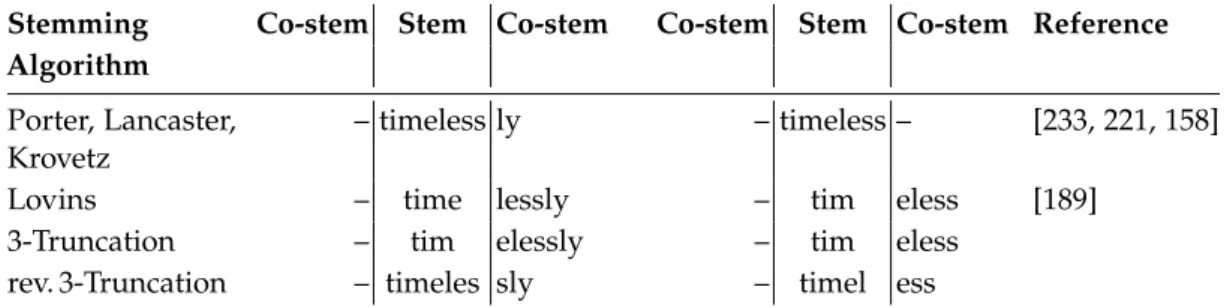
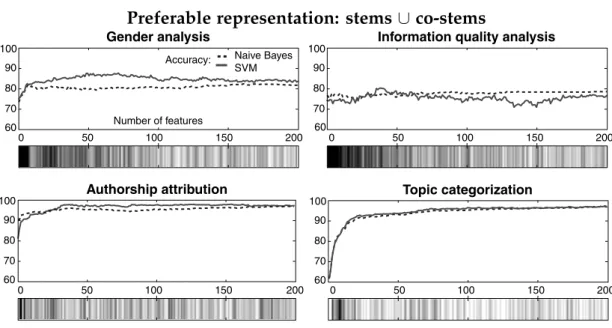
We call a task “non-standard” if the classification goes beyond the texts subjects and a machine learning algorithm cannot generalize under bag-of-words models. A bag-of-words model is a common text representation that reduces texts to an unordered collection of words and utilizes the word frequencies as features. Figure 1.1 shows a variety of non-standard text classification tasks. It shows the effectivenesses of a classifier in terms of the F-measure when bag of words (stems) and a complementary representation (co-stems) are employed. To illustrate the difference of these representations consider for example the word “timelessly”, which is either represented by its stem “time” or by its co-stem “lessly”. Tasks on the diagonal in the figure perform equally well under both representations; however, the complementary representation is independent of the content of the texts and is preferred because of the resulting generality. Therefore, tasks near the diagonal are referred to as non-standard. Typical standard tasks are found in the upper left of the figure, whereby a bag-of-words model is sufficient to achieve a high effectiveness. Topic categorization, for example, classifying news articles from the 20 Newsgroups corpus by their topic, is clearly a standard task in contrast to many other tasks in the figure. Non-standard text classification tasks provide clues about in-depth knowledge such as
• authorship, • author’s gender,
• effects (is the text humorous, an act of vandalism, spam), • sentiment,
• genre, • sector, or
• information quality.
Improving the effectiveness of non-standard tasks has a high impact on several applications. The information age reclaims filtering, extraction, and retrieval
avg. F-measure, std. dev. (stems)
avg. F-measure, std. dev. (co-stems)
0.5 0.6 0.7 0.8 0.9 1 0.5 0.6 0.7 0.8 0.9 1 sector (7-sectors) topic (20-news)
authorship (in arts)
authorship (in engineering)
gender Web genre
effect (humor)
sentiment
effect (flamebait vandalism)
spam
information quality standard
non-standard
Figure 1.1:The figure presents a landscape of text classification tasks mostly considered to be non-standard. The axes show the averaged effectiveness of a linear support vector machine classifier under different text representations: (1) a standard bag-of-words representation with word stems on the y-axis and (2) the complementary representation on the x-axis. The complementary representation is based on the residuals if the word stems are removed from the text; therefore, topic information is excluded. The co-stem of the word “timelessly” is “lessly”.
applications to satisfy the society’s thirst for knowledge and to gain insights used as intermediate inputs or as final results in (big) data mining processes. These applications need to handle unstructured texts, which are a substantial source of information in the Web. Common examples are authorship and Web genre analyses. Authorship analysis is a tool for forensic linguistics, which helps to verify claims of responsibility, confessions, wills, or to identify plagiarism offenses. In particular, plagiarism identification requires a high degree of automation; the number of suspicious texts is growing since publishing in the Web and reusing content is easier than ever. Web genre analysis is applied for filtering blog, news, or scientific articles and the like; the number of these applications is growing and they are no niche products anymore. It should be noted that the results of genre analyses can also be reused as metadata to improve the ranking effectiveness of vertical search engines. This applies in general for text classification, and our leitmotif is:
“The more knowledge exists about a text, the higher is the potential of filtering, extracting, or retrieving it.”
While the loss of information that occurs under bag of words, namely the order of words, is not decisive, bag of words misses to unveil deeper text characteristics to the classifier. As an unintended consequence a different target concept is learned; classifiers with a bag-of-words representation are likely to
1.1 Thesis structure 3
become topic-, domain-, or time-dependent and do not generalize beyond these bounds. For example, a classifier that is trained to distinguish between authors through a bag-of-words lens implicitly learns to distinguish between the topics in the training sample (texts that are given to the learning algorithm) instead of unveiling the authors’ writing styles.
In addition to the employed model of text representation, the training sample takes an important role and decides on the appropriateness of learning algo-rithms. A training sample has to be representative for the population of texts and the target concept. The representativeness is compromised by the following aspects, which also characterize non-standard tasks:
• lack of target or complementary examples and open classes • unknown class balances and drifting target concepts
If only the target class is properly represented in the training sample but not the complementary class, a standard learning algorithm is not able to evaluate the class boundaries. This applies in a similar way to the reverse case, namely, highly imbalanced classes where the target class makes up a small fraction of the training sample. If the class balance is unknown or if the target concept is open, the entire training sample becomes questionable.
When unseen texts are to be classified, standard classification approaches often make unreliable decisions in non-standard tasks because of two difficulties: (1) the classifier has no support, that is, training examples with high similarities to the unseen texts are not available, and therefore its confidence estimation fails, and (2) a different concept might have been learned.
This dissertation is endeavoring to address these problems in non-standard text classification, which are rooted in the text representation and the training sample. Sophisticated models are proposed that capture the gist of non-standard tasks and that have the capability to generalize. In summary, bag of words holds the risk of deluding the learning algorithm for particular tasks, moreover, it is difficult diagnosing this risk with standard evaluation methods, such as leave-n-out validation. Therefore, appropriate experimental evaluations are proposed. Furthermore, difficulties that result from the training samples are approached by proposing strategies for feature engineering (the creation of text representations), sampling (the creation of training samples), learning (the creation of text classifiers), and evaluating text classification solutions.
1.1 Thesis structure
Text classification deals (1) with the discovery of knowledge in texts and (2) with the application of this knowledge for extracting, filtering, or retrieving informa-tion in text streams or collecinforma-tions.
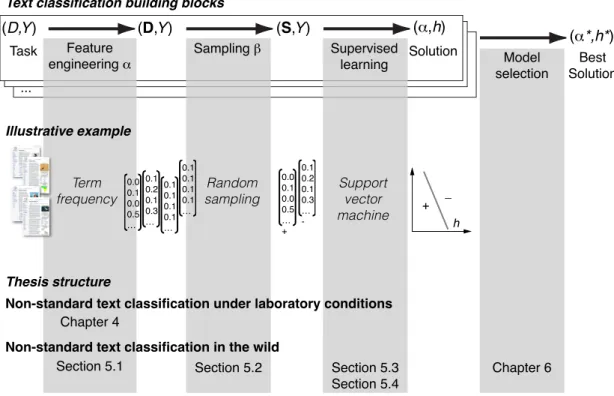
(D,Y) (D,Y) (S,Y) Task (α,h) Solution Section 5.1 Chapter 4 (α*,h*) Best Solution Chapter 6 Section 5.2 Section 5.3 Section 5.4 Text classification building blocks
Non-standard text classification under laboratory conditions Non-standard text classification in the wild
...
Feature
engineering α Sampling Supervisedlearning β Model selection … D 0.1 0.1 0.1 0.1 … 0.1 0.2 0.1 0.3 … 0.1 0.1 0.1 0.1 … 0.0 0.1 0.0 0.5 … 0.1 0.2 0.1 0.3 … -0.0 0.1 0.0 0.5 … + + _ h Illustrative example Term
frequency samplingRandom Supportvector
machine
Thesis structure
Figure 1.2:The figure shows the building blocks for text classification (feature engineer-ing, samplengineer-ing, supervised learnengineer-ing, model selection), which also represent the structure of this thesis. As illustrative example, consider the text classification task(D,Y)that comprises the population D of Wikipedia articles and the class scheme Y with the classes “+, featured articles” and “-, non-featured articles”. The articles are represented under a bag-of-words model and a training sample is randomly drawn from Wikipedia. A support vector machine is trained on the labeled training sample.
(1) The kind and the source of knowledge to be discovered are encoded by a text classification task. A text classification task T, T = (D,Y), comprises a population D, the source of knowledge, and a class scheme Y, the kind of knowledge. The population comprises the texts that are or will be considered during classification. Often, only little information exist concerning D. The class scheme specifies a partition concept, regarding topics, authors, genres, and the like. The so-called target concept c is a generally unknown function that correctly maps the population to the class scheme.
Discovering knowledge is implemented by finding a hypothesis (or classifier)h that is a close approximation of the target concept. A learning algorithm L, which is also known as classifier, induces h from a sample of examples, for which the class membership is known. This induction is known as supervised learning or simply training. For learning from examples, two further functions are needed: a feature engineering function α, which maps a text to the input
format of Land a sampling functionβ, which implements a strategy for selecting
examples from D.
(2) The application of knowledge, in terms of classifying texts, is implemented by a text classification solution of T. A solution m= (α,h) comprises a feature
1.1 Thesis structure 5
engineering function α and a classifier h. A text is classified by m as follows: α is employed for representing the text andhis employed for predicting its class
value.1
The process of modeling T is on the “how” of the discovery and the application of knowledge. Modeling is regarded as the process of specifying a model M = (α,β,L) that is used for building automatically a solution for T. Informally,
modeling is on exploring how examples are represented, how they are selected for training, and how one learns a classifier from them. This is an ambiguous undertaking. The engineer has to gain an understanding of the task at the level of a domain expert along with a profound understanding of machine learning since, most important, the feature engineering α and sampling βneed
to support the learning algorithm L. Furthermore, the engineer designs and chooses appropriate experiments and measures so that model selection can be applied to find effective solutions for T. Modeling starts either in a top down or bottom up fashion and continues iteratively. Top down: understand the task and then conduct experiments. Bottom up: conduct experiments and then gain a better understanding of the task. The described processes are demonstrated for various text classification tasks in this thesis.
The modeling process for text classification tasks can be summarized in four building blocks, cf. Figure 1.2:
(1) feature engineering (2) sampling
(3) supervised learning (4) model selection
In the first three building blocks, engineers define the methods used for building a classification solution; in the fourth block, they choose a strategy for measuring the effectiveness of the resulting solution.
(1) Feature engineering is the process of developing, selecting, extracting, and generating features that represent a text in a metric space. Feature engineering defines the construction of a text representation; more formally, it defines a function α,
α : d7→ d,
where d is a text document represented by a feature vector d. During this thesis d is always, unless otherwise mentioned, an unstructured text, a text without metadata such as formatting, revision history, or source information. (2) Sampling is the process of choosing examples, here, from a stream or collec-tion of texts. Formally, it is a funccollec-tion that selects elements from a populacollec-tionD
of represented documents to form a training sample Sof documents:
β: D 7→S, S ⊆D.
1Note, the output comes often along with a confidence value or a class probability, which
The sampleSis utilized for learning and evaluating a text classifier. Depending on the text classification task, the examples are labeled with respect to a classifi-cation scheme. Since labeling usually entails costs, the size |S|is restricted to a budget of time, money, or whatever resources are needed.
(3) Supervised learning is the process of learning from examples. A learning algorithm Linduces a hypothesis hfrom labeled examples S,
L: S7→ h, h : d7→y,
where, during this thesis, the class labely∈ {+1,−1}is binary, unless otherwise mentioned.
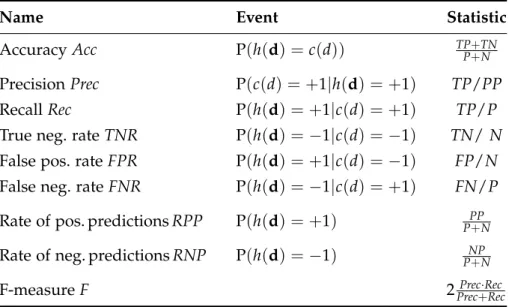
(4) Model selection is the process of estimating the effectiveness e(m,S) of a classification solution m = (α,h), given a sampleS, an effectiveness measure,
and an experiment, and selecting the best model accordingly.
The structure of this thesis corresponds to the building blocks in Figure 1.2. Chapter 4 describes analyzing non-standard tasks and feature engineering under laboratory condition, that is, the analyses are based on text corpora with a closed set of classes and examples. The challenge is to understand, from an engineering perspective, the particular classification task and to design a text representation that supports the employed classification technology. Chapter 5 provides research towards text classification in the wild by proposing robust feature engineering, sampling, and learning algorithms. Finally, Chapter 6 contributes to model selection in the wild.
1.2 Contributions
Chapter 2 This chapter provides the background of the most relevant text classi-fication tasks. It provides a categorization scheme for text classiclassi-fication tasks, which is based on the Lasswell Formula, a language function model used in communication theory.
Chapter 3 This chapter establishes a taxonomy of different types of bias found in the literature; a classifier’s inductive bias is an explanatory model of the classifier’s capability for predicting the class of unseen examples. The chapter also reviews the inductive biases of common supervised learning algorithms, and, finally, gives an introduction to support vector machines, which are often employed in text classification tasks.
Chapter 4 This chapter comprises sections, which examine a variety of text clas-sification tasks and new text representations. In this regard, each section also focuses on tailored experiments and evaluations for the particular task.
1.2 Contributions 7
Section 4.1 We combine the output of a stemming algorithm (stems) and
the stem-reduced words (co-stems) in text representation for non-standard text classification tasks. Besides the content, the writing style is an im-portant discriminator for many tasks. Ideally, the solution of such a task employs a text representation that models both kinds of characteristics. Word stems are clearly content capturing, whereas word suffixes qualify as writing-style indicators. We analyze the discriminative power of our new representation for a broad range of tasks and provide insights into the adequacy and task-specificity of text representation models. For several relevant tasks, co-stem-based representations outperform bag-of-words models.
Section 4.2 We contribute to core-vocabularies for Web genre analysis and discuss existing and new technologies for their construction. So-called core-vocabularies focus on the words that are descriptive for a specific class. Combining concentration measures with core-vocabularies results in non-linear features with a high generalization capability. We also present new evaluation measures and show in a quantitative analysis that our features are superior to state-of-the-art Web genre representations.
Section 4.3 Wikipedia provides an information quality assessment model with criteria for human peer reviewers for identifying featured articles; for the task “Is an article featured or not?” we exploit the articles’ dis-tributions of character trigrams. This representation does not require meta-features such as the edit history and aims to evaluate writing style. We conceptualize an experiment design where, among others, the domain transferability is analyzed. Character trigram representations outperform existing methods for this information quality task.
Section 4.4 It is known that language identification can be accomplished with a high precision for ordinary texts; we extend these findings and compare for the first time the effectivenesses of state-of-the-art language-identification approaches on very short, query-style texts. In a multi-language information retrieval setting, the knowledge about the multi-language of a query is necessary for further processing. The results show that already for single words an identification accuracy of more than 80% can be achieved; for slightly longer texts we report accuracies close to 100%. Section 4.5 We study the applicability of Koppel and Schler’s unmasking approach [153] for authorship verification analyses. In these analyses one is given writing examples from an author A, and one is asked to determine whether unseen texts are also written by A. Therefore, unmasking assesses the usage of function words in A’s writing examples and unseen texts. The main research question is to what extend unmasking is applicable if the prior writing examples are noisy, that is, not all of them are originally from A. This question is relevant for the subsequent section on intrinsic plagiarism analysis.
Section 4.6 We examine the question whether plagiarized text sections can be detected within an automatized analysis even if no reference is provided, for example, if the plagiarized sections are from a book that is not available in digital form. We refer to this automation as intrinsic plagiarism analysis, which can be transformed into an authorship verification analysis. Therefore, stylometry and, for the first time, one-class classification are utilized for constructing a set of reliable and a set of suspicious writing examples; both sets serve as the input of an authorship verification analysis. We study the effectivenesses of this transformation process and of the entire intrinsic plagiarism analysis.
Chapter 5 This chapter addresses the problems of applying text classification in the wild. The major problems relate to the training sample: first, the labeling of training examples usually involves a great deal of expense and is limited or even impossible; second, the laboratory conditions pre-sumed in almost all classification studies and text corpora do not meet the challenges of text classification problems in the wild, i.e., in the real-world. Section 5.1 Text classification tasks in the Web deal with collections of enormous size, which makes the ratio between the training sample and the set of unseen texts extremely small. With a sample ratio close to zero, the evaluation of the generalization capability of a classification solution with leave-n-out-methods becomes unreliable and leads one astray. In order to alleviate this problem we introduce the idea of robust models where the engineer intentionally restricts the hypothesis structure within the feature engineering process.
Section 5.2 We explore a sampling strategy for active learning, a
sub-discipline of supervised learning, for achieving a greater classification effectiveness with fewer training examples. This is largely accomplished by allowing the active learning heuristics to select the examples from which it learns. Our new, more general sampling strategy is based upon machine learning and learns the informativeness of examples from prior classification tasks.
Section 5.3 We suggest to conceive a text classification task as a one-class classification problem if the complementary class is unrepresentable, for example, because of noise or volatility. As an illustration of this situation, we study the task “Is a Wikipedia article flawed by a flaw f?” since Wikipedia provides cleanup templates for tagging articles that are flawed by f. Untagged articles cannot serve as complementary examples since they might be flawed but not tagged yet, and, more important, since their distribution is dynamic. Tackling this situational condition, we employ a one-class classifier and thoroughly analyze its effectiveness.
Section 5.4 For learning in a one-class classification problem multimodal distributed target classes, we propose a new cluster-based ensemble that outperforms standard one-class technology for several text classification
1.2 Contributions 9
tasks. Various relevant tasks in information retrieval, filtering, and ex-traction are one-class classification problems at heart; that is, common discrimination-based classification approaches are not applicable. Achiev-ing a high effectiveness when solvAchiev-ing one-class problems is difficult and it becomes even more challenging when the target class is multimodal, which is often the case. Our idea is to learn for each mode a separate one-class classifier.
Chapter 6 This chapter covers model selection for text classification solutions when the underlying data source undergoes unknown subclass distribu-tion shifts. This informadistribu-tion volatility is observed, for examples, in online media, such as tweets, blogs, or news articles, where the text emissions follow topic popularities. We propose the notion and the estimation of the “expected effectiveness” of text classification solutions under subclass distribution shifts and introduce a probabilistic effectiveness bound for selecting solutions with a superior stability.
Related publications by the author
Used Publisher Length Venue Type Year Reference
in Publication
4.1 Springer-Verlag short ECIR conference 2011 [178]
N. Lipka and B. Stein. Classifying with co-stems: A new representation for information filtering.
4.2 Springer-Verlag full – book chapter 2011 [295]
B. Stein, S. Meyer zu Eissen, and N. Lipka. Web genre analysis: Use cases, retrieval models, and implementation issues.
4.3 ACM poster WWW conference 2010 [177]
N. Lipka and B. Stein. Identifying featured articles in Wikipedia: Writing style matters.
4.4 Springer-Verlag poster ECIR conference 2010 [99]
T. Gottron and N. Lipka. A comparison of language identification approaches on short, query-style texts.
4.5 IEEE full TIR workshop 2008 [293]
B. Stein, N. Lipka, and S. Meyer zu Eißen. Meta-analysis within authorship verification.
4.6 Springer-Verlag full – journal 2011 [294]
B. Stein, N. Lipka, and P. Prettenhofer. Intrinsic plagiarism analysis.
5.1 IEEE full TIR workshop 2011 [179]
N. Lipka and B. Stein. Robust models in information retrieval.
5.2 online full DMEF conference 2011 [270]
J. Shanahan, N. Lipka, and D. Van den Poel. Learning to active learn with applications in the online advertising field of look-alike modeling.
5.3 ACM full SIGIR conference 2012 [9]
M. Anderka, B. Stein, and N. Lipka. Predicting quality flaws in user-generated content: The case of Wikipedia.
ACM poster CIKM conference 2011 [8]
M. Anderka, B. Stein, and N. Lipka. Detection of text quality flaws as a one-class classification problem.
ACM poster WWW conference 2011 [7]
M. Anderka, B. Stein, and N. Lipka. Towards automatic quality assurance in Wikipedia.
5.4 ACM poster SIGIR conference 2012 [180]
N. Lipka, B. Stein, and M. Anderka. Cluster-based one-class ensemble for classification problems in information retrieval.
6 IEEE short ICDM conference 2012 [176]
N. Lipka, B. Stein, and J. Shanahan. Estimating the expected effectiveness of text classification Solutions under subclass distribution shifts.
– ACM full CLEF conference 2009 [6]
M. Anderka, N. Lipka, and B. Stein. Evaluating cross-language explicit semantic analysis and cross querying.
– IEEE full CISCHED conference 2009 [16]
M. Aufenanger, N. Lipka, B. Klopper, and W. Dangelmaier. A knowledge-based Giffler-Thompson heuristic for rescheduling job-shops.
Chapter 2
The history of text classification
This chapter provides a landscape of the most relevant text classification tasks. The tasks are organized by a function scheme that is usually used in communi-cation studies. Furthermore, the descriptions of the tasks offer insights into the development history of text classification solutions. The landscape establishes the relationship between standard and non-standard text classification in our conducted research. For a general overview of text classification, many surveys on text classification exist [3, 266, 343, 207].
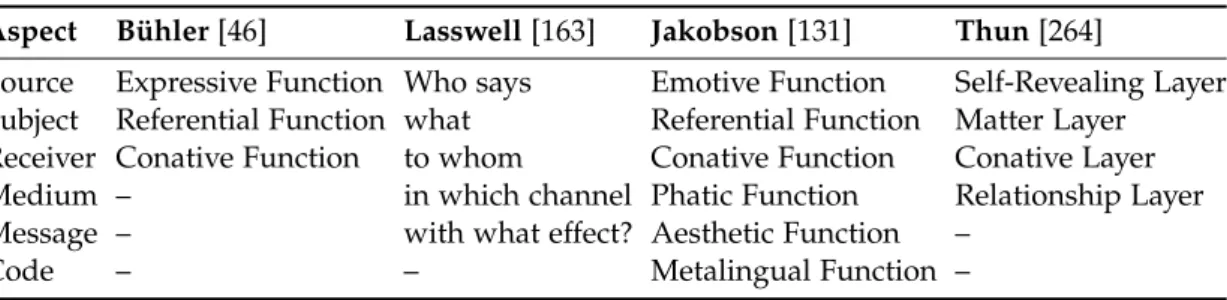
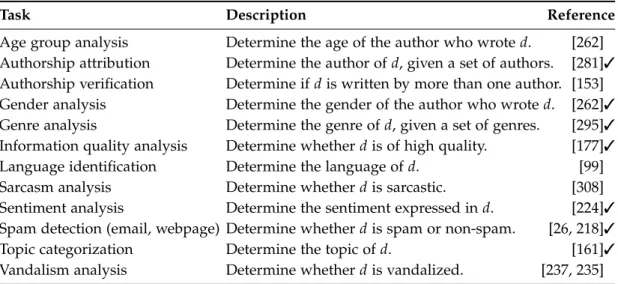
In communication studies, several well-known models exist which decompose the functions of a text. A textis an utterance that can be represented in written language. Throughout this thesis, a document is a written and unformatted text, which is also known as plain or unstructured text in the literature. Table 2.1 summarizes four models of language functions arranged by communication aspects: the four-sides model by Schulz von Thun [264], the Jakobson functions of language by Jakobson [131], the Lasswell formula by Lasswell [163], and the Organon model by Bühler [46]. The Lasswell formula “who says what to whom in which channel with what effect” is often utilized for organizing the research in communication studies and serves here as the basis for organizing text classification tasks.
Text classificationis the generic task of making a functional statement about a text. One of the first text classification tasks in history, namely topic categorization, is the determination of what a text is about. Within this task, a classifier makes a functional statement about the subject of a text, the “what” of Lasswell’s language function model. In the early 1960’s, a lot of research was carried out into automatically assigning a text to one or more given topics. This is driven by text representations derived from the words in the texts, starting with index terms in the papers by Maron and Kuhns [195], Maron [196], and Borko and Bernick [32, 33]. Today, text representations for topic categorization include more sophisticated meta-features that, for example, rely on external knowledge retrieved from Wikipedia [92]. In what follows, we will discover that more and more tasks are related to language functions other than just “what a text is about”; these tasks typically belong to the group of non-standard text classification tasks and need specialized features.
Table 2.1:Models of language functions.
Aspect Bühler[46] Lasswell[163] Jakobson[131] Thun[264]
Source Expressive Function Who says Emotive Function Self-Revealing Layer Subject Referential Function what Referential Function Matter Layer Receiver Conative Function to whom Conative Function Conative Layer Medium – in which channel Phatic Function Relationship Layer Message – with what effect? Aesthetic Function –
Code – – Metalingual Function –
2.1 Who is speaking
Authorship attribution, verification, and profiling are the most prevalent text classification tasks related to the source of a text. The difference between the first two tasks is that within authorship attribution a set of candidate authors with writing examples is given, which is not necessarily the case with authorship veri-fication. The third task, authorship profiling, is on characterizing an anonymous author by dimensions such as gender or age. The text representations, utilized for analyzing these tasks, are often writing-style-related. It should be noted that the writing style of an author depends on the time lapse between text formations, disclosure requirements, and the like, and is not always author-invariant.
2.1.1 Authorship attribution
During the 19th century, the Shakespeare authorship debate arose, questioning whether William Shakespeare’s poems and plays were written by himself. One of the suspicious candidates was Sir Francis Bacon. Mendenhall [200] conducted in 1901 possibly the first quantitative analyses of writing style in this context, which compares the word-length distributions observed in Shakespeare’s plays and Sir Francis Bacon’s texts. Therefore, Mendenhall [199] applied his research on languages and writing style, and his finding was that Bacon could be excluded from the candidates as the stylistic differences are too large. In 1975, Williams [334] rejected Mendenhall’s conclusion by showing that the comparison of Shakespeare’s verse and Bacon’s prose is inappropriate. An author is likely to produce different writing styles when writing verse and prose, therefore one cannot draw conclusions related to the authorship from these differences. On the contrary, same writing style is a good indicator for same authorship, and, however, the Shakespeare authorship question was the first prolific authorship attribution task tackled by a statistical analysis.
A second famous case is the disputed authorship of the Federalist Papers, which is one of American history’s most infamous questions. Between 1787 and 1788, 85 articles were anonymously published in several of New York’s newspapers with the goal to promote the ratification of the United States Constitution. While the authorship of the articles had been largely clarified, twelve of them were disputed. In 1964, Mosteller and Wallace presented a reliable authorship
2.1 Who is speaking 13
analysis based on the frequencies of a set of function words (“the”, “and”, “for”, etc.). The usage of function words is still today a strong feature within
authorship tasks.
Within the field of authorship attribution various features evolved. In 1939, Yule [348] introduced the sentence length as a statistical characteristic for au-thorship questions. Later, Yule [349] proposed word-frequency distributions, the characteristic K, alphabetical distributions, and vocabulary distributions. More detailed, the word-frequency distribution determines how many words occur once (hapax legomenon), twice (dis legomenon), and so on. Yule’s K is a measure of lexical repetition where 1/Kis the probability that two randomly chosen words are the same assuming the word occurrences are governed by the Poisson Law. The alphabetical distribution is the frequency distribution of initial letters. Finally, the vocabulary distribution is the distribution of a set of words over a set of classes: given n classes, determine the number of words that occur in n,n−1, . . . , 1 classes. Additionally, Yule analyzed each part of speech (noun, verbs, adjectives, pronouns, etc.) separately. His work laid the foundations of authorship analysis features.
In the 1960’s and 1970’s more lexical-complexity measures such as Yule’sKwere developed. Among them are Herdan’sVm, Sichel’sS, Brunet’sW, Honoré’sR. All of them are based on word frequencies and the size of the used vocabulary. Furthermore, a good deal of readability measures, such as the Automated Readability Index, LIX, SMOG Grading, or Flesch-Kincaid readability test, were published in these decades. “Non-traditional authorship attribution” was born, and stylometry, which is the field on quantifying writing style, makes up the largest part of it. Informally, the goal of stylometry is to identify text features (style markers) that are writer-invariant; features that only tend to similar values or characteristics when the represented texts are from the same author—often only the combination of features become writer invariant.
2.1.2 Authorship verification and intrinsic plagiarism analysis
Authorship verification first occurred in the 21st century with the objective of verifying a singular authorship of a set of texts. In contrast, intrinsic plagiarism analysis works on one text as input, but the goal basically remains the same. Trivially, the input text has to be chunked in a set of text sections for reducing an intrinsic plagiarism task to an authorship verification task. Even though the applied features are the same as in the field of authorship attribution, the statistical evaluation is fundamentally different. Authorship verification is a one-class classification problem because no reliable examples from the comple-mentary class are available. Without the complecomple-mentary class, which represents all foreign authors, it is not possible to determine the discriminativeness of features. van Halteren [314] reformulated the task as a two-class problem by representing the complementary class by a large reference corpus. Koppel and
Schler [153], Koppel et al. [155] worked with the reformulation “are two texts written by the same author” and suggested an analysis of the learning curves that are formed by impairing the text representation. In the context of this thesis, machine-learning-based one-class classification technology [303] has been employed for the first time in intrinsic plagiarism analysis, cf. Stein, Lipka, and Prettenhofer [294].
2.1.3 Authorship profiling
Authorship profiling, which is closely related to sociolinguistics, encompasses all tasks that determine further information about the author. The field of sociolinguistics arose in the beginning of the 20th century and concerns the relationship between society and language. Sociolinguistic analyses provide information of the social contexts of authors. The important subfield of dialec-tology arose slightly earlier, in the 19th century, and concentrates on the variety of language, which is a so-called “lect”. The variety of language over individ-uals is known as “idiolect”, which is the linguistic perspective on authorship attribution and verification. The variety is known as “sociolect” if it depends on social classes, and it is known as “regiolect” if it depends on geographical areas. Lects can also depend on historical eras (stylochronometry) or on political groups, which can give clues to the intention of a text. Even though dialectology was around for a long time, the automatic classification of dialects was studied much later, for example in 2006 by Huang [126]. More examples of state-of-the-art authorship profiling are on classifying the nativeness of language use [315], the author’s gender [120, 262], the author’s age [262, 227], or the author’s personality [228, 14, 205].
2.1.4 Stylochronometry analysis
Stylochronometry analysis is the task of determining the creation date of a document, which is not only relevant to historians but, for example, to all Web search users, who like to chronologically filter retrieved documents. For analyzing documents without meta-information, either writing-style or content-based methods are employed. One of the first works determining the creation date via language models based on word unigrams was by de Jong et al. [68] in 2005. This approach was improved by Kanhabua and Nørvåg [138] with advanced features such as part-of-speech tags and collocations. Other studies examined a variety of content-based features: Swan and Jensen [300] studied the temporal dimension of word usage, and, on the other hand, Garcia-Fernandez et al. [95] considered dates of entities occurring in documents extracted from Wikipedia and also neologisms and archaisms extracted from Google booksn -grams.
2.2 What is the text about 15
2.1.5 Provenance and lineage analysis
Provenance and lineage analyses unveil information about a document’s origin and history of ownership. Documents in the Web are copied, modified, and stored in different places. Knowing the origin of documents can help, for example, to judge its trustworthiness. While this field is well studied for scientific data processing and database management systems [275, 34, 56], to our knowledge, the automatic identification of provenance for text documents in general has not been studied by now.
2.2 What is the text about
The classification of texts with respect to their topic(or subject) dates back to the first libraries around 2600 BC. The libraries in Nippur about 1900 BC had the first library classification systems. In general, a library classification system categorizes documents by index terms that describe what a text is about. In the 1920s and 1930s the first automatized information retrieval systems were developed. In 1931, Emanuel Goldberg patents a document search engine, which uses pattern recognition techniques for retrieving microfilmed documents based on their metadata. Hans Peter Luhn started in 1947 developing an information retrieval system for chemical compounds based on punch cards. And, in 1950, Mooers [209, 210] used the terminformation retrievalfor the first time.
Text categorization relies on indexing technology used in information retrieval. The entry of probability theory in information retrieval has it’s own history, starting with Maron and Kuhns [195] in the 1960’s, followed by Cooper, Robert-son [249], and van Rijsbergen [316, 317]. Probabilistic topic categorization was operationalized for the first time by Maron [196] in 1961. Even though automatic information retrieval systems focus on the idea of ranking documents by their relevance to an information need, which is formulated as a query, ranking and categorization are conceptually the same. The two most influential projects in information retrieval and topic categorization are from Salton and Lesk [254] and Fuhr et al. [91]. Salton and Lesk founded in the 1960’s the SMART in-formation retrieval system, where the vector space model was invented and implemented, along with statistical term weighting schemes [255]. Later, the vector space model was extended to the generalized vector space models [337] and the topic-based vector space models [18]. In contrast to the SMART project, Fuhr et al. [91] founded the AIR/X system, which is one of the first automatic text categorization systems that handles numerous categories and documents. Then, in the 1990’s, topic categorization became more appealing and found application in many filtering, organization, and dispatching tasks, as well as in the generation of metadata [266].
2.3 To whom is the text addressed
In general, texts have implicit or explicit audiences, where an audience can be a group that speaks the same language, private persons, adults, or maybe children. An implicit audience is a group of people who can read and understand a text whereby we identify language identification as a task related to implicit audiences. An explicit audience is a group of direct addressees whereby adult and private content detection are related to explicit audiences.
2.3.1 Adult content detection
The protection of children is a matter of concern to all of us. The classifica-tion of adult content is becoming ever more important since the Web offers pornographic material in masses.1 For spotting this content, Santos et al. [259] employed compression procedures that also had been shown to be effective in spam classification by Bratko et al. [38], and, moreover, Kim [146] classified texts in a four level grading scheme via standard classifiers. Although, this task is relatively new and arose with the commercialization and popularization of the Web, more related work can be found in Ho and Watters [117] and Hu et al. [124].
2.3.2 Private content detection
A private text has specific recipients and several types of information, such as security information, corporate trade secrets, or personal content, should not be read by others. In contrast, a public text is allowed to be broadcasted. Nguyen [216] applied statistical learning methods to the task of discriminating between private and public texts. The analyzed datasets comprise emails from the Enron Email dataset serving as private texts, versus Twitter messages, Myspace forum discussions, and Slashdot comments serving as public texts. The Enron Email dataset contains emails of the U.S. energy company Enron Corporation, which are accessible because of the investigations in one of the largest cases of accounting fraud in 2001. In a 1 : 1.12 setup (public : private), 95.6% accuracy in discriminating the data can be achieved.
A highly related task is “data loss detection/prevention”. Its goal is to detect texts that are private but readable outside the authorized scope of recipients and to prevent unauthorized readability. Usually this task refers to data in general, which can be in-use, in-motion, and at-rest [269, 225]. With the growth of cloud computing the demand for data loss detection systems is likely to be increased in the private and in the commercial sector. The aspect of identifying
1At the upcoming WSDM 2013 will be a dedicated workshop on this topic, called SEXI 2013
2.4 Which channel is used 17
data, for example, credit-card data, intellectual properties, or social security numbers, range from precise (via hashing) to imprecise (via regular expressions and statistical machine learning) identification approaches.
2.3.3 Language identification
Language identification deals with the identification of a text’s language. This task is seen as solved for conventional texts, and current research is on language identification for special use cases, such as short texts or queries, for example, by Gottron and Lipka [99]. Ingle [130] is one of the first who proposed a statistical approach for identifying the language of a text. In the 1990’s, Dunning [77] and Cavnar and Trenkle [51] studied n-gram models as a representation for the classification task. Standard approaches are summarized in the comparative study by Lena Grothe and Nürnberger [168].
2.4 Which channel is used
The channel that is used for publishing a text is often an implicit outcome of text classification tasks. We propose Web genre classification with appropriate schemes, for example, the differentiation between Wiki articles, blog posts, forum entries, private or commercial homepages, for identifying channels. Web genre classification is, however, a special case and is examined on its own merits in Section 2.6.
Also the grading of text with respect to readability [162, 64, 86, 147, 52] can be seen as a channel-related task. The popularization of these grading schemes and indexes is driven by the military to minimize the risk of misunderstandings [142]. It should be noted that the readability of a text is also audience-related.
2.5 What is the effect of the text
Modern research in text classification is on the effects of texts. The questions behind the respective tasks are, for example: is a text an act of vandalism; is it making people smile; or does it express a sentiment. Especially the last task received much attention recently.
2.5.1 Opinion mining
A large part of research in opinion mining concerns movie and product reviews, see [223] for a detailed survey. In the context of product reviews, additional information extraction is needed to identify product features and consecutive
sentences [182, 123, 231]. Building a list of product features is a classification task by itself, known as terminology extraction [137, 35]. It is worth mentioning the subtask of retrieving comparative sentences, where two or more entities are compared with respect to a product feature [94]. In contrast, opinion mining for movies is more straightforward and requires less preprocessing.
The central elements in mining opinions are sentiment, polarity, and subjec-tivity analyses. Early related work was already conducted in the 1970’s by Carbonell [48] and later by Wilks and Bien [333]. This was followed by re-search in identifying the point of view in texts [332, 331, 110, 253]. Later, Hatzivassiloglou and McKeown [109] and Wiebe [330] deal with the semantic orientation of adjectives, before sentiment analysis became a vibrant research field in 2001 [65, 302, 307, 72, 212, 66, 222], followed by hundreds of publications. Different learning setting and specialized features were examined: unsuper-vised approaches [223], domain transfer [185], polarized word lists enhanced by synonyms, antonyms, negations, or emoticons [145, 65, 243].
Sentiment analysis is of high importance for economics, and therefore detecting opinion spam is relevant [132]. A distinctive example for sentiment analysis in economics is the work by Archak et al. [12]; it studies how important specific product features are, and, regarding these features, how the polarity of a review affects the customers’ buying decisions. This is only one demonstration of the impact of opinion mining. Today’s big data experts consider sentiment analysis as a key technology for retrieving valuable information for making strategic decisions in companies.
2.5.2 Vandalism detection
Vandalism is a phenomenon that occurs in editable online content such as Wikipedia articles. For the case of Wikipedia, “vandalism is any addition, removal, or change of content in a deliberate attempt to compromise the integrity of Wikipedia.” 2 Depending on the vandalized domain, the types of features can go beyond capturing textual characteristics and evaluate editor profiles, edit histories, or other meta-information.
In a study by Potthast et al. [235], vandalized and well-intentioned Wikipedia edits are discriminated by a logistic regression classifier using features such as the longest consecutive sequence of the same character, the compression rate, the frequency of upper case letters, and the frequency of vulgar words. Meta-information is utilized as well, such as the anonymity of the editor, the length of supplied comments, and the similarity between the old and updated articles.
The range of features was expanded by Wang and McKeown [326] where punctuation misuse (e.g. “!!!”), Web slang (e.g. “LOL”), comment cue words
2.6 A comprehensive task: Web genre analysis 19
were suggested. Chin et al. [57] utilized the revision history to build language models for vandalism detection in Wikipedia. In addition, Wang and McKeown [326] considered the probabilities that edits are generated by syntactical and semantic n-gram language models function as features.
Based on the hypothesis “vandalism can be detected by writing style”, Harpalani et al. [106] proposed probabilistic context free grammars (PCFG) for unveiling syntactic patterns. Basically two PCFG parsers are trained, one on vandalized and one on well-intentioned Wikipedia edits. A parser ouputs a probability of generating an edit, and, for the classification of an unseen edit, the correspond-ing probabilities of both grammars are compared. Other features in this context relate to an author’s reputation [1] and the impact of an edit [237].
2.5.3 Other tasks
There are several uncommon tasks that are related to the effect of a text. Koppel et al. [156] studied ideology identification, which is, for example, the discrim-ination between speeches of Republicans or Democrats. Yu [347] evaluated text classification methods for classifying erotic language patterns in poems (eroticism) and for classifying sentimentality levels in texts (sentimentalism). Yang et al. [340] classified emotions expressed in blog entries; Mihalcea and Strapparava [204] classified humor.
Carvalho et al. [50] and Reyes et al. [246] detected irony in user posts of news-paper and tweets, whereas Gibbs [96] provided a descriptive analysis of irony types (hyperbole, sarcasm, rhetorical questions, understatements, and jocularity) and Filatova [83] crowdsourced a corpus for irony and sarcasm classification in Amazon reviews.
Further common tasks are the classification of ads, fake reviews, patents, frauds, and lies. In natural language processing, there are even more tasks such as part-of-speech tagging, grouping adjacent words, and anaphora resolution. In field of information extraction the list continues with named entity recognition, named entity detection, relationship extraction, and comment extraction. And, the number of text classification tasks is still growing.
2.6 A comprehensive task: Web genre analysis
Web genre analysis is of high practical interest and provides information, with respect to nearly all language functions, cf. Table 2.1, depending on the assigned class scheme. Web genres relate to the presentation, the intended target group, the effects, the channel in use, and the authorship of a text. Regarding the Web, due to different user groups and technical means, several favorite specializations of Web documents emerged: a document may contain many links (e.g. a link
collection), scientific text (e.g. a research article), almost no text but pictures (e.g. an advertisement page), or a short answer to a specific question (e.g. a message in a help forum). These are examples for, what is called here, “genre” or “Web genre”.
This section outlines the use cases in [295], where Web genre analysis forms an essential building block in the information processing chain, namely retrieval ser-vices that are empowered by genre labeling and information extraction that uses genre classification as auxiliary technology. Web genre analysis demonstrates two general observations for text classification tasks:
• The use cases of text classification tasks can be manifold. • Tasks can be related to more than one language function.
2.6.1 Genre-enabled Web search
Search engines are the most influential and important applications in the Web. An integration of genre analysis can happen according to two differ-ent paradigms, namely filtering and Web search. Under the filtering paradigm, a user declare their information needs in terms of genre preferences, and the retrieval process accounts for these constraints. Under the classical Web search paradigm using Google, Bing, Yahoo, and the like, Web genre information is introduced by assigning genre labels to the snippets in the search results. Both approaches have their advantages and disadvantages, pertaining to retrieval time and retrieval precision. Different Web genre schemes along with technology for identifying the genre classes are compiled in Table 4.5.
2.6.2 Information extraction based on genre information
Web genre schemes provide a diversification of documents into text types that is oriented at search habits and the emerged culture of Web presences. In a technical sense, Web genre models can be understood as a collective term for classification models that quantify arbitrary structure and presentation-related document features, while being topic-orthogonal at the same time. Examples for high-level Web services that need a special text type as input are:
Market forecast summarization Market forecasting seeks to anticipate the future development of new technologies at an early stage. It is vital for most companies in order to develop reasonable business strategies and to make appropriate corporate investments. Market forecasting can be supported by automatically collecting, assessing, and summarizing information from the Web into a comprehensive presentation of the expected market volume. For this purpose a four step approach was implemented by Stein and Busch [289]: collecting candidate documents, report filtering, time and money identification, and phrase analysis along with template filling. The
2.6 A comprehensive task: Web genre analysis 21
third and fourth steps are computationally very demanding, and the ratio-nale of the proposed approach is reducing unnecessary natural language processing effort by a reliable identification of interesting business reports published on the Web. The heart of this strategy is a genre analysis in the report filtering step.
Retrieval of scholary material Specialized search engines and technology for verti-cal search are building blocks of future information extraction applications for the retrieval of academic research material. They shall be able to iden-tify, synthesize, and present Web documents related to exercises, FAQs, introductory readings, definitions, or sample solutions, given a topic in question. The driving force is a reliable document type and genre analysis. Focused crawling for plagiarism analysis The discriminative power of a genre clas-sifier can also be utilized at the crawling stage. Here, the challenges result from a classification model that has to get by with few and small document snippets. An interesting application is plagiarism analysis, which focuses on research articles, book chapters, and theses.
Chapter 3
Supervised learning
Supervised learning means to induce from labeled training examples a function, known as hypothesis or classifier, that predicts the labels of unseen examples. The ultimate goal in statistical classification is to find a hypothesis h that is a close approximation of the target function c, which is generally unknown and therefore the closeness of both functions cannot be directly evaluated. The most fundamental question in supervised learning is: if hcan generalize, i.e., predict the classes of unseen examples. The need of these predictions is prevalent in all text classification tasks. This chapter reveals an understanding of supervised learning that forms the foundation of this thesis.
3.1 An explanatory model of generalization: inductive
bias
Each hypothesis h, as part of a solution of a classification task T, makes, be it implicitly or explicitly, a-priori assumptions aboutT. These assumptions will be introduced in what follows asinductive bias. The inductive bias forms the ratio-nale for learning—better: for generalization; without bias is no generalization possible [206, 108].
Lethbe a hypothesis selected by an inductive learnerLwhen given the examples of a training sample Sto L. An example in the training sample is a pair of an input variable d, which represents the document d, and an output variable y, which represent the class label of the d. Using h, the class label of an unseen exampledcan be computed,h(d), precisely stated: “the predictionh(d) follows inductively from S, L, andd”, which is the semantics of the formula below:
L∧S∧d h(d)
Because of the inductive situation, the predicted class label h(d) need not necessarily correspond to the true class label c(d). As a consequence, h(d) is not provably correct. Mitchell [206] asks what minimum set of additional assertions Bcould be added to L∧S∧dso thath(d) follows deductively:
rote learner (hash table) constant
classifier
L's exploitation of
the variance in S to accept an induced Assertions B necessaryh(d) as a deduction
hypothesis complexity
high low
h
Figure 3.1: Mitchell’s inductive bias is defined as the size or complexity of the smallest set of assertions B. For example, a rote learner classifies without any assertions training examples provably correct but is not able to classify unseen examples. This learner has therefore no inductive bias and does not generalize. In contrast, a constant classifier has a strong inductive bias, namely, the assertion h =c.
The inductive bias of a learnerLis defined as the smallest set of assertionsBsuch that for all d∈ Dthe class label h(d) can be deductively inferred, cf. Figure 3.1. If the additional assertions Bare fulfilled, the deduced class label h(d)is equal to the true label c(d); hypothesis and target concept are equalh =c.
Even though this understanding of the inductive bias is appealing, this bias is hard to be quantified: typically B represents a formula in predicate logics, specifying the assertions in an axiomatic way, while there is no intuitive and sensible calculus for measuring the complexity, the extent, or the scope of the propositions contained in this formula. Describing the inductive bias of a learner L, either formally or informally, however, describes L’s gist. It tells us how much of the variation in a sample Sis captured by the inductive learner, which in turn correlates with the complexity of the hypothesis spaceH, which comprises all hypotheses that Lcan generate.
The idea behind Mitchell’s inductive bias becomes perspicuous if two extreme strategies of inductive learners are considered, the here called maximum-bias learner and the zero-bias learner, cf. Figure 3.1. The maximum-bias learner, for example, a constant learner, is able to classify an example d without knowing anything about it. Its decision is always the same and nothing of the variance contained in a sample Sis modeled. By contrast, the zero-bias learner captures the entire variance in S, even if its elements are randomly distributed. An example for this extreme is a hash table. Hash tables model arbitrary hypotheses, which comes at the price that from an unseen examplednothing can be induced with respect toc(d). Consequently, the generalization ability of a hash table is zero.
3.1 An explanatory model of generalization: inductive bias 25
Table 3.1:A taxonomy that relates the different types of bias found in the literature. Inductive Bias
Structural bias bias(H) Estimation bias bias(L)
(learner-independent) (learner-dependent)
Model formation Hypothesis Preference
bias complexity bias bias
3.1.1 Bias types
The main findings in computational learning theory are based on results in the fields of combinatorics (how many hypotheses are consistent with a given train-ing sample) and probability theory (how likely is the selection of a hypothesis with an error smaller e). Since the hypothesis spaceH comprises the hypotheses
a learner Linfers from 2D (all possible training samples), its characteristics take a major role in this context, which are affected by different types of biases. The types of biases found in the literature are organized within the taxonomy shown in Table 3.1. Commonly accepted is the distinction between a structural bias and an estimation bias, cf. Line 2 in the table. The former is learner-independent and is also known as model bias; the latter is learner-dependent. Line 3 in the table shows three types of inductive bias that have an impact on the hypothesis space H in terms of its size and elements. The types are: (1) model formation bias, in the form of heuristics and assertions in the feature engineering phase, (2) hypothesis complexity bias, which results from the structure of the hypothesis function, and (3) preference bias, which is a consequence of the optimization strategy of the learner. The feature engineering and the resulting representation restrict Hin a structural way and introduce a learner-independent bias. The hypothesis complexity relates to the flexibility of modeling even small differences between randomly drawn samplesS. Hastie et al. [108] use the term “model complexity” in this connection. Mitchell [206] subsumes this kind of structural property under the term “restriction bias”; it depends on the structure of a hypothesish, which is determined by the parameter number and parameter interaction. The exploration strategy defines whether or not H contains all hypotheses of a certain structure. The situation that H is not complete can also be understood as a complete hypothesis space H0 that is incompletely explored, such that, the “effective size” of H0corresponds to |H|. Mitchell subsumes this kind of structural property under the name “search bias” or “preference bias”; it is determined by the learner.
Finally, all types of bias entail an incurred bias, which cannot be controlled; incurred biases are caused by statistical deficiencies, by shortcomings in design ot the learning algorithm, or by a lack of appropriate features. Furthermore, some of the mentioned structural properties influence each other, while others are orthogonal. Altogether they can be used for reducing |H| and improving the generalization capability of a text classification solution m= (α,h).
x1
x2
pdf of H
h*
E(H)
Figure 3.2: Illustration of the hypothesis space that a learning algorithm produces when learning from different training samples. h∗ is the optimum hypothesis andE(H)is the expected hypothesis. In the upper part, the probability density function ofH can be seen.
3.1.2 Bias quantization
The following definitions unify the notion of biases. The statistical learning theory considersdto be a realization of the real-valued multivariate random vari-ableX and, for simplicity, the assigned class labely to be a value of the binary random variable Y ∈ {−1, 1} with the joint probability distribution P(X,Y). The symbolHdenotes a random variable whose observed values are hypotheses in the hypothesis space H.
Most important is the generalization error of a text classification solution. The minimization of this error is the ultimate goal since it concerns the entire population of the classification task.
Generalization error of a hypothesis h, err(h):
err(h) := E(loss(h(X),c(X))) = Z loss(h(d),c(d))dd, where loss(y,y0):= 0 if y=y0 1 otherwise.
The generalization error is also known as prediction error, real error, or true error [108, 313, 70, 335, 261]. Usually the population cannot be analyzed in its entirety, and one resorts to an estimator of err(h). The most common estimator oferr(h)is the sample errorerrS(h), which is defined as follows:
errS(h) :=
1
3.1 An explanatory model of generalization: inductive bias 27
where S denotes a sample of examples. errS(h) is known as “training error”
if Sis used for the construction of h by a learnerL; it is known as “test error” otherwise.
The generalization error err(h) describes a property of a single hypothesis h. In addition, there are also statistics that measure properties of a hypothesis space H such as the structural bias, as well as statistics that measure properties of a learner Lsuch as the estimator bias [90], cf. Table 3.1 and Figure 3.2. Structural bias of a hypothesis space H, bias∗(H):
bias∗(H) := err(h∗)
:= min
h∈H err(h).
The structural bias quantifies the expected difference between an optimum hypothesis h∗ ∈ H and the target concept c; Hastie et al. [108] terms it model bias. The optimum hypothesis h∗ is defined as the hypothesis in H with the lowest generalization error. Depending on the structure of H, h∗ does not necessarily need to be equal to c.
Estimation bias of an inductive learnerL, bias(L):
bias(L) := E loss(H(X),h∗(X)) = Z loss(E(H)(d),h∗(d))dd, with E(H)(d) = argmax y∈Y Z 1(h(d),y)dh and 1(y,y0):= 1 if y=y0 0 otherwise.
The distribution over the hypotheses in H is characterized by the random variableH, which can be estimated by learning from randomly drawn training samples. The estimation bias quantifies the expected difference between the expected hypothesis returned by L and an optimum hypothesis h∗ ∈ H [206, 108]. The expected hypothesis is not necessarily an element of H. Informally speaking, the expected hypothesis E(H) classifies the documentd as follows:
d receives the class label that is predicted by the majority of hypotheses in H, cf. E(H)(d).
The structural bias is independent of the distribution of hypotheses and consid-ers only the structural aspects of the hypothesis space. In contrast, the estimation bias is based on the distribution and is therefore learner-dependent. Both char-acteristics are practically not computable since it is not possible to identify the optimum hypothesish∗without exhaustively exploring the complete hypothesis
space. The expected hypothesis can be estimated by repetitive resampling and learning. When approximating h∗ by the target functionc, which is known for the training examples, the estimation bias can also be estimated. The quality of this estimate is unknown but, nevertheless, the estimate can be applied for comparing different text classification models.
3.2 Inductive biases of common learning algorithms
The inductive bias of a learning algorithm describes its way of learning from examples. Understanding the inductive bias of learning algorithms is an essen-tial part both in applying and in developing them. It also enables the engineer to explain the effectiveness and generalization capability of an algorithm to a large extent. This section lists the most common learning algorithms used in text classification and describes their inductive biases.Linear support vector machine (SVM) An SVM is a maximum margin classifier.
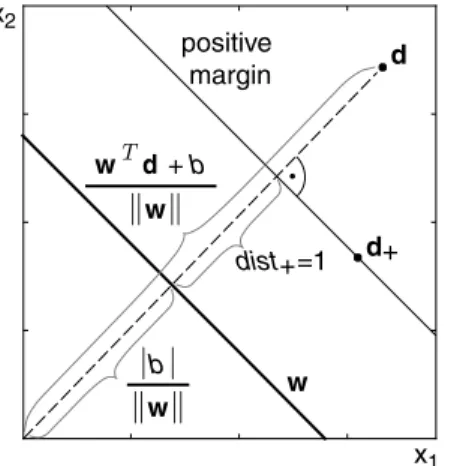
The learning algorithm finds a linear classification boundary (hyperplane) that separates the training examples and maximizes the margin to the closest training examples regarding their class labels. A soft margin SVM, proposed by Cortes and Vapnik [59], also allows the misclassification of examples to a certain degree, which is needed when the examples are not separable by the classification boundary. A variety of research studies, for example, by Joachims [134], [133], showed that linear SVMs have good generalization capabilities and rank for most text classification tasks under the top classifiers. In general, a learner with a maximum margin inductive bias selects consistent hypotheses that are maximizing the distance to the closest training examples with different labels.
Naïve Bayes (NB) The naïve Bayes classifier is a probabilistic learning algorithm, which assigns an unseen example to the class that has the highest condi-tional probability under a parametrized model. Its inductive bias maxi-mizes the conditional independence. The training phase is made up of computing the maximum likelihood estimate of the classifier’s parameters. Within the field of text classification the class probability estimates of naïve Bayes are often poorly calibrated but the classification decisions are still reliable [105]. SVMs are often the better choice in general but it was shown that naïve Bayes classifiers are robust to the concept drift problem where the distribution of classes or subclasses changes over time [88].
Decision tree (C4.5) The C4.5 algorithm by Quinlan [239] classifies an unseen example with a decision tree. Each path in a decision tree is a conjunction of constraints on the feature values. The tree is constructed by choosing for each node the feature and constraint which maximizes the information gain in the resulting split of training examples. Often, decision trees have a bias that controls their complexities. For example, a learner with a
3.3 Optimization for learning algorithms 29
minimum-description-length inductive bias selects the simplest hypothesis in terms of its description length. This bias is typically implemented by pruning strategies for tree learning algorithms, which prefer smaller trees, for example, in terms of the number of nodes, the maximum path length, or the number of leafs.
k-Nearest Neighbor (k-NN) Thek-NN learning algorithm stores the training ex-amples and assigns the most frequent class among the k