McDonald, Graham (2019)
A framework for technology-assisted sensitivity
review: using sensitivity classification to prioritise documents for
review.
PhD thesis.
https://theses.gla.ac.uk/41076/
Copyright and moral rights for this work are retained by the author
A copy can be downloaded for personal non-commercial research or study,
without prior permission or charge
This work cannot be reproduced or quoted extensively from without first
obtaining permission in writing from the author
The content must not be changed in any way or sold commercially in any
format or medium without the formal permission of the author
When referring to this work, full bibliographic details including the author,
title, awarding institution and date of the thesis must be given
Enlighten: Theses
https://theses.gla.ac.uk/ [email protected]
Using Sensitivity Classification to Prioritise
Documents for Review
Graham McDonald
Submitted in fulfilment of the requirements for the
Degree of Doctor of Philosophy
School of Computing Science
College of Science and Engineering
University of Glasgow
Abstract
More than a hundred countries implement freedom of information laws. In the UK, the Freedom of Information Act 2000 (c. 36) (FOIA) states that the government’s documents must be made freely available, or opened, to the public. Moreover, all central UK government departments’ documents that have a historic value, for example the minutes from significant meetings, must be transferred to the The National Archives (TNA) within twenty years of the document’s cre-ation. However, government documents can contain sensitiveinformation, such as personal in-formation or inin-formation that would likely damage the international relations of the UK if it was opened to the public. Therefore, all government documents that are to be publicly archived must besensitivity reviewedto identify andredactthe sensitive information, orclosethe document un-til the information is no longer sensitive. Historically, government documents have been stored in a structured file-plan that can reliably inform a sensitivity reviewer about the subject-matter and the likely sensitivities in the documents. However, the lack of structure in digital document collections and the volume of digital documents that are to be sensitivity reviewed mean that the traditional manual sensitivity review process is not practical fordigital sensitivity review.
In this thesis, we argue that the automatic classification of documents that contain sensitive information, sensitivity classification, can be deployed to assist government departments and human reviewers to sensitivity review born-digital government documents. However, classify-ing sensitive information is a complex task, since sensitivity is context-dependent. For example, identifying if information is sensitive or not can require a human to judge on the likely effect of releasing the information into the public domain. Moreover, sensitivity is not necessarily topic-oriented, i.e., it is usually dependent on a combination of what is being said and about whom. Furthermore, the vocabulary and entities that are associated to particular types of sensitive in-formation, e.g., confidential inin-formation, can vary greatly between different collections.
We propose to address sensitivity classification as a text classification task. Moreover, through a thorough empirical evaluation, we show that text classification is effective for sensitivity clas-sification and can be improved by identifying the vocabulary, syntactic and semantic document features that are reliable indicators of sensitive or non-sensitive text. Furthermore, we propose to reduce the number of documents that have to be reviewed to learn an effective sensitivity classi-fier through an active learning strategy in which a sensitivity reviewer redacts any sensitive text in a document as they review it, to construct a representation of the sensitivities in a collection.
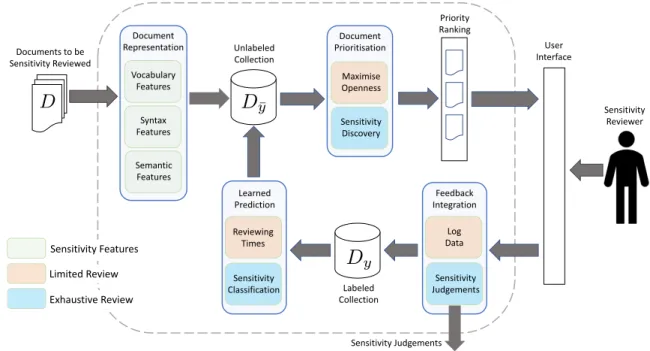
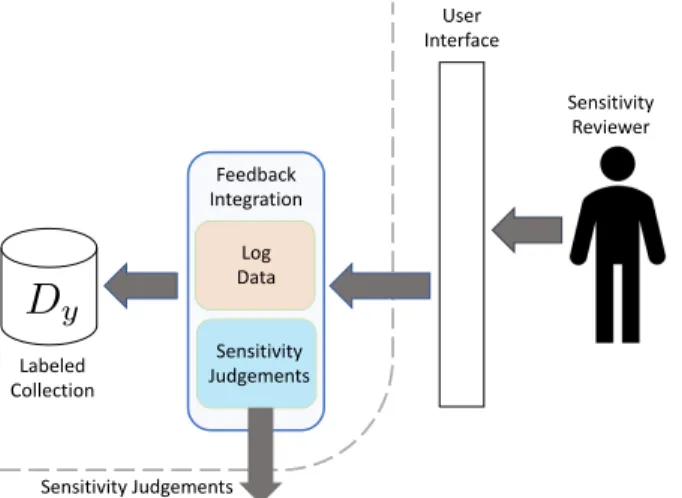
With this in mind, we propose a novel framework for technology-assisted sensitivity review that can prioritise the most appropriate documents to be reviewed at specific stages of the review process. Furthermore, our framework can provide the reviewers with useful information to assist them in making their reviewing decisions. Our framework consists of four components, namely theDocument Representation,Document Prioritisation,Feedback IntegrationandLearned Pre-dictions components, that can be instantiated to learn from the reviewers’ feedback about the sensitivities in a collection or provide assistance to reviewers at different stages of the review. In particular, firstly, the Document Representation component encodes the document features that can be reliable indicators of the sensitivities in a collection. Secondly, the Document Prioritisa-tion component identifies the documents that should be prioritised for review at a particular stage of the reviewing process, for example to provide the sensitivity classifier with information about the sensitivities in the collection or to focus the available reviewing resources on the documents that are the most likely to be released to the public. Thirdly, the Feedback Integration component integrates explicit feedback from a reviewer to construct a representation of the sensitivities in a collection and identify the features of a reviewer’s interactions with the framework that indicate the amount of time that is required to sensitivity review a specific document. Finally, the Learned Predictions component combines the information that has been generated by the other three components and, as the final step in each iteration of the sensitivity review process, the Learned Predictions component is responsible for making accurate sensitivity classification and expected reviewing time predictions for the documents that have not yet been sensitivity reviewed.
In this thesis, we identify two realistic digital sensitivity review scenarios as user models and conduct two user studies to evaluate the effectiveness of our proposed framework for as-sisting digital sensitivity review. Firstly, in the limited review user model, which addresses a scenario in which there are insufficient reviewing resources available to sensitivity review all of the documents in a collection, we show that our proposed framework can increase the num-ber of documents that can be reviewed and released to the public with the available reviewing resources. Secondly, in theexhaustive reviewuser model, which addresses a scenario in which all of the documents in a collection will be manually sensitivity reviewed, we show that pro-viding the reviewers with useful information about the documents in the collection that contain sensitive information can increase the reviewers’ accuracy, reviewing speed and agreement.
This is the first thesis to investigate automatically classifying FOIA sensitive information to assist digital sensitivity review. The central contributions of this thesis are our proposed frame-work for technology-assisted sensitivity review and our sensitivity classification approaches. Our contributions are validated using a collection of government documents that are sensitivity reviewed by expert sensitivity reviewers to identify two FOIA sensitivities, namelyinternational relations and personal information. The thesis draws insights from a thorough evaluation and analysis of our proposed framework and sensitivity classifier. Our results demonstrate that our proposed framework is a viable technology for assisting digital sensitivity review.
Acknowledgements
First and foremost I would like to thank my supervisors Iadh Ounis and Craig Macdonald for their endless support and inspiration, for the rigorous and lively debates that kept the work moving forward and for teaching me how to write better. Most importantly, without whom, and their attention to detail, I would not be in the position that I am now submitting this thesis.
A great deal of gratitude is due to my external supervisors from The National Archives. Firstly, to Tim Gollins who’s foresight and determination started this ball rolling. I am very happy to be able to submit this work in recognition of your efforts that made the undertaking of this thesis possible. Secondly, to Simon Lovett, who’s invaluable experience and insights about sensitive information brought life to the subject. Thirdly, to David Willcox who’s boundless enthusiasm for the project meant that no operational difficulty was ever an obstacle. Lastly, to Anthea Seles and Anna Sexton for stepping into the role to make sure that there was always support from The National Archives. It has been a real pleasure working with all of you.
I would like to express my sincere gratitude to all the anonymous reviewers at The National Archives, the Foreign and Commonwealth Office and beyond who played such a vital role in constructing the test collection for this research. This thesis would not have been possible with-out all of your efforts.
I would also like to thank Douglas W. Oard and Mary Ellen Foster for their insights and thoughtful feedback during my PhD viva. Thanks also to all my friends and colleagues in the TerrierTeam and The University of Glasgow who I have had the pleasure of working with, or just hanging out with, over the years. You have made this a very enjoyable endeavour.
Lastly, I would like to give an extra big thank you to: Mom and John, for always encouraging me to pursue whatever interests me in life; Anita and Martin for all the fun times and fantastic food over the years, you have kept me slightly sane; and Anita for being a true life-long friend.
Contents
Abstract i Acknowledgements iii 1 Introduction 1 1.1 Introduction . . . 1 1.2 Motivation . . . 31.3 Scope of the Thesis . . . 7
1.4 Thesis Statement . . . 8 1.5 Contributions . . . 9 1.6 Origins of Material . . . 10 1.7 Outline of Thesis . . . 11 2 Background 14 2.1 Introduction . . . 14 2.2 Text Classification . . . 15 2.2.1 Test Collection . . . 15 2.2.2 Document Representation . . . 16 2.2.3 Feature Reduction . . . 18
2.2.4 Effective Classifiers for Text Classification . . . 20
2.2.5 Evaluation and Metrics . . . 22
2.3 Active Learning . . . 24
2.3.1 Selecting Informative Documents . . . 25
2.4 Technology-Assisted Review . . . 27
2.5 Conclusions . . . 30
3 Classification of Sensitive Information 31 3.1 Introduction . . . 31
3.2 Identified Sensitivities . . . 32
3.2.1 Section 27: International Relations . . . 33
3.2.2 Section 40: Personal Information . . . 38 iv
3.3 Previous Approaches for Classifying Sensitive Data . . . 43
3.4 A Test Collection for Sensitivity Classification . . . 46
3.5 Conclusions . . . 49
4 A Framework for Technology-Assisted Sensitivity Review 50 4.1 Introduction . . . 50
4.2 User Models for Technology-Assisted Sensitivity Review . . . 51
4.3 Framework Overview . . . 55 4.4 Document Representation . . . 56 4.5 Document Prioritisation . . . 58 4.6 Feedback Integration . . . 60 4.7 Learned Predictions . . . 62 4.8 Conclusions . . . 64
5 Sensitivity Classification Baseline 65 5.1 Introduction . . . 65
5.2 Masking Information that is Supplied in Confidence . . . 66
5.2.1 Experimental Methodology . . . 68
5.2.2 Results and Discussion . . . 68
5.3 Sensitivity Classification Baseline . . . 69
5.3.1 Experimental Methodology . . . 70
5.3.2 Results and Discussion . . . 72
5.4 Classifying Individual Sensitivities . . . 75
5.4.1 Hand-Crafted Sensitivity Features . . . 75
5.4.2 Experimental Methodology . . . 78
5.4.3 Results and Discussion . . . 79
5.5 Ensemble Sensitivity Classification . . . 82
5.5.1 Combining Sensitivity Classifiers . . . 83
5.5.2 Experimental Methodology . . . 84
5.5.3 Results and Discussion . . . 84
5.6 Conclusions . . . 85
6 Enhanced Sensitivity Classification 87 6.1 Introduction . . . 87
6.2 Vocabulary Features . . . 89
6.3 Syntactic Features . . . 90
6.3.1 Kernel Functions for Sensitivity Classification with POS Sequences . . 92
6.3.2 Combining Text Classification and POS Sequence Classification . . . . 95
6.5 Extending Sensitivity Classification with Vocabulary, Syntactic and Semantic
Features . . . 101
6.5.1 Experimental Method . . . 101
6.5.2 Results . . . 103
6.6 Analysis . . . 105
6.6.1 Important Vocabulary Features . . . 105
6.6.2 Semantic Features . . . 110
6.6.3 Sensitivity Review . . . 110
6.7 Conclusions . . . 112
7 Active Learning for Sensitivity Classification 114 7.1 Introduction . . . 114
7.2 Active Learning for Sensitivity Classification . . . 116
7.3 Selecting Documents to be Reviewed . . . 117
7.3.1 Uncertainty Sampling . . . 118
7.3.2 Utility-Theoretic . . . 118
7.4 Incorporating Reviewer Feedback . . . 120
7.5 Selecting an Appropriate Classifier . . . 122
7.6 Experimental Methodology . . . 123
7.7 Results . . . 124
7.7.1 Selecting Informative Documents . . . 125
7.7.2 Integrating Reviewer Feedback . . . 127
7.7.3 The Effect of the Batch Size on Learning . . . 130
7.8 Conclusions . . . 132
8 Maximising Openness in the Limited Review User Model 134 8.1 Introduction . . . 134
8.2 Limited Review User Model . . . 136
8.3 Reviewing Times User Study . . . 137
8.3.1 Study Design and Participants . . . 138
8.3.2 Test Collection Constructed from the User Study . . . 139
8.4 Predicting Reviewing Times . . . 140
8.4.1 Predictions Reviewing Times Approach and Features . . . 140
8.4.2 Experimental Methodology . . . 144 8.4.3 Results . . . 145 8.5 Maximising Openness . . . 147 8.5.1 Experimental Methodology . . . 147 8.5.2 Results . . . 148 8.6 Conclusions . . . 151
9 Assisting Sensitivity Reviewers in the Exhaustive Review User Model 152
9.1 Introduction . . . 152
9.2 Exhaustive Review User Model . . . 155
9.3 Hypotheses . . . 155
9.4 Assisted Sensitivity Review: User Study . . . 156
9.4.1 Ground Truth . . . 157
9.4.2 Reviewing Interface and Logging Interactions . . . 157
9.4.3 Study Design . . . 159
9.4.4 Participants, Incentives and Instructions . . . 161
9.4.5 Evaluation and Metrics . . . 161
9.5 Results and Evaluation . . . 163
9.5.1 The Impact of Classification Effectiveness on Reviewer Performance . 163 9.5.2 The Impact of Classifier Confidence on Reviewer Performance . . . 168
9.5.3 Study Conclusions . . . 170
9.6 Conclusions . . . 171
10 Conclusions and Future Work 173 10.1 Contributions and Conclusions . . . 173
10.1.1 Contributions . . . 174
10.1.2 Limitations of this Work . . . 179
10.1.3 Conclusions . . . 179
10.2 Directions for Future Work . . . 183
10.3 Closing Remarks . . . 186
List of Tables
1.1 The Freedom of Information Act 2000: Categories of exempt information. . . . 4
2.1 An example 2-way class contingency table. . . 19
2.2 A contingency table (matrix) for evaluating a classifier’s effectiveness. The ma-trix cells contain the number of documents that are true positive predictions (T P), false negative predictions (FN), false positive predictions (FP) and true negativepredictions (T N). . . 23
3.1 Exemption S27: International Relations, descriptions of sub-categories. . . 35
3.2 Exemption S40: Personal Information, descriptions of sub-categories. . . 39
3.3 The salient statistics of our test collection. . . 49
4.1 The attributes of a sensitivity judgement. . . 61
4.2 The attributes of a reviewer’s interactions from the reviewing interface log data. 62 5.1 Information Content (IC) document sanitisation results. The table shows the re-sulting precision, recall, F1, F2and Balanced Accuracy (BAC) scores. Threshold values,β, that are statistically significantly better than random (McNemar’s test, p<0.05) are denoted by †. . . 69
5.2 The feature reduction combinations that we evaluate for each of the document representation approaches binary (BIN), tf (TF) and TF-IDF. Each of the docu-ment representations is evaluated with combinations ofBasicfeature reduction (stopword removal and stemming), Basic plus Information Gain (IG) and Basic plus Chi-Squared (χ2) feature reduction. . . 71
5.3 Stopword removal, stemming, Information Gain (IG) and Chi-Squared (χ2) fea-ture reduction combinations for binary (BIN), tf (TF) and TF-IDF document representations. The table presents precision, recall, F1, F2and Balanced Accu-racy (BAC) scores. Statistical significance is denoted by † forbetween-doctests and ‡ forwithin-doctests (McNemar’s test p<0.05). . . 73 5.4 The Feature groups that we evaluate for classifying individual FOI exemptions. 76
5.5 Hand crafted features s27. The table presents the precision, recall, F1, F2 and
Balanced Accuracy (BAC) scores of the TF-IDFstopNoSm baseline and the
base-line extended with hand crafted features. Statistical significance is denoted as † (McNemar’s test, p<0.05). . . 81 5.6 Hand crafted features s40. The table presents the precision, recall, F1, F2 and
Balanced Accuracy (BAC) scores of the TF-IDFstopNoSm baseline and the
base-line extended with hand crafted features. Statistical significance is denoted as † (McNemar’s test, p<0.05). . . 82 5.7 Ensemble classification results. The table shows the precision, recall, F1, F2,
Balanced Accuracy (BAC) and auROC scores. Statistical significance is denoted as † (McNemar’s test, p<0.05) . . . 85 6.1 Overview of the kernel functions that we evaluate for classifying sensitive
in-formation using POS sequences. The table shows thetypeof kernel, i.e. either Vector SpaceorString, and the definition of the kernel function. . . 91 6.2 The total unique POSn-gram tokens in each collection representation. . . 93 6.3 SVM Kernels for POS sequence classification. The table shows the best
per-forming size ofn-gram. The highest values for each metric are in bold. We de-note kernels that perform statistically significantly better than random by † and statistically significantly better than the next best performing kernel (according to BAC) by∆. We test statistical significance using McNemar’s non-parametric
test, p<0.01. . . 94 6.4 Fleiss’κ agreement between the linear, Gaussian and Spectrum kernels for
pre-dictions on sensitive documents, i.e., True Positive or False Negative prepre-dictions. 94 6.5 Results for POS sequence and Text Classification ensembles. The table shows
the precision, recall, F1, F2, Balanced Accuracy (BAC) and auROC scores.
Sta-tistical significance compared to the Text Classification (TC) baseline is denoted as † (McNemar’s test, p<0.05). . . 97 6.6 Extending sensitivity classification with language, syntax and semantic features:
The feature set combinations that we evaluate and the abbreviations that we use to denote them. . . 102 6.7 The pre-trained word embedding models that we use for deriving semantic
fea-tures. . . 103 6.8 Results for combinations ofvocabulary, syntaxandsemanticfeature sets,
com-pared against the text classification (Text) baseline. The table shows the preci-sion, recall, F1, F2, Balanced Accuracy (BAC) and auROC scores. Statistical
6.9 Results for extending the text classification (Text) baseline with combinations of language,syntaxandsemanticfeature sets. The table shows the precision, recall, F1, F2, Balanced Accuracy (BAC) and auROC scores. Statistical significance
compared to the baseline is denoted as †, and compared to the text classification with additional term features (Text+TN) are denoted with ‡ (McNemar’s test,
p<0.05). . . 105 7.1 Summary of the active learning strategies that we evaluate and how we denote
them. We evaluate the four document prioritisationstrategies from Section 7.3 asRawactive learning strategies. Moreover, we evaluate each of the document prioritisation strategies Extended with one of the three sensitivity annotations strategies from Section 7.4 (sixteen strategies in total). . . 121 8.1 The generated reviewing times test collection. Document length is measured by
number of words. The average reviewing time is measured in seconds. . . 139 8.2 The Feature groups that we evaluate for predicting a document’s reviewing time. 142 8.3 Reviewing Time Predictions. The root mean squared error (RMSE) in seconds,
R2and adjusted R2(R2Adj) achieved by our linear regression model for
predict-ing a document’s Normalised Dwell Time (NDT). The table shows the results achieved when either of a Perfect, Good or Baseline sensitivity classifier is de-ployed to predict a document’s sensitivity. . . 146 8.4 The achieved openness for our proposed approach (SPR) with perfect
sensitiv-ity classification, compared against the shortest document first (SDF), chrono-logical (CHR) and random (RND) approaches. The table presents the Absolute Openness (OA) and the Openness Ratio (OR) of each approach on simulated collections in which 10%, 30%, 50% or 70% of the documents are sensitive. Approaches that perform statistically significantly better than random for all sensitivity distributions are denoted as † (Sign test, p<0.05). . . 149 9.1 The distribution of automatic classification predictions for documents in batches
representing different classification effectiveness treatments along with the re-sulting F2and Balanced Accuracy (BAC) scores. . . 159
9.2 Distributions of Low, Medium and High simulated confidence scores for each classification effectiveness. . . 160 9.3 Summary table of hypothesis conclusions. . . 170
List of Figures
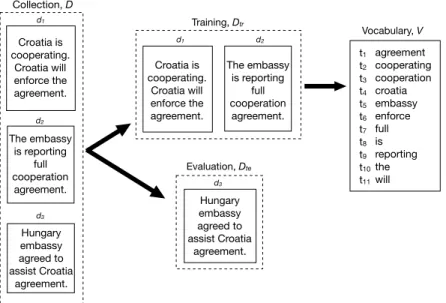
1.1 The digital sensitivity review input, process and output. . . 2 2.1 An example document collection,D, with three documents,d1..d3. The
collec-tion is split into training data,Dtr, and test data,Dte. The collection vocabulary, V, is all the unique terms inDtr. . . 17 2.2 The document vector representations, x, for document d1 presented in
Fig-ure 2.1, for each of the representation strategies: binary,tf and TF-IDF. . . 17 2.3 Illustration of pool-based active learning cycle. . . 25 2.4 The typical components of a system for technology-assisted Review (TAR). . . 28 3.1 Examples of international relations sensitivities. . . 36 3.2 Examples of personal information sensitivities. . . 41 3.3 The sensitivity reviewing interface used to generate our test collection. The
panel on left of the interface enables reviewers to navigate the collection, while the main panel enables reviewers to sensitivity review the documents and to record a document’s sensitivity judgement. . . 47 3.4 The sensitivity reviewing interface annotation functionality for identifying
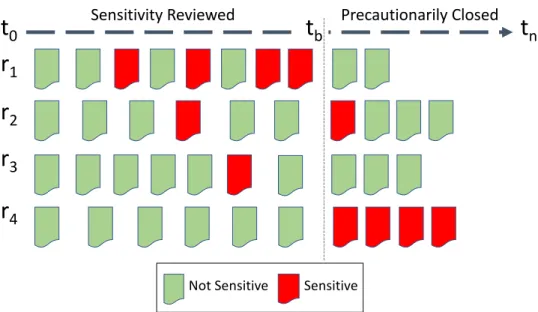
sen-sitive text within documents and recording the relevant sensitivity sub-categories. 48 4.1 Limited Review user model. Examples of the possible ordering of documents to
be reviewed and their resultingopenness. . . 53 4.2 An overview of our proposed technology-assisted sensitivity review framework. 54 4.3 The Document Representation component of our technology-assisted sensitivity
review framework. . . 57 4.4 The Document Prioritisation component of our technology-assisted sensitivity
review framework. . . 58 4.5 The Feedback Integration component of our technology-assisted sensitivity
re-view framework. . . 60 4.6 Example of the Feedback Integration component’s log data input. . . 62 4.7 The Learned Predictions component of our technology-assisted sensitivity
re-view framework. . . 63 xi
5.1 Document sanitisation analysis. The figure shows a document with (a) the text that a human sensitivity reviewer judged as being sensitive shown in red, and (b) text that the document sanitisation classifier predicted as being sensitive. The figure also show the resulting confusion matrix (c) for the individual terms in the document. . . 67 5.2 Supply Verbs. Verbs that are associated with an action of giving something. . . 78 5.3 An illustration of the methods that we evaluate for combining sensitivity
classi-fiers. . . 83 6.1 An illustration of a word embedding vector space. . . 99 6.2 The 100 single term (uni-gram) features with the largest coefficient scores, i.e.,
“most important”, for the text classification (Text) model presented in Tables 6.8 and 6.9. . . 106 6.3 The 15 highest ranked n-gram features, where 6≤n≤9, for the text
classifica-tion + termn-gram model (Text+TN9) presented in Table 6.9. Each row presents
1 n-gram feature. Stopwords are removed from the collection prior to feature generation. . . 106 6.4 An illustration of how we identify the terms that are most associated with
im-portant semantic word embedding features. . . 108 6.5 Word cloud representation of the terms associated with the most important word
embedding dimension classification feature for themaxfunction of the best per-forming model from Table 6.9 (Text+TN7+WEwp+WEgn(concat)). . . 109
6.6 Excerpts from two documents containing sensitivities linked to conversations that the classifier could only identify with the addition of semantic features. Document (a) reports an informant’s recount of inappropriate interrogations and harassment of activists in Cambodia by the police. Document (b) recounts dis-paraging remarks regarding the levels of corruption and efficiency throughout the Cameroon political establishment. . . 111 6.7 (a) Receiver Operating Characteristic Curve. (b) True Positive Rate vs.
Classi-fication Threshold. The blue line shows the baseline text classiClassi-fication (Text) and the red line shows Text+TN7+WEwp+WEgn(concat). The dashed line in (a)
shows a random classifier. The dashed lines in (b) show the classification thresh-old required to achieve 0.95 TPR. . . 112 7.1 The roles of our framework’s components for selecting informative documents
to be reviewed and constructing a representation of the sensitivities from the reviewer’s feedback. . . 116
7.2 An example of a reviewer’s sensitivity annotations. The document contains three annotated sensitive passages, shown with a yellow background. Sensitivity an-notations are analogous to redacting the sensitive text. . . 121 7.3 Results for the document selection active learning strategies, Entropy,
Mar-gin, Utility and the confidence that a document is sensitive sConf. The figure shows the Precision, Recall, F1, F2and Balanced Accuracy (BAC) scores
plot-ted against the number of documents reviewed. . . 126 7.4 Results of the document selection strategies for active learning, Entropy,
Mar-gin, UtilityandsConf for each of the methods for incorporating reviewer feed-back+Anno,+InfAnnoand+AnnoPool. The figure shows the Precision, Recall, F1, F2and Balanced Accuracy (BAC) scores plotted against the number of
doc-uments reviewed. . . 128 7.5 Results of the document selection strategies for active learning, Entropy,
Mar-gin, UtilityandsConf without additional sensitivity annotations features, Raw (No Anno), and extended with +InfAnno sensitivity annotation features. The figure shows the Recall, F1, F2 and Balanced Accuracy (BAC) scores plotted
against the number of documents reviewed. . . 129 7.6 The effect of varying the batch size,k, of documents that are sensitivity reviewed
at each iteration of the review cycle, for Margin extended with +InfAnno the sensitivity annotations strategy. The plot shows the Precision, Recall, F1, F2
and Balanced Accuracy (BAC) scores plotted against the number of documents reviewed. . . 131 8.1 Normalised Dwell Time (NDT) distributions in seconds for the training and test
data of our test collection constructed from the reviewing times user study. . . . 142 8.2 (a) Number of documents opened per hour. (b) Ratio of reviewed documents
opened. . . 148 8.3 The resulting Absolute openness achieved by our proposed SPR document
pri-oritisation approach when either the Baseline, Good or Perfect sensitivity clas-sifier is deployed. . . 150 9.1 Reviewing Interface Information Panel: The panel displays the classification
prediction (Sensitive or Not Sensitive), and the classifier’s prediction simulated confidence score. The panel also enables participants to record their sensitivity judgements and provide comments. . . 158 9.2 Mean reviewer accuracy (in terms of BAC and F2), with 95% confidence
inter-vals, for each classification treatment: None,Medium(0.7 BAC) andPerfect. . 165 9.3 Normalised Processing Speed (NPS) (words per minute), with 95% confidence
9.4 Cohen κ participant classifier agreement, with 95% confidence intervals, for
each classification treatment: None,Medium(0.7 BAC) andPerfect. . . 167 9.5 Cohen’s κ, and 95% confidence intervals, for participant and classifier
agree-ment for each simulated confidence level; Low, Medium and High. . . 168 9.6 Normalised Processing Speed (words per minute), and 95% confidence
inter-vals, for when participants agree (subscriptA) or disagree (subscriptD) with the classifier, for each of the classifier’s simulated confidence levels: Low, Medium and High. . . 169 9.7 Normalised Processing Speed (words per minute) and 95% confidence intervals
when participants either agree or disagree with the classifier predictions, for all judgements made on documents with associated classifier predictions. . . 170
Chapter 1
Introduction
1.1
Introduction
More than a hundred countries around the world implement laws to provide the public a right to access information that has been produced by any public body within the country, e.g., the government (The Centre for Law and Democracy, 2016). Moreover, at least fifty nine of these countries have written their citizen’s access to information rights, commonly known as free-dom of information(FOI), into the county’s constitution (Right2INFO.org, 2016). In the United Kingdom (UK), freedom of information laws are enacted through the Freedom of Information Act 2000 (c. 36) (FOIA), with the supplemental Freedom of Information (Scotland) Act 2002 (asp. 13) covering public bodies that are under the jurisdiction of the Scottish Parliament.
FOIA provides members of the public with a general right to access information that is held by public bodies. This right to access is facilitated through two mechanisms. Firstly, FOIA en-ables anyone to request any specific information that is held by a public sector organisation. The second method of accessing public information in the UK applies to historical public records (e.g., documents, photographs, audio and video etc.). The Public Records Act 1958 (c. 51)1 legislates that all records that are of historical value, i.e., public records, are to be transferred to a designated public archive. For example, public records from central UK government de-partments are transferred to The National Archives2 (TNA) for permanent preservation, within twenty years from the document’s creation date (Constitutional Reform and Governance Act 2010, c. 25). Public access to the information within these records is governed by the FOIA.
There is an assumption ofopennesswithin the FOIA, i.e., it is assumed that all of the infor-mation within public records will be made available to the public. However, government docu-ments can containsensitiveinformation, such as personal information or information that would likely damage the national security or international relations of a country if the information was
1The UK also has acts for: Scotland, Public Records (Scotland) Act 2011 (asp. 12); Wales, Government of Wales Act 2006 (c. 32); and Northern Ireland, Public Records Act (Northern Ireland) 1923 (c. 20).
2http://www.nationalarchives.gov.uk
A collection of born-digital documents that are to be
transferred to a public archive.
A sensitivity reviewer reads each of the documents in turn, in batches
of kdocuments, to identify and record any sensitive information.
.
.
.
.
Not Sensitive Not Sensitive SensitiveA Sensitivity judgementis made for each of the reviewed documents. A sensitivity judgement must record if a document
is sensitive or not. For sensitive documents, the judgement needs to record (1) the FOIA sensitivity categories that apply to
the document, (2) which parts of the document they apply to and (3) a justification for judging the information to be sensitive.
Not Sensitive
Input: Process: Output:
.
.
.
.
.
.
.
. .
.
.
dk d1 d2Figure 1.1: The digital sensitivity review input, process and output.
made freely available. Therefore, the FOIA defines twenty five categories of sensitive infor-mation that are exempt from the obligation to be released publicly. Moreover, all government documents that are selected to be transferred to a public archive must besensitivity reviewed, to identify any sensitive information and handle it appropriately. For example, the specific infor-mation, or the entire document, may be withheld (orclosed) until it is no longer deemed to be sensitive.
The sensitivity review of paper-based government documents is a manual process. However, it has been widely recognised that there is a need for new technologies to automatically iden-tify sensitive information in born-digital3 government documents toassist with the sensitivity review of digital government documents (Allan, 2015; Defense Advanced Research Projects Agency, 2010; Lain, 2013; The National Archives, 2016a).
Digital Sensitivity Review (DSR) is the process of reviewing a collection of digital govern-ment docugovern-ments to identify any sensitive information in the docugovern-ments. Figure1.1 illustrates the input, process and the output of the task. The input to the process is a collection of digital documents,D, that are to be transferred to a public archive, such as TNA. A sensitivity reviewer reads each document,di∈D, in turn, in batches ofkdocuments, and records asensitivity judge-ment, ji, for each of the documents. A sensitivity judgement, ji, needs to record if the document is sensitive or not sensitive. For a document that is judged as being sensitive, the sensitivity judgement must also include: (1) the FOIA sensitivity categories that apply to the document; (2) which parts (e.g., sentences or paragraphs) of the document they apply to; and (3) a textual de-scription, or justification, about why the information is sensitive and should, therefore, be closed. The output of the DSR process is the collection of reviewed documents and the set of sensitivity judgements,J, where for each document,di, there is a corresponding sensitivity judgement, ji.
3Born-digital documents are documents that are originally created in a digital format, such as emails, as op-posed to documents that were originally created in a paper format and subsequently digitised, such as scanned or photocopied documents. For brevity, in the remainder of this thesis we will refer to them as digital documents.
Digital sensitivity review is, therefore, an iterative process. A framework to assist digital sen-sitivity review can, therefore, make decisions, for example, about the order in which (batches ofk) documents should be reviewed, the information that is provided to a reviewer along with a document (to assist their reviewing task) and the feedback that the reviewer should provide the system about the documents that they review. Moreover, by having the framework make decisions, such as the order that documents are reviewed, digital sensitivity review can be seen as a technology-assisted review (TAR) process. In TAR, a human reviewer and an Information Retrieval (IR) system actively work together to identify and label documents as being either relevant (i.e., sensitive) or not relevant (i.e., not sensitive) to a particular information need (Cor-mack & Grossman, 2014). In this thesis, we investigate methods for automatically identifying documents that contain sensitive information (we refer to this task as sensitivity classification). Moreover, we show how sensitivity classification can be integrated into a framework toassist sensitivity reviewers, and government departments, with the sensitivity review of digital govern-ment docugovern-ments to increase the number of docugovern-ments that can be reviewed and released to the public, hereby supporting openness. We refer to this as technology-assisted sensitivity review.
1.2
Motivation
All documents that are public records of central UK government departments, such as the For-eign and Commonwealth Office4(FCO) or the Ministry of Defence5(MoD), must be transferred to a designated public archive, such as TNA, for preservation. However, these documents must first be sensitivity reviewed to identify and handle any sensitive information appropriately.
Paper-based government documents are typically stored, and transferred to the archives, within a structured logical file-plan in which each file contains documents that are related to each other. The sensitivity review process for paper documents typically requires a manual re-view of each file within the file-plan. The contents of the file is checked and if a document contains sensitive information the document is either partially redacted or it is removed from the file. If the file is seen to contain a large amount of sensitive information then the whole file is closed (Moss & Gollins, 2017), removing the need to review the documents in the file indi-vidually. For many central UK government departments, such as the FCO, this process requires expert reviewers with a good knowledge of the expected sensitivities within the department (The National Archives, 2017).
The sensitivity review process for paper documents is, therefore, a well defined process. However, over the last twenty to thirty years, government departments have been increasingly using digital documents, such as emails, word processing documents, PDFs, web pages and on-line discussions, instead of paper documents. These digital documents are considered to be
4https://www.gov.uk/government/organisations/foreign-commonwealth-office 5https://www.gov.uk/government/organisations/ministry-of-defence
Table 1.1: The Freedom of Information Act 2000: Categories of exempt information.
21. Information accessible to applicant by other means 33. Audit functions. 22. Information intended for future publication. 34. Parliamentary privilege.
22A. Research 35. Formulation of government policy, etc.
23. Information supplied by, or relating to, bodies dealing with security matters. 36. Prejudice to effective conduct of public affairs. 24. National security. 37. Communications with Her Majesty, etc. and honours. 25. Certificates under ss. 23 and 24: supplementary provisions. 38. Health and safety.
26. Defence. 39. Environmental information.
27. International relations. 40. Personal information.
28. Relations within the United Kingdom. 41. Information provided in confidence.
29. The economy. 42. Legal professional privilege.
30. Investigations and proceedings conducted by public authorities. 43. Commercial interests.
31. Law enforcement. 44. Prohibitions on disclosure.
32. Court records, etc.
public records and, therefore, should also be assessed for archiving within twenty years of their creation. In the UK, twenty one government departments are due to transfer digital records to TNA in 2018, this number will rise over the coming years to fifty government departments due to transfer in 2021 (The National Archives, 2016b).
However, the process of sensitivity reviewing digital government documents is not yet well defined and, moreover, the paper-based sensitivity review process is not suitable for digital doc-uments, mainly due to two aspects of how digital documents are produced:
1. Loss of Structure: Digital documents are not systematically filed in a master file-plan. Therefore, for digital documents, there is no equivalent to the structured logical file-plan of paper documents (Moss & Gollins, 2017). For example, email threads can splinter and create orphan threads (Kerr, 2003). Therefore, sensitivities that may have been contained within a single paper file can be distributed throughout a collection of digital documents. 2. Volume: The volume of digital documents that are created means that governments
can-not recruit enough resources to sensitivity review all documents that are selected to be archived (The National Archives, 2016a). For example, some government departments have reported having up to 190 TB of emails in email servers that will need to be consid-ered for archiving (The National Archives, 2016b). A proportion of these emails will be selected to be publicly archived and, therefore, will need to be sensitivity reviewed. For digital sensitivity review to be effective, sensitivity reviewers need to be assisted by au-tomatic techniques that can address the problems of: 1. theloss of structurein how documents are created and stored and 2. thevolume of documents that are to be reviewed. In this thesis, we propose to address the problem of the loss of structure by automaticallyidentifying sensitive informationwithin a document collection to inform the reviewers about which of the documents are likely to contain sensitive information. We propose to address the problem of the volume of digital documents that are to be reviewed by increasing reviewer productivity, for example by enabling reviewers to review documents more quickly or prioritising documents for review based on the likelihood that the documents (do not) contain sensitive information, to maximise
the number of documents that can be released with the available reviewing resources.
Identifying Sensitive Information: Automatically identifying sensitive information in doc-uments is, therefore, a fundamental task for assisting the digital sensitivity review process. Sen-sitive information can be defined as information that would likely cause harm to, or prejudice the interests of, a person group or organisation, if the information was made freely available to the public. Table 1.1 presents the twenty five categories of information that are exempt from public release through the Freedom of Information Act 2000 (c. 36). The categories in Table 1.1 are broadly defined. However, each of the categories (except for21. Information accessible to applicant by other means) are exempt from public release due to the sensitive nature of the in-formation. To illustrate this point, we shall now consider a scenario relating to exemption 27 (international relations).
Many government operations and decisions are conducted at the international level, for ex-ample on matters concerning environmental issues, criminal investigations or counter terrorism activities. However, governments cannot be expected to conduct and maintain these activities without having the privilege of being able to discuss privately, for example, cultural differences between negotiating parties. Moreover, within this scenario it may be necessary for government officials to express opinions that could be offensive to the other parties. There is an expecta-tion within the FOIA that documents relating to the decisions taken within a negotiaexpecta-tion will be opened to the public. However, if the offensive opinions were released into the public do-main it would likely corrode the trust between the parties (i.e., the governments) and damage the relations between the countries, making such negotiations less likely in the future.
This scenario illustrates two important points about sensitive information. Firstly, sensitivity is nottopic-oriented. It is not the fact that information in the documents is about the negotiations, or the countries involved, that makes the information sensitive. Rather, the sensitivity arises due to the context of the information, e.g., who said what about whom. Moreover, a judgement on whether the information is sensitive or not is dependent on the expectedeffectsfrom making the information freely available (Ackerman & Sandoval-Ballesteros, 2006). Secondly, identifying sensitive information (and, moreover, sensitivity review) is a recall-oriented task. There may be many offensive comments, or other sensitive pieces of information, within a collection of documents. However, it only requires one of these pieces of information to be opened to the public for the information to cause harm. Therefore, a reviewer must identifyallof the sensitive information in the documents that are to be reviewed and released to the public.
Increasing Reviewer Productivity: All documents that are opened to the public must first be sensitivity reviewed and the volume of digital documents is expected to be very significantly larger than the volumes that have been seen for paper documents (Allan, 2015). There are many different types and sizes of collections that need to be sensitivity reviewed, from email
collec-tions to public enquiries (Inquiries Act 2005, c. 12). Since governments are not expected to be able to recruit enough reviewing resources to sensitivity review all digital documents (The National Archives, 2016a) and, moreover, the volumes of sensitivities vary greatly between dif-ferent collections and government departments (Allan, 2014), the digital sensitivity review task will likely have different priorities, depending on the available resources and the collections that are being reviewed.
For example, public inquiries (Inquiries Act 2005, c. 12), such as the Iraq Inquiry (Chilcot, J, 2016) or the Al Sweady Inquiry (Forbes, 2014), often deal with a lot of information that is sensitive. Moreover, the information that is created in public inquiries is predominantly in digital documents (The National Archives, n.d.). All of the documents that are created or used in a public inquiry must be sensitivity reviewed before the end of the inquiry, so that they can be transferred to TNA or retained if they are highly sensitive. Therefore, when sensitivity reviewing public inquiries, the main priority is that the review can be carried out quickly so that the public sees that the outcome of the inquiry is being published in a timely manner. However, the order in which documents are reviewed may be less important since the whole collection must be reviewed before the documents can be released.
The order in which documents are reviewed is most likely to be important for reviewing the day-to-day documents of government departments. There is a large backlog of paper doc-uments that are awaiting review in some government departments (Allan, 2014). For example, the Department for Culture, Media and Sport6 (DCMS) has a backlog of roughly twenty two thousand paper files awaiting review (The National Archives, 2018), although it is hard to make an accurate assessment of the size of the DCMS backlog (Allan, 2014). Other departments that have reported having a reviewing backlog include the Department for Business Innovation and Skills7(BIS), the Department for Transport8(DfT) and the FCO. Moreover, the FCO, the MoD, the Home Office9and the Cabinet Office10have a large volume of records containing potentially sensitive material (Allan, 2014). With the increased volumes of digital documents, and shortfall in reviewing resources, this situation is expected to be worse for digital sensitivity review. For departments that have a backlog and are, therefore, not meeting the time-to-transfer obligation of the Public Records Act 1958 (c. 51), ensuring that reviewing can be conducted quickly is clearly a priority. However, to comply with the Public Records Act 1958 (c. 51) a priority is also to release as many of the documents as possible. Therefore, prioritising the documents that are most likely to be the quickest to review and, importantly, that are the most likely to be released to the public will increase the overall productivity of the review process.
The additional pressure to review quickly, that is likely to result from dealing with the
back-6https://www.gov.uk/government/organisations/department-for-digital-culture-media-sport 7https://www.gov.uk/government/organisations/department-for-business-innovation-skills 8https://www.gov.uk/government/organisations/department-for-transport
9https://www.gov.uk/government/organisations/home-office 10https://www.gov.uk/government/organisations/cabinet-office
log of documents that are to be reviewed, has the potential to negatively impact the quality of the human reviews. Sensitivity reviewing is a labour-intensive process, that requires a judgement about the effect of releasing the information, and one where mistakes are bound to occur (Allan, 2014). Moreover, we have observed that there is only moderate agreement between sensitiv-ity reviewers (McDonaldet al., 2014). Indeed, high levels of reviewer disagreement have been observed in a studies about assessing a document’s relevance (Scholeret al., 2011; Voorhees, 1998; Webber, 2011). Although assessing if a document is sensitive or not is not exactly the same task as assessing for (topical) relevance, they are both tasks that assess if a document is related to a particular category. Assessing sensitivity is complex and the difficulty of assessing relevance has been shown to have the greatest impact on assessor agreement (Oardet al., 2010). Therefore, a framework that can increase the agreement between reviewers can also increase productivity, since increased agreement will lead to less time and resources being allocated to discussing reviews that are disputed, either by senior sensitivity reviewers in departments such as the FCO or by The Advisory Council11 when a department applies to have the information closed.
1.3
Scope of the Thesis
The transition to digital government documents brings a very wide range of challenges, from human-computer interaction factors to the efficient storage and distribution of documents and reviews. This thesis is a first investigation into how Information Retrieval (IR) and Text Classifi-cation (TC) technologies can be deployed to assist with the sensitivity review of digital govern-ment docugovern-ments. The scope of this thesis is bounded by, what we argue to be, the three essential elements of technology-assisted review that need to be addressed when developing a framework to assist with digital sensitivity review. Moreover, we argue that they are essential to be able to ensure that the framework can enable a sensitivity reviewer to review documents more quickly and/or release more documents to the public:
1. Sensitivity Classification: A reliable method of modelling sensitive information that is generalisable enough to automatically classify documents by whether they do or do not contain sensitive information that is exempt from being released to the public, due to a Freedom of Information exemption.
2. Sensitivity Identification: An effective method of quickly identifying the sensitivities that are in a collection so that an efficient sensitivity classifier can be developed while using minimal reviewing resources. The logical file plan of paper records means that, for paper-based sensitivity review, the topic of a file, i.e., what the documents in the file are
11The Advisory Council is the independent body that considers applications for the retention or closure of gov-ernment records. http://www.nationalarchives.gov.uk/about/our-role/advisory-council
about, can give a reviewer an idea if the documents are likely to contain sensitive informa-tion and, if so, what the sensitivities will be (Allan, 2015). However, for digital sensitivity review, the lack of a structured file plan means that the sensitivities are dispersed through-out a collection. Therefore, it is not clear what the sensitivities in a specific collection are, i.e., what they are related to or the vocabulary that is used in the sensitive text. With this in mind, it is important that a framework to assist sensitivity review can quickly learn from the reviewer what the sensitivities in a collectionlook like. The framework should, therefore, deploy anactive learningstrategy to quickly learn to classify the sensitivities in a collection by integrating explicit reviewer feedback about the sensitivities in a collection as the documents are reviewed.
3. Reviewing Models: A strategy, or strategies, for using the developed sensitivity classi-fier’s predictions to increase the effectiveness and efficiency of available reviewing re-sources. Since this is a first investigation into automatically classifying FOI sensitivities to assist with the sensitivity review of digital government documents, we have identified two realistic user models to investigate how our proposed framework can assist sensitivity review in two different scenarios. Firstly, in ourlimited reviewuser model, we investigate how our framework can assist reviewers when there are not enough reviewing resources to review all of the documents in a collection that is due to be publicly archived. Secondly, in ourexhaustive reviewuser model, we investigate how our framework can assist reviewers whenallof the documents in a collection are reviewed.
1.4
Thesis Statement
The statement of this thesis is that automatic sensitivity classification can be effective for assist-ing human reviewers with the sensitivity review of digital government documents. Moreover, an effective sensitivity classifier can be learned by identifying the latent vocabulary, syntax and semantic language features of the sensitive information in a corpus. Furthermore, by deploying an active learning strategy to select specific documents to be reviewed and by having a reviewer annotate, orredact, any passages of sensitive text in a document as they review, we can identify the most informative annotated terms to construct a representation of the sensitivities in a col-lection. Assigning the identified informative terms more weight, or importance, in the classifier will result in fewer documents being required to be reviewed to learn an effective sensitivity classifier.
In particular, sensitivity classification can assist with the sensitivity review of digital gov-ernment documents by predicting which of the documents contain sensitive information in a collection that is to be reviewed. Moreover, automatic sensitivity classification predictions can be used to prioritise specific documents for review to increase the number of non-sensitive docu-ments that can be reviewed and released to the public when the available reviewing time budget
is insufficient to review all of the documents that are due for release. Furthermore, providing the reviewers with sensitivity classification predictions for the documents that are to be reviewed can increase the reviewers’ accuracy, speed and agreement.
1.5
Contributions
The main contributions of this thesis are the following. Firstly, we introduce the task of auto-matically classifying documents that contain sensitive information that is exempt from being publicly released through Freedom of Information Act 2000 (c. 36), i.e., international relations and personal information sensitivities. Secondly, we contribute a deployable end-to-end frame-work for assisting with the sensitivity review of digital government documents. Our frameframe-work consists of four components, namelyDocument Representation,Document Prioritisation, Feed-back IntegrationandLearned Predictions that can be instantiated to perform different tasks at different stages of the review process, depending on the current priorities for assisting the review process. For example, developing an effective sensitivity classifier early in the review process when the sensitivities in a collection are not known or, later in the review process, selecting the specific documents that should be reviewed to increase the number of documents that are released to the public within a limited period of time.
Throughout the digital sensitivity review process, the four components of our framework collaborate to address the three essential elements of technology-assisted review that we iden-tified in Section 1.3. In the course of this thesis, we instantiate various functionalities of our framework’s components to propose, develop and evaluate novel approaches, to ensure that our framework can assist a sensitivity reviewer to review documents more quickly and release more documents to the public. Our main contributions with respect to the three essential elements of technology-assisted review are as follows:
1. Sensitivity Classification: We propose a fully-automatic approach for discovering latent vocabulary, syntactic and semantic features of sensitive information, that are useful for increasing the accuracy of a sensitivity classification. The approach uses natural language processing and analysis of the semantic relations of the terms in a collection of docu-ments, to construct a document representation for classification. The approach can effec-tively capture the latent features of the context-dependent FOIA sensitivitiesinternational relationsandpersonal information.
2. Sensitivity Identification: Early in the digital sensitivity review process, a reviewer will not know the topics that are being discussed in, or the vocabulary that is used in, or even the entities that are related to the sensitive information in the documents that are to be reviewed. Therefore, we investigate methods for constructing a representation of the sen-sitivities in the collection to improve the effectiveness of sensitivity classification. We
propose to integrate the process of redacting the sensitive text in a document into the dig-ital sensitivity review process. By having reviewers annotate (or redact) the sensitive text in a document, as they review, our approach measures the expected amount of information that terms from the annotations will provide to the classifier and integrates the most infor-mative terms. We present a thorough analysis of the approach and show that it can reduce the amount of reviewing effort (i.e., time) that is required to learn an effective sensitivity classifier.
3. Reviewing Model:We present the results of a user study that demonstrates how automatic sensitivity classification can be deployed to assist reviewers when all of the documents in a collection will be reviewed. Our study shows that sensitivity classification can provide reviewers with additional information about the sensitivities in a document at the time of review to reduce the time that is required to review a collection of documents and increase the agreement between reviewers.
We also propose a novel approach for prioritising documents to be reviewed to increase the total number of documents that can be reviewed and released to the public when there are not enough reviewing time resources to review all of a collection. The approach mod-els a sensitivity reviewer’s behaviour, along with a document’s complexity, to predict the amount of time that a reviewer will require to review a specific document. Moreover, the approach prioritises documents that are (1) classified as being not sensitive so that review-ing resources are focused on reviewreview-ing documents that will be released to the public,and (2) that are predicted to take less time to review so that more documents will be reviewed within the available time. We thoroughly evaluate the approach and show that is can in-crease the number of documents that can be released to the public within a specific period of time.
Additionally, in the course of this thesis, we provide recommendations for government de-partments that are looking to implement a technology-assisted review process for digital sen-sitivity review. Moreover, we propose a roadmap for future directions in this emerging and important area of research.
1.6
Origins of Material
Some of the work in this thesis is based on a number of conference publications. The following are our publications that form the basis for research detailed in the following chapters:
• Chapter 3: The possibility of applying Information Retrieval (IR) technologies to ad-dress the challenges of archival transfer of digital government documents (Selection, Appraisal and Sensitivity Review) was discussed in our paper published at PIR@SIGIR
2014 (Gollins, McDonald, Macdonald & Ounis, 2014). A broader outline of the character-istics of sensitive information that can be identified as features of sensitivity for developing automatic classifiers was published in FDIA 2015 (McDonald, 2015).
• Chapter 5: Our baseline text classification approach for sensitivity classification was pub-lished at ECIR 2014 (McDonaldet al., 2014). This work also experimented with extend-ing text classification with additional features from external resources, such as knowledge bases, to identify specific sensitivities.
• Chapter 6: Our approach for deploying part-of-speech (POS) sequences as features for identifying passages of sensitive text in government documents was published in ICTIR 2015 (McDonaldet al., 2015). Following from this, the work identifying effective kernels for POS sequence classification approaches for sensitivity classification was published in SIGIR 2017 (Mcdonald, García-Pedrajas, Macdonald & Ounis, 2017). Our methodology for extending text classification with semantic features, and extended text sequences, for sensitivity classification was published in ECIR 2017 (McDonald, Macdonald & Ounis, 2017).
• Chapter 7: Our proposed active learning strategies for integrating reviewer feedback into the classification process and generating knowledge of the sensitivities within a collection through annotation features were published in ECIR 2018 (McDonaldet al., 2018a).
• Chapter 8: Our proposed approach for modelling reviewing times and prioritising docu-ments for review in ourlimited reviewreviewer model was published in ECIR 2018 (Mc-Donaldet al., 2018b).
1.7
Outline of Thesis
The remainder of this thesis is organised as follows:
• Chapter 2 provides an introduction to the fundamental concepts in document classifica-tion, active learning and technology-assisted review that we build on throughout this the-sis. In particular, we first introduce the essential components for developing a document classifier: generating a test collection; representing documents as structured data; feature reduction techniques for improving classification effectiveness; supervised machine learn-ing classifiers that are effective for document classification; and methods for evaluatlearn-ing the effectiveness of document classification. We then discuss active learning strategies for selecting informative documents as classification training data before, finally, providing an introduction to technology-assisted review.
• Chapter 3, firstly, reviews the types of sensitive information that most frequently result in document closures within central UK government and identifies the Freedom of Infor-mation (FOI) exemptions (sensitivities) that we focus on in this thesis. The chapter then provides a detailed description of the types of information that are likely to be closed due to the identified sensitivities, before discussing existing works on automatically classify-ing sensitive information and identifyclassify-ing the existclassify-ing knowledge gaps for classifyclassify-ing FOI sensitivities. Finally, the chapter presents our methodology for creating the test collec-tion that we use throughout this thesis for developing and evaluating our framework for technology-assisted sensitivity review.
• Chapter 4, firstly, provides details of the exhaustive review and limited review user mod-els that we have identified to evaluate the effectiveness of our proposed framework. The chapter also presents our proposed framework for technology-assisted sensitivity review and describes each if its four components, namely Document Representation, Document Prioritisation, Reviewer Feedback and Learned Predictions.
• Chapter 5 evaluates the effectiveness of a document sanitisation approach from the litera-ture for classifying confidential information in documents. We show that document sani-tisation is not an appropriate strategy for identifying Freedom of Information Act 2000 (c. 36) sensitivities. Therefore, in this chapter, we propose to address the task of identify-ing sensitive information (i.e. sensitivity classification) as a document (text) classification task. Moreover, we present our sensitivity classification baseline that we build on in the remainder of the thesis. Furthermore, we evaluate the effectiveness of classifying individ-ual FOI exemptions compared to classifying sensitive information as a single category and an ensemble classification approach for combining sensitivity classifiers.
• Chapter 6, looks at advanced feature engineering techniques for sensitivity classification. In particular, the chapter presents our empirical evaluation of extended text sequences and part-of-speech sequences for sensitivity classification. Moreover, the chapter presents an empirical evaluation of kernel techniques for sequence classification approaches to sen-sitivity classification. Furthermore, the chapter presents an empirical analysis of our ap-proach for engineering classification features that capture semantic relations within doc-uments. The chapter evaluates the effectiveness of the engineered features for extending text classification for sensitivity identification.
• Chapter 7 presents an empirical analysis of active learning strategies for integrating re-viewer feedback into the sensitivity classification process. Moreover, the chapter presents our approach for generating a representation of the sensitivities within a collection. Fur-thermore, through empirical analysis, the chapter shows how the generated sensitivity representations can be integrated into the classification process to learn an effective sen-sitivity classifier more quickly by reducing the amount of reviewing effort required for
training a classifier. Lastly, the chapter empirically evaluates methods for predicting when the developed sensitivity classifier has achieved peak performance.
• Chapter 8 investigates how our proposed framework can assist reviewers in the first of the two user models for technology-assisted sensitivity review that we address in this thesis, namelylimited review. Limited review addresses a scenario when there are not enough re-viewing resources available to review a whole collection of documents. In this chapter, we propose a method for prioritising specific documents for review so that we can maximise the number of documents that can be released to the public with the available reviewing resources. We conduct a user study to analyse reviewing behaviour, such as the time taken to review documents. Moreover, we use the log data from the user study to develop and evaluate our proposed approach for prioritising documents for review. Furthermore, we evaluate how the distribution of sensitive information within the collection and how the sensitivity classification effectiveness affects our proposed approach.
• Chapter 9 investigates how our proposed framework can assist reviewers in the second of the two user models for technology-assisted sensitivity review that we address in this the-sis, namelyexhaustive review. This chapter presents the results of a controlled user study that investigates how our framework can assist reviewers when all the documents in a col-lection will be reviewed. The study evaluates the impact that 1) classification effectiveness has on reviewer accuracy and agreement, and 2) the classifier’s confidence levels has on the level of trust that a reviewer has in the classifier’s predictions and the impact that this has on reviewing times.
• Chapter 10 closes the thesis by highlighting the contributions drawn from each of the in-dividual chapters and provides our recommendations for deploying technology-assisted sensitivity review within government departments, before discussing possible further re-search directions and future work.
Chapter 2
Background
2.1
Introduction
In this chapter, we provide an overview of the classification, active learning and technology-assisted review techniques that this thesis builds on. Indeed, we describe existing works that our framework relies on as a basis for the automatic classification of documents into known cate-gories, selecting documents to have reviewed with the aim of quickly developing an effective sensitivity classifier, and assisting a human reviewer to meet the goals of their review by priori-tising documents for review based on the needs of the reviewer or the operational constraints of the government department. The remainder of this chapter is organised as follows:
• Section 2.2 provides the background to automatic document classification, commonly re-ferred to astext classification. We provide preliminary details of the components that are required for text classification, i.e., a document test collection, features for document rep-resentation, feature reduction techniques, a classification algorithm that is effective for text classification and, finally, the evaluation of text classification.
• Section 2.3 introduces active learning techniques for integrating a reviewer’s feedback to the classification process. This section presents the strategies that we evaluate for enabling the classifier to select the most informative documents to have reviewed and, therefore, to develop an effective sensitivity classifier more quickly. Thereby, reducing the number of documents that are required to be reviewed to learn an effective classifier.
• Section 2.4 provides an overview of technology-assisted review, in which automatic doc-ument classification and active learning are combined to assist human reviewers by in-creasing the reviewer’s efficiency and effectiveness when performing a reviewing task. Moreover, in this section, we provide a detailed analysis of the similarities and differences between previous technology-assisted review tasks and technology-assisted sensitivity re-view.
2.2
Text Classification
Automatic document classification, also known astext classificationortext categorisation, has been an active area of research since Maron (1961) published his foundational work in which he claimed, and empirically demonstrated, that statistics about the type, order, location and fre-quency of words in a document can provide reliable enoughcluesto predict the subject category that a document most probably belongs to.
In general, text classification is the process of automatically assigning to a document,d, the category, orclass, labels,y1..yn,yi∈Y, corresponding to a set of pre-defined classes,C,|C|=n, that correctly identifies which of the classes the document belongs to. Following from Maron (1961), early approaches to text classification relied on rule-based approaches that required man-ual construction of the rules of classification, for example:
i f(condition1)&&(condition2) =⇒y1:else=⇒y0 (2.1)
However, these approaches could only make rigid binary decisions about class membership and importantly, as the available text collections grew in size, were typically difficult to modify (Du-mais, 1998). Following on from this, from the 1990’s onwards, machine learning approaches to text classification started to gain in popularity (Sebastiani, 2002).
A machine learning document classifier for a specific class of interest, c∈C, is automati-cally built, or trained, through a process whereby the classifier learns by observing examples of documents that belong to c(i.e.,positiveexamples) and examples of documents that do not belong to c, denoted as ¯c, (i.e.,negative examples). The classifier identifies statistical patterns of document features that are more frequent, and therefore indicative of, the positive or negative class, to predict the most likely class of a new document based on its previous observations.
In this thesis, we investigate the effectiveness of machine learning classifiers for automati-cally classifying documents by whether they do, or do not, contain sensitive information. More-over, the classification tasks that we address in this thesis are binary classification tasks, i.e., wheren=2. Therefore, in the remainder of this chapter we will limit out discussion to the case of binary classification.
2.2.1
Test Collection
Machine learning approaches to document classification aresupervisedtasks. Training, and eval-uating, a supervised document classifier relies on there being a collection of documents,D, that contains both positive and negative examples of the class of documents that we wish to classify. Moreover, each document,di∈D, must have a corresponding class label,yi∈Y, that states if the document is either a positive or a negative example. The labelled collection,D, usually referred to as atest collection, is typically separated into three disjoin sets: a set of training documents, Dtr, that is used for training the classifier; a validation set of documents, Dva, that is used to
learn parameters of the classifier or other processes; and a set of documents, Dte, that are used to evaluate, ortest, the classifier’s performance.
A test collection is typically constructed by having humans assessors read each document in the collection and manually assign the appropriate class label to a document. This process can be very labour intensive and, for complex classes such as sensitive information, can require the assessors to have a certain level of expertise in judging whether a document is a positive or negative example (Grossman & Cormack, 2010; The National Archives, 2017).
Moreover, for complex tasks, judging the class or classes that