EN
USE OF
VALIDATION
BY ENTERPRISES
FOR HUMAN RESOURCE AND CAREER DEVELOPMENT PURPOSES USE OF
VALIDATION
BY ENTERPRISES
FOR HUMAN RESOURCE AND CAREER DEVELOPMENT PURPOSES
European enterprises give high priority to assessing skills and competences, seeing this as crucial for recruitment and human resource management. Based on a survey of 400 enterprises, 20 in-depth case studies and interviews with human resource experts in 10 countries, this report analyses the main purposes of competence assessment, the standards and methods applied, the employee groups targeted and the way results are documented and used. The study shows that competence assessment practices predominantly target executives and technical specialists, to a lesser extent other employees. Company size influences the way assessments are carried out, the larger the company, the more formalised approaches are. Outcomes of assessments are mainly used for internal company purposes; at this stage, therefore, validation in enterprises supports those seeking alternative employment or further learning only to a limited extent.
Europe 123, 570 01 Thessaloniki (Pylea), GREECE PO Box 22427, 551 02 Thessaloniki, GREECE
Tel. +30 2310490111, Fax +30 2310490020, E-mail: [email protected] European Centre for the Development of Vocational Training
3065 EN
Use of validation by enterprises
for human resource and
career development purposes
Cedefop Reference series; 96
Cedefop was established in 1975 by Council Regulation (EEC) No 337/75.
Europe 123, 570 01 Thessaloniki (Pylea), GREECE PO Box 22427, 551 02 Thessaloniki, GREECE Tel. +30 2310490111, Fax +30 2310490020 E-mail: [email protected] www.cedefop.europa.eu
James J. Calleja, Director Laurence Martin, Chair of the Governing Board
A great deal of additional information on the European Union is available on the Internet.
It can be accessed through the Europa server (http://europa.eu). Cataloguing data can be found at the end of this publication. Luxembourg:
Publications Office of the European Union, 2014 ISBN 978-92-896-1444-3
ISSN 1608-7089 doi: 10.2801/54941
©European Centre for the Development of Vocational Training, 2014 All rights reserved.
Printed in the European Union
We provide information on and analyses of vocational education and training systems, policies, research and practice. Cedefop was established in 1975 by Council Regulation (EEC) No 337/75.
Europe 123, 570 01 Thessaloniki (Pylea), GREECE PO Box 22427, 551 02 Thessaloniki, GREECE Tel. +30 2310490111, Fax +30 2310490020 E-mail: [email protected] www.cedefop.europa.eu
James J. Calleja, Director Laurence Martin, Chair of the Governing Board
A great deal of additional information on the European Union is available on the Internet.
It can be accessed through the Europa server (http://europa.eu). Cataloguing data can be found at the end of this publication. Luxembourg:
Publications Office of the European Union, 2014 ISBN 978-92-896-1444-3
ISSN 1608-7089 doi: 10.2801/54941
©European Centre for the Development of Vocational Training, 2014 All rights reserved.
Printed in the European Union
Cedefop was established in 1975 by Council Regulation (EEC) No 337/75.
Europe 123, 570 01 Thessaloniki (Pylea), GREECE PO Box 22427, 551 02 Thessaloniki, GREECE Tel. +30 2310490111, Fax +30 2310490020 E-mail: [email protected] www.cedefop.europa.eu
James J. Calleja, Director Barbara Dorn, Chair of the Governing Board
ISBN 978-92-896-1139-8 ISSN 1608-7089 doi: 10.2801/47250
Please cite this publication as:
Cedefop (2014). Use of validation by enterprises for human resource and career development purpose. Luxembourg: Publications Office of the European Union. Cedefop reference series; No 96.
The European Centre for the Development of Vocational Training (Cedefop) is the European Union’s reference centre for vocational education and training. We provide information on and analyses of vocational education and training systems, policies, research and practice. Cedefop was established in 1975 by Council Regulation (EEC) No 337/75.
Europe 123, 570 01 Thessaloniki (Pylea), GREECE PO Box 22427, 551 02 Thessaloniki, GREECE Tel. +30 2310490111, Fax +30 2310490020 E-mail: [email protected] www.cedefop.europa.eu
James J. Calleja, Director Laurence Martin, Chair of the Governing Board
A great deal of additional information on the European Union is available on the Internet.
It can be accessed through the Europa server (http://europa.eu). Cataloguing data can be found at the end of this publication. Luxembourg:
Publications Office of the European Union, 2014 ISBN 978-92-896-1444-3
ISSN 1608-7089 doi: 10.2801/54941
©European Centre for the Development of Vocational Training, 2014 All rights reserved.
Printed in the European Union
The European Centre for the Development of Vocational Training (Cedefop) is the European Union’s reference centre for vocational education and training. We provide information on and analyses of vocational education and training systems, policies, research and practice. Cedefop was established in 1975 by Council Regulation (EEC) No 337/75.
Europe 123, 570 01 Thessaloniki (Pylea), GREECE PO Box 22427, 551 02 Thessaloniki, GREECE Tel. +30 2310490111, Fax +30 2310490020 E-mail: [email protected] www.cedefop.europa.eu
James J. Calleja, Director Laurence Martin, Chair of the Governing Board
A great deal of additional information on the European Union is available on the Internet.
It can be accessed through the Europa server (http://europa.eu). Cataloguing data can be found at the end of this publication. Luxembourg:
Publications Office of the European Union, 2014 ISBN 978-92-896-1444-3
ISSN 1608-7089 doi: 10.2801/54941
©European Centre for the Development of Vocational Training, 2014 All rights reserved.
Printed in the European Union
The European Centre for the Development of Vocational Training (Cedefop) is the European Union’s reference centre for vocational education and training. We provide information on and analyses of vocational education and training systems, policies, research and practice. Cedefop was established in 1975 by Council Regulation (EEC) No 337/75.
Europe 123, 570 01 Thessaloniki (Pylea), GREECE PO Box 22427, 551 02 Thessaloniki, GREECE Tel. +30 2310490111, Fax +30 2310490020 E-mail: [email protected] www.cedefop.europa.eu
James J. Calleja, Director Barbara Dorn, Chair of the Governing Board
Foreword
In this report, Cedefop analyses use of validation of non-formal and informal learning – or competence assessment – by European enterprises. The report is based on an extensive study covering more than 400 European enterprises and thus provides one of the first comprehensive reviews of validation activities outside the public sector.
Cedefop has been actively involved in validation since the mid-1990s. We have seen how validation has moved from being of interest to a few experts to becoming a core topic of European and national lifelong learning policies.
The Council recommendation on validation of non-formal and informal learning adopted in December 2012 (Council of the European Union, 2012), reflects increased importance attributed to learning taking place outside formal education and training systems and institutions. Validation is seen as an instrument to help make better use of the vast amount of skills and competences acquired outside educational institutions. The recommendation lists the following reasons for intensifying European cooperation on validation:
(a) strengthening employability of individuals; (b) promoting lifelong learning;
(c) increasing flexibility of education and training systems; (d) improving functionality of the labour market.
The recommendation thus sees validation as an instrument bridging education and training and the labour market.
Validation cannot be the exclusive responsibility of education and training authorities. It involves a broad group of stakeholders, including employers, trade unions, chambers of commerce and industry, education and training institutions as well as civil society organisations. Most of the debate on validation, however, refers to how such mechanisms work and are organised in national education and training systems. This stands in stark contrast to the fact that companies are continuously assessing employees’ competences for recruitment and personnel management strategies.
This report makes an effort to understand better this important part of validation practices, hopefully providing a basis for concrete solutions to be implemented in the next few years. Cedefop would encourage national authorities and social partners (at national and European levels) to engage in dialogue on how to take practices relevant for enterprises forward both in the private and public sectors. This would directly support the ambitions expressed in the 2012 recommendation on validation of non-formal and informal learning and, in particular, give European citizens the added benefit of valuing all learning for employability.
James Calleja
Acknowledgement
This report is the result of a team effort and brings together contributions of all those involved in the study on validation in enterprises.
Jens Bjornavold (Cedefop senior expert) initiated and coordinated the study and drafted parts of this report (such as Chapter 9). Isabelle Le Mouillour (former Cedefop expert) contributed to coordination of the project during its initial stage. Ernesto Villalba (Cedefop expert) peer reviewed the publication and provided valuable comments.
In the Austrian Institute for SME Research (KMU Forschung Austria), Thomas Oberholzner and Christina Enichlmair, carried out the research and drafted the main part of the report (*).
Thanks to Yvonne Noutsia and Joanne Basiakou (Cedefop) for technical support in preparing this publication.
(*) Work was carried out under Cedefop’s service contract No 2010-0144/AO/ECVL/JB-ILEMO/Validation-in-Enterprises.
Table of contents
Foreword 5 Acknowledgement 6 Executivesummary 13 Chapter 1 Introduction 221.1. Context and aims of the study 22
1.2. Main concepts 24
1.2.1. Learning outcomes:
knowledge, skills, competences 25
1.2.2. Process of validation 26
1.3. Methodology and structure of the report 28
Chapter 2
Reasons for competence assessments in companies 29
2.1. Recruitment of personnel 29
2.2. Personnel and competence development 29
2.3. Career progress and succession planning 31
Chapter 3
Main targets for competence assessment 36
Chapter 4
Types and profiles of competences 38
4.1. Types of competences assessed 38
4.2. Use of competence grids and models 41
4.3. Stability of competence grids and models 45
Chapter 5
Assessment methods and instruments 48
5.1. Interviews and talks 48
5.2. Screening CVs, certificates, qualifications, references 50
5.3. Work samples 51
5.4. Continuous observation of work behaviour 51
5.5. Psychometric tests 51
5.7. The 360 degree feedback tool 54
5.8. Assessment centres 55
5.9. Current trends in use of assessment methods 57
Chapter 6
Results and documentation of competence assessments 59
6.1. Ways and forms of documentation 59
6.2. Accessibility for employees 61
6.3. Comparability and recognition of assessment results 62
Chapter 7
Assessment challenges 68
7.1. Methodology and quality of results 68
7.2. Acceptance by employees 73
Chapter 8
Role of collective agreements and regulation 76
Chapter 9
Competence assessments and their benchmarks –
Lessons from 20 companies 81
9.1. What we understand by competence standards 81
9.2. Internal company benchmarks 82
9.3. Internal consortium standards 84
9.4. External standards 88
9.5. Diversity of competence standards – Some lessons 91
Chapter 10 Summary of findings 93 List of abbreviations 98 Bibliography 99 Annex Methodology 101
List of tables, boxes and figures
Tables1 Example: specifying competences by behavioural
ndicators at Deutsche Bahn (DB) 71
2 DB employee competences: values and competences derived from the DB Group mission statement and
example of a definition with behavioural indicators 85
3 DB executive competences: values and competences derived from the DB Group mission statement and
example of a definition with behavioural indicators 86
4 Background of interviewed experts 101
5 Quotas of enterprise surveyed by sector and size
class of enterprise 102
6 Quotas of enterprise survey by country 103
7 Functions/positions of respondents to
the enterprise survey 104
Boxes
1 Forms of learning 22
2 Example of competence assessments 35
3 Examples of social and personal competences
assessed 40
4 Examples of competence models and catalogues 44
5 Competence assessment in the social care sector 65
6 Examples of coping with assessment quality 70
7 Example of integrating self-evaluation into the
assessment process 75
8 Example of a competence assessment practice
Figures
1 Extensiveness/systematisation of competence assessment for recruitment, percentage of surveyed
companies, by size class of enterprise 30
2 Extensiveness/systematisation of competence assessment for personnel development, percentage
of surveyed companies, by size class of enterprise 31
3 Extensiveness/systematisation of competence assessment for personnel development, percentage
of surveyed companies, by sector 32
4 Extensiveness/systematisation of competence assessment for career progress and succession planning, percentage of surveyed companies,
by size class of enterprise 33
5 Extensiveness/systematisation of competence assessment, percentage of surveyed companies,
by share of staff with tertiary education 37
6 Extensiveness/systematisation of competence assessment, by main type of competence
percentage of surveyed companies 39
7 Use of standardised/predefined grids or catalogues of competences in employee appraisals, percentage
of surveyed companies, by size class of enterprise 41
8 Use of more general external competence catalogues/models in employee appraisals, percentage of surveyed companies using
competence grids 43
9 Persistency of standardised/predefined grids or catalogues of competences in employee appraisals, percentage of surveyed companies
using competence grids 46
10 Methods and instruments used in companies for assessing competences, skills or knowledge
of employees, percentage of surveyed companies 49
11 Screening CVs, certificates, qualifications and references for assessing employees, percentage
11 List of tables, boxes and figures
12 Use of psychometric tests for external recruiting, percentage of surveyed companies, by size class
of enterprise 52
13 Use of psychometric tests/questionnaires for assessing employees, percentage of surveyed
companies, by size class of enterprise 53
14 Use of simulations and exercises for external recruiting (ER) and for assessing employees (AEE), percentage of surveyed companies, by size class
of enterprise 54
15 Use of 360 degree feedback for assessing employees, percentage of surveyed companies,
by size class of enterprise 55
16 Use of assessment centres for external recruiting (ER) and for assessing employees (AEE), percentage
of surveyed companies, by size class of enterprise 56
17 Way of recording assessment results, percentage
of surveyed companies 59
18 Way of recording assessment results, percentage
of surveyed companies, by size class of enterprise 60
19 Handing over documents with assessment results to the assessed person, percentage of
surveyed companies 62
20 Usefulness of results of competence assessment practices done by other companies, percentage
of surveyed companies 63
21 Reasons for results of competence assessment practices done by other companies being of limited
value, percentage of surveyed companies 64
22 Involvement in initiatives to make competence assessment practices better comparable across
companies, percentage of surveyed companies 66
23 Methodological difficulties/challenges of competence
assessments, percentage of surveyed companies 70
24 Contestation of competence assessment practices and its results by employees, percentage of surveyed
25 Involvement of employee representatives in
designing and implementing competence assessment
practices, percentage of surveyed companies 76
26 Aspects of competence assessment practices particularly influenced by employee representatives, percentage of surveyed companies
(more than one answer allowed) 77
27 Prescriptions/constraints by labour legislation or collective agreements in relation to design and implementation of competence assessment practices,
percentage of surveyed companies 78
28 Prescriptions/constraints by labour legislation or collective agreements in relation to design and implementation of competence assessment practices, percentage of surveyed companies, by
size class of enterprise 79
29 Main industries of surveyed enterprises 105
30 Type of ownership of surveyed enterprises 106
31 Share of surveyed enterprises by size class 106
32 Educational structure of jobs/staff in surveyed
enterprises 107
33 Share of employees with managerial/leadership
Executive summary
Cedefop’s study on validation of non-formal and informal learning in European enterprises reveals that while European enterprises give high priority to making knowledge, skills and competences visible – as well as to value them – the term validation is not well known. While terminological differences can be overcome – competence assessment is the term recognised and preferred by most – lack of connection between efforts of enterprises in this field with public validation arrangements is problematic. Employees having their skills and competences assessed will normally not be able to use outcomes of this process outside the company in question. This lack of ‘portability’ is partly caused by the fact that companies rarely use common methodologies or presentation formats, and by lack of common terminology for referring to knowledge, skills and competences. This makes it particularly difficult to link competence assessment practices in enterprises to validation arrangements in the public sector.
The study builds on the following sources:
(a) 29 expert (human resource managers) interviews in 10 selected European countries (1);
(b) a survey of 400 European enterprises (with 50+ employees); (c) 20 case studies.
Reasons for competence assessments in companies
There are many reasons why companies assess employee competences, skills or knowledge. The three most important are:(a) recruitment: this is the most frequent reason for competence assessments and here companies seem to assess people most extensively and systematically;
(b) personnel and competence development: assessments are widely used by enterprises to determine employees training and development needs, especially in more knowledge-intensive sectors;
(c) career progress and succession planning: competence assessments help to identify and develop successors for higher job positions and determine remuneration. This aspect is more relevant in larger companies where performance and target achievement are often crucial evaluation criteria.
Further, regular competence assessments of employees are sometimes required by company quality assurance or management systems/standards. Also, in some countries labour law seems, directly or indirectly, to cause enterprises regularly to measure skills of their workforce. Finally, employee appraisals are occasionally used by firms for restructuring and organisational change.
Main targets for competence assessments
Not all company segments or groups of employees are assessed to the same degree. Appraisals are mostly developed and detailed for two types of job position:
(a) executives and leadership/management positions are assessed most extensively;
(b) highly-qualified technicians and engineers appear to be the second main group for competence assessment.
Other types of employees are assessed but to a lesser degree: sales personnel or, more generally, people who directly work with a company’s customers; skilled craftsmen/workers; administrative and office workers. Low-skilled blue-collar workers are the least exposed to systematic competence assessments by companies. This pattern points to a positive relationship between the skills content of different occupational groups and competence assessment in enterprises: the more important a position, the more a firm will invest in appraisal.
Main types of competences assessed
In principle, competences assessed by companies are derived from a required set of skills which in turn stem from the task profile of a specific job position. Required capabilities are therefore certainly very heterogeneous. Overall, however, firms focus employee appraisals mostly on the following broad types of competences:
(a) specific job-related skills and competences are most frequently and most extensively assessed. This category of competences is relevant to almost all types of staff, occupations, and job positions. Assessing job-related competences is more important in the recruitment process than personnel development or career planning;
(b) social and personal competences are ranked second in employee appraisals. They are especially relevant in assessments related to management positions and career progression. Generally, the higher the hierarchical position,
15 Executive summary
social/personal capabilities are more important than technical/professional skills. Social skills are also thoroughly assessed for sales personnel and other customer-related jobs, such as caretakers;
(c) digital literacy is broadly assessed as many employees use computers today;
(d) language skills (foreign and/or mother tongue) are mainly assessed for management positions and any jobs involving significant customer contact; (e) analytical and mathematical competences are examined primarily for
accountants, bookkeepers and similar jobs, as well as managers and engineers.
Standards and benchmarks – Use of formal
competence grids and models
Assessment of specific competences is usually based on a required skills profile related to a specific position. The profile represents the competences expected or needed in terms of content and level. However, in many companies these expectations or norms are very simple and ad-hoc and are not necessarily predefined in form of a written competence catalogue or grid. There is a clear difference between sizes: predefined formal grids are applied much more frequently in larger enterprises (mostly also including systems of scales or grades) and to a much lesser extent in smaller firms (50 to 249 employees). A comparison of sectors shows that firms in financial services use predefined competence catalogues more frequently than other sectors.
Among enterprises surveyed in this study, more than 60% of formal competence assessment grids/catalogues used are entirely firm-specific, while less than 40% are based on a more general external model. Human resource consultants are the most important source of such external models or catalogues of competences. In most cases, however, these models are still being adapted to circumstances of a specific company. Almost all consultant models focus on personal and social competences and hardly on professional skills. Standards from State institutions, sector organisations or collective agreements are another source of competence catalogues, seemingly most important in the healthcare sector.
More than 60% of companies interviewed consider their competence grids and catalogues – be it firm-specific or linked to an outside model – to be quite stable over time. Changes that have taken place over the past few years can be summarised as follows:
social competences in catalogues and therefore in employee assessments; (b) more personal competences have been included;
(c) for profession-related (technical) competences changes in assessment grids are mainly induced by technological change: ICT and computer skills and knowledge of industrial automation have increasingly been taken into account;
(d) an emerging trend, especially in large enterprises, has been to look increasingly at the potential people may have in five years or so rather than looking only at current status of skills and competences.
Assessment methods and instruments
A broad range of methods and instruments are used by companies to assess or measure competences, skills or knowledge of employees. Easy-to-use methods such as interviews and talks or screening CVs, certificates, qualifications and references are used by almost all enterprises. Document screening is mainly used for recruiting and to appraise profession-related skills.
Various other instruments are characterised by a higher complexity and tend to be time-consuming and expensive. These include: psychometric tests (often used when recruiting for leadership positions or sales personnel); simulations, exercises and role play; 360 degree feedback (which focuses on key competences and is mainly used for employee development and career decisions); assessment centres (mostly used for management positions). These instruments are not so common, especially in smaller enterprises.
The main trends in assessment practices over the past few years point to upgrading and refinement of appraisal methods especially where applied for personnel development and career progression purposes.
Documenting competence assessments
On recording appraisal results of employees, almost 40% of interviewed enterprises keep standardised and structured competence profiles with scales/ grades, and another third keep non-standardised and non-structured reports on a regular basis. The rest keep records only on a case-by-case basis and unsystematically or do not draw up and file reports with assessment results. However, again there are significant differences between company size classes: standardised and structured documentation is much more common in larger firms. Companies do not usually certify workers’ competences. Aside from
17 Executive summary
assessments for recruitment processes, appraisal results are usually handed over to concerned employees (if requested).
Comparability of assessment results
Company competence assessment practices and standards are mostly firm-specific and appraisal results are hardly ever used across companies, for example for a job application to another firm. Although a large share of company managers (more than 60%) think appraisals done by other companies (of the same industry) could be useful, their value is seen to be limited for the following reasons:
(a) companies have quality and credibility concerns (such as unknown assessors);
(b) sets of competences measured by other companies are seen to be insufficiently related to their own competence requirements;
(c) understanding specific competences is seen to be too different between companies;
(d) results of competence assessments done by other companies are regarded as insufficiently informative or too general.
Still, assessment results of some competences or knowledge are seen to be quite comparable across firms, such as health and safety know-how, ICT skills, or ability to operate specific machinery.
One way of making enterprises’ validations more comparable and transferable is through developing common standards and approaches. However, only a very small percentage of companies are presently involved in such initiatives. One initiative is developing assessment standards among organisations in an association or group, such as an association of savings banks, retailers or an umbrella organisation of hospitals and care centres. (Sectoral) initiatives of trade unions and employer associations – partly governed by collective agreements – is another.
Challenges and success factors in competence
assessments
For enterprises, defining a relevant set of criteria to be assessed for a job position is less difficult than correctly assessing a person’s actual level of competence.
Subjectivity of assessors, who are usually line managers, is a major challenge. Personal and social competences are regarded as more difficult to assess than professional competences.
The main factors and measures determining quality of competence assessments include:
(a) competences, experience and proper training of assessors; (b) having a person evaluated by more than one assessor;
(c) careful identification and definition of job requirements as a basis for specifying assessment criteria;
(d) defining assessment criteria and scales as precisely as possible.
Other factors include: using a mix of methods and instruments to increase reliability; high standardisation and systematisation of the overall process; and regular assessments over time. Beyond quality methods, embedding competence assessments in corporate strategy is a key factor for success or failure.
Employee acceptance of competence assessments
According to Cedefop’s study, employees’ acceptance of companies’ competence assessment practices and their results seems generally positive. Assessment of social and personal competences is by far more often contested than assessment of professional skills. Naturally, probability of objections also depends on the purpose of assessments. Evaluations during an organisational change or downsizing as well as those linked to remuneration are more often disliked and opposed. Assessments are most accepted if used for development purposes or for defining further training.Important factors for ensuring good acceptance of assessment practices by employees include:
(a) good prior communication and information about assessments, creating an atmosphere of openness, trust and transparency;
(b) involving employees or their representatives, such as work councils, in designing assessment procedures;
(c) clear and understandable competence assessment systems, designed to ensure objective results and impartiality (using standardised and well-specified evaluation criteria);
(d) results are thoroughly discussed with concerned employees who receive feedback and an opportunity to react.
19 Executive summary
External determinants – Collective agreements
and public regulation
Employee representatives were involved in designing and implementing assessment practices in approximately half the surveyed companies. Their participation depends very much on the type of appraisals introduced. They are mainly involved in implementing more formal and advanced assessment approaches, such as when standard competence models/catalogues, or instruments like psychometric tests or assessment centres are going to be used. Most frequently, employee representatives co-decide on the competences to be assessed as well as the assessment methods and instruments to be used. To a lesser degree, they participate in the decision on purposes of assessments and how assessment results will be documented.
The majority of enterprises do not experience any labour legislation or collective agreement constraints with regard to design and implementation of competence assessment practices. However, a few feel affected by specific provisions related to the competences they may assess and some have to fulfil obligations on use and documentation of assessment results.
Both labour legislation and collective agreements influence the extent to which competence assessment is used. The larger the enterprise, the more common these externally imposed requirements become.
Some key conclusions
The more crucial specific job positions are, the more effort companies put into competence assessment.
Social and personal competences are especially important in assessments for management positions, in promotion and succession planning, and with employees who have direct client contact. Overall, notably social competences have become more significant in firms’ employee assessments over the past few years.
Beyond skills and competences, appraisals in companies, unlike national validation mechanisms, often also refer to performance or target achievement.
Degree of formalisation of competence assessments depends mainly on firm size:
(a) use of written catalogues of the specific competences to be measured (standards) increases with the size of businesses. In smaller companies competences needed or expected of employees are often only determined ad-hoc and/or remain implicit;
(b) competence catalogues have mostly been developed in or for a particular firm. Some are based on or related to more general models provided by various human resource (HR) consultants (usually covering personal and social competences);
(c) larger enterprises also document and record assessment results (such as employee competence profiles) in a more standardised and structured way. Smaller firms frequently keep records inconsistently. In contrast to national validation mechanisms, companies generally do not certify competences. Degree of formalisation and comprehensiveness of competence assessments also differ among sectors: industries or companies with a large share of ‘knowledge workers’, such as financial services, are more inclined to use formal and extensive methods than traditional sectors or companies, such as construction. There are also indications that firms in newer Member States generally use less sophisticated or formalised appraisal systems than companies in older Member States.
Regulation based on (labour) legislation or collective agreements seems to play a minor role for design and implementation of companies’ assessment practices. There are some examples where assessment practices have been prescribed by law or social partner agreements, but these did not yet seem to have a strong impact on practices. However, introduction of quality assurance/ management systems in companies often triggers more formalised competence assessment procedures.
From the company perspective, the most crucial issue determining quality of competence assessments is avoiding subjectivity, partiality and inconsistencies on the part of assessors (usually line managers). This demands appropriate training for carrying out appraisals.
Employee acceptance of assessment practices and results depends on various factors including employee involvement in their design and implementation and the assessment’s purposes and consequences for workers.
Assessment of personal and social competences is far more often contested by employees and is also regarded by companies as much more difficult to do than professional or technical competences. This is also due to a lack of formal qualifications in personal and social competences.
Results point to different assessment cultures. In Nordic countries and the Netherlands, we find comparatively open treatment of assessment issues by companies and comparatively high acceptance of appraisals by employees. Involvement of employee representatives in designing assessment systems is also more common in Nordic countries.
21 Executive summary
Comparability and transferability of appraisal results across companies is limited: firms often consider appraisals by other companies to be only weakly related to their own competence requirements. They may have very different (context-dependent) understandings of the same competence terms and have concerns regarding quality and credibility of appraisals by other firms and unknown assessors.
Apart from traditional employment attestations, assessment results are currently rarely used outside a particular firm, such as for job applications to other employers. Validation in enterprises therefore contributes little to the benefits expected from the basic principle of validation.
There are different types of collaborative initiatives to harmonise assessment practices of companies: common assessment standards are sometimes developed among enterprises organised under a cooperative, association or other kind of umbrella organisation. There are also comparatively wider sectoral initiatives of employer associations and trade unions, partly governed by collective agreements. Such initiatives may cover most occupations or job positions in an industry or group of firms or refer to only a specific occupation or function.
Only few companies are presently involved in some form of collaborative initiative on competence assessment, but in certain areas there seems to be significant interest to engage in such activities.
Forming inter-firm initiatives could be promoted by public and semi-public institutions at national and European levels (governments, social partners, associations in the HR area, etc.) through awareness-raising, provision of advice, guidance and training, or financially.
1.1.
Context and aims of the study
Over the past decades, validation of knowledge, skills and competences of individuals has become a cornerstone in Europe’s training and education policies, and an important element of lifelong learning strategies. Basically, the idea is to make outcomes of learning acquired outside school and classroom settings – for example at work, through engagement in civil society or through the Internet – more visible on the labour market and by society in general. In some cases these learning outcomes form the basis for a certificate or qualification. An important distinction is made between formal, non-formal and informal learning. Box 1 defines these terms.
Box 1 Forms of learning
Formal learning takes place in an organised and structured environment (frequently in an education and training institution) and is explicitly designated and intended as learning. It typically leads to award of a qualification (certificate or similar).
Non-formal learning takes place through planned activities and where some form of learning support is present (such as student-teacher relationship). Non-formal learning is intentional. Very common cases of non-Non-formal learning include in-company training, through which companies update and improve their workers’ skills such as ICT skills, structured online learning (by making use of open educational resources), and courses organised by civil society organisations.
Informal learning results from daily activities related to work, family or leisure. It is not organised or structured in terms of objectives, time or learning support. Informal learning is often unintentional. Examples of learning outcomes acquired through informal learning are skills acquired through life and work experiences, such as project management skills, ICT skills, languages learned during a stay in another country, skills acquired through volunteering, sports, youth work and through activities at home, such as taking care of a child.
Increased transparency of skills and competences, through appropriate validation procedures, promotes a better match between labour supply and
23 Introduction
demand and improves mobility on the labour market. It allows companies to find more easily the workers they are looking for and fully utilise otherwise hidden and invisible human capital. It also increases individuals’ opportunities to find jobs they are actually skilled for and pursue their careers. Transparency and documentation of previous experiences is especially important for people in danger of losing their job or facing radical occupational changes. Transparency also enables individuals to make progress in the education and training system, from one level to another or from one institution to another. In these contexts, validation seems particularly important for groups at risk, for example those having dropped out from school. Finally, validation of non-formal and informal learning may also work as an incentive for taking up learning opportunities and therefore boost lifelong learning.
Against this background, a series of policy initiatives and instruments have been brought forward at European level to foster implementation of validation processes and systems. The most important initiatives are:
(a) a set of common European principles for identification and validation of non-formal and innon-formal learning was adopted by the European Council in May 2004 (Council of the European Union, 2004). These principles were followed by European guidelines for validating non-formal and informal learning, providing a practical reference point and checklist for policy-makers and practitioners for developing validation methods and systems across Europe (Cedefop, 2009);
(b) also in 2004 the Europass framework was established, providing a set of documents (such as the Europass CV) for individuals to communicate better their learning outcomes throughout Europe. Europass is important for validation as it supports presentation and documentation of experiences gained outside schools;
(c) the 2008 Parliament and Council recommendation on the European qualifications framework EQF eases validation. The EQF has triggered a shift towards learning outcomes across Europe which makes it easier to assess and recognise learning experiences gained outside school;
(d) in 2009, a set of European guidelines on validation were published by the European Commission and Cedefop. Supported by the European inventory on validation, also published by Cedefop, these tools seek to support national stakeholders when developing and implementing validation;
(e) in December 2012, a Council recommendation on validation of non-formal and informal learning was adopted (Council of the European Union, 2012). This recommendation invites Member States to put in place national arrangements on validation of non-formal and informal learning by 2018. As part of this, Member States are encouraged to involve all relevant
stakeholders, notably employers and trade unions, to ensure that validation’s full potential is released.
These European initiatives’ main purpose has been to stimulate use of validation in public education and training institutions and systems. Validation has predominantly been seen as an alternative way of acquiring certificates, and as a way to increase flexibility of vocational education and training and higher education.
Stakeholders have increasingly argued, however, that validation should not be exclusively seen as an extension of the education and training system. The 2012 Council recommendation on validation defines validation as something relevant to both education and employment and sees involvement of employers, trade unions and enterprises as important for making progress. First, a large part of non-formal and informal learning occurs at work and in companies. Second, many companies have already for a long time been involved in assessment of knowledge, skills and competences, in particular in human resource management (HRM), such as recruitment to mention just one area of application. Closer investigation of companies’ validation procedures seems therefore certainly worthwhile to understand better and learn from their approaches. Against this background, the main objectives of this study are to:
(a) identify and map out competence validation activities in enterprises;
(b) characterise company-based competence validation approaches (the various purposes, target groups assessed, main types of competence assessed, methods and instruments used, external embedding of approaches, etc.); (c) evaluate company-based competence validation approaches (acceptance
of results, challenges and success factors, comparability, etc.).
1.2.
Main concepts
Validation of non-formal and informal learning is described as a process of confirmation by a competent body that learning outcomes (knowledge, skills and/or competences) acquired by an individual in a formal, non-formal or informal setting have been assessed against predefined criteria and are compliant with requirements of a validation standard (Cedefop, 2008; Cedefop, 2009).
There are two central components in this definition which shall be discussed further to clarify the research subject: learning outcomes (knowledge, skills and competences) and process of their validation and assessment.
25 Introduction
1.2.1. Learning outcomes: knowledge, skills, competences
Through a learning process an individual acquires new knowledge, skills or competences. This conceptual tripartition of possible learning outcomes is widely accepted in education policy terminology at European level (Winterton, 2008) (2). This is not only reflected in common European glossaries (Cedefop,
2008), but also and even more importantly, it is fundamental to instruments like the European qualifications framework. The three components can be further characterised as follows:
Knowledge is usually understood as a body of facts, principles, theories and practices related to a field of work or study. It has a theoretical or factual nature.
Skills refer to the ability to apply knowledge and use know-how to perform tasks and solve problems. Skills may be of cognitive nature (such as use of logical or creative thinking) or practical nature (manual dexterity; use of materials or tools).
Competence is seen as ability to use knowledge, skills and personal, social and methodological abilities adequately in (specific) work or study contexts. ‘A competent individual is able to combine knowledge, skills and attitudes …’ (Council of the European Union, 2010b). In this sense, one could say that competence is based on (or uses) knowledge, skills and certain features of personality, including values. It is, however, not identical to these three pillars. The Council conclusions cited above state that competences ‘signal the ability of individuals to act in a self-organised way’. This means that competence is seen as an integrative concept, influencing the ability of individuals to apply knowledge and skills and changing and unpredictable situations.
There are several approaches to subdivide and classify competences further. One well-known approach is of Erpenbeck and von Rosenstiel (2007) who also emphasise handling problem-solving processes and aspects of self-control and self-organisation in their conceptualisation of competences. They distinguish the following four classes of competences, defined as dispositions of a person to act in a self-organised manner:
(a) personal competences;
(b) activity- and implementation-oriented competences; (c) professional-methodological competences;
(d) social-communicative competences.
(2) However, also in recent academic work there is a trend towards similar tripartite conceptual systems, even
though the wording might be different. Winterton synthesises such typologies by distinguishing (a) cognitive competence (designating knowledge and understanding), (b) functional competence (designating skills, abilities), and (c) social competence (including behaviour, attitudes, values).
In companies’ appraisal practices in human resource management (HRM) all kinds of learning outcomes – people’s knowledge, skills and competences – may in principle be relevant, and will therefore be taken into account in their entirety when investigating enterprises’ validation procedures in the present study. While these distinctions are important to understand the complexity of learning addressed by validation, enterprises frequently use different terms. Overall, however, the term competence is widely used by enterprises and can thus serve as the focal point of this study. As will be demonstrated throughout the study, the distinction made by Erpenbeck and Rosenstiel (op.cit.) seems broadly reflected in enterprise practices and can be used as a basis for our analysis (see Chapter 4 for further elaboration). It should be noted finally that, in some instances, practical appraisal procedures of firms actually go beyond the learning outcome concept and also include aspects of employee performance. Although, formally, performance or achievement is different from competences, skills and knowledge it is often not clearly separated in practice.
1.2.2. Process of validation
Both the 2009 European guidelines (Cedefop, 2009) and the 2012 Council recommendation on validation (Council of the European Union, 2012) underline that validation of non-formal and informal learning can normally be described in four distinct phases:
(a) identification through dialogue of particular experiences of an individual; (b) documentation to make visible the individual’s experiences;
(c) formal assessment of these experiences; and
(d) recognition leading to certification, for example, a partial or full qualification. The identification phase is dedicated to identifying systematically through dialogue, the particular experiences and related knowledge, skills and competences of an individual.
In the documentation phase individual experiences are systematically described and documented in a way that makes them visible to external parties.
In the assessment phase a formal assessment (measurement) of the individual’s knowledge, skills and competences takes place against a relevant standard. Standards (norms, referential) constitute a key element of the validation process. The standard represents, as predefined criteria, the knowledge, skills or competences which are expected and required. In an education and training context the standard and criteria could for example refer to content of curricula; in an employment context it could be specific job requirements. Another key element is the assessment (or measurement) method. These methods may include, as appropriate, debate, interviews, observation in real practice,
27 Introduction
presentations, simulations and work samples, or tests and examinations.
In the recognition step, an authorised body confirms that an individual has acquired knowledge, skills, and competences in compliance with requirements of a relevant standard. Official status is granted to skills and competences through award of qualifications or certificates (or credit units).
While the four steps outlined above reflect public validation arrangements, aiming at formal certification, they can help us in establishing a hypothesis on enterprise approaches in this field:
(a) some kind of identification phase is probably found in most employee appraisals. For example, in recruitment processes relevant experience of a candidate will usually be identified in interviews (dialogue). The same holds for interviews with employees to assess their recent development or training needs;
(b) a documentation phase described above might be less significant in enterprises. Comprehensive documentation of experience, especially for making it visible to third parties, will be drawn up only in exceptional cases; (c) the assessment phase probably constitutes the principal part of employee
validation processes in firms. The necessary standards or criteria are usually represented by or derived from job requirements. However, in many cases they may even not be predefined in written form (but implicitly in a recruiter’s or line manager’s mind). Assessment methods can, in principle, be similar to those used in national validation processes. However, as with standards, they may often be very informal (such as unsystematic observation in day-to-day routine leading to a subjective opinion of an employee’s competence); (d) finally, formal recognition or certification following assessments may be less
relevant in enterprises. However, the assessment’s final outcome is important as it will define to which extent individuals can use results of assessments outside an enterprise, for further employment or education.
In conclusion, the assessment phase is the nucleus of validation processes in private sector organisations and seems highly integrated with the identification phase. Assessment approaches vary in terms of systematisation and formalisation.
While important aspects of the above stages can be observed in enterprises, the term validation is not in common use. Terms such as appraisals, assessments, (performance) reviews, measurement, profiling or evaluation are quite frequently used. For this research we therefore use competence assessment to denote our subject of study.
1.3.
Methodology and structure of the report
For this study, 10 European countries were selected to conduct empirical research on competence assessment in enterprises: Denmark, Finland, France, Germany, Ireland, Lithuania, the Netherlands, Norway, Romania and Spain. In several of these countries validation has become or is becoming a practical reality for individuals (3).
The empirical research is based on three pillars. First, a total of 29 expert interviews with HR consulting firms, recruitment agencies, providers of assessment tools and other organisations concerned with competence assessment in enterprises, people disposing of first-hand experience with validation in the business sector. Second, a total of 400 enterprises were approached through a telephone survey. The survey addresses companies of different size (50-249 employees; 250-999 employees; 1 000+ employees) and in different sectors of activity (manufacturing, retail trade, construction, transport, finance and insurance services, information and communication, healthcare). Due to the limited sample size, a systematic comparison of individual countries is not feasible, but geographic patterns are indicated throughout the text. Third, 20 case studies of companies and their competence assessment approaches were drawn up to gain further insights.
Main findings of the expert interviews and telephone survey are presented in Chapters 3 to 9. Important lessons from the case studies are presented in Chapter 10 (Cedefop, 2010) (4). Chapter 10 draws conclusions and lists
recommendations for follow-up.
(3) These countries have validation policies and practices enabling individuals to have their learning outcomes
identified, validated, or both systematically. The countries have legal structures supporting validation methods, together with a strong policy framework.
(4) The full set of case studies will be available in the European inventory on validation of non-formal
Chapter 2
Reasons for competence
assessments in companies
There are several reasons why companies assess employee competences, skills or knowledge. The enterprise survey and expert interviews have shown that the three most frequent are the following.
2.1.
Recruitment of personnel
Recruitment of staff is not only the most frequent purpose of competence assessment in the HRM context but is also the domain where companies seem to assess people most extensively and systematically. This is because, in cases of external recruiting (5), managers do not know the candidate; qualifications,
certificates or other documents may only insufficiently inform about the required skills set; moreover, selection of inappropriate candidates can be extremely costly to the company.
Figure 1 illustrates that competence assessment for recruitment is prevalent in all firm size classes, but the degree of systematisation slightly increases with firm size.
2.2.
Personnel and competence development
Competence assessments for personnel development are second ranked in terms of overall frequency as well as extensiveness. This HR policy domain represents the measures an enterprise takes to develop its human knowledge and skills base, and thereby its competitive capacity. In general terms, this refers to upgrading responsibilities, adapting employees’ competences, which is not necessarily connected to career progression (even for given job positions, required skill sets may constantly change). In this context, prior competence assessment – against skills requirements – becomes necessary to define for each employee the skills gap and required training or learning measures.
(5) It should also be noted that recruitment can be done from within the company (internal recruitment),
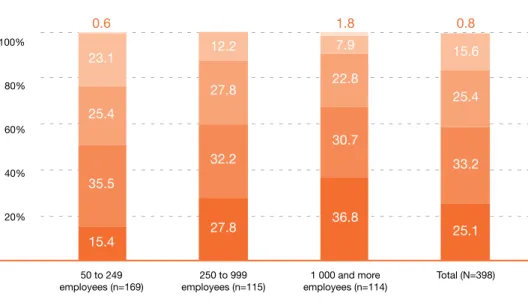
There is a more pronounced size class difference regarding extensiveness and degree of systematisation of competence assessment for personnel development, as data presented in Figure 2 show. Previous studies (IKEI, 2005) suggest that, even though efforts to identify needs for skills upgrading are prevalent both in larger firms and SMEs, formal systems for evaluating personnel training needs are much more likely to be implemented in large enterprises than in SMEs. This may be related to the fact that relevant decision-makers in SMEs know their employees well from day-to-day routine compared to decision-makers in large corporations.
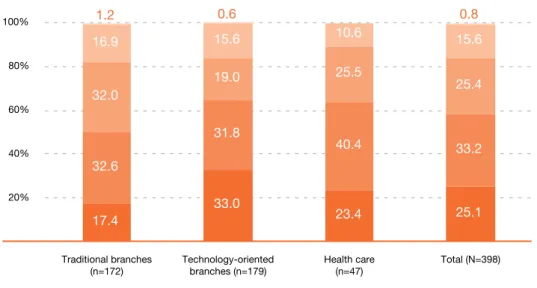
Next to a size class difference there is also a sector difference. In knowledge-oriented sectors, competence assessments for personnel development purposes seem to be more systematic and extensive than assessments in more traditional sectors (see Figure 3). This might be due to greater importance of continuous skills upgrading in the former group of sectors.
Figure 1 Extensiveness/systematisation of competence assessment for recruitment, percentage of surveyed companies, by size class of enterprise 20% 40% 60% 80% 100% 50 to 249
employees (n=169) employees (n=115)250 to 999 employees (n=114)1 000 and more Total (N=398)
0.5 0.9 0.6 7.8 10.4 10.7 18.3 14.0 16.5 22.5 34.7 40.4 33.9 31.4 38.7 43.9 39.1 34.9 4 = very extensive/systematic 3 2
1 = no assessments at all or hardly extensive/systematic No answer
31 Reasons for competence assessments in companies
To evaluate effectiveness of a training or development measure, assessments may also be conducted after training takes place. Learning effects – referring to new knowledge and skills acquired – could be measured, for example, through subsequent observation or tests, but interviewed experts and literature indicate this is rarely done (Stone et al., 2006).
2.3.
Career progress and succession planning
Validating competences is also used for career development and succession planning, when identifying and developing successors for, for example, management positions. The purpose is to measure an individual’s competences against requirements of a higher job position and to establish their potential as well as possible personnel development measures if needed.
50 to 249
employees (n=169) employees (n=115)250 to 999 employees (n=114)1 000 and more Total (N=398) 20% 40% 60% 80% 100% 0.8 1.8 0.6 15.6 7.9 12.2 23.1 25.4 22.8 27.8 25.4 33.2 30.7 32.2 35.5 25.1 36.8 27.8 15.4
Source: Cedefop, enterprise survey, 2012. 4 = very extensive/systematic
3 2
1 = no assessments at all or hardly extensive/systematic No answer
Figure 2 Extensiveness/systematisation of competence assessment for personnel development, percentage of surveyed companies, by size class of enterprise
The enterprise survey shows that extensiveness of competence assessments is on average somewhat lower than for recruitment or personnel development. One explanation is that, next to skills, performance may play a stronger role for career progression (although in practice HR managers often do not exactly distinguish between these two aspects).
For career planning systems to be in place, a certain hierarchy in a company is obviously required. Therefore, competence validation for career planning is more frequent and more systematic in larger companies, as Figure 4 clearly shows.
Similarly, competence assessments play a role in determining wages and salaries. Pay scale classifications, according to collective agreements or other rules, often take competences into account, but corresponding criteria are mainly based on certified qualifications and less on tests, etc. within a company. Beyond that, wages and salaries (similar to career progress) are often predominantly determined by result or performance rather than competence. Moreover, seniority is also an important determinant of remuneration.
Figure 3 Extensiveness/systematisation of competence assessment for personnel development, percentage of surveyed companies, by sector 20% 40% 60% 80% 100% Traditional branches
(n=172) Technology-orientedbranches (n=179) Health care(n=47)
0.8 0.6 1.2 15.6 10.6 15.6 16.9 25.4 25.5 19.0 32.0 33.2 40.4 31.8 32.6 25.1 23.4 33.0 17.4 Total (N=398) 4 = very extensive/systematic 3 2
1 = no assessments at all or hardly extensive/systematic
No answer NB: Traditional sectors: (retail) trade, construction, transport. Knowledge-oriented sectors: manufacturing, finance/insurance services, information and communication. Source: Cedefop, enterprise survey, 2012.
33 Reasons for competence assessments in companies
The enterprise survey and expert interviews show there are also other reasons for competence assessments, which are however less frequent:
(a) redundancy, restructuring, organisational change: occasionally, comprehensive competence assessments are done in company restructuring and organisational change. In such cases, information on available human capital is needed as, for example, the workforce must be reallocated to other activities and jobs or entire divisions of a company have to be valued. If employees are made redundant, validation of competences, going beyond usual simple work testimonials, can be part of a social plan to help people find new jobs. An example is given in Box 2;
(b) reintegration after disability or sickness: when employees return after long-term absence due to sickness or other health problems, some companies reassess their skills and competences to identify appropriate jobs;
(c) knowledge management systems: some firms, mainly larger ones, run knowledge management systems, often based on specific ICT tools.
20% 40% 60% 80% 100% 1.8 0.9 1.0 21.4 14.0 18.3 28.4 31.9 31.6 32.2 32.0 27.1 26.3 30.4 25.4 18.6 28.1 18.3 50 to 249
employees (n=169) employees (n=115)250 to 999 employees (n=114)1 000 and more Total (N=398)
Source: Cedefop, enterprise survey, 2012.
12.4
4 = very extensive/systematic 3
2
1 = no assessments at all or hardly extensive/systematic No answer
Figure 4 Extensiveness/systematisation of competence assessment for career progress and succession planning, percentage of surveyed companies, by size class of enterprise
Mapping and making visible a company’s competences and human capital potential can constitute one part of such systems. It may serve internal purposes (such as for people to know whom to refer to within a company) or external purposes (such as to display intangible assets to stakeholders). However, extensive competence assessments of individual employees are rarely part of these systems;
(d) quality assurance/management: some companies run quality assurance or management systems which foresee that specific employees are required to dispose of certain knowledge, skills or competences and are (regularly) assessed accordingly. The relevant tasks and needed skills may for instance be related to safety issues. Examples are presented in Box 2;
(e) legal provisions: in principle, companies are not obliged by law to carry out competence assessments of employees. Labour law may nevertheless function as a driver for firms to measure regularly skills of their workforce. In France, since 2005, there is a legal obligation – accompanied by public support measures – for enterprises with more than 300 employees to introduce a GPEC (gestion prévisionnelle des emplois et des competences; forward-looking employment and skills management). Although skills assessments are not compulsory within a GPEC this was, according to interviewed experts, nevertheless an important driver for implementing competence assessments in French companies. Firms may also get involved in employee validation to different degrees and forms in countries where their participation in national validation systems is foreseen, such as Norway, the Netherlands (EVC) (6) or the UK. Further information on roles of
legislation and collective agreements is presented in Chapter 8.
35 Reasons for competence assessments in companies
Box 2 Example of competence assessments
Example of competence assessments for organisational change
Fiskars, a Finnish international consumer goods company with a total of about 3 400 employees is going through a significant process of organisational change forcing the company to reevaluate their personnel’s skills. Some employees need to be given new jobs in the company while others are supported in finding new jobs elsewhere. Traditional appraisal procedures are now carried out more systematically and have been adapted to take account of different scenarios. This means that people are not only assessed against requirements of their current jobs, but also to find out which other jobs in or outside a company they could possibly take on. Assessments have also been adapted to take better account of individuals’ development potential.
Examples of competence assessments prompted by quality assurance systems
The approach to competence assessment of St Vincent’s University Hospital (SVUH) in Dublin, Ireland, has been influenced by the hospital’s accreditation in 2010 by an international organisation (JCI) focusing on improvement of safety of patient care. Achieving this accreditation requires SVUH to develop continuously and improve its competence assessment policies and practices. For example, one accreditation requirement is that job descriptions used in accredited hospitals also contain the relevant competences for the job. In addition, the hospital’s laboratory department has achieved accreditation to ISO 15189 (a quality standard for medical laboratories), which required among others, formally observing and testing trainees, and holding annual competence review meetings with staff members.
MB – Ihre Logistik Service GmbH, a German provider of logistics services, received in 2011 certification according to the quality management norm DIN EN ISO 9001:2008 for its control and rework division. This resulted in implementation of regular competence assessments, throughout all hierarchical levels, not only in the concerned division, but also in the other three divisions.
A quality certificate received in 2010 prompted Koivupirtin säätiö, a foundation providing housing services for the elderly in Finland, to measure employee skills and knowledge more precisely than before and, in particular, fully to record and store results to be available for inspection by an external quality auditor.
competence assessment
Not all company segments or groups of employees are assessed to the same degree. Appraisals are most developed and detailed for two types of job position: (a) executives and leadership/management positions are assessed most
extensively. This holds for both assessments for recruitment and existing managers (personnel development, succession planning, etc.). Obviously, most assessments for career/succession planning are almost by nature connected to this type of position;
(b) highly-qualified technicians and engineers appear to be the second main group for competence assessment.
The reason for these two groups standing out is that thorough competence assessments require significant financial and time resources which only pay off for crucial job functions in a company.
Other types of employees assessed to a reasonable extent include:
(a) sales personnel undergo extensive appraisals especially when recruited. Generally, competence assessments seem to be important for people who work directly with a company’s customers, including not only sales personnel but also, e.g. consultants, customer support staff or caretakers in the health sector;
(b) skilled craftsmen/workers (foremen, machine operators, printers, IT experts, etc.) are often assessed by simpler methods, such as CV screening, testimonials, and interviews. In many cases available educational qualifications are seen to be sufficiently informative as far as technical/ professional skills are concerned;
(c) administrative and office workers.
Low-skilled blue-collar workers are the least exposed to systematic competence assessments by companies. According to some interviewed experts, this group is usually only assessed when recruited but seldom at later stages, for instance for personnel development or career progress.
The pattern outlined above points to a positive relationship between the skills content of different occupational groups and their involvement in competence assessment activities in companies. The more important a job position, the
37 Main targets for competence assessment
more a firm will invest in appraisal. This phenomenon can also be observed for provision of training and development measures by enterprises. The OECD acknowledges that firms tend to choose investments from which they expect a high return, so training concentrates on workers who are already qualified and enjoy relatively high professional status (OECD, 2003). It also can be observed that enterprises with a relatively large number of manual workers and a small number of highly-educated employees invest less in education than enterprises with a high concentration of highly-educated people. The higher the ‘status’ of an employee the more resources are invested in training that employee (European Commission, 2003).
The same positive correlation is found with regard to competence assessments. The enterprise survey shows that companies with a higher share of employees with a tertiary level of education use (on average) more extensive/systematic assessment practices (see Figure 5). The interrelation between educational levels and investment in assessments holds for appraisals for both recruiting and personnel development.
Figure 5 Extensiveness/systematisation of competence assessment, percentage of surveyed companies, by share of staff with tertiary education
NB: R = for recruitment; PCD = for personnel development. Source: Cedefop, enterprise survey, 2012. 20% 40% 60% 80% 100% 0.8 0.8 14.5 11.3 21.1 7.0 15.4 7.1 16.1 14.5 21.1 12.3 30.4 21.3 30.6 17.7 22.8 35.1 35.6 36.4 38.7 56.5 35.1 45.6 17.8 34.4 R PCD R PCD R PCD
tertiary education share
up to 33 % (n=253) tertiary education share33 to 65 % (n=57) tertiary education share66 % and more (n=62)
4 = very extensive/systematic 3
2
1 = no assessments at all or hardly extensive/systematic No answer
competences
In principle, competences assessed by companies are derived from a required set of skills which are, in turn, derived from the task profile of a specific job, especially in recruitments, succession planning or personnel development. Even though skills requirements are certainly very heterogeneous, we investigate in Section 4.1 on which broad types of competences firms focus most in their assessments. In Section 4.2 we examine to which extent companies use predefined competence catalogues or profiles for appraisal purposes.
4.1.
Types of competences assessed
Based on the enterprise survey, Figure 6 provides an overview of importance of different types of competence in companies’ employee apprai