Durham Research Online
Deposited in DRO:
15 February 2017
Version of attached le:
Accepted VersionPeer-review status of attached le:
Peer-reviewedCitation for published item:
Biro, P. and Kern, W. and Paulusma, D. and Wojuteczky, P. (2018) 'The stable xtures problem with payments.', Games and economic behavior., 108 . pp. 245-268.
Further information on publisher's website:
https://doi.org/10.1016/j.geb.2017.02.002Publisher's copyright statement:
c
2017 This manuscript version is made available under the CC-BY-NC-ND 4.0 license
http://creativecommons.org/licenses/by-nc-nd/4.0/
Additional information:
Use policy
The full-text may be used and/or reproduced, and given to third parties in any format or medium, without prior permission or charge, for personal research or study, educational, or not-for-prot purposes provided that:
• a full bibliographic reference is made to the original source
• alinkis made to the metadata record in DRO
• the full-text is not changed in any way
The full-text must not be sold in any format or medium without the formal permission of the copyright holders. Please consult thefull DRO policyfor further details.
The Stable Fixtures Problem with Payments
?P´eter Bir´o1,2 ??, Walter Kern3, Dani¨el Paulusma4 ? ? ?, and P´eter Wojuteczky1
1 Institute of Economics, Hungarian Academy of Sciences; H-1112, Buda¨orsi ´ut 45, Budapest, Hungary,[email protected], [email protected]
2
Department of Operations Research and Actuarial Sciences, Corvinus University of Budapest
3
Faculty of Electrical Engineering, Mathematics and Computer Science, University of Twente, P.O.Box 217, NL-7500 AE Enschede
4 School of Engineering and Computing Sciences, Durham University, Science Laboratories, South Road, Durham DH1 3LE, UK,
Abstract. We generalize two well-known game-theoretic models by introduc-ing multiple partners matchintroduc-ing games, defined by a graphG= (N, E), with an integer vertex capacity functionband an edge weightingw. The setN consists of a number of players that are to form a setM ⊆E of 2-player coalitionsij
with valuew(ij), such that each playeriis in at mostb(i) coalitions. A payoff vector is a mappingp:N×N →Rwithp(i, j) +p(j, i) =w(ij) ifij∈M and p(i, j) =p(j, i) = 0 ifij /∈M. The pair (M, p) is called a solution. A pair of playersi, jwithij ∈E\M blocks a solution (M, p) ifi, j can form, possibly only after withdrawing from one of their existing 2-player coalitions, a new 2-player coalition in which they are mutually better off. A solution is stable if it has no blocking pairs. Our contribution is as follows:
– We survey, for the first time, known results on stable solutions in seven basic models and show that our model of multiple partners matching games is the natural model that was missing so far.
– We give a polynomial-time algorithm that either finds that a given mul-tiple partners matching game has no stable solution, or obtains a stable solution for it. Previously this result was only known for multiple part-ners assignment games, which correspond to the case whereGis bipartite (Sotomayor, 1992) and for the case whereb≡1 (Bir´o et al., 2012).
– We characterize the set of stable solutions of a multiple partners matching game in two different ways and show how this leads to simple proofs for a number of known results of Sotomayor (1992, 1999, 2007) for multiple partners assignment games and to generalizations of some of these results to multiple partners matching games.
– We perform a study on the core of the corresponding cooperative game, where coalitions of any size may be formed. In particular we show that the standard relation between the existence of a stable solution and the non-emptiness of the core, which holds in the other models with payments, is no longer valid for our (most general) model. We also prove that the problem of deciding if an allocation belongs to the core jumps from being polynomial-time solvable forb≤2 toNP-complete forb≡3.
Keywords.stable solutions, cooperative game, core.
?
An extended abstract of this paper has appeared in the proceedings of WG 2015 [7]. Part of the work was conducted when Kern and Paulusma visited Bir´o at Corvinus University of Budapest sponsored by COST Action IC1205 on Computational Social Choice.
??Supported by the Hungarian Academy of Sciences under Momentum Programme
LD-004/2010, by the Hungarian Scientific Research Fund - OTKA (no. K108673), and by J´anos Bolyai Research Scholarship of the Hungarian Academy of Sciences.
1
Introduction
Consider a group of soccer teams participating in a series of friendly games with each other off-season. Suppose each team has some specific target number of games it wants to play. For logistic reasons, not every two teams can play against each other. Each game brings in some revenue, which is to be shared by the two teams involved. The revenue of a game may depend on several factors, such as the popularity of the two teams involved or the soccer stadium in which the game is played. In particular, at the time when the schedule for these games is prepared, the expected gain may well depend on future outcomes in the current season (which are in general difficult to predict [25]). In this paper, we assume for simplicity that the revenues are known. Is it possible to construct astable fixture of games, that is, a schedule such that there exist no two unmatched teams that are both better off by playing against each other? Note that if teams decide to play against each other, they may first need to cancel one of their other games in order not to exceed their targets.
The above example describes the problem introduced in this paper (see Section 4 for another example). In the next section we explain how we model this problem.
1.1 Our Model
We model the above example in two settings, namely as a matching problem and as a cooperative game. As we will show these two settings are deeply interwoven.
Matching Problem.A multiple partners matching gameis a triple (G, b, w), where G= (N, E) is a finite undirected graph on nvertices and medges with no self-loops and no multiple edges,b:N →Z+is avertex capacity function, which is a nonnegative integer function, andw:E→R+is a nonnegative edge weighting. The setN is called theplayer setand its vertices are also calledplayers. There exists an edgeij∈Eif and only if playersi, jcan form a 2-player coalition. A setM ⊆E is ab-matchingif every player i is incident to at mostb(i) edges of M. So, a b-matching is a set of 2-player coalitions, in which no player is involved in more 2-player coalitions than described by her capacity. Ifij ∈M theni andj arematchedbyM; we also say thati andj are
partnersunderM. Thevalueof a 2-player coalitioni, j withij ∈Eis given by w(ij). A nonnegative function p : N ×N → R+ is a payoff vector with respect to a b-matchingM if the following two conditions hold:
• p(i, j) +p(j, i) =w(ij) for all ij∈M;
• p(i, j) =p(j, i) = 0 for allij /∈M.
Here,p(i, j) andp(j, i) represent payoffs thatiand respectivelyjobtain when they are matched to each other. If the two conditions above hold, then we say thatM andpare
compatible.1Note thatpprescribes how the valuew(ij) of a 2-player coalition{i, j}is distributed amongstiandj, ensuring that non-coalitions between two players yield a zero payoff. A pair (M, p), whereM is ab-matching andpis a payoff compatible with M, is asolutionfor (G, b, w). We viewpas a vector with entriesp(i, j), which we call
payoffs.
Let (M, p) be a solution. Two players i, j with ij ∈ E\M may decide to form a new 2-player coalition if they are “better off”, even if one or both of them must first leave an existing 2-player coalition inM (in order not to exceed their individual capacity). To describe this formally we define autility function up:N →R+, related
1
Assume thatbandware strictly positive functions. IfpandM are compatible, thenpis not compatible with any otherb-matching, that is,puniquely determinesM. However, for our purposes it is more convenient to follow the literature and definepwith respect toM.
to a payoff vectorp. IfiissaturatedbyM, that is, ifiis incident withb(i) edges inM, then we letup(i) = min{p(i, j) : ij ∈ M} be the worst payoffp(i, j) of any 2-player coalitioni is involved in. Otherwise,i is unsaturatedby M and we define up(i) = 0. Alternatively, we could defineup(i) as the b(i)th largest payoffp(i, j) toi. Note that the second definition shows that utilities are independent ofM and determined byp only (recall1 that this is becausepin fact determinesM).
A pair i, j with ij ∈ E\M blocks (M, p) if up(i) +up(j) < w(ij). We say that (M, p) isstable if it has no blocking pairs, or equivalently, if every edge ij ∈E\M satisfies thestability condition, that is, if
up(i) +up(j)≥w(ij) for allij ∈E\M.
Note that the stability condition only needs to be verified for edges not inM.
Remark 1. Let (G, b, w) be a multiple partners matching game withb≡1. Then any b-matching is a 1-matching, i.e, amatching, as for eachi∈N, we havep(i, j)>0 for at most one playerj6=i, which must be matched toi. In that case we will sometimes assume, with slight abuse of notation, thatpis a nonnegative function defined on N. Then we can writeup(i) =p(i) for everyi∈N. Checking if a pair (M, p) is a solution for (G,1, w) comes down to verifying ifp(i) +p(j) =w(ij) for every edgeij∈M and p(i) = 0 for every player inot matched byM. Checking if a solution (M, p) is stable comes down to verifying ifp(i) +p(j)≥w(ij) for every edgeij ∈E\M.
We can now define our problem formally:
Stable Fixtures with Payments(SFP)
Instance:a multiple partners matching game (G, b, w)
Question:does (G, b, w) have a stable solution?
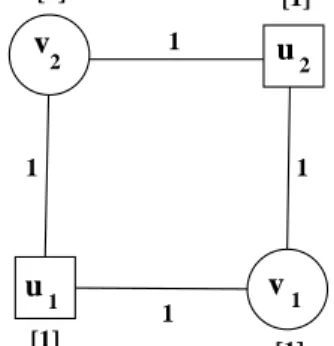
Example 1.Let Gbe the 4-vertex cycle u1v1u2v2u1 displayed in Figure 1. Let b≡1 andw≡1. Then Ghas two maximum weight matchings, namely M ={u1v1, u2v2} and ˆM ={u1v2, u2v1}. Let pbe given by p(u1, v1) = 107,p(v1, u1) = 103, p(u2, v2) =
7
10, p(v2, u2) = 3
10 and p(u1, v2) = p(v2, u1) = p(u2, v1) = p(v1, u2) = 0. Then pis compatible withM and (M, p) is a stable solution for (G,1,1). We also observe that pis not compatible with ˆM. However, there exists a stable solution ( ˆM ,p), where ˆˆ p can be obtained frompby permuting the entriesp(i, j) for every fixedi. Namely, let ˆ
p be defined as ˆp(u1, v2) = 107, ˆp(v2, u1) = 103, ˆp(u2, v1) = 107, ˆp(v1, u2) = 103 and ˆ
p(u1, v1) = ˆp(v1, u1) = ˆp(u2, v2) = ˆp(v2, u2) = 0.
Being a bit more specific than in the above example, let (M, p) and ( ˆM ,p) be twoˆ stable solutions for a multiple partners matching game (G, b, w). Then we say that p and ˆpareequivalentif the following four conditions hold:
– up(i) =upˆ(i) for everyi∈N,
– p(i, j) = ˆp(i, j) andp(j, i) = ˆp(j, i) for everyij ∈M∩Mˆ,
– p(i, j) =up(i) =up(i) andˆ p(j, i) =up(j) =up(j) for everyˆ ij∈M \Mˆ, and
– p(i, j) =ˆ upˆ(i) =up(i) and ˆp(j, i) =upˆ(j) =up(j) for everyij∈Mˆ \M.
If p and ˆp are equivalent, then the multisets {p(i, j) | j ∈ N with ij ∈ E} and
{p(i, j)ˆ |j ∈Nwithij∈E}are the same for everyi∈N. For a payoff vector p, the total payoff vector pt ∈
RN is defined by pt(i) =
P
equiv-v
2u
2 [1] [1] [1] 1 1u
1v
1 [1] 1 1Fig. 1.The 4-vertex cycle from Example 1 with unit vertex capacities and edge weights.
alent, then their total payoff vectors are the same, that is, pt = ˆpt.2 Moreover, for b≡1 two payoff vectorspand ˆpare equivalent if and only ifpt= ˆpt. We illustrate the definition of two payoff vectors being equivalent with another example.
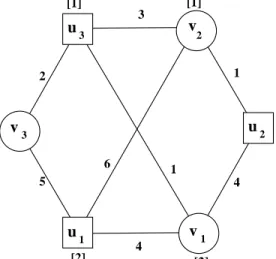
Example 2.Let Gbe the bipartite graph displayed in Figure 2 that has six vertices u1,u2,u3,v1,v2,v3and edgesu1v1,u1v2,u1v3,u2v1,u2v2,u3v1,u3v2andu3v3(that is, all edges between the two partition classes exist exceptu2v3). Letb(u1) =b(u2) = b(v1) = 2 and b(u3) = b(u3) = b(v3) = 1, and define w(u1v1) = 4, w(u1v2) = 6, w(u1v3) = 5,w(u2v1) = 4, w(u2v2) = 1,w(u3v1) = 1, w(u3v2) = 3 andw(u3v3) = 2. ThenGhas two maximum weightb-matchings, namely M ={u1v1, u1v2, u2v1, u3v3} and ˆM = {u1v1, u1v3, u2v1, u3v2}. Let p be given by p(u1, v1) = 3, p(v1, u1) = 1, p(u1, v2) = 3,p(v2, u1) = 3,p(u2, v1) = 2,p(v1, u2) = 2,p(u3, v3) = 0,p(v3, u3) = 2 andp(u1, v3) =p(v3, u1) =p(u2, v2) =p(v2, u2) =p(u3, v1) =p(v1, u3) =p(u3, v2) = p(v2, u3) = 0. Thenpis compatible withM and (M, p) is a stable solution for (G, b, w). We also observe that p is not compatible with ˆM. However, there exists a payoff vector ˆpthat is equivalent with psuch that ( ˆM ,p) is a stable solution. Namely, let ˆˆ p be defined as ˆp(u1, v1) = 3, ˆp(v1, u1) = 1, ˆp(u1, v3) = 3, ˆp(v3, u1) = 2, ˆp(u2, v1) = 2, ˆ
p(v1, u2) = 2, ˆp(u3, v2) = 0, ˆp(v2, u3) = 3 and ˆp(u1, v2) = ˆp(v2, u1) = ˆp(u2, v2) = ˆ
p(v2, u2) = ˆp(u3, v1) = ˆp(v1, u3) = ˆp(u3, v3) = ˆp(v3, u3) = 0.
Cooperative Game.So far, we modelled only situations in which 2-player coalitions can be formed. Allowing coalitions of any size is a natural and well-studied setting in the area of Cooperative Game Theory. Moreover, as we will discuss, there exist close relationships between stable solutions and their counterpart in the second setting, the so-called core allocations, which we define below.
Acooperative game with transferable utilities(TU-game) is a pair (N, v) consisting of a set N of n players and a value function v : 2N → R+ with v(∅) = 0. It is usually assumed that the grand coalition N is formed. Then the central problem is how to allocate thetotal value v(N) to the individual players inN. In this context, apayoff vector (orallocation) is a vectorp∈RN withp(N) =v(N), where we write p(S) =P
i∈Sp(i) forS⊆N. Thecoreof a TU-game consists of all allocationsp∈R N
satisfying
p(S)≥v(S), ∅ 6=S⊆N. (1)
2In fact, Sotomayor[39], calls two payoff vectors p and ˆp equivalent if pt = ˆpt and the
multisets {p(i, j)|j∈N withij ∈E}and{ˆp(i, j)|j∈N withij∈E}are the same for everyi∈N. Our definition implies hers and enables us to prove our results in a stronger form. However, in the proof of her results, Sotomayer uses in fact our definition as well.
v
3u
3v
2u
2 [2] [2] [2] [1] [1] [1] 5 6 2 3 4 4 1 1u
1v
1Fig. 2.The bipartite graph G from Example 2 with the given vertex capacities and edge weights.
A core allocation is seen as reasonable, because it offers no incentive for a subset of players to leave the grand coalition and form a coalition on their own. However, a TU-game may have an empty core. Hence, the most interesting computational complexity problems (given an input game (N, v)) are:
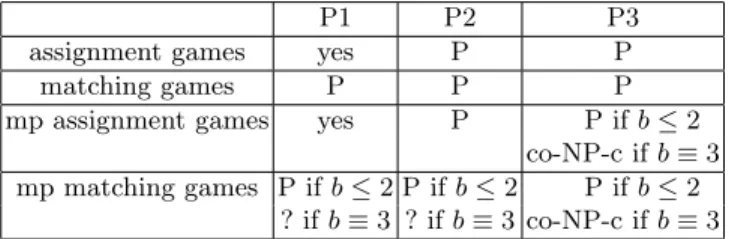
P1. Determine if the core is non-empty;
P2. Exhibit a vector in the core (provided there is any);
P3. Determine if a givenp∈RN is in the core or find a coalitionS withp(S)< v(S). In the literature both polynomial-time and (co-)NP-hardness results are known for each of these three problems (see e.g. [14]). An efficient algorithm for answering P3 implies that P1 and P2 can be solved in polynomial time as well. This follows from the work of Gr¨otschel, Lov´asz and Schrijver [18, 19] who proved, by refining the ellipsoid method of Khachiyan [26], that an efficient algorithm for solving the separation problem for a polyhedronP implies a polynomial-time algorithm that either finds thatP is empty, or obtains a vector ofP.
We define the TU-game (N, v) that corresponds to a multiple partners matching game (G, b, w) by setting, for everyS⊆N,
v(S) =w(MS) = X e∈MS
w(e),
whereMS is ab-matching with maximum weightP
e∈MSw(e) in the graphG[S], that
is, the subgraph of G induced by S; we also say that MS is a maximum weight b -matching of G[S]. We define v(S) = 0 if S induces an edgeless graph. We say that (N, v) isdefined on (G, b, w) but, unless confusion is possible, we may also call (N, v) a multiple partners matching game. If we say that a payoff vector p involved in a stable solution (M, p) of SFP is a core allocation, we mean in fact that the total payoff vectorptis a core allocation.
Example 3.LetGbe the 4-vertex cyclev1v2v3v4v1. Define a vertex capacity functionb byb(v1) =b(v2) = 1 andb(v3) =b(v4) = 2, and an edge weightingwbyw(v1v2) = 3 and w(v2v3) = w(v3v4) = w(v4v1) = 1. The pair (M, p) with M = {v1v2, v3v4}
and p(v1, v2) = p(v2, v1) = 32, p(v3, v4) = p(v4, v3) = 12 and p(v2, v3) = p(v3, v2) = p(v4, v1) =p(v1, v4) = 0 is a solution for the multiple partners matching game (G, b, w). Note thatup(v1) =up(v2) = 32 andup(v3) =up(v4) = 0. We find that (M, p) is even a stable solution, becauseup(v2) +up(v3) = 32 ≥1 =w(v2v3) andup(v4) +up(v1) = 32 ≥ 1 =w(v4v1) (note that we only need to verify the stability condition for edges outside the matching). Moreover, the total payoff vectorpt given bypt(v1) =pt(v2) = 32 and pt(v
3) =pt(v4) = 12 is readily seen to be a core allocation of the corresponding TU-game. In Section 5 we will give an example of a multiple partners matching game with no stable solutions for which the corresponding TU-game has a non-empty core. Before stating our results for multiple partners matching games in both settings we first discuss some existing work. As we will see, our model in both settings generalizes (or relaxes) several well-known models.
1.2 Known Results
The first model that we discuss is the most basic model related to the famousstable marriage problem(SM), defined as follows. Given two disjoint sets I and J of men and women, respectively, let each player have a strict preference ordering over a subset of players from the opposite set. A set of marriages is a matching in the underlying bipartite graph with partition classesI and J. Such a matching is stable if there is no unmarried pair, who would prefer to marry each other instead of a possible other partner. Gale and Shapley [17] proved that every instance of this problem has a stable matching and gave a linear-time algorithm that finds one.3
The main assumptions in the basic model are
(i) monogamy: each player is matched to at most one other player (1-matching); (ii) opposite-sex: every match is between players fromI andJ (bipartiteness); (iii) no dowry: only cardinal preferences are considered (no payments).
Dropping one or more of these three conditions leads to seven other models, one of which corresponds to our new model of multiple partner matching games, namely the one, in whichnoneof the three conditions (i)–(iii) is imposed. Below we briefly survey the other six models (see also Table 1).
In the first three models that we discuss, payments are not allowed. Hence, the no-tion of a (core) allocano-tion defined for TU-games is meaningless for these three models.
Remove (i).If we allow polygamy, that is, if we allow generalb-matchings instead of only 1-matchings, we obtain the many-to-many stable matching problem, which gen-eralizes the stable marriage problem. The problem variant, in which we demand that b(i) = 1 for each playeri∈I, is called thecollege admission problem[17], which is also known as themany-to-one stable matching problem[35] and as thehospital/residents problem[30]. Gale and Shapley [17] proved that every instance of the college admis-sion problem has a stableb-matching and gave a linear-time algorithm that finds one. Ba¨ıou and Balinski [3] proved these two results for the (more general) many-to-many stable matching problem.
Remove (ii). If we allow same-sex marriages, so the underlying graph may be an arbitrary graph that is not necessarily bipartite, then we get the stable roommates problem (SR), also defined by Gale and Shapley [17]. They proved that, unlike the previously discussed models, in this model a stable matching does not always exist.
3
Gale and Shapley assumed that the underlying bipartite graph is complete, but in fact their algorithm can also be used for arbitrary graphs; see [20].
Irving [21] gave a linear-time algorithm that finds a stable matching if there exists one.4
Remove (i) & (ii). Allowing polygamy and same-sex marriages leads to the stable fixtures problem(SF), which generalizes the stable roommates problem. Hence, a stable matching does not always exist. Irving and Scott [22] gave a linear-time algorithm for finding a stableb-matching (if there exists one). Cechl´arov´a and Fleiner [11] defined the more generalmultiple activities problem, in which the underlying graph may have multiple edges. They proved that even in this setting a stableb-matching can be found in polynomial time (if there exists one). Moreover, they also showed that this problem can be reduced to SR by a polynomial size graph construction.
In the remaining three models we allow payments to individual players.
Remove (iii).If we allow dowry then we obtain anassignment game, which is a multiple partners matching game (G, b, w) whereGis bipartite andb≡1. In this case the SFP problem is known as thestable marriage problem with payments (SMP). Koopmans and Beckmann [28] proved the following result.
Theorem 1 ([28]).Every instance(G,1, w)ofSMPhas a stable solution, which can be found in polynomial time. If(M, p)is a stable solution, thenM is a maximum weight matching. Moreover, for every other maximum weight matchingMˆ of Gthere exists an equivalent payoff vectorpˆof p, such that ( ˆM ,p)ˆ is a stable solution of (G, b, w).
Shapley and Shubik [37] proved that every core allocation of an assignment game is a payoff vector in a stable solution for the corresponding instance ofSMPand vice versa. Combining their result with Theorem 1 implies that every assignment game has a non-empty core. It is possible to obtain a stable solution in polynomial time and also to give affirmative answers to problems P1-P3 about the core of an assignment game; in the next paragraph we explain that this holds even if we allow same-sex marriages.
Remove (ii) & (iii). If we allow dowry and same-sex marriages then we obtain a
matching game, which is a multiple partners matching game (G, b, w) where b ≡ 1. In this case the SFP problem is called thestable roommates problem with payments
(SRP). The following two observations are well-known [6, 15] and easy to verify. First, a payoff vectorpis a core allocation of a matching game if and only if there exists a matchingM such that (M, p) is a stable solution for the corresponding instance of SRP. Note that the core may be empty (take a triangle with unit edge weights). Hence, a stable solution may not always exist.
Second, for matching games, the coalitions in the system of inequalities (1) may be restricted to 2-player coalitions. This means that problem P3, on core membership, can be answered in linear time. As explained, a polynomial-time algorithm for P3 also leads to polynomial-time algorithms for solving P1 and P2, about core non-emptiness, and finding a core allocation, and thus finding a stable solution. The restriction to 2-player coalitions even allows one to use the ellipsoid method of Khachiyan [26] directly. In a previous paper [6], we circumvented the ellipsoid method and presented anO(nm+ n2logn)-time algorithm that either finds that the core is empty, or obtains a core allocation.
Remove (i) & (iii).If we allow dowry and polygamy then we obtain a multiple part-ners assignment game, which is a multiple partners matching game (G, b, w) where G is bipartite. In this case the SFP problem is called the multiple partners assign-ment problem (MPA). Just as matching games, multiple partners assignment games generalize assignment games. Sotomayor generalized Theorem 1.
4
Irving showed that a stable matching may not exist even if the underlying graph is complete. His algorithm was designed for complete graphs, but can be used for arbitrary graphs [20].
Theorem 2 ([39]). Every instance (G, b, w) of MPA has a stable solution, which can be found in polynomial time. If(M, p)is a stable solution, thenM is a maximum weight b-matching and pt is a core allocation of the corresponding multiple partners assignment game. Moreover, for every other maximum weight b-matching Mˆ of G
there exists an equivalent payoff vectorpˆofp, such that ( ˆM ,p)ˆ is a stable solution of
(G, b, w).
Theorem 2 gives affirmative answers for problems P1 and P2 for multiple partners assignment games. The answer to P3 was still open for multiple partners assignment games and is settled in this paper, as we will discuss in Section 1.3. We refer to Table 1 for a survey of known results and related new results that we show in this paper. In Section 1.3 we describe all our new results.
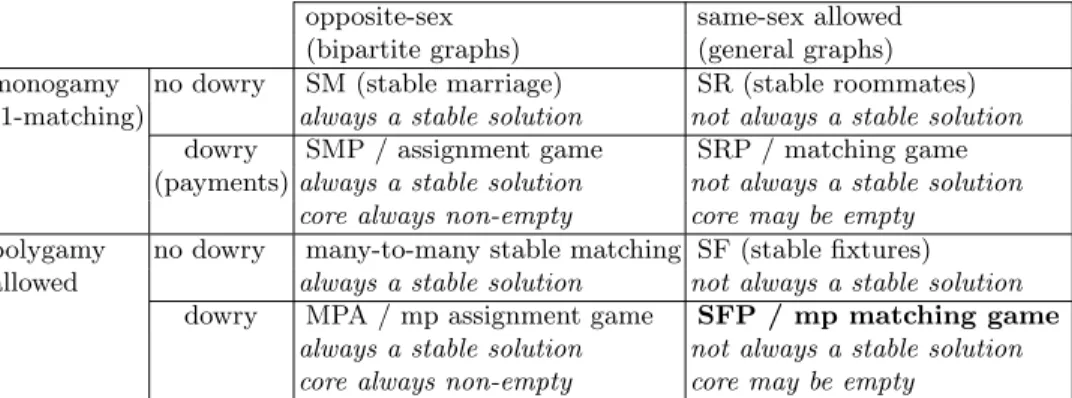
opposite-sex same-sex allowed (bipartite graphs) (general graphs) monogamy no dowry SM (stable marriage) SR (stable roommates) (1-matching) always a stable solution not always a stable solution
dowry SMP / assignment game SRP / matching game (payments)always a stable solution not always a stable solution
core always non-empty core may be empty
polygamy no dowry many-to-many stable matching SF (stable fixtures) allowed always a stable solution not always a stable solution
dowry MPA / mp assignment game SFP / mp matching game
always a stable solution not always a stable solution
core always non-empty core may be empty
Table 1.The eight different models; “mp” stands for “multiple partners”. Thehighlighted
case is the new model introduced and considered in this paper. As discussed in Section 1.2, for all models, the results on the (non-)existence of a stable solution or core allocation were known already or can be readily deduced from known results. Moreover, as discussed in Section 1.2 as well, it was already known that for all models, except for the highlighted model, a stable solution can be found in polynomial time (if it exists) and that for all the models with payments, except for the highlighted model, a core allocation can be computed in polynomial time (if the core is non-empty). As explained in Section 1.3, we give a polynomial-time algorithm for finding a stable solution (if it exists) for the highlighted model. We also prove that every stable solution corresponds to a core allocation. However, in contrast to the correspondence between the existence of stable solutions for SRP and core allocations for matching games, we show that there exist multiple partners matching games with a non-empty core, while the corresponding instance of SFP has no stable solution.
1.3 Our Results
In Section 3, after stating some known results that we need as lemmas in Section 2, we will prove that SFP is polynomial-time solvable. This generalizes the aforementioned corresponding results for SRP and MPA, respectively. In particular we prove that also for multiple partners matching games, the payoff vectors in stable solutions are always core allocations and the compatibility result of Theorem 2 for maximum weight b-matchings of bipartite graphs can be generalized to arbitrary graphs (in fact we generalize the whole of Theorem 2 from MPA to SFP apart from the opening claim that every instance of MPA has a stable solution, which does not hold for SFP). Our
technique for proving all these results is based on a reduction to MPA. Moreover, we characterize the set of stable solutions for a given instance of SFP via a reduction to SRP. We do this via linear programming techniques that show a close relationship between optimal solutions in the dual LP for SFP and stable solutions in the reduced instance of SRP.
In Section 4 we illustrate the power of our characterization of the set of stable solutions for an instance of SFP by proving that this characterization, which obviously holds for instances of MPA as well, immediately leads to simple alternative proofs of the three main results of Sotomayor for MPA, namely Theorem 2 of [39] (the whole theorem) and two theorems of [40] and [41], respectively.
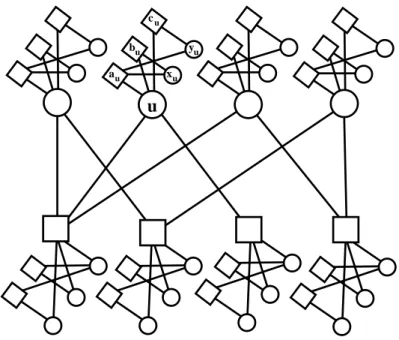
In Section 5 we aim to increase our understanding of the core of a multiple partners matching game. To that end we first prove that every core allocation of a multiple partners matchings game equals the total payoff vector of some suitable payoff vector, which we can find in polynomial time. We then show that there exist multiple partners matching games with a non-empty core for which the corresponding instance ofSFP has no stable solutions. Afterwards we focus on core membership, which corresponds to problem P3. We first show that core membership is polynomial-time solvable for multiple partner matching games defined on a triple (G, b, w) withb≤2, that is, with b(i) ≤ 2 for all i ∈ N. Due to the aforementioned result of Gr¨otschel, Lov´asz and Schrijver [18, 19] this leads to efficient answers to P1 and P2 as well (forb≤2). In our proof, we make a connection to the tramp steamer problem [27]. We complement this result by showing that it is tight, namely that already forb≡3 andw≡1, testing core membership is co-NP-complete even for multiple partners assignment games (whose core is always non-empty and for which a core allocation can be found in polynomial time due to Theorem 2).
Finally, in Section 6, we give some directions for future work.
2
Preliminaries
In order to prove our results we will need two known lemmas. The first lemma is used in Section 3 and generalizes the last two statements of Theorem 1 from SMP to SRP and is implicitly used in the literature (see, for example, [5]); we give its proof for completeness. The second lemma, which we will use in Sections 3 and 5, is due to Letchford, Reinelt and Theis [29].
Lemma 1. If (M, p)is a stable solution for an instance(G,1, w)of SRP, thenM is a maximum weight matching andptis a core allocation of the corresponding matching
game. Moreover, for every other maximum weight matching Mˆ of G there exists an equivalent payoff vectorpˆofp, such that( ˆM ,p)ˆ is a stable solution of(G,1, w). Proof. Let (M, p) be a stable solution for an instance (G,1, w) ofSRP. Then the total payoff vectorpt is readily seen to be in the core of the corresponding matching game (see also [6, 15]). Hencew(M) =pt(N) =v(N) holds, which means thatM must be a maximum weight matching.
Let ˆM be another maximum weight matching. As pt is in the core, we find that pt
i+ptj≥w(ij) for every edgeij. Asw( ˆM) =v(N) =pt(N), this means thatpti+ptj = w(ij) for everyij ∈ Mˆ, and moreover pt
i = 0 if i is not incident to an edge of ˆM. Consequently, the vector ˆp, defined by ˆp(i, j) =pt
i ifij∈Mˆ and ˆp(i, j) = 0 ifij /∈Mˆ, is equivalent topand forms together with ˆM a stable solution of (G,1, w). ut Lemma 2 ([29]).For a graphGwith vertex capacity functionband edge weightingw, it is possible to find a maximum weightb-matching of GinO(n2mlog(n2/m))time.
3
Stable Fixtures with Payments
We start with the following useful lemma. This lemma shows that a matchingM in a stable solution (M, p) for an instance (G, b, w) of SFP is always a maximum weight b-matching. Moreover it implies that the core of a multiple partners matching game is nonempty if the corresponding instance (G, b, w) of SFP has a stable solution (the reverse does not hold as we will prove in Section 5).
Lemma 3. Let (G, b, w) be an instance of SFP. If (M, p) is a stable solution for
(G, b, w), then M is a maximum weight b-matching andpt is a core allocation of the
corresponding multiple partners matching game.
Proof. Let (M, p) be a stable solution for an instance (G, b, w) of SFP, where G = (N, E). Before we prove thatM is a maximum weight b-matching, we will first show that pt is a core allocation of the multiple partners matching game (N, v) defined on (G, b, w). Recall that pt is defined as pt(i) =P
j:ij∈Ep(i, j) for every i ∈N. Let S⊆N be an arbitrary coalition, and letM0 be a maximum weightb-matching in the subgraph ofGinduced by S. Then we have that
pt(S) =X i∈S pt(i) =X i∈S X j:ij∈M∩M0 p(i, j) + X j:ij∈M\M0 p(i, j) = X ij∈M∩M0 (p(i, j) +p(j, i)) +X i∈S X j:ij∈M\M0 p(i, j) = X ij∈M∩M0 w(ij) +X i∈S X j:ij∈M\M0 p(i, j) ≥ X ij∈M∩M0 w(ij) +X i∈S X j:ij∈M0\M up(i) = X ij∈M∩M0 w(ij) + X ij∈M0\M (up(i) +up(j)) ≥ X ij∈M∩M0 w(ij) + X ij∈M0\M w(ij) =w(M0) =v(S).
The first inequality is valid because of the following reason. Ifiis unsaturated byM thenup(i) = 0 by definition. Ifiis saturated byM then|{j:ij∈M\M0}| ≥ |{j:ij ∈
M0\M}|and p(i, j)≥up(i) holds for every j 6=i by definition. The last inequality follows from the stability condition for the pairs not matched byM. We conclude that ptis in the core. In particular this means thatw(M) =P
ip
t(i) =v(N). Hence,M is
a maximum weightb-matching of G. ut
The remainder of the section is organized as follows. In Section 3.1 we present our characterizations of the set of stable solutions for a given instance of SFP in terms of stable solutions for some corresponding instance of SRP and in terms of integral optimal solutions of some appropriate LP relaxation. In Section 3.2 we first observe that our characterization of the set of stable solutions directly leads to a polynomial-time algorithm for solving SFP and then we present an alternative but asymptotically faster algorithm (in order to do so we use Lemma 2). In Section 3.3 we generalize Lemma 1 from SRP to SFP and simultaneously Theorem 2 from MPA to SFP (apart from one statement of Theorem 2 that we observe cannot be generalized in this way).
3.1 Characterizing Stable Solutions of SFP
In this subsection we show how stable solutions of an instance (G, b, w) of SFP corre-spond to both stable solutions of an instance (G0,1, w0) of SRP, where G0 is a graph of sizeO(n3), and to integral optimal solutions of an LP relaxation.
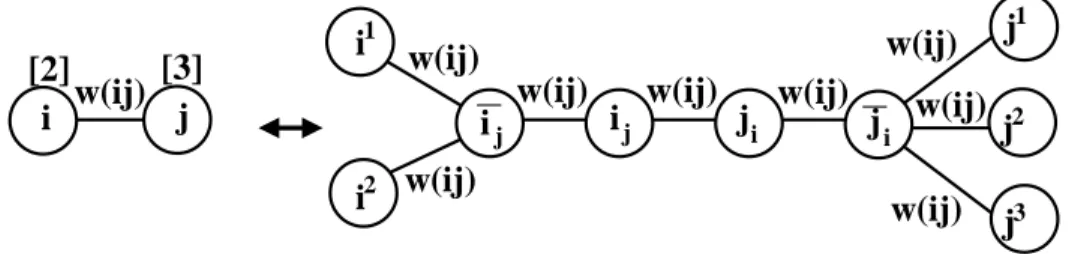
Reducing to SRP.We first explain how to construct the instance (G0,1, w0) of SRP from an instance (G, b, w) of SFP; see also Figure 3. Our construction is based on a well-known construction, which was introduced by Tutte [43] for nonbipartite graphs with no edge weights. We writeG0 = (N0, E0). For each playeri∈Nwith capacityb(i) we createb(i) copies,i1, i2, . . . , ib(i)inN0. For each edgeij∈Ewe create four players,
ij,ij,ji,ji, with edgesisijfors= 1, . . . , b(i),ijij,ijji,jijiandjijtfort= 1, . . . , b(j), each with weightw(ij). This completes the construction. Note thatG0 is bipartite if and only ifGis bipartite. Hence, our construction also reduces an instance of MPA to an instance of SMP. We say that (G0,1, w0) isreducedfrom (G, b, w).
j
i
i
1 2i
jj
ij
ii
jj
j
j
1 2 3i
[2]
[3]
w(ij)
w(ij)
w(ij)
w(ij)
w(ij)
w(ij)
w(ij)
w(ij)
w(ij)
Fig. 3.An example of the construction of an SRP instance (G0,1, w0) from a SFP instance (G, b, w), whereb(i) = 2 andb(j) = 3.
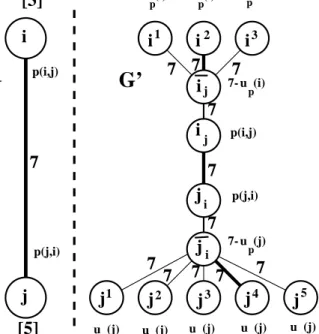
Given a solution (M, p) for (G, b, w), we define a solution (M0, p0) for (G0,1, w0) as follows; see also Figures 4 and 5. Asb≡1 in the instance (G0,1, w0), we definep0 as a function onN0 for simplicity, that is, with slight abuse of notation we define p0 as a
total payoff vector.
– The payoffs of the copies will be the same as the minimum payoffs of the original players, that is, for eachi∈N, letp0(is) =u
p(i) for every s= 1, . . . , b(i).
– For eachi∈N, we order its partners underM.
• For eachij ∈M, ifjis thes-th partner ofifor somes∈ {1, . . . , b(i)}, andiis thet-th partner ofjfor somet∈ {1, . . . , b(j)}then letisi
j ∈M0,ijji∈M0and jijt∈M0 with the following payoffs:p0(ij) =p(i, j) andp0(ij) =w(ij)−up(i), and similarly p0(ji) =p(j, i) andp0(ji) =w(ij)−up(j).
• For each ij ∈E\M, let ijij, jiji ∈M0 with p0(ij) = min{up(i), w(ij)} and p0(i
j) = w(ij)−min{up(i), w(ij)}, and similarly p0(ji) = min{up(j), w(ij)} andp0(ji) =w(ij)−min{up(j), w(ij)}.
We say that (M0, p0) is reduced from (M, p) and prove in our next lemma that (M0, p0) is a solution for (G0,1, w). Note that (M0, p0) may not be the unique solution reduced from (M, p), as it might be possible to order the partners of a player differently and we used this order in the construction ofM0. We may also define a matchingM0 in the above way, without defining any payoff vector p0, and say that M0 is reduced
fromM. In our next lemma we also show that our reduction preserves the “maximum weight property” of a matching.
G’
G
j
i i7
7
7
7
7
7
7
7
7
j
i
[5]
7
[3]
j
ji
ji
5j
7
4j
3j
2j
1j
3i
2i
1i
7
p u (j) p u (i) 7-p u (j) p u (j) p u (j) u (j) p u (j) p u (i) p u (i) p u (i) p u (j) p u (i) p 7-p(j,i) p(i,j) p(i,j) p(j,i)Fig. 4.Reducing a solution (M0, p0) from a solution (M, p): the case when ij ∈ M (here
b(i) = 3,b(j) = 5 andw(i, j) = 7). The thick edges represent matching edges.
G’
G
ij
j
j7
7
7
7
7
7
7
7
7
7
j
i
7
[5]
[3]
i
ji
5j
4j
7
3j
2j
1j
3i
2i
1i
i p u (j) p u (i) 7-p u (j) p u (j) p u (j) p p u (j) p u (i) p u (i) p u (i) p u (j) p u (i) u (j) 7-p u (i) u (j) pFig. 5.Reducing a solution (M0, p0) from a solution (M, p): the case when ij /∈ M (here
Lemma 4. Let (G, b, w)be an instance of SFP and let (G0, b0, w0) be its reduced in-stance. Then the following two statements hold:
(i) every matchingM0 reduced from a maximum weight b-matchingM is a maximum weight matching ofG0;
(ii) every pair (M0, p0) reduced from a solution (M, p) for(G, b, w) is a solution for
(G0,1, w).
Proof. Let (G, b, w) be an instance ofSFPand let (G0, b0, w0) be its reduced instance. We first prove (i) and then (ii).
(i)Let M be a maximum weight b-matching of G, and let M0 be a matching in G0 reduced fromM. Note that
w0(M0) = 3 X ij∈M
w(ij) + 2 X ij∈E\M
w(ij) = 3w(M) + 2w(E\M) =w(M) + 2w(E).
Consider a maximum weight matchingM∗ of G0. LetEij denote all the edges in G0 that are incident with at least one vertex in{ij, ij, ji, ji}. AsM∗has maximum weight, eachEij contains at least two edges ofM∗. By construction ofG0, eachEij contains at most three edges ofM∗. If |Eij∩M∗|= 2, then we replace the edges ofEij∩M∗ by the edgesijij and jiji if necessary. If |Eij∩M∗|= 3, thenM∗ must contain the edge ijji together with the edges isij for some s ∈ {1, . . . , b(i)} and jijt for some t∈ {1, . . . , b(j)}. Hence the resulting matching ˆM0 is a maximum weight matching of G0, which we can reduce from someb-matching ˆM ofGby construction. In particular, we have thatw0( ˆM0) = w( ˆM) + 2w(E). As M is a maximum weight b-matching of
G, we find that w(M)≥w( ˆM). Hence, we deduce that w0( ˆM0) =w( ˆM) + 2w(E)≤
w(M) + 2w(E) =w0(M0). As ˆM0 is a maximum weight matching of G0, this implies thatM0 is a maximum weight matching ofG0.
(ii)Let (M, p) be a solution for (G, b, w), and let (M0, p0) be a pair reduced from (M, p). Every edge inG0is obtained from an edgeijofG. We consider all cases (cf. Remark 1). Ifisi
j ∈M0 thenp0(is) +p0(ij) =up(i) +w(ij)−up(i) =w(ij) =w0(isi¯j). Ifijij∈M0 thenp0(ij) +p0(ij) =w(ij)−min{up(i), w(ij)}+ min{up(i), w(ij)}=w(ij) =w0(ijij). Ifijji ∈M0 then p0(ij) +p0(ji) = p(i, j) +p(j, i) =w(ij) =w0(ijji), where the one-but-last equality follows from the assumption that (M, p) is a solution for (G, b, w).
Hence, we have shown statement (ii). ut
Our next result shows that reduced solutions preserve stability. In fact, we prove a stronger statement, as we characterize stable solutions for instances of SFP in terms of stable solutions for instances of SRP. In particular, Theorems 3 (ii) and (iii) specify properties of stable solutions of reduced instances that we will need later on. We note that the restriction in statements (ii) and (iii) of Theorem 3 to maximum weight b-matchings does not make these statements weaker due to Lemma 3.
Theorem 3. Let (G, b, w) be an instance of SFP and (G0,1, w0) be the instance of
SRPreduced from (G, b, w). Then the following three statements hold:
(i) (G, b, w)has a stable solution if and only if (G0,1, w0)has a stable solution; (ii) (G, b, w)has a stable solution(M, p)for some maximum weightb-matchingM of
Gif and only if(G0,1, w0)has a stable solution(M0, p0), whereM0 is reduced from
M andp0(ij) =p(i, j)andp0(ji) =p(j, i)for every ij∈M;
(iii) a solution (M, p) for (G, b, w), whereM is a maximum weight b-matching of G, is stable if and only if every solution(M0, p0)for(G0,1, w0)reduced from(M, p)is stable.
Proof. Let (G, b, w) be an instance of SFP and (G0,1, w0) be the instance of SRP reduced from (G, b, w).
We first prove the “⇒”-direction of statement (iii), namely that if (G, b, w) has a stable solution (M, p), then every (M0, p0) for (G0,1, w0) that is reduced from (M, p) is stable. Note that this immediately implies the “⇒”-direction of statements (i) and (ii) as well. Let (M0, p0) be reduced from (M, p). By Lemma 4 (ii) we find that (M0, p0) is a solution for (G0,1, w0). We will show that (M0, p0) is a stable solution for (G0,1, w0).
Throughout the proof we assume thatp0 is a total payoff vector defined onN0. In order to prove that (M0, p0) is stable we must check whether the stability con-dition for each edge not inM0 is satisfied, that is, whetherup0(i0) +up0(j0)≥w0(i0j0)
holds for alli0j0 ∈E0\M0. Asup0(i0) =p0(i0) for every i0 ∈N0, this comes down to
checking whether
p0(i0) +p0(j0)≥w0(i0j0) for alli0j0∈E0\M0.
First consider each edge isij ∈/ M0. Then p0(ij) = w(ij)−min{up(i), w(ij)}. Hence
we find thatp0(is) +p0(ij) = up(i) +w(ij)−min{up(i), w(ij)} ≥ w(ij) = w0(isij). Now consider each edgeijij ∈/ M0. Thenp0(ij) =w(ij)−up(i) andp0(ij) =p(i, j). As up(i)≤p(i, j), we obtainp0(ij) +p0(ij) =w(ij)−up(i) +p(i, j)≥w(ij) =w0(ijij). Finally, consider each edgeijji ∈/ M0. Then p0(ij) = min{up(i), w(ij)} and p0(ji) = min{up(j), w(ij)}. If w(ij)≤ up(i) or w(ij)≤ up(j), then p0(ij) +p0(ji)≥w(ij) = w0(i
jji). Now suppose that w(ij)> up(i) andw(ij)> up(j). Then p0(ij) +p0(ji) = up(i) +up(j)≥w(ij) =w0(ijji), where the inequality follows from the fact that (M, p) is a stable solution for (G, b, w). Hence the “⇒”-directions of statements (i) and (ii) have been proven.
We will now prove the “⇐”-directions of statements (i) and (ii). We do this as fol-lows. First we assume that (G0,1, w0) has a stable solution. We then show that this stable solution can be changed into a stable solution for (G0,1, w0) as prescribed by statement (ii), followed by a proof of the “⇐”-direction of statement (ii).
Let (M00, p00) be a stable solution for (G0,1, w0). LetM0 be a matching ofG0 that can be reduced from a maximum weight b-matching M of G. By Lemma 4 (i), we find that M0 is a maximum weight matching of G0 By Lemma 1, (G0,1, w0) has a stable solution (M0, p0), where p0 is equivalent to p00. We define p(i, j) =p0(ij) and p(j, i) = p0(ji) for every ij ∈ M and p(i, j) = p(j, i) = 0 for every ij ∈E\M. We claim that (M, p) is a stable solution for (G, b, w).
First we show that (M, p) is a solution for (G, b, w). Letij∈E. Ifij∈E\M, then p(i, j) =p(j, i) = 0 by definition of p. Ifij ∈M, thenijji∈M0 by construction. As (M0, p0) is a solution, this means thatp(i, j)+p(i, j) =p0(ij)+p0(ji) =w0(ijji) =w(ij). Now we show that (M, p) is stable. For contradiction, assume thatGhas an edge ij∈E\M that blocks (M, p), that is,
up(i) +up(j)< w(ij).
Note thatijji ∈E0\M0 by construction. We claim that p0(ij)≤up(i) andp0(ji)≤
up(j) hold. Then p0(ij) +p0(ji) ≤ up(i) +up(j) < w(ij) = w0(ijji), which means, together withijji∈E0\M0, that we have obtained a contradiction with the stability of (M0, p0).
In order to prove that p0(ij)≤ up(i) and p0(ji)≤ up(j), we distinguish between two cases. First suppose thati is not saturated byM. Then G0 contains a copy ofi, sayis, that is not matched byM0, which means thatp0(is) = 0. As (M0, p0) is stable andisi
j ∈ E\M0, we find that up0(is) +up0(ij) =p0(is) +p0(ij)≥w0(isij). Hence,
we obtain p0(ij) +p0(ij) = w0(ijij). As p0(ij) ≥ w(ij) and p0 ≥ 0, this means that p0(ij) = 0. Hence,p0(ij)≤up(i).
Now suppose that i is saturated by M. Then all b(i) copiesih of i in (G0,1, w0)
are matched byM0. Letkbe the partner ofifor whichp(i, k) is minimal, sou
p(i) = p(i, k) = p0(ik). As isik ∈ M0 and (M0, p0) is a solution for (G0,1, w0), we find that p0(is) +p0(i
k) =w(ik). From the stability of (M0, p0) it follows that p0(ik) +p0(ik)≥ w(ik). Hence p0(ik)≥p0(is) holds. From the stability of (M0, p0) it also follows that p0(is) ≥ w(ij)−p0(ij). As (M0, p0) is a solution for (G0,1, w0) and ijij ∈ M0, we
find that w(ij)−p0(ij) = p0(ij). Putting the last three conditions together yields p0(ij)≤p0(ik) =up(i), just as we claimed. We can showp0(ji)≤up(j) by exactly the same arguments. Hence the two “⇐”-directions of statements (i) and (ii) have been proven.
We are left to prove the “⇐”-direction of statement (iii). This direction can be seen as follows. Let (M, p) be a solution for (G, b, w), where M is a maximum weight b-matching ofG. If the starting stable solution (M00, p00) is reduced from a solution (M, p) of (G, b, w) (instead of being an arbitrary stable solution for (G0,1, w)) then the above argument shows that (M, p) is stable. This completes the proof of the theorem. ut
Note that not all stable solutions for (G0,1, w0) can be reduced from stable solutions for (G, b, w), asup(i)> p0(is) is possible for somes∈1. . . b(i). This might be the case even for very small instances (G, b, w), as the following example shows.
Example 4.Let Gconsist of only two adjacent players i and j with b(i) =b(j) = 1 and w(ij) = 7. Then the pair (M, p) with M ={ij} and p(i, j) = 3, p(j, i) = 4 is a stable solution, which has only one reduced solution (M0, p0) (see Figure 6) given by M0 = {i1ij, ijji, jij1} and payoffs p0(i1) = 3, p0(ij) = 4, p0(ij) = 3, p0(ji) = 4, p0(j
i) = 3 and p0(j1) = 4. An alternative stable solution for (G0,1, w0), depicted in Figure 6 as well, is the pair (M0, p00), where p00(i1) = 1, p00(i
j) = 6, p00(ij) = 3, p00(ji) = 4,p00(ji) = 4,p00(j1) = 3. 1
i
1i
i
ji
jj
ij
ij
17
7
7
7
7
p’’
1 6 3 4 3 4i
jj
ij
ii
jj
17
7
7
7
7
p’
3 4 3 4 3 4Fig. 6.The two stable solutions (M0, p0) and (M0, p00) for the instance (G0,1, w0) reduced from the instance (G, b, w) from Example 4; the stable solution (M0, p00) cannot be reduced from a stable solution for (G, b, w).
Remark 2. In the proof of Theorem 3 we could have used a simpler construction, namely the one where each 4-player path in the reduced instance,ij, ij, ji, jiis replaced with a 2-player pathij, ji. However, this reduction would not give us the one-to-one correspondence described in Theorem 3 (ii), and this correspondence is crucial for some of our other results.
The LP Relaxation.Let (G, b, w) be an instance of SFP. Let M be a matching of G. With M we associate a binary vector xM : E → {0,1} called the characteristic
functionof M, which is defined byxM(ij) = 1 for all ij ∈M andxM(ij) = 0 for all ij∈E\M. Then we can writeP
j:ij∈Ex
M(ij)≤b(i) for eachi∈N as an alternative way to state the capacity condition. This leads to the following LP relaxation, which we call Primal-(G, b, w): max X ij∈E w(ij)x(ij) (P-obj) subject to X j:ij∈E
x(ij)≤b(i) for each i∈N, (a)
0≤x(ij)≤1 for eachij ∈E. (b) We make the following observation.
Lemma 5. The (optimal) solutions of the integer linear program corresponding to Primal-(G, b, w)correspond to the (maximum weight)b-matchings ofGand vice versa.
We now formulate the dual LP Dual-(G, b, w) of Primal-(G, b, w):
minX
i∈N
b(i)y(i) + X ij∈E
d(ij) (D-obj)
subject to y(i) +y(j) +d(ij)≥w(ij) for eachij ∈E, (a’) 0≤y(i) for alli∈N, (b’)
0≤d(ij) for allij∈E. (c’)
Note that for an optimal dual solution (y, d), it holds thatd(ij) = [w(ij)−y(i)−y(j)]+ (where the latter notation means max{w(ij)−y(i)−y(j),0}).
We now characterize stable solutions of instances of SFP in terms of integral optimal solutions of Primal-(G, b, w).
Theorem 4. An instance(G, b, w)of SFPhas a stable solution if and only if the LP Primal-(G, b, w)has an integral optimal solution.
Proof. Let (G, b, w) be an instance of SFP. By Theorem 3 (i) it suffices to show that the instance (G0,1, w0) of SRP reduced from SFP has a stable solution if and only if Primal-(G, b, w) has an integral optimal solution. We show this below.5
(⇒)Suppose that (M00, p00) is a stable solution for (G0,1, w0), where we again assume thatp00is a total payoff vector (defined onN0). LetM0be a maximum weight matching ofG0 that can be reduced from a maximum weightb-matchingM ofG. By Lemma 1, (G0,1, w0) has a stable solution (M0, p0), wherep0 is equivalent to p00.
Before we define a feasible solution (y, d) of Dual-(G, b, w), we will first show that p0(is) =p0(it) for every playeri∈N and every two indicess, t∈ {1, . . . , b(i)}. For con-tradiction, suppose thatp0(is)> p0(ir) for somei∈N and indicesr, s∈ {1, . . . , b(i)}. Then, as p0(ir) ≥ 0, we have that p0(is) > 0. This means that isij ∈ M0 for some
j ∈ N \ {i}, which implies that p0(is) +p0(ij) = w0(isij) = w(ij). Consequently,
5
Note that we could have proven Theorem 4 directly, without reducing to an instance of SRP. However, as a byproduct of our proof we obtain an alternative description of the set of stable solutions of the reduced instance (Corollary 1), which we think is worth noting.
p0(ir) +p0(ij)< p0(is) +p0(ij) =w(ij) =w0(irij), thusirij would block (M0, p0). This
contradicts the fact that (M0, p0) is a stable solution for (G0,1, w). Hence we may set y(i) =p0(is) for every copyisof everyi∈N, (2) as this is well-defined. We also define
d(ij) = [w(ij)−y(i)−y(j)]+for everyij∈E. (3) In this way we have obtained our feasible solution (y, d) of Dual-(G, b, w).
We define an integral solutionxof Primal-(G, b, w) as follows. For eachij∈E, let x(ij) = 1 if ijji ∈M0 andx(ij) = 0 otherwise. Recall thatisij ∈M0 for exactly one
indexs∈ {1, . . . , b(i)}if and only ifijji∈M0. Hence, as eachisis incident to at most one edge ofM0, we find thatP
j:ij∈Ex(ij) =
P
j:ijji∈M01 ≤b(i). As 0≤x(ij)≤1
for everyij∈E, we find that xis a feasible solution.
It remains to prove thatxis an optimal solution of Primal-(G, b, w). In fact we will show thatxand (y, d) are both optimal, as they satisfy the complementary slackness conditions:
– For everyi∈N, if P
j:ij∈Ex(ij)< b(i) then (asi
sij ∈M0 for exactly one index
s∈ {1, . . . , b(i)}if and only if ijji∈M0) some copy of i, sayir, is unmatched in M0. Thereforey(i) =p0(ir) = 0. This means that dual condition (b’) is binding.
– For every ij ∈ E, if x(ij) < 1, then x(ij) = 0 and thus ijji ∈/ M0 . Then, by construction of M0, we have that isij ∈/ M0 for anys ∈ {1, . . . , b(i)}, ijij ∈M0,
jiji ∈ M0 and jijt ∈/ M0 for any t ∈ {1, . . . , b(j)}. These facts, together with the stability conditions forisij and jijt and the fact thaty(i) =p0(is) holds by definition, imply that
y(i) +p0(ij) =p0(is) +p0(ij)≥w0(isij) =w(ij) =w(ijij) =p0(ij) +p0(ij), and thusy(i)≥p0(ij), and similarly,y(j)≥p0(ji), which means thaty(i) +y(j)≥
p0(ij) +p0(ji)≥ w0(ijji) = w(ij), where the second inequality is implied by the stability condition for ijji. As a consequence, d(ij) = [w(ij)−y(i)−y(j)]+ = 0 holds. This means that dual condition (c’) is binding.
– For everyij∈E, ifx(ij)>0, thenx(ij) = 1 and thusijji∈M0 and therefore, by construction ofM0, we have thatisi
j ∈M0 for somes∈ {1, . . . , b(i)},ijij ∈/ M0, jiji ∈/ M0 and jijt ∈ M0 for some t ∈ {1, . . . , b(j)}. These facts, together with the stability conditions forijij and jiji and the fact that y(i) =p0(is) holds by definition, imply that
y(i) +p0(ij) =p0(is) +p0(ij) =w0(isij) =w(ij) =w(ijij)≤p0(ij) +p0(ij), and thusy(i)≤p0(i
j), and similarly,y(j)≤p0(ji), which means thaty(i) +y(j)≤ p0(ij)+p0(ji) =w0(ijji) =w(ij); as a consequence,d(ij) = [w(ij)−y(i)−y(j)]+= w(ij)−y(i)−y(j) holds. This means that dual condition (a’) is binding.
Hencexis an integral optimal solution of Primal-(G, b, w), as required.
(⇐) Let x be an integral optimal solution for Primal-(G, b, w) and let (y, d) be an optimal solution of Dual-(G, b, w). Fromxand (y, d) we create a stable solution (M0, p0) for (G0,1, w0) as follows.
Asxis an integral optimal solution,xis a characteristic function of some maximum weight b-matching M by Lemma 5. Let M0 be a maximum weight matching in G0
ij /∈M we definep0(ij) =y(i) and p0(ij) =w(ij)−y(i). For each ij ∈M we choose ξ(i, j)≥0 andξ(j, i)≥0 withξ(i, j) +ξ(j, i) =d(ij) and definep0(ij) =y(i) +ξ(i, j) andp0(ij) =w(ij)−y(i).
We will first show that (M0, p0) is a solution for (G0,1, w0), that is,p0(i0) +p0(j0) = w0(i0j0) for every i0j0 ∈M0. Supposeij ∈M. Then isij ∈M0 for somes= 1, . . . , b(i) and jtji ∈M0 for some t = 1, . . . , b(j). By symmetry, we only need to consider the edgeisi
j. We find thatp0(is) +p0(ij) =y(i) +w(ij)−y(i) =w(ij) =w0(isij). We also haveijji∈M0 and find that
p0(ij) +p0(ji) =y(i) +ξ(i, j) +y(j) +ξ(j, i) =y(i) +y(j) +d(ij) =w(ij) =w0(ijji), where the one-but-last equality follows from the fact that dual condition (a’) is binding forij ∈M, asx(ij) = 1>0.
Now supposeij /∈M. Then ijij ∈M0 andjiji ∈M0. By symmetry we only need to consider the edgeijij. We find that p0(ij) +p0(ij) =w(ij)−y(i) +y(i) =w(ij) = w0(ijij). Hence,p0(i0) +p0(j0) =w0(i0j0) for everyi0j0∈M0, which means that (M0, p0) is a solution for (G0,1, w0).
Now we show that (M0, p0) is stable, that is, we show thatp0(i0) +p0(j0)≥w0(i0j0)
for everyi0j0 ∈E0\M0. First supposeij ∈M. Thenijij∈E0\M0andp0(ij) +p0(ij) = w(ij)−y(i) +y(i) =w(ij) = w0(ijij), as required. We also havejiji ∈E0\M0 and can show that the stability condition is satisfied forjiji in the same way.
Now supposeij ∈E\M. Thenijji∈E0\M0. Asx(ij) = 0<1, dual condition (c’) is binding forij, sod(ij) = 0. Consequently, we deduce that
p0(ij) +p0(ji) =y(i) +y(j) =y(i) +y(j) +d(ij)≥w(ij) =w0(ijji),
where the last inequality follows from the fact that (y, d) is a solution of Dual-(G, b, w). We also haveisi
j ∈/ E0\M0 fors= 1, . . . , b(i) andjtji∈/ E0\M0 fort= 1, . . . , b(j). By symmetry it suffices to consider an edgeisi
j for somes∈ {1, . . . , b(i)}. Then we obtainp0(is) +p0(i
j) =y(i) +w(ij)−y(i) =w(ij) = w0(isij). We conclude that the stability condition is satisfied for everyi0j0 ∈E0\M0. This completes our proof. ut
The following corollary is obtained directly from the proof of Theorem 4. It gives a full description of the set of stable solutions of every instance of SFP that is reduced from some instance of SRP. In particular, this explains why this set may contain stable solutions that cannot be reduced from stable solutions for (G, b, w) (recall that we gave an explicit example of such a stable solution in the paragraph after the proof of Theorem 3).
Corollary 1. Let(G0,1, w0)be an instance of SRPreduced from an instance(G, b, w)
of SFPthat has a stable solution. Then(G0,1, w0)has a stable solution(M0, p0)if and only if Dual-(G, b, w)has an optimal solution(y, d)with y(i) =p0(is)for everyi∈N
ands∈ {1, . . . , b(i)} (andd(ij) = [w(ij)−y(i)−y(j)]+ for everyij∈E).
Proof. Let (G0,1, w0) be an instance of SRP reduced from an instance (G, b, w) of SFP that has a stable solution.
(⇒) Suppose that (G0,1, w0) has a stable solution (M0, p0). Then Dual-(G, b, w) has an optimal solution (y, d) withy(i) =p0(is) for everyi∈N ands∈ {1, . . . , b(i)}and d(ij) = [w(ij)−y(i)−y(j)]+ for every ij ∈E due to equations (2) and (3) in the proof of Theorem 4.
(⇐)Suppose that Dual-(G, b, w) has an optimal solution (y, d) withy(i) =p0(is) for every i∈ N and s ∈ {1, . . . , b(i)}. Recall that the equalitiesd(ij) = [w(ij)−y(i)−
y(j)]+ (ij ∈E) follow directly from the optimality of (y, d). As (G, b, w) has a stable solution, Theorem 4 tells us that Primal-(G, b, w) has an integer optimal solution x. In the proof of Theorem 4 we created a stable solution (M0, p0) fromxand (y, d). ut
We finish Section 3.1 by summarizing our main results in the following corollary (the 1⇔2 proof follows directly from Theorem 3 (i), whereas 2⇔3 follows directly from Theorem 4).
Corollary 2. Let (G, b, w) be an instance of SFP and(G0,1, w0) be the instance of
SRPreduced from (G, b, w). The following statements are equivalent: 1. (G, b, w)has a stable solution.
2. (G0,1, w0)has a stable solution.
3. Primal-(G, b, w)has an integral optimal solution.
3.2 Solving SFP efficiently
We first show how to solve SFP on an instance (G, b, w) by using the results from Section 3.1. We construct the instance (G0,1, w0) of SRP. This takes O(n3) time as we may assume without loss of generality that b(i) ≤ n for all i ∈ N and thus
|N0|=P
i∈Nb(i) + 4m =O(n
2) and |E0| ≤ P
i∈Nb(i)n+ 3m ≤n
3+ 3m =O(n3). We then use the aforementioned algorithm of Bir´o et al. [6] to compute inO(n0m0+ n02logn0) =O(n5) time a stable solution for (G0,1, w0) or else conclude that (G0,1, w0)
has no stable solution. In the first case we can modify the stable solution into a stable solution for (G, b, w) in O(n3) time, as described in the proof of Theorem 4. In the second case, Theorem 4 tells us that (G, b, w) has no stable solution. The total running time isO(n5). Below we present an algorithm that solves SFP in O(n2mlog(n2/m)) time.
Ahalf-b-matching in a graphG= (N, E) with an integer vertex capacity function b and an edge weighting w is an edge mapping f that maps each edge e to a value in {0,12,1}, such thatP
e:v∈ef(e)≤b(i) for eachi∈N. The weight of f is w(f) =
P
e∈Ew(e)f(e).
Let (G, b, w) be an instance of SFP. We define itsduplicated instance ( ˆG,ˆb,w) ofˆ MPA as follows. We replace each playeriofGby two playersi0 andi00 in ˆGwith the same capacities, that is, we set ˆb(i0) = ˆb(i00) =b(i). Moreover, we replace each edgeij by two edgesi0j00andi00j0with half-weights, that is, we set ˆw(i0j00) = ˆw(i00j0) = 12w(ij). In a previous paper [6], three of us proved the following statement for instances of SRP only. By using the technique of instance duplication, we now generalize it for instances of SFP by using similar arguments.
Theorem 5. An instance (G, b, w)of SFPadmits a stable solution if and only if the maximum weight of a b-matching in G is equal to the maximum weight of a half-b -matching inG.
Proof. Suppose that ( ˆG,ˆb,w) is the duplicated MPA instance of (G, b, w). From Theo-ˆ rem 2 we know that ( ˆG,ˆb,w) admits a stable solution ( ˆˆ M ,p), where ˆˆ M is a maximum weightb-matching in ˆG.
Let ˆxbe the characteristic function of ˆM. Let (ˆy,d) denote a dual optimal solution,ˆ which has the same objective function value as ˆxby Theorem 4. We define a half-b-matching f for (G, b, w) by setting f(ij) = xˆ(i0j00)+ˆ2x(i00j0) for each ij ∈ E(G). We observe that w(f) = X ij∈E(G) w(ij)f(ij) = X ij∈E(G) ˆ
w(i0j00)ˆx(i0j00) + ˆw(i00j0)ˆx(i00j0) = ˆw(ˆx).
Thereforef is a feasible solution for Primal-(G, b, w) with the same value as ˆx. We create a feasible dual solution (y, d) for Dual-(G, b, w) from (ˆy,d) with the same objec-ˆ tive function value, namely ˆw(ˆx), as follows. Lety(i) = ˆy(i0) + ˆy(i00) for every player
iof Gand let d(ij) = ˆd(i0j00) + ˆd(i00j0) for every edgeij in E(G). Let us verify that (y, d) is a feasible dual solution, i.e. that for every edgeij ∈E(G) we have
y(i) +y(j) +d(ij) = (ˆy(i0) + ˆy(i00)) + (ˆy(j0) + ˆy(j00)) + ( ˆd(i0j00) + ˆd(i00j0)) = (ˆy(i0) + ˆy(j00) + ˆd(i0j00)) + (ˆy(i00) + ˆy(j0) + ˆd(i00j0))
≥w(iˆ 0j00) + ˆw(i00j0) =w(ij).
Thereforef is a feasible solution for Primal-(G, b, w) and (y, d) is a feasible solution for Dual-(G, b, w) with the same value, namely ˆw(ˆx), so by the Weak Duality theorem both f and (y, d) are optimal solutions. Hence we get that f is indeed a maximum weight half-b-matching with total weight equal to the primal-dual optimum for both (G, b, w) and ( ˆG,ˆb,w). It is now readily seen that (G, b, w) has a stable solution if andˆ only if the maximum weight of a b-matching is equal to the maximum weight of a
half-b-matching of (G, b, w). ut
We observe that the maximum weight of a b-matching can be computed in time O(n2mlog(n2/m)), as described in Lemma 2. The maximum weight of a half-b-matching can be computed in the same time, since the maximum weight of a half-b-matching in (G, b, w) is the same as the maximum weight of a b-matching in the duplicated instance ( ˆG,ˆb,w), as explained in the proof of Theorem 5. This leads to the followingˆ result.
Theorem 6. SFP can be solved in O(n2mlog(n2/m))time.
3.3 Generalizing Lemma 1 and Theorem 2 to SFP
We will now completely generalize Lemma 1 from SRP to SFP. In this way we will also extend corresponding statements in Theorem 2 from MPA to SFP (see also Sec-tion 4.1). Note that there exist instances of SRP (for instance, take a triangle) and thus of SFP with no stable solution. Hence, it is not possible to give a full generaliza-tion of Theorem 2, as the statement that each instance of MPA has a stable solugeneraliza-tion cannot be generalized. For proving our result we need one additional lemma.
Lemma 6. Let (G, b, w)be an instance of SFPthat has a stable solution(M, p), and let(G0,1, w0)be the instance of SRP reduced from(G, b, w). Let(M0, p0)be a solution for (G0,1, w0) reduced from (M, p). Then for every maximum weight b-matching Mˆ
ofG, the pair( ˆM ,p)ˆ, where
– p(i, j) =ˆ p0(ij)andp(j, i) =ˆ p0(ji)forij∈Mˆ
– p(i, j) = ˆˆ p(j, i) = 0 forij∈E\Mˆ,
is a stable solution for(G, b, w). Moreover,pˆis equivalent top.
Proof. Let (G, b, w) be an instance of SFP that has a stable solution (M, p). Let (G0,1, w0) be the instance of SRP reduced from (G, b, w). Moreover, let (M0, p0) be a solution for (G0,1, w0) reduced from (M, p). Now let ˆM be a maximum weight b-matching ofG, and let ˆpbe the pay-off vector defined by ˆp(i, j) =p0(ij) and ˆp(j, i) = p0(ji) forij∈Mˆ and ˆp(i, j) = ˆp(j, i) = 0 forij∈E\Mˆ. We must prove that ( ˆM ,p) isˆ a stable solution for (G, b, w). Consider a matching ˆM0 ofG0 that is reduced from ˆM. By Lemma 4 (i), we find that ˆM0 is a maximum weight matching ofG0. As (M0, p0)
is a stable solution of (G0,1, w0) by Theorem 3 (iii), we may apply Lemma 1 to find
payoff vector defined onN0). By Theorem 3 (ii) we find that ( ˆM ,p) is a stable solutionˆ for (G, b, w). We are left to prove that pand ˆp are equivalent, that is, we show the following four conditions:
– up(i) =upˆ(i) for everyi∈N,
– p(i, j) = ˆp(i, j) andp(j, i) = ˆp(j, i) for everyij ∈M∩Mˆ,
– p(i, j) =up(i) =upˆ(i) andp(j, i) =up(j) =upˆ(j) for everyij∈M \Mˆ, and
– p(i, j) =ˆ up(i) =ˆ up(i) and ˆp(j, i) =up(j) =ˆ up(j) for everyij∈Mˆ \M.
First suppose that ij ∈ M ∩Mˆ. Then p(i, j) = p0(ij) = ˆp(i, j). Now suppose that ij∈Mˆ\M. Thenij∈E\M. By definition, this means thatijij∈M0. As (M0, p0) is a solution for (G0,1, w0), we find thatp0(ij) +p0(ij) =w0(ijij). As ij∈Mˆ and ˆM0 is
reduced from ˆM, we also find by definition thatisij ∈Mˆ0 for somes∈ {1, . . . , b(i)}. As ( ˆM0, p0) is a solution for (G0,1, w0), this means that p0(is) +p0(ij) = w(ij). We conclude that ˆp(i, j) =p0(i
j) = p0(is) = up(i), where the last equality follows from the definition of p0(is). The same arguments show that for ij ∈ M \Mˆ we have p(i, j) =p0(ij) =p0(is) =up(i). Also, for everyi∈N we deduce that
upˆ(i) = min ik∈Mˆp(i, k)ˆ = min ik∈Mˆp 0(i k) = min min ik∈Mˆ∩Mp 0(i k), min ik∈Mˆ\Mp 0(i k) ≥min min ik∈Mp 0(i k), min ik∈Mˆ\Mp 0(i k) = min min ik∈Mp(i, k),ik∈minMˆ\Mp 0(i k) = min up(i), min ik∈Mˆ\Mp 0(i k) = min up(i), up(i) =up(i),
where the one-but-last equality uses the fact thatp0(ik) =up(i) for everyik∈Mˆ \M. Ifup(i) = 0, then the facts thatp(i, j) = ˆp(i, j) for everyij ∈M∩Mˆ and ˆp(i, j) =up(i) for everyij ∈Mˆ\M imply thatup(i) =up(i) = 0. Ifˆ up(i)>0, thenup(i)ˆ ≥up(i)>0. Hence,i is saturated by ˆM, which implies that up(i) = up(i) as well. Consequently,ˆ for ij ∈ M \Mˆ we find that p(i, j) = up(i) =up(i). Hence, for allˆ i ∈ N, we find that up(i) = minj:ij∈Ep(i, j) = minj:ij∈Ep(i, j) =ˆ up(i). We conclude thatˆ p and ˆp are indeed equivalent. This completes the proof of the lemma. ut
We are now ready to present the generalization of Lemma 1 from SRP to SFP and appropriate parts of Theorem 2 from MPA to SFP.
Theorem 7. Let (G, b, w) be an instance of SFP. If (M, p) is a stable solution for
(G, b, w), then M is a maximum weight b-matching andpt is a core allocation of the
corresponding multiple partners matching game. Moreover, for every other maximum weightb-matchingMˆ ofGthere exists an equivalent payoff vectorpˆof pthat is com-patible withMˆ.
Proof. The first statement follows immediately from Lemma 3. The second statement
4
Connecting MPA with SMP
In this section we show how Theorem 3 readily implies the three main results of Sotomayor for MPA in [39], [40] and [41], respectively. Essentially what we do in each of our three alternative proofs is reducing MPA to SMP, that is, to the one-to-one case, which then enables us to apply classical results for SMP. These alternative proofs are therefore not just simpler than the originals, but also shed light on the connection between MPA and SMP.
Sotomayor obtained her results for MPA in the context of economic markets. Con-sider a two-sided market, consisting of two disjoint groups, namely a groupIofsellers
and a group J of buyers (I and J are also called the buyer and seller side of the market, respectively). The setE consists of pairs (i, j) withi∈Iandj∈J that may go in business with each other. Hence, we can define a bipartite graphG= (I∪J, E) whereIandJ are the two partition classes. Each selleri∈Ihasb(i) identical objects (and hence can sell at most b(i) objects). Each buyer j ∈ J may purchase at most one object from each seller and can buy at mostb(j) objects in total. So, the vectorb can be seen as a vertex capacity vector. For each (i, j)∈E, we denote the gain of a transaction between selleriand buyerj byw(ij). This yields an instance (G, b, w) of MPA.
4.1 The Existence of a Stable Solution
First we provide an alternative proof for Theorem 2, which we restate below.
Theorem 2 ([39]). Every instance (G, b, w) of MPA has a stable solution, which can be found in polynomial time. If(M, p) is a stable solution thenM is a maximum weight b-matching and pt is a core allocation of the corresponding multiple partners
assignment game. Moreover, for every other maximum weight b-matching Mˆ of G
there exists an equivalent payoff vectorpˆof pthat is compatible withMˆ.
Proof. Combining Theorems 1 and 3 immediately implies the existence of a stable solution for every instance of MPA. The other parts of the theorem are covered by Theorem 6 (the polynomial-time result on finding a stable solution) and Theorem 7
(the remaining part). ut
4.2 The Lattice Structure of Stable Solutions
Acomplete latticeis a partially ordered set in which every subset has a supremum (ob-tained via join operations) and an infimum (ob(ob-tained via meet operations). Sotomayor [40] proved the following result on the lattice structure of the payoff vectors of stable solutions of an instance of MPA, for which we give a simple alternative proof. Here, a stable solution (M, p) of an instance (G, b, w) isoptimalfor a setSif there is no stable solution (M0, p0) withP
j:ij∈Ep0(i, j)>
P
j:ij∈Ep(i, j) for somei∈S.
Theorem 8 (Sotomayor [40]).The payoff vectors of stable solutions of an instance of MPA form a complete lattice with unique optimal outcomes for each side of the market.
Proof. Shapley and Shubik [37] proved that the payoff vectors of stable solutions of an instance of SMP form a complete lattice with unique optimal outcomes for each side of the market. They defined the meet and joint operations for two payoff vectors pandqby setting [p∨q](i) = min{p(i), q(i)}and [p∧q](i) = max{p(i), q(i)}for every i∈I, and [p∨q](j) = max{p(j), q(j)}and [p∧q](i) = min{p(j), q(j)}for everyj �