1496 The Open Cybernetics & Systemics Journal, 2015, 9, 1496-1501
1874-110X/15 2015 Bentham Open
Open Access
A Service Process Model for Outsourcing Human Resources Management
System: Based on Massive Customized Requirements Research
Perspec-tives
Jingyu Zhao
1,*and Xin Yan
21School of Management, Xiamen University, Xiamen, Fujian, 361005, P.R. China; 2China Construction Bank Inner Mongolia Branch, Hohhot, Inner Mongolia, 010000, P.R. China
Abstract: The traditional service process model focus on personalized requirements for each customer and build model for everyone. However, when a large number of customers appear, system modeling efficiency rapidly decreased and maintenance cost rapidly increased. To solve this problem, this article proposed massive personalized requirements de-scription service process model, MPSPM. This model firstly divides customer’s personalized requirements into three di-mensions: functional, efficiency, and valuable. Furthermore, in order to meet the customized modeling requirements by using minimal modeling tools, MPSPM model define the variable point and modeling standard. Finally, this article dis-cussed a modeling case of outsourcing human resources management system. Especially develop a set of graphical model-ing tools to test and verify MPSPM model.
Keywords: Massive customized requirements, service process modeling, variable point.
1. INTRODUCTION
In recent years, human resource management has tended to outsource model. Human resources outsourcing Services Company, like Aon Hewitt, provide a complete set of serv-ices for employers. And that service can be seen as an inter-action process through provider, requester, and enabler. Cus-tomer as a service requester proposes a range of service’s needs, service enablers, human resources outsourcing Serv-ices Company, negotiates different service providers and solve a solutions to customers. In the development course of modern service industry, customized requirements have been considered as vital concerns and it could bring a lot of addi-tional values for customers. So how to satisfy customer’s personalized requirements and increase the service value become a question. And how to build service model for mas-sive customized requirements become the key to the problem proposed above.
Service model make an accurate and comprehensive de-scription of various service elements by employing a set of standard modeling notations, and make an open and trans-parent communication platform for all participants involved in the service. Traditional service model focus on single cus-tomer’s personalized requirements and build appropriate service model for it. Traditional service process modeling methods include the following types [1].
(1) Flow chart model. Flow chart describes the service im-plementation process, but does not support hierarchical description of services.
*Address correspondence to this author at the School of Management, Xiamen University, Xiamen, Fujian, 361005, P.R. China; Tel: +86-0592-2187289; Fax: +86-0592-2187289; E-mail: [email protected]
(2) Uniform Modeling Language flow chart model. It dis-plays service process by describing the sequence of ac-tivities, and to realize the process visualization by a set of business-centric symbols.
(3) Service blueprinting model. It describes foreground events, interact with customers, and other visible ele-ments of service in an intuitively way. But it does not de-scribe the sequence of service activities [2, 3].
(4) Business process execution language model, BPEL. BPEL generate an execution process for multiple small-grained web service according to specific business logic rules [4].
(5) Business process modeling notification model, BPMN. It reference a web chart, which including activities of a service and the process controller that used to define these activity execution orders. BPMN model also pro-vide a set of notification, which can be used to build a service process model [5].
All the models reviewed above can used to build a visual service process model according to customer’s personalized requirements. However, all those models have the same dis-advantage: when massive customers arise, information man-agement system needs to build a specific service solution for each customer. Therefore, service process modeling effi-ciency rapidly decreased, and maintenance cost rapidly in-creased.
Based on the discussion of massive customized require-ments’ characteristics, this research proposed a service proc-ess-modeling standard. This service process model can be divided into two parts. First part is built for the staff of in-formation system. Mainly provide a wide range of service
A Service Process Model for Outsourcing Human Resources The Open Cybernetics & Systemics Journal, 2015, Volume 9 1497
process modeling template and set the attributes of the cus-tomized service process elements. Second part is built for the customer. According to the classification of customer’s per-sonalized requirements, this model design different initial service templates. So the customers can use this system to customize their own service model. This article makes a theoretical contribution to the research of massive custom-ized requirements service modeling.
2. MASSIVE CUSTOMIZED SERVICE PROCESS MODEL
2.1 Description Method of Traditional Service Process Modeling
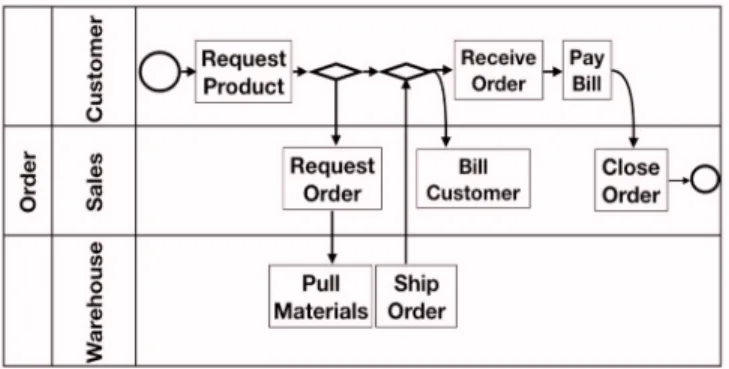
The Among all the traditional service process models have been reviewed above, BPMN model can provide more detailed elements to describe a service process. BPMN con-clude the service process modeling elements into 4 catego-ries, flow objects, connecting objects, swim lanes, and arti-facts. Where the flow objects is the core element of BPMN, which includes event, gateway, and activity [6]. We can use these visual elements to generate a service process model according to the BPMN modeling standard. For example we can use BPMN modeling standard to build an ordering serv-ice model as showed in Fig. (1).
Fig. (1). An ordering service process model based on BPMN.
Fig. (1) shows a whole ordering service process model, but only for a single and basic order service process. In con-trol flow, branching and merging only represents the rela-tionship of activities’ implementation, not represent the
serv-ice process according to different customers [7]. So this model standard cannot applies to massive customized re-quirements service process modeling.
2.2. Classification of Massive customized Requirements Customized requirements represent the personalized de-mand for a specific service, customer needs the service to have their own feature, and they need the service to meet their specific demands.
However, there are so many types of personalized de-mand in business. So we classified these dede-mands into some standardizable and repeatable categories. In the view of cus-tomer’s expectations, we classified cuscus-tomer’s personalized demand into 3 dimensions: functional demand, efficiency demand, and valuable demand. And Table 1 shows the detail of this classification method.
Those eight types of customized requirements can be formally defined as the following equations.
(1) Service assignment. Service assignment can be de-fined as two categories, required task (TaskM) and optional task (TaskO). Required task refers to those tasks must be done of a specific service process. And optional task refers to those tasks whether a customer demand or not. Optional task is a part that customer can determined by themselves.
Task=(T_ID,T_Name,T_Type,T_Choose) (1) in where, T_ID refers to assignment ID; T_Name re-fers to the assignment name; T_Type refers to the assign-ment type, T_Type[TaskM,TaskO]; T_Choose refers to customer’s choice, T_Choose[0,1].
(2) Resources. Service quality can be determined by serv-ice resource input. And customers have their personal prefer-ence about the price and quantity of service resource.
Task_Res=(R_ID,R_Name,R_Type,R_Num,R_ Pr) (2) in where, R_IDrefers to resource ID; R_Namerefers to the resource name; R_Type refers to the resource type,
R_Num refers to the resource quantity; R_ Pr refers to the resource price.
Table 1. Result of experiments and theory.
Dimensions Subcategories Description
Service assignment Options that customers may have during a service process
Resources Preference about the resource and price
Functional demand
Sequence of assignments Preference about the service sequence in a service process Assignment QoS Preference about the efficacy and quality of one or several service assignments Efficiency demand
Service QoS Preference about the efficacy and quality of one or several service property Valuable demand Observable benefits and it's constraints Customer's preference about the observable benefits and it's constraints
Observable cost and it's constraints Customer's preference about the observable cost and it's constraints Valuable demand
(3) Sequence of assignments. The sequence of assign-ments can be determined by customer’s personalized prefer-ences. And the sequence of assignments also determines the pattern of a service process model.
Task_Task=(T_IDset,T_T_Choose) (3) in where, T_IDset refers to a set of assignments; T_T_Chooserefers to customer’s personalized assign-ments sequence.
(4) Assignment QoS. The quality of each assignment can affect the whole service quality evaluation. However cus-tomer have different preference to a specific assignment.
Task_QoS=(QoS_ID,QoS_Opt,QoS_Choose) (4) in where, QoS_IDrefers to assignment quality ID; QoS_Opt refers to configurable intervals of a specific as-signment QoS; QoS_Choose refers to customer’s configu-ration interval, QoS_ChooseQoS_Opt.
(5) Service QoS. Compared to assignment QoS, Service QoS focus on the whole quality and efficiency of a service process.
Service_QoS=(QoS_ID,QoS_Opt,QoS_Choose) (5) in where, QoS_ID refers to service quality ID; QoS_Opt refers to configurable intervals of a specific serv-ice QoS; QoS_Choose refers to customer’s configuration interval, QoS_ChooseQoS_Opt.
(6) Observable benefits and it's constraints. Observable benefits and its constraints can both affect the service quality and customer’s service experience. The constraint is deter-mined by customer’s preference.
B_CONB=(B,B_QName,B_QValue,B_QWeight) (6) in where, B refers to observable benefit of a specific as-signment; B_QName refers to the name of constraints about a specific observable benefit; B_QValue refers to the value
of a specific constrains; B_QWeight refers to weight coef-ficient of a specific benefit quality.
(7) Observable cost and it's constraints. Observable costs and its constraints directly affect the service quality and re-source input of a specific service process. Cost constraint is determined by customer’s preference.
C_CONC=(C,C_QName,C_QValue,C_QWeight) (7) in where, Crefers to observable cost of a specific as-signment; C_QName refers to the name of constraints about a specific observable benefit; C_QValue refers to the value of a specific constrains; C_QWeight refers to weight coef-ficient of a specific benefit quality.
(8) Latent benefits and its constraints. Latent benefits are determined by customer’s expectations and the constraints of resources. Also latent benefits can be customized.
E_CONE=(E,E_QName,E_QValue,E_QWeight) (8) in where, E refers to latent benefit of a specific assign-ment; E_QName refers to the name of constraints about a specific latent benefit; E_QValue refers to the value of a specific constrains; E_QWeight refers to weight coefficient of a specific benefit quality.
3. SERVICE PROCESS MODEL
Based on the review and theory analysis above, we intro-duce a new service process modeling method, MPSPM. MPSPM is based on customer’s personalized demand classi-fication, following the description of configuration layer and customization layer. This modeling method provides a uni-fied concept of environment for everyone that participated in service process.
We divided MPSPM into configuration layer and cus-tomization layer in order to fit massive customized require-ments. Configuration layer is build for modeling staff. Mod-eling staff can set the basic service template and the relevant variable location. Customization layer is build for customer. Fig. (2). Framework of service process model.
A Service Process Model for Outsourcing Human Resources The Open Cybernetics & Systemics Journal, 2015, Volume 9 1499 Customer can set their personalized preference on the
spe-cific template that has been generated by configuration layer. Finally a customized service model can be automatically generated from the template that has been modified by cus-tomer. And Fig. (2) shows that model framework.
3.1. Elements of MPSPM Model
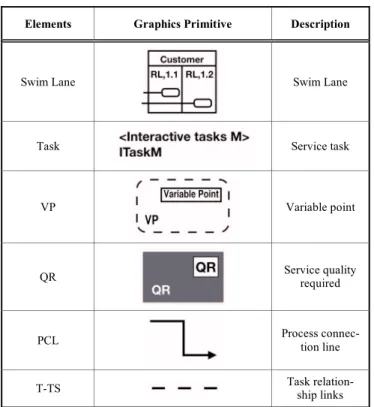
The description of MPSPM is based on an assignment-centric way. Use graphics to express service assignments, service elements, and assignment sequence. Use implicit equation to express assignment property information. Based on the definition and description of service process model, main elements of MPSPM include: swim lanes, service as-signments, service quality requirements and so on. And Table 2 shows each element’s graphics primitive and attrib-ute description.
Table 2. Elements of MPSPM model.
Elements Graphics Primitive Description
Swim Lane Swim Lane
Task Service task
VP Variable point
QR Service quality required
PCL Process connec-tion line
T-TS Task relation-ship links
Table 2 show the elements of MPSPM model, and the at-tribute set of these elements are as follows.
Swimlane = (info, type);Task = (info, Res, B,C, E,CONS); VP1= (Task,Task_Res, Task_Task,Task_QoS,Task_Service); VP2=(Task_B,Task_C,Task_E);PCL = (info, SO, EO,CONS) QR = (QoS_ID,QoS_Name,Qos_Value);T_Ts = (info,SO, EO). And all the elements including the model must obey the at-tribute set.
3.2. MPSPM Configuration Layer
In order to support customized requirements, we firstly define the concept of variable point as following. Variable point refers to the service elements that customer can deter-mine to satisfy their demand during a service execution process. And variable point can be express as following equation.
VP = (VP_Position,VP_Value,VP_Expreession) (9) in where, VP_Position refers to the variable point posi-tion
VP_Position{Task,Task_Res,Task_Task,Task_QoS,Servic e_Qos,B_CONB,C_CONC,E_CONE}. VP_Value refers to the service element’ value of a specific variable position. VP_Expreession refers to the service element’s expression of a variable point with customer’s configuration.
Firstly, about MPSPM configuration layer modeling rules. The modeling rules are as follows.
Rule #1 if VP_Position={Task_Res or Task_QoS or B_CONB or C_CONC or E_CONE }, then staff can con-figure a lot of variable positions, process connector’s start object corresponding to service assignment.
Rule #2 if VP_Position=Task, then Task=TaskO. It means the customized service process is a template stan-dardization service process, and that service model can be choosing from the database. Process connector object should be the beginning of a variable point.
Rule #3 if VP_Position=Task_Task, let T_TS connect all the service assignments. Process connector object should be the beginning of a variable point.
Rule #4 if VP_Position=Service_Qos, then set related service quality variable position to the customized value. Process connector object should be connecting to QR graph-ics primitive.
Secondly, MPSPM configuration layer modeling process. The modeling processes are as follows.
Step 1. Build the template based on SPC view modeling rule, which is the core of SMPD service modeling standard.
Step 2. Introduce variable point graphics primitive into model corresponding to customer’s personalized demand.
Step 3. Fill correlated information into the box.
Step 4. Configure the variable point based on rule#1, rule #2, rule#3, and rule#4 that has been defined above.
3.3. MPSPM Customization Layer
MPSPM Configuration layer is primarily designed for customers. Customers can set their preference on the service process template that been generated by MPSPM configura-tion layer.
Firstly, MPSPM customization layer modeling rules are as following.
Rule #1 all Task_ID must be the same for one service model.
Rule #2 about the value set of Service_QoS and Task_QoS. The value of QoS in Customization layer must be a subset of QoS in configuration layer.
Rule #3 Use “A-B-C” mode to describe the assignments ID which is included in the set of service assignments. What’s more, use “1-2-3” mode to describe the sequence of assignments.
Fig. (3). A service process model template based on MPSPM.
A Service Process Model for Outsourcing Human Resources The Open Cybernetics & Systemics Journal, 2015, Volume 9 1501 Step 1. Based on the template, let customer use the
pref-erence menu to set their service prefpref-erence.
Setp 2. Use “generate service” menu to generate the cus-tomized service process model.
4. A CASE STUDY
Outsourcing human resources is becoming a trend for companies to manage their HR resources. It takes a lot of convenient and strategy advantage for customer. But outsourcing human resources management firm has to face many of customers, each of them has their own require-ments. Traditional service modeling method cannot satisfy this situation. This section will use the modeling method that been discussed above, give a demonstration of service proc-ess modeling.
Assignments of an outsourcing human resources service include: proposed employment requirements, training, and performance evaluation. Resources of an outsourcing human resources service include: employee, training skills, and per-formance evaluation consulting resources [8]. Finally, Fig. (3) shows a service process model template, and Fig. (4) shows a whole customized service model.
From the service process model template and customized service model above, we can find that MPSPM can build ser-vice process model for each customer’s personalized require-ments and shows the advantage of operational convenient CONCLUSION
From the case study we can find that MPSPM modeling method is an effective modeling way for massive customized requirements. Both service provider and customer can achieve service value form the convenient modeling process. We designed MPSPM have two layer, configuration layer and customization layer. This design solved the problem of maintenance cost rapidly increased when there is so many customers propose personalized demands.
Though MPSPM fill a theory gap of massive customized requirements, there are still some limits about this research.
The different set of demand classification will affect model-ing efficiency. This article only discussed one classification method [9]. That is one of the limits of this research. What’s more, this research only discussed one simple case. And we believe MPSPM model can also apply to other service pat-terns. Above all, further research can focus on the different personalized demand classification method. And the model-ing standard also needs more study.
CONFLICT OF INTEREST
The authors confirm that this article content has no con-flict of interest.
ACKNOWLEDGEMENTS
Both author wish to thanks the advice from Dr. Ma Zhuang and Dr. Han haitao.
REFERENCES
[1] R. S. Aguilar-Saven, "Business process modelling: Review and framework", International Journal of Production Economics, vol. 90, pp. 129-149, 2004.
[2] G. L. Shostack, "How to design a service", European Journal of Marketing, vol. 16, pp. 49-63, 1982.
[3] M. J. Bitner, A. L. Ostrom, and F. N. Morgan, "Service blueprint-ing: A practical technique for service innovation", California Man-agement Review, vol. 50, pp. 66-90, 2008.
[4] M. B. Juric, B. Mathew, and P. G. Sarang, Business Process Execu-tion Language for Web Services: An Architect and Developer's Guide to Orchestrating Web Services Using BPEL4WS, Packt Pub-lishing Ltd, 2006, pp. 55-65.
[5] A. L. N. Campos, and T. Oliveira, "Software processes with BPMN: an empirical analysis", In: Product-Focused Software Pro-cess Improvement, Springer, Berlin Heidelberg, 2013, pp. 338-341. [6] R. Dijkman, J. Hofstetter, and J. Koehler, Eds., Business Process
Model and Notation, Springer, 2011, pp. 10-12.
[7] P. Wohed, On The Suitability of BPMN for Business Process Mod-elling, Springer, Berlin Heidelberg, 2006, pp. 20-26.
[8] N. P. Kumar, "Human resource management in future an obstacle of champion of globalization", Human Resource Management, vol. 1, no. 1, 2014, pp. 49-57.
[9] M. J. Jahid, T, H. Huang, and J. Ruan, "A personalized committee classification approach to improving prediction of breast cancer metastasis", Bioinformatics, vol. 30, no. 13, 2014, pp. 1858-1866.
Received: June 10, 2015 Revised: July 29, 2015 Accepted: August 15, 2015 © Zhao and Yan; Licensee Bentham Open.
This is an open access article licensed under the terms of the (https://creativecommons.org/licenses/by/4.0/legalcode), which permits unrestricted, non-commercial use, distribution and reproduction in any medium, provided the work is properly cited.