Singapore Management University
Institutional Knowledge at Singapore Management University
Research Collection School Of Information Systems
School of Information Systems
8-2012
Boosting Multi-Kernel Locality-Sensitive Hashing
for Scalable Image Retrieval
Hao XIA
Nanyang Technological University
Steven C. H. HOI
Singapore Management University
, [email protected]
Pengcheng WU
Nanyang Technological University
Rong JIN
Michigan State University
DOI:
https://doi.org/10.1145/2348283.2348294
Follow this and additional works at:
https://ink.library.smu.edu.sg/sis_research
Part of the
Databases and Information Systems Commons
, and the
Numerical Analysis and
Scientific Computing Commons
This Conference Proceeding Article is brought to you for free and open access by the School of Information Systems at Institutional Knowledge at Singapore Management University. It has been accepted for inclusion in Research Collection School Of Information Systems by an authorized administrator of Institutional Knowledge at Singapore Management University. For more information, please [email protected].
Citation
XIA, Hao; HOI, Steven C. H.; WU, Pengcheng; and JIN, Rong. Boosting Multi-Kernel Locality-Sensitive Hashing for Scalable Image Retrieval. (2012).SIGIR'12: Proceedings of the International ACM SIGIR Conference on Research and Development in Information Retrieval: August 12-16, Portland, OR. 55-64. Research Collection School Of Information Systems.
Boosting Multi-Kernel Locality-Sensitive Hashing for
Scalable Image Retrieval
Hao Xia, Pengcheng Wu, Steven C.H. Hoi
School of Computer EngineeringNanyang Technological University Singapore 639798
{xiah0002,wupe0003,chhoi}@ntu.edu.sg
Rong Jin
Computer Science and Engineering Dept. Michigan State University
East Lansing, MI, 48824
ABSTRACT
Similarity search is a key challenge for multimedia retrieval ap-plications where data are usually represented in high-dimensional space. Among various algorithms proposed for similarity search in high-dimensional space, Locality-Sensitive Hashing (LSH) is the most popular one, which recently has been extended to Kernelized Locality-Sensitive Hashing (KLSH) by exploiting kernel similarity for better retrieval efficacy. Typically, KLSH works only with a single kernel, which is often limited in real-world multimedia ap-plications, where data may originate from multiple resources or can be represented in several different forms. For example, in content-based multimedia retrieval, a variety of features can be extracted to represent contents of an image. To overcome the limitation of reg-ular KLSH, we propose a novel Boosting Multi-Kernel Locality-Sensitive Hashing (BMKLSH) scheme that significantly boosts the retrieval performance of KLSH by making use of multiple kernels. We conduct extensive experiments for large-scale content-based image retrieval, in which encouraging results show that the pro-posed method outperforms the state-of-the-art techniques.
Categories and Subject Descriptors
H.3.3 [Information Storage and Retrieval]: Retrieval models; H.2.8 [Database Applications]: Image databases
General Terms
Algorithms, ExperimentationKeywords
Image Retrieval, High-dimensional indexing, Locality-sensitive hash-ing, Kernel methods
1.
INTRODUCTION
Similarity search, or Nearest Neighbor (NN) search, plays a crit-ical role in Content-Based Image Retrieval (CBIR) systems [33, 24]. Typically, images in a CBIR system are represented in a high-dimensional space, and the size of an image database can easily
Permission to make digital or hard copies of all or part of this work for personal or classroom use is granted without fee provided that copies are not made or distributed for profit or commercial advantage and that copies bear this notice and the full citation on the first page. To copy otherwise, to republish, to post on servers or to redistribute to lists, requires prior specific permission and/or a fee.
SIGIR’12, August 12–16, 2012, Portland, Oregon, USA.
Copyright 2012 ACM 978-1-4503-1472-5/12/08 ...$15.00.
be over millions or even billions for large-scale real-world applica-tions. These two aspects have made CBIR an open grand challenge although it has been extensively studied for decades.
A variety of data structures have been proposed for indexing and searching data points in a low-dimensional space [31, 7, 2, 29]. These approaches work well for low dimensional data. But, when the number of dimensions grows, they often become less efficient, a phenomenon known as the curse of dimensionality. Specifically, the time or space requirements of these approaches often grow ex-ponentially with the dimensionality.
Since exact NN search is hard to scale for high-dimensional data, recent studies mainly focus on approximation approaches [20,14, 25,1], which aim to remove the exponential dependence on dimen-sionality. Instead of finding the nearest pointpto a query pointq, approximate NN search allows to return any point within the dis-tance of (1 +ǫ)times the distance fromqtop. Recent studies have shown that by adopting the approximation, the complexity of NN search is reduced from exponential to polynomial in terms of its dependence on the dimensionality. Several recent studies have successfully applied the random projection idea for approximate NN search over high-dimensional data. One of the most well-known techniques in this direction is Locality-Sensitive Hashing (LSH) [20, 14, 6], which has been actively studied and success-fully applied to many applications [20,10,1].
One limitation of regular LSH is that they require explicit vec-tor representation of data points. Kernelized LSH (KLSH) [23] addresses this limitation by employing kernel functions to capture similarity between data points without having to know their explicit vector representation. KLSH has been shown effective empirically, but there is no formal analysis of KLSH in theory. In this paper, we first analyze the theoretical property of KLSH to better understand the behavior and capacity of KLSH in similarity search. Second, we address the limitation of KLSH. Despite the success, most exist-ing KLSH techniques only adopt a sexist-ingle kernel function. This sig-nificantly limits its application to many real-world image retrieval tasks [40, 18], where images are often analyzed by a variety of feature descriptors and are measured by a wide class of diverse similarity functions.
To this end, we propose a novel Boosting Multi-Kernel Locality-Sensitive Hashing (BMKLSH) framework, which improves KLSH by learning a combination of multiple kernels. The key challenge of kernel LSH is to determine an optimal combination of multi-ple kernels by determining appropriate bit size to each of the mul-tiple kernels. To overcome the challenge, we propose a boosting scheme to greedily find a good solution in an efficient approach. Our extensive experiments show that BMKLSH significantly
en-hances the performance of KLSH in exploring the power of multi-ple kernels for CBIR.
The rest of this paper is organized as follows. Section2reviews related work. Section3gives our analysis of KLSH, and Section4
presents the proposed BMKLSH method. Section5discusses our experiments. Finally Section6concludes this work.
2.
RELATED WORK
This section reviews related work in approximate nearest neigh-bor (NN) search with the focus on image retrieval applications.
In literature, developing efficient techniques for indexing high dimensional images has been studied extensively in information retrieval, multimedia, and database communities [4,5,9]. Spatial data structure approaches (e.g., kd-tree [2,29] or metric tree [35]) were used to handle the NN search problem; however, they scale poorly with data dimensionality. In practice, if the number of di-mensions is large enough, kd-tree and other similar data structures require an expensive inspection in the data set, thereby perform no better than an exhaustive linear search that simply compares a query to every data point in the database.
Instead of solving the exact similarity search for high dimen-sional indexing, recent years have witnessed active studies of ap-proximate high-dimensional indexing techniques [20,14,25,3,8, 11]. The key of most techniques is to exploit random projection to tackle the curse of dimensionality issue, such as Locality-Sensitive Hashing (LSH) [20], a very well-known and highly successful tech-nique in this area. In general, we can group most of existing ap-proaches into two major categories: linear projection methods and kernel-based methods. Below we briefly review the first category and then focus on discussing the second category.
For the first category, one of the most notable techniques is LSH [20], which utilizes a family of locality sensitive hashing functions which map similar items to same bucket with high probability, and dis-similar items to same bucket with low probability. With such a hash function, one can easily search within the bucket a query point belongs to in order to find nearest neighbors of the query. LSH efficiently solves the approximate similarity search problem and achieves query time in the worst case O(dn1/ǫ). Gionis et al. [14] improved the techniques and achieved significant query time O(dn1/(1+ǫ)). Recently, many studies have attempted to im-prove upon the regular LSH technique. For example, [25] intro-duced multi-probe LSH methods that reduce the space requirement of the basic LSH method. Tao et al. [34] proposed the locality-sensitive B-tree technique that mainly concerns the performance improvement of I/O disk access. Besides, there are many other ex-isting works that accommodate LSH functions in tackling different issues, including Hamming distance [20], inner products [6],ℓp -norms [10], normalized partial matching [15], learned Mahalanobis metrics [27], and so on. Last but not least, there are also many re-cent studies of learning compact binary codes inspired by the idea of LSH [39,16,36,22].
Our study is more related to the second category of kernel-based methods. In particular, kernel-based LSH (KLSH) [23] was re-cently proposed to overcome the limitation of the regular LSH tech-nique that often assumes the data come from a multidimensional vector space and the underlying embedding of the data must be ex-plicitly known and computable. KLSH provides a powerful frame-work to explore arbitrary kernel/similarity functions where their underlying embedding only needs to be known implicitly. In [28], the authors proposed a variant of KLSH which aims to force the expected Hamming distance between the binary codes of two vec-tors is related to the value of a shift-invariant kernel. In [17], the authors proposed an improved algorithm for learning binary codes
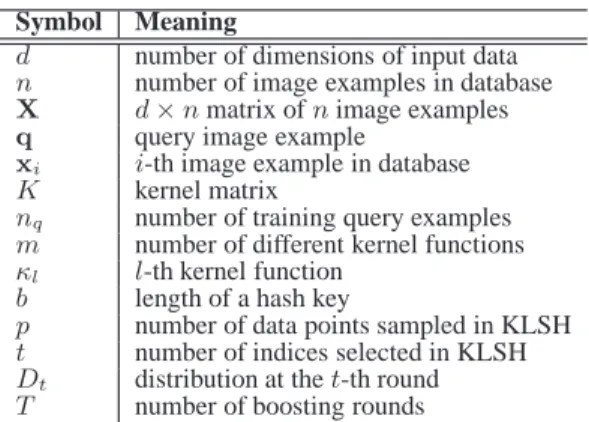
Symbol Meaning
d number of dimensions of input data
n number of image examples in database X d×nmatrix ofnimage examples q query image example
xi i-th image example in database
K kernel matrix
nq number of training query examples
m number of different kernel functions
κl l-th kernel function
b length of a hash key
p number of data points sampled in KLSH
t number of indices selected in KLSH
Dt distribution at thet-th round
T number of boosting rounds
Table 1: Summary of notation used in this paper
with kernel to speed up the KLSH technique. Despite being studied actively, most existing kernel-based hashing methods [23,28,17, 26] only consider a single kernel, which cannot fully explore the potential of multiple kernel functions in a real CBIR application.
Very recently, some emerging study has attempted to apply KLSH by exploring multiple kernels. In [37], they proposed a simple so-lution named MKLSH by applying the existing KLSH algorithm for each specific kernel individually, and then combining the out-puts of these KLSH processes. Our work however differs from their method in several aspects. First of all, their naive approach to combining multiple kernels simply treats each kernel equally, which fails to fully explore the power of combining multiple di-verse kernels in KLSH. Second, their technique is essentially un-supervised, which does not fully explore the data characteristics and thus cannot achieve the optimal indexing performance. In con-trast, our technique is in general supervised and is able to learn the optimal combination of multiple kernels from training data to maximize the indexing performance.
3.
ANALYSIS OF KERNELIZED LSH
In this section, we first review the algorithm of Kernelized Locality-Sensitive Hashing (KLSH), and then present our analysis of KLSH.
LetX∈ Rd×nbe the collection of data points to be searched. Given a queryq ∈Rd, to efficiently find theknearest neighbors, LSH projects each data point into a low-dimensional binary space, referred to as the hash key. The hash keys are constructed by ap-plyingbbinary-valued hash functionsh1, . . . , hbto the data points inX. KLSH generalizes LSH by introducing a kernel function
κ(xi,xj)to map a data pointxito a functional space through a nonlinear feature mappingφ(xi)that satisfies the conditionκ(xi,xj) =
φ⊤(xi)φ(xj). To build the hash function, KLSH first randomly se-lects a subset ofpdata points fromX, denoted asS={xs1, . . . ,xsp}, and forms a kernel matrixKover the sampled data points; it then generatesb random vectorse1S, . . . ,ebS and computes a hashing function for each random vectorekSas
hk(φ(x)) = sign p X j=1 wkjκ(x,xsj) ! ,
wherewk = (wk1, . . . , wpk)⊤is given bywk = K−1/2ekS. Al-gorithm1outlines the key steps of KLSH, where bis a critical parameter that determines the length of hash key to be constructed in KLSH.
Although KLSH is proved to be effective empirically, no theo-retical analysis is provided for the properties of KLSH. To bound approximation error of KLSH, we introduce a few notations.
De-Algorithm 1 KLSH
INPUT:
• an image database:{xi|i= 1, . . . , n},xi∈Rd
• length of the hash key: b • a kernel function:κ(·,·)
1: randomly selectpdata pointsS={xs
j|j= 1, . . . , p}
2: K= [κ(xs i,xsj)]p×p
3: fork= 1, . . . , bdo
4: formek
S: selecttindices at random from[1, . . . , p] 5: formwk=K−1/2ek
S 6: construct hash function:
hk(φ(x)) = sign(Pp
j=1wjkκ(x,xsj)) 7: end for
OUTPUT: a set ofbhash functionsH={hk|k= 1, . . . , b}
finehi∈Rbas hi= p X j=1 wj1κ(xi,xsj), . . . , p X j=1 wbjκ(xi,xsj) !⊤
andH = (h1, . . . ,hn). LetKa = [κ(xi,xj)]n×nbe the Gram matrix for all data points inX, andKb = [κ(xi,xsj)]n×pbe the kernel matrix between data points inXand the sampled data points inS. Letλ1, . . . , λnbe the eigenvalues ofKaranked in the de-scending order. We first bound the error caused by the random vectors{ekS}bk=1.
THEOREM 1. With a probability at least1−δ, we have
t pKbK −1K⊤ b − 1 bH ⊤H F ≤ r 2tln(2/δ) b |KbK −1K⊤ b|F PROOF. Let us defineAasA= 1
b Pb k=1e k S[ekS]⊤. It is easy to see thatE[A] = t
pI. According to the concentration inequality of linear operator [32], we have, with a probability1−δ, that
A− t pI F ≤ s 2tln(2/δ) p
We complete the proof by the using the fact
t pKbK −1K⊤ b − 1 bH ⊤H F = KbK−1/2 t pI−A K−1/2Kb⊤ F ≤ t pI−A F |KbK−1Kb⊤|F
THEOREM 2. Assumeκ(x,x)≤1for anyx. Letk ∈Zand
ǫ∈(0,1)be any two numbers satisfyingk/ǫ4 ≤p/[64η2], where
η= 1 +p
8 log(1/δ). Then, with a probability at least1−2δ, we have 1 n2 n X i,j=1 κ(xi,xj)− p tbh ⊤ ihj 2 ≤ 3 n n−k X i=1 λ2k+i+ 3ǫ+ 6p2ln(2/δ) bt
PROOF. According to Theorem [12], with a probability1−δ, for anyǫ∈[0,1]andk∈Zthat satisfy
k ǫ4 ≤ p 64η2 whereη= 1 +p 8 log(1/δ), we have |Ka−KbK−1Kb⊤|F ≤ v u u t n−k X i=1 λ2 k+i+ǫn
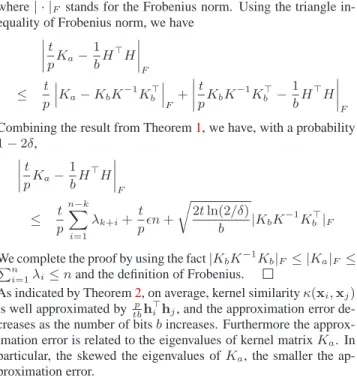
where| · |F stands for the Frobenius norm. Using the triangle in-equality of Frobenius norm, we have
t pKa− 1 bH ⊤H F ≤ t p Ka−KbK −1K⊤ b F+ t pKbK −1K⊤ b − 1 bH ⊤H F
Combining the result from Theorem1, we have, with a probability
1−2δ, t pKa− 1 bH ⊤H F ≤ t p n−k X i=1 λk+i+ t pǫn+ r 2tln(2/δ) b |KbK −1K⊤ b |F We complete the proof by using the fact|KbK−1Kb|F ≤ |Ka|F ≤
Pn
i=1λi≤nand the definition of Frobenius.
As indicated by Theorem2, on average, kernel similarityκ(xi,xj) is well approximated by tbph⊤ihj, and the approximation error de-creases as the number of bitsbincreases. Furthermore the approx-imation error is related to the eigenvalues of kernel matrixKa. In particular, the skewed the eigenvalues ofKa, the smaller the ap-proximation error.
Theorem2shows that different types of kernels will lead to very different approximation errors, depending on their eigenvalue dis-tributions. Hence, some kernels will have good retrieval accuracy but rather poor approximation performance while the others may have the opposites. Thus, combining multiple kernels could po-tentially avoid relying too much on a single kernel that could be of neither poor approximation nor low retrieval accuracy. To make a good tradeoff between retrieval accuracy and approximation er-ror, we propose a boosting scheme to combine multiple kernels for KLSH in order to obtain both high retrieval accuracy and low ap-proximation error.
4.
LEARNING TO COMBINE MULTIPLE
KERNELS FOR KLSH
4.1
Overview
In this section, we propose a framework of learning the combina-tion of multiple kernels for Kernelized Locality-Sensitive Hashing, which aims to boost KLSH by making use of a combination of mul-tiple kernels. One key question is how to determine the weights for kernel combination. A straightforward approach is to assign equal weight to each kernel function, and apply KLSH with the uniformly combined kernel function. Such an approach might not fully explore the power of multiple kernels.
To address this limitation, we propose a scheme to assign each kernel a different number of bits so as to reflect the importance of the kernel. The key challenge of this scheme is thus how to op-timize the bit size allocation with respect to different kernel func-tions. Figure1illustrates the proposed framework, which consists of two key steps: (i) bit allocation optimization, and (ii) the multi-kernel hashing as shown in Algorithm2.
Figure 1: The proposed framework of learning to combine mul-tiple kernels for improving kernel LSH
Algorithm 2 The Multi-Kernel Hashing scheme
INPUT:
• an image database:{xi|i= 1, . . . , n},xi∈Rd
• a set ofmdifferent kernels:{κl|l= 1, . . . , m}
• bits allocation vector[b1, . . . , bm] 1: k= 0
2: randomly selectpdata pointsS={xsj|j= 1, . . . , p}
3: forl= 1, . . . , mdo 4: Kl= [κl(xs i,xsj)]p×p 5: forr= 1, . . . , bldo 6: k=k+ 1 7: formek
S: selecttindices at random from[1, . . . , p] 8: formwk=K−1/2
l ekS 9: construct hash function:
hk(φ(x)) = sign(Pp
j=1wkjκl(x,xs j)) 10: end for
11: end for
OUTPUT: a set ofbhash functionsH={hk|k= 1, . . . , b}
Unlike the regular KLSH that adopts a single kernel, BMKLSH employs a set ofmkernels for the hashing scheme. Besides, a key difference between BMKLSH and some existing Multi-Kernel LSH (MKLSH) [37] is the bit allocation optimization step to find the parameter [b1, . . . , bm] that determines the allocations of bit sizes for a set ofmkernels. Unlike the existing MKLSH approach [37] that simply assigns the same number of bits to each kernel, lead-ing to a uniform combination of multiple kernels, we develop two supervised learning algorithms (WMKLSH and BMKLSH), de-scribed below, that effectively learn the importance of individual kernels, and consequentially determine the appropriate number of bits for each kernel.
4.2
WMKLSH by Weighted Bit Allocation
We first propose a Weighted Multi-Kernel Locality-Sensitive Hash-ing (WMKLSH) scheme by a supervised learnHash-ing approach to de-termine the allocation of bit size, where a kernel is assigned a larger size of bits if it better captures the similarity between data points.
In order to learn the importance weights of different kernels for the retrieval tasks, we assume a small training data set is available for our learning task. The training set consists of a small set of queries and their relevance judgements, which usually can be eas-ily collected in a real-life CBIR system via the relevance feedback mechanism [30,19].
For the WMKLSH algorithm, we begin by testing the retrieval performance of KLSH with a set ofmkernels on the given training set. After that, we can obtain the retrieval performance in terms of mean Average Precision (mAP), As a result, we can compute the weights based on the retrieval performance of each kernel, i.e.,
αl=emAPl, l= 1, . . . , m. Finally, the bit sizes of the kernels are allocated proportionally according to their importance weights.
4.3
BMKLSH for Optimizing Bit Allocation
To further improve the above learning scheme, we propose a boosting scheme, referred to as BMKLSH, to learn the optimal allocation of bit sizes, which adopts the similar idea of boosting algorithms for classification [13]. Let us denote bynqthe number of queries, andAPl(i), l∈[m], i∈[nq], be the Average Precision performance of applying thel-th kernelκl(·,·)to retrieve vectors for thei-th query. In order to find the optimal allocation of bit sizes, we cast it into the following optimization problem:
max b1,...,bm∈[b] nq X i=1 exp m X l=1 APl(i) ! subject toX l bl=b (1)
Since eachblis an integer variable, the above problem is essen-tially an integer programming task, which is NP-hard. To find an efficient solution, we approximate the above optimization problem by introducing a set of combination weightsαl, l ∈ [m], each of which represents the importance of each kernel so as to determine each bit sizebi. In order to learn the optimal weights, we turn the above optimization into the following optimization problem
max α∈Rm +,α⊤1=1 nq X i=1 exp m X l=1 αlAPl(i) ! (2) Given the learned weightsα, we assign to thel-th kernelbαlbits, wherebis the total number of bits.
To efficiently solve the problem in (2), we adopt a boosting based strategy. Following the similar procedure of Adaboost algorithm [13], we introduce a distribution of weightsDtto indicate the retrieval difficulty of the instances in the training data set. At each boosting round, we measure the retrieval performance (e.g. average preci-sion) of each kernel based on the existing KLSH algorithm (shown in Algorithm1), and select the best kernel with the largest weighted Average Precision (wAP) performance over the current distribution
Dt, which is defined as:
wAPl= nq
X
i=1
Dt(i)APl(i) (3) At the end of each boosting round, an importance weight is com-puted for the selected kernel based on its retrieval performance, and the weights of each poorly retrieved query example will be in-creased such that the next selected kernel will focus more on those hardly retrieved examples. The boosting procedure will be repeated
T times. Finally, we allocate a bit size to each kernel based on its cumulative weight in all theT boosting rounds. The details of the proposed algorithm are given in Algorithm 3.
4.4
Time Complexity Analysis
First of all, assume the length of hash keybis fixed, both WMKLSH and BMKLSH algorithms have the same querying time cost as that of KLSH and MKLSH. Next we focus on discussing training and indexing time cost.
As supervised methods, WMKLSH and BMKLSH algorithms need to test the performance for all training instances with all kinds of kernels once. For BMKLSH, at each boosting round, it only up-dates the distribution of training instances and computes the weight for each round based on the distribution. The updating step is in general linear. Thus, the main time cost consumed mostly falls into the process of validating the performance of training instances.
5.
EXPERIMENTS
We conduct extensive experiments to examine the efficacy of the proposed algorithms for scalable content-based image retrieval.
5.1
Experimental Testbed
We perform experiments on two well-known public image databases which have been widely used for benchmark image retrieval tasks. Besides, we downloaded 1,000,000 social images from Flickr to form a background class and combine it with the second database to form a large scale data set. We briefly introduce some details of the two data sets below.
The first data set is the INRIA Holidays data set1, which has been widely used for benchmark evaluation of image retrieval per-formance [21]. It contains 500 image groups, each of which
repre-1
Algorithm 3 BMKLSH: Boosting Multi-Kernel LSH algorithm for
optimizing the bit size allocation
INPUT:
• an image database:{xi|i= 1, . . . , n},xi∈Rd
• length of the hash key:b
• a set ofmdifferent kernels,{κl|l= 1, . . . , m}
• a set ofnqtraining instances{xt
i|i = 1, . . . , nq}with additional
feedback info (positive and negative lists) • number of boosting rounds:T
• initial distribution:D1(i) = 1/nq, i= 1, . . . , nq
1: fort= 1, . . . , Tdo
2: forl= 1, . . . , mdo
3: obtainAPl(i), l= 1, . . . , m, i = 1, . . . , nqby testing on the training set based on Algorithm1
4: wAPl=Pnq i=1Dt(i)APl(i) 5: αl t=ewAPl 6: end for 7: αl t← αlt Pm i=1αit , l= 1, . . . , m 8: l∗= arg max l∈{1,2,...,m}α l t 9: αt←αl∗
t ,APt←APl∗,wAPt←wAPl∗
10: update the distribution of the training instances:
Dt+1(i) = Dt(i)
Zt ×
(
e−αt if APt(i)≥wAPt
eαt if APt(i)< wAPt
Ztis a normalization factor to makeDt+1a distribution 11: end for
12: αl=PT
t=1αlt,l= 1, . . . , m
13: allocate bits to m kernels[b1, . . . , bm]based on the weightsαl 14: Multi-Kernel Hashing([b1, . . . , bm])
sents a distinct scene or object. The first image of each group is the query image and the correct retrieval results are the other images of the group. There are 1491 images in total, including 500 queries and 991 corresponding relevant images.
The second data set is a large-scale data set, which consists of both the ImageCLEF database2and the collection of 1,000,000 im-ages crawled from Flickr (named as “Flickr1M"). ImageCLEF is a medical image database, which was also used in [38]. For all the categories, we randomly select10%images as the query pool, the other images as database pool. For the Flickr photos, we treat all of them as the background noisy photos, which are mainly used to test the scalability of our algorithms. We denote this data set as the “ImageCLEF + Flickr1M" data set or “ImageCLEFFlickr" for short.
5.2
Experimental Setup
We present our experimental results by showing the percentage of database items searched with the hashing function instead of measuring the exact search time in order to avoid the unfairness from different implementations of the codes. To achieve this pur-pose, we have to set a parameter for the LSH search, i.e.,ρ, which is used to control the fraction of nearest neighbors to be linearly scanned.
For performance metric, we evaluate the retrieval performance based on mean Average Precision (mAP) and top-n(n= 1,2, . . . ,5) retrieval accuracy. The Average Precision (AP) value is the area un-der precision-recall curve for a query. The mAP value is calculated based on the average AP value of all the queries. The precision value is the ratio of relevant examples over the total retrieved ex-amples, while recall is the ratio of the relevant examples retrieved over the total relevant examples in the database.
2
http://www.imageclef.org
Our objective is to achieve fast and accurate image retrieval. As LSH can only return a portion of images, only the top returned images (Hit Items) are needed to be evaluated. Based on this con-cern, the mAP performance reported in our experiments is based on the mAP over all the returned items (except for the experiments of parameter sensitivity evaluation, where we adopt the top-10 mAP performance to enable a fair evaluation of different parameter set-tings). It is worth mentioning that in some previous works they usually reported mAP values for the whole data set. As we know, the more the image examples retrieved the higher the mAP value obtained. Thus, it is not totally fair to directly compare the ex-act value of our results with the results of the previous works. In our experiments, we have implemented all the compared methods including our algorithms under the same evaluation criterion to en-able fair comparisons. Nonetheless, from the experimental results, we found that the mAP results we achieved are higher than some of the others’s reported results, although we are actually based on a criterion that generates relatively lower mAP values.
As the proposed algorithms need some training data, we split the original query set into two parts, each time we select one part for query, and the other part for training. The final result is obtained by computing the average of the results over the two splits. Finally, we conduct the evaluations of all the algorithms 10 times and average the results over these 10 runs to obtain a stable result.
5.3
Image Descriptors and Kernel Functions
5.3.1
Image Descriptors
We adopt both global and local feature descriptors for represent-ing images in our experiments. We have some preprocessrepresent-ing by resizing all images to500×500pixels while keeping the aspect ratio unchanged. For global features, we extract five kinds of fea-tures, including (1) Color histogram and color moments, (2) Edge direction histogram, (3) Gabor wavelets transform, (4) Local Bi-nary Pattern, and (5) GIST. For local features, we extract the bag of visual words features based on two types of descriptors: SIFT and SURF. In particular, for SIFT: we adopt the Hessian-Affine in-terest region detector with threshold 500 and the SIFT descriptor; for SURF: we use SURF detector with threshold 500 and SURF descriptor. For the clustering, we adopt a forest of 16 kd-trees and search 2048 neighbor to speed up the clustering task. Finally, we use TF-IDF to generate the bag of visual words to represent the local features. In total, with different vocabulary sizes, we ex-tracted four kinds of local features, including SIFT200, SIFT1000, SURF200 and SURF1000.
5.3.2
Kernel Functions
From the above, we represent each image by 9 types of differ-ent features. We then build kernel functions for these 9 types of features. Before we compute the kernels, we normalize the feature vectors to zero mean (each dimension) and unit length (each point). We adopt the RBF kernel:
κ(x,x′) =exp(−γ−1d(x,x′)) (4) whered(·,·)is the distance andγis selected as the mean of the pairwise distance where the distance is computed using L2 dis-tance. In total, we have a set of 9 kernels for our retrieval tasks. Finally, we note that all kernel matrices are normalized to unit trace to balance different kernels.
5.4
Comparison Algorithms
To extensively examine the efficacy of the proposed algorithms, we have implemented several different solutions for adopting KLSH
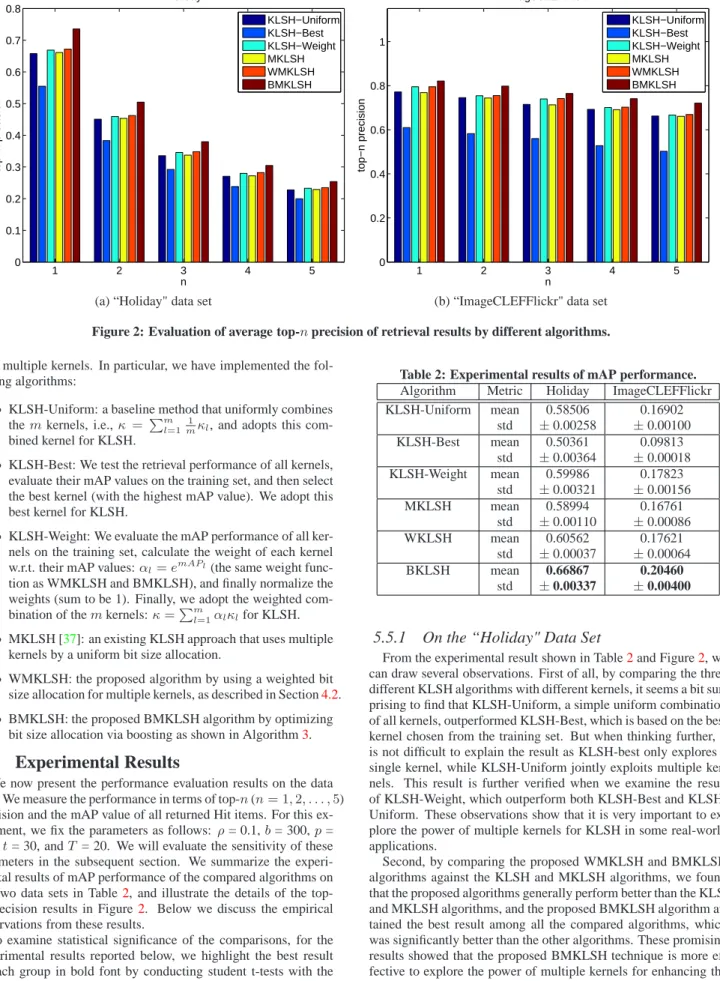
1 2 3 4 5 0 0.1 0.2 0.3 0.4 0.5 0.6 0.7 0.8 n top−n precision Holiday KLSH−Uniform KLSH−Best KLSH−Weight MKLSH WMKLSH BMKLSH 1 2 3 4 5 0 0.2 0.4 0.6 0.8 1 n top−n precision ImageCLEFFlickr KLSH−Uniform KLSH−Best KLSH−Weight MKLSH WMKLSH BMKLSH
(a) “Holiday" data set (b) “ImageCLEFFlickr" data set
Figure 2: Evaluation of average top-nprecision of retrieval results by different algorithms.
with multiple kernels. In particular, we have implemented the fol-lowing algorithms:
• KLSH-Uniform: a baseline method that uniformly combines themkernels, i.e.,κ = Pm
l=1 1
mκl, and adopts this com-bined kernel for KLSH.
• KLSH-Best: We test the retrieval performance of all kernels, evaluate their mAP values on the training set, and then select the best kernel (with the highest mAP value). We adopt this best kernel for KLSH.
• KLSH-Weight: We evaluate the mAP performance of all ker-nels on the training set, calculate the weight of each kernel w.r.t. their mAP values:αl=emAPl(the same weight func-tion as WMKLSH and BMKLSH), and finally normalize the weights (sum to be 1). Finally, we adopt the weighted com-bination of themkernels:κ=Pm
l=1αlκlfor KLSH.
• MKLSH [37]: an existing KLSH approach that uses multiple kernels by a uniform bit size allocation.
• WMKLSH: the proposed algorithm by using a weighted bit size allocation for multiple kernels, as described in Section4.2.
• BMKLSH: the proposed BMKLSH algorithm by optimizing bit size allocation via boosting as shown in Algorithm3.
5.5
Experimental Results
We now present the performance evaluation results on the data sets. We measure the performance in terms of top-n(n= 1,2, . . . ,5) precision and the mAP value of all returned Hit items. For this ex-periment, we fix the parameters as follows:ρ= 0.1,b= 300,p= 300,t= 30, andT = 20. We will evaluate the sensitivity of these parameters in the subsequent section. We summarize the experi-mental results of mAP performance of the compared algorithms on the two data sets in Table2, and illustrate the details of the
top-nprecision results in Figure2. Below we discuss the empirical observations from these results.
To examine statistical significance of the comparisons, for the experimental results reported below, we highlight the best result in each group in bold font by conducting student t-tests with the significance levelα= 0.05.
Table 2: Experimental results of mAP performance.
Algorithm Metric Holiday ImageCLEFFlickr KLSH-Uniform mean 0.58506 0.16902 std ±0.00258 ±0.00100 KLSH-Best mean 0.50361 0.09813 std ±0.00364 ±0.00018 KLSH-Weight mean 0.59986 0.17823 std ±0.00321 ±0.00156 MKLSH mean 0.58994 0.16761 std ±0.00110 ±0.00086 WKLSH mean 0.60562 0.17621 std ±0.00037 ±0.00064 BKLSH mean 0.66867 0.20460 std ±0.00337 ±0.00400
5.5.1
On the “Holiday" Data Set
From the experimental result shown in Table2and Figure2, we can draw several observations. First of all, by comparing the three different KLSH algorithms with different kernels, it seems a bit sur-prising to find that KLSH-Uniform, a simple uniform combination of all kernels, outperformed KLSH-Best, which is based on the best kernel chosen from the training set. But when thinking further, it is not difficult to explain the result as KLSH-best only explores a single kernel, while KLSH-Uniform jointly exploits multiple ker-nels. This result is further verified when we examine the result of Weight, which outperform both Best and KLSH-Uniform. These observations show that it is very important to ex-plore the power of multiple kernels for KLSH in some real-world applications.
Second, by comparing the proposed WMKLSH and BMKLSH algorithms against the KLSH and MKLSH algorithms, we found that the proposed algorithms generally perform better than the KLSH and MKLSH algorithms, and the proposed BMKLSH algorithm at-tained the best result among all the compared algorithms, which was significantly better than the other algorithms. These promising results showed that the proposed BMKLSH technique is more ef-fective to explore the power of multiple kernels for enhancing the image retrieval performance.
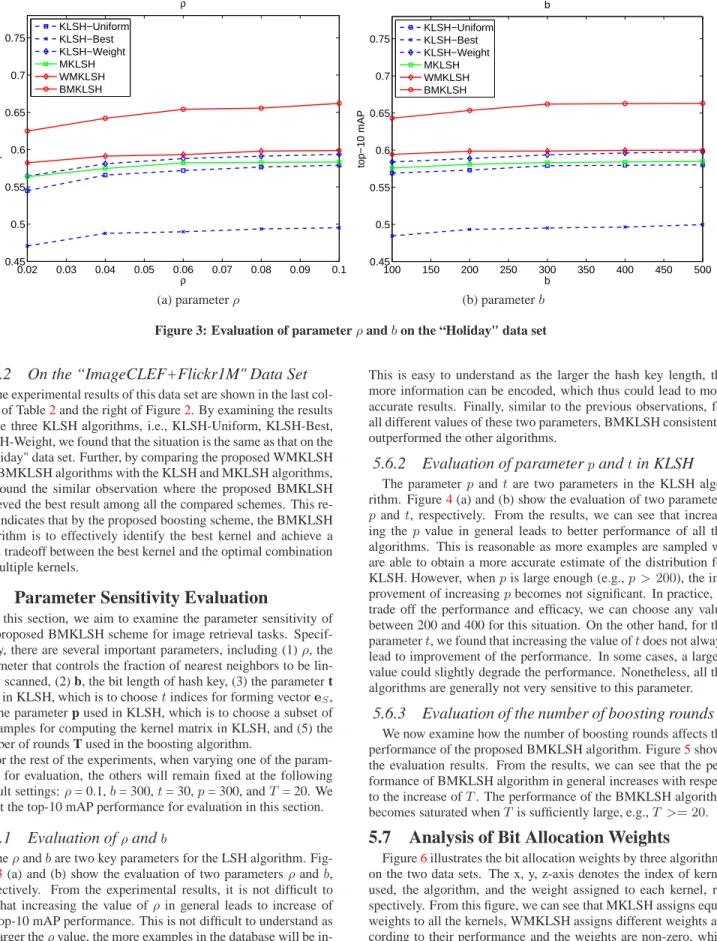
0.02 0.03 0.04 0.05 0.06 0.07 0.08 0.09 0.1 0.45 0.5 0.55 0.6 0.65 0.7 0.75 ρ top−10 mAP ρ KLSH−Uniform KLSH−Best KLSH−Weight MKLSH WMKLSH BMKLSH 100 150 200 250 300 350 400 450 500 0.45 0.5 0.55 0.6 0.65 0.7 0.75 b top−10 mAP b KLSH−Uniform KLSH−Best KLSH−Weight MKLSH WMKLSH BMKLSH
(a) parameterρ (b) parameterb
Figure 3: Evaluation of parameterρandbon the “Holiday" data set
5.5.2
On the “ImageCLEF+Flickr1M" Data Set
The experimental results of this data set are shown in the last col-umn of Table2and the right of Figure2. By examining the results of the three KLSH algorithms, i.e., KLSH-Uniform, KLSH-Best, KLSH-Weight, we found that the situation is the same as that on the “Holiday" data set. Further, by comparing the proposed WMKLSH and BMKLSH algorithms with the KLSH and MKLSH algorithms, we found the similar observation where the proposed BMKLSH achieved the best result among all the compared schemes. This re-sult indicates that by the proposed boosting scheme, the BMKLSH algorithm is to effectively identify the best kernel and achieve a good tradeoff between the best kernel and the optimal combination of multiple kernels.5.6
Parameter Sensitivity Evaluation
In this section, we aim to examine the parameter sensitivity of the proposed BMKLSH scheme for image retrieval tasks. Specif-ically, there are several important parameters, including (1)ρ, the parameter that controls the fraction of nearest neighbors to be lin-early scanned, (2) b, the bit length of hash key, (3) the parameter t used in KLSH, which is to choosetindices for forming vectoreS, (4) the parameter p used in KLSH, which is to choose a subset of
pexamples for computing the kernel matrix in KLSH, and (5) the number of rounds T used in the boosting algorithm.
For the rest of the experiments, when varying one of the param-eters for evaluation, the others will remain fixed at the following default settings:ρ= 0.1,b= 300,t= 30,p= 300, andT= 20. We adopt the top-10 mAP performance for evaluation in this section.
5.6.1
Evaluation of
ρand
bTheρandbare two key parameters for the LSH algorithm. Fig-ure3(a) and (b) show the evaluation of two parametersρandb, respectively. From the experimental results, it is not difficult to see that increasing the value ofρin general leads to increase of the top-10 mAP performance. This is not difficult to understand as the larger theρvalue, the more examples in the database will be in-spected, thus more relevant image examples can be likely retrieved. Similarly, we also observe that increasing the value of hash key lengthbalso leads to the increase of the top-10 mAP performance.
This is easy to understand as the larger the hash key length, the more information can be encoded, which thus could lead to more accurate results. Finally, similar to the previous observations, for all different values of these two parameters, BMKLSH consistently outperformed the other algorithms.
5.6.2
Evaluation of parameter
pand
tin KLSH
The parameterpandtare two parameters in the KLSH algo-rithm. Figure4(a) and (b) show the evaluation of two parameterspandt, respectively. From the results, we can see that increas-ing thepvalue in general leads to better performance of all the algorithms. This is reasonable as more examples are sampled we are able to obtain a more accurate estimate of the distribution for KLSH. However, whenpis large enough (e.g.,p >200), the im-provement of increasingpbecomes not significant. In practice, to trade off the performance and efficacy, we can choose any value between 200 and 400 for this situation. On the other hand, for the parametert, we found that increasing the value oftdoes not always lead to improvement of the performance. In some cases, a larget
value could slightly degrade the performance. Nonetheless, all the algorithms are generally not very sensitive to this parameter.
5.6.3
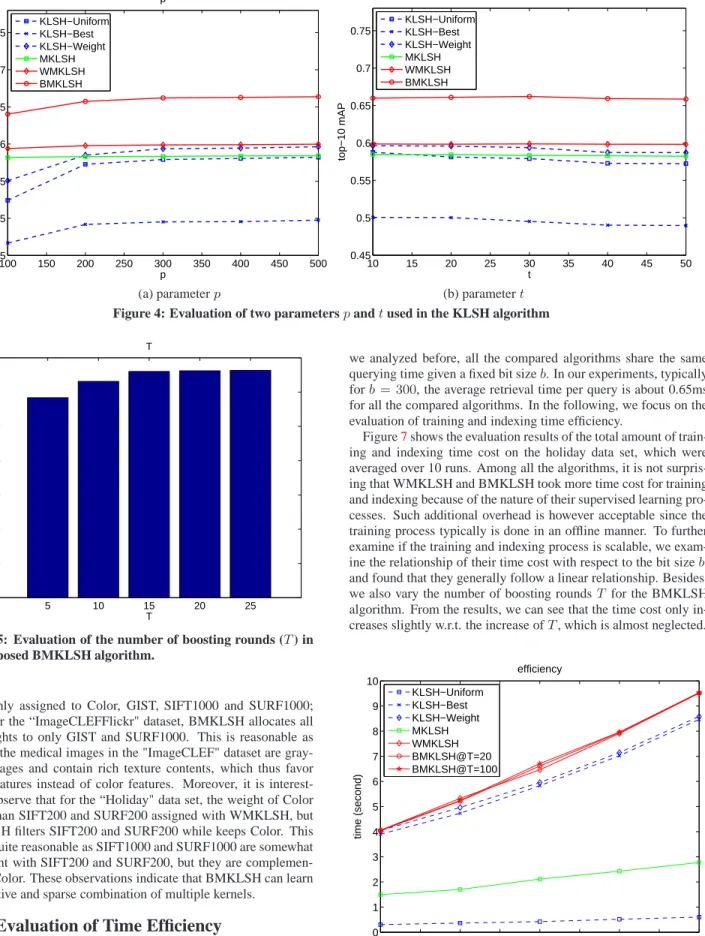
Evaluation of the number of boosting rounds
TWe now examine how the number of boosting rounds affects the performance of the proposed BMKLSH algorithm. Figure5shows the evaluation results. From the results, we can see that the per-formance of BMKLSH algorithm in general increases with respect to the increase ofT. The performance of the BMKLSH algorithm becomes saturated whenTis sufficiently large, e.g.,T >= 20.
5.7
Analysis of Bit Allocation Weights
Figure6illustrates the bit allocation weights by three algorithms on the two data sets. The x, y, z-axis denotes the index of kernel used, the algorithm, and the weight assigned to each kernel, re-spectively. From this figure, we can see that MKLSH assigns equal weights to all the kernels, WMKLSH assigns different weights ac-cording to their performance and the weights are non-zero, while the weights assigned by BMKLSH are sparse, i.e., it focuses on those kernels which are more beneficial to the retrieval tasks. Specif-ically, for the “Holiday" dataset, the weights learned by BMKLSH
100 150 200 250 300 350 400 450 500 0.45 0.5 0.55 0.6 0.65 0.7 0.75 p top−10 mAP p KLSH−Uniform KLSH−Best KLSH−Weight MKLSH WMKLSH BMKLSH 10 15 20 25 30 35 40 45 50 0.45 0.5 0.55 0.6 0.65 0.7 0.75 t top−10 mAP t KLSH−Uniform KLSH−Best KLSH−Weight MKLSH WMKLSH BMKLSH
(a) parameterp (b) parametert
Figure 4: Evaluation of two parameterspandtused in the KLSH algorithm
5 10 15 20 25 0 0.1 0.2 0.3 0.4 0.5 0.6 0.7 T top−10 mAP T
Figure 5: Evaluation of the number of boosting rounds (T) in the proposed BMKLSH algorithm.
are mainly assigned to Color, GIST, SIFT1000 and SURF1000; while for the “ImageCLEFFlickr" dataset, BMKLSH allocates all the weights to only GIST and SURF1000. This is reasonable as most of the medical images in the "ImageCLEF" dataset are gray-level images and contain rich texture contents, which thus favor GIST features instead of color features. Moreover, it is interest-ing to observe that for the “Holiday" data set, the weight of Color is less than SIFT200 and SURF200 assigned with WMKLSH, but BMKLSH filters SIFT200 and SURF200 while keeps Color. This is also quite reasonable as SIFT1000 and SURF1000 are somewhat redundant with SIFT200 and SURF200, but they are complemen-tary to Color. These observations indicate that BMKLSH can learn an effective and sparse combination of multiple kernels.
5.8
Evaluation of Time Efficiency
Finally, we evaluate the efficiency of all the six algorithms on the “Holiday" data set. The experiments were running in Matlab on a Linux machine with 3GHz Intel CPU and 16GB RAM. As
we analyzed before, all the compared algorithms share the same querying time given a fixed bit sizeb. In our experiments, typically forb= 300, the average retrieval time per query is about 0.65ms for all the compared algorithms. In the following, we focus on the evaluation of training and indexing time efficiency.
Figure7shows the evaluation results of the total amount of train-ing and indextrain-ing time cost on the holiday data set, which were averaged over 10 runs. Among all the algorithms, it is not surpris-ing that WMKLSH and BMKLSH took more time cost for trainsurpris-ing and indexing because of the nature of their supervised learning pro-cesses. Such additional overhead is however acceptable since the training process typically is done in an offline manner. To further examine if the training and indexing process is scalable, we exam-ine the relationship of their time cost with respect to the bit sizeb, and found that they generally follow a linear relationship. Besides, we also vary the number of boosting roundsT for the BMKLSH algorithm. From the results, we can see that the time cost only in-creases slightly w.r.t. the increase ofT, which is almost neglected.
100 150 200 250 300 350 400 450 500 0 1 2 3 4 5 6 7 8 9 10 b time (second) efficiency KLSH−Uniform KLSH−Best KLSH−Weight MKLSH WMKLSH BMKLSH@T=20 BMKLSH@T=100
1 2 3 4 5 6 7 8 9 MKLSH WMKLSH BMKLSH 0 0.5 1 Kernel ID Holiday Kernel Weight ( α ) Color Edge Gabor LBP GIST SIFT200 SIFT1000 SURF200 SURF1000 1 2 3 4 5 6 7 8 9 MKLSH WMKLSH BMKLSH 0 0.5 1 Kernel ID ImageCLEFFlickr Kernel Weight ( α )
Figure 6: Visualization of bit allocation weights obtained by three different algorithms.
5.9
Evaluation of Qualitative Performance
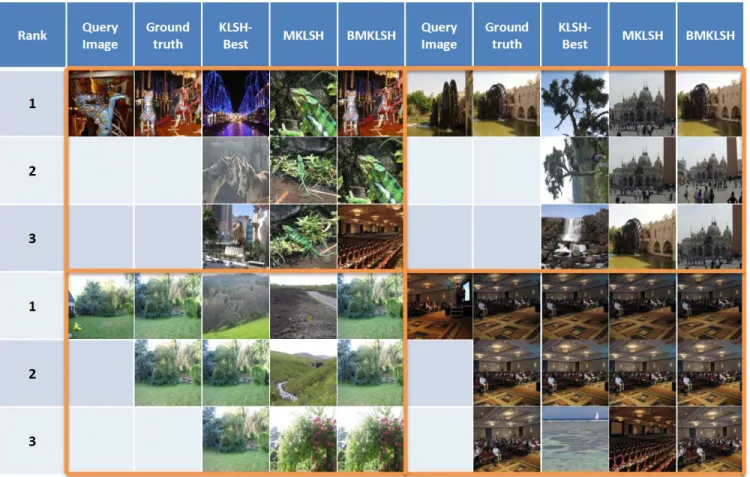
Finally, we illustrate the qualitative retrieval performance by ran-domly choosing some query images from the database. Figure8shows the retrieval results by different algorithms. This figure in-cludes four retrieval cases of different queries, each of which shows the top-3 retrieved results by three representative algorithms: KLSH-Best, MKLSH, and BMKLSH. From the qualitative results, we can see that the proposed BMKLSH algorithm in general is able to re-turn more relevant results than the other algorithms.
6.
CONCLUSIONS
This paper investigated a framework of Multi-Kernel Locality-Sensitive Hashing by exploring multiple kernels for efficient and scalable content-based image retrieval. We first analyzed the the-oretical property of kernel LSH (KLSH). We further emphasized that it is of crucial importance to develop a proper combination of multiple kernels for determining the bit allocation task in KLSH, although KLSH and MKLSH with naive use of multiple kernels have been proposed in literature. We thus proposed two new algo-rithms: (i) WMKLSH that combines multiple kernels via a simple weighted combination, and (ii) BMKLSH that employs a boosting-like scheme to optimize the bit allocation of multiple kernels for KLSH. We have conducted an extensive set of experiments to eval-uate the performance of the proposed algorithms, in which the en-couraging results showed that the proposed BMKLSH algorithm using the boosting approach is able to considerably surpass a num-ber of baseline methods. Future work will apply our technique to tackle other problems, such as search-based image annotation.
Acknowledgments
This work was in part supported by Singapore MOE tier 1 project (RG33/11), Microsoft Research grant (M4060936), and US Army Research Office (W911NF-11-1-0383).
7.
REFERENCES
[1] S. Arya, T. Malamatos, and D. M. Mount. Space-time tradeoffs for approximate nearest neighbor searching. J. ACM, 57(1):1–54, 2009. [2] J. L. Bentley. Multidimensional binary search trees used for
associative searching. Commun. ACM, 18(9):509–517, 1975.
[3] S. Berchtold, D. A. Keim, and H.-P. Kriegel. The x-tree: An index structure for high-dimensional data. In VLDB, pages 28–39, San Francisco, CA, USA, 1996.
[4] C. Böhm, S. Berchtold, and D. A. Keim. Searching in high-dimensional spaces: Index structures for improving the performance of multimedia databases. ACM Comput. Surv., 33(3):322–373, 2001.
[5] G.-H. Cha, X. Zhu, P. Petkovic, and C.-W. Chung. An efficient indexing method for nearest neighbor searches in high-dirnensional image databases. IEEE Transactions on Multimedia, 4(1):76–87, 2002.
[6] M. Charikar. Similarity estimation techniques from rounding algorithms. In STOC, pages 380–388, 2002.
[7] K. L. Clarkson. A randomized algorithm for closest-point queries.
SIAM J. Comput., 17(4):830–847, 1988.
[8] B. Cui, B. C. Ooi, J. Su, and K.-L. Tan. Indexing high-dimensional data for efficient in-memory similarity search. IEEE Trans. on
Knowl. and Data Eng., 17(3):339–353, 2005.
[9] I. Daoudi, K. Idrissi, S. E. Ouatik, A. Baskurt, and D. Aboutajdine. An efficient high-dimensional indexing method for content-based retrieval in large image databases. Image Commun., 24(10):775–790, 2009.
[10] M. Datar, N. Immorlica, P. Indyk, and V. S. Mirrokni.
Locality-sensitive hashing scheme based on p-stable distributions. In
Proc. 20th annual symposium on Computational geometry (SCG’04),
pages 253–262. New York, NY, 2004.
[11] W. Dong, M. Charikar, and K. Li. Asymmetric distance estimation with sketches for similarity search in high-dimensional spaces. In
SIGIR, pages 123–130, 2008.
[12] P. Drineas and M. W. Mahoney. On the nystrom method for approximating a gram matrix for improved kernel-based learning.
Journal of Machine Learning Research, 6:2005, 2005.
[13] Y. Freund and R. E. Schapire. A decision-theoretic generalization of on-line learning and an application to boosting. J. Comput. Syst. Sci., 55(1):119–139, 1997.
[14] A. Gionis, P. Indyk, and R. Motwani. Similarity search in high dimensions via hashing. In VLDB, 1999.
[15] K. Grauman and T. Darrell. Pyramid match hashing: Sub-linear time indexing over partial correspondences. In CVPR, 2007.
[16] J. He, S.-F. Chang, R. Radhakrishnan, and C. Bauer. Compact hashing with joint optimization of search accuracy and time. In
CVPR, pages 753–760, 2011.
[17] J. He, W. Liu, and S.-F. Chang. Scalable similarity search with optimized kernel hashing. In KDD, pages 1129–1138, 2010. [18] S. C. H. Hoi and M. R. Lyu. A multimodal and multilevel ranking
Figure 8: Comparison of qualitative retrieval performance on the “Holiday" dataset. This figure shows four examples. For each query, we show the top-3 retrieved images by three representative methods, i.e., KLSH-Best, MKLSH, and BMKLSH, respectively.
scheme for large-scale video retrieval. IEEE Transactions on
Multimedia, 10(4):607–619, 2008.
[19] S. C. H. Hoi, M. R. Lyu, and R. Jin. A unified log-based relevance feedback scheme for image retrieval. IEEE Trans. KDE, 18(4):509–204, 2006.
[20] P. Indyk and R. Motwani. Approximate nearest neighbor: Towards removing the curse of dimensionality. In STOC, pages 604–613, 1998.
[21] H. Jegou, M. Douze, and C. Schmid. Hamming embedding and weak geometric consistency for large scale image search. In ECCV (1), pages 304–317, 2008.
[22] A. Joly and O. Buisson. Random maximum margin hashing. In
CVPR, pages 873–880, 2011.
[23] B. Kulis and K. Grauman. Kernelized locality-sensitive hashing for scalable image search. In ICCV, 2009.
[24] M. S. Lew, N. Sebe, C. Djeraba, and R. Jain. Content-based multimedia information retrieval: State of the art and challenges.
ACM Trans. Multimedia Comput. Commun. Appl., 2(1):1–19, 2006.
[25] Q. Lv, W. Josephson, Z. Wang, M. S. Charikar, and K. Li. Multi-probe lsh: efficient indexing for high-dimensional similarity search. In VLDB. Vienna, Austria, 2007.
[26] Y. Mu, J. Shen, and S. Yan. Weakly-supervised hashing in kernel space. In CVPR, pages 3344–3351, 2010.
[27] B. K. P. Jain and K. Grauman. Fast image search for learned metrics. In CVPR, 2008.
[28] M. Raginsky and S. Lazebnik. Locality-sensitive binary codes from shift-invariant kernels. In NIPS, pages 1509–1517, 2009.
[29] J. T. Robinson. The k-d-b-tree: A search structure for large multi-dimensional dynamic indexes. SIGMOD, pages 10–18, 1981. [30] Y. Rui, T. S. Huang, M. Ortega, and S. Mehrotra. Relevance
feedback: A power tool in interactive content-based image retrieval.
IEEE Trans. CSVT, 8(5):644–655, Sept. 1998.
[31] M. Shamos and D. Hoey. Closest-point problems. In Proc. 16th
Annual IEEE Symposium on Foundations of Computer Science (FOCS), pages 151–162, 1975.
[32] S. Smale and D.-X. Zhou. Geometry on probability spaces. Constr
Approx, 30:311–323, 2009.
[33] A. W. M. Smeulders, M. Worring, S. Santini, A. Gupta, and R. Jain. Content-based image retrieval at the end of the early years. IEEE
Trans. PAMI, 22(12):1349–1380, 2000.
[34] Y. Tao, K. Yi, C. Sheng, and P. Kalnis. Quality and efficiency in high dimensional nearest neighbor search. In SIGMOD Conference, pages 563–576, 2009.
[35] J. K. Uhlmann. Satisfying general proximity/similarity queries with metric trees. Information Processing Letters, 40:175–179, 1991. [36] J. Wang, O. Kumar, and S.-F. Chang. Semi-supervised hashing for
scalable image retrieval. In CVPR, pages 3424–3431, 2010. [37] S. Wang, S. Jiang, Q. Huang, and Q. Tian. S3mkl: scalable
semi-supervised multiple kernel learning for image data mining. In
ACM Multimedia, pages 163–172, 2010.
[38] L. Yang, R. Jin, L. B. Mummert, R. Sukthankar, A. Goode, B. Zheng, S. C. H. Hoi, and M. Satyanarayanan. A boosting framework for visuality-preserving distance metric learning and its application to medical image retrieval. IEEE Trans. Pattern Anal. Mach. Intell., 32(1):30–44, 2010.
[39] D. Zhang, J. Wang, D. Cai, and J. Lu. Self-taught hashing for fast similarity search. In SIGIR, pages 18–25, 2010.
[40] J. Zhuang, T. Mei, S. C. H. Hoi, X.-S. Hua, and S. Li. Modeling social strength in social media community via kernel-based learning. In ACM Multimedia, pages 113–122, 2011.