Analyzing Clone Evolution for Identifying the
Important Clones for Management
A Thesis Submitted to the
College of Graduate Studies and Research
in Partial Fulfillment of the Requirements
for the degree of Doctor of Philosophy
in the Department of Computer Science
University of Saskatchewan
Saskatoon
By
Manishankar Mondal
Permission to Use
In presenting this thesis in partial fulfilment of the requirements for a Postgraduate degree from the University of Saskatchewan, I agree that the Libraries of this University may make it freely available for inspection. I further agree that permission for copying of this thesis in any manner, in whole or in part, for scholarly purposes may be granted by the professor or professors who supervised my thesis work or, in their absence, by the Head of the Department or the Dean of the College in which my thesis work was done. It is understood that any copying or publication or use of this thesis or parts thereof for financial gain shall not be allowed without my written permission. It is also understood that due recognition shall be given to me and to the University of Saskatchewan in any scholarly use which may be made of any material in my thesis. Requests for permission to copy or to make other use of material in this thesis in whole or part should be addressed to:
Head of the Department of Computer Science 176 Thorvaldson Building 110 Science Place University of Saskatchewan Saskatoon, Saskatchewan Canada S7N 5C9
Abstract
Code clones (identical or similar code fragments in a code-base) have dual but contradictory impacts (i.e., both positive and negative impacts) on the evolution and maintenance of a software system. Because of the negative impacts (such as high change-proneness, bug-proneness, and unintentional inconsistencies), software researchers consider code clones to be the number one bad-smell in a code-base. Existing studies on clone management suggest managing code clones through refactoring and tracking. However, a software system’s code-base may contain a huge number of code clones, and it is impractical to consider all these clones for refactoring or tracking. In these circumstances, it is essential to identify code clones that can be considered particularly important for refactoring and tracking. However, no existing study has investigated this matter. We conduct our research emphasizing this matter, and perform five studies on identifying important clones by analyzing clone evolution history.
In our first study we detect evolutionary coupling of code clones by automatically investigating clone evolution history from thousands of commits of software systems downloaded from on-line SVN repositories. By analyzing evolutionary coupling of code clones we identify a particular clone change pattern, Similarity Preserving Change Pattern (SPCP), such that code clones that evolve following this pattern should be considered important for refactoring. We call these important clones theSPCP clones. We rank SPCP clones considering their strength of evolutionary coupling. In our second study we further analyze evolutionary coupling of code clones with an aim to assist clone tracking. The purpose of clone tracking is to identify the co-change (i.e. changing together) candidates of code clones to ensure consistency of changes in the code-base. Our research in the second study identifies and ranks the important co-change candidates by analyzing their evolutionary coupling. In our third study we perform a deeper analysis on the SPCP clones and identify their cross-boundary evolutionary couplings. On the basis of such couplings we separate the SPCP clones into two disjoint subsets. While one subset contains the non-cross-boundary SPCP clones which can be considered important for refactoring, the other subset contains the cross-boundary SPCP clones which should be considered important for tracking. In our fourth study we analyze the bug-proneness of different types of SPCP clones in order to identify which type(s) of code clones have high tendencies of experiencing bug-fixes. Such clone-types can be given high priorities for management (refactoring or tracking). In our last study we analyze and compare the late propagation tendencies of different types of code clones. Late propagation is commonly regarded as a harmful clone evolution pattern. Findings from our last study can help us prioritize clone-types for management on the basis of their tendencies of experiencing late propagations. We also find that late propagation can be considerably minimized by managing the SPCP clones. On the basis of our studies we develop an automatic system called AMIC (Automatic Mining of Important Clones) that identifies the important clones for management (refactoring and tracking) and ranks these clones considering their evolutionary coupling, bug-proneness, and late propagation tendencies. We believe that our research findings have the potential to assist clone management by pin-pointing the important clones to be managed, and thus, considerably minimizing clone management effort.
Acknowledgements
First of all, I would like to express my heartiest gratitude to my respected supervisors Dr. Chanchal K. Roy and Dr. Kevin A. Schneider for their constant guidance, advice, encouragement and extraordinary patience during this thesis work. Without them this work would have been impossible.
I would like to thank Dr. Kevin Stanley, Dr. Ian McQuillan, Dr. Ramakrishna Gokaraju, and Dr. Michael W. Godfrey for their willingness to take part in the advisement and evaluation of my thesis work.
Thanks to all of the members of the Software Research Lab with whom I have had the opportunity to grow as a researcher. In particular, I would like to thank Muhammad Asaduzzaman, Md. Saidur Rahman, Masudur Rahman, Amit Mondal, Farouq Al. Omari, Shamima Yeasmin, and Judith Fransisca.
I am grateful to the Department of Computer Science of the University of Saskatchewan for their generous financial support through scholarships, awards and bursaries that helped me to concentrate more deeply on my thesis work.
I thank the anonymous reviewers for their valuable comments and suggestions in improving the papers produced from this thesis.
I would like to thank all of my friends and other staff members of the Department of Computer Science who have helped me to reach at this stage. In particular, I would like to thank Gwen Lancaster, Heather Webb, and Sakiba Jalal.
The most wonderful thing in my life is my daughter, Bhaswatee Mondal, whose presence drove me in the right direction in finishing my thesis work. Also, my daughter and my wife Smritikana Mondal are the ones who sacrificed the most for this thesis. I could not be present at their side during their most difficult moments.
I express my heartiest gratitude to my mother Gita Rani Mondal, and my father Monoranjan Mondal who are the architects of my life. Their endless sacrifice has made me to reach at this stage of my life. My parents, my sister Maitrayee Mondal, and my wife have always inspired me in completing my thesis work.
Dedication
I dedicate this thesis to my mother, Gita Rani Mondal, whose affection and inspiration have given me mental strength in every step of my life, to my father, Monoranjan Mondal, whose strong character and philosophical thoughts have always made me take the right decisions, and to my wife, Smritikana Mondal, whose continuous sacrifice has helped me achieve my goal.
Contents
Permission to Use i Abstract ii Acknowledgements iii Dedication iv Contents v List of Tables ix List of Figures xList of Abbreviations xii
1 Introduction 1
1.1 Problem Definition . . . 2
1.2 Addressing the Research Problem . . . 2
1.2.1 Study 1: Identifying Code Clones that Can Be Important for Refactoring . . . 4
1.2.2 Study 2: Ranking Co-change Candidates of Code Clones . . . 4
1.2.3 Study 3: Identifying Code Clones that can Be Important for Tracking . . . 5
1.2.4 Study 4: Investigating Bug-proneness of Code Clones . . . 5
1.2.5 Study 5: Investigating Late Propagation in Code Clones . . . 6
1.3 Outline of the Thesis . . . 7
2 Background 8 2.1 Code Clone . . . 8
2.2 Types of Code Clones . . . 10
2.2.1 Type 1 Clones . . . 10
2.2.2 Type 2 Clones . . . 10
2.2.3 Type 3 Clones . . . 10
2.2.4 Type 4 Clones . . . 11
2.2.5 Clone Detection Techniques . . . 12
2.3 Impacts of Code Clones . . . 13
2.3.1 Positive Impacts of Code Clones . . . 13
2.3.2 Negative Impacts of Code Clones . . . 14
2.4 Clone Refactoring and Tracking . . . 15
2.4.1 Clone Refactoring . . . 15
2.4.2 Clone Tracking . . . 16
2.5 Evolutionary Coupling of Program Entities . . . 16
2.5.1 Association Rule . . . 16
2.5.2 Support and Confidence . . . 17
3 Automatic Ranking of Clones for Refactoring through Mining Association Rules 18 3.1 Introduction . . . 18
3.2 Significance of Our Study . . . 22
3.3 Similarity Preserving Change Pattern . . . 22
3.3.1 Definition of Similarity Preserving Change Pattern . . . 22
3.3.3 Mining Association Rules Considering SPCP . . . 24
3.3.4 Ranking of Association Rules . . . 24
3.3.5 Finding Groups of Refactoring Candidates . . . 25
3.3.6 Tool Support . . . 25
3.4 Experimental Results and Discussion . . . 27
3.4.1 Answer to Research Question RQ 1: Are the changes occurring to the clone fragments in SPCOs (similarity preserving co-changes) consistency ensuring changes?. 28 3.4.2 Answer to Research Question RQ 2: Can SPCP clones be candidates for refac-toring? . . . 30
3.4.3 Answer to Research Question RQ 3: What are the characteristics of the clones that change following similarity preserving change pattern (SPCP)? . . . 33
3.4.4 Answer to Research Question RQ 4: What ratio of the SPCP clones do receive resynchronizing changes? . . . 34
3.5 Threats to Validity . . . 34
3.6 Related Work . . . 35
3.7 Summary . . . 36
4 Prediction and Ranking of Co-change Candidates for Clones 37 4.1 Introduction and Motivation . . . 37
4.1.1 Importance of Our Study with Respect to the Existing Studies . . . 38
4.1.2 The Underlying Idea of Ranking . . . 38
4.1.3 Findings . . . 39
4.2 Terminology . . . 40
4.2.1 Evolutionary Coupling . . . 40
4.2.2 Pair of Co-changed Clone Fragments (PCCF) . . . 41
4.3 Experimental Steps . . . 41
4.4 Experimental Results and Analysis . . . 42
4.4.1 Answering Research Question 1 . . . 43
4.4.2 Answering Research Question 2 . . . 48
4.4.3 Answering Research Question 3 . . . 51
4.4.4 Answering Research Question 4 . . . 54
4.5 Threats to Validity . . . 55
4.6 Related Work . . . 56
4.7 Summary . . . 57
5 Automatic Identification of Important Clones for Refactoring and Tracking 59 5.1 Introduction and Motivation . . . 59
5.2 Terminology . . . 62
5.3 SPCP Clones having Relationships beyond their Class Boundaries . . . 62
5.3.1 SPCP Clones . . . 63
5.3.2 SPCP Clones having Cross-Boundary Relationships. . . 63
5.3.3 Detecting Cross-Boundary SPCP Clones by Mining their Evolutionary Coupling . . . . 64
5.4 Methodology . . . 65
5.5 Experimental Results and Discussion . . . 66
5.5.1 RQ 1: What Proportion of the SPCP Clones of a Subject System Have Cross-boundary Relationships? . . . 66
5.5.2 RQ 2: Should We Discard the Cross-boundary SPCP Clones from Consideration While Taking Refactoring Decisions and also, Consider them for Tracking? . . . 68
5.5.3 RQ 3: Do Cross-boundary SPCP Clones Have Higher Change-proneness Than the Non-cross-boundary SPCP Clones? . . . 72
5.5.4 RQ 4: Which Types of SPCP Clones Have Higher Possibility of Having Cross-boundary Relationships? . . . 74
5.5.5 Ranking of SPCP Clones for Tracking and Refactoring . . . 76
5.7 Related Work . . . 77
5.8 Summary . . . 78
6 A Comparative Study on the Bug-Proneness of Different Types of Code Clones 79 6.1 Introduction and Motivation . . . 79
6.2 Terminology . . . 80
6.3 Similarity Preserving Change Pattern (SPCP) . . . 80
6.4 Experimental Steps . . . 81
6.4.1 Preliminary Steps . . . 81
6.4.2 Bug-proneness Detection Technique . . . 82
6.5 Experimental Results and Analysis . . . 83
6.6 Threats to Validity . . . 94
6.7 Related Work . . . 95
6.8 Summary . . . 96
7 A Comparative Study on the Intensity and Harmfulness of Late Propagation in Near-Miss Code Clones 97 7.1 Introduction and Motivation . . . 97
7.2 Terminology . . . 99
7.2.1 Late Propagation in a Clone Pair . . . 99
7.2.2 SPCP Clones . . . 99
7.2.3 Granularity of Late Propagation . . . 101
7.3 Detection of Late Propagation . . . 101
7.3.1 Preliminary Steps . . . 101
7.3.2 Detection of Clone-Pairs that Experienced Late Propagation . . . 103
7.4 Experimental Results and Discussion . . . 106
7.4.1 RQ 1: What Percentage of Late Propagations in Type 3 Clones Mainly Occur Because of the Changes in the Non-matched Portions of the Partici-pating Clone Fragments? . . . 106
7.4.2 RQ 2: Are the Intensities of Late Propagation Different in Different Types of Clones?. . . 109
7.4.3 RQ 3: Late Propagations in Which Types of Clones Are More Related to Bugs?. . . 111
7.4.4 RQ 4: Clones of Which Clone-type(s) Have Higher Possibilities of Experi-encing Bug-fixing Changes at the time of Convergence? . . . 116
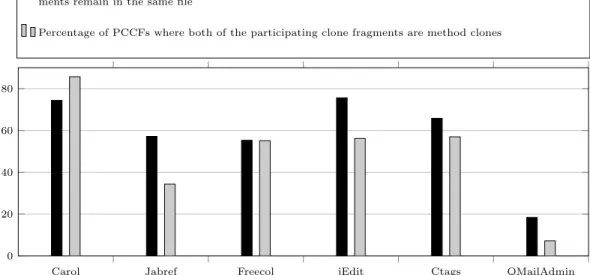
7.4.5 RQ 5: Do the Participating Clone Fragments in a Clone Pair that Experi-ence Late Propagation Generally Remain in Different Files? . . . 117
7.4.6 RQ 6: Do Block Clones or Method Clones Exhibit Higher Intensity of Late Propagation?. . . 120
7.4.7 RQ 7: Do Late Propagations Mainly Occur to the SPCP Clones or Non-SPCP Clones?. . . 124
7.4.8 Discussion . . . 127
7.5 Related Work . . . 129
7.6 Threats to Validity . . . 130
7.7 Summary . . . 132
8 Automatic Mining of Important Clones (AMIC) 133 8.1 Introduction . . . 133
8.2 An Example Use Case of AMIC . . . 133
8.3 Concept behind AMIC . . . 134
8.3.1 Separating the SPCP Clones into Two Subsets . . . 135
8.4 Description of AMIC . . . 135
8.5 Implementation and Data Storage . . . 137
8.6 Output of AMIC . . . 137
9 Conclusion 139
9.1 Summary . . . 139
9.2 Contribution . . . 140
9.3 Future Research Directions . . . 142
References 145 A Publications From This Thesis Research 162 B User Manual for AMIC 164 B.1 Using AMIC through its Desktop Implementation . . . 164
B.1.1 Installation . . . 164
B.1.2 Executing AMIC . . . 164
B.2 Using AMIC through its Web-based Implementation . . . 172
B.2.1 User Registration . . . 172
B.2.2 Subject System Initialization / Selection . . . 172
B.2.3 Downloading the Revisions of a Selected Subject System . . . 172
B.2.4 Detecting Changes between Revisions . . . 176
B.2.5 Detecting and Managing Methods in Revisions . . . 176
B.2.6 Detecting and Managing Clones in Revisions . . . 176
B.2.7 Detecting the Important Code Clones . . . 176
B.2.8 Ranking Code Clones . . . 177
B.2.9 Viewing Clone Evolution . . . 177
List of Tables
3.1 Subject Systems . . . 26
3.2 Statistics Regarding the Important Cloned Fragments (i.e., the SPCP Clones) Retrieved by Our Prototype Tool . . . 26
4.1 Research Questions . . . 40
4.2 Subject Systems . . . 41
4.3 Statistics Regarding Evolutionary Coupling among Clones . . . 42
5.1 Research Questions . . . 62
5.2 Subject Systems . . . 65
5.3 Number of SPCP Clone Fragments . . . 67
5.4 Mann-Whitney-Wilcoxon Tests Regarding the Significance of Difference between Change-proneness Values of Cross-Boundary-Group and Non-Cross-Boundary-Group . . . 74
5.5 Cross-Boundary SPCP Clones in Three Clone-types . . . 75
6.1 Research Questions . . . 80
6.2 Subject Systems . . . 81
6.3 Percentage of Changes Related to Bug-fix . . . 84
6.4 Percentage of Clones Related to Bug-fix . . . 86
6.5 Percentage of Bug-fix Clones that Experienced Similarity Preserving Co-change in the Bug-fix Commits . . . 89
6.6 No. of Bug-fix Clones that Evolved by Following an SPCP (Similarity Preserving Change Pattern) . . . 92
7.1 Research Questions . . . 98
7.2 Subject Systems . . . 102
7.3 Late Propagations in Type 3 Clones . . . 108
7.4 Statistics Regarding Late Propagations in Different Clone-types . . . 108
7.5 Percentage of Clone Genealogies that Experienced Late Propagations from Different Clone-types110 7.6 The Average Number of Times a Alone-pair Experienced Late Propagation from Different Clone Types . . . 111
7.7 Percentage of Late Propagations Related to Bug-fix . . . 114
7.8 Percentage of Clone Genealogies that Experienced Buggy Late Propagations . . . 115
7.9 Percentage of Clone Genealogies that Experienced Bug-fixing Changes at the Time of Conver-gence . . . 118
7.10 Percentage of Late Propagation Clone-pairs Each Having Clone Fragments from the Same File or from Different Files . . . 119
7.11 Percentage of Late Propagation Clone-pairs Each Consisting of Method Clones or Block Clones121 7.12 The Number of Block Clones and Method Clones that Experienced Late Propagations . . . 123
7.13 Percentage of Block Clones and Method Clones that Experienced Late Propagations . . . 123
7.14 Statistics Regarding SPCP clones and Late Propagations . . . 124
7.15 Percentage of Late Propagations Involving SPCP Clones . . . 125
List of Figures
2.1 Type 1 (identical) clone pair . . . 9
2.2 Type 2 clone pair . . . 11
2.3 Type 3 clone pair . . . 12
2.4 Type 4 clone pair . . . 13
3.1 Change history of clone fragments . . . 19
3.2 Proposed refactoring step . . . 21
3.3 Similarity preserving change pattern (SPCP) . . . 22
3.4 Rules of Type 3 clones sorted in decreasing order of support values . . . 25
3.5 Overall percentages of cloned fragments that followed SPCP . . . 28
3.6 Changes to two Type 3 clone fragments of Carol in commit 51 . . . 29
3.7 Overall percentages of refactorable rules and groups . . . 31
3.8 Statistics regarding SPCP clones and rules . . . 33
3.9 Proportions of SPCP clones that received resynchronizing changes . . . 35
4.1 Evolution history of four clone fragments from the same clone class . . . 38
4.2 Proportion of modified clones (i.e., the clones that received changes at least once during evo-lution) that exhibited evolutionary coupling . . . 43
4.3 Prediction of co-change candidates using evolutionary coupling . . . 44
4.4 Comparison between the proportions of predicted co-change candidates and non-predicted co-change candidates . . . 46
4.5 Comparison between the percentage of predicted co-change candidates that were true co-change candidates (i.e., the precision) and the percentage of non-predicted co-change candidates that were true co-change candidates . . . 47
4.6 The proportion of true co-change candidates that we could predict by analyzing evolutionary coupling (i.e., the recall) . . . 48
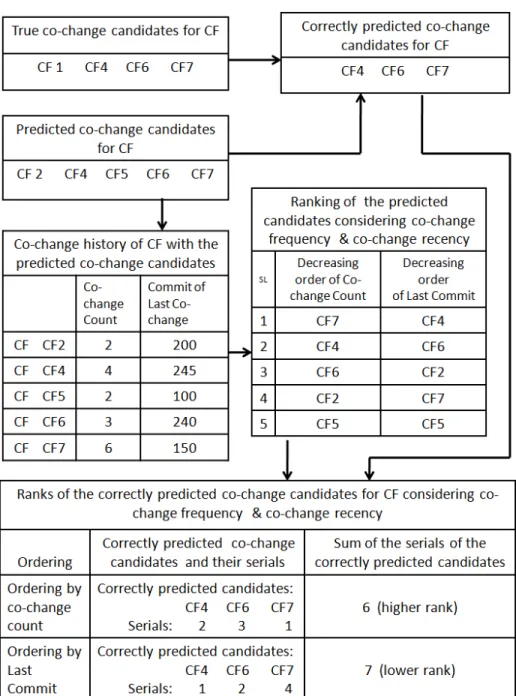
4.7 Ranking of predicted co-change candidates by co-change frequency and co-change recency . . . 50
4.8 Comparison of the two ranking systems (ranking using co-change frequency and co-change recency) . . . 52
4.9 Comparing the characteristics of clone fragments that exhibit evolutionary coupling . . . 54
4.10 Comparison of the two ranking systems for the non-predicted co-change candidates . . . 55
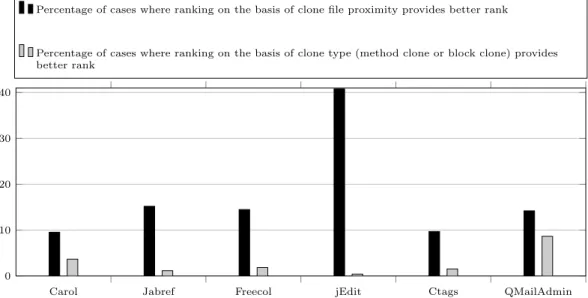
4.11 Comparison between the combined ranking (i.e, ranking predicted candidates by co-change re-cency and non-predicted co-change candidates by clone file proximity) and ranking considering only clone file proximity . . . 56
5.1 Example of an SPCP clone fragment having relationships beyond its class boundary . . . 60
5.2 Percentage of cross-boundary SPCP clone fragments . . . 68
5.3 The average number of code fragments to which a cross-boundary SPCP clone fragment is related beyond its class boundary . . . 70
5.4 Changes occurred to an SPCP clone fragment in the commit operation applied on revision 217 of our subject system Ctags. . . 71
5.5 Changes occurred to a non-clone fragment in the commit operation applied on revision 217 of our subject system Ctags. . . 71
5.6 Comparison of change-proneness between cross-boundary and non-cross-boundary SPCP clone fragments . . . 73
5.7 Comparison of change-proneness between cross-boundary and non-cross-boundary SPCP clone fragments . . . 76
6.1 Comparison regarding the percentage of bug-fix changes that occurred to the clone fragments. 85 6.2 Comparison regarding the percentage of clone fragments that experienced bug-fixing changes. 85
6.3 Comparison regarding the percentage of bug-fix clones that experiencedsimilarity preserving
co-changes during bug-fix commits. . . 89
6.4 An example of a similarity preserving co-change of two Type 3 clone fragments (i.e., Clone Fragment 1, and Clone Fragment 2) of Freecol in a bug-fix commit operation applied to revision 1075. Each of these two clone fragments is a method clone (i.e., the whole method is a clone fragment). The figure shows that they were changed consistently in the bug-fix commit and were again considered as Type 3 clones of each other in revision 1076. . . 90
6.5 Comparison regarding the percentage of clone fragments that have experienced bug-fixes and have also been selected as SPCP clones. . . 93
6.6 Comparison regarding the percentage of bug-fix clones that have been selected as SPCP clones and are also present in the last revision. . . 94
7.1 A possible example of late propagation . . . 100
7.2 An example of late propagation in a Type 3 clone pair from subject system jEdit . . . 105
8.1 A similarity preserving change pattern followed by two clone fragments CF1 and CF2 is presented in this figure. We see that CF1 and CF2 received similarity preserving changes in commits: Ci andCi+1. They received diverging change at commitCi+3. However, they again converged after the changes in commit Ci+5. Thus, the figure also shows a re-synchronizing change consisting of the diverging change and converging change. . . 135
8.2 The steps in detecting SPCP clones. There are eight processing steps in detecting SPCP clones. The rectangles in this figure indicate these steps. . . 136
B.1 The first dialog of AMIC . . . 165
B.2 The dialog for downloading revisions of a subject system . . . 166
B.3 Notifying users about the pre-existing revisions of the subject system . . . 166
B.4 Extracting changes between revisions of the subject system . . . 167
B.5 Extracting and analyzing methods from each revision . . . 167
B.6 Extracting and analyzing code clones from each revision . . . 168
B.7 Identifying and ranking important code clones for management . . . 169
B.8 Ranking code clones using more than one criterion . . . 170
B.9 Visualizing clone evolution . . . 171
B.10 Visualizing co-evolution of clone fragments . . . 172
B.11 Snap-shot of AMIC website . . . 173
B.12 User registration . . . 173
B.13 Initializing subject system . . . 174
B.14 Viewing initialized subject systems . . . 174
B.15 Subject system selection . . . 175
B.16 Downloading revisions of a subject system . . . 175
B.17 Detecting changes between revisions of a subject system . . . 176
B.18 Managing methods in revisions of a subject system . . . 177
B.19 Managing clones in revisions of a subject system . . . 178
B.20 Identifying the important clones of a subject system . . . 179
B.21 Ranking code clones of a subject system . . . 180
B.22 Visualizing clone evolution . . . 181
List of Abbreviations
SPCP Similarity Preserving Change Pattern SPC Similarity Preserving Change
SPCO Similarity Preserving Co-change AMIC Automatic Mining of Important Clones
JAR Java Archive
JDK Java Development Kit
SQL Structured Query Language
Chapter 1
Introduction
Code cloning has emerged as a controversial term in the realm of software engineering research and prac-tice, because of its contradictory impacts on software evolution and maintenance. Code cloning generally refers to the frequent copy/paste activities of programmers during implementation. Copying one code frag-ment from one place of a code-base and pasting it to several other places with or without modification cause the existence of identical or nearly similar code fragments in the code-base. Such code fragments are known as code clones. A group of similar code fragments forms a clone class or a clone group. Two code fragments that are similar to each other form a clone-pair. Although copy/pasting is considered to be the primary reason behind code clones, some other factors such as: repetition of common functionality, programmer laziness, technology limitation, and code understandability may influence clone creation.
Code clones are of significant importance from the perspectives of software maintenance. A great many studies [19, 29, 30, 75, 78, 89, 111, 113, 114, 120, 146, 155, 158, 183, 186, 192, 194–197, 197–199, 201, 203, 211, 215, 220, 229, 232, 233, 248, 272, 275, 276] have been conducted on analyzing clone impacts on software maintenance and evolution. While a number of studies [19, 75, 89, 111, 131–133] identified some positive impacts of code clones (such as: faster software development, and better understandability of source code), there is strong empirical evidence [29, 30, 44, 51, 78, 91, 97, 141, 142, 145, 146, 156, 158, 263] of some negative impacts too. These negative impacts include: hidden bug-propagation [145], unintentional inconsistent changes [29], late propagations [30], and higher instability [78]. Emphasizing the negative impacts, software researchers suggest managing code clones through refactoring [25, 35, 272] and tracking [61, 95].
Clone refactoring refers to the task of merging several clone fragments from a clone class (i.e., a group of code fragments that are similar to one another) into a single one if possible. However, there can be situations where refactoring of clone fragments in a particular class is impossible but the fragments need to be updated together consistently. Clone tracking is important in such situations. Clone tracking [61, 95] means remembering all the clone fragments in a clone class as the software system evolves through changes so that when a programmer makes some changes to a particular clone fragment in that class, the clone tracking system can automatically notify her about the existence of the other clone fragments in the class. The programmer can then decide whether she needs to implement similar changes to these other clone fragments in order to ensure consistency of the software system’s code-base.
1.1
Problem Definition
A software system may contain a huge number of code clones. It is impractical to consider all these clones for refactoring or tracking, because some clones are volatile and a considerable proportion of the code clones never change during evolution [119]. Moreover, clone refactoring is often very time consuming and requires interactions from experienced programmers. Clone tracking is resource intensive. In such a situation, it is essential to identify code clones that are important from refactoring and tracking perspectives. However, although a great many studies [26, 27, 27, 35, 37, 38, 56, 60–62, 82–84, 95, 134, 152, 218, 219, 236, 237, 244, 268, 274] have been conducted on clone refactoring and tracking, none of these studies investigate which of the code clones in a software system are important to be refactored or tracked. A number of clone refactoring and tracking tools [27, 35, 39, 61, 67, 80, 83, 87, 95, 122, 139, 151, 152, 210, 239, 244, 245] currently exist. However, these tools cannot identify which code clones can be important for refactoring or tracking. Focusing on this drawback of the existing studies and tools, we address the following problem through our research.
Research Problem
Given the huge number of code clones in a software system’s code-base, how do we identify the important ones from the perspectives of clone management (clone refactoring and tracking)?
1.2
Addressing the Research Problem
In order to address the problem stated above, we conduct our research for identifying code clones that can be important for refactoring and tracking. In our research, we automatically mine and analyze clone evolution history from thousands of commits of software systems downloaded from on-line SVN repositories. We investigate whether evolutionary coupling and bug-proneness of code clones can be used for prioritizing them for management such as refactoring and tracking. We briefly describe our research behind finding important code clones in the following way.
Our Research behind Addressing the Problem
By manually observing the clone evolution history we realize that not all of them evolve in the same way. While some code clones evolve together (co-evolve) by preserving similarity among them, a considerable portion of them evolve independently (without preserving similarity). Moreover, many code clones never change during evolution. Intuitively, code clones that evolve independently or are rarely changed during evolution should not be considered important for management. Only the code clones that co-evolve by preserving their similarity should be considered important. By observing the evolution of such code clones we discover their change pattern and call this pattern aSimilarity Preserving Change Pattern (SPCP). We consider SPCP clones (the code clones that evolve following an SPCP) to be the important ones for refactoring,
because they have a tendency of co-evolving consistently (by preserving their similarity). We rank SPCP clones on the basis of the strength of their evolutionary coupling. We further analyze the evolutionary coupling of code clones, and utilize it for predicting and ranking co-change (changing together) candidates for a clone fragment that a programmer attempts to change. While dealing with evolutionary coupling among clone fragments from the same clone class, we suspected that clones might have evolutionary coupling with code fragments beyond their class boundaries. We investigate this and realize that clones having cross-boundary (beyond class boundary) evolutionary coupling should not be considered for refactoring. Refactoring such a clone fragment might negatively affect the evolution of the cross-boundary code fragments that have coupling with it. Thus, such a clone fragment should be considered important for tracking. We mine the cross-boundary evolutionary couplings of SPCP clones, and suggest that SPCP clones having such couplings should be considered important for tracking rather than refactoring. The non-cross-boundary SPCP clones should be considered for refactoring. We rank the non-cross-boundary and cross-boundary SPCP clones for refactoring and tracking on the basis of the strength of their non-cross-boundary and cross-boundary evolutionary coupling respectively. Although we rank the SPCP clones for management on the basis of their evolutionary coupling, we realize that we should also consider their bug-proneness when ranking. Intuitively, code clones with a higher bug-proneness should be given a higher priority for management. Considering this fact, we analyze the bug-proneness of different types (Type 1, 2, and 3) of code clones and realize that Type 3 clones have the highest bug-proneness among the three types. Moreover, the bug-prone clones of Type 3 have the highest possibility of evolving following an SPCP. Thus, Type 3 SPCP clones should be considered the important ones for management. It is suspected that bug-proneness of code clones is primarily influenced by their tendencies of experiencing late propagation. We investigate late propagation in code clones and find that Type 3 clones have the highest tendency of experiencing late propagation among the three clone-types. We finally discover that we can significantly minimize the occurrences of late propagation by managing SPCP clones through refactoring and tracking.
Decomposing Our Research behind Addressing the Problem
We decompose our research behind addressing the research problem into the following five studies.
Study 1: Identifying code clones that can be considered important for refactoring [163].
Study 2: Ranking co-change candidates of code clones [167].
Study 3: Identifying code clones that should be considered important for tracking [162].
Study 4: Investigating bug-proneness of code clones [168].
Study 5: Investigating late propagation in code clones [171].
1.2.1
Study 1: Identifying Code Clones that Can Be Important for Refactoring
In this study we investigate how we can identify code clones that can be considered important for refactoring. We have already discussed that none of the existing studies on clone refactoring focused on identifying important clones for refactoring. There are a number of studies [38, 138, 277] on scheduling clone refactoring activity. The purpose of these studies is to determine an optimal schedule for refactoring such that refactoring gain is maximized and refactoring effort is minimized. These studies consider all the code clones in a software system to determine the refactoring schedule. Scheduling is one form of ranking. However, we believe that before determining the refactoring schedule, we need to identify code clones that are important for refactoring. We can then only consider these important clones for scheduling. We do not need to consider the unimportant clones for scheduling. Clone refactoring is time consuming and it may require much effort from the experienced programmers. Thus, discarding the unimportant clones from refactoring considerations is essential to minimize clone refactoring effort.
In our first study, we analyze the clone evolution history of a software system. According to our con-sideration, if two or more clone fragments from a particular clone class evolve together by preserving their similarity, then these clone fragments should be considered important for refactoring. Emphasizing this fact we define a particular clone change pattern calledSimilarity Preserving Change Pattern(SPCP). The code clones that evolve following this pattern (i.e., theSPCP clones) are considered to be the important ones for refactoring. We also rank the SPCP clones for refactoring on the basis of the strength of their evolutionary coupling (we will discuss evolutionary coupling in Chapter 2). Thenon-SPCP clones(i.e., the code clones that do not evolve following an SPCP) either evolve independently or rarely change during evo-lution. Thus, such clones should not be considered important for refactoring. Chapter 3 presents a detailed description of our first study.
1.2.2
Study 2: Ranking Co-change Candidates of Code Clones
Clone refactoring is one way of managing code clones. There can be situations where refactoring of code clones in a particular clone class is impractical, however, the clone fragments in the class need to be updated consistently. Clone tracking is important in such situations. As we explained before, a clone tracker remem-bers the clone fragments in a clone class through system evolution so that it can notify a programmer about the existence of the other fragments in this class when she attempts to make changes to a particular fragment. The programmer can then decide whether she needs to change these other fragments consistently. However, all these other fragments might not need to be changed together (i.e., might not need to be co-changed) consistently with the particular fragment that is going to be changed. Only a few of these other fragments might be important for changing consistently with the particular fragment. Thus, ranking these other frag-ments on the basis of their importance of changing together with the particular clone fragment that has been attempted to be changed can help a programmer easily identify the important ones to be co-changed.
In our second study we analyze the evolutionary coupling of the clone fragments in a clone class. Let us consider that a programmer is attempting to change a particular clone fragmentCF in a clone class. The
other clone fragments in the clone class are the co-change candidates. We analyze the past change history of all the clone fragments in the clone class and determine their evolutionary coupling. We then determine which other clone fragments in the clone class exhibited evolutionary coupling withCF. Such clone fragments have higher possibilities of co-changing with CF. We also analyze and compare two types of ranking (we will describe these ranking mechanisms in Chapter 4) of the clone fragments that previously co-changed with
CF. On the basis of our analysis, we rank these clone fragments considering how recently they co-changed with CF. We also rank the clone fragments that did not co-change withCF by considering their distances from CFin the file system hierarchy. We will elaborate our second study in Chapter 4.
1.2.3
Study 3: Identifying Code Clones that can Be Important for Tracking
From our first study we discovered that SPCP clones (code clones that evolved following an SPCP) can be the important ones for refactoring. SPCP clones from a particular clone class have evolutionary coupling among them. However, code clones from a particular clone class might have evolutionary coupling with non-clone fragments, and with clone fragments from other clone classes. Code clones having evolutionary coupling beyond their class boundary should not be considered important for removal through refactoring. Removal of such a clone fragment might negatively affect the evolution of the code fragments that have coupling with it but reside beyond its class boundary. Thus, it is important to identify SPCP clones that have relationships beyond their class boundaries. Such SPCP clones should not be considered for removal through refactoring. These should be considered important for tracking along with their cross-boundary relationships (i.e., relationships beyond their class boundaries). While the cross-boundary SPCP clones should be considered important for tracking, the remaining SPCP clones (i.e., the non-cross-boundary SPCP clones) in a code base can be considered important for refactoring. None of the existing studies on clone analysis and management investigated cross-boundary relationships of code clones.
In our third study, we detect all the SPCP clones in a software system’s code-base and then analyze the evolutionary coupling relationships of these SPCP clones beyond their class boundaries. We separate the SPCP clones into two groups: (1) cross-boundary SPCP clones, and (2) non-cross-boundary SPCP clones. While the cross-boundary ones are important for tracking, the non-cross-boundary ones are important for refactoring. In Section 1.2.1, we mentioned that we rank the SPCP clones for refactoring on the basis of the strength of their evolutionary coupling. We apply such a ranking for the non-cross-boundary SPCP clones. We rank the cross-boundary SPCP clones on the basis of the number of cross-boundary coupling links they have. We will describe our third study in Chapter 5.
1.2.4
Study 4: Investigating Bug-proneness of Code Clones
From our previous studies we realize that SPCP clones (Code clones that evolved following a similarity preserving change pattern called SPCP) are important for refactoring and tracking. We ranked SPCP
considered when prioritizing them for management. There are a number of studies [44, 51, 91, 97, 141] on clone bug-proneness. However, none of these studies compared the bug-proneness of the three types of code clones. Also, there is no study on investigating which type of SPCP clones (i.e., Type 1, Type 2, or Type 3 SPCP clones) have high possibilities of containing bugs. We believe that bug-proneness of code clones should also be considered when prioritizing them for management (refactoring and tracking).
In our fourth study, we analyze the evolutionary history of the clone fragments and identify which of the clone fragments experienced bug-fix changes during evolution. We compare the bug-proneness of the major types (Type 1, Type 2, and Type 3) of code clones. More specifically, we investigate which type of SPCP
clones (Type 1, Type 2, or Type 3SPCPclones) have high possibilities of experiencing bug-fixes. Although we previously ranked the SPCP clones on the basis of their evolutionary coupling, we can also rank them on the basis of their bug-proneness. We present our clone bug-proneness study in Chapter 6.
1.2.5
Study 5: Investigating Late Propagation in Code Clones
Late propagation is a particular evolutionary pattern of code clones. We will define late propagation in Chapter 7. Existing studies [19, 29, 30] show that this pattern is related to bugs and inconsistencies in the code-base. Researchers have investigated different specific patterns [30] of late propagation and identified which patterns are more related to bugs, faults, and inconsistencies. However, none of the studies investigated the intensities of late propagation in different types of clones separately. Such a study is important because, if late propagation is observed to be more intense in a particular clone type compared to the others, we might consider being more conscious while changing clones of that particular type. Also, we might want to refactor clones of that particular type with higher priority. None of the existing studies investigate the bug-proneness of late propagation in different types of clones separately. Such an investigation is also very important for understanding the comparative harmfulness of late propagation in different clone-types. Our previous studies introduce the importance of SPCP clones. We established that SPCP clones are the important ones for refactoring and tracking. However, we did not investigate whether managing SPCP clones can help us minimize late propagation in code clones.
In our fifth study, we analyze the evolutionary history of three types of clones separately and identify which code clones experienced late propagations. We then compare the intensities of late propagations in different types (Type 1, Type 2, and Type 3) of code clones. We also investigate and compare the bug-proneness of the late propagation clones of different clone-types. We finally investigate what percentage of the late propagations occur inSPCP clones. If most of the late propagations occur in SPCP clones, then it is an implication that managing SPCP clones can minimize the occurrence late propagations. We found that Type 3 clones have higher possibilities of experiencing late propagation compared to Type 1 and Type 2 clones. We also found that late propagations can be minimized considerably by managing the SPCP clones. We describe our fifth study in Chapter 7.
1.3
Outline of the Thesis
Our first chapter (Chapter 1, Introduction) introduces the research problem and presents a short description of our research behind addressing the research problem. The rest of the thesis is organized as follows.
Chapter 2describes the background topics.
Chapter 3elaborates our first study (i.e.,Study 1) on identifying and ranking code clones that can be considered important for refactoring.
Chapter 4discusses our second study (i.e.,Study 2) on ranking co-change candidates for clones. Chapter 5contains the details of our third study (i.e.,Study 3) on cross-boundary coupling
relation-ships of SPCP clones (the code clones that evolved following an SPCP).
Chapter 6presents our fourth study (i.e.,Study 4) on comparing the bug-proneness of different types of code clones.
Chapter 7describes our fifth study (i.e.,Study 5) on the intensity and harmfulness of late propagation in different types of code clones.
Chapter 8concludes the thesis.
Our five studies described in the thesis have already been published in major software engineering con-ferences [162, 163, 167, 168] and journal [171]. There are a number of other publications [92, 159–161, 164–166, 169, 170, 172] from this thesis research. Appendix A contains the list of all the publications out of this thesis. On the basis of our five studies presented in the thesis we develop an automatic system called AMIC for mining important clones from the whole code-base of a software system, and also, for ranking these important clones considering their evolutionary coupling, bug-proneness, and late propagation tendencies. AMIC works by automatically mining and analyzing the clone evolution history from thousands of revisions of a candidate software system. We develop AMIC using Java with MySQL as the back-end database server. Chapter 8 presents a conceptual description of AMIC. A user-manual for AMIC is presented in Appendix B. We have also deployed AMIC in the web [173]. The website helps us easily detect and rank the important code clones.
Chapter 2
Background
This chapter presents the terminology that will be used in the rest of the thesis. Section 2.1 defines code clones, Section 2.2 describes different types of code clones, Section 2.3 focuses on the impacts of code clones on software evolution and maintenance, Section 2.4 describes clone refactoring and tracking, and Section 2.5 defines and discusses evolutionary coupling among program entities.
2.1
Code Clone
According to the literature [110, 192, 203],if two or more code fragments in a software system’s code-base are identical or nearly similar to one another, we call them code clones.
Clone-Pair
Two code fragments that are similar to each other form a clone pair.
Clone Class
A group of similar code fragments forms a clone class or a clone group.
Clone Fragment
We frequently use the term ‘clone fragment’ in the thesis. A clone fragment is a particular code fragment which is exactly or nearly similar to one or more other code fragments in a code-base. Each member in a clone class or a clone-pair is a clone fragment.
Cloned Method
If a method contains cloned lines, we call this method a cloned method. If all lines of a method are cloned lines, then this method is a fully cloned method. If a method contains both cloned and non-cloned lines, we call this method a partially cloned method.
Figure 2.1: Type 1 (identical) clone pair
Method Clones
If two or more methods are clones of one another, we refer to these as method clones. Method clones are fully cloned methods.
Clone Genealogy
Clone genealogy [119] detection is an integral part of clone analysis. There are a number of studies [19, 24, 77, 131, 146, 179, 207, 208, 208, 209, 241] on clone genealogy detection. We define a clone genealogy in the following way. Let us assume that a clone fragment was created in a particular revision of a software system and was alive in a number of consecutive revisions. Thus, each of these revisions contains a snapshot of the clone fragment. The genealogy of this clone fragment consists of the set of its consecutive snapshots from the consecutive revisions where it was alive. Each clone fragment in a particular revision belongs to a particular clone genealogy. In other words, a particular clone fragment in a particular revision is actually a snapshot in a particular clone genealogy. By examining the genealogy of a clone fragment we can determine how it changed during software evolution.
Clone Visualization
A number of studies [16, 17, 212, 247] have been conducted on visualizing code clones resulting a number of tools. The goal of these studies and tools is to help us visually analyze the clone fragments in a clone class in a particular revision of a software system. Some of these tools also help us visualize the evolution of a clone fragment through different revisions.
2.2
Types of Code Clones
There are four types of code clones as discussed below.
2.2.1
Type 1 Clones
Exactly similar (i.e., identical) code fragments disregarding their comments and indentations are known as Type 1 clones. Fig. 2.1 shows a Type 1 clone-pair. One fragment of the pair resides in the method named ‘DetermineFactorialAndPrime’, and the other fragment resides in the method ‘FindAllPrimes’. The two fragments have been shown in the light gray boxes. We see that the fragment at the right hand side contains a comment. If we disregard this comment, then the two fragments become identical.
2.2.2
Type 2 Clones
Type 2 clones are syntactically similar code fragments. These are mainly created from Type 1 clones because of renaming identifiers and changing data-types. Fig. 2.2 shows a Type 2 clone pair where the two fragments in the pair reside in two methods ‘DetermineFactorialAndPrime’ and ‘FindAllPrimes’. The clone fragments have also been highlighted in the methods. We see that the fragment at the left hand side contains a variable called n. The fragment at the right hand side the corresponding variable has been named asj. Because of this variable renaming, these two fragments make a Type 2 clone pair.
2.2.3
Type 3 Clones
Type 3 clones are created from Type 1 and Type 2 clones because of addition, deletion, or modification of source code lines. Type 3 clones are also known as gapped clones. Fig. 2.3 contains an example of a Type 3 clone pair. The two fragments in the clone pair again reside in the two methods ‘DetermineFactorialAnd-Prime’ and ‘FindAllPrimes’. We see that the fragment at the right hand side contains a line ‘k=k+1’ for counting the number of primes. However, this line is absent in the fragment at the left hand side. Thus, these two clone fragments make a Type 3 clone pair.
Figure 2.2: Type 2 clone pair
2.2.4
Type 4 Clones
Semantically similar code fragments are known as Type 4 clones. If two or more code fragments perform the same task but are implemented in different ways, these code fragments are called Type 4 clones. Type 4 clones are also known as semantic clones. The two methods (’SumNonRecursive’ and ‘SumRecursive’) in Fig. 2.4 make a Type 4 clone pair. We see that each of these two methods perform the same task (finding the sum from 1 ton), however, they have been implemented in two different ways. When the method at the left hand side finds the sum using a for loop, the method at the right hand side calculates the sum using recursion. Thus, these two methods make a Type 4 clone pair.
Code clones can be of different granularities such as: file clones, class clones, method clones, or arbi-trary block clones. Researchers have also investigated on detecting duplications (i.e., clones) in higher level code structures [31, 32, 149], formal models [11, 57, 58, 224, 226], UML sequence diagrams [144, 228], software requirements specifications [101, 102], and Matlab/Simulink models [12, 13, 100, 181, 188, 222, 223, 225].
Figure 2.3: Type 3 clone pair
2.2.5
Clone Detection Techniques
A great many clone detection techniques [6, 9, 10, 20–23, 33, 35, 47, 49, 50, 54, 55, 63, 65, 66, 70, 73, 85, 88, 90, 96, 98, 99, 108, 109, 112, 114, 114–118, 121, 124–128, 130, 135–137, 140, 142, 147, 149, 150, 176–178, 185, 189, 192–194, 196, 198, 201, 204, 206, 213, 214, 216, 227, 230, 234, 235, 240, 243, 246, 253, 260, 261, 264, 269, 270, 274, 275] have already been proposed by the researchers resulting a number of clone detection tools. Different techniques are suitable for different purposes. The clone detection techniques as well as tools can be categorized into the following categories on the basis of their underlying detection mechanism.
Text similarity based clone detection: A number of clone detection techniques [98, 99] detect code clones by measuring textual similarity of the candidate code fragments. Such techniques are generally language independent.
Token similarity based clone detection: Such techniques [20, 21, 109, 112, 142] first convert the program into a stream of tokens using lexical analyzers, and then compare the token sequences of the candidate code fragments to determine whether they are clones of one another. Such techniques can detect Type 1 and Type 2 clones.
AST (Abstract Syntax Trees) based clone detection: Some techniques [35, 264] detect code clones by converting the whole program into a parse tree, and then by identifying similar sub-trees.
Figure 2.4: Type 4 clone pair
Hybrid clone detection: There is a hybrid clone detection technique called NiCad [48] that depends on TXL1 parser for flexible pretty printing (i.e., normalizing) of the program source code, and then compares pretty-printed code fragments using simple text match.
A number of studies [196, 198, 201, 204, 231] have compared the clone detection techniques on the basis of their detection accuracy (i.e., precision, and recall). According to the most recent study [231] performed by Svajlenko and Roy using the Mutation Framework [198], the clone detection tools: NiCad [48], iClones [76], ConQat [103], and SimCad [249] are very good options for detecting the major three types of clones: Type 1, Type 2, and Type 3. A number of techniques [64, 115, 267] have also been proposed for detecting Type 4 clones (i.e., semantic clones).
2.3
Impacts of Code Clones
According to a great many studies [19, 29, 30, 51, 75, 78, 89, 97, 111, 123, 131–133, 141, 145, 146, 154, 156, 158, 161, 200,255,256,278] code clones have both positive and negative impacts on software evolution and maintenance. We discuss these impacts in the following paragraphs.
2.3.1
Positive Impacts of Code Clones
According to a number of studies [18, 19, 75, 89, 111, 131–133, 157, 184, 202] code cloning has some positive impacts on software development. The positive impacts of cloning have been discussed below.
Faster software development: Code cloning can help us in faster development of software systems. Reusing existing code blocks by slightly modifying them for implementing similar functionalities can considerably reduce implementation time and efforts resulting a considerable reduction of software
development costs. According to a study of Kapser and Godfrey [111] code cloning can often be considered a reasonable development strategy.
Program comprehension: Cloning can also help us in program comprehension. Understanding one clone fragment in a particular clone class might often be sufficient to know what other clone fragments in the same class do. Presence of code clones can also help us in context sensitive code completion [18] as well as context-aware search keywords formulation for handling programming errors and exceptions [184].
Reducing the risks of ripple change effect: Changing a particular code fragment such as a method that is being used by several other methods might require corresponding changes to these other methods. In such a situation, it might be wise to create a copy of the particular method and using this newly created copy by making necessary changes to it leaving the original one as it is [157]. Changing the original fragment is often time consuming because it needs a proper analysis of the change impacts.
2.3.2
Negative Impacts of Code Clones
A number of studies [29, 30, 51, 78, 97, 141, 145, 146, 156, 158] have identified some strong negative impacts of code clones on the evolution and maintenance of software systems. We discuss these in the following points.
Hidden bug propagation: The most important negative impact of the code clones is hidden bug propagation [29]. If one code fragment contains a bug and a programmer copy/pastes it to several places in the code-base without knowing the existence of the bug in the original fragment, the bug gets propagated. If such a hidden bug gets discovered at a particular point of evolution, the fixing should take place in all the copies.
Unintentional inconsistencies: Code clones might create unintentional inconsistencies in the code-base. In general, the clone fragments in a clone class (i.e., a clone group) need to be updated together consistently. However, updating a subset of these fragments leaving the others as they are only because of not knowing the existence of these other fragments might create inconsistency in the code-base [30]. If such inconsistencies get discovered during later evolution, the clone fragments that were previously left unintentionally will need to be updated consistently. Such a phenomenon is also called late propagation [30] in code clones.
Higher change-proneness: The existing studies [145, 146, 156, 158] also show that code clones have higher possibilities of experiencing changes (i.e., code clones are more change-prone) than non-clone code during software evolution. Thus, code clones are expected to require higher maintenance effort compared to non-clone code [158].
Code bloat: Code cloning may lead to an unnecessary increase of code in the code-base [21, 111]. The increased code may require extra effort and cost during maintenance. Code cloning can also cause
the existence of unused or dead code fragments in a code-base [111]. Such code fragments reduce code comprehensibility.
2.4
Clone Refactoring and Tracking
Focusing on the impacts of code clones, software researchers suggest to manage code clones through refactoring and tracking so that we can minimize the negative impacts of code clones, while also receiving their positive impacts. A great many studies [26, 27, 35, 37, 38, 45, 56, 59–62, 74, 81–84, 95, 134, 148, 152, 187, 205, 217–219, 236– 238, 242, 244, 257, 258, 266, 268, 271, 274, 279, 280] have been done on clone refactoring and tracking resulting a number of techniques and tools.
2.4.1
Clone Refactoring
Clone refactoring is the task of merging (unifying) two or more clone fragments from the same clone class to a single fragment. The objective of clone refactoring is to improve the internal structure of the code-base so that the programmers can maintain it easily. The external behaviour of the software system should not be changed because of refactoring. A number of clone refactoring tools [27,35,39,67,83,87,122,139,151,239,245] currently exist. Given two clone fragments from a clone class, these tools can be used to assess their refactorability, and perform refactoring if they are refactorable.
Clone Categorization from Refactoring Perspective
A number of studies [26,219,268] have categorized code clones from the perspectives of refactoring. Balazinska et al. [26] proposed 18 categories of code clones on the basis of re-engineering/refactoring opportunities. They only considered method clones for categorization. Yu and Ramaswamy [268] categorized code clones into the following three categories: (1) singular concern clones, (2) cross-cutting concern clones, and (3) partial concern clones. They found that partial concern clones are not suitable for refactoring. Schulze et al. [219] categorized code clones for refactoring on the basis of location and type of code in the clone fragments. According to their analysis when clone fragments of a particular clone class are scattered throughout the code-base, AOR (Aspect Oriented Refactoring) is more appropriate for them compared to OOR (Object Oriented Refactoring).
Automatic Refactoring of Code Clones
Balazinska et al. [27] and Meng et al. [151] investigated fully automatic refactoring of code clones. While the tool called CLoRT introduced by Balazinska et al. [27] can refactor method clones only, Meng et al.’s [151] tool, RASE, can refactor code clones of fragment level granularity. Meng et al. also reports that automatic refactoring of code clones cannot eradicate the necessity of manual analysis from the experienced programmers.
Semi-automatic Refactoring of Code Clones
Most of the existing clone refactoring techniques [27, 39, 46, 67, 83, 84, 86, 105, 122, 139, 245, 252] are semi-automatic (i.e., they require user interactions for the actual implementation of refactoring). The most promising tool for seme-automatic clone refactoring is the one that was introduced by Tsantalis et al. [245]. It can automatically assess the refactorability of all major types (Type 1, Type 2, and Type 3) of code clones.
Scheduling for Clone Refactoring
After identifying the code clones for refactoring we can refactor them in different orders. Different refactoring orders will result different extents of gains in terms of system performance, and maintainability. The studies [38, 138, 273, 277] regarding refactoring scheduling propose different schedules (i.e., orders) for refactoring code clones with the goal of achiving the maximum gain while minimizing the refactoring effort.
2.4.2
Clone Tracking
There can be situations where refactoring of some clone fragments is impossible, however, they need to be updated consistently. Clone tracking is important in such situations. Clone tracking refers to the task of remembering all clone fragments from a clone class so that when a programmer attempts to change one fragment in the future, the system can remind her about the existence of the other clone fragments in the same clone class. The programmer can then decide whether these other clone fragments should also be updated consistently or not. Thus, clone tracking is important to update the code-base consistently. A number of clone trackers [61, 80, 95, 152, 210, 244] currently exist. These can track the evolution of the clone fragments in a clone class.
2.5
Evolutionary Coupling of Program Entities
If two or more program entities (such as files, classes, or methods) have evolved by changing together (i.e., by co-changing) during system evolution, then it is an implication that these entities are related and future changes in any of these entities might require the other entities to be changed consistently. In such a situation we say that these entities have evolutionary coupling [7,71]. A number of studies [8,14,15,28,34,41–43,52,71, 72, 79, 93, 94, 106, 107, 129, 159, 160, 165, 180, 182, 190, 191, 262, 265, 281] have investigated evolutionary coupling for identifying file level or method level co-change candidates. We can realize evolutionary coupling by using
association rules.
2.5.1
Association Rule
An association rule [7] is an expression of the formX=>Y whereXis the antecedent andY is the consequent. Each ofX andY is a set of one or more program entities. The meaning of such a rule in our context is that if
X gets changed in a particular commit operation,Y also has the tendency of getting changed in that commit operation. We can determine the confidence or strength of a particular association rule by determining the
support of its constituent parts.
2.5.2
Support and Confidence
Support is the number of commit operations in which an entity or a group (two or more) of entities changed together. We consider an example of two entities E1 and E2. If E1 and E2 have ever changed together, we can assume two association rules, E1 => E2 andE2 => E1, from them. Suppose, E1 changed in four commits: 2, 5, 6, and 10. E2 changed in six commits: 4, 6, 7, 8, 10, and 13. Thus, support(E1) = 4 and
support(E2) = 6. However, support(E1, E2) = 2, because E1 and E2 changed together in two commits: 6, and 10. Also,support(E1 =>E2) = support(E2 => E1) = support(E1, E2) = 2.
Confidence of an association rule, X => Y, determines the probability that Y will change in a commit operation provided that X changed in that commit operation. We determine the confidence ofX => Y in the following way.
confidence(X=>Y) =support(X, Y)/support(X) (2.1) From the above example of two entities,confidence (E1 =>E2) = support(E1, E2) / support(E1) = 2 /
4 = 0.5 andconfidence(E2 =>E1) = 2 / 6 = 0.33. In our research, we extract and analyze association rules where each of X and Y consist of a single clone or a non-clone fragment. Such a rule can be expressed as
x=>ywherexandycan be: (1) two clone fragments from the same clone class, (2) two clone fragments from two different clone classes, or (3) a clone and a non-clone fragment. We investigate evolutionary coupling considering a finer granularity (fragment level granularity) compared to file level or method level granularities investigated in the existing studies [41, 52, 71, 72, 79]. Moreover, the existing studies on evolutionary coupling did not investigate identifying code clones that can be important for refactoring and tracking. We investigate this issue in our research considering fragment granularity.
Chapter 3
Automatic Ranking of Clones for Refactoring through
Mining Association Rules
In this chapter, we present our study on identifying code clones that can be considered important for refactoring. We mine association rules (i.e., evolutionary coupling) among clones in order to detect clone fragments that belong to the same clone class and have a tendency of changing together during software evolution. The idea is that if two or more clone fragments from the same class often change together (i.e., are likely to co-change) by preserving their similarity, they might be important candidates for refactoring. Merging such clones into one (if possible) can potentially decrease future clone maintenance effort.
We define a particular clone change pattern, theSimilarity Preserving Change Pattern (SPCP), and consider the cloned fragments that changed according to this pattern (i.e., the SPCP clones) as important candidates for refactoring. By automatically analyzing the clone evolution history of a software system, we identify SPCP clones and mine evolutionary coupling (i.e., association rules) among these. We rank SPCP clones on the basis of the strength of their evolutionary coupling. We apply our implementation on thirteen subject systems and retrieve the refactoring candidates for three types of clones (Type 1, Type 2, and Type 3) separately. Our experimental results show that SPCP clones can be considered important candidates for refactoring. Clones that do not follow SPCP either evolve independently or are rarely changed. By considering SPCP clones for refactoring we not only can minimize refactoring effort considerably but also can reduce the possibility of delayed synchronizations among clones and thus, can minimize inconsistencies in software systems.
The rest of the chapter is organized as follows: Section II describes the significance of our study, Section III describes the terminology, Section IV elaborates on the SPCP (similarity preserving change pattern), Section V presents experimental results and discussion, Section VI mentions some threats to validity, Section VII discusses related work, and Section VIII contains the concluding remarks.
3.1
Introduction
Code cloning is a common yet controversial practice frequently employed by programmers during both de-velopment and maintenance of software systems. Cloning involves copying a code fragment from one place and pasting it in one or more additional places in the code-base with or without modifications causing the
Figure 3.1: Change history of clone fragments
same or similar code fragments to be scattered throughout the system. The original code fragment (i.e., the code fragment from which the copies were created) and the pasted code fragments are clones of one another.
Numerous empirical studies [75,104,131–133,145,146,209,241] have been conducted identifying the possi-ble impact of clones on software maintenance. While a number of studies [131–133] reported that clones are beneficial to both software development and maintenance, there is strong empirical evidence [104, 145, 146] of the negative effects of clones, including hidden bug propagation and unintentional inconsistent changes. Also, higher number of clones indicate higher change-proneness of the software systems [156] as well as higher maintenance effort and cost. The negative effects of clones indicate the necessity of clone refactoring. Clone refactoring refers to the task of merging several clone fragments (that are similar to one another) into a single one (if possible).
Motivation. A number of clone refactoring techniques [26, 105, 219, 239, 277] have been proposed by different studies. Before refactoring, it is important to identify the clones that are our primary refactoring candidates because, there can be a large number of clones in a system and not all of them need to be refactored [119]. That is, we should identify clones that would be important to refactor. Clone refactoring may not be able to be fully automated as it may require critical analysis by the programmer. Thus, a significant amount of effort and cost might sometimes need to be spent for refactoring clones. Identifying and ranking clones according to refactoring need can help us minimize refactoring effort and cost, because we are able to focus on just those clones that are important to be refactored, and we can leave the clones where refactoring is less important or unnecessary. However, there is no existing study that focuses on how we should identify and rank the important clones (from the whole set of clones in a code-base) for refactoring.
A number of studies [38, 138, 277] have investigated scheduling for clone refactoring activity. Given a number of clone fragments for refactoring, these studies aim to find an optimal schedule for refactoring tasks so that refactoring gain is maximized and refactoring effort is minimized. However, these studies cannot identify which of the huge number of code clones in a software system should be given a high importance for refactoring. Our research objective is to identify the important code clones for refactoring and ranking those. We believe that our study can complement the existing clone scheduling studies and techniques by pin pointing the most important ones to be scheduled.
According to our consideration, all clones in a software system might not need to be refactored with equal importance. We use the clone change example presented in Fig. 3.1 to explain this. We see that there are nine code fragments forming four groups (CG-1 through CG-4). The code fragments in a particular group are clones of one another. The change history (in Fig. 3.1) of these code fragments implies the following:
(1) The clone fragments, CF-1 and CF-2 in group CG-1, are likely to be related to each other and they have received corresponding changes. In other words, it is likely that the changes were made to these clones focusing on their consistency. The same is also true for the two code fragments CF-6 and CF-7 in CG-3.
(2) It is likely that the clone fragments, CF-3 and CF-4 in group CG-2, have experienced independent evolution. Because of the independent evolutions, CF-3 and CF-4 might not be regarded as clones of each other after a particular evolution period. Out of the three clone fragments in group CG-3, clone fragments CF-6 and CF-7 seem to be related as they received corresponding changes. However, the other clone fragment CF-5 seems to have a tendency of independent evolution.
(3) The clone fragments, CF-8 and CF-9, are not change-prone and it is likely that in future they will exhibit lower change-proneness compared to the others. Thus, these clones are not likely to add change effort during maintenance.
The example in Fig. 3.1 implies that refactoring clone fragments might not always be appropriate, since clones might evolve independently without preserving similarity. Also, if some clone fragments do not change during evolution we might not consider refactoring those clone fragments, since they do not require additional change effort during software evolution. Thus, when clone fragments belonging to the same clone class change consistently during evolution these clone fragments might be important refactoring candidates. Moreover, a clone class may containnclone fragments, however, if it is observed that only a subset of the clone fragments change consistently while others are either evolving independently or are rarely changing we should consider refactoring only those consistently changing clone fragments. If the consistently changing clones can be merged through refactoring we can reduce the effort spent for changing clones. The co-change histories of the clones: (1) CF-1 and CF-2 in CG-1, and (2) CF-6 and CF-7 in CG-3 indicate that such clone fragments can be identified by mining association rules among clones.
Contribution. Focusing on the above discussion we define a particular clone change pattern called
Figure 3.2: Proposed refactoring step
this pattern (i.e., SPCP clones) are likely to be important candidates for refactoring. We describe SPCP in Section 3.3. For the purpose of our study, we develop a prototype tool that can detect all SPCP clones from a subject system and then mines association rules among SPCP clones. It ranks these rules according to their support and confidence values (defined in Chapter 2). According to our investigation on the rules as well as SPCP clones retrieved by our prototype tool,
(1) SPCP clones can be important candidates for refactoring. The clones that do not follow SPCP either evolve independently or are rarely changed during evolution. Thus, we can mainly focus on the SPCP clones for refactoring.
(2) Overall, only 7.04% of the clones existing in a code-base are SPCP clones. Also, for each of 63.44% of the association rules retrieved by our prototype tool, the corresponding SPCP clones are method clones and also, they belong to the same source code file. Thus, automatic identification and ranking of SP