Real-time 3D Gesture Recognition using Dynamic Time
Warping and Simplification Methods
Alan dos Santos Soares Federal University of Bahia, Brazil
Av. Adhemar de Barros, Ondina 40.170-110, Salvador, Bahia
Antonio L. Apolinário Jr Federal University of Bahia, Brazil
Av. Adhemar de Barros, Ondina 40.170-110, Salvador, Bahia
ABSTRACT
The recognition of dynamic gestures of hands using pure geometric 3D data in real-time is a challenge. RGB-D sensors simplified this task, giving an easy way to acquire 3RGB-D points and track them using the depth maps information. But use this collection of raw 3D points as a gesture representation in a classification process is prone to mismatches, since gestures of different people can vary in scale, location and velocity. In this paper we analyze how different techniques of simplification and regularization can provide more accurate representations of the gestures. Using Dynamic Time Warping (DTW) as the classification method, we show that the simplification and regularization steps can improve the recognition rate and also reduce the time of gesture recognition.
Keywords
Hands Gesture; Geometric Modeling; 3D Gesture Classification; Real-Time; Gesture Acquisition;
1
INTRODUCTION
The use of hand gestures in the construction of com-puter systems has many challenges [Pal+13]. For ex-ample, a single gesture can have different meanings depending on the culture of each country or region [HK12]. Furthermore gestures of different people can vary in scale, location and velocity.
The complexity of a gesture depends on the amount of body parts used in the movement [Pal+13], so it is nec-essary to define a descriptor or method to simplify the gesture in such a way that only key points are stored to improve the performance of the recognition. Our work provides an approach that recognizes gestures in real-time, regardless of position, lighting and physical aspects of the user. We define gesture as sequence of hand positions performed in the 3D space like "let’s go", "bye bye", etc. We evaluated the recognition rate and performance using different combinations of regu-larization and simplification methods.
The main contributions of this paper are:
• A purely geometrical approach to gesture
recogni-tion.
• A method to recognize gestures in sequence without
human intervention, requiring only an time interval between the executions.
• A comparison of different methods for curve
simpli-fication, showing that a step of pre-processing can reduce about a half the time consumption needed to recognize gestures.
• Support to recognize gestures with one or both
hands, trained or not.
As an secondary contribution, we create a new dataset composed of depth, image and tracking information for 7 gestures performed by 7 people with different physi-cal aspects, totalizing a set of 1099 executions. This article is structured as follows: in Section 2 we discuss the advantages and drawbacks of related works. In Section 3 we show our proposed solution in detail. In Section 4 we present the results of the evaluation of different simplification and regularization methods through the performance and recognition aspects. In Section 5 we state our final remarks and suggest some future works.
2
RELATED WORK
Many works for gesture recognition have been pub-lished in the last few years [RA15] [Che+13] [HK12] [MA07].
The gesture recognition approaches can be divided in three main: glove-based, vision-based and depth-based. The glove-based approach uses a device to capture the 3D information (position and orientation) about hands or fingers directly, having the advantage of less input data and high speed [Bar+15]. However, the device has to be used all the time, besides it has a lot of ca-bles and is considered more invasive [HK12]. Vision-based approaches are less invasive that the glove-Vision-based ones because the user does not need to use wearable de-vices [RA15]. However, vision-based approaches have
Depth-map Detection Simplification Tracking Dataset • Recognition • Tracking • Smoothing • Simplification • Acquisition • Detection Smoothing RGB-D Sensor
Figure 1: Overview of the proposed approach.
some disavantages like sensitiveness to lighting, color and shadow, limited acquisition by the distance, and the 3D information cannot be obtained directly [Han+13] [HK12].
Recent works uses the Dynamic Time Warping (DTW) [RK05] algorithm to recognize gestures. The DTW finds the cost of similarity through the alignment of two time series. [Iba+14] proposed a framework called EasyGR (Easy Gesture Recognition) that assists de-velopers in the implementation of NUI applications, reducing the complexity through the encapsulation of the algorithms and management of the gesture data. [Bau+13] improved the recognition rates compared to the usual DTW [SC07] and Hidden Markov Model (HMM) [Rab89] using a probability-based DTW that updates the cost of the DTW according to a Gaussian model [Mat01]. However, both approaches were not evaluated taking into account the gestures obtained by people with different physical aspects.
[Wu+14] proposed a new method for view-invariant gesture recognition using a shape representation that is build from a set of euclidean distances between all tra-jectory points. The shape is smoothed using a ten-order B-Spline interpolation and the classification was per-formed using a Support Vector Machine (SVM) clas-sifier [Mul+01]. Other approach [Bar+15] uses a wear-able camera coupled to the user’s head to recognize ges-tures performed by hands. This type of approach is can generate movement restriction, as it relies on wearable devices, batteries, cables, besides it can only recognize gestures that are in the field of view of the camera. Our work provides an approach that use purely geo-metric information to recognize gestures. Different of some related works [Wu+14], we do not need train a
model to recognize gestures. Different of [Bar+15], as we use a RGB-D sensor users do not need to use wear-able devices to perform gestures. We introduce a step of simplification that can reduce the time consumption to recognize a gesture. This step allow the recognition in real-time.
3
PROPOSED SOLUTION
Our solution aims to use simplification and regulariza-tion techniques to speedup the recogniregulariza-tion in real-time. We proposed an approach that is focused only in the use of geometric information.
The figure 1 shows an overview of our approach. First we use a RGB-D sensor (Microsoft Kinect) to cap-ture the geometric information through the depth-map. Then, we use an algorithm [Sen13] to detect and track the 3D hands movement. The next step smooths and simplifies the gesture to remove noise and capture the key points. Finally, we use the DTW to classify the gesture.
3.1
Detection and Tracking
The first step aims to detect the hands using an RGB-D sensor. The RGB-D sensor used to acquire the depth information was the Kinect [CLV12]. We use a sample
algorithm of the OpenNI1 library to detect and track
the movement of the hands. Detection begins from the execution of some of the basic gestures implemented by OpenNI, such as "bye bye". After the hand detec-tion, the algorithm is able to track the movement of the
hands, providing the central position Pi(x,y,z) of the
hand in each frame.
We have developed an algorithm to automatically detect when a gesture starts and ends. This allow the continu-ous gesture recognition without human intervention us-ing only a time interval between gestures. The gesture
start consists of verifying if the sumSof the distances
Di between the previousn positions is greater than a
thresholdt. S= n−s
∑
i=1 Di (1)If the sumSis greater than the thresholdt, then the hand
is in motion, otherwise it is stopped. We choosen=25
25 empirically to detect the hand’s movement.
3.2
Normalization
The next step normalizes the gesture since it can vary in scale and location. We use the same normalization
proposed by [Iba+14] first calculating the centroidciof
the gesture by dividing the sum of the points by the total
number of pointsnof the gesture.
ci= (x¯,y¯,z¯) =
∑ni=1(xi,yi,zi)
n (2)
Then, the centroid is used to move all points to the ori-gin with (3), that subtracts from each point of the ges-ture the respective coordinate of the centroid.
(xi,yi,zi)
0
= (xi−x¯,yi−y¯,zi−z¯) (3)
In the end, we scale the gesture in the interval−1 and 1.
These processes ensures that the gesture is recognized regardless of the location and physical aspects of the user.
3.3
Smoothing
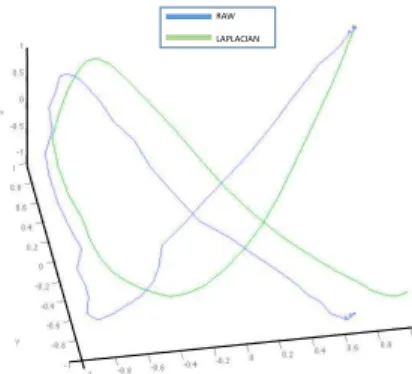
Once normalized the gesture, the next step smooths the raw gesture data to reduce noise by the depth sensor. The method used was the Laplacian [Tau95], which consist of recalculating all points using the mean of each point and its neighbors, according to (4). In our approach we used the 1-ring neighbourhood to smooth one time the gesture. Figure 2 shows the smoothing.
¯ xi= n−1
∑
i=1 ( xi xi−1+xi+xi+1 ) (4)3.4
Simplification
After the normalization and smoothing of the gesture, the next step consists on its simplification. We use this step to provide a compact representation of the gesture, further improving the performance of the gesture recog-nition.
RAW LAPLACIAN
Figure 2: A raw gesture before and after smoothing us-ing the Laplacian operator.
We use two algorithms to perform this task. The first approach simplifies the gesture using a curvature-based method and the second uses the Douglas-Peucker (DP) algorithm [DP73]. As we will show in the section 4, both of them keep the high recognition rate, while im-proving the algorithm’s performance.
3.4.1
Curvature
The first simplification method of the gesture consists in checking whether the curvature of each segment is
below a pre-defined thresholdt=0.01. In section 4.2
we explain how we choose this value.
S1 S6 S7 S8 S2 S3 S4 S5
Figure 3: The endpoints in blue cannot be removed. The green points are points evaluated that cannot be removed. The red points can be removed because its
curvature are below the thresholdt.
As shown in Figure 3, the curvature-based method evaluates the curvature iteratively using segments
defined by a point and its neighborhoods, e.g.
Si= (pi−1,pi,pi+1). Then, for each segmentSi, if the
curvature ofSiis below the thresholdt, then the middle
pointpiis removed. The pointpi−1of the next segment
is the pointpi+1of the previous segment.
3.4.2
Douglas-Peucker
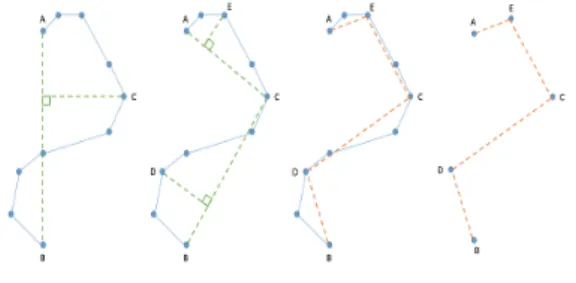
The Douglas-Peucker (DP) algorithm introduced by [DP73] is a polyline simplification. As shown in the
figure 4, the DP algorithm first use the endpoints[A,B]
to find and calculate the distance to the furthest point
C. Then it uses the points [A,C] and [B,C] to
calcu-late again the furthest points of[A,C]and[B,C], that is
DandE. Finally it add the points[C,D,E]if distance
exceeded the tolerancet. This condition of similarity
is based on the maximum distance measured between the original and the simplified curve. The original end-points always are inserted in the simplified curve.
Figure 4: Steps of the DP algorithm to simplify a curve with 10 points.
We choosed this algorithm because it can reduce the number of points of the gesture while retaining its shape. Furthermore, the DP algorithm is faster then oth-ers algorithms like Bend Simplify [VH99].
3.5
Recognition
The last step use Dynamic Time Warping (DTW) [RK05] as classification method to recognize gestures. We use the nearest neighborhood algorithm with DTW to find the closest gesture according with the cost distance provided by it.
3.5.1
Dynamic Time Warping - DTW
The DTW algorithm finds the cost of similarity through the alignment of two time series, which in our case are the gestures. The basic idea is to construct an array of distances between the two trajectories and find the minimum distance between each pair of points. The
result of the comparison is the sum s of the smallest
distances found. The lower the value ofs, the higher
the degree of similarity between the two trajectories. One of the main advantages of using the DTW is that it allows to compare two trajectories, even if they have different lengths [RK05]. This property of the DTW is important, since the gestures can be done with different speeds, so that the sampling rate is not always the same.
4
EXPERIMENTAL RESULTS
This section describes in detail the experimental setup and results. First we did a cross-validation to evaluate
different parameters and obtain the optimal values to use in the Curvature, DP and DTW algorithms. Then we use the parameters found to evaluate the recognition rate and performance for each class of gesture applying these algorithms. Also, we evaluate the recognition and performance using as template the median gesture from each class.
The experimental evaluation was performed in a Mac-book Pro (13-inch, Late 2011), Processor 2.4GHz In-tel Core i5, Memory 4GB 1333 MHz DDR3, InIn-tel HD Graphics 3000 384 MB, macOS Sierra version 10.12.3.
4.1
Dataset
G4 G1 G7 G2 G3 G6 G5Figure 5: Set of 7 gestures of our dataset.
We tried use the MSRC-12 [Fot+12] dataset, but it has gestures written continuously in a single file and we did not have the executions separator to do it. ChaLearn [Guy+14] has only RGB and depth videos. Therefore, we create our own dataset.
Our dataset contains 1099 gestures, collected from 7 individuals performing 7 gestures, with different phys-ical aspects and positions. In our dataset, we have 5 gestures performed using two hands and 2 gestures per-formed by one hand. The gestures were recorded using the Kinect XBox 360 sensor at a sample rate of 30Hz. We recorded both RGB, depth and 3D motion of hands, but we only used the motion of hands. Each motion contains a set of 3D positions of both hands. Figure 5 shows our 7 gestures, 6 of them are the same defined in dataset [Fot+12].
After create the dataset, we splits our dataset with 1099 gestures to perform the evaluation using 70% for test and 30% as template matching for each class of gesture. The next step was to generate 7 median gestures from our dataset to use as template and evaluate the recogni-tion rate using all 1099 as tests.
To generate median gestures, we first apply for each gesture class a method to normalize the distance be-tween points according with the desired Euclidean
dis-tancek=0.1. The method calculate the Euclidean
dis-tancediof each segmentsiand remove the pointpi+1if
di<k, otherwise we apply a linear interpolation in the
segmentsiuntildi<k. Then, we equalize the number
of points removing or adding points according with the average point of each gesture class. Finally, we
calcu-late a simple mean for each gesture classgi with (5),
where we divide the sum of xi,yi andzi by the total
number of gesturesnof each class.
gi=∑ n i=1(xi,yi,zi) n (5)
4.2
Cross-validation
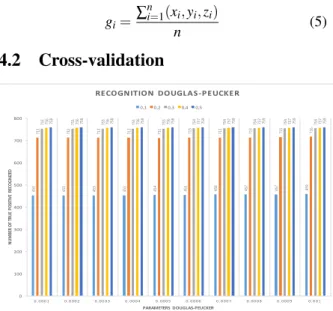
453 453 453 453 454 455 456 457 457 459 712 712 712 712 711 713 712 713 715 716 753756758 753756758 753756758 753756758 753756758 754757759 754757759 754757759 754757759 754757759 0 100 200 300 400 500 600 700 800 0 . 0 0 0 1 0 . 0 0 0 2 0 . 0 0 0 3 0 . 0 0 0 4 0 . 0 0 0 5 0 . 0 0 0 6 0 . 0 0 0 7 0 . 0 0 0 8 0 . 0 0 0 9 0 . 0 0 1 NU M BE R OF TR UE P OS ITI VE R EC OG NI ZE D PARAMETERS DOUGLAS-PEUCKER RECOGNITION DOUGLAS-PEUCKER 0,1 0,2 0,3 0,4 0,5Figure 6: Cross-validation applied for DP with DTW using the parameters in Table 1.
366 173 65 29 26 32 44 49 43 47 713 697 671 654 632 604 573 556 556 553 753 751 748 745 745 743 737 727 722 715 756761 755761 752758 756761 760762 759760 756758 761763 760762 760761 0 100 200 300 400 500 600 700 800 900 0 . 0 1 0 . 0 2 0 . 0 3 0 . 0 4 0 . 0 5 0 . 0 6 0 . 0 7 0 . 0 8 0 . 0 9 0 . 1 NU M BE R OF TR UE P OS ITI VE R EC OG NI ZE D PARAMETERS CURVATURE RECOGNITION CURVATURE 0,1 0,2 0,3 0,4 0,5
Figure 7: Cross-validation applied for Curvature with DTW using the parameter shown in Table 1.
Algorithm Parameter domain Final
Curvature 0.01<=t<=0.1 0.01
DP 0.0001<=t<=0.001 0.001
DTW 0.1<=d<=0.5 0.5
Table 1: Table with the cross-validation parameter do-mains for each algorithm and the chosen ones.
To perform cross-validation, we use all the gestures in our dataset, totaling 1099 gestures of different classes.
We selected 30% of each class for tests, being the same applied for the different combinations of parameters. After the data preparation phase, we selected a param-eter domain for each method described in Table 1. The domains of the parameters were defined according to
the normalization of the gesture in the interval of−1 to
1 and in some values tested manually to find the mini-mum and maximini-mum thresholds of each algorithm. The best threshold criteria was the recognition rate resulting from each combination. The column Final in the Table 1 shows the selected final parameters for each method. Figures 6 and 7 show the cross-validation result applied in the DP and Curvature algorithms for each DTW pa-rameter shown in Table 1.
4.3
Recognition rate
We have created an algorithm to automate the execution of the tests. Initially the algorithm loads and divides the data into test and template according with section 4.1. Then, the pre-processing is applied for each test itera-tion before the classificaitera-tion using the DTW algorithm. We save in a file all the parameters used, including the time needed to process and classify the gesture. As we can see in the Table 2, the results show a
recog-nition rate above 90% with 83.75% on average, even
applying a simplification step. The Laplacian with DP
provides an improvement of 1.73% compared to the
recognition with raw data simplification. Compared to the DTW results of [Iba+14], our approach with sim-plification showed an improvement of 2% in the recog-nition rate. We noticed that some classifications of the
G1 gesture always made matching with theG6 gesture,
however the opposite did not occur. The same occur to
the one hand gesturesG3 andG7, where the
recogni-tion rate forG3 was 100% while theG7 had an average
of 94.5%.
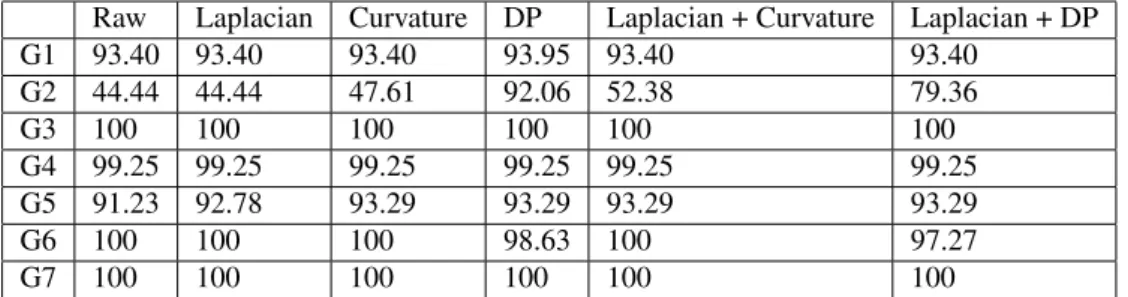
Table 3 show the results using median gestures as tem-plate. We get a reduction in the recognition rate for the
gestureG2, where we identified matching withG1 that
are similar with it. Using the DP algorithm we get an
improvement of 47,62% over the raw data. In general
the recognition rate was above 90%.
We also identified during the cross-validation process that the variation of the parameter for simplification us-ing curvature did not affect the recognition rate for an evaluation of ten-order threshold. On the other hand the parameter for the DP reduced the recognition rate for larger values, being not robust to variation.
4.4
Performance
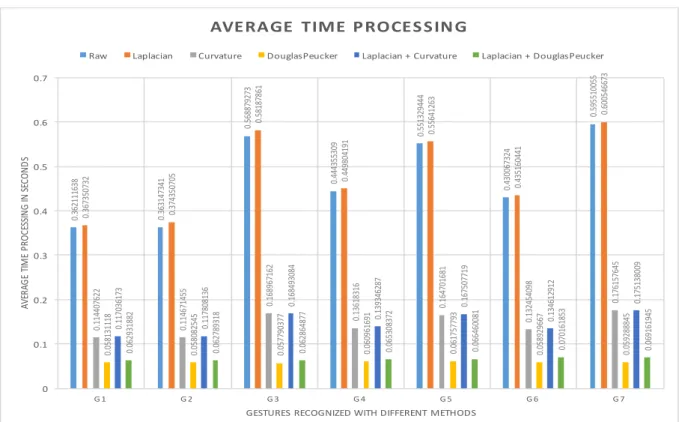
Figures 8 and 9 shows the performance results using simplification and regularization methods. In figure 8, compared to the classification with the raw data, the time needed to recognize the gesture was reduced more
0. 362111638 0.363147341 0. 568879273 0. 444355309 0. 551329444 0. 430067324 0. 595510055 0. 367350732 0.374350705 0. 58187861 0. 449804191 0. 55641263 0. 435160441 0. 600546673 0. 114407622 0.114671455 0. 168967162 0. 13618316 0. 164701681 0. 132454098 0. 176157645 0. 058131118 0.058082545 0.057790377 0.060961691 0.061757793 0. 058929667 0.059288845 0. 117036173 0.117808136 0. 168493084 0. 139346287 0. 167507719 0. 134612912 0. 175138009 0. 062931882 0.062789318 0.062864877 0.065308372 0.066460081 0.070161853 0. 069161945 0 0.1 0.2 0.3 0.4 0.5 0.6 0.7 G 1 G 2 G 3 G 4 G 5 G 6 G 7 AV ER AG E TIM E PR OC ES SIN G IN SE CO ND S
GESTURES RECOGNIZED WITH DIFFERENT METHODS
AVERAGE TIME PROCESSING
Raw Laplacian Curvature DouglasPeucker Laplacian + Curvature Laplacian + DouglasPeucker
Figure 8: Average time processing for recognize each class of gesture. The process includes both pre-processing and classification time.
Raw Laplacian Curvature DP Laplacian + Curvature Laplacian + DP
G1 90.55 90.55 90.55 90.55 90.55 90.55 G2 100 100 100 100 100 100 G3 100 100 100 100 100 100 G4 98.93 98.93 98.93 98.93 98.93 98.93 G5 100 100 100 100 100 100 G6 100 100 100 100 100 100 G7 94.55 91.81 94.54 95.54 93.63 97.27
Table 2: Recognition rate using different combinations of algorithms for simplification and smoothing for each gesture class.
than a half using a simplification step. Also, figure 9 shows that the average time processing to recognize with median gestures as templates was lower then 2 milliseconds. The Curvature was better then DP for me-dian gestures.
The gestures G3,G5 and G7 had a longer processing
time because they are more complex, as can be seen in figure 5. The difference between the raw and Lapla-cian gestures was very subtle, with a slight increase in the time of recognition with the Laplacian, since it only smooths without simplifying the gesture.
4.5
Discussions
As shown in this section, the recognition rate does not changed significantly when we apply a step to simplify the gestures. However, the performance was reduced more then a half when we apply the simplification. Fur-thermore, the median gestures reduced the average time
processing to 2 milliseconds. With median gestures we allow recognize without compare all samples of the dataset.
The DP algorithm shown better results in performance, but lost for curvature in the recognition rate. We note that the curvature-based method is more robust in sim-plification in the sense of maintaining the key points that describe the shape of the gesture. This explains why the curvature algorithm obtained better recognition rate results than DP and because DP processing time was better. The DP tends to remove more points in the simplification.
As we conclude, the filter is interesting because can im-prove the performance without affect the recognition using specifically the DTW.
3.942456044 3.942587302 3.025863636 4.915666667 6.159989691 4.69537415 3.241727848 4.015961538 4.034492063 3.226745455 5.05277037 6.262840206 4.817755102 3.414398734 1.168313187 1.175206349 1.060836364 1.419733333 1.716891753 1.399306122 1.115303797 1.760725275 2.031920635 1.829381818 2.145259259 2.511587629 1.941755102 1.950018987 1.256785714 1.251222222 1.156913636 1.498103704 1.863969072 1.498965986 1.231917722 1.728230769 1.776222222 1.698359091 2.113911111 2.430494845 1.916428571 1.850246835 0 1 2 3 4 5 6 7 G 1 G 2 G 3 G 4 G 5 G 6 G 7 AV ER AG E TIM E PR OC ES SIN G IN M ILI SE CO ND S
GESTURES RECOGNIZED WITH DIFFERENT METHODS
AVERAGE TIME PROCESSING FOR MEDIAN GESTURES
Raw Laplacian Curvature DouglasPeucker Laplacian + Curvature Laplacian + DouglasPeucker
Figure 9: Average time processing for recognize each class using as template the median gesture. The process includes both pre-processing and classification time.
Raw Laplacian Curvature DP Laplacian + Curvature Laplacian + DP
G1 93.40 93.40 93.40 93.95 93.40 93.40 G2 44.44 44.44 47.61 92.06 52.38 79.36 G3 100 100 100 100 100 100 G4 99.25 99.25 99.25 99.25 99.25 99.25 G5 91.23 92.78 93.29 93.29 93.29 93.29 G6 100 100 100 98.63 100 97.27 G7 100 100 100 100 100 100
Table 3: Recognition rate using as template median gestures and different combinations of algorithms for simpli-fication and smoothing.
5
CONCLUSION
In this paper, we propose an approach to gesture recog-nition based on geometric data and simplification of its representation. We analyzed two simplification meth-ods based on curvature and DP algorithm. In the first,
we obtained a recognition rate of 97.7% on average,
while for the DP algorithm, we have obtained 98.1%.
Using median gestures, we obtained a recognition rate
above 90% with exception of the gestureG2. Both
sim-plification methods evaluated reduced the recognition time in more than 2 times, being the DP more efficient for the first case, while for median gestures the Curva-ture was better then DP.
Simplification plays an important role in gesture recog-nition systems that have large robust datasets. The clas-sification in such systems can not be robust in real-time without a pre-processing step because we noted in our results that performance depends of the number of
ges-tures and points. This makes sense, because we must compare all gestures template to ensure the best match. One of the more important advantages of the simplifi-cation is the recognition time reduction.
As future work, we want to create more sophisticated gesture descriptor and use it with a tree decision to avoid full comparison of gestures in the dataset. We also will evaluate the simplification in supervised ap-proaches with HMM to check if the recognition keeps robust after the simplification. As future work, we will also use standard datasets to evaluate our approach. Fi-nally, we will try to recognize gestures continuously, without human intervention and without the need for time intervals between the beginning and end between the gestures.
6
REFERENCES
[DP73] David H Douglas and Thomas K Peucker.
“Algorithms for the reduction of the number of points required to represent a digitized line or its
carica-ture”. In: Cartographica: The International
Jour-nal for Geographic Information and
Geovisualiza-tion10.2 (1973), pp. 112–122.
[Rab89] Lawrence R Rabiner. “A tutorial on hidden
Markov models and selected applications in speech
recognition”. In: Proceedings of the IEEE 77.2
(1989), pp. 257–286.
[Tau95] Gabriel Taubin. “A signal processing
ap-proach to fair surface design”. In:Proceedings of the
22nd annual conference on Computer graphics and interactive techniques. 1995, pp. 351–358.
[VH99] Mahes Visvalingam and Simon Herbert. “A
computer science perspective on the
bendsimplifica-tion algorithm”. In:Cartography and Geographic
In-formation Science26.4 (1999), pp. 253–270.
[Mat01] Mark W Matsen. “The standard Gaussian
model for block copolymer melts”. In: Journal of
Physics: Condensed Matter14.2 (2001), R21.
[Mul+01] K-R Muller et al. “An introduction to
kernel-based learning algorithms”. In: IEEE
trans-actions on neural networks 12.2 (2001), pp. 181– 201.
[RK05] Chotirat Ann Ratanamahatana and Eamonn
Keogh. “Three myths about dynamic time warping
data mining”. In: Proceedings of the 2005 SIAM
International Conference on Data Mining. SIAM. 2005, pp. 506–510.
[MA07] Sushmita Mitra and Tinku Acharya.
“Ges-ture recognition: A survey”. In: IEEE Transactions
on Systems, Man, and Cybernetics, Part C (Applica-tions and Reviews)37.3 (2007), pp. 311–324.
[SC07] Stan Salvador and Philip Chan. “Toward
accurate dynamic time warping in linear time and
space”. In: Intelligent Data Analysis 11.5 (2007),
pp. 561–580.
[CLV12] Leandro Cruz, Djalma Lucio, and Luiz
Velho. “Kinect and rgbd images: Challenges and
applications”. In: Graphics, Patterns and Images
Tutorials (SIBGRAPI-T), 2012 25th SIBGRAPI Conference on. IEEE. 2012, pp. 36–49.
[Fot+12] Simon Fothergill et al. “Instructing people
for training gestural interactive systems”. In:
Pro-ceedings of the SIGCHI Conference on Human Fac-tors in Computing Systems. ACM. 2012, pp. 1737– 1746.
[HK12] Haitham Sabah Hasan and S. Abdul Kareem.
“Human Computer Interaction for Vision Based
Hand Gesture Recognition: A Survey”. In: 2012
International Conference on Advanced Computer Science Applications and Technologies (ACSAT) (Nov. 2012), pp. 55–60.
[Bau+13] Miguel Angel Bautista et al.
“Probability-based dynamic time warping for gesture recognition
on RGB-D data”. In:Advances in Depth Image
Anal-ysis and Applications. Springer, 2013, pp. 126–135.
[Che+13] Lingchen Chen et al. “A survey on hand
gesture recognition”. In:Computer Sciences and
Ap-plications (CSA), 2013 International Conference on. IEEE. 2013, pp. 313–316.
[Han+13] Jungong Han et al. “Enhanced computer
vision with microsoft kinect sensor: A review”. In: IEEE transactions on cybernetics 43.5 (2013), pp. 1318–1334.
[Pal+13] Jose Manuel Palacios et al.
“Human-computer interaction based on hand gestures using
RGB-D sensors.” In: Sensors (Basel, Switzerland)
13.9 (Jan. 2013), pp. 11842–60.
[Sen13] Prime Sense. “NITE Algorithms”. In:
Prime-Sense NITE Algorithms 1.5. Feb. 2013, pp. 1–3.
[Guy+14] Isabelle Guyon et al. “The ChaLearn
ges-ture dataset (CGD 2011)”. In: Machine Vision and
Applications25.8 (2014), pp. 1929–1951.
[Iba+14] Rodrigo Ibanez et al. “Easy gesture
recog-nition for Kinect”. In:Advances in Engineering
Soft-ware76 (2014), pp. 171–180.
[Wu+14] Xingyu Wu et al. “View-invariant gesture
recognition using nonparametric shape descriptor”. In:Pattern Recognition (ICPR), 2014 22nd Interna-tional Conference on. IEEE. 2014, pp. 544–549.
[Bar+15] Lorenzo Baraldi et al. “Gesture
Recogni-tion using Wearable Vision Sensors to Enhance
Visi-tor’s Museum Experiences”. In:IEEE Sensors
Jour-nal15.5 (2015), pp. 2705–2714.
[RA15] Siddharth S. Rautaray and Anupam Agrawal.
“Vision based hand gesture recognition for human
computer interaction: a survey”. In:Artificial