V´ıctor Revuelta
Design and implementation of a software system
for the composition of a database and automated
trading system on different cryptocurrency
trading markets
Master’s Thesis
Chair of Entrepreneurial Risks
Department of Management, Technology and Economics Swiss Federal Institute of Technology (ETH) Zurich
Examiner:
Prof. Dr. Didier Sornette
Supervisor:
Dr. Dorsa Sanadgol Z¨urich, March 18, 2018
Abstract
Cryptocurrency is a means of digital exchange that, by its design and operation, complies with the functions of traditional money allowing the exchange of goods and services by using cryptography to verify and store transactions in a public ledger.
The purpose of this project is to design and implement a cryptocurrency trading platform able to connect to multiple exchange APIs in order to gather market data information as well as place orders automatically on different market pairs. The platform is designed to allow the integration of new cryptocurrency exchange APIs. Furthermore, the software also allows the configuration of different trading strategies based on real time market data information. The present project will constitute the basis of future trading research analysis on the cryptocurrency market.
In addition, an analysis, description and comparison of the most important cryp-tocurrencies and exchanges is presented. More specifically, the working principles and the key technological differences between most relevant cryptocurrenies based on market capitalization are discussed. A general overview of characteristics, digital coins offered, current performance and fee analysis of different cryptocurrency exchanges is conducted. Finally, an evaluation of trading strategies based on real data gathered by the de-signed platform is performed.
Contents
1 Introduction 1
1.1 Motivation . . . 1
1.2 Research objectives . . . 2
1.3 Thesis outline . . . 2
1.4 State of the art . . . 3
2 Cryptocurrencies and Exchanges 7 2.1 Introduction to cryptocurrencies . . . 7
2.2 Basic Concepts . . . 8
2.2.1 Blockchain . . . 8
2.2.2 Cryptographic hash function and mining difficulty . . . 9
2.2.3 Proof of Work vs Proof of Stake . . . 11
2.2.4 Address, public and private digital keys . . . 13
2.3 Cryptocurrency analysis and comparison . . . 14
2.3.1 Bitcoin . . . 14
2.3.2 Ether . . . 16
2.3.3 Litecoin . . . 17
2.3.4 Ripple . . . 18
2.3.5 Cryptocurrency comparison . . . 19
2.4 Cryptocurrency exchanges analysis and comparison . . . 22
2.4.2 Exchange analysis . . . 25 2.4.3 Exchange comparison . . . 29
3 Trading platform 33
3.1 Base project . . . 33 3.2 Structure of the program . . . 34 3.3 User guide . . . 37 4 Trading opportunities 44 5 Conclusion 51 Appendices 53 A 54 A.1 Appendix . . . 54
Introduction
1.1
Motivation
Over the last years, cryptocurrencies such as Bitcoin, have become more and more pop-ular due to their disruptive innovation and, most importantly, because of their meteoric rising value. Nowadays, the exchange of virtual currencies is present in a very active way and it is one of the most revolutionary transaction systems of all times. Unlike traditional currencies, such as conventional fiat money, cryptocurrencies are electronic assets that are independent of banks and states.
The number of cryptocurrencies and exchanges that offer them has been growing enormously in the last years. As of march 2018, there are more than 4500 cryptocurren-cies available over the internet and more than 120 active exchanges1.
Because the cryptocurrency market is very new, many investment opportunities have emerged by means of applying different trading strategies. Although the market is grow-ing very fast, the options to trade automatically are limited. High-speed algorithmic trading in cryptocurrency markets can only be performed via an exchange Application Programming Interface. For this reason, good understanding in programming is a crit-ical requirement. Nowadays, very few open source projects are up-to-date and fully developed.
The main focus of this project is to create a software system that can send automated orders to an exchange, based on a defined strategy using the historic data of one or more cryptocurrencies.
1
1.2
Research objectives
The purpose of this thesis is to design and develop a program able to connect to one or more exchanges accessing their API in order to allow an easy placement of orders. In addition, the program should be able to collect and save the most relevant market data in a database. This database should be designed to handle the large size of data that will accumulate.
Other specific objectives of this project are: • Real-time data acquisition.
• Parallel connectivity with two or more exchanges to allow interexchange strategies. • Real-time trade execution.
Among that, an analysis and comparison between cryptocurrencies and exchanges will be conducted.
1.3
Thesis outline
The project software result is divided in two different parts:
• Design and implementation of a system able to collect on real time the most important financial data from different cryptocurrency exchanges in order to locally store the information. This will be implemented through a Time Series Database specifically designed to handle large size of data. This data will be used for research, fundamental analysis and strategy backtesting.
• Design and implementation of an automated transaction system able to send or-ders to a cryptocurrency exchange based on a trading strategy using the above mentioned database.
Both systems will be connected to a cryptocurrency exchange API (Application Pro-gramming Interface) in order to achieve a high level of automation, allowing the user to interact minimally with the platform.
The software system will be implemented incrementally. Therefore, the preliminary system should collect data from one exchange and send orders to the same exchange.
Software system
Data from exchange Orders to exchange
Exchange Trading strategy
Figure 1.1: Design of the software system
Once the system is correctly designed with a robust performance, it will be imple-mented with an additional cryptocurrency exchange API both for data gathering and for order sending. This implies more development time and code complexity but will mitigate the risk by not relying on a single exchange for trades and will give more data and the possibility to backtest interexchange strategies.
The program will be designed to enable new exchange APIs implementations. An analysis between exchange characteristics will be made in order to decide the most suitable exchange for every case. Some of the specifications that are going to be taken into consideration are: liquidity, transaction costs, reliability, connectivity and number of digital coins offered.
The platform can be implemented with different degree of automation. It could either be an assisted trading system, which means that the trader manually approves the order before its send to the exchange, or it could be fully automated, which means that the system will send unsupervised orders to the exchange.
Finally, to complete the system, it will be implemented with the possibility to trade with different trading strategies or using different indicators. In the last part of this report, an analysis of possible trading strategies using real time data from 2 different exchanges will be made.
1.4
State of the art
A brief description of the current up-to-date cryptocurrency trading bots projects are as follows.
Haasbot
Haasbot2 is an advanced crypto trading bot designed primarily for crypto trading pro-fessionals, but it is also suitable for beginning traders and hobbyist.
Haasbot offers three types of standard bots: Trade, Arbitrage and Maximum Order. Trade bots are supported by a range of technical analysis indicators, safeties and insur-ances. The 2.0 update also brings customizable Script bots. Depending on the license, users can set up several interconnected bots capable of performing a range of different functions. The new version of Haasbot currently supports Bitfinex, Bitstamp, Binance, Bittrex, Kraken, Poloniex, OkCoin and a few smaller exchanges. The connectivity be-tween Haasbot and the exchanges is done via Representional State Transfer (REST) API. Figure 1.2 illustrates the graphical user interface of Haasbot.
The software is available in three different pricing tiers. The full license is priced at 0,44 BTC per year, around 4.400eat actual BTC price.
Figure 1.2: Haasbot Interface
Gunbot
GunBot3 is an automated cryptocurrency trading platform that operates on the fol-lowing exchanges: Poloniex, Bittrex, Binance, Bittfinex and Kraken. This automatic crypto trading bot includes some strategies, such as: Bollinger Bands, Gain, Step Gain, PingPong, 1000Trades and Supergun. The platform also has the option of mixing these strategies simultaneously in different exchanges. It can run on Linux, Windows or Ma-cOS. The connectivity between Gunbot and the exchanges is done via REST API. Figure 1.3 illustrates the graphical user interface of Gunbot.
The software has three different pricing plans depending on the possibility to run the program in more than one exchange. Prices range from 0,1 to 0,8 BTC, between 1.000e and 8.000eat actual BTC price, depending on the license.
Figure 1.3: Gunbot Interface
Gekko
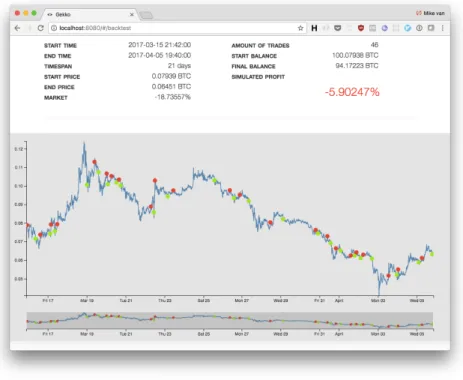
Gekko4 is a Bitcoin Technical Analysis trading and backtesting platform that connects to popular Bitcoin exchanges. The project is free and fully open source and it comes with some pre-installed strategies such as: DEMA, MACD, PPO, RSI, StochRSI and CCI. Although it comes with this strategies, the author recommends programming own trading strategies and because of that, good programming skills are required. There is also a Technical analysis library installed, that allows to calculate and use indicators in strategies.
Gekko supports 23 different exchanges (including Bitfinex, Bitstamp and Poloniex). The software offers the possibility to run against the live market (using either a paper trader or real trader) or to backtest a strategy over historical market data. Gekko implements a webinterface that shows the local market data stored. In addition, the program can run in backtesting mode and is able to create automatic graphs in order to visualize the results. The software connection with the exchanges is done via REST API. Figure 1.4 illustrates the graphical user interface of Gekko.
Figure 1.4: Gekko Interface
Tribeca
Tribeca5is an automated cryptocurrency market making trading bot. Tribeca supports 4 different exchanges: Coinbase, HitBTC, OKCoin and Bitfinex. The program is featured with a web client user interface and it has been designed to work as a high frequency trading bot. Tribeca is mostly written in Typescript and HTML for the user interface.
The software has different market making trading modes implemented that calculate the best position to place bid and ask orders depending on the order book. The exchange connectivity is mostly done through WebSocket API, but REST API is also used to persist market data information through a MongoDB database.
Although the software is very complete, there is a big lack of documentation and design information. In addition, the project has not been properly updated in the last year while cryptocurrency exchanges have upgraded their APIs causing important divergences between APIs and Tribeca connectivity.
5
Tribeca. A high frequency, market making cryptocurrency trading platform in node.js. https: //github.com/michaelgrosner/tribeca.
Cryptocurrencies and Exchanges
2.1
Introduction to cryptocurrencies
Cryptocurrency is a digital or virtual asset used as a way of exchange that implements cryptography to secure transactions and control the production of additional units. By using cryptography, cryptocurrency transactions are verified and stored in a public ledger known as the blockchain[1].
Cryptocurrency is a means of digital exchange that, by its design and operation, complies with the functions of traditional money allowing the exchange of goods and services. It is stored in electronic wallets, which allows carrying out the buying and selling operations needed by the user.
A cryptocurrency differs distinctly from other currencies in that it is has no central regulating body i.e. the European Central Bank for the Euro. The exchange rate of a cryptocurrency is given by the perception of value that the users have of the cryp-tocurrency, since there is no entity that determine its price. As such its value is much less stable than a standard currency and fluctuates in a manner more similar to other commodities such as precious metals or oil[2].
The first cryptocurrency that started operating was bitcoin in 2009 and since then, many others have appeared, with different characteristics and protocols such as Ether, Litecoin, Ripple or Dogecoin.
These currencies don’t have an intrinsic value and they are not backed by an amount of something or by some service, so they are similar to the current fiduciary money. Its value depends on the law of supply and demand, which gives the advantage of not being affected by monetary policies of central banks. Like a foreign currency, bitcoins can be bought or sold in exchange houses or companies that accept it as a form of payment.
2.2
Basic Concepts
2.2.1 Blockchain
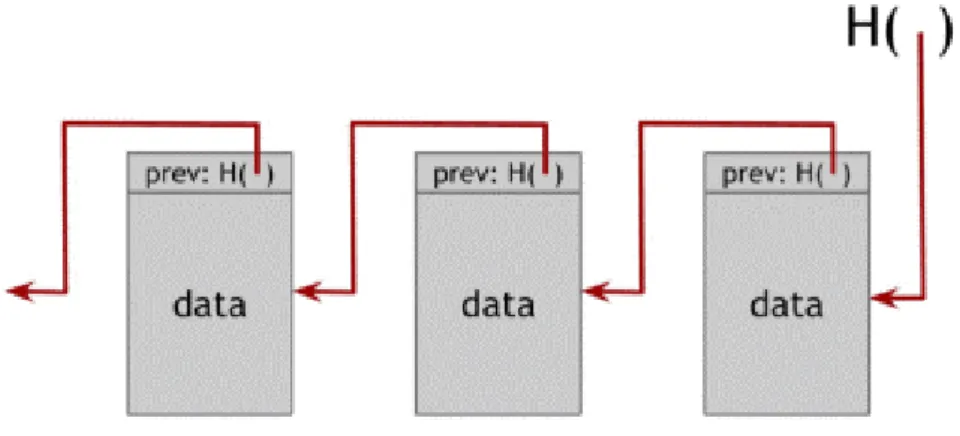
A blockchain, also known as distributed ledger, is a distributed database that registers blocks of information and interlaces them to facilitate the recovery of information and the verification that it has not been changed. The blocks of information are linked by means of hash pointers that connect the current block with the previous block and so on until the block genesis is reached [3].
The blockchain is stored by all those nodes in the network that stay in synchrony with it. The generation of new blocks is called mining, as an analogy with gold mining.
Figure 2.1: Structure of a blockchain. Reprinted from Bitcoin and Cryptocurrency Technolo-gies: A Comprehensive Introduction, by Narayanan, A. (2016). Princeton.
Each block belonging to the blockchain contains information regarding the transac-tions related to a period of time, the cryptographic address (hash pointer) of the previous block and a unique arbitrary number (nonce).
In the case of Bitcoin, a new block appears, on average, every 10 minutes1, and in-cludes information of new transactions that are stored chronologically in the blockchain. One transaction is normally considered valid when it gets up to 6 confirmations (1 hour), although this time is variable and may depend on the seller and the monetary amount[4]. The Bitcoin network is programmed to create six blocks per hour1. Each 2016 blocks (around 14 days), all Bitcoin customers compare the real number created with this objective and modify the target by the percentage that has varied. This increases (or decreases) the difficulty of generating blocks.
2.2.2 Cryptographic hash function and mining difficulty
Cryptographic hash functions are hash functions that are used in many cryptographic algorithms and protocols. It is a mathematical algorithm that maps data of an arbitrary size to a bit string of a fixed size (a hash) and is designed to be a one-way function, that is, a function that is infeasible to invert. There are many applications in the area of information security, some of the most common algorithms in this category include algorithms such as the SHA-256, a successor of SHA-1. There are also other algorithms such as RIPEMD, BLAKE or Skein[5].
Historically, the applications of this type of hash functions were in the context of digital signatures, which are used today in many different applications as a fundamental pillar of many e-commerce protocols. The cryptographic hash functions are also used to generate protocol authentication messages with the generation of random numbers and security passwords. They are characterized by reducing the original message to a sequence of bits that identifies it and is called the ”Fingerprint” of the message.
In the case of Bitcoin, the miners in the network compete to be the first to find the solution (the hash) to the cryptographic problem of their current candidate block through a system of Proof of Work.
A Proof of Work is a piece of data which is difficult (costly, time-consuming) to produce but easy for others to verify and fulfills certain requirements. Proof of Work is a random process with low probability which needs a lot of trial and error on average before a valid Proof of Work is generated. Bitcoin uses the Hashcash Proof of Work system[6].
Miners have to solve a problem, the hash, that requires several repetitive attempts, by brute force, that is non-deterministic, preventing miners with high level of processing from leaving out the smallest. The frequency of localization of each block follows a Pois-son distribution[6] and the probability that a miner finds it depends on his computational power in relation to the computational power of all the combined nodes. Validation of the solution provided by the miner is trivial and takes place immediately.
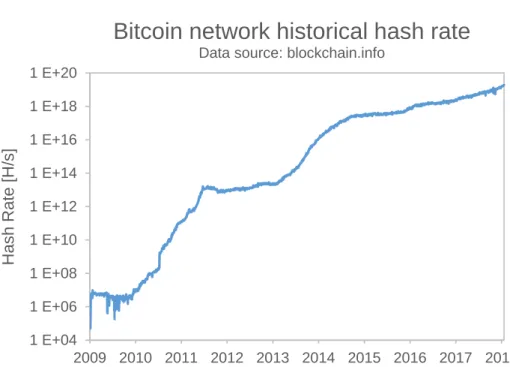
The hash rate is the speed at which a computer is completing a hash operation. It measures the number of times a hash function can be computed per second. A miner’s expected profit is directly proportional to the hash rate. A higher hash rate increases the opportunity of finding the next block and receiving the reward, in other words, new bitcoins distributed by the network.
1 E+04 1 E+06 1 E+08 1 E+10 1 E+12 1 E+14 1 E+16 1 E+18 1 E+20 2009 2010 2011 2012 2013 2014 2015 2016 2017 2018 H as h R at e [H /s ]
Bitcoin network historical hash rate
Data source: blockchain.infoFigure 2.2: Bitcoin network hash rate. Represents the evolution of Bitcoin network hash rate over the last years in a semi-logarithmic scale.
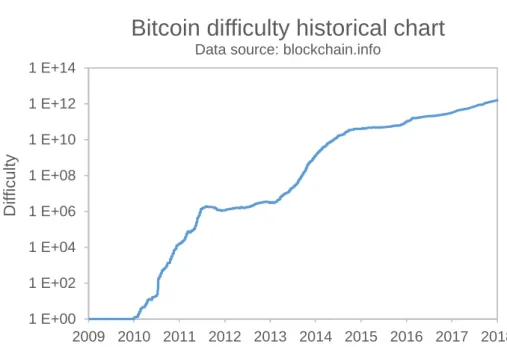
The mining difficulty is a measure of how difficult it is to find a hash below a given target. Bitcoin difficulty started at 1[7]. As mentioned before, the Bitcoin community defined that the creation of new blocks should have a rate of 6 blocks per hour. At this rate, the time needed to create 2016 blocks should be 14 days. We can calculate how much should the difficulty be increased or decreased as follows:
Dn+1 =Dn
14 days
T (2.1)
Where:
Dn+1: the network difficulty of the hash after the difficulty update
Dn: the network difficulty of the hash before the difficulty update
1 E+00 1 E+02 1 E+04 1 E+06 1 E+08 1 E+10 1 E+12 1 E+14 2009 2010 2011 2012 2013 2014 2015 2016 2017 2018 D if fi c u lt y
Bitcoin difficulty historical chart
Data source: blockchain.infoFigure 2.3: Mining difficulty. Represents the evolution of Bitcoin mining difficulty over the last years in a semi-logarithmic scale.
2.2.3 Proof of Work vs Proof of Stake
As mentioned before, Proof of Work (PoW) is a piece of data which is difficult (costly, time-consuming) to produce but easy for others to verify and fulfills certain requirements. A Proof of Work is a random process with low probability so that a lot of trial and error is required on average before a correct Proof of Work is generated[8].
Mining serves to verify the legitimacy of a transaction, or avoiding the so-called double-spending[6]. It also serves to create new digital currencies by rewarding miners for performing the previous task.
All the network miners compete to be the first to find a solution for the mathematical problem that concerns the candidate block, a problem that cannot be solved in other ways than through brute force so that essentially requires a huge number of attempts.
When a miner finally finds the right solution, he/she announces it to the whole network at the same time, receiving a cryptocurrency prize (the reward) provided by the protocol.
Figure 2.4: Proof of Work representation. Reprinted fromhttps://www.eventbrite.com
Proof of Stake (PoS) is an alternate way of verifying and validating the transaction or block. PoS is a distributed consensus protocol for distributed networks that secures a cryptocurrency network by requesting evidence of possession of said currencies[8]. With PoS the probability of finding a block of transactions, and receiving the corresponding prize, is directly proportional to the amount of coins that one has accumulated (thus avoiding the confidence given by the amount of work invested).
This system is based on the assumption that those who own more units of a PoS-based currency are especially interested in the survival and proper functioning of the network that gives value to these currencies and therefore they are the best suited to have the responsibility to protect the system from possible attacks. That is why the protocol rewards them with a lower difficulty in finding blocks (it is inversely proportional to the number of coins they demonstrate to own). In PoS, a validator (equivalent of ”miner” in PoW) is picked based on the amount of stake (coins) and the respective age of the stake. In other words, a validator that holds a significant amount of stake with good aging will get a higher chance to validate a block[8].
With PoS the probability of finding a block of transactions is directly proportional to the number of cryptocurrencies accumulated, which implies that the wallet is connected to the network. This way, the wallet is exposed to possible security problems. Trying to avoid this problem, a variant of the protocol called Delegated Proof of Stake (DPoS) has been developed. In DPoS, the cyrptocurrency owner nodes allow to delegate their privileges to build new blocks in a new type of nodes called witnesses[9]. An example of platform using this algorithm is EOS.
PoS offers the following advantages compared to PoW:
• In order to attack the system a lot of money is required. Although someone manages to collect the sizeable amount of money, he will suffer from the attack since the stability of the cryptocurrency will be disturbed.
• No need of expensive and specific hardware.
• It is possible to achieve a high level of security similar to PoW but with a lower energetic cost.
• Faster validations.
PoS has also some disadvantages compared to PoW:
• Since the wallet is online connected to proof the stake, it exposes to security issues. • It is more difficult to maintain anonymity since the funds in stake are protected
with an IP address.
• Too much power for the biggest coin owners.
Figure 2.5: Proof of Stake representation. Reprinted fromhttps://www.eventbrite.com
2.2.4 Address, public and private digital keys
Digital keys give access to the cryptocurrencies stored in a digital wallet. In the case of Bitcoin, digital keys come in pairs: private and public key. We can think of the public key as if it wpuld be the number of a bank account and the private key as if it would be the secret PIN.
A private key and a public key are mathematically related, and in fact, the public key is derived from the private key. While it is possible to create the public key from a private key, it is practically impossible to create the private key from a public key[10].
The possession of both keys automatically determines the control over the bitcoins that are stored in a Bitcoin wallet and therefore it is important that the private key always remains under the control of the owner of the account. In addition, it is important to note that digital keys in Bitcoin are created and stored by users (or can be generated
and managed by the user’s wallet software) and, therefore, are completely independent of the Bitcoin protocol[11].
An example of a private key of Bitcoin could be:
18E14A7B6A307F426A94F8114701E7C8E774E7F9A47E2C2035DB29A206321725 An example of a public key of Bitcoin could be:
0450863AD64A87AE8A2FE83C1AF1A8403CB53F53E486D8511DAD8A04887E5B2352 2CD470243453A299FA9E77237716103ABC11A1DF38855ED6F2EE187E9C582BA6
The most common way to send bitcoins is to an address, which is a hash (mathemat-ical process) of a Bitcoin public key. A Bitcoin address is a string of numbers and letters that are normally produced from public and private keys and that we could define as the fingerprint of those keys.
The reason of working with Bitcoin address (hash of Bitcoin key) and not public keys is because it gives more security to the user, since the public key will only be used when the money is transferred. These public and private key versions are called public and private addresses. The private address is the one that gives access to the bitcoins and therefore must be kept secret. The public address is used to share with other Bitcoin users to indicate the transaction recipient[10].
An example of a public address of Bitcoin could be: 16UwLL9Risc3QfPqBUvKofHmBQ7wMtjvM An example of a private address of Bitcoin could be:
1CC3X2gu58d6wXUWMffpuzN9JAfTUWu4Kj
2.3
Cryptocurrency analysis and comparison
In this section a short description and analysis of the most relevant cryptocurencies will be done. Furthermore, a comparison between these currencies will be made.
2.3.1 Bitcoin
Bitcoin is an electronic payment system that came into existence in 2009 with the re-lease of the first open source bitcoin client and the issuance of the first bitcoins. It is characterized by being built based on a cryptographic protocol. For this reason, it offers a high level of security since it has been observed resistant to fraud, falsification and other attacks. It offers anonymity to its users because transactions are not associated with personal data[12].
The system is distributed and decentralized (it does not depend on a central author-ity, such as governments or banks) so it allows transactions to be carried out without intermediaries, reducing the operation cost compared to other systems such as Paypal. This decentralization also means that the Bitcoin network is controlled and owned by all of its users and, as all users must adhere to the same set of rules, there is a great incentive to maintain the decentralized nature of the network[13].
Bitcoin uses blockchain technology, which keeps a record of every single transaction, and the transaction and authentication process is carried out by the network of users. Although the decentralized nature offers many advantages, critics often argue that apart from its users, there is nobody overlooking the whole system and that the value of Bitcoin is unfounded.
In return for contributing their computing power to the network to carry out some of the tasks mentioned above, also known as mining, users are rewarded with Bitcoins. The processing power of the miners is used to validate transaction blocks and adding them to the blockchain. As mentioned before, Bitcoins are mined using a proof-of-work function by individual miners and verified by the decentralized nodes in the peer to peer Bitcoin network[4]. $0 $2.000 $4.000 $6.000 $8.000 $10.000 $12.000 $14.000 $16.000 $18.000 $20.000 2010 2011 2012 2013 2014 2015 2016 2017 BT C /U SD
Bitcoin Price Chart US Dollar (BTC/USD)
Data source: www.coindesk.com2.3.2 Ether
Ethereum is an open source decentralized platform that allows the creation of intelligent contract agreements between peers based on the blockchain model without any possibility of downtime, censorship, fraud or third-party interference[14]. Any developer can create and publish distributed applications that make intelligent contracts. Ethereum also provides a cryptocurrency token called ’ether’[2].
The Ethereum network enables developers to create markets, store registries of debts or promises and move funds in accordance with instructions given long in the past (like a will or a futures contract) without a middleman or counterparty risk. The Ethereum protocol is built to allow flexibility to users and increase the functionality of the system as it progresses and provides the ability to program many different types of smart contracts within the Ethereum system[15].
Ethereum offers the possibility to create decentralized applications[2]. Unlike other centralized applications, Ethereum decentralized applications do not need servers or other centralized entities. The application lives in the blockchain, as well as all its content. Typical applications such as Facebook are centralized, that is, we deposit our trust (data, photos, videos and content in general) in a main entity or server.
In the same way as Bitcoin, Ether tokens are put into circulation through a mining process. Although Ether tokens are also mined using a proof-of-work function, it is planned to make a leap towards a proof-of-stake function or PoS. In PoS, the reward system changes drastically so that the electricity cost is not so bulky[15].
In a Proof of Stake model there will no longer be miners, but validators. Instead of difficult mathematical functions that the miners must solve, validators will be required to have Ether and to be able to validate a block. Validators take turns proposing and voting on the next block, and the weight of each validator’s vote depends on the size of its deposit (i.e. stake). Significant advantages of PoS include security, reduced risk of centralization and energy efficiency.
In chain-based Proof of Stake, the algorithm pseudo-randomly selects a validator during each time slot (eg. every period of 10 seconds might be a time slot), and assigns that validator the right to create a single block, and this block must point to some previous block (normally the block at the end of the previously longest chain), and so over time most blocks converge into a single constantly growing chain[15].
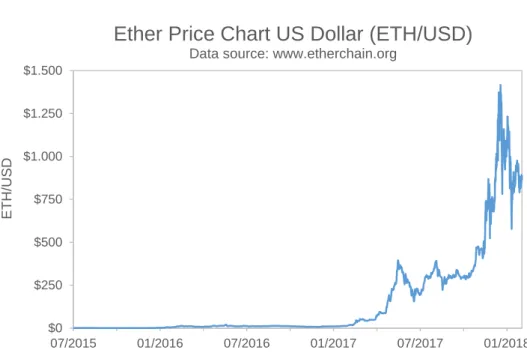
$0 $250 $500 $750 $1.000 $1.250 $1.500 07/2015 01/2016 07/2016 01/2017 07/2017 01/2018 E T H/ US D
Ether Price Chart US Dollar (ETH/USD)
Data source: www.etherchain.org
Figure 2.7: Ether to US dollar evolution rate
2.3.3 Litecoin
Litecoin is a decentralized P2P cryptocurrency created in October 2011. It was created as an open source project inspired by Bitcoin, so it is virtually identical in most of its technical aspects. However, there are at least three fundamental differences between Litecoin and Bitcoin: its speed, its number of coins and changes in the algorithm[16].
First of all, one of the biggest differences is the speed at which transactions are made. Litecoin network performs the processing of a block every 2.5 minutes instead of every 10 minutes[16], which means that it generates the blocks of its chain four times faster than Bitcoin. Because of this, transactions are carried out at a higher speed.
Another difference is the amount of coins planned to generate. One of the things that gives more value to Bitcoin than conventional currencies is that the network generates a fixed amount of coins every year, and the total number of Bitcoins is finite. Bitcoin will stop creating new units when it reaches 21 million coins, while Litecoin will stop at 84 million[16].
Finally, Litecoin is the first coin that changed the hashing algorithm and used scrypt[16]. This allows to use any PC to dedicate itself to mining, helping non-professional miners to participate in the network.
$0,0 $0,5 $1,0 $1,5 $2,0 $2,5 $3,0 $3,5 08/2013 08/2014 08/2015 08/2016 08/2017 X R P /U S D
Ripple Price Chart US Dollar (XRP/USD)
Data source: www.coinmarketcap.com
Figure 2.8: Litecoin to US dollar evolution rate
2.3.4 Ripple
Originally released in 2012 as a subsequent iteration of Ripplepay, Ripple is a real-time gross settlement system (RTGS), currency exchange and remittance network. Using a common ledger that is managed by a network of independently validating servers that constantly compare transaction records, Ripple does not rely on the energy and com-puting intensive proof-of-work used by Bitcoin[17]. Ripple is based on a common public database that uses a consensus process between validating servers to ensure integrity. Validating servers can be owned by anyone, from individuals to banks.
The Ripple protocol (token represented as XRP) is meant to enable the near in-stant and direct transfer of money between two parties. Any type of currency can be exchanged, from fiat currency to gold. Ripple technology claim to avoid the fees and wait times of traditional banking and even cryptocurrency transactions through exchanges[18].
Ripple transactions rely on a consensus protocol in order to validate account balances and transactions on the system. The consensus works to improve the integrity of the system by preventing double spending. Individual distributed nodes decide by consensus which transaction was made first by taking a poll to determine the majority vote. The confirmations are instant and take roughly 5 seconds[17]. Since there is no central authority that decides who can set up a node and confirm transactions, Ripple platform is described as decentralized.
Thus far, Ripple has been stable since its release with over 35 million transactions processed without issue. It is able to handle 1,500 transactions per second (tps)[18] and has been updated to be able to scale to Visa levels of 50,000 transactions per second. By comparison, Ethereum can handle 15 tps and Bitcoin 3 to 6 tps.
Ripple’s token, XRP, is not mined like Bitcoin, Ethereum, Litecoin and many other cryptocurrencies. Instead, Ripple issued a fixed number of tokens at its inception, 100 billion of XRP[18]. 61 billion of them are nowadays under control of the Ripple company and they are planned to be released at a rate of 1 billion XRP a month for at least four and a half years.
There are three components forming Ripple: Ripple Labs, the parent company, based in San Francisco, which has raised nearly $ 100 million in funds; RippleNet, the payment network, now used by important partners such as American Express; and XRP, the settlement token of the Ripple network.
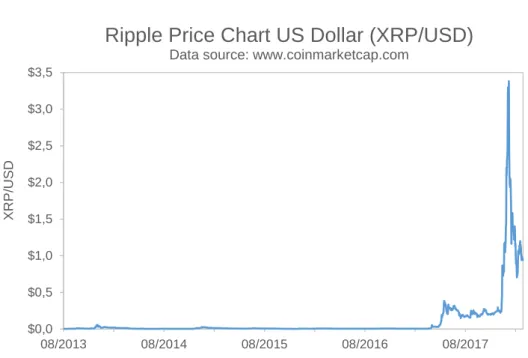
$0,0 $0,5 $1,0 $1,5 $2,0 $2,5 $3,0 $3,5 08/2013 08/2014 08/2015 08/2016 08/2017 XRP/ USD
Ripple Price Chart US Dollar (XRP/USD)
Data source: www.coinmarketcap.com
Figure 2.9: XRP to US dollar evolution rate
2.3.5 Cryptocurrency comparison
In this section, a more detailed comparison will be made between top 10 cryptocurrencies, based on market capitalization. Most suitable characteristics and properties have been chosen in order to analyze and compare the main differences between cryptocurrencies. Table 2.1 shows main properties from top 10 cryptocurrencies based on market cap-italization as of 27th February 2018. Figure 2.10 represents the market capitalization of
each coin in million US dollars and as a proportion of the total market capitalization including alternative cryptocurrencies.
Coin Sym b ol Mark et capitalization 1 Mark et Cap(%) 1 Price USD 1 Price BTC 1 Circulating supply 1 Max supply T ransaction Time 1 Mining Minining difficult y 1 Pro of typ e Hash algorithm Bitcoin BTC $180.660.002.170 39,49% $10.697 1 BTC 16.889.650 21.000.000 10 min u te s Pro cessor in tensiv e 3.007.383.866.429 P oW SHA-256 Etherum ETH $86.238.962.573 18,85% $ 881 0,083 BTC 97.877.341 Inflationary 12-14 seconds Memory in tensiv e 3.103.058.930.915.360 P oW KECCAK-256 Ripple XRP $37.255.743.602 8,14% $ 1,0 0,089 mBTC 38.291.387.790 100.000.000.000 4 seconds Not mineable Not mineable RPCA 2 SHA-512 Bitcoin Cash BCH $21.204.312.207 4,63% $ 1.248 0,12 BTC 16.482.113 21.000.000 10 min u te s Pro cessor in tensiv e 352.589.267.721 P oW SHA-256 Litecoin L TC $12.001.318.815 2,62% $ 216,6 0,02 BTC 52.051.682 84.000.000 2,5 min u tes Memory in tensiv e 5.034.453 P oW Scrypt Neo NEO $9.045.725.000 1,98% $ 139,2 0,013 BTC 50.000.000 100.000.000 15-20 seconds Not mineable Not mineable P oS -Cardano AD A $8.656.815.509 1,89% $ 0,3 0,031 mBTC 25.927.070.538 45.000.000.000 20 sec on ds Not mineable Not mineable P oS -Stellar XLM $6.656.263.930 1,45% $ 0,4 0,033 mBTC 18.468.076.589 100.000.000.000 20 sec on ds Not mineable Not mineable P oS -EOS EOS $6.002.921.137 1,31% $ 8,6 0,81 mBTC 695.886.137 900.000.000 30 sec on ds Not mineable Not mineable DP oS 3 -IOT A IOT $5.253.590.188 1,15% $ 1,9 0,17 mBTC 2.779.530.283 2.779.530.283 1-3 min utes Not mineable Not mineable None -1 As of 27 th F ebruary 2018. Source: h ttps://coinmark etcap.com 2 Ripple Proto col Consensus Algorithm 3 Delegated Pro of of Stak e T able 2.1: T op 10 crypto currencies comparison. Elab orated b y the author. 0% 5% 10% 15% 20% 25% 30% 35% 40% 45% $0M $20. 000M $40. 000M $60. 000M $80. 000M $100. 000M $120. 000M $140. 000M $160. 000M $180. 000M $200. 000M Per cen tage of total m arke t cap (% ) Mar ket Cap (M ilion dol lar s) Cr yp to cu rr en cy Ma rk et Ca pit aliz at io n Da ta so ur ce : h ttp s://c oi nmar ke tc ap .c om/ Figure 2.10: T op 10 cry p to currency mark et capi talization. Elab orated b y the author.
2.4
Cryptocurrency exchanges analysis and comparison
Cryptocurrency exchanges are businesses, normally in form of websites or platforms that allow customers to trade digital currencies for other assets, such as conventional fiat money (USD, EUR, etc.) or different digital currencies. The profit of these exchanges is made in the transactions. They can take the spread of bid/ask as a transaction commission for their services or charge fees as a matching platform. Cryptocurrency exchanges accept many payment methods, such as bank transfer, postal money orders, credit card payment or cryptocurrencies.
The first Bitcoin currency exchange called BitcoinMarket appeared in February 2010 and it was created by a user from the Bitcointalk forum2. In May 2010, the first financial transaction using Bitcoins took place. A different user from Bitcointalk forum offered to pay 10,000 Bitcoins for a couple of pizzas3 and made the deal.
Nowadays there are more than 120 active cryptocurrency exchanges. They differ in many areas such as reputation, fees, payment methods, verification requirements, coins and base currency offered and the exchange rate.
2.4.1 Exchange connectivity
Cryptocurrency exchanges provide APIs (Application Programming Interface) to allow users to connect their own software directly to the exchange server. They offer three types of connection between client and server:
• REST API. REST, or REpresentational State Transfer, is an architectural style
for designing network applications[19]. REST APIs are interfaces between systems that use HTTP to obtain data or indicate the execution of operations of the data, in any format (XML, JSON, etc). The vast majority of web applications are architected using HTTP through a REST API[19]. REST APIs are normally programmed in Ruby, Java, Go or NodeJS and they are fundamentally similar in that they receive Request of information and then make a Response to them. Because REST APIs are based on HTTP it has some limitations, in particular the way that connections are handled. Every time a request is made (e.g. BTC actual price), a port or socket is opened and data is transferred. Once the data transfer is completed, the port is closed. This means that every time that the user request some information to the server a gate is opened and closed, which creates overhead. Obviously, this is not suitable for applications that need real time interactions or display big streams of data. Another limitation of REST APIs is related to the HTTP ”pull” standard. The client has to request or pull information from the server, because the server can’t push the data to the client when is needed. This 2 Global online Bitcoin forum. https://bitcointalk.org/.
3
means that the client needs to send requests to the server repeatedly to check if there is new information available (e.g. new price level in the order book).
• WebSocket API. Unlike REST APIs, WebSocket allow bi-directional connection
in which the server and client can continuously send messages back and forth[20]. This means that the connection between server and client remains open until the client decides to close it. Because of that, WebSocket APIs are more suitable for real time applications because the server can send the information directly to the client the very moment it changes on the server[20]. In the case of using a REST call, the client needs to request the information every some fixed time interval and will only get new data at the point of their polling interval. Moreover, in order to avoid server saturation, exchanges limit the number of requests per second per client to the server. Usually, the request limit fixed by the cryptocurrency exchanges using REST APIs is around 1 request per second. If the call rate exceeds the exchange limit, the exchange bans the IP of the client and the connection is lost for a certain time. In the case of WebSocket, there is no request limit since the client does not need to send request calls to the server every time data has changed. In WebSocket, the server sends new data to the client automatically every time it is updated, following a ”push” pattern. WebSocket technology offers a faster and easier connectivity on a networking infrastructure, because less operations are done to send a packet over an existing WebSocket connection[20].
• FIX API. FIX (Financial Information Exchange) protocol facilitates the transfer
of electronic information between a trader and liquidity provider, allowing a quick and accurate execution[21]. Nowadays, FIX protocol is the technology used by the global financial markets and it is extensively used by trading platforms, buy and sell-side firms and even regulators to communicate trade information[21]. The pro-tocol does not have a proprietary; it is free and open. Its standards are constantly being developed to support evolving business and regulatory needs, and is used by thousands of firms every day to complete millions of transactions. Although FIX protocol would be suitable for real time applications, such as a real time trading robot, very few exchanges offer this technology and, within this exchanges, most of them have their FIX API outdated.
Below the network operations done to gather price data from a cryptocurrency exchange using a REST API are summarized:
1. Client defines a polling interval.
2. In the next polling interval trigger, the client creates a new socket connection to the server.
3. The server receives the request to open a new socket with the client.
4. When the handshake is made with the server, the client sends a request for the new pricing information to the server.
5. The server receives the request for new pricing info and replies with new data (if any).
6. The client receives the new pricing information. 7. The client closes the socket.
8. The server receives socket close
On the other hand, the network operations needed to gather new data from an already open Websocket connection are summarized below:
1. The server register a price change and immediately sends a message to every client. 2. The client receives the message about new pricing information.
As may be seen, WebSocket technology is much more efficient and suitable than REST APIs for applications that need real time data or when the client needs to request data to the server continuously, for example, in a real time trading robot.
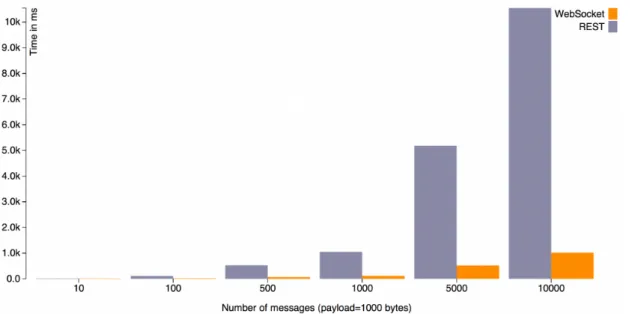
To understand better the difference between both methodologies, below is represented an analysis using WebSocket API and REST API. Figure 2.11 shows the time needed to process N messages of a constant payload size (1000 bytes) using both technologies.
Figure 2.11: Connectivity test between protocols showing the increasing overhead of REST API compared to WebSocket API due to multiple opening and closing connections. Reprinted
from: REST vs WebSocket Comparison and Benchmarks, by Gupta, A. (2014). http://blog.
As can be noted, REST API overhead increases when the number of messages in-crease. This is caused because the more messages need to be sent, the more connections between client and server need to be initiated and terminated. By contrast with Web-Socket, the client only needs to do the initial handshake with the server, so the messages can be processed directly.
Because of Websocket superiority in real time systems, this project will try to use this technology to interact with the cryptocurrency exchanges. Although Websocket offers a significant improvement compared to REST, the programming difficulty to connect to a WebSocket API is considerable.
2.4.2 Exchange analysis
In this section a short description and analysis of the most relevant cryptocurrency exchanges will be done. Furthermore, a detailed comparison between this exchanges will be presented.
Coinbase
Coinbase is a cryptocurrency exchange based in the USA founded in 2012. Is one of the most recognized and accredited platforms that supports users from more than 32 countries. In 2014, Coinbase created GDAX, the Global Digital Asset Exchange, de-veloped for professionals with high trading volumes. GDAX functions as a traditional exchange offering a real-time market to negotiate 4 different cryptocurrencies and 16 market pairs. Compared to Coinbase, GDAX is an advanced platform that allows ad-vanced order placement, such as Market or Limit order, Stop Loss and different time in force options: Good Til Cancelled, Immediate or Cancel or Fill or Kill.
Among that, GDAX also offers a better fee plan compared to Coinbase. Trading fees vary depending on whether the order is executed immediately (market order) or if it is placed on the orderbook (limit order). Limit orders are fee free while market orders are charged with a 0,25%4 fee. In case of big trading volume, market order fees can be reduced up to 0,1%4.
The firm offers a free mobile wallet, offline storage and insurance protection for the currency stored in their servers. GDAX supports several fiduciary currencies: US dollars, Euros and Pounds Sterling.
Regarding the exchange connectivity, GDAX offers two types of API: REST and WebSocket, both updated. There is also a FIX API used for order management.
4
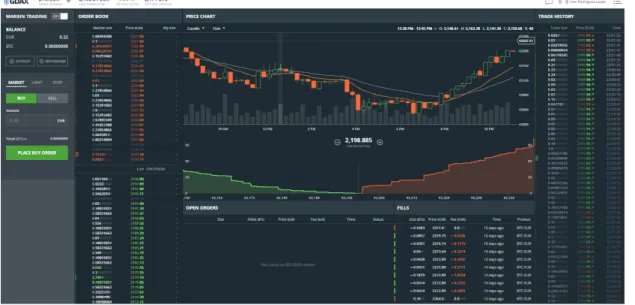
Figure 2.12: GDAX User Interface.https://www.gdax.com/
Bitfinex
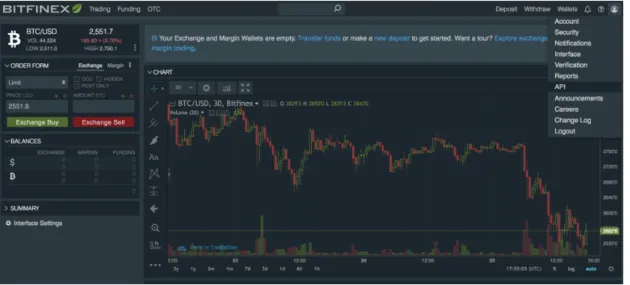
Bitfinex is a cryptocurrency trading platform based in Hong Kong that became famous for its leverage services of Margin Trading: The exchange supports clients from worldwide countries, except USA. Bitfinex offers the possibility to obtain ”loans” when carrying out cryptocurrency purchase transactions, as long as the initial equity of the funds held have to be at least the 30%5 of the position opened. Bitfinex also allows the possibility to open short positions. A short position is a way of trading where the investor sells borrowed currencies in the market. The idea is that an investor expects that the price will decrease over time and decides to sell the borrowed currencies and purchase them again in the next future, so that he can return them to the entity, in this case the exchange, which he borrowed them from. By doing this, it is possible to have profit even if the price of a cryptocurrency is decreasing.
Bitfinex offers 16 different cryptocurrencies with 38 market pairs and US Dollars as its base currency. Market order fees range from 0,1%6to 0,2%6depending on the volume traded. Limit order fees range from 0%6 to 0,1%6 depending on the volume traded.
Regarding Bitfinex networking connectivity, they offer two kinds of APIs: REST and WebSocket, both updated.
5
Intro to Margin Trading https://support.bitfinex.com/hc/en-us/articles/ 115004555165-Intro-to-Margin-Trading.
6Bitfinex Fees Schedule
Figure 2.13: Bitfinex User Interface.https://www.bitfinex.com/
HitBTC
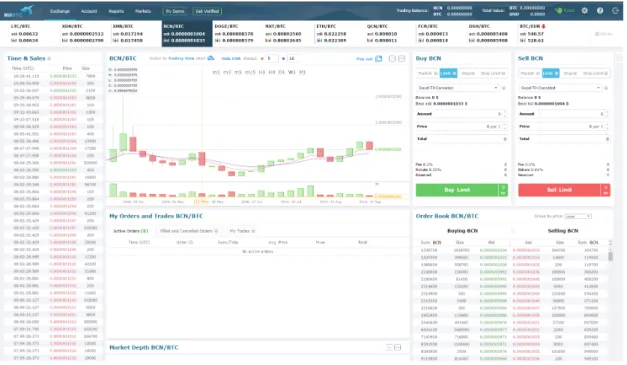
HitBTC is a cryptocurrency exchanges that offers a large number of cryptocurrencies and rising altcoins. HitBTC also offers lots of market to negotiate with different tokens and ICOs. HitBTC is registered in the UK since 2013. Its volume has been steadily rising which provides a good liquidity with a narrow bid ask spread.
HitBTC offers a total of 149 different digital coins in 160 market pairs and supports two fiduciary currencies: US Dollars and Euros. Trading fees vary depending on whether it is placed a market order or limit order. Market orders are charged with a 0,1%7 fee from the trade while limit orders are not charged. Moreover, limit orders receive a 0,01%1 rebate from the trade.
HitBTC offers two types of APIs: REST and Websocket. Recently, a new version of the API has been released, called APIv2.
7
Figure 2.14: HitBTC User Inteface.https://hitbtc.com/
OKCoin
OKCoin is one of the largest Bitcoin exchange in the world. The exchange was founded in 2013 and its based in Beijing, China. Currently, the exchange is focused on the Chinese market, providing cryptocurrency trading services to the rest of the world. OKCoin offers 5 cryptocurrencies that can be bought with US Dollars. This exchange offers also the possibility to leverage up to 20 times. Trading fees are fixed at 0,2%8 whether is a market order or limit order.
OKCoin has a strong institutional support, since it has been receiving funds and investments from important actors, such as VenturesLab, or Chinese funds, Ceyuan and Longling Capital.
Similarly to Coinbase, OKCoin has also a second exchange called OKex whose target are more experienced traders. In OKex, trading fees range between 0,02% and 0,15% for limit orders and between 0,05% and 0,2% for market orders, depending on the volume traded.
In the last years, opening an account with this broker has been more complicated, specially for US citizens. This is linked to the fact that the US Securities and Exchange Commission (SEC), is trying to limit as much as possible that US traders can trade in brokers of foreign countries that are not legally registered in the United States[22].
Figure 2.15: OKCoin User Interface.https://www.okcoin.com/
2.4.3 Exchange comparison
In this section, a more detailed comparison based on traded volume between most im-portant cryptocurrency exchanges will be made. Most suitable characteristics and prop-erties have been chosen in order to analyze and compare the main differences between exchanges.
Table 2.2 and Table 2.3 show main properties from top cryptocurrency exchanges based on trading volume as of 7th March 2018. Trading volumes presented in Table 2.2 are calculated as the average of the monthly volume between January 2018 and February 2018. Table 2.3 shows the base currencies and the most important digital coins offered by the exchanges in their different market pairs.
Digital coins presented in Table 2.3 are: Bitcoin (BTC), Ether (ETH), Bitcoin Cash (BCH), Ripple (XRP), Litecoin (LTC), Digita Cash (DASH), NEM(XEM), IOTA (IOT), Monero (XMR), OmiseGO(OMG), NEO (NEO), Ethereum Classic (ETC), EOS (EOS), Lisk (LSK), ZCash (ZEC) and TenX (PAY). Base currencies presented in Table 2.3 are: US Dollar (USD), Euro (EUR), Yen (JPY), Pound (GBP), Canadian Dollar (CAD), Won (KRW), Yuan Renminbi (CNY), Bitcoin (BTC), Ether (ETH), Bitcoin Cash (BCH), Monero (XMR) and Tether Dollar (USDT).
Exc hange Mon thly trading v olume ($) 1 Num b er of digital coins 2 Num b er of base currency 2 Num b er of mark et pairs 2 Most traded pair 2 Coun try 2 Has b een hac k ed ? WS? 4 REST? 4 REST call rate (requests/min) Binance $2.700.000.000 114 3 262 BTC/USDT Hong Kong 3 No No Y es 1200 Bith um b $2.000.000.000 12 1 12 XRP/KR W South Korea 3 Y es No Y es 120 Ok ex $1.900.000.000 90 4 271 BTC/USDT Hong Kong 3 Y es Y es Y es 600 Bitfinex $1.800.000.000 38 4 105 BTC/USD Hong Kong 3 Y es Y es Y es 60 Bittrex $1.450.000.000 199 3 273 BTC/USDT US No No Y es 60 GD AX $860.000.000 4 4 12 ETH/USD US No Y es Y es 180 Huobi $850.000.000 97 3 202 BTC/USDT Singap ore 3 No Y es Y es 60 P oloniex $725.000.000 68 4 98 BTC/USDT US Y es Y es Y es 360 Krak en $650.000.000 17 7 57 BTC/EUR US No No Y es 60 Bitstamp $580.000.000 5 3 14 BTC/USD Luxem b ourg Y es Y es Y es 60 HitBTC $505.000.000 300 4 562 BCC/BTC UK No Y es Y es 60 Coinone $440.000.000 9 1 9 XRP/KR W South Korea 3 No No Y es 90 Coinc hec k $420.000.000 1 1 1 BTC/JPY Japan 3 No No Y es 60 Bitfly er $280.000.000 3 2 3 BTC/JPY Japan 3 No No Y es 200 OK Coin $110.000.000 3 1 6 BTC/CNY China 3 No Y es Y es 600 1 Mon thly a v e rage v olume of Jan uary and F ebruary 2018. Source: h ttps://bitgup.com/ 2 As of 7 th Marc h 2018. Source: h ttps ://bitgup.com/ 3 In Asia, order filling dela y of 2-3 seconds 4 Ev aluation of the t yp e of API offered b y the exc hange (REST or W ebSo c k et) T able 2.2: Crypto curre ncy exc ha nge comparison. Elab orated b y the author. Exc hange Base currency 4 Digital coins offered 4 USD EUR JPY GBP CAD KR W CNY BTC ETH BCH XMR USDT BTC ETH BCH XRP L TC D ASH XEM IOT XMR OMG NEO ETC EOS LSK ZEC P A Y Binance X X X X X X X X X X X X X X X X X Bith um b X X X X X X X X X X Ok ex X X X X X X X X X X X X X X X X X X X Bitfinex X X X X X X X X X X X X X X X X Bittrex X X X X X X X X X X X X X X X X X GD AX X X X X X X X X Huobi X X X X X X X X X X X X X X X X X P oloniex X X X X X X X X X X X X X X X X Krak en X X X X X X X X X X X X X X Bitstamp X X X X X X X X X X X X HitBTC X X X X X X X X X X X X X X X X X Coinone X X X X X X X X X Coinc hec k X X Bitfly er X X X X X OK Coin X X X X X X X 4 As of 7 th Marc h 2018. Source: h ttps ://w ww.coin hills.com/ T able 2. 3: Digital coins and base currencies offered b y exc hanges. Elab orated b y the author.
Fees
The fee schedule of the most important cryptocurrency exchanges is presented below. Table 2.4 summarizes the most relevant exchange fees: trading, deposit and withdrawal fees.
Table 2.4 also contains information about the total transaction cost for a normal investment operation. That is, deposit fiat money at an exchange, buy some amount of cryptocurrency, sell the amount purchased and withdraw the fiat funds of the sale. Table 2.4 shows the total transaction cost of this operation in the case of investing in 1 Bitcoin as a percentage of the Bitcoin price.
Total transaction cost of purchasing and selling in relation to the amount of Bitcoins invested is shown in Figure 2.16 and Figure 2.17. More specifically Figure 2.16 represents the total fee for market order execution and Figure 2.17 illustrates the total fee for limit order execution.
Exc hange T rading fee 1 Withdra w al fee 1 Dep osit 1 Round trip transaction cost T otal fee for dep osit-buy-sell-withdra w 1 BTC as mark et tak er (%) T otal fee for dep osit-buy-sell-withdra w 1 BTC as mark et mak er (%) T ak er fee Mak er fee Base currency Digital coin (BTC) FIA T money Digital coin (BTC) Fix ( e ) V ariable (%) Mark et tak er Mark et mak er Binance 0,10% 0,10% $10,80 0,0005 0 0 8,71 e 2 0,20% 0,20% 0,31% 0,31% Bitfly er 0,15% 0,15% 756 JPY 0,0004 324 JPY 0 8,24 e 2 0,30% 0,30% 0,40% 0,40% Bitfinex 0,20% 0,10% 0,10% 0,0005 0,10% 0 0,00 e 0,60% 0,40% 0,60% 0,40% Bith um b 0,15% 0,15% 1.000 KR W 0,0005 0 0 0,75 e 2 0,30% 0,30% 0,31% 0,31% Bittrex 0,25% 0,25% 0 0,001 0 0 0,00 e 0,50% 0,50% 0,50% 0,50% Coinc hec k 0,15% 0,00% 400 JPY 0,0005 1.000 JPY 0 10,69 e 2 0,30% 0,00% 0,43% 0,13% HitBTC 0,10% 0,09% 30 e 0,00085 5 e 0 35,00 e 0,20% 0,18% 0,64% 0,62% P oloniex 0,25% 0,15% 0 0,0001 0 0 0,00 e 0,50% 0,30% 0,50% 0,30% Coinone 0,10% 0,10% 1.000 KR W 0,0005 0 0 0,75 e 2 0,20% 0,20% 0,21% 0,21% Bitstamp 0,25% 0,25% 0,90 e 0 0 0 0,90 e 0,50% 0,50% 0,51% 0,51% Krak en 0,26% 0,16% 0,09 e 0,001 0 0 0,09 e 0,52% 0,32% 0,52% 0,32% GD AX 0,25% 0,00% 0,15 e 0 0 0 0,15 e 0,50% 0,00% 0,50% 0,00% OK Coin 0,20% 0,20% 0,50% 0 0 0 0,00 e 0,90% 0,90% 0,90% 0,90% 1 Accessed N o v em b er 2017 at exc hanges official site 2 Currency con v ersion rate calculated as of 7 th Marc h 2018. Source: h t tps://www.blo om b erg.com T able 2.4: T op exc hanges fee sc hedule. Elab orated b y the auth or. -0 ,1 0% 0, 00% 0, 10% 0, 20% 0, 30% 0, 40% 0, 50% 0, 60% 0, 70% 0, 80% 0, 90% 1, 00% 1, 10% 1, 20% 0 1 2 3 4 5 6 7 8 9 10 Roun d tr ip tr ans acti on co st ( %) Amo un t o f B itc oi ns (B TC ) Ro un d tr ip tr an sa ct io n co st a s a m ar ke t m ak er So ur ce: Ow n el ab or at io n ba sed o n exc ha nge fees OK Coi n Bit fly er Bit fin ex Bit hu m b Bit tr ex Co in ch eck Hit BTC Po lo ni ex Coi non e Bit st am p Kr ak en GD AX Bi na nc e Figure 2.16: Round trip mark et order transaction fee. Elab o-rated b y the author. -0 ,1 0% 0, 00% 0, 10% 0, 20% 0, 30% 0, 40% 0, 50% 0, 60% 0, 70% 0, 80% 0, 90% 1, 00% 1, 10% 1, 20% 0 1 2 3 4 5 6 7 8 9 10 Roun d tr ip tr ans acti on co st ( %) Amo un t o f B itc oi ns (B TC ) Ro un d tr ip tr an sa ct io n co st a s a m ar ke t t ake r So ur ce: Ow n el ab or at io n ba sed o n exc ha nge fees OK Coi n Bit fly er Bit fin ex Bit hu m b Bit tr ex Co in ch eck Hit BTC Po lo ni ex Coi non e Bit st am p Kr ak en GD AX Bi na nc e Figure 2.17: Round trip limit order transaction fee. Elab orated b y th e author.
Trading platform
In the following chapter a description of the software and programs implemented will be provided. In addition, an installation and user’s guide will be detailed.
3.1
Base project
As mentioned before, this project will try to use WebSocket technology to connect with exchanges because of its superiority, in terms of communication speed, compared to other kinds of connectivity technologies, such as REST API. Despite this fact, the complexity of establishing a connection with the port or socket using WebSocket is significantly greater. Because of the short period of this project and due to programming and coding difficulty, it has been decided to create a program based on other already designed open-source projects.
The criteria to choose the appropriate existing project is the following: • The project has to be free and open-source.
• It should have implemented a transaction system as well as a market data gathering system.
• The project should be well documented.
• Ideally, the programming language should be a high level language such as Python or Matlab.
After an extensive search, installation and testing of the existing projects that matched this criteria[23, 24, 25, 26, 27, 28, 29, 30, 31, 32, 33], it was decided that the platform more suited to be the basis of this project was the program Tribeca. The reason of choosing Tribeca is that the majority of open-source projects were based on REST APIs instead of WebSocket APIs. The main problem of Tribeca software is that it is a very developed project with almost no coding documentation. Among that, another major problem is that the project has not been properly updated in the last year with the
last exchange APIs upgrades and, because of that, some of the functionalities were not working. Finally, Tribeca is designed as an automated market making bot and it is not programmed to send simple orders such as market orders.
In order to respond to the problems presented above, a new program called Cryptobot will be implemented based on the initial structure of Tribeca.
Tribeca is a high frequency market making cryptocurrency trading platform. Market making is a trading strategy where a trader places two orders at the same time, buying on bid and selling on ask. By placing both orders, the trader expects to earn the bid-ask spread in each double trade execution.
This type of strategy is very attractive for traders because there is no need to predict the direction of the market, they should make profit no matter if the market goes up or down. In practice, this strategy has a risk associate, especially when the market moves in one direction very fast. The major risk in this case is that the trader executes one order but not the other. If this happens, the trader will most probably lose money in the operation.
Market makers are welcomed by exchanges because they provide liquidity to their markets, since they are always ready to buy and sell from other traders. For this reason, many exchanges incentive this kind of operations by charging 0% commission on make orders or even receive a rebate from the trade.
Although Tribeca is designed as a market making trading program, this project aims to complement the platform with the possibility to make individual trades but keeping possibility of operate market making strategies.
3.2
Structure of the program
The code is organized in 3 modules:
• The engine layer. The central module of the application. This part of the code
is designed to incorporate market data, order status, fees and open positions into the program. It is also responsible of synthesizing trades and security information and transform it into a block to send to the exchange. This part of the program calculates the fair value (FairValueEngine), variable used for market making purposes, and generates quotes (QuotingEngine). Fair value is an estimation of the price of the digital coin and it is used as a starting point to generate a quote.
• The adapter layer. The engine layer should not know about the individual
characteristics of every exchange. The engine layer uses the adapter layer to carry out its bidding. The adapter layer also has no idea that it is being used in a manner to make markets. In theory, the adapter layer code and the gateway layer code could be divorced from the Engine layer and we could build a technical analysis
or latency arbitrage bot, instead. The adapter layer also contains all the state reported by the gateways.
• The gateway layer. Each exchange has their own API for interacting with the
exchange. The connectivity with every API is handled by 4 different interfaces:
– IMarketDataGateway: Handles order book updates and market trade
up-dates.
– IOrderEntryGateway: Send and cancel orders and handle updates to the
orders.
– IPositionGateway: Pulls in the latest position information (e.g. USD amount
in the exchange account).
– IExchangeDetailsGateway: Read-only information describing naming and
exchange fee structure.
The major part of the software is programmed in TypeScript (95%), although some parts are written in HTML (4,5%) and JavaScript (0,5%). HTML and JavaScript are used to design the User Interface. The connection between TypeScript and HTML/JavaScript is made via AngularJS and Socket.io.
AngularJS is a client side JavaScript framework to design dynamic single page web applications by changing static HTML into dynamic HTML. It is commonly used in real time web applications. AngularJS extends HTML vocabulary with directives and attributes, maintaining the semantic and with no need to use external libraries.
Socket.io is a JavaScript library that runs on Node.js and is also designed to develop real time web applications. Socket.io allows two-way communication between client and server because is based on WebSocket technology.
Regarding the connectivity to the different exchanges, the platform connects simulta-neously to the REST and WebSocket API from the exchange. WebSocket API is used to gather fundamental market data information from the exchange as well as send trades to the exchange. REST API is used to receive a full report of market data information and present it through the UI. This information is persisted through a MongoDB database. Figure 3.1 shows how the different program files are interconnected. As can be noted, the main nodes of the program are models.ts, messaging.ts and main.ts. The file
models.ts defines and declares most of the classes, functions and collections that are
used while the program is running. Messaging.ts is responsible for the correct regis-tration and understanding of the different messages received by the exchange as well as the messages published in the own program logging files. Finally, main.ts is the file where everything is put together. The main is structured in two parts. The first part, liveTradingSetup loads and initialize basic configuration such as exchange and pair configured, initialization of MongoDB database, connectivity to the UI... The cen-tral part, runTradingSystem, loads the setup configuration and maintains the program running in an asynchronous mode.
service/active-state.ts service/backtest.ts gateways/bitfinex.ts service/broker.ts admin/client.ts gateways/coinbase-api.ts gateways/coinbase.ts service/config.ts quoting-styles/depth.ts service/fair-value.ts quoting-styles/helpers.ts gateways/hitbtc.ts service/interfaces.ts service/logging.ts service/main.ts service/market-filtration.ts admin/market-quoting.ts admin/market-trades.ts service/markettrades.ts service/messages.ts admin/messages.ts common/messaging.ts quoting-styles/mid-market.ts common/models.ts gateways/nullgw.ts gateways/okcoin.ts quoting-styles/oneside.ts admin/orderlist.ts admin/pair.ts service/persister.ts service/position-management.ts admin/position.ts service/quote-sender.ts service/quoter.ts service/quoting-engine.ts service/quoting-parameters.ts service/safety.ts admin/shared_directives.ts service/statistics.ts quoting-styles/style-registry.ts admin/target-base-position.ts quoting-styles/top-join.ts admin/trade-safety.ts admin/trades.ts service/utils.ts service/web.ts service/websocket.ts
Figure 3.1: Network diagram of the program representing the files that are interacting. Elab-orated by the author using JetBrains Webstorm.
Regarding the folder’s structure, Cryptobot has all coding files insidesrcfolder. Insrc, folders are structured in the following way:
• admin. This folder stores all the information related to the use of Browserify.
side (the browser) using the same syntax as Nodejs. With this library it is possible to install modules of third parties or from NPM, in addition to private modules.
• common. Commoncontainsmessaging.tsandmodels.ts, both mentioned before.
These files are separated from the rest because they are used commonly by most of the other files.
• service. Inserviceall the files associated to the program’s core are stored. Inside
servicethere are two additional folders:
– gateways. Contains the files that convert the information received and
sent to every exchange into a common scheme understandable for Crypto-bot. These files should be updated and modified every time an exchange API is updated. It is also possible to implement new exchanges through this folder making the appropriate changes in the linked files.
– quoting-styles. This folder includes all the trading modes available in
Cryp-tobot. Top-join.ts and Depth.ts contain the code responsible for the best bid and ask price estimation for the market making trading modes.
OneSide.ts contains the code responsible for the trading mode OneSide.
The rest of the files are auxiliary files.
• static. This folder stores the information related to the User Interface. Modifying
index.htmlallows to change the data displayed through the UI.
3.3
User guide
Installation manual
To understand better the components involved in the program and to explain further configuration of the trading bot, it is best to install the program first. The installation steps are the following:
0. System requirements. A prerequisite for installing the program is to have a
64-bit computer. Installation has been tested on Windows 10, but it should work on a 64-bit system running Windows 7 or higher or macOS 10.8 or higher.
1. Docker Toolbox installation. Docker is used as a highly optimized virtual
machine that puts libraries and dependencies in the same package using contain-ers (images) without creating a whole virtual operating system. Docker allows many advantages such as an easier installation of programs, images are treated independently of the platform of execution, the applications are isolated so ev-ery container runs independently from the rest and the applications are centrally managed. Windows installation is available through https://docs.docker.com/ toolbox/toolbox_install_windows/. Docker 1.7.1 or higher is required. During
installation process, uncheck ”Kitematic for Windows” (visual container manager), since the program does not need it.
2. Program folders. Download, unzip and save folders Cryptobot1 and
Crypto-bot2 in an empty directory. Cryptobot1 and CryptoCrypto-bot2 are the same program with different exchange configurations to allow connection of 2 exchanges at the same time. Cryptobot1 is connected by default to pair BTC/USD of GDAX and Cryptobot2 to pair BTC/USD of Bitfinex.
3. Program configuration. Environmental variables are configurable through the
fileenvin ∼/Cryptobot1 .
• Variable EXCHANGE configures the exchange at which Cryptobot will be con-nected. The program has been updated with the latest API configuration from exchanges textttCoinbase (GDAX) and textttBitfinex.
• Variable TradedPair configures the trading pair. If the connected exchange supports it, any of the following combination is possible: USD, BTC, LTC, EUR, GBP, CNY, ETH, DASH, DOGE, LSK, XMR. Example: LTC/EUR.
• MongoDbUrldefines the name of the mongoDB database associated with the
program. By default mongoDB database is called mycryptobot1 for Cryp-tobot1 and mycryptobot2 for Cryptobot2. If the program is running on Windows or macOS, ”192.168.99.100” in MongoDbUrl should be changed to the output of $ docker-machine ip from your docker terminal.
• Variable WebClientUsername and WebClientPassword allow to set a user-name and password to access the UI through the browser. If kept as NULL , the web client will not require authentication.
• Modify API key, secret and passphrase of your desired exchange to your personal configuration.
4. Compilation. Open Docker Quickstart Terminal and navigate to the folder
Cryp-tobot1. Example: if it is saved in your Desktop run $ cd Desktop/Cryptobot1 . Compile the program with $ ./build . If the program is correctly compiled, run-ning $ ./docker ps should present information about the cryptobot running con-tainers.
5. User Interface. Once the program is compiled, you can access to the User
In-terface by visiting http://192.168.99.100:3001/through your browser address bar. It should look something like this:
Figure 3.2: Cryptobot user interface
If you want to run in parallel Cryptobot2, go back to Step 3. UI for Cryptobot2 is available throughhttp://192.168.99.100:3002/.
6. Plotter. A Matlab script has been programmed to plot data collected from
both platforms. Plotter.m connects to mongoDB databases mycryptobot1 and
mycryptobot2 and creates plots of the price difference between exchanges,
arbi-trage opportunities and spread evolution. If you are interested in plotting the data collected by both programs, you can download the scriptPlotter.m to your com-puter and run it through Matlab. Plotter.m only works when both programs are running. Plotter.muses the add-on Database Interface for MongoDB. This Add-On can be installed through the Matlab tab Add-Add-Ons>Get Add-Ons. ”Database Interface for MongoDB” also needs Add-On Database Toolbox 8.0 for running. In the chapter ”Results”, a detailed description of the script will be made. After running the script different plots should appear:
Figure 3.3: Plots created with the Matlab script
7. Trading strategy. Cryptobot1 and Cryptobot2 are configured by default to place
an order, that should not be filled (limit order at 20.000 USD), when the exchange spread margin is greater than 5 cents of the pair base currency to which it is con-nected. In order to change this order placement configuration, a different trading strategy can be programmed in fileOneSidestored inCryptobot1/src/service/
quoting-styles. From OneSideit is possible to gather information such as price
and size of orders in the different levels of the order book as well as getting infor-mation from the exchange account such as current position of BTC. Finally, it is also possible to configure the type of orders Cryptobot is sending to the exchange.
8. Close the application. In order to stop the running containers Cryptobot1 and
Cryptobot2 execute $ ./stop from Cryptobot1 or Cryptobot2 through the Docker Terminal. To close the terminal execute $ exit .
User Interface
Once Cryptobot1 is up and running, visit HTTP port 3001 (3002 for Cryptobot2) to access the UI (i.e. http://192.168.99.100:3001/). Through the User Interface plenty of data can be analyzed: order book, market trades, currency positions, exchange and pair connected, order list, trades done, quoting mode and parameters to trade. Figure 3.4 illustrates the information shown by the UI.