The Real Effects of Opacity: Evidence from Tax Avoidance
Jon N. Kerr
Submitted in partial fulfillment of the requirements for the degree of
Doctor of Philosophy under the Executive Committee of the Graduate School of Arts and Sciences
COLUMBIA UNIVERSITY 2013
© 2013 Jon N. Kerr All rights reserved
The Real Effects of Opacity: Evidence from Tax Avoidance Jon N. Kerr
This study provides evidence on a significant real consequence of an opaque financial reporting information environment: increased corporate tax avoidance. Using an international sample of firms, I find that firms with a more opaque information environment, as measured at both the firm and country level, exhibit higher levels of firm-specific tax avoidance. More importantly, additional tests using the adoption of International Financial Reporting Standards (IFRS) as an exogenous shock to the information environment while simultaneously controlling for tax regime changes around the date of IFRS adoption provide direct evidence on the direction of the association, namely that opacity causes tax avoidance. Similarly, the results from tests using the initial enforcement of insider trading laws provide additional support for a directional hypothesis. In support of the firm-level findings, I also find evidence in the aggregate that opacity is associated with countries collecting less corporate tax revenues as a percentage of gross domestic product. In whole, these findings suggest that tax avoidance is a significant real effect of opacity with implications for practitioners, regulators, researchers, and tax-enforcement agencies.
i
1. Introduction 1
2. Empirical Predictions 7
3. Research Design 13
3.1. Measuring firm-level opacity 13
3.2. Measuring country-level opacity 15
3.3. Measuring tax avoidance 15
3.4. Control Variables 18
4. Sample and Results 20
4.1. Descriptive statistics 21
4.2. Results 23
4.2.1. Tax avoidance and firm-level information opacity 23
4.2.2. Tax avoidance and country-level information opacity 24
4.2.3. Directional tests of opacity and tax avoidance 25
4.2.4. Rent extraction, opacity, and tax avoidance 32
4.2.5. Collected tax revenues 34
4.2.6. Firm-level robustness 36
5. Conclusion 38
ii
iii
This paper has benefited greatly from the guidance and helpful suggestions of my committee: Trevor Harris (sponsor), Dan Amiram (chair), Gil Sadka, Ron Shalev, and Emanuel Zur.
Additionally, I would like to thank many others who have read prior drafts and offered constructive feedback, including: Andrew Bauer, Travis Chow, Scott Dyreng, Alon Kalay, Sharon Katz, Urooj Khan, Bugra Ozel, Ethan Rouen, and Jake Thornock, as well as workshop participants at the BYU Accounting Symposium, Columbia
University Accounting Workshop, Baruch College – CUNY, Cornell University, London Business School, and Washington University in St. Louis.
I gratefully acknowledge financial support from the Graduate School of Business at Columbia University.
Lastly, I am indebted to my wife, parents, and family for their immeasurable support.
iv Tara, Adalyn, and Cecily, this one’s for you.
1 Introduction
This study hypothesizes and nds evidence that increased corporate tax avoidance is a signicant real eect of nancial reporting information opacity. On a practical process level there are compelling reasons to believe that the opacity of a rm's information environment will have an eect on tax avoidance. Implicit within each amount claimed as either an income or deduction on the corporate tax return is the underlying economic activity and the revenue or expense as reported by management in the nancial report, both of which preceded it. As all information available to investors and analysts is also available to tax-enforcing entities, to the extent that the rm's nancial information environment is opaque, the rm may be better able to obfuscate its tax liability to government agencies and thus avoid more tax. My ndings are consistent with this explanation - that the direction of the association is such that opacity leads tax avoidance.
Despite this intuitive link between information environment and tax liability, tax avoid-ance as a real eect of opacity or opacity as a determinant of tax avoidavoid-ance is largely overlooked within the literature. Filling this gap is useful for at least two reasons. First, the literature struggles to explain the cross-sectional dierences in opacity given that opacity hurts rm value (e.g., Bhattacharya et al. 2003) and also still seeks to understand the overall benets and costs of nancial opacity. One possible benet, that may help to outweigh the costs, is the ability of opaque rms to avoid taxation. Second, tax avoidance is a signicant global economic phenomenon. A recent study by the Tax Justice Network (2011) estimates the size of tax evasion, where tax evasion is a lower bound for tax avoidance, at 5.1 percent of
global gross domestic product (GDP).1 Thus, providing evidence on a link between opacity
and tax avoidance can have important implications for both academic and policy debates.
1To put this in perspective, tax evasion is equal to 54.9 percent of worldwide healthcare expenditure, a
ratio only so low due to the USA having the highest healthcare costs and the highest GDP yet one of the lowest tax evasion rates. In contrast, the unweighted average tax evasion to health care spending ratio is 110 percent meaning that, in most countries, tax evasion exceeds healthcare spending.
Two recent working papers have begun to consider the relationship between opacity and tax avoidance, but do so with mixed results and in stylized settings, leaving the question open for additional study. First, Wang (2010) investigates tax avoidance in the context of rm value and information opacity for S&P 1500 rms from 1994 to 2001 and nds that opaque rms avoid less taxes than their transparent counterparts. Wang (2010) argues that this negative association is a result of value-conscious corporate management. In contrast to this, Balakrishnan et al. (2011) argue that tax aggressiveness causes increased corporate organizational complexity, and therefore hypothesize that increased tax avoidance will lead to a lower level of nancial reporting transparency. Using a new measure of tax avoidance, Balakrishnan et al. (2011) control for determinants of opacity and nd a positive relationship between tax avoidance and opacity for a sample of domestic-only rms. It should also be noted here that, though they do not provide direct tests of the causal aspect of their hypothesis, Balakrishnan et al. (2011) assume one direction of causality, while this study hypothesizes and nds evidence consistent with the association running in the opposite direction.
Along with these mixed ndings, there is also tension outside the literature. First, though it has been shown that rms attempt to guide analysts, the rm's information environment is not entirely within the rm's control and even if it were there are still many countervailing incentives (of which taxes may be one) that would aect a rm's decisions regarding trans-parency. Second, to the extent that book and tax are linked and to the extent that rms face incentives to manage earnings upward to meet analyst or market expectations, rms may be unable to keep taxable income low while also meeting those expectations. Therefore, whether and to what extent nancial opacity aects rm-level tax avoidance remains largely an unresolved and important empirical question.
To study the relationship between opacity and tax avoidance, I use an international setting with a broad sample of cross-country market, nancial, and analyst data. An inter-national setting is particularly relevant to the research question due to the cross-sectional
variation present in both the information environment and tax avoidance behaviors found between countries and the rms domiciled within them. While an international setting has the potential advantage of greater congruence between book and tax, this can also be a disadvantage as incentives with higher order than tax may take precedence. In addition, the recent adoption of International Financial Reporting Standards (IFRS) by various countries around the world as well as the initial enforcement of insider trading laws over the last few decades allows for natural experiments using dierence-in-dierence analyses to test predic-tions regarding the causal direction of the association. Finally, the use of an international setting also allows for the study of tax avoidance in the aggregate by testing cross-sectional dierences in government-collected corporate tax revenues and how those revenues vary with country-level measures of opacity.
I follow Bushman et al. (2004b) and dene the opacity (transparency) of the nancial reporting information environment as the unavailability (availability) of rm-specic infor-mation to those outside the rm. For parsimony, this construct is frequently referred to simply as opacity. Conceptually, the construct opacity is the inability of outsiders to pierce the cloud of the rm and see through to its underlying operations and activities. To mea-sure rm-level opacity I use proxies for information uncertainty, information asymmetry, and earnings quality commonly used in the literature, including: the absolute value of analysts' forecast error, analysts' forecast dispersion, the average bid-ask spread, and performance-adjusted discretionary accruals. In addition, country-level proxies of opacity include: an index of corporate governance, an index of disclosure requirements, the extent of news me-dia penetration, and the mandatory adoption of IFRS.
I dene tax avoidance broadly as any activity, legal or otherwise, that reduces a rm's tax liability per dollar of pre-tax earnings. This denition follows from such papers as Hanlon and Heitzman (2010a) and is widely used in the literature. Firm-level tax avoidance is measured using two dierent but complementary variables, namely the spread between the applicable country-year statutory tax rate and either 1) the rm's cash eective tax rate (cash ETR)
for the year, or 2) the rm's reported eective tax rate (reported ETR) for the year. Both the cash and reported ETR are frequently used within the tax avoidance literature.
This study begins by extending the prior literature by testing the association between opacity and tax avoidance in an international setting. The results of this rst set of anal-yses indicate that both rm- and country-level opacity are incrementally and signicantly
associated with greater rm-level tax avoidance.2 Specically, each of the four rm-level
opacity proxies is positively associated with tax avoidance, suggesting that tax avoidance increases as opacity increases. In addition, tax avoidance is also positively associated with a new summary opacity measure: an index score created from the four rm-level opacity measures. Similarly, results from regressions using four country-level indicators of opacity also show that country-level opacity is signicantly associated with greater rm-level tax avoidance and is incremental to rm-level opacity (as measured by the opacity summary index measure). Since rms are less likely able to inuence country-level opacity through their individual tax avoidance activities, this is initial evidence that opacity may lead tax avoidance.
The next tests directly investigate this preliminary evidence on the direction of the as-sociation using rm-level data. Specically, I test the directional hypothesis that an opaque nancial information environment has an eect that naturally leads and may potentially be exploited by management to obfuscate the rm's tax avoidance activities to taxing authori-ties. This analysis uses dierence-in-dierence regression models utilizing rst, the adoption of IFRS, and then second, the initial enforcement of insider trading laws, as an exogenous shock to the nancial reporting environment of the rm and tests how these shocks to opacity aect tax avoidance. In tests using the adoption of IFRS, I also limit the treatment group to exclude those countries with tax regime changes around the time of adoption to ensure that the eect on tax avoidance is not confounded by coinciding changes to tax laws. The results from both tests provide direct evidence consistent with opacity causing tax avoidance.
To further examine the relationship, I next interact opacity with IFRS adoption and investigate the eect this interaction has on tax avoidance for those countries that maintained their tax regime immediately before and after mandatory IFRS adoption. Results from this test suggest that IFRS adoption attenuates the ability of rms to use opacity to avoid taxes and is consistent with the argument that the reduction in tax avoidance due to IFRS adoption is because of a decrease in opacity. Additionally, results from a lag analysis where the main regression model is modied to include either lagged opacity or lagged tax avoidance show that lagged opacity continues to have a signicant and positive association with unlagged tax avoidance, whereas the model using lagged tax avoidance and unlagged opacity fails to nd a signicant association. The results of all these tests together strengthen the argument that tax avoidance follows from the information environment facing the rm.
Further analysis presents evidence that the positive association between opacity and tax avoidance is strengthened for rms with opportunities to extract private benets. Financial opacity is a logical mechanism to investigate the connection between rent extraction and tax avoidance as both require some level of covertness, something that opacity can provide. These tests follow from and provide new evidence to the observation made in Hanlon and Heitzman
(2010a) that the theory from Desai and Dharmapala (2006) that rent extraction3 and tax
avoidance require complementary technologies is an interesting angle and is underexplored. Finally, the positive association between opacity and tax avoidance is robust to a wide range of alternative specications for the cash ETR and reported ETR and the summary opacity index measure. In addition, the association is also robust to other model speci-cations and sample restrictions, including adjusting the sample to remove U.S. rms and employing yearly cross-sectional (Fama and MacBeth 1973) regression models. The results of all robustness tests remain qualitatively similar to the initial rm-level results.
3Rent extraction is dened broadly and includes a wide range of behaviors such as perquisite consumption,
otherwise excessive amounts of executive compensation (regardless of form), non-arms-length or related-party transactions, and outright theft. In addition, earnings management, to the extent that it inates stock price and allows for insiders to take abusive action and extract gains, would also fall under this umbrella.
This study contributes to the existing literature in several ways; rst, by documenting the robust, positive relationship between opacity and tax avoidance and extending these ndings to a sample of international rms; second, by establishing that country-level opacity has an incremental eect to rm-level opacity on both rm-level tax avoidance and in the aggregate with collected country-level corporate tax revenue as a percentage of GDP; third, by presenting evidence showing that the association between opacity and tax avoidance is strengthened for rms with opportunities to extract rents; and fourth, by providing direct evidence that opacity has a causal association with tax avoidance by using two separate exogenous shocks to opacity to show that tax avoidance decreases following those shocks. In summary, the results suggest that opacity is a signicant, yet overlooked, determinant of tax avoidance and that the link between the two has important implications for practitioners, regulators, researchers, and governmental tax-enforcement entities. In addition, the frictions and market costs related to opacity and the tension between opacity and book-tax congruence may help to explain the observation in Armstrong et al. (2012) that some rms appear to engage in more conservative tax planning than might otherwise seem to be optimal.
This paper joins with others in answering the call in Shackelford and Shevlin (2001) for additional research that investigates the cross-sectional determinants of rm-level tax avoid-ance and extends the body of literature by looking to the overall information environment of the rm as a potential and important determinant of its tax avoidance activities. In addi-tion, this paper joins a small, but growing body of international research that has sprung up in recent years to investigate the incentives for tax avoidance across the globe by utilizing
country-specic variation (for examples, see Amiram et al. 2011 and Atwood et al. 2011).4
4Amiram et al. (2011) note that past tax avoidance research has focused mostly on classical systems
- that is systems where both the corporation and shareholders pay tax on the same income. Exploiting country-specic imputation systems (which at least partially eliminate the double taxation of corporate prots as found in the U.S.), they hypothesize and nd that rms located in countries with imputation tax systems have a weaker incentive to avoid taxes. Atwood et al. (2011) investigate various country-specic tax structures including a worldwide taxing regime, required book-tax conformity, statutory corporate tax rates, and the perceived level of tax enforcement and nd that rms avoid less taxes when a worldwide approach is used, required book-tax conformity is higher, statutory corporate tax rates are lower, and tax enforcement is perceived to be stronger. However, upon further investigation they nd that the relationship between tax
The rest of this paper is organized as follows. Section 2 develops the empirical predictions while providing an overview of the relevant literature. Section 3 details the research design. Section 4 outlines the sample selection as well as presents the results of all signicant tests. Section 5 concludes and poses possible areas of additional inquiry.
2 Empirical Predictions
This study builds upon the intuition that a rm's economic activities are common to both its nancial and tax functions and that both the economic activity and nancial reporting occur prior to reporting for tax purposes. For example, when an economic activity occurs it is rst reected within the management reporting system. This information is then packaged, usually in several dierent ways depending on the intended audience and their needs, so that it can be eectively reported to management, analysts, shareholders, and other users (e.g., a rm's economic activities are translated through the lens of the local GAAP and then made publicly available in its annual and quarterly nancial statements). After these activities and amounts have been used for nancial purposes, they are then further subjected to tax laws to produce lings suitable for tax authorities. This common process suggests that opacity could be associated with tax avoidance for two reasons. First, although the information is subjected to additional tax laws, it is often the case (especially in an international setting) that a rm's tax amounts follow closely from its local GAAP amounts and thus opacity for nancial purposes directly precedes and contributes to opacity for tax purposes. Second, all information that is available to investors and analysts is necessarily also available to tax-enforcing entities such as the Internal Revenue Service (IRS). Therefore, any activity or amount that a rm wishes to obfuscate from tax authorities must, by necessity, also be excluded from or obfuscated in its public disclosures.
avoidance and each of the four tax system characteristics is contextual and depends largely upon the variable compensation of management.
In addition, this study builds primarily upon two distinct streams of literature, namely those of corporate transparency (the inverse of opacity) and tax avoidance. A large body of research shows the market eects of corporate transparency in an international setting, including Leuz and Verrecchia (2000), Daske et al. (2008), and Lang et al. (2011). Specically, these studies show that greater nancial transparency at the rm-level is associated with lower bid-ask spreads and a greater level of liquidity. In addition, Francis et al. (2004) and Francis et al. (2005) show that corporate nancial reporting quality is an important determinant of both the rm's cost of equity and its cost of debt. Also related, but in a slightly dierent vein, is Bushman et al. (2004a). This study notes that organizational complexity (where greater complexity is associated with reduced reporting transparency) can hinder the eorts of investors to understand rm operations and value.
The impact of corporate transparency, however, is not limited to overall market con-sequence. Corporate transparency can also serve a disciplinary role for corporate insiders resulting in a better selection of investments, more ecient management of assets in place, and a reduction in the expropriation of minority shareholders' wealth (see Bushman and Smith 2001). This line of argument suggests that corporate transparency can also aect spe-cic real corporate activities, of which tax avoidance is one. As an example of how opacity may aect real activities, McNichols and Stubben (2008) examine whether rms with opaque nancial reporting also make suboptimal investment decisions and nd that such rms tend to over-invest. Following this line of thought, as the underlying economic transactions, ac-cruals processes, and rm operations and structures become more opaque, tax avoidance activities can more easily proliferate.
Increased tax avoidance being associated with opacity, however, is not a foregone conclu-sion. Scholes et al. (2009) detail how managers face tradeos between nancial reporting and tax avoidance. These tradeos are often due to the conicting motives that management has to produce higher results for nancial purposes, yet at the same time to minimize the rm's tax liability. Especially in an international setting where the association between tax laws
and the local GAAP is stronger than in a purely domestic one, economic transactions are often reported in a similar fashion for both book and tax reporting purposes (e.g., income or expense in period A for book purposes is also an income or expense in period A for tax purposes), thereby limiting the degree to which these two numbers can be driven apart. To the extent that nancial reporting or market concerns outweigh tax concerns, and to the extent that rms manage earnings to meet those concerns, then a rm's tax liability may also increase as earnings are managed.
Notwithstanding, recent studies show that management has incentives for avoiding tax and are often rewarded for doing so. For example, Rego and Wilson (2008) examine the impact that executive compensation has on tax risk/aggressiveness and nd that executive compensation and tax aggressiveness are positively related. Further studies show that this association reects ecient contracting rather than a form of rent extraction. Using a pro-prietary data set of detailed executive compensation, Armstrong et al. (2012) investigate the pay-related incentives of the tax director and nd a signicant and negative relationship between the tax director's level of compensation and the rm ETR. However, they fail to nd much of a relationship with any other tax-related variable, suggesting that tax directors
have an incentive to reduce the reported tax expense for nancial statement purposes.5
While past studies exploited rm-specic characteristics as proxies for rm-level
oppor-tunities and incentives (see Zimmerman 1983 and Gupta and Newberry 1997)6, more recent
studies have looked to agency costs, managerial incentives, and corporate governance to ex-plain a rm's level of tax avoidance (see Desai and Dharmapala 2006, Desai et al. 2007, and Desai and Dharmapala 2009). For example, Desai and Dharmapala (2006) nd a negative association between the level of tax sheltering and incentive compensation with the
associa-5Additional examples of recent studies involving agency costs, governance, and managerial incentives
include Desai et al. (2007) and Dyreng et al. (2010).
6Zimmerman (1983) looks at the relation between rm size and rm-level ETRs (as a component of
polit-ical costs) and nds evidence consistent with larger rms engaging in income-reducing accounting activities in order to mitigate the increased government scrutiny they incur over smaller rms. However, using the Tax Reform Act of 1987 (TRA), Gupta and Newberry (1997) nd conicting evidence that rm-level ETRs are not associated with rm size when looking across longer horizons. Instead, they show that ETRs are related to capital structure, asset mix, and rm performance both before and after the TRA.
tion being mostly driven by rms with weak corporate governance. They argue that through the use of incentive-based compensation, managerial incentives are better aligned with those of shareholders and that these high-powered incentives reduce agency costs by discouraging management from participating in activities that would otherwise involve rent extraction.
To the extent that the agency cost view of tax avoidance predominates, then opacity, under the guise of less transparent accounting and nancial reporting and a lower level of coverage by information intermediaries, may create a shield under which managerial oppor-tunism thrives leading to increased tax avoidance. Under this point of view, one would expect a positive association between opacity and tax avoidance. However, prior research also shows that information transparency allows outsiders to better monitor managerial activities and discretion (see Lang et al. 2004), which includes the tax function. Therefore, if tax avoidance is value-enhancing and management communicates this through transparency, then trans-parency may instead be associated with increased tax avoidance. Under this alternative view there would be a negative relationship between opacity and tax avoidance. Finally, to the extent that both of the above eects exist and neither predominates (or the eects cancel out one another), then an empirical analysis should lead to no discernible association.
This study begins by relying upon the agency cost theory of tax avoidance and by testing the intuition that a rm's economic activities are common to both its book and tax functions and by seeking to clarify the mixed ndings of the prior literature. Therefore, the rst hypothesis is as follows:
H1: Opacity, at both the rm and country level, is associated with increased rm-level tax avoidance.
This hypothesis also leads to predictions for country-level aggregate tax avoidance (as op-posed to rm-level tax avoidance). Since corporate tax revenues collected by a country are the sum of individual rm-level taxes paid, and to the extent that opacity is associated with tax avoidance at the rm-level, the hypothesis and association should continue to hold when investigating opacity and taxes collected at the country-level.
H1 above hypothesizes about the association between tax avoidance and opacity. How-ever, it also leads to questions about the direction of this association as the intuition and theory behind the hypothesis is that opacity creates an environment that management can exploit to obscure taxes and reduce the rm's tax liability. An international setting pro-vides a laboratory-like setting for testing the causal direction of this association. Starting December 31, 2005, countries began mandating the adoption of IFRS, including many EU countries, Australia, and New Zealand. Several studies have shown that IFRS, when com-pared to many local GAAPs, provides more extensive measurement and disclosure rules, along with many capital market benets, accounting property improvements, and a positive eect on analysts' ability to forecast future earnings (see Ding et al. 2007, Bae et al. 2008, Daske et al. 2008, Byard et al. 2011, and Landsman et al. 2012). Due to the adoption of IFRS within a country being outside the rm's control, as well as the improvement in the information environment that accompanied such adoption, I use the mandatory adoption of IFRS as an exogenous shock to opacity. To the extent that tax avoidance follows opacity and to the extent that IFRS adoption was not also accompanied by a change to the country's tax regime, it follows then that IFRS adoption will lead to a decrease in tax avoidance for those rms in countries that experienced the shock relative to those that did not. However, to the extent that tax avoidance leads to opacity, there should be no such eect post adoption. This leads to the second hypothesis:
H2: The adoption of International Financial Reporting Standards, an exogenous shock to the information environment, decreased the tax avoidance activities of the rm relative to non-adopters and the pre-adoption period.
This second hypothesis is notable for its prediction in regard to the ow of information between book and tax. Prior literature shows that both book and taxable income provide information to investors and market participants (see Hanlon and Heitzman 2010b) with many studies nding that book-tax dierences are informative as to the growth and persis-tence of rm-level earnings (see Lev and Nissim 2004 and Hanlon 2005) and that taxable
income has information content incremental to book income such that book-tax conformity may reduce the amount of benecial information available to the marketplace (see Han-lon et al. 2005 and Atwood et al. 2010). This vein of literature implies that tax expenses and book-tax dierences are informative due to their ability to capture an element of some underlying and broadly dened earnings quality or earnings management behavior. This second hypothesis, however, stands apart from these previous studies by predicting that the eect from the ow of information between nancial and tax may also run in the opposite direction.
Similar to H2 above, I also construct a hypothesis in regards to the enforcement of insider trading laws: that the initial enforcement of insider trading laws, an exogenous shock to the information environment, decreased the tax avoidance activities of the rm relative to countries without such enforcement and the pre-enforcement period. Prior literature suggests that, following the initial enforcement of insider trading laws, analyst following increased, analysts began forecasting a broader set of measures, and that nancial reporting quality improved (see Bushman et al. 2005, Hail 2007, and Zhang and Zhang 2012). Thus, the initial enforcement of insider trading laws is another potential exogenous shock to the information environemtn with which I can test whether an improvement in information transparency precedes a reduction in tax avoidance.
Finally, Desai and Dharmapala (2006) suggest that rent extraction and tax avoidance may require additional technologies. Financial information opacity is a particularly com-pelling mechanism for which both rent extraction and tax avoidance may exist due to the complementary environment it provides for both. Indeed, to the extent that tax avoidance and rent extraction occur and to the extent that they rely on the same organizational and transactional structures, an opaque information environment would be an ideal setting in which management would be able to pursue both simultaneously. This leads to the third and nal hypothesis:
H3: Opacity provides the rm and its management the joint opportunities and processes necessary to engage in both rent extraction and tax avoidance.
3 Research Design
To test the empirical predictions, I estimate a series of pooled OLS regressions of the following general form:
T axAvoidi,t =γ0+γ1Opacity Characteristicsi,t+β1Controlsi,t+F ixed Ef f ects+εi,t (1)
where Opacity Characteristics is the primary variable of interest, the proxies and measure-ment of which are described in detail, along with TaxAvoid and Controls, in the following sections. In addition, standard errors are clustered by rm and year (see Gow et al. 2010) to account for possible correlation in residuals. To reduce the undue inuence of outliers, all rm-level continuous variables are winsorized at the top and bottom percentile of their respective distributions.
3.1 Measuring rm-level opacity
Because opacity is inherently dicult to measure, I use the following ve separate indicators as proxies for the availability of rm-specic information: analysts' forecast error, analysts' forecast dispersion, performance-adjusted discretionary accruals as calculated in Kothari et al. (2005) and Frank et al. (2009), the average bid-ask spread, and a summary opacity
index score based upon the other four measures.7 Higher values of each measure of opacity
correspond to higher levels of opacity.
The rst analyst-based measure, ForErr, is calculated as the absolute value of the most recent analysts' mean earnings per share (EPS) forecast less the actual EPS for the year,
both from I/B/E/S, scaled by the rm's stock price at the beginning of the scal year. The most recent analysts' mean EPS forecast used in the calculation is the last analysts' forecast prior to the actual EPS. Similarly, the second analyst-based measure, ForDisp, is calculated as the dispersion of analysts' forecasts scaled by the rm's stock price at the beginning of the scal year. Both ForErr and ForDisp have been shown to be related to greater transparency in the rm's information environment and reect the ability of outsiders to the rm to process rm-related information (see Lang and Lundholm 1996 and Jin and Myers 2006). In addition, it follows intuitively that as a rm become more opaque (i.e., further limits the avialability of rm-specic information) that those analysts following the rm will have a reduced ability to forecast that rm's important nancial measures, such as earnings. Therefore, analyst forecast error and dispersion will increase.
The third measure follows Kothari et al. (2005) and Frank et al. (2009) and is a mea-sure of performance-adjusted discretionary accruals, or DiscAcc. This meamea-sure calculates discretionary accruals based on the modied-Jones model (per Dechow et al. 1995) with performance-matching based on Francis et al. (2005). An extensive literature in accounting shows that rms with earnings that exhibit greater levels of earnings management are more likely to have a lower quality accounting and therefore exhibit greater opacity. In addition, this measure has been used to capture nancial reporting aggressiveness (see Frank et al. 2009) and has been shown in a domestic sample to be related to the level of discretionary permanent dierences.
The fourth measure of rm-level opacity is the natural logarithm of the average bid-ask spread, BidAskSpr, and follows Anderson et al. (2009). Due to data limitations regarding intra-day detail for the international sample, the bid-ask spread used here as simply the natural logarithm of the average of the daily spread. The bid-ask spread is a measure of information uncertainty and relates to the inability of market participants to agree upon a price for the rm's equity oerings. Finally, an overall measure of rm-level opacity is constructed as an index based upon the four rm-level opacity measures. This opacity
index, OScore, increases in value by one for each of the four rm-level opacity measures that is above the sample median and thus takes a value ranging from 0 to 4.
3.2 Measuring country-level opacity
In addition to rm-level measures of opacity, I also investigate the association between tax avoidance and four country-level measures of opacity. The rst country-level opacity variable is the governance disclosure measure from Bushman et al. (2004b), Governance. Bushman et al. (2004b) show that the quality of a country's corporate governance infrastructure, and its required disclosures about this infrastructure, are an important determinant of corporate reporting transparency. As with all the country-level measures, and opposite to the rm-level opacity measures, higher values of Governance correspond to lower levels of opacity (higher levels of transparency).
The second country-level opacity measure, Disclosure, is the nancial disclosure require-ments as reported by La Porta et al. (2006). La Porta et al. (1997) document that indicators of the country-level required disclosure intensity are important determinants of a rm's information environment. The third measure, MediaPen, follows Maett (2011) and is a measure of the extent that news media have penetrated a country. Bushman et al. (2004b) show that the lack of a well-developed media communication infrastructure limits the ow of rm-specic information to interested parties, which increases information opacity.
The nal measure, PostIFRS, is an indicator variable for country-years that have man-dated the use of IFRS. Many studies within the accounting literature (see Hail and Leuz 2009) have shown that the use of a well-developed international form of GAAP, such as IFRS, can have benecial eects on the overall quality of a rm's information environment.
3.3 Measuring tax avoidance
I dene tax avoidance as any activity, legal or otherwise, that reduces a rm's tax liability per dollar of pre-tax earnings. This denition conforms closely to others used in the literature
(see Hanlon and Heitzman 2010a), and follows directly from Frank et al. (2009) which denes tax aggressiveness as the downward manipulation of taxable income through tax planning
that may or may not be considered fraudulent tax evasion.8 Thus, for purposes of this
study, tax avoidance is not strictly limited to those activities that are legal, but may also
include otherwise abusive or illegal transactions.9
There are several proxies for tax avoidance that have been used in the literature, in-cluding: reported eective tax rate, cash eective tax rate, temporary book-tax dierences, permanent book-tax dierences, and operations in jurisdictions labeled as tax havens. Due to data restrictions of the international sample, I calculate measures based upon the reported and cash eective tax rate only. To be able to calculate many of the alternative measures of tax avoidance, such as the level of book-tax dierences or operations in tax havens, would require data that is unavailable for a large portion of the sample and thus require that those observations be dropped, severly shrinking the sample size and limiting the power of statistical tests.10
To calculate the measures of tax avoidance I follow Amiram et al. (2011) and use the spread between the enacted corporate statutory tax rate (CSTR) and the cash eective tax rate, CETRSpr, as well as the spread between the enacted CSTR and the reported eective tax rate, ETRSpr. More positive spreads of both the cash ETR and ETR relative
8Although this denition is broad and widely accepted, not all studies dene tax avoidance this way.
For example, Rego (2003) denes tax avoidance as only those activities which legally reduce a rm's tax payments while Desai and Dharmapala (2006) dene it as synonymous with abusive tax sheltering.
9Forms of illegal or abusive tax avoidance often used within the literature include three separate concepts
of tax evasion, tax noncompliance, and tax sheltering. Tax evasion is used to refer to those tax reporting activities which, if discovered, would lead to civil or criminal sanctions (see Crocker and Slemrod 2005). Tax noncompliance refers to corporate income tax which is justly due but goes unpaid to the taxing authority (see Slemrod 2004). Lastly, tax sheltering refers to often complex transactions and tax loopholes which are marketed and sold to corporations, often by accounting or legal rms, for the sole purpose of reducing corporate tax liabilities (see U.S. GAO October 21, 2003 and Hanlon and Slemrod 2009). Tax shelters often involve the manipulation of many dierent parts of the tax code and are, by their very nature, varied, sophisticated, and dicult to both measure and detect.
10Financial statement data is not as readily available in Datastream Advanced Database as it is in other
datasets such as Compustat. Examples of missing tax-related data necessary for the calculation of other measures of tax avoidance, such as book-tax dierences, include domestic income, state, local, and other taxes, and tax loss carryforwards.
to the benchmark of the corporate statutory tax rate are assumed to imply more rm-level corporate tax avoidance.
Both the unbenchmarked cash and reported eective tax rates are widely used as mea-sures of tax avoidance within the literature for domestic settings. Using the corporate statu-tory tax rate as an adjusting benchmark to calculate the spread of both rates has the ad-vantage of implicitly controlling for unobserved time-varying country-level characteristics present in an international setting that may not otherwise be controlled for through xed eects. In addition, cash ETR measures have the benet of being less sensitive to country-specic nancial accounting standards, whereas measures using the reported eective tax rate does not have that advantage.
The measurement of CETRSpr is based upon the cash ETR constructs used in Dyreng et al. (2008). Dyreng et al. (2008) calculate the cash ETR over a ve-year period to study those rms that consistently pay less in corporate taxes. However, due to data restrictions that would substantially reduce the size of the sample and country representation if I were to calculate the measure over a ve-year period, the calculation of CETRSpr here is limited to include only a single year. Specically, CETRSpr is dened as the corporate statutory tax rate of the country in which the rm resides less that rm's annual cash ETR, where cash ETR equals the cash taxes paid divided by pre-tax income adjusted for discontinued operations and extraordinary items.
While the cash ETR measures the cash paid to taxing authorities, prior research shows that investors, and thus management, focus on earnings over cash (see Sloan 1996). There-fore, I also use the spread between the reported eective tax rate and the statutory rate since the reported ETR more directly impacts a rm's earnings (in juxtaposition to the cash ETR which uses cash taxes paid) on which a company and its management are likely to focus. ETRSpr is calculated as the dierence between the rm's annual ETR and the CSTR of the country in which it is domiciled, where ETR equals the income tax expense for the year divided by pre-tax income adjusted for discontinued operations and extraordinary items.
In addition to the above two measures, I also test the robustness of the results against a number of alternative specications using the CSTR and rm-specic tax rates, including the ratio of the annual rm-level rates (cash ETR or reported ETR) to the CSTR, labeled CETRSca and ETRSca, respectively. Unlike the spread measures, higher ratios are assumed to imply less corporate tax avoidance relative to the statutory benchmark. In addition, each of the cash ETR and reported ETR proxies is calculated without adjusting pre-tax income for discontinued operations and extraordinary items resulting in four more measures, CETR2Spr, CETR2Sca, ETR2Spr, and ETR2Sca. Lastly, I also calculate the cash ETR and reported ETR without rst dierence or scaling by the CSTR and use the measures in models both with and without the CSTR as an additional control variable.
3.4 Control variables
Consistent with prior studies in the tax avoidance literature, I include an extensive list of additional variables to control for factors other than opacity that are likely to be associated with tax avoidance (see Gupta and Newberry 1997, Rego 2003, Dyreng et al. 2008, Frank et al. 2009, and Wilson 2009). The rationale behind including these controls is to capture the extent to which rms may be limited in their ability to either decrease taxable income or increase tax credits. A detailed description of the calculation of each control variable can be found in the Appendix.
The rst control is the presence of a Big-5 auditor, Big5, and is included as the tax avoidance activities of rms audited by a Big-5 auditor are likely to be dierent from those audited by others for two potentially conicting reasons. First, rms often use the same accounting rm for tax consultant services as they do for audit services, meaning that rms employing a Big-5 auditor are also likely to have access to more sophisticated tax avoidance techniques. However, and in opposition to that, due to the increased scrutiny of a Big-5 audit, the tax provision and its generating processes are also likely to undergo an increased level
of scrutiny. Therefore, the coecient on Big5 may be either positive or negative depending upon which eect dominates.
As a potential measure of tax sophistication, I include a measure for rm age, Age. Firms that have been established for longer are also more likely to have more advanced tax policies in place as well as having more rened tax avoidance behaviors. Following Amiram et al. (2011) I also include rm-level return on assets, RoA, and leverage, Lev, measures to control for the increased incentives and opportunities that both protable rms and rms with greater leverage (or complex nancing arrangements) have to avoid taxes. Size, the natural logarithm of assets, is a control for the inuence that rm size may exhibit upon the tax function and has been shown to be related to tax avoidance in Zimmerman (1983). Additionally, prior studies suggest that operations in foreign jurisdictions may give the rm an increased opportunity to avoid taxes and so an indicator variable to control for rms with foreign operations, ForOps, is included as a measure for the presence of foreign-based income. In addition, the book-to-market ratio, BM, is a control for the growth opportunities of the rm as rms with stable growth may avoid more tax on average.
Following Bauer (2011), I also control for the potential constraint a rm has on its cash ows (CFConstrnt) and for consecutive accounting losses (AggLoss). Firms with poor perfor-mance are likely to have fewer nancial resources available to allocate to their other functions and therefore are likely to allocate fewer resources to their tax function in comparison to rms without similar constraints. Thus, these rms are likely to pay tax at a rate much closer to the country-specic statutory tax rate as they instead focus on returning to prof-itability rather than on tax avoidance activities. Intang and RnD control for the intensity of intangibles and research and development, respectively. Firms with high levels of intangi-ble assets and intellectual property may be aintangi-ble to shift those assets and income-producing activities more easily to foreign jurisdictions and thus be able to exploit the lower statutory rates of other tax regimes. However, these variables are also likely to have dierent treat-ment for book and tax purposes (see Chen et al. 2010), leading to a possible ambiguity in
their relationship to tax avoidance. Similar to the control for intangible assets, PPE controls for the eect of tangible assets. Because PPE and RnD are expected to generate large tax deductions which would work to decrease the tax base, both are expected to be associated with lower taxes relative to the corporate statutory tax rate benchmark.
Additionally, prior research has shown that rms with a U.S. American Depositary Re-ceipt have greater transparency due to a higher level of institutional holdings (see Lang et al. 2003). To the extent that the nancial reporting environment of the rm inuences its tax avoidance activities, it is likely that rms cross-listed in the United States will also have dierent tax payment tendencies than rms domiciled in the same jurisdiction but not cross-listed in the United States. Therefore, ADR controls for rms that choose to cross-list in the U.S. during each period.
Finally, prior research shows that deferred taxes vary across industries (e.g., Lev and Nissim 2004 and Hanlon 2005). Therefore, I include industry xed eects for each two-digit Industry Classication Benchmark (ICB) industry. The ICB is an industry classication taxonomy created by Dow Jones and the FTSE Group and is used globally to divide the market into increasingly specic and well-dened sectors and subsectors. In addition to industry xed eects, I also include xed eects for both the year and home country of the rm in the event that tax avoidance varies across both time or location as well as to control for otherwise unobserved year and country characteristics.
4 Sample and Results
Firm-level fundamental and nancial variables are obtained from Thomson Reuters Datas-tream Advanced Database. More specically, rm-level nancial data is taken from World-scope and market data from Datastream. Analyst-related data is obtained from the In-stitutional Brokers' Estimate System (I/B/E/S). In addition, country-level data regarding statutory tax rates is collected from the Organisation for Economic Co-operation and
Devel-opment (OECD) website or, where necessary, by hand. I use all rm-year observations with necessary data between the years 1993 and 2008. The analysis begins in 1993 due to the general lack of tax-related data on Worldscope prior to that time. In addition, the analysis is stopped at 2008 due to the global changes related to the escalating nancial and housing crises occurring at that time and resulting austerity measures imposed by various countries. Because lagged variables, such as total assets, are used in the measurement of variables, the year 1993 is essentially eliminated from the analysis. After eliminating all observations that lack the necessary data to construct all variables, the nal sample includes 71,652 rm-year observations for the least restrictive model, though the sample size for each individual test may be less due to additional data restrictions.
4.1 Descriptive statistics
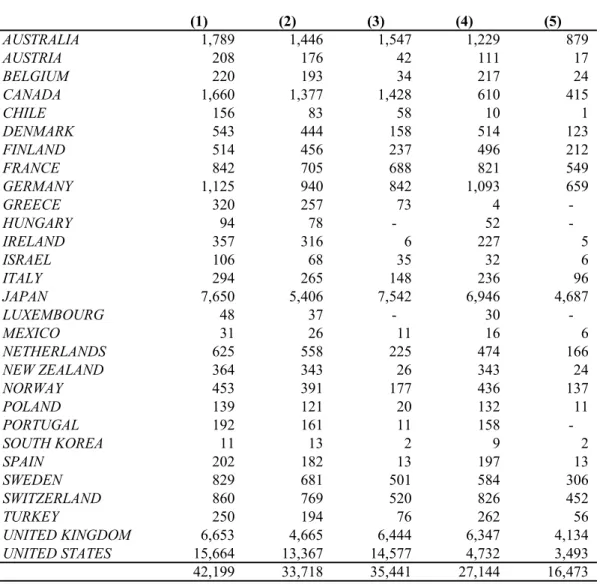
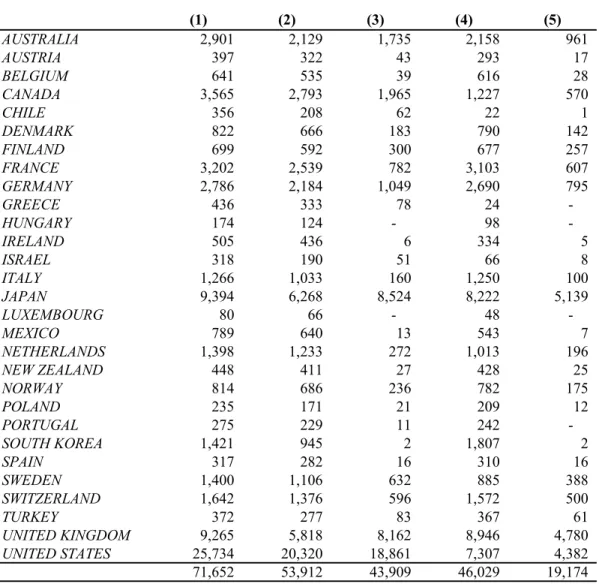
The composition of the sample by country is shown in Table 1. This table presents char-acteristics for country-level opacity variables, corporate statutory tax rate, and IFRS and imputation years. As seen, the sample includes 42,199 rm-year observations with enough data to estimate the least restrictive model using CETRSpr and 71,652 rm-year observa-tions with enough data to estimate the least restrictive model using ETRSpr. The dierence in number of observations between CETRSpr and ETRSpr is the result of less data availabil-ity in Worldscope for cash taxes paid (WC04150) in comparison to total income tax expense (WC01451). Both samples include 30 countries with broad variation in enacted policies, information environment, and corporate statutory rates. An advantage of this international sample is that it is not dominated by the largest most heavily followed rms and, as a result, contains a substantial number of rms for which opacity issues are likely more pronounced. The United States is the most represented country with either 37.1 (CETRSpr) or 35.9 (ETRSpr) percent of the sample domiciled within its borders. Japan and the United King-dom make up the next largest with 18.1 (CETRSpr) or 13.1 (ETRSpr) and 15.8 (CETRSpr) or 12.9 (ETRSpr) percent, respectively. In addition, a few other European countries and
Australia also see modest gains in representation in the cash ETR sample as compared to the reported ETR sample. Additional details regarding the country composition of a specic subsample used in a main test can be found in the country composition panels preceding that test.
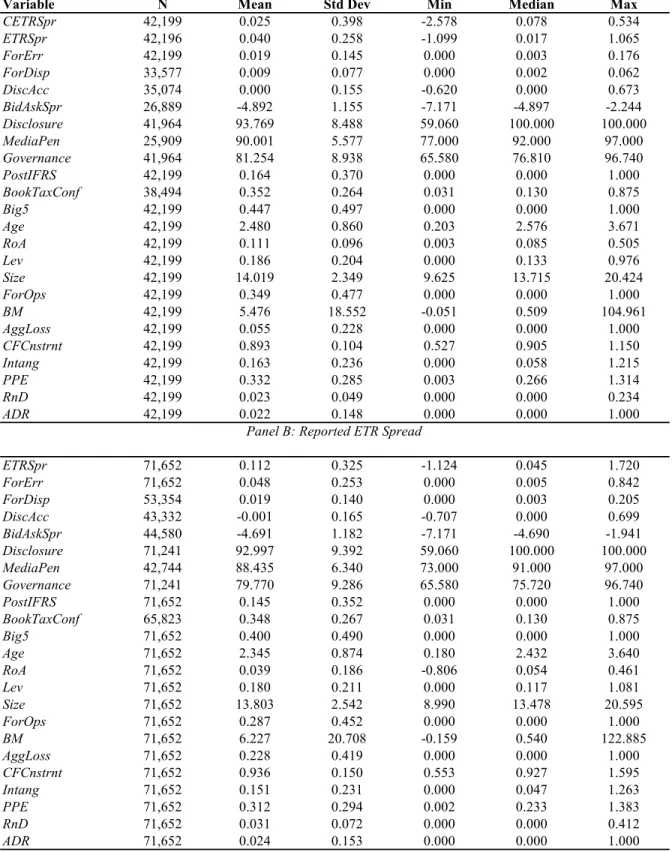
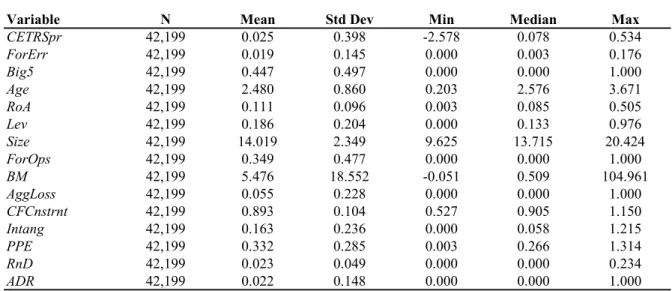
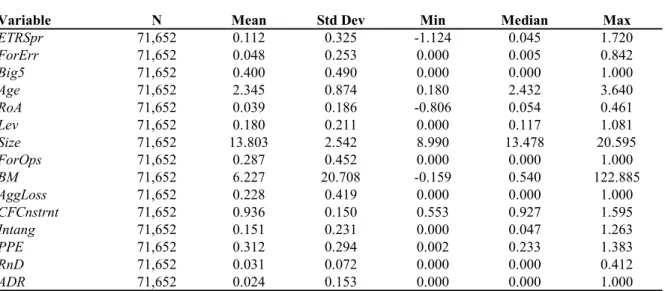
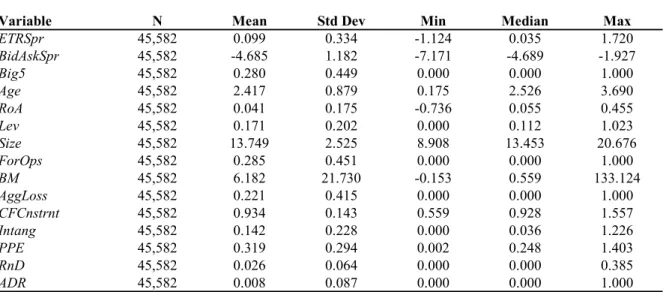
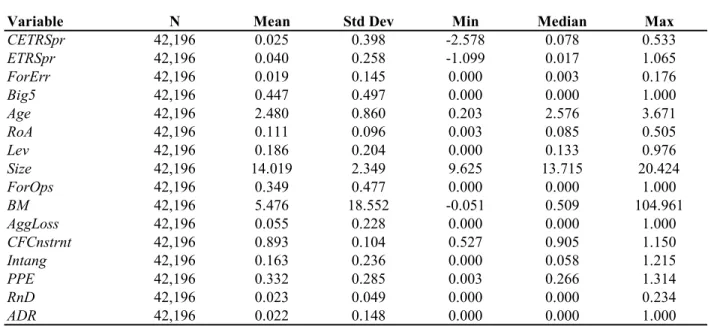
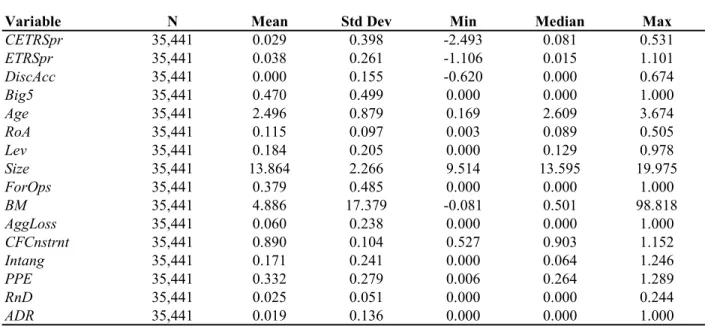
Table 2, Panels A and B presents a summary of rm-level descriptive statistics. Panel A shows descriptive statistics for the least restrictive models using CETRSpr, while Panel B shows descriptive statistics for the least restrictive models using ETRSpr. These statistics are particularly useful when determining the economic signicance of subsequent regression coecients. Both CETRSpr and ETRSpr have mean and median values greater than zero, indicating that the average rm both expenses and pays tax at a rate less than the corporate statutory rate. A comparison between the two panels shows slight dierences in sample char-acteristics with the cash ETR sample containing rms that are, on average, slightly older, larger, and more protable. Overall, however, the rms appear comparable across samples with both containing a diverse group of rms, ranging from small to large, old and young, with a broad representation of protability, growth opportunities, investment decisions, and information environment. Similar to the country composition panels, additional details re-garding the summary statistics of a specic subsample used in a main test can be found in the summary statistic panels preceding that test.
Table 3, Panel A presents a correlation matrix of variables of interest with Pearson correlations reported below the diagonal and Spearman correlations above the diagonal based upon the most restrictive model using listwise deletion. A similar correlation matrix can be found in Table 3, Panel B, which reports the Pearson correlations for the least restrictive model using pairwise deletion. Most of the rm- and country-level opacity measures are signicantly correlated in both panels, suggesting that they capture a shared underlying economic construct. In addition, most of the opacity measures are correlated with the tax avoidance measures and in the expected direction, giving initial credence to the rst hypotheses.
4.2 Results
4.2.1 Tax avoidance and rm-level information opacity
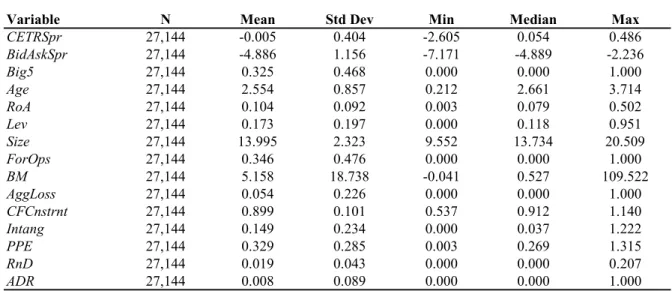
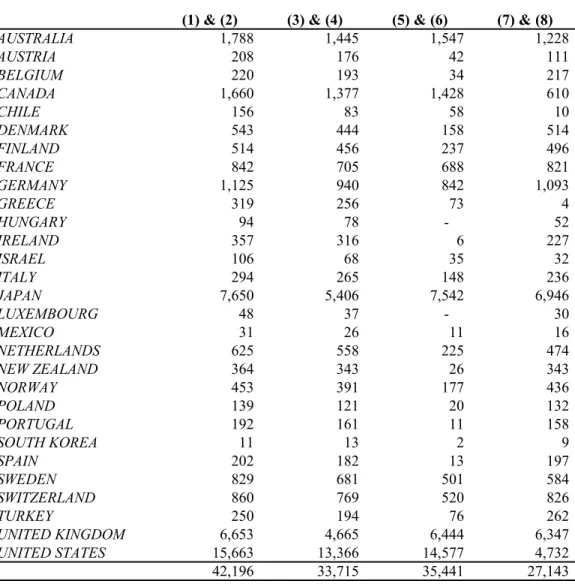
The rst hypothesis predicts that the magnitude of tax avoidance is increasing in the opacity of the nancial reporting environment. Table 4 presents the results for the tests of this prediction using ve dierent measures of rm-level information opacity. In addition, Table 4 also contains panels detailing the country composition and summary statistics used for each subsample. Column (5) of Panels A and B shows results for OScore, a new summary index measure that, as noted in the Appendix, is calculated by adding one to the score when each of the four opacity measures is above its sample median and thus ranges from 0 to 4. Panel A shows results using the cash ETR spread as the dependent variable while Panel B uses the reported ETR spread. In addition, Panel C reports results where the sample is limited to include those rms with requisite data for calculation both CETRSpr and ETRSpr. Country, industry, and year xed eects are included in each model, thus allowing each regression to explicitly focus on rm-level opacity and how its variation within a particular country, industry and year relates to tax avoidance. In Panels A and B the coecient for every measure of opacity is both signicant and positive, indicating that as opacity increases, so too does tax avoidance as measured by CETRSpr and ETRSpr.
Further investigation of Panel A shows that the eect appears to be particularly strong for cash taxes paid, as all ve measures of information opacity are signicant at the 1-percent level for the cash ETR spread. The results in Panel B continue to be signicant and in the expected direction but are slightly weaker in statistical signicance. This may be due to the greater diversity of accounting rules and increased noise in the reported ETRs for an international sample. In general, the coecients on the other variables are also signicant and consistent across models, signifying that tax avoidance is associated with higher leverage, book-to-market, lower cash ow constraints, lower intangibles, and greater property, plant, and equipment (PP&E), and research and development (R&D) intensities. In addition,
Panel A shows that return on assets, rm age, and size are all positively associated with increased tax avoidance as measured by the cash ETR spread, whereas Panel B shows that Big-5 auditor, return on assets, and size are all negatively associated with an increase in the ETR spread. These ndings are consistent with earlier ndings within the literature regarding the ambiguity between certain rm fundamentals and tax avoidance. In addition, Panel C shows that each opacity measure is statistically signicantly in relation to the cash ETR spread, whereas the results where the reported ETR spread is the dependent variable are weaker. This follows the general trend seen in Panels A and B.
Overall, the results of Table 4 on tax avoidance and rm-level opacity support the hy-pothesis that tax avoidance is increasing with more opaque nancial reporting environments and help to clarify the mixed results of earlier studies.
4.2.2 Tax avoidance and country-level information opacity
The prior analysis controlled for country-level xed eects and showed a positive association between tax avoidance and nancial opacity. However, rm-level tax avoidance likely also depends on country-level opacity. The next analysis provides further tests of the empirical
predictions through the use of four country-level opacity measures.11 The inclusion of the
rm-level summary opacity measure, OScore, in each model as an additional control variable means that the eect of the country-level opacity measures are incremental to the rm-level eect.
In addition to test results, Table 5 also contains panels detailing the country composition and summary statistics used for each subsample. Table 5, Panel A shows results for the four country-level variables on the cash ETR spread. The results of Columns (1) through (4) are unambiguous in showing that as country-level opacity increases, as measured by an index of governance, an index of disclosure, the level of media penetration, and the
manda-11These tests also have the advantage that the determinants of country-level opacity are (largely) out of the
rm's control. Therefore, this limits the possibility that the documented associations are due to endogeneity, self-selection, or some other unobservable rm-level characteristic.
tory adoption of IFRS, rm-level tax avoidance decreases and that the eect is incremental to rm-level opacity (which continues to be signicant and positively associated with tax avoidance). The country-level opacity results are signicant at the 1-percent level for all measures. Similar to the rm-level regressions, increased tax avoidance is also associated with return on assets, size, cash ow constraints, PP&E and R&D intensities though results for leverage, book-to-market, and intangibles are weaker.
Table 5, Panel B shows results of the test using the reported ETR spread as the dependent variable. The results of Columns (1) through (4) also nd that each of the country-level opacity measures continues to be signicantly related to the reported ETR spread, though the signicance of OScore is attenuated. This is in line with the rm-level ndings in regard to the results being weaker for the reported ETR spread than for the cash ETR spread. 4.2.3 Directional tests of opacity and tax avoidance
The analyses thus far have shown that both rm- and country-level opacity are associated with rm-level tax avoidance. The next analysis performs tests on the direction of this association as formalized in the second hypothesis. These tests rely upon the idea that nancial reporting opacity serves as a shield behind which management is able to avoid taxes and is a test of a directional hypothesis, namely that tax avoidance follows opacity. To test the direction of the association I estimate dierence-in-dierence regression models using the mandatory adoption of IFRS as an exogenous shock to the nancial reporting environment. The adoption of IFRS led to standards that, when compared to local GAAPs, are more capital-market oriented and provide more extensive measurement and disclosure rules (see Ding et al. 2007 and Bae et al. 2008). Several studies have also shown that IFRS adoption is associated with benets to capital markets, improvements of accounting properties, and more precision in analysts' ability to forecast earnings (see Daske et al. 2008, Byard et al. 2011, and Landsman et al. 2012). The dependent variable is the cash ETR spread because, while the change to IFRS would likely also aect the calculation of tax expense for nancial
reporting purposes, a rm's cash payments made to government agencies (to the extent that the tax regime remains unchanged) should not be. Of additional concern is that the period of IFRS adoption also saw some of the adopting countries making similar changes for tax purposes. In this scenario, IFRS adoption would be a shock to both opacity and tax avoidance as measured through cash taxes paid and would therefore be unsuited for the
dierence-in-dierence tests as an exogenous shock.12
To relieve this concern, I rst determine tax regime changes for each country around the date of IFRS adoption. For a vast majority of the world, taxable prot is based upon the legal-entity (or statutory) accounts since the consolidated company does not exist as a legal entity against which taxes are assessed (see Ng 2009). Therefore, I isolate those countries where IFRS adoption was not accompanied by a shift in the tax regime by looking at the accounting rules governing statutory accounts for each country. To determine the tax regime and the accounting standards used for statutory accounts for the sample of countries, I rely upon two sources of data, the Planned implementation of the IAS Regulation (1606/2002) in the EU and EEA as provided by the European Commission and both the 2009 and 2011 ver-sions of IFRS adoption by country provided by PricewaterhouseCoopers LLP. The Planned implementation of the IAS Regulation (1606/2002) in the EU and EEA, shows the proposed and nal laws in place prior to the mandatory adoption of IFRS regarding whether the coun-try's statutory accounting will also change or be allowed to change to IFRS post adoption. To the extent that information regarding the nal laws is not available from the European Commission document, the ndings are supplemented with the information contained in
12Christensen et al. (2012) show that the market liquidity eects previously documented as relating to the
adoption of IFRS are actually dominated by changes to reporting enforcement as countries began proactively reviewing nancial statements. Using the changes to reporting enforcement here, however, is problematic for many reasons. First, the ndings of Christensen et al. (2012) are in regard to the market liquidity benets of IFRS adoption and not the overall information environment (which includes analysts, earning quality, etc.). While market liquidity is an aspect of information opacity, it is not the focus of this paper. Second, of the ten countries that Christensen et al. (2012) report as initiating the proactive review of nancial statement, only eight are represented in the sample here, ve of which bundled the change in enforcement with IFRS adoption, making it dicult to dierentiate between the two events. Furthermore, only two countries with changes in enforcement also retained their tax regimes, drastically dropping the power of potential tests. Finally, to the extent that the overall opacity shock is actually attributable to reporting enforcement and not IFRS adoption, then that should only bias against nding results using IFRS adoption.
IFRS adoption by country, rst from the 2009 document and then, when necessary, from the 2011 document. Since it is unlikely that the statutory accounts would change to IFRS and then immediately back to local GAAP, I am condent in relying upon these two documents even though they weren't published until many years after IFRS was adopted.
The details regarding country-level tax regimes and statutory accounting are summarized in Table 6. As expected, the vast majority of countries use statutory accounting for tax
purposes with the tax regime classied as being quasi-dependent.13 Only ve countries have
tax regimes classied as independent and only Luxembourg is classied as dependent. In addition, of the 18 countries classied as quasi-dependent and that mandate the adoption of IFRS for consolidated purposes during the sample period, nine do not allow IFRS for statutory accounts, eight permit the use of IFRS for statutory accounts with only New Zealand requiring its use for statutory accounts. The treatment group for the dierence-in-dierence analyses is selected as: 1) those countries that have adopted IFRS, and that 2) have either an independent or quasi-dependent tax regime. Furthermore, for those countries classied as a quasi-dependent tax regime, I require 3) that IFRS be not permitted for statutory accounting purposes. These requirements leave 11 countries that adopt IFRS for nancial purposes but have no change in either the tax regime or the accounting for statutory
accounts.14
In addition, Table 15 provides the change in both the corporate statutory tax rate and the personal statutory tax rate for all countries which adopted IFRS for the three years
13Per IFRS adoption by country, there are three types of tax regimes: dependent, quasi-dependent, and
independent. A dependent tax regime refers to those countries where taxable prot is based on the legal-entity statutory accounts with only limited deductions. Quasi-dependent refers to those countries where taxable prot is principally based on the legal entity statutory accounts with a number of adjustments provided in the tax law. Independent refers to those countries where taxable prot is determined in accordance with a specic set of tax rules with little or no direct reliance on the legal entity statutory accounts of the company.
14Of note here is that some rms and countries had concerns prior to IFRS convergence on the potential
direct impact such convergence might have on rms' tax liabilities. For example, in 2008, subsequent to adopting IFRS for nancial purposes, Spain shifted to a modied Spanish GAAP for tax purposes but passed legislation around the same time in an attempt to ensure that rm-level tax liabilities would not change pre- and post-change. The results of the tests presented here imply that even despite the eorts of such legislation, there may still be an indirect eect on tax avoidance as rms are less able to hide tax avoidance strategies in the more transparent environment.
surrounding IFRS adoption. As is seen there, the adoption to IFRS for most countries did not also include include a change in the tax rate, with only two of the eleven treatment countries having any noticeable change in the CSTR from the year immediately prior IFRS adoption to the year of IFRS adoption. Of these two, Austria experience the greatest change by lowering its CSTR by 9 percentage points. Denmark was the second country and lowered its rate by 2 percentage points. These ndings further reinforces the belief that for these countries the adoption of IFRS did not include a change in tax regime.
To test the direction of the association, I perform pooled OLS regressions of the following form:
T axAvoidi,t =γ0+γ1Adopteri,t+γ2P ostY earsi,t+γ3Adopteri,t∗P ostY earsi,t+
β1Controlsi,t+F ixed Ef f ects+εi,t (2)
where Adopter takes a value of one for rms domiciled in one of the 11 countries chosen according to the three criteria above and zero otherwise. PostYears takes a value of one for
all scal years ending after the IFRS adoption date, December 31, 2005, and zero otherwise.15
Due to Adopter and PostYears both being linear combinations of country or year xed eects, respectively, the model above is also restricted to include only the interaction term. To the extent that tax avoidance follows opacity, tax avoidance will be reduced post-IFRS adoption for the sample of rms in those 11 countries relative to tax avoidance both pre-adoption and for those rms domiciled in other countries. However, to the extent that the direction of the association runs opposite and that opacity leads tax avoidance, there will be no such
eect on tax avoidance. The variable of interest that captures this eect isγ3. A coecient
on γ3 dierent from zero is interpreted as signifying that opacity has a diering impact on
15I focus only on the December 31, 2005, IFRS adoption period and exclude the January 1, 2008, IFRS
adoption by Israeli rms for the following reasons: rst, only a handful of Israeli rms are represented at the later date; and second, due to the sample period only extending to 2008, I am unable to do a full post-IFRS analysis for the Israeli rms that adopted IFRS at the later date.
tax avoidance for the 11 countries identied as IFRS adopters but not tax regime changers after IFRS adoption versus tax avoidance before IFRS adoption and for other countries.
Specically, I expect a negative sign onγ3 when using CETRSpr as the dependent variable.
Due to the exogenous nature of IFRS adoption without tax regime changes, this implies that opacity leads tax avoidance.
The results of this test can be found in Table 7. Columns (1) and (3) of Table 7 report results where the dependent variable is CETRSpr, and Columns (2) and (4) report results where the dependent variable is CETRSca for robustness. In all models the interaction term
γ3 is signicant and in the expected direction (i.e., -0.042 and -0.043 for models where the
dependent variable is CETRSpr and 0.118 and 0.121 for those using CETRSca), suggesting that increased tax avoidance does indeed follow from increased opacity. In addition, neither Adopter nor PostYears is signicantly dierent from zero on its own. This suggests that the reduction in tax avoidance is not due to some inherent country- or time-related charac-teristic but is because of the shock to opacity experienced by these 11 countries post-IFRS adoption. In addition, Table 7, Columns (5) through (8) report robustness results of these tests. Columns (5) and (6) report results using a random selection of 11 countries as IFRS adopters that did not also change tax regimes while Columns (7) and (8) report results using a randomly selected year as the mandatory IFRS adoption year. Due to IFRS adoption oc-curing at a single time for the countries in the sample, these additional tests help to ensure
that the results are not spurious. As is seen in Columns (5) through (8),γ3 is insignicantly
dierent from zero in all four specications, lending further support to the argument that the adoption of IFRS for the 11 countries identied in Table 6 was a shock to opacity and that this shock led to a reduction in tax avoidance.
As is seen in Table 1, the U.S. is a large part of the sample. Since US GAAP is generally of higher quality than the local GAAPs found in other countries (Leuz and Verrecchia 2000), the inclusion of U.S. rms in the control sample in the above tests may be inducing a bias in the results of those tests. Therefore, to ensure the robustness of the results, I next exclude the
U.S. from the control group. As is seen in Table 7, Columns (9) and (10), the results continue to be very statistically signicant, with the coecients on the interaction terms continuing in the desired directions (-0.055 and 0.155 for CETRSpr and CETRSca, respectively) and both signicant at the 5-percent level. These results reinforce those found above and further strengthen the causal argument.
To further test the association, I use a dierence-in-dierence design for the one year immediately before and after IFRS adoption and interact the rm-level summary opacity measure, OScore, with the interaction of PostYears and Adopter (termed PostAdopter) where PostAdopter is again equal to one for those rms in the 11 countries that have adopted IFRS but had no change to the tax regime in the year after IFRS adoption and equal to zero otherwise. This test is performed to determine whether the association between opacity and tax avoidance changes post-IFRS adoption for those 11 countries in the treatment sample. Limiting the analysis to the years immediately before and after adoption focuses on the eect that IFRS adoption has on the ability of rms to use opacity for tax avoidance. As is seen in Table 8, Columns (1) and (2), the coecient on OScore remains signicant and in the expected direction with a value of 0.025 for CETRSpr and -0.071 for CETRSca. This implies that opacity continues to be positively associated with tax avoidance for all rms during those years. Of particular importance, however, is the interaction term between OScore and PostAdopter, which is signicant at the 1 percent level with a coecient of -0.017 and 0.051 for CETRSpr and CETRSca, respectively. This dierential eect pre- and post-IFRS adoption implies that the ability of the rms in those 11 countries to use opacity to avoid taxes is attenuated by the exogenous shock to opacity of IFRS adoption and bolsters the claim that tax avoidance follows nancial opacity. Lastly, but also of interest, is the coecient on PostAdopter, which is not signicant. This is consistent with the reduction in tax avoidance occurring due to the decrease in opacity and not through some alternative channel related to other changes that might have occurred at the time of IFRS adoption. This is expected, as the rms located in countries that could opportunistically change their tax regime to reduce