UNIVERSIDADNACIONAL DECÓRDOBA
La Revista de Economía y Estadística, se edita desde el año 1939. Es una publicación semestral del Instituto de Economía y Finanzas (IEF), Facultad de Ciencias Económicas, Universidad Nacional de Córdoba, Av. Valparaíso s/n, Ciudad Universitaria. X5000HRV, Córdoba, Argentina.
Teléfono: 00 - 54 - 351 - 4437300 interno 253. Contacto:[email protected]
Dirección webhttp://revistas.unc.edu.ar/index.php/REyE/index
REVISTAS de la Universidad Nacional de Córdoba
El Portal de Revistas de la Universidad Nacional de Córdoba es un espacio destinado a la difusión de las investigaciones realizadas por los miembros de la Universidad y a los contenidos académicos y culturales desarrollados en las revistas electrónicas de la Universidad Nacional de Córdoba. Considerando que la Ciencia es un recurso público, es que la Universidad ofrece a toda la comunidad, el acceso libre de su producción científica, académica y cultural.
http://revistas.unc.edu.ar/index.php/index Instituto de
Economía y Finanzas
A Practitioner's Guide to Intergovernmental Fiscal Transfers
Anwar Shah
Revista de Economía y Estadística, Cuarta Época, Vol. 44, No. 2 (2006), pp. 127-186.
http://revistas.unc.edu.ar/index.php/REyE/article/view/4088
Shah, A. (2006). A Practitioner's Guide to Intergovernmental Fiscal Transfers.Revista de Economía y Estadística,Cuarta Época, Vol. 44, No. 2, pp. 127-186.
Disponible en: <http://revistas.unc.edu.ar/index.php/REyE/article/view/4088>
OBSERVATORIO DE POLÍTICA
Esta sección incluye artículos que discuten en forma rigurosa, pero no técnica, temas corrientes de política económica que son de interés por su vinculación al mundo real, aún cuando la literatura económica no los haya todavía incorporado definitivamente y artículos que presentan conte-nidos teóricos o resultados empíricos con implicancias de política relevan-tes. Como en todas las revistas en las que esta sección se incluye, un obje-tivo a destacar es que la misma permite acercar a los investigadores aca-démicos con los formuladores de política aportando, respectivamente unos y otros, desarrollos teórico-conceptuales y empíricos importantes y clari-dad e información sobre las prioriclari-dades de política. Los artículos enviados a para esta Sección están sujetos a los procedimientos normales de refera-to de la Revista.
A Practitioner’s Guide to Intergovernmental
Fiscal Transfers
1A
NWARS
HAH*
World Bank Institute [email protected]
The practice of intergovernmental fiscal tranfers is the magical art of passing money from one government to another and seeing it vanish in thin air.
Anonymous
Abstract
Intergovernmental fiscal transfers are a dominant feature of sub-national finance in most countries. They are used to ensure that revenues roughly match the expenditure needs of various orders (levels) of sub-national governments. They are also used to advance national, regional and local area objectives such as fairness and equity and creating a common economic union. The structure of these transfers create incentives for national, regional and local governments that have a bearing on fiscal management, macroeconomic stability, distributional equity, allocative efficiency and public services delivery. This paper reviews conceptual, empirical and the practice literature to distill lessons of policy interest in designing the fiscal transfers to create the right incentives for prudent fiscal managment and competitive and innovative service delivery. The paper provides practical guidance on the design of performance-oriented
* Dr. Anwar Shah Lead Economist and Program Leader, Public Sector Governance, World Bank Institute, Washington DC.
transfers that emphasize bottom-up, client- focused and results-based government accountability. It cites examples of simple but innovative grant designs that can satisfy grantors’ objectives while preserving local autonomy and creating an enabling environment for responsive, responsible, equitable and accountable public governance. The paper further provides guidance on the design and the practice of equalization transfers for regional fiscal equity as well as the institutional arrangements for implementation of such transfer mechanisms.
The paper concludes with negative (practices to avoid) and positive (practices to emulate) lessons from international practices.
Intergovernmental fiscal transfers finance about 60 percent of subnational expenditures in developing countries and transition economies and about a third of such expenditures in OECD countries (29 percent in the Nordic countries, 46 percent in non-Nordic Europe). Beyond the expenditures they finance, these transfers create incentives and accountability mechanisms that affect the fiscal management, efficiency, and equity of public service provision and government accountability to citizens.
This chapter reviews the principles and practices of intergovernmental finance, with a view to drawing some general lessons of relevance to policymakers and practitioners in developing countries and transition economies. It provides a taxonomy of grants, their possible impacts on local fiscal behavior, and the accountability of grant recipients to donor governments and citizens. The first section describes the instruments of intergovernmental finance. Section 2 discusses performance-oriented, or output-based, transfers, an important tool for results-based accountability. Section 3 describes the objectives and design of fiscal transfers in various countries around the world. It shows that in developing countries and transition economies, fiscal transfers focus largely on revenue-sharing transfers, with little attention paid to serving national objectives. It cites examples of simple but innovative grant designs that can satisfy grantors’ objectives while preserving local autonomy and creating an enabling environment for responsive, responsible, equitable and accountable public governance. Section 4 describes institutional arrangements for determining these transfers. The last section highlights some lessons of relevance to current policy debates in developing countries and transition economies. It lists practices to avoid as well as those to emulate in designing and implementing grant programs.
I. I
NSTRUMENTS OFI
NTERGOVERNMENTALF
INANCEIntergovernmental transfers or grants can be broadly classified into two categories: general-purpose (unconditional) and specific-purpose (conditional or earmarked) transfers.
General-Purpose Transfers
General-purpose transfers are provided as general budget support, with no strings attached. These transfers are typically mandated by law, but occasionally they may be of an ad hoc or discretionary nature. Such transfers are intended to preserve local autonomy and enhance interjurisdictional equity. That is why article 9 of the European Charter of Local Self Government advocates such transfers by stating: “As far as possible, grants to local authorities shall not be earmarked for the financing of specific projects. The provision of grants shall not remove the basic freedom of local authorities to exercise policy discretion within their own jurisdiction.” (Barati and Szalai 2000, p.21)
General-purpose transfers are termed bloc transfers when they are used to provide broad support in a general area of subnational expenditures (such as education) while allowing recipients discretion in allocating the funds among specific uses. Bloc grants are a vaguely defined concept. They fall in the grey area between general-purpose and specific-purpose transfers, as they provide budget support with no strings attached in a broad but specific area of subnational expenditures.
General-purpose transfers simply augment the recipient’s resources. They have only an income effect as indicated in Figure 1.1 by the shift in the recipient’s budget line AB upwards and to the right throughout by the amount of the grant (AC=BD) and the new budget line becomes CD. Since the grant can be spent on any combination of public goods or services or used to provide tax relief to residents, general nonmatching assistance does not affect relative prices (no substitution effect). It is also the least stimulative of local spending, typically increasing such spending by less than $0.50 for each additional $1 of unconditional assistance. The remaining funds are made available as tax relief to local residents to spend on private goods and services .
Figure 1.1
Effect of Unconditional Nonmatching Grant
Source: Shah (1994)
Conceptually a one dollar increase in local residents’ income should have exactly the same impact on local public spending as receipt of one dollar of general purpose transfer. Both tend to shift the budget line outwards identically. Contrary to this, all empirical studies show that a dollar received by the community in the form of general purpose grant tends to have a greater increase in local public spending more than a dollar increase in residents’ income i.e. the portion of grants retained for local spending tends to exceed the effective tax rate imposed by local governments on resident’s incomes (Rosen 2005, Oates 1999, Gramlich 1977; chapter 8 of this volume). Grant money tends to stick where it first lands, leaving a smaller than expected fraction available for tax relief, a phenomenon referred to as the “flypaper effect.” The implication is that for political and bureaucratic reasons, grants to local governments tend to result in more local spending than they would have had the same transfers been made directly to local residents (McMillan, Shah, and Gillen 1980). An explanation for this impact is provided by the hypothesis that bureaucrats seeks to maximize the size of their budgets as it gives them greater power and influence in local community (Filimon, Romer and Rosenthal 1982).
Formula-based general-purpose transfers are very common. The federal and state transfers to municipalities in Brazil are examples of grants of this kind. Evidence suggests that such transfers induce municipalities to underutilize their own tax bases (Shah, 1991).
Specific-Purpose Transfers
Specific-purpose, or conditional, transfers are intended to provide incentives for governments to undertake specific programs or activities. These grants may be regular or mandatory in nature or discretionary or ad hoc.
Conditional transfers typically specify the type of expenditures that can be financed (input-based conditionality). These may be capital expenditures, operating expenditures, or both. Conditional transfers may also require attainment of certain results in service delivery (output-based conditionality). Input-based conditionality is often intrusive and unproductive, whereas output-based conditionality can advance grantors’ objectives while preserving local autonomy.
Conditional transfers may incorporate matching provisions – requiring grant recipients to finance a specified percentage of expenditures using their own resources. Matching requirements can be either open ended, meaning that the grantor matches whatever level of resources the recipient provides, or closed ended, meaning that the grantor matches recipient funds only up to a pre-specified limit.
Matching requirements encourage greater scrutiny and local ownership of grant-financed expenditures; closed-ended matching is helpful in ensuring that the grantor has some control over the costs of the transfer program. Matching requirements, however, represent a greater burden for a recipient jurisdiction with limited fiscal capacity. . In view of this, it may be desirable to set matching rates in inverse proportion to the per capita fiscal capacity of the jurisdiction in order to allow poorer jurisdictions to participate in grant-financed programs.
Nonmatching Transfers
Conditional nonmatching transfers provide a given level of funds without local matching, as long the funds are spent for a particular purpose. Following the grant (=AC), the budget line in Figure 1.2 shifts
from AB to ACD, where at least OE (=AC) of the assisted public good will be acquired.
Figure 1.2
Effect of Conditional Nonmatching Grant
Source: Shah (1994)
Conditional nonmatching grants are best suited for subsidizing activities considered high priority by a higher-level government but low priority by local governments. This may be the case if a program generates a high degree of spillovers up to a given level of provision (OE), after which the external benefits terminate abruptly.
For a given level of available assistance, grant recipients prefer unconditional nonmatching transfers, which provide them with maximum flexibility to pursue their own objectives. Because such grants augment resources without influencing spending patterns, they allow recipients to maximize their own welfare. Grantors, however, may be prepared to sacrifice some recipient satisfaction to ensure that the funds are directed toward expenditures on which they place a priority. This is particularly so when federal objectives are implemented by line agencies or departments rather than through a central agency, such as the Ministry of Finance, with a broader mandate. Federal departments do not want local governments to
shift their program funds toward other areas. In this situation, conditional (selective) nonmatching (bloc) grants can ensure that the funds are spent in a department’s area of interest (for example, health care) without distorting local priorities among alternative activities or inducing inefficient allocations in the targeted expenditure area.
Matching Transfers
Conditional matching grants, or cost-sharing programs, require that funds be spent for specific purposes and that the recipient match the funds to some degree. Figure 1.3 shows the effect on a local government budget of a 25 percent subsidy program for transportation. AB indicates the no subsidy line —the combination of transportation and other public goods and services a city can acquire with a budget of OA = OB. A federal subsidy of 25 percent of transportation expenditures (that is, a grant of $1 for every $3 of local funds for spent on transportation) shifts the budget line of attainable combinations to AC. At any level of other goods and services, the community can obtain one-third more transportation services. If the community chooses combination M before the grant, it will likely select a combination such as N afterward. At N more transportation is acquired.
Figure 1.3
Effect of Open-Ended Matching Grant
The subsidy has two effects, an income effect and a substitution effect. The subsidy gives the community more resources, some of which go to acquiring more transportation services (the income effect). Since the subsidy reduces the relative price of transportation services, the community acquires more transportation services from a given budget (the substitution effect). Both effects stimulate higher spending on transportation.
Although the grant is for transportation, more other public goods and services may also be acquired, even though they become relatively more expensive, as a result of the substitution effect. If the income effect is sufficiently large, it will dominate and the grant will increase consumption of other goods and services. Most studies find that for grants of this kind, spending in the specified area increases by less than the amount of the grant, with the remainder going toward other public goods and services and tax relief. This is the so-called fungibility effectof grants. The fungibility of conditional grants depends on both the level of spending on the assisted public service and the relative priority of such spending. For example, if the recipient’s own-financed expenditure on the assisted category exceeds the amount of the conditional grant, the conditionality of the grant may or may not have any impact on the recipient’s spending behavior: all, some, or none of the grant funds could go to the assisted function. Shah (1985, 1988b, 1989) finds that while provincial assistance to cities in Alberta for public transit was partially diverted to finance other services, similar assistance for road transportation improvement was not. Open-ended matching grants, in which no limit is placed on available assistance through matching provisions, are well suited for correcting inefficiencies in the provision of public goods arising from benefit spillovers, or externalities. Benefit spillovers occur when services provided and financed by a local government also benefit members of other local governments that do not contribute to their provision. Because the providing government bears all the costs but obtains only a portion of the benefits, it tends to underprovide the goods. If the affected communities cannot negotiate compensation, the situation can be corrected by a higher government subsidizing provision of the service, with the extent of the spillover determining the degree of subsidy or the matching ratio.
Matching grants can correct inefficiencies from spillovers, but they do not address uneven or inadequate fiscal capacities across state and local governments. Local governments with ample resources can afford to meet matching requirements and acquire a substantial amount of assistance. States with limited fiscal capacities may be unable to match federal funds
and therefore fail to obtain as much assistance, even though their expenditure needs may be equal to or greater than those of wealthier states (Shah 1991). Other forms of assistance are needed to equalize fiscal capacities in such cases.
Grantors usually prefer closed-ended matching transfers, in which funds are provided to a certain limit, since such transfers permit them to retain control over their budgets. Figure 1.4 shows the effect of closed-ended matching grants on the local budget. AB is the original budget line. When $1 of assistance is available for every $3 of local funds spent up to a prespecified limit, the budget line becomes ACD. Initially, costs are shared on a one-third:two-thirds basis up to a level of OF, at which the subsidy limit of CG (= CE) is reached. Expenditures beyond OF receive no subsidy, so the slope of the budget line reverts back to 1:1 rather than 1:3 along the subsidized segment, AC.
Empirical studies typically find that closed-ended grants stimulate expenditures on the subsidized activity more than open-ended grants (Gramlich 1977; Shah 1994b; Gamkhar and Shah, 2006). The estimated response to an additional $1.00 of this kind of grant is typically $1.50. Institutional factors may explain this surprisingly large response.
Figure 1.4
Effect of Closed-Ended Matching Grant
Why are conditional closed-ended matching grants common in industrial countries when they seem ill designed to solve problems and inefficiencies in the provision of public goods? The answer seems to be that correcting for inefficiencies is not the sole or perhaps even the primary objective. Instead, grants are employed to help local governments financially while promoting spending on activities given priority by the grantor. The conditional (selective) aspects of or conditions on the spending are expected to ensure that the funds are directed toward an activity the grantor views as desirable. This, however, may be false comfort in view of the potential for fungibility of funds. The local matching or cost-sharing component affords the grantor a degree of control, requires a degree of financial accountability by the recipient, and makes the cost known to the granting government.
Conditional closed-ended matching grants have advantages and disadvantages from the grantor’s perspective. While such grants may result in a significant transfer of resources, they may distort output and cause inefficiencies, since the aid is often available only for a few activities, causing overspending on these functions while other functions are underfinanced. If capital outlays are subsidized while operating costs are not, grants may induce spending on capital-intensive alternatives.
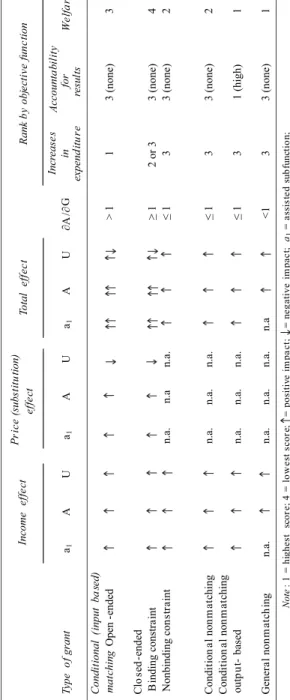
Conditional open-ended matching grants are the most suitable vehicles to induce lower-level governments to increase spending on the assisted function (table 1.1). If the objective is simply to enhance the welfare of local residents, general-purpose nonmatching transfers are preferable, as they preserve local autonomy.
To ensure accountability for results, conditional nonmatching output-based transfers are preferable to other types of transfers. Output-based transfers respect local autonomy and budgetary flexibility while providing incentives and accountability mechanisms to improve service delivery performance. The design of such transfers is discussed in the next section.
T
able 1.1
T
axonomy of Grants and
Their
Conceptual Impacts
Sour
ce
:
II. A
CHIEVINGR
ESULTS-B
ASEDA
CCOUNTABILITY THROUGHP
ERFORMANCE-O
RIENTEDT
RANSFERSEconomic rationales for output-based grants (used interchangeably with performance-oriented transfers in this chapter) stem from the emphasis on contract-based management under the new public management framework and strengthening demand for good governance by lowering the transactions costs for citizens in obtaining public services under the new institutional economics approach. The new public management framework seeks to strengthen accountability for results by changing the management paradigm in the public sector from permanent appointments to contractual appointment and continuation of employment subject to fulfillment of service delivery contracts. It seeks to create a competitive service delivery environment by making financing available on similar conditions to all providers –government and non-government. The new institutional economics approach argues that dysfunctional governance in the public sector results from opportunistic behavior by public officials, as citizens are either not empowered to hold public officials accountable for their noncompliance with their mandates and/or for corrupt acts or face high transactions costs in doing so. In this framework, citizens are treated as the principals and public officials the agents. The principals have bounded rationality—they act rationally based on the incomplete information they have. Acquiring and processing information about public sector operations is costly. Agents (public officials) are better informed than principals. Their self-interest motivates them to withhold information from the public domain, as releasing such information helps principals hold them accountable. This asymmetry of information allows agents to indulge in opportunistic behavior which goes unchecked due to high transactions costs faced by the principals and a lack of or inadequacy of countervailing institutions to enforce accountable governance. Results-based accountability through output-based grants empowers citizens by increasing their information base and lowering their transactions costs in demanding action. Output-based transfers link grant finance with service delivery performance. These transfers place conditions on the results to be achieved while providing full flexibility in the design of programs and associated spending levels to achieve those objectives. Such transfers help restore recipients’ focus on the results-based chain (figure 1.5) and the alternate service delivery framework (competitive framework for public service delivery) to achieve those results. In order to achieve grant objectives, a
public manager in the recipient government would examine the results-based chain to determine whether or not program activities are expected to yield the desired results. To do so, he or she needs to monitor program activities and inputs, including intermediate inputs (resources used to produce outputs), outputs (quantity and quality of public goods and services produced and access to such goods and services), outcomes (intermediate-to long-run consequences for consumers/taxpayers of public service provision or progress in achieving program objectives), impact (program goals or very long-term consequences of public service provision), and reach (people who benefit from or are hurt by a program). Such a managerial focus reinforces joint ownership and accountability of the principal and the agent in achieving shared goals by highlighting terms of mutual trust. Thus internal and external reporting shifts from the traditional focus on inputs to a focus on outputs, reach, and outcomes —in particular, outputs that lead to results. Flexibility in project definition and implementation is achieved by shifting emphasis from strict monitoring of inputs to monitoring performance results and their measurements. Tracking progress toward expected results is done through indicators, which are negotiated between the provider and the financing agency. This joint goal setting and reporting helps ensure client satisfaction on an ongoing basis while building partnership and ownership into projects (Shah 2005b).
Figure 1.5
Output-based grants must have conditions on outputs as opposed to outcomes, as outcomes are subject to influence by factors beyond the control of a public manager. Public managers should be held accountable only for factors under their control. Outcome-based conditions diffuse enforcement of accountability for results. Since the grant conditions are concerned with service delivery performance in terms of quality of output and access, the manager is free to choose the program and inputs to deliver results. To achieve those results, he or she faces positive incentives by grant conditions that encourage alternate service delivery mechanisms by contracting out, outsourcing, or simply encouraging competition among government and nongovernment providers. This can be done by establishing a level playing field through at par financing, by offering franchises through competitive bidding, or by providing rewards for performance through benchmarking or yardstick competition. Such an incentive environment is expected to yield a management paradigm that emphasizes results-based accountability to clients with the following common elements:
• Contracts or work program agreements based on pre-specified outputs and performance targets and budgetary allocations.
• Replacement of lifelong rotating employment with contractual appointments with task specialization.
• Managerial flexibility but accountability for results.
• Redefinition of public sector role as purchaser but not necessarily provider of public services.
• Adoption of the subsidiarity principle —that is, public sector decisions made at the level of government closest to the people, unless a convincing case can be made not to do so.
• Incentives for cost efficiency.
• Incentives for transparency and competitive service provision. • Accountability to taxpayers.
Under such an accountable governance framework, grant-financed budget allocations support contracts and work program agreements, which are based on prespecified outputs and performance targets. The grant recipient’s flexibility in input selection —including hiring and firing of personnel and implementation of programs —is fully respected, but there is strict accountability for achieving results. The incentive and accountability
regime created by output-based transfers is expected to create responsive, responsible, and accountable governance without undermining local autonomy. In contrast, traditional conditional grants with input conditionality undermine local autonomy and budgetary flexibility while reinforcing a culture of opportunism and rent seeking (Table 1.2).
Table 1.2
Features of Traditional and Output-Based Conditional Grants
Output-based grants create incentive regimes that promote a results-based accountability culture. Consider the case in which the national government aims to improve access to education by the poor and to enhance the quality of such education. A common approach is to provide grants to government schools through conditional grants. These grants specify the type of expenditures eligible for grant financing (books, computers, teacher aids, and so forth) as well as financial reporting and audit requirements. Such input conditionality undermines budgetary autonomy and flexibility without providing any assurance about the achievement of results. Moreover, in practice it is difficult to enforce, as there may be significant opportunities for fungibility of funds. Experience has shown that there is no one-to-one link between increases in public spending and improvements in service delivery performance (see Huther, Roberts, and Shah 1997).
Output-based design of such grants can help achieve accountability for results. Under this approach, the national government allocates funds to local governments based on the size of the school-age population. Local governments in turn pass these funds on to both government and non-government providers based on school enrollments. Non-non-government providers are eligible to receive grant funds if they admit students based on merit and provide a tuition subsidy to students whose parents cannot afford the tuition. All providers are expected to improve or at the minimum maintain baseline achievement scores on standardized tests, increase graduation rates, and reduce dropout rates. Failure to do so will invite public censure and in the extreme case cause grant funds to be discontinued. In the meantime, reputation risks associated with poor performance may reduce enrollments, thereby reducing the grant funds received. Schools have full autonomy in the use of grant funds and are able to retain unused funds.
This kind of grant financing would create an incentive environment for both government and non-government schools to compete and excel to retain students and establish reputations for quality education, as parental choice determines grant financing to each school. Such an environment is particularly important for government schools, where staff have lifelong appointments and financing is ensured regardless of performance. Budgetary flexibility and retention of savings would encourage innovation to deliver quality education.
Output-based grants thus preserve autonomy, encourage competition and innovation, and bring strict accountability for results to residents. This accountability regime is self-enforcing through consumer (parental choice in the current example) choice.
III. D
ESIGNINGF
ISCALT
RANSFERS: D
IVIDING THES
POILS ORC
REATING AF
RAMEWORK FORA
CCOUNTABLE ANDE
QUITABLEG
OVERNANCE?
The design of fiscal transfers is critical to ensuring the efficiency and equity of local service provision and the fiscal health of subnational governments (for a comprehensive treatment of the economic rationale of intergovernmental fiscal transfers, see Boadway and Shah forthcoming). A few simple considerations can be helpful in designing these transfers:
Guidelines for Grant Design
1) Clarity in grant objectives. Grant objectives should be clearly and precisely specified to guide grant design.
2) Autonomy. Subnational governments should have complete
independence and flexibility in setting priorities. They should not be constrained by the categorical structure of programs and uncertainty associated with decisionmaking at the center. Tax-base sharing —allowing subnational governments to introduce their own tax rates on central bases, formula-based revenue sharing, or bloc grants— is consistent with this objective.
3) Revenue adequacy. Subnational governments should have adequate revenues to discharge designated responsibilities.
4) Responsiveness. The grant program should be flexible enough to accommodate unforeseen changes in the fiscal situation of the recipients.
5) Equity (fairness). Allocated funds should vary directly with fiscal need factors and inversely with the tax capacity of each jurisdiction.
6) Predictability. The grant mechanism should ensure predictability of subnational governments’ shares by publishing five-year projections of funding availability. The grant formula should
specify ceilings and floors for yearly fluctuations. Any major changes in the formula should be accompanied by hold harmless or grandfathering provisions.
7) Transparency. Both the formula and the allocations should be
disseminated widely, in order to achieve as broad a consensus as possible on the objectives and operation of the program.
8) Efficiency. The grant design should be neutral with respect to subnational governments’ choices of resource allocation to different sectors or types of activity.
9) Simplicity. Grant allocation should be based on objective factors over which individual units have little control. The formula should be easy to understand, in order not to reward grantsmanship.
10) Incentive. The design should provide incentives for sound fiscal management and discourage inefficient practices. Specific transfers to finance subnational government deficits should not be made.
11) Reach. All grant-financed programs create winners and losers. Consideration must be given to identifying beneficiaries and those who will be adversely affected to determine the overall usefulness and sustainability of the program.
12) Safeguarding of grantor’s objectives. Grantor’s objectives are best safeguarded by having grant conditions specify the results to be achieved (output-based grants) and by giving the recipient flexibility in the use of funds.
13) Affordability. The grant program must recognize donors’ budget constraints. This suggests that matching programs should be closed ended.
14) Singular focus. Each grant program should focus on a single
objective.
15) Accountability for results. The grantor must be accountable for the design and operation of the program. The recipient must be accountable to the grantor and its citizens for financial integrity and results —that is, improvements in service delivery performance. Citizens’ voice and exit options in grant design can help advance bottom-up accountability objectives.
therefore have to assign priorities to various factors in comparing design alternatives (Shah 1994b); Canada 2006).
For enhancing government accountability to voters, it is desirable to match revenue means (the ability to raise revenues from own sources) as closely as possible with expenditure needs at all levels of government. However, higher-level governments must be allowed greater access to revenues than needed to fulfill their own direct service responsibilities, so that they are able to use their spending power through fiscal transfers to fulfill national and regional efficiency and equity objectives.
Six broad objectives for national fiscal transfers can be identified. Each of these objectives may apply to varying degrees in different countries; each calls for a specific design of fiscal transfers. Lack of attention in design to specific objectives leads to negative perceptions of these grants (Box 1.1).
Box 1.1 Well-Founded Negative Perceptions of Intergovernmental Finance
Perceptions of intergovernmental finance are generally negative. Many federal officials believe that giving money and power to subnational governments is like giving whiskey and car keys to teenagers. They believe that grant monies enable these governments to go on spending binge and the national government then is faced with the consequences of their reckless spending behaviors. Past spending behavior of provincial and local officials also demonstrates that ‘grant money does not buy anything’ meaning that it is treated as a windfall gain and wastefully expended with little to show for in service delivery improvements. Citizens perceive the granting of intergovernmental fiscal transfers as the magical art of passing money from one government to another and seeing it vanish into thin air.
These perceptions are well grounded in reality in developing countries, where the primary focus of fiscal transfers is on dividing the spoils. In developing (and industrial) countries, four types of transfers are common:
• Passing the buck transfers. These are general revenue–sharing
programs that employ multiple factors that work at cross purposes. Argentina, Brazil, India, the Philippines, and many other countries have such ongoing programs.
• Asking for more trouble grants. These are grants that finance subnational deficits, in the process encouraging higher and higher deficits. China, Hungary, and India provide this type of grants. • Pork barrel transfers. In the past politically opportunistic grants
were common in Brazil and Pakistan. They are currently in vogue in India and Western countries especially the United States of America. • Command and control transfers. These are grants with conditions on
inputs. They are used to micromanage and interfere in local decisionmaking. They are widely practiced in most industrial and developing countries.
Source: Author.
Source: Cartoon by Nicholson from The Australiandated November 3, 1997. www.nicholsoncartoons.com.au
Bridging Vertical Fiscal Gaps
The terms vertical fiscal gap and vertical fiscal imbalance have been mistakenly used interchangeably in recent literature on fiscal decentralization. A vertical fiscal gap is defined as the revenue deficiency
arising from a mismatch between revenue means and expenditure needs, typically of lower orders of government. A national government may have more revenues than warranted by its direct and indirect spending responsibilities; regional and local governments may have less revenues than their expenditure responsibilities.
A vertical fiscal imbalance occurs when the vertical fiscal gap is not adequately addressed by the reassignment of responsibilities or by fiscal transfers and other means. Boadway (2002b) argues that vertical fiscal imbalance incorporates an ideal or optimum view of expenditures by different orders of government and is therefore hard to measure.
Vertical fiscal gap may arise due to (a) inappropriate assignment of responsibilities; or (b) centralization of taxing powers; or (c) pursuit of beggar-thy-neighbor tax policies (wasteful tax competition) by subnational governments; and (d) lack of tax room at subantional levels due to heavier tax burdens imposed by the central government. To deal with the vertical fiscal gap, it is important to deal with its sources through a combination of policies such as the reassignment of responsibilities, tax decentralization or tax abatement by the center and tax-base sharing (by allowing subnational governments to levy supplementary rates on a national tax base). Only as a last resort should revenue sharing, or unconditional formula-based transfers, all of which weaken accountability to local taxpayers, be considered to deal with this gap. Taxation by tax-sharing, as practiced in China and India, is particularly undesirable, as it creates incentives for donors to exert less effort in collecting taxes that are shared than they would collecting taxes that are fully retained. In industrial countries the fiscal gap is usually dealt with by tax decentralization or tax-base sharing. Canada and the Nordic countries have achieved harmonized personal and corporate income tax systems by allowing the central government to provide tax abatement and subnational governments to impose supplementary rates on the national tax base. In developing countries and transition economies, both tax by tax sharing and general revenue sharing are typically used to deal with the fiscal gap.
A number of countries, including China, India, Malaysia, Pakistan, Sri Lanka and South Africa, have in the past, provided deficit grants to fill fiscal gaps at subnational levels —with unwelcome results in terms of mushrooming of subnational deficits. These grants are still in vogue in China, Hungary, and South Africa.
Bridging the Fiscal Divide through Fiscal Equalization Transfers
Fiscal equalization transfers are advocated to deal with regional fiscal equity concerns. These transfers are justified on political and economic considerations.
Large regional fiscal disparities can be politically divisive and may even create threats of secession (Shankar and Shah 2003). This threat is quite real: since 1975 about 40 new countries have been created by the break-up of existing political unions. Fiscal equalization transfers could forestall such threats and create a sense of political participation, as demonstrated by the impact of such transfers on the separatist movement in Quebec, Canada.
Decentralized decisionmaking results in differential net fiscal benefits (imputed benefits from public spending minus tax burden) for citizens depending on the fiscal capacities of their place of residence. This leads to both fiscal inequity and fiscal inefficiency in resource allocation. Fiscal inequity arises as citizens with identical incomes are treated differently depending on their place of residence. Fiscal inefficiency in resource allocation results from people in their relocation decisions comparing gross income (private income plus net public sector benefits minus cost of moving) at new locations; economic efficiency considerations warrant comparing private income minus moving costs only without any regard to public sector benefits. A nation that values horizontal equity (the equal treatment of all citizens nationwide) and fiscal efficiency needs to correct the fiscal inequity and inefficiency that naturally arise in a decentralized government. Grants from the central government to states and/or local governments can eliminate these differences in net fiscal benefits if the transfers depend on the tax capacity of each state relative to others and on the relative need for and cost of providing public services. The more decentralized the tax system is, the greater the need for equalizing transfers.
The elimination of net fiscal benefits requires a comprehensive fiscal equalization program that equalizes fiscal capacity (the ability to raise revenues from own basis using national average tax rates) to a national average standard and provides compensation for differential expenditure needs and costs due to inherent cost disabilities rather than differences that reflect different policies. Some economists argue that if public sector tax burdens and service benefits are fully capitalized in property values, the case for fiscal equalization transfers is weaker, as
residents in rich states pay more for private services and less for public services and vice versa in poorer states. According to this view, as argued by Oates (1982), fiscal equalization is a matter of political taste. This view has gained currency at the federal level in the United States and explains why there is no federal fiscal equalization program there. In contrast, local fiscal equalization drives most state assistance to local governments in the USA, especially school finance (Box 1.2).
Box 1.2 Financing Schools in the United States
U.S. states have taken various approaches to school finance. The states of Hawaii, Idaho, and Washington fully finance primary and secondary education. In contrast, New Hampshire covers only 9 percent of school finance.
Delaware and North Carolina finance education through bloc grants that are indexed to population, GDP, and inflation growth rates. The grants are derived by calculating equal amounts per unit based on the number of students, teachers, classrooms, courses, classes, and other factors. The units can be standardized using various yardsticks, such as class size and teacher: pupil ratios. Various measures of students, including enrollment, average daily attendance, enrollment weighted by grades, types of programs, and number of students with special needs, are used.
Other states use equalization grants, including foundation grants, percentage equalization grants, and district power equalization grants.
Foundation grants vary inversely with the fiscal capacity of a school board. The grant allocation is based on an application of the representative tax system approach to fiscal capacity equalization per student across school districts. The following formula is used:
foundation grant = (maximum per student grant – own school district contribution per student based on mandated minimum tax rate applied to per student tax base) x enrollment
Forty-two states have adopted variants of this approach, with 22 states specifying the minimum mandated tax rate. Various measures are used to determine enrollment, including the number of students on the rolls on a specified date, average daily attendance, and average attendance over a period. Most states (36) use a scheme that weights enrollment by grade, program, and student disabilities.
Rhode Island uses a percentage equalization grant —a matching cum equalization grant for school spending based on the following formula:
grant per student = [1– matching rate x (per capita tax capacity in the district/ state average district tax capacity per capita)] x district spending per capita
District power equalization grants, used in Indiana and Washington, include incentives for increased tax effort in an equalizing grant. The formula used is:
grant = (per capita average fiscal capacity – per capita fiscal capacity of the district) x district tax rate
Source: Vaillancourt (1998).
Conceptually, full capitalization requires a small open area with costless mobility. Most federations and even states in large countries do not fulfill this condition. As a result, criticism of fiscal equalization using the capitalization argument may have only weak empirical support (Shah, 1988a).
In principle, a properly designed fiscal equalization transfers program corrects distortions that may cause fiscally induced migration by equalizing net fiscal benefits across states. A reasonable estimate of the costs and benefits of providing public services in various states is essential to measure net fiscal benefits. Measures of differential revenue-raising abilities and the needs and costs of providing public services in different states must be developed. Equalization of net fiscal benefits could then be attempted by adopting a standard of equalization and establishing the means of financing the needed transfers.
Measuring Fiscal Capacity
Estimating fiscal capacity —the ability of governmental units to raise revenues from their own sources— is conceptually and empirically difficult. The two most common ways of doing so are with macroeconomic indicators and the representative tax system.
Various measures of income and output serve as indicators of the ability of residents of a state to bear tax burdens. Among the better known measures are the following:
• State gross domestic product (GDP). State GDP represents the total value of goods and services produced within a state. It is an imperfect guide to the ability of a state government to raise taxes, since a significant portion of income may accrue to nonresident owners of factors of production. For example, the Northern Territory has the highest per capita income in Australia, but it is treated as the poorest jurisdiction in federal-state fiscal relations.
• State factor income. State factor income includes all income —capital and labor— earned in the state. It makes no distinction between income earned and income retained by residents.
• State factor income accruing to residents only.This measure represents a more useful measure, provided states are able to tax factor income. • State personal income. The sum of all income received by residents of
a state is a reasonable measure of the state’s ability to bear tax burdens. It is an imperfect and partial measure of the ability to impose tax burdens, however, and therefore not a satisfactory measure of overall fiscal capacity.
• Personal disposable income. Personal disposable income equals
personal income minus direct and indirect taxes plus transfers. This concept is subject to the same limitations affecting personal income.
In general, macro measures do not reflect the ability of subnational governments to raise revenues from own sources. Boadway argues against the use of macro indicators in an equalization formula on the grounds that a macro formula “ignores the fact that fiscal inefficiency and fiscal inequity are the products of the actual mix of taxes chosen by provincial governments” (Boadway, 2002a, 12). This neglect runs the risk of violating the principles of equalization itself. A second major difficulty in the use of macro indicators is the availability of accurate and timely data at subnational levels. Such data become available only with significant lags, and the accuracy of such data may be questionable. Use of these data may therefore invite controversy (see Aubut and Vaillancourt 2001 for a Canadian illustration of this point). Despite these problems, both Brazil and India use macro indicators in their federal-state revenue-sharing programs.
The representative tax system approach measures the fiscal capacity of a state by the revenue that could be raised if the government employed all of the standard sources at the nationwide average intensity of use.
Estimating equalization entitlements using the representative tax system requires information on the tax bases and tax revenues for each state. Fiscal capacity of the have-not states is brought up to the median, mean, or other norm. Using the mean of all states as a standard, the state equalization entitlement for a revenue source is determined by the formula:
where Ei is the equalization entitlement of state x from revenue
source i, POPis population, PCTBiis the per capita tax base of revenue
source i, tiis the national average tax rate of revenue source i, subscript na
is the national average, and subscript x is state x. The equalization entitlement for a state from a particular revenue source can be negative, positive, or zero. The total of these values indicates whether a state receives a positive or negative entitlement from the interstate revenue-sharing pool. Since data on major tax bases and tax collections required to implement representative tax system are usually published regularly by various levels of government, the representative tax system does not impose new data requirements and can be readily implemented in countries that have decentralized taxing responsibility to subnational levels, as most transition economies do. Of course, implementing such a system will not be feasible in countries with limited tax decentralization (very large vertical fiscal gaps) or poor tax administration.
Measuring Expenditure Needs
The case for fiscal equalization rests on eliminating different net fiscal benefits across states that give rise to fiscally induced migration. Such differential net fiscal benefits can arise as a result of decentralization of taxing authority and decentralized public expenditures. Differences in the demographic composition of the population across jurisdictions will result in differential needs for decentralized public services, such as education, health and social welfare. Differences in age distribution affect the need for schools, hospitals, and recreational facilities. Differences in the incidence of poverty and disease may affect the need for education, training, health, social services, and transfer payments. Jurisdictions with higher need factors would have greater need for revenues to provide comparable levels of public services at comparable levels of taxation. These need differentials are likely to cause substantial variations across
jurisdictions in the level and mix of public goods provided, resulting in different net fiscal benefits A strong case for equalization can be established on grounds of efficiency and equity to compensate for need differentials that give rise to different net fiscal benefits.
The fiscal federalism literature treats differential costs as synonymous with differential needs, but some cost differences may arise from deliberate policy decisions by subnational governments rather than differences in need. Boadway (2004) argues that even for inherent cost disadvantages, such as differences between urban and rural areas, the equity advantage of more equal provision must be weighed against the efficiency costs. If it is more costly to deliver public services in rural areas than urban areas, it is inefficient for an equalization program to neutralize these cost differences. Even in unitary states, the level of public services in remote, rural, or mountainous areas is usually lower than in more densely populated urban areas. Under a decentralized fiscal system, a policy choice must be made about minimum standards, but there is no justification for providing the same level of services in remote and urban areas, as the Australian fiscal need equalization program does. Instead, as Boadway suggests, one could stratify locations in all regions by their costs and equalize across regions within comparable strata. Equalization grants should partially offset only inherent disabilities, disregarding cost differences that reflect deliberate policy decisions or differences in the efficiency with which resources are used.
In practice, expenditure need is more difficult to define and derive than fiscal capacity. The difficulties include defining an equalization standard; understanding differences in demographics, service areas, populations, local needs, and policies; and understanding strategic behavior of recipient states. Despite these formidable difficulties, numerous attempts have been made to measure expenditure need. The approaches can be broadly classified into three main categories: (a) ad hoc determination of expenditure needs, (b) representative expenditure system using direct imputation methods, and (c) the theory-based representative expenditure system.
(a) Ad hoc determination of expenditure needs uses simple
measures of expenditure needs in general-purpose transfers. The factors used and their relative weights are arbitrarily determined. Germany uses population size and population density adjustments, China uses the number of public employees, India uses measures of backwardness.
The Canadian provinces use simple measures of expenditure need in their general-purpose transfers to municipalities These include
population size, population density, population growth factors, road length, number of dwelling units, location factors (such as northern location), urbanization factors (primary urban population and urban/rural class) and social assistance payments (see Shah 1994b). The most sophisticated of these approaches is the one taken by Saskatchewan, where the standard municipal expenditure of a class of municipalities is assumed to be a function of the total population of the class. Regression analysis is used to derive a graduated standard per capita expenditure table for municipal governments by population class.
An interesting example of the application of this approach is South Africa’s use of it in its equitable share transfers to the provinces (South Africa 2006). The equitable share formula applicable for 2006–08 focuses almost entirely on need factors, with only a 1 percent weight given to negative needs (per capita GDP). The formula uses the following shares: • A basic share (14 percent weight) is derived from each province’s share
of the national population.
• An education share (51 percent) is based on the size of the school-age population (5–17) and the average number of learners (grades R–12) enrolled in public ordinary schools over the past three years.
• A health share (26 percent) is based on the proportion of the population with and without access to medical aid.
• An institutional component (5 percent) is divided equally among the provinces.
• A poverty component (3 percent) is based on incidence of poverty. • An economic output component (1 percent) is based on data on GDP
by region.
(b) The representative expenditure system using direct imputation methodsseeks to create a parallel system to the representative tax system on the expenditure side. This is done by dividing subnational expenditures into various functions, determining total expenditures by each jurisdiction for each function, identifying relative need/cost factors, assigning relative weights using direct imputation methods or regression analysis, and allocating total expenditures of all jurisdictions on each function across jurisdictions on the basis of their relative costs and needs for each function (see table 1.3 for a compilation of need factors used in industrial countries).
T
able 1.3
Measur
ement of Fiscal Needs by Service Category
Sour
ce:
The advantage of this approach is that it obviates the need for the very elaborate calculations and assumptions needed to quantify the provision of services at some defined level. It does so by using the sum of actual total expenditures as the point of departure for measuring expenditure needs, reducing the problem to one of allocating total need among subnational governments on the basis of selected indicators of need, including proxies for need if desired. The disadvantage of this approach is that it does not necessarily exclude expenses incurred by any of the provinces that go beyond the concept of a “reasonable level of public service”. However, the approach can be adjusted to exclude identifiable excesses from total expenditures (for example gold standards for some services or relatively unafforadble benefits provided by some rich states) in respect of which needs are to be allocated.
A sophisticated variant of this methodology is used by the Commonwealth Grants Commission of Australia, which defines expenditure as the cost of supplying average performance levels for the existing mix of state-local programs. Relative expenditure needs are then determined empirically using direct imputation methods for 41 state-local expenditures. The following hypothetical example illustrates the treatment of welfare expenditures using a crude approach similar to that used by the Commonwealth Grants Commission for establishing expenditure needs under a representative expenditure system.
Assume that there are 10 states in Grantland, that the unit costs of welfare are equal in all states, and that needs for welfare vary based on the percentage of the working-age population that is unemployed, the percentage of the population that is not of working age, and the percentage of families with a single parent. The independent grants commission assigns a 40 percent weight to the percentage of the working-age population that is unemployed, a 35 percent weight to the percentage of the population that is not of working age, and a 25 percent weight to the percentage of families with a single parent. Assume that expenditures by all states for welfare total $5 billion and that state Aaccounts for 4.8 percent of the 10-state total for the first factor, 3.0 percent of the total for the second factor, and 2.2 percent of the total for the third factor. State A’s estimated need for a standard level of welfare expenditure would then equal:
$5 billion x (0.048 x 0.40) + (0.03 x 0.35) + (0.022 x 0.25) = $176 million, or 3.2 percent of all state expenditures.
Shah (1994a) provides an application of the approach using provincial-local expenditure functions for Canada and uses quantitative analysis in selection and weighting of factors for various l expenditure functions (see Table 1.4).
Table 1.4
Weighting of factors for provincial-local expenditure functions for Canada
Note: Calculations based on regression coefficients. The use of a variable prefixed by I means that a relative index of the variable is used.
This approach is highly subjective and therefore potentially controversial. Recent experience in Australia vividly demonstrates the problems that arise if such an approach is followed in practice as discussed in the following section. Some subjectivity and imprecision can be alleviated by using quantitative analysis in choosing factors and weights, as Shah suggests (1994a).
(c) The Theory-based representative expenditure system. The
representative expenditure system can be significantly improved using a conceptual framework that embodies appropriately defined concept of fiscal need and properly specified expenditure functions that are estimated using objective quantitative analysis, as proposed by Shah (1996) for Canada. Under this refined approach, the so-called the theory-based representative expenditure system, the equalization entitlement from expenditure category iequals the per capita potential expenditure of state
Afor category i based on own need factors if it had national average fiscal capacity minus per capita potential expenditure of state Aon expenditure category i if it had national average need factors and national average fiscal capacity.
This approach is even more difficult to implement than the less refined approach, but it has the advantage of objectivity and it enables the analyst to derive measures based on actual observed behavior rather than ad hoc value judgments. The relative weights assigned to various need factors and their impact on allocation of grant funds are determined by econometric analysis. Furthermore, this approach yields both the total pool and the allocation of fiscal need equalization grants among recipient units. This method requires specifying determinants for each service category, including relevant fiscal capacity and public service need variables. A properly specified regression equation yields quantitative estimates of the influence each factor has in determining spending levels of a category of public service. This information can be analyzed to determine what each state would actually have spent if it had national average fiscal capacity and but actual need factors. This then can be compared to the standard expenditure for each service based upon an evaluation of the same equation for determining what each state would have spent if it had the national average fiscal capacity and also national average need factors. The sum of differences of these two expressions for all expenditure categories would determine whether or not the state had more (if sum was positive) or less than the average needs (if sum was negative) (see Shah 1996 for a Canadian application of this approach).
The formula for equalization entitlement based on expenditure classification ifor state x could be stated as follows:
EEi
x = (POP) x [(PCSE)ix– (PCSE) ina]
where EEi
x is the equalization entitlement for expenditure
classification ifor state x, POPxis the population of state x, PCSEi xis the
per capita standardized expenditure by state xon expenditure classification
i(or the estimated amount the state would have spent to meet actual needs if it had national average fiscal capacity), and PCSE i
na is the national
average per capita standardized expenditure for classification i. This is the estimated expenditure for all states, based on national average values of fiscal capacity and need. The equalization entitlement for a particular expenditure classification could be positive, negative, or zero. The total of these entitlements in all expenditure categories is considered for equalization.
A comprehensive system of equalization determines the overall entitlement of a state by considering its separate entitlements from the representative tax system and the representative expenditure system. Only states with positive net entitlements are eligible for transfers of all or some fraction of the total amount, with the fraction determined by the central government based on the availability of funds.
Practical Difficulties in Equalizing Expenditure Needs: Australia’s Experience
The Commonwealth Grants Commission of Australia found the theory-based representative expenditure system approach difficult to implement. It opted instead for an alternate representative expenditure system using direct imputation methods that simply equalizes what all states on average actually spend. The Australian system seeks absolute comparability for all 41 state-local services rather than just merit goods (some would question whether this is worth pursuing).
Australia’s approach raises several questions. Is equal access to all services in remote areas desirable at any cost? If a rich state decides to buy limousines for its officials, or make higher welfare payments to its aboriginal population, why should equalization payments to poorer states go up? Such an approach diverts states’ energies to demonstrate that they
“need more to do less” or “money does not buy much” as opposed to “doing more with less” as higher spending is rewarded and cost-saving in delivering improved services is discouraged by the equalization grant formula. Such a system rewards some bad behaviors, including excessive use of some services by specific groups, tax expenditures by states to attract capital and labor, and state assumption of contingent and non-contingent liabilities.
In addition to conceptual difficulties, the Australian program is plagued with measurement problems. The determinants of expenditure needs for various expenditure categories are arrived at based on broad judgments. Arbitrary procedures are used to derive factor weights and combine various factors into functional forms. State disabilities stemming from various factors are multiplied. For highly correlated factors, disabilities are artificially magnified through double counting and multiplication. The Australian experience highlights the practical difficulties associated with implementing fiscal need compensation as part of a comprehensive fiscal equalization approach (see Shah 2004).
Conclusions regarding the Practice of Fiscal Need Equalization
Fiscal capacity equalization is relatively straightforward to comprehend and feasible (with some difficulty) to implement once a (political) decision is made on the standard of equalization. Fiscal need equalization is a complex and potentially controversial proposition, because by its very nature it requires making subjective judgments and using imprecise analytical methods. An analytical approach such as regression analysis using historical data is inappropriate when underlying structures are subject to change due to technology and other dynamic considerations. Great care is needed to specify determinants of each service.
Australia’s Commonwealth Grants Commission makes these calculations using broad judgments and sampling services. With the single exception of the Northern Territory, which has a large aboriginal population, there is little cross-state variations in the expenditure needs of the Australian states. A special grant for the Northern Territory would simplify the Australian program while achieving its equalization objectives.
Very few countries opt for a comprehensive program of fiscal equalization. In contrast, a few industrial countries use fiscal capacity equalization programs, both at the federal-state (Canada, Switzerland) and
state-local levels (Canada, Sweden, Switzerland, Denmark). Fiscal need compensation is important, but for the sake of simplicity and objectivity, rather than implement a fiscal need equalization approach as part of the fiscal equalization program, it may be better instead to achieve fiscal needs compensation on a service by service basis through output-based national minimum standards grants. South Africa, however, as discussed earlier, does not use output-based transfers and instead compensates for fiscal needs on a service-by-service basis in determining provincial entitlements for central general-purpose grants to the provinces.
Frequently Encountered Concerns in Designing Equalization Transfers
The most frequently encountered concerns in designing equalization transfers include: defining the equalization standard, whether or not to include tax efforts provisions, how to ensure stability and forestalling strategic behaviors to qualify for higher level of transfers. These issues are discussed in the following paragraphs.
Equalizing net fiscal benefits requires an explicit standard of equalization —the level to which each state is entitled to be raised to provide public sector net benefits per household that are comparable to other states. Simplicity dictates choosing either the mean or the median of the governmental units involved as the standard. The mean provides a good representation of the data as long as outliers are not present. If sample values have a wide range, the median, or the mean after eliminating outliers, provides a better representation of the sample. The mean is preferable to the median, however, for ease of computation.
An ideal fiscal equalization program is self-financing. Member governments are assessed, as in Germany, positive and negative entitlements that total zero, with the federal government acting as a conduit. If an interstate equalization pool creates administrative difficulties, the equalization program can be financed out of general federal revenues, as done in Canada, derived in part from the states receiving equalization.
There is general consensus in the academic literature that an equalization system should enable state governments to provide a standard package of public services if the government imposes a standard level of taxes on the bases at its disposal. State governments or their citizens
should, however, be permitted to substitute lower rates of taxation for lower levels of services. In such cases, the equalization payments should be in the form of unconditional grants, which have only income effects. Service areas in which there is a good reason to set minimum national standards are better handled by output-based conditional grants and shared-cost programs. By raising a state’s fiscal capacity, unconditional equalization grants enable poorer states to participate in shared-cost programs more easily.
Incorporating tax effort into the formula for determining equalization involves making the equalization entitlement a function of the ratio of actual tax collections in a state to the state’s base. Potential nonrecipient states may wish to see such a factor incorporated into the program to prevent states with a positive fiscal deficiency in an area from collecting equalization payments even if they may not levy a tax in the area. Potential recipient states may wish to see tax effort incorporated because without it, extra tax effort on their part will be relatively unproductive compared with a wealthy state.
Several problems exist with incorporating tax effort into the program: • The inclusion of tax effort will cause the program to depart from its unconditional nature. A state should be free to substitute grant funds for revenue from own sources.
• If a state raises taxes to provide a package of services that is more costly than the standard, it should not receive equalization for doing so; other states should not have to pay most of the cost if a state decides to paint its roads.
• Incorporating tax effort ties the federal government to the expenditure philosophies of the various states.
• Some states do not have tax bases in all areas.
• Incorporating tax effort may encourage the employment of strategy by a state.
• In view of the different abilities of the states to export taxes, the measurement of tax effort would be crude.
• Incorporating tax effort could result in an increase in taxes on the poor states.